
Showing 789 items matching "carmichael "
-
 Orbost & District Historical Society
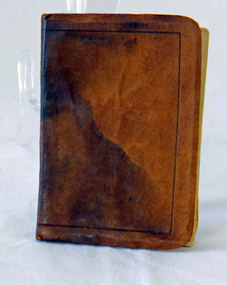
Book - Jennings Carmichael poems, Jennings Carmichael, POEMS by Jennings Carmichael (Mrs Francis Mullis), 1910
... POEMS by Jennings Carmichael (Mrs Francis Mullis)...This small book of POEMS by Jennings Carmichael is one piece of a large number of published works by this poetess and author. ...A small book with a brown leather cover, gold lettering on the spine with the words Jennings Carmichael. ...on the spine: Jennings Carmichael on title page inside: POEMS by Jennings Carmichael (Mrs Francis Mullis)...Jennings Carmichael...POEMS by Jennings Carmichael (Mrs Francis Mullis) Book Jennings Carmichael poems Jennings Carmichael Thomas C. ...This small book of POEMS by Jennings Carmichael is one piece of a large number of published works by this poetess and author. As a child in the 1880s, Jennings Carmichael lived with her mother and step-father on Orbost Station. She witnessed the early development of Orbost township and later wrote about this. She later trained as a nurse in Melbourne and wrote stories and reports about her experiences in this profession. Following her marriage to Francis Mullis, they lived in England where she later died. Jennings Carmichael had 4 sons and a daughter Audrey. Only three of her sons survived to come to Australia. Jennings Carmichael is a significant poetess and author and is well-known and admired. Her early association with Orbost is recognised by the development of a Sensory Gardens on Forest Road, by the Orbost Garden Club in the early 2000s, near where she lived. This small book of POEMS is significant because it represents part of the oeuvre by well-known author and poetess, Grace Jennings Carmichael who lived in the Orbost area as a girl in the 1880s.A small book with a brown leather cover, gold lettering on the spine with the words Jennings Carmichael. on the spine: Jennings Carmichael on title page inside: POEMS by Jennings Carmichael (Mrs Francis Mullis)jennings carmichael, orbost, poems -
 Flagstaff Hill Maritime Museum and Village
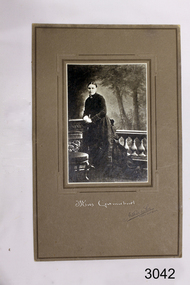
Photograph - Portrait, Arthur & Son, photographers, Miss Carmichael, 1878
... Miss Carmichael...Miss Eva Carmichael, the subject of the photograph, was one of only two survivors from the wreck of the Loch Ard, wrecked on Mutton Bird Island near Port Campbell, Victoria, on June 1st, 1878.....Photographic portrait mounted on brown cardboard of Miss Eva Carmichael. Miss Carmichael is standing near an upholstered chair and rests wth both hands upon a masonry pillar. ...Handwritten in white "Miss Carmichael" Stamped "Arthur & Son / MOUNT GAMBIER"...The photograph holds great significance for its connection to Eva Carmichael, one of two survivors from the wreck of the Loch Ard. ...Miss Eva Carmichael, the subject of the photograph, was one of only two survivors from the wreck of the Loch Ard, wrecked on Mutton Bird Island near Port Campbell, Victoria, on June 1st, 1878..The photograph holds great significance for its connection to Eva Carmichael, one of two survivors from the wreck of the Loch Ard. It is also significant for its connection to the Loch Ard, one of the most tragic shipwrecks in Victoria's coastline and listed on the Historic Shipwreck Register.Photographic portrait mounted on brown cardboard of Miss Eva Carmichael. Miss Carmichael is standing near an upholstered chair and rests wth both hands upon a masonry pillar. Behind her is a balustrade in the classic style common to that period. The background consists of a large tree giving the impression of a garden setting. It was produced at the studio of Arthur & Son, Mount Gambier, 1878. Inscriptions handwritten below the photograph. Handwritten in white "Miss Carmichael" Stamped "Arthur & Son / MOUNT GAMBIER"flagstaff hill, warrnambool, shipwrecked-coast, flagstaff-hill, flagstaff-hill-maritime-museum, maritime-museum, shipwreck-coast, flagstaff-hill-maritime-village, photograph, shipwreck loch ard, eva carmichael, portrait, arthur & son, mount gambier, loch ard, shipwreck, mutton bird island -
 Flagstaff Hill Maritime Museum and Village
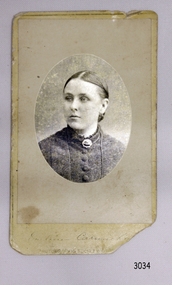
Photograph - Portrait, Miss Eva Carmichael, 24-07-1878
... Miss Eva Carmichael...Eva Carmichael was the daughter of Dr and Mrs Emery Carmichael. ...Photograph, small sepia portrait of Miss Eva Carmichael within an oval matte frame, on card. ...Front, handwritten below photograph: "Miss Eva Carmichael" Reverse, bottom right, handwritten: [3 signatures] Stamped: “PHOTOGRAPHIC / SOCIETY OF VICTORIA / MELBOURNE / REGISTERED COPYRIGHT / JULY 24th 878” and “NONE ARE GENUINE UNLESS WITH / SIGNATURES THUS” and “PRESIDENT / VICE PRESIDENT / - - - - - TARY” Label, handwritten: “F- Ph 56/2 – 74”...Eva Carmichael was the daughter of Dr and Mrs Emery Carmichael. ...Eva Carmichael was the daughter of Dr and Mrs Emery Carmichael. Both her parents, as well as her three sisters and two brothers, were drowned when the Loch Ard was wrecked. Only five bodies were recovered from the wreck, two of these being Miss Carmichael's mother and sister. They were buried on top of the cliff. The only other survivor, Mr Tom Pearce, assisted Miss Carmichael. She was taken to Glenample homestead, where she remained for some time before going to Melbourne. A few months later, she returned to Ireland, where she later married Mr T Townshend. The sailing ship Loch Ard was bound for Melbourne in 1878, loaded with passengers and cargo, when it ran into a rocky reef at the base of Mutton Bird Island, near Port Campbell. Of the 54 crew members and passengers on board, only two survived: an apprentice, Tom Pearce and a young woman passenger, Eva Carmichael, who lost all of her family in the tragedy. The wreck of Loch Ard still lies at the base of Mutton Bird Island, and much of the cargo has been salvaged. Some washed up into what is now known as Loch Ard Gorge following the shipwreck. Cargo and artefacts have also been illegally salvaged over many years before protective legislation was introduced.The photograph is significant for its association with the wreck of the Loch Ard. This wreck has been protected as a Historic Shipwreck since 11 March 1982, under the Commonwealth Historic Shipwrecks Act (1976) Flagstaff Hill’s collection of artefacts from Loch Ard is significant for being one of the largest collections of artefacts from this shipwreck in Victoria. It is significant for its association with the shipwreck, which is on the Victorian Heritage Register. The collection is significant because of the relationship between the objects, as together they have a high potential to interpret the story of the Loch Ard. The Loch Ard collection is archaeologically significant as the remains of a large international passenger and cargo ship. The Loch Ard collection is historically significant for representing aspects of Victoria’s shipping history and its potential to interpret sub-theme 1.5 of Victoria’s Framework of Historical Themes (living with natural processes). The collection is also historically significant for its association with the Loch Ard, which was one of the worst and best known shipwrecks in Victoria’s history. The Loch Ard collection meets the following criteria for assessment: Criterion A: Importance to the course, or pattern, of Victoria’s cultural history. Criterion B: Possession of uncommon, rare or endangered aspects of Victoria’s cultural history. Criterion C: Potential to yield information that will contribute to an understanding of Victoria’s cultural history. Photograph, small sepia portrait of Miss Eva Carmichael within an oval matte frame, on card. Photographed in 1878 in Melbourne by the Photographic Society of Victoria. There is a handwritten inscription below the photograph. The reverse has a stamp, gold maker’s print and a white adhesive label with handwriting on it.Front, handwritten below photograph: "Miss Eva Carmichael" Reverse, bottom right, handwritten: [3 signatures] Stamped: “PHOTOGRAPHIC / SOCIETY OF VICTORIA / MELBOURNE / REGISTERED COPYRIGHT / JULY 24th 878” and “NONE ARE GENUINE UNLESS WITH / SIGNATURES THUS” and “PRESIDENT / VICE PRESIDENT / - - - - - TARY” Label, handwritten: “F- Ph 56/2 – 74”flagstaff hill maritime museum and village, flagstaff hill, warrnambool, maritime museum, shipwreck coast, photograph, miss eva carmichael, loch ard shipwreck, loch ard survivor, photographic society of melbourne, dr and mrs emery carmichael., mr t townshend, mutton bird island, port campbell, tom pearce, 1878 -
 Orbost & District Historical Society
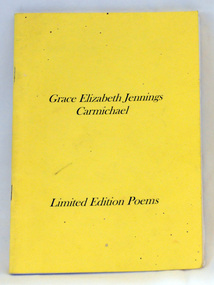
book, Grace Elizabeth Jennings Carmichael
... Grace Elizabeth Jennings Carmichael...Grace Elizabeth Jennings Carmichael (1867-1904), poet and nurse, was born on 24 February 1867 at Ballarat, Victoria, daughter of Archibald Carmichael, a miner from Perthshire, Scotland, and his wife Margaret Jennings, née Clark, from Cornwall, England. . ...It is titled "Grace Elizabeth Jennings Carmichael" and is a limited edition print of Carmichael's poetry. ...It is titled "Grace Elizabeth Jennings Carmichael" and is a limited edition print of Carmichael's poetry. ...This book was produced with a grant from the Victorian Government Dept of State and Regional Development. Grace Elizabeth Jennings Carmichael (1867-1904), poet and nurse, was born on 24 February 1867 at Ballarat, Victoria, daughter of Archibald Carmichael, a miner from Perthshire, Scotland, and his wife Margaret Jennings, née Clark, from Cornwall, England. . About 1880 the family moved to Gippsland where Henderson managed a station near Orbost. Grace learned to love the Gippsland forest. She began to express in verse her understanding of the sights, scents and sounds of the bush, often writing in some remote clearing, her manuscripts stored for privacy in a hollow trunk. The Bairnsdale Advertiser published her first story, and the Weekly Times an early poem; then on 28 November 1885 her poem 'The Old Maid' was published in the Australasian under her pen name Jennings Carmichael. Encouraged by its editor, David Watterston, Grace sent nearly all her subsequent verse to that newspaper. (Read more by Lindsay Gardiner in Australian Dictionary of Biography.)This is a useful collection of the poetry of Jennings Carmichael, a leading Australian poet who spent much of her childhood in Orbost.A thin, stapled, yellow covered paperback book. It is titled "Grace Elizabeth Jennings Carmichael" and is a limited edition print of Carmichael's poetry. Print is black.poetry literature jennings-carmichael -
 Mont De Lancey
Domestic object - Fruit Pitter, D CARMICHAEL, c1920's
... D CARMICHAEL is stamped on the scoop....D CARMICHAEL...Domestic object Fruit Pitter D CARMICHAEL D. CARMICHAEL ...Used by Dianne McIntyre's grandmother c 1910 and possibly by an earlier generation too.Antique wooden handled metal fruit pitter with bevilled edges on both sides of the wedge shaped blade. Usually used for pitting peaches or apricots.D CARMICHAEL is stamped on the scoop.kitchen equipment, domestic equipment -
 Flagstaff Hill Maritime Museum and Village
Newspaper - Newspaper clipping, The Loch Ard : An Epic Wreck : Death of Eva Carmichael, ca. April 1934
... The Loch Ard : An Epic Wreck : Death of Eva Carmichael...Mrs Townshend was the Eva Carmichael who, with the late Tom Pearce, were the only two survivors of the ship Loch Ard, which was wrecked near Port Campbell, on 1st June, 1878 ....”. ...It contains the obituary notice of Eva Carmichael (Townshend), the only female survivor of the LOCH ARD shipwreck in 1878. ...The Loch Ard : An Epic Wreck : Death of Eva Carmichael Newspaper Newspaper clipping T.S. McInnes ...“On the 8th April 1934, at her residence in Bedford, England, Eveline Victoria Townshend, widow of the late Thomas Achilles Townshend, C.E. of County Cork, Ireland, died in her 74th year. Mrs Townshend was the Eva Carmichael who, with the late Tom Pearce, were the only two survivors of the ship Loch Ard, which was wrecked near Port Campbell, on 1st June, 1878 ....”. [Transcription of the article is attached]. Captain Gibbs was master of the Loch Ard, an iron clipper of 1623 tons, which was wrecked on Mutton Bird Island, one mile east of Sherbrook River. The two survivors, Carmichael, a passenger and Pearce, a member of the crew, were washed through the mouth of the gorge, which now bears the name of the ill-fated ship. The impact of the ship was so violent that the deck was torn clean off the hull, which now lies in 70 fathoms of water. (edited version of the same article)The newspaper article is of local, state and national historical significance for its association with the wreck of the sailing ship LOCH ARD, which is now listed on the Victorian Heritage Register S417. The article records an eye witness account of the rescue of the only two survivors from the Loch Ard wreck. A newspaper cutting from the Warrnambool Standard in 1934. It contains the obituary notice of Eva Carmichael (Townshend), the only female survivor of the LOCH ARD shipwreck in 1878. She died on 8 April 1934, a widow in England, in her 74th year. This original newspaper cutting has yellowed and creased with age. The article in the cutting is incomplete. flagstaff hill, warrnambool, shipwrecked-coast, flagstaff-hill, flagstaff-hill-maritime-museum, maritime-museum, shipwreck-coast, flagstaff-hill-maritime-village, warrnambool standard, eva carmichael, loch ard, eveline townshend, tom pearce, eveline victoria townsend, thomas achilles townshend, county cork, ireland, loch ard survivors, port campbell victoria, royal reade, 1-6-1878, w. c. till, eye witness account, george ford, glenample homestead, princetown, gibson, w. shields, mckenzie, robertson, robert strasenburg, loch venacher, robert pearce, tss hobsons bay -
 Stawell Historical Society Inc
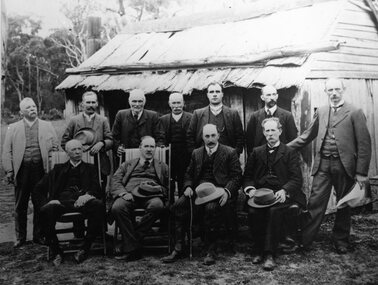
Photograph, Victorian Governer Lord Carmichael & Councillors visit to Borough Huts 1909
... Victorian Governer Lord Carmichael & Councillors visit to Borough Huts 1909...Lord Carmichael Governor and Councillors visit to Borough Huts 1909...Lord Carmichael Governor and Councillors visit to Borough Huts 1909 stawell government Victorian Governer Lord Carmichael & Councillors visit to Borough Huts 1909 Photograph ...Lord Carmichael Governor and Councillors visit to Borough Huts 1909stawell government -
 Ringwood and District Historical Society
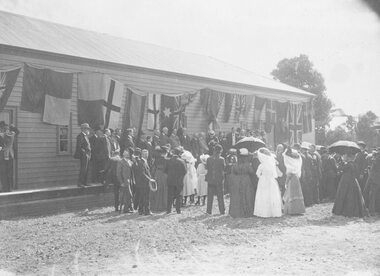
Photograph, Opening of the Ringwood Cool Store by Sir Thomas Gibson Carmichael Governor of Victoria 1911
... Opening of the Ringwood Cool Store by Sir Thomas Gibson Carmichael Governor of Victoria 1911....Written below original photograph: "Opening of the Ringwood Cool Store by Sir Thomas Gibson Carmichael, Governor of Victoria." Written on rear of backing: "Opening of Ringwood Cool Store 17-3-1911 by State Gov. ...Coolstore Written below original photograph: "Opening of the Ringwood Cool Store by Sir Thomas Gibson Carmichael, Governor of Victoria." Written on rear of backing: "Opening of Ringwood Cool Store 17-3-1911 by State Gov. ...Black and white photograph (2 copies- one original mounted on embossed cardboard backing)Written below original photograph: "Opening of the Ringwood Cool Store by Sir Thomas Gibson Carmichael, Governor of Victoria." Written on rear of backing: "Opening of Ringwood Cool Store 17-3-1911 by State Gov. Later a co-op. Corner Main St. and W. Prussia Rd., S.E. corner."coolstore -
 Clunes Museum
Document - REPORT, ABBEY CARMICHAEL, THE HISTORY AND GRADUAL EVOLUTION OF QUEENS PARK CLUNES FROM 1900 TO THE PRESENT DAY, NOVEMBER 2006
... PROJECT BY ABBY CARMICHAEL, A STUDENT IN THE FACULTY OF LAND AND FOOD RESOURCES, UNIVERSITY OF MELBOURNE, NOVEMBER 2006...ABBEY CARMICHAEL...THE HISTORY AND GRADUAL EVOLUTION OF QUEENS PARK CLUNES FROM 1900 TO THE PRESENT DAY Document REPORT ABBEY CARMICHAEL ...PROJECT BY ABBY CARMICHAEL, A STUDENT IN THE FACULTY OF LAND AND FOOD RESOURCES, UNIVERSITY OF MELBOURNE, NOVEMBER 2006THE HISTORY AND GRADUAL EVOLUTION OF QUEENS PARK, CLUNES FROM 1900 TO THE PRESENT DAY, IN A BLACK - BOUND FOLDER.document, local history, queens park -
 Returned Nurses RSL Sub-branch
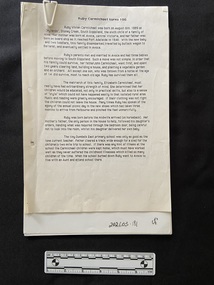
Document - Photocopy of a collection of documents and photographs, Australian Imperial Force, base records office, Ruby Vivien Carmichael, unknown
... Ruby Vivien Carmichael...A biographical collection of papers and photographs relating to Australian Army Nursing Service (AANS) nurse, Ruby Vivian Carmichael, who served during the First World War. ...A biographical collection of papers and photographs relating to Australian Army Nursing Service (AANS) nurse, Ruby Vivian Carmichael, who served during the First World War. ...A biographical collection of papers and photographs relating to Australian Army Nursing Service (AANS) nurse, Ruby Vivian Carmichael, who served during the First World War. It includes a copy of her army record, a short story that was published in the "Leongatha Star" newspaper and copies of ten photographs.A collection of black and white typed and photocopied documents and pages of photographs.army nurses, australian imperial forces, world war 1914-1918, australia. australian army. australian imperial force (1914-1921), australian nurses, wwi, ww1, ships - hospital, hospitals - camp, ww1 living conditions, wedding ceremonies, solonika, karoola hospital ship -
 Flagstaff Hill Maritime Museum and Village
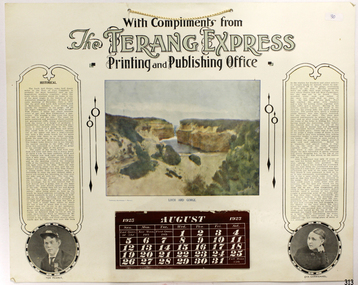
Book - Calendar, Terang Express, The Terang Express: August 1923, Before August 1923
... The calendar has an account of the event of the wreck of the Loch Ard and the only survivors, tom Pearce and Eva Carmichael....Calendar, August 1923, with a coloured picture of Loch Ard Gorge and portraits of Tom Pearce and Eva Carmichael. It includes a brief history of the episode of the wreck of the ship Loch Ard. ..."With Compliments from The Terang Express Printing and Publishing Office" "August 1923" "Historical" "Tom Pearce" "Eva Carmichael"...Flagstaff Hill Flagstaff Hill Maritime Museum and Village Warrnambool Maritime Museum Maritime Village Great Ocean Road Shipwreck Coast calendar August 1923 Loch Ard Gorge Eva Carmichael Tom Pearce Terang Express "With Compliments from The Terang Express Printing and Publishing Office" "August 1923" "Historical" "Tom Pearce" "Eva Carmichael" Calendar, August 1923, with a coloured picture of Loch Ard Gorge and portraits of Tom Pearce and Eva Carmichael. ...The calendar has an account of the event of the wreck of the Loch Ard and the only survivors, tom Pearce and Eva Carmichael.The calendar records the wreck of the Loch Ard, showing that the event was significant locally and thought worthy of publishing on a local calendar. The calendar is significant for its connection to the wreck of the Loch Ard.Calendar, August 1923, with a coloured picture of Loch Ard Gorge and portraits of Tom Pearce and Eva Carmichael. It includes a brief history of the episode of the wreck of the ship Loch Ard. It was printed by Terang Express."With Compliments from The Terang Express Printing and Publishing Office" "August 1923" "Historical" "Tom Pearce" "Eva Carmichael"flagstaff hill, flagstaff hill maritime museum and village, warrnambool, maritime museum, maritime village, great ocean road, shipwreck coast, calendar, august 1923, loch ard gorge, eva carmichael, tom pearce, terang express -
 RMIT Design Archives
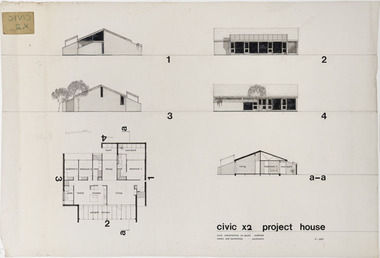
Architectural drawings, Civic x2 Project House
... Robin Cocks (1941- ) and Peter Carmichael (1942 - ) formed their partnership in 1967, and designed some of Australia's most innovative project houses in the late 1960s and early 1970s. ......Carmichael, Peter...Robin Cocks (1941- ) and Peter Carmichael (1942 - ) formed their partnership in 1967, and designed some of Australia's most innovative project houses in the late 1960s and early 1970s. ...Robin Cocks (1941- ) and Peter Carmichael (1942 - ) formed their partnership in 1967, and designed some of Australia's most innovative project houses in the late 1960s and early 1970s. The award winning Civic Growth House (1974) was designed for Civic Construction. It provided clients with a modular grid and a range of components that allowed choice in location and spatial variation. The houses were designed to be expanded as families grew or as finance became available. The one-level Civic X2 was constructed in full-brick, included a pergola and deck, and a private courtyard off the main bedroom, This drawing includes floor plan, elevation and section.architecture, domestic architecture, project homes -
 Flagstaff Hill Maritime Museum and Village
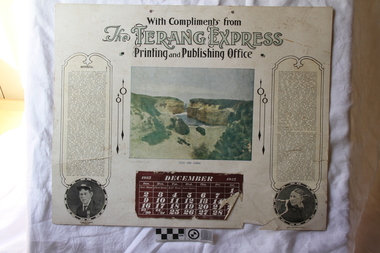
Book - Calendar, Terang Express, The Terang Express: December 1923, 1923
... The calendar has an account of the event of the wreck of the Loch Ard and the only survivors, Tom Pearce and Eva Carmichael. It was printed by the local firm, The Terang Express. ...Calendar printed by Terang Express for December 1923 with a Coloured picture of Loch Ard Gorge and portraits of the survivors of the wreck, Tom Pearce and Eva Carmichael, and a brief story of the episode of the wreck. ..."With Compliments from The Terang Express Printing and Publishing Office" "December1923" "Historical" "Tom Pearce" "Eva Carmichael"...The calendar has an account of the event of the wreck of the Loch Ard and the only survivors, Tom Pearce and Eva Carmichael. It was printed by the local firm, The Terang Express. ...The calendar has an account of the event of the wreck of the Loch Ard and the only survivors, Tom Pearce and Eva Carmichael. It was printed by the local firm, The Terang Express. HISTORY OF THE LOCH ARD: - The LOCH ARD belonged to the famous Loch Line, which sailed many ships from England to Australia. Built in Glasgow by Barclay, Curdle and Co. in 1873, the LOCH ARD was a three-masted square-rigged iron sailing ship. The LOCH ARD made three trips to Australia and one trip to Calcutta before its final voyage. LOCH ARD left England on March 2, 1878, under the command of Captain Gibbs, a newly married, 29-year-old, bound for Melbourne with a crew of 37, plus 17 passengers and a load of cargo. There were items included in the cargo that were intended for display in the Melbourne International Exhibition in 1880. The voyage to Port Phillip was long but uneventful. At 3 am on June 1, 1878, the LOCH ARD was running into a fog that greatly reduced visibility. Captain Gibbs was becoming anxious as there was no sign of land or the Cape Otway lighthouse. The lifteed about an hour later, and the sheer cliffs of Victoria's west coast came into view. Captain Gibbs realised that the ship was much closer to them than expected. Soon after, just half a mile from the coast, the ship's bow was suddenly pulled around by the anchor. The captain tried to tack out to sea, but the ship struck a reef at the base of Mutton Bird Island, near Port Campbell. Waves broke over the ship, and the top deck was loosened from the hull. The masts and rigging came crashing down, knocking passengers and crew overboard. When a lifeboat was finally launched, it crashed into the side of LOCH ARD and capsized. Tom Pearce drifted out to sea and then, on the flood tide, came into what is now known as LOCH ARD Gorge. He swam to shore, bruised and dazed, and found a cave in which to shelter. Eva Carmichael had raced onto the deck to find out what was happening, only to be confronted by towering cliffs looming above the stricken ship. In all the chaos, she was swept into the sea. Eva saw Tom Pearce on a small rocky beach and yelled to attract his attention. He dived in and swam to the exhausted woman and dragged her to shore. He took her to the cave and broke open a case of brandy which had washed up on the beach. He opened a bottle to revive the unconscious woman. Later, Tom scaled a cliff in search of help. He eventually came by chance upon two men from nearby Glenample Station. Eventually, the two shipwreck survivors were taken to Glenample Station to recover. Eva stayed at the station for six weeks before returning to Ireland, this time by steamship. Of the 54 crew members and passengers on board, only two survived: the apprentice, Tom Pearce and the young woman passenger, Eva Carmichael, who lost all of her family in the tragedy.The calendar records the wreck of the Loch Ard, showing that the event was significant locally and thought worthy of publishing on a local calendar. The calendar is significant for its connection to the wreck of the Loch Flagstaff Hill’s collection of artefacts from LOCH ARD is significant for being one of the largest collections of artefacts from this shipwreck in Victoria. It is significant for its association with the shipwreck, which is on the Victorian Heritage Register (VHR S417). The collection is significant because of the relationship between the objects, as together they have a high potential to interpret the story of the LOCH ARD. The LOCH ARD collection is archaeologically significant as the remains of a large international passenger and cargo ship. The LOCH ARD collection is historically significant for representing aspects of Victoria’s shipping history and its potential to interpret sub-theme 1.5 of Victoria’s Framework of Historical Themes (living with natural processes). The collection is also historically significant for its association with the LOCH ARD, which was one of the worst and best known shipwrecks in Victoria’s history. Calendar printed by Terang Express for December 1923 with a Coloured picture of Loch Ard Gorge and portraits of the survivors of the wreck, Tom Pearce and Eva Carmichael, and a brief story of the episode of the wreck. "With Compliments from The Terang Express Printing and Publishing Office" "December1923" "Historical" "Tom Pearce" "Eva Carmichael"flagstaff hill, warrnambool, shipwrecked coast, flagstaff hill maritime museum, maritime museum, shipwreck coast, flagstaff hill maritime village, great ocean road, loch line, loch ard, captain gibbs, eva carmichael, tom pearce, glenample station, mutton bird island, loch ard gorge, calendar, terang express, 1923, 50th anniversary, flagstaff hill maritime museum and village, maritime village, august 1923 -
 Flagstaff Hill Maritime Museum and Village
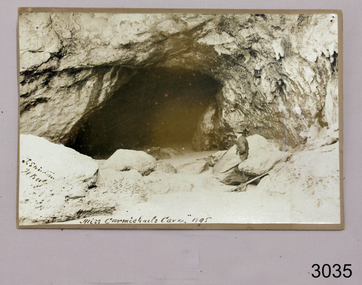
Photograph, March 1895
... Of the 54 crew members and passengers on board, only two survived: an apprentice, Tom Pearce and a young woman passenger, Eva Carmichael, who lost all of her family in the tragedy. ...Photograph of Miss Eva Carmichaels Cave at Loch Ard Gorge where the survivors found shelter. ...Reverse of photograph Hand written in pencil “ … refuge … which he … offer words … Miss Carmichael. He then … on the …“ Hand written in ink “Loch Ard Gorge / Miss Carmichael’s cave” and “ Mr J Swinton / Warrnambool / March 1895” ...He then … on the …“ Hand written in ink “Loch Ard Gorge / Miss Carmichael’s cave” and “ Mr J Swinton / Warrnambool / March 1895” Photograph of Miss Eva Carmichaels Cave at Loch Ard Gorge where the survivors found shelter. ...Loch Ard was bound for Melbourne in 1878 loaded with passengers and cargo when it ran into a rocky reef at the base of Mutton Bird Island, near Port Campbell. Of the 54 crew members and passengers on board, only two survived: an apprentice, Tom Pearce and a young woman passenger, Eva Carmichael, who lost all of her family in the tragedy. The wreck of Loch Ard still lies at the base of Mutton Bird Island and much of the cargo has been salvaged. Some was washed up into what is now known as Loch Ard Gorge following the shipwreck. Cargo and artefacts have also been illegally salvaged over many years before protective legislation was introduced. The photograph is significant for its association with the wreck of the Loch Ard. This wreck has been protected as a Historic Shipwreck since 11 March 1982, under the Commonwealth Historic Shipwrecks Act (1976) Flagstaff Hill’s collection of artefacts from Loch Ard is significant for being one of the largest collections of artefacts from this shipwreck in Victoria. It is significant for its association with the shipwreck, which is on the Victorian Heritage Register. The collection is significant because of the relationship between the objects, as together they have a high potential to interpret the story of the Loch Ard. The Loch Ard collection is archaeologically significant as the remains of a large international passenger and cargo ship. The Loch Ard collection is historically significant for representing aspects of Victoria’s shipping history and its potential to interpret sub-theme 1.5 of Victoria’s Framework of Historical Themes (living with natural processes). The collection is also historically significant for its association with the Loch Ard, which was one of the worst and best known shipwrecks in Victoria’s history. The Loch Ard collection meets the following criteria for assessment: Criterion A: Importance to the course, or pattern, of Victoria’s cultural history. Criterion B: Possession of uncommon, rare or endangered aspects of Victoria’s cultural history. Criterion C: Potential to yield information that will contribute to an understanding of Victoria’s cultural history. Photograph of Miss Eva Carmichaels Cave at Loch Ard Gorge where the survivors found shelter. Reverse has four areas of torn surface, perhaps were photo had been mounted. Hand written text in pencil and in ink.Reverse of photograph Hand written in pencil “ … refuge … which he … offer words … Miss Carmichael. He then … on the …“ Hand written in ink “Loch Ard Gorge / Miss Carmichael’s cave” and “ Mr J Swinton / Warrnambool / March 1895” flagstaff hill, warrnambool, shipwrecked coast, flagstaff hill maritime museum, maritime museum, shipwreck coast, flagstaff hill maritime village, great ocean road, loch line, loch ard, captain gibbs, eva carmichael, tom pearce, glenample station, mutton bird island, loch ard gorge, loch ard shipwreck, 1878 shipwreck, loch ard gorge, miss eva carmichael -
 Orbost & District Historical Society
Literary work - Grace Jennings Carmichael Collection of works, Laughing Jackass Compilations, Jennings Carmichael, Australian Nurse, writer, author, journalist, 1867 - 1904, April 2026
... Jennings Carmichael, Australian Nurse, writer, author, journalist, 1867 - 1904...Jennings Carmichael, Australian Nurse, writer, author, journalist, 1867 - 1904 Literary work Grace Jennings Carmichael Collection of works Laughing Jackass Compilations ...This collection was research and compiled by 'Laughing Jackass Compilations, Bob SleemanThis collection is significant because Grace Jennings Carmichael (1867-1904), the author, was a significant writer and poet and well recognised in Australia literary circles. She spent her early life in the Orbost district. Five spiral bound books with plastic covers, black print, blue lines on a white background.3394:1 Collection 1: Heads of Gold, 8 Poems, 30 x 21 cms. 25pp 3394:2 Collection 2: "Jackasses", 22 Stories, 30 x 21 cms. 27pp 3394:3 Collection 11: First published work, "Through Weal and though Woe", 5 Stories, 30 x 21cms. 96pp 3394:4 Collection 12: Kitty Donnelly; "My Schoolmate", 5 Stories, 30 x 21 cms. 26pp 3394:5 Collection 13: "The Story Teller" Hospital Children, The Journalist, The Sketcher, 78 Stories, 30 x 21 x 3.5 cms. 464ppgrace jennings carmichael, poems, stories -
 Eltham District Historical Society Inc
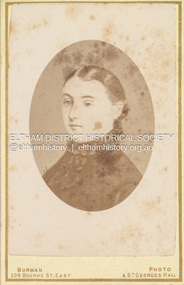
Photograph, W.J. Burman, Eva Carmichael, sole surviving passenger of the wreck of the Loch Ard, 1878
... Eva Carmichael, sole surviving passenger of the wreck of the Loch Ard...Ltd., Berwick, Victoria 1991 Marg Ball Collection 1878 1878-1885 Burman's Photographer 209 Bourke St East and St Georges Hall Melbourne Shillinglaw Family Photo Album 2 Eva Carmichael Loch Ard (Ship) Carte-de-visite (Approx 2 1/2 x 4 1/8 inches or 6.3 x 10.5 cm) Digital file only, scanned from album in private collection Eva Carmichael, sole surviving passenger of the wreck of the Loch Ard Photograph Photograph W.J. ...Special Carte-de-Visite produced by W. Burman, July 3,1878 featuring the sole surviving passenger of the wreck of the ship, Loch Ard near Mutton Bird Island on the Shipwreck Coast of Victoria on June 1st, 1878. THE PHOTOGRAPHIC SOCIETY. (1878, October 12). The Age (Melbourne, Vic. : 1854 - 1954), p. 7. Retrieved December 4, 2022, from http://nla.gov.au/nla.news-article199353573 According to Sands & McDougall Melbourne Directory, Burman's were operating from 209 Bourke St. East and St George's Hall (73 Bourke St. East) from 1879-1885 Back of photo is overtsamped "Registered Copyright by W. Burman, July 3rd 1878" CARTE-DE-VISITE (cdv) 1857-1890 Cartes-de-visite (cdv's) are the most common form of photograph from the nineteenth century, generally measuring two and a half inches by four and an eighth inches (6.3 x 10.5 cm) when mounted, sepia toned, mounted on a card which was generally printed with the photographer's name and address on the back or beneath the portrait. - Frost, Lenore; Dating Family Photos 1850-1920; Valiant Press Pty. Ltd., Berwick, Victoria 1991marg ball collection, 1878, 1878-1885, burman's photographer 209 bourke st east and st georges hall melbourne, shillinglaw family photo album 2, eva carmichael, loch ard (ship) -
 Linton and District Historical Society Inc
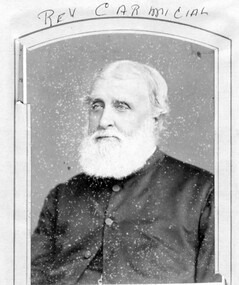
Photograph, Bardwell 21 Collins St East, Melbourne, Reverend Carmichael
... Reverend Carmichael...Part of S E Surman collection (album) page 30. Rev. Carmichael Surman collection John Campbell Carmichael C of E Reader at Carngham 1883 Sepia portrait of an elderly bearded man wearing high necked suit jacket, fob chain. ...Part of S E Surman collection (album) page 30.Sepia portrait of an elderly bearded man wearing high necked suit jacket, fob chain.rev. carmichael, surman collection, john campbell carmichael, c of e reader at carngham, 1883 -
 Flagstaff Hill Maritime Museum and Village
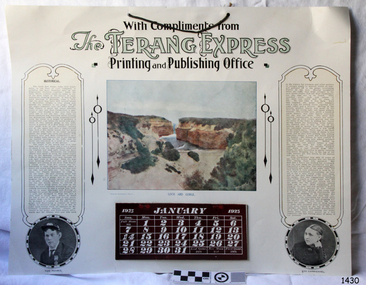
Book - Calendar, T.S. McInnes, The Terang Express: August 1923, 1923
... The calendar has an account of the event of the wreck of the Loch Ard and the only survivors, Tom Pearce and Eva Carmichael. It was printed by the local firm, The Terang Express. ...Calendar printed by Terang Express for August 1923 with a Coloured picture of Loch Ard Gorge and portraits of the survivors of the wreck, Tom Pearce and Eva Carmichael, and a brief story of the episode of the wreck. ..."With Compliments from The Terang Express Printing and Publishing Office" "December1923" "Historical" "Tom Pearce" "Eva Carmichael"...The calendar has an account of the event of the wreck of the Loch Ard and the only survivors, Tom Pearce and Eva Carmichael. It was printed by the local firm, The Terang Express. ...The calendar has an account of the event of the wreck of the Loch Ard and the only survivors, Tom Pearce and Eva Carmichael. It was printed by the local firm, The Terang Express. HISTORY OF THE LOCH ARD: - The LOCH ARD belonged to the famous Loch Line, which sailed many ships from England to Australia. Built in Glasgow by Barclay, Curdle and Co. in 1873, the LOCH ARD was a three-masted square-rigged iron sailing ship. The LOCH ARD made three trips to Australia and one trip to Calcutta before its final voyage. LOCH ARD left England on March 2, 1878, under the command of Captain Gibbs, a newly married, 29-year-old, bound for Melbourne with a crew of 37, plus 17 passengers and a load of cargo. There were items included in the cargo that were intended for display in the Melbourne International Exhibition in 1880. The voyage to Port Phillip was long but uneventful. At 3 am on June 1, 1878, the LOCH ARD was running into a fog that greatly reduced visibility. Captain Gibbs was becoming anxious as there was no sign of land or the Cape Otway lighthouse. The lifteed about an hour later, and the sheer cliffs of Victoria's west coast came into view. Captain Gibbs realised that the ship was much closer to them than expected. Soon after, just half a mile from the coast, the ship's bow was suddenly pulled around by the anchor. The captain tried to tack out to sea, but the ship struck a reef at the base of Mutton Bird Island, near Port Campbell. Waves broke over the ship, and the top deck was loosened from the hull. The masts and rigging came crashing down, knocking passengers and crew overboard. When a lifeboat was finally launched, it crashed into the side of LOCH ARD and capsized. Tom Pearce drifted out to sea and then, on the flood tide, came into what is now known as LOCH ARD Gorge. He swam to shore, bruised and dazed, and found a cave in which to shelter. Eva Carmichael had raced onto the deck to find out what was happening, only to be confronted by towering cliffs looming above the stricken ship. In all the chaos, she was swept into the sea. Eva saw Tom Pearce on a small rocky beach and yelled to attract his attention. He dived in and swam to the exhausted woman and dragged her to shore. He took her to the cave and broke open a case of brandy which had washed up on the beach. He opened a bottle to revive the unconscious woman. Later, Tom scaled a cliff in search of help. He eventually came by chance upon two men from nearby Glenample Station. Eventually, the two shipwreck survivors were taken to Glenample Station to recover. Eva stayed at the station for six weeks before returning to Ireland, this time by steamship. Of the 54 crew members and passengers on board, only two survived: the apprentice, Tom Pearce and the young woman passenger, Eva Carmichael, who lost all of her family in the tragedy.The calendar records the wreck of the Loch Ard, showing that the event was significant locally and thought worthy of publishing on a local calendar. The calendar is significant for its connection to the wreck of the Loch Flagstaff Hill’s collection of artefacts from LOCH ARD is significant for being one of the largest collections of artefacts from this shipwreck in Victoria. It is significant for its association with the shipwreck, which is on the Victorian Heritage Register (VHR S417). The collection is significant because of the relationship between the objects, as together they have a high potential to interpret the story of the LOCH ARD. The LOCH ARD collection is archaeologically significant as the remains of a large international passenger and cargo ship. The LOCH ARD collection is historically significant for representing aspects of Victoria’s shipping history and its potential to interpret sub-theme 1.5 of Victoria’s Framework of Historical Themes (living with natural processes). The collection is also historically significant for its association with the LOCH ARD, which was one of the worst and best known shipwrecks in Victoria’s history.Calendar printed by Terang Express for August 1923 with a Coloured picture of Loch Ard Gorge and portraits of the survivors of the wreck, Tom Pearce and Eva Carmichael, and a brief story of the episode of the wreck. There is a piece of string for hanging the calendar on a wall."With Compliments from The Terang Express Printing and Publishing Office" "December1923" "Historical" "Tom Pearce" "Eva Carmichael"flagstaff hill, warrnambool, shipwrecked coast, flagstaff hill maritime museum, maritime museum, shipwreck coast, flagstaff hill maritime village, great ocean road, loch line, loch ard, captain gibbs, eva carmichael, tom pearce, glenample station, mutton bird island, terang express, calendar, 1923, calendar 1923, printer, newspaper, loch ard gorge, 50th anniversary, flagstaff hill maritime museum and village, maritime village, august 1923 -
![Hardcover book with black and white photo showing a children's ward with nurses in uniform and maroon coloured text. A touching story of the Melbourne Hospital for Sick Children (now the Royal Children's Hospital) [ca.1990] one of the most poignant books of Melbourne's early social history.](/media/collectors/50187a8f023fd7201471f198/items/675bb03784253782337fab7e/item-media/675bb26884253782337fe6df/item-fit-380x285.jpg?cb=6) Alfred Hospital Nurses League - Nursing History Collection
Alfred Hospital Nurses League - Nursing History CollectionBook - Hard cover Book, Grace Jennings Carmichael, Hospital Children: sketches of life and character in the Children's Hospital Melbourne, 1891
... Grace Jennings Carmichael...Hospital Children: sketches of life and character in the Children's Hospital Melbourne Book Hard cover Book Grace Jennings Carmichael George Robertson & Company 1891 Loch Haven Books 1991 Brown Prior Anderson Pty Ltd ...A touching story of the Melbourne Hospital for Sick Children (now the Royal Children's Hospital) [ca.1990] one of the most poignant books of Melbourne's early social history.Book with maroon cover, title, authors name and publisher's mark printed in gilt on spine. Dust jacket has a black and white photo of a children's hospital ward as background, with title and author's name printed in maroon on front and spine.A touching story of the Melbourne Hospital for Sick Children (now the Royal Children's Hospital) [ca.1990] one of the most poignant books of Melbourne's early social history.royal children's hospital (melbourne-vic)-anecdotes, paediatric nursing-victoria-history -
Linton Mechanics Institute and Free Library Collection
Book - Novel, Carmichael, Harry, Death counts three, 1954
... Carmichael, Harry...Fiction Crime Mystery Harry Carmichael The business that took John Piper to novelist Edith Ellerby's country house, Sicklehurst, had nothing to do with murder. ...The business that took John Piper to novelist Edith Ellerby's country house, Sicklehurst, had nothing to do with murder. The shot that Piper heard soon after his arrival had apparently had nothing to do with murder either; he was told that Edith's secretary, Walter Parr, enjoyed shooting rabbits. It was an uneasy party which gathered there and Piper was landed with one of the trickiest problems he had ever encountered - a problem which led to a terrifying conclusion.192p. ; red cover with original dust jacket cut and pasted onto front coverfictionThe business that took John Piper to novelist Edith Ellerby's country house, Sicklehurst, had nothing to do with murder. The shot that Piper heard soon after his arrival had apparently had nothing to do with murder either; he was told that Edith's secretary, Walter Parr, enjoyed shooting rabbits. It was an uneasy party which gathered there and Piper was landed with one of the trickiest problems he had ever encountered - a problem which led to a terrifying conclusion.fiction, crime, mystery, harry carmichael -
 Flagstaff Hill Maritime Museum and Village
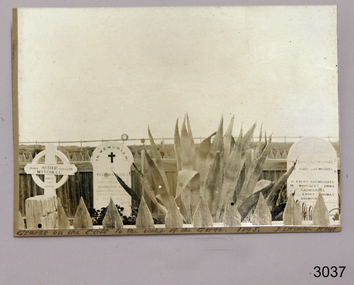
Photograph, March, 1895
... Of the 54 crew members and passengers on board, only two survived: an apprentice, Tom Pearce and a young woman passenger, Eva Carmichael, who lost all of her family in the tragedy. ...Photograph of Loch Ard Gorge graves on hillside, including the Carmichael family, Reginald Jones and Arthur Mitchell Reverse has hand writing in pen and ink, part of details are lost due to photo being trimmed. ...Reverse has hand writing “ … Loch Ard Gorge / Graves of / the Carmichael family / Mr. Reginald Jones / Mr Arthur Mitchell “ and “Mr J Swinton / March 1895”...Of the 54 crew members and passengers on board, only two survived: an apprentice, Tom Pearce and a young woman passenger, Eva Carmichael, who lost all of her family in the tragedy. ...Loch Ard was bound for Melbourne in 1878 loaded with passengers and cargo when it ran into a rocky reef at the base of Mutton Bird Island, near Port Campbell. Of the 54 crew members and passengers on board, only two survived: an apprentice, Tom Pearce and a young woman passenger, Eva Carmichael, who lost all of her family in the tragedy. The wreck of Loch Ard still lies at the base of Mutton Bird Island and much of the cargo has been salvaged. Some was washed up into what is now known as Loch Ard Gorge following the shipwreck. Cargo and artefacts have also been illegally salvaged over many years before protective legislation was introduced. The photograph is significant for its association with the wreck of the Loch Ard. This wreck has been protected as a Historic Shipwreck since 11 March 1982, under the Commonwealth Historic Shipwrecks Act (1976) Flagstaff Hill’s collection of artefacts from Loch Ard is significant for being one of the largest collections of artefacts from this shipwreck in Victoria. It is significant for its association with the shipwreck, which is on the Victorian Heritage Register. The collection is significant because of the relationship between the objects, as together they have a high potential to interpret the story of the Loch Ard. The Loch Ard collection is archaeologically significant as the remains of a large international passenger and cargo ship. The Loch Ard collection is historically significant for representing aspects of Victoria’s shipping history and its potential to interpret sub-theme 1.5 of Victoria’s Framework of Historical Themes (living with natural processes). The collection is also historically significant for its association with the Loch Ard, which was one of the worst and best known shipwrecks in Victoria’s history. The Loch Ard collection meets the following criteria for assessment: Criterion A: Importance to the course, or pattern, of Victoria’s cultural history. Criterion B: Possession of uncommon, rare or endangered aspects of Victoria’s cultural history. Criterion C: Potential to yield information that will contribute to an understanding of Victoria’s cultural history. Photograph of Loch Ard Gorge graves on hillside, including the Carmichael family, Reginald Jones and Arthur Mitchell Reverse has hand writing in pen and ink, part of details are lost due to photo being trimmed. Also has four areas of torn surface, perhaps were photo had been mounted. Reverse has hand writing “ … Loch Ard Gorge / Graves of / the Carmichael family / Mr. Reginald Jones / Mr Arthur Mitchell “ and “Mr J Swinton / March 1895”flagstaff hill, warrnambool, shipwrecked coast, flagstaff hill maritime museum, maritime museum, shipwreck coast, flagstaff hill maritime village, great ocean road, loch line, loch ard, captain gibbs, eva carmichael, tom pearce, glenample station, mutton bird island, loch ard gorge, loch ard shipwreck, carmichael family, arthur mitchell, reginald jones, loch ard gorge graves -
 Orbost & District Historical Society
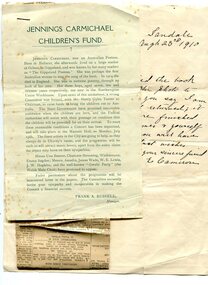
letters, 1910
... Two of Jennings Carmichael's sons were present at the ceremony....James concerning the Jennings Carmichael Children's Fund. Stapled to one letter is a typed article about the Jennings Carmichael Children's Fund written by Frank a. ...Two of Jennings Carmichael's sons were present at the ceremony. ...These letters were received by Henry James of Orbost. Henry James (1860-1932) was a well-known identity in the Orbost district. He was a stock agent and auctioneer who helped to establish the seed bean industry in Orbost. He was the second secretary of the Snowy River Shipping Co. as well as a shire councillor and prominent member of MUIOOF. They concern a fund established to raise money to bring the three sons of Jennings Carmichael to Australia. A committee established by Henry Gyles Turner, a a notable Australian banker and historian, was formed to raise funds to bring the boys to Australia. Grace Elizabeth Jennings Carmichael (1867-1904), poet and nurse, was born on 24 February 1867 at Ballarat, Victoria, daughter of Archibald Carmichael, a miner from Perthshire, Scotland, and his wife Margaret Jennings, née Clark, from Cornwall, England. . She was educated at Melbourne and while still a child went to live on a station at Orbost, and grew up close to the bush she came to love so much. In 1888 she went to Melbourne to be trained as a nurse at the Royal Children's Hospital, Melbourne, and in 1891 published a small volume of prose sketches, Hospital Children. Having qualified she obtained a position on a station near Geelong, and subsequently married Francis Mullis. She contributed verse to the Australasian, and in 1895 Poems by Jennings Carmichael was published. She lived for a time in South Australia and then went to London, where she died in poor circumstances in 1904. Her husband, Henry Mullis, was last recorded in the workhouse in Woolrich, but then disappeared leaving the three children- Geoffrey 7 yrs, (Thomas) Clive 5 yrs & 4 year old (Archibald) Keith and one year old (Rupert) Wyatt, destitute & were sent to the Northampton workhouse, (Thomas ) Clive dying in 1906. In 1910, a group of Carmichael's admirers, discovered the whereabouts of her children, where a public fund was established to bring the children to Australia, the Victorian Government giving them free passage, arriving in Victoria in October of 1910. The children were placed in private homes and took on their mother's single name of Carmichael. In 1910 a small selection of her poems was published, in 1937 a plaque to her memory was unveiled at Orbost in the Mechanics Institute ( reg. 554), and a year later a replica was placed in the public library at Ballarat. Two of Jennings Carmichael's sons were present at the ceremony.Jennings Carmichael, a leading Australian poet spent much of her childhood in Orbost.Several letter written to H. James concerning the Jennings Carmichael Children's Fund. Stapled to one letter is a typed article about the Jennings Carmichael Children's Fund written by Frank a. Russell. The other letter is a three page stapled handwritten letter from St Oswald's, Ormond College, seeking information about Jennings Carmichael.james-henry jennings-carmichael correspondence -
 Orbost & District Historical Society
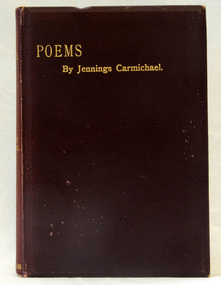
book, Ballantyne, Hanson & Co, Poems, 1895
... Grace Elizabeth Jennings Carmichael (1867-1904), poet and nurse, was born on 24 February 1867 at Ballarat, Victoria, daughter of Archibald Carmichael, a miner from Perthshire, Scotland, and his wife Margaret Jennings, née Clark, from Cornwall, England. . ...A 212 pp cloth bound book with a dark purple cover and gold print on the spine and front - "Poems by Jennings Carmichael"....Grace Elizabeth Jennings Carmichael (1867-1904), poet and nurse, was born on 24 February 1867 at Ballarat, Victoria, daughter of Archibald Carmichael, a miner from Perthshire, Scotland, and his wife Margaret Jennings, née Clark, from Cornwall, England. . ...Grace Elizabeth Jennings Carmichael (1867-1904), poet and nurse, was born on 24 February 1867 at Ballarat, Victoria, daughter of Archibald Carmichael, a miner from Perthshire, Scotland, and his wife Margaret Jennings, née Clark, from Cornwall, England. . About 1880 the family moved to Gippsland where Henderson managed a station near Orbost. Grace learned to love the Gippsland forest. She began to express in verse her understanding of the sights, scents and sounds of the bush, often writing in some remote clearing, her manuscripts stored for privacy in a hollow trunk. The Bairnsdale Advertiser published her first story, and the Weekly Times an early poem; then on 28 November 1885 her poem 'The Old Maid' was published in the Australasian under her pen name Jennings Carmichael. Encouraged by its editor, David Watterston, Grace sent nearly all her subsequent verse to that newspaper. (Read more by Lindsay Gardiner in Australian Dictionary of Biography.) This is a useful collection of the poetry of Jennings Carmichael, a leading Australian poet who spent much of her childhood in Orbost.A 212 pp cloth bound book with a dark purple cover and gold print on the spine and front - "Poems by Jennings Carmichael".Inside cover.carmichael-jennings literature poetry -
 Sunshine and District Historical Society Incorporated
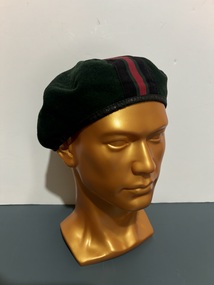
Uniform - Sunshine Technical School - Girl's Beret, Philip Joseph & Son
... Beret worn by a Sunshine Technical School student named Heather Carmichael...Heather Carmichael|Mackay|Form 1A|The Lady Gay Fashioned Beret|Styled by Philip Joseph & Son of Melbourne|Size 22 1/2|Pure Wool...Beret worn by a Sunshine Technical School student named Heather Carmichael Sunshine Technical School Technical School Clothing Heather Carmichael|Mackay|Form 1A|The Lady Gay Fashioned Beret|Styled by Philip Joseph & Son of Melbourne|Size 22 1/2|Pure Wool Green beret with a black, green, and red stripe Uniform Sunshine Technical School - Girl's Beret Philip Joseph & Son ...Beret worn by a Sunshine Technical School student named Heather CarmichaelHeather Carmichael|Mackay|Form 1A|The Lady Gay Fashioned Beret|Styled by Philip Joseph & Son of Melbourne|Size 22 1/2|Pure Woolsunshine technical school, technical school, clothing -
 Orbost & District Historical Society
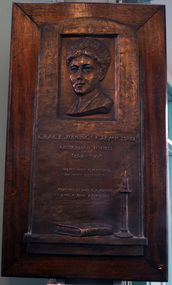
memorial plaque, early 20th Century
... Grace Elizabeth Jennings Carmichael (1867-1904), poet and nurse, was born on 24 February 1867 at Ballarat, Victoria, daughter of Archibald Carmichael, a miner from Perthshire, Scotland, and his wife Margaret Jennings, née Clark, from Cornwall, England. . ...Grace Jennings Carmichael, Australian poetess, 1868-1904, spent her childhood in this district, erected by Mrs G A Hunter & a few admirers....Grace Elizabeth Jennings Carmichael (1867-1904), poet and nurse, was born on 24 February 1867 at Ballarat, Victoria, daughter of Archibald Carmichael, a miner from Perthshire, Scotland, and his wife Margaret Jennings, née Clark, from Cornwall, England. . ...Grace Elizabeth Jennings Carmichael (1867-1904), poet and nurse, was born on 24 February 1867 at Ballarat, Victoria, daughter of Archibald Carmichael, a miner from Perthshire, Scotland, and his wife Margaret Jennings, née Clark, from Cornwall, England. . She was educated at Melbourne and while still a child went to live on a station at Orbost, and grew up close to the bush she came to love so much. In 1888 she went to Melbourne to be trained as a nurse at the Royal Children's Hospital, Melbourne, and in 1891 published a small volume of prose sketches, Hospital Children. Having qualified she obtained a position on a station near Geelong, and subsequently married Francis Mullis. She contributed verse to the Australasian, and in 1895 Poems by Jennings Carmichael was published. She lived for a time in South Australia and then went to London, where she died in poor circumstances in 1904. Her husband, Henry Mullis, was last recorded in the workhouse in Woolrich, but then disappeared leaving the three children- Geoffrey 7 yrs, (Thomas) Clive 5 yrs & 4 year old (Archibald) Keith and one year old (Rupert) Wyatt, destitute & were sent to the Northampton workhouse, (Thomas ) Clive dying in 1906. In 1910, a group of Carmichael's admirers, discovered the whereabouts of her children, where a public fund was established to bring the children to Australia, the Victorian Government giving them free passage, arriving in Victoria in October of 1910. The children were placed in private homes and took on their mother's single name of Carmichael. In the late 1930s, plaques were unveiled in Orbost & Ballarat in honor of Grace Jennings Carmichael. The one in Orbost was part of the "Back To' celebrations. It hung in Mechanics' Institute in Orbost.This is significant to the Orbost region in that it is associated with a woman who is certainly our foremost female poet. A bronze cast memorial plaque set onto a wooden backing board. The plaque has an image of a woman, a candle and a book, and also some text (see below).Grace Jennings Carmichael, Australian poetess, 1868-1904, spent her childhood in this district, erected by Mrs G A Hunter & a few admirers.memorial-plaque grace-jennings-carmichael orbost-poet -
 Flagstaff Hill Maritime Museum and Village
Photograph, late 1800's
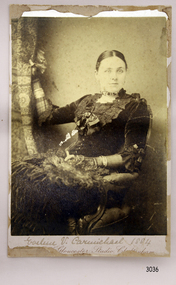
... Miss Eva Carmichael is one of two survivors of the Loch Ard shipwreck.. ...Photograph of Miss Eva Carmichael sitting on a chair holding a curtain. ...Miss Eva Carmichael is one of two survivors of the Loch Ard shipwreck.. ...Miss Eva Carmichael is one of two survivors of the Loch Ard shipwreck.. Loch Ard was bound for Melbourne in 1878 loaded with passengers and cargo when it ran into a rocky reef at the base of Mutton Bird Island, near Port Campbell. Of the 54 crew members and passengers on board, only two survived: an apprentice, Tom Pearce and a young woman passenger, Eva Carmichael, who lost all of her family in the tragedy. The wreck of Loch Ard still lies at the base of Mutton Bird Island and much of the cargo has been salvaged. Some was washed up into what is now known as Loch Ard Gorge following the shipwreck. Cargo and artefacts have also been illegally salvaged over many years before protective legislation was introduced. The photograph is significant for its association with the wreck of the Loch Ard. This wreck has been protected as a Historic Shipwreck since 11 March 1982, under the Commonwealth Historic Shipwrecks Act (1976) Flagstaff Hill’s collection of artefacts from Loch Ard is significant for being one of the largest collections of artefacts from this shipwreck in Victoria. It is significant for its association with the shipwreck, which is on the Victorian Heritage Register. The collection is significant because of the relationship between the objects, as together they have a high potential to interpret the story of the Loch Ard. The Loch Ard collection is archaeologically significant as the remains of a large international passenger and cargo ship. The Loch Ard collection is historically significant for representing aspects of Victoria’s shipping history and its potential to interpret sub-theme 1.5 of Victoria’s Framework of Historical Themes (living with natural processes). The collection is also historically significant for its association with the Loch Ard, which was one of the worst and best known shipwrecks in Victoria’s history. The Loch Ard collection meets the following criteria for assessment: Criterion A: Importance to the course, or pattern, of Victoria’s cultural history. Criterion B: Possession of uncommon, rare or endangered aspects of Victoria’s cultural history. Criterion C: Potential to yield information that will contribute to an understanding of Victoria’s cultural history. Photograph of Miss Eva Carmichael sitting on a chair holding a curtain. Text below photograph is partly unreadable but gives the name of the photographic studio. A printed on the back "County of Gloucester Studio Cheltenham" with the address and other informaion.Reverse has crest that includes “PRIZE MEDALIST PARIS EXHIBIT’N 1867” Printed text “No. …………” “COUNTY OF GLOUCESTER STUDIO / 20a / PROMENADE VILLAS / CHELTENHAM” and “Autotype Prints or Permanent Porcelain enlargements can be made from this plate” flagstaff hill, warrnambool, shipwrecked-coast, flagstaff-hill, flagstaff-hill-maritime-museum, maritime-museum, shipwreck-coast, flagstaff-hill-maritime-village, photograph of miss eva carmichael, eva carmichael, loch ard shipwreck, county of gloucester studio -
 Drysdale RSL Sub-Branch
Flag - Union Jack
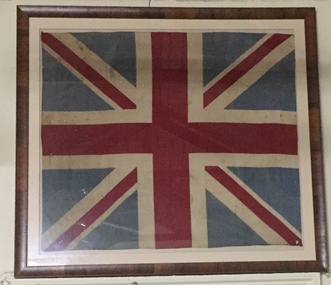
... Square Union Jack souvenired at Gallipoli by James Carmichael Lindsay...Square Union Jack souvenired at Gallipoli by James Carmichael Lindsay Flag Union Jack ...Square Union Jack souvenired at Gallipoli by James Carmichael Lindsay -
 Flagstaff Hill Maritime Museum and Village
Letter
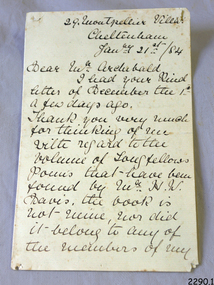
... The author is Eveline V. Carmichael, of 29 Montpellier Villa, Cheltenham. ...The letter is from Eva Carmichael, one of only 2 survivors from that disaster, and is addressed to J. ...The card states: “Photographic copy of the letter written by Eva Carmichael to Mr J Archibald, first Curator of the Warrnambool Museum. ...The author is Eveline V. Carmichael, of 29 Montpellier Villa, Cheltenham. ...This original letter was handwritten and dated 21 January 1884. The author is Eveline V. Carmichael, of 29 Montpellier Villa, Cheltenham. Eva Carmichael was the only woman survivor of the iron clipper LOCH ARD, which was wrecked on 1 June 1878, at the subsequently named Loch Ard Gorge near Port Campbell. The letter was written to Mr J Archibald, first curator of the Warrnambool Mechanics Institute Museum, and was in response to a letter he wrote to Miss Carmichael on 1 December 1883. A complete transcript of Eva’s letter is attached as a Hard Copy Supplementary File. The letter first addressed the subject of her reply. She writes, “Thank you very much for thinking of me with regard to the volume of Longfellows Poems that have been found by Mr HW Davis [at Loch Ard Gorge], the book is not mine, nor did it belong to any members of my family. We had a ‘Longfellows’, but our book had a green cover.” The rescued book is on display at Flagstaff Hill (541) and has a blue cover. Another interesting aspect to her letter is its reference to the only other survivor from the LOCH ARD. As a postscript she writes, “You will be glad to hear that Tom Pearce is now on board the HMS Solvent. I heard from him last month he wrote from the West-Indies and seemed well and in good spirits. I have not seen him since we parted in Melbourne. I believe he is to be married next year, or perhaps this, but I do not know the young lady.” Tom Pearce was the young, male, able seaman who had risked his life to save her. In the months after the shipwreck, an excited public press speculated of a romantic connection between the two survivors, but this was clearly not the case. HISTORY OF THE LOCH ARD The LOCH ARD belonged to the famous Loch Line which sailed many ships from England to Australia. Built in Glasgow by Barclay, Curdle and Co. in 1873, the LOCH ARD was a three-masted square rigged iron sailing ship. The ship measured 262ft 7" (79.87m) in length, 38ft (11.58m) in width, 23ft (7m) in depth and had a gross tonnage of 1693 tons. The LOCH ARD's main mast measured a massive 150ft (45.7m) in height. LOCH ARD made three trips to Australia and one trip to Calcutta before its final voyage. LOCH ARD left England on March 2, 1878, under the command of Captain Gibbs, a newly married, 29 year old. She was bound for Melbourne with a crew of 37, plus 17 passengers and a load of cargo. The general cargo reflected the affluence of Melbourne at the time. On board were straw hats, umbrella, perfumes, clay pipes, pianos, clocks, confectionary, linen and candles, as well as a heavier load of railway irons, cement, lead and copper. There were items included that intended for display in the Melbourne International Exhibition in 1880. The voyage to Port Phillip was long but uneventful. At 3am on June 1, 1878, Captain Gibbs was expecting to see land and the passengers were becoming excited as they prepared to view their new homeland in the early morning. But LOCH ARD was running into a fog which greatly reduced visibility. Captain Gibbs was becoming anxious as there was no sign of land or the Cape Otway lighthouse. At 4am the fog lifted. A man aloft announced that he could see breakers. The sheer cliffs of Victoria's west coast came into view, and Captain Gibbs realised that the ship was much closer to them than expected. He ordered as much sail to be set as time would permit and then attempted to steer the vessel out to sea. On coming head on into the wind, the ship lost momentum, the sails fell limp and LOCH ARD's bow swung back. Gibbs then ordered the anchors to be released in an attempt to hold its position. The anchors sank some 50 fathoms - but did not hold. By this time LOCH ARD was among the breakers and the tall cliffs of Mutton Bird Island rose behind the ship. Just half a mile from the coast, the ship's bow was suddenly pulled around by the anchor. The captain tried to tack out to sea, but the ship struck a reef at the base of Mutton Bird Island, near Port Campbell. Waves broke over the ship and the top deck was loosened from the hull. The masts and rigging came crashing down knocking passengers and crew overboard. When a lifeboat was finally launched, it crashed into the side of LOCH ARD and capsized. Tom Pearce, who had launched the boat, managed to cling to its overturned hull and shelter beneath it. He drifted out to sea and then on the flood tide came into what is now known as LOCH ARD Gorge. He swam to shore, bruised and dazed, and found a cave in which to shelter. Some of the crew stayed below deck to shelter from the falling rigging but drowned when the ship slipped off the reef into deeper water. Eva Carmichael had raced onto deck to find out what was happening only to be confronted by towering cliffs looming above the stricken ship. In all the chaos, Captain Gibbs grabbed Eva and said, "If you are saved Eva, let my dear wife know that I died like a sailor". That was the last Eva Carmichael saw of the captain. She was swept off the ship by a huge wave. Eva saw Tom Pearce on a small rocky beach and yelled to attract his attention. He dived in and swam to the exhausted woman and dragged her to shore. He took her to the cave and broke open case of brandy which had washed up on the beach. He opened a bottle to revive the unconscious woman. A few hours later Tom scaled a cliff in search of help. He followed hoof prints and came by chance upon two men from nearby Glenample Station three and a half miles away. In a state of exhaustion, he told the men of the tragedy. Tom returned to the gorge while the two men rode back to the station to get help. By the time they reached LOCH ARD Gorge, it was cold and dark. The two shipwreck survivors were taken to Glenample Station to recover. Eva stayed at the station for six weeks before returning to Ireland, this time by steamship. In Melbourne, Tom Pearce received a hero's welcome. He was presented with the first gold medal of the Royal Humane Society of Victoria and a £1000 cheque from the Victorian Government. Concerts were performed to honour the young man's bravery and to raise money for those who lost family in the LOCH ARD disaster. Of the 54 crew members and passengers on board, only two survived: the apprentice, Tom Pearce and the young woman passenger, Eva Carmichael, who lost all of her family in the tragedy. Ten days after the LOCH ARD tragedy, salvage rights to the wreck were sold at auction for £2,120. Cargo valued at £3,000 was salvaged and placed on the beach, but most washed back into the sea when another storm developed. The wreck of LOCH ARD still lies at the base of Mutton Bird Island. Much of the cargo has now been salvaged and some was washed up into what is now known as LOCH ARD Gorge. Cargo and artefacts have also been illegally salvaged over many years before protective legislation was introduced. One of the most unlikely pieces of cargo to have survived the shipwreck was a Minton porcelain peacock - one of only nine in the world. The peacock was destined for the Melbourne International Exhibition in 1880. It had been well packed, which gave it adequate protection during the violent storm. Today, the Minton peacock can be seen at the Flagstaff Hill Maritime Museum in Warrnambool. From Australia's most dramatic shipwreck it has now become Australia's most valuable shipwreck artefact and is one of very few 'objects' on the Victorian State Heritage Register. The LOCH ARD shipwreck is of State significance – Victorian Heritage Number S417 Flagstaff Hill’s collection of artefacts from LOCH ARD is significant for being one of the largest collections of artefacts from this shipwreck in Victoria. It is significant for its association with the shipwreck, which is on the Victorian Heritage Register (VHR S417). The collection is significant because of the relationship between the objects, as together they have a high potential to interpret the story of the LOCH ARD. The LOCH ARD collection is archaeologically significant as the remains of a large international passenger and cargo ship. The LOCH ARD collection is historically significant for representing aspects of Victoria’s shipping history and its potential to interpret sub-theme 1.5 of Victoria’s Framework of Historical Themes (living with natural processes). The collection is also historically significant for its association with the LOCH ARD, which was one of the worst and best known shipwrecks in Victoria’s history. A photocopy of a letter, handwritten in ink on both sides of 4 small sheets of thick, light blue paper. The letter is in neat cursive script. The writing originally covered 7 sides of the note paper and has been reproduced as 7 separate pages. It is dated 21 January 1884, five and a half years after the LOCH ARD shipwreck. The letter is from Eva Carmichael, one of only 2 survivors from that disaster, and is addressed to J. Archibald, first curator of the Warrnambool Mechanics Institute Museum. The copies include the reproduction of a typed index card which accompanies the original letter. The card states: “Photographic copy of the letter written by Eva Carmichael to Mr J Archibald, first Curator of the Warrnambool Museum. The original letter is kept with other documents, but the writing being on both sides of the note-paper it was not possible to read in its entireity when on display”.flagstaff hill, warrnambool, shipwrecked coast, flagstaff hill maritime museum, maritime museum, shipwreck coast, flagstaff hill maritime village, great ocean road, loch line, loch ard, captain gibbs, eva carmichael, tom pearce, glenample station, mutton bird island, loch ard gorge, loch ard, survivor’s letter, eva carmichael, longfellow’s poems, warrnambool mechanics institute museum, joseph archibald, henry davis -
 Flagstaff Hill Maritime Museum and Village
Photograph - Portrait, Photographic Society of Victoria, late 19th century
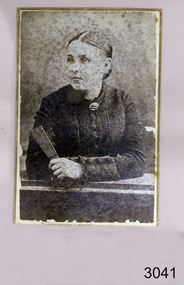
... The portrait is of Miss Eva Carmichael, one of only two survivors of the disastrous wreck of the Loch Ard. ...Photograph, sepia, of Miss Eva Carmichael holding a book, seated at a desk. Oval gilt-framed portrait in a green container edged with gilt. ...The portrait is of Miss Eva Carmichael, one of only two survivors of the disastrous wreck of the Loch Ard. ...The portrait is of Miss Eva Carmichael, one of only two survivors of the disastrous wreck of the Loch Ard. The sailing ship Loch Ard was bound for Melbourne in 1878, loaded with passengers and cargo, when it ran into a rocky reef at the base of Mutton Bird Island, near Port Campbell. Of the 54 crew members and passengers on board, only two survived: an apprentice, Tom Pearce and a young woman passenger, Eva Carmichael, who lost all of her family in the tragedy. The wreck of Loch Ard still lies at the base of Mutton Bird Island, and much of the cargo has been salvaged. Some washed up into what is now known as Loch Ard Gorge following the shipwreck. Cargo and artefacts have also been illegally salvaged over many years before protective legislation was introduced. The photograph is significant for its association with the wreck of the Loch Ard. This wreck has been protected as a Historic Shipwreck since 11 March 1982, under the Commonwealth Historic Shipwrecks Act (1976). Flagstaff Hill’s collection of artefacts from the Loch Ard is significant for being one of the largest collections of artefacts from this shipwreck in Victoria. It is significant for its association with the shipwreck, which is on the Victorian Heritage Register. The collection is significant because of the relationship between the objects, as together they have a high potential to interpret the story of the Loch Ard. The Loch Ard collection is archaeologically significant as the remains of a large international passenger and cargo ship. The Loch Ard collection is historically significant for representing aspects of Victoria’s shipping history and its potential to interpret sub-theme 1.5 of Victoria’s Framework of Historical Themes (living with natural processes). The collection is also historically significant for its association with the Loch Ard, which was one of the worst and best-known shipwrecks in Victoria’s history. The Loch Ard collection meets the following criteria for assessment: Criterion A: Importance to the course, or pattern, of Victoria’s cultural history. Criterion B: Possession of uncommon, rare or endangered aspects of Victoria’s cultural history. Criterion C: Potential to yield information that will contribute to an understanding of Victoria’s cultural history. Photograph, sepia, of Miss Eva Carmichael holding a book, seated at a desk. Oval gilt-framed portrait in a green container edged with gilt. The reverse has a piece of tape centred left and right. Also has printed maker’s information. Printed by the Photographic Society of Victoria, Melbourne.Reverse, printed brown text “PHOTOGRAPHIC / SOCIETY OF VICTORIA / MELBOURNE / REGISTERED COPYRIGHT / JULY 24th 878” and “NONE ARE GENUINE UNLESS WITH / SIGNATURES THUS” and “PRESIDENT / VICE PRESIDENT / SECRETARY” flagstaff hill, warrnambool, shipwrecked-coast, flagstaff-hill, flagstaff-hill-maritime-museum, maritime-museum, shipwreck-coast, flagstaff-hill-maritime-village, loch ard shipwreck, miss eva carmichael, loch ard survivor, photographic society of victoria, melbourne -
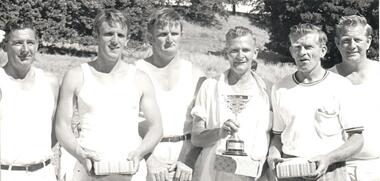 Hume City Civic Collection
Photograph
... ...carmichael...A b/w photograph of a group of 6 males identified as (L to R) Jim Reilly, Bernard Hall, Chris Hall, Ted Carmichael, Ken Morgan, Barry Rowe - the Wood Chop Final Winners - with their trophies - the George Hall Memorial Trophy....reilly jim hall bernard chris carmichael ted morgan ken rowe barry george hall memorial trophy wood chopping sports b. george evans collection Handwritten on back: -REGIONAL - NEEDED AT 6% OFFICE TUESDAY (obviosly details for the photographer specifying the length of the finished photo required. <------36.9 lns----> 79% A b/w photograph of a group of 6 males identified as (L to R) Jim Reilly, Bernard Hall, Chris Hall, Ted Carmichael, Ken Morgan, Barry Rowe - the Wood Chop Final Winners - with their trophies - the George Hall Memorial Trophy. ...A b/w photograph of a group of 6 males identified as (L to R) Jim Reilly, Bernard Hall, Chris Hall, Ted Carmichael, Ken Morgan, Barry Rowe - the Wood Chop Final Winners - with their trophies - the George Hall Memorial Trophy.Handwritten on back: -REGIONAL - NEEDED AT 6% OFFICE TUESDAY (obviosly details for the photographer specifying the length of the finished photo required. <------36.9 lns----> 79%reilly, jim, hall, bernard, chris, carmichael, ted, morgan, ken, rowe, barry, george hall memorial trophy, wood chopping, sports, b., george evans collection
