
Showing 54 items matching "cast-iron weights"
-
 National Wool Museum
Weights
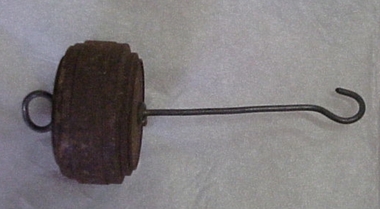
... A cast iron weight, associated with the "Beehive Sock Knitter."...A cast iron weight, associated with the "Beehive Sock Knitter."...A cast iron weight, associated with the "Beehive Sock Knitter." ...A cast iron weight, associated with the "Beehive Sock Knitter."A cast iron weight, associated with the "Beehive Sock Knitter."knitting textile machinery machine knitting, hosiery, knitting, textile machinery, machine knitting -
 National Wool Museum
Weights
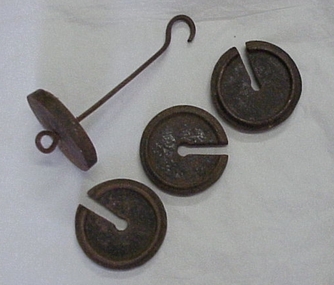
... A four piece set of cast iron weights, associated with the "Beehive Sock Knitter."...A four piece set of cast iron weights, associated with the "Beehive Sock Knitter." ...A four piece set of cast iron weights, associated with the "Beehive Sock Knitter." ...A four piece set of cast iron weights, associated with the "Beehive Sock Knitter."A four piece set of cast iron weights, associated with the "Beehive Sock Knitter." A four piece set of cast iron weights, associated with the "Beehive Sock Knitter."knitting textile machinery machine knitting, hosiery, knitting, textile machinery, machine knitting -
 National Wool Museum
Weights
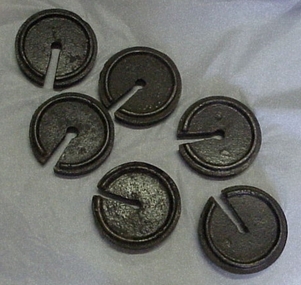
... A six piece set of cast iron weights, associated with the Wertheim "Preciosa" knitting machine....A six piece set of cast iron weights, associated with the Wertheim "Preciosa" knitting machine....A six piece set of cast iron weights, associated with the Wertheim "Preciosa" knitting machine. ...A six piece set of cast iron weights, associated with the Wertheim "Preciosa" knitting machine.A six piece set of cast iron weights, associated with the Wertheim "Preciosa" knitting machine.knitting, jepson, mr keith -
 National Wool Museum
Weights
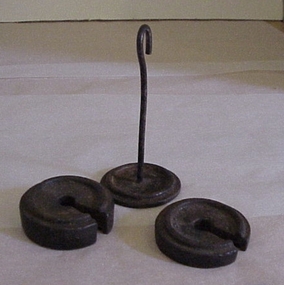
... A three piece set of cast iron weights, associated with the "Beehive" manual benchtop Sock Knitter....A three piece set of cast iron weights, associated with the "Beehive" manual benchtop Sock Knitter....A three piece set of cast iron weights, associated with the "Beehive" manual benchtop Sock Knitter. ...A three piece set of cast iron weights, associated with the "Beehive" manual benchtop Sock Knitter.A three piece set of cast iron weights, associated with the "Beehive" manual benchtop Sock Knitter.knitting textile machinery machine knitting, hosiery, knitting, textile machinery, machine knitting -
 Orbost & District Historical Society
weights
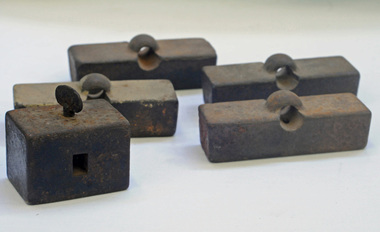
... cast-iron weights...Five rectangular cast iron handled weights - one smaller than the other four. ...Rectangular weights like these were often used with platform scales used for weighing large items or bags. cast-iron weights Five rectangular cast iron handled weights - one smaller than the other four. ...Rectangular weights like these were often used with platform scales used for weighing large items or bags.Five rectangular cast iron handled weights - one smaller than the other four. Each of the larger ones has a moulded ring in the middle of the top. The smallest one is cubic and has a small rectangular recess in the front.On the top is a small oval shape on a stem. cast-iron weights -
 Stawell Historical Society Inc
Memorabilia - Realia, Quantity of Weights used for trade. Shire of Stawell Weights & Measures, 1870's
... Assorted Cast Iron Weights...Stawell Standards Assorted Cast Iron Weights Quantity of Weights used for trade. ...Assorted Cast Iron Weightsstawell, standards -
 Parks Victoria - Point Hicks Lightstation
Weights
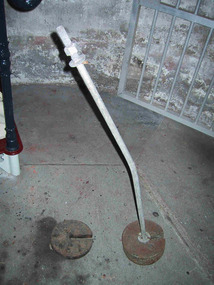
... A small number of heavy cast iron weights and two rods remain at the Point Hicks. ...PHLS0005.1 Round cast iron weight with flat base used for lens clock-work mechanism attached to a bent metal rod. ...A small number of heavy cast iron weights and two rods remain at the Point Hicks. ...A small number of heavy cast iron weights and two rods remain at the Point Hicks. The weights and rods were part of the original clockwork mechanism that was fitted beneath the lens to keep the kerosene-fuelled light turning. They were attached to a cable or chains and moved vertically in similar fashion to the way weights move on grandfather clocks. As the weight fell, the optic clock was driven and the lens was turned. To keep the clock turning, the weight needed to be wound back up to the top of its travel. The cables and weights in this lighthouse were visible as they moved through the length of the tower up to the lantern room. It was usual for systems to move inside a tube extending up to the top, but in this case the tower’s cast iron spiral staircase, which is supported on cantilever cast iron brackets set into the concrete wall, spiralled around the space in which they moved. Lighthouse keepers had the arduous job of having to constantly wind the clock to keep the light active, and at least two keepers needed to observe a strict roster of hours. When electric motors were invented, all of this became redundant and the motors were able to turn the optic for as long as there was power to drive them. In December 1964, the original 1890 Chance Bros kerosene-fuelled light and clockwork mechanism were replaced by small electric motor, and the number of keepers reduced to two. The six circular weights and rods originate from the obsolete system and may have been part of a larger set. Wilsons Promontory retains seven of its original set of ten weights, all of which are detached from the tower’s weight tube. Cape Schanck has a set of fourteen weights remaining in situ as well as another four detached weights, which have inscriptions . One weight is displayed in the lantern room at Cape Otway. The Point Hicks weights have first level contributory significance for the insights they provide into the superseded technology and operations of a late nineteenth century lighthouse. They are well provenanced and are significant for their historic value as part of the lightstation’s Chance Brothers optical system installed in 1890.PHLS0005.1 Round cast iron weight with flat base used for lens clock-work mechanism attached to a bent metal rod. PHLS0005.2 Removable round cast iron weight with flat base used for lens clock-work mechanism stored above the other weight. -
 Kiewa Valley Historical Society
Weights
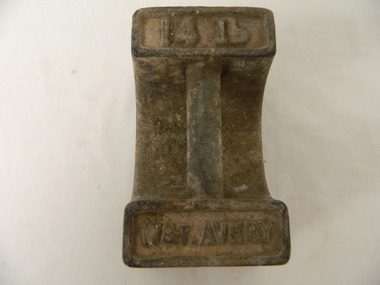
... Cast iron weight with a solid base the upper side curved to form two ends which are joined by a cylindrical handle. ...W & T Avery 14 lb Cast iron weight with a solid base the upper side curved to form two ends which are joined by a cylindrical handle. ...Weight was used on platform type scale to weigh farm produceImperial weights were used prior to 1966 when decimal currency was introduced. Weights were used in stores selling farm produce prior to packaging.Cast iron weight with a solid base the upper side curved to form two ends which are joined by a cylindrical handle. The ends are embossed on the top.W & T Avery 14 lbweights. scale. farms produce. w & t avery. -
 Mont De Lancey
Weights
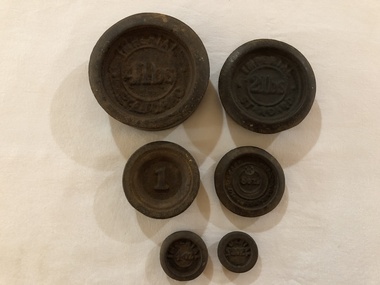
... Set of 6 Imperial measurement, heavy cast iron weights. 6 = 4 lb., 2 lb., 1 lb., 8 oz., 4 oz., and 2 oz....Weights Set of 6 Imperial measurement, heavy cast iron weights. 6 = 4 lb., 2 lb., 1 lb., 8 oz., 4 oz., and 2 oz. ...Set of 6 Imperial measurement, heavy cast iron weights. 6 = 4 lb., 2 lb., 1 lb., 8 oz., 4 oz., and 2 oz.weights -
 Whitehorse Historical Society Inc.
Functional object - Weight - 2 lb
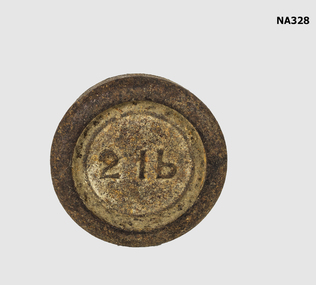
... Cast iron circular weight, with 2 lb embossed on the top...DOMESTIC ITEMS Weighing FOOD TECHNOLOGY Bakery 2 lb on top of weight, B1 underneath weight Cast iron circular weight, with 2 lb embossed on the top Functional object Weight - 2 lb ...Cast iron circular weight, with 2 lb embossed on the top2 lb on top of weight, B1 underneath weightdomestic items, weighing, food technology, bakery -
 Flagstaff Hill Maritime Museum and Village
Functional object - Weight, Jabez & John Whitehouse Phoenix Foundry, Mid 19th to early 20th century
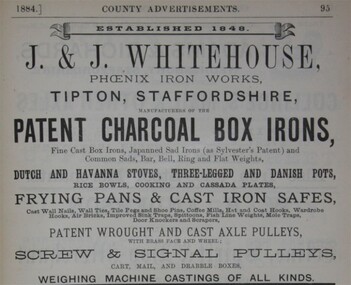
... ...cast iron weight...This cast iron weight was made in England by Jabez and John Whitehouse ironfounders of Tipton and who founded the company in 1848. ...This cast iron weight was made in England by Jabez and John Whitehouse ironfounders of Tipton and who founded the company in 1848. ...This cast iron weight was made in England by Jabez and John Whitehouse ironfounders of Tipton and who founded the company in 1848. J. Whitehouse owned and operated the Phoenix Foundry, in Castle Street, Tipton, Staffordshire, England. The Whitehouse family at the Phoenix Foundry produced cast-iron goods including this weight from the mid 1800s until the early 1900s. John Whitehouse died in 1893.An item made by one of the many ironfounders that operated foundries in the West Midlands of England giving a snapshot into the history of making cast iron objects at a time before plastics and other modern materials when most utilitarian items were made of cast iron by ironfounders.Weight, metal, 14 pound or 1 stone weight with a lifting handle. Three round indentations underneath."Whitehouse" inscribed at one end, "14" at the other flagstaff hill, warrnambool, shipwrecked coast, flagstaff hill maritime museum, maritime museum, flagstaff hill maritime village, great ocean road, weight, stone weight, weights and measures, j & j whitehouse, phoenix foundry, tipton uk, cast iron weight -
 Kiewa Valley Historical Society
Weights - 3 in Set
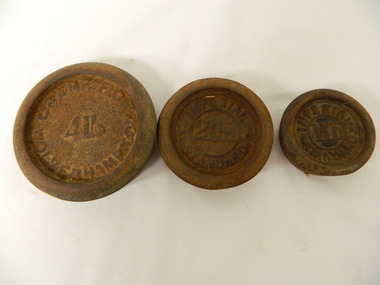
... Solid cast iron brown weights with rim around the circumference. ...Historical: These weights were used prior to decimalisation and prior to packaging of goods. weights. store. shop. scales. 4 lb / Crane F Co. / Wolverhampton 2 lbs / Imperial / Standard 1 lb / Imperial / Standard Solid cast iron brown weights with rim around the circumference. ...These weights were used to measure goods in a shop or farm produce store.Historical: These weights were used prior to decimalisation and prior to packaging of goods.Solid cast iron brown weights with rim around the circumference. Embossed inside the rim at the top with the maker and weight. Slightly narrower at the base.4 lb / Crane F Co. / Wolverhampton 2 lbs / Imperial / Standard 1 lb / Imperial / Standardweights. store. shop. scales. -
 Flagstaff Hill Maritime Museum and Village
Functional object - Weight, Thomas & James Middleton, 1840-1852
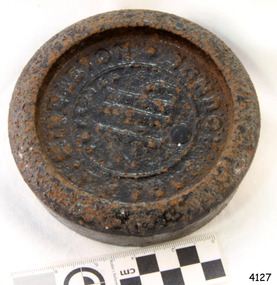
... The foundry had been in production from before 1830 or possibly earlier and had become specialist manufacturers in the Birmingham area by the 1840s making many other cast iron items at the foundry, weights being one. ...Weight cast iron disc black colour...The foundry had been in production from before 1830 or possibly earlier and had become specialist manufacturers in the Birmingham area by the 1840s making many other cast iron items at the foundry, weights being one. An item made in England around 1850-1860 by a renowned company making items various cast iron items at its foundry in Smethwick, Birmingham. flagstaff hill warrnambool shipwrecked-coast flagstaff-hill flagstaff-hill-maritime-museum maritime-museum shipwreck-coast flagstaff-hill-maritime-village 4lb "Middleton" Weight cast iron disc black colour Functional object Weight Thomas & James Middleton ...Thomas and James Middleton owned the Britannia Bedstead Works and were based at the Victoria Iron Foundry in Smethwick’s Rolfe Street Birmingham England. The Britannia Bedstead Works was not a particularly large employer by local standards in 1851 it employed 80 men but it was profitable enough to enable James Middleton and his wife Elizabeth to live in a house in New Street, North Harborne, and to employ a servant. The foundry had been in production from before 1830 or possibly earlier and had become specialist manufacturers in the Birmingham area by the 1840s making many other cast iron items at the foundry, weights being one. An item made in England around 1850-1860 by a renowned company making items various cast iron items at its foundry in Smethwick, Birmingham. Weight cast iron disc black colour4lb "Middleton"flagstaff hill, warrnambool, shipwrecked-coast, flagstaff-hill, flagstaff-hill-maritime-museum, maritime-museum, shipwreck-coast, flagstaff-hill-maritime-village -
 Flagstaff Hill Maritime Museum and Village
Functional object - Weight, Unknown
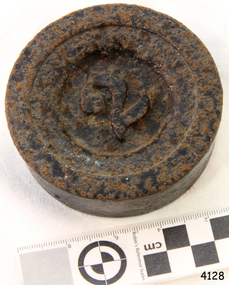
... Weight cast iron disc on-black colour...None available for this item an early disc weight it's maker date of manufacture is not known None available flagstaff hill warrnambool shipwrecked-coast flagstaff-hill flagstaff-hill-maritime-museum maritime-museum shipwreck-coast flagstaff-hill-maritime-village weight Number 2 marked on upper surface Weight cast iron disc on-black colour Functional object Weight ...None available for this item an early disc weight it's maker date of manufacture is not knownNone availableWeight cast iron disc on-black colourNumber 2 marked on upper surfaceflagstaff hill, warrnambool, shipwrecked-coast, flagstaff-hill, flagstaff-hill-maritime-museum, maritime-museum, shipwreck-coast, flagstaff-hill-maritime-village, weight -
 Kiewa Valley Historical Society
Weights - 3 in Set
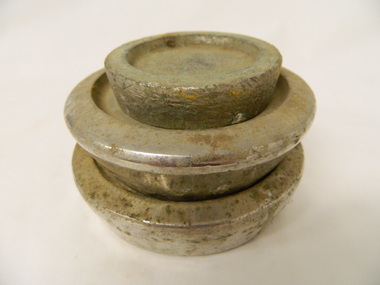
... Cast iron solid circular weights with rim around circumference and slightly narrower at the base....Weights were used to weigh goods prior to packaging. weights. shop. store. scale. Largest - 4 lb Middle - 4 lb (None on smallest) Cast iron solid circular weights with rim around circumference and slightly narrower at the base. ...Used to weigh goods in a shop or farming produce store.Imperial weights were used prior to decimalisation. Weights were used to weigh goods prior to packaging.Cast iron solid circular weights with rim around circumference and slightly narrower at the base.Largest - 4 lb Middle - 4 lb (None on smallest)weights. shop. store. scale. -
 Flagstaff Hill Maritime Museum and Village
Weight
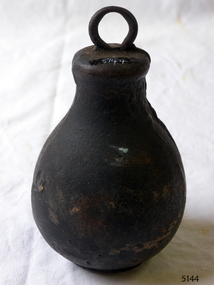
... Black cast iron pear shaped weight for scales. Has ring for attaching to scales. ...flagstaff hill warrnambool shipwrecked-coast flagstaff-hill flagstaff-hill-maritime-museum maritime-museum shipwreck-coast flagstaff-hill-maritime-village Black cast iron pear shaped weight for scales. Has ring for attaching to scales. ...Black cast iron pear shaped weight for scales. Has ring for attaching to scales. Weighs approx 6lb 10onz. Possibly for Steelyard Scales.flagstaff hill, warrnambool, shipwrecked-coast, flagstaff-hill, flagstaff-hill-maritime-museum, maritime-museum, shipwreck-coast, flagstaff-hill-maritime-village -
 Kiewa Valley Historical Society
Weights - 5 in Set
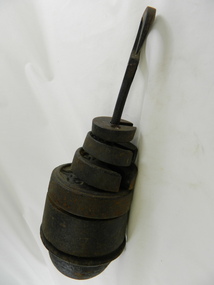
... 5 circular cast iron weights with a slot from the edge towards the centre. ...Weights: 14 lbs; 28 lbs; 56 lbs; 1 cwt; 2 cwt. 5 circular cast iron weights with a slot from the edge towards the centre. ...Used to weigh bulk produce in the Tawonga Store. Part of a platform scale.Historical: Imperial weights used before packaging of goods. Tawonga Store opened c1920 selling produce for the farming community of the Kiewa Valley.5 circular cast iron weights with a slot from the edge towards the centre. Each has a ridge around the circumference to enable each to fit on top of a bigger one. On the top, above the slot, the weight is embossed. The set is held together with a piece of wire about 50 cm long. The set fit on to a holder which has a circular hook for hanging and a long straight cast iron rod going through a solid half sphere which is held with a nut at the base. The half sphere has a wider circular base for weights to sit on. Used with scales (KVHS 0800 (B)) to weigh goods sold at Tawonga Store.Weights: 14 lbs; 28 lbs; 56 lbs; 1 cwt; 2 cwt.weights. scales. shop. store. tawonga store. -
 Kiewa Valley Historical Society
Weights - 2 in Set
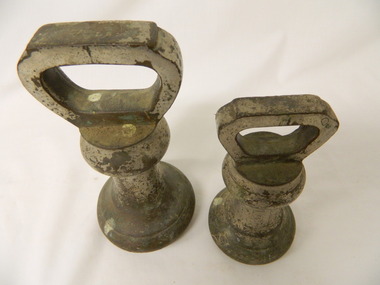
... Cast iron solid bell shaped weight with a handle at the narrow end at the top. ...Imperial weight used to weigh goods prior to packaging. weights. shop. store. scales. Large one has 7 lb inscribed on the handle. Cast iron solid bell shaped weight with a handle at the narrow end at the top. ...Used as a weight to measure goods in a store prior to the introduction of packaging.Imperial weight used to weigh goods prior to packaging.Cast iron solid bell shaped weight with a handle at the narrow end at the top. There is a large one and smaller one.Large one has 7 lb inscribed on the handle.weights. shop. store. scales. -
Clunes Museum
Equipment - BUTCHER SCALES
... OVAL SHAPED AND PAINTED CREAM. .4 ROUND CAST IRON WEIGHT....OVAL SHAPED AND PAINTED CREAM. .4 ROUND CAST IRON WEIGHT. Equipment BUTCHER SCALES ....1 METAL BUTCHER'S SCALES. MANUFACTURED BY THE COMPUTING SCALE CO. DAYTON, O. USA. HAS A CRADLE FOR THE TRAY TO WEIGH ITEMS AND A FLAT SPACE FOR THE WEIGHTS. .2 10 METAL PRICE TAGS WITH SPIKES. EACH TAG IS HEART SHAPED, PAINTED CREAM WITH NUMBERS PAINTED FRONT AND BACK. 1, 1 1/2; 2D, 2 1/2 (2 OF); 3D, 3 1/2 (2 OF); 4D, 4 1/2 (2 OF); 5D, 5 1/2; 7, 7 1/2; 8, 8 1/2. .3 WEIGHING TRAY. OVAL SHAPED AND PAINTED CREAM. .4 ROUND CAST IRON WEIGHT.THE COMPUTING SCALE CO. DAYTON, O. USAcommerce, butcher scales, rod sparks -
 Parks Victoria - Wilsons Promontory Lightstation
Weights
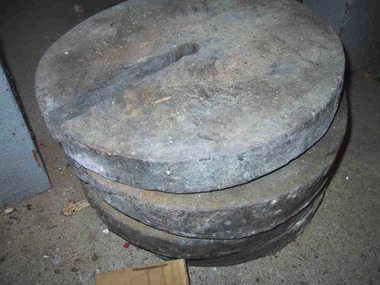
... A small number of detached cast iron weights and two associated rods remain at the Point Hicks Lightstation and one weight is displayed in the lantern room at Cape Otway....A small number of detached cast iron weights and two associated rods remain at the Point Hicks Lightstation and one weight is displayed in the lantern room at Cape Otway. ...The seven weights (0008.4 and 0136.3) are circular in shape with a hole in the centre and a groove cut across the radius. They were specifically designed to fit into a weight tube, which allowed movement of the weights that were used for driving the clockwork mechanism for turning the lighthouse lens. They are most likely original to the Chance Brothers system installed in 1913, which was originally equipped with a set of ten, each weighing around thirty kilograms.The weights were moved vertically in similar fashion to the way weights move on a grandfather clock. As the weight fell, the optic clock was driven and the lens was turned. To keep the clock turning, the weight needed to be wound back up to the top of its travel. Lighthouse keepers had to constantly wind the clock to keep the light active, and at least two keepers needed to observe a strict roster of hours. When electric motors were invented, weights became obsolete and the motors were able to turn the optic for as long as there was power to drive them. Wilsons Promontory’s Chance Bros. kerosene operated light, which was turned by a clockwork mechanism, was replaced by small electric motor in 1975, reducing the number of keepers and eliminating the need for weights. Cape Schanck has a set of fourteen weights remaining in situ in the lighthouse weight tube as well as another four detached weights, two of which may be associated with the 1859 mechanism. A small number of detached cast iron weights and two associated rods remain at the Point Hicks Lightstation and one weight is displayed in the lantern room at Cape Otway.The Wilson Promontory weights have first level contributory significance for the insights they provide into the technology and operations of a late nineteenth/early twentieth century lighthouse which has since been superseded. They are well provenanced and are significant for their historical value as part of the lightstation’s Chance Brothers optical system installed in 1913.Four circular disc shaped lead weights, all with a narrow section cut out to the middle of shape. (as in slice of cake) -
 Wodonga & District Historical Society Inc
Functional object - Imperial Postal Weights used in the Post Office in Wodonga
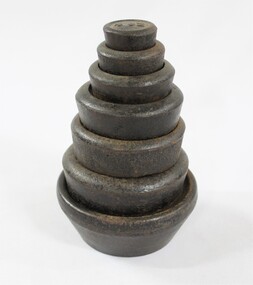
... Set of seven cast iron and lead weights with imperial measurements '4 oz, 8oz, 1 lb, 2 lb, 3 lb, 4 lb, and 7 lb' The exterior circular black painted cast iron encases the heavy inner grey lead component, which is visible from the underside. ...The weights also have national significance as examples of the equipment used in post offices in Australia pre 1966. wodonga post office post office victoria post offices wodonga north eastern victoria post offices victorian mail service "4 oz.", "8 / oz.", 1 lb.", "1 lb.", "2 lb.", "3 lb.", 4 lb.", MERCURY / 7 LB." on the top of the weights in raised numbers and letters. Set of seven cast iron and lead weights with imperial measurements '4 oz, 8oz, 1 lb, 2 lb, 3 lb, 4 lb, and 7 lb' The exterior circular black painted cast iron encases the heavy inner grey lead component, which is visible from the underside. ...The set of seven imperial weights were used in the Post Office in Wodonga. The first Post Office in Wodonga opened on the 6th June 1856, and a second Post Office was built in 1874 on the corner of Sydney Road which became High St. and South St. In 1878 there were three staff at the Wodonga Post Office, including the Postmaster/Telegraph Manager and two Office-Keepers/Messengers. The mail service in 1878 included delivery four times a day from the Railway Station to the Post Office in Wodonga, and to and from the Wodonga Post Office to Albury twice a day.The set of seven imperial weights has local and state significance as it was used in the Wodonga Post Office in North East Victoria before decimal currency was introduced in Australia in 1966. The weights also have national significance as examples of the equipment used in post offices in Australia pre 1966.Set of seven cast iron and lead weights with imperial measurements '4 oz, 8oz, 1 lb, 2 lb, 3 lb, 4 lb, and 7 lb' The exterior circular black painted cast iron encases the heavy inner grey lead component, which is visible from the underside. "4 oz.", "8 / oz.", 1 lb.", "1 lb.", "2 lb.", "3 lb.", 4 lb.", MERCURY / 7 LB." on the top of the weights in raised numbers and letters.wodonga post office, post office, victoria post offices, wodonga, north eastern victoria post offices, victorian mail service -
 Parks Victoria - Point Hicks Lightstation
Weights
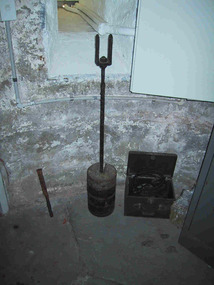
... A small number of heavy cast iron weights and two rods remain at the Point Hicks Lightstation. ...A small number of heavy cast iron weights and two rods remain at the Point Hicks Lightstation. ...A small number of heavy cast iron weights and two rods remain at the Point Hicks Lightstation. These weights comprise one rod with a forked top and four circular weights attached to the bottom of the shaft. The weights and rods were part of the original clockwork mechanism that was fitted beneath the lens to keep the kerosene‐fuelled light turning. They were attached to a cable or chains and moved vertically in similar fashion to the way weights move on grandfather clocks. As the weight fell, the optic clock was driven and the lens was turned. To keep the clock turning, the weight needed to be wound back up to the top of its travel. The cables and weights in this lighthouse were visible as they moved through the length of the tower up to the lantern room. It was usual for systems to move inside a tube extending up to the top, but in this case the tower’s cast iron spiral staircase, which is supported on cantilever cast iron brackets set into the concrete wall, spiralled around the space in which they moved. Lighthouse keepers had the arduous job of having to constantly wind the clock to keep the light active, and at least two keepers needed to observe a strict roster of hours. When electric motors were invented, all of this became redundant and the motors were able to turn the optic for as long as there was power to drive them. In December 1964, the original 1890 Chance Bros kerosene‐fuelled light and clockwork mechanism were replaced by small electric motor, and the number of keepers reduced to two. The six circular weights and rods originate from the obsolete system and may have been part of a larger set. Wilsons Promontory retains seven of its original set of ten weights, all of which are detached from the tower’s weight tube. Cape Schanck has a set of fourteen weights remaining in situ as well as another four detached weights, which have inscriptions. One weight is displayed in the lantern room at Cape Otway. The image shows four of the clockwork weights attached to a rod with a forked top. They were part of the original clockwork mechanism that was fitted beneath the lens to keep the kerosene‐fuelled light turning. The Aldis lamp in its case sits on the floor next to the weights. Source: Parks Victoria.The Point Hicks weights have first level contributory significance for the insights they provide into the superseded technology and operations of a late nineteenth century lighthouse. They are well provenanced and are significant for their historic value as part of the lightstation’s Chance Brothers optical system installed in 1890. Four circular metal weights are stored on a metal rod with a forked section at the top. The weights have a cut out section which allows the weights to be removed easily. -
 Flagstaff Hill Maritime Museum and Village
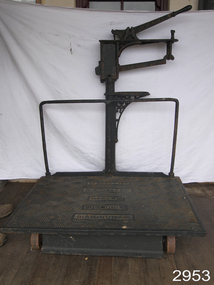
Equipment - Platform Scales
... Large cast iron, scales painted black, weight capacity to 7 CWT (hundred weight). ...cast iron arm on scale, one side "W. & T. AVERY", opposite side "BIRMINGHAM", and into the platform "TO WEIGH 7 CWT, W. & T. AVERY, MAKERS, LONDON & BIRMINGHAM" Platform scales with wheels. Large cast iron, scales painted black, weight ...Large platform scales such as these ones made by W. & T. Avery were used for weighing goods for trading and passengers' luggage. They would be used in places such as railway stations, shipping ports, customs offices and ticketing offices. Often fees would be charged to customers according to the weight of their goods and luggage. Items would be placed onto the large horizontal platform then weights would be added to the weighing bar until the bar leveled to being horizontal. The weights would be added together and the total of the weights would be used for the final figure. These scales were made in Birmingham, England, by the British company, W and T Avery. The company had its origins in the early 1700s but only became known as W and T Avery when the brothers William and Thomas Avery inherited the scale-making business from a relative, Joseph Balden, on his death in 1813. By 1885 they had three factories and In 1895, the company acquired James Watt & Co and two years later had moved to the 25-acre Soho Foundry site in Smethwick, Birmingham where James Watt had manufactured steam engines. When the last Avery family member died in 1918, the company employed over 3,000 people and had businesses all over the world. Following the highly successful introduction of the first digital retail scale in 1971, the company was taken over by the GEC Group in 1979. The business was subsequently acquired by the American company, Weigh-Tronix, in 2000 which had already acquired a competitor, Salter. The Avery name continues today in the company known as Avery Weigh-Tronix.An item that was used at the turn of the century as train platform scales or for weighing agricultural products. Made by a company that pioneered weighing equipment with offices all over the world. With many examples of this scale in museums throughout the world. Platform scales with wheels. Large cast iron, scales painted black, weight capacity to 7 CWT (hundred weight). Weight beam has markers "0. 5. 10. 15. 20. 25". Platform scale loose weight type with relieving handle; cast iron construction, fluted columns with integral weight stand, the two wheels are fitted to base at front of platform; there is a graduated steelyard 0-14bs with pear-shaped poise. Weight carrier is missing.Pressed into cast iron arm on scale, one side "W. & T. AVERY", opposite side "BIRMINGHAM", and into the platform "TO WEIGH 7 CWT, W. & T. AVERY, MAKERS, LONDON & BIRMINGHAM" flagstaff hill, warrnambool, shipwrecked-coast, flagstaff-hill, flagstaff-hill-maritime-museum, maritime-museum, shipwreck-coast, flagstaff-hill-maritime-village, measuring scales, weighing scales, weighing instrument, fees for goods, fees for luggage, ticket office -
 Puffing Billy Railway
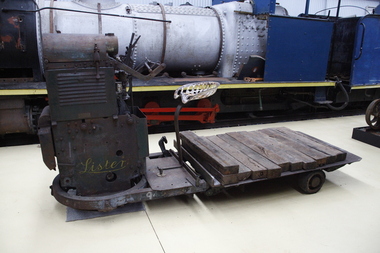
Lister Auto Truck
... Strangely this panel is made of thick cast iron, providing substantial weight high on the engine and only adding to its top heaviness. ...Strangely this panel is made of thick cast iron, providing substantial weight high on the engine and only adding to its top heaviness. ...The Lister Auto-Truck was a small monowheel tractor built for moving light loads around factories, railway yards and similar sites. They were built by R A Lister and Company of Dursley, Gloucestershire, well known for their range of small stationary engines The Auto-Truck was one of several monowheel tractors to appear in the 1920s and '30s, with the availability of small, reliable petrol engines, as developed for motorcycles and the stationary engines for which Lister were already known. These were tricycle vehicles, with the single leading wheel used for both drive and steering. Their simple construction carried most of the mechanism on this wheel as a single unit, the chassis with the trailing wheels being little more than a trailer for balance. Simplicity was a key feature. The engines were single-cylinder and air-cooled. Ignition was by magneto, rather than requiring a battery and electrical system. One of these designs was produced in the 1920s by George Grist of the Auto Mower Co., Norton St Philip, Somerset. The engine was a JAP 600 cc four-stroke air-cooled sidevalve, a typical small engine of the time. The Auto Mower Co. were Lister agents and when Lister heard of this 'Auto-Truck' they bought one for use in their own factory. It was used to carry heavy engine castings from the foundry to the machine shop. Lister customers saw them and there was such interest in wanting to buy them that Lister negotiated with Auto Mower to build them under licence. Although Lister were already well known for their small petrol stationary engines, these were heavy cast-iron engines with water hopper cooling and unsuitable for vehicle use. Lister remained with the JAP engine for the Auto-Truck. The Auto-Truck was designed for use in factories or other places with smooth surfaces of concrete or tarmac. This allowed the use of small solid-tyred wheels with only simple suspension, making the vehicle simple, cheap and lightweight. They had little ability on soft surfaces though and could even topple over if driven carelessly across slopes. Their design was a compromise between the top-heavy nature of the tall engine grouping above its wheel and a well thought-out chassis for stability. The bearing between them was a large diameter ring roller bearing, mounted at the lowest part of the chassis. This gave rigidity and stability, even after long wear. A ring of rolled channel girder was attached to the engine group and rollers on the chassis carried the load upon this. On early Auto-Trucks this bearing is set very low, in line with the chassis members, and is covered by thin steel plates. The front panel of the engine cover is distinctive with large ventilation holes and a Lister signature cut through it. Strangely this panel is made of thick cast iron, providing substantial weight high on the engine and only adding to its top heaviness. To improve visibility of moving vehicles in noisy factories, this panel was often painted white, the rest of the vehicle being Lister's usual brunswick green. The driver was seated on a Brooks bicycle saddle, which in recognition of the lack of vehicle suspension, was carried on the end of a cantilevered bar that acted as a leaf spring. A wide handlebar on the engine group was used for steering. A squeeze bar the width of this handlebar engaged the clutch. Controls included a hand throttle, a gear lever with two forward and one reverse gears, and a large handbrake lever. The engine unit rotated freely for a full 360° rotation. When used in reverse, the Auto-Truck could either be driven from the saddle, looking backwards over the driver's shoulder; or they could dismount, swivel the engine unit around and control it as a pedestrian-controlled truck from behind. Under the engine cover were two equal diameter tanks, a fuel tank for petrol and a shorter oil tank. Engine and chain-drive lubrication used a total-loss oil system, controlled by a small pump and needle valve. Info Ref: Lister Auto-Truck - Wikipedia https://en.wikipedia.org/wiki/Lister_Auto-TruckHistoric - Industrial monowheel tractor for moving light loads around factories, railway yards and similar sites.The Lister Auto-Truck - small monowheel tractor Made of steel with three wheels. Powered by a J.A.P single cylinder petrol motor which is Hand Cranked to start.Lister puffing billy, lister, lister auto truck, monowheel tractor -
 Flagstaff Hill Maritime Museum and Village
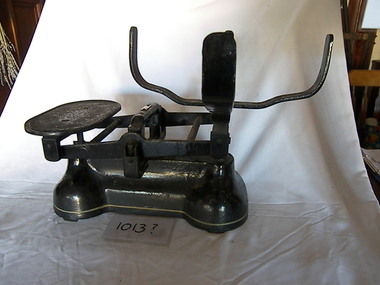
Instrument - Scale, 1900-1930
... weights on each side of the fulcrum have been used by everyone from apothecaries and assayers to jewellers and postal workers. Known as an unequal arm balance scale, this variety builds the counterweight into the device. Counter scales used in dry-goods stores and domestic kitchens often featured Japanned or (blackened) cast iron...Black cast iron, medium weighing scales, with a fulcrum which the beam that balances on, there is a scoop or large bowl at one end for the material to be weighted and a flat platform at the other end that holds the weights. ...Around the cast iron base is an embossed strip weight and bowl missing....This item is significant as it gives a snapshot into domestic life within the average home in Australia around the turn of the twentieth century and is, therefore, an item with social relevance. flagstaff hill warrnambool shipwrecked-coast flagstaff-hill flagstaff-hill-maritime-museum maritime-museum shipwreck-coast flagstaff-hill-maritime-village Around the cast iron base is an embossed strip weight and bowl missing. Black cast iron, medium weighing scales, with a fulcrum which the beam that balances on, there is a scoop or large bowl at one end for the material to be weighted and a flat platform at the other end that holds the weights. ...The basic balance scale has been around for thousands of years and its accuracy has improved dramatically over the last several centuries, the principle behind this tool remains unchanged. Its parts include a fulcrum, a beam that balances on it, a pan at the end of the beam to hold the materials to be weighed, and a flat platform at the other for the counter-balancing weights. Balance scales that require equal weights on each side of the fulcrum have been used by everyone from apothecaries and assayers to jewellers and postal workers. Known as an unequal arm balance scale, this variety builds the counterweight into the device. Counter scales used in dry-goods stores and domestic kitchens often featured Japanned or (blackened) cast iron with bronze trims. Made by companies such as Howe and Fairbanks, the footed tin pans of these scales were often oblong, some encircled at one end so bulk items could be easily poured into a bag. Seamless pans were typically stamped from brass and given style names like Snuff (the smallest) and Birmingham (the largest). Some counter scales were designed for measuring spices, others for weighing slices of cake. In the 18th century, spring scales began to appear and would use the resistance of spring to calculate weights, which are read automatically on the scale’s face. The ease of use of spring scales over balance scales. These scales are significant as they identify one of the basic preparation items for the weighing of foodstuff in the family kitchen to prepare everyday meals. This item is significant as it gives a snapshot into domestic life within the average home in Australia around the turn of the twentieth century and is, therefore, an item with social relevance. Black cast iron, medium weighing scales, with a fulcrum which the beam that balances on, there is a scoop or large bowl at one end for the material to be weighted and a flat platform at the other end that holds the weights. Around the cast iron base is an embossed strip weight and bowl missing.flagstaff hill, warrnambool, shipwrecked-coast, flagstaff-hill, flagstaff-hill-maritime-museum, maritime-museum, shipwreck-coast, flagstaff-hill-maritime-village -
 Flagstaff Hill Maritime Museum and Village
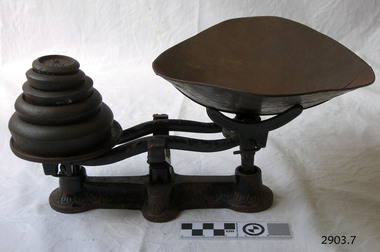
Instrument - Scale, Early 20th century
... weights on each side of the fulcrum have been used by everyone from apothecaries and assayers to jewellers and postal workers. Known as an unequal arm balance scale, this variety builds the counterweight into the device. Counter scales used in dry-goods stores and domestic kitchens often featured Japanned or (blackened) cast iron...Black cast iron, medium weighing scales, with a fulcrum which the beam that balances on, there is as scoop at one end for the material to be weighted and a flat circular disc at the other end that holds the weights. ...Black cast iron, medium weighing scales, with a fulcrum which the beam that balances on, there is as scoop at one end for the material to be weighted and a flat circular disc at the other end that holds the weights. ...The basic balance scale has been around for thousands of years and its accuracy has improved dramatically over the last several centuries, the principle behind this tool remains unchanged. Its parts include a fulcrum, a beam that balances on it, a pan at the end of the beam to hold the materials to be weighed, and a flat platform at the other for the counter-balancing weights. Balance scales that require equal weights on each side of the fulcrum have been used by everyone from apothecaries and assayers to jewellers and postal workers. Known as an unequal arm balance scale, this variety builds the counterweight into the device. Counter scales used in dry-goods stores and domestic kitchens often featured Japanned or (blackened) cast iron with bronze trims. Made by companies such as Howe and Fairbanks, the footed tin pans of these scales were often oblong, some encircled at one end so bulk items could be easily poured into a bag. Seamless pans were typically stamped from brass and given style names like Snuff (the smallest) and Birmingham (the largest). Some counter scales were designed for measuring spices, others for weighing slices of cake. In the 18th century, spring scales began to appear and would use the resistance of spring to calculate weights, which are read automatically on the scale’s face. The ease of use of spring scales over balance scales. One of the most common types of spring scales was the kitchen scale also known as a family or dial scale. Designed for horizontal surfaces, these vintage kitchen scales used the weight of goods in a pan at the top of the scale to force the spring down rather than the balance system. Such scales were common in early 20th century households and were sold by many companies. Many had flat weighing surfaces but some were topped by shallow pans. Companies such as Salters, Chatillon, and Fairbanks were the most popular brands used. These scales are significant as they identify one of the basic preparation items for the weighing of foodstuff in the family kitchen to prepare everyday meals. This item is significant as it gives a snapshot into domestic life within the average home in Australia around the turn of the twentieth century and is, therefore, an item with social relevance. Black cast iron, medium weighing scales, with a fulcrum which the beam that balances on, there is as scoop at one end for the material to be weighted and a flat circular disc at the other end that holds the weights. Around the cast iron base is an embossed leaf pattern. All the weights have their weight embossed within the casting.There are 5 weights, marked 2 oz, 4 oz,8 oz,1 lb,2 lb, This scale does not have any visual markings on the arms to identify a maker or true balance. It is therefore assumed that these scales were made for domestic use only.flagstaff hill, warrnambool, shipwrecked-coast, flagstaff-hill, flagstaff-hill-maritime-museum, maritime-museum, shipwreck-coast, flagstaff-hill-maritime-village, spring scale, scale -
 Flagstaff Hill Maritime Museum and Village
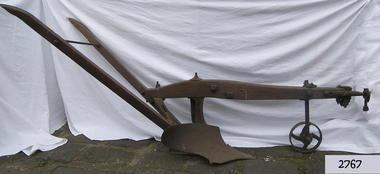
Tool - Plough, Syracuse Chilled Plow Co, 1876-1900
... weight and was adapted to work sandy or light loamy soil. This plough has a sloping landside, which tends to keep the clods and dirt from falling into the furrow, making the ploughman's work much more comfortable and easy. This design was made in eight sizes for both right and left-handed ploughing and became very popular in the far West and South of the USA. Note: The definition of a chill plough means : a plough having the share and mould-board of chilled semi steel or cast iron...weight and was adapted to work sandy or light loamy soil. This plough has a sloping landside, which tends to keep the clods and dirt from falling into the furrow, making the ploughman's work much more comfortable and easy. This design was made in eight sizes for both right and left-handed ploughing and became very popular in the far West and South of the USA. Note: The definition of a chill plough means : a plough having the share and mould-board of chilled semi steel or cast iron ...The Syracuse Chilled Plough Company was created in 1876 and specialised in the manufacture of agricultural ploughs. Harry Wiard invented the chilling process in plough manufacture. The company was originally founded as the Robinson Chilled Plough Company in 1876 and changed its name 3 years later. At its peak, in the early 20th century. The company made more than 100,000 horse-drawn ploughs and road scrapers of various designs that were sold from the Syracuse plant each year and exported around the world. The company slogan of the day was, “The sun never sets on a Syracuse plough." Eventually, other farming implements were added to the line. The company employed more than 300 people in its local plant, which covered a square block on the cities Near West Side. In 1910-11, Deere and Company began expanding its holdings, and with the success of the Syracuse Chilled Plough Company, Deere sought to acquire the company. The management of the Syracuse operation after John Deere took over remained in the hands of Wiard and Chase, and the manufacturing operations were left in Syracuse. The only change from previous Syracuse operations was the selling of the companies products through Deere retail outlets instead of directly to the trade. The factory in Syracuse continued to produce ploughs until 1955. The subject item in the Flagstaff collection is an early model Syracuse Chilled plough with a wooden beam frame it is very much lighter in weight and was adapted to work sandy or light loamy soil. This plough has a sloping landside, which tends to keep the clods and dirt from falling into the furrow, making the ploughman's work much more comfortable and easy. This design was made in eight sizes for both right and left-handed ploughing and became very popular in the far West and South of the USA. Note: The definition of a chill plough means : a plough having the share and mould-board of chilled semi steel or cast iron.The subject item is believed to be a very early plough given its wooden beam frame and was made before 1900 probably around 1880. This makes it a significant example of the types of plough that early settlers were using in Victoria. There would not be very many of this type of vintage plough left with a wooden beam and frame, making it today a desirable collector's item. Syracuse Wood Beam Chilled single furrow plough metal wheel in front. Syracuse Chiller Co Syracuse & 50 L stamped on ploughshare.flagstaff hill, warrnambool, shipwrecked-coast, flagstaff-hill, flagstaff-hill-maritime-museum, maritime-museum, shipwreck-coast, flagstaff-hill-maritime-village, plough, syracuse chiller co, chiller plourh, farm equipment, furrow -
 Flagstaff Hill Maritime Museum and Village
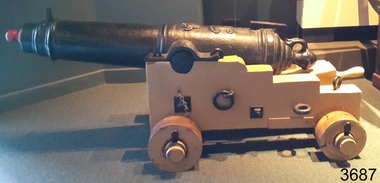
Weapon - Carronade, 1840
... cast during Queen Victoria's reign / 1840 & 4-2-0 denoting the weight of the barrel. Right hand trunnion has a serial number “8708”. Also on top of the barrel is the British "Board of Ordinance" identifying mark a broad arrow indicating the carronade was in military use. Carronade firing a 6 lb cast iron ...The carronade was designed as a short-range naval weapon with a low muzzle velocity for merchant ships, but it also found a niche role on warships. It was produced by the Carron Iron Works and was at first sold as a complete system with the gun, mounting, and shot altogether. Carronades initially became popular on British merchant ships during the American Revolutionary War. A lightweight gun that needed only a small gun crew and was devastating at short range was well suited to defending merchant ships against French and American privateers. The invention of the cannon is variously attributed to Lieutenant General Robert Melville in 1759, or to Charles Gascoigne, manager of the Carron Company from 1769 to 1779. In its early years, the weapon was sometimes called a "mellvinade" or a "gasconade". The carronade can be seen as the culmination of a development of naval guns reducing the barrel length and thereby the gunpowder charge. The Carron Company was already selling a "new light-constructed" gun, two-thirds of the weight of the standard naval gun and charged with one-sixth of the weight of the ball in powder before it introduced the carronade, which further halved the gunpowder charge. The theory of its design was to use less powder and had other advantages that were advertised in the company's sales pamphlet of the time, state. The smaller gunpowder charge reduced the barrel heating in action, also reduced the recoil. The mounting, attached to the side of the ship on a pivot, took the recoil on a slider, without altering the alignment of the gun. The pamphlet advocated the use of woollen cartridges, which eliminated the need for wadding and worming, although they were more expensive. Carronades also simplified gunnery for comparatively untrained merchant seamen in both aiming and reloading that was part of the rationale for adopting the gun. Other advantages promoted by the company were. The replacement of trunnions by a bolt underneath, to connect the gun to the mounting, reduced the width of the carriage that enhanced the wide angle of fire. A merchant ship would almost always be running away from an enemy, so a wide-angle of fire was much more important than on a warship. A carronade weighed a quarter as much as a standard cannon and used a quarter to a third of the gunpowder charge. This reduced charge allowed Carronades to have a shorter length and much lighter weight than long guns. Increasing the size of the bore and ball reduces the required length of the barrel. The force acting on the ball is proportional to the square of the diameter, while the mass of the ball rises by the cube, so acceleration is slower; thus, the barrel can be shorter and therefore lighter. Long guns were also much heavier than Carronades because they were over-specified to be capable of being double-shotted, (to load cannons with twice the shot, for increased damage at the expense of range), whereas it was dangerous to do this in a carronade. A ship could carry more carronades, or carronades of a larger calibre, than long guns, and carronades could be mounted on the upper decks, where heavy long guns could cause the ship to be top-heavy and unstable. Carronades also required a smaller gun crew, which was very important for merchant ships, and they were faster to reload. The small bore carronade and carriage is part of a collection of nineteenth Century Flagstaff Hill Guns and Cannon, which is classified as being of significance and was made a few years after the beginning of Queen Victoria's reign in 1837 and fires a 6 lb pound cannon ball. This nineteenth century artillery piece is a rare and representative item of artillery of this era, used predominately on ships, both military and merchant. The artillery piece, individually and as part of the collection, is highly significant for its historical, scientific and aesthetic reasons at the state, national and world level. This carronade represents the methods of artillery technology, its advancement and its modifications to suit dangerous situations that sailors encountered from attacks from free booters (pirates, living from plunder) or others at the time. Carronade firing a 6 lb cast iron ball, with a smooth bore barrel 6.5 cm in dia the item is mounted on stepped wooden carriage with wooden wheels. Cannon barrel can have its elevation adjusted via a wooden wedge. Gun carriage has loops for locating and holding in position to a deck by ropes. Carriage is a replica made 1982Cast into the barrel is the royal emblem of Queen Victoria (VR "Victoria Regina") indicating the carronade was cast during Queen Victoria's reign / 1840 & 4-2-0 denoting the weight of the barrel. Right hand trunnion has a serial number “8708”. Also on top of the barrel is the British "Board of Ordinance" identifying mark a broad arrow indicating the carronade was in military use. flagstaff hill, warrnambool, shipwrecked coast, flagstaff hill maritime museum, maritime museum, shipwreck coast, flagstaff hill maritime village, great ocean road, colonial defences, victoria’s coastal defences, warrnambool fortification, warrnambool garrison battery, warrnambool volunteer corps, ordinance, armaments, garrison gun, smooth bore cannon, carronade, black powder, 12 pounder, 1840, artillery, lieutenant general robert melville, charles gascoigne, carron company, mellvinade, gasconade -
 Flagstaff Hill Maritime Museum and Village
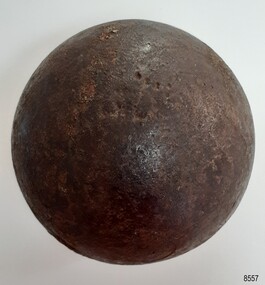
Weapon - Cannon Ball, Victorian era
... cast cannon ball Remnants of an indecipherable stamp and / or red text. Cannon ball, iron, black with a pitted shiny surface. It has three flat areas and evidence of a seam around the circumference. There are remnants of a possible inscription stamped into the iron. The cannon ball is a four-pounder ball. Imperial weight ...This small cannon ball was found by the donor around 1975 to 1977 when he was digging a trench to install underground cables at the Warrnambool Surfside Caravan Park' Its location is just below both Cannon Hill and the 19th century Fortifications at Flagstaff Hill Maritime Museum and Village. The ball is made of iron. Cannon balls were used as ammunition for a cannon gun and fired at a target. This cannon ball is only 8 cm round, or 4.15 inches, and is likely to have been called a 4-pounder (4-pdr). The ball was made from molten iron was poured into the small opening of a two-piece mould. The seam between the moulds sometimes left a raised ring mark on the ball, as can be seen on this ball. The ridge would have been filed to make the join smooth, sometimes leaving a slightly flat area. Six 4-powder cannons were recovered from Endeavour Reef, Queensland, in 1969. They were from Captain Cook's HMS Endeavour, thrown overboard when the ship struck a reef there in 1770. They are likely to have been mounted on deck cannon carriages on the ship. Similar 4-pounder cannons were mounted on gun carriages and used as field guns. Cannons with cannon balls as ammunition were installed at Warrnambool for protection from possible invasion in the mid-to-late 19th century and early 20th century.Cannon ball, iron, black with a pitted shiny surface. It has three flat areas and evidence of a seam around the circumference. There are remnants of a possible inscription stamped into the iron. The cannon ball is a four-pounder ball. Imperial weight is 71 oz (201.3 gms or 4.44 pounds).Remnants of an indecipherable stamp and / or red text.flagstaff hill, flagstaff hill maritime museum and village, warrnambool, maritime museum, maritime village, great ocean road, shipwreck coast, cannon ball, ammunition, cannon, fortifications, military equipment, firearm, weapon, two-piece mould, seam line, four-pounder, 4-pounder, field gun, field ammunition, gun carriage, cast cannon ball -
Greensborough Historical Society
Scales, Kitchen scales, 1900c
... Domestic kitchen balance scales used to measure ingredients, made of cast iron, they would have a tray for ingredients and graduated weights....Domestic kitchen balance scales used to measure ingredients, made of cast iron, they would have a tray for ingredients and graduated weights. kitchen scales scales balances Kitchen scales, to weigh 4 lbs, with weights of 1 lb and 4 oz. ...Domestic kitchen balance scales used to measure ingredients, made of cast iron, they would have a tray for ingredients and graduated weights.Kitchen scales, to weigh 4 lbs, with weights of 1 lb and 4 oz.kitchen scales, scales, balances
