
Showing 34 items matching "centenary decorations"
-
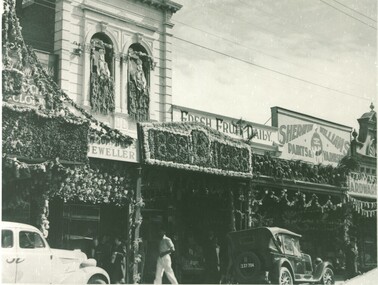 Ballaarat Mechanics' Institute (BMI Ballarat)
Centenary Decorations, 1938
... Centenary Decorations, 1938...Ballarat centenary Centenary Decorations, 1938 ...This photograph is from the Max Harris Collection held by the Ballaraat Mechanics' Institute. Please contact BMI for all print and usage inquiries.ballarat, centenary -
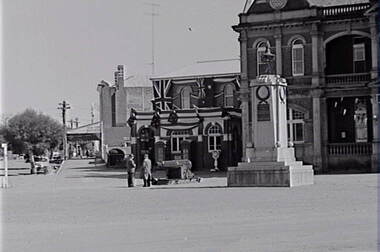 Allan Doney Collection, Bendigo Historical Society Inc.
Negative - Eaglehawk - Town Hall - Centenary Decorations - Monument, Allan Doney, 1950 -1970
... Eaglehawk - Town Hall - Centenary Decorations - Monument...Negative Eaglehawk - Town Hall - Centenary Decorations - Monument Allan Doney ...In the years of Allan Doney’s photography, landmark buildings succumbed to fire, neglect and redevelopment. He photographed the grey sand hills from Bendigo’s mining past, the streetscapes, poppet heads, miners’ cottages, gracious homes with ornate verandahs, trams and much more. Above all, his photographs show how much of the city has survived from the 19th century – and how much has not. Through two decades of great change, Allan Doney was there to capture ways people interacted with it. Although he travelled to many other places in Northern Victoria and beyond in search of subjects for his art, he seemed to always return to Bendigo for inspiration. -
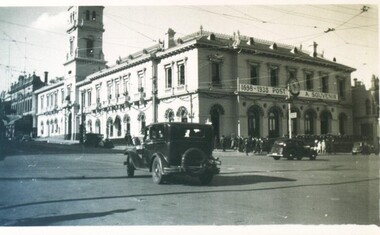 Federation University Historical Collection
Photograph, Ballarat Photographs
... ...centenary decorations...Ballarat centenary decorations Camp Street sturt street academy of art former ballarat library former wesley church Lydiard Street south Ten black and white photographs of Ballarat Central Ballarat Photographs Photograph ...Ten black and white photographs of Ballarat Centralballarat, centenary decorations, camp street, sturt street, academy of art, former ballarat library, former wesley church, lydiard street south -
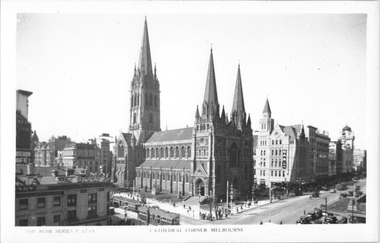 Melbourne Tram Museum
Postcard, Rose Stereograph Co, "Cathedral Corner Melboune", 1934
... In the photo are the Melbourne Centenary "Lollypop" street decorations of 1934...In the photo are the Melbourne Centenary "Lollypop" street decorations of 1934 Yields information St Paul's Cathedral and the Melbourne Centenary in 1934. ...Rose Series postcard P.4748, titled "Cathedral Corner Melbourne". There are two W2 class tramcars in Swanston St. In the photo are the Melbourne Centenary "Lollypop" street decorations of 1934Yields information St Paul's Cathedral and the Melbourne Centenary in 1934.Postcard - printed real photograph with Rose Stereograph Co. name on the rear. Two copies held. Second copy has been used for a letter. Also has the Ken Magor stamp on the rear.st pauls cathedral, swanston st, flinders st, melbourne centenary, trams, tramways, w2 class, rose series -
 Melbourne Tram Museum
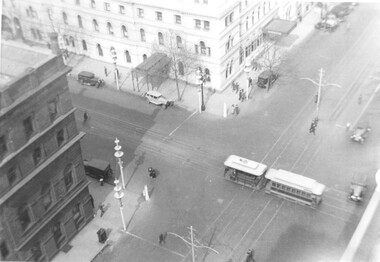
Photograph, Menzies Hotel and the Goldsborough & Mort Woolstore with a cable tram crossing William Street in Bourke Street, c1937
... Also in the photo are the Melbourne Centenary "Lollypop" street decorations of 1934. The photo appears to be taken from the roof of the Shell Building in William Street. ...Also in the photo are the Melbourne Centenary "Lollypop" street decorations of 1934. The photo appears to be taken from the roof of the Shell Building in William Street. ...The photograph shows a cable tram in Bourke St, crossing over the electric tram track in William Street. The Menzies Hotel 1867 (see reference) is in the background, along with the Goldborough Mort Woolstore building 1862 on the opposite corner. Also in the photo are the Melbourne Centenary "Lollypop" street decorations of 1934. The photo appears to be taken from the roof of the Shell Building in William Street. Yields information about the Menzies Hotel and the intersection of Bourke and William St. Photograph, black and white, plain papertrams, tramways, cable tram, bourke st, william st, menzies hotel, goldsborough mort, melbourne centenary -
 Ballarat Tramway Museum
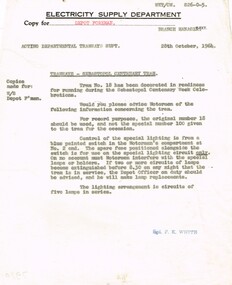
Administrative record - Memorandum, State Electricity Commission of Victoria (SECV), "Tramways - Sebastopol Centenary Tram", 28/10/1964 12:00:00 AM
... Memorandum on Electricity Supply Department letterhead, quarto, from the Branch Manager, F K White to the Acting Branch Tramways Superintendent, dated 28/10/1964 with a copy to the Depot Foreman, titled "Tramways - Sebastopol Centenary Tram", about the decoration of tram 18 for the Centenary event. ...Trams tramways Sebastopol Centenary Tram Numbering Lights Tramcars Drivers Memorandum on Electricity Supply Department letterhead, quarto, from the Branch Manager, F K White to the Acting Branch Tramways Superintendent, dated 28/10/1964 with a copy to the Depot Foreman, titled "Tramways - Sebastopol Centenary Tram", about the decoration of tram 18 for the Centenary event. ...Yields information about the painting of tram 18 and the use of the lamps during the Sebastopol Centenary., Yields information about the painting of tram 18 and the use of the lamps during the Sebastopol Centenary.Memorandum on Electricity Supply Department letterhead, quarto, from the Branch Manager, F K White to the Acting Branch Tramways Superintendent, dated 28/10/1964 with a copy to the Depot Foreman, titled "Tramways - Sebastopol Centenary Tram", about the decoration of tram 18 for the Centenary event. Tram had been given the number "100" temporarily, and about the control of the lighting circuits. Stamped "F. K. White"trams, tramways, sebastopol, centenary, tram numbering, lights, tramcars, drivers -
 City of Melbourne Libraries
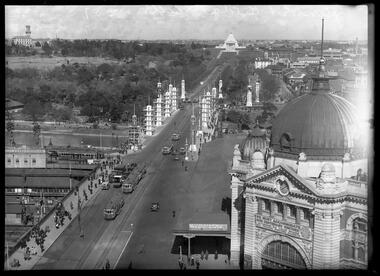
Photograph, Bull, Hugh Jones, 1897-1993, Princes Bridge Centenary pylons under construction
... A Camberwell City Councillor described the pylons as unimaginative, and the Herald reported that skeletons of pylons for the Centenary decorations in their present form led the area to resemble an oilfield! ...A Camberwell City Councillor described the pylons as unimaginative, and the Herald reported that skeletons of pylons for the Centenary decorations in their present form led the area to resemble an oilfield! ...Princes Bridge Centenary pylons under construction Possibly taken from Young and Jacksons Hotel (formerly Princes Bridge Hotel) on the corner of Flinders and Swanston streets, Flinders Street Station’s clocks and main entrance dominate, along with its distinctive copper dome and decorative façade. The time on the main clock is 1.40pm, and the sign underneath, reflecting Melbourne’s upcoming Centenary reads, “We must accommodate our Centenary visitors! Citizens! Do your share by taking paying guests.” At left is the original Princes Bridge Station, today the site of Federation Square. The riverside tram terminus advertises a Café/Tobacconist/Refreshment Room selling cigars & cigarettes, fountain drinks & confectionery, and in smaller text: “Leave your boot repairs here”. Nearly everyone is dressed in dark suits, coats and hats. The footpaths are wide and there are no traffic lights. The roadway stretches towards the Shrine of Remembrance, not yet dedicated but very dominant on the skyline. Government House is clearly visible across the wide parkland that would come to be known as Kings Domain and that is an area of deep importance to the people of the Eastern Kulin. Originally, Birrarung was part of a network of swamps and lagoons linked to the course of the river. From 1896, Public Works Department engineer Carlo Catani, oversaw a new channel to straighten the river and the swamps and lagoons were filled with spoil from the channel works. From the same vantage point today, only the top of the tower of Government House would be visible. The photo captures the pylons along Princes Bridge, mid-construction and being installed to mark Melbourne’s Centenary. The pylons were not without controversy. Both The Argus and The Age bemoaned them for being “made almost entirely of imported softwood timber”, denying work to native hardwood timber workers and sawmillers, and leading visitors to think Australia did not have its own exceptional native hardwoods. The pylons were also variously described in their incomplete state, as unimaginative and resembling an oilfield. Published: The Age 5 September 1934 Featured in "Newsworthy: Melbourne in photographs 1933-1936" exhibition at East Melbourne Library, October to December 2023. Exhibition caption by project volunteer, Louise McKenzie Photographer notations on slide: "Pylons + St Kilda Rd C57" Published: Age (Melbourne, Vic. : 1854 - 1954), Wednesday 5 September 1934, page 11 Published title: DECORATIONS -- THEN AND NOW. Published caption: "Although not completed yet, some impression of the effect of the decorations on Princes-bridge may be obtained from the first picture which shows the majestic sweep of St Kilda road with the Shrine of Remembrance and Government House dominating the horizon. The area to the left of St. Kilda-road and in front of Government House is portion of the area which it is proposed to call the King's Domain, which extends to Domain-road and Anderson-street..." Description: East-facing, elevated view of Flinders Street Station and Princes Bridge, featuring partially completed pylons erected for Melbourne's Centenary celebrations. The Shrine of Remembrance and Government House can be seen in the distance. In the foreground are trams, cars and trucks, pedestrians, Batman Avenue tram terminus and refreshment rooms. Signage on Flinders Street Station encourages citizens to accommodate Centenary visitors. The Melbourne Centenary was held 1934-35 in celebration John Batman's proclamation that Melbourne "the place for a village". Centenary events included a visit by Prince Henry, Duke of Gloucester. A Centenary Cake measuring 50 feet in height and ten tons in weight was cut into 250,000 pieces and sold at 1 shilling per piece for charity. Spectacular floodlighting of city landmarks, the creation of the Pioneer Women's Memorial Garden, and the MacRobertson Air Race from London, were other notable activities. Research by project volunteer, Louise McKenzie: The photo in The Age collage of 5 September 1934 has a slightly cropped foreground. The original photo has been taken from an elevated vantage point, most probably the roof of the Nicholas Building on the corner of Flinders and Swanston streets. The right foreground is dominated by the main “clocks” entrance to Flinders Street Station, showing its distinctive copper dome and decorative façade. The time on the main clock is 1.40 pm. The main sign on the front of the Station reads, "We Must Accommodate our Centenary Visitors! Citizens! Do your share by taking paying guests. Write to The Official Centenary Accommodation Bureau, 436 Collins St. City. Tel M 4671”. Another sign at eye level at the main entrance says: “Cheap Trips on Sundays”. The sign on the end of the roof along the eastern side of the station reads, “The Babies Need Your Help! Support Broadmeadows Foundling Hospital Appeal. July and August”. Run by the Sisters of St Joseph of the Sacred Heart, St Joseph’s Foundling Hospital was a purpose built infants’ home for up to 300 babies, plus accommodation for expectant mothers, mainly single women. In the early 1930s, the department (Victorian Children’s Welfare Department) contracted St Joseph’s Foundling Hospital to care for an additional 60 infant state wards, and up to 175 non wards at any given time. In 1931 it also operated a mothercraft training school. The centre foreground shows the commencement of Princes Bridge. Beneath the left side of the bridge was the site of the original Princes Bridge Station, by this time incorporated into Flinders Street Station, and today the area is the site of Federation Square. It was linked to Flinders Street station by the railway tracks that ran underneath the northern approach to the bridge. This photo shows a tram terminus which has a Café/Tobacconist/Refreshment Room, selling cigars & cigarettes, fountain drinks & confectionary, and a sign: Leave your boot repairs here. In the foreground is a wide roadway running south/north, comprising two vehicle lanes each heading north/south, and a central section containing two sets of tram tracks. There are cars, buses and delivery vans on the roadway. The trams visible are Glen Iris (Route No. 6; tram no. 448), Toorak (Route No. 8, tram no. 333), ? (No. 7), ? (No. 1), and ? (No. 2A). The footpaths are extremely wide. There is a square newspaper/magazine stand on the eastern side footpath. And also a “Ferry” sign. There are no traffic lights, but a policeman is visible on the roadway. There are pedestrians – men, women, children, a porter with trolley, women with prams. Clothing comprises dark suits, coats and hats for nearly everyone. There are double headed “Collins Street” lights along the side of the roadway, and along the northern riverbank. The roadway in the foreground is an extension of Swanston Street, which becomes Princes Bridge, then St Kilda Road, stretching towards the Shrine of Remembrance, and diverting past it. The Shrine had not yet been officially dedicated, and looks very white and dominant on the skyline. On the LHS of St Kilda Road, Government House is clearly visible across the wide parkland to be known as Kings Domain. The Kings Domain area is important to the people of the Eastern Kulin nation, and also has historical importance for its association with the early settlement of Melbourne and the foundation of British colonial administration in Victoria. On the southern side of the Yarra River (Birrarung) an historic rowing boathouse is visible, located adjacent to the Alexandra Gardens. Originally Birrarung was part of a network of swamps and lagoons linked to the course of the river. From 1896, under the guidance of engineer Carlo Catani* a new channel to straighten the river was created and the swamps and lagoons were filled with spoil from the channel works. The gardens were then created and completed in time for a Royal visit by the Duke of York in May 1901. The gardens are named after Alexandra of Denmark, the wife of King Edward VII. Both these areas, plus the Royal Botanic Gardens Victoria, Shrine of Remembrance Reserve, Sidney Myer Music Bowl, Government House, and the Queen Victoria Gardens together form the Domain Parklands. The extent of the subsequent plantings is evident today, where from the same vantage point only the top of the tower of Government House would be visible. *Catani was born in Florence in 1852, but after arriving in Melbourne worked as a civil engineer for the Victorian Government. His last major project was the reclamation of the foreshore of St Kilda, envisaged in the style of a European resort, complete with a split level esplanade, bathing pavilions, dance halls, amusements and a French-Italian style of landscape complete with palms. The gardens at the end of Fitzroy Street, St Kilda, now bear his name. The historic boathouse visible across the Yarra is another glimpse into Melbourne’s past. “Boathouse Row” comprises 7 amateur rowing clubs, the first established in 1859 (Melbourne University Boat Club). Other Clubs were Richmond, Melbourne, Banks, Melbourne Grammar School, Yarra Yarra and Mercantile. South of the river and west of the bridge is an area today developed into the Melbourne arts precinct of Hamer Hall and the Arts Centre. But at this time it was the home of Wirths Olympia Circus, which comprised Wirths Pleasure Park (an amusement park), a 5,000 seat auditorium – Hippodrome, a roller skating rink, a glaciarium, a cinema, and the Green Mill Dance Hall. Dog shows were also held at Olympia. The Green Mill Dance Hall closed in 1950, and the remainder of the Wirth buildings on site were destroyed by fire in December 1953. The feature of the photo is the pylons erected along Princes Bridge to mark Melbourne’s Centenary in 1934. The sixteen plastered pylons were designed by Roy Prentice, the second person to qualify as an architect at The University of Melbourne’s Bachelor of Architecture degree, in 1933, aged 27. Simon Reeves in his article marking the 100th birthday of Roy Prentice on 20 June 2006 reports that the State Electricity Commission sponsored this work, and the Argus reported that “… the pylons were “illuminated from within to give the effect of soft radiance”. Australia Home Beautiful 1 Oct 1934 reports in a very detailed and comprehensive article: The 10 taller pylons, including flagpole, were 48 ft, with a base of 8 ft. Timber-framed and faced with fibrous plaster and galvanised sheet iron, each structure was securely bolted to a concrete foundation three feet in depth. Panels of glass let into the shaft of each pylon were indirectly lit by 40, 100 watt lamps, and the upper bank of internal lamps were dyed so as to flood the panels with a deep red light. The decorative painted shields and flagpoles/pennants were illuminated by three 200 watt projectors concealed in the roof of each pylon, and were part of an electric night light decoration scheme involving 28 miles of wire to supply more than 20,000 lights. An article in the Argus on 18 October 1934 provided minute detail of the lighting erected in Melbourne for the Centenary, converting it “… into a coloured fairyland by night.” The estimated cost of 10 pounds per hour the lights were on. The display included 800 standard light poles 30 feet high which were tiered with electric bulbs concealed in inverted cones, 138 specially designed “Venetian poles” draped in flags trophies and streamers. The streets included in the electric night light decoration scheme were Bourke Street from Spring to William, the entire length of Collins Street, Flinders Street from Elizabeth to Spring, Lonsdale Street from Elizabeth to Swanston, Swanston and Elizabeth Streets from Flinders to Lonsdale, and parts of Springs and Spencer Streets. Together with the Princes Bridge pylons, approximately 28 miles of wire was required to supply power to the more than 20,000 lights. And that is just in the city of Melbourne. It was estimated the same amount of lighting was duplicated among other local councils. The pylons were not without controversy. The Argus on 28 August 1934 in an article headed “Imported Timber in Pylons” reported that the Princes Bridge pylons are “made almost entirely of imported softwood timber”, and have therefore denied work to native hardwood timber workers and sawmillers. The same day the Melbourne Age ran a similar story, bemoaning the fact that foreign oregon had been used which may lead tourists to think Australia did not have its own exceptional native hardwoods. A Camberwell City Councillor described the pylons as unimaginative, and the Herald reported that skeletons of pylons for the Centenary decorations in their present form led the area to resemble an oilfield! The Yarra River and Princes Bridge have long been a focal point of Melbourne life. In the early days of European settlement in Melbourne a rope-hauled punt carried people across the Yarra River. A surge in population and increased shipping traffic created a need for a bridge. There was difficulty in agreeing on a suitable site for the bridge (options were crossing at Elizabeth, Swanston, Queen or Market Streets), but the NSW Government favoured Swanston Street and the Melbourne Town Council decided on a temporary bridge across the Yarra spanning from the foot of Swanston Street. This first bridge was a single span timber toll bridge designed by Scottish born bridge designer David Lennox, and completed in 1845. It was 120 feet long, had a roadway of 17 feet wide, and a footpath on one side of 4 feet. It was leased to the Melbourne Bridge Company in the name of Robert A Balbirnie. The tollhouse was on the north side of the river and the toll keeper, Patrick Doherty, was credited with saving nine lives during the four years he was in charge of the toll station. The second bridge was stone (completed 1850), and named Prince’s Bridge after the HRH Prince of Wales, later Edward VII. It was designed with an elliptical single arc and an exceedingly small rise in proportion to the span. However, this design created an obstacle for flood waters, and together with Melbourne’s increasing population it was quickly apparent that a new bridge was required. At its opening on 15 November 1850 coincided with the imminent declaration of Victoria as a separate colony, it provided a moment of great celebration for Melbournians and “The opening ceremony was described as the grandest processional display witnessed in the colony.” (ToMelbourne.com.au) Princes Bridge in its present form, as depicted in this photograph, was designed by Jenkins, D’Ebro and Grainger, and constructed in 1886-88 by David Munro. John Grainger (father of Australian composer Percy Grainger) did the majority of the design work for the bridge. The structure was to have three arches each 96 feet wide measured across the river, and the banks on both sides were raised to allow more space for floodwater to flow. St Kilda Road was originally many feet below the current level. The bridge is of architectural significance for its substantial size, giant half columns, extensive use of wrought and cast iron, decorative elements (cast-iron lamps) and the skilled stonemasonry in the construction of the abutments and piers. Its main design features are similar to those of Blackfriars Bridge in London (1870). The bluestones were quarried from Footscray, the Malmsbury stones were from quarries at Kyneton, and the granite from Harcourt. The cost was met by the State of Victoria, City of Melbourne, and six out of seven of its municipalities, and their coats of arms feature on the bridge. The building of the bridge reflected the boom period of Melbourne, including the Victorian gold rush 1851- late 1860s, and its contractor, David Munro, was also responsible for the construction of Queens Bridge and Sandridge Railway Bridge. The Centenary pylons are no longer in place, but today this intersection still plays a major part in Melbourne’s daily life: people still meet “under the clocks” at Flinders Street station, and the route in and out of the city along St Kilda Road is often a feature of parades such as Moomba, the Grand Final Parade, and of course the Anzac Day Parade which commences at the Princes Bridge intersection and finishes at the Shrine of Remembrance. There are many tram routes, which cross the Bridge, and it directs pedestrians towards the Arts Precinct, the various components of Domain Park, plus the Southbank restaurant and rowing precincts. Even though this is a street scene, it feels very intimate; the viewer is instantly immersed in the activity of a Melbourne afternoon, looking down St Kilda Road from a viewpoint near today’s Federation Square. References: DECORATIONS -- THEN AND NOW. (1934, September 5). The Age (Melbourne, Vic. : 1854 - 1954), p. 11. Retrieved September 21, 2023, from http://nla.gov.au/nla.news-article205880269 'Flinders Street railway station', Wikipedia, https://en.wikipedia.org/wiki/Flinders_Street_railway_station 'St Joseph’s Foundling Hospital (1901-75)', Finding Records, Department of Health and Human Services, State of Victoria, https://www.findingrecords.dhhs.vic.gov.au/collectionresultspage/St-JosephsFoundling-Hospital-Babies-Home#departmental-administration 'Alexandra Gardens', City of Melbourne, https://www.melbourne.vic.gov.au/community/parks-open-spaces/major-parks-gardens/Pages/alexandra-gardens.aspx 'Wirths Circus', Wikipedia, https://en.wikipedia.org/wiki/Wirth's_Circus 'Roy Prentice: Centenary Architect', Built Heritage Pty Ltd, Simon Reeves, https://www.builtheritage.com.au/downloads/prentice.pdf 'Princes Bridge', Heritage Council Victoria, https://vhd.heritagecouncil.vic.gov.au/places/817 PORT PHILLIP. (1846, April 1). The Sydney Morning Herald (NSW : 1842 - 1954), p. 3. Retrieved September 21, 2023, from http://nla.gov.au/nla.news-article12886251 'Edward VII', Wikipedia, https://en.wikipedia.org/wiki/Edward_VII 'Princes Bridge', ToMelbourne.com, https://tomelbourne.com.au/princes-bridge/ 'Princes Bridge', eMelbourne, https://www.emelbourne.net.au/biogs/EM01189b.htm 'Princes Bridge', Australia for everyone, http://australiaforeveryone.com.au/files/melbourne/princes-bridge.html 'Victorian gold rush', Wikipedia, https://en.wikipedia.org/wiki/Victorian_gold_rush IMPORTED TIMBER IN PYLONS (1934, August 28). The Argus (Melbourne, Vic. : 1848 - 1957), p. 9. Retrieved September 21, 2023, from http://nla.gov.au/nla.news-article10952507 Princes-Bridge Pylons. (1934, August 28). The Age (Melbourne, Vic. : 1854 - 1954), p. 7. Retrieved September 21, 2023, from http://nla.gov.au/nla.news-article205532235 Pylons Appear Near Princes Bridge (1934, August 18). The Herald (Melbourne, Vic. : 1861 - 1954), p. 1. Retrieved September 21, 2023, from http://nla.gov.au/nla.news-article243104375 PRINCES-BRIDGE PYLONS. (1934, September 20). The Age (Melbourne, Vic. : 1854 - 1954), p. 10. Retrieved September 21, 2023, from http://nla.gov.au/nla.news-article205873535 28 Miles of Wire (1934, October 18). The Argus (Melbourne, Vic. : 1848 - 1957), p. 1 (The Junior Argus). Retrieved September 21, 2023, from http://nla.gov.au/nla.news-article10977836 'Historical references for Boathouse Row, Melbourne', http://boathouserowmelbourne.com.au/history/ 'ITALIAN DELEGATION TO HONOUR CARLO CATANI, DESIGNER OF THE ST KILDA FORESHORE, St Kilda Historical Society, 2001, https://web.archive.org/web/20070928061938/http://www.skhs.org.au/~SKHSarticles/articles/Carlo_Catani.html# HISTORY IN LIGHTS (1934, July 12). The Herald (Melbourne, Vic. : 1861 - 1954), p. 16. Retrieved September 21, 2023, from http://nla.gov.au/nla.news-article243172436 'Dressing Melbourne for the Duke', The Australian home beautiful: a journal for the home builder. Vol 12 No. 10 (1 October 1934), page 21, 58. Retrieved September 14, 2023, from http://nla.gov.au/nla.obj-2950922209Photographer notations on slide: "Pylons + St Kilda Rd C57".centenaries, bridges, lighting, flinders street railway station -
 Federation University Historical Collection
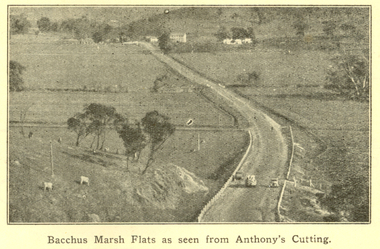
Booklet, F.C. Mc C. Crisp, Bacchus Marsh Centenary Celebrations, 10/1936
... centenary celebrations committee comprised of L.M. Dugdale (President), A.W. Bond (Hon. Secretary), Charles Dickie, W. Grant Morton, W.R. Vigor, C.J. McFarlane, G.H. Anderson, T.J. Shea, F.C. McC Crisp, Dr E. McDonald, Robert Elliott (treasurer), R.H. Lambert (Decorations...centenary celebrations committee comprised of L.M. Dugdale (President), A.W. Bond (Hon. Secretary), Charles Dickie, W. Grant Morton, W.R. Vigor, C.J. McFarlane, G.H. Anderson, T.J. Shea, F.C. McC Crisp, Dr E. McDonald, Robert Elliott (treasurer), R.H. Lambert (Decorations ...Bacchus Marsh celebrated 100 years of white settlement in 1936. The centenary celebrations committee comprised of L.M. Dugdale (President), A.W. Bond (Hon. Secretary), Charles Dickie, W. Grant Morton, W.R. Vigor, C.J. McFarlane, G.H. Anderson, T.J. Shea, F.C. McC Crisp, Dr E. McDonald, Robert Elliott (treasurer), R.H. Lambert (Decorations manager)Brown covered book of 28 pages. The book includes an historical essay, official centenary programme, Electric Light Plant, Patriotic Bacchus Marsh, milk industry, Pioneer Women's Memorial Avenue, Bacchus Marsh Gas Works . The book includes numerous advertisement, some illustrated. Images include: * Bacchus Marsh Flats from Anthony's Cutting; * Manor house; * Scene in Maddingley Park * Werribee Valley; * Werribee Gorge * Maddingley Park lake; * ANA Hall and Post Office * Shire Hall and Soldiers' Memorial Hall, * State School No 28 * At Werribee Gorge ** The Gas Supply Co, Bacchus Marsh * Bacchus Marsh Shire Council, 1935-6 (named) Images depicted in the book were supplied by H.J.M. Vallancebacchus marsh, merrimu guest house, anthony's cutting, captain bacchus, manor house, maddingley, maddingley park, werribee gorge, bacchus marsh shire, bacchus marsh shire council -
 Federation University Historical Collection
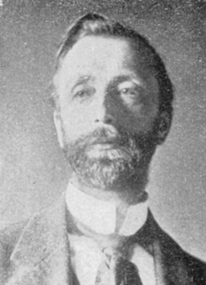
Photograph - Black and White, Ponsonby May Carew Smyth, 1906
... Decoration Society, and he was important in the organization of the state schools' exhibition that year. He designed the commemorative wall plaques installed in state schools after World War I, and the art teachers' certificate. He was prominent in bringing about the 1922 Jubilee Exhibition, and the 1926 showing of work of overseas schools, and especially the 1934 Melbourne centenary 'Early Victorian Art' exhibition. ...Decoration Society, and he was important in the organization of the state schools' exhibition that year. He designed the commemorative wall plaques installed in state schools after World War I, and the art teachers' certificate. He was prominent in bringing about the 1922 Jubilee Exhibition, and the 1926 showing of work of overseas schools, and especially the 1934 Melbourne centenary 'Early Victorian Art' exhibition. ...Ponsonby Carew Smyth, A.R.C.A. London, was Victorian Art Inspector of Technical Schools. "Ponsonby May Carew-Smyth (1860-1939), educationist, was born on 7 August 1860 at Cork, Ireland, son of Emmanuel Uniacke Smyth, gentleman, and his wife Catherine Giles, née Carew. Carew-Smyth's initial art training and teaching was at the Belfast Government School of Art and Design. In 1885 he entered the National Art Training School at South Kensington, London, where he remained as student and teacher for five years. He also taught at Rugby School, studied at the Royal School of Wood Carving and the Guild School of Handicrafts, London, and was sent by the Department of Science and Art to study art, art education and museum procedures in Paris. Testimonials to his career in England affirm his ability and dedication as an educationist and his integrity as a man. On 23 December 1890 Carew-Smyth married Marie Reynolds of Brixton; they migrated to Australia next January. In September Carew-Smyth applied from Melbourne for the position of master of the school of art and design, established under the auspices of the Ballarat Fine Art Gallery. Opening in November, the school offered day classes and a broad curriculum, and under Carew-Smyth's guidance, established a sound reputation. In November 1899 he was appointed inspector of drawing in the Department of Education. Carew-Smyth saw drawing as a crucial link between primary and technical education, insisting on it as a 'mental process quite as much as a manual'; he believed strongly in the utilitarian value of drawing to the artisan class and of art as 'craftmanship'. By his emphasis on teacher-training, by his role in the Teachers' Training College, and by his constant travels, writing and lecturing, he upgraded both the standard and importance of drawing early in the century. His meticulous mind formulated the Austral Drawing Books which provided the basis of instruction in the subject in Victoria until 1927. Although he gave his occupation as 'artist', Carew-Smyth was primarily an educationist. He was actively involved in the early years of Prahran and Swinburne Technical colleges, and especially the Working Men's College which held his interest even after his retirement. In 1906 he was appointed chairman of the Victorian State Schools' Equipment and Decoration Society, and he was important in the organization of the state schools' exhibition that year. He designed the commemorative wall plaques installed in state schools after World War I, and the art teachers' certificate. He was prominent in bringing about the 1922 Jubilee Exhibition, and the 1926 showing of work of overseas schools, and especially the 1934 Melbourne centenary 'Early Victorian Art' exhibition. In the 1930s he wrote wide-ranging, informative and sometimes humorous articles for the Argus on various aspects of the decorative arts. In mid-1936 he was acting director of the National Gallery of Victoria. To students his single-mindedness sometimes suggested sternness, but Carew-Smyth was always held in the highest regard both professionally and personally. His colleagues recalled a man of kindness, unstinting devotion to work, and humour; he was considered quite a raconteur. Survived by his wife, a son and a daughter, he died in his home at South Yarra on 9 October 1939, and was cremated." (Margot Lethlean, 'Carew-Smyth, Ponsonby May (1860–1939)', Australian Dictionary of Biography, National Centre of Biography, Australian National University, http://adb.anu.edu.au/biography/carew-smyth-ponsonby-may-5501/text9359, accessed 4 June 2013.)Image of the face and shoulders of a bearded man - Ponsonby Carew Smyth. The image was originally published from the State Schools Exhibition Catalogue, 1906. (Cat. No. 401)carew smyth, inspector, technical schools, art. -
 Federation University Historical Collection
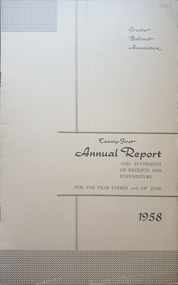
Booklet - Annual Report, Greater Ballarat Association Annual Report 1952-1974, 1952-1974
... Cooke. greater ballarat association annual report edgar bartrop g.b. richmond a.w. nicholson g.e. deeble r.g> caddell l.j. fraser t.u. haymes a.w. lynch keith rash tourist bureau botanical gardens telepone booth pryor park tree planting ballarat zoological gardens centenary window dressing competition soldier settlement proposal for university for ballarat caravan park ballarat common ballarat common development t.t. hollway housing commission wendouree housing commission industrial development s.s. ballarat begomia festiva r.g. caddell w.gordon smith f.h. menzies olympic rowing royal tour decorations begonia float widening of railway bridge j. chatham l.g. chester s.v. playsted n. ellis langi kal kal langi kal kal training centre migrants to victoria flood lighting of the arch of victory olympics holidays ballarat's projected olympic pool ballarat fish hatcheries olympic hostel town planning murray byrne titles for residence areas service club signs railway level crossing traffic ploughing competition w. fraser young australia league removal of raaf from ballarat renumbering of streets renumbering of streets to the block system miners' racecourse reserve historical museum ballarat historical society c.m. canty mavis canty university status ballarat university college j.w. murray p.r. gray b.c. mcorist n.c. ellis w.h. heinz save the lake campaign lake wendouree weed home host scheme b. walker develop victoria council eureka development victorian decentralization league r.h. ramsay allan c. pittard w. gordon smith c.h. davis b.c. hedgcock les kennedy p.j. rice a.f. waddington john p. cook historic markers maze traffic lights bungal dam camera clubs sunraysia way map centre of road parking paddle steamer wendouree apex local government women's association may nelson wes sobey melton foo l.l. zilles dulcie sullivan m. barnes lou zilles john wesley sobey e.r. ingles herb warren kryal castle Eighteen annual reports of the Greater Ballarat Association. ...The first presedent of the Greater Ballarat Association in 1938 was Robert J. Cooke. Eighteen annual reports of the Greater Ballarat Association. Each one discussed the work of the association and lists the subscribers. greater ballarat association, annual report, edgar bartrop, g.b. richmond, a.w. nicholson, g.e. deeble, r.g> caddell, l.j. fraser, t.u. haymes, a.w. lynch, keith rash, tourist bureau, botanical gardens telepone booth, pryor park tree planting, ballarat zoological gardens, centenary window dressing competition, soldier settlement, proposal for university for ballarat, caravan park, ballarat common, ballarat common development, t.t. hollway, housing commission, wendouree housing commission, industrial development, s.s. ballarat, begomia festiva, r.g. caddell, w.gordon smith, f.h. menzies, olympic rowing, royal tour decorations, begonia float, widening of railway bridge, j. chatham, l.g. chester, s.v. playsted, n. ellis, langi kal kal, langi kal kal training centre, migrants to victoria, flood lighting of the arch of victory, olympics holidays, ballarat's projected olympic pool, ballarat fish hatcheries, olympic hostel, town planning, murray byrne, titles for residence areas, service club signs, railway level crossing, traffic, ploughing competition, w. fraser, young australia league, removal of raaf from ballarat, renumbering of streets, renumbering of streets to the block system, miners' racecourse reserve, historical museum, ballarat historical society, c.m. canty, mavis canty, university status, ballarat university college, j.w. murray, p.r. gray, b.c. mcorist, n.c. ellis, w.h. heinz, save the lake campaign, lake wendouree, weed, home host scheme, b. walker, develop victoria council, eureka development, victorian decentralization league, r.h. ramsay, allan c. pittard, w. gordon smith, c.h. davis, b.c. hedgcock, les kennedy, p.j. rice, a.f. waddington, john p. cook, historic markers, maze, traffic lights, bungal dam, camera clubs, sunraysia way, map, centre of road parking, paddle steamer, wendouree apex, local government women's association, may nelson, wes sobey, melton foo, l.l. zilles, dulcie sullivan, m. barnes, lou zilles, john wesley sobey, e.r. ingles, herb warren, kryal castle -
 City of Moorabbin Historical Society (Operating the Box Cottage Museum)
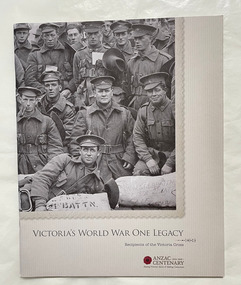
Book, Victorian Government, Victoria's World War One Legacy : Recipients of the Victoria Cross : ANZAC centenary, 2014-2018 sharing Victoria's stories & making connections, 2014
... decorations The following 26 stories are about outstanding valour on the battlefields of the Great War. They tell the story of men who were recipients of the Victoria Cross, the British Empire’s highest award for bravery in wartime, and now Australia’s pre-eminent award for conspicuous gallantry in combat. Inside cover. 31 pages : portraits Includes bibliographical references. Victoria's World War One Legacy : Recipients of the Victoria Cross : ANZAC centenary ...The following 26 stories are about outstanding valour on the battlefields of the Great War. They tell the story of men who were recipients of the Victoria Cross, the British Empire’s highest award for bravery in wartime, and now Australia’s pre-eminent award for conspicuous gallantry in combat. Inside cover.31 pages : portraits Includes bibliographical references.non-fictionThe following 26 stories are about outstanding valour on the battlefields of the Great War. They tell the story of men who were recipients of the Victoria Cross, the British Empire’s highest award for bravery in wartime, and now Australia’s pre-eminent award for conspicuous gallantry in combat. Inside cover.australian army, soldiers, world war one, victoria cross, military decorations -
 Eltham District Historical Society Inc
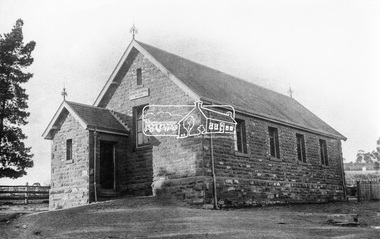
Photograph, Eltham - State School No. 209. Dalton Street, c.1910
... Harry Gilham notes: - One of two very early photos - stairs not in place to entrance; these were repaired in 1943 - no skylights in original roof - pump over water well in lower right hand corner - bogs on right hand side in 1900s - note roof gable decoration This photo forms part of a collection of photographs gathered by the Shire of Eltham for their centenary project book,"Pioneers and Painters: 100 years of the Shire of Eltham" by Alan Marshall (1971). ...Eltham Primary School - original part of present school built 1875-1876 prior to any additions. Photo appears to have been taken prior to modifications made in 1913 and certainly prior to extensions made in 1920/21. Harry Gilham notes: - One of two very early photos - stairs not in place to entrance; these were repaired in 1943 - no skylights in original roof - pump over water well in lower right hand corner - bogs on right hand side in 1900s - note roof gable decorationThis photo forms part of a collection of photographs gathered by the Shire of Eltham for their centenary project book,"Pioneers and Painters: 100 years of the Shire of Eltham" by Alan Marshall (1971). The collection of over 500 images is held in partnership between Eltham District Historical Society and Yarra Plenty Regional Library (Eltham Library) and is now formally known as the 'The Shire of Eltham Pioneers Photograph Collection.' It is significant in being the first community sourced collection representing the places and people of the Shire's first one hundred years.Digital image (Neg missing)shire of eltham pioneers photograph collection, eltham, dalton street, eltham primary school, eltham state school no. 209, state school no. 209 -
 Warrnambool and District Historical Society Inc.
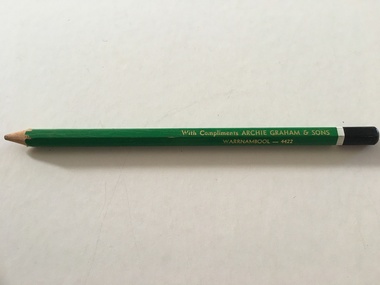
Artefact, Archie Graham & Son Warrnambool - 4423, Mid 20th century
... He planned and organized the street decorations for the Warrnambool Centenary in 1947, was chairman of the committee that developed Albert Park and the Reid Oval and was active in Rotary Club and Cricket Club affairs. ...He planned and organized the street decorations for the Warrnambool Centenary in 1947, was chairman of the committee that developed Albert Park and the Reid Oval and was active in Rotary Club and Cricket Club affairs. ...This pencil was used as an advertising medium for the Warrnambool firm of Archie Graham and Sons. It was given to customers of the firm. Archie Graham (1906-1992) commenced a building business in Warrnambool in the 1930s and was well-known for his many building projects in the city and his innovation in the industry. Archie Graham was a prominent member of the Uniting Church and a tireless worker in community affairs in Warrnambool for sixty years. He planned and organized the street decorations for the Warrnambool Centenary in 1947, was chairman of the committee that developed Albert Park and the Reid Oval and was active in Rotary Club and Cricket Club affairs. He was also a member of the Warrnambool Technical School Council. Today the building in Timor Street for senior citizens and other community use is named after Archie Graham. This pencil is of interest as a memento of the type of complimentary article given to customers of businesses in Warrnambool in the mid 20th century. It is also a memento of Archie Graham, an important businessman and community worker in Warrnambool in the 20th century. This is a large six-sided wooden pencil sharpened at one end. The pencil is painted green with a white band near the top and a black-colored end rounded at the top. The paint on the pencil is slightly chipped. The inside of the pencil contains graphite for writing or drawing. The business name on the side of the pencil is inscribed in gold lettering. ‘With Compliments ARCHIE GRAHAM & SONS WARRNAMBOOL – 4422’ archie graham, warrnambool, history of warrnambool -
 Eltham District Historical Society Inc
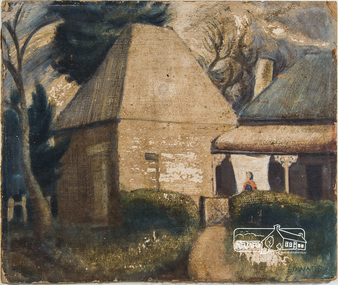
Painting, Lindsay Edward, The Malt House, 1942c
... Retrieved October 16, 2016, from http://nla.gov.au/nla.news-article127509819 Queensland Centenary Artwork (includes image) http://queenswharf.org/places/former-queensland-state-library-wall-decoration-and-sculpture/ Eltham Cemetery http://www.elthamcemetery.com/index.php/search ...Retrieved October 16, 2016, from http://nla.gov.au/nla.news-article127509819 Queensland Centenary Artwork (includes image) http://queenswharf.org/places/former-queensland-state-library-wall-decoration-and-sculpture/ Eltham Cemetery http://www.elthamcemetery.com/index.php/search fairfield malt house lindsay edward home beautiful home beautiful magazine alistair knox Inscribed on back "The Malt House Lindsay Edward 15 Park Cres Fairfield" oil on paper board 31.5 x 37.5 cm signed "Edward" lower right The Malt House Painting Lindsay Edward ...Artist Lindsay Edward and wife Jan built a house designed by Alistair Knox at 151 Old Eltham Road, Lower Plenty. See article on home designed by Alistair Knox for Lindsay Edward, teacher, at 151 Old Eltham Road, Lower Plenty. The home was originally featured on the cover of the January 1953 issue of Home Beautiful magazine and was revisited in the March 1969 issue. See registration record No. 01649. Lindsay Edward Biography: 1919: 26 August Lindsay Maurice Edward was born in Melbourne. 1937: 4 – 9 May Exhibition - Heidelberg art exhibition (SLV collection) 1939: Art student at the National Gallery of Victoria 1940: 7-14 October Exhibition Heidelberg art exhibition. (SLV collection) 1941: November - Exhibition Heidelberg Art Exhibition 1942: Lindsay was an art student living at this 14 Park Cres. Fairfield. Occupation Art student. He most likely painted this painting around this time. c.1942 – 1944: Enlistment for military service in World War 2 in Casino, NSW. 1944: Rank of Sergeant. 1944: Exhibition Seddon Galleries (Melbourne) 1945: Exhibition Seddon Galleries 1946: Exhibition Exhibition of Past Students of the National Gallery of Victoria 1947: Submitted “Self- portrait in the Archibald Prize, Art Gallery of NSW 1948: Lived in London for a year and married a fellow artist ? Knox. 1949: Returned from London 1949: Electoral Roll Residence– 16 Mount Street, Ivanhoe 1950: October Exhibition Stanley Coe Galleries, 435 Bourke Street, Melbourne 1951: 19 Nov. - 9 Dec. Exhibition An exhibition of present day art of Victoria Victorian 1951 Commemoration Committee in conjunction with the Victorian Artists' Society, 1951: (SLV Collection) 1953: October Exhibition Melbourne Contemporary Artists Exhibiton 1954: Exhibition Melbourne Contemporary Artists Exhibition 1958: Victorian artist and educator Lindsay Edward won the £500 prize for the wall decoration of the Queensland Library - . Edward was born in 1919 and had studied at the National Gallery of Victoria. In 1958 he was head of the painting section of the Royal Melbourne Technical College (now RMIT) and had only recently begun experimenting with mosaic. The Centennial mosaic covers a wall 68 feet (20.72 metres) in length and 14 feet (4.26 metres) high. In a Melbourne Age article in July 1958 Edward described the mural as ‘not a literal subject’ rather as ‘a basic formation of organic forms indicating growth and development’. 1960: Exhibition Eltham Art Show (SLV collection) 1963: Exhibition October 28-November 17 - Argus Gallery, 290 Latrobe Street, Melbourne and at Hassall's Roadside Gallery, Eltham and at Gallery A and at Russell Davis Art Gallery. (SLV Collection) 1963, 1967, 1977 and 1980: Electoral Rolls – Residence Old Eltham Road, Lower Plenty. Occupation Teacher 1966: Exhibition Art Show -Austin Hospital Appeal (Heidelberg) (SLV collection) 1970s: Head of Art Department RMIT where he established a fine art collection. 1982: Exhibition Bolitho Gallery Canberra http://nla.gov.au/nla.news-article116467780 1988: 28 July – Exhibition Recent Paintings Darwin Performing Arts Centre (SLV Collection) 1993: Exhibition Solander Gallery, Canberra 2007: January Died and is buried in Eltham Cemetery 2007: Obituary in Age Jun 2, 2007 - LINDSAY Edward's retirement as head of the fine art department at RMIT in August 1979 signalled the end of an important chapter in the art Sources: ART CONTEST. (1939, March 2). The Argus (Melbourne, Vic. : 1848 - 1957), p. 8. Retrieved October 16, 2016, from http://nla.gov.au/nla.news-article12103185 ART EXHIBITION AT HEIDELBERG (1941, November 25). The Argus (Melbourne, Vic. : 1848 - 1957), p. 6. Retrieved October 16, 2016, from http://nla.gov.au/nla.news-article8218682 ART EXHIBITIONS (1945, October 3). The Age (Melbourne, Vic. : 1854 - 1954), p. 7. Retrieved October 16, 2016, from http://nla.gov.au/nla.news-article205639922 EX-GALLERY STUDENTS' SHOW (1946, October 15). The Argus (Melbourne, Vic. : 1848 - 1957), p. 3. Retrieved October 16, 2016, from http://nla.gov.au/nla.news-article22386440 https://www.artgallery.nsw.gov.au/prizes/archibald/1947/ Art World Busy (1949, February 26). The Argus (Melbourne, Vic. : 1848 - 1957), p. 12. Retrieved October 16, 2016, from http://nla.gov.au/nla.news-article22706197 http://nla.gov.au/nla.news-article22781141 ART NOTES (1953, October 13). The Age (Melbourne, Vic. : 1854 - 1954), p. 2. Retrieved October 16, 2016, from http://nla.gov.au/nla.news-article206462733 Design, color in art show (1954, October 5). The Argus (Melbourne, Vic. : 1848 - 1957), p. 9. Retrieved October 16, 2016, from http://nla.gov.au/nla.news-article23453359 https://artcollection.its.rmit.edu.au/?p=rmit-gallery-about Cinema (1993, October 7). The Canberra Times (ACT : 1926 - 1995), p. 7 (Good Times). Retrieved October 16, 2016, from http://nla.gov.au/nla.news-article127509819 Queensland Centenary Artwork (includes image) http://queenswharf.org/places/former-queensland-state-library-wall-decoration-and-sculpture/ Eltham Cemetery http://www.elthamcemetery.com/index.php/search oil on paper board 31.5 x 37.5 cm signed "Edward" lower rightInscribed on back "The Malt House Lindsay Edward 15 Park Cres Fairfield"fairfield, malt house, lindsay edward, home beautiful, home beautiful magazine, alistair knox -
 Bendigo Historical Society Inc.
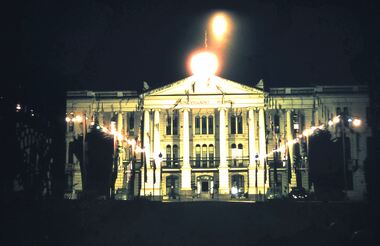
Slide - FLEMING COLLECTION: 1950S BENDIGO SLIDE, 1950s
... Benevolent Home Centenary. The light on top is the number 100. Decorations on building....Benevolent Home Centenary. The light on top is the number 100. Decorations on building Bendigo 1950s. ...Bendigo 1950s. Benevolent Home Centenary. The light on top is the number 100. Decorations on building.buildings, hospital, benevolent home, bendigo 1950s. benevolent home centenary. the light on top is the number 100. decorations on building -
 Bendigo Historical Society Inc.
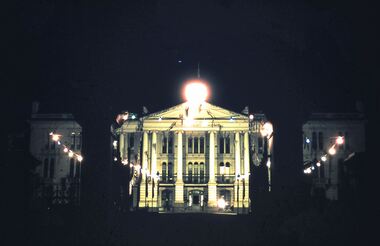
Slide - FLEMING COLLECTION: 1950S BENDIGO SLIDE, 1950s
... Benevolent Home Centenary. The light on top is the number 100. Decorations on building....Benevolent Home Centenary. light on top is the number 100. Decorations on building Bendigo 1950s. ...Bendigo 1950s. Benevolent Home Centenary. The light on top is the number 100. Decorations on building.buildings, hospital, benevolent home, bendigo 1950s. benevolent home centenary. light on top is the number 100. decorations on building -
 Ballaarat Mechanics' Institute (BMI Ballarat)
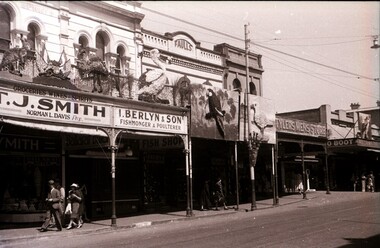
Centenary Decoration
... Centenary Decoration...Ballarat Centenary decorated Bridge St shops Faulls Tylers floral festival Centenary Decoration ...This photograph is from the Max Harris Collection held by the Ballaraat Mechanics' Institute. Please contact BMI for all print and usage inquiries.ballarat, centenary, decorated, bridge st, shops, faulls, tylers, floral festival -
 Ballarat Tramway Museum
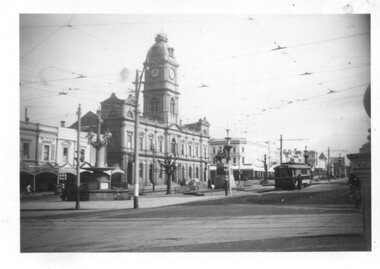
Photograph - Tram No.14 travelling East, outside the Town Hall, 1938
... Note the decorations along the roadside for the centenary of settlement in the Ballarat district in 1938 - see item 5909. ...Note the decorations along the roadside for the centenary of settlement in the Ballarat district in 1938 - see item 5909. ...Tram No.14 travelling East, outside the Town Hall. The Town Hall clock shows 8 o'clock. Judging by the shadows, and level of natural light indicates that it may be a Summer evening. The conductor is standing alongside the front door. Note the decorations along the roadside for the centenary of settlement in the Ballarat district in 1938 - see item 5909. Yields information about Sturt St and tram 14 in 1938. Black and white photograph with notes on the rear,"85", "KEN MAGOR Neg. No 2335"ballarat, ballarat tramways, sturt st, ballarat town hall, tram 14 -
 Ballarat Tramway Museum
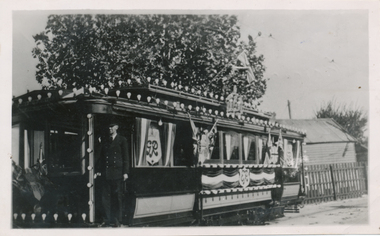
Photograph - SECV Bendigo 21 decorated for the coronation of George VI, May. 1937
... Yields information about the decoration of Bendigo 21 for the coronation of George VI Trams tramways Bendigo Decorated Trams Coronation George VI tram 21 On the rear in ink "Bendigo Decorated car, decorated for centenary there". ...Photograph of Bendigo 21 decorated for the coronation of George VI, May 1937 on the depot access track. Source unknown. Wal's album notes provides details of the photograph, the note on the back is incorrect. Black and White print contained within the Wal Jack Bendigo and Geelong Album, see Reg Item 5003 for more details.Yields information about the decoration of Bendigo 21 for the coronation of George VIBlack and White print with photographer's notes on the rearOn the rear in ink "Bendigo Decorated car, decorated for centenary there".trams, tramways, bendigo, decorated trams, coronation, george vi, tram 21 -
 Ballarat Tramway Museum
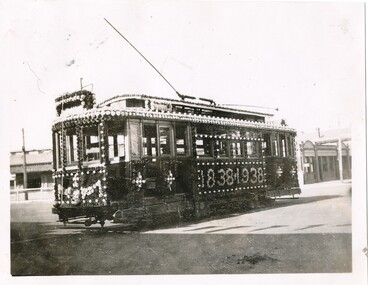
Photograph - SECV Geelong No. 23 decorated for the Centenary, 1938
... Centenary in 1939, photographed at the old Wharf Terminus, decorated with festooned lighting and other "baubles" and items. On the sides, the letters "1838.1938" In the background, are various wharf buildings. The tram has the destination of Newtown. Handwriting is the same as other photos such as Reg item 5850. Printed on Velox paper. See also Reg item 5865 for another photograph of the same decorated tramcar and 8886 for a mounted photograph. Yields information about the decoration ...Black and White print contained within the Wal Jack Bendigo and Geelong Album, see Reg Item 5003 for more details. Photo of No. Geelong No. 23 decorated for the Centenary in 1939, photographed at the old Wharf Terminus, decorated with festooned lighting and other "baubles" and items. On the sides, the letters "1838.1938" In the background, are various wharf buildings. The tram has the destination of Newtown. Handwriting is the same as other photos such as Reg item 5850. Printed on Velox paper. See also Reg item 5865 for another photograph of the same decorated tramcar and 8886 for a mounted photograph.Yields information about the decoration of Geelong tram 23 for the 1938 Victorian Centenary.black and white photograph with notes on the rear. Has the rear in ink "Geelong Centenary 1938".trams, tramways, geelong, wharf, decorated trams, tram 23 -
 Ballarat Tramway Museum
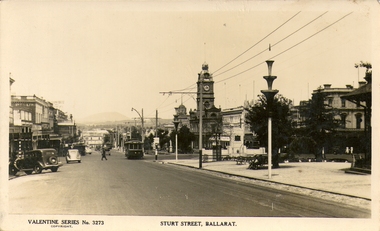
Photograph - Digital Image and Black & White Photograph/s, Valentine & Sons Publishing Co, 1938
... Note the decorations along the roadside for the centenary of settlement in the Ballarat district in 1938. ...Centenary tram 14 Print has "J75" in red ink in the top left hand corner on rear - the tram's Melbourne number. Digital image provided by David Critchley of a postcard looking east along Sturt, north side towards Grenville St, at Doveton St. Has a detailed image of the tram. Tram has the destination of Lydiard St North. Note the decorations ...Digital image provided by David Critchley of a postcard looking east along Sturt, north side towards Grenville St, at Doveton St. Has a detailed image of the tram. Tram has the destination of Lydiard St North. Note the decorations along the roadside for the centenary of settlement in the Ballarat district in 1938. Valentine Postcard No. 3273. .1 - large format print of the above image without the lower label. Has "Sturt St, Ballarat c1940's" along bottom edge. Print has "J75" in red ink in the top left hand corner on rear - the tram's Melbourne number.trams, tramways, sturt st, postcards, centenary, tram 14 -
 Bayside Gallery - Bayside City Council Art & Heritage Collection
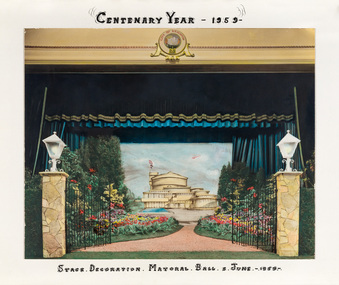
Photograph - hand-coloured photograph, Brighton Centenary Year, Stage decoration, Mayoral Ball, c. 1959
... Brighton Centenary Year, Stage decoration, Mayoral Ball...centenary...Brighton Town Hall...Stage Decoration...Centenary in 1959. Brighton was first incorporated as a borough on 18 January 1859, it became a town on 18 March 1887 and was proclaimed a city on 12 March 1919. The new Brighton Municipal Offices were designed by Kevin Knight of Oakley and Parkes with the engineers John Connell and Associates and were erected by Prentice Builders Pty Ltd. The foundation stone was laid on 13 February 1959 and the building was opened on 21 July 1961. The interior decoration...Brighton Centenary Year, Stage decoration, Mayoral Ball Photograph hand-coloured photograph ...This work was presented to The Mayor and Mayoress, Cr. and Mrs R.G. Ward, by the citizens of Brighton to commemorate the Brighton Centenary in 1959. Brighton was first incorporated as a borough on 18 January 1859, it became a town on 18 March 1887 and was proclaimed a city on 12 March 1919. The new Brighton Municipal Offices were designed by Kevin Knight of Oakley and Parkes with the engineers John Connell and Associates and were erected by Prentice Builders Pty Ltd. The foundation stone was laid on 13 February 1959 and the building was opened on 21 July 1961. The interior decoration and furniture was by Grant Featherston.brighton centenary, brighton town hall, stage decoration, mayoral ball, brighton municipal offices, civic centre, oakley and parkes, kevin knight, r.g. ward, mayor -
 Bayside Gallery - Bayside City Council Art & Heritage Collection
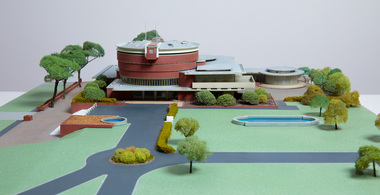
Model, Alan W. Chandler, Brighton Municipal Complex, 1959
... decoration and furniture was by Grant Featherston. As is common practice, an architectural model was prepared to present the final concept of the building for approval to the Brighton City Council. In February 1959 festivities occurred to celebrate the centenary...decoration and furniture was by Grant Featherston. As is common practice, an architectural model was prepared to present the final concept of the building for approval to the Brighton City Council. In February 1959 festivities occurred to celebrate the centenary ...This model of the Brighton Municipal Offices was made by Alan W. Chandler. The Brighton Municipal Offices were designed by Kevin Knight of Oakley and Parkes with the engineers John Connell and Associates and were erected by Prentice Builders Pty Ltd. The foundation stone was laid on 13 February 1959 and the building was opened on 21 July 1961. The interior decoration and furniture was by Grant Featherston. As is common practice, an architectural model was prepared to present the final concept of the building for approval to the Brighton City Council. In February 1959 festivities occurred to celebrate the centenary of the municipality of Brighton. A garden party attended by two hundred Brighton residents was held in the grounds of the Brighton Town Hall. This model graced the centre of the lily pond during the event. The following day the foundation stone of the Brighton Municipal Offices was laid.Architectural model of a large public building in orange brick, the main cylindrical tower is set within a rectangular structure, with circular and oval roof structures. The model is set within landscaped grounds with paths, a water feature, several trees and bushes, lawns and flower beds.brighton municipal complex, brighton civic centre, brighton chambers, architectural model, model, alan w. chandler, kevin knight, oakley and parkes, architecture, municipal offices, municipal building, scale model -
 Box Hill Historical Society
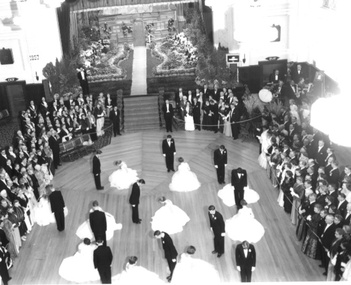
Photograph - Mayoral Balls, 1957
... Mayoral balls Debutantes Festive decorations Centenaries Box Hill Town Hall Unidentified Clothing and dress Dances and balls Proudfoot> James Kneale (Cr.) ...The Mayoral Ball of 1957, showing the debutantes bowing to their partners, preparing to dance. The six-piece band can be seen in the rear RH corner of the hall. The stage is decorated with flowers and rocks. It must have been a celebratory dance of 100 years as the year "1857" is on the LH side of the stage.B&w photomayoral balls, debutantes, festive decorations, centenaries, box hill town hall, unidentified, clothing and dress, dances and balls, proudfoot> james kneale (cr.) -
 Sunshine and District Historical Society Incorporated
Photograph - Walter Peeler, n.d
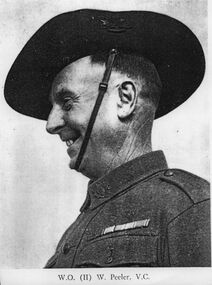
... Photocopy of a photograph of WO II W Peeler VC World War I Signed up for World War II|Ancestry of Walter Peeler Victorian Coss Recipient|Extract from Anzac Centenary 2014 to 2018 Walter Peeler between the wars worked for the Department of Lands and at the Sunshine Harvester Works|Typed Report Walter Peeler 1887 to 1968 Family Background World War I Inter War Period World War II Post World War II Addresses Recreation Decorations The Victoria Cross Citation for Walter Peelers Victoria Cross The Victoria Cross for Australia Walters Childrens Service History Kenneth...Walter Peeler World War 1914 - 1918 World War 1939 - 1945 Photocopy of a photograph of WO II W Peeler VC World War I Signed up for World War II|Ancestry of Walter Peeler Victorian Coss Recipient|Extract from Anzac Centenary 2014 to 2018 Walter Peeler between the wars worked for the Department of Lands and at the Sunshine Harvester Works|Typed Report Walter Peeler 1887 to 1968 Family Background World War I Inter War Period World War II Post World War II Addresses Recreation Decorations The Victoria Cross Citation for Walter Peelers Victoria Cross The Victoria Cross for Australia Walters Childrens Service History Kenneth Walter Peeler Photograph Walter Peeler ...Photocopy of a photograph of WO II W Peeler VC World War I Signed up for World War II|Ancestry of Walter Peeler Victorian Coss Recipient|Extract from Anzac Centenary 2014 to 2018 Walter Peeler between the wars worked for the Department of Lands and at the Sunshine Harvester Works|Typed Report Walter Peeler 1887 to 1968 Family Background World War I Inter War Period World War II Post World War II Addresses Recreation Decorations The Victoria Cross Citation for Walter Peelers Victoria Cross The Victoria Cross for Australia Walters Childrens Service History Kennethwalter peeler, world war 1914 - 1918, world war 1939 - 1945 -
 Ballarat Tramway Museum
Photograph - B&W print of donated negative, Ron E. Fluck, 26/03/1951 12:00:00 AM
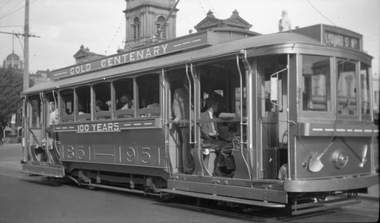
... centenary of the discovery of gold in Ballarat. Tram has destination of Lydiard St. North, has Town Hall in Background. Shows detail of decoration...centenary of the discovery of gold in Ballarat. Tram has destination of Lydiard St. North, has Town Hall in Background. Shows detail of decoration ...Black and white print of a donated negative. Print made 8/1998. Photo of decorated SEC tram 23 for the centenary of the discovery of gold in Ballarat. Tram has destination of Lydiard St. North, has Town Hall in Background. Shows detail of decoration. Taken on 26-3-1951. Shows arrangement for mirrors on a single truck - rare? High Res scan of copy negative added 17/1/2019tramways, trams, gold tram, gold centenary, ballarat, decorated trams, tram 23 -
 Whitehorse Historical Society Inc.
Memorabilia - Centenary Plate, 1888
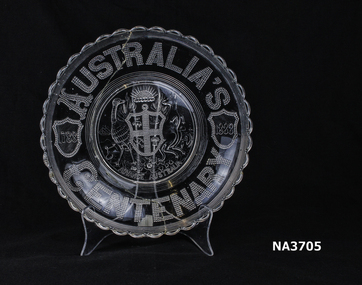
... Glass plate which reads 'Australia's Centenary' around the lip, with 1788 and 1888 within shields on either side. Coat of Arms flanked by an emu and kangaroo and further decoration in centre with the motto 'Advance Australia'...The use of the Coat of Arms with a kangaroo and emu shows that this form of the crest we know today was used for many years before Australia became a Federation civic mementoes souvenirs glass technology glassware Glass plate which reads 'Australia's Centenary' around the lip, with 1788 and 1888 within shields on either side. Coat of Arms flanked by an emu and kangaroo and further decoration in centre with the motto 'Advance Australia' Memorabilia Centenary Plate ...It is representative of souvenir ware produced for mass consumption at a time of community celebration - the 1888 Centenary of British Settlement in Australia. The use of the Coat of Arms with a kangaroo and emu shows that this form of the crest we know today was used for many years before Australia became a FederationGlass plate which reads 'Australia's Centenary' around the lip, with 1788 and 1888 within shields on either side. Coat of Arms flanked by an emu and kangaroo and further decoration in centre with the motto 'Advance Australia'civic mementoes, souvenirs, glass technology, glassware -
 City of Ballarat Libraries
Photograph, Sturt Street Centenary Celebrations 1938
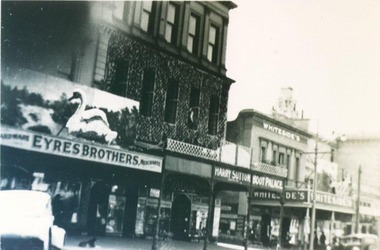
... Sturt Street during the Centenary Celebrations in 1938. You can see decorations on the Eyre Bros building. ...Sturt Street during the Centenary Celebrations in 1938. You can see decorations on the Eyre Bros building. ...Sturt Street during the Centenary Celebrations in 1938. You can see decorations on the Eyre Bros building. Other businesses shown are Sutton's Boot Palace and Whiteside's.sturt steet, centenary, ballarat, eyre bros, sutton's boot palace, whiteside's, decorations -
 City of Ballarat Libraries
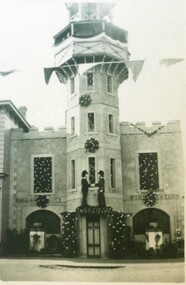
Photograph - Card Box Photographs, Ballarat West Fire Station 1938
... The fire station in Sturt Street was decorated for the Ballarat Centenary Celebrations. ballarat west fire station centenary celebrations sturt street building decorations Ballarat West Fire Station 1938. ...The fire station in Sturt Street was decorated for the Ballarat Centenary Celebrations.ballarat west fire station, centenary celebrations, sturt street, building, decorations -
 Melbourne Tram Museum
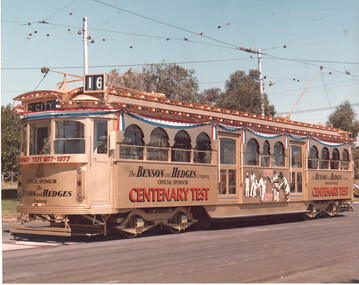
Photograph - Centenary test tram - W7 1024, March 1977
... Centenary Test 1977 sponsored by Benson & Hedges as the official sponsor. The reference gives the month of March 1977 as the operation of the tram in the livery. Done before cigarette sponsoring of major sports events was banned, Yields information decoration of tram 1024 for the 1977 Centenary test. tramways W7 class tram 1024 cricket decorated trams In ink "4" Colour print with a number on the rear. ...Colour print of W7 class tram 1024 (City Route 16) in an all-over advertising livery for the Centenary Test 1977 sponsored by Benson & Hedges as the official sponsor. The reference gives the month of March 1977 as the operation of the tram in the livery. Done before cigarette sponsoring of major sports events was banned,Yields information decoration of tram 1024 for the 1977 Centenary test.Colour print with a number on the rear.In ink "4"tramways, w7 class, tram 1024, cricket, decorated trams
