
Showing 64 items matching "centenary plates"
-
 Warrnambool and District Historical Society Inc.
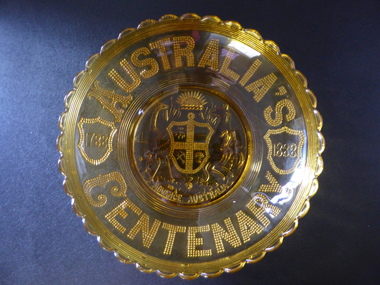
Plates x 4, Henry Greener and Company of Sunderland England, Souvenirs of Australian Centenary 1788-1888, 1888
... ...centenary plates...These plates were pressed to commemorate the centenary of the European settlement of Australia. ...Text is stippled glass on the back which appears through to the inside of the dish.An early version of Australian Coat of Arms is in the centre with the centenary years inside shields, either side. 001423.2 A smaller version of 001423.1 001423.3 Small clear glass saucer shaped dish with same design as the larger dishes. 001423.4 Small amber coloured shallow dish with small glass handle on each side. Pattern matching the larger plates...Centenary in stippled glass around the edge of each dish. Advance Australia below the the Coat of Arms. 1788 1888. R*No 88120 behind one scallop on edge on each plate...The pressed glass was a common method of manufacturing around that period and of which they are an excellent example. warrnambool centenary of australia centenary plates 1788-1888 Australia's Centenary in stippled glass around the edge of each dish. ...These plates were pressed to commemorate the centenary of the European settlement of Australia. A large number were produced and the were distributed throughout AustraliaThese plates are a good example of souvenirs which were produced to commemorate the celebrations of the centenary of European settlement of Australia. The pressed glass was a common method of manufacturing around that period and of which they are an excellent example.001423.1 Large rounded amber glass dish with scalloped edge and seven fine rings below. Text is stippled glass on the back which appears through to the inside of the dish.An early version of Australian Coat of Arms is in the centre with the centenary years inside shields, either side. 001423.2 A smaller version of 001423.1 001423.3 Small clear glass saucer shaped dish with same design as the larger dishes. 001423.4 Small amber coloured shallow dish with small glass handle on each side. Pattern matching the larger plates is embossed on underside of the dish. The surface is scored acroos the centre bottom of the dish.Australia's Centenary in stippled glass around the edge of each dish. Advance Australia below the the Coat of Arms. 1788 1888. R*No 88120 behind one scallop on edge on each platewarrnambool, centenary of australia, centenary plates, 1788-1888 -
 Jonadab Masonic Lodge No. 771
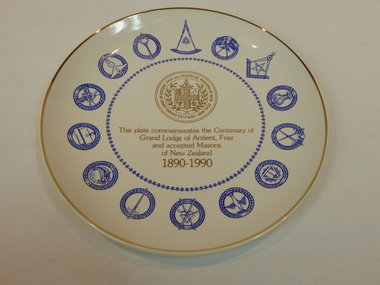
Plate
... ...centenary...plate...This plate was created as one of 5000 only to commemorate the Centenary of the Grand Lodge of Antient Free and Accepted Masons of New Zealand 1890-1990. ...Plate - Front "This plate commemorates the Centenary of Grand Lodge of Antient, Free and accepted Masons of New Zealand 1890-1990" Plate - Back "GRAND LODGE OF NEW ZEALAND CENTENARY PLATE" "This plate has been created as one of 5000 only to commemorate the centenary of the Grand Lodge of Antient Free and Accepted Masons of New Zealand" "Conceived by Lodge St Andrew No. 32 the design was authorised by the Most Worshipful the Gand Master" "Manufactured by Crown Lynn Potteries Limited, New Zealand" Blue Outer box - Front Inscription as above Blue Outer box - Back Inscription as above6y ...This item is significant to Jonadab because it was presented to the Lodge by WBro Donald Viles PGOrganist (New Zealand Constitution) - as a token of affection when he was Master of Jonadab Lodge in 1999-2000. kimbolton nz centenary plate jonadab lodge grand lodge commemorate lodge st andrew no 32 grand master design donald viles Plate - Front "This plate commemorates the Centenary of Grand Lodge of Antient, Free and accepted Masons of New Zealand 1890-1990" Plate - Back "GRAND LODGE OF NEW ZEALAND CENTENARY PLATE" "This plate has been created as one of 5000 only to commemorate the centenary of the Grand Lodge of Antient Free and Accepted Masons of New Zealand" "Conceived by Lodge St Andrew No. 32 the design was authorised by the Most Worshipful the Gand Master" "Manufactured by Crown Lynn Potteries Limited, New Zealand" Blue Outer box - Front Inscription as above Blue Outer box - Back Inscription as above6y Ceramic Plate - white with good rim and fourteen assorted Masonic Symbols in blue paint. ...This plate was created as one of 5000 only to commemorate the Centenary of the Grand Lodge of Antient Free and Accepted Masons of New Zealand 1890-1990. It was conceived by Lodge St Andrew No. 32, and the design was authorised by the Most Worshipful the Gand Master of New Zealand.This item is significant to Jonadab because it was presented to the Lodge by WBro Donald Viles PGOrganist (New Zealand Constitution) - as a token of affection when he was Master of Jonadab Lodge in 1999-2000.Ceramic Plate - white with good rim and fourteen assorted Masonic Symbols in blue paint. Gold printing and gold UGLNZ sealPlate - Front "This plate commemorates the Centenary of Grand Lodge of Antient, Free and accepted Masons of New Zealand 1890-1990" Plate - Back "GRAND LODGE OF NEW ZEALAND CENTENARY PLATE" "This plate has been created as one of 5000 only to commemorate the centenary of the Grand Lodge of Antient Free and Accepted Masons of New Zealand" "Conceived by Lodge St Andrew No. 32 the design was authorised by the Most Worshipful the Gand Master" "Manufactured by Crown Lynn Potteries Limited, New Zealand" Blue Outer box - Front Inscription as above Blue Outer box - Back Inscription as above6y kimbolton, nz, centenary, plate, jonadab lodge, grand lodge, commemorate, lodge st andrew no 32, grand master, design, donald viles -
 Tatura Irrigation & Wartime Camps Museum
Souvenir Spoon, Sonic, 1984
... There is a coloured picture of the Tatura Fire Station with the wording Tatura Fire Brigade Centenary 1884-1984. Silver plated....There is a coloured picture of the Tatura Fire Station with the wording Tatura Fire Brigade Centenary 1884-1984. Silver plated. Souvenir Spoon Sonic ...Tatura Fire Brigade memorabilia produced for centenarySouvenir spoon in plastic case. There is a coloured picture of the Tatura Fire Station with the wording Tatura Fire Brigade Centenary 1884-1984. Silver plated.souvenir spoons, tatura fire brigade -
 Mission to Seafarers Victoria
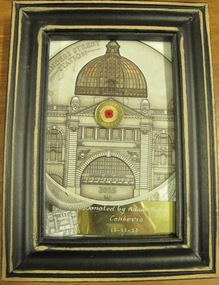
Mixed media - Framed Collage, Flinders Street Station 2015 (commemorative print), 2015
... Possibly Anzac-linked given the centenary of this event. world war 1 flinders street station prints collage poppy ww1 first world war great war coin memorabilia adam baker canberra 11 november 2015 artwork-paintings Engraved plaque at lower edge of print: Donated by Adam Baker ( Bakewell ?) / Canberra 11/11/2015 Framed and glazed depiction of Flinders Street Station with a $2 coin with enamelled poppy and an engraved description on a small brass plate ...Produced 2015 to commemorate WW1. Possibly Anzac-linked given the centenary of this event.Framed and glazed depiction of Flinders Street Station with a $2 coin with enamelled poppy and an engraved description on a small brass plate. Engraved plaque at lower edge of print: Donated by Adam Baker ( Bakewell ?) / Canberra 11/11/2015world war 1, flinders street station, prints, collage, poppy, ww1, first world war, great war, coin, memorabilia, adam baker, canberra, 11 november, 2015, artwork-paintings -
Federation University Historical Collection
Album, Newspaper Clippings Scrap Book on Henry Sutton
... plate glass...concertina...r.h. sutton music warehouse...organ harmonium...ballarat temperance hall...fire...accordian...musical instruments...St Paul's Anglican Church...Bakery Hill...military side-drums...ballarat volunteer Rangers fife band...shops...street broadcasting...complete music store...concord piano...alfred sutton...walter sutton...fred sutton...e. gordon.jones...astor radio...centenary...Shepperd cooper's reading room plate glass concertina r.h. sutton music warehouse organ harmonium ballarat temperance hall fire accordian musical instruments St Paul's Anglican Church Bakery Hill military side-drums ballarat volunteer Rangers fife band shops street broadcasting complete music store concord piano alfred sutton walter sutton fred sutton e. gordon.jones astor radio centenary dinner jeffrey sutton music stool orguinette harp chilver wilson benefit Collard and collard w.h. figgis hydraulic lift sturt street mary sutton advertisements sutton's cycle agency a. leslie sutton gramophone Several folders of newspaper articles relating to Henry Sutton. ...Henry Sutton is a talented world-wide accepted inventor with inventions relating to the telephone, photography, wireless, cars, motorcycles, and bicycles as well as many more inventions. Henry was also one of four brothers that ran the Sutton's Music Store after the death of their Father Richard Sutton. Henry Sutton taught Applied Electricity at the Ballarat School of Mines in 1883 to 1886. Several folders of newspaper articles relating to Henry Sutton. henry sutton, mining companies, hugo brunn, main road, ballarat east, sutton music seller, plank road, richard sutton, flutina, halophone, inventions, instruments, all saints mining company, phillipson jeweller, ballaarat mechanics' institute, w.g. shepperd, cooper's reading room, plate glass, concertina, r.h. sutton music warehouse, organ harmonium, ballarat temperance hall, fire, accordian, musical instruments, st paul's anglican church, bakery hill, military side-drums, ballarat volunteer rangers fife band, shops, street broadcasting, complete music store, concord piano, alfred sutton, walter sutton, fred sutton, e. gordon.jones, astor radio, centenary dinner, jeffrey sutton, music stool, orguinette, harp, chilver wilson benefit, collard and collard, w.h. figgis, hydraulic lift, sturt street, mary sutton, advertisements, sutton's cycle agency, a. leslie sutton, gramophone -
 Ballarat Clarendon College
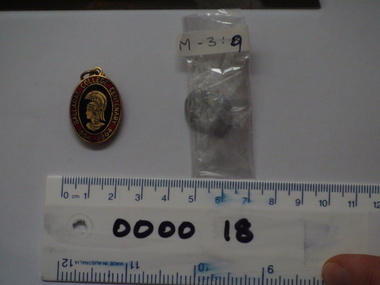
Badge, 1964 (exact)
... Gold-plated, oval-shaped medallion featuring Ballarat College crest and centenary inscription. ...As such is appropriately expresses the sentiment of the College council at this auspicious milestone in the College history and reflects the Christian heritge of the College. badge centenary medallion ballarat college ballarat college centenary 1964 Inscribed around Minerva Head 'BALLARAT COLLEGE CENTENARY 1864-1964' Inscribed on back of medallion: 'SICUT / PATRIBUS / SIT DEUS / NOBIS' Gold-plated, oval-shaped medallion featuring Ballarat College crest and centenary inscription. ...This medallion was produced for the Ballarat College centenary celebrations held during 1964. The insciption on the back of the medallion is translated: 'as with our fathers, may God be with us'. As such is appropriately expresses the sentiment of the College council at this auspicious milestone in the College history and reflects the Christian heritge of the College.Gold-plated, oval-shaped medallion featuring Ballarat College crest and centenary inscription. The college crest is red and black enamel and the Minerva head, inscriptions and other marking are gold-plate. There is circular link attachment at the top. The following insciption is on back of the medallion: 'SICUT PATRIBUS SIT DEUS NOBIS'Inscribed around Minerva Head 'BALLARAT COLLEGE CENTENARY 1864-1964' Inscribed on back of medallion: 'SICUT / PATRIBUS / SIT DEUS / NOBIS'badge, centenary, medallion, ballarat college, ballarat college centenary, 1964 -
Ballarat Clarendon College
Book, Byron
... centenary - A history of Ballarat College 1864 - 1964. Example of ongoing old collegian support of school. The Weatherly Library was opened in 1936 and its collection significantly established by donation or bequest of old collegians. Book plate ...Old Collegian Graeme Mein was the son of W G Mein & Alma (Catbush) Mein (O/C1928); wife Margaret (Yelland) Mein (O/C1959) and brother of Russell, Phillip & Jocelyn. W Gordon Mein, former staff member (1954 - 1964), compiled a history of the college for the centenary - A history of Ballarat College 1864 - 1964. Example of ongoing old collegian support of school. The Weatherly Library was opened in 1936 and its collection significantly established by donation or bequest of old collegians.Plain black covered book with gold lettering on spine. Book plate inside front cover: Ballarat College Library / PRESENTED BY / W G Mein Esq. / 1958.... -
Glenelg Shire Council Cultural Collection
Souvenir - Plate - Bicentenary of Australia, c. 1970
... Patented in 1813 by Charles James Mason in Staffordshire, England, it was an immediate success, and ironstone blanks were decorated with transfer patterns or hand painting to imitate Chinese porcelain. celebration souvenir Australian souvenir 1970 1770 bicentenary ironstone English ironstone Front: 'To commemorate the Bi-Centenary of the Discovery of Australia 1770-1970' - black, around inner rim Back: Short history of James Cook's voyage to Australia. History of HMB 'Endeavour'. Makers mark. Alpine white English ironstone Wood & Sons, plate ...Ironstone is a porous earthenware, made of clay mixed with feldspar. Patented in 1813 by Charles James Mason in Staffordshire, England, it was an immediate success, and ironstone blanks were decorated with transfer patterns or hand painting to imitate Chinese porcelain.Alpine white English ironstone Wood & Sons, plate commemorating bicentenary of Australia, 1770-1970. Black and white depiction of HMS 'ENDEAVOUR', Capt. James Cook, Coats of Arms for states of Australia, Australian Coat of Arms; background of state floral emblems.Front: 'To commemorate the Bi-Centenary of the Discovery of Australia 1770-1970' - black, around inner rim Back: Short history of James Cook's voyage to Australia. History of HMB 'Endeavour'. Makers mark.celebration, souvenir, australian souvenir, 1970, 1770, bicentenary, ironstone, english ironstone -
Glenelg Shire Council Cultural Collection
Souvenir - Commemorative Sandwich Plate - The MacRobertson Trophy Air Race, c. 1934
... The race was devised by the Lord Mayor of Melbourne, Sir Harold Gengoult Smith,[1] and the prize money of £15,000 was provided by Sir Macpherson Robertson, a wealthy Australian confectionery manufacturer, on the conditions that the race be named after his MacRobertson confectionery company, and that it was organised to be as safe as possible.[2] A further condition was that a gold medal be awarded to each pilot who completed the course within 16 days Uk Australia air race MacRobertson Air Race 1934 Melbourne Centenary Front: VICTORIAN AND MELBOURNE CENTENARY 1934-1935 - etched from beneath Clear glass sandwich plate, commemorating the Air Race from UK to Australia. ...From Wikipedia: The MacRobertson Trophy Air Race (also known as the London to Melbourne Air Race) took place in October 1934 as part of the Melbourne Centenary celebrations. The race was devised by the Lord Mayor of Melbourne, Sir Harold Gengoult Smith,[1] and the prize money of £15,000 was provided by Sir Macpherson Robertson, a wealthy Australian confectionery manufacturer, on the conditions that the race be named after his MacRobertson confectionery company, and that it was organised to be as safe as possible.[2] A further condition was that a gold medal be awarded to each pilot who completed the course within 16 daysClear glass sandwich plate, commemorating the Air Race from UK to Australia. Map of UK and Australia, aeroplanes, etched into glass.Front: VICTORIAN AND MELBOURNE CENTENARY 1934-1935 - etched from beneathuk australia air race, macrobertson air race, 1934, melbourne centenary -
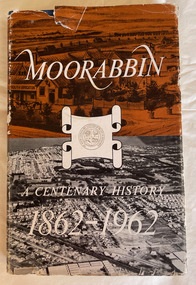 City of Moorabbin Historical Society (Operating the Box Cottage Museum)
Book, Thomas Arthur Sheehy, Moorabbin : a centenary history, 1862-1962, 1962
... moorabbin moorabbin history History of Moorabbin and surrounding suburbs that were part of the Moorabbin Roads Board, Moorabbin Shire, Moorabbin Council. 96 p., 24 leaves of plates : ill. ; Moorabbin : a centenary history, 1862-1962. ...History of Moorabbin and surrounding suburbs that were part of the Moorabbin Roads Board, Moorabbin Shire, Moorabbin Council.96 p., 24 leaves of plates : ill. ;non-fictionHistory of Moorabbin and surrounding suburbs that were part of the Moorabbin Roads Board, Moorabbin Shire, Moorabbin Council.moorabbin, moorabbin history -
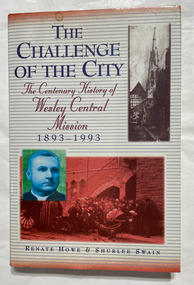 City of Moorabbin Historical Society (Operating the Box Cottage Museum)
Book, Howe, Renate et al, The challenge of the city : the centenary history of Wesley Central Mission 1893-1993, 1993
... plates : ill., maps, ports. Includes bibliographies p. 218-234, and index. The challenge of the city : the centenary history of Wesley Central Mission 1893-1993 Book Howe, Renate Swain, Shurlee ...240 p., [40] p. of plates : ill., maps, ports. Includes bibliographies p. 218-234, and index.non-fictionreligion, wesley central mission, uniting church, city missions -
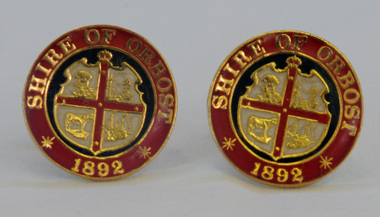 Orbost & District Historical Society
cuff links, 1992
... centenary of the formation of the Shire of Orbost - 1892-1992. Orbost was at first included in the Bairnsdale Shire from 1882 and was later part of the Tambo Shire. Because of travelling distances the Croajingalong Shire was created in 1892 (name changed to Orbost Shire 17.2.1893 with James Cameron as the first Shire President. In 1994 it amalgamated to become part of East Gippsland Shire Council. cuff-links souvenir memento Orbost-Shire-Council Shire of August 1892 A pair of gold-plated ...This pair of cuff links was produced in 1992 as a memento/souvenir to commemorate the centenary of the formation of the Shire of Orbost - 1892-1992. Orbost was at first included in the Bairnsdale Shire from 1882 and was later part of the Tambo Shire. Because of travelling distances the Croajingalong Shire was created in 1892 (name changed to Orbost Shire 17.2.1893 with James Cameron as the first Shire President. In 1994 it amalgamated to become part of East Gippsland Shire Council.A pair of gold-plated and enamel cuff links embossed with the Shire of Orbost Coat of Arms and the year of inauguration.Shire of August 1892cuff-links souvenir memento orbost-shire-council -
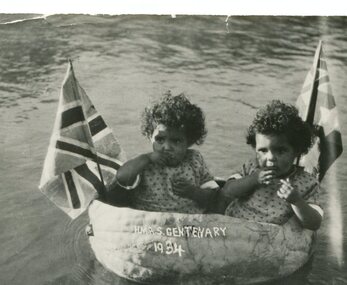 Orbost & District Historical Society
black and white photograph, Warren, Mrs H, 1934
... plates in bright sunlight and ruined them, to a competent photographer who became both the local press correspondent and an inveterate producer of humorous trompe l’oeil postcard images. This photograph has significance in its association with Helen Frances Warren, a popular Orbost identity who was well known as an accomplished photographer and needleworker. pumpkins-orbost warren-helena-photographer mason-marion mason-may aboriginal-children A black / white photograph of two small twin Aboriginal girls in a large pumpkin floating on water. There is a Union Jack at each end with "HMAS CENTENARY ...This is a photograph of the twin daughters of Mrs Trixie Mason - Marion and May,. They had a brother Alec Mason. The Mason Twins are the granddaughters of George and Agnes Thomas from Newmerella . The photographer was Warren, Helena (1871-1962) who was a self-taught photographer who became both the local press correspondent and a producer of humorous trompe l'oeil postcard images. Helena Warren was a thirty-two year old settler living on a small mixed farm with her husband, William, at Newmerella, near Orbost in Gippsland, Victoria, when she bought her first camera, an Austral Box quarter-plate. Her family says she was entirely self-taught, like many women photographers who started out with nothing but the instructions on the packets of film and chemicals. In over fifty years practice she graduated from the total novice, who opened all her first mail order plates in bright sunlight and ruined them, to a competent photographer who became both the local press correspondent and an inveterate producer of humorous trompe l’oeil postcard images.This photograph has significance in its association with Helen Frances Warren, a popular Orbost identity who was well known as an accomplished photographer and needleworker.A black / white photograph of two small twin Aboriginal girls in a large pumpkin floating on water. There is a Union Jack at each end with "HMAS CENTENARY 1934" on the side.pumpkins-orbost warren-helena-photographer mason-marion mason-may aboriginal-children -
 Seaworks Maritime Museum
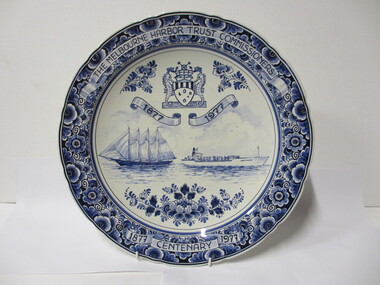
Plate
... Plate created to celebrate the centenary of the Melbourne Harbor Trust beginning operations. ...Plate created to celebrate the centenary of the Melbourne Harbor Trust beginning operations. ...Plate created to celebrate the centenary of the Melbourne Harbor Trust beginning operations. Presented by Australian Dredging and General works Pty. Ltd. Large blue and white Dutch Delftware ceremonial plate with image of two ships, one sailing ship and the Abel Tasman at sea. The Melbourne Harbor Trust shield features above the ships. "The Melbourne Harbor Trust Commissioners/ 1877 Centenary 1977/ 1877 1977/ Abel Tasman" On reverse: "Presented by/ Australian Dredging and/ General works Pty. Ltd./ Delfts blauw/ Hand painted / Made in Holland/ Wp." Sticker attached "43196 B" "PMA 0166/1" -
 Eltham District Historical Society Inc
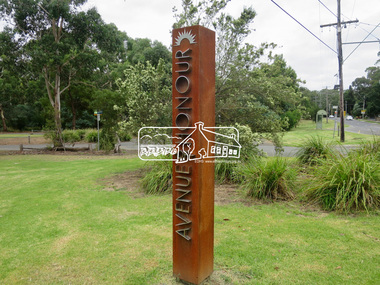
Photograph, Jim Connor, Avenue of Honour, Main Road, Eltham, 14 Jan 2017
... plates were later added. In the ‘20s and ‘30s too many branches were broken off by carriers whipping their horses up the steep slope. In the 1950s many of the original trees were removed for road widening and new plane trees were planted in their place. In June 2015 during the Anzac Centenary...plates were later added. In the ‘20s and ‘30s too many branches were broken off by carriers whipping their horses up the steep slope. In the 1950s many of the original trees were removed for road widening and new plane trees were planted in their place. In June 2015 during the Anzac Centenary ...Walking or driving up Main Road, you enter Eltham’s Avenue of Honour, with its rows of plane trees, each commemorating the death of a soldier sent to fight in World War 1. 115 trees were first planted on 21st September 1917 beginning at “the flat” to the intersection of Pitt Street. Tree guards and copper name plates were later added. In the ‘20s and ‘30s too many branches were broken off by carriers whipping their horses up the steep slope. In the 1950s many of the original trees were removed for road widening and new plane trees were planted in their place. In June 2015 during the Anzac Centenary, Nillumbik Shire Council dedicated the new Avenue of Honour in the Eltham Gateway. New markers commemorate local soldiers. Tomorrow's history documented todayeltham, jim connor collection, main road, avenue of honour, eltham gateway, commemoration, marker -
 Eltham District Historical Society Inc
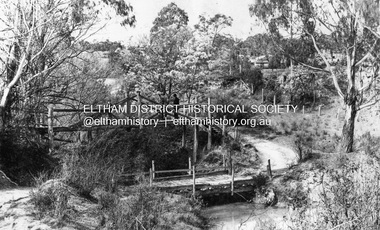
Negative - Photograph, Diamond Creek, Eltham. Old Diamond Street Bridge
... centenary project book,"Pioneers and Painters: 100 years of the Shire of Eltham" by Alan Marshall (1971). The collection of over 500 images is held in partnership between Eltham District Historical Society and Yarra Plenty Regional Library (Eltham Library) and is now formally known as 'The Shire of Eltham Pioneers Photograph Collection.' It is significant in being the first community sourced collection representing the places and people of the Shire's first one hundred years. Diamond Creek Diamond Street Bridge Eltham Eltham Railway Station Glass Plate ...Copy of Rose Series Postcard P. 4314. (The Rose Stereograph Company) Shows two bridge crossings over the Diamond Creek in Diamond Street, Eltham. The upper pedestrian crossing provided continual access for foot traffic during times of flood. The railway came to Eltham in 1901, the Eltham Railway Station is visible in the distance as well as a wooden bodied Tait (Red Rattler) First Class train carriage. The Tait train was first introduced in 1910 as a steam locomotive hauled carriage and in 1919 electric motor carriages were introduced however the line to Heidelberg was not electrified till 1921 and to Eltham in April 1923. The Railway General Store on Main Road is visible beyond the station and was built by Luther Haley in 1902. It was the first shop in the present day shopping centre. It was later known as lloyd's stopre (1917-1920) followed by a succession of six other owners until purchased by Eric Staff in 1939. George Rose founded the Rose Stereograph Company in 1880 and was joined by Herbert (Bert) Cutts in the early 20th Century. The pair formed a lifetime working partnership and strong personal friendship. Assisted by George’s two sons, Herbert George and Walter, and later by Neil Cutts, the Rose Stereograph Company continued its operations for more than 140 years. The company was initially built on stereographs, but as cinema took over and stereographs fell out of fashion, the Rose Stereograph Company developed Australia’s first commercially viable photographic postcard business. Specialising in postcards of iconic historical moments and significant landmarks, The Rose Stereograph Company became a staple of the Australian travel industry.This photo forms part of a collection of photographs gathered by the Shire of Eltham for their centenary project book,"Pioneers and Painters: 100 years of the Shire of Eltham" by Alan Marshall (1971). The collection of over 500 images is held in partnership between Eltham District Historical Society and Yarra Plenty Regional Library (Eltham Library) and is now formally known as 'The Shire of Eltham Pioneers Photograph Collection.' It is significant in being the first community sourced collection representing the places and people of the Shire's first one hundred years.Digital image 4 x 5 inch B&W Negdiamond creek, diamond street bridge, eltham, eltham railway station, glass plate negative, lloyd's general store, postcard, railway station, railway store, rose series postcard, rose stereograph company, shire of eltham pioneers photograph collection, staffs general store, tait train, travel -
 Eltham District Historical Society Inc
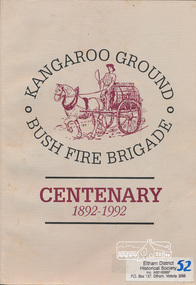
Book, Bruce Bence, Kangaroo Ground Bush Fire Brigade, centenary 1892-1992 : the story of the Kangaroo Ground Fire Brigade / Bruce Bence, 1992
... This book is significant in that not only does it traces the development of Kangaroo Ground Bush fire brigade since 1892 and of emergency services in the area but it also gives an insight into the people and their community. kangaroo ground fire brigades emeregency services kangaroo ground fire brigade fires bush fires shire of eltham war memorial kangaroo ground tower ISBN 064606651X Softcover; 61 p., [7] p. of plates : b&w ill., 7 maps, ports. Kangaroo Ground Bush Fire Brigade, centenary 1892-1992 : the story of the Kangaroo Ground Fire Brigade / Bruce Bence. ...Contents (described as Index): The early days, Ewen Hugh Cameron, 1914-1939, Supporting organisations, Eltham Emergency Operations Centre, Kangaroo Ground Fire Brigade Ladies Auxiliary, The fire tower, the Salvation Army and Red Cross, 1930-1992, The Kangaroo Ground Fire Brigade Today, Kangaroo Ground Fire Brigade Chronology. Includes a list of names of office bearers. Also includes references to neighbouring brigades and copies of historical newspaper articles. This publication was supported by the resources, information and facilities of The Shire of Eltham Historical Society.This book is significant in that not only does it traces the development of Kangaroo Ground Bush fire brigade since 1892 and of emergency services in the area but it also gives an insight into the people and their community.Softcover; 61 p., [7] p. of plates : b&w ill., 7 maps, ports.ISBN 064606651Xkangaroo ground, fire brigades, emeregency services, kangaroo ground fire brigade, fires, bush fires, shire of eltham war memorial, kangaroo ground tower -
 Bendigo Historical Society Inc.
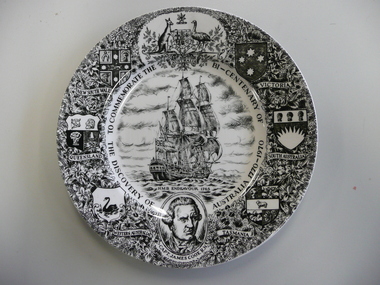
Souvenir - BI-CENTENARY PLATE, 1970
... BI-CENTENARY PLATE...AUSTRALIA History captain cook Wood & Sons Ltd Burslem England Black and white round china plate commemorating the discovery of Australia 1770-1970 depicting James Cook, the Endeavour & coats of arms of States on front, on back the history of Capt James Cook and the Endeavour. Souvenir BI-CENTENARY PLATE ...Black and white round china plate commemorating the discovery of Australia 1770-1970 depicting James Cook, the Endeavour & coats of arms of States on front, on back the history of Capt James Cook and the Endeavour.Wood & Sons Ltd Burslem Englandaustralia, history, captain cook -
 Bendigo Historical Society Inc.
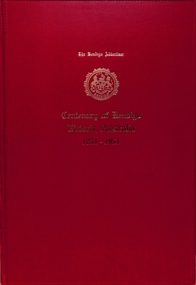
Newspaper - Griffith Collection: Centenary of Bendigo Supplement 1851 - 1951, 1951
... Centenary Bendigo Advertiser Supplement Inside front cover is name plate of "R. ...Bendigo Advertiser Supplement "Centenary of Bendigo Supplement 1851 - 1951", bound in red leather. Title "The Bendigo Advertiser Centenary of Bendigo Victoria, Australia 1851 - 1951" and City of Bendigo Coat of Arms embossed in gold lettering. Lined inside back and front covers with red, black and gold paper with geometric pattern. Red leather reinforcing along the seams. 76pp. Black and white illustrations and photographs. Page 76 has a full-page brown and gold advertisement for Reed's Drinks and Cordials. Owner has pasted in two copies of cuttings of newspaper articles about Rae's School.Inside front cover is name plate of "R. A. Anderson" with a shield .centenary, bendigo advertiser, supplement -
 Bendigo Historical Society Inc.
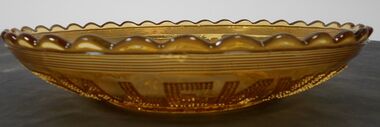
Domestic object - 1888 Australian Centenary Bowl
... plate was made by Henry Greener and Company of Sunderland England in 1887 or 1888. The company specialised in the manufacture of commemorative pressed glass. They received commissions from British and colonial clients, and individuals and organisations outside the Empire. The glassware typically commemorated prominent individuals or events. https://collection.powerhouse.com.au/object/8811 Centenary ...This plate was made by Henry Greener and Company of Sunderland England in 1887 or 1888. The company specialised in the manufacture of commemorative pressed glass. They received commissions from British and colonial clients, and individuals and organisations outside the Empire. The glassware typically commemorated prominent individuals or events. https://collection.powerhouse.com.au/object/8811 Amber Glass Bowl with frilled top commemorating Australia's Centenary 1788-1888. Showing Australian coat of arms with Emu and Kangaroo encircled with wording advance Australia. Australia's centenary and 1788 1888 in shieldcentenary 1788 - 1888, coat of arms, amber glass -
 Warrnambool and District Historical Society Inc.
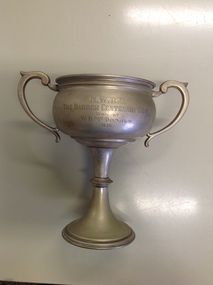
Unknown - Trophy, NWRC Barber Cup 1935
... This is a sports trophy cup made of electro-plated nickel silver (now very tarnished). It was a trophy named ‘The Barber Centenary Cup’ given for competitions amongst the North Warrnambool Rifle Club members during 1934-5. ...The Barber Centenary Cup Won by W.D.McDonald 1935 On base: E.P.N.S. Empire Plate ...The Barber Centenary Cup Won by W.D.McDonald 1935 On base: E.P.N.S. Empire Plate This is a sports trophy cup made of electro-plated nickel silver (now very tarnished). ...The North Warrnambool Rifle Club was operating in Warrnambool in the 1930s. It had 132 members in 1935. A noted member was the well-known local photographer, Arthur Jordan whose father, Joseph, was a crack rifle shot and was a member of the Warrnambool Rifle Club. The Barber Centenary Cup was presumably established to commemorate the Centenary of Victoria as the cup competitions commenced in 1934 and were completed in 1935. The competitions were usually held over distances of 300, 500 and 600 yards. It is not known which member of the several Barber families in Warrnambool at the time donated the cup but G. Barber was a member of the Rifle Club in 1934-5 and winner of the Gray Centenary Cup. W. D. McDonald, the winner of the trophy, was the Captain of the C lub in 1935.This item is significant as it is connected with early 20th century Warrnambool sport (rifle shooting). It shows what sort of award was given for competition winners and reveals the popularity of rifle shooting in Warrnambool in earlier decades, with two clubs existing at that timeThis is a sports trophy cup made of electro-plated nickel silver (now very tarnished). It was a trophy named ‘The Barber Centenary Cup’ given for competitions amongst the North Warrnambool Rifle Club members during 1934-5. On cup: N.W.R.C. The Barber Centenary Cup Won by W.D.McDonald 1935 On base: E.P.N.S. Empire Plate warrnambool;, rifle shooting; barber centenary cup; w.d.mcdonald, barber centenary cup, w.d.mcdonald -
 Bendigo Historical Society Inc.
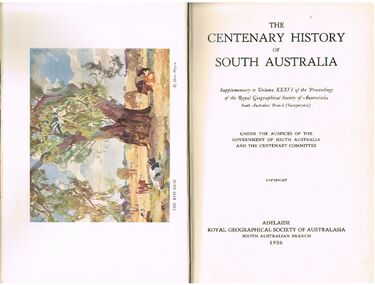
Book - ALEC H CHISHOLM COLLECTION: BOOK ''CENTENARY HISTORY OF SOUTH AUSTRALIA''
... CENTENARY ROYAL GEOGRAPHICAL SOCIETY OF AUSTRALASIA HISTORY Various Book. ALEC H CHISHOLM COLLECTION. 420 page history of South Australia (1836 - 1936). Illustrated with B & W photos, maps and a colour plate ...Book. ALEC H CHISHOLM COLLECTION. 420 page history of South Australia (1836 - 1936). Illustrated with B & W photos, maps and a colour plate of a painting by Hans Heysen. Published in 1936 by The Royal Geographical Society of Australasia ( South Australian Branch). Printed by the Hassell Press, Adelaide. Chapters written by various contributors. Catalogue sticker ''2165 VAR'' on spine. A typed page stuck on the flyleaf indicates the book belonged to the Education Dept., Adelaide. Handwritten in ink on this typed insert ''Given to me by Adey's successor, Dr. C. Fenner. A H Chisholm''Variousbooks, collections, history, alec h chisholm collection, south australia, centenary, royal geographical society of australasia, history -
 Alfred Hospital Nurses League - Nursing History Collection
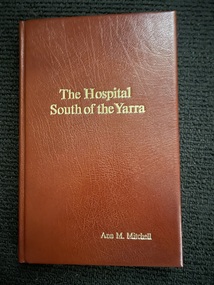
Book - Illustrated book, Ann M.Mitchell, The hospital south of the Yarra: a history of Alfred Hospital Melbourne from foundation to the nineteen-forties, 1977
... Commissioned by the Board of Management as part of Alfred Hospital's centenary celebrations in 1971 Important to the AHNL as a record Of Alfred Hospital history (including nursing) Alfred Hospital AHNL nursing history Melbourne Prahan History of Alfred Hospital Melbourne Previous catalogue number written in black ink at top right of front-end page. On title page is a white book plate ...History of Alfred Hospital MelbourneIllustrated hardcover book with red brown cover. Title and authors name embossed in gold on front cover and spinenon-fictionHistory of Alfred Hospital Melbournealfred hospital, ahnl, nursing history, melbourne, prahan -
 Narre Warren and District Family History Group
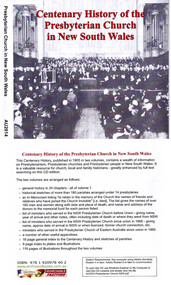
Document, James Cameron, Centenary history of the Presbyterian Church in NSW, 2004
... . ~ ministers who served in the Presbyterian Church of Eastern Australia since union in 1865 ~ a number of other useful appendixes ~ 16 page general index to the Centenary History and sketches of parishes ~ 9 page index to plates and illustrations ~ 116 pages of illustrations throughout the two volumes 1 optical disc Centenary history of the Presbyterian Church in NSW Document James Cameron Archive CD Books Australia ...Centenary History of the Presbyterian Church in New South Wales This Centenary History, published in 1905 in two volumes, contains a wealth of information on Presbyterianism, Presbyterian churches and Presbyterian people in New South Wales. It is a valuable resource for church, local and family historians - greatly enhanced by full text searching on this CD edition. The two volumes are arranged as follows: ~ general history in 24 chapters - all of volume 1 ~ historical sketches of more than 180 parishes arranged under 14 presbyteries ~ an In Memoriam listing "to retain in the memory of the Church the names of friends and relatives who have joined the Church Invisible" [i.e. died]. The list gives the names of over 160 men and women along with date and place of death, and name and address of the donors to the memorial fund for each person listed. ~ list of ministers who served in the NSW Presbyterian Church before Union - giving name, year of arrival and other notes, often including date of death or where they went from NSW ~ list of ministers who served in the NSW Presbyterian Church since union in 1866 - giving name, approx date of arrival in NSW or when licensed, former church connection, etc. ~ ministers who served in the Presbyterian Church of Eastern Australia since union in 1865 ~ a number of other useful appendixes ~ 16 page general index to the Centenary History and sketches of parishes ~ 9 page index to plates and illustrations ~ 116 pages of illustrations throughout the two volumes1 optical discnon-fictionCentenary History of the Presbyterian Church in New South Wales This Centenary History, published in 1905 in two volumes, contains a wealth of information on Presbyterianism, Presbyterian churches and Presbyterian people in New South Wales. It is a valuable resource for church, local and family historians - greatly enhanced by full text searching on this CD edition. The two volumes are arranged as follows: ~ general history in 24 chapters - all of volume 1 ~ historical sketches of more than 180 parishes arranged under 14 presbyteries ~ an In Memoriam listing "to retain in the memory of the Church the names of friends and relatives who have joined the Church Invisible" [i.e. died]. The list gives the names of over 160 men and women along with date and place of death, and name and address of the donors to the memorial fund for each person listed. ~ list of ministers who served in the NSW Presbyterian Church before Union - giving name, year of arrival and other notes, often including date of death or where they went from NSW ~ list of ministers who served in the NSW Presbyterian Church since union in 1866 - giving name, approx date of arrival in NSW or when licensed, former church connection, etc. ~ ministers who served in the Presbyterian Church of Eastern Australia since union in 1865 ~ a number of other useful appendixes ~ 16 page general index to the Centenary History and sketches of parishes ~ 9 page index to plates and illustrations ~ 116 pages of illustrations throughout the two volumesnew south wales, presbyterian church (nsw) -
 Warrnambool and District Historical Society Inc.
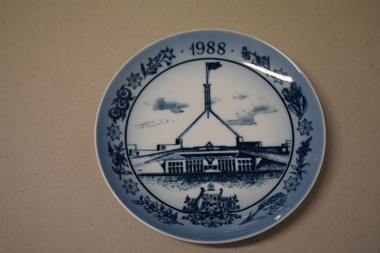
Plate souvenir, Royal Copenhagen, New parliament house
... centenary of australia Front 1988 Reverse ROYAL COPENHAGEN DENMARK and crown. COPYRIGHT THE A.B.A 1981 REG.TRADE MARK OF THE A.B.A. USED UNDER LICENCE BY ROYAL COPENHAGEN NEW PARLIAMENT HOUSE, CANBERRA Logo Australia 1788-1988 Signature " Gorn Uestezaul"(?) Circular ceramic plate ...This item is a souvenir of the Bi- Centenary of Australia (1988) It features the new Parliament House in Canberra which was opened in May 1988 and cost more than one billion dollars to build and contains four thousand seven hundred rooms. This item came from the estate of a well known Warrnambool lawyer and is retained as a high quality souvenir of the Bi-Centenary of AustraliaCircular ceramic plate. White concave surface with blue drawing of Parliament House, Australian Coat of Arms, flowers including banksia, Sturt Desert Pea, eucalypt and seven pointed stars. Reverse has raised inner rim and includes text in blue. Front 1988 Reverse ROYAL COPENHAGEN DENMARK and crown. COPYRIGHT THE A.B.A 1981 REG.TRADE MARK OF THE A.B.A. USED UNDER LICENCE BY ROYAL COPENHAGEN NEW PARLIAMENT HOUSE, CANBERRA Logo Australia 1788-1988 Signature " Gorn Uestezaul"(?)parliament house, bi centenary of australia -
 Sunshine and District Historical Society Incorporated
Mixed media - Mrs Isobel McKay Collection, 1997
... 519.01 - Printers Plate 519.02 - Centenary of McKay invention document 1st Day Cover (1984) 519.03 - 1st Day Cover (1955) 519.04 - Photograph of Albion overpass (1962) 519.05 - McKay homes Talmage Street (1920's) 519.06 - McKay factory site (1962)...Isobel McKay 519.01 - Printers Plate 519.02 - Centenary of McKay invention document 1st Day Cover (1984) 519.03 - 1st Day Cover (1955) 519.04 - Photograph of Albion overpass (1962) 519.05 - McKay homes Talmage Street (1920's) 519.06 - McKay factory site (1962) Various photographs and memorabilia held by Mrs Isobel McKay (wife of Donald "Don" McKay). ...519.01 - Printers Plate 519.02 - Centenary of McKay invention document 1st Day Cover (1984) 519.03 - 1st Day Cover (1955) 519.04 - Photograph of Albion overpass (1962) 519.05 - McKay homes Talmage Street (1920's) 519.06 - McKay factory site (1962)isobel mckay -
 Uniting Church Archives - Synod of Victoria
Commemorative Plate, 1907
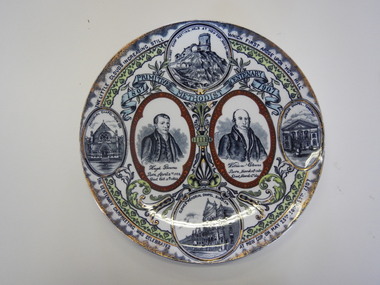
... The is text around the rim of the plate: "The little clouds increasing still which first arose upon Mow Hill" "The Centenary Camp Meeting was celebrated at Mow Cop on May 26th & 27th 1907". ...The is text around the rim of the plate: "The little clouds increasing still which first arose upon Mow Hill" "The Centenary Camp Meeting was celebrated at Mow Cop on May 26th & 27th 1907". ...In 1823 the membership of the Primitive Methodist church in the UK was 33,000. Forty years later, in 1863, membership had grown to half a million making it the third largest religious group after Anglican and Wesleyan Methodist. Primitive Methodism came to Australia in 1840. Source: https://www.movements.net/blog/2016/02/08/lessons-from-the-primitive-methodists-dave-price.htmlCH019.1 - Primitive Methodist white commemorative plate with grey, green, brown and gold illustrations and text. Images: Top: "First camp meeting, held at Mow Cop, May 31 1907". Right side: "Jubilee Chapel, Tunstall". Left side: "Memorial Chapel Mow Cop". Bottom:" Clowes Memorial Chapel, Burslem". Centre: "Hugh Bourne. Born April 3rd 1772. Died Oct 11th 1852" "William Cowes Born march 12th 1780 Died March 2nd 1858". The is text around the rim of the plate: "The little clouds increasing still which first arose upon Mow Hill" "The Centenary Camp Meeting was celebrated at Mow Cop on May 26th & 27th 1907". The back of the plate gives church statistics: "Truly What Hath God Wrought. Chapels & Preaching places 4,905. Ministers 1,153. Local Preachers 16,209. Church Members 210,173. Congregational ... 607,682. Sunday Schools 4,209. Teachers 61,275. Scholars 477,114. Value of Property 4,958,978 pounds. CH019.2 - Same as CH019.1 in white, blue and gold. CH019.3 - Same as CH019.1 with more gold and colour. The wording around the rim is the same but differently placed."1807 PRIMITIVE METHODIST CENTENARY 1907"primitive methodist, primitive methodist jubliee chapel tunstall, mow cop, bourne, hugh, clowes, william -
 Uniting Church Archives - Synod of Victoria
Souvenir tea spoon
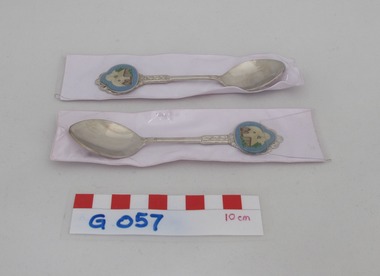
... "Unting Church 1990 Centenary 1890 Invermay" G057.1 and G057.2 - chrome plated souvenir tea spoons with enamelled disc. ...G057.1 and G057.2 - chrome plated souvenir tea spoons with enamelled disc. The tea spoons are in plastic wallets. "Unting Church 1990 Centenary 1890 Invermay" -
 Ballarat Tramway Museum
Domestic Object - China Plate, C.R. Hose Cheltenham, May. 2010
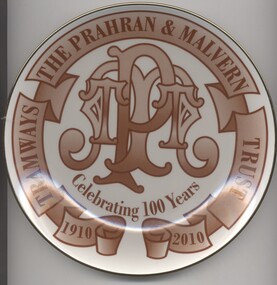
... Approx 200mm dia china plate prepared for the Centenary or 100 years of The Prahran and Malvern Tramways Trust. ...Has a strong association with the celebration of 100 years of the Prahran and Malvern Tramways Trust - some of whose trams operate still for the Ballarat Tramway Museum Tramways trams PMTT Crockery Centenary Celebrations Approx 200mm dia china plate prepared for the Centenary or 100 years of The Prahran and Malvern Tramways Trust. ...Has a strong association with the celebration of 100 years of the Prahran and Malvern Tramways Trust - some of whose trams operate still for the Ballarat Tramway MuseumApprox 200mm dia china plate prepared for the Centenary or 100 years of The Prahran and Malvern Tramways Trust. White china with a gold rim and a red brown PMTT logo and the words "Celebrating 100 years". Made by C.R. Hose Cheltenham for Ron Scholten who organised the celebrations.tramways, trams, pmtt, crockery, centenary, celebrations -
Tatura Irrigation & Wartime Camps Museum
Plate - centenary, Tatura Butter Factory
... Plate - centenary...Plate, boxed, with picture of early Tatura Butter Factory in centre and the inscription "Centenary 1907 - 2007". ...Tatura Butter Factory Plate - centenary ...Produced to mark the centenary of Tatura Milk Industries (originally Butter Factory).Plate, boxed, with picture of early Tatura Butter Factory in centre and the inscription "Centenary 1907 - 2007". Stand enclosed. Gold edge and writing. Red border.as above Tatura Milk Industries Tatura Butter Factory Farmers Produce Coy.tatura milk industries, tatura butter factory, tatura butter factory centenary
