
Showing 323 items matching "charles young"
-
 Marysville & District Historical Society
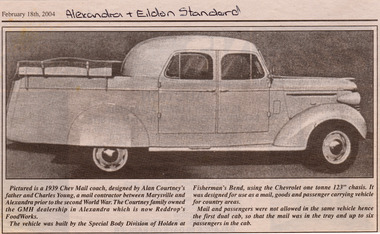
Newspaper (item) - Newspaper article, The Alexandra and Eildon Standard, 18-02-2004
... ...charles young...A newspaper article picturing a 1939 Chev Mail coach, designed by Alan Courtney's father and Charles Young, a mail contractor between Marysville and Alexandra prior to the second World War. ...A newspaper article picturing a 1939 Chev Mail coach, designed by Alan Courtney's father and Charles Young, a mail contractor between Marysville and Alexandra prior to the second World War. ...A newspaper article picturing a 1939 Chev Mail coach, designed by Alan Courtney's father and Charles Young, a mail contractor between Marysville and Alexandra prior to the second World War. ...A newspaper article picturing a 1939 Chev Mail coach, designed by Alan Courtney's father and Charles Young, a mail contractor between Marysville and Alexandra prior to the second World War. The vehicle was built by the Special Body Division of Holden at Fisherman's Bend using the Chevrolet one tonne 123" chassis. It was designed for use as a mail, goods and passenger carrying vehicle for country areas and was used in the Marysville region.A newspaper article picturing a 1939 Chev Mail coach, designed by Alan Courtney's father and Charles Young, a mail contractor between Marysville and Alexandra prior to the second World War. The vehicle was built by the Special Body Division of Holden at Fisherman's Bend using the Chevrolet one tonne 123" chassis. It was designed for use as a mail, goods and passenger carrying vehicle for country areas and was used in the Marysville region.marysville, victoria, australia, alexandra, alexandra & eildon standard, alan courtney, 1939 chev mail coach, charles young -
 Bendigo Historical Society Inc.
Document - Mike Butcher Collection: Bendigo Regional Photographic Library, 1985
... ...Charles Young Chung...Two documents. 1) Typed letter from family member looking for information on Charles Young Chung. Dated 1981. 2) Typed letter from Bendigo Advertiser forwarding on letter from person seeking information on family member. ...Friends of the Bendigo Library Photography Charles Young Chung Two documents. 1) Typed letter from family member looking for information on Charles Young Chung. ...Two documents. 1) Typed letter from family member looking for information on Charles Young Chung. Dated 1981. 2) Typed letter from Bendigo Advertiser forwarding on letter from person seeking information on family member. friends of the bendigo library, photography, charles young chung -
 Bendigo Historical Society Inc.
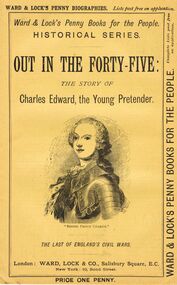
Book - LYDIA CHANCELLOR COLLECTION: CHARLES EDWARD, THE YOUNG PRETENDER
... LYDIA CHANCELLOR COLLECTION: CHARLES EDWARD, THE YOUNG PRETENDER...A book titled ' Out in the forty-five: The story of Charles Edward, the Young Pretender. The last of England's Civil Wars. ...Book LYDIA CHANCELLOR COLLECTION: CHARLES EDWARD, THE YOUNG PRETENDER ...A book titled ' Out in the forty-five: The story of Charles Edward, the Young Pretender. The last of England's Civil Wars. Published London : Ward, Lock & Co., Salisbury Square, E.C. New York : 10 Bond Street. 65 - 80 pgs, (ill.) This book is one of a series of 37 Ward & Lock Penny Books for the People.' 'Historical Series.' Price one penny. There are advertisements of note.books, biography, english history, lydia chancellor, collection, ward & lock's penny biographies, biographies, penny books, ward & lock's penny books for the people, historical series, history, out in the forty-five, charles edward, england, english history, civil war, book, books, advertisements -
 Victorian Farmers Federation
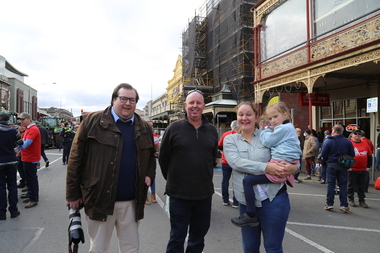
Photograph - Digital Photograph, Stop Ausnet Rally Ballarat - Katherine Myers, Scott Young, Charles Everist, 15 July 2022
... Stop Ausnet Rally Ballarat - Katherine Myers, Scott Young, Charles Everist...https://www.vff.org.au/wp-content/uploads/2021/09/PS210901LG-Managing-Entry-to-Farms-adopted.pdf https://www.vff.org.au/wp-content/uploads/2021/09/VFF-Renewable-Energy-and-Energy-Efficiency-Policy-Statement-Meeting-172-June-2021.pdf advocacy renewable energy farmers protest rally managing entry to farm Victorian Farmers Federation Ballarat Stop Ausnet Rally Ballarat - Katherine Myers, Scott Young, Charles Everist Photograph Digital Photograph Lisa Gervasoni ...VFF is seeking an appropriate framework to ensure farmers do not bear the cost of infrastructure on their farms. Overhead powerlines are proposed through the rich volcanic soils around Ballarat. This land supports 1200 jobs in processing in Ballarat. The towers would impact on the ability to irrigate crops, to use tractors around them, on biosecurity and on ability to use emergency equipment near them. VFF wants assurances that the managing entry to farm policy position will be adhered to and that a statewide strategic plan for renewable energy is prepared. https://www.vff.org.au/wp-content/uploads/2021/09/PS210901LG-Managing-Entry-to-Farms-adopted.pdf https://www.vff.org.au/wp-content/uploads/2021/09/VFF-Renewable-Energy-and-Energy-Efficiency-Policy-Statement-Meeting-172-June-2021.pdfadvocacy, renewable energy, farmers, protest, rally, managing entry to farm, victorian farmers federation, ballarat -
Box Hill Historical Society
Book, Neville, Nanette,Wood, Margaret,Rae, Valerie, The Leech Family : Robert, Marianne and Descendants
... ...Wedge> Charles...Young...Leech> Robert Leech> Marianne Neville> Nanette Rae> Valerie Wood> Margaret Wedge> Fanny Bethia Wedge> Charles Young> Doris Margaret Rodgerson> David Bruce Upton> Frances Wrighte> Arundel A written history of the Leech family and their descendants. ...A written history of the Leech family and their descendants. A few of these people are buried in Box Hill.55p.A written history of the Leech family and their descendants. A few of these people are buried in Box Hill.leech> robert, leech> marianne, neville> nanette, rae> valerie, wood> margaret, wedge> fanny bethia, wedge> charles, young> doris margaret, rodgerson> david bruce, upton> frances, wrighte> arundel -
Tarnagulla History Archive
Registration of Birth form, circa 1871
... Registration of Birth form for: Child's name: Isabella Young Date of Birth: 30th July 1871 Place of birth: Newbridge Father: Charles Young Mother: Janet Young (nee Campbell) ...Registration of Birth form for: Child's name: Isabella Young Date of Birth: 30th July 1871 Place of birth: Newbridge Father: Charles Young Mother: Janet Young (nee Campbell) Registration of Birth form ...A large lot of papers, including this and many other birth and death registration forms, were apparently found in the ceiling cavity of the Sandy Creek/Tarnagulla Post and Telegraph Office in the later 20th Century, during building works. Donald Clark Collection. Registration of Birth form for: Child's name: Isabella Young Date of Birth: 30th July 1871 Place of birth: Newbridge Father: Charles Young Mother: Janet Young (nee Campbell) -
 Box Hill Historical Society
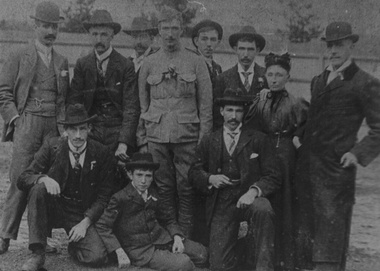
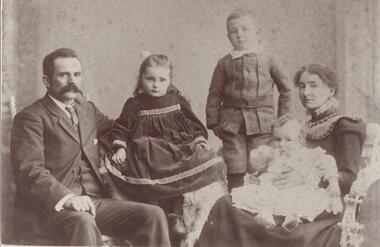
Photograph - Young family
... ...Young> Charles William...Walter Ivan Young in the Boer War uniform, Leslie Ashton Young (seated in front of Walter Ivan Young - Leslie, the youngest married an Aspinall.) Charles William Young (is left of Walter). ...Davey> Louisa Elizabeth (Miss) Young> Walter Ivan Young> Leslie Ashton Young> Charles William Boer War 1899-1902 B&w photo Photograph Young family ...A family photo of the Young family - identified as Thomas William Young (extreme right), Louisa Elizabeth Young (nee Davey) next to him. Walter Ivan Young in the Boer War uniform, Leslie Ashton Young (seated in front of Walter Ivan Young - Leslie, the youngest married an Aspinall.) Charles William Young (is left of Walter). William Frederick Young kneeling in front of his mother. Information on the identification of family members was supplied by Wendy Higgins, Traralgon - a descendantB&w photoyoung> thomas william, young> louisa elizabeth (mrs.), davey> louisa elizabeth (miss), young> walter ivan, young> leslie ashton, young> charles william, boer war 1899-1902 -
 Glen Eira Historical Society
Photograph - Beddoe Family & Store
... Charles Crichton... Beddoe Tysae... Beddoe Archibald... Beddoe FG... Merchants... Wood carters... Glenhuntly road... Elsternwick... Wall Geo... Photographers... Beddoe wood yard... Horne Street... Carriers... Coles store... Young...Photograph taken 18/04/1916 All photos have unattributed, undated notes on reverse Beddoe Robert Henry Beddoe Ella Mary Beddoe Charles Crichton Beddoe Tysae Beddoe Archibald Beddoe FG Merchants Wood carters Glenhuntly road Elsternwick Wall Geo Photographers Beddoe wood yard Horne Street Carriers Coles store Young Charles Beddoe Francis George Photograph Beddoe Family & Store ...Three black & white photos of: Robert Henry Beddoe & family RH&FG Beddoe business premises and Beddoe wood yard on corner Horne St & Glenhuntly Rd Elsternwick. Photograph taken 18/04/1916 All photos have unattributed, undated notes on reversebeddoe robert henry, beddoe ella mary, beddoe charles crichton, beddoe tysae, beddoe archibald, beddoe fg, merchants, wood carters, glenhuntly road, elsternwick, wall geo, photographers, beddoe wood yard, horne street, carriers, coles store, young charles, beddoe francis george -
 Uniting Church Archives - Synod of Victoria
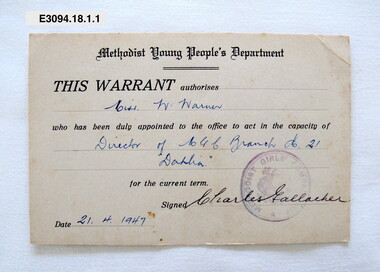
Certificate - Warrant, Win Warner
... ...Charles Gallacher...Methodist Young...Young People's Department. Methodist Girls' Comradeship Hampton Dahlia Branch No 21 Win Warner Charles Gallacher Methodist Young People's Department E3094.18.1.1 "Miss W Warner" "Director of MGC Branch No. 21 "Dahlia" "Charles Gallacher" "21.4.1947" E3094.18.1.2 "Miss W. ...E3094.18.1.1 and E3094.18.1.2 are issued by the Methodist Young People's Department. E3094.18.1.3 is issued by the Methodist Girl's Comradeship Province of Victoria and Tasmania conducted under the authority of the Young People's Department.Three card warrants. E3094.18.1.1 and E3094.18.1.2 Buff coloured card with black text and blue ink handwriting. Both cards have a Methodist Girls' Comradeship rubber stamp imprint. E3094.18.1.3 Light blue card with black text, the Methodist Girls' Comradeship emblem and blue ink handwriting.E3094.18.1.1 "Miss W Warner" "Director of MGC Branch No. 21 "Dahlia" "Charles Gallacher" "21.4.1947" E3094.18.1.2 "Miss W. Warner" "Director of the "Dahlia" Branch Hampton M.G.C." "Charles Gallacher" "8.3.1948" E3094.18.1.3 "Win Warner" "Director" "Dahlia" "21" "26th March, 1956"methodist girls' comradeship hampton dahlia branch no 21, win warner, charles gallacher, methodist young people's department -
 Greensborough Historical Society
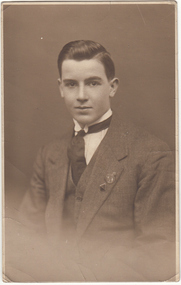
Photograph - Digital image, Charles Marshall et al, Charles Frederick Marshall, 1918_
... This photograph shows a young Charles Frederick Marshall...This photograph shows a young Charles Frederick Marshall charles marshall world war 1 No caption on this postcard Digital copy of black and white photograph. ...This photograph shows a young Charles Frederick MarshallDigital copy of black and white photograph. No caption on this postcardcharles marshall, world war 1 -
 Greensborough Historical Society
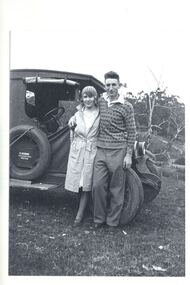
Photograph - Digital Image, Charles Wightman and Laura Harding, 1920s
... Picture of a young couple, Charles Wightman and Laura Harding...Picture of a young couple, Charles Wightman and Laura Harding charles wightman laura harding wightman family Digital copy of black and white photograph Charles Wightman and Laura Harding Photograph - Digital Image Wightman family ...Picture of a young couple, Charles Wightman and Laura HardingDigital copy of black and white photographcharles wightman, laura harding, wightman family -
 Bendigo Military Museum
Photograph - AUSTRALIAN CHINESE SERVICEMEN, WW2, Bendigo & District RSL Club, WW2
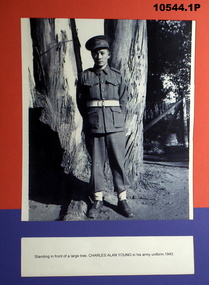
... "Standing in front of a large tree, CHARLES ALAN YOUNG in his Army uniform, 1943". 2. ..."Standing in front of a large tree, CHARLES ALAN YOUNG in his Army uniform, 1943". 2. ...Australian Chinese Servicemen from WW2 photographs - Exhibition held at the Bendigo & District RSL, post 2010.1.2.3. Photographs on photographic paper, enlarged black and white portrait. Mount - red and blue colour cardboard, double mount with top area containing the photograph, lower area printed information. 1. Serviceman in uniform, full length informal portrait WW2. 2. Serviceman in uniform, portrait WW2.Printed information - black ink print. 1. "Standing in front of a large tree, CHARLES ALAN YOUNG in his Army uniform, 1943". 2. LESLIE FANG YUEN joined the RAAF in 1942, and as a wireless air gunner flew missions into France and the heart of enemy territory, Germany's industrial powerhouse, the Ruhr. He was one of the first Chinese Australians accepted for aircrew by the RAAF in Queensland during World War 2.photographs, australian/chinese, ww2 -
 Brunswick Community History Group
Photograph - Reunion Jewell Crescent
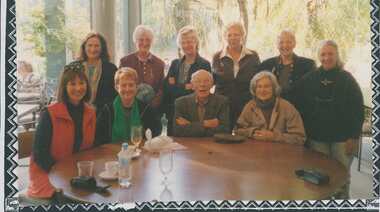
... Back row: Helen Young, Margaret Young, Bronwyn Newman, Lorna Newman, Marion Newman, Judith Walker. Front Row: Diana Walker, Marcia Walker, Charles Newman, Janet Young. ...Back row: Helen Young, Margaret Young, Bronwyn Newman, Lorna Newman, Marion Newman, Judith Walker. Front Row: Diana Walker, Marcia Walker, Charles Newman, Janet Young. ...See also 2024.062. Reunion Jewell Crescent. Back row: Helen Young, Margaret Young, Bronwyn Newman, Lorna Newman, Marion Newman, Judith Walker. Front Row: Diana Walker, Marcia Walker, Charles Newman, Janet Young. Featured in Fusion, vol 20, issue 3, November 2006 with 'Recollections of my childhood' by Lorna Newman. Accompanied by photo and article in Moreland Leader, 7 June 2010 - Coburg's Charles knocks up a century - Charles Newman turned 100. -
 Flagstaff Hill Maritime Museum and Village
Book - Ancient Political Speeches/Reference, William Tegg, Select Orations of Cicero, 1853
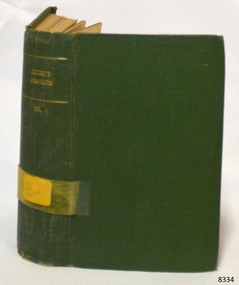
... He was a prominent figure in the Victorian print boom and counted a young Charles Dickens among his close friends....He was a prominent figure in the Victorian print boom and counted a young Charles Dickens among his close friends. ...This book is not regarded as a novel rather as an educational anthology of classical political and legal speeches. Select Orations of Cicero is a curated collection of speeches delivered by the famous Roman statesman, orator, and philosopher Marcus Tullius Cicero during the 1st century BCE. Instead of just presenting the raw Latin text, this specific volume features an extensive English commentary, explanatory footnotes, and historical, geographical, and legal indexes compiled by Charles Anthon. It was designed primarily as a prestigious schoolbook and university textbook, helping 19th-century students translate the Latin while fully understanding the complex political backstabbing and legal systems of ancient Rome. Some of Cicero's orations include his famous exposure of a conspiracy to overthrow the Roman government, his prosecution of the notoriously corrupt governor of Sicily, and a masterclass in legal defense regarding a high-profile political murder.The Select Orations of Cicero Author: Charles Anthon Publisher: William Tegg & Co Date: 1853 Further Information: Olive green cloth hardcover with a spine lettering in gold . The spine has a label with an Library inscription.non-fictionThis book is not regarded as a novel rather as an educational anthology of classical political and legal speeches. Select Orations of Cicero is a curated collection of speeches delivered by the famous Roman statesman, orator, and philosopher Marcus Tullius Cicero during the 1st century BCE. Instead of just presenting the raw Latin text, this specific volume features an extensive English commentary, explanatory footnotes, and historical, geographical, and legal indexes compiled by Charles Anthon. It was designed primarily as a prestigious schoolbook and university textbook, helping 19th-century students translate the Latin while fully understanding the complex political backstabbing and legal systems of ancient Rome. Some of Cicero's orations include his famous exposure of a conspiracy to overthrow the Roman government, his prosecution of the notoriously corrupt governor of Sicily, and a masterclass in legal defense regarding a high-profile political murder.flagstaff hill, warrnambool, shipwrecked coast, flagstaff hill maritime museum, maritime museum, shipwreck coast, flagstaff hill maritime village, great ocean road, book, pattison collection, warrnambool library, warrnambool mechanics’ institute, ralph eric pattison, corangamite regional library service, warrnambool city librarian, mechanics’ institute library, victorian library board, warrnambool books and records, warrnambool children’s library, select orations of cicero, thomas tegg, cicero -
 Sunshine and District Historical Society Incorporated
Article - Australian Pentecostalism In Sunshine
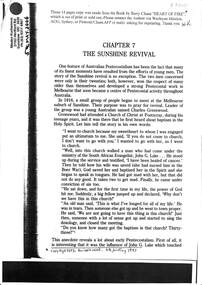
... The Pentecostalism movement in Sunshine was established in 1916 by Charles Lewis Greenwood, a young 25 year old Sunshine resident and employee of the H.V. ...The Pentecostalism movement in Sunshine was established in 1916 by Charles Lewis Greenwood, a young 25 year old Sunshine resident and employee of the H.V. ...The Pentecostalism movement in Sunshine was established in 1916 by Charles Lewis Greenwood, a young 25 year old Sunshine resident and employee of the H.V. McKay Sunshine Harvester Works. He and his wife Frances held the first cottage meetings in their Devonshire Road home. For nine years these meetings continued to be held there, including people being baptised in their bath. The Sunshine Gospel Hall in Martin Street, Sunshine was the third Pentecostal meeting place to be established in Melbourne. Its construction was completed in February 1925. The small hall was described as a timber hall of weatherboard construction with a small brick room at the back. The hall was simply named as the Sunshine Gospel Hall. In 1925, Adolfo C. Valdez arrived from America, he joined the Sunshine group and became its leader that year. Shortly afterwards, the church's congregation outgrew the Sunshine Gospel Hall, and in 1926, the congregation moved to the Richmond Theatre on Bridge Road. This theatre was later to become known as the 'Richmond Temple'. The Martin Street Hall then became the 1st Sunshine Scout Hall. In 1994, the site was sold for private development, and a residential house was built on the site. In 1926, W. J. Nankervis, an enthusiastic Pentecostal poet wrote an unpublished song about the brick prayer room, but unfortunately only part of the words are known. 'There's a little brick room in Sunshine Hall, whose walls give forth no sound, you can shout as you will with never a fear of troubling the folks around'.These documents record the early established of the Pentecostalism movement in Sunshine. The documents also describes the character of Charles Lewis Greenwood as being 25 years old and married for one year. although small in stature, he was a lively, effervescent young man, with abundant energy and drive. When he preached, it was with obvious joy and with infectious enthusiasm. His simple, literal approach to the Word of God gave an authority to this message that caused people to respond. He spoke the language of the working man, and he made clear what he said.5720.01 - Australian Pentecostalism In Sunshine.jpg 5720.02 - Australian Pentecostalism In Sunshine.jpg 5720.03 - Australian Pentecostalism In Sunshine.jpg 5720.04 - Australian Pentecostalism In Sunshine.jpgpentecostal church, martin street, sunshine, sunshine gospel hall, devonshire road, charles lewis greenwood, adolfo c. valdez, w.j.nankervis -
 Ballarat Tramway Museum
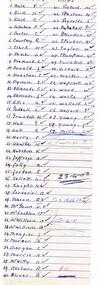
Document - List, Dave Kellett, "Welfare Club Payment", 23/04/1953 12:00:00 AM
... Bath Percy Carl Motorman 1949 1971 6312 Birch Harold Reginald Conductor 1949 1963 6312 Black E. 1953 6312 Carter T. 1953 6312 Courtney R. 1953 6312 Davies A. 1953 6312 Diamond Leo Motorman 1953 1954 6312 Donald James Frederick 1949 1963 6312 Dynon J. 1953 6312 Ellis Alfred Lewis Motorman 1942 1968 6312 Hall Keith William Conductor 1953 1954 6312 Harry D. 1953 6312 Hutchins K. 1953 6312 Jolly A. 1953 6312 Jordan R. 1953 6312 Kellett Alfred Joseph Tramway employee 1949 1971 6312 McGann N. 1953 6312 Menzies J. 1953 6312 Mills I. 1953 6312 Morgan Colin George 1953 1963 6312 Morris N. 1953 6312 Oliver R. 1953 6312 Pinkard M. 1953 6312 Spencer M. 1953 6312 Taylor H. 1953 6312 Thompson Arthur Frederick Mark 1953 1954 6312 Vicars A. 1953 6312 Wapshott Herbert William 1953 1954 6312 Weeks John Herbert Motorman 1953 1954 6312 Wellard Graham Charles 1953 1954 6312 Young S. 1953 6312 These people have more than one entry into the data base T. ...Bath Percy Carl Motorman 1949 1971 6312 Birch Harold Reginald Conductor 1949 1963 6312 Black E. 1953 6312 Carter T. 1953 6312 Courtney R. 1953 6312 Davies A. 1953 6312 Diamond Leo Motorman 1953 1954 6312 Donald James Frederick 1949 1963 6312 Dynon J. 1953 6312 Ellis Alfred Lewis Motorman 1942 1968 6312 Hall Keith William Conductor 1953 1954 6312 Harry D. 1953 6312 Hutchins K. 1953 6312 Jolly A. 1953 6312 Jordan R. 1953 6312 Kellett Alfred Joseph Tramway employee 1949 1971 6312 McGann N. 1953 6312 Menzies J. 1953 6312 Mills I. 1953 6312 Morgan Colin George 1953 1963 6312 Morris N. 1953 6312 Oliver R. 1953 6312 Pinkard M. 1953 6312 Spencer M. 1953 6312 Taylor H. 1953 6312 Thompson Arthur Frederick Mark 1953 1954 6312 Vicars A. 1953 6312 Wapshott Herbert William 1953 1954 6312 Weeks John Herbert Motorman 1953 1954 6312 Wellard Graham Charles 1953 1954 6312 Young S. 1953 6312 These people have more than one entry into the data base T. ...Yields information about the SEC Ballarat tram employees names for 23/4/ 1953. Has a strong association with the list Author. Also demonstrates the administration of a locally based welfare fund.Carbon copy of a hand written list dated 23-4-1953 of 59 people on the front and two on the rear showing payment to the Ballarat Tramway "Welfare Club Payment". Payment appears to total 12 pounds 4 shillings. See also Reg item 6312 for a June 1952 list. Handwritten on ruled paper which has been folded into four. Note: - this list may also include depot employees. List compiled from the .xls file compiled by Peter Waugh. The ones listed as record 6312 only below. Bath Percy Carl Motorman 1949 1971 6312 Birch Harold Reginald Conductor 1949 1963 6312 Black E. 1953 6312 Carter T. 1953 6312 Courtney R. 1953 6312 Davies A. 1953 6312 Diamond Leo Motorman 1953 1954 6312 Donald James Frederick 1949 1963 6312 Dynon J. 1953 6312 Ellis Alfred Lewis Motorman 1942 1968 6312 Hall Keith William Conductor 1953 1954 6312 Harry D. 1953 6312 Hutchins K. 1953 6312 Jolly A. 1953 6312 Jordan R. 1953 6312 Kellett Alfred Joseph Tramway employee 1949 1971 6312 McGann N. 1953 6312 Menzies J. 1953 6312 Mills I. 1953 6312 Morgan Colin George 1953 1963 6312 Morris N. 1953 6312 Oliver R. 1953 6312 Pinkard M. 1953 6312 Spencer M. 1953 6312 Taylor H. 1953 6312 Thompson Arthur Frederick Mark 1953 1954 6312 Vicars A. 1953 6312 Wapshott Herbert William 1953 1954 6312 Weeks John Herbert Motorman 1953 1954 6312 Wellard Graham Charles 1953 1954 6312 Young S. 1953 6312 These people have more than one entry into the data base T. Dunstan H. Grundell G. Hall H. Hawkes A. Jeffreys D. Kellett H. Knight H. Lorensini H. McWilliams A. McWilliams R. Mason A. Mercer R. Nestor H. Preston S. Reynolds H. Smerdon G. Satchell R. Turnbull A. Vicars W. Ward L. Walker L. Wellard S. Young T, Young J. Menzies F. Edmonds S. Edmonds F. Callahan N. Clark L. Godsell N. McLachlan F. Brown J. Myers On rear "Welfare Club Payment"sec, ballarat, personnel, welfare, crews -
 Flagstaff Hill Maritime Museum and Village
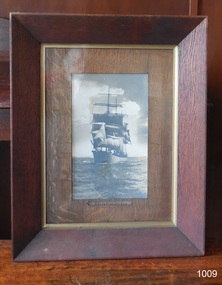
Photograph - Ship, Monkbarns, ca. 1924
... Charles Webster Corsar, Liverpool - 1902, the owner was D. Corsar & Son, Liverpool - 1909, owned by John Hardie & Sons, Glasgow - 1911, John Stewart & Co., Liverpool - by1915, James A. Young...Charles Webster Corsar, Liverpool - 1902, the owner was D. Corsar & Son, Liverpool - 1909, owned by John Hardie & Sons, Glasgow - 1911, John Stewart & Co., Liverpool - by1915, James A. Young ...This photograph was taken in about 1924 as it approached Newcastle, New South Wales before the sailing ship Monkbarns was converted for use as a hulk. The steel-hulled, 3-masted fully rigged ship was built in 1895 by Archibald McMillan & Son at Dumbarton in Scotland. It was 267 feet long, 40.1 feet wide and 23.5 feet deep. In 1914 John Stewart & Co. owned ten sailing vessels, one of which was the Monkbarns, but by the end of the first World War, the fleet had only four vessels survived the war, including the Monkbarns. The Monkbarns traded across the world. Some of the destinations included Port Adelaide, Table Bay in South Africa, Liverpool, Sydney, London and New York. Her last commercial voyage was in 1926. Overall, the ship traded for 32 years before it was converted in Spain in 1927 for use as a hulk for carrying coal. There were several owners of the ship over its lifetime. They were - 1895, first owner, Charles Webster Corsar, Liverpool - 1902, the owner was D. Corsar & Son, Liverpool - 1909, owned by John Hardie & Sons, Glasgow - 1911, John Stewart & Co., Liverpool - by1915, James A. Young, London - 1926, L.H. Wilson, Liverpool - 1927, Ballener Espando (Brunn & van Lippe, Tonsberg).Photograph, black and white, of the ship "Monkbarns" , a steel hulled sailing ship under sail, bow facing viewer. Rectangular wooden frame has an inner gilt frame around a wide, natural bark matte. The lover edge of the matte has a decorative rectangular cut-out surrounding an inscription with the ship's name. On the back is a handwritten inscription about the ship and the presentation of the photograph..Front: "MONKBARNS" Reverse handwritten in pen: "PRESENTED TO A.F. WATSON / FOR S.S.V. BY / CAPT. F.K. BAXTER / 74 VERDON ST/ WILLIAMSTOWN " Reverse: "STEEL SHIP MONKBARNS / 1771 TONS REGISTER / 267 x 40' X 27'2" Draft / Build 1895 by McMillan, Dumbarton, Scotland / Converted to a hulk in /Spain 1927. / Photo taken in - Converted from NEWCASTLE N.S.W. about 1924"flagstaff hill, warrnambool, maritime village, maritime museum, flagstaff hill maritime museum & village, shipwreck coast, great ocean road, monkbarns, sailing ship, newccastle, new south wales, hulk -
 Flagstaff Hill Maritime Museum and Village
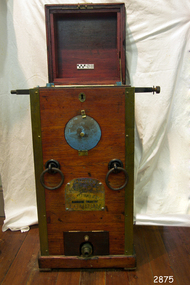
Machine - Diving Compressor, Siebe Gorman & Co. Ltd, 1880-1890
... Charles Pasley. Apart from some small modifications to valves and diver communications, the basic 12 bolt ‘closed’ diving dress remained relatively unchanged after the 1870s. Later company successes were also based on innovation, with new products that could be successfully developed and manufactured to high standards. This was largely attributed to the inventive nature, foresight, engineering and entrepreneurial skills of Robert Henry Davis (1870-1965). In 1882, RH Davis joined the company of 'Siebe & Gorman' as a young...Charles Pasley. Apart from some small modifications to valves and diver communications, the basic 12 bolt ‘closed’ diving dress remained relatively unchanged after the 1870s. Later company successes were also based on innovation, with new products that could be successfully developed and manufactured to high standards. This was largely attributed to the inventive nature, foresight, engineering and entrepreneurial skills of Robert Henry Davis (1870-1965). In 1882, RH Davis joined the company of 'Siebe & Gorman' as a young ...This compressor was part of the E.G. Ward Collection. It is connected to the diving suit and boots, also in our collection. Siebe Gorman & Company Ltd was a British company that developed diving equipment and breathing equipment and worked on commercial diving and marine salvage projects. The company advertised itself as 'Submarine Engineers'. It was founded by Augustus Siebe, a German-born British engineer chiefly known for his contributions to diving equipment. Siebe Gorman traded as an engineering firm for over 180 years, from 1819 to 1999. The early success of the business was due to its founder, the Prussian immigrant Christian 'Augustus' Siebe (1788-1872). For business reasons, he applied for and was granted British citizenship in 1856. He was a gifted engineer who was able to translate theoretical problems into practical, working products. During the industrial Victorian period, the business traded as 'A. Siebe's at 145 High Street, Holborn, London, but in 1828, new premises were acquired at 5 Denmark Street, Soho. The family firm produced a wide range of manufactured goods, including paper-making machinery, measuring machinery, water-pumps, refrigeration equipment and diving apparatus. Augustus Siebe specialised in submarine engineering early on, and the company gained a reputation for the manufacture of safe, reliable diving apparatus. Augustus Siebe is best remembered for the development and manufacture of the ‘closed’ Diving Dress based on the ideas of Charles and John Deane, George Edwards and Charles Pasley. Apart from some small modifications to valves and diver communications, the basic 12 bolt ‘closed’ diving dress remained relatively unchanged after the 1870s. Later company successes were also based on innovation, with new products that could be successfully developed and manufactured to high standards. This was largely attributed to the inventive nature, foresight, engineering and entrepreneurial skills of Robert Henry Davis (1870-1965). In 1882, RH Davis joined the company of 'Siebe & Gorman' as a young 11-year-old office boy, and he was to remain with the company until he died in 1965. Augustus Siebe retired in 1869 and handed over the company to a new partnership of Henry H. Siebe (1830-1885) and William A. O'Gorman (1834-1904). The new firm traded as 'Siebe & Gorman' (1870-1879) from premises in and around Mason Street, Westminster Bridge Road, Lambeth, London. The two partners soon recognised the potential of R.H. Davis, and in 1894, aged 24, he became General Manager of Siebe & Gorman. Davis increasingly ran the company until the surviving partner (W.A. Gorman) died in 1904. The firm was disposed of to the Vickers (armaments) family, and a new company, Siebe Gorman & Co. Ltd. (1905-1998) was formed. Under the chairmanship of Albert Vickers, R.H. Davis was kept on as Managing Director, and the company forged ahead. However, after WW1, the Great Depression caused manufacturing output and share prices to slump. In 1924, Robert Davis made a deal with the Vickers Board and acquired control of the company through majority shares. Under his leadership, the Siebe Gorman Company flourished, and in time, four of his sons also joined the firm. The company gained a worldwide reputation for the manufacture of diving apparatus, decompression and observation chambers, and safety breathing apparatus of all types for use on the land, in the air and under the sea (including mine rescue, tunnelling, aircraft, diving, submarine escape and in other hazardous environments). Close research and development links with the MOD (especially the Admiralty), also provided a lucrative outlet for the company's products. In 1932, Robert Davis was knighted by King George V, principally for his invention of the ‘Davis Submerged Escape Apparatus’ (D.S.E.A.). Siebe Gorman essentially remained a family firm from the beginning (under A Siebe) until it became a public company for the first time in 1952. However, following WW2, British manufacturing stagnated through stifled investment and post-war austerity, and there was little innovation. Siebe Gorman's fortunes began to decline as an ageing Sir Robert Davis failed to invest or change the company's business and management practices. In 1959, Siebe Gorman was acquired by the “Fairy Group” and the ailing Sir Robert was made Life President. Consequently, nothing changed, and the slow decline continued until Sir Robert's death in March 1965. Around 1960, Siebe Gorman acquired the diving apparatus manufacturer C E Heinke, and for a brief period, it manufactured some diving equipment under the combined name of Siebe Heinke. Around 1964, Mr E. 'Barry' Stephens was appointed as the new Managing Director to modernise Siebe Gorman. Changes were made, including a move to a new factory in Wales in 1975. The new company concentrated on firefighting breathing apparatus and escape equipment, and the move coincided with the loss of many of the older, traditional craft skills. Between 1985 and 1998, Siebe expanded through acquisitions, and several other companies were acquired. The Siebe Gorman (diving apparatus) company has therefore traded as A. Siebe (1819-1870); Siebe & Gorman (1870-1879); Siebe Gorman & Co (1880-1904); Siebe Gorman & Co. Ltd (1905-1998).The diving compressor, along with associated equipment in the Flagstaff Hill collection, represents a highly significant snapshot of marine history. These items are particularly important in understanding the evolution of diving equipment, with a special focus on their use in salvage operations before and throughout the Second World War. Manufactured by a company renowned for its inventions, development, and innovation in marine engineering, the equipment demonstrates the progression of technology in deep-sea diving. Early helmets and related items produced by this company remain highly sought after by collectors worldwide, highlighting their historical and technological value. The presence of these items within the Flagstaff Hill Maritime Museum allows for a unique insight into the working conditions and methods employed by divers. It also illustrates the considerable dangers they faced while performing such essential and hazardous work, underscoring the critical role played by these professionals in maritime history.A single cylinder divers' pump by Siebe Gorman & Co Ltd, London, eccentric hand cranked in brass, brass-mounted mahogany case with instructions to the underside of the lid, brass-covered pressure gauge and air outlet, brass maker's plaque to the front, water inlet and outlet to the rear, green-painted lifting rings. Machinery has some blue-painted areas on the metal. This compressor is part of the E.G. Ward Collection.Plate on the back 'WATER SUPPLY" "WATER OVERFLOW" "WATER DRAIN-IN" Pressure gauge dial "BOURDON'S PRESSURE GAUGE" STEBE GORMAN & CO. LONDON", "LBS PRESSURE" "FEET OF SALT WATER" Plate on the front " PATENT, Siebe Gorman & Co Ltd Submarine Engineers" below emblem (Lion, Crown, Horse)flagstaff hill, warrnambool, flagstaff-hill, maritime-museum, diving compressor, london, siebe gorman & co ltd, marine technology, life saving, deep sea diving, maritime museum, maritime village, manine history, maritime history, marine engineers, marine diving, deep-sea diving, e g ward, vintage diving compressor, e. g. ward, e.g. ward, edward ward, ted ward -
 Flagstaff Hill Maritime Museum and Village
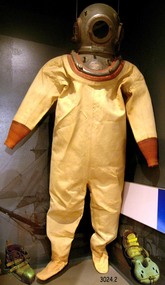
Functional object - Diving Suit, boots and weight, Early-to-mid 20th century
... Charles Pasley. Apart from some small modifications to valves and diver communications, the basic 12-bolt ‘closed’ diving dress remained relatively unchanged after the 1870s. Later company successes were also based on innovation, with new products that could be successfully developed and manufactured to high standards. This was largely attributed to the inventive nature, foresight, engineering and entrepreneurial skills of Robert Henry Davis (1870-1965). In 1882, RH Davis joined the company of 'Siebe & Gorman' as a young...Charles Pasley. Apart from some small modifications to valves and diver communications, the basic 12-bolt ‘closed’ diving dress remained relatively unchanged after the 1870s. Later company successes were also based on innovation, with new products that could be successfully developed and manufactured to high standards. This was largely attributed to the inventive nature, foresight, engineering and entrepreneurial skills of Robert Henry Davis (1870-1965). In 1882, RH Davis joined the company of 'Siebe & Gorman' as a young ...This diving suit with helmet, boots and weight is part of the E. G.Ward collection, along with the diving compressor and a photograph of a diver in this equipment. Siebe Gorman & Company Ltd was a British company that developed diving equipment and breathing equipment and worked on commercial diving and marine salvage projects. The company advertised itself as 'Submarine Engineers'. It was founded by Augustus Siebe, a German-born British engineer chiefly known for his contributions to diving equipment. Siebe Gorman traded as an engineering firm for over 180 years from 1819 to 1999. The early success of the business was due to its founder, the Prussian immigrant Christian 'Augustus' Siebe (1788-1872). For business reasons, he applied for and was granted British citizenship in 1856. He was a gifted engineer who was able to translate theoretical problems into practical, working products. During the industrial Victorian period, the business traded as 'A. Siebe' at 145 High Street Holborn London, but in 1828 new premises were acquired at 5 Denmark Street, Soho. The family firm produced a wide range of manufactured goods including paper-making machinery, measuring machinery, water pumps, refrigeration equipment and diving apparatus. Augustus Siebe specialised in submarine engineering early on and the company gained a reputation for the manufacture of safe, reliable diving apparatus. Augustus Siebe is best remembered for the development and manufacture of the ‘closed’ Diving Dress based on the ideas of Charles and John Deane, George Edwards and Charles Pasley. Apart from some small modifications to valves and diver communications, the basic 12-bolt ‘closed’ diving dress remained relatively unchanged after the 1870s. Later company successes were also based on innovation, with new products that could be successfully developed and manufactured to high standards. This was largely attributed to the inventive nature, foresight, engineering and entrepreneurial skills of Robert Henry Davis (1870-1965). In 1882, RH Davis joined the company of 'Siebe & Gorman' as a young 11-year-old office boy and he was to remain with the company until he died in 1965. Augustus Siebe retired in 1869 and handed over the company to a new partnership of Henry H. Siebe (1830-1885) and William A. O'Gorman (1834-1904). The new firm traded as 'Siebe & Gorman' (1870-1879) from premises in and around Mason Street, Westminster Bridge Road, Lambeth, London. The two partners soon recognised the potential of R.H. Davis and in 1894, aged 24, he became General Manager of Siebe & Gorman. Davis increasingly ran the company until the surviving partner (W.A. Gorman) died in 1904. The firm was disposed of to the Vickers (armaments) family and a new company 'Siebe Gorman & Co. Ltd.' (1905-1998) was formed. Under the chairmanship of Albert Vickers, R.H. Davis was kept on as Managing Director, and the company forged ahead. However, after WW1, the Great Depression caused manufacturing output and share prices to slump. In 1924 Robert Davis made a deal with the Vickers Board and acquired control of the company through majority shares. Under his leadership, the Siebe Gorman Company flourished and within time, four of his sons also joined the firm. The company gained a worldwide reputation for the manufacture of diving apparatus, decompression and observation chambers, and safety breathing apparatus of all types for use on the land, in the air and under the sea (including mine rescue, tunnelling, aircraft, diving, submarine escape and in other hazardous environments). Close research and development links with the MOD (especially the Admiralty), also provided a lucrative outlet for the company products. In 1932, Robert Davis was knighted by King George V, principally for his invention of the ‘Davis Submerged Escape Apparatus’ (D.S.E.A.). Siebe Gorman essentially remained a family firm from the beginning (under A.Siebe) until it became a public company for the first time in 1952. However, following WW2, British manufacturing stagnated through stifled investment and post-war austerity, and there was little innovation. Siebe Gorman fortunes began to decline as an ageing Sir Robert Davis failed to invest, or change the company business and management practices. In 1959, Siebe Gorman was acquired by the “Fairy Group” and the ailing Sir Robert was made Life President. Consequently, nothing changed and the slow decline continued until Sir Robert's death in March 1965. Around 1960, Siebe Gorman acquired the diving apparatus manufacturer C E Heinke, and for a brief period, it manufactured some diving equipment under the combined name of Siebe Heinke. Around 1964, Mr E. 'Barry' Stephens was appointed as the new Managing Director to modernise Siebe Gorman. Changes were made, including a move to a new factory in Wales in 1975. The new company concentrated on fire-fighting breathing apparatus and escape equipment, and the move coincided with the loss of many of the older, traditional craft skills. Between 1985 and 1998, Siebe expanded through acquisitions, and several other companies were acquired. The Siebe Gorman (diving apparatus) company has therefore traded as A. Siebe (1819-1870); Siebe & Gorman (1870-1879); Siebe Gorman & Co (1880-1904); Siebe Gorman & Co. Ltd (1905-1998).The diving suit, helmet, boots, and weights, along with associated equipment in the Flagstaff Hill collection, represent a highly significant snapshot of marine history. These items are particularly important in understanding the evolution of diving equipment, with a special focus on their use in salvage operations before and throughout the Second World War. Manufactured by a company renowned for its inventions, development, and innovation in marine engineering, the equipment demonstrates the progression of technology in deep-sea diving. Early helmets and related items produced by this company remain highly sought after by collectors worldwide, highlighting their historical and technological value. The presence of these items within the Flagstaff Hill Maritime Museum allows for a unique insight into the working conditions and methods employed by divers. It also illustrates the considerable dangers they faced while performing such essential and hazardous work, underscoring the critical role played by these professionals in maritime history.Diving suit including helmet, boots and a weight. Diving suit is made of canvas with knitted cuffs. The helmet is metal. The boots have a thick sole and thick leather upper that is held on with leather straps and buckles. The toe of the boot is heavy metal. The weight is worn next to the trunk of the diver and it has an inscription to mark the front. It is worn with straps and buckles holding it in place. Royal Navy Admiralty Pattern 6 bolt No 3 light Siebe Gorman light diving helmet circa 1960, used by the Royal Navy before and after World War 2. This equipment is part of the E. G. Ward Collection."Siebe Gorman & Co Ltd Marine Engineers London. Patent" with "E G Ward" on front and back plate. On weight "FRONT"flagstaff hill, warrnambool, diving suit, siebe gorman and co ltd., siebe gorman and co ltd marine engineers london, marine engineers, diving helmet, diving boots, diving weight, marine diving, maritimemuseum, maritime village, maritime history, marine technology, life saving, deep sea diving, maritime museum, siebe gorman and co ltd., siebe gorman and co ltd, london, deep-sea diving, e. g. ward, e g ward, e.g. ward, edward ward, ted ward -
 Flagstaff Hill Maritime Museum and Village
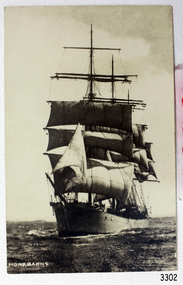
Postcard - Ship, Monkbarns, ca. 1924
... Charles Webster Corsar, Liverpool - 1902, the owner was D. Corsar & Son, Liverpool - 1909, owned by John Hardie & Sons, Glasgow - 1911, John Stewart & Co., Liverpool - by1915, James A. Young...Charles Webster Corsar, Liverpool - 1902, the owner was D. Corsar & Son, Liverpool - 1909, owned by John Hardie & Sons, Glasgow - 1911, John Stewart & Co., Liverpool - by1915, James A. Young ...This photograph of the Monkbarns was taken prior to 1927 before the sailing ship was converted for use as a hulk. The steel-hulled, 3-masted fully rigged ship was built in 1895 by Archibald McMillan & Son at Dumbarton in Scotland. It was 267 feet long, 40.1 feet wide and 23.5 feet deep. In 1914 John Stewart & Co. owned ten sailing vessels, one of which was the Monkbarns, but by the end of the first World War, the fleet had only four vessels survived the war, including the Monkbarns. The Monkbarns traded across the world. Some of the destinations included Port Adelaide, Table Bay in South Africa, Liverpool, Sydney, London and New York. Her last commercial voyage was in 1926. Overall, the ship traded for 32 years before it was converted in Spain in 1927 for use as a hulk for carrying coal. There were several owners of the ship over its lifetime. They were - 1895, first owner, Charles Webster Corsar, Liverpool - 1902, the owner was D. Corsar & Son, Liverpool - 1909, owned by John Hardie & Sons, Glasgow - 1911, John Stewart & Co., Liverpool - by1915, James A. Young, London - 1926, L.H. Wilson, Liverpool - 1927, Ballener Espando (Brunn & van Lippe, Tonsberg).The postcard shows and example of the sailing ships that traded across the seas and into Australia in the late 19th and early 20th century.Black and white postcard of a sailing ship, fully rigged, at sea. Handwritten on front of card is "Monkbarns"Handwritten on front "MONKBARNS". monkbarns, postcard, sailing ship, flagstaff hill, warrnambool, maritime village, maritime museum, flagstaff hill maritime museum & village, shipwreck coast, great ocean road, newccastle, hulk -
 Federation University Historical Collection
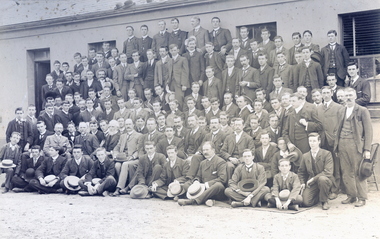
Photograph - Photograph (black & white), Staff and Students of the Ballarat School of Mines, c1903, c.1903
... The building they stand in front of is the first building used by the Ballarat School of Mines, and was the abandoned Ballarat Circuit Court House. grey ballarat school of mines young harry longford philburn hepburn wallin blayney futter and kingsbury thomas hart dawbarn alfred mica smith daniel walker former ballarat circuit courthouse student activity Ferdinand krause George hepburn Some names of students have been handwritten onto the mount card and include: Harry Longford, Philburn, Hepburn, Wallin, Blayney, Grey, Futter, Young, and Kingsbury Staff and students of the Ballarat School of Mines are photographed in front of the former Ballarat Circuit Court House (now demolished). Staff are seated in the second row from the front, and are (from left) Daniel Walker , ? , Alfred Mica Smith, Dawburn, Thomas Hart, ? , ?, [Charles ...This photo is assumed to be science (mining) students at the Ballarat School of Mines. The building they stand in front of is the first building used by the Ballarat School of Mines, and was the abandoned Ballarat Circuit Court House.Staff and students of the Ballarat School of Mines are photographed in front of the former Ballarat Circuit Court House (now demolished). Staff are seated in the second row from the front, and are (from left) Daniel Walker , ? , Alfred Mica Smith, Dawburn, Thomas Hart, ? , ?, [Charles Fenner?]. Some names of students have been handwritten onto the mount card and include: Harry Longford, Philburn, Hepburn, Wallin, Blayney, Grey, Futter, Young, and Kingsburygrey, ballarat school of mines, young, harry longford, philburn, hepburn, wallin, blayney, futter, and kingsbury, thomas hart, dawbarn, alfred mica smith, daniel walker, former ballarat circuit courthouse, student activity, ferdinand krause, george hepburn -
 Federation University Historical Collection
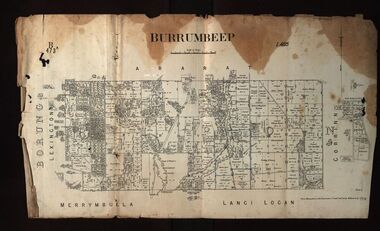
Plan, Burrumbeep, 1884, 16/10/1884
... The plan includes the Burrumbeep Pre-Emptive Right (Roger and Wright); licensed land holders including Stephen Young, John Carroll, William Walsh, Thomas Purcell, Martha M. Bond, Colin Johnson, John Charles Webb, Henry Withycombe, William Henry Barbridge, John Wall, Thomas Flatelly, William Jenkinson, Elisia Radford, V. ...The plan includes the Burrumbeep Pre-Emptive Right (Roger and Wright); licensed land holders including Stephen Young, John Carroll, William Walsh, Thomas Purcell, Martha M. Bond, Colin Johnson, John Charles Webb, Henry Withycombe, William Henry Barbridge, John Wall, Thomas Flatelly, William Jenkinson, Elisia Radford, V. ...Auctions of Crown land were introduced in the Colony of Victoria from 1851 to encourage settlers to occupy and work the land. Many squatters purchased land at auction at the upset (minimum) price of £1 per acre. In some areas where demand was high, such as the goldfields, the price realised at auction was much more. Land was put up for sale in the study area on the Burrumbeep run in May 1855, on the Lexington run in 1857, and on the Gorrinn run in 1858. (http://www.ararat.vic.gov.au/library/document/thermatics.pdf, accessed 27 January 2015) For 70 years or more, Yalla-y-Poora, Burrumbeep, Edgarley, Mount William and Narrapumelap ranked in the leading wool producers in Victoria. 1 Stud owners at Yalla-y-Poora, Eurambeen, Burrumbeep and Challicum crossed merino sheep with sheep descended from John Macarthur's Camden Park in New South Wales. (http://www.ararat.vic.gov.au/library/document/thermatics.pdf, accessed 27 January 2015) In what was to become the Ararat Mining Division, gold was discovered in May 1854 on the Burrumbeep run at a place that became known as Pinky Point on the Mount William goldfield. By 21 June 1854, between 600 and 1,000 people had arrived. (http://www.ararat.vic.gov.au/library/document/thermatics.pdf, accessed 27 January 2015)\ Town allotment plan for Burrumbeep. Merrymbuela, Borung, Lexington and Langi Logan are neighbouring areas. The plan includes the Burrumbeep Pre-Emptive Right (Roger and Wright); licensed land holders including Stephen Young, John Carroll, William Walsh, Thomas Purcell, Martha M. Bond, Colin Johnson, John Charles Webb, Henry Withycombe, William Henry Barbridge, John Wall, Thomas Flatelly, William Jenkinson, Elisia Radford, V. Radford, Denis Byrne, George Cook. Land holders included Andrew Maloney, Richard Wingfield Harrocks, W. Sporton, Terence Lynch, F. S. Falkiner, A. Millman, H. Morris, George Upham, J. McCLure, S. Fletcher, W. Parker, Thomas Myers, William wright, W.C. Winter, C. Wordman, Oliver A. Winter This plan is associated with former Ballarat School of Mines student Richard Squire (1875-6) Gift of the Squire FamilyVerso written in pencil - Plan of Burrembeep Ararat Burrembeep Araratburrumbeep, corrinn, langi logan, merrymbuela, lexington, ararat, roger & wright, cook, rogers, upham, george upham, ross, parsans, morris, johnson, withycoombe, colin johnson, falkiner, dsporton, john carroll, donald gordon, denis bryne, maurice dooley, martha bond, william harricks, \william wingfield harricks, william l.c. harricks, michael houlihan, thomas purcell, martin ryan, michael cody, fletcher, mccaw, w. parker, j.m. clow, elisia radford, thomas radford, thomas myers, barbridge, e. wilde, j. wall, flatelly, g. wardman, w.c. winter, david ball, jenkinson, ballarat school of mines, richard squire, squire -
 Federation University Historical Collection
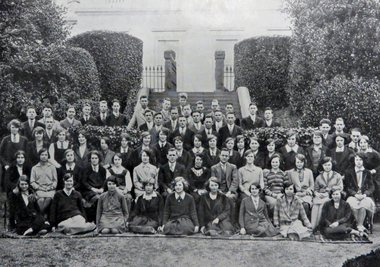
Magazine, Extra Muros: Journal of the Ballarat Teachers' College, 1929, 1929
... Charles Hender; E.B. Tregoning; Bunnett; Henry J. Parker; H. Duggan; C.F. Kirk; Gladys Dunstan; Clare M. Cummin; J.B. Hickey; Norman Povey; Joan McKebery; Monica J. Monaghan; Elsie E. Bruhn; Muriel E. McDonald; Kathleen Fitzgerald; Mary Fogarty; Peggy Skene; Frances Craig; Andrew B. Morton; Ron E. Mosman; Rex Braben; Doris Jarman; A.R. Gready; Monica J. Monahan; Ina Dickman; Himmie Brothers; Jean Green; Alex A. Brown; Eva Varae; H.A. Frost; E.O. Jones; Florence Old; C.A. Harrison; J. Leath-Kingsley; Jack Heard; A.M. McPherson; W. Ian Young...young j.mcnaughton e. errey r. moosman g. neumann r. nicholls r. warriner The last page is autographed by members and staff of the Ballarat Teachers' College. The autographs include: W.H. Elwood (Principal), A.P. Hamano, H.B. Jones; M.H. Miller; W. Braden, Rose Battye; Jean Renkin; Mabel Roll; Nancy Schroeter; O.K. McLeod; George E. Neumann; Z. Zerby; Ada J. Looney; O. Van Bertel; R.P. Warriner; R.R. Watson; C. Goltz; Charles ...The 1929 Magazine Committee were John H. McNaughton (President and Editor), Miss I. Dickman (Secretary) , Mr E.B. Tregoning (Business Manager) and Miss P. Bunnett. John McNaughton was also president of the 1929 Ballarat Teachers' College Dramatic Club. The 1929 Ballarat Teachers' College Council comprised of Miss A. Ballinger, Mr R. Broben, John H. McNaughton, Mr R.P. Warriner and Miss Monahan.Crimson soft covered booklet of 50 pages relating to the Ballarat Teachers' College. It belonged to John McNaughton. The magazine includes the following images: Ballarat Teachers' College Staff and Students; women's tennis; football, men's tennis; hockey; Ballarat Teachers' College Council; visit of Bendigo Teachers' College. The Ballarat Teachers' College Football team included: C. Goltz (Captain), A.M. McPherson (Vice-captain), S.C. Hender, Rex Broben, N. Povey, F. Hickey, J. Heard, J. Johnson, J. Thomas, R. Watson, J. Braden, F. Spencer, H. Parker, I. Young, J. McNaughton, E. Errey, R. Moosman, G. Neumann, R. Nicholls and R. Warriner. The magazine reported "There are undoubtedly three outstanding players in the team - C. Goltz, R. Broben , and A. McPherson. 'The last page is autographed by members and staff of the Ballarat Teachers' College. The autographs include: W.H. Elwood (Principal), A.P. Hamano, H.B. Jones; M.H. Miller; W. Braden, Rose Battye; Jean Renkin; Mabel Roll; Nancy Schroeter; O.K. McLeod; George E. Neumann; Z. Zerby; Ada J. Looney; O. Van Bertel; R.P. Warriner; R.R. Watson; C. Goltz; Charles Hender; E.B. Tregoning; Bunnett; Henry J. Parker; H. Duggan; C.F. Kirk; Gladys Dunstan; Clare M. Cummin; J.B. Hickey; Norman Povey; Joan McKebery; Monica J. Monaghan; Elsie E. Bruhn; Muriel E. McDonald; Kathleen Fitzgerald; Mary Fogarty; Peggy Skene; Frances Craig; Andrew B. Morton; Ron E. Mosman; Rex Braben; Doris Jarman; A.R. Gready; Monica J. Monahan; Ina Dickman; Himmie Brothers; Jean Green; Alex A. Brown; Eva Varae; H.A. Frost; E.O. Jones; Florence Old; C.A. Harrison; J. Leath-Kingsley; Jack Heard; A.M. McPherson; W. Ian Youngballarat teachers' college, mcnaughton, john mcnaughton, dickman, tregoning, bunnett, ellwood, j. brown, a. ballinger, warriner, g. goltz, a.m. mcppherson, s.c. hender, rex broben, n. povey, f. hickey, j. heard, j. johnson, j. thomas, r. watson, j. braden, f. spencer, h. parker, i. young, j.mcnaughton, e. errey, r. moosman, g. neumann, r. nicholls, r. warriner -
 Federation University Historical Collection
Book, Kevin Murray, A History of the Ballarat Technical School, 1969
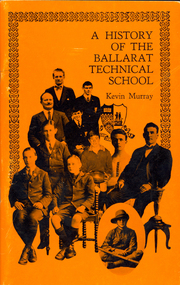
... charles jeffrey...rex cutter...leslie garner...robert watson...kevin murray...w. poole...c. fenner...maurice copland...hesiltine...arblaster...barker...w.h. barnard...andrew berry...fred martell...austin...martell...robinson...ferguson...bald...angow...bainbridge...billman...blackam...coxall...crawley...eason...fraser...gay...gray...john dulfer...lamont...lee...lyons...manson...murphy...myers...pllover...riddiford...skewes...snibson...wilson...young...ballarat junior technical school ballarat school of mines steane uniform cap charles jeffrey rex cutter leslie garner robert watson kevin murray w. poole c. fenner maurice copland hesiltine arblaster barker w.h. barnard andrew berry fred martell austin martell robinson ferguson bald angow bainbridge billman blackam coxall crawley eason fraser gay gray john dulfer lamont lee lyons manson murphy myers pllover riddiford skewes snibson wilson young beacham anstis copeman janes william skilbeck wakeling harold wakeling gladstone procter f.g. procter skilbeck Gladstone Proctor Orange soft coverered book of 67 pages. ...Orange soft coverered book of 67 pages. Contents include the origins of Junior Technical Schools in Victoria, Albert Steane, Ballarat Girls' Junior Technical School, Teachers, mothers' club, Old Boys' Association, School records, Family Links, headmasters, record of teachers. ballarat junior technical school, ballarat school of mines, steane, uniform, cap, charles jeffrey, rex cutter, leslie garner, robert watson, kevin murray, w. poole, c. fenner, maurice copland, hesiltine, arblaster, barker, w.h. barnard, andrew berry, fred martell, austin, martell, robinson, ferguson, bald, angow, bainbridge, billman, blackam, coxall, crawley, eason, fraser, gay, gray, john dulfer, lamont, lee, lyons, manson, murphy, myers, pllover, riddiford, skewes, snibson, wilson, young, beacham, anstis, copeman, janes, william skilbeck, wakeling, harold wakeling, gladstone procter, f.g. procter, skilbeck, gladstone proctor -
 Federation University Historical Collection
Book - Ledger, Ballarat Junior Technical School Examination Results, 1913-1919, 1913-1919
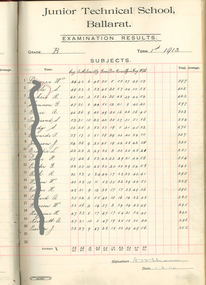
... charles strachan...Thomas stubb...fred ellsworth...cecil hood...vivian taylor...thomas wasley...william shattock...harry o'bern...victor coates...albert anstis...alex amiller...jospeh minster...h. hammer...l. Featherstone...J. Penhalluriack...r.j. selkirk...j.d. chard...a.s. begg...r. caldwell...w. lepp...arthur Coates...hector gay...w.c.f. Almeida...Arthur Pearce...john Trethowan...john cowan...Ivan Ditchburn...A. Boyce...a. pattendon...S. rowe...h. corne...j. skilbeck...e. wyatt...e. birt...r. young...charles strachan Thomas stubb fred ellsworth cecil hood vivian taylor thomas wasley william shattock harry o'bern victor coates albert anstis alex amiller jospeh minster h. hammer l. Featherstone J. Penhalluriack r.j. selkirk j.d. chard a.s. begg r. caldwell w. lepp arthur Coates hector gay w.c.f. Almeida Arthur Pearce john Trethowan john cowan Ivan Ditchburn A. Boyce a. pattendon S. rowe h. corne j. skilbeck e. wyatt e. birt r. young ...The Ballarat Junior Technical School was established in 1913 as a division of the Ballarat School of Mines. It is a predecesor institution of Federation University Australia.Black cloth covered foolscap book with red leather spine and corners. The book is filled out by hand and includes the name of each student, the subjects they studied, their grade for each subject and a total. Each page is signed by Principal A.W. Steaneballarat junior technical school, exams, examinations, a.w. steane, steane, a.e. williams, a. northcott, r. borradale, h. wakeling, r. mcvitty, e. embling, w. skilbeck, c. brittain, r. bath, john dulfer, r. luikeis, allan bernaldo, a. whitla, r. hauffman, n. ellis, a. cutter, h. dodds, h. edmonds, j. deautschmann, j. landvogt, george leech, guido brelaz, roy kauffman, baily leslio, henry dodds, john landvogt, e. adamthwaite, alan billman, william deveux, thomas fry, ernest towsell, thomas wesley, h. barraclough, william baragwanath, rex kitchen, matt moralee, john breen, john garner, g. quigley, h. o'bern, sid chambers, frank prout, reginald crick, f. leask, v. coates, a. butterworth, claude gunnell, eugene lowe, cecil hart, thomas rees, sam prout, charles strachan, thomas stubb, fred ellsworth, cecil hood, vivian taylor, thomas wasley, william shattock, harry o'bern, victor coates, albert anstis, alex amiller, jospeh minster, h. hammer, l. featherstone, j. penhalluriack, r.j. selkirk, j.d. chard, a.s. begg, r. caldwell, w. lepp, arthur coates, hector gay, w.c.f. almeida, arthur pearce, john trethowan, john cowan, ivan ditchburn, a. boyce, a. pattendon, s. rowe, h. corne, j. skilbeck, e. wyatt, e. birt, r. young, lyle eves, hubert lazarus, harry david, john jude, raymond proctor, gustave j. zilles, david flockhart, richard j. young, alfred e. boyce, l. curnow, p. dance, e.f. rowe, h. holmes, c. hiscock -
 Flagstaff Hill Maritime Museum and Village
Certificate - Invitation, Norman Lindsay (Artist), Opening of the Parliament of the Commonwealth by His Royal Highness The Duke of Cornwall and York, ca. 1901
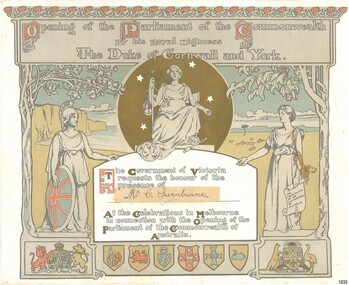
... Flagstaff Hill Maritime Museum and Village Flagstaff hill Maritime Museum Maritime Village Warrnambool Great Ocean Road Shipwreck Coast invitation certificate Mr C Swinburne Government of Victoria Opening of Federal Parliament HRH The Duke of Cornwall and York C Swinburne Susan Jane Granter Susan Jane Swinburne Federal Parliament 1901 Australian Federation Ceremonies Politics Royal Exhibition Building Invited guest Britannia Orb Sceptre Advance Australia Arms Constitution of the Commonwealth of Australia Norman Lindsay John Longstaff Sands & McDougall Federation British colonies Commonwealth of Australia Charles Grant Swinburne Chas Swinburne C G Swinburne Opening of the Federal Parliament Duke of Cornwall and York May 9th Tattersall’s Hotel Marco Polo Warrnambool Steam Packet Co Warrnambool Pioneers Board Joseph Granter Ann Granter Inscription, handwritten on a label: "Mr. C. Swinburne" Left image: [figure of Britannia holding a blue shield with three crossing red bands, standing below an oak tree] Central image, in front of a gilt circle : [symbolic female royal future with Orbe and Sceptre seated on throne, four stars around her] Right image: [young female figure representing Australia holding a scroll, standing below a flowering gum] "THE CONSTITUTION OF THE COMMONWEALTH OF AUSTRALIA" Bottom left: Combined Arms: "[Duke of Cornwall and York, Prince George Frederick Ernest Albert, Princess Alexandra, his Duchess]" Bottom centre: [six symbols representing the Coat of Arms for each state of Australia] Bottom right: Advance Australia Arms "[Shield with six symbols, between Kangaroo and Emu, and below Rising Sun'] ADVANCE AUSTRALIA" Invitation: certificate size, colour lithograph on cream card with gilt highlights. ...Australia became a Federation on January 1st, 1901, uniting Australia's six British colonies - New South Wales, Victoria, Queensland, South Australia, Western Australia and Tasmania – into States of the Commonwealth of Australia. The Government of Victoria invited 12,000 guests to attend the official celebrations for the Opening of the Federal Parliament by His Royal Highness, the Duke of Cornwall and York (later King George V). The historic occasion was held at noon on May 9th, 1901, at Melbourne's Royal Exhibition Building, the only building large enough for that number of guests. The guests represented all six states of Australia with varied connections and interests, including politics, business and industry, the arts, religion, education, and public service. In Melbourne, the occasion was followed by two weeks of celebrations. The decorative, elaborate design of the certificate-size invitation represents Australia’s colonial history and its transition to the Federated Commonwealth of Australia. The National Gallery of Australia attributes the artwork of this invitation to Australian artists Norman Lindsay (1879–1969) and John Longstaff (1861–1941) and its printing to Sands & McDougall Limited, Melbourne. The invitation has no date or location details. This invitation has the label “Mr. C Swinburne” added over an original, handwritten name. Perhaps it was a spelling correction, or a late change, with Swinburne attending in the place of another citizen. The book “Our Invited Guests An Official Directory, Melbourne, Victoria, 1901” lists all the guests, but not one has the surname SWINBURNE. There are five Warrnambool listings, eight people in all: - - MoCOBMICK, G. D., Esq., P.M., Warrnambool. - O’DOWD, The Ven. Monsignor, Warrnambool. - OPIE, C. N. T., Esq. (and Lady), Warrnambool. - OSBORNE, Hy. Wm., Esq., Shire Secretary (and Lady), Town Hall, Warrnambool. - STEVENS, Mrs. F. P., Mia Mia, Warrnambool. CHARLES GRANT SWINBURNE (1864-1934): - Charles Grant Swinburne, known as Chas.., was a prominent Warrnambool figure: a member of Toc H., the Progress Association and several other local clubs and societies. He purchased Warrnambool’s Tattersall’s Hotel in 1911 and had a booth at the 1914 Warrnambool Show. In 1891, he married Susan Jane Granter (1867-19 June 1935), daughter of Joseph Granter (1832-1879) and Ann (born Holley). Joseph had arrived in Melbourne on the famous tall ship Marco Polo in February 1856. In 1868, he was a shareholder of the Warrnambool Steam Packet Co., trading along the coast of Victoria. His portrait is among those recognised on the historic Warrnambool Pioneers Board. The invitation is nationally significant for its connection with the first Federal Parliament in May 1901, where the first federal parliamentarians were sworn in, and where the Duke and Duchess of Cornwall and York attended, representing the continued link with Britain. The invitation also unites a local Warrnambool businessman, Mr C Swinburne, with the 12,000 guests representing their towns and states that in 1901 became the Commonwealth of Australia. Swinburn was also married to the daughter of Joseph Granter, an early pioneer recognised on Warrnambool’s Pioneer Board. Invitation: certificate size, colour lithograph on cream card with gilt highlights. The Victorian Government invited Mr C Swinburne to celebrate the Opening of Federal Parliament by HRH the Duke of Cornwall and York, held in Melbourne. The invitation has printed drawings of figures, decorations, heraldic symbols, and gilt accents behind the central figure, on the capital letters of the message, and the Advance Australia Arms. Inscribed with a handwritten label that covers handwritten text. [The event was held at Noon, 9th May 1901, Royal Exhibition Building, Melbourne.] Inscription, handwritten on a label: "Mr. C. Swinburne" Left image: [figure of Britannia holding a blue shield with three crossing red bands, standing below an oak tree] Central image, in front of a gilt circle : [symbolic female royal future with Orbe and Sceptre seated on throne, four stars around her] Right image: [young female figure representing Australia holding a scroll, standing below a flowering gum] "THE CONSTITUTION OF THE COMMONWEALTH OF AUSTRALIA" Bottom left: Combined Arms: "[Duke of Cornwall and York, Prince George Frederick Ernest Albert, Princess Alexandra, his Duchess]" Bottom centre: [six symbols representing the Coat of Arms for each state of Australia] Bottom right: Advance Australia Arms "[Shield with six symbols, between Kangaroo and Emu, and below Rising Sun'] ADVANCE AUSTRALIA"flagstaff hill maritime museum and village, flagstaff hill, maritime museum, maritime village, warrnambool, great ocean road, shipwreck coast, invitation, certificate, mr c swinburne, government of victoria, opening of federal parliament, hrh the duke of cornwall and york, c swinburne, susan jane granter, susan jane swinburne, federal parliament, 1901, australian federation, ceremonies, politics, royal exhibition building, invited guest, britannia, orb, sceptre, advance australia arms, constitution of the commonwealth of australia, norman lindsay, john longstaff, sands & mcdougall, federation, british colonies, commonwealth of australia, charles grant swinburne, chas swinburne, c g swinburne, opening of the federal parliament, duke of cornwall and york, may 9th, tattersall’s hotel, marco polo, warrnambool steam packet co, warrnambool pioneers board, joseph granter, ann granter -
 Flagstaff Hill Maritime Museum and Village
Plant specimen - Wood Sample, Herbst, 1759-1765
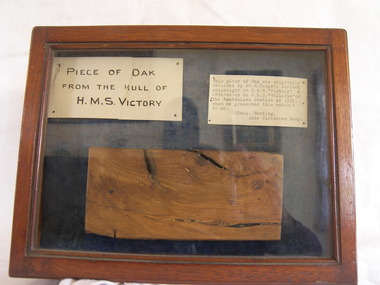
... young man in Royal Navy uniform, with the emblem of a petty officer third class. While Cooper was stationed on the H.M.S. Wallaroo in Sydney, he presented the display case, containing the wood sample from H.M.S. Victory, as well as the exhibit labels, to Charles...young man in Royal Navy uniform, with the emblem of a petty officer third class. While Cooper was stationed on the H.M.S. Wallaroo in Sydney, he presented the display case, containing the wood sample from H.M.S. Victory, as well as the exhibit labels, to Charles ...The piece of oak wood sample inside the case was obtained from Mr H. Cooper during the time he served as a shipwright for the British Royal Navy on Nelson’s flagship, HMS Victory, in 1891. By that time, the H.M.S. Victory was around 100 years old, having been built in 1765 and was currently in dry dock undergoing restoration. Cooper’s skills as a shipwright would have been well employed during this period. HMS Victory was, and still is, undergoing continuous restoration to preserve her for display as a museum ship, due to the vessel's significant naval history. It was during that early restoration period that Cooper obtained the piece of Oak from HMS Victory, believed to be from the ship's hull. Cooper was in Australia in September 1891 serving on the HMS Wallaroo, a British Auxiliary Squadron commissioned as part of the British Royal Navy contingent, to serve and operate in Australian waters. The photograph included with the donation of the wood sample is a portrait of Mr H Cooper taken in 1895 in Sydney. The inscription on the photograph describes him as a skilled shipwright from H.M.S. Wallaroo, depicting Cooper as a young man in Royal Navy uniform, with the emblem of a petty officer third class. While Cooper was stationed on the H.M.S. Wallaroo in Sydney, he presented the display case, containing the wood sample from H.M.S. Victory, as well as the exhibit labels, to Charles Harding ("Chas"), late of the Royal Australian Navy. Harding had been based at the H M Naval Torpedo Depot at Williamstown, Victoria. Although not mentioned, it is believed the two men met whilst serving together in Australia in their respective assignments. It could have been a retirement gift from Cooper to Harding, with the photograph of Cooper likely included with the case, and gifted to Harding in 1895, as the date on the photograph indicates. One of the exhibit's labels indicates that Harding had the item on display whilst serving at the Naval Torpedo Depot in Williamstown. The label indicates: "This piece of Oak is part of the hull of H.M.S. 'Victory', Lord Nelson’s renowned flagship, which took such a prominent part in the Battle of Trafalgar. 21st October 1805. Exhibited by Charles Harding, H.M.V. Naval Torpedo Depot, Williamstown.” After Charles Harding died in 1931, the case containing the sample of oak from H.M.S. Victory was donated by his son, Reg Harding, to Mr Murphy in 1962. The display case has since become a treasured item at Flagstaff Hill. A newspaper article dated 1905 included with the donation mentions that the city of Hamilton in Victoria was shortly expecting a mounted piece of the H.M.S. Victory to be included in the city’s commemoration of the centenary of the "Battle of Trafalgar". Battle of Trafalgar: On October 21, 1805, twenty-seven British ships of the line led by Admiral Lord Nelson aboard HMS Victory defeated thirty-three French and Spanish ships of the line under French Admiral Villeneuve. The battle took place in the Atlantic Ocean off the southwest coast of Spain, just west of Cape Trafalgar, near the town of Los Caños de Meca. The victory confirmed the naval supremacy Britain had established during the course of the eighteenth century, and it was achieved in part through Nelson's departure from the prevailing naval tactical orthodoxy of the day. Conventional practice at the time was for opposing fleets to engage each other in single parallel lines, to facilitate signalling and disengagement, and to maximise fields of fire and target areas. Nelson instead arranged his ships into two columns to sail perpendicularly into the enemy fleet's line. During the battle, Nelson was shot by a French musketeer, and he died shortly before the battle ended. Villeneuve was captured, along with his ship Bucentaure. He later attended Nelson's funeral while a captive on parole in Britain. Admiral Federico Gravina, the senior Spanish flag officer, escaped with the remnant of the fleet. He died five months later from wounds sustained during the battle. It was before this battle that Nelson had issued his now-famous final orders to his ships in 12 separate flag-hoists: “England expects that every man will do his duty”. This wood sample is historically significant for its association with Admiral Lord Nelson and the Battle of Trafalgar. Through Nelson’s leadership and unorthodox battle tactics, he secured not only a victory against the French and Spanish but also reaffirmed Britain's naval supremacy, opening the way for Britain to continue the policy of colonisation of many countries, including Australia.Wood sample adhered to the base of a hinged wood and glass display case. Wood is a sample of oak taken from the hull of Vice-Admiral Lord Nelson's flagship, the HMS Victory, built in 1765. The case also contain two exhibit labels pinned above the wood sample. Other items donated with the display case, and relating to the wood sample: an 1895 photograph, a 1905 newspaper clipping, a 1962 donor's letter (two pages), and a handwritten exhibit label with a border of red lines. Photograph Front: printed- "Herbst" "28 Oxford Street, Hyde Park, Sydney", handwritten - "Mr Cooper", "see back". Back: handwritten - "Mr H Cooper, skilled shipwright, H.M.S. Wallaroo 1895" Exhibit labels still in the case: Left: handwritten- “PIECE OF OAK FROM THE HULL OF H.M.S. VICTORY”, Right: typewritten- “This piece of Oak was originally obtained by Mr. H. Cooper, skilled shipwright on H.M.S. “Victory” & afterwards on H.M.S. “Wallaroo” on the Australian Station in 1895, when he presented this exhibit to me. Chas. Harding, Late Victorian Navy.”flagstaff hill, warrnambool, shipwrecked-coast, flagstaff-hill, flagstaff-hill-maritime-museum, maritime-museum, shipwreck-coast, flagstaff-hill-maritime-village, oak, hms victory, vice-admiral lord nelson, horatio nelson, lord nelson, oak piece, piece of oaknelson, battle of trafalgar, maritime technology, ship relics, 18th century warship, british royal navy, h cooper shipwright, hms wallaroo, herbst hyde park sydney, charles harding, hmv naval orpedo depot williamstown, sir home popham’s telegraphic code, admiralty official day signal book -
 Flagstaff Hill Maritime Museum and Village
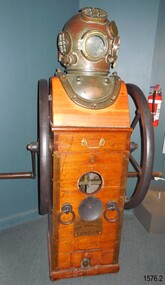
Equipment - Diving compressor and helmet, 1944
... Charles Pasley. Apart from some small modifications to valves and diver communications, the basic 12 bolt ‘closed’ diving dress remained relatively unchanged after the 1870s. Later company successes were also based on innovation, with new products that could be successfully developed and manufactured to high standards. This was largely attributed to the inventive nature, foresight, engineering, and entrepreneurial skills of Robert Henry Davis (1870-1965). In 1882, RH Davis joined the company of 'Siebe & Gorman' as a young...Charles Pasley. Apart from some small modifications to valves and diver communications, the basic 12 bolt ‘closed’ diving dress remained relatively unchanged after the 1870s. Later company successes were also based on innovation, with new products that could be successfully developed and manufactured to high standards. This was largely attributed to the inventive nature, foresight, engineering, and entrepreneurial skills of Robert Henry Davis (1870-1965). In 1882, RH Davis joined the company of 'Siebe & Gorman' as a young ...Siebe Gorman & Company Ltd was a British company that developed diving equipment and breathing equipment and worked on commercial diving and marine salvage projects. The company advertised itself as 'Submarine Engineers'. It was founded by Augustus Siebe, a German-born British engineer chiefly known for his contributions to diving equipment. Siebe Gorman traded as an engineering firm for over 180 years from 1819 to 1999. The early success of the business was due to its founder, the Prussian immigrant Christian 'Augustus' Siebe (1788-1872). For business reasons, he applied for and was granted British citizenship in 1856. He was a gifted engineer who was able to translate theoretical problems into practical, working products. During the industrial Victorian period, the business traded as 'A. Siebe' at 145 High Street Holborn London, but in 1828 new premises were acquired at 5 Denmark Street, Soho. The family firm produced a wide range of manufactured goods including paper-making machinery, measuring machinery, water pumps, refrigeration equipment, and diving apparatus. Augustus Siebe specialised in submarine engineering early on and the company gained a reputation for the manufacture of safe, reliable diving apparatus. Augustus Siebe is best remembered for the development and manufacture of the ‘closed’ Diving Dress based on the ideas of Charles and John Deane, George Edwards, and Charles Pasley. Apart from some small modifications to valves and diver communications, the basic 12 bolt ‘closed’ diving dress remained relatively unchanged after the 1870s. Later company successes were also based on innovation, with new products that could be successfully developed and manufactured to high standards. This was largely attributed to the inventive nature, foresight, engineering, and entrepreneurial skills of Robert Henry Davis (1870-1965). In 1882, RH Davis joined the company of 'Siebe & Gorman' as a young 11-year-old office boy and he was to remain with the company until he died in 1965. Augustus Siebe retired in 1869 and handed over the company to a new partnership of Henry H. Siebe (1830-1885) and William A. O'Gorman (1834-1904). The new firm traded as 'Siebe & Gorman' (1870-1879) from premises in and around Mason Street, Westminster Bridge Road, Lambeth, London. The two partners soon recognised the potential of R.H. Davis and in 1894, aged 24, he became General Manager of Siebe & Gorman. Davis increasingly ran the company until the surviving partner (W.A. Gorman) died in 1904. The firm was disposed of to the Vickers (armaments) family and a new company 'Siebe Gorman & Co. Ltd.' (1905-1998) was formed. Under the chairmanship of Albert Vickers, R.H. Davis was kept on as Managing Director, and the company forged ahead. However, after WW1, the Great Depression caused manufacturing output and share prices to slump. In 1924 Robert Davis made a deal with the Vickers Board and acquired control of the company through majority shares. Under his leadership, the Siebe Gorman Company flourished and within time, four of his sons also joined the firm. The company gained a worldwide reputation for the manufacture of diving apparatus, decompression and observation chambers, and safety breathing apparatus of all types for use on the land, in the air, and under the sea (including mine rescue, tunneling, aircraft, diving, submarine escape and in other hazardous environments). Close research and development links with the MOD (especially the Admiralty), also provided a lucrative outlet for the company products. In 1932, Robert Davis was knighted by King George V, principally for his invention of the ‘Davis Submerged Escape Apparatus’ (D.S.E.A.). Siebe Gorman essentially remained a family firm from the beginning (under A.Siebe) until it became a public company for the first time in 1952. However, following WW2, British manufacturing stagnated through stifled investment and post-war austerity, and there was little innovation. Siebe Gorman's fortunes began to decline as an aging Sir Robert Davis failed to invest, or change the company's business and management practices. In 1959, Siebe Gorman was acquired by the “Fairy Group” and the ailing Sir Robert was made Life President. Consequently, nothing changed and the slow decline continued until Sir Robert's death in March 1965. Around 1960, Siebe Gorman acquired the diving apparatus manufacturer C E Heinke, and for a brief period, it manufactured some diving equipment under the combined name of Siebe Heinke. Around 1964, Mr E. 'Barry' Stephens was appointed as the new Managing Director to modernise Siebe Gorman. Changes were made, including a move to a new factory in Wales in 1975. The new company concentrated on fire-fighting breathing apparatus and escape equipment, and the move coincided with the loss of many of the older, traditional craft skills. Between 1985 and 1998, Siebe expanded through acquisitions, and several other companies were acquired. The Siebe Gorman (diving apparatus) company has therefore traded as A. Siebe (1819-1870); Siebe & Gorman (1870-1879); Siebe Gorman & Co (1880-1904); Siebe Gorman & Co. Ltd (1905-1998). (For information regards the diving helmet & Frank King see Notes Section at the end of this document)The items are very significant as a snapshot into marine history and the development of diving equipment generally especially that used for salvage operations before and during WW2. The company that made the equipment was a leading inventor,developer and innovator of marine equipment with its early helmets and other items eagerly sought after today for collections around the world. The items in the Flagstaff Hill collection give us an insight as to how divers operated and the dangers they faced doing a very necessary and dangerous job. Frank Kings' diving helmet and compressor (communication pipe stored separately). Compressor is hand cranked. US Navy diving helmet, Mark V. Two maker's plates attached. Made in 1944.On rear "WATER SUPPLY" On front 'PATENT" " Logo: Images (Lion, Crown, Horse, Shield within an oval) "SIEBE, GORMAN & Co. Ltd. SUBMARINE ENGINEERS, LONDON.flagstaff hill, warrnambool, maritime museum, great ocean road, us navy diving helmet, commonwealth government salvage, diving helmet, marine salvage, frank king, diver, siebe. gorman & co ltd, submarine equipment, diving equipment, communication under water, hand cranked, diving compressor -
The Beechworth Burke Museum
Audio - Oral History, Jennifer Williams, Mrs Vanessa McDonald, 9 November 2000
... Charles Collins, arrived in 1851-1852. Mrs. McDonald spent her childhood in the isolated hamlet of Stanley, in the area known as 'Little Scotland', where she recalls helping her mother to raise younger siblings, picking apples and walnuts on the family farm, and roaming the hills for wildflowers. As a young...Charles Collins, arrived in 1851-1852. Mrs. McDonald spent her childhood in the isolated hamlet of Stanley, in the area known as 'Little Scotland', where she recalls helping her mother to raise younger siblings, picking apples and walnuts on the family farm, and roaming the hills for wildflowers. As a young ...Mrs. Vanessa McDonald was born in Beechworth in 1917. Christened, Agnes Bertha Collins, Vanessa changed her name in 1960. Mrs. McDonald's family's connection with gold mining in the district reach back to the first of Beechworth's gold rushes, when her great grandfather, a Dutchman who adopted the name Charles Collins, arrived in 1851-1852. Mrs. McDonald spent her childhood in the isolated hamlet of Stanley, in the area known as 'Little Scotland', where she recalls helping her mother to raise younger siblings, picking apples and walnuts on the family farm, and roaming the hills for wildflowers. As a young woman Mrs. McDonald attended religious and social gatherings in the local community. In 1940 she went to Melbourne to work as a mothercraft nurse during the Second World War. She met her husband at a Beechworth football match and was married at the Stanley Methodist Church in 1941. The gold diggings known as the 'Nine Mile' became the hamlet of Stanley, after the British Prime Minister, Lord Stanley, in 1858. By the late 1850s, Stanley boasted schools, an athenaeum, a church, a weekly newspaper and several hotels and other civic infrastructure to cater for a growing population. The area attracted large numbers of Chinese miners, whose presence was frequently resisted. Like other early Victorian mining settlements, Stanley was a hotbed of political and racial tensions during the gold rush. One side of the Nine Mile Creek was known as 'Little Scotland’, the other, 'Little Ireland'. A number of Christian denominations built congregations and churches in Stanley, including the Church of England, Methodist Church, the Catholic Church, and Presbyterian Church. Stanley became part of the United Shire of Beechworth in 1871. By 1880 timber was being cut and two sawmills were established by 1887. River-dredged gold mining consumed vast amounts of timber from the forests in the area, and in 1931 the first of several softwood plantations began. This oral history recording was part of a project conducted by Jennifer Williams in the year 2000 to capture the everyday life and struggles in Beechworth during the twentieth century. This project involved recording seventy oral histories on cassette tapes of local Beechworth residents which were then published in a book titled: 'Listen to what they say: voices of twentieth century Beechworth'. These cassette tapes were digitised in July 2021 with funds made available by the Friends of the Burke.Following the decline in the mining and associated industries during the early-mid-twentieth century, the Beechworth district experienced a period of general economic decline. On the east side of the Dingle Range, Mrs. McDonald's father, William Henry Collins, felled timber and the family were pioneer apple orchardists. The establishment of apple orchards in Stanley reflects changes to how land was used and contributes to our understanding of the historical development of rural communities following the gold rush. Mrs. McDonald's recollections are significant for understanding family and social life in a small rural town in years leading up to the Great Depression and prior to the Second World War. This oral history recording may be compared with other oral histories and items in the Burke Museum's collection. This oral history account is socially and historically significant as it is a part of a broader collection of interviews conducted by Jennifer Williams which were published in the book 'Listen to what they say: voices of twentieth-century Beechworth.' While the township of Beechworth is known for its history as a gold rush town, these accounts provide a unique insight into the day-to-day life of the town's residents during the 20th century, many of which will have now been lost if they had not been preserved.This is a digital copy of a recording that was originally captured on a cassette tape. The cassette tape is black with a horizontal white strip and is currently stored in a clear flat plastic rectangular container. It holds up 40 minutes of recordings on each side.Mrs Vanessa McDonald /listen to what they say, beechworth, oral history, burke museum, emigration, gold rush immigration, victorian gold rush, mining families, apple orchard, forestry, forest plantation, little scotland, stanley, twentieth century history, regional australia, rural australia, farming, harvest festival, great depression, dingle range, the nine mile, australian wildflowers, high country wildflowers, mothercraft nurse, rural and regional women, social history, collins, mrs. vanessa mcdonald, building community life, shaping cultural and creative life, fruit growers, family history, changes to land use in regional victoria -
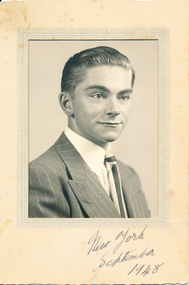 Mission to Seafarers Victoria
Photograph - Photograph, Black and white, Knox Studios, New York September 1948, September 1948
... This is a photograph from the Allan Charles Quinn collection which is a collection of letters and photograph depicting aspects of life at sea for a young man in the era immediately following World War II. allan-quinn photograph portrait new-york 1948 Front, right hand bottom corner: NEW YORK / SEPTEMBER / 1948 handwritten in faded blue/black ink. ...This is a portrait of Allan Quinn, taken during a visit to New York, U.S.A, in September of 1948, when he was 20 years old. This is one of the few portraits of Allan, professional or otherwise, in the collection.This is a photograph from the Allan Charles Quinn collection which is a collection of letters and photograph depicting aspects of life at sea for a young man in the era immediately following World War II.A black and white portrait photograph of Allan Quinn as a young man. It is mounted on a cream cardboard frame, with a pale blue ornate border around the image. The photograph is held in place with clear and coloured tape. The top edge of the cardboard has been roughly cut, and the bottom edge has been cut with a wave design.Front, right hand bottom corner: NEW YORK / SEPTEMBER / 1948 handwritten in faded blue/black ink. On the reverse is tape printed with the Knox Studio logo.allan-quinn, photograph, portrait, new-york, 1948
