
Showing 17 items matching "cheese manufacturer"
-
 Flagstaff Hill Maritime Museum and Village
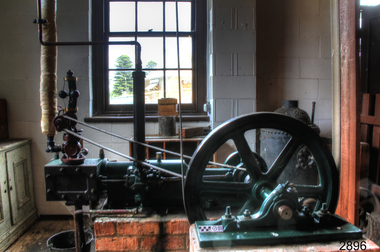
Machine - Steam Engine, Tangyes engineering, Mid-1880s
... ...cheese manufacturer...In the 1880s, many local butter and cheese manufacturers installed Tangye steam engines to power their machinery. ...In the 1880s, many local butter and cheese manufacturers installed Tangye steam engines to power their machinery. ...This Tangye B-size, single-cylinder, horizontal steam engine was likely manufactured in England around the mid-1880s. It was distributed by Melbourne machinery merchants Cameron & Sutherland, which also operated in Bendigo and Ballarat. A local cheese maker once used the engine to drive factory equipment. It was later donated to the Warrnambool Technical School, which then donated it to Flagstaff Hill to add to its historical steam engine collection. Between its manufacture and its donation to Flagstaff Hill, the governor had been replaced by the current Pickering governor. This engine design was very popular in the late 19th and early 20th centuries. When connected and powered up, the engine could drive an overhead line shaft via a flat belt off its flywheel. The line shaft would then drive the machinery via flat belts. It could drive virtually any type of machinery, such as water and sewerage pumps, mine elevators, winches, cranes, metal forges, air blowers, and marine machinery. This engine features a mechanical governor, which controls the speed of the engine regardless of whether it is under load. It also has a water pump built into the valve rod, which is used to supply the boiler with water. Steam enters the cylinder via a slide valve and applies pressure to the piston; it is like a modern internal combustion engine, but in the case of the steam engine, the pressure is exerted in turn on either side of the piston. In other words, the connecting rod is pushed by steam via the piston and piston rod and then pulled back again by steam pushing on the opposite side of the piston. Thus, power is exerted almost continuously, except at the end of each piston stroke, when it reverses direction. In the 1880s, many local butter and cheese manufacturers installed Tangye steam engines to power their machinery. A comprehensive article in the Gippsland Mercury in September 1889 extolled the magnificence of the Farnham Butter Factory in Dennington, Warrnambool, and described how one Tangye engine was used to drive several machines in the cheese- and butter-making processes. A report in the Warragul Guardian in December 1890 notes that the newly opened Warrnambool Butter Factory used a Tangye steam engine to pump water from a 60-foot well. Tangye: Richard Tangye (1833–1906) and four of his brothers—James, Joseph, Edward, and George—were the sons of Joseph Tangye, a Quaker Cornish miner. In 1857, they founded the engineering firm Richard Tangye & Brothers in Birmingham, UK. In 1860, the firm became Tangye Brothers and moved to Cornwall Works in Birmingham. The business encouraged inventors to join the company and develop their patents there, as happened with Weston’s differential pulley block, invented by the Englishman Thomas Aldridge Weston in 1854. Tangye bought the patent in 1858, giving the firm the sole right to manufacture it. The design received a medal for “original application, practical utility and success” at the 1862 International Exhibition in London. Also in 1858, the Tangye firm was commissioned by Brunel’s shipping company to manufacture hydraulic lifting jacks, or rams, to launch the steamship SS Great Eastern. The success of this project brought favourable attention to the firm, and it became involved in other notable projects, including the erection of Cleopatra’s Needle in London in 1878 and work on the Forth Road Bridge in Scotland. The firm underwent several name changes over the years, including James Tangye and Brothers (1857), Tangye Brothers and Price (1859), Tangye Brothers (1860), Tangye Brothers & Holman (1876), Tangye Brothers (by 1878), Tangye Ltd. (1881), and then simply Tangye. Its machinery and equipment were exported worldwide. In 1884, a branch with showrooms, offices, and a warehouse was opened in Melbourne at Cornwall House, Collins Street West. The firm was well known for producing high-quality machinery for agriculture and industry. Even today, new Tangye machinery is available for a subsidiary of Allspeeds. An extensive account of the firm’s history, names, inventions, and further references is available in Grace’s Guide, which also includes references to and diagrams of the Tangye horizontal steam engine. The horizontal steam engine was made by the well-known engineering firm Tangye, known for its high quality of manufacture. It was an important development in machinery because it helped improve productivity. Engines of this type are still used in some parts of the world today. This engine is a good example of a late 19th-century steam engine used in industry and agriculture and adapted for many different purposes. It is also important locally because it was connected to a local cheese making business and part of the thriving western district dairy industry. It may have been one of the Tangyes engines used at the Farnham butter factory or the Warrnambool Butter Factory, which was reported to be one of the most important in the Colony. It is also connected to the Warrnambool Technical School, established in 1968. Steam engine: stationary Tangye Size B, single-cylinder, horizontal Mill type steam engine. It has a 4-inch diameter cylinder with an 8-inch stroke. The body is painted green, and the Pickering governor is red. It was manufactured in Birmingham, England, in accordance with Tangye's Patent 238930, and distributed by Cameron and Sunderland, Melbourne, in the mid-1880s. TANGEYS PATENT BIRMINGHAM B SIZE 238930 CAMERON & SUTHERLAND MELBOURNE THE PICKERING PORTLAND . GOVERNOR . CONN. U.S.A.flagstaff hill, warrnambool, maritime village, maritime museum, flagstaff hill maritime museum and village, shipwreck coast, great ocean road, machine, invention, engine, steam, steam engine, horizontal steam engine, tangyes horizontal steam engine, stationary steam engine, single cylinder steam engine, manufacturing, farming, pumps, lifting equipment, engines, machine tools, hydraulic rams, hydraulic pumps, steam pumps, differential pulleys, mill type steam engine, 4 inch cylinder, weston’s differential pulley, thomas aldridge weston, 1862 international exhibition in london, brunel, ss great eastern, cleopatra’s needle, forth road bridge, cornwall house, collins street melbourne, agricultural machinery, industrial machinery, allspeeds, dairy, pump, richard tangye & brothers, james tangye and brothers, tangye brothers and price, tangye brothers, tangye brothers & holman, tangyes ltd., tangye, richard tangye, james tangye, joseph tangye, edward tangye, george tangye, cornwall works, birmingham, pickering governor, pickering portland connecticut usa, 19th century, dairy plant, steam power, tangye's patent 238930, tangye b size engine, cameron & sutherland, machine merchants, 1880s, mid-1880s, cheese manufacturer, butter manufacturer, diary industry, warrnambool technical school, belt driven machinery, agriculture, mechanical governor, farnham butter factory, warrnambool butter factory -
 Flagstaff Hill Maritime Museum and Village
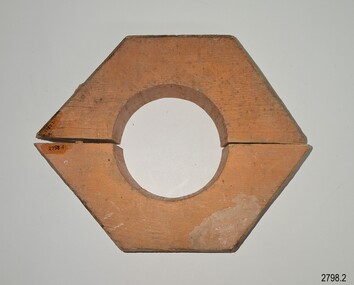
Equipment - Pattern, Briggs Brass Foundry, Early 20th century
... manufacturers and other local industries. The Brass Foundry display featured a historic Cornish chimney, constructed as a working model to illustrate the process of smelting metal in furnaces and pouring it into sand moulds. The chimney, crafted from specially curved bricks, currently stands at approximately two-thirds of its original height, having previously been located at the Grassmere Cheese factory. ...manufacturers and other local industries. The Brass Foundry display featured a historic Cornish chimney, constructed as a working model to illustrate the process of smelting metal in furnaces and pouring it into sand moulds. The chimney, crafted from specially curved bricks, currently stands at approximately two-thirds of its original height, having previously been located at the Grassmere Cheese factory. ...The wooden pattern forms part of a larger collection, securely stored within a durable wooden crate. This pattern was an essential tool at Briggs’ Brass Foundry, specifically designed for creating sand casts. Sand casting is a time-honoured technique, with a history exceeding 2,000 years. The handcrafted nature of this process results in the production of brass and copper alloy items, which are particularly suitable for maritime applications. Typical products include bells, boat hooks, cowls, propellers, handles, lids, rowlocks, hooks, letters, bolts, rail holders, brackets, deck plates, flanges, rudder guides, portholes and covers. The distinctive bronze mixture used at Briggs’ Foundry is copper-based, composed of local ingots of copper, tin, zinc and lead, blended in precisely measured quantities. The resulting alloy is non-ferrous, known for its exceptional durability and longevity. In the early years of Flagstaff Hill, the Briggs family generously donated the crate of patterns along with other related items such as brassware, tools and machinery. These items were prominently displayed in a simulated Brass Foundry within the Village, alongside other working crafts, trades and services typical of a maritime town. From the completion of the building in 1986 until its repurposing in 1994, visitors could view these items and gain insight into the foundering and metalwork trades that supported maritime industries, including shipwrights and boatbuilders. The castings produced at the foundry were also vital for farmers, manufacturers and other local industries. The Brass Foundry display featured a historic Cornish chimney, constructed as a working model to illustrate the process of smelting metal in furnaces and pouring it into sand moulds. The chimney, crafted from specially curved bricks, currently stands at approximately two-thirds of its original height, having previously been located at the Grassmere Cheese factory. The craft of sand-casting, which utilises intricately carved wooden patterns to create metal objects, stands as a testament to the enduring value of traditional skills. This age-old technique remains relevant today, linking past craftsmanship to ongoing industrial practices. The foundry pattern set holds particular significance due to its strong associations with brass foundries, both locally and in coastal regions across Victoria. In these areas, marine industries such as ship and boat building have long depended on high-quality metal castings for the machinery, equipment, and fittings essential to their operations. The alloys formulated by Briggs Brass Foundry, crafted from non-ferrous metals, were specifically designed to provide superior longevity and durability in maritime environments. These patterns are closely tied to the history of the Briggs Brass Foundry, a respected and long-running company that specialised in producing cast goods for the marine sector. The foundry was equipped to supply both unique, one-off items and mass-produced components, ensuring that its products found their way onto a variety of sail and steam vessels along the Victorian coast, including in Warrnambool. In addition to its broader marine applications, Briggs Brass Foundry established itself as a bell-founder specialist. The company’s expertise is notably linked to the historic Schomberg Bell at Flagstaff Hill, which they restored to its original splendour as a fine example of a bell from a luxury migrant ship of the mid-19th century. The significance of the pattern set is further heightened by its association with Briggs Brass Founders, a firm established in the early 20th century and widely recognised for its proficiency in producing, repairing, and restoring ship bells and other marine equipment. Renowned for their non-ferrous metal casting, Briggs Brass Founders consistently supplied high-quality fittings and equipment vital to maritime pursuits. Moreover, the company expanded its influence by opening a branch in Warrnambool. Through this local presence, Briggs Brass Founders supported the regional marine industry and forged strong connections with fishermen and businesses. This not only reinforced their reputation as skilled manufacturers but also highlighted their commitment to community engagement and support. Pattern; hexagonal wooden shape painted orange. The thick carved wooden shape is in halves forming a hole when locked together with the dowel pegs and opposing drilled holes. The pattern is part of a set of foundry patterns from Briggs Brass Foundry.flagstaff hill, flagstaff hill maritime museum and village, warrnambool, maritime museum, maritime village, great ocean road, shipwreck coast, briggs' bronze, trade, sand cast, cast, brass alloy, copper alloy, pattern, mould, foundry, brass foundry, metal foundry, casting, sand mould, sand casting, marine equipment, marine tools, marine fittings, copper tin zinc lead, non-ferrous, non-corrosive, brassware, metalware, foundering, metalwork, maritime, bell founders, ship chandlers, marine products, briggs family, herbert harrison briggs, h h briggs, george edward briggs, cyril falkiner mckinnon briggs, cyril briggs, briggs & son brass foundry, h h briggs & sons foundry, briggs marine, alliance casting & engineering solutions, grassmere cheese factory, cornish chimney, curved bricks, collingwood, moorabbin, collingwood foundry, moorabbin foundry, 1912, briggs, briggs brass foundry, briggs marine foundry, briggs marine products, frank lee, les lee, eva lee, briggs marine warrnambool, non-ferrous founders, bell specialists, ship bell specialists, founders, traditional send casting -
 Federation University Historical Collection
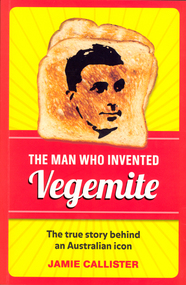
Book, Jamie Callister, The Man Who Invented Vegemite, 2012
... manufacturer later known as Kraft) as a laboratory assistant to develop a yeast extract spread. It took some years but by 1954 the special Vegemite song 'Happy Little Vegemites' demonstrated the popularity of the spread. Callister was also known for packing cheese...manufacturer later known as Kraft) as a laboratory assistant to develop a yeast extract spread. It took some years but by 1954 the special Vegemite song 'Happy Little Vegemites' demonstrated the popularity of the spread. Callister was also known for packing cheese ...Cyril Percy Callister, a chemist by training, became a food technologist and the inventor of the well known spread 'Vegemite'. A Ballarat School of Mines (SMB) student around 1910, Callister then went to Melbourne University where he obtained his B.Sc. in 1914, M.Sc. in 1917 and D.Sc. in 1931. With Sir David Rivett in 1931 he secured the royal charter for the Royal Australian Chemical Institute, becoming president of the Society of Chemical Industry of Victoria in 1935-36. Vegemite, a yeast based spread, and perhaps one of most famous trademarks in Australia, was discovered around 1922 by Cyril Percy Callister. He was hired by the Fred Walker Company (a Melbourne based manufacturer later known as Kraft) as a laboratory assistant to develop a yeast extract spread. It took some years but by 1954 the special Vegemite song 'Happy Little Vegemites' demonstrated the popularity of the spread. Callister was also known for packing cheese in a can to preserve it and developing Kraft processed cheese. he son of a school teacher and postmaster he was born at Chute on 16 February 1893 and died on 5 October 1949. His brother Reginald Clive Callister (1889-1971) was also a student of SMB. (http://www.ballarat.edu.au/about-ub/history/art-and-historical-collection/ub-honour-roll/c/cyril-callister-1893-1949)Red and yellow soft covered book of 208 pages relating to Cyril Callister who invented Vegemite. On Frontispage signed "11th Oct 2012 James Callister"ballarat school of mines, callister, cyril callister, vegemite, william callister -
 Flagstaff Hill Maritime Museum and Village
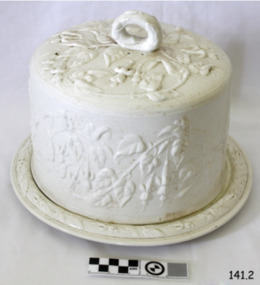
Ceramic - Cheese Dome, Prior to 1950
... Item at this time appears to be an early example of British ironstone earthenware that could possibly be a Staffordshire piece but cannot be associated with an historical event, person or manufacturer, provenance is therefore unknown, as a result the subject item assessed as a collection asset given it was produced before 1950. flagstaff hill warrnambool shipwrecked coast flagstaff hill maritime museum flagstaff hill maritime village great ocean road ceramic dish dish kitchen ware covered dish ironstone cheese dome Decorative relief floral design date letter "A" impressed in base Cheese dome round white ironstone, with flat base and a bell lid with ornate handle white Ceramic Cheese Dome ...Over 1500 pottery firms have operated in Stoke-on-Trent since the early 1700's Some lasted only a few years and some for well over 200 years. Some potters built and owned their own works. Many others were tenants in works built by others and a succession of potters occupied the same works. It was also a common practice for a works to be split between two different pottery companies or for a larger manufacturer to let out a smaller section of his works to a potter who would make wares which were not of interest to the pot works owner. Some potters purchased 'blanks' from other manufacturers and put their own decoration on them some items have two back stamps some have no marks at all. This adds to the confusion and frustration of trying to trace details of a particular manufacturer such as the subject item.Item at this time appears to be an early example of British ironstone earthenware that could possibly be a Staffordshire piece but cannot be associated with an historical event, person or manufacturer, provenance is therefore unknown, as a result the subject item assessed as a collection asset given it was produced before 1950.Cheese dome round white ironstone, with flat base and a bell lid with ornate handle white Decorative relief floral design date letter "A" impressed in baseflagstaff hill, warrnambool, shipwrecked coast, flagstaff hill maritime museum, flagstaff hill maritime village, great ocean road, ceramic dish, dish, kitchen ware, covered dish, ironstone cheese dome -
 Flagstaff Hill Maritime Museum and Village
Equipment - Pattern, Briggs Brass Foundry, 1912-1972
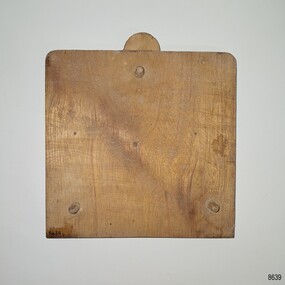
... manufacturers and other local industries also needed the castings made by foundries. The Brass Foundry included a historic Cornish chimney set up as a working model, to tell the story of smelted metal heated in furnaces then be poured into the sand moulds. This chimney was made from specially curved bricks and is now about two-thirds of its full height when originally located at the Grassmere Cheese...manufacturers and other local industries also needed the castings made by foundries. The Brass Foundry included a historic Cornish chimney set up as a working model, to tell the story of smelted metal heated in furnaces then be poured into the sand moulds. This chimney was made from specially curved bricks and is now about two-thirds of its full height when originally located at the Grassmere Cheese ...The wooden pattern is part of a set that is stored in a strong wooden crate and may be part of another similar pattern. It was used at Briggs’ Brass Foundry for making sand casts. The traditional craft of sand casting is over 2000 years old. The handcrafted process produces brass and copper alloy goods that are well suited to marine use; bells, boat hooks, cowls, propellers, handles, lids, rowlocks, hooks, letters, bolts, rail holders, brackets, deck plates, flanges, rudder guides, portholes and covers. Briggs’ Bronze mixture is a copper-based alloy made from local ingots of copper, tin, zinc and lead in carefully measured quantities. The finished product is non-ferrous and can last indefinitely. The crate of patterns was donated by the Briggs family in the early years of Flagstaff Hill, along with other related items such as brassware, tools and machinery. The donated items were displayed in a simulated Brass Foundry in the Village along with other working crafts, trades and services found in a Maritime town. The items were on show from the completion of the building in 1986 until 1994 when the building was repurposed. The patterns represent the trades of foundering and metalwork, both supporting maritime industries such as shipwrights and boatbuilders. Farmers, manufacturers and other local industries also needed the castings made by foundries. The Brass Foundry included a historic Cornish chimney set up as a working model, to tell the story of smelted metal heated in furnaces then be poured into the sand moulds. This chimney was made from specially curved bricks and is now about two-thirds of its full height when originally located at the Grassmere Cheese factory. The hand-cast sand patterns hold considerable significance due to their association with Briggs Brass Founders, a firm established in the early 20th century and widely recognised for its expertise in producing, repairing, and restoring ship bells and marine equipment. Known for their specialisation in non-ferrous metal casting, Briggs Brass Founders supplied high-quality fittings and equipment for maritime use. The company extended its operations by opening a branch in Warrnambool, where it actively supported the local community. The foundry’s ability to cast essential products was important to local and regional industries, like fishing, farming, manufacturing and commercial businesses. Through its presence, its reputation was reinforced as both a skilled manufacturer and a community-minded enterprise. The foundry is notably associated with the Schomberg Bell at Flagstaff Hill, having restored this small, historic bell to its original condition. The Schomberg Bell is a fine example from a luxury migrant vessel dating back to the mid-19th century, reflecting the craftsmanship and heritage preserved by Briggs Brass Foundry. Pattern; unpainted, square wooden block with a semi-circle of dowel added to the centre of the side with rounded corners. Three short dowel pegs are inserted on one flat side; one below the semi-circle and one near the lower corners in an overall triangle configuration. The pattern is part of a set of foundry patterns from Briggs Brass Foundry.flagstaff hill, flagstaff hill maritime museum and village, warrnambool, maritime museum, maritime village, great ocean road, shipwreck coast, briggs' bronze, traditional method, trade, sand cast, cast, brass alloy, copper alloy, pattern, mould, foundry, brass foundry, metal foundry, casting, sand mould, sand casting, marine equipment, marine tools, marine fittings, copper tin zinc lead, non-ferrous, non-corrosive, brassware, metalware, foundering, metalwork, maritime, bell founders, ship chandlers, marine products, biggs, briggs family, herbert harrison briggs, h h briggs, george edward briggs, cyril falkiner mckinnon briggs, cyril briggs, briggs & son brass foundry, h h briggs & sons foundry, briggs marine, alliance casting & engineering solutions, grassmere cheese factory, cornish chimney, curved bricks, collingwood, moorabbin, collingwood foundry, moorabbin foundry, 1912, briggs, briggs brass foundry, briggs marine foundry, briggs marine products, frank lee, les lee, eva lee, briggs marine warrnambool, non-ferrous founders, bell specialists, ship bell specialists, founders, metalworking, traditional sand casting, casting pattern, foundry pattern -
 Cheese World Museum
Box, butter
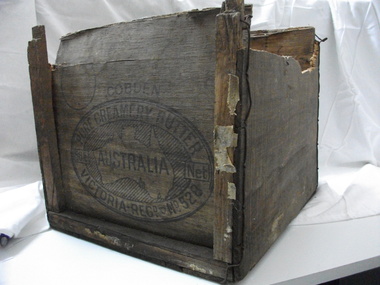
... It is connected to Warrnambool Cheese and Butter Factory Company Limited through the box manufacturer, Peter John McGennan, who was one of the instigators of the factory. ...It is connected to Warrnambool Cheese and Butter Factory Company Limited through the box manufacturer, Peter John McGennan, who was one of the instigators of the factory. ...This butter box belonged to Jack Gore of Warrnambool who used it in his garage to store car parts. It is connected to Warrnambool Cheese and Butter Factory Company Limited through the box manufacturer, Peter John McGennan, who was one of the instigators of the factory. Cobden and Warrnambool factories were the first two co-operative factories to produce butter in Victoria, both commencing in 1888. Warrnambool Cheese and Butter Factory Company Ltd is the only remaining independent butter factory still using its original name. It is an example of the manner in which butter was packed for export from the late 19th century until well into the 20th century. Its innovative design is light but strong, using plywood for the box body and struts 'stitched' to the body with wire. The ply was originally pine imported from New Zealand which did not taint the butter. Following the exclusion of the timber from NZ, plantations of local pine were planted and used. McGennan's box factory supplied butter boxes to the majority of butter factories in Victoria, producing up to half a million boxes per year by 1917.This Cobden butter box is historically significant relating to the butter industry and a rare item. Not many of these exist. Wooden butter box with broken ends and a hole in the bottom.Constructed using thin ply ends, sides and base with square wooden struts tied with wire to strengthen the box. The trade mark on the end of the box is an oval with text around a map of Australia with the word AUSTRALIA printing across the map.COBDEN/PURE CREAMERY BUTTER/56lb Net/VICTORIA/REGD No.528butter, dairying, dairy manufacturing industry, butter boxes, cobden -
 Cheese World Museum
Book, Spectrum Print Solutions, Pioneering Dairy Families, May 2013
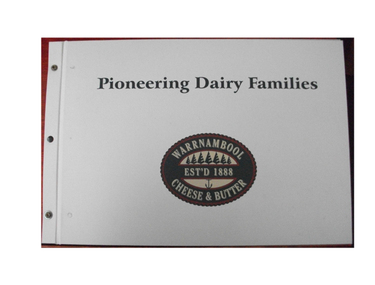
... Cheese and Butter Factory Ltd. The book was printed and launched at the 125th Anniversary celebrations of the factory in May 2013. Families featured are Anderson, Burke, Burleigh, Chislett, Kelly, Logan, Mahony, McConnell, Rea, Taylor, Uebergang. Records the contribution of early dairy farming families connected with Victoria's oldest dairy processing manufacturer ...Book developed from the Heritage Week 2011 display featuring some pioneering farming families connected with Warrnambool Cheese and Butter Factory Ltd. The book was printed and launched at the 125th Anniversary celebrations of the factory in May 2013. Families featured are Anderson, Burke, Burleigh, Chislett, Kelly, Logan, Mahony, McConnell, Rea, Taylor, Uebergang.Records the contribution of early dairy farming families connected with Victoria's oldest dairy processing manufacturer. The company was established in May 1888 and commenced commercial processing in November 1888. The company remained as an independent processor until early 2014.White cloth bound book with chrome screw binding, green and cream Warrnambool Cheese and Butter Factory Company logo and title in green print; 12 laminated pages, full colour. Book printer details on sticker on inside back cover.Spectrum Print Solutions/for all your printing needs/Shop2,377 Raglan Pde, Warrnambool/Ph 03 5561 5233 www.spectrum-oz.comdairying, dairy processors, milk, butter, cheese, families, anderson, burke, burleigh, kelly, logan, mahony, mcconnell, rea, taylor, uebergang, warrnambool cheese and butter factory company, wcb, anniversary celebrations -
 Cheese World Museum
Scales, Persinware, Post Office scales
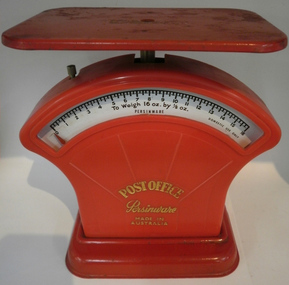
... Allansford Warrnambool Cheese & Butter Factory WCB Post offices Scales Weighing instruments No.63 (on base) POST OFFICE/Persinware/Made in Australia Red Post Office wedge-shaped scales with rectangular base and spring-loaded top plate; white dial face marked to 16oz by 1/8 oz increments. Marked Domestic Use Only. Manufacturer's ...These scales were used in the post office which was located at Warrnambool Cheese & Butter Factory.Red Post Office wedge-shaped scales with rectangular base and spring-loaded top plate; white dial face marked to 16oz by 1/8 oz increments. Marked Domestic Use Only. Manufacturer's details marked in gold on the front of the scales.No.63 (on base) POST OFFICE/Persinware/Made in Australiaallansford, warrnambool cheese & butter factory, wcb, post offices, scales, weighing instruments -
 Cheese World Museum
Toy, projector, Fairymark
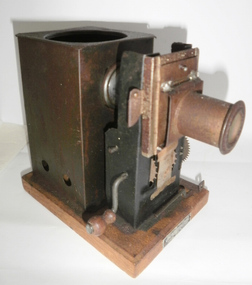
... Cheese World Museum. tin toys projectors film Allansford Uebergang Fairymark audio visual appliances photography Fairymark/Made in Japan Tin toy projector mounted on a wooden base. A box shape with a lens on the front has a removable lid with a fluted edge. In front of this is the film holder which has a carrier for the film, a winding mechanism, and a protruding lens at the front. This projector was lit by a candle inserted in the body. A baseplate with the manufacturer's ...The Uebergang family lived at Tooram Park, Allansford from 1912 until 1992. The projector is part of a collection of toys given into the care of Cheese World Museum.Tin toy projector mounted on a wooden base. A box shape with a lens on the front has a removable lid with a fluted edge. In front of this is the film holder which has a carrier for the film, a winding mechanism, and a protruding lens at the front. This projector was lit by a candle inserted in the body. A baseplate with the manufacturer's name is on the front of the wooden mount.Fairymark/Made in Japantin toys, projectors, film, allansford, uebergang, fairymark, audio visual appliances, photography -
 Cheese World Museum
Booklet, The Modern Printing Company, Memorandum and Articles of Association of the Warrnambool Cheese and Butter Factory Company Ltd, 1932
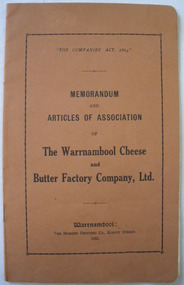
... The Warrnambool Cheese and Butter Factory Company Limited was established in 1888 at Allansford and remained as an independent dairy manufacturer until 2014 when it was taken over by Canadian company Saputo. ...Warrnambool Cheese and Butter Company Ltd was the earliest dairy manufacturer registered in Victoria. ...The Warrnambool Cheese and Butter Factory Company Limited was established in 1888 at Allansford and remained as an independent dairy manufacturer until 2014 when it was taken over by Canadian company Saputo. The factory was burnt in 1929 and all records lost. This booklet is a reprint of the original.Warrnambool Cheese and Butter Company Ltd was the earliest dairy manufacturer registered in Victoria. Registered in May 1888, it commenced processing in November 1888. The Articles record the early rules of the company and some of those early people involved in the company.Brown soft cover 12 page booklet 'Memorandum & Articles of Association of Warrnambool Cheese & Butter Factory Company Ltd', with black border around the black text.The Companies Act 1864/ Memorandum/ and/ Articles of Association/ of/ The Warrnambool Cheese/ and/ Butter Factory Company Ltd/ Warrnambool: / The Modern Printing Company, Koroit St/ 1932allansford, warrnambool cheese and butter factory company, companies, commerce, articles of association, companies act 1864, dairy industry -
 Cheese World Museum
Photograph, Warrnambool Cheese and Butter Factory Co Ltd site 2000 -aerial view, 2000
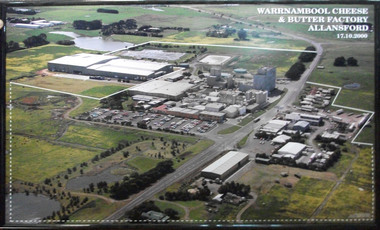
... Cheese World Museum operates under the Cheese World umbrella. allansford warrnambool cheese and butter factory company saputo dairyiing dairy manufacturing diary manufacturers cheese butter 17.10.2000 Aerial colour photograph of Warrnambool Cheese and Butter Factory in wooden frame. ...Warrnambool Cheese and Butter Factory Company was formed by a group of Warrnambool business men. The company was registered in May 1888 and commenced commercial production in November 1888. The company retained its independence for more than 125 years until acquired by Canadian firm Saputo. It has operated from the same site since its inception and also has an office in Japan. Milk processing is undertaken by Sungold. Milk powder for export is also produced on-site. Cheese World is a retail arm of the company operates on a connected site selling company products, local food products, wine and cheese tasting. Cheese World Museum operates under the Cheese World umbrella.Aerial colour photograph of Warrnambool Cheese and Butter Factory in wooden frame. Shows buildings and surrounds. Lines indicate factory boundaries, dotted lines indicate property extension. Date is recorded on the image.17.10.2000allansford, warrnambool cheese and butter factory company, saputo, dairyiing, dairy manufacturing, diary manufacturers, cheese, butter -
 Warrnambool and District Historical Society Inc.
Label, Rosebrook Cheese and Butter Factory, Early 20th century
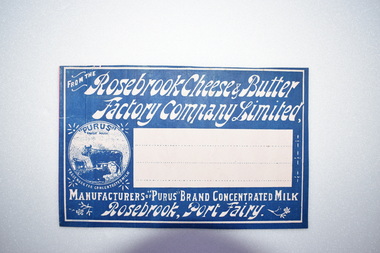
... FROM THE Rosebrook Cheese & Butter Factory Company Limited, MANUFACTURERS OF "PURUS BRAND CONCENTRATED MILK Rosebrook, Port Fairy. ...This label is of some local significance as the Rosebrook Cheese and Butter factory operated for 30 years rosebrook cheese and butter concentrated milk lydiard rosebrook butter factory FROM THE Rosebrook Cheese & Butter Factory Company Limited, MANUFACTURERS OF "PURUS BRAND CONCENTRATED MILK Rosebrook, Port Fairy. ...The Rosebrook Cheese and Butter Factory was opened in November 1888 by Messrs Lydiard &T F Rutledge & was a cooperative factory managed by Mr. Goldie. It operated out of the former Rosebrook Flour Mill which was built on the banks of the Moyne River near the Rosebrook bridge in the late 1840s. In 1896 the factory commenced the production of the condensation of milk. The company closed in 1911. The building and machinery were sold in 1917. Rosebrook is situated about 20 kilometres from Warrnambool on the Princes Highway. This label is of some local significance as the Rosebrook Cheese and Butter factory operated for 30 years Rectangular dark blue and white label featuring text and a trade mark. The latter is circular with three cows pictured. There are decorations of flowers and leaves. The central area of the label is white with three lines. The label is adhered to a piece of pink card.FROM THE Rosebrook Cheese & Butter Factory Company Limited, MANUFACTURERS OF "PURUS BRAND CONCENTRATED MILK Rosebrook, Port Fairy. "PURUS" TRADE MARK FOR CONCENTRATED MILKrosebrook, cheese and butter, concentrated milk, lydiard, rosebrook butter factory -
 Warrnambool and District Historical Society Inc.
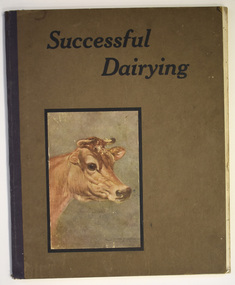
Book, The Nightingale Supply Company Limited, Sydney, Successful Dairy Farming in Australia, c.1930
... manufacturers of SAFONIA) and appears to have been written about 1930 when Australia had 2,400,000 dairy cows. This book is of antiquarian interest and is also of some local interest as dairy farming remains a key industry in the Warrnambool district with several important cheese and butter factories. ...Information on dairy farming in AustraliaThis is a book of 71 pages. The cover is grey with a colour photograph of a jersey cow's head, black printing and dark blue binding. The pages contain black and white photographs, sketches and tables, printed text and a colour fold out of a cow showing internal organs etc. The cover is partly detached from the pages.non-fictionInformation on dairy farming in Australiadairy farming in australia, dairy cows, warrnambool, western victoria -
 Warrnambool and District Historical Society Inc.
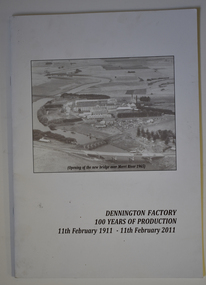
Booklet - Centenary History of Dennington Factory, Dennington Factory 100 Years of Production, 2011
... cheese, Milo, Nescafe Instant Coffee and Sunshine Powdered Milk. In 2005 the factory was sold to Fonterra Australia Pty Ltd. In 2019 the factory ceased to be a milk processing plant and in 2020 ProviCo, an animal nutrition manufacturer, took over the factory....cheese, Milo, Nescafe Instant Coffee and Sunshine Powdered Milk. In 2005 the factory was sold to Fonterra Australia Pty Ltd. In 2019 the factory ceased to be a milk processing plant and in 2020 ProviCo, an animal nutrition manufacturer, took over the factory. ...Centenary History of the Dennington FactoryThis is a booklet of 24 pages. The front cover has a black and white photograph and black printing and the back cover has a colour photograph, a logo and black printing. The pages contain printed text and black and white and colour photographs. The booklet is stapled.non-fictionCentenary History of the Dennington Factorynestles factory dennington, fonterra factory dennington -
 Bendigo Historical Society Inc.
Financial record - INVOICE COLLECTION: Foggitt Jones Pty. Ltd
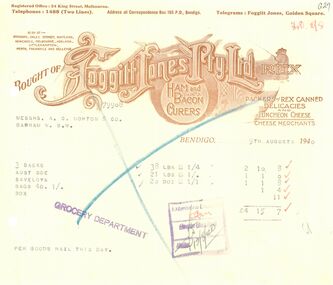
... https://historyoutthere.com/2015/09/14/ham-and-cheese-please/ The company was founded in 1904 when Charles Emanuel Foggitt and Thomas Llewellyn Jones left food manufacturer J.C.Hutton. ...https://historyoutthere.com/2015/09/14/ham-and-cheese-please/ The company was founded in 1904 when Charles Emanuel Foggitt and Thomas Llewellyn Jones left food manufacturer J.C.Hutton. ...https://historyoutthere.com/2015/09/14/ham-and-cheese-please/ The company was founded in 1904 when Charles Emanuel Foggitt and Thomas Llewellyn Jones left food manufacturer J.C.Hutton. Together they took over the floundering Oxley factory. Within five years their trade in ham, bacon, cheese, and related foodstuffs, was worth over £1,000,000 a year. They paid over-award wages, premises were scrupulously clean, and their products filled banquet halls and kitchens across the country. Foggitt ran the processing. He was born to a farming family in Yorkshire, England, in 1865. Two of his sons served on the western front in the First World War, and his third son in the Second World War earning a Distinguished Service Cross and Mentioned in Despatches. His brother-in-law was William Bertram, the long-time Labor member and speaker of the Queensland Legislative Assembly. Foggitt didn’t live to witness the crowning glory however. He died in 1926, the year before his company with partner Thomas Jones as chairman of directors, took over his old employer J.C.Hutton. Jones himself passed away in 1946. With the founders gone, after a while so too was the passion. The holding company United Provisions Ltd changed its name to Huttons, eventually selling its operations, and delisting from the stock exchange. Jones ran the business. He was born to a radical family in Welshpool, Wales, in 1872. His father was a strong radical before the labor movement was founded, and his grandfather was a militant chartist who narrowly escaped transportation. Jones was elected as a Labor member to the Queensland Legislative Assembly in 1915, defeating the then premier. He was subsequently appointed to the Legislative Council. In his spare time he served as commodore of Royal Queensland Yacht Club.All printed in tan ink on thick cream paper. Each with two holes punched in the left side of the page. 10934.31a - receipt number G27 or 79908 Receipt dated: 9th August 1940 The receipt header reads "Bought of Foggitt Jones Pty. Ltd. Rex" in capital letters. The header also reads: ham and bacon curers. Packers of rex Canned Delicacies and Luncheon Cheese - Cheese merchants. Above the company name, it lists the company's: Locations - "Also at: - Brisbane, Oxley, Sydney, Maitland, Newcastle, Melbourne, Adelaide, Littlehampton, Perth, Fremantle and Bellevue." This receipt is from their Bendigo location. Addresses - registered office: 34 King Street, Melbourne. Contact Info - Phone 1488 Telegrams: Foggitt Jones, Golden Square. Correspondence to P.O. Box 195, Bendigo. receipt items typed in black ink. For the purchase of 3 backs, Aust Sge, Saveloys etc. Purchased for the price of: 4 pounds, 15 shillings and 7 pence. 10934.31b - receipt number G9 or 79565 Receipt dated: 5th August 1940 The receipt header reads "Bought of Foggitt Jones Pty. Ltd. Rex" in capital letters. The header also reads: ham and bacon curers. Packers of rex Canned Delicacies and Luncheon Cheese - Cheese merchants. Above the company name, it lists the company's: Locations - "Also at: - Brisbane, Oxley, Sydney, Maitland, Newcastle, Melbourne, Adelaide, Littlehampton, Perth, Fremantle and Bellevue." This receipt is from their Bendigo location. Addresses - registered office: 34 King Street, Melbourne. Contact Info - Phone 1488 Telegrams: Foggitt Jones, Golden Square. Correspondence to P.O. Box 195, Bendigo. receipt items typed in black ink. For the purchase of 6 backs bacon, saveloys etc. Purchased for the price of: 5 pounds, 14 shillings and 4 pence. 10934.31c - receipt number G38 or 80159 Receipt dated: 13th August 1940 The receipt header reads "Bought of Foggitt Jones Pty. Ltd. Rex" in capital letters. The header also reads: ham and bacon curers. Packers of rex Canned Delicacies and Luncheon Cheese - Cheese merchants. Above the company name, it lists the company's: Locations - "Also at: - Brisbane, Oxley, Sydney, Maitland, Newcastle, Melbourne, Adelaide, Littlehampton, Perth, Fremantle and Bellevue." This receipt is from their Bendigo location. Addresses - registered office: 34 King Street, Melbourne. Contact Info - Phone 1488 Telegrams: Foggitt Jones, Golden Square. Correspondence to P.O. Box 195, Bendigo. receipt items typed in black ink. For the purchase of 2 backs bacon, Saveloys etc. Purchased for the price of: 2 pounds, 7 shillings and 6 pence. 10934.31d - receipt number G70 or 79420 Receipt dated: 2nd August 1940 The receipt header reads "Bought of Foggitt Jones Pty. Ltd. Rex" in capital letters. The header also reads: ham and bacon curers. Packers of rex Canned Delicacies and Luncheon Cheese - Cheese merchants. Above the company name, it lists the company's: Locations - "Also at: - Brisbane, Oxley, Sydney, Maitland, Newcastle, Melbourne, Adelaide, Littlehampton, Perth, Fremantle and Bellevue." This receipt is from their Bendigo location. Addresses - registered office: 34 King Street, Melbourne. Contact Info - Phone 1488 Telegrams: Foggitt Jones, Golden Square. Correspondence to P.O. Box 195, Bendigo. receipt items typed in black ink. For the purchase of 2 backs bacon, Aust Sge, Saveloys etc. Purchased for the price of: 3 pounds, 8 shillings and 4 pence.bendigo, morton's stores, foggitt jones pty ltd -
 Williamstown Historical Society Inc
Domestic object - Mickey Mouse canister
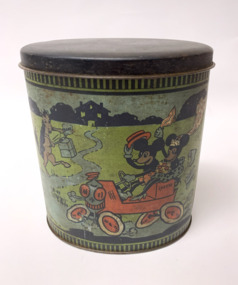
... manufacturer. Mickey mouse Minnie mouse Biscuit tin A sign hanging from rear of the car: "Just Married" On the side of the car seat: "CHEESE" Illustrated oval canister or biscuit tin with a dark coloured lid. ...This tin cannister was probably made in the 1930s and demonstrates the popularity of Disney characters in Australia during that decade. The manufacturer of the tin canister may have been Wilson Bros. Pty Ltd. That company went on to become Willow, a famous Australian metalware manufacturer. Illustrated oval canister or biscuit tin with a dark coloured lid. It features a coloured depiction of Mickey Mouse and Minnie Mouse riding in a car with a "Just Married" sign hanging from the rear of the car. Mickey drives the car. A variety of animal singers and instrument players are sending them off on their way in a jovial way. A kangaroo as part of the musical ensemble.A sign hanging from rear of the car: "Just Married" On the side of the car seat: "CHEESE"mickey mouse, minnie mouse, biscuit tin -
 Emerald Museum & Nobelius Heritage Park
Functional object - Butter(?) Churn, c. Late 19th-Early 20th Century
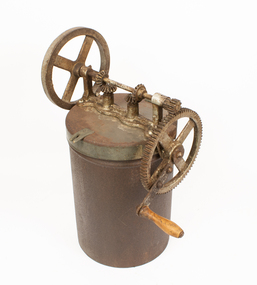
... cheese maker. There are no visible corporate logos or manufacturer's marks, limiting our ability to determine its true origins....cheese maker. There are no visible corporate logos or manufacturer's marks, limiting our ability to determine its true origins. ...This item was brought to Australia by an Italian family in the 1920s who settled in Avonsleigh. It resembles historical hand-crank butter churns; however, it does have the notable difference of using a whisk-like structure rather than a paddle-based churn. (The whisks may have been a modification of the original machine.) It is possible it was used for another similar application requiring faster spinning, such as whipping cream, and it has been suggested it could be an ice-cream maker (though ice-cream makers also tend to use paddles). Another suggestion has been a cheese maker. There are no visible corporate logos or manufacturer's marks, limiting our ability to determine its true origins.This is a unique example of food production tools in the late 19th and early 20th centuries.This item is in two parts, both made with metal heavily rusted on the outside and mostly clean on the inside. The larger section is the empty cylindrical container. The smaller section is both the lid to the container and a whisk for the butter churn; it has a whisk section which protrudes into the cream in the container, which is turned by the hand-crank and gears.N/Atools, agriculture, domestic life
