
Showing 158 items matching "chemist labels"
-
 Warrnambool and District Historical Society Inc.
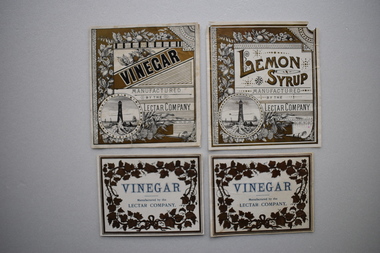
Labels, Gaspars Modern Print, Lectar Company, Early 20th century
... ...chemist labels... These labels come from the pharmacy business of R.F.Kennedy who sold Lectar Company products and used a lighthouse image as his logo. Richard Kennedy (1826-1903), a wholesale, retail and manufacturing chemist in Timor Street, came to Warrnambool in 1880 and had what was described in the ‘Cyclopedia of Victoria’ as ‘the largest and best-appointed pharmacy in Victoria’. ...This business was the most important historically of all the Warrnambool chemists. warrnambool R F Kennedy chemist labels Lectar company .1,.2 Vinegar manufactured by the Lectar Company .3 Lemon Syrup manufactured by the Lectar Company .4,.5 Vinegar manufactured by the Lectar Company .1, .2 Paper with a decorative order, images in gold and black of grapes, flowers and a lighthouse and black printing .3 As .1 above .4,.5 Paper with a gold border, images of grape vines in gold and blue printing Lectar Company Labels Gaspars Modern Print ...These labels come from the pharmacy business of R.F.Kennedy who sold Lectar Company products and used a lighthouse image as his logo. Richard Kennedy (1826-1903), a wholesale, retail and manufacturing chemist in Timor Street, came to Warrnambool in 1880 and had what was described in the ‘Cyclopedia of Victoria’ as ‘the largest and best-appointed pharmacy in Victoria’. Kennedy was the Vice-President of the Pharmaceutical Society of Victoria, on the Pharmacy Board and was prominent in community affairs n Warrnambool. He also made local perfumes with many varieties named after people or events of the time – Nellie Melba, Federation etc. His pharmacy building in Timor Street and his house in Canterbury Road (“Ivanhoe”) still stand today.These labels are of some interest as they are associated with the Warrnambool business of the chemist, R.F.Kennedy. This business was the most important historically of all the Warrnambool chemists. .1, .2 Paper with a decorative order, images in gold and black of grapes, flowers and a lighthouse and black printing .3 As .1 above .4,.5 Paper with a gold border, images of grape vines in gold and blue printing .1,.2 Vinegar manufactured by the Lectar Company .3 Lemon Syrup manufactured by the Lectar Company .4,.5 Vinegar manufactured by the Lectar Company warrnambool, r f kennedy, chemist labels, lectar company -
 Warrnambool and District Historical Society Inc.
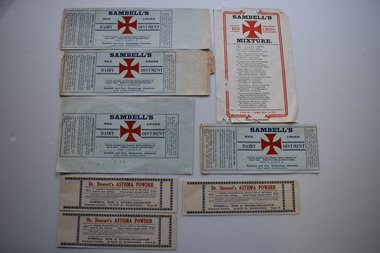
Label, Gaspers Modern Print, Sambell, Early 20th century
... Chemist,...Warrnambool...Labels... These labels come from the Warrnambool chemist business of John Sambell/Sambell and Son/Sambell, Son and Granddaughter. ... also remind us that this business was unusual in that in the 20th century it acknowledged a female proprietor along with the male proprietors (Sambell, Son and Granddaughter) Sambell, Chemist, Warrnambool Labels .1 Sambell’s Chest and Lung Mixture .2 Sarsparilla Blood Purifier .3. ...These labels come from the Warrnambool chemist business of John Sambell/Sambell and Son/Sambell, Son and Granddaughter. John Sambell opened the Hall of Pharmacy in Fairy Street, Warrnambool about 1890. He was a chemist and dentist with previous business experience in Great Britain and Victoria. By 1919 John Sambell’s son, Herbert had joined the business, trading as Sambell and Son (though John Sambell died in 1906) and the shop was located at 151 Fairy Street. In the late 1930s Sambells moved to 90 Fairy Street and was known as Sambell, Son and Granddaughter. Herbert Sambell died in 1943. These labels show some of the many products sold by the Warrnambool chemist business of John Sambell/Sambell & Son/Sambell, Son and Granddaughter, a prominent 20th century Warrnambool business. The labels also remind us that this business was unusual in that in the 20th century it acknowledged a female proprietor along with the male proprietors (Sambell, Son and Granddaughter).1A sheet of paper pasted on to a thicker card. It has a red border and a red cross and blue printing .2 A sheet of paper pasted onto another sheet with red and blue printing and a red and blue border .3 A sheet of paper with a red border, a red cross and blue printing .4 A sheet of paper with red lines, a red cross and blue and red printing .5 A sheet of paper with a red decorative border and blue and red printing .6 A sheet of pink paper with a black border and black printing .7 A sheet of paper with a gold border and blue and gold printing .8 A sheet of paper with blue printing and a red cross .1 Sambell’s Chest and Lung Mixture .2 Sarsparilla Blood Purifier .3. Sambell’s Restorative Tonic 4. Sambell’s Balsamic Salve 5. Sambell’s Emulsion of Cod Liver Oil 6. Sambell’s White Diarrhoea Mixture 7. Sambell’s Elixir Strengthening Tonic 8. Sambell’s Red Cross Dairy Ointment sambell, chemist,, warrnambool, labels -
 Southern Sherbrooke Historical Society Inc.
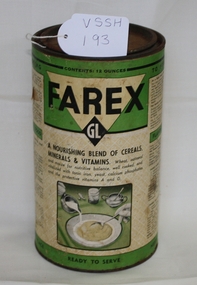
Cereal tin, Before 1966
... "2/-" in pencil on Amcal Chemist label. Stamped "3G"....Most probably used to store early childhood materials. food container "2/-" in pencil on Amcal Chemist label. Stamped "3G". 12oz tin, labelled 'Farex'. ...Donated to Historical Society by Helen Gibson, the first district preschool playleader (early childhood educator). Most probably used to store early childhood materials.12oz tin, labelled 'Farex'. Label is green and white in colour. Cylindrical. "Glaxo Laboratories (Aust) Pty. Ltd" on label."2/-" in pencil on Amcal Chemist label. Stamped "3G".food container -
 Bendigo Historical Society Inc.
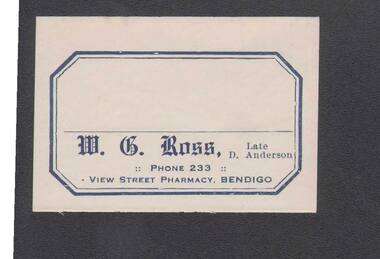
Document - CAMBRIDGE PRESS COLLECTION: LABEL - ROSS PHARMACY
... White chemist label with dark blue printing and double line border on white gummed paper. ...BUSINESS Printers cambridge press Cambridge Press Collection W G Ross D Anderson White chemist label with dark blue printing and double line border on white gummed paper. ...White chemist label with dark blue printing and double line border on white gummed paper. Border has eight sides of unequal length.Name of W. G. Ross, Late D. Anderson, View Street Pharmacy, Bendigo.business, printers, cambridge press, cambridge press collection, w g ross, d anderson -
 Bendigo Historical Society Inc.
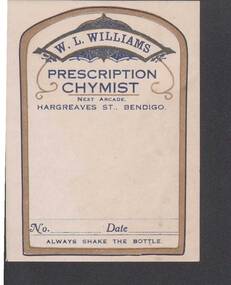
Document - CAMBRIDGE PRESS COLLECTION: LABEL - W. L. WILLIAMS, CHYMIST
... Chemist label printed in dark blue with gold border and decoration. ...BUSINESS Printers cambridge press Cambridge Press Collection W L Williams Chemist label printed in dark blue with gold border and decoration. ...Chemist label printed in dark blue with gold border and decoration. Gold border has blue outline. Name of W. L. Williams, Prescription Chymist, Next Arcade, Hargreaves St., Bendigo. Dark blue and gold decoration around the name at the top. Space for number and date at the bottom.business, printers, cambridge press, cambridge press collection, w l williams -
 Warrnambool and District Historical Society Inc.
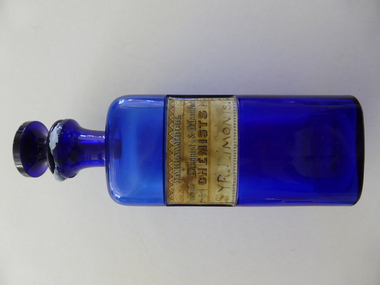
Bottle Blue, Druggist and Manufacturer, 1889
... Label: Warrnambool Wholesale Druggists & manufacturi chemist. handwritten on label Syr Limonis. ...A fine example of a late 19th century bottle which was used and owned by a Warrnambool business. warrnambool warrnambool chemist chemist bottle Label: Warrnambool Wholesale Druggists & manufacturi chemist. handwritten on label Syr Limonis. ...This bottle was made by Whitall and Tatum who manufactured bottles from the early 1800's through to the 1930's. They specialised in producing chemist bottles and this particular cobalt blue bottle is on of the more rarely produced bottles. This syrup forms a cooling and pleasant addition to beverages for patients with febrile complaints, and serves to conceal the taste of saline purgatives in solution. It is made by steeping lemon juice and skin in a sugar syrup and alcohol. We are unsure of the particular chemist to whom it belonged.A fine example of a late 19th century bottle which was used and owned by a Warrnambool business.Square cobalt blue glass bottle with rounded neck and lip with round stopper with narrow section in the middle.Printed paper label with red and gold border and mainly black text, is attached to rectangular section which is indented on one side.It has a fine line through the centre of the bottle from the process of manufacturing.Label: Warrnambool Wholesale Druggists & manufacturi chemist. handwritten on label Syr Limonis. On bottom of bottle: Pat apr2 1889 W T & Co.warrnambool, warrnambool chemist, chemist bottle -
 Bendigo Historical Society Inc.
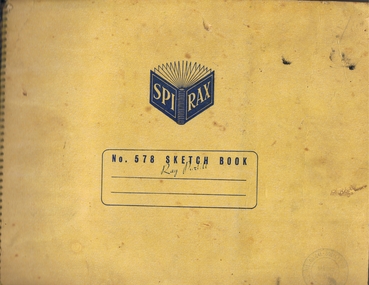
Book - SCRAPBOOK, 1950S EPHEMERA
... Book contains Menu/Programmes, In Memoriam King George VI, thank you cards, business cards, Golden Square Methodist Church Centenary, Boort Lodge No. 183 Golden Jubilee Meeting, Mannequin Parade Program, serviette, business stationary, advertising for Fair-View Upholsterers, musical and concert tickets, members badges, Bendigo Masonic Meeting, chemist's label, marriage invitations, Greenvale Kennels stationary, Bendigo Rotary dinner menu and programme, Past Presidents of Rotary, Christmas Greeting cards, Business Cheques, 3BO Duty Pass, Templeton's Sports Store, Sea Lake ticket, Bendigo Agricultural Show Society 1953 Prize Tickets for First, Second, Third, Champion and Highly Commended. ...Book contains Menu/Programmes, In Memoriam King George VI, thank you cards, business cards, Golden Square Methodist Church Centenary, Boort Lodge No. 183 Golden Jubilee Meeting, Mannequin Parade Program, serviette, business stationary, advertising for Fair-View Upholsterers, musical and concert tickets, members badges, Bendigo Masonic Meeting, chemist's label, marriage invitations, Greenvale Kennels stationary, Bendigo Rotary dinner menu and programme, Past Presidents of Rotary, Christmas Greeting cards, Business Cheques, 3BO Duty Pass, Templeton's Sports Store, Sea Lake ticket, Bendigo Agricultural Show Society 1953 Prize Tickets for First, Second, Third, Champion and Highly Commended. ...Yellow spring back Spirax No. 578 Sketch Book. Book contains Menu/Programmes, In Memoriam King George VI, thank you cards, business cards, Golden Square Methodist Church Centenary, Boort Lodge No. 183 Golden Jubilee Meeting, Mannequin Parade Program, serviette, business stationary, advertising for Fair-View Upholsterers, musical and concert tickets, members badges, Bendigo Masonic Meeting, chemist's label, marriage invitations, Greenvale Kennels stationary, Bendigo Rotary dinner menu and programme, Past Presidents of Rotary, Christmas Greeting cards, Business Cheques, 3BO Duty Pass, Templeton's Sports Store, Sea Lake ticket, Bendigo Agricultural Show Society 1953 Prize Tickets for First, Second, Third, Champion and Highly Commended. Printing in book by Ray Purtill. Mrs J. Braddy, Dixons Caravan Park, Marong written on the back.book, bendigo, bendigo organisations & businesses, book, scrapbook, mrs j braddy, ray purtill, bendigo organisations, bendigo businesses, see link -
 Port Melbourne Historical & Preservation Society
Container - Bottle, W D Pfeiffer, Chemist, 364 Graham Street, Port Melbourne, 1950s
... Medium size clear glass bottle with black lid. Pasted on label with chemist logo and W D Pfeiffer, Ph.C., M.P.S., 364 Graham Street Port Melbourne. ...On bottom of bottle imprinted RO.No.47,686 1661 23 Medium size clear glass bottle with black lid. Pasted on label with chemist logo and W D Pfeiffer, Ph.C., M.P.S., 364 Graham Street Port Melbourne. ...Medium size clear glass bottle with black lid. Pasted on label with chemist logo and W D Pfeiffer, Ph.C., M.P.S., 364 Graham Street Port Melbourne. Telephone 64 2379Written on ink on label "Friar's Balsam" . On bottom of bottle imprinted RO.No.47,686 1661 23business and traders - chemists, w d pfeiffer -
 Warrnambool and District Historical Society Inc.
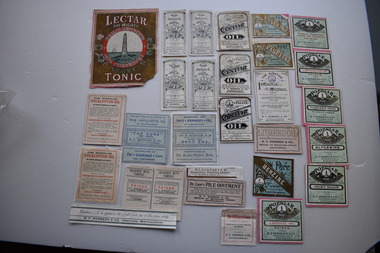
Multiple Labels, Kennedy, Early 20th century
... KENNEDY &CO manufacturing Chemists WARRNAMBOOL .Small label PROPRIETORS OF THE. CELEBRATED . ...KENNEDY &CO manufacturing Chemists WARRNAMBOOL .Small label PROPRIETORS OF THE. CELEBRATED . ...Richard Kennedy (1826-1903), a wholesale , retail and manufacturing chemist in Timor Street, came to Warrnambool in 1880 and had what was described in "Cyclopedia of Victoria' as the "largest and best appointed pharmacy in Victoria'. Kennedy was Vice President of the Pharmaceutical Society of Victoria, on the Pharmacy Board and was prominent in community affairs in Warrnambool. He was for some time President of the Mechanics Institute and the Warrnambool Hospital and a foundation member of the Warrnambool Bowls Club. He also made locally perfumes with many varieties named after people or events of the time-Federation, Nellie Melba etc.. His pharmacy building in Timor Street and his house 55 Canterbury Road "Ivanhoe" still stands (2019) The use of a lighthouse in his advertising and on his bottles is of particular interest. W.D.H.S. has Kennedy bottles in its collectionThese labels are of great significance as they were produced for a pharmacist of note in Victoria and Warrnambool. .1 Rectangular paper label adhered to a piece of pink card. It features a lighthouse and small sailing ship in the centre of a red circle with black and white text, Surrounding the circle is text and decorations of flowers on an olive green background. The label is torn on the bottom right hand corner. It is adhered to a piece of pink card. .2 Light green label featuring a lighthouse in a circle underneath which is a scroll with text, There are finely drawn curly decorations and further text. It is adhered to a piece of pink card. .3 Similar to .2 with different text .4 Similar to .2 and .3 with different text .5 Similar to .2,.3,.4 with different text .6 Similar to .2,.3,.4,.5 with different text 6.1Similar to .2,.3,.4,.5,.6 with different text 6.2 Turquoise label with a gold diagonal wide band with text. The label features a lighthouse in a circle , there are decorations of leaves, and curls. The white and black text is stylised, especially the name of the manufacturer. .7 Buff coloured rectangular card adhered to a piece of pink card. The dark green text is surrounded by a decorative border. .8 White rectangular featuring a blue coloured lighthouse and detailed black text .9 White rectangular label with black detailed text surrounded by a border. .10 Similar to 6.2 with different text, adhered to white paper. .11 identical to .10 but adhered to pink card. .12 White rectangular card with black and red text .13 identical to .12 .14 Three joined pale blue labels with dark blue text. The central label is larger than the other two which are equal in size. One of the smaller labels in upside down. All have borders. .15 Identical to .14 excepting it is adhered to white card .16 White rectangular label with black text. It features a lighthouse, decorations of leaves and a variety of styles and fonts of the print. It is adhered to a piece of pink card. .17 Identical to .16 excepting it is adhered to white card. .18 Identical to .17 .19 Rectangular white label with red and black detailed text adhered to a piece of white paper .20 Identical to .19 excepting it is adhered to a piece of pink card. .21 Rectangular white label with grey text , a decorative border and further decorations adhered to a piece of white card. .22 Identical to .21 but not adhered, .23 Identical to .21 , adhered to white card .24 Identical to .22 .25 Square white label with red and black text. and a red border. .26 White rectangular label with dark green text and border. .27 Small white rectangular label with gold text adhered to a piece of white paper .1 LECTAR THE MIGHTY HEALTH RESTORING LIFE PRESERVER NERVE TONIC .2 POPULAR FAMILY MEDICINES CARBOLIC OIL POISON FROM R. F. KENNEDY& CO PHARMAISTS WARRNAMBOOL .3 As for .2 FRIAR'S BALSAM in lieu of CARBOLIC OIL .4 As for .2, .3 GLYCERINE in lieu OF FRIAR'S BALSAM .5 As for .2,.3,.4 Paregoric, Peppermint, Aniseed and Laudanum. POISON in lieu of GLYCERINE .6 As for .2,.3,.4,.5 CAMPHORATED OIL in lieu of Paregoric,Peppermint, Aniseed and Laudanum .6.1 As for .2,.3,.4,.5,.6 PARRISH'S FOOD . in lieu of CAMPHORATED OIL Dose- Adults 1/2 to 1 teaspoonful 6.2 Pure BENZINE FROM R. F. KENNEDY AND CO. Pharmaceutical Works WARRRNAMBOOL .7 LINSEED OILR.F KENNEDY & CO. Wholesale and Manufacturing Chemists WARRNAMBOOL .8 the primary text is : THE ALSATIAN INFLUENZA MIXTURE A section of the ensuing text is ; "For EXHAUSTION, LOSS OF APPETITE , NEURITIS and GENERAL RUN DOWN it will be found a Powerful Tonic." .9 Dr Law's PILE OINTMENT Directions ............... R.F KENNEDY & CO Wholesale and Manufacturing Chemists WARRNAMBOOOL 10. As for .2,.3,.4,.5,.6.6.1 VASELINE in lieu of BENZINE .11 Identical to .10 .12 COLOURED WITH TUMERIC. Labelled in accordance with the "SALE AND USE OF POISONS ACT" POISON R.F. KENNEDY & CO. Chemists WARRNAMBOOL APPROXIMATELY 7 GRAMS .13 Identical to .12. .14 Central label "THE CURE" FOR CORNS R.F. KENNEDY &CO manufacturing Chemists WARRNAMBOOL .Small label PROPRIETORS OF THE. CELEBRATED . CURE FOR TOOTHACHE . Small label PROPRIETORS OF The Sulpho- Thymol Soap, For Eruptions and Irritations of the Skin. .15 Identical to .14 .16TASTELESS ITALIAN CASTOR OIL OF THE PUREST QUALITY. Adults Dose one to two tablespoonfuls . Children half to one tablespoonful. IMPORTED BY R.F. KENNEDY&CO. Manufacturing Chemists Timor ST. Warrnambool .17 Identical to .16 .18 Identical to .16 .19 PURE REDISTILLED EUCALYPTUS OIL OF EXTRA STRENGTH & PURITY DEODORANT & DISINFECTANT FROM R.F. KENNEDY & CO'S Pharmaceutical Works Warrnambool ( Much more detail) .20 Identical to .19 .21,.22,.23,.24 PURE Refined SALAD OIL FROM R.F. KENNEDY & CO.MANUFACTURING CHEMISTS WARRNAMBOOL .25 Brilliantine AN ELEGANT AND FRAGRANT PREPARATION FOR THE HAIR, MOUSTACHE, OR WHISKERS. PROPRIETORS R.F. KENNEDY & CO. WARRNAMBOOL .26 Directions.--- To be applied to the irritable parts two or three times daily R.F. KENNEDY & CO., Chemists, Warrnambool .27 R.F. KENNEDY & CO. Manufacturing and Dispensing Chemists WARRNAMBOOL chemists, pharmaceutical society of victoria, mechanics institute, warrnambool, warrnambool hospital, warrnambool bowls club -
 Flagstaff Hill Maritime Museum and Village
Wood Samples, 1891
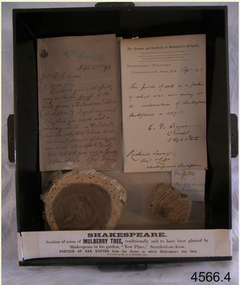
... This scion was then established at Shakespeare's garden at "New Home" that had been demolished by Rev Francis Gastrell in 1759. flagstaff hill warrnambool shipwrecked coast flagstaff hill maritime museum maritime museum shipwreck coast flagstaff hill maritime village great ocean road shakespeare display case wood samples oak from shakespeare's birthplace mulberry from shakespeare's home "new place" stratford-upon-avon shakespeare's birthplace the trustees and guardians of shakespeare's birthplace &c. shakespeare trust shakespeare birthday committee r.s. harris, brunswick, victoria richard s harris, brunswick, victoria c.f. loggins, chemist, 3 high street stratford-on-avon richard savage warrnambool museum and art gallery thomas court pt barnum charles dickins anne hathaway black mulberry tree reverend francis gastrell Cardboard label inside the glass case “Shakespeare Section of Mulberry Tree, traditionally said to have been planted by Shakespeare in his garden, “New Place,” Stratford-on-Avon. ...The timber display case was presented to Mr Richard Standcombe Harris of Warrnambool (1831-1923). He was a councillor (1875-1891) and predominant businessman. Mr C F Loggin had met Mr Harris while on a trip to Stratford upon Avon in the United Kingdom. Upon his return to Warrnambool, Mr Harris donated the item to the Warrnambool Museum and Art Gallery, (established 1886) where Joseph Archibald was Curator: he catalogued the case in 1894. THE LETTERS IN THE CASE The two letters contained within the display case confirm the authenticity of the oak wood sample. The first letter in the case includes the text; "[Stamped Header on banner] High Street, Stratford on Avon [Hand written] Sept. 22nd / 91. Mr. R. S. Harris, Dear Sir, Enclosed you will find [underlined next 3 words] every authentic proof of the Oak from Shakespeare's House (Birth place). I regret very much Sir, that you made a short-day at S. on A. I should have been delighted to have had the honour, & pleasure, of showing you around our Beautiful Country. You did not give [next 3 words underlined] me or yourself a fair chance. But however I hope that we may again some day have more time to go quietly around. With kind regards, and wishing you, Sir, a pleasant voyage, I remain, Dear Sir, Yours very truly, C.F. Loggin. P.S. A paper will be always acceptable to be as how you Jolly Warrnamboolites are desporting yourselves. “ The second letter includes text; “[Printed Letterhead with stamped impression] The Trustees and Guardians of Shakespeare’s Birthplace Incorporated by Act of 54 and 55, Vict. 1891 Secretary and Librarian - Richard Savage Shakespeare’s Birthplace Stratford-upon-Avon [handwritten] 22 Sept 1891 This piece of oak is a portion of what was cut away at at the restoration of Shakespeare’s Birthplace in 1857-58. C. F. Loggins Chemist 3 High Street Richard Savage Sec. – Shakespeare’s Birthplace Mr C F Loggin was connected with the Shakespeare Trust as the person who had originally donated a scion of Shakespeare's mulberry tree to the "Shakespearean Birthday Committee" in 1842. (The scion that was given to the Shakespearean Birthday Committee, from which the Mulberry sample is derived, still grows today in "New Place" garden.) Mr Richard Savage was the Secretary and Liberian of the then renamed “Trustees and Guardians of Shakespeare’s Birthplace when the display case was given to Mr Harris in 1891 by Mr Loggin. WILLIAM SHAKESPEARE Shakespeare was born in 1564 in Stratford-upon-Avon, where he also grew up. He married at 18 years and he and his wife, Anne Hathaway, had three children: They moved to London where he became successful as an actor, writer, and part-owner of a playing company. He later returned to Stratford and purchased his last home, which he called "New Place" in 1602 where he later died in 1616. For the next 150 years, it was known that there existed a black mulberry tree in the garden. At the time there was a fashion for planting mulberry trees. It was the early 17th century after King James had come to the throne, and he imported tens of thousands of saplings in an attempt to get landowners to start a silk industry in England. Unfortunately for posterity, Shakespeare's mulberry was felled around 1756, by the then owner of “New Place" the Reverend Francis Gastrell, who was apparently tired of continual visits by pilgrims asking to see the tree, so he chopped it down. Gastrell had applied for local permission to extend the garden but the application was rejected and his tax was increased. Gastrell retaliated by demolishing the house in 1759, this greatly outraged the local inhabitants. Gastrell was eventually forced to leave town having provoked the wrath of Stratford residents for committing such an act. Today only the garden remains where “New House" used to stand with a scion from the original mulberry tree still growing there. The wood from the felled mulberry tree at “New House" was purchased by an enterprising local clock-maker Thomas Sharp and he spent the next 40 years or so years making souvenirs from the wood. These became early tourist souvenirs and subsequently developed into a profitable sideline for various other makers, including George Cooper and John Marshall. These objects range from relatively small domestic wooden objects, such as snuff boxes and weight scales to large tea caddies and even tables. C. F. Loggin donated a scion or cutting from Shakespeare's mulberry tree to the Shakespeare Birthplace Trust in 1862, he was a chemist who lived and worked in Stratford. There is a note on the frame of the donation that the mulberry sample is from this scion, research shows that from Richard Savage's diary notes that there must have been a lot of wood taken from that scion over the years which was planted in the garden of “New Place” and is still growing there today. The "Trustees and Guardians of Shakespeare’s Birthplace" (1847 -1964) was formed after the house where Shakespeare is believed to have been born fell into disrepair. Subsequently in 1846 after the death of Thomas Court's widow the last owner. Interest in the house was revived when PT Barnum, the American showman, wanted to buy it and ship the house back to America. In response to this, the Shakespeare Birthday Committee was established (by a private Act of Parliament) with the help of such luminaries as Charles Dickens, the Committee of Trustees raised the necessary £3,000 and purchased the house the following year. Once the Committee had acquired the building, restoration work began. Originally the Birthplace formed part of a terrace with later houses built either side. The first stage in its conservation was their destruction. At the time it was thought necessary to avoid the risk of fire spreading to Shakespeare's birthplace. Reconstruction was carried out by the Shakespeare Trust between 1857 and 1864 that restored the outside of the building to its original 16th-century state. It is from this restoration that the donated piece of oak is derived, originally from a beam that was in the house. Communication from The Shakespeare Birthplace Trust, dated April 11th, 2019, confirms that the pieces displayed in this case have good provenance. The wood samples are significant for their association with the history of William Shakespeare. The display case and its content is significant to Warrnambool local history for its association with the establishment in 1886 of the Warrnambool Museum and Art Gallery. However, it should be noted that the letters of authentication that accompany the wood samples are only applicable to the oak sample. None the less, all the pieces have very good provenance, with Richard Savage's certificate of authenticity for the oak, and the mulberry sample with the letter to Mr Harris from Mr CF Loggin having also been the donor of the scion of mulberry in 1862 to the Shakespeare Birthplace Trust. This scion was then established at Shakespeare's garden at "New Home" that had been demolished by Rev Francis Gastrell in 1759. Two wood samples associated with William Shakespeare, presented in a hanging, timber and glass display case with metal trim around the frame. The case also contains two letters and a label printed on a card that refers to the contents, their origins and the donor. A card label with a printed number and a round adhesive label are attached on the back of the case. The left round section of wood is from a donated scion (or shoot) derived from the original mulberry tree planted by William Shakespeare at his last home "New Place", Stratford-upon-Avon. The outer section is light brown coloured while the centre is dark grain. The right wood sample in the case is a section of oak rafter from the house where Shakespeare was born in 1564. The wood is mid brown with a distinct grain. The included letters, each dated 22/9/1891, refer to only the oak sample. - The letter on the left comprises two handwritten pages from Mr CF Loggin to Mr Richard Standcombe Harris. The paper has the printed letterhead address of High Street, Stratford on Avon. - The letter on the right is a handwritten certificate of authenticity signed by Mr CF Loggin and counter signed by Mr Richard Savage, Secretary and Liberian of the Shakespeare Trust. It is on the printed letterhead of The Trustees and Guardians of Shakespeare’s Birthplace Cardboard label inside the glass case “Shakespeare Section of Mulberry Tree, traditionally said to have been planted by Shakespeare in his garden, “New Place,” Stratford-on-Avon. PORTION OF OAK RAFTER from the house in which Shakespeare was born. (Presented by R S Harris 1891.) Printed label on the back of the case “3 2 “ The handwritten adhesive label “0566” flagstaff hill, warrnambool, shipwrecked coast, flagstaff hill maritime museum, maritime museum, shipwreck coast, flagstaff hill maritime village, great ocean road, shakespeare display case, wood samples, oak from shakespeare's birthplace, mulberry from shakespeare's home "new place", stratford-upon-avon, shakespeare's birthplace, the trustees and guardians of shakespeare's birthplace &c., shakespeare trust, shakespeare birthday committee, r.s. harris, brunswick, victoria, richard s harris, brunswick, victoria, c.f. loggins, chemist, 3 high street stratford-on-avon, richard savage, warrnambool museum and art gallery, thomas court, pt barnum, charles dickins, anne hathaway, black mulberry tree, reverend francis gastrell -
 Flagstaff Hill Maritime Museum and Village
Bottle
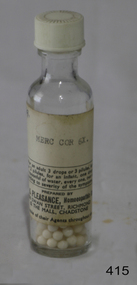
... Bottle clear glass with paper label and screw plastic cap. Contains white pills. Prepared by Martyn and Pleasance, Chemists, Melbourne, Homeopathic medication....Flagstaff Hill Warrnambool Shipwrecked-coast Flagstaff-Hill Flagstaff-Hill-Maritime-Museum Maritime-Museum Shipwreck-coast Flagstaff-Hill-Maritime-Village Bottle clear glass with paper label and screw plastic cap. Contains white pills. Prepared by Martyn and Pleasance, Chemists, Melbourne, Homeopathic medication. ...Bottle clear glass with paper label and screw plastic cap. Contains white pills. Prepared by Martyn and Pleasance, Chemists, Melbourne, Homeopathic medication.flagstaff hill, warrnambool, shipwrecked-coast, flagstaff-hill, flagstaff-hill-maritime-museum, maritime-museum, shipwreck-coast, flagstaff-hill-maritime-village -
 Flagstaff Hill Maritime Museum and Village
Bottle, March 1969
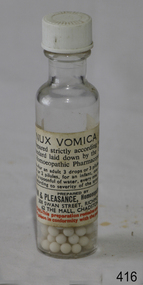
... label and screw plastic cap. Contains white Nux Vomica pills, Prepared by Martin and Pleasance, Chemists, Melbourne. ...This is the botanical name with the active ingredient of Strychnine, This medication, in the small 1g dose, could have been used for a calming effect on the patient. flagstaff hill warrnambool shipwrecked-coast flagstaff-hill flagstaff-hill-maritime-museum maritime-museum shipwreck-coast flagstaff-hill-maritime-village Nux Vomica Strychnine Medication Martin & Pleasance chemist melbourne treatment "MERC COR 6X" on label Bottle clear glass with paper label and screw plastic cap. ...Pills containing ‘Nux Vomica’. This is the botanical name with the active ingredient of Strychnine, This medication, in the small 1g dose, could have been used for a calming effect on the patient.Bottle clear glass with paper label and screw plastic cap. Contains white Nux Vomica pills, Prepared by Martin and Pleasance, Chemists, Melbourne. Homeopathic medication. 1g tablets."MERC COR 6X" on labelflagstaff hill, warrnambool, shipwrecked-coast, flagstaff-hill, flagstaff-hill-maritime-museum, maritime-museum, shipwreck-coast, flagstaff-hill-maritime-village, nux vomica, strychnine, medication, martin & pleasance chemist melbourne, treatment -
 Flagstaff Hill Maritime Museum and Village
Bottle
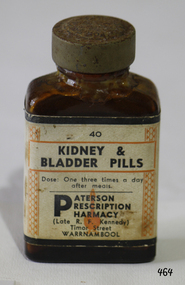
... Bottle brown glass with paper label marked "Kidney and Bladder Pills" Screw metal cap with label "For Safety Buy From Your Chemist"...flagstaff hill warrnambool shipwrecked-coast flagstaff-hill flagstaff-hill-maritime-museum maritime-museum shipwreck-coast flagstaff-hill-maritime-village Bottle brown glass with paper label marked "Kidney and Bladder Pills" Screw metal cap with label "For Safety Buy From Your Chemist" Bottle ...Bottle brown glass with paper label marked "Kidney and Bladder Pills" Screw metal cap with label "For Safety Buy From Your Chemist"flagstaff hill, warrnambool, shipwrecked-coast, flagstaff-hill, flagstaff-hill-maritime-museum, maritime-museum, shipwreck-coast, flagstaff-hill-maritime-village -
 Mission to Seafarers Victoria
Container - Large Square Based Glass Container
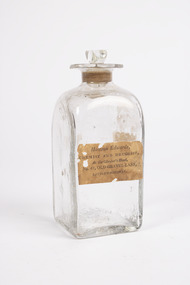
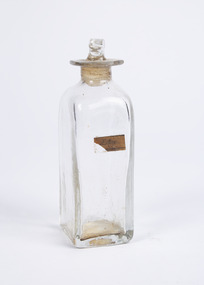
... volum collection Howson Edwards, Chemist and Druggist, At the Glauber's Head, No.47, Old-Gravel-Lane, Ratcliff-Highway Large square based glass containers with a circular openings on their tops and some of which have a paper label with respective text depending on its contents. ...Large square based glass containers with a circular openings on their tops and some of which have a paper label with respective text depending on its contents. Each container is accompanied by a corresponding glass lid. These are found in the back storage location of the parent item. Howson Edwards, Chemist and Druggist, At the Glauber's Head, No.47, Old-Gravel-Lane, Ratcliff-Highway volum collection, -
Blacksmith's Cottage and Forge
Bottle
... V D Johnston, Chemist. 8 Bayswater Road, Darlinghurst. 260 Victoria Street, Darlinghurst. Glass bottle (full) containing camphorated oil. Cork is in place in neck of bottle. Tied-on leather label ...Before widespread medical services were available, most families kept a medicine cupboard of home remedies, or medications made by the local chemist. Camphorated oil was commonly used as an inhalant, or as a chest rub for those suffering from colds or flu. It is a forerunner of the modern Vicks VapoRub.Local. it is of interest that this bottle was manufactured in NSW.Glass bottle (full) containing camphorated oil. Cork is in place in neck of bottle. Tied-on leather label white with red lettering.Camphorated Oil. V D Johnston, Chemist. 8 Bayswater Road, Darlinghurst. 260 Victoria Street, Darlinghurst. -
 Flagstaff Hill Maritime Museum and Village
Book - Papers and Addresses, John F W Herschel, Essays From The Edinburgh and Quarterly Reviews, 1857
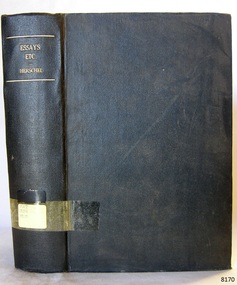
... Flagstaff Hill Flagstaff Hill Maritime Museum and Village Warrnambool Maritime Museum Maritime Village Great Ocean Road Shipwreck Coast Pattison Collection Ralph Eric Pattison Warrnambool Mechanics’ Institute Mechanics’ Institute Library Warrnambool Library Free Library Corangamite Regional Library Service Essays from the Edinburgh and Quarterly Reviews Sir John F W Herschel Longman Brown Green Longmans and Roberts 1857 Mid-19th century mathematician botanist astronomer chemist The label on spine: "PAT 824 HER" Sticker on pastedown front endpaper: "Warrnambool Public Library" Sticker on front loose endpaper: "Corangamite Regional Library Service" Stamp on front loose endpaper: Corangamite Regional Library Service" Stamps, two, on fly: "Warrnambool Mechanics Institute" Handwriting on fly: "155 (crossed out)" "165" "P/W" 4608" "824" Essays from the Edinburgh and Quarterly Reviews: with addresses and other pieces Author: Sir John F W Herschel Publisher: Longman, Brown, Green, Longmans and Roberts Date: 1857 Black cloth hardcover book with embossed gold text on the spine. ...The author of this book, and many other similar books, was Sir John F. W. Herschel (John Frederick William), 1792-1871. He was a famous mathematician, astronomer, chemist and botanist. In 1838 he was created a baronet, of Slough in the County of Buckingham. The results of his research and discoveries are in use today. The book is part of Flagstaff Hill's Pattison Collection, a large group of books and records, some of which are rare and valuable. The collection was originally owned by the Warrnambool Mechanics' Institute, which was founded in 1853 and is named after Warrnambool's Public Librarian, Ralph Pattison. Thomas Longman founded his publishing firm in 1724 in London by the name Longman. In August of that year, he bought the two shops and goods of William Taylor and set up his publishing house there at 39 Paternoster Row. The shops were called Black Swan and Ship, and it is said that the 'ship' sign was the inspiration for Longman's Logo. After many changes of name and management, including Longman Brown Green Longman and Roberts, the firm was incorporated in 1926 as Longmans, Green & Co. Pty Ltd. The firm was acquired by Pearson in 1968 and was known as Pearson Longman or Pearson PLC. The book is significant for its association with the author, Sir John F W Herschel, and his discoveries and inventions, some of which are still used today.. The book is important for its connection with the London publisher Longmans, Green, Brown, Longmans and Roberts. The firm has been established for over two centuries and is renowned for publishing encyclopedias, dictionaries, books on English grammar, textbooks, poetry, reference books, novels, magazines and more. The book has additional importance for its connection to the Pattison Collection, which, along with other items at Flagstaff Hill Maritime Village, was originally part of the Warrnambool Mechanics' Institutes’ Collection. The Warrnambool Mechanics’ Institute book collection has historical and social significance for its strong association with the Mechanics Institute movement and its important role in people's intellectual, cultural and social development throughout the latter part of the nineteenth century and the early twentieth century. The collection of books is a rare example of an early lending library and its significance is enhanced by the survival of an original collection of many volumes. The Warrnambool Mechanics' Institute’s publication collection is of both local and state significance.Essays from the Edinburgh and Quarterly Reviews: with addresses and other pieces Author: Sir John F W Herschel Publisher: Longman, Brown, Green, Longmans and Roberts Date: 1857 Black cloth hardcover book with embossed gold text on the spine. Inscriptions are on labels, stickers, stamps and handwriting. The book is part of the Pattison Collections.The label on spine: "PAT 824 HER" Sticker on pastedown front endpaper: "Warrnambool Public Library" Sticker on front loose endpaper: "Corangamite Regional Library Service" Stamp on front loose endpaper: Corangamite Regional Library Service" Stamps, two, on fly: "Warrnambool Mechanics Institute" Handwriting on fly: "155 (crossed out)" "165" "P/W" 4608" "824" flagstaff hill, flagstaff hill maritime museum and village, warrnambool, maritime museum, maritime village, great ocean road, shipwreck coast, pattison collection, ralph eric pattison, warrnambool mechanics’ institute, mechanics’ institute library, warrnambool library, free library, corangamite regional library service, essays from the edinburgh and quarterly reviews, sir john f w herschel, longman brown green longmans and roberts, 1857, mid-19th century, mathematician, botanist, astronomer, chemist -
 Flagstaff Hill Maritime Museum and Village
Instrument - Letter Scale, Ca. early 20th century
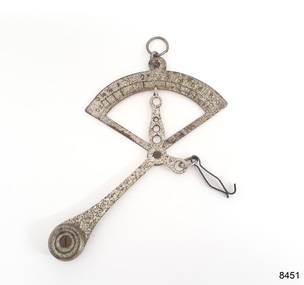
... Angus Collection scale weighing instrument measure weight postal scale chemist scale letter weigh post office quadrant scale letter scale handheld portable mechanical scale pendulum scale fixed balance scale Scale measurements, "OZ" (ounces), "0 /14 1/2 1 2 3 4 5 6 7 8 9 10 " Letter scale, a handheld quadrant fixed pendulum scale made from silver-plated metal. This small weighing instrument is shaped like a quarter-circle with a metal ring, a fixed pendulum counterweight and a decorative pivoting arrow indicator. A hanger clip is attached to a short arm of the scale. Measurements are embossed on the arc of the circle, labelled ...This handheld portable pendulum quadrant scale was used to weigh small paper items such as letters and documents, powdered chemicals or metals like gold, and animal fleece samples. This mechanical scale can weigh up to a maximum of 10 ounces, which is about 285 grams or one-and-a-half cups of brown sugar. The operator holds the scale’s ring and connects the item to be weighed onto the wire clip. The weight of the item causes the pendulum to pivot, and the scale measures the weight of the object, indicated by the arrow. This scale belonged to Dr William Roy Angus and is now part of Flagstaff Hill’s comprehensive W.R. Angus Collection, donated by the family of Dr W R Angus, 1901-1970, surgeon and oculist. The W.R. Angus Collection: - The W.R. Angus Collection includes historical medical equipment, surgical instruments and material belonging to Dr Edward Ryan and Dr Thomas Francis Ryan, (both of Nhill, Victoria) and Dr Angus’ own belongings. The Collection’s history spans the medical practices of the two Doctors Ryan, from 1885-1926 plus that of Dr Angus, up until 1969. It includes historical medical and surgical equipment and instruments from the doctors Edward and Thomas Ryan of Nhill, Victoria. Dr Angus married Gladys in 1927 at Ballarat, the nearest big city to Nhill where he began as a Medical Assistant. He was also Acting House surgeon at the Nhill hospital where their two daughters were born. During World War II He served as a Military Doctor in the Australian Defence Force. Dr Angus and his family moved to Warrnambool in 1939, where Dr Angus operated his own medical practice. He later added the part-time Port Medical Officer responsibility and was the last person appointed to that position. Both Dr Angus and his wife were very involved in the local community, including the planning stages of the new Flagstaff Hill and the layout of the gardens there. Dr Angus passed away in March 1970.This letter scale is the only one of its type in our collection. It is an example of objects belonging to Dr. W. R. Angus, 1901-1970, surgeon and oculist. The W.R. Angus Collection is significant for still being located at the site it is connected with, Doctor Angus being the last Port Medical Officer in Warrnambool. The Collection includes historical medical objects that date back to the late 1800s.Letter scale, a handheld quadrant fixed pendulum scale made from silver-plated metal. This small weighing instrument is shaped like a quarter-circle with a metal ring, a fixed pendulum counterweight and a decorative pivoting arrow indicator. A hanger clip is attached to a short arm of the scale. Measurements are embossed on the arc of the circle, labelled in ounces (oz) and ranging from 0 to 10 at unequal distances apart. The scale is part of the W.R. Angus Collection.Scale measurements, "OZ" (ounces), "0 /14 1/2 1 2 3 4 5 6 7 8 9 10 "flagstaff hill, warrnambool, maritime village, maritime museum, shipwreck coast, great ocean road, flagstaff hill maritime museum and village, dr w r angus, mira hospital, w.r. angus collection, scale, weighing instrument, measure weight, postal scale, chemist scale, letter, weigh, post, office, quadrant scale, letter scale, handheld, portable, mechanical scale, pendulum scale, fixed balance scale -
 City of Moorabbin Historical Society (Operating the Box Cottage Museum)
Manufactured Glass, brown bottle 'Saccharin', 20thC
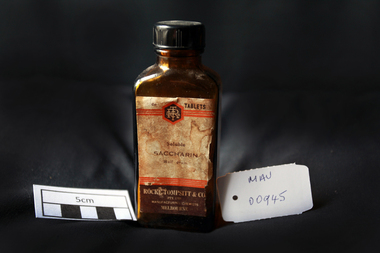
... label ; .... TABLETS / trademark ' R T & C ( entwined)' / Soluble / SACCHARIN / Half Grain / ROCKE TOMSETT & CO. / PTY LTD / MANUFACTURING CHEMISTS / MELBOURNE...chemist working on coal tar derivatives in Ira Remsen's laboratory at the Johns Hopkins University, Baltimore, Maryland USA. Although saccharin was commercialized not long after its discovery, it was not until sugar shortages during World War I that its use became widespread. fahlberg constantin remsen ira john hopkins university maryland baltimore america nasau south america central america sugar cane pharmacy medicines saccharin glassware bottles moorabbin bentleigh cheltenham elbe germany Front label ; .... ...Saccharin is an artificial sweetener. The basic substance, benzoic sulfilimine, has effectively no food energy and is much sweeter than sucrose, but has a bitter or metallic aftertaste, especially at high concentrations. It is used to sweeten products such as drinks, candies, , medicines, and toothpaste. Saccharin derives its name from the word "saccharine", meaning of, relating to, or resembling sugar. The form used as an artificial sweetener is usually its sodium salt. Saccharin was produced first in 1878 by Constantin Fahlberg, a chemist working on coal tar derivatives in Ira Remsen's laboratory at the Johns Hopkins University, Baltimore, Maryland USA. Although saccharin was commercialized not long after its discovery, it was not until sugar shortages during World War I that its use became widespread. A brown glass bottle with a plastic screw top containing 'Saccharin' tabletsFront label ; .... TABLETS / trademark ' R T & C ( entwined)' / Soluble / SACCHARIN / Half Grain / ROCKE TOMSETT & CO. / PTY LTD / MANUFACTURING CHEMISTS / MELBOURNEfahlberg constantin, remsen ira, john hopkins university, maryland, baltimore, america, nasau, south america, central america, sugar cane, pharmacy, medicines, saccharin, glassware, bottles, moorabbin, bentleigh, cheltenham, elbe, germany -
 City of Moorabbin Historical Society (Operating the Box Cottage Museum)
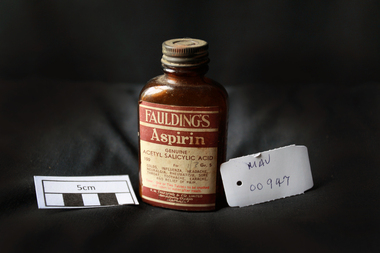
Manufactured Glass, brown bottle 'Fauldings Aspirin', c1950
... Front label : FAULDINGS / ASPIRIN / GENUINE / ACETYL SALICYLIC ACID / 100 Gr 5 / for / Colds, .............. / DOSE ........... / F.H.FAULDING & CO LTD / MANUFACTURING CHEMISTS / AUSTRALIA...Front label : FAULDINGS / ASPIRIN / GENUINE / ACETYL SALICYLIC ACID / 100 Gr 5 / for / Colds, .............. / DOSE ........... / F.H.FAULDING & CO LTD / MANUFACTURING CHEMISTS / AUSTRALIA A brown glass, bottle with a metal screw top containing ‘Faulding's Aspirin’ tablets Manufactured Glass, brown bottle 'Fauldings Aspirin' F.H. ...Francis Hardy Faulding 1816 – 1868 arrived in Sydney 1842. He was a Surgeon on the emigrant ship Nabob. 1845 Francis Hardy Faulding opened his first pharmacy at 5 Rundle Street in Adelaide and the business prospered. In 1867 he formed F.H Faulding & Co with Luther Scammel. as wholesale druggists and manufacturing chemists. Two of the Faulding company's major innovations were the development of a process for distillation of eucalyptus oil, and the development of the test for determining the eucalyptol content of the oil. Faulding's success was founded on eucalyptus oil, which formed the basis of an antiseptic marketed as "Solyptol" In 1868 Francis Hardy Faulding died, aged 52 at his suburban Glen Osmond home in Adelaide. Scammel’s two sons took over the business in 1888 and in 1890 the Company expanded to West Australia, then Sydney, Brisbane and finally, in 1924, Faulding began operations in Exhibition Street, Melbourne, eventually adding wholesale activities. 1986 With a presence in every city, from Darwin to Tasmania. Faulding becomes a truly national company. 2008 Zuelllig Group takes control Focusing solely on pharmaceutical wholesaling and distribution, Hong Kong based Zuelllig Group takes over control of Symbion Pharmacy Services. 2008 Symbion Pharmacy Services exceeds $3 billion with one of the country's largest networks of warehousing systems and service A brown glass, bottle with a metal screw top containing ‘Faulding's Aspirin’ tabletsFront label : FAULDINGS / ASPIRIN / GENUINE / ACETYL SALICYLIC ACID / 100 Gr 5 / for / Colds, .............. / DOSE ........... / F.H.FAULDING & CO LTD / MANUFACTURING CHEMISTS / AUSTRALIApharmacy, medicines, faulding f.h., scammell luther, faulding's aspirin, glassware, bottles, moorabbin, bentleigh, cheltenham, antiseptics, analgesics, pharmaceuticals, south australia, ss nabob, f.h.faulding & co. -
 City of Moorabbin Historical Society (Operating the Box Cottage Museum)
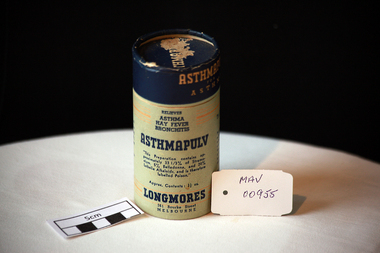
Containers, cardboard, ‘Longmores’ ‘Asthmapulv’, mid 20thC
... labelled Poison" / Approx. Contents 3 1/2 oz. / LONGMORES / 361 Bourke Street / MELBOURNE / For Inhalation Only / DIRECTIONS ................ / Invaluable in severe cases of Asthma. ......... / (Patent Medicine) Act 1942........ A cardboard cylindrical container with a lift-off lid for 'Longmores Asthmapulv'. Containers, cardboard, ‘Longmores’ ‘Asthmapulv’ Longmores Chemists ...Longmore’s was a manufacturing chemical pharmacy of many over-the-counter preparations, including Sulphur Hair Restorer, Strengthening Tonic, Blood and Liver Pills, Asthmacur (for asthma) and Hoyle’s Miraculous Oil (for miracles unknown), He was a native of New South Wales, but his father, Mr. Joseph Longmore settled in Melbourne in the late 1850s. Mr Longmore was educated at the Melbourne Grammar School, and leaving early, he studied and qualified as a chemist. Argus “12 October 1921, Mr. Francis Longmore, chemist of Bourke Street was at his business on Saturday but he had a chill which developed into pneumonia, and he died yesterday morning. The funeral will leave from his residence Wontravell, Gower Street, Kensington. He was a widower, his wife having died a year ago and he leaves a grownup family of 2 sons and 6 daughters. Carlisle Francis Longmore and his certificate number as a pharmacist was No. 1440; he qualified as a pharmacist at his final exam in Victoria on 11 September 1905. He had three pharmacies in addition to the address on the covers, one on the corner of Flinders and King Streets, Melbourne, one at 130 Bourke Street East and one Brunswick Street, North Fitzroy. He also had another sideline in addition to his pharmaceuticals and this was White Crow Jelly Crystals made at his Food Products division in Melbourne A cardboard cylindrical container with a lift-off lid for 'Longmores Asthmapulv'.Lid ASTHMAPULV. Around Lid ASTHMAPULV /FOR / ASTHMA Relieves/ ASTHMA / HAY FEVER / BRONCHITIS / ASTHMAPULV / "This preparation contains......... labelled Poison" / Approx. Contents 3 1/2 oz. / LONGMORES / 361 Bourke Street / MELBOURNE / For Inhalation Only / DIRECTIONS ................ / Invaluable in severe cases of Asthma. ......... / (Patent Medicine) Act 1942........* pharmacy, medicines, longmore c.. francis, longmore joseph, asthma, hospitals, nursing, containers, moorabbin, bentleigh, cheltenham, melbourne -
Glenelg Shire Council Cultural Collection
Administrative record - Ledger - chemist, Chemist Ledger, 1914-1915
... Portland chemist Sutton prescriptions administrative record ledger 1914 WWI Front: Prescription Book Cream cloth cover. Red label ...Sutton Chemist "Martell" Building, 79 Bentinck St, Portland.Front: Prescription Bookportland chemist, sutton, prescriptions, administrative record, ledger, 1914, wwi -
Glenelg Shire Council Cultural Collection
Administrative record - Ledger - chemist, Chemist Ledger, 1912-1913
... Sutton Chemist "Martell" Building, 79 Bentinck St, Portland. chemist Sutton prescription Portland administration Front: Prescription Book Cream cloth cover. Red label ...Sutton Chemist "Martell" Building, 79 Bentinck St, Portland.Front: Prescription Bookchemist, sutton, prescription, portland, administration -
Glenelg Shire Council Cultural Collection
Administrative record - Ledger, chemist, 1914-1915
... Suttons Chemist Portland trade prescriptions ledger administration records Front: Prescription book. Ledger with a cream cover and red label on the spine. ...Suttons Chemist, "Martell" Building, 79 Bentinck Street, Portland.Front: Prescription book.suttons chemist, portland trade, prescriptions, ledger, administration, records -
 Ringwood and District Historical Society
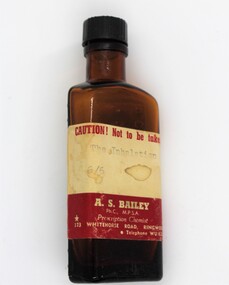
Container, A.S. Bailey, Brown Glass Bottle of inhalation dispensed by A.S. Bailey Chemist Ringwood. C1950, c. 1950
... Bailey Chemist Ringwood. Brown glass. Red and white label. Black Bakelite screw top....Bailey Chemist Ringwood. Brown glass. Red and white label. Black Bakelite screw top. ...Bottle of inhalation dispensed by A.S. Bailey Chemist Ringwood. Brown glass. Red and white label. Black Bakelite screw top.Caution! Not to be taken./ The Inhalation 6/6. -
 Glenelg Shire Council Cultural Collection
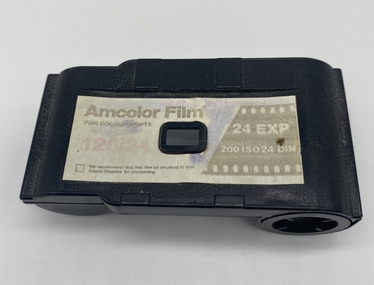
Container - Film cartridge, Unknown
... Amcolor Film for colour prints Red text "126/24' We recommend that this film be returned to your Amcal Chemist for processing Amcolour 126 film cartridge for instamatic cameras. Cartridge is black with a white and blue label, and black white and red text. ...Owned by Wilma Harris nee. Bowering resident of Merino Victoria.Amcolour 126 film cartridge for instamatic cameras. Cartridge is black with a white and blue label, and black white and red text. Has a image of a cut off piece of film.Amcolor Film for colour prints Red text "126/24' We recommend that this film be returned to your Amcal Chemist for processing womens history, ros harris, merino, photography, kodak -
 Mission to Seafarers Victoria
Container - Medicine Container, c. 1840
... volum collection medicine chemist apothecary ether AEther Small glass container with a square base and an octagonal rim surrounding the circular opening on the top. Paper label ...Small glass container with a square base and an octagonal rim surrounding the circular opening on the top. Paper label with the text: ‘AEther’. Found within the front storage location of the parent item.AEthervolum collection, medicine, chemist, apothecary, ether -
Phillip Island and District Historical Society Inc.
Book, Wells, H. G. (Herbert George), history�of Mr.�Polly, 1910
... Labelled 'Cowes Free Public Library', 'Phillip Island Historical Society, Cleeland Bequest', 'Cooper's Universal Book Exchange'. Stamped 'H.C. Bray, Chemist...Labelled 'Cowes Free Public Library', 'Phillip Island Historical Society, Cleeland Bequest', 'Cooper's Universal Book Exchange'. Stamped 'H.C. Bray, Chemist ...Labelled 'Cowes Free Public Library', 'Phillip Island Historical Society, Cleeland Bequest', 'Cooper's Universal Book Exchange'. Stamped 'H.C. Bray, Chemist, Cowes, 21 Dec 1943'. -
 Flagstaff Hill Maritime Museum and Village
Instrument - Sphygmomanometer, Riester, 1948 -1969
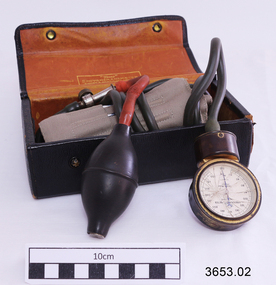
... Dr Angus assisted Dr Tom Ryan, a pioneer in the use of X-rays and in ocular surgery. flagstaff hill flagstaff hill warrnambool maritime museum shipwreck coast flagstaff hill maritime village great ocean road sphygmomanometer chemist equipment dr w.r. angus medical instrument warrnambool base hospital medical treatment medical history "Patent 9535. No. 39370". Gold maker's stamp " "TYCOS" "SPHYGMOMANOMETER / SHORT & MASON LTD. LONDON / company’s logo”. Cloth label ...This blood pressure monitor (sphygmomanometer) belonged to Dr William Roy Angus, surgeon and oculist. It was donated to Flagstaff Hill Maritime Village by his daughter, Berry McDade in January 2015. . It is part of the “W.R. Angus Collection” that includes historical medical equipment, surgical instruments and material once belonging to Dr Edward Ryan and Dr Thomas Francis Ryan, (both of Nhill, Victoria) as well as Dr Angus’ own belongings. The Collection’s history spans the medical practices of the two Doctors Ryan, from 1885-1926 plus that of Dr Angus, up until 1969. The approximate manufacture date of the blood pressure monitor coincides with the time when Doctor William Roy Angus had his practice in Warrnambool. The company Short & Mason Ltd. London used the brand name TYCOS between 1907-1969 and Rudolf Riester (the brand on the cuff) formed the company ‘Riester” in Germany in 1948, where he developed and produced the first mercury blood pressure monitors. In 1939 Dr Angus and his family moved to Warrnambool where he purchased “Birchwood,” the 1852 home and medical practice of Dr John Hunter Henderson, at 214 Koroit Street. (This property was sold in1965 to the State Government and is now the site of the Warrnambool Police Station.). Dr Angus was appointed on a part-time basis as Port Medical Officer (Health Officer) in Warrnambool and held this position until the 1940’s when the government no longer required the service of a Port Medical Officer in Warrnambool; he was thus Warrnambool’s last serving Port Medical Officer. (The duties of a Port Medical Officer were outlined by the Colonial Secretary on 21st June, 1839 under the terms of the Quarantine Act. Masters of immigrant ships arriving in port reported incidents of diseases, illness and death and the Port Medical Officer made a decision on whether the ship required Quarantine and for how long, in this way preventing contagious illness from spreading from new immigrants to the residents already in the colony.) Dr Angus was a member of the Australian Medical Association, for 35 years and surgeon at the Warrnambool Base Hospital 1939-1942, He served as a Surgeon Captain during WWII1942-45, in Ballarat, Victoria, and in Bonegilla, N.S.W., completing his service just before the end of the war due to suffering from a heart attack. During his convalescence he carved an intricate and ‘most artistic’ chess set from the material that dentures were made from. He then studied ophthalmology at the Royal Melbourne Eye and Ear Hospital and created cosmetically superior artificial eyes by pioneering using the intrascleral cartilage. Angus received accolades from the Ophthalmological Society of Australasia for this work. He returned to Warrnambool to commence practice as an ophthalmologist, pioneering in artificial eye improvements. He was Honorary Consultant Ophthalmologist to Warrnambool Base Hospital for 31 years. He made monthly visits to Portland as a visiting surgeon, to perform eye surgery. He represented the Victorian South-West subdivision of the Australian Medical Association as its secretary between 1949 and 1956 and as chairman from 1956 to 1958. In 1968 Dr Angus was elected member of Spain’s Barraquer Institute of Barcelona after his research work in Intrasclearal cartilage grafting, becoming one of the few Australian ophthalmologists to receive this honour, and in the following year presented his final paper on Living Intrasclearal Cartilage Implants at the Inaugural Meeting of the Australian College of Ophthalmologists in Melbourne. In his personal life Dr Angus was a Presbyterian and treated Sunday as a Sabbath, a day of rest. He would visit 3 or 4 country patients on a Sunday, taking his children along ‘for the ride’ and to visit with him. Sunday evenings he would play the pianola and sing Scottish songs to his family. One of Dr Angus’ patients was Margaret MacKenzie, author of a book on local shipwrecks that she’d seen as an eye witness from the late 1880’s in Peterborough, Victoria. In the early 1950’s Dr Angus, painted a picture of a shipwreck for the cover jacket of Margaret’s book, Shipwrecks and More Shipwrecks. She was blind in later life and her daughter wrote the actual book for her. Dr Angus and his wife Gladys were very involved in Warrnambool’s society with a strong interest in civic affairs. Their interests included organisations such as Red Cross, Rostrum, Warrnambool and District Historical Society (founding members), Wine and Food Society, Steering Committee for Tertiary Education in Warrnambool, Local National Trust, Good Neighbour Council, Housing Commission Advisory Board, United Services Institute, Legion of Ex-Servicemen, Olympic Pool Committee, Food for Britain Organisation, Warrnambool Hospital, Anti-Cancer Council, Boys’ Club, Charitable Council, National Fitness Council and Air Raid Precautions Group. He was also a member of the Steam Preservation Society and derived much pleasure from a steam traction engine on his farm. He had an interest in people and the community. He and his wife Gladys were both involved in the creation of Flagstaff Hill, including the layout of the gardens. After his death (28th March 1970) his family requested his practitioner’s plate, medical instruments and some personal belongings be displayed in the Port Medical Office surgery at Flagstaff Hill Maritime Village, and be called the “W. R. Angus Collection”. The W.R. Angus Collection is significant for still being located at the site it is connected with, Doctor Angus being the last Port Medical Officer in Warrnambool.. The collection of medical instruments and other equipment is culturally significant, being an historical example of medicine from late 19th to mid-20th century. Dr Angus assisted Dr Tom Ryan, a pioneer in the use of X-rays and in ocular surgery. Sphygmomanometer (blood pressure meter), from the collection of W.R. Angus. Brand TYCOS by Short & Mason Ltd, London. The case is of black leather with press-stud closure, lined in brown leather with gilded maker's embossing inside lid. The meter has a grey fabric cuff attached to two black rubber tubes, one tube has a pump bulb on a short brown extension tube on the end, the other has a round meter with glass covered dial on the end. Dial registers 20 – 300. There are maker's details on both meter and box."Patent 9535. No. 39370". Gold maker's stamp " "TYCOS" "SPHYGMOMANOMETER / SHORT & MASON LTD. LONDON / company’s logo”. Cloth label sewn on cuff "GERMANY / RIESTER"flagstaff hill, flagstaff hill warrnambool, maritime museum, shipwreck coast, flagstaff hill maritime village, great ocean road, sphygmomanometer, chemist equipment, dr w.r. angus, medical instrument, warrnambool base hospital, medical treatment, medical history -
 Flagstaff Hill Maritime Museum and Village
Equipment - First Aid Case, Thomas Urquhart & Son Pty Ltd (Thos. Urquhart), 1930-1939
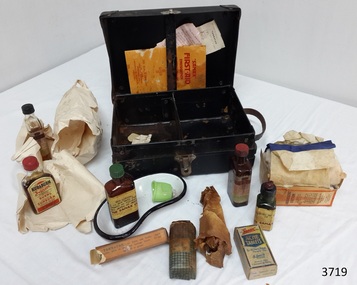
... Sanax brand specialties are prepared by highly qualified pharmaceutical chemists and may be accepted as safe and effective for the purpose indicated on the label. ...Sanax brand specialties are prepared by highly qualified pharmaceutical chemists and may be accepted as safe and effective for the purpose indicated on the label. ...This small, portable 1930s Sanax First Aid Case has been strongly constructed, with corners reinforced with metal to take knocks and bumps, so it could be quickly transported to the site of an emergency. Having these supplies organised into a kit made them easily accessible and reduces time to take them to the site of the accident. It was possibly designed for use in factories because the booklet in the case states that the kit complies with “Part 1, Victorian Factories Regulations”. The text of the printed brand “Sanax First Aid Case” is right-way up when the case stands vertically on its hinged side. In modern times people are well aware of the importance of quick treatment when accident and injury occur. However, before the first commercial First Aid Kit was made by Johnson & Johnson in 1888, people had little knowledge about treating injuries and lacked information about suitable supplies to keep on hand for emergencies. They were often unaware of how to help in that critical time before the doctor or other assistance arrived, a particularly important time for the many people living in remote areas. A quote from Johnson’s & Johnson’s 1888 price list explains “It is a fact, which is everywhere being recognized, that many lives are lost and much suffering entailed in such accidents on account of the lack of the simple but necessary articles required to afford prompt assistance to the wounded.” One example of the value of First Aid assistance to community groups is shown in an article from the Weekly Times, 29th November 1930. It records a report from the Annuello Branch of the Younger Set (a Country Women’s Organisation), telling that on Armistice Day their president Mrs Jamieson, presented the Annuello School with the gift of a Sanax Red Cross First Aid outfit, which was accepted as being “of great practical use to the scholars.” (Annuello is a remote wheat growing area in the Mallee region of North Western Victoria, which became a soldier settlement area after World War I. There is a strain of wheat named ‘Annuello’ due to its suitability for that area. ) The Sanax Case in our Collection contains instructions, equipment and medical items suitable for use in emergency situations. The Case was one of 42 patterns available from Sanax that conformed to ‘Part 1, Victorian Factories Regulations’. It includes items made by Sanax Company and by Burroughs Wellcome & Co. (Australia) Ltd., Sydney, NSW. A quote at the back of the First Aid Emergency Instructions booklet says: “Sanax products are made in Australia by or under the supervision of qualified chemists, from the highest quality materials. They are dependable for the purposes written on labels.” BOOKLET included in First Aid Case: “SANAX” First-Aid Emergency Instructions has orange cover and white pages, joined in the centre by two staples. Booklet contains First Aid Instructions for general events listed in alphabetical order. It also contains an indexed sections headed “Poisoning, and what to do” written by S.A. Burrows, Ph.C., Vuc and N.Z. There are instructions and diagrams on how to perform Artificial Respiration. There are advertisement for Sanax products throughout the booklet that include; - Sanax Ambulance Stretcher for timber mills, mines, ships and quarries - Saw dust masks (porous rubber) for workers in dust, paint or duco sprayers Inside cover lists Sanax’s Australian made products including - tablets and powders for headaches, neuralgia, influenza, colds - snuff for Catarrh that is “quite harmless” - First Aid Cases that come in a range of 42 patterns - sunburn preventatives and treatments - healing salve for carbuncles, pock, pimples, boils, varicose ulcers etc. - snake bite outfits and kits LEAFLETS included in First Aid Case: (1) Tannafax Tannic Acid Jelly. Tannafax should be kept at hand in every home. It should be applied direct from the tube and used with neither oil nor grease. Where a large area has to be covered the clamped end may be torn or cut off to give a wider mouth to the tube. Collapsible tubes of different sizes. Made in Australia. Burroughs Wellcome & Co. (Australia) Ltd. (Incorporated in England). Sydney, NSW. Assorted Houses, London, New York, Montreal, Cape Town, Milan, Bombay, Shanghai, Buenos Aires. Copyright A. 1817, J. 9463 (2) Tabloid. The strong thing is the just - - . Tabloid marks the wor - - Burroughs Wellcome & Comp. The use of the word is to enab – the prescriber, dispenser and patient to get the right thing with one short word, instead of the firm’s long name. If another maker apply the word to his product, the act is unlawful. Tabloid is our trade mark and brand. If a vendor disregard it in dispensing or selling, the act is unlawful for the same reason. We prosecute both offenders rigorously, in the interest of prescribers, dispensers, patients and the owners of the trade mark. Please inform us of any instance of either offence. Burroughs Wellcome & Co. (Australia) Ltd. (Incorporated in England). Telephone Number - M 4184 (4 lines) All communications to G.P.O. Box No. 1185 DD. Copyright Sy. 20. & J 9894. Medicines and Equipment included in First Aid Case: - Absorbent Cotton, Sanax, for absorbing blood or drying a wound. As a swab for washing wounds; to place above a compress to keep the heat in: or as a pad to protect wounds or fractures. The Sanax Co. Manuf. Chemists, Melbourne. Regd. Office: 5 Brunswick St, Fitzroy. N.6. - ACHE tablets, Sanax, for all aches, pains, fevers etc. Dose: 2 to 3 tablets with a draught of water, every 3 hours. Children in proportion. For influenza or colds, take the bedtime dose with a hot lemon drink or toddy. Recommended for Headaches, Colds, Influenza, Fevers, Neuralgia, Rheumatism, Nerve Pains, Sleeplessness, and Seasickness. Three Sanax Ache tablets equals one Sanax Ache powder. Each tablet contains 1.75grs. each Phenacotinum and Acety acSzilcyl, and .75grs Ammon Brom. Etc.. Sanax brand specialties are prepared by highly qualified pharmaceutical chemists and may be accepted as safe and effective for the purpose indicated on the label. The Sanax Co. Melbourne - Eye lotion, Sanax, “in eye bath full strength or diluted with equal parts of water. Sanax Co. Brunswich St, Fitzroy, Melbourne. - Iodine, Sanax, POISON, with instructions for what to do if swallowed. - Kuraburn, Sanax, Applied to the burn and allowed to dry, the pain and heat instantly disappear, and blistering is prevented. If necessary, apply again in an hours. To safeguard against burning when sunbathing, apply before exposure to the sun. If already sunburnet, use Kuraburn as directions above. Safe and harmless. Sole makers, The Sanax Co. Brunswick St. - - Vic. - Sal Volatile, Sanax, - - stimulant for - - nervous aches - - or as smelling salts Dose - - - - Solution of A- - - 5%, . The Sanax Co. Brunswick St, Melbourne. - Tannafax, Burroughs Wellcome & Co. Australia Ltd. Sydney, N.S.W., 20gm. Approx., Tannic Acid Jelly, (Tannic Acid with 0.5% Phenol in a water-soluble base) for burns and scalds. A.N. 15050, p188, logo of a unicorn. Apply lightly, allow to dry, and bandage loosely. Do not apply oil or grease. - bottle wrapped in brown paper, unknown contents, paper adhered to bottle. - dish, kidney shaped, metal, white enamel with black rim - eye bath, green, plastic or Bakelite SANAX COMPANY The Sanax Company was at the address of 5 Brunswick Street, Fitzroy [Melbourne] at least as early as November 1924, as shown by its advertisement of Ache Powder in the Weekly Times, 8th November 1924. It was still at this address in September 1951, when it advertised First Aid outfits and components in the Post Master General’s section of the Commonwealth of Australia Gazette. REFERENCES: Annuello, Victoria; Wikipedia, https://en.wikipedia.org/wiki/Annuello,_Victoria Annuello Younger Set, Branch Activities and Local Reports, Country Women’s Organisations, Weekly Times, 29 November 1930, Trove http://trove.nla.gov.au/newspaper/article/224921009?searchTerm=%22sanax%22%20and%20%22melbourne%22&searchLimits=# Commonwealth of Australia Gazette, Issue 32, 24th April 1915, https://www.legislation.gov.au/file/1915GN32 [Johnson & Johnson Price List, September 1, 1888, p. 20. From our archives], Celebrating the 125th Birthday of the First Aid Kit , The Story of Johnson & Johnson, , http://www.kilmerhouse.com/2013/06/from-1888-to-2013-celebrating-the-125th-birthday-of-the-first-aid-kit/ Post Master General’s section of the Commonwealth of Australia Gazette, Issue No. 73, Thursday 27th September 1951 http://trove.nla.gov.au/newspaper/article/232185299?searchTerm=%22sanax%22%20and%20%22fitzroy%22&searchLimits= Sanax First Aid Emergency Instructions, by S.A. Burrows, publisher Sanax Ltd. Fitzroy, Victoria, 1930-1939 English, book, Illustrated edition, Trove http://trove.nla.gov.au/version/40948895 Access to emergency medical help in early settlement days of Victoria could take quite some time, especially in remote areas. From 1888 First Aid Kits and instructions became available for work sites, offices, community groups and individuals, helping to bridge the gap between the accident and the arrival of medical assistance. This portable Sanax First Aid Case is an example of portable medical equipment made in Melbourne, Australia, in the 1930’s and available to the public. It contains a range of items plus information to be used in a variety of injuries and emergencies in in factories, households, businesses and local communities, and instructions on their use. First Aid Case, portable, Sanax First Aid Case. First Aid kit in strong black cardboard carry case with metal reinforced corners, metal hinges on lid, metal catch and leather carry handle. Inside lid is a vertical strap with narrow gap behind it. Base is divided into two compartments. Manufactured by Sanax, Fitzroy, Melbourne, C. 1930-1939 Contents include "Sanax" First Aid instructions booklet, 2 leaflets, metal kidney dish enamelled in white with black trim on edge, green plastic or Bakelite eye bath, eye lotion, Tannafax tannic acid jelly, Sal Volitile, Kuraburn, Iodine, Argyrol, ACHE tablets, absorbent cotton in cardboard box, gauze bandage, and UNKNOWN wrapped bottle. Printed in gold on lid of case “SANAX” FIRST AID CASE. Most of the contents, as well as the case, show the “SANAX” brand. Some contents are inscribed Burroughs Wellcome & Co. (Australia) Ltd., flagstaff hill, warrnambool, shipwrecked coast, flagstaff hill maritime museum, maritime museum, shipwreck coast, flagstaff hill maritime village, great ocean road, first aid items, first aid kit, emergency first aid, medical emergency kit, home emergency kit, industrial emergency kit, sanax company fitzroy melbourne, burroughs wellcome & co. (australia) ltd, thos. urquhart & son pty. ltd. melbourne, sanax first aid case, sanax first-aid emergency instructions, part 1 victorian factories regulations, tabloid medical supplies -
 Flagstaff Hill Maritime Museum and Village
Article - Ointment, Bates & Co. (William Usher), 1851 - mid-1900s
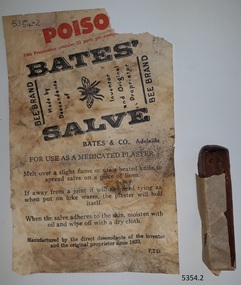
... The ointment was then taken to a room in the house where it was divided, labelled and packaged. It was then sent to Faulding’s Wholesale Chemist for distribution. ...The ointment was then taken to a room in the house where it was divided, labelled and packaged. It was then sent to Faulding’s Wholesale Chemist for distribution. ...Bates' Salve has been used as a home remedy for the treatment of boils, skin infections, splinters, pimples and insect bites for decades, from the mid-1800s to the mid-1900s. It is a drawing application for bringing out foreign bodies and pusses from a wound. There are still many families who remember using it and others who have been using it and are down to their last ‘inch’. One comment from a reader from Queensland tells how his Dad was a sleeper cutter in the 1950s and on school holidays his brother and he used to help their Dad. When doing this task after a wet season they would be confronted with spear grass about a metre high. Sometimes the spears would enter their skin, and when the spears were wet they would screw like a corkscrew into their flesh. If they left them for too long it was impossible to dig them out with a needle. That's when the Bates Salve was put into action to draw the spearhead out. "It worked wonders. It was a marvellous invention." Many people say that they would love to be able to purchase more of it today and hope that someone will produce a ‘safe’ version of it. There are several versions of a recipe for the salve available online. It appears that the salve is named after Daisy Bates, wife of the Bates’ Salve proprietor, William Usher. William’s son Victor continued making Bates’ Salve well into the mid-1900s, with the business being carried on by Victor’s only son, Alan. There are still descendants in the family home in Norwood, Adelaide. William’s great-grandchild has stated that, despite being subject to the salve during childhood, there have been no noticeable ill effects. A small notice in the Adelaide Advertiser in 1915 made a suggestion “It is said that Bates’ Salve is the popular line with OUR BOYS in Gallipoli. They recently sent to the Adelaide Red Cross for a supply, so it would be a good line to put in soldiers’ Christmas Billies.“ Over 700 ‘Christmas Billies’ were sent from generous Warrnambool citizens to our soldiers in the trenches in Gallipoli. The average cost of filling a billy with gifts was Ten Shillings, calculated at about Fifty-four Dollars in 2021. The contents included Christmas puddings and tobacco. The huge project was coordinated by a local Committee and involved generous businesses and hundreds of kind-hearted community members, with recognition sown by naming many of those involved in an article in the Warrnambool Standard. The project’s idea was initiated by Australia’s Department of Defence and all states were involved in supporting the soldiers in this way. Mr Bates (Theopholis) of Hull, England, was the original owner of the Bates’ Salve recipe. When he died he left his business to William Usher, his son-in-law. William arrived in South Australia in 1851 after he had sold his recipe to an English firm, giving them the rights to make and sell it all over the world, except in Australia. Bates then became the registered proprietor of Bates’ Salve for the Commonwealth and still had a large market for his product. William Usher made the salve at his Norwood home, in a wood-fired copper in the garden within a three-sided enclosure. The ointment was then taken to a room in the house where it was divided, labelled and packaged. It was then sent to Faulding’s Wholesale Chemist for distribution. William and his wife May (or Mary) had three children; Jack, Victor and Ivy. When May died, William married Mary Williams (May’s maid, from Tasmania, twenty years younger than William) and had seven more children. The treatment’s packaging labels it as a POISON. It seems that its active ingredient was lead oxide (22 per cent), which is no longer considered unsafe. A member of the public mentioned that in 2016 they found some Bates’ Salve in an old family medicine chest. Its label stated that the product “contains a minimum of 25.8 per cent of red lead oxide”. That particular sample was made at 470 Wallon Road, West Molesey, Surrey, England. Some people would love to be able to use the product still and even take the risk of poisoning. Instructions for its use are included on the wrapper. Here is a transcription - "Bates' Salve. Bee Brand. POISON. This Preparation contains 22 parts per centum [lead oxide]… Made by Descendants of the Inventor and Original Proprietor. For use as a medicated plaster. Melt over a slight flame or use a heated knife to spread the salve on a piece of linen. If away from a joint it will not need tying as, when put on lukewarm, the plaster will hold itself. When the salve adheres to the skin moisten it with oil and wipe it off with a dry cloth. Manufactured by the direct descendants of the inventor and the original proprietor since 1833."This package of Bates' Salve has been used as a home remedy since the mod-1800s and even up to now in 2019 by those who consider themselves lucky to still have some at home. It was promoted as a 'cure all' treatment and kept handy for use at home and away. It represents our early industry and health management when medical treatment was often difficult to access. The product is the part of many childhood memories of those alive today.Bates’ Salve ointment; oblong stick of firm, brown waxy substance wrapped in waxed paper, with an outer printed wrapper. Text on wrapper warns that it is POISON and includes instructions for use as a medicated plaster, to be heated and spread onto linen then applied to the injury. Made by Bates & Co., Adelaide. The wrapper shows an emblem of a bee. The formula has been used since 1833.Text on wrapper includes "POISO[N]", "BATES' SALVE", "BEE BRAND", "BATES & CO., ADELAIDE". "This Preparation contains 22 parts per centum [lead oxide]" There is an emblem of a bee with wings outstretched.flagstaff hill, warrnambool, shipwrecked-coast, flagstaff-hill, flagstaff-hill-maritime-museum, maritime-museum, shipwreck-coast, flagstaff-hill-maritime-village, bates’ salve, bates’ salve medicated plaster, bates and co adelaide, bee brand, medicated plaster, medical treatment, remedy, drawing treatment for infection, medicine cabinet, home remedy, pharmacy treatment, mid 1800s – mid 1900s remedy, topical application, treatment for boils, bites, splinters and infections, poison, preparation for treatment, ointment
