
Showing 147 items matching "chestnuts"
-
 University of Melbourne, Burnley Campus Archives
Document - Invoice, [Chestnut trees]
... [Chestnut trees]......chestnuts...Invoice for 12 budded chestnut trees...trees chestnuts Invoice for 12 budded chestnut trees [Chestnut trees] Document Invoice ...Invoice for 12 budded chestnut treestrees, chestnuts -
 Marysville & District Historical Society
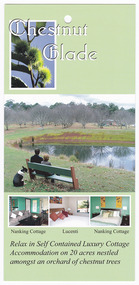
Flyer (Item) - Information flyer, Chestnut Glade, Unknown
... Chestnut Glade...An information flyer regarding accommodation at Chestnut Glade in Narbethong....An information flyer regarding accommodation at Chestnut Glade in Narbethong....An information flyer regarding accommodation at Chestnut Glade in Narbethong. An information flyer regarding accommodation at Chestnut Glade in Narbethong. narbethong victoria australia chestnut glade accommodation information flyer An information flyer regarding accommodation at Chestnut Glade in Narbethong. ...An information flyer regarding accommodation at Chestnut Glade in Narbethong.An information flyer regarding accommodation at Chestnut Glade in Narbethong.narbethong, victoria, australia, chestnut glade, accommodation, information flyer -
 Marysville & District Historical Society
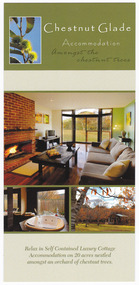
Flyer (Item) - Information flyer, Chestnut Glade Accommodation, Unknown
... Chestnut Glade Accommodation...An information flyer regarding accommodation at Chestnut Glade in Narbethong....An information flyer regarding accommodation at Chestnut Glade in Narbethong....An information flyer regarding accommodation at Chestnut Glade in Narbethong. An information flyer regarding accommodation at Chestnut Glade in Narbethong. narbethong victoria australia chestnut glade accommodation information flyer An information flyer regarding accommodation at Chestnut Glade in Narbethong. ...An information flyer regarding accommodation at Chestnut Glade in Narbethong.An information flyer regarding accommodation at Chestnut Glade in Narbethong.narbethong, victoria, australia, chestnut glade, accommodation, information flyer -
 Marysville & District Historical Society
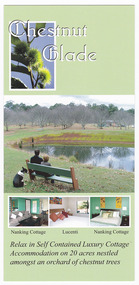
Flyer (Item) - Information flyer, Chestnut Glade, Unknown
... Chestnut Glade...An information flyer regarding accommodation at Chestnut Glade in Narbethong....An information flyer regarding accommodation at Chestnut Glade in Narbethong....An information flyer regarding accommodation at Chestnut Glade in Narbethong. An information flyer regarding accommodation at Chestnut Glade in Narbethong. narbethong victoria australia chestnut glade accommodation information flyer An information flyer regarding accommodation at Chestnut Glade in Narbethong. ...An information flyer regarding accommodation at Chestnut Glade in Narbethong.An information flyer regarding accommodation at Chestnut Glade in Narbethong.narbethong, victoria, australia, chestnut glade, accommodation, information flyer -
 Marysville & District Historical Society
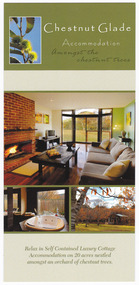
Flyer (Item) - Information flyer, Chestnut Glade Accommodation, Unknown
... Chestnut Glade Accommodation...An information flyer regarding accommodation at Chestnut Glade in Narbethong....An information flyer regarding accommodation at Chestnut Glade in Narbethong....An information flyer regarding accommodation at Chestnut Glade in Narbethong. An information flyer regarding accommodation at Chestnut Glade in Narbethong. narbethong victoria australia chestnut glade accommodation information flyer An information flyer regarding accommodation at Chestnut Glade in Narbethong. ...An information flyer regarding accommodation at Chestnut Glade in Narbethong.An information flyer regarding accommodation at Chestnut Glade in Narbethong.narbethong, victoria, australia, chestnut glade, accommodation, information flyer -
Glenelg Shire Council Cultural Collection
Functional object - Oakum
... Mass of rope strands, dress in tar. Dark chestnut in colour, one side apears to be in a large plait....Sailing Ships whaling None Mass of rope strands, dress in tar. Dark chestnut in colour, one side apears to be in a large plait. ...Oakum picked from old rope and dressed in tar, then driven between planks to make them water tight.Mass of rope strands, dress in tar. Dark chestnut in colour, one side apears to be in a large plait.Nonesailing ships, whaling -
 Luther College
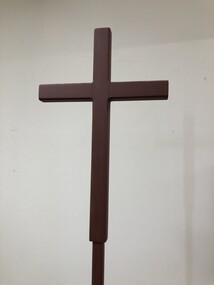
Ceremonial object, Prototype of Luther College's ceremonial cross, Early 2010's
... Chestnut brown wooden cross on smaller pole for carrying, which sits in a wooden base of the same colour...The cross, based on this prototype, is now used for all formal and religious services in Luther's chapel. Chapel Chestnut brown wooden cross on smaller pole for carrying, which sits in a wooden base of the same colour Prototype of Luther College's ceremonial cross Ceremonial object ...This prototype was made by Cobus Vissar in the early 2010's. His design was well-received, and he was asked to make the ceremonial cross for Luther College chapel services. The cross, based on this prototype, is now used for all formal and religious services in Luther's chapel.Chestnut brown wooden cross on smaller pole for carrying, which sits in a wooden base of the same colourchapel -
Clunes Museum
Book, REV E.P. ROE, 1 THE OPENING OF A CHESTNUT BURR BY E.P.ROE 2. A FACE ILLUMINED BY REV E.P.ROE
... .1 THE OPENING OF A CHESTNUT BURR BY E.P.ROE 2. A FACE ILLUMINED BY REV E.P.ROE...RED HARD COVER BOOK - THE OPENING OF A CHESTNUT BURR BY E.P.ROE 2. RED HARD COVER BOOK - A FACE ILLUMINED BY REV E.P.ROE...RED HARD COVER BOOK - THE OPENING OF A CHESTNUT BURR BY E.P.ROE 2. RED HARD COVER BOOK - A FACE ILLUMINED BY REV E.P.ROE .1 THE OPENING OF A CHESTNUT BURR BY E.P.ROE 2. ....1 THE OPENING OF A CHESTNUT BURR BY E.P.ROE 2. RED HARD COVER BOOK - A FACE ILLUMINED BY REV E.P.ROE1. RED HARD COVER BOOK - THE OPENING OF A CHESTNUT BURR BY E.P.ROE 2. RED HARD COVER BOOK - A FACE ILLUMINED BY REV E.P.ROEfiction.1 THE OPENING OF A CHESTNUT BURR BY E.P.ROE 2. RED HARD COVER BOOK - A FACE ILLUMINED BY REV E.P.ROElocal history, document, book, novel, books -
Lakes Entrance Historical Society
Map - Alpine Study Area - Primary Production, Land Conservation Council
... Map shows private land, cropping, sheep, cattle, dairy farm, tobacco farm, walnut, chestnuts, apples. Public area, uncleared area, cattle main stock route,...crops livestock study primary production Map No. 9 Map shows private land, cropping, sheep, cattle, dairy farm, tobacco farm, walnut, chestnuts, apples. Public area, uncleared area, cattle main stock route, Map Alpine Study Area - Primary Production Land Conservation Council ...Map shows private land, cropping, sheep, cattle, dairy farm, tobacco farm, walnut, chestnuts, apples. Public area, uncleared area, cattle main stock route,Map No. 9crops, livestock, study, primary production -
Friends of Ballarat Botanical Gardens History Group
Work on paper - Horse Chestnuts, Notes by Sandy DeGroot, 2011. No references given
... Information about the many Horse Chestnut trees to be found in Ballarat....Information about the many Horse Chestnut trees to be found in Ballarat. These notes provide additional information about the Horse Chestnut and a little of the history of these trees. ...Information about the many Horse Chestnut trees to be found in Ballarat.These notes provide additional information about the Horse Chestnut and a little of the history of these trees.One page with typing (?) just over half a page.Printed in black biro, "Sandy De Groot 2011horse chestnuts, avenue of horse chestnuts, aesculus hippocastanum, john garner, doctor, john garner collection, friends of ballarat botanical gardens, sandy de groot, ballarat botanical gardens, gregory street, conkers, gardens, ballarat -
 The Beechworth Burke Museum
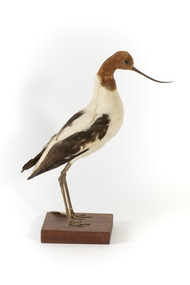
Animal specimen - Red Necked Avocat, Trustees of the Australian Museum, 1860-1880
... The name of this species is derived from the distinctive chestnut brown/red colouring of the head and neck. ...The plumage of this species is largely white. It has a chestnut brown/red coloured head which is where this species gets its name. ...The name of this species is derived from the distinctive chestnut brown/red colouring of the head and neck. ...This particular species is native to Australia and can be located throughout the mainland, preferably in the south-western interior. It is known for its distinctively upturned bill, the males of this species have a slightly more upturn to their bill than the female. This style of bill is unusual among birds and is used to assist them forage in the water of shallow wetlands. These birds feed on aquatic insects, crustaceans and seeds. The name of this species is derived from the distinctive chestnut brown/red colouring of the head and neck. Interestingly, the call of this bird has been described as a "yapping" sound which is similar to the sound of dogs barking when performed by a flock in flight. This specimen is part of a collection of almost 200 animal specimens that were originally acquired as skins from various institutions across Australia, including the Australian Museum in Sydney and the National Museum of Victoria (known as Museums Victoria since 1983), as well as individuals such as amateur anthropologist Reynell Eveleigh Johns between 1860-1880. These skins were then mounted by members of the Burke Museum Committee and put-on display in the formal space of the Museum’s original exhibition hall where they continue to be on display. This display of taxidermy mounts initially served to instruct visitors to the Burke Museum of the natural world around them, today it serves as an insight into the collecting habits of the 19th century.This specimen is part of a significant and rare taxidermy mount collection in the Burke Museum. This collection is scientifically and culturally important for reminding us of how science continues to shape our understanding of the modern world. They demonstrate a capacity to hold evidence of how Australia’s fauna history existed in the past and are potentially important for future environmental research. This collection continues to be on display in the Museum and has become a key part to interpreting the collecting habits of the 19th century.This Red Necked Avocat specimen is stylized in a standing position upon a wooden platform. There is a pale brown identification tag tied around its left leg. The bird has long pale grey coloured legs and a characteristic long, thin and black upturned bill. The plumage of this species is largely white. It has a chestnut brown/red coloured head which is where this species gets its name. The wings are white with black tips.25c. / Avocet / Catalogue, page, 36. / taxidermy mount, taxidermy, animalia, burke museum, beechworth, australian museum, skin, reynell eveleigh johns, bird, australian birds, large bird, red necked avocat, avocat -
 The Beechworth Burke Museum
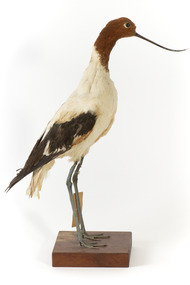
Animal specimen - Red-Necked Avocat, Trustees of the Australian Museum, 1860-1880
... The name of this species is derived from the distinctive chestnut brown/red colouring of the head and neck. ...The plumage of this species is largely white. It has a chestnut brown/red coloured head which is where this species gets its name. ...The name of this species is derived from the distinctive chestnut brown/red colouring of the head and neck. ...This particular species is native to Australia and can be located throughout the mainland, preferably in the south-western interior. It is known for its distinctively upturned bill, the males of this species have a slightly more upturn to their bill than the female. This style of bill is unusual among birds and is used to assist them forage in the water of shallow wetlands. These birds feed on aquatic insects, crustaceans and seeds. The name of this species is derived from the distinctive chestnut brown/red colouring of the head and neck. Interestingly, the call of this bird has been described as a "yapping" sound which is similar to the sound of dogs barking when performed by a flock in flight. This specimen is part of a collection of almost 200 animal specimens that were originally acquired as skins from various institutions across Australia, including the Australian Museum in Sydney and the National Museum of Victoria (known as Museums Victoria since 1983), as well as individuals such as amateur anthropologist Reynell Eveleigh Johns between 1860-1880. These skins were then mounted by members of the Burke Museum Committee and put-on display in the formal space of the Museum’s original exhibition hall where they continue to be on display. This display of taxidermy mounts initially served to instruct visitors to the Burke Museum of the natural world around them, today it serves as an insight into the collecting habits of the 19th century.This specimen is part of a significant and rare taxidermy mount collection in the Burke Museum. This collection is scientifically and culturally important for reminding us of how science continues to shape our understanding of the modern world. They demonstrate a capacity to hold evidence of how Australia’s fauna history existed in the past and are potentially important for future environmental research. This collection continues to be on display in the Museum and has become a key part to interpreting the collecting habits of the 19th century.This Red Necked Avocat specimen is stylized in a standing position upon a wooden platform. There is a pale brown identification tag tied around its left leg. The bird has long pale grey coloured legs and a characteristic long, thin and black upturned bill. The plumage of this species is largely white. It has a chestnut brown/red coloured head which is where this species gets its name. The wings are white with black tips.24c. / Avocat / Catalogue, page, 36. /taxidermy mount, taxidermy, animalia, burke museum, beechworth, australian museum, skin, reynell eveleigh johns, bird, australian birds, large bird, red necked avocat, avocat -
 Jewish Museum of Australia
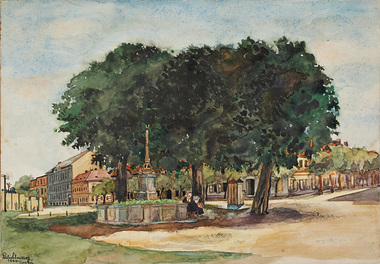
Schwarz, Mr Paul, Theresienstadt: Im Schatten des Kastanien by Paul Schwarz, 1944, 1944
... Handwritten (LL): "Pali Schwarz 1944 Terezin" On reverse, handwritten in pencil: "Theresienstadt: Im Schatten des Kastanien" [Under the Shade of the Chestnut Tree]...Second World War, 1939-1945 Jewish History & People Holocaust Czech Republic Handwritten (LL): "Pali Schwarz 1944 Terezin" On reverse, handwritten in pencil: "Theresienstadt: Im Schatten des Kastanien" [Under the Shade of the Chestnut Tree] Mounted watercolour and pencil on paper. ...Mounted watercolour and pencil on paper.Handwritten (LL): "Pali Schwarz 1944 Terezin" On reverse, handwritten in pencil: "Theresienstadt: Im Schatten des Kastanien" [Under the Shade of the Chestnut Tree]second world war, 1939-1945, jewish history & people, holocaust, czech republic -
Friends of Ballarat Botanical Gardens History Group
Work on paper - Horse Chestnut, Aesculus hippocastanum, Details and Uses of These Trees, 9/2/2016
... There are Horse Chestnut Trees in the Ballarat Botanical Gardens and Gregory Street, Wendouree, as well as other parts of Ballarat....Work on paper Horse Chestnut, Aesculus hippocastanum ...There are Horse Chestnut Trees in the Ballarat Botanical Gardens and Gregory Street, Wendouree, as well as other parts of Ballarat.This large handsome deciduous tree is not only part of Ballarat's history but often found in parks and streets in temperate parts of the world.1 page, printed 1/2 way down, with the names of the FBBG Guiding Group at the top of the page. The bottom of the 3rd line of the text is missing but is still legible.BBG Trees is written at the top of the page in blue biro.john garner, doctor john garner, ballarat botanical gardens, horse chestnuts, aesculus hippocastanum, friends of ballarat botanical gardens, guiding friends, traditional chinese medicine -
 Bendigo Military Museum
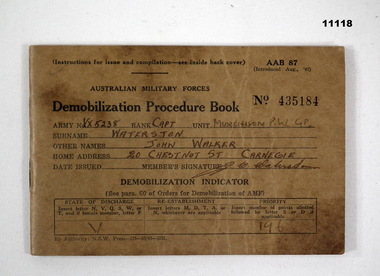
Administrative record - DEMOBILIZATION PROCEDURE BOOK, Aug 1945
... Waterston, John Walker, 20 Chestnut St. Carnegie (Signature)” “State of Discharge V - Priority 196”....Waterston, John Walker, 20 Chestnut St. Carnegie (Signature)” “State of Discharge V - Priority 196”. ...Ref: "John Walker WATERSTON" VX5238 (born ST. Kilda, Enlisted: Bendigo) on 21/10/1939. Discharged 1/7/1947. Rank: Captain in 2/6 Battalion.This is a pocket sized booklet. The cover is a light brown cardboard. printing in black ink. Army Form NR AAB87. Inside are about 32 pages of service details.Written on front is: ”VX5238 Capt Unit = Murchison P.W. G.P. Waterston, John Walker, 20 Chestnut St. Carnegie (Signature)” “State of Discharge V - Priority 196”.ww2, pow camp, murchison, john walker waterston -
 Friends of Ballarat Botanical Gardens History Group
Slide - Colour transparency, Eastman Kodak, c. 1940
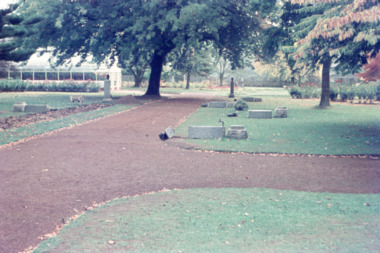
... On March 2, 1940, Sir Winston Dugan, Governor of Victoria unveiled the busts of the six first prime ministers of Australia at a ceremony on the long avenue of Horse Chestnuts. The donor, Richard Armstrong Couch, was born in Ballarat in 1868....On March 2, 1940, Sir Winston Dugan, Governor of Victoria unveiled the busts of the six first prime ministers of Australia at a ceremony on the long avenue of Horse Chestnuts. The donor, Richard Armstrong Couch, was born in Ballarat in 1868. ...On March 2, 1940, Sir Winston Dugan, Governor of Victoria unveiled the busts of the six first prime ministers of Australia at a ceremony on the long avenue of Horse Chestnuts. The donor, Richard Armstrong Couch, was born in Ballarat in 1868.The Prime Ministers Avenue is a feature of national significance, set in the magnificent Horse Chestnut Avenue of the Gardens. The 28 Prime Ministers of Australia are displayed as bronze portraits mounted on polished granite pedestals. The collection includes a portrait of one of the founding fathers of Federation, Alfred Deakin, who was the first Federal Member for Ballarat and the second Prime Minister.Kodachrome slide depicting the gardens during the installation of the pedestals and busts of the first six prime ministers.Kodachromeballarat botanical gardens, trees, lawns, pathways, sculptures, busts, governors, prime ministers avenue, richard armstrong couch, federation, 1940, chestnut trees, horse chestnuts, bronze, granite, pedestals, alfred deakin, sir winston dugan, wallace anderson -
 Friends of Ballarat Botanical Gardens History Group
Slide - Colour transparency, Eastman Kodak, c. 1940
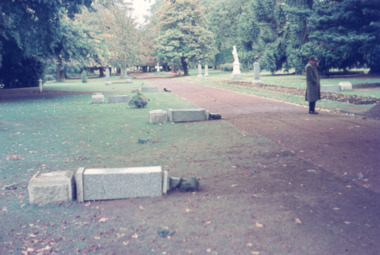
... On March 2, 1940, Sir Winston Dugan, Governor of Victoria unveiled the busts of the six first prime ministers of Australia at a ceremony on the long avenue of Horse Chestnuts. The donor, Richard Armstrong Couch, was born in Ballarat in 1868....On March 2, 1940, Sir Winston Dugan, Governor of Victoria unveiled the busts of the six first prime ministers of Australia at a ceremony on the long avenue of Horse Chestnuts. The donor, Richard Armstrong Couch, was born in Ballarat in 1868. ...On March 2, 1940, Sir Winston Dugan, Governor of Victoria unveiled the busts of the six first prime ministers of Australia at a ceremony on the long avenue of Horse Chestnuts. The donor, Richard Armstrong Couch, was born in Ballarat in 1868.The Prime Ministers Avenue is a feature of national significance, set in the magnificent Horse Chestnut Avenue of the Gardens. The 28 Prime Ministers of Australia are displayed as bronze portraits mounted on polished granite pedestals. The collection includes a portrait of one of the founding fathers of Federation, Alfred Deakin, who was the first Federal Member for Ballarat and the second Prime Minister.Kodachrome slide depicting a pathway and lawns where pedestals and busts of the first six prime ministers are lying on the ground to be installed. A man with hat, long winter coat is standing on the pathway.Kodachromeballarat botanical gardens, trees, men, pathways, lawns, sculptures, busts, prime ministers avenue, chestnut trees, granite, alfred deakin, federation, horse chestnuts, richard armstrong crouch, pedestals, governor, sir winston dugan, wallace anderson -
 Mont De Lancey
Domestic object - Razors, Klein, Early 20th Century
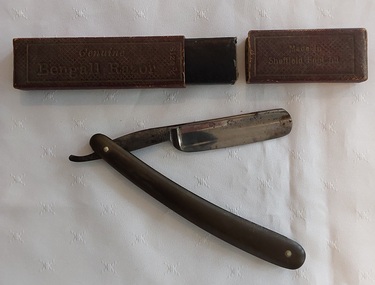
... Boker & Co. is a historic German-American company, established in 1837 by Hermann Boker, known for its high-quality cutlery, especially vintage straight razors, pocket knives, and other tools, marked by the iconic "Tree Brand" symbol originating from a chestnut tree near their Remscheid forge...An empty H Boker and Co razor case with the name in ornate lettering printed in black lettering on the front with Trade Mark written each side of an outline of marked by the iconic "Tree Brand" symbol originating from a chestnut tree near their Remscheid forge tree on the short section of the case. ...An empty H Boker and Co razor case with the name in ornate lettering printed in black lettering on the front with Trade Mark written each side of an outline of marked by the iconic "Tree Brand" symbol originating from a chestnut tree near their Remscheid forge tree on the short section of the case. ...Bengall razors, made by T.R. Cadman & Sons in Sheffield, England, were produced for a long period, with the trademark granted in 1748 and the company trading until 1965, meaning they were made throughout the 18th, 19th, and 20th centuries, with many popular models from the early to mid-20th century (1900s-1940s/50s) being common finds. They were a classic type of straight razor, popular for daily use before safety razors took over. Klein cut-throat razors marked "Ground in Hamburg" are vintage straight razors, often collectible, indicating they were manufactured by or for J. Klein & Co. (or similar) and had their blades ground for sharpness in Hamburg, Germany, a traditional centre for steel and razor making, reflecting a quality indicator for these classic wet-shaving tools. H. Boker & Co. is a historic German-American company, established in 1837 by Hermann Boker, known for its high-quality cutlery, especially vintage straight razors, pocket knives, and other tools, marked by the iconic "Tree Brand" symbol originating from a chestnut tree near their Remscheid forgeTwo cut throat razors: 1. A vintage Bengall Cut Throat Shaving Razor with a brown bakelite handle made by T.R. Cadman & Sons, in Sheffield, England.The blade folds back into the handle to protect it. It has a floral decoration around the end of the blade near the handle. It is stored in a burgundy leather case with 'Genuine Bengall Razor' stamped onto it. 2. A vintage Klein Cut Throat Shaving Razor ground in Hamburg Germany with a brown bakelite handle.The blade folds back into the handle to protect it. There is a blue sticker on the end of the inside of the case with SHOP written on both sides. 3. An empty H Boker and Co razor case with the name in ornate lettering printed in black lettering on the front with Trade Mark written each side of an outline of marked by the iconic "Tree Brand" symbol originating from a chestnut tree near their Remscheid forge tree on the short section of the case. There is a white sticker with E.A. Pettit printed on it in purple and the name Kennedy in black ink handwriting below.1. The blade has 'Bengall' engraved one side and on the back it has 'T.R. Cadman & Sons Sheffield England'. 2.The blade has 'Klein' engraved on one side and on the back has 'Ground in Hamburg Germany'. There is a blue sticker on the end of the inside of the case with 'SHOP' written on both sides.3. On the empty worn black case 'H Boker and Co' 'Trade Mark' is written each side of an outline of tree on the short section of the case. There is a white sticker with 'E.A. Pettit Puts Your razor Inters Class Order' or 1/6' printed on it in purple and the name 'Kennedy' in black ink handwriting below.cut throat razors, shaving equipment, shavers, barbers -
 Ithacan Historical Society
Document - Greek Passport, Personal details page, C1936
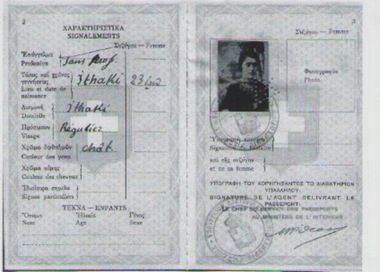
... Her colouring is described as being regular and her eyes chestnut. Information was written in Greek and French....Her colouring is described as being regular and her eyes chestnut. Information was written in Greek and French. ...This is a copy of a page taken from Kalypso Sofiano's' Greek passport when she migrated from Ithaca in 1936. She was 23 years of age and was living in Ithaca. Her colouring is described as being regular and her eyes chestnut. Information was written in Greek and French.At the time of issue French was the lingua franca of the international and diplomatic world.A scanned copy of a page from a passport issued in Greece to a female. As well as a photograph of passport holder, it gives details of her age, and colouring as well as her place of residence. The information fields are in both Greek and French and hand writing is in French with official stamps across the photograph and the signature of the person who issued the passport.migration -
 The Beechworth Burke Museum
Animal specimen - Buff-Banded Rail, Trustees of the Australian Museum, 1860-1880
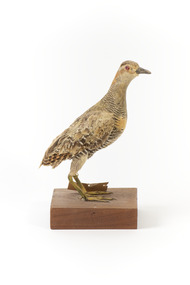
... This bird is multicoloured with streaks of chestnut brown, black, white and a faint orange-brown. ...This bird is multicoloured with streaks of chestnut brown, black, white and a faint orange-brown. ...The Buff-banded Rail is located on mainland Australia. It can also be found in south-east Asia, New Guinea and New Zealand. These birds are often seen individually or in pairs walking through the dense reeds and vegetations of wetlands or crops. This rail has a slow walk and often flicks its tail, which is raised, as they move. They are omnivore scavengers who feed on a large variety of invertebrates, fruit, seeds and vegetables. This specimen is part of a collection of almost 200 animal specimens that were originally acquired as skins from various institutions across Australia, including the Australian Museum in Sydney and the National Museum of Victoria (known as Museums Victoria since 1983), as well as individuals such as amateur anthropologist Reynell Eveleigh Johns between 1860-1880. These skins were then mounted by members of the Burke Museum Committee and put-on display in the formal space of the Museum’s original exhibition hall where they continue to be on display. This display of taxidermy mounts initially served to instruct visitors to the Burke Museum of the natural world around them, today it serves as an insight into the collecting habits of the 19th century.This specimen is part of a significant and rare taxidermy mount collection in the Burke Museum. This collection is scientifically and culturally important for reminding us of how science continues to shape our understanding of the modern world. They demonstrate a capacity to hold evidence of how Australia’s fauna history existed in the past and are potentially important for future environmental research. This collection continues to be on display in the Museum and has become a key part to interpreting the collecting habits of the 19th century.This specimen is in a standing position on a wooden platform. The Buff-Branded Rail has a pale grey/yellow eyebrow over the orange glass eyes and a pale grey bill. It also has an orange and brown coloured band on its breast. This bird is multicoloured with streaks of chestnut brown, black, white and a faint orange-brown. This specimen has a paper identification tag tied to its left leg.29 c. / (22c)? Spotted Water Crake / See Catalogue, page, 35. / taxidermy mount, taxidermy, animalia, burke museum, beechworth, australian museum, skin, reynell eveleigh johns, bird, landrail, buff-banded rail -
 Marysville & District Historical Society
Postcard (item) - Black and white postcard, Main Road Marysville, Unknown
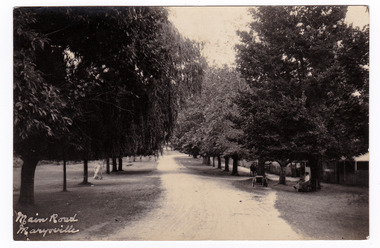
... On the right-hand side of the photograph you can see two ladies sitting on a seat under a tree in front of Thomas Barton's house, 'The Chestnuts'. In front of the ladies is a motorbike with a sidecar. ...On the right-hand side of the photograph you can see two ladies sitting on a seat under a tree in front of Thomas Barton's house, 'The Chestnuts'. In front of the ladies is a motorbike with a sidecar. ...Postcard of early black and white photograph of the main street of Marysville in Victoria. This street is now known as Murchison Street.Postcard of early black and white photograph of the main street of Marysville in Victoria. This street is now known as Murchison Street.POST CARD PLACE/ POSTAGE/ STAMP/ HEREmarysville, victoria, murchison street, postcard, souvenir -
 Marysville & District Historical Society
Postcard (Item) - Black and white postcard, Main Road Marysville, Unknown
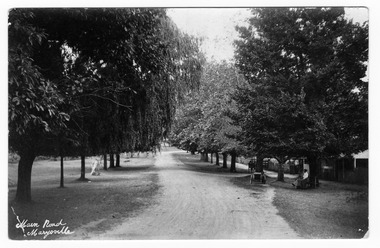
... On the right-hand side of the photograph you can see two ladies sitting on a seat under a tree in front of Thomas Barton's house, 'The Chestnuts'. In front of the ladies is a motorbike with a sidecar. ...On the right-hand side of the photograph you can see two ladies sitting on a seat under a tree in front of Thomas Barton's house, 'The Chestnuts'. In front of the ladies is a motorbike with a sidecar. ...Postcard of early black and white photograph of the main street of Marysville in Victoria.Postcard of early black and white photograph of the main street of Marysville in Victoria. This street is now known as Murchison Street.POST CARD PLACE/ POSTAGE/ STAMP/ HEREmarysville, victoria, murchison street, postcard, souvenir -
 Kew Historical Society Inc
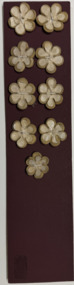
7 buttons on chestnut card 14 on cream card, 1940s
... The item comprises nine cream coloured, flower shaped buttons mounted on a rectangular dark brown chestnut coloured card. Each button featurers raised floral designs comprising of six rounded petals surrounding a smaller central flower motif. ...Manufacturer is Beust & Bills of South Melbourne. 7 buttons on chestnut card 14 on cream card ...Sally Hearn (1932–2018) was a dedicated button collector and a prominent member of the Victoria Button Collectors Club. Her button collection was featured as a primary display in the 'The Melbourne Story' exhibition at the Melbourne Museum, which opened in mid-2008.The Hearn Collection of locally made and international buttons is historically and aesthetically significant as it illustrates the textile and manufacturing history of button making.The item comprises nine cream coloured, flower shaped buttons mounted on a rectangular dark brown chestnut coloured card. Each button featurers raised floral designs comprising of six rounded petals surrounding a smaller central flower motif. The buttons are arranged in four pairs, with a single button positioned below. The buttons vary slightly in size and appearance. Manufacturer is Beust & Bills of South Melbourne.Official Catalogue Entry: "The white deluxe 3 layered flower buttons were identified as from the first innerspring mattress c.1946 from Beust & Bills of South Melbourne. The others are typical of those used on kapok and horsehair filled mattresses of previous times."sally hearn, button collections -
 The Beechworth Burke Museum
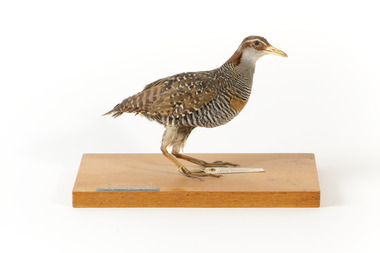
Animal specimen - Buff-Banded Rail, 1860-1880
... This bird is multicoloured with streaks of chestnut brown, black, white and a faint orange-brown. ...This bird is multicoloured with streaks of chestnut brown, black, white and a faint orange-brown. ...The Buff-banded Rail is located on mainland Australia. It can also be found in south-east Asia, New Guinea and New Zealand. These birds are often seen individually or in pairs walking through the dense reeds and vegetations of wetlands or crops. This rail has a slow walk and often flicks its tail, which is raised, as they move. They are omnivore scavengers who feed on a large variety of invertebrates, fruit, seeds and vegetables. This specimen is part of a collection of almost 200 animal specimens that were originally acquired as skins from various institutions across Australia, including the Australian Museum and the National Museum of Victoria, as well as individuals such amateur anthropologist Reynell Eveleigh Johns between 1860-1880. These skins were then mounted by members of the Burke Museum Committee and put-on display in the formal space of the Museum’s original exhibition hall where they continue to be on display. This display of taxidermy mounts initially served to instruct visitors to the Burke Museum of the natural world around them, today it serves as an insight into the collecting habits of the 19th century. This specimen is part of a significant and rare taxidermy mount collection in the Burke Museum. This collection is scientifically and culturally important for reminding us of how science continues to shape our understanding of the modern world. They demonstrate a capacity to hold evidence of how Australia’s fauna history existed in the past and are potentially important for future environmental research. This collection continues to be on display in the Museum and has become a key part to interpreting the collecting habits of the 19th century.This specimen is in a standing position on a wooden platform. The Buff-Branded Rail has a pale grey/yellow eyebrow over the black glass eyes and a pale yellow bill. It also has an orange and brown coloured band on its breast. This bird is multicoloured with streaks of chestnut brown, black, white and a faint orange-brown. This specimen has a paper tag tied to its right leg and a grey/back label on the wooden platform.Platform: "Banded Landrail" Paper tag: "National Museum Victoria. Banded Landrail Hypotoenidia w8 427 Philippensis (L)"taxidermy mount, taxidermy, animalia, burke museum, beechworth, australian museum, skin, reynell eveleigh johns, bird, landrail, buff-banded rail -
 The Beechworth Burke Museum
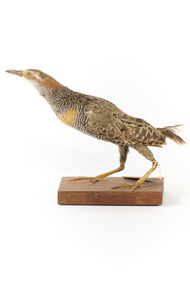
Animal specimen - Buff-Banded Rail, Trustees of the Australian Museum, 1860-1880
... This bird is multicoloured with streaks of chestnut brown, black, white and a faint orange-brown. ...This bird is multicoloured with streaks of chestnut brown, black, white and a faint orange-brown. ...The Buff-banded Rail is located on mainland Australia. It can also be found in south-east Asia, New Guinea and New Zealand. These birds are often seen individually or in pairs walking through the dense reeds and vegetations of wetlands or crops. This rail has a slow walk and often flicks its tail, which is raised, as they move. They are omnivore scavengers who feed on a large variety of invertebrates, fruit, seeds and vegetables. This specimen is part of a collection of almost 200 animal specimens that were originally acquired as skins from various institutions across Australia, including the Australian Museum in Sydney and the National Museum of Victoria (known as Museums Victoria since 1983), as well as individuals such as amateur anthropologist Reynell Eveleigh Johns between 1860-1880. These skins were then mounted by members of the Burke Museum Committee and put-on display in the formal space of the Museum’s original exhibition hall where they continue to be on display. This display of taxidermy mounts initially served to instruct visitors to the Burke Museum of the natural world around them, today it serves as an insight into the collecting habits of the 19th century.This specimen is part of a significant and rare taxidermy mount collection in the Burke Museum. This collection is scientifically and culturally important for reminding us of how science continues to shape our understanding of the modern world. They demonstrate a capacity to hold evidence of how Australia’s fauna history existed in the past and are potentially important for future environmental research. This collection continues to be on display in the Museum and has become a key part to interpreting the collecting habits of the 19th century.This specimen is in a standing position with its neck stretched forwards on a wooden platform. The Buff-Branded Rail has a pale grey/yellow eyebrow over the orange glass eyes and a pale grey bill. It also has an orange and brown coloured band on its breast. This bird is multicoloured with streaks of chestnut brown, black, white and a faint orange-brown. This specimen has a paper identification tag tied to its left leg.20D. / Land Raid / See Catalogue, page, 35. /taxidermy mount, taxidermy, animalia, burke museum, beechworth, australian museum, skin, reynell eveleigh johns, bird, landrail, buff-banded rail -
 The Beechworth Burke Museum
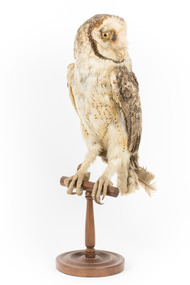
Animal specimen - Australian masked owl, Trustees of the Australian Museum, 1860-1880
... The plumage is mostly brown, patterned with flecks and patches of white, chestnut and light grey. The tail is short and largely concealed by long wing feathers. ...The plumage is mostly brown, patterned with flecks and patches of white, chestnut and light grey. The tail is short and largely concealed by long wing feathers. ...Australian masked owls are an Australian barn owl species ranging across most of mainland Australia and Tasmania, generally within 300 km of coastline. Masked Owls are a medium sized bird averaging 390-500mm in length with wing spans up to 1250mm. There are several subspecies across Australia and the Tasmanian Masked Owl is the largest. Female Masked Owls are markedly larger than males. Masked Owls prefer forested, woodland, or timbered waterway habitats to open country, and nest in tall trees with suitable hollows and adjacent areas for foraging. They are territorial and hunt small mammals, rodents, rabbits, reptiles and small marsupials. Population numbers are in decline on the mainland and in Victoria the species is considered threatened. This specimen is part of a collection of almost 200 animal specimens that were originally acquired as skins from various institutions across Australia, including the Australian Museum in Sydney and the National Museum of Victoria (known as Museums Victoria since 1983), as well as individuals such as amateur anthropologist Reynell Eveleigh Johns between 1860-1880. These skins were then mounted by members of the Burke Museum Committee and put-on display in the formal space of the Museum’s original exhibition hall where they continue to be on display. This display of taxidermy mounts initially served to instruct visitors to the Burke Museum of the natural world around them, today it serves as an insight into the collecting habits of the 19th century.This specimen is part of a significant and rare taxidermy mount collection in the Burke Museum. This collection is scientifically and culturally important for reminding us of how science continues to shape our understanding of the modern world. They demonstrate a capacity to hold evidence of how Australia’s fauna history existed in the past and are potentially important for future environmental research. This collection continues to be on display in the Museum and has become a key part to interpreting the collecting habits of the 19th century. This Masked Owl specimen is medium sized with a large head and distinctive heart-shaped facial markings. The plumage is mostly brown, patterned with flecks and patches of white, chestnut and light grey. The tail is short and largely concealed by long wing feathers. The face, feathered tarsi and underparts are much paler in contrast to the dorsal plumage, and the facial mask is edged by a distinct dark brown line. The eyes are large and yellow. This specimen stands on a wooden perch pedestal with identification tags attached to its leg. 12. / Delicate Owl / See Catalogue, page, 3 /taxidermy, taxidermy mount, masked owl, burke museum, australian museum, owls, birds of prey, heart-shaped faced owl, nocturnal birds, predator birds, barn owl, carnivore, tyto novaehollandiae, australian masked owl, tytonidae, tyto, territorial owl, threatened species, animalia, australian owls, tasmanian masked owl -
 Friends of Ballarat Botanical Gardens History Group
Slide - Colour transparency, Eastman Kodak, c. 1940
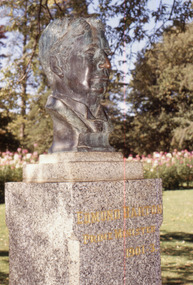
... On March 2, 1940, Sir Winston Dugan, Governor of Victoria unveiled the busts of the six first prime ministers of Australia at a ceremony on the long avenue of Horse Chestnuts. The donor, Richard Armstrong Couch, was born in Ballarat in 1868. ...On March 2, 1940, Sir Winston Dugan, Governor of Victoria unveiled the busts of the six first prime ministers of Australia at a ceremony on the long avenue of Horse Chestnuts. The donor, Richard Armstrong Couch, was born in Ballarat in 1868. ...On March 2, 1940, Sir Winston Dugan, Governor of Victoria unveiled the busts of the six first prime ministers of Australia at a ceremony on the long avenue of Horse Chestnuts. The donor, Richard Armstrong Couch, was born in Ballarat in 1868. Edmund Barton (1849 –1920) was an Australian politician and judge who served as the first Prime Minister of Australia, in office from 1901 to 1903. He was appointed prime minister on 1 January 1901, the day on which the new federal constitution came into effect. The Prime Ministers Avenue is a feature of national significance, set in the magnificent Horse Chestnut Avenue of the Gardens. The 28 Prime Ministers of Australia are displayed as bronze portraits mounted on polished granite pedestals. The collection includes a portrait of one of the founding fathers of Federation, Alfred Deakin, who was the first Federal Member for Ballarat and the second Prime Minister.3/4 view using flash of the bronze bust and granite pedestal of Prime Minister, Edmund Barton in the Prime Ministers Avenue. A vertical scratch line is visible on the right side.Kodachromeballarat botanical gardens, trees, lawns, pathways, sculptures, busts, governors, prime ministers avenue, richard armstrong couch, federation, 1940, chestnut trees, horse chestnuts, bronze, granite, pedestals, alfred deakin, edmund barton, wallace anderson, sir winston dugan -
 Phillip Island and District Historical Society Inc.
Photographs, Rhyll Swamp Bird Life
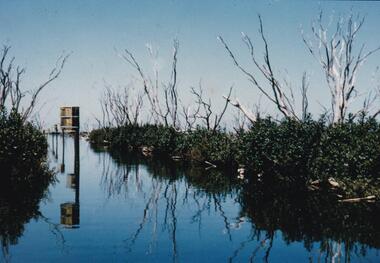
... 441-01: 2nd year growth of Fathom Hen Seeds underwater dormant for 12 years. 441-02: Photo of Bill checking nesting boxes in Rhyll Swamp 441-03: Black & White photo of Bill & helper 441-04: Bee Hive at Rhyll Swamp 441-05: Royal Spoon Bill with 12 eggs 441-06: Ibis Hatchlings 441-07:Chestnut Teal Duck eggs at Rhyll Swamp 441-08: Photo of a painting of a Mallard Duck with 6 ducklings. ...Selection from a collection of photographs given to John Jansson from the Estate of Bill Barrett - Fisheries & Wildlife on Phillip Island Rhyll Swamp Phillip Island Mallard Duck Royal Swamp Hen Royal Spoon Bill Bill Barrett Chestnut Teal Duck eggs Beehive at Rhyll Swamp Fathom Hen Plants at Rhyll Swamp Nesting Boxes Rhyll Swamp John Jansson Descriptions written on back of photographs 441-01: 2nd year growth of Fathom Hen Seeds underwater dormant for 12 years. 441-02: Photo of Bill checking nesting boxes in Rhyll Swamp 441-03: Black & White photo of Bill & helper 441-04: Bee Hive at Rhyll Swamp 441-05: Royal Spoon Bill with 12 eggs 441-06: Ibis Hatchlings 441-07:Chestnut Teal Duck eggs at Rhyll Swamp 441-08: Photo of a painting of a Mallard Duck with 6 ducklings. ...Selection from a collection of photographs given to John Jansson from the Estate of Bill Barrett - Fisheries & Wildlife on Phillip Island441-01: 2nd year growth of Fathom Hen Seeds underwater dormant for 12 years. 441-02: Photo of Bill checking nesting boxes in Rhyll Swamp 441-03: Black & White photo of Bill & helper 441-04: Bee Hive at Rhyll Swamp 441-05: Royal Spoon Bill with 12 eggs 441-06: Ibis Hatchlings 441-07:Chestnut Teal Duck eggs at Rhyll Swamp 441-08: Photo of a painting of a Mallard Duck with 6 ducklings. Descriptions written on back of photographsrhyll swamp phillip island, mallard duck, royal swamp hen, royal spoon bill, bill barrett, chestnut teal duck eggs, beehive at rhyll swamp, fathom hen plants at rhyll swamp, nesting boxes rhyll swamp, john jansson -
 The Beechworth Burke Museum
Animal specimen - Belted King Fisher, Trustees of the Australian Museum, 1860-1880
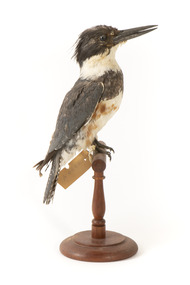
... The stomach has a chestnut brown band which identifies this particular specimen as female. ...The stomach has a chestnut brown band which identifies this particular specimen as female. ...The Belted Kingfisher is commonly seen near bodies of water or coasts in Canada, Alaska and the United States. During migration periods these birds may stray far from their usual habitat. Interestingly, the female of this species, as is the case for this specimen, is often larger than the male. They are also more brightly coloured. This species feed on amphibians, small crustaceans, insects, small mammals and reptiles. They lie await perched on a tree located close to water and remain there watching until they see their prey. When they have located their prey, the Belted Kingfisher plunges its head into the water and catches its food. This specimen is part of a collection of almost 200 animal specimens that were originally acquired as skins from various institutions across Australia, including the Australian Museum in Sydney and the National Museum of Victoria (known as Museums Victoria since 1983), as well as individuals such as amateur anthropologist Reynell Eveleigh Johns between 1860-1880. These skins were then mounted by members of the Burke Museum Committee and put-on display in the formal space of the Museum’s original exhibition hall where they continue to be on display. This display of taxidermy mounts initially served to instruct visitors to the Burke Museum of the natural world around them, today it serves as an insight into the collecting habits of the 19th century.This specimen is part of a significant and rare taxidermy mount collection in the Burke Museum. This collection is scientifically and culturally important for reminding us of how science continues to shape our understanding of the modern world. They demonstrate a capacity to hold evidence of how Australia’s fauna history existed in the past and are potentially important for future environmental research. This collection continues to be on display in the Museum and has become a key part to interpreting the collecting habits of the 19th century.The Belted Kingfisher stands upon a wooden perch with a light brown paper tag attached to leg. This specimen has pale cream/white and slate grey/blueplumage. The head and back are coloured the blue-grey while the neck and stomach are cream/white. The bird has a black ring around its upper chest. The stomach has a chestnut brown band which identifies this particular specimen as female. The bill is long and pointed and the eyes and legs black. The bird is small and stocky with a large head and a square-tipped tail.95.a / Belted / Kingfisher / Catalogue page, 25 /taxidermy mount, taxidermy, animalia, burke museum, beechworth, australian museum, skin, reynell eveleigh johns, bird, australian birds, kingfisher, small birds, belted kingfisher, king fisher, female bird -
 The Beechworth Burke Museum
Animal specimen - Brown Quail, Trustees of the Australian Museum, 1860-80
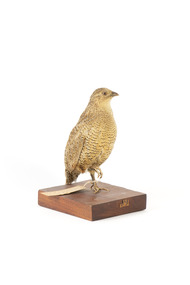
... It is variable in colour, ranging from red brown to grey brown with fine white streaks and black barring above, and chestnut brown below. The eye is red to yellow, the bill black and the legs and feet orange-yellow. ...It is variable in colour, ranging from red brown to grey brown with fine white streaks and black barring above, and chestnut brown below. The eye is red to yellow, the bill black and the legs and feet orange-yellow. ...This specimen is part of a collection of almost 200 animal specimens that were originally acquired as skins from various institutions across Australia, including the Australian Museum in Sydney and the National Museum of Victoria (known as Museums Victoria since 1983), as well as individuals such as amateur anthropologist Reynell Eveleigh Johns between 1860-1880. These skins were then mounted by members of the Burke Museum Committee and put-on display in the formal space of the Museum’s original exhibition hall where they continue to be on display. This display of taxidermy mounts initially served to instruct visitors to the Burke Museum of the natural world around them, today it serves as an insight into the collecting habits of the 19th century. Like many species of quail, the Brown Quail is often difficult to see, as it inhabits rank, overgrown grassy areas, often in damp, low-lying patches beside wetlands. They are difficult to flush from this cover, preferring to squat among the grass or run quickly off through the vegetation rather than fly off. As is the case with many species that inhabit dense habitats, the Brown Quail may be heard more often than it is seen, with its characteristically mournful two-note call whistle often heard at dawn and dusk. The Brown Quail is found across northern and eastern Australia, from the Kimberley region in Western Australia to Victoria and Tasmania, as well as in south-western Australia. It is also found in Papua New Guinea and Indonesia, and has been introduced to New Zealand. The Brown Quail feeds in the early morning or evening, on the ground, mainly on seeds and green shoots, but also on insects. In some area, quails will readily cross roads and may be seen feeding along roadsides.This specimen is part of a significant and rare taxidermy mount collection in the Burke Museum. This collection is scientifically and culturally important for reminding us of how science continues to shape our understanding of the modern world. They demonstrate a capacity to hold evidence of how Australia’s fauna history existed in the past and are potentially important for future environmental research. This collection continues to be on display in the Museum and has become a key part to interpreting the collecting habits of the 19th century. The Brown Quail is a small, plump ground-dwelling bird. It is variable in colour, ranging from red brown to grey brown with fine white streaks and black barring above, and chestnut brown below. The eye is red to yellow, the bill black and the legs and feet orange-yellow. In Tasmania, this species is called the Swamp Quail and tends to be larger and darker than mainland birds, with a pale yellow eye. Female Brown Quails are larger and may be more heavily marked with black and paler below than males. Young birds are like adult females, with less distinct markings and a dark brown eye.Label: 33. / Swamp Quail / See Catalogue, page 30 / Mount: 09/taxidermy, quail, brown quail, taxidermy bird, burke museum taxidermy
