
Showing 498 items matching "childers st"
-
 Melbourne Tram Museum
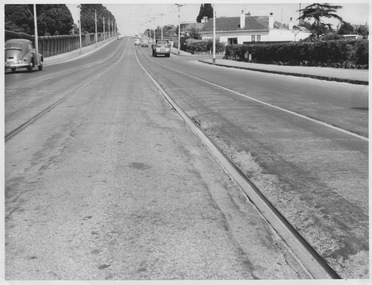
Photograph - Double track High St, Kew, 1960s or 1970s
... ...Childers St...Photograph shows double track section of tramway in High St, Kew looking southwest towards Childers St. The rails appear slightly sunken into the bitumen covered roadway, the Kew cemetery wall is prominent along the left of the roadway and numerous motor vehicles feature in the mid and background dating the photograph as 1960s or 1970s....M&MTB High St Kew doulbe track sunken track Childers St Black and white photograph Photograph Double track High St, Kew ...Photograph shows double track section of tramway in High St, Kew looking southwest towards Childers St. The rails appear slightly sunken into the bitumen covered roadway, the Kew cemetery wall is prominent along the left of the roadway and numerous motor vehicles feature in the mid and background dating the photograph as 1960s or 1970s.Yields information about section of track before relaying in mas concrete. Black and white photographm&mtb, high st, kew, doulbe track, sunken track, childers st -
 Stawell Historical Society Inc
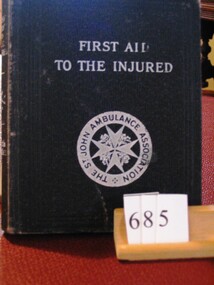
Book, St Johns Ambulance Association, First Aid to the Injured, 1928
... Janette Mary Phillips Child St Stawell...stawell medicine Janette Mary Phillips Child St Stawell First Aid to the Injured Book St Johns Ambulance Association ...Janette Mary Phillips Child St Stawellstawell medicine -
 Kew Historical Society Inc
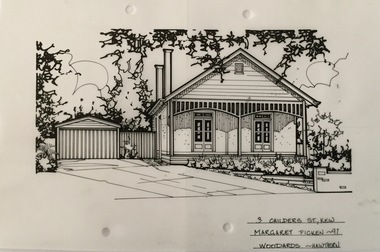
Drawing - Property Illustration, Margaret Picken, 3 Childers Street, Kew, 1997
... 3 CHILDERS ST., KEW / MARGARET PICKEN ~97 / WOODARDS ~ HAWTHORN...The year in which the drawing was created is also a valuable record for house historians, as a number of the properties depicted have either been altered since that date or demolished. artist -- margaret picken 1950- architectural drawings -- houses -- kew (vic.) 3 childers street -- kew (vic.) 3 CHILDERS ST., KEW / MARGARET PICKEN ~97 / WOODARDS ~ HAWTHORN Pen and ink architectural drawing on drafting film of 3 Childers Street, Kew by Margaret Picken. 3 Childers Street, Kew Drawing Property Illustration Margaret Picken Woodards (Hawthorn) ...After training as a Cartographic Draftsman within the mining industry, I worked as a property illustrator for real estate firms in the eastern suburbs of Melbourne for 23 years from 1983. I initially photographed houses with a Polaroid camera and made a 'thumbnail' sketch while there. The photos were used to scale off a sketch in pencil and then that sketch was overlaid with drafting film and the 'pen and ink' completed. The pens I used were the Rotring ‘Rapidigraph’ drafting pens. The ink was also made by Rotring (German).The film was ‘Rapidraw’, polyester drafting film, double matte. It takes a very fine line and doesn’t bleed. As well as house sketches, there were often floor plans and site plans ordered. Aerial sketches were ordered when the property needed an overall view. (Margaret Picken, 2020)This drawing is one of a series created by Margaret Picken for a range of real estate agents in Melbourne between c.1983 and c.2005. Each work is signed and dated by the artist.Gift of Margaret Picken, 2020Pen and ink architectural drawing on drafting film of 3 Childers Street, Kew by Margaret Picken.3 CHILDERS ST., KEW / MARGARET PICKEN ~97 / WOODARDS ~ HAWTHORNartist -- margaret picken 1950-, architectural drawings -- houses -- kew (vic.), 3 childers street -- kew (vic.) -
 Kew Historical Society Inc
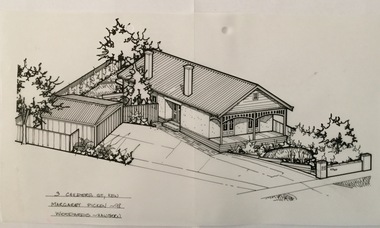
Drawing - Property Illustration, Margaret Picken, 3 Childers Street, Kew, 1998
... 3 CHILDERS ST., KEW / MARGARET PICKEN ~98 / WOODARDS ~ HAWTHORN...The year in which the drawing was created is also a valuable record for house historians, as a number of the properties depicted have either been altered since that date or demolished. artist -- margaret picken 1950- architectural drawings -- houses -- kew (vic.) 3 childers street -- kew (vic.) 3 CHILDERS ST., KEW / MARGARET PICKEN ~98 / WOODARDS ~ HAWTHORN Pen and ink architectural drawing on drafting film of 3 Childers Street, Kew by Margaret Picken. 3 Childers Street, Kew Drawing Property Illustration Margaret Picken Woodards (Kew) ...After training as a Cartographic Draftsman within the mining industry, I worked as a property illustrator for real estate firms in the eastern suburbs of Melbourne for 23 years from 1983. I initially photographed houses with a Polaroid camera and made a 'thumbnail' sketch while there. The photos were used to scale off a sketch in pencil and then that sketch was overlaid with drafting film and the 'pen and ink' completed. The pens I used were the Rotring ‘Rapidigraph’ drafting pens. The ink was also made by Rotring (German).The film was ‘Rapidraw’, polyester drafting film, double matte. It takes a very fine line and doesn’t bleed. As well as house sketches, there were often floor plans and site plans ordered. Aerial sketches were ordered when the property needed an overall view. (Margaret Picken, 2020)This drawing is one of a series created by Margaret Picken for a range of real estate agents in Melbourne between c.1983 and c.2003. Each work is signed and dated by the artist.Gift of Margaret Picken, 2020Pen and ink architectural drawing on drafting film of 3 Childers Street, Kew by Margaret Picken.3 CHILDERS ST., KEW / MARGARET PICKEN ~98 / WOODARDS ~ HAWTHORNartist -- margaret picken 1950-, architectural drawings -- houses -- kew (vic.), 3 childers street -- kew (vic.) -
 Kew Historical Society Inc
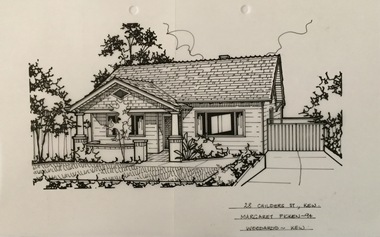
Drawing - Property Illustration, Margaret Picken, 28 Childers Street, Kew, 1994
... 28 CHILDERS ST., KEW / MARGARET PICKEN ~94 / WOODARDS ~ KEW...The year in which the drawing was created is also a valuable record for house historians, as a number of the properties depicted have either been altered since that date or demolished. artist -- margaret picken 1950- architectural drawings -- houses -- kew (vic.) 28 childers street -- kew (vic.) 28 CHILDERS ST., KEW / MARGARET PICKEN ~94 / WOODARDS ~ KEW Pen and ink architectural drawing on drafting film of 28 Childers Street, Kew by Margaret Picken. 28 Childers Street, Kew Drawing Property Illustration Margaret Picken Woodards (Kew) ...After training as a Cartographic Draftsman within the mining industry, I worked as a property illustrator for real estate firms in the eastern suburbs of Melbourne for 23 years from 1983. I initially photographed houses with a Polaroid camera and made a 'thumbnail' sketch while there. The photos were used to scale off a sketch in pencil and then that sketch was overlaid with drafting film and the 'pen and ink' completed. The pens I used were the Rotring ‘Rapidigraph’ drafting pens. The ink was also made by Rotring (German).The film was ‘Rapidraw’, polyester drafting film, double matte. It takes a very fine line and doesn’t bleed. As well as house sketches, there were often floor plans and site plans ordered. Aerial sketches were ordered when the property needed an overall view. (Margaret Picken, 2020)This drawing is one of a series created by Margaret Picken for a range of real estate agents in Melbourne between c.1983 and c.2005. Each work is signed and dated by the artist.Gift of Margaret Picken, 2020Pen and ink architectural drawing on drafting film of 28 Childers Street, Kew by Margaret Picken.28 CHILDERS ST., KEW / MARGARET PICKEN ~94 / WOODARDS ~ KEWartist -- margaret picken 1950-, architectural drawings -- houses -- kew (vic.), 28 childers street -- kew (vic.) -
 Kew Historical Society Inc
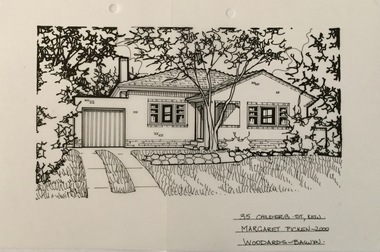
Drawing - Property Illustration, Margaret Picken, 35 Childers Street, Kew, 2000
... 35 CHILDERS ST., KEW / MARGARET PICKEN ~2000 / WOODARDS ~ BALWYN...The year in which the drawing was created is also a valuable record for house historians, as a number of the properties depicted have either been altered since that date or demolished. artist -- margaret picken 1950- architectural drawings -- houses -- kew (vic.) 35 childers street -- kew (vic.) 35 CHILDERS ST., KEW / MARGARET PICKEN ~2000 / WOODARDS ~ BALWYN Pen and ink architectural drawing on drafting film of 35 Childers Street, Kew by Margaret Picken. 35 Childers Street, Kew Drawing Property Illustration Margaret Picken Woodards (Balwyn) ...After training as a Cartographic Draftsman within the mining industry, I worked as a property illustrator for real estate firms in the eastern suburbs of Melbourne for 23 years from 1983. I initially photographed houses with a Polaroid camera and made a 'thumbnail' sketch while there. The photos were used to scale off a sketch in pencil and then that sketch was overlaid with drafting film and the 'pen and ink' completed. The pens I used were the Rotring ‘Rapidigraph’ drafting pens. The ink was also made by Rotring (German).The film was ‘Rapidraw’, polyester drafting film, double matte. It takes a very fine line and doesn’t bleed. As well as house sketches, there were often floor plans and site plans ordered. Aerial sketches were ordered when the property needed an overall view. (Margaret Picken, 2020)This drawing is one of a series created by Margaret Picken for a range of real estate agents in Melbourne between c.1983 and c.2005. Each work is signed and dated by the artist.Gift of Margaret Picken, 2020Pen and ink architectural drawing on drafting film of 35 Childers Street, Kew by Margaret Picken.35 CHILDERS ST., KEW / MARGARET PICKEN ~2000 / WOODARDS ~ BALWYNartist -- margaret picken 1950-, architectural drawings -- houses -- kew (vic.), 35 childers street -- kew (vic.) -
 Kew Historical Society Inc
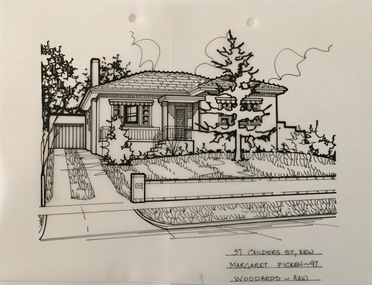
Drawing - Property Illustration, Margaret Picken, 37 Childers Street, Kew, 1997
... 37 CHILDERS ST., KEW / MARGARET PICKEN ~97 / WOODARDS ~ HAW...The year in which the drawing was created is also a valuable record for house historians, as a number of the properties depicted have either been altered since that date or demolished. artist -- margaret picken 1950- architectural drawings -- houses -- kew (vic.) 37 childers street -- kew (vic.) 37 CHILDERS ST., KEW / MARGARET PICKEN ~97 / WOODARDS ~ HAW Pen and ink architectural drawing on drafting film of 37 Childers Street, Kew by Margaret Picken. 37 Childers Street, Kew Drawing Property Illustration Margaret Picken Woodards (Hawthorn) ...After training as a Cartographic Draftsman within the mining industry, I worked as a property illustrator for real estate firms in the eastern suburbs of Melbourne for 23 years from 1983. I initially photographed houses with a Polaroid camera and made a 'thumbnail' sketch while there. The photos were used to scale off a sketch in pencil and then that sketch was overlaid with drafting film and the 'pen and ink' completed. The pens I used were the Rotring ‘Rapidigraph’ drafting pens. The ink was also made by Rotring (German).The film was ‘Rapidraw’, polyester drafting film, double matte. It takes a very fine line and doesn’t bleed. As well as house sketches, there were often floor plans and site plans ordered. Aerial sketches were ordered when the property needed an overall view. (Margaret Picken, 2020)This drawing is one of a series created by Margaret Picken for a range of real estate agents in Melbourne between c.1983 and c.2005. Each work is signed and dated by the artist.Gift of Margaret Picken, 2020Pen and ink architectural drawing on drafting film of 37 Childers Street, Kew by Margaret Picken.37 CHILDERS ST., KEW / MARGARET PICKEN ~97 / WOODARDS ~ HAWartist -- margaret picken 1950-, architectural drawings -- houses -- kew (vic.), 37 childers street -- kew (vic.) -
 Kew Historical Society Inc
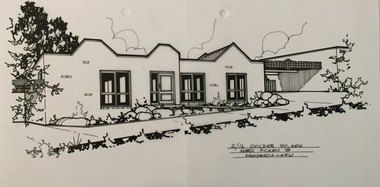
Drawing - Property Illustration, Margaret Picken, 2/16 Childers Street, Kew, 1988
... 2/16 CHILDERS ST., KEW / MARGARET PICKEN ~88 / WOODARDS ~ KEW...The year in which the drawing was created is also a valuable record for house historians, as a number of the properties depicted have either been altered since that date or demolished. artist -- margaret picken 1950- architectural drawings -- houses -- kew (vic.) 2/16 childers street -- kew (vic.) 2/16 CHILDERS ST., KEW / MARGARET PICKEN ~88 / WOODARDS ~ KEW Pen and ink architectural drawing on drafting film of 2/16 Childers Street, Kew by Margaret Picken. 2/16 Childers Street, Kew Drawing Property Illustration Margaret Picken Woodards (Kew) ...After training as a Cartographic Draftsman within the mining industry, I worked as a property illustrator for real estate firms in the eastern suburbs of Melbourne for 23 years from 1983. I initially photographed houses with a Polaroid camera and made a 'thumbnail' sketch while there. The photos were used to scale off a sketch in pencil and then that sketch was overlaid with drafting film and the 'pen and ink' completed. The pens I used were the Rotring ‘Rapidigraph’ drafting pens. The ink was also made by Rotring (German).The film was ‘Rapidraw’, polyester drafting film, double matte. It takes a very fine line and doesn’t bleed. As well as house sketches, there were often floor plans and site plans ordered. Aerial sketches were ordered when the property needed an overall view. (Margaret Picken, 2020)This drawing is one of a series created by Margaret Picken for a range of real estate agents in Melbourne between c.1983 and c.2005. Each work is signed and dated by the artist.Gift of Margaret Picken, 2020Pen and ink architectural drawing on drafting film of 2/16 Childers Street, Kew by Margaret Picken.2/16 CHILDERS ST., KEW / MARGARET PICKEN ~88 / WOODARDS ~ KEWartist -- margaret picken 1950-, architectural drawings -- houses -- kew (vic.), 2/16 childers street -- kew (vic.) -
 Kew Historical Society Inc
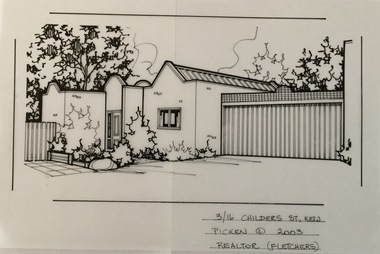
Drawing - Property Illustration, Margaret Picken, 3/16 Childers Street, Kew, 2003
... 3/16 CHILDERS ST., KEW / PICKEN (c) 2003 / REALTOR (FLETCHERS)...The year in which the drawing was created is also a valuable record for house historians, as a number of the properties depicted have either been altered since that date or demolished. artist -- margaret picken 1950- architectural drawings -- houses -- kew (vic.) 3/16 childers street -- kew (vic.) 3/16 CHILDERS ST., KEW / PICKEN (c) 2003 / REALTOR (FLETCHERS) Pen and ink architectural drawing on drafting film of 3/16 Childers Street, Kew by Margaret Picken. 3/16 Childers Street, Kew Drawing Property Illustration Margaret Picken Realtor (Fletchers) ...After training as a Cartographic Draftsman within the mining industry, I worked as a property illustrator for real estate firms in the eastern suburbs of Melbourne for 23 years from 1983. I initially photographed houses with a Polaroid camera and made a 'thumbnail' sketch while there. The photos were used to scale off a sketch in pencil and then that sketch was overlaid with drafting film and the 'pen and ink' completed. The pens I used were the Rotring ‘Rapidigraph’ drafting pens. The ink was also made by Rotring (German).The film was ‘Rapidraw’, polyester drafting film, double matte. It takes a very fine line and doesn’t bleed. As well as house sketches, there were often floor plans and site plans ordered. Aerial sketches were ordered when the property needed an overall view. (Margaret Picken, 2020)This drawing is one of a series created by Margaret Picken for a range of real estate agents in Melbourne between c.1983 and c.2005. Each work is signed and dated by the artist.Gift of Margaret Picken, 2020Pen and ink architectural drawing on drafting film of 3/16 Childers Street, Kew by Margaret Picken.3/16 CHILDERS ST., KEW / PICKEN (c) 2003 / REALTOR (FLETCHERS)artist -- margaret picken 1950-, architectural drawings -- houses -- kew (vic.), 3/16 childers street -- kew (vic.) -
 Kew Historical Society Inc
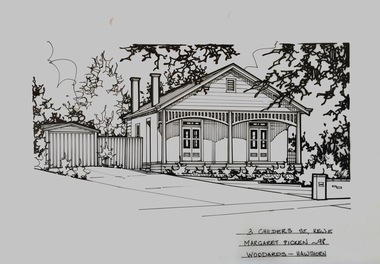
Drawing - Property Illustration, Margaret Picken, 3 Childers Street, Kew, 1998
... 3 CHILDERS ST., KEW E. / MARGARET PICKEN ~98 / WOODARDS ~ HAWTHORN...The year in which the work was created is also a valuable record for house historians, as a number of the properties depicted have either been altered since that date or demolished. artist -- margaret picken 1950- property illustrations — buildings — kew (vic.) 3 childers street - kew (vic) 3 CHILDERS ST., KEW E. / MARGARET PICKEN ~98 / WOODARDS ~ HAWTHORN Pen and ink drawing on drafting film of 3 Childers Street, Kew by Margaret Picken. 3 Childers Street, Kew Drawing Property Illustration Margaret Picken Woodards (Hawthorn) ...After training as a Cartographic Draftsman within the mining industry, I worked as a property illustrator for real estate firms in the eastern suburbs of Melbourne for 23 years from 1983. I initially photographed houses with a Polaroid camera and made a 'thumbnail' sketch while there. The photos were used to scale off a sketch in pencil and then that sketch was overlaid with drafting film and the 'pen and ink' completed. The pens I used were the Rotring ‘Rapidigraph’ drafting pens. The ink was also made by Rotring (German).The film was ‘Rapidraw’, polyester drafting film, double matte. It takes a very fine line and doesn’t bleed. As well as house sketches, there were often floor plans and site plans ordered. Aerial sketches were ordered when the property needed an overall view. (Margaret Picken, 2020)This drawing is one of a series created by Margaret Picken for real estate agents in Melbourne between 1983 and 2006. Each work is signed and dated by the artist.Gift of Margaret Picken, 2020Pen and ink drawing on drafting film of 3 Childers Street, Kew by Margaret Picken.3 CHILDERS ST., KEW E. / MARGARET PICKEN ~98 / WOODARDS ~ HAWTHORNartist -- margaret picken 1950-, property illustrations — buildings — kew (vic.), 3 childers street - kew (vic) -
 Kew Historical Society Inc
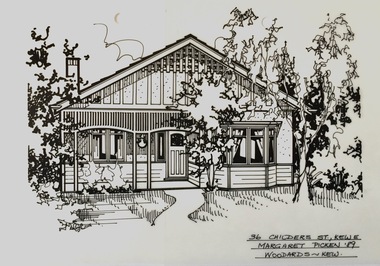
Drawing - Property Illustration, Margaret Picken, 36 Childers Street, Kew, 1989
... 36 CHILDERS ST., KEW E. / MARGARET PICKEN '89 / WOODARDS ~ KEW...The year in which the work was created is also a valuable record for house historians, as a number of the properties depicted have either been altered since that date or demolished. artist -- margaret picken 1950- property illustrations — buildings — kew (vic.) 36 childers street - kew (vic) 36 CHILDERS ST., KEW E. / MARGARET PICKEN '89 / WOODARDS ~ KEW Pen and ink drawing on drafting film of 36 Childers Street, Kew by Margaret Picken. 36 Childers Street, Kew Drawing Property Illustration Margaret Picken Woodards (Kew) ...After training as a Cartographic Draftsman within the mining industry, I worked as a property illustrator for real estate firms in the eastern suburbs of Melbourne for 23 years from 1983. I initially photographed houses with a Polaroid camera and made a 'thumbnail' sketch while there. The photos were used to scale off a sketch in pencil and then that sketch was overlaid with drafting film and the 'pen and ink' completed. The pens I used were the Rotring ‘Rapidigraph’ drafting pens. The ink was also made by Rotring (German).The film was ‘Rapidraw’, polyester drafting film, double matte. It takes a very fine line and doesn’t bleed. As well as house sketches, there were often floor plans and site plans ordered. Aerial sketches were ordered when the property needed an overall view. (Margaret Picken, 2020)This drawing is one of a series created by Margaret Picken for real estate agents in Melbourne between 1983 and 2006. Each work is signed and dated by the artist.Gift of Margaret Picken, 2020Pen and ink drawing on drafting film of 36 Childers Street, Kew by Margaret Picken.36 CHILDERS ST., KEW E. / MARGARET PICKEN '89 / WOODARDS ~ KEWartist -- margaret picken 1950-, property illustrations — buildings — kew (vic.), 36 childers street - kew (vic) -
 Kew Historical Society Inc
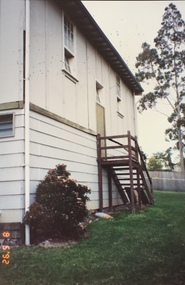
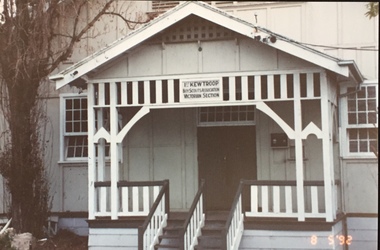
Photograph - 1st Kew Scout Hall, Disraeli Street, 1992
... "1st Kew Scout Hall / Cr Disraeli and Childers St North Kew. Demolished ... Re-established Cr Kilby Rd & Kellett Grove. ...Still operating (in 2020) from their new Scout Hall on the corner of Kilby Road and Kellett Grove, Kew. scout troops -- kew (vic.) 1st kew scouts scout halls -- kew (vic.) scout halls -- melbourne (vic.) boy scouts "1st Kew Scout Hall / Cr Disraeli and Childers St North Kew. Demolished ... Re-established Cr Kilby Rd & Kellett Grove. ...The 1st Kew Scouts was one of the first Scout Troops in Victoria, being formed in 1909. From 1927 they met in a magnificent Scout Hall in Disraeli Street, Kew until it was demolished in 1993. Still operating (in 2020) from their new Scout Hall on the corner of Kilby Road and Kellett Grove, Kew.Original colour positive photograph of the 1st Kew Scout Troop's single-storey wooden hall in Disraeli Street, Kew, prior to the building's demolition and the relocation of the troop to a new site."1st Kew Scout Hall / Cr Disraeli and Childers St North Kew. Demolished ... Re-established Cr Kilby Rd & Kellett Grove. Nth Kew .."scout troops -- kew (vic.), 1st kew scouts, scout halls -- kew (vic.), scout halls -- melbourne (vic.), boy scouts -
 Kew Historical Society Inc
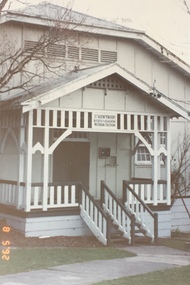
Photograph - 1st Kew Scout Hall, Disraeli Street, 1992
... "1st Kew Scout Hall / Cr Disraeli and Childers St North Kew. Demolished ... Re-established Cr Kilby Rd & Kellett Grove. ...Still operating (in 2020) from their new Scout Hall on the corner of Kilby Road and Kellett Grove, Kew. scout troops -- kew (vic.) 1st kew scouts scout halls -- kew (vic.) scout halls -- melbourne (vic.) boy scouts "1st Kew Scout Hall / Cr Disraeli and Childers St North Kew. Demolished ... Re-established Cr Kilby Rd & Kellett Grove. ...The 1st Kew Scouts was one of the first Scout Troops in Victoria, being formed in 1909. From 1927 they met in a magnificent Scout Hall in Disraeli Street, Kew until it was demolished in 1993. Still operating (in 2020) from their new Scout Hall on the corner of Kilby Road and Kellett Grove, Kew.Original colour positive photograph of the 1st Kew Scout Troop's single-storey wooden hall in Disraeli Street, Kew, prior to the building's demolition and the relocation of the troop to a new site."1st Kew Scout Hall / Cr Disraeli and Childers St North Kew. Demolished ... Re-established Cr Kilby Rd & Kellett Grove. Nth Kew .."scout troops -- kew (vic.), 1st kew scouts, scout halls -- kew (vic.), scout halls -- melbourne (vic.), boy scouts -
 Kew Historical Society Inc
Photograph - 1st Kew Scout Hall, Disraeli Street, 1992
... "1st Kew Scout Hall / Cr Disraeli and Childers St North Kew. Demolished ... Re-established Cr Kilby Rd & Kellett Grove. ...Still operating (in 2020) from their new Scout Hall on the corner of Kilby Road and Kellett Grove, Kew. scout troops -- kew (vic.) 1st kew scouts scout halls -- kew (vic.) scout halls -- melbourne (vic.) boy scouts "1st Kew Scout Hall / Cr Disraeli and Childers St North Kew. Demolished ... Re-established Cr Kilby Rd & Kellett Grove. ...The 1st Kew Scouts was one of the first Scout Troops in Victoria, being formed in 1909. From 1927 they met in a magnificent Scout Hall in Disraeli Street, Kew until it was demolished in 1993. Still operating (in 2020) from their new Scout Hall on the corner of Kilby Road and Kellett Grove, Kew.Original colour positive photograph of the 1st Kew Scout Troop's single-storey wooden hall in Disraeli Street, Kew, prior to the building's demolition and the relocation of the troop to a new site."1st Kew Scout Hall / Cr Disraeli and Childers St North Kew. Demolished ... Re-established Cr Kilby Rd & Kellett Grove. Nth Kew .."scout troops -- kew (vic.), 1st kew scouts, scout halls -- kew (vic.), scout halls -- melbourne (vic.), boy scouts -
 Halls Gap & Grampians Historical Society
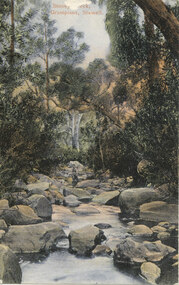
Postcard - Coloured, C 1906
... Postcard has been addressed to Miss E. Westmoreland Child St. Stawell, with the message "Many Happy Returns from Jurgums? ...Postcard has been addressed to Miss E. Westmoreland Child St. Stawell, with the message "Many Happy Returns from Jurgums? ...Postcard has been addressed to Miss E. Westmoreland Child St. Stawell, with the message "Many Happy Returns from Jurgums? The coloured postcard was printed in Germany. Date of message 13.10.06. Scan of rear saved as Rec601b.Postcard shows a man sitting on a rock in the middle of a creek. There are many big boulders and bush on both sides. A gum tree with a white trunk stands in the middle foreground.scenery, stoney creek -
 St Kilda Historical Society
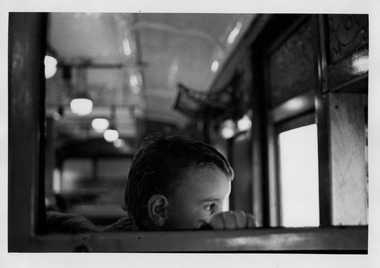
Photograph - Industrial, Red Rattler train, c1980s
... Child on old St Kilda "Red Rattler" train. The "Red Rattlers", or Tait trains, were red-painted trains that served Melbourne's suburban railway network from 1910 until 1984 (initially steam-hauled and then electric from 1919). ...Child on old St Kilda "Red Rattler" train. The "Red Rattlers", or Tait trains, were red-painted trains that served Melbourne's suburban railway network from 1910 until 1984 (initially steam-hauled and then electric from 1919). ...Child on old St Kilda "Red Rattler" train. The "Red Rattlers", or Tait trains, were red-painted trains that served Melbourne's suburban railway network from 1910 until 1984 (initially steam-hauled and then electric from 1919). Known for their timber-bodied construction, rattling windows, and distinct, manual sliding doors. Black and white photograph, unmounteddavid rae collection, st kilda, st kilda train -
 Port Melbourne Historical & Preservation Society
Document - City of Port Melbourne, Health care lists, 1980s
... Lists concerning Health Care in the City of Port Melbourne during the 1980s. .01 - Waiting lists for the Child Care Centre, Clark St Port Melbourne. 17 pages .02 - Lists of recipients of pensions, benefits and allowances. 2 pages...Local Government - City of Port Melbourne Health - General Health Children Beris CAMPBELL Jenny EVERIST Michael READ Lists concerning Health Care in the City of Port Melbourne during the 1980s. .01 - Waiting lists for the Child Care Centre, Clark St Port Melbourne. 17 pages .02 - Lists of recipients of pensions, benefits and allowances. 2 pages Document City of Port Melbourne, Health care lists ...Lists concerning Health Care in the City of Port Melbourne during the 1980s. .01 - Waiting lists for the Child Care Centre, Clark St Port Melbourne. 17 pages .02 - Lists of recipients of pensions, benefits and allowances. 2 pageslocal government - city of port melbourne, health - general health, children, beris campbell, jenny everist, michael read -
 Peterborough History Group
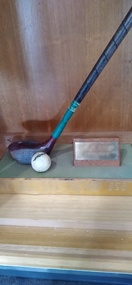
Souvenir - Bay of Islands Championshiop trophy
... They subsequently built a house in Childers St. It ceased when the original participants were no longer able to play. ...They subsequently built a house in Childers St. It ceased when the original participants were no longer able to play. ...Informal 12 hole golf event, played on Grand Final weekend. This event was started by a group of friends when there were few official golf tournaments played at Peterborough. The event was a stroke event with "mystery handicaps" ie you didn't know your handicap until you finished playing. The event was played on the Sunday of Grand Final weekend (except initially); Friday night traditionally was tea at Boggy Creek Pub and a Fishing Comp on Saturday. The name came about because three of the regular players, Ivan Voss, Bob Loader and R. McKendrick had a hut at the top of the dunes near Crofts Bay. They had a clinker boat on the beach as well. They subsequently built a house in Childers St. It ceased when the original participants were no longer able to play. The date of the first winner is 1980, last recorded winner is 1995. No longer played. further information required. Winners: 2nd August 1980 F. Virgona, 8th March 1981, R Case 25th September 1982, E Brierly 24th September 1983, R Mckendrick, 28th September 1984 D Stead, 28th September 1985 I Turnbull, 27th September 1986 J Charles, 26th September 1987 I Voss, 1988 no winner, 1989 F Carlin, 1990 B Turner, 1991 R Pollock, 1992 S McGuire 25th September 1993 B haskett 1st of october 1994 R pollock 30th of september 1995.Shortened golf driver and cracked ball mounted upon a wooden base with names engraved on metal surround.Engraved names, listed below, on metal plate affixed to the base.golf, peterborough golf club, golf tournment -
 Melbourne Tram Museum
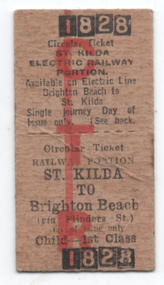
Ephemera, Victorian Railways (VR), "Circular ticket", c1925
... Ticket issued by the Victorian Railways that allowed the passenger to do a round trip from Brighton Beach to St Kilda via the Electric Street railway or tramway and then return using a train via Flinders St station. Child first class. Appears to have been in album or adhered to a board - shows paper damage on the rear. ...Ticket issued by the Victorian Railways that allowed the passenger to do a round trip from Brighton Beach to St Kilda via the Electric Street railway or tramway and then return using a train via Flinders St station. Child first class. Appears to have been in album or adhered to a board - shows paper damage on the rear. ...Ticket issued by the Victorian Railways that allowed the passenger to do a round trip from Brighton Beach to St Kilda via the Electric Street railway or tramway and then return using a train via Flinders St station. Child first class. Appears to have been in album or adhered to a board - shows paper damage on the rear. See reference page 120 and for a related image, figure 6-14. The reference notes that for the rail travel, tickets were issued for first-class travel only.Demonstrates a VR Round trip ticket to Brighton Beach.Edmondson ticket - pasteboard, fawn, black printing with red overprinting - No. 1828tramways, trams, vr trams, round trip, st kilda brighton tramway, railways, brighton beach -
 Flagstaff Hill Maritime Museum and Village
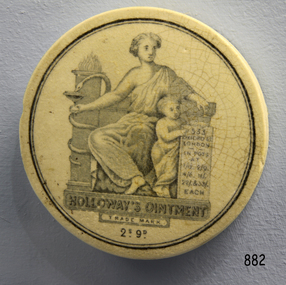
Ceramic - Lid, circa 1878
... On the stone tablet pointed to by the child is inscribed “533 OXFORD ST. LONDON”, and beneath this, “IN POTS AT 1/½, 2/9, 4/6,11/-, 22/- & 33/- EACH”....On the stone tablet pointed to by the child is inscribed “533 OXFORD ST. LONDON”, and beneath this, “IN POTS AT 1/½, 2/9, 4/6,11/-, 22/- & 33/- EACH”. ...This ceramic lid is from a Holloway’s Ointment pot. It was retrieved from the wreckage of the LOCH ARD. The vessel was laden with an up-to-date, high-value cargo, including luxury items intended for the Melbourne International Exhibition in 1880. Britain exported her manufactures to the Australasian colonies and the Americas. Holloway’s Ointment was one nineteenth-century pharmaceutical product that was advertised in both these markets. The price of this particular jar and its contents was printed on the label as “2S 9D” (2 shillings and nine pence). This value calculated to the approximate price in 2014, would be £51.31 (UK pounds and decimal pence) or $85 AU ― quite an expensive ointment. The label also shows a picture of a stone tablet with the inscription "IN POTS AT 1/½, 2/9, 4/6,11/-, 22/- & 33/- EACH”, which is most likely the alternative prices that the ointment was available for in differently sized containers. Holloway’s claims for his “great remedy” included the cure of sores, wounds, ulcers and boils, gout, rheumatism, diphtheria, bronchitis, influenza, sore throats, coughs and colds, “all varieties of skin diseases”, scrofula, ringworm, scurvy, “dropsical swellings” and liver disease, piles, fistulas, and internal inflammation. The salve cream was said to penetrate the skin when rubbed on; purifying internal tissues and organs, cleansing all bodily fluids particularly the blood, and eradicating all disease from the body. Purchasers were assured that if Holloway’s Ointment alone did not affect immediate cure, then the combination of it and Holloway’s Pills (sold separately) most certainly would. Thomas Holloway began manufacturing and marketing his miraculous ointment from premises at 244 Strand in the 1840s, moving to the more prestigious address of 533 Oxford in the late 1860s. The London address was an important part of his promotional appeal and was displayed prominently on the packaging of his products. Holloway’s attention to marketing is also observed in the pseudo-Classical emblems that decorated his containers. The sign of a snake curled around a staff is a longstanding and commonly recognised symbol of the physician’s power to heal. Similar reference on this lid is also being made to an ancient goddess of healing and her healthy young offspring. History of the Loch Ard: The Loch Ard got its name from ”Loch Ard” a loch which lies to the west of Aberfoyle, and the east of Loch Lomond. It means "high lake" in Scottish Gaelic. The vessel belonged to the famous Loch Line which sailed many vessels from England to Australia. The Loch Ard was built in Glasgow by Barclay, Curdle and Co. in 1873, the vessel was a three-masted square-rigged iron sailing ship that measured 79.87 meters in length, 11.58 m in width, and 7 m in depth with a gross tonnage of 1693 tons with a mainmast that measured a massive 45.7 m in height. Loch Ard made three trips to Australia and one trip to Calcutta before its fateful voyage. Loch Ard left England on March 2, 1878, under the command of 29-year-old Captain Gibbs, who was newly married. The ship was bound for Melbourne with a crew of 37, plus 17 passengers. The general cargo reflected the affluence of Melbourne at the time. Onboard were straw hats, umbrella, perfumes, clay pipes, pianos, clocks, confectionery, linen and candles, as well as a heavier load of railway irons, cement, lead and copper. There were other items included that were intended for display in the Melbourne International Exhibition of 1880. The voyage to Port Phillip was long but uneventful. Then at 3 am on June 1, 1878, Captain Gibbs was expecting to see land. But the Loch Ard was running into a fog which greatly reduced visibility. Captain Gibbs was becoming anxious as there was no sign of land or the Cape Otway lighthouse. At 4 am the fog lifted and a lookout aloft announced that he could see breakers. The sheer cliffs of Victoria's west coast came into view, and Captain Gibbs realised that the ship was much closer to them than expected. He ordered as much sail to be set as time would permit and then attempted to steer the vessel out to sea. On coming head-on into the wind, the ship lost momentum, the sails fell limp and Loch Ard's bow swung back towards land. Gibbs then ordered the anchors to be released in an attempt to hold its position. The anchors sank some 50 fathoms - but did not hold. By this time the ship was among the breakers and the tall cliffs of Mutton Bird Island rose behind. Just half a mile from the coast, the ship's bow was suddenly pulled around by the anchor. The captain tried to tack out to sea, but the ship struck a reef at the base of Mutton Bird Island, near Port Campbell. Waves subsequently broke over the ship and the top deck became loosened from the hull. The masts and rigging came crashing down knocking passengers and crew overboard. When a lifeboat was finally launched, it crashed into the side of Loch Ard and capsized. Tom Pearce, who had launched the boat, managed to cling to its overturned hull and shelter beneath it. He drifted out to sea and then on the flood tide came into what is now known as Lochard Gorge. He swam to shore, bruised and dazed, and found a cave in which to shelter. Some of the crew stayed below deck to shelter from the falling rigging but drowned when the ship slipped off the reef into deeper water. Eva Carmichael a passenger had raced onto the deck to find out what was happening only to be confronted by towering cliffs looming above the stricken ship. In all the chaos, Captain Gibbs grabbed Eva and said, "If you are saved Eva, let my dear wife know that I died like a sailor". That was the last Eva Carmichael saw of the captain. She was swept off the ship by a huge wave. Eva saw Tom Pearce on a small rocky beach and yelled to attract his attention. He dived in and swam to the exhausted woman and dragged her to shore. He took her to the cave and broke the open case of brandy which had washed up on the beach. He opened a bottle to revive the unconscious woman. A few hours later Tom scaled a cliff in search of help. He followed hoof prints and came by chance upon two men from nearby Glenample Station three and a half miles away. In a complete state of exhaustion, he told the men of the tragedy. Tom then returned to the gorge while the two men rode back to the station to get help. By the time they reached Loch Ard Gorge, it was cold and dark. The two shipwreck survivors were taken to Glenample Station to recover. Eva stayed at the station for six weeks before returning to Ireland by steamship. In Melbourne, Tom Pearce received a hero's welcome. He was presented with the first gold medal of the Royal Humane Society of Victoria and a £1000 cheque from the Victorian Government. Concerts were performed to honour the young man's bravery and to raise money for those who lost family in the disaster. Of the 54 crew members and passengers on board, only two survived: the apprentice, Tom Pearce and the young woman passenger, Eva Carmichael, who lost her family in the tragedy. Ten days after the Lochard tragedy, salvage rights to the wreck were sold at auction for £2,120. Cargo valued at £3,000 was salvaged and placed on the beach, but most washed back into the sea when another storm developed. The wreck of Lochard still lies at the base of Mutton Bird Island. Much of the cargo has now been salvaged and some items were washed up into Lochard Gorge. Cargo and artefacts have also been illegally salvaged over many years before protective legislation was introduced in March 1982. One of the most unlikely pieces of cargo to have survived the shipwreck was a Minton majolica peacock- one of only nine in the world. The peacock was destined for the Melbourne 1880 International Exhibition in. It had been well packed, which gave it adequate protection during the violent storm. Today the Minton peacock can be seen at the Flagstaff Hill Maritime Museum in Warrnambool. From Australia's most dramatic shipwreck it has now become Australia's most valuable shipwreck artifact and is one of very few 'objects' on the Victorian State Heritage Register.The shipwreck of the Loch Ard is of significance for Victoria and is registered on the Victorian Heritage Register ( S 417). Flagstaff Hill has a varied collection of artefacts from Loch Ard and its collection is significant for being one of the largest accumulation of artefacts from this notable Victorian shipwreck of which the subject items are a small part. The collections objects give us a snapshot of how we can interpret the story of this tragic event. The collection is also archaeologically significant as it represents aspects of Victoria's shipping history that allows us to interpret Victoria's social and historical themes of the time. Through is associated with the worst and best-known shipwreck in Victoria's history. The ceramic lid off a Holloway’s Ointment container, retrieved from the wreckage of the LOCH ARD. The artefact is white with the pale blue image of a woman (seated) and a child (standing). The woman is draped in a soft white robe and her throne is beside a pillar that is entwined by a serpent. The child points to an inscribed stone tablet he is holding on the other side of seated woman. The front face of the lid, at the base of the woman on the throne, bears the label “HOLLOWAY’S OINTMENT”. Below this, in smaller letters, is written “TRADE MARK” and “2S.9D.” On the stone tablet pointed to by the child is inscribed “533 OXFORD ST. LONDON”, and beneath this, “IN POTS AT 1/½, 2/9, 4/6,11/-, 22/- & 33/- EACH”.flagstaff hill, warrnambool, flagstaff hill maritime museum, shipwreck coast, flagstaff hill maritime village, great ocean road, loch line, loch ard, captain gibbs, eva carmichael, tom pearce, glenample station, mutton bird island, loch ard gorge, holloway’s ointment, ceramic lid, pot lid, nineteenth-century medicines, pharmaceutical marketing -
 Flagstaff Hill Maritime Museum and Village
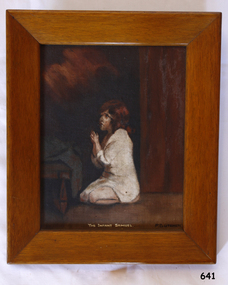
Painting - Religious Portrait, P Butcher, artist, The Infant Samuel, ca. 1943
... Portrait of a child dressed in white, kneeling in prayer, within a dark room. The artist, P Butcher, titled the picture "The Infant Samuel". This object is part of the St...Flagstaff Hill Maritime Museum and Village Flagstaff Hill Warrnambool Maritime Museum Maritime Village Shipwreck Coast Great Ocean Road Religion Religious service St Nicholas Seamen’s Church Williamstown Missions to Seamen Victoria painting oil painting religious painting infant samuel P Butcher religious worship worship service Mission to Seafarers St Nicholas Missions to Seamen’s Church Williamstown Missions to Seamen St Nicholas Missions to Seamen’s Church Flagstaff Hill 139 Nelson Place Williamstown Anglican church church furnishings religious furnishings Painted at centre bottom edge "THE INFANT SAMUEL.", and right bottom edge "B. BUTCHER" Painting, oil on board, behind glass framed with wood. Portrait of a child ...This painting was part of the original furnishings of the St Nicholas' Mission to Seamen's Church at 139 Nelson Place, Williamstown, Victoria. The Church was operated by the Mission to Seamen organisation. It was donated to the Church by the Williamstown Lightkeepers' Auxiliary. THE MISSIONS TO SEAMEN (Brief History: for more, see our Reg. No. 611, Set of Pews) The Missions to Seamen was an Anglican charity that served seafarers of the world since 1856 in Great Britain. It symbol is a Flying Angel, inspired by a Bible verse. Today there are centres in over 200 ports worldwide where seamen of all backgrounds are offered a warm welcome and provided with a wide range of facilities. In Victoria, the organisation began in Williamstown in 1857 as a Sailors’ Church, also known as ‘Bethel’ or the ‘Floating Church’ in an old hulk floating in Hobson’s Bay, Port of Melbourne. It soon became part of the Missions to Seamen, Victoria. In the year 2000 the organisation, now named Mission to Seafarers, still operated locally in Melbourne, Portland, Geelong and Hastings. The Ladies’ Harbour Lights Guild was formed in 1906 to support the Missions to Seamen in Melbourne and other centres such as Williamstown. Two of the most significant ladies of the Guild were founder Ethel Augusta Godfrey and foundation member Alice Sibthorpe Tracy (who established a branch of the Guild in Warrnambool in 1920). The Guild continued its work until the 1960s. In 1943 a former Williamstown bank was purchased for the Missions to Seaman Club. The chapel was named St Nicholas’ Seamen’s Church and was supported by the Ladies’ Harbour Lights Guild, the Williamstown Lightkeepers’ Auxiliary and the League of Soldiers’ and Sailors’ Friends. It ceased operation in 1966. A Missions to Seamen Chapel and Recreation Room was a significant feature of ports during the late 1800s and into the 1900s. It seemed appropriate for Flagstaff Hill to include such a representation within the new Maritime Village, so the Melbourne Board of Management of Missions to Seamen Victoria gave its permission on 21st May 1979 for the entire furnishings of the Williamstown chapel to be transferred to Flagstaff Hill. The St Nicholas Seamen’s Church was officially opened on October 11, 1981, and closely resembles the Williamstown chapel. This painting is significant historically for its origin in the St Nicholas Mission to Seamen's Church in Williamstown, established in 1857 to cater for the physical, social, and spiritual needs of seafarers. It originated in Bristol, England when a Seamen's Mission was formed in 1837. The painting is historically significant for its connection to the Williamstown Lightkeepers’ Auxiliary, an organisation of women, formed to support seafarers. The connection of this painting to the Mission to Seamen and to the Ladies Lightkeepers’ Auxiliary highlights the strong community awareness of the life of people at sea, their dangers and hardships, and their need for physical, financial, spiritual and moral support. Painting, oil on board, behind glass framed with wood. Portrait of a child dressed in white, kneeling in prayer, within a dark room. The artist, P Butcher, titled the picture "The Infant Samuel". This object is part of the St Nicholas Seamen's Church Collection.Painted at centre bottom edge "THE INFANT SAMUEL.", and right bottom edge "B. BUTCHER"flagstaff hill maritime museum and village, flagstaff hill, warrnambool, maritime museum, maritime village, shipwreck coast, great ocean road, religion, religious service, st nicholas seamen’s church, williamstown, missions to seamen victoria, painting, oil painting, religious painting, infant samuel, p butcher, religious worship, worship service, mission to seafarers, st nicholas missions to seamen’s church williamstown, missions to seamen, st nicholas missions to seamen’s church flagstaff hill, 139 nelson place williamstown, anglican church, church furnishings, religious furnishings -
 Federation University Historical Collection
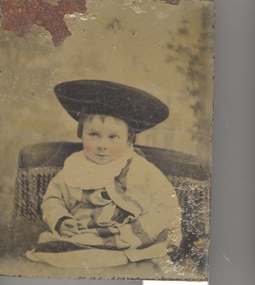
Photograph - Photograph - Little Gem tintype, Possibly American Studio, Portrait of a child
... St, Ballarat; - Marinus W. Bent, Sandhurst (Bendigo); - George Fisher, Victoria; - Anson Brothers, Hobart Town. (Abridged information from http://members.ozemail.com.au/~msafier/photos/tintypes.html) little gem child hat A tintype portrait of a child, attached to a card. ...The tintype (or ferrotype or Melainotype) was produced on metallic sheet (not, actually, tin) instead of glass. The plate was coated with collodion and sensitized just before use. It was introduced by Adolphe Alexandre Martin in 1853. The most common size was about the same as the carte-de-visite, 5.5cm x 9.0cm, but both larger and smaller ferrotypes were made. The smallest were "Little Gem" tintypes, about the size of a postage-stamp, made simultaneously on a single plate in a camera with 12 or 16 lenses. They were often produced by travelling photographers, and were cheaper than Ambrotypes so made photography available to working classes, not just to the more well-to-do. The print would come out laterally reversed (as one sees oneself in a mirror). Being quite rugged, tintypes could be sent by post. Tintypes were eventually superseded by gelatin emulsion dry plates in the 1880s, though street photographers in various parts of the world continued with this process until the 1950s. (Above information abridged from http://www.rleggat.com/photohistory/history/tintype.htm) The firm of Gove and Allen opened in Sydney in 1880 and were responsible for the belated popularizing of the gem tintype in Australia. The firm traded as both The American Gem Studio and The American Studio. Others franchises were opened in Melbourne, Ballarat and Sandhurst (Bendigo). The Sandhurst branch closed in 1882 and Adelaide in 1884. All Gove and Allen studios had ceased trading by 1885. The studio addresses were: 23 King William St, Adelaide; 324 George St, Sydney; 95 Swanston St, Melbourne; Howard Place, Sandhurst; 7 Queen St, Brisbane; The card mounts used in Gove and Allen studios in Australia are identical to those used in America. They were initially made of plain white card with embossing around the oval image opening in the mount while some also had simple geometric and floral printed designs as well. Although Gove and Allen studios produced the majority of gem tintypes in Australia, other studios offered them including: - London, American & Sydney Photo Company, 328 George St, Sydney; - David Edelsten, 55 & 57 Bourke St, Melbourne; - Burman's Portrait Rooms, St. George's Hall, 209 Bourke St, Melbourne; - Bell's Gem Portrait Studio, 57 Bourke St East, Melbourne; - R. H. Kenny, Bridge St, Ballarat; - Marinus W. Bent, Sandhurst (Bendigo); - George Fisher, Victoria; - Anson Brothers, Hobart Town. (Abridged information from http://members.ozemail.com.au/~msafier/photos/tintypes.html) A tintype portrait of a child, attached to a card. little gem, child, hat -
 Federation University Historical Collection
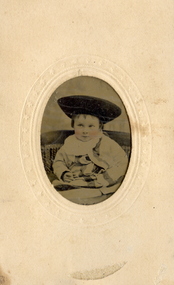
Photograph - Photo - Little Gem tintype, Possibly American Studio, Portrait of a child
... St, Ballarat; - Marinus W. Bent, Sandhurst (Bendigo); - George Fisher, Victoria; - Anson Brothers, Hobart Town. (Abridged information from http://members.ozemail.com.au/~msafier/photos/tintypes.html) little gem photography child portrait .5) A tintype portrait of a child, attached to a card. ...The tintype (or ferrotype or Melainotype) was produced on metallic sheet (not, actually, tin) instead of glass. The plate was coated with collodion and sensitized just before use. It was introduced by Adolphe Alexandre Martin in 1853. The most common size was about the same as the carte-de-visite, 5.5cm x 9.0cm, but both larger and smaller ferrotypes were made. The smallest were "Little Gem" tintypes, about the size of a postage-stamp, made simultaneously on a single plate in a camera with 12 or 16 lenses. They were often produced by travelling photographers, and were cheaper than Ambrotypes so made photography available to working classes, not just to the more well-to-do. The print would come out laterally reversed (as one sees oneself in a mirror). Being quite rugged, tintypes could be sent by post. Tintypes were eventually superseded by gelatin emulsion dry plates in the 1880s, though street photographers in various parts of the world continued with this process until the 1950s. (Above information abridged from http://www.rleggat.com/photohistory/history/tintype.htm) The firm of Gove and Allen opened in Sydney in 1880 and were responsible for the belated popularizing of the gem tintype in Australia. The firm traded as both The American Gem Studio and The American Studio. Others franchises were opened in Melbourne, Ballarat and Sandhurst (Bendigo). The Sandhurst branch closed in 1882 and Adelaide in 1884. All Gove and Allen studios had ceased trading by 1885. The studio addresses were: 23 King William St, Adelaide; 324 George St, Sydney; 95 Swanston St, Melbourne; Howard Place, Sandhurst; 7 Queen St, Brisbane; The card mounts used in Gove and Allen studios in Australia are identical to those used in America. They were initially made of plain white card with embossing around the oval image opening in the mount while some also had simple geometric and floral printed designs as well. Although Gove and Allen studios produced the majority of gem tintypes in Australia, other studios offered them including: - London, American & Sydney Photo Company, 328 George St, Sydney; - David Edelsten, 55 & 57 Bourke St, Melbourne; - Burman's Portrait Rooms, St. George's Hall, 209 Bourke St, Melbourne; - Bell's Gem Portrait Studio, 57 Bourke St East, Melbourne; - R. H. Kenny, Bridge St, Ballarat; - Marinus W. Bent, Sandhurst (Bendigo); - George Fisher, Victoria; - Anson Brothers, Hobart Town. (Abridged information from http://members.ozemail.com.au/~msafier/photos/tintypes.html) .5) A tintype portrait of a child, attached to a card. little gem, photography, child, portrait -
 Federation University Historical Collection
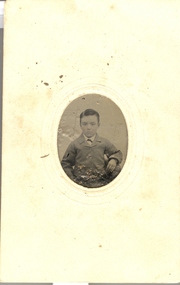
Photograph - Little Gem tintype, Possibly American Studio, Portrait of a Boy
... St Ballarat; - Marinus W. Bent, Sandhurst (Bendigo); - George Fisher, Victoria; - Anson Brothers, Hobart Town. (Abridged information from http://members.ozemail.com.au/~msafier/photos/tintypes.html) little gem .9) A tintype portrait of a child's head and torso, attached to a card. ...The tintype (or ferrotype or Melainotype) was produced on metallic sheet (not, actually, tin) instead of glass. The plate was coated with collodion and sensitized just before use. It was introduced by Adolphe Alexandre Martin in 1853. The most common size was about the same as the carte-de-visite, 5.5cm x 9.0cm, but both larger and smaller ferrotypes were made. The smallest were "Little Gem" tintypes, about the size of a postage-stamp, made simultaneously on a single plate in a camera with 12 or 16 lenses. They were often produced by travelling photographers, and were cheaper than Ambrotypes so made photography available to working classes, not just to the more well-to-do. The print would come out laterally reversed (as one sees oneself in a mirror). Being quite rugged, tintypes could be sent by post. Tintypes were eventually superseded by gelatin emulsion dry plates in the 1880s, though street photographers in various parts of the world continued with this process until the 1950s. (Above information abridged from http://www.rleggat.com/photohistory/history/tintype.htm) The firm of Gove and Allen opened in Sydney in 1880 and were responsible for the belated popularizing of the gem tintype in Australia. The firm traded as both The American Gem Studio and The American Studio. Others franchises were opened in Melbourne, Ballarat and Sandhurst (Bendigo). The Sandhurst branch closed in 1882 and Adelaide in 1884. All Gove and Allen studios had ceased trading by 1885. The studio addresses were: 23 King William St, Adelaide; 324 George St, Sydney; 95 Swanston St, Melbourne; Howard Place, Sandhurst; 7 Queen St, Brisbane; The card mounts used in Gove and Allen studios in Australia are identical to those used in America. They were initially made of plain white card with embossing around the oval image opening in the mount while some also had simple geometric and floral printed designs as well. Although Gove and Allen studios produced the majority of gem tintypes in Australia, other studios offered them including: - London, American & Sydney Photo Company, 328 George St, Sydney; - David Edelsten, 55 & 57 Bourke St, Melbourne; - Burman's Portrait Rooms, St. George's Hall, 209 Bourke St, Melbourne; - Bell's Gem Portrait Studio, 57 Bourke St East, Melbourne; - R. H. Kenny, Bridge St, 6 Sturt St Ballarat; - Marinus W. Bent, Sandhurst (Bendigo); - George Fisher, Victoria; - Anson Brothers, Hobart Town. (Abridged information from http://members.ozemail.com.au/~msafier/photos/tintypes.html) .9) A tintype portrait of a child's head and torso, attached to a card. The boy is wearing a suit and the cheeks have been hand coloured.little gem -
 Mission to Seafarers Victoria
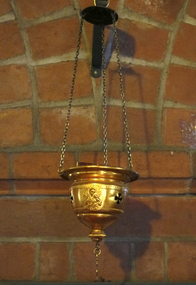
Ceremonial object - Thurible, 1940-1990
... This is one of the many objects used for religious services in the chapel of the Mission. religious objects incense burner religious icons thurible mission to seafarers st peter chapel sanctuary lamp Cone shaped brass incense burner with relief religious motif of madonna and child and cut-out cross-shaped holes, suspended from chains at three points from the top rim. ...Thurible located in the Anglican chapel of St Peter of the Mission to Seafarers.This is one of the many objects used for religious services in the chapel of the Mission.Cone shaped brass incense burner with relief religious motif of madonna and child and cut-out cross-shaped holes, suspended from chains at three points from the top rim. Suspended by rings underneath is swinging brass cross.religious objects, incense burner, religious icons, thurible, mission to seafarers, st peter chapel, sanctuary lamp -
 Mission to Seafarers Victoria
Photograph, February/March 1958
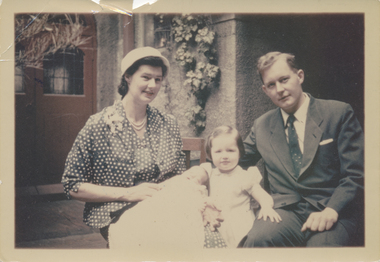
... child, Andrew. Beverley was the daughter of Padre Oliver and his wife Moira. She was born in the Mission an has lived there. Beverley and Robin met and married at the Mission robin kent christening baptism mission to seafarers flinders street courtyard st peter chapel beverley kent nee oliver rosamond kent andrew kent Written in red ink on verso: KENT Written in blue ink on verso: Andre Kent baptism / at St Peter's Mariners / church / Dockland / (Robin, Beverley and Ro Kent) / Feb/March 1958 Colour photograph depicting a couple with their young daughter and a baby. ...Christening of Beverley and Robin Kent's second child, Andrew.Beverley was the daughter of Padre Oliver and his wife Moira. She was born in the Mission an has lived there. Beverley and Robin met and married at the MissionColour photograph depicting a couple with their young daughter and a baby. The photograph was taken in the courtyard of the Flinders Street Mission. The baby is wearing a long white outfit Written in red ink on verso: KENT Written in blue ink on verso: Andre Kent baptism / at St Peter's Mariners / church / Dockland / (Robin, Beverley and Ro Kent) / Feb/March 1958robin kent, christening, baptism, mission to seafarers, flinders street, courtyard, st peter chapel, beverley kent nee oliver, rosamond kent, andrew kent -
 Ballarat Clarendon College
Book, The watches of the trails
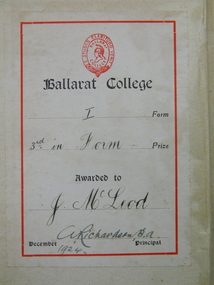
... John Anning MacLeod John was born in Ballarat as the second generation of Ballarat MacLeod’s, with his grandfather arriving in Geelong on the Hornet in 1857 as an 11 year old child with his 60 year old father John and mother Mary aged 37 years and 5 brothers and one sister. He grew up on the corner of Drummond Street and Mair Streets, opposite what became St John of God hospital, at his parents house of Dunvegan. ...John Anning MacLeod John was born in Ballarat as the second generation of Ballarat MacLeod’s, with his grandfather arriving in Geelong on the Hornet in 1857 as an 11 year old child with his 60 year old father John and mother Mary aged 37 years and 5 brothers and one sister. He grew up on the corner of Drummond Street and Mair Streets, opposite what became St John of God hospital, at his parents house of Dunvegan. ...John Anning MacLeod John was born in Ballarat as the second generation of Ballarat MacLeod’s, with his grandfather arriving in Geelong on the Hornet in 1857 as an 11 year old child with his 60 year old father John and mother Mary aged 37 years and 5 brothers and one sister. He grew up on the corner of Drummond Street and Mair Streets, opposite what became St John of God hospital, at his parents house of Dunvegan. John entered Ballarat College as a junior student in 1923. He received 3rd in Form prizes in both 1924 and 1925. His sister Margaret, attended Clarendon Ladies College. The household employed a chauffeur, a cook, a gardener and a ladies maid to care for them. In the 1930’s his father lost his fortune in the collapse of the jute future’s market so the staff were dismissed and he left Ballarat to go to Geelong College as a boarder. He was an officer in the Geelong College cadet corps and joined the Army as a private and rose to the permanent rank of Major after meritorious performance in the intelligence area of operations. He served in North Africa, in Palestine, Egypt, Moratai, the Philippines, Java and New Guinea. He was awarded his Military MBE by King George VI for exceptional devotion to duty and for brilliant coordination work amongst the allied intelligence team. During the war he met Mary Monica Carrol Bateman, a lietenant in the 2/4th Army General Hospital at a dinner party in Brisbane. The couple had four children, Hamish John Torquil born in 1945, Rory Hugh Alexander born in 1947 and twins Ian Donald and Katriona Margaret born in 1948. After the Second World War he worked for Lumley’s Insurance Brokers in London for a couple of years to follow up his accountancy training and then returned to Ballarat due to his father’s failing health and took over the management of John MacLeod and Co, Wholesale grocers and Merchants in Lydiard Street, Ballarat. The business had been started by his great grandfather and they produced the famous Sirdar brand of products and a special tea blend called Afternoon Cup. There was a spice mill in nearby Market Street and there they roasted peanuts, coffee and ground spices for packaging and distribution to the small corner shops who were the mainstay of commercial grocery. In the 1950’s John MacLeod and Co merged with James McKay and Sons to form McKay MacLeod Pty Ltd., wholesale tobacco, wine and spirits and grocery merchants who also manufactured the Sunny South brand of sweet mustard pickles, brewed vinegar and tomato sauce. He introduced the semi-automated system for extensions and financial records on the Bradma plates that saved staff the problems of sorting out the calculations for sales tax, miscellaneous charges etc. that greatly sped up the transactions at the checkout points. A new warehouse and office complex was built in Mair Street east up near Humffray Street, with the manufacturing factory on the opposite side of the street. They had a shop in St Arnaud and one in Geelong which was the local wholesaler for supplying to the corner shops of the greater Geelong area. With the development of supermarkets the demise of the corner store began and so the sales profiles began to diminish. He unsuccessfully stood for Liberal Party pre-selection for the seat of Ballarat in 1948 and served on the Liberal state finance and executive team for many years before resigning over the issue of conscripts being sent to Vietnam. He was instrumental in leading a group of Ballarat academics in opposition to the Vietnam war and publicly resigned from the Liberal Party over their foreign policy. John MacLeod saw the writing on the wall of the business in the early 1970’s and suggested that the firm restructured with focusing on tobacco, wine and spirits. His partners did not agree and so he sold out and retired to Barwon Heads. After a few years of golfing and surfing he became frustrated and joined SCORE, the Service Corp of Retired Executives. In this role he worked for ten years in the Geelong area solving accounting problems for Geelong small businesses and so helped Beaumont’s bakery back onto its feet. He worked gentlemen’s hours of 10 am to 3 pm which allowed him to have time for a round of 9 holes on the golf course at the end of the day and to have a surf before breakfast. He fully retired at the age of 65 and had ten years of voluminous reading of local library books before dying of burns at the age of 75. His war record has been documented in other archives at the College. He was a member of the Naval and Military Club and of the Barwon Heads Golf Club. He had good crafting skills and built a series of steam driven boats for his four children that used to be sailed at home on Lake Wendouree, Lake Learmonth and on the sheltered waters of the Barwon River. The boats are now being restored to operational order to be sailed by his great grandson Grayson Girardi. Red cloth bound book with title printed in gold lettering on spine, embossed publisher's mark centre of front cover and school crest in gold relief on front cover; book plate inside front cover. Book plate inside front cover: School crest / Ballarat College / I form / 3rd in form Prize / Awarded to / J MacLeod / December 1924 A Richardson B A Principaljohn-macleod, ballarat-college, book-prize, 1924 -
 Ballarat Clarendon College
Book, The school across the road
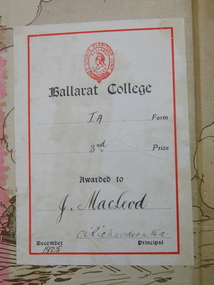
... John Anning MacLeod John was born in Ballarat as the second generation of Ballarat MacLeod’s, with his grandfather arriving in Geelong on the Hornet in 1857 as an 11 year old child with his 60 year old father John and mother Mary aged 37 years and 5 brothers and one sister. He grew up on the corner of Drummond Street and Mair Streets, opposite what became St John of God hospital, at his parents house of Dunvegan. ...John Anning MacLeod John was born in Ballarat as the second generation of Ballarat MacLeod’s, with his grandfather arriving in Geelong on the Hornet in 1857 as an 11 year old child with his 60 year old father John and mother Mary aged 37 years and 5 brothers and one sister. He grew up on the corner of Drummond Street and Mair Streets, opposite what became St John of God hospital, at his parents house of Dunvegan. ...John Anning MacLeod John was born in Ballarat as the second generation of Ballarat MacLeod’s, with his grandfather arriving in Geelong on the Hornet in 1857 as an 11 year old child with his 60 year old father John and mother Mary aged 37 years and 5 brothers and one sister. He grew up on the corner of Drummond Street and Mair Streets, opposite what became St John of God hospital, at his parents house of Dunvegan. John entered Ballarat College as a junior student in 1923. He received 3rd in Form prizes in both 1924 and 1925. His sister Margaret, attended Clarendon Ladies College. The household employed a chauffeur, a cook, a gardener and a ladies maid to care for them. In the 1930’s his father lost his fortune in the collapse of the jute future’s market so the staff were dismissed and he left Ballarat to go to Geelong College as a boarder. He was an officer in the Geelong College cadet corps and joined the Army as a private and rose to the permanent rank of Major after meritorious performance in the intelligence area of operations. He served in North Africa, in Palestine, Egypt, Moratai, the Philippines, Java and New Guinea. He was awarded his Military MBE by King George VI for exceptional devotion to duty and for brilliant coordination work amongst the allied intelligence team. During the war he met Mary Monica Carrol Bateman, a lietenant in the 2/4th Army General Hospital at a dinner party in Brisbane. The couple had four children, Hamish John Torquil born in 1945, Rory Hugh Alexander born in 1947 and twins Ian Donald and Katriona Margaret born in 1948. After the Second World War he worked for Lumley’s Insurance Brokers in London for a couple of years to follow up his accountancy training and then returned to Ballarat due to his father’s failing health and took over the management of John MacLeod and Co, Wholesale grocers and Merchants in Lydiard Street, Ballarat. The business had been started by his great grandfather and they produced the famous Sirdar brand of products and a special tea blend called Afternoon Cup. There was a spice mill in nearby Market Street and there they roasted peanuts, coffee and ground spices for packaging and distribution to the small corner shops who were the mainstay of commercial grocery. In the 1950’s John MacLeod and Co merged with James McKay and Sons to form McKay MacLeod Pty Ltd., wholesale tobacco, wine and spirits and grocery merchants who also manufactured the Sunny South brand of sweet mustard pickles, brewed vinegar and tomato sauce. He introduced the semi-automated system for extensions and financial records on the Bradma plates that saved staff the problems of sorting out the calculations for sales tax, miscellaneous charges etc. that greatly sped up the transactions at the checkout points. A new warehouse and office complex was built in Mair Street east up near Humffray Street, with the manufacturing factory on the opposite side of the street. They had a shop in St Arnaud and one in Geelong which was the local wholesaler for supplying to the corner shops of the greater Geelong area. With the development of supermarkets the demise of the corner store began and so the sales profiles began to diminish. He unsuccessfully stood for Liberal Party pre-selection for the seat of Ballarat in 1948 and served on the Liberal state finance and executive team for many years before resigning over the issue of conscripts being sent to Vietnam. He was instrumental in leading a group of Ballarat academics in opposition to the Vietnam war and publicly resigned from the Liberal Party over their foreign policy. John MacLeod saw the writing on the wall of the business in the early 1970’s and suggested that the firm restructured with focusing on tobacco, wine and spirits. His partners did not agree and so he sold out and retired to Barwon Heads. After a few years of golfing and surfing he became frustrated and joined SCORE, the Service Corp of Retired Executives. In this role he worked for ten years in the Geelong area solving accounting problems for Geelong small businesses and so helped Beaumont’s bakery back onto its feet. He worked gentlemen’s hours of 10 am to 3 pm which allowed him to have time for a round of 9 holes on the golf course at the end of the day and to have a surf before breakfast. He fully retired at the age of 65 and had ten years of voluminous reading of local library books before dying of burns at the age of 75. His war record has been documented in other archives at the College. He was a member of the Naval and Military Club and of the Barwon Heads Golf Club. He had good crafting skills and built a series of steam driven boats for his four children that used to be sailed at home on Lake Wendouree, Lake Learmonth and on the sheltered waters of the Barwon River. The boats are now being restored to operational order to be sailed by his great grandson Grayson Girardi. john-macleod, ballarat-college, 1925, book-prize -
 Federation University Historical Collection
Photograph - Photograph - Black and White, Chatham-Holmes Collection: Wedding of Elizabeth Holmes to Philip Chatham, 1957, 1957
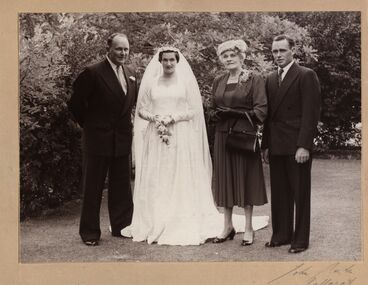
... St Augustines Catholic Church's Creswick L- R Eldest brother, Jack [John] Holmes, [Mary] Elizabeth Holmes, mother Edith Holmes, brother Bill [William Smerdon] Holmes. Her father, Henry, and brother David were deceased. Jack Holmes "gave her away". Jessie Imogene [Gene] Chatham ( nee Furniss 1901 - 1980) was the grand-daughter of Rosanna McFadden and Alexander Poynton, the 13th child...St Augustines Catholic Church's Creswick L- R Eldest brother, Jack [John] Holmes, [Mary] Elizabeth Holmes, mother Edith Holmes, brother Bill [William Smerdon] Holmes. Her father, Henry, and brother David were deceased. Jack Holmes "gave her away". Jessie Imogene [Gene] Chatham ( nee Furniss 1901 - 1980) was the grand-daughter of Rosanna McFadden and Alexander Poynton, the 13th child ...This Holmes Family photograph was taken in Elizabeth's parent's front garden at "Launchley" Ascot before her marriage to Philip, second son of Jack [John] and Jessie Imogene [Gene] Chatham (nee Furniss), on the 20 Feb 1957 at St Augustines Catholic Church's Creswick L- R Eldest brother, Jack [John] Holmes, [Mary] Elizabeth Holmes, mother Edith Holmes, brother Bill [William Smerdon] Holmes. Her father, Henry, and brother David were deceased. Jack Holmes "gave her away". Jessie Imogene [Gene] Chatham ( nee Furniss 1901 - 1980) was the grand-daughter of Rosanna McFadden and Alexander Poynton, the 13th child of their eldest daughter Mary Jane Poynton. Philip Chatham was Gene's second eldest child. Rosanna married Liverpool-born Alexander Poynton in the Free Church of Victoria in 1852. Alexander is reported to have been involved in the Eureka Rebellion, placing Rosanna at Ballarat in late 1854. The family moved about the Victorian Goldfields during the 1850s and early 1860s, before selecting a 240 acre property at Illabarook which they named Rosanna’s first child Alexander, was a State and Federal Politican, holding the role of Treasurer in Billy Hughes government. He was awarded an OBE in 1920 for his work on WW1 repatriation issues. Fifth child Rosanna, married the Mayor of Brunswick and their son Sir Alexander George Wales was Lord Mayor of Melbourne between 1934 – 37. Finally, eleventh son John Joseph was Lord Mayor of Perth. [Jane Dyer (nee Chatham) 2025] Black and white photograph mounted on beige card. Wedding photograph of M. Elizabeth Holmes with her mother Edith Holmes (nee Pickford) and brothers Jack (on left) and Bill on the occasion of her marriage to Philip Chatham. Taken in the front garden of the Holmes family home “Launchley” Ascot, Vic. Victoria"John Smith Ballarat" signed at bottom on cardchatham-holmes collection, elizabeth holmes, philip chatham, edith holmes (nee pickford), bill holmes, wedding -
 Greensborough Historical Society
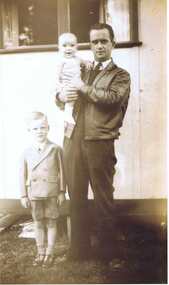
Photograph - Digital image, Rex Smith and father, 1947_
... Photograph of the Smith family in 1947: Rex (child standing), Les and Ian Smith. rex smith Caption on back of photograph reads:"1947 / Reservoir (.. Daventry St ...Photograph of the Smith family in 1947: Rex (child standing), Les and Ian Smith.Digital copy of black and white group photograph.Caption on back of photograph reads:"1947 / Reservoir (.. Daventry St) / Whitley house (rear of bungalow) / Rex, Les and Ian Smith"rex smith
