
Showing 21 items matching "chinese ivory"
-
 Embroiderers Guild, Victoria
Tool - Chinese carved ivory clamp, c1850
... Chinese carved ivory clamp...Chinese carved ivory clamp with missing pincushion ...Possibly from Chinese workbox Carved ivory pincushions clamp were often included in work boxes. clamp pincushion Garden scenes carved on one end, Chrysanthemum design with three rows of ptals Chinese carved ivory clamp with missing pincushion Tool Chinese carved ivory clamp ...Clamps used to grasp fabric combined with a pincushion or emery (missing in this example) were very popular sewing tools in 19th century. Possibly from Chinese workboxCarved ivory pincushions clamp were often included in work boxes. Chinese carved ivory clamp with missing pincushion Garden scenes carved on one end, Chrysanthemum design with three rows of ptalsclamp, pincushion -
 Embroiderers Guild, Victoria
Tool - Chinese carved bone needlecase, Needle case, 1840's
... Typical of ivory needlecase made in China for workboxes for sale to visiting Europeans 1840's...Carved chinese ivory needlecase with screw lid...Typical of ivory needlecase made in China for workboxes for sale to visiting Europeans 1840's Typical of ivory needlecase made in China for workboxes for sale to visiting Europeans 1840's Carved chinese ivory needlecase with screw lid Needle case Tool Chinese carved bone needlecase ...Typical of ivory needlecase made in China for workboxes for sale to visiting Europeans 1840'sTypical of ivory needlecase made in China for workboxes for sale to visiting Europeans 1840'sCarved chinese ivory needlecase with screw lid -
 Embroiderers Guild, Victoria
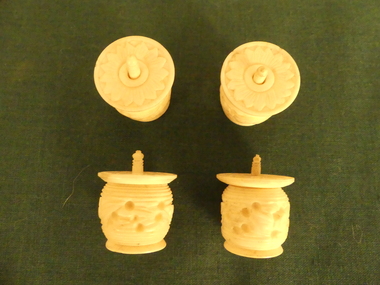
Tool - Bone or Ivory Thread barrel, Thread barrel, 1840's
... ...Chinese ivory...Not all the contents were quite functional for the European market Work box contents Thread barrel Chinese ivory Bone or ivory carved Bone barrel thread winder with cap and spindle Thread barrel Tool Bone or Ivory Thread barrel ...Thread barrels ideally kept thread wound, clean and untangled in work box in an era when cotton and threads were sold in skeins or by weight.Decorative Chinese work boxes offered the opportunity to demonstrate one's wealth. Not all the contents were quite functional for the European marketBone barrel thread winder with cap and spindle Bone or ivory carved work box contents thread barrel, chinese ivory -
 Embroiderers Guild, Victoria
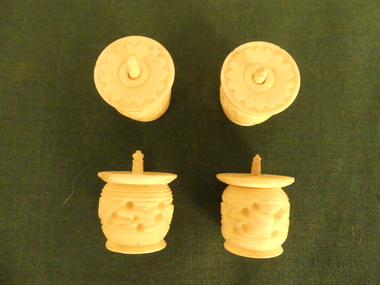
Tool - Bone or Ivory Thread barrel, Thread barrel, 1840's
... ...Chinese ivory...Not all the contents were quite functional for the European market Work box contents Thread barrel Chinese ivory Bone or ivory carved Bone barrel thread winder with cap and spindle Thread barrel Tool Bone or Ivory Thread barrel ...Thread barrels ideally kept thread wound, clean and untangled in work box in an era when cotton and threads were sold in skeins or by weight.Decorative Chinese work boxes offered the opportunity to demonstrate one's wealth. Not all the contents were quite functional for the European marketBone barrel thread winder with cap and spindle Bone or ivory carved work box contents thread barrel, chinese ivory -
 Embroiderers Guild, Victoria
Tool - Crochet Hook bone
... ...Chinese ivory...Bone or ivory crochet hook, made in China for sale to Europeans....Ivory crochet hook Crochet Chinese ivory None Bone crochet hook Tool Crochet Hook bone ...Bone or ivory crochet hook, made in China for sale to Europeans.Ivory crochet hookBone crochet hookNonecrochet, chinese ivory -
 Embroiderers Guild, Victoria
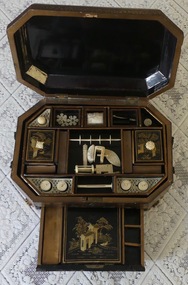
Container - Chinese Lacquer Work and writing box with ivory contents and fittings, Chinese Lacquer Work Box
... Chinese lacquerware...Workbox...Ivory...ivory fittints. Black all-over lacquered surfaces decorated with Chinese pavilion scenes and motifs with butterflies. ...Typical of work boxes made in China for sale to visiting Europeans 1840's Chinese lacquerware Workbox Ivory needlework accessories Exterior: Black lacquer with gold and pale green inlay Black lacquerware work box, hexagonal, with bone or ivory fittints. ...Typical of work boxes made in China for sale to visiting Europeans 1840'sBlack lacquerware work box, hexagonal, with bone or ivory fittints. Black all-over lacquered surfaces decorated with Chinese pavilion scenes and motifs with butterflies. Two inner compartments, upper one fitted with bone/ivory lids to compartments for needlework. Lower compartment is a drawer with missing contents. Two metal carrying handles, two metal key holes (no keys). Front feet gilded wood, back feet wooden blocks. Interior has one removable fitted tray with eleven compartments. Two compartment lids match gold and green lacquerware of exterior. Two have removvable inserts. Third compartment has removable pincushion insert. Four narrow compartments fitted with wooden blocks to contain tools. Lower drawer has folding writing slope decorated and five compartments for writing toolsExterior: Black lacquer with gold and pale green inlaychinese lacquerware, workbox, ivory needlework accessories -
 Warrnambool and District Historical Society Inc.
Paint set, Artist's paints, Late 19th century
... These works of art using lustroleum and crystoleum which were mainly metallic paints, were produced on a variety of surfaces, including glass, wood, tapestry, china and ivory. ...These works of art using lustroleum and crystoleum which were mainly metallic paints, were produced on a variety of surfaces, including glass, wood, tapestry, china and ivory. These items have no known provenance but it is known that lustroleum and crystoleum painting were popular pastimes with women in Warrnambool in the late 19th century. ...These items are a collection of paints etc for those artists wanting to produce lustroleum and crystoleum works of art in the late 19th century and early 20th century. These works of art using lustroleum and crystoleum which were mainly metallic paints, were produced on a variety of surfaces, including glass, wood, tapestry, china and ivory. These items have no known provenance but it is known that lustroleum and crystoleum painting were popular pastimes with women in Warrnambool in the late 19th century. There are several records of women advertising classes in lustroleum and crystoleum painting in the 1880s and 90s in Warrnambool. One was these was Annie Newcombe, an art teacher who offered classes at her studio in Timor Street in 1884.This is a metal tin with a metal catch and a hinged lid. The tin contains 10 items - four glass bottles of Lustroleum, one glass bottle of gold paint, one glass bottle of purple metallic paint, one tube of green paint, one china bowl with a lip for pouring, one dish to hold paint with a broken base and one small dish for holding paint. There is also a sheet of paper containing information on the Crystoleum Company of London advertising that they supplied photographs, price list for classes, silk frames and crystal glasses. On bottles: ‘Lustroleum Registered’ ; ‘H. Bessemer, Gold Paint’, ‘Purple’, On tube: ‘Winsor & Newton, Chrome Green, Vert Anglais, London England’ crystoleum and lustroleum painting, warrnambool, paint set, artist's paints -
 Embroiderers Guild, Victoria
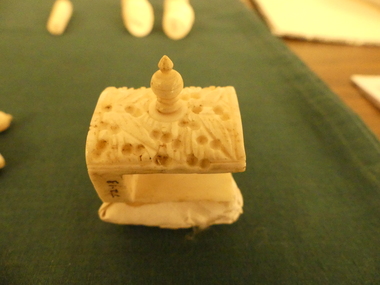
Tool - Carved chinese ivorty or bone clamp wiwth pincushion top, Small ivory sewing clamp with pincushion top, 1840's
... Pins were expensive and so the use of pincushions to keep them safe, to protect them and other items was practical and popular. Chinese carved ivory clamps with pincushion tops were common accessories for work boxes. ...Pins were expensive and so the use of pincushions to keep them safe, to protect them and other items was practical and popular. Chinese carved ivory clamps with pincushion tops were common accessories for work boxes. ...Pins were expensive and so the use of pincushions to keep them safe, to protect them and other items was practical and popular. Chinese carved ivory clamps with pincushion tops were common accessories for work boxes. Such as these they were made in the East for sale to European markets where they were a way of showing one's financial status. Pins were precious sewing tools which needed to be kept safe and sharp, pincushions were an essential sewing tool for keeping pins. Carved bone or ivory clamp with screw through base for attachment.. Topped with pincushion covered with (replacement) embroidered silkclamp, pincushion, ivory carving -
 Bendigo Historical Society Inc.
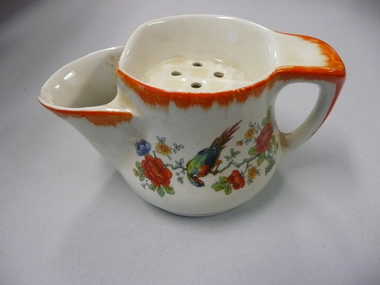
Accessory - CHINA SHAVING MUG
... China shaving mug ('Empire'; 'Ivory Ware England' marked on base)). ...PERSONAL EFFECTS Shaving mug China shaving mug ('Empire'; 'Ivory Ware England' marked on base)). ...China shaving mug ('Empire'; 'Ivory Ware England' marked on base)). Flower and bird motif on mug sides. Inscribed with catalog number U2-232.1.personal effects, shaving, mug -
 Creswick Museum
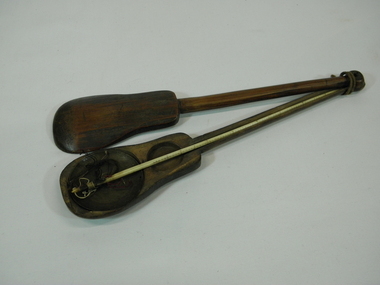
Chinese Opium or Gold Scale, circa 1840 - 1880
... Ivory rod. Metal weight is missing Chinese Opium or Gold Scale ...Probably brought to the area by Chinese miners or shopkeepers. It was used to weigh small items at a time when goods were often paid in gold. In could also be used for weighing opium. In China it was known as a Dotchin. Creswick had a large Chinese population which arrived circa 1855 and established the Chinese Camp (now Calembeen Park) plus other satelite camps in the area. In 1859 there was over 1,000 residents in the area and many operated as shopkeepers. Joined pieces of wood (bamboo), violin shape case joined with brass rivet together. The case features a long section to house the ivory rod with the bulbous section to house metal dish with four holes. Ivory rod. Metal weight is missingIvory rod has markings to indicate weight. Metal dish has four holesscale, goldrush, gold, miners, opium smoking, shopkeeping -
 Bendigo Historical Society Inc.
Memorabilia - BENDIGO JOSS HOUSE CHOPSTICKS
... Two ivory coloured chopsticks inscribed with the words Bendigo Joss House and some Chinese characters....BENDIGO Chinese joss house Two ivory coloured chopsticks inscribed with the words Bendigo Joss House and some Chinese characters. ...Two ivory coloured chopsticks inscribed with the words Bendigo Joss House and some Chinese characters.bendigo, chinese, joss house -
 Embroiderers Guild, Victoria
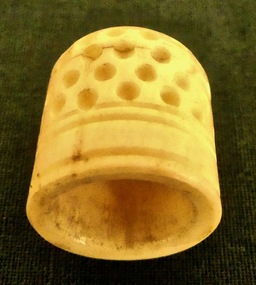
Tool - Bone thimble, 1840-1860
... Ivory thimble made in China for European market 1840's. ...Ivory thimble made in China for European market 1840's. ...Ivory thimble made in China for European market 1840's. Representative of the style of bone and ivory thimbles made in China for workboxes made for European marketIvory thimbleThree plain bands on lower edge, rounded top heavily dimpled, ivory, thimble -
 Embroiderers Guild, Victoria
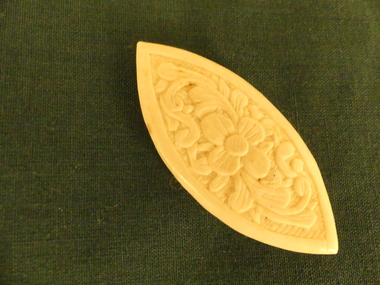
Tool - Carved Ivory Shuttle, Ivoery shuttle, 1840's
... Tatting shuttles were used to make knotted lace and became popular in early 19th century - later than knotting Decoratively carved ivory tatting shuttle made in China for sale to Europeans, often included in workboxes. ...Oriental made tatting shuttle. Tatting shuttles were used to make knotted lace and became popular in early 19th century - later than knotting Decoratively carved ivory tatting shuttle made in China for sale to Europeans, often included in workboxes. These were not practical tools as a smooth tatting shuttle surface is more suited to the task.Elliptical shaped ivory carved tatting shuttle Carved flower design on both sidestatting -
 Embroiderers Guild, Victoria
Clothing - Chinese Embroidered Silk Cloak
... Surface stitchery China Metal thread Embroidery White satin cloak with grey satin border and pale green lining. It is embroidered in grey and ivory silk threads and silver metallic thread in a trailing floral design. ...White satin cloak with grey satin border and pale green lining. It is embroidered in grey and ivory silk threads and silver metallic thread in a trailing floral design.surface stitchery, china, metal thread embroidery -
 Embroiderers Guild, Victoria
Tool - Carved ivory tape measure, 1840-1860's
... Turned ivory tools were made in China for the European market in the mid 1800's and were popular as displays of social status...Turned ivory tools were made in China for the European market in the mid 1800's and were popular as displays of social status Represents the sewing tools of the era. ...Prior to the development of standardized tape measures, tapes such as these were marked by hand. The tape in this tape measure has probably been replaced. Turned ivory tools were made in China for the European market in the mid 1800's and were popular as displays of social statusRepresents the sewing tools of the era.Tape measure in a pierced ivory barrel. Green ribbon tape (no marks visible) has a bone stopper glued to the endtape measure, ivory -
 Embroiderers Guild, Victoria
Tool - Ivory needleholder, Needleholder, 19th century
... Carved in basket weave pattern ivory needle holder in shape of a Chinese umbrella with plain top and bottom band....Decorative chinese carved needleholder in era when needles were expensive and items such as these were made in China for sale to European markets Needleholder Ivory Carved in basket weave pattern ivory needle holder in shape of a Chinese umbrella with plain top and bottom band. ...Chinese made container for sewing needles when needles were expensive.Decorative chinese carved needleholder in era when needles were expensive and items such as these were made in China for sale to European markets Carved in basket weave pattern ivory needle holder in shape of a Chinese umbrella with plain top and bottom band.needleholder, ivory -
 Embroiderers Guild, Victoria
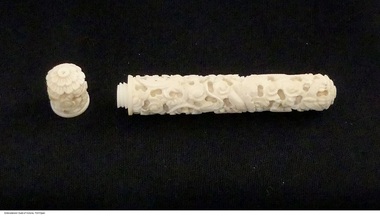
Tool - Ivory needlecase, Needleholder, late 18h/early 19th century
... China for European market. Made to hold needles which were expensive tools By late 18th century, needle making had achieved the ability to produce very fine needles which needed to be protected. Needleholder Ivory ...Typical of needlework accessories made in Canton area of China for European market. Made to hold needles which were expensive tools By late 18th century, needle making had achieved the ability to produce very fine needles which needed to be protected. Cylindrical carved ivory needlecase. Screw cap.Bas relief carving design with butterflies and flowers needleholder, ivory -
 Embroiderers Guild, Victoria
Clothing - Shawl, Early to mid 19th century
... Embroidery Surface stitchery 19th century China Silk Embroidery Oriental Shawl Ivory Canton crepe with a deep fringe. ...This type of shawl said to have been made by Chinese for the European market. Provenance : Colombo? India? China?Ivory Canton crepe with a deep fringe. Cream coloured embroidery over a large area. Satin stitch floral design. Knotted fringe.embroidery, surface stitchery, 19th century, china, silk embroidery, oriental, shawl -
 Mont De Lancey
Ornaments
... china WNR. Stoke-on-Kent. Crest shows two men. "Fortis in Armis". Bamburgh. Has five prongs. 7 cm 3. Swan Royal ivory...china WNR. Stoke-on-Kent. Crest shows two men. "Fortis in Armis". Bamburgh. Has five prongs. 7 cm 3. Swan Royal ivory ...Six china items. 1. Porcelain urn made in England. Crest shows deer and bracknell. Has two handles. 7 cm. 2. Carlton china WNR. Stoke-on-Kent. Crest shows two men. "Fortis in Armis". Bamburgh. Has five prongs. 7 cm 3. Swan Royal ivory porcelain. England. Blue crest in Latin, with yellow and green leaves. Arms of Penshore Abbey. 8 cm. 4. Harp. Made in England. Florentine China. Has crest with horses. Writing in Latin. 10 cm. 5. Peacock. Crest St. John's Chapel. Weardale. Stoke-on-Trent. Arcadian. 12 cm 6. Four pronged vase. Made in Germany. Has crest with red cross and two dragons. London. 8 cmornaments -
 Embroiderers Guild, Victoria
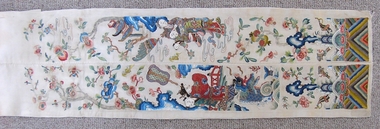
Accessory - Pair of Chinese Embroidered Sleeve Bands, 19 th C
... Embroidery Garments Silk Embroidery China landscape garden figures Both cuffs show figures in an outdoor setting, done in colourful silk thread on a ivory satin. ...Chinese sleeve embroidery bands, or wanxiu became popular in the late 19th century during the Qing Dynasty, evolving from the traditional Han cuff embroidery and Manchu styles. These detachable, decorated bands were added to women's informal jackets and robes, often featuring symbolic motifs like landscapes, flowers, and auspicious symbols. They served both a decorative function, displaying artistic skill and personal wishes, and a practical one by covering the sleeves when hands were folded at the waist. History and evolution: Origins: The practice of embroidering cuffs on robes existed during the previous Ming Dynasty for Han women, and this was adopted by the Manchu rulers who founded the Qing Dynasty. Qing Dynasty (1644-1911): The practice was popularized and elaborated upon during this era, with detachable bands becoming a fashionable element for informal wear. Symbolism: The embroidery included a complex visual vocabulary of wishes for a long life, many offspring, and a happy marriage, derived from nature, mythology, and classical literature. Functionality: Women would fold their arms, often with their hands inside the sleeves, so the embroidered bands, which were sewn to hang down the back of the jacket, would be displayed prominently down the front. 19th century peak: The late 19th century was the peak of their popularity, with intricate designs becoming fashionable and even influenced by court tastes, such as those favoured by the Empress Dowager Cixi. Later developments: The late 19th century saw the introduction of chemical 'aniline' dyes from Europe, leading to brighter, bolder colours in embroidery. Motifs and their Meanings: Auspicious symbols: Designs often included symbols for good fortune, wealth, and longevity. Natural imagery: Birds, flowers, and landscapes were common motifs that could represent natural beauty or convey specific symbolic meanings. Figurative scenes: Bands could also feature narrative scenes from classical stories or legends. The choice of motifs allowed women to express personal desires, cultural values, and aesthetic preferences, reflecting a more personal and informal style than official court attire. Symbolism: Mountains and sea, clouds and waves - Good luck. Dragon/fish tail/flaming pearl = Good fortune. This refers to the legend 'liyutiaolongmen' - a carp rising from the waves with the head already changed into a dragon implies the wish for success in the civil service examination. It is an allegory for the persistent effort needed to overcome obstacles. Male with black hat - Zhuang Yuan conferred. Among patterns with implied meanings , patterns related to the pursuits of scholarly honour and official rand include mainly the 'three number ones'. 'Zheng Yuan conferred' and 'carp jumping over the dragon gate'. In feudal society, examiners for the official positions had to go through three different levels of examinations. Bats - the work for bat is 'fu' and is a visual pun for the word happiness 'fu'. Rhino horn - wealth and good fortune. The ruyi sceptre - is a curved decorative Chinese object that symbolizes power, good fortune, and the wish that “things go as you desire.” The head of the sceptre resembles the 'lingzhi' of the 'longevity fungus'. Pomegranate - fertility ie; offspring, a virtue in China. Boy holding the flowering branch in the arms of the woman - in the selection of officials through imperial examinations in feudal society, the winner of an official position is described as ' having picked the crown'. 'Gui' (sweet scented osmanthus) and 'gui' (high rank or official) are very close in sound Chinese. In this design the boy in the woman's arms is seen waving a sweet scented osmanthus, thus an auspicious message is delivered. Information from Dr Rachel Silberstein, visiting Associate Professor at Rhode Island School of Design. "This pair of sleeve bands are two halves of a scene known as "tian xian song zi" or "Heavenly immortals deliver a son". The historical origins of this saying is a story from 'The History of the Wei Imperial records', involving the Emperor Sheng and an immortal maiden who presents him with a son. After this, the expression "tian xian song zi" came to be used as good wishes for marriage, closely associated with 'qilin song zi' (the qilin delivers a son), another popular topic in nianhua popular prints". Both cuffs show figures in an outdoor setting, done in colourful silk thread on a ivory satin. Reading from the bottom to the top of the cuff both have pointed mountains, clouds and sea with a rhino horn and a 'rui' coming out of the waves. Left cuff: above the sea there are a fish/dragon and a flaming pearl. Next two male figures standing on a bridge. One holds a fan and the other is wearing a black hat. More flowers, peonies and blossoms are above the figures. Right cuff: Above the water and mountains is a bat, peonies and pomegranates. Above these are three figures and another bat. The figure in there rear holds a feathered fan, while the front figure holds a child, who is holding a flowering branch. Above the trio is a low pagoda and blossoms. Silk satin stitch, Pekin knots and couched gold metal thread.embroidery, garments, silk embroidery, china, landscape, garden, figures -
 Embroiderers Guild, Victoria
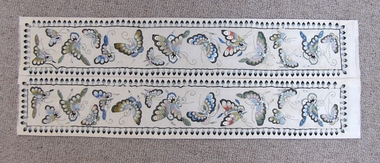
Clothing - Pair of Chinese Embroidered Sleeve Bands, 19 th C
... Silk Embroidery China Butterflies sleeve band Pair of sleeve bands with embroidered butterflies worked in satin stitch. Ivory ...Chinese sleeve embroidery bands, or wanxiu became popular in the late 19th century during the Qing Dynasty, evolving from the traditional Han cuff embroidery and Manchu styles. These detachable, decorated bands were added to women's informal jackets and robes, often featuring symbolic motifs like landscapes, flowers, and auspicious symbols. They served both a decorative function, displaying artistic skill and personal wishes, and a practical one by covering the sleeves when hands were folded at the waist. History and evolution: Origins: The practice of embroidering cuffs on robes existed during the previous Ming Dynasty for Han women, and this was adopted by the Manchu rulers who founded the Qing Dynasty. Qing Dynasty (1644-1911): The practice was popularized and elaborated upon during this era, with detachable bands becoming a fashionable element for informal wear. Symbolism: The embroidery included a complex visual vocabulary of wishes for a long life, many offspring, and a happy marriage, derived from nature, mythology, and classical literature. Functionality: Women would fold their arms, often with their hands inside the sleeves, so the embroidered bands, which were sewn to hang down the back of the jacket, would be displayed prominently down the front. 19th century peak: The late 19th century was the peak of their popularity, with intricate designs becoming fashionable and even influenced by court tastes, such as those favoured by the Empress Dowager Cixi. Later developments: The late 19th century saw the introduction of chemical 'aniline' dyes from Europe, leading to brighter, bolder colours in embroidery. Motifs and their Meanings: Auspicious symbols: Designs often included symbols for good fortune, wealth, and longevity. Natural imagery: Birds, flowers, and landscapes were common motifs that could represent natural beauty or convey specific symbolic meanings. Figurative scenes: Bands could also feature narrative scenes from classical stories or legends. The choice of motifs allowed women to express personal desires, cultural values, and aesthetic preferences, reflecting a more personal and informal style than official court attire.Pair of sleeve bands with embroidered butterflies worked in satin stitch. Ivory satin background and embroidered in silk thread silk embroidery, china, butterflies, sleeve band
