Historical information
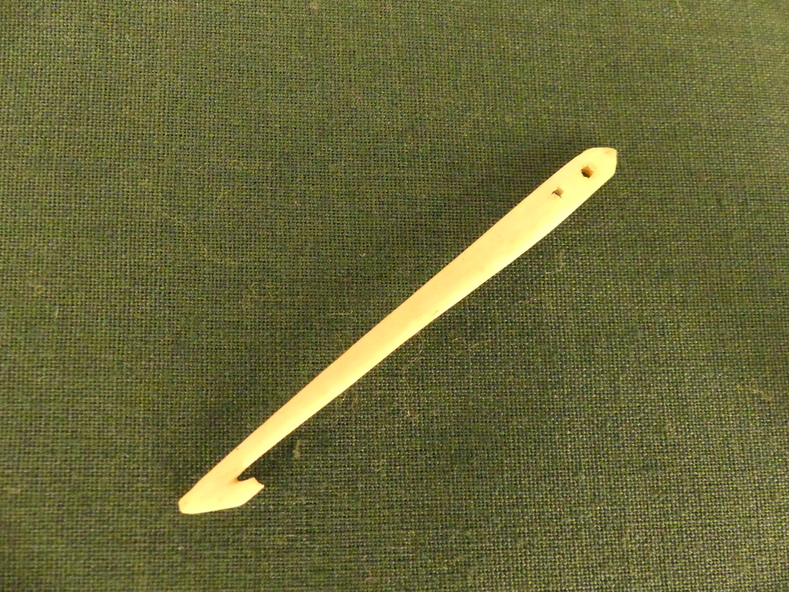
Bone or ivory crochet hook, made in China for sale to Europeans.
Significance
Ivory crochet hook
Physical description
Bone crochet hook
Inscriptions & markings
None


Untitled image
Can you reuse this media without permission? No (with exceptions, see below)
All rights reserved
This media item is licensed under "All rights reserved". You cannot share (i.e. copy, distribute, transmit) or rework (i.e. alter, transform, build upon) this item, or use it for commercial purposes without the permission of the copyright owner. However, an exception can be made if your intended use meets the "fair dealing" criteria. Uses that meet this criteria include research or study; criticism or review; parody or satire; reporting news; enabling a person with a disability to access material; or professional advice by a lawyer, patent attorney, or trademark attorney.
Please acknowledge the item’s source, creator and title (where known)
Have a question? Contact Embroiderers Guild, Victoria
Bone or ivory crochet hook, made in China for sale to Europeans.
Ivory crochet hook
Bone crochet hook
None
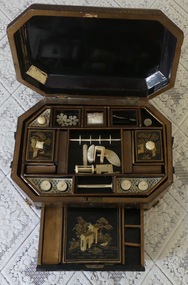
Typical of work boxes made in China for sale to visiting Europeans 1840's
Black lacquerware work box, hexagonal, with bone or ivory fittints. Black all-over lacquered surfaces decorated with Chinese pavilion scenes and motifs with butterflies. Two inner compartments, upper one fitted with bone/ivory lids to compartments for needlework. Lower compartment is a drawer with missing contents. Two metal carrying handles, two metal key holes (no keys). Front feet gilded wood, back feet wooden blocks. Interior has one removable fitted tray with eleven compartments. Two compartment lids match gold and green lacquerware of exterior. Two have removvable inserts. Third compartment has removable pincushion insert. Four narrow compartments fitted with wooden blocks to contain tools. Lower drawer has folding writing slope decorated and five compartments for writing tools
Exterior: Black lacquer with gold and pale green inlay
chinese lacquerware, workbox, ivory needlework accessories
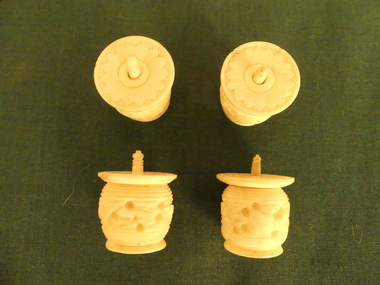
Thread barrels ideally kept thread wound, clean and untangled in work box in an era when cotton and threads were sold in skeins or by weight.
Decorative Chinese work boxes offered the opportunity to demonstrate one's wealth. Not all the contents were quite functional for the European market
Bone barrel thread winder with cap and spindle
Bone or ivory carved
work box contents thread barrel, chinese ivory
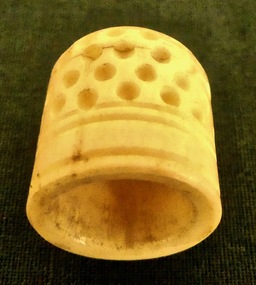
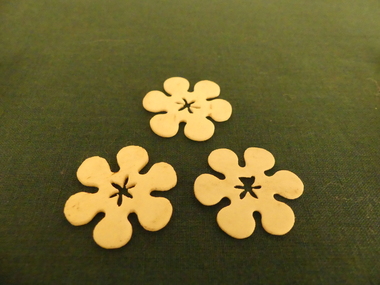
Ivory thimble made in China for European market 1840's.
Representative of the style of bone and ivory thimbles made in China for workboxes made for European market
Ivory thimble
Three plain bands on lower edge, rounded top heavily dimpled,
ivory, thimble
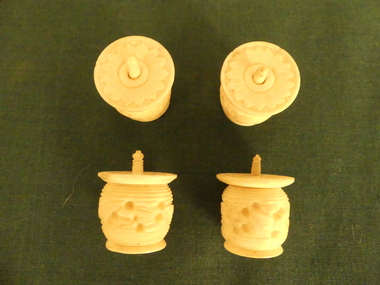
Thread barrels ideally kept thread wound, clean and untangled in work box in an era when cotton and threads were sold in skeins or by weight.
Decorative Chinese work boxes offered the opportunity to demonstrate one's wealth. Not all the contents were quite functional for the European market
Bone barrel thread winder with cap and spindle
Bone or ivory carved
work box contents thread barrel, chinese ivory
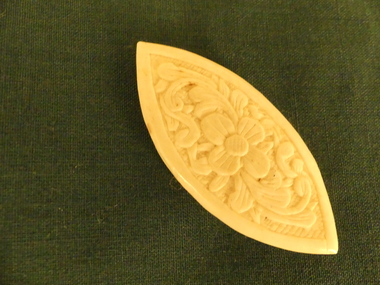
Oriental made tatting shuttle. Tatting shuttles were used to make knotted lace and became popular in early 19th century - later than knotting
Decoratively carved ivory tatting shuttle made in China for sale to Europeans, often included in workboxes. These were not practical tools as a smooth tatting shuttle surface is more suited to the task.
Elliptical shaped ivory carved tatting shuttle
Carved flower design on both sides
tatting
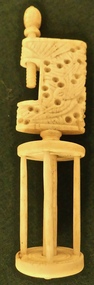
When threads of silk, linen and cotton, were supplied in skeins, they had to be transferred to spools. Pairs of clamps with hollow winding frames revolving on a spindle were used with the threads stretched between them to wind into a more usable form
Prior to 1840's when manufacturers began to sell sewing thread ready for use, winding clamps and similar were needed to transform skeins of thread into a spool so it could be used without tangling
One of a pair of Bone Winding Clamps, carved base, decorated with birds. Topped by rotating cage with four uprights and central spindle, joining two discs. Top Finial missing lower bone screw
Clamp base decorated with birds
winding clamp
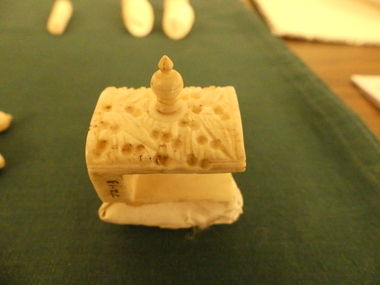
Pins were expensive and so the use of pincushions to keep them safe, to protect them and other items was practical and popular. Chinese carved ivory clamps with pincushion tops were common accessories for work boxes. Such as these they were made in the East for sale to European markets where they were a way of showing one's financial status.
Pins were precious sewing tools which needed to be kept safe and sharp, pincushions were an essential sewing tool for keeping pins.
Carved bone or ivory clamp with screw through base for attachment.. Topped with pincushion covered with (replacement) embroidered silk
clamp, pincushion, ivory carving
