
Showing 39 items matching "civic identity"
-
 Broadmeadows Historical Society & Museum
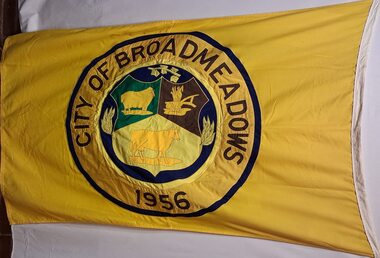
Flag - Municipal Flag, City of Broadmeadows Flag
... ...Civic Identity...The item represents civic identity, local government administration, and municipal symbolism within Broadmeadows. ...The item represents civic identity, local government administration, and municipal symbolism within Broadmeadows. ...This flag is associated with the former City of Broadmeadows, a municipal authority that administered a large proportion of the area now incorporated within the City of Hume. The item represents civic identity, local government administration, and municipal symbolism within Broadmeadows. The former catalogue worksheet identifies the item as a "City of Broadmeadows Flag 1956".The City of Broadmeadows Flag is historically significant as a surviving municipal emblem of the former City of Broadmeadows. It demonstrates how the municipality represented itself through official civic symbols and contributes to the interpretation of local government history within Broadmeadows and the wider Hume district. The survival of a complete municipal flag enhances its research and interpretive value and provides tangible evidence of community identity and municipal heritage.Yellow oblong municipal flag manufactured from cotton. The flag bears the City of Broadmeadows civic logo on both faces and retains attachments along the hoist edge for display or flying. The flag is complete and substantially intact.No inscriptions or markings recorded. The flag incorporates the official City of Broadmeadows municipal logo on both faces.city of broadmeadows, local government, municipal administration, municipal symbols, broadmeadows, hume region, flags, civic identity -
 Broadmeadows Historical Society & Museum
Ephemera - Commemorative Cover, Australia Post, 125 Years of Local Government 1857-1982, 1982
... ...Civic Identity...The item reflects civic identity and municipal pride during the City of Broadmeadows era and incorporates the municipal seal used by the municipality. ...The item reflects civic identity and municipal pride during the City of Broadmeadows era and incorporates the municipal seal used by the municipality. ...This commemorative envelope was produced to mark the 125th anniversary of local government in Victoria, calculated from the establishment of the colony's municipal system in 1857. The envelope specifically commemorates local celebrations held in Broadmeadows on 27 November 1982. The item reflects civic identity and municipal pride during the City of Broadmeadows era and incorporates the municipal seal used by the municipality. The special cancellation references the Broadmeadows Leisure Centre, indicating its role in anniversary activities.This commemorative cover is historically significant for its association with the 125th anniversary of local government in Victoria and the City of Broadmeadows' participation in those celebrations. It provides evidence of civic commemoration, municipal identity, and the use of official symbols during the late twentieth century. The inclusion of a special Broadmeadows cancellation links the item directly to a local event, while the numbered limited edition enhances its documentary value. The cover contributes to understanding how local government milestones were publicly celebrated and represented within the municipality.Rectangular commercially produced paper envelope with gummed flap. Printed in black ink on cream stock. Front bears municipal insignia of the City of Broadmeadows, commemorative text, Australia Post pre-stamped floral indicium, and special pictorial cancellation. Reverse contains explanatory Australia Post text and postal markings. Limited edition numbered 0486 of 2000.city of broadmeadows, local government, municipal administration, municipal history, civic identity, municipal symbols, postal history, commemorative covers, australia post, broadmeadows leisure centre, anniversary celebrations, philately, community events, victoria. -
 Broadmeadows Historical Society & Museum
Photograph (series) - Civic Photograph, Civic Photographs of Council, City of Broadmeadows, 2026
... ...Civic identity...Created within a British-derived municipal tradition, they served as formal records of governance, reflecting continuity, civic authority, and democratic representation amid significant population growth, migration, and changing community identity....Civic Photographs City of Broadmeadows Black and white 1957 1994 Framed Local government Councillors Broadmeadows City Council Civic identity Political representation Civic Photographs of Council, City of Broadmeadows Photograph Civic Photograph Mark Moore ...Produced and retained by Broadmeadows City Council (and earlier Shire) as part of official civic and administrative practices. On loan from Hume Civic Collection, and internal collectionPhotographs were created to formally document elected councillors and municipal governance following elections; intended for official recordkeeping and display within council buildings. The series was established to consolidate the related items.Arranged chronologically by council term and displayed in civic buildings; maintains a logical sequence reflecting successive elected councils. Includes a digital reproduction of a 1991 Broadmeadows City Council group photograph held by the Hume Civic Collection.Group of formally posed photographic images depicting elected councillors across multiple terms, including the transition from Shire to City status. Typically framed and uniform in presentation.civic photographs, city of broadmeadows, black and white, 1957, 1994, framed, local government, councillors, broadmeadows city council, civic identity, political representationcivic photographs, city of broadmeadows, black and white, 1957, 1994, framed, local government, councillors, broadmeadows city council, civic identity, political representation -
Broadmeadows Historical Society & Museum
Document - Letter, Roby, 9 June 1964
... civic roles...mayoral identity...This item is a well documented example of everyday Australian correspondence in the 1960s, notable for its clear geographic origin, personal engagement announcement, and references to international travel and civic identity, enhancing its social and historic interpretive value. ...The letter was written from Mile End, South Australia, and references anticipated overseas travel to Japan and Hong Kong in July 1965, as well as civic roles (“Mayor & Mayoress”), situating the item in mid 20th century Australian social and family networks.This item is a well documented example of everyday Australian correspondence in the 1960s, notable for its clear geographic origin, personal engagement announcement, and references to international travel and civic identity, enhancing its social and historic interpretive value.Single page handwritten letter, ink on paper. Envelope Front / Address side: PLEASE POST EARLY AUSTRALIA BEFORE LUNCH BEFORE FOUR O'CLOCK/9 JUN 1964/Miss Kath Fletcher/14 Wembley Road/Fawkner / Vic Letter text: 64 Fisher Drive/Mile End/South Australia/9-6-1964/Dear Kath/Many thanks for your kind/ thoughts and the Ticket for my Birthday I/think Kath this ticket should show results/as the whole thing seems to be wrapped up/in such great occasions/ Vally & I was / terribly thrilled with the great news of your/engagement to Keith (ARC) I am sure that it/will mean great happiness to you both because/what we saw of ARC he is a very fine/gentleman and yourself you Know our/Thoughts so once again luck to you both/ also Mum:/ As you know we have our name down/for Japan & Hong Kong next July 1965 and passing/through Melbourne we will certainly look up the/ Mayor & Mayoress/ Will Vally is scribbling something/so will conclude this note with our Deepest & Sincere/wishes to you both and may God Grant you all the/happiness that is due to you/(A Kiss for / Kiss for Mum/ Roby)/Yours sweetly/Roby personal correspondence, family relationships, engagement announcements, social customs, mid 20th century daily life, suburban australia, international travel plans, japan travel, hong kong travel, civic roles, mayoral identity, handwritten letters, 1960s australia -
Broadmeadows Historical Society & Museum
Photograph - Press Photograph, The Leader Newspaper Group, Group Photograph, c.mid–late 20th century
... The photograph documents a public event associated with the City of Broadmeadows, reflecting civic identity, local celebrations, and community participation during the period the municipality existed under that name (pre 1994)....The photograph documents a public event associated with the City of Broadmeadows, reflecting civic identity, local celebrations, and community participation during the period the municipality existed under that name (pre 1994). ...The photograph documents a public event associated with the City of Broadmeadows, reflecting civic identity, local celebrations, and community participation during the period the municipality existed under that name (pre 1994).This photograph has historic and social significance as a visual record of community life and civic identity in Broadmeadows. It also has representative value as an example of local newspaper press photographyBlack and white glossy press photograph; single sheet; rectangular; landscape orientation.“THE LEADER NEWSPAPER GROUP PHOTOGRAPH” (stamp) / “Reproduction without written authority is prohibited.” / “160 Whitehorse Rd, Blackburn” /“COP7 PH6552” / “1530” (Location: verso)broadmeadows, city of broadmeadows, community events, civic celebrations, local government, parades, press photography, newspapers, streetscapes, public life -
 Broadmeadows Historical Society & Museum
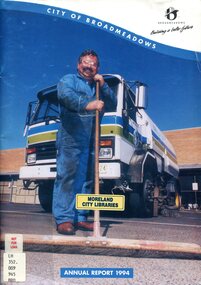
Administrative record - Annual Report, Phillip Shannihan, City of Broadmeadows Annual Report 1994, 1994
... The publication evidences the civic identity, priorities and administrative activities of the former City of Broadmeadows. ...The publication evidences the civic identity, priorities and administrative activities of the former City of Broadmeadows. ...Official annual report of the City of Broadmeadows for 1994. Includes reports on council operations, administration, finance, infrastructure, community services, planning activities and municipal achievements. The publication serves as a primary source documenting local government functions and community development within Broadmeadows during 1994.Printed annual report comprising paper text pages with colour printed paper cover. The front cover depicts a municipal street-sweeping vehicle and a municipal works employee standing with a long-handled broom. The title "CITY OF BROADMEADOWS" appears at the top of the cover, with the municipal logo and slogan "Building a better future". The publication bears evidence of former ownership by Moreland City Libraries, including labels and classification markings. Softcover publication; paper and paperboard construction.non-fictionOfficial annual report of the City of Broadmeadows for 1994. Includes reports on council operations, administration, finance, infrastructure, community services, planning activities and municipal achievements. The publication serves as a primary source documenting local government functions and community development within Broadmeadows during 1994.city of broadmeadows, local government, municipal administration, annual reports, community services, infrastructure, urban development, council governance, broadmeadows history, hume region. -
Broadmeadows Historical Society & Museum
Document - Letter, Edna M. Tripovich, Letter from Edna M. Tripovich to Kath Forsyth congratulating her on engagement, 20 May 1964
... The document illustrates mid 20th century communication practices, gendered social conventions, and civic identity in a rapidly developing suburban municipality....The document illustrates mid 20th century communication practices, gendered social conventions, and civic identity in a rapidly developing suburban municipality. ...This letter documents a personal social exchange connected with civic leadership in the City of Broadmeadows in 1964. It reflects interpersonal networks, political office holders, and community relationships, specifically referencing the engagement of Kath Forsyth to Cr. Evans, Mayor of Broadmeadows. The document illustrates mid 20th century communication practices, gendered social conventions, and civic identity in a rapidly developing suburban municipality.This handwritten letter is historically significant as evidence of social and civic networks in Broadmeadows during the mid 20th century, particularly in relation to the office of the Mayor. It demonstrates the intersection of personal relationships and public roles and contributes to understanding local governance culture and community life. Its provenance within a broader archival collection enhances its research and interpretive value.Single handwritten letter in ink on paper. The letter comprises one page and is written in cursive handwriting. Paper shows typical ageing consistent with mid 20th century correspondence. No envelope present.(Front page, handwritten in ink) “20 5 64 /Dear Kath, /It was lovely to see you again at/Brunswick last night. You certainly/gave me a pleasant surprise when you/told me the news that you will be getting married to Cr. Evans. It has/been a pleasure having the opportunity/to get to know you during your term/as Mayoress, and I still hope that it/continues in the future. Jack & I join/in wishing you both a very happy future together, and the best of luck to you both./Yours sincerely /Edna M. Tripovich / 1 Halifax Court / Ashburton, SE11” On the outside: Yellow catalogue label: “WI 4186”broadmeadows (vic.) — history, local government — victoria — broadmeadows, mayors — social life and customs, personal correspondence — 20th century, engagements (marriage announcements), women’s social networks -
 Broadmeadows Historical Society & Museum
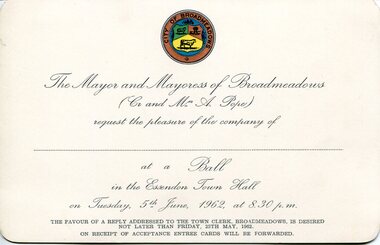
Document - Invitation, City of Broadmeadows, Invitation to a ball at Essendon Town Hall, 1962, 1962
... The event reflects the role of ceremonial and social functions in reinforcing civic identity, municipal authority, and community cohesion during a formative period in Broadmeadows’ development....The event reflects the role of ceremonial and social functions in reinforcing civic identity, municipal authority, and community cohesion during a formative period in Broadmeadows’ development. ...This item relates to the civic and social life of the City of Broadmeadows during the early 1960s, a period marked by rapid population growth and municipal consolidation. The invitation documents a formal civic ball organised by the municipality and held at Essendon Town Hall prior to Broadmeadows having its own dedicated civic facilities. The event reflects the role of ceremonial and social functions in reinforcing civic identity, municipal authority, and community cohesion during a formative period in Broadmeadows’ development.This invitation is significant as a representative example of mid‑twentieth‑century municipal ceremonial ephemera that documents the civic and social activities of the City of Broadmeadows in 1962. It demonstrates how local government used formal social events to foster community identity, reinforce civic authority, and maintain social networks during a period of post‑war expansion. The item has strong provenance and interpretive value for understanding municipal culture and civic life prior to the opening of the Broadmeadows Town Hall.Rectangular printed invitation card on cream card stock with rounded corners. Text printed in black formal script. Coloured City of Broadmeadows municipal seal printed at head.Recto: The Mayor and Mayoress of Broadmeadows/request the pleasure of the company of/......../at a Ball/in the Essendon Town Hall/on Tuesday, 5th June, 1962, at 8.30 p. m./THE FAVOUR OF A REPLY ADDRESSED TO THE TOWN CLERK, BROADMEADOWS, IS DESIRED/NOT LATER THAN FRIDAY, 25TH MAY, 1962./ON RECEIPT OF ACCEPTANCE ENTREE CARDS WILL BE FORWARDED. Verso: Accession label “WI 4258” (upper right) city of broadmeadows, civic ceremonies, municipal government, social events, essendon town hall -
 Broadmeadows Historical Society & Museum
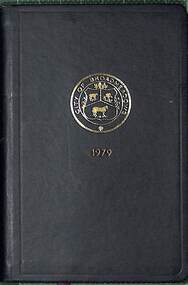
Ephemera - Diary, City of Broadmeadows Diary 1979
... The diary also reflects the formal and practical tools of local governance, even when not actively used, and contributes to the broader understanding of council operations and civic identity in Broadmeadows during a period of suburban development and administrative evolution....The diary contributes to the broader understanding of local government operations, record-keeping practices, and civic identity in Broadmeadows during the late 1970s. ...This pocket diary, produced for the year 1979 and bearing the insignia of the City of Broadmeadows on its cover, was given to Councillor John Coutts during his time as a council committee member. Although unused, the diary represents a standard item issued to council members for the purpose of recording meetings, civic events, and administrative duties. Its presence in the archival collection offers insight into the materials distributed to elected officials and the branding practices of the municipality during the late 1970s. The diary also reflects the formal and practical tools of local governance, even when not actively used, and contributes to the broader understanding of council operations and civic identity in Broadmeadows during a period of suburban development and administrative evolution.This 1979 pocket diary, bearing the insignia of the City of Broadmeadows, is significant as a material representation of the administrative tools provided to council members during a period of civic development in suburban Melbourne. Although unused, the diary was issued to Councillor John Coutts, reflecting his continued involvement in municipal affairs following his earlier tenure as Mayor. Its compact format and official branding illustrate the practical and symbolic aspects of council-issued materials, intended to support the daily responsibilities of elected officials. The diary contributes to the broader understanding of local government operations, record-keeping practices, and civic identity in Broadmeadows during the late 1970s. As a preserved artifact, it offers insight into the formal structures and expectations of council service, even in its unused state.Navy Blue PVC DiaryCity of Broadmeadows Logo, 1979 coutts collection, city of broadmeadows, diary, 1979, councillor j. coutts, j. coutts -
 Ballarat Tramway Museum
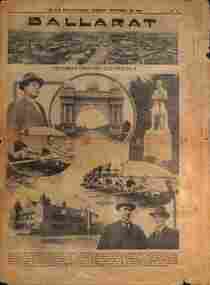
Newspaper - The Sun News Pictorial Supplement, Herald Sun, "Ballarat", 30/9/1924
... Has a photo of the Lydiard St Methodist church. Page 13 - Civic Identities - A E Kenny, Frederick Brawn MLC, W R Elsworth, Frank Herman, Alex Bell MLC, notes on Ballarat Power supply ESCo and SECV - Yallourn vs local generation, and an advertisement for Tyler's men's clothing and house furnishings. ...Has a photo of the Lydiard St Methodist church. Page 13 - Civic Identities - A E Kenny, Frederick Brawn MLC, W R Elsworth, Frank Herman, Alex Bell MLC, notes on Ballarat Power supply ESCo and SECV - Yallourn vs local generation, and an advertisement for Tyler's men's clothing and house furnishings. ...Newspaper supplement to The Sun News Pictorial, Tuesday 30/9/1924 - "Victoria Country Centres - No. 4". Has extensive notes on Ballarat, its history, civic history, and personalities. or figures. Page 11 - photo from the Town Hall, Avenue of Honour Arch, rowing, Hospital including W J Hoare, R H Ramsey of the Ballarat Cricket Association, Mr Charlie Suffren, J R Jopling, R W Todd. Page 12 - Ballarat and district history, industry, statistics, School of Mines. Has a photo of the Lydiard St Methodist church. Page 13 - Civic Identities - A E Kenny, Frederick Brawn MLC, W R Elsworth, Frank Herman, Alex Bell MLC, notes on Ballarat Power supply ESCo and SECV - Yallourn vs local generation, and an advertisement for Tyler's men's clothing and house furnishings. Page 14 - Ballarat sports, Cr Robert Cooke, South St, Craigs Hotel, photo of Ballarat Woollen Mills, the observatory, and an advert for A M Heath, Booksellers, stationer. Page 15 - Advert for Barlow Motors, Mining exchange building, Buick and Vauxhall motor cars Page 16 - South St competition adverts, schools, Mayor Levy, W J Coghlan, railway and wheat traffic, Myer's woollen mill, J T Walker furniture. Page 17 - advert to T M Burke - real estate - Forest St estate Page 18 - photos of the Executive's office, the Water Board - F Brown, A Farrer, W Brazenor, J C Fletcher, F W Saunders and G M Searle. Football league - A A O'Dea, W R Elsworth, J R Cooke, Cr F Besemeres. Brind's Diestillery of Dunnstown - Frank Brind and Harold Gill. W Ware boxing. Photos of St Andrew's Kirk and live livestock market with Graeme Dowling, Gold diggings. Page 19 - Council officers - G F Morton, A Levy, H Finch, J Pascoe, C J Liddiard, W McIntosh, W P Pryor and E R Marchani. South St Society W W Harris, W H Pearson, W S Sampson, A A King, F J Martell, F S Herman, A A O'Dea. Photos of Woollen mill, Sunshine biscuits, Ballarat Water pipe, Golf Club, Ballarat High School, Bridge St with tram and Golden Point monument. Page 20 - notes on racing, red cross - Mrs James Coghlan, fire brigade, sewerage scheme. Photo of Ballarat Freezing Co meat works with adverts for Craig's Hotel and the Ballarat Trustees Executors & Agency Co. Page 21 - General items re Tylers, city of statues, George Hotel, Barlow's cars, Eva Chemist, Dr W A Spring - racing, with an advert for Millers the Clothiers, Page 22 - Ballarat streets, Adam Lindsay Gordon cottage in grounds of Craig's Hotel, Miller's clothing store, with adverts for the Annual Spring agricultural show, and EVA's pharmacy. Page 23 - Photo of Sturt and Lydiard St with two trams, one possibly 13 in an accident with a motor car, photos of McDonald gates, Loreto Abbey with a racing people - Dave Barry, C L Fox, andHarry McGoldrick. Has adverts for Gribble suits and J T Walker furnishers. Page 24 - notes on real estate, stock agents, with photos of Miss McDonald of Red Cross, Mr and Mrs James Allan, Mr H H Osborne, and an advert for Sunshine Biscuits. Page 25 - Photos of the School of Mines, Orphanage, football crowd and Miss D Balten and Miss K Kennedy tennis with adverts for Macleod and Booth stock and station agents and The George Hotel. Page 26 - advert for Melbourne Sub-division company - Capitol House Melbourne.Yields information about Ballarat, its civic history, and personalities in 1924.Newspaper, 16 printed pages with photographs.ballarat, ballarat history, civic history, tramways, accidents -
 Broadmeadows Historical Society & Museum
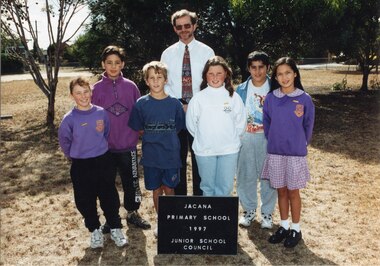
Photograph - Group Photograph, Fotek School Portraits, Jacana Primary School: Junior School Council, 1997, 1997
... As part of the school’s visual archive, this photograph contributes to a broader understanding of how public education shaped local identity, encouraged civic engagement from an early age, and promoted social cohesion. ...As part of the school’s visual archive, this photograph contributes to a broader understanding of how public education shaped local identity, encouraged civic engagement from an early age, and promoted social cohesion. ...This 1997 photograph of students and a staff member from the junior student council at Jacana Primary School offers a compelling glimpse into suburban school life in Melbourne during a time of considerable social and urban change. Founded in 1959, Jacana Primary served as a vital educational and community institution until its closure in the early 2000s. More than a place of learning, the school was a foundation for building identity, connection, and shared experience among students and staff. The image highlights the school’s emphasis on student leadership and participation, reflecting its commitment to fostering an inclusive, empowering, and supportive environment for young learners. It also subtly documents the increasing cultural diversity of Jacana in the late 20th century, as suburban growth brought together families from a wide range of backgrounds. As part of the school’s visual archive, this photograph contributes to a broader understanding of how public education shaped local identity, encouraged civic engagement from an early age, and promoted social cohesion. It stands as a meaningful record of the school’s legacy and its lasting impact on the lives of children and their communities.The 1997 photograph of the junior student council at Jacana Primary School is a culturally and historically significant record that reflects the values and dynamics of suburban education in Melbourne during a period of notable social and urban transformation. Capturing a moment of student leadership and engagement, the image highlights the school’s commitment to fostering inclusive, participatory learning environments where young voices were encouraged and empowered. Jacana Primary School, established in 1959 and active until its closure in the early 2000s, served as a vital educational and community hub in Melbourne’s northern suburbs. This photograph not only documents the school’s emphasis on student representation but also subtly illustrates the increasing cultural diversity of the Jacana area in the late 20th century, shaped by migration and suburban development. As part of the school’s visual archive, the image contributes to a broader understanding of how public education helped shape community identity, promote social cohesion, and instill civic values in younger generations. It stands as a meaningful artifact of educational heritage and community memory.Colour Photograph mounted on white card, and laminatedBack: Top Left Corner: (Blue Label): PH-2187, (Front): (Bottom Left corner): Fotek Portraits © Photograph (Back): (Dispersed): Fujifilmjacana primary school, education, photograph, group photograph, 1997, junior school council -
 Glenelg Shire Council Cultural Collection
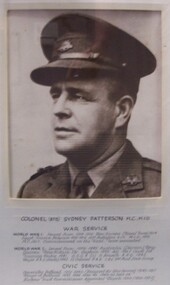
Photograph - Photograph - Colonel (RTD) Sydney Patterson, M.C., M.I.D, c. 1950
... CIVIC SERVICE Councillor, Portland 1931-1940 (Resigned for War Service) 1945-1957. Mayor of Portland 1935, 1938, 1939-40, 1949-50, 1953-54. Harbour Trust Commissioner, appointed March 1950 (1950-1957). Back: Mr. Stevenson (pencil, centre) Black and white photograph of man in military uniform, with peaked hat. Badges are pinned to hat and left lapel. ¾ turn to right. Below image is text stating man's identity ...On display in History House.Black and white photograph of man in military uniform, with peaked hat. Badges are pinned to hat and left lapel. ¾ turn to right. Below image is text stating man's identity and positions.Front: Colonel (RTD) Sydney Patterson M.C., M.I.D., War Service World War 1. Served from 1914-1919 New Guinea (Naval Force) 1914. Egypt, France, Belgium 1915-1919, 20th Batalion A.I.F.M.I.D. 1916, M.C. 1917. Commissioned on the Field. Twice wounded. World War 2. Served from 1939-1945 Australia (Darwin) New Guinea, New Britain, etc. Captain 1939, Adj. No. 7 Aust Int. Training Centre, 1941. G.S.O. 3 (O) G. Branch A.H.Q. 1942. Major R.A.E. (Docks) 1942. L.L. Colonel R.A.E. C.R.E 3rd Aust. Dock Group. CIVIC SERVICE Councillor, Portland 1931-1940 (Resigned for War Service) 1945-1957. Mayor of Portland 1935, 1938, 1939-40, 1949-50, 1953-54. Harbour Trust Commissioner, appointed March 1950 (1950-1957). Back: Mr. Stevenson (pencil, centre) -
 Sunshine and District Historical Society Incorporated
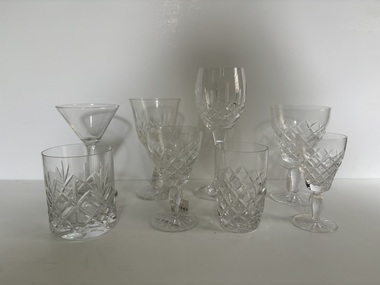
Functional object - City of Sunshine Mayoral Crystal Ware
... The significance of this crystal ware lies in what it represents a rare surviving piece of City of Sunshine civic regalia, an object tied to mayoral authority, municipal ceremony, and the public identity of a pre‑amalgamation council. ...This crystal ware originally came from the City of Sunshine Mayoral Chambers, located within the former Municipal Offices on Alexandra Avenue, Sunshine. Following the 1995 council mergers that created the City of Brimbank, the new municipality constructed the Brimbank Community and Civic Centre on Hampshire Road. During the relocation process, the crystal ware was assessed as no longer required and transferred into storage at The Hunt Club Community Arts Centre. It was later deemed surplus and discarded by the Council. The Sunshine & District Historical Society recovered the crystal ware from a waste bin at the Hunt Club Community Centre during a clean‑out.The significance of this crystal ware lies in what it represents a rare surviving piece of City of Sunshine civic regalia, an object tied to mayoral authority, municipal ceremony, and the public identity of a pre‑amalgamation council. Its survival is unusual, and its rescue from disposal gives it added heritage value.Set of 8 Crystal Ware Glasses - Wine, Whiskey, Port & Cocktail examplesNilcity of sunshine, mayor -
 Sunshine and District Historical Society Incorporated
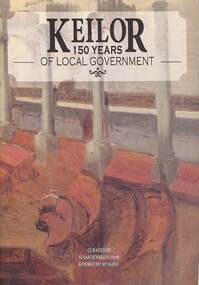
Booklet - Keilor 150 Years of Local Government, Keilor Historical Society, Curated by Susan Jennison OAM and Dorothy Minkoff, 2013
... So, the 150th anniversary in 2013 celebrated the beginning of Keilor’s civic identity, long before it became a shire, a city, or was later divided into Brimbank, Moonee Valley, and Hume City Councils. ...This booklet celebrates the 150th year of local Government in Keilor.The 150th year of local government in Keilor marks the anniversary of Keilor’s first incorporation as a local governing body, a milestone that traces back to 3 March 1863, when Keilor was formally established as a Road District. Subsequent milestones: 22 December 1871 — Becomes the Shire of Keilor. 29 April 1961 — Proclaimed the City of Keilor. 15 December 1994 — City of Keilor abolished during statewide council amalgamations. So, the 150th anniversary in 2013 celebrated the beginning of Keilor’s civic identity, long before it became a shire, a city, or was later divided into Brimbank, Moonee Valley, and Hume City Councils.Keilor 150 years of local government. Curated by Susan Jennison OAM and Dorothy Minkoff.keilor, history -
 Sunshine and District Historical Society Incorporated
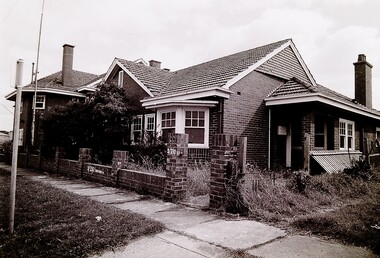
Photograph - Sunshine Fire Station Hampshire Road 1991 Photographs, Sharon Cavanagh, 27th March 1991
... The Sunshine Fire Station on Hampshire Road is one of Sunshine’s most historically significant civic buildings, a landmark of the suburb’s inter‑war growth, its industrial identity, and its long relationship with the Metropolitan Fire Brigade. ...The Sunshine Metropolitan Fire Station, built in 1927 at the corner of Hampshire Road and Hertford Street, served as Sunshine’s main fire station for decades. Designed by noted architect Cedric Ballantyne, it is one of the suburb’s most ornate public buildings and a key symbol of Sunshine’s rapid expansion during the inter‑war period. It closed around 1990 and was later restored and repurposed as the Tobin Brothers “Legacy of Life” Chapel.”The Sunshine Fire Station on Hampshire Road is one of Sunshine’s most historically significant civic buildings, a landmark of the suburb’s inter‑war growth, its industrial identity, and its long relationship with the Metropolitan Fire Brigade. These photographs were taken after the fire station closed and relocated to McIntyre Road in Sunshine North, but before the building was restored and repurposed for use by Tobin Brothers. The residential part of the fire station, the adjoining house in Berkshire Road has been demolished.State Of Fire Station Hampshire Rd Sunshinesunshine fire station, hampshire road, berkshire road, sunshine -
 Sunshine and District Historical Society Incorporated
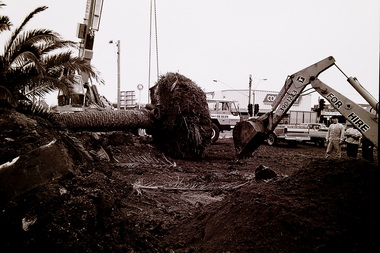
Photograph - St. Albans Square Palm Tree Installation 1991 Photographs, C. McGee, 17th June 1991
... civic space separate from traffic, somewhere for markets, gatherings, and casual socialising. The Square was built as part of the Main Road East commercial precinct, becoming the suburb’s unofficial “town centre.” These photographs taken by The Advocate captures the installation of the 10 metre palm tree at St Albans Square is significant as the palm tree has become a long‑standing landscape marker that contributes to the visual identity and social character of the precinct. ...St Albans Square emerged during the period when Melbourne’s outer suburbs were building European‑style pedestrian plazas to support growing migrant communities. St Albans, with its large Maltese, Yugoslav, Italian, Greek, and later Vietnamese population, needed: a central meeting place, a pedestrian‑friendly shopping zone, a civic space separate from traffic, somewhere for markets, gatherings, and casual socialising. The Square was built as part of the Main Road East commercial precinct, becoming the suburb’s unofficial “town centre.”These photographs taken by The Advocate captures the installation of the 10 metre palm tree at St Albans Square is significant as the palm tree has become a long‑standing landscape marker that contributes to the visual identity and social character of the precinct. The tree was donated to Council by local Ardeer resident Peter Zafiropoulous. Positioned at the intersection of Main Road East and The Esplanade, it serves as a focal point within the plaza and reflects late‑20th‑century suburban design practices that used distinctive plantings to create recognisable civic landmarks. The tree has remained a constant feature through decades of commercial change, multicultural growth, and streetscape redevelopment, and continues to embody the continuity of community life in St Albans. Its survival into 2026 enhances its value as a living element of the suburb’s public‑realm heritage.Palm Tree St. Albans Square 284.2st. albans square, main road east, the esplanade, st. albans -
 Sunshine and District Historical Society Incorporated
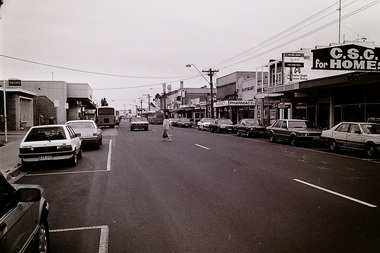
Photograph - Sunshine Shopping Centre Sun Crescent Sunshine 1990 Photographs, Adam Ellwood, 14th November 1990
... Typical businesses included: Milk bars Small grocers Hairdressers Takeaway shops Service businesses Local professional rooms Its customer base came from the dense residential blocks around the station, Town Hall, and Sunshine Technical School. 1980s–1990s — Stable neighbourhood centre Sun Crescent remained a modest but steady retail strip, overshadowed by the larger Hampshire Road and Sunshine Plaza precincts but still serving: Commuters Local residents Students Workers from nearby civic buildings Some older shops were redeveloped or replaced with modern commercial units. 2000s–2020s — Modern mixed‑use strip Today, Sun Crescent functions as: A secondary retail strip within the Sunshine Major Activity Centre A mix of small shops, services, and professional suites A transitional zone between the station precinct and residential streets Its heritage value lies in its connection to the original 1920s Hampshire Road shops and the mid‑century renaming that created the Sun Crescent identity....Typical businesses included: Milk bars Small grocers Hairdressers Takeaway shops Service businesses Local professional rooms Its customer base came from the dense residential blocks around the station, Town Hall, and Sunshine Technical School. 1980s–1990s — Stable neighbourhood centre Sun Crescent remained a modest but steady retail strip, overshadowed by the larger Hampshire Road and Sunshine Plaza precincts but still serving: Commuters Local residents Students Workers from nearby civic buildings Some older shops were redeveloped or replaced with modern commercial units. 2000s–2020s — Modern mixed‑use strip Today, Sun Crescent functions as: A secondary retail strip within the Sunshine Major Activity Centre A mix of small shops, services, and professional suites A transitional zone between the station precinct and residential streets Its heritage value lies in its connection to the original 1920s Hampshire Road shops and the mid‑century renaming that created the Sun Crescent identity. ...Sun Crescent Shopping Centre emerged in the 1960s–1970s as a redeveloped section of Hampshire Road, created when the road alignment was altered and the former 1920s–1930s shop rows were renamed Sun Crescent. It became a small but important neighbourhood retail strip serving the residential blocks around the Sunshine Railway Station and Town Hall precinct. 1920s–1930s — Original Hampshire Road shops Before Sun Crescent existed, the area was part of the main Hampshire Road commercial strip. Shops between 107–117 Hampshire Road were built during the 1923–1925 period, including: Homewood’s Café (a major social hub) Confectioners Grocers Butchers Timber yards Small specialty shops This cluster formed part of Sunshine’s early civic and retail centre. 1960s — Road realignment and renaming During Sunshine’s mid‑century redevelopment, the section of Hampshire Road near the Town Hall was realigned. The old shop row at 107–117 Hampshire Road was renamed Sun Crescent. This renaming marks the birth of the Sun Crescent Shopping Centre. 1970s — Formation of a neighbourhood shopping strip By the 1970s, Sun Crescent had developed into a small but active local shopping centre. Typical businesses included: Milk bars Small grocers Hairdressers Takeaway shops Service businesses Local professional rooms Its customer base came from the dense residential blocks around the station, Town Hall, and Sunshine Technical School. 1980s–1990s — Stable neighbourhood centre Sun Crescent remained a modest but steady retail strip, overshadowed by the larger Hampshire Road and Sunshine Plaza precincts but still serving: Commuters Local residents Students Workers from nearby civic buildings Some older shops were redeveloped or replaced with modern commercial units. 2000s–2020s — Modern mixed‑use strip Today, Sun Crescent functions as: A secondary retail strip within the Sunshine Major Activity Centre A mix of small shops, services, and professional suites A transitional zone between the station precinct and residential streets Its heritage value lies in its connection to the original 1920s Hampshire Road shops and the mid‑century renaming that created the Sun Crescent identity.Sunshine Shopping Centres 492.3sunshine shopping centre, sun crescent, sunshine -
 Sunshine and District Historical Society Incorporated
Photograph - Sunshine City Band 60th Anniversary 1988 Photographs, The Sunshine Advocate, 25th June 1988
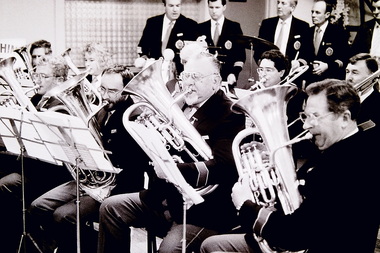
... The Sunshine City Band has been active for more than 100 years, evolving from an industrial township ensemble into a long‑standing cultural institution that reflects Sunshine’s civic pride, industrial heritage, and multicultural identity....The Sunshine City Band has been active for more than 100 years, evolving from an industrial township ensemble into a long‑standing cultural institution that reflects Sunshine’s civic pride, industrial heritage, and multicultural identity. Sunshine City Band Sunshine City Band 60th Birthday 576.2 Digital scans of black and white negatives Photograph Sunshine City Band 60th Anniversary 1988 Photographs The Sunshine Advocate ...The Sunshine City Band has been active for more than 100 years, evolving from an industrial township ensemble into a long‑standing cultural institution that reflects Sunshine’s civic pride, industrial heritage, and multicultural identity.Sunshine City Band 60th Birthday 576.2sunshine city band -
 Broadmeadows Historical Society & Museum
Photograph - Group Photograph, Fotek School Portraits, Jacana Primary School; Junior School Council, 1993, 1993
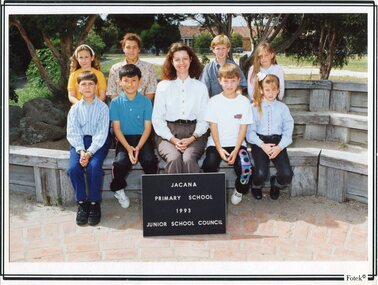
... civic awareness. Set against the backdrop of significant urban and demographic change, this image also offers insight into the social dynamics and educational values of the early 1990s. It stands as a testament to Jacana Primary’s nurturing ethos and its role in shaping not only academic outcomes but also the personal growth and community identity of its students. ...civic awareness. Set against the backdrop of significant urban and demographic change, this image also offers insight into the social dynamics and educational values of the early 1990s. It stands as a testament to Jacana Primary’s nurturing ethos and its role in shaping not only academic outcomes but also the personal growth and community identity of its students. ...Jacana Primary School, founded in 1959 and closed in 2009, was a cornerstone of public education in Melbourne’s northern suburbs for over five decades. During this time, the school evolved alongside the community it served, adapting to waves of suburban development and increasing cultural diversity. The 1993 Junior School Council photograph captures a moment of student leadership and engagement, reflecting the school’s commitment to fostering responsibility, inclusion, and active participation from an early age. Junior School Council initiatives encouraged students to contribute to decision-making and community-building within the school, helping to develop confidence and civic awareness. Set against the backdrop of significant urban and demographic change, this image also offers insight into the social dynamics and educational values of the early 1990s. It stands as a testament to Jacana Primary’s nurturing ethos and its role in shaping not only academic outcomes but also the personal growth and community identity of its students. The 1993 Junior School Council photograph from Jacana Primary School is a significant historical record that highlights the school’s emphasis on student voice, leadership, and community participation. Captured during a time of urban growth and increasing cultural diversity in Melbourne’s northern suburbs, the image reflects the inclusive and democratic values that shaped the school’s educational approach. This photograph not only documents the students who took on leadership roles but also symbolises the broader ethos of empowerment and engagement that Jacana Primary fostered among its young learners. As part of the visual legacy of a school that served its community for 50 years, the image preserves the memory of a place where children were encouraged to contribute, lead, and grow—making it a meaningful artefact for former students, staff, and the wider community.Colour Photograph on Satin Finish Paper, mounted on card backingBack; (Blue Label): PH-5396 (Front) (Bottom Right Corner): Fotek ©jacana primary school, education, photograph, group photograph, 1993, jacana, junior school council -
Broadmeadows Historical Society & Museum
Photograph - Group Photo, Classic Studios Victoria, Jacana Primary School - Students and Staff Photograph, 2006, 2006
... civic engagement, and social support. Although Jacana Primary School closed in the early 2000s, its legacy endures through archival materials like this photograph. These records offer valuable insights into the role of public education in shaping community identity and fostering social cohesion during a transformative period in Melbourne’s suburban history. ...civic engagement, and social support. Although Jacana Primary School closed in the early 2000s, its legacy endures through archival materials like this photograph. These records offer valuable insights into the role of public education in shaping community identity and fostering social cohesion during a transformative period in Melbourne’s suburban history. ...Jacana Primary School was established in 1959 during a period of rapid suburban expansion in Melbourne’s northern corridor. Situated in the suburb of Jacana, the school was part of a broader post-war initiative aimed at delivering accessible public education to communities shaped by migration, industrial growth, and government housing programs. Over the decades, Jacana Primary evolved alongside its community, reflecting the changing social and cultural landscape of the area. By the 1990s and early 2000s, the school had become a vibrant and inclusive environment, welcoming students from a wide range of cultural and socio-economic backgrounds. This diversity was embraced through inclusive teaching practices, multicultural celebrations, and student leadership initiatives such as the junior student council. The 2006 photograph captures a moment near the end of the school’s operation, showcasing the unity and shared purpose of its students and staff. It highlights the school’s role not only as a place of learning but also as a centre for community building, civic engagement, and social support. Although Jacana Primary School closed in the early 2000s, its legacy endures through archival materials like this photograph. These records offer valuable insights into the role of public education in shaping community identity and fostering social cohesion during a transformative period in Melbourne’s suburban history. The 2006 Students and Staff photograph from Jacana Primary School is a historically significant visual record that captures the final chapter of a school deeply embedded in Melbourne’s northern suburban landscape. Established in 1959 during a wave of post-war development, Jacana Primary was part of a broader initiative to provide accessible public education to communities shaped by migration, industrial growth, and housing expansion. This photograph reflects the school’s enduring commitment to inclusion, diversity, and community engagement. By the early 2000s, Jacana Primary had become a vibrant educational environment, welcoming students and staff from a wide range of cultural and socio-economic backgrounds. The image documents the collaborative spirit and shared purpose that defined the school’s ethos, highlighting its role as both a learning institution and a centre of social cohesion. As one of the final visual records before the school’s closure, the photograph holds particular significance. It offers insight into the lived experiences of students and educators during a transformative period in Melbourne’s suburban history and stands as a testament to the lasting impact of public education in fostering community identity and resilience.A colour photograph mounted on matte Paper with a purple border(Blue Label) PH - 5383 Classic Studios VIC order: p337249 / Frame x Jacana whole school item 4 Kodak Professional / Endura Paper. papier. papel / Professional images are/ copyright protected / Dutch copyright Gerschütz jacana primary school, education, photograph, group photograph, 2006, students and staff, jacana -
Broadmeadows Historical Society & Museum
Document - Invitation, Invitation to the Official Opening of the Broadmeadows Town Hall, 1964, 1964
... It reflects mid‑twentieth‑century municipal ceremony, civic identity, and governance, and is associated with prominent local leadership and national political figure The Hon. ...Documents the official opening of the Broadmeadows Town Hall, a milestone in the civic development of the City of Broadmeadows during a period of rapid post‑war suburban growth. The involvement of The Hon. A. A. Calwell, M.P., highlights the event’s political and civic importance.The invitation is historically, socially, and associatively significant as documentary evidence of the official opening of the Broadmeadows Town Hall in 1964. It reflects mid‑twentieth‑century municipal ceremony, civic identity, and governance, and is associated with prominent local leadership and national political figure The Hon. A. A. Calwell, M.P.Rectangular printed invitation card on cream card stock with rounded corners. Black formal script with municipal seal printed at head.Recto: “The Mayor and Mayoress of Broadmeadows/(Cr. & Mrs H. Payne)/ request the pleasure of the company of/Cr. And Mrs. R.K. Evans/at the/Official Opening of the Broadmeadows Town Hall/by the/Leader of the Opposition, The Hon. A. A Calwell, M. P./ on Saturday, 21st November, 1964,/at 3 p.m./THE FAVOR OF A REPLY ADDRESSED TO THE TOWN CLERK, BROADMEADOWS, IS DESIRED/NOT LATER THAN 14th NOVEMBER, 1964.” Bottom right corner (in blue ink): 440501 Verso: Accession label “WI 4291” (upper left) • broadmeadows town hall, • local government, • civic ceremonies, • a. a. calwell, • city of broadmeadows, broadmeadows -
 Broadmeadows Historical Society & Museum
Document - Reception Card, Reception – The Mayoress of Broadmeadows, 1979
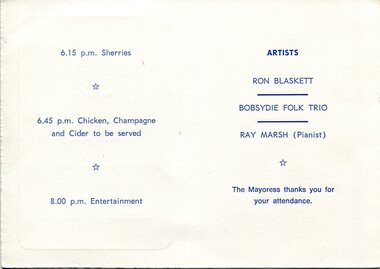
... It documents the civic and social functions of the City of Broadmeadows in 1979, highlighting hospitality practices, local performers, and the public role of the Mayoress in fostering civic identity and community engagement. The item’s provenance, intact design, and clear association with municipal leadership support its interpretive value for local government history. ...Documents municipal ceremonial and hospitality practices in Broadmeadows in the late 1970s, illustrating the role of the Mayoress in civic hosting and the use of Broadmeadows City Hall for official social functions.This reception card is a representative example of late twentieth‑century municipal ceremonial ephemera. It documents the civic and social functions of the City of Broadmeadows in 1979, highlighting hospitality practices, local performers, and the public role of the Mayoress in fostering civic identity and community engagement. The item’s provenance, intact design, and clear association with municipal leadership support its interpretive value for local government history.Folded reception card on cream‑textured card stock. Exterior bears the City of Broadmeadows municipal seal and event details; interior lists program timings and artists. Printed in blue ink.Outside (recto): “Reception / The Mayoress of Broadmeadows / Mrs. Kath Laherty / City Hall Broadmeadows / Friday 9th March 1979” with City of Broadmeadows seal. Inside: “6.15 p.m. Sherries / 6.45 p.m. Chicken, Champagne and Cider to be served / 8.00 p.m. Entertainment / Artists: Ron Blaskett; Bobsydie Folk Trio; Ray Marsh (Pianist) / The Mayoress thanks you for your attendance.” Verso: Accession label “WI‑4278”.city of broadmeadows, civic ceremonies, municipal government, social events, broadmeadows city hall -
Broadmeadows Historical Society & Museum
Archive (sub-series) - Mayoral invitation, Invitation to the Mayoral Ball, 8 April2026
... It documents the role of mayoral functions in fostering civic identity, public representation, and formal social engagement within local government. ...Created by the curator, Broadmeadows Museum.Created to bring together for archival and research purposes.Arranged in the logical order of invitation and then reply card.Formal printed invitation to the Mayoral Ball issued by the City of Broadmeadows, 1978, together with a completed reply card accepting the invitation. Includes event details, dress code, RSVP instructions, and evidence of civic attendance.local government, mayors and mayoresses, civic ceremony, municipal events, city of broadmeadows, 1970s victorialocal government, mayors and mayoresses, civic ceremony, municipal events, city of broadmeadows, 1970s victoria -
 Sunshine and District Historical Society Incorporated
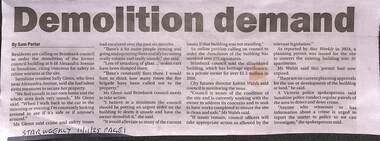
Photograph - Sunshine Municipal Offices Demolition Photographs, John Alchin, 29th December 2025
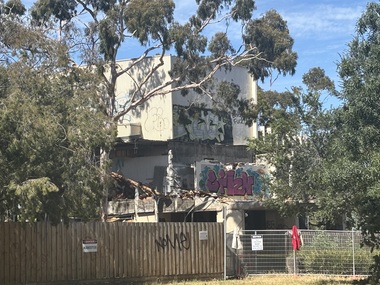
... civic structure with a distinctive boomerang / Y‑shaped plan. Its most iconic feature is the dramatic stained‑glass mural panel projecting over the main entrance featuring a modern sun motif referencing Sunshine’s industrial identity and the Sunshine Harvester Works logo. ...civic structure with a distinctive boomerang / Y‑shaped plan. Its most iconic feature is the dramatic stained‑glass mural panel projecting over the main entrance featuring a modern sun motif referencing Sunshine’s industrial identity and the Sunshine Harvester Works logo. ...The Sunshine Municipal Offices in Alexandra Avenue Sunshine opened in 1967. The building was designed by Gordon Stuart Warmington, a former Sunshine resident. The building was a substantial modernist civic structure with a distinctive boomerang / Y‑shaped plan. Its most iconic feature is the dramatic stained‑glass mural panel projecting over the main entrance featuring a modern sun motif referencing Sunshine’s industrial identity and the Sunshine Harvester Works logo. During the 1970's and 1980's additional wings and extension were added to the eastern side of the building. The building served as the City of Sunshine’s Town Hall until the municipality was abolished in 1994, when Sunshine merged into the newly created City of Brimbank. After the new Brimbank Community and Civic Centre in Hampshire Road opened in 2016, the Council moved its corporate and library operations to the new building. The Alexandra Avenue site was sold to developers in 2018 for $5.58 million. The building then fell into disrepair and was subject to a number of arsonist attacks, squatting, drug taking and other criminal activity. The building is protected by heritage overlays, particularly for its stained‑glass mural and original 1960s form. In November 2025, the City of Brimbank ordered the owners of the site to undertake some emergency demolition works to make the site safe. The stained‑glass mural panel was dismantled in pieces and has been store away for future restoration works by the City of Brimbank.These photographs record the part demolition of a former City of Sunshine Civic building from December 2025 to February 2026. These pictures were captured after the stained‑glass mural panel was dismantled and put into storage. The former eastern end extension had previously been demolished.5554.01 - Alexandra Avenue - Sunshine Municipal Offices Demolition 2025 Photo 01.JPG 5554.02 - Alexandra Avenue - Sunshine Municipal Offices Demolition 2025 Photo 02.JPG 5554.03 - Alexandra Avenue - Sunshine Municipal Offices Demolition 2025 Photo 03.JPG 5554.04 - Alexandra Avenue - Sunshine Municipal Offices Demolition 2025 Photo 04.JPG 5554.05 - Alexandra Avenue - Sunshine Municipal Offices Demolition 2025 Photo 05.JPG 5554.06 - Alexandra Avenue - Sunshine Municipal Offices Demolition 2025 Photo 06.JPG 5554.07 - Alexandra Avenue - Sunshine Municipal Offices Demolition 2025 Photo 07.JPG 5554.08 - Alexandra Avenue - Sunshine Municipal Offices Demolition 2025 Photo 08.JPG 5554.09 - Alexandra Avenue - Sunshine Municipal Offices Demolition 2026 Photo 09.jpeg 5554.10 - Alexandra Avenue - Sunshine Municipal Offices Demolition 2026 Photo 10.jpeg 5554.11 - Alexandra Avenue - Sunshine Municipal Offices Demolition 2026 Photo 11.jpeg 5554.12 - Alexandra Avenue - Sunshine Municipal Offices Demolition 2026 Photo 12.jpeg 5554.13 - Alexandra Avenue - Sunshine Municipal Offices Demolition 2026 Photo 13.jpeg 5554.14 - Alexandra Avenue - Sunshine Municipal Offices Demolition 2026 Photo 14.jpeg 5554.15 - Alexandra Avenue - Sunshine Municipal Offices Demolition 2026 Photo 15.jpeg 5554.16 - Alexandra Avenue - Sunshine Municipal Offices Demolition 2026 Photo 16.jpeg 5554.17 - Alexandra Avenue - Sunshine Municipal Offices Demolition 2026 Photo 17.jpeg 5554.18 - Alexandra Avenue - Sunshine Municipal Offices Demolition 2026 Photo 18.jpeg sunshine municipal offices, alexandra avenue, sunshine -
 Sunshine and District Historical Society Incorporated
Article - Sunshine Municipal Offices Part Demolition, Star Weekly, 29th December 2025
... civic structure with a distinctive boomerang / Y‑shaped plan. Its most iconic feature is the dramatic stained‑glass mural panel projecting over the main entrance featuring a modern sun motif referencing Sunshine’s industrial identity and the Sunshine Harvester Works logo. ...civic structure with a distinctive boomerang / Y‑shaped plan. Its most iconic feature is the dramatic stained‑glass mural panel projecting over the main entrance featuring a modern sun motif referencing Sunshine’s industrial identity and the Sunshine Harvester Works logo. ...The Sunshine Municipal Offices in Alexandra Avenue Sunshine opened in 1967. The building was designed by Gordon Stuart Warmington, a former Sunshine resident. The building was a substantial modernist civic structure with a distinctive boomerang / Y‑shaped plan. Its most iconic feature is the dramatic stained‑glass mural panel projecting over the main entrance featuring a modern sun motif referencing Sunshine’s industrial identity and the Sunshine Harvester Works logo. During the 1970's and 1980's additional wings and extension were added to the eastern side of the building. The building served as the City of Sunshine’s Town Hall until the municipality was abolished in 1994, when Sunshine merged into the newly created City of Brimbank. After the new Brimbank Community and Civic Centre in Hampshire Road opened in 2016, the Council moved its corporate and library operations to the new building. The Alexandra Avenue site was sold to developers in 2018 for $5.58 million. The building then fell into disrepair and was subject to a number of arsonist attacks, squatting, drug taking and other criminal activity. The building is protected by heritage overlays, particularly for its stained‑glass mural and original 1960s form. In November 2025, the City of Brimbank ordered the owners of the site to undertake some emergency demolition works to make the site safe. The stained‑glass mural panel was dismantled in pieces and has been store away for future restoration works by the City of Brimbank.5683.01 - Sunshine Municipal Offices - Demolition Demand.JPG 5683.02 - Sunshine Municipal Offices - Part Demolition For Unsafe Building.JPG 5683.03 - Sunshine Municipal Offices - Farewell To Local Landmark.jpgsunshine municipal offices, alexandra avenue, sunshine -
 Sunshine and District Historical Society Incorporated
Flag - Australian Flag
... identity, and political structure. Its three core elements, the Union Jack, the Commonwealth Star, and the Southern Cross represent a different layer of Australia’s history and national story. The Union Jack - Located in the canton (top-left corner), the position of honour. - Acknowledges the history of British settlement and the institutions inherited from Britain, the parliamentary democracy, rule of law, and civic rights. ...identity, and political structure. Its three core elements, the Union Jack, the Commonwealth Star, and the Southern Cross represent a different layer of Australia’s history and national story. The Union Jack - Located in the canton (top-left corner), the position of honour. - Acknowledges the history of British settlement and the institutions inherited from Britain, the parliamentary democracy, rule of law, and civic rights. ...The Australian flag symbolises the nation’s origins, identity, and political structure. Its three core elements, the Union Jack, the Commonwealth Star, and the Southern Cross represent a different layer of Australia’s history and national story. The Union Jack - Located in the canton (top-left corner), the position of honour. - Acknowledges the history of British settlement and the institutions inherited from Britain, the parliamentary democracy, rule of law, and civic rights. The Commonwealth Star - Large seven‑pointed star beneath the Union Jack. - Six points, the six points represent the states, the seventh point represents all territories. - Represents federation and the unity of Australia as a Commonwealth. The Southern Cross - Five stars on the fly side of the flag. - A constellation visible only in the Southern Hemisphere, long used for navigation by explorers and sailors. - Holds deep significance in First Nations astronomy, with many cultural stories attached to it. - Symbolises Australia’s geographical location and its identity as a southern nation. The Australian flag was first flown in 1901 after a public design competition with over 32,000 entries. It was officially adopted in 1903 and modified in 1908 to add the seventh point to the Commonwealth Star. It became the official national flag in 1954 under the Flags Act, reflecting Australia’s growing independence from Britain.Australian Flag. This flag is suitable to be flown on a flagpole.Manufacturer's Tag: Manufactured in Australia by Carroll & Richardsonaustralian flag -
Broadmeadows Historical Society & Museum
Furniture (collection) - Shire Chairs
... Gibb, reflects a continued family commitment to civic service and commemorates the foundational role played by pioneering families in shaping the Shire’s identity. ...Collection of chairs donated to Shire of BroadmeadowsNo order or sequence.Furniture from the Shire of Broadmeadowsshire council, broadmeadows, furniture, alexander coupar gibbshire council, broadmeadows, furniture, alexander coupar gibb -
 Broadmeadows Historical Society & Museum
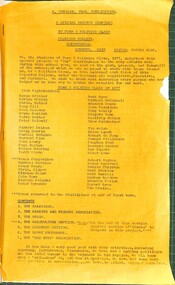
Document - School Project, A Jubilee Year Publication, 1977
... civic engagement of students during a milestone year in the college’s history. Created as a special project, the publication reflects a thoughtful and structured examination of the school’s identity through the lens of political systems—Legislative, Executive, and Judicial—demonstrating both creativity and critical thinking. ...This 1977 Jubilee Year publication was a special project undertaken by the Form 5 Politics Class at Salesian College, Rupertswood, as part of the school’s commemorative efforts to reflect on its past, present, and future. Created during a year of celebration and reflection, the project was both a civic and educational exercise, allowing students to explore the structure and culture of their school through the lens of political systems. Organised under the themes of Legislative, Executive, and Judicial branches, the publication presents a unique and structured interpretation of the college’s operations and community life. It includes contributions on key aspects of the school such as the Salesian order, the Parents and Friends Association, academic and sporting programs, the media, and the Old Boys’ Association. The project reflects the educational ethos of the time—encouraging inquiry, collaboration, and pride in one’s school. It also highlights the role of student voice in shaping the narrative of the college’s history. As a student-led initiative, this publication stands as a testament to the creativity, engagement, and reflective spirit of the 1977 cohort.This 1977 Jubilee Year publication, compiled by the Form 5 Politics Class at Salesian College, Rupertswood, is a significant historical document that captures the voice, perspective, and civic engagement of students during a milestone year in the college’s history. Created as a special project, the publication reflects a thoughtful and structured examination of the school’s identity through the lens of political systems—Legislative, Executive, and Judicial—demonstrating both creativity and critical thinking. The document is notable for its student-led authorship, its comprehensive scope—including reflections on the Salesians, the Parents and Friends Association, media, agriculture, academics, sport, and alumni—and its collaborative spirit. It offers a rare and valuable insight into how students of the time understood and interpreted the structure and culture of their school community. As a preserved artifact, this publication contributes meaningfully to the archival record of Salesian College. It not only documents the educational and social environment of the late 1970s but also highlights the enduring values of participation, reflection, and pride in community that continue to define the Rupertswood legacy.A 27 page stapled document, with a yellow front page (cover), detailing the history of Salesian College, Sunbury to 1977.salesian college, rupertswood, sunbury, 1977, jubilee -
Broadmeadows Historical Society & Museum
Book - Community History, Elaine V Brogan OAM, Fifty years 1969-2019: History of the Western Metropolitan group of Historical Societies, 2019
... identities in the face of rapid urban development, industrial expansion, and social change. Melbourne’s western suburbs—historically shaped by waves of migration, industrial growth, and working-class resilience—offered a rich and diverse tapestry of stories. From early European settlement and Indigenous histories to the rise of manufacturing hubs and multicultural communities, the region has long been a microcosm of broader Australian historical themes. The formation of individual historical societies within the western metropolitan area reflected a grassroots response to the need for localised historical preservation. These societies emerged independently, often founded by passionate residents, educators, and civic...identities in the face of rapid urban development, industrial expansion, and social change. Melbourne’s western suburbs—historically shaped by waves of migration, industrial growth, and working-class resilience—offered a rich and diverse tapestry of stories. From early European settlement and Indigenous histories to the rise of manufacturing hubs and multicultural communities, the region has long been a microcosm of broader Australian historical themes. The formation of individual historical societies within the western metropolitan area reflected a grassroots response to the need for localised historical preservation. These societies emerged independently, often founded by passionate residents, educators, and civic ...Fifty Years of the WMGHS, from 196948-page white book with stapled card coversnon-fictionFifty Years of the WMGHS, from 1969western metropolitan group of historical societies, 1969, 2019, elaine v. brogan oam -
 Broadmeadows Historical Society & Museum
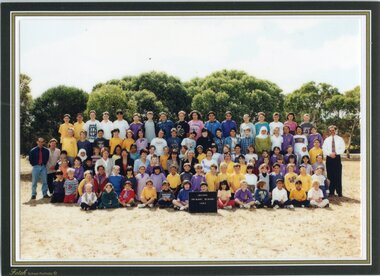
Photograph - Group Photo, Fotek School Portraits, Jacana Primary School 1997 Students and Staff Photograph, 1997
... civic engagement, and social support. Jacana Primary closed in the early 2000s as part of broader changes in educational policy and demographic shifts. However, its legacy lives on through archival materials like this photograph, which offer valuable insights into the role of public schools in shaping community identity and fostering social cohesion during a transformative period in Melbourne’s suburban history. ...civic engagement, and social support. Jacana Primary closed in the early 2000s as part of broader changes in educational policy and demographic shifts. However, its legacy lives on through archival materials like this photograph, which offer valuable insights into the role of public schools in shaping community identity and fostering social cohesion during a transformative period in Melbourne’s suburban history. ...Jacana Primary School was established in 1959 during a period of rapid suburban expansion in Melbourne’s northern corridor. Located in the suburb of Jacana, the school was part of a broader post-war effort to provide accessible public education to growing communities shaped by migration, industrial development, and housing initiatives. Throughout its operation, Jacana Primary reflected the evolving social fabric of the area. By the 1990s, the school had become a microcosm of Melbourne’s increasing cultural diversity, welcoming students from a wide range of ethnic and socio-economic backgrounds. This diversity was not only embraced but actively celebrated through inclusive teaching practices, multicultural events, and student leadership programs such as the junior student council. The 1997 photograph captures a moment in this dynamic environment, showcasing both staff and students engaged in a shared educational mission. It represents a time when schools were not only places of learning but also key sites of community building, civic engagement, and social support. Jacana Primary closed in the early 2000s as part of broader changes in educational policy and demographic shifts. However, its legacy lives on through archival materials like this photograph, which offer valuable insights into the role of public schools in shaping community identity and fostering social cohesion during a transformative period in Melbourne’s suburban history. This 1997 photograph of staff and students at Jacana Primary School marks a poignant moment in the history of a community-centred educational institution that served Melbourne’s northern suburbs from 1959 until its closure in the early 2000s. More than a conventional group portrait, the image stands as a historical artifact that encapsulates the spirit and values of a school deeply embedded in its local community. Jacana Primary School was distinguished by its commitment to educational equity, inclusivity, and a strong sense of belonging—principles that were actively lived and practiced within its classrooms and broader school culture. The photograph offers insight into the educational ethos and staff dynamics of the time, while also reflecting the broader social and cultural shifts occurring in suburban Melbourne at the close of the 20th century. As part of the school’s visual archive, this image contributes to a richer understanding of how public education shaped community identity, supported diverse student populations, and left a lasting legacy in the lives of generations of children and families.A colour photograph mounted on white card with a black border, is laminated. Back: (Blue Label Top) (Right Corner): PH -2157, Front: (Bottom Left Corner): Fotek School Portraitsjacana primary school, education, photograph, group photograph, 1997
