
Showing 21 items matching "classical motif"
-
 Villa Alba Museum
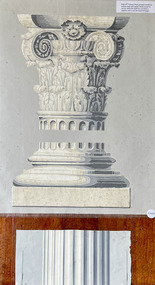
Wallpaper sample - Classical Frieze, mid 19th century
... ...classical motif...Heritage interiors Wallpapers 19th century design architectural friezes classical motif P.AI (Col) Mid 19th century block printed Corinthian column base and capital which would be cut out while the shaft was cut from a separate roll to suit the required height Wallpaper sample - Classical Frieze ...Part of a collection of historic wallpapers collected by Phyllis Murphy, most of whose wallpapers were donated to the collection of Historic Houses Sydney. This wallpaper sample, annotated and encased in mylar was used by Phyllis for educational purposes, and donated by her son to Villa Alba Museum's collection in 2025.Mid 19th century block printed Corinthian column base and capital which would be cut out while the shaft was cut from a separate roll to suit the required heightP.AI (Col)heritage interiors, wallpapers, 19th century design, architectural friezes, classical motif -
 Villa Alba Museum
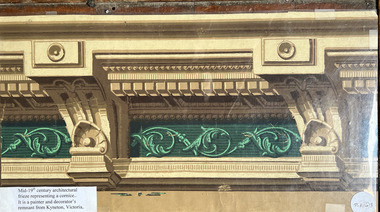
Wallpaper sample - Architectural border frieze, mid 19th century
... The sample demonstrates the elaborate ornamental style characteristic of the High Victorian Period which utilised classical motifs like scrolls and floral patterns. ...The sample demonstrates the elaborate ornamental style characteristic of the High Victorian Period which utilised classical motifs like scrolls and floral patterns. ...Part of a collection of historic wallpapers collected by Phyllis Murphy, most of whose wallpapers were donated to the collection of Historic Houses Sydney. This wallpaper sample, annotated and encased in mylar was used by Phyllis for educational purposes, and donated by her son to Villa Alba Museum's collection in 2025.Mid 19th century architectural frieze wallpaper representing a cornice. The design features a classic cornice with prominent corbels (bracket-like supports) and a decorative frieze section. The sample demonstrates the elaborate ornamental style characteristic of the High Victorian Period which utilised classical motifs like scrolls and floral patterns. This particular example was a remnant wallpaper from the work of a painter and decorator in Kyneton, Victoria. P. A3 (f)heritage interiors, wallpapers, 19th century design, wallpaper borders, classical friezes -
 Tennis Australia
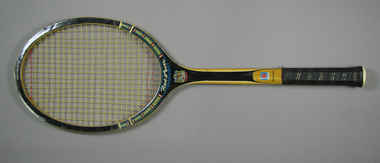
Racquet, Circa 1970
... Model name features across base of head, flanked by Classical Greek motifs. A coat-of-arms with lion and deer features on throat. ...Model name features across base of head, flanked by Classical Greek motifs. A coat-of-arms with lion and deer features on throat. ...A Chemold Rod Laver Tournament tennis racquet, with ribbon whipping around shoulders, and mottled black leather grip. Model name features across base of head, flanked by Classical Greek motifs. A coat-of-arms with lion and deer features on throat. Lower shaft and plastic butt cover feature blue, red, and white Chemold trademark. Materials: Wood, Nylon, String, Ribbon, Paint, Ink, Plastic, Leather, Rubber, Glue, Lacquer, Metaltennis -
 Villa Alba Museum
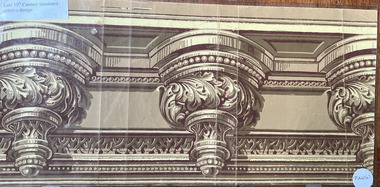
Wallpaper sample - Simulated cornice design, late 19th century
... The design uses a classically inspired bracketed cornice motif. ...The design uses a classically inspired bracketed cornice motif. Wallpaper sample - Simulated cornice design ...Part of a collection of historic wallpapers collected by Phyllis Murphy, most of whose wallpapers were donated to the collection of Historic Houses Sydney. This wallpaper sample, annotated and encased in mylar was used by Phyllis for educational purposes, and donated by her son to Villa Alba Museum's collection in 2025.Late 19th century simulated cornice design. The wallpaper border uses trompe-loiel to simulate a three dimensional architectural feature to create the illusion of depth. The design uses a classically inspired bracketed cornice motif. "P-A6 (f)heritage interiors, wallpapers, 19th century design, borders -
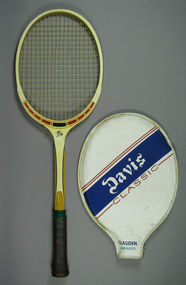 Tennis Australia
Racquet & cover, Circa 1970
... Davis logo and model name features across base of head, flanked by classical design motifs around the shoulders. TAD "Kings of the Court" trademark features on throat on obverse. ...Davis logo and model name features across base of head, flanked by classical design motifs around the shoulders. TAD "Kings of the Court" trademark features on throat on obverse. ...A Davis Classic tennis racquet (.1), with Davis Classic vinyl racquet head cover (.2). Davis logo and model name features across base of head, flanked by classical design motifs around the shoulders. TAD "Kings of the Court" trademark features on throat on obverse. Davis coat-of-arms "Duce virtute comite fortuna" trademark features on throat on reverse. TAD trademark features on rubber butt cap. Materials: Wood, Nylon, Ink, Glue, Lacquer, Metal, String, Leather, Adhesive tape, Paint, Rubber, Fibreglass, Vinyl, Metaltennis -
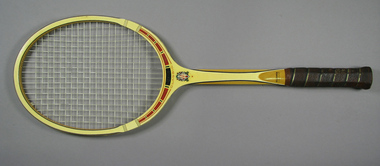 Tennis Australia
Racquet, Circa 1975
... Davis logo and model name features across base of head, flanked by classical design motifs around the shoulders. TAD "Kings of the Court" trademark features on throat on obverse. ...Davis logo and model name features across base of head, flanked by classical design motifs around the shoulders. TAD "Kings of the Court" trademark features on throat on obverse. ...A Davis Classic tennis racquet, with ribbon whipping around shoulders and leather handle grip with patterned perforations. Davis logo and model name features across base of head, flanked by classical design motifs around the shoulders. TAD "Kings of the Court" trademark features on throat on obverse. Davis coat-of-arms "Duce virtute comite fortuna" trademark features on throat on reverse. TAD trademark features on rubber butt cap. Materials: Wood, Nylon, Ink, Glue, Lacquer, Metal, Ribbon, Leather, Adhesive tape, Paint, Rubber, Fibreglasstennis -
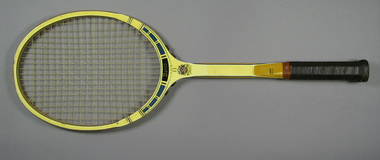 Tennis Australia
Racquet, Circa 1972
... Davis logo and model name features across base of head, flanked by classical design motifs around the shoulders. TAD "Kings of the Court" trademark features on throat on reverse. ...Davis logo and model name features across base of head, flanked by classical design motifs around the shoulders. TAD "Kings of the Court" trademark features on throat on reverse. ...A Davis Classic II tennis racquet, with string whipping around shoulders and shaft, and leather handle grip with patterned perforations. Davis logo and model name features across base of head, flanked by classical design motifs around the shoulders. TAD "Kings of the Court" trademark features on throat on reverse. Davis coat-of-arms "Duce virtute comite fortuna" trademark features on throat on robverse. TAD trademark features on rubber butt cap. Materials: Wood, Nylon, Ink, Glue, Lacquer, Metal, String, Leather, Adhesive tape, Paint, Rubber, Fibreglasstennis -
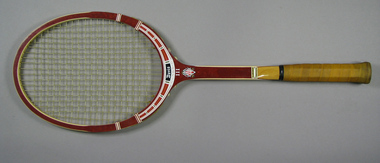 Tennis Australia
Racquet, Circa 1975
... Davis logo and model name features across base of head, flanked by classical design motifs around the shoulders. TAD "Kings of the Court" trademark features on throat on obverse. ...Davis logo and model name features across base of head, flanked by classical design motifs around the shoulders. TAD "Kings of the Court" trademark features on throat on obverse. ...A Davis Classic III tennis racquet, with string whipping around shoulders, and mottled orange leather handle grip. Davis logo and model name features across base of head, flanked by classical design motifs around the shoulders. TAD "Kings of the Court" trademark features on throat on obverse. Davis coat-of-arms "Duce virtute comite fortuna" trademark features on throat on reverse. TAD trademark features on rubber butt cap. Materials: Wood, Nylon, Ink, Glue, Lacquer, Metal, String, Leather, Adhesive tape, Paint, Rubber, Fibreglasstennis -
 Tennis Australia
Racquet, Circa 1972
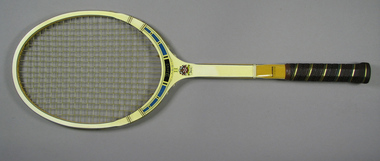
... Davis logo and model name features across base of head, flanked by classical design motifs around the shoulders. TAD "Kings of the Court" trademark features on throat on reverse. ...Davis logo and model name features across base of head, flanked by classical design motifs around the shoulders. TAD "Kings of the Court" trademark features on throat on reverse. ...A Davis Classic II tennis racquet, with string whipping around shoulders and ribbon whipping around shaft, and leather handle grip with patterned perforations. Davis logo and model name features across base of head, flanked by classical design motifs around the shoulders. TAD "Kings of the Court" trademark features on throat on reverse. Davis coat-of-arms "Duce virtute comite fortuna" trademark features on throat on obverse. TAD trademark features on rubber butt cap. Materials: Wood, Nylon, Ink, Glue, Lacquer, Metal, String, Leather, Adhesive tape, Paint, Rubber, Ribbon, Fibreglasstennis -
 Glen Eira Historical Society
Album - Album page, Caulfield Town Hall cnr Hawthorn & Glen Eira Rds, Circa 1972
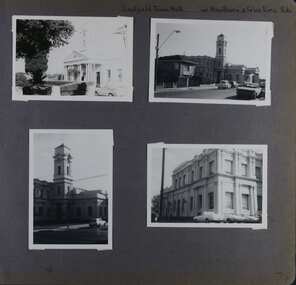
... The Adamesque plasterwork, timber panelling and furniture, Art Nouveaux enrichment and Classically derived treatment with sparing use of Australian decorative motifs are contributory elements. ...This photograph is part of the Caulfield Historical Album 1972. This album was created in approximately 1972 as part of a project by the Caulfield Historical Society to assist in identifying buildings worthy of preservation. The album is related to a Survey the Caulfield Historical Society developed in collaboration with the National Trust of Australia (Victoria) and Caulfield City Council to identify historic buildings within the City of Caulfield that warranted the protection of a National Trust Classification. Principal photographer thought to be Trevor Hart, member of Caulfield Historical Society. Most photographs were taken between 1966-1972 with a small number of photographs being older and from unknown sources. All photographs are black and white except where stated, with 386 photographs over 198 pages. Caulfield Town Hall is now known as Glen Eira Town Hall.From Victorian Heritage Database: Citation for Town Hall, Corner Glen Eira and Hawthorn Roads - HO106 https://vhd.heritagecouncil.vic.gov.au/places/43613 as at (19/10/2020) The former City of Caulfield (now City of Glen Eira) Municipal Offices, located at the south-west corner of Hawthorn and Glen Eira Roads, Caulfield South, were commenced for the Borough of Caulfield in 1884 when they also included a Post and Telegraph Office and Court of Petty Sessions. They were designed by the Borough surveyor, Sydney Smith. The hall was completed in 1890 to the design of Alexander Rankin and the present hall, foyer and portico completed to the design of Goldsmith and Jenkin, architects, in 1931. The complex is historically, aesthetically and socially significant. It is historically significant {Criterion A) as the centre of Local Government services in the area since 1885 and as a centre of post and telegraph and legal services for a period. Its association with architect and Borough surveyor, Sydney W. Smith is important in that the east elevation and facade (ground floor level only)as far west as the tower (lower two stages) survive as evidence of his work, the practice which his son continued after his death in 1886, becoming highly successful. The work of Goldsmith and Jenkin is historically important in that it indirectly demonstrates the growth of the City sustained during the Inter-war period, the work proceeding in spite of the Depression. It compares with other similar work of that time including the refurbishment of the Malvern Municipal Offices and Hall in 1927 (Hudson and Wardrop), the Melbourne Corporation Offices and Hall in 1925-28 (Stephenson and Meldrum, A. and K. Henderson) and the Camberwell Offices and Council Chamber in 1924 (Leighton Irwin and Roy Stevenson), other comparable municipal projects being undertaken during the 1930s. Finally, the Goldsmith and Jenkin works are important as a project of the Depression years organised specifically to alleviate unemployment problems in the Municipality. The complex is aesthetically important (Criterion E) as a prominent and imposing Classically derived complex of its type with individually noteworthy interior spaces being the entry hall and staircase, main Hall, Foyer and Council Chamber. The Adamesque plasterwork, timber panelling and furniture, Art Nouveaux enrichment and Classically derived treatment with sparing use of Australian decorative motifs are contributory elements. Exterior .elements of note include the remains of the original design prepared by Sydney Smith and the clock tower and portico which have come to symbolise important Municipal complexes erected prior to the Second World War. The complex is socially important (Criterion G) for the value placed on it by the community which has made use of it for activities including that of Local government for well over a century.Page 74 of Photograph Album with four photographs (three portrait and one landscape) of different views of the Caulfield Town Hall.Hand written: Caulfield Town Hall cnr Hawthorn & Glen Eira Rds [top right] / 74 [bottom right] trevor hart, caulfield, glen eira, caulfield town hall, sydney smith, sydney w smith, municipal, adamesque plasterwork, adamesque, art nouveaux, portico, council chambers, alexander rankin, foyer, local government, timber panelling, tower, unemployment, clock tower, hawthorn road, glen eira road, city of glen eira, municipal offices, post and telegraph office, goldsmith and jenkin, courthouses, surveyors, architects, classical architectural style, streetscapes, gardens, cars, glen eira town hall, depression 1929-1939 -
 Glen Eira Historical Society
Album - Album page, Caulfield Town Hall cnr Hawthorn & Glen Eira Rds, Circa 1972
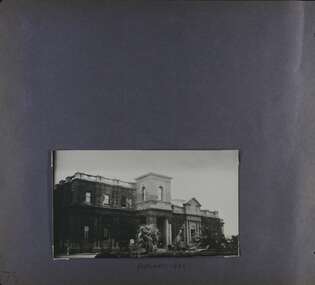
... The Adamesque plasterwork, timber panelling and furniture, Art Nouveaux enrichment and Classically derived treatment with sparing use of Australian decorative motifs are contributory elements. ...This photograph is part of the Caulfield Historical Album 1972 but is noted as taken in 1922. This album was created in approximately 1972 as part of a project by the Caulfield Historical Society to assist in identifying buildings worthy of preservation. The album is related to a Survey the Caulfield Historical Society developed in collaboration with the National Trust of Australia (Victoria) and Caulfield City Council to identify historic buildings within the City of Caulfield that warranted the protection of a National Trust Classification. Principal photographer thought to be Trevor Hart, member of Caulfield Historical Society. Most photographs were taken between 1966-1972 with a small number of photographs being older and from unknown sources. All photographs are black and white except where stated, with 386 photographs over 198 pages. Caulfield Town Hall is now known as Glen Eira Town Hall.From Victorian Heritage Database: Citation for Town Hall, Corner Glen Eira and Hawthorn Roads - HO106 https://vhd.heritagecouncil.vic.gov.au/places/43613 as at (19/10/2020) The former City of Caulfield (now City of Glen Eira) Municipal Offices, located at the south-west corner of Hawthorn and Glen Eira Roads, Caulfield South, were commenced for the Borough of Caulfield in 1884 when they also included a Post and Telegraph Office and Court of Petty Sessions. They were designed by the Borough surveyor, Sydney Smith. The hall was completed in 1890 to the design of Alexander Rankin and the present hall, foyer and portico completed to the design of Goldsmith and Jenkin, architects, in 1931. The complex is historically, aesthetically and socially significant. It is historically significant {Criterion A) as the centre of Local Government services in the area since 1885 and as a centre of post and telegraph and legal services for a period. Its association with architect and Borough surveyor, Sydney W. Smith is important in that the east elevation and facade (ground floor level only)as far west as the tower (lower two stages) survive as evidence of his work, the practice which his son continued after his death in 1886, becoming highly successful. The work of Goldsmith and Jenkin is historically important in that it indirectly demonstrates the growth of the City sustained during the Inter-war period, the work proceeding in spite of the Depression. It compares with other similar work of that time including the refurbishment of the Malvern Municipal Offices and Hall in 1927 (Hudson and Wardrop), the Melbourne Corporation Offices and Hall in 1925-28 (Stephenson and Meldrum, A. and K. Henderson) and the Camberwell Offices and Council Chamber in 1924 (Leighton Irwin and Roy Stevenson), other comparable municipal projects being undertaken during the 1930s. Finally, the Goldsmith and Jenkin works are important as a project of the Depression years organised specifically to alleviate unemployment problems in the Municipality. The complex is aesthetically important (Criterion E) as a prominent and imposing Classically derived complex of its type with individually noteworthy interior spaces being the entry hall and staircase, main Hall, Foyer and Council Chamber. The Adamesque plasterwork, timber panelling and furniture, Art Nouveaux enrichment and Classically derived treatment with sparing use of Australian decorative motifs are contributory elements. Exterior .elements of note include the remains of the original design prepared by Sydney Smith and the clock tower and portico which have come to symbolise important Municipal complexes erected prior to the Second World War. The complex is socially important (Criterion G) for the value placed on it by the community which has made use of it for activities including that of Local government for well over a century.Page 75 of Photograph Album with one portrait photograph of the exterior of Caulfield Town Hall taken in 1922.Hand written: FEBRUARY 1922 [under photo] / 75 [bottom left] trevor hart, caulfield, glen eira, caulfield town hall, sydney smith, sydney w smith, adamesque plasterwork, art nouveaux, portico, council chambers, alexander rankin, foyer, local government, timber panelling, tower, unemployment, clock tower, hawthorn road, glen eira road, city of glen eira, municipal offices, palms, gardens, post and telegraph offices, goldsmith and jenkin, architects, city of caulfield, ivy clad walls, surveyors, depression 1929-1939, glen eira town hall -
 Bendigo Historical Society Inc.
Newspaper - History Lives Article - "New Art Has Classic Touch", Jul 24 2008
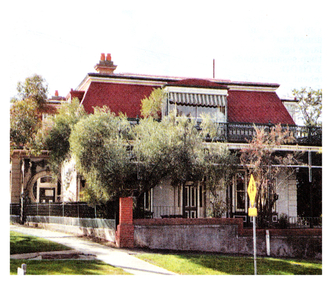
... Art Nouveau began in the 1880s as a reaction to classical, academic art. Itfeatures organic, especially floral motifs, highly stylized forms, and flowing curves. ...Art Nouveau began in the 1880s as a reaction to classical, academic art. Itfeatures organic, especially floral motifs, highly stylized forms, and flowing curves. ...Art Nouveau began in the 1880s as a reaction to classical, academic art. Itfeatures organic, especially floral motifs, highly stylized forms, and flowing curves. Artists aimed to integrate art into everyday life, influencing everything from architecture to furniture. Most outstanding examples are found in Riga (Latvia) and Brussels (Belgium), with Brussels townhouses recognized as UNESCO World Heritage sites for their architectural brilliance and historical importance. Local Examples are the Former Royal Bank Building (View Point): Built in 1908, designed by Beebe and Garin, now a restaurant. It survived the 1893 financial crash and stands out for its Art Nouveau influences. Denderah (now Cooloch House): Purchased and redecorated in 1910 by George Victor Lansell, featuring distinctive windows, colored glass, carved woodwork, and plaster ceilings. 159 Forest and Verona Street (Verona): Built in 1909 for Lawrence J. Murphy, notable for its cast-iron balustrade and curved woodwork, breaking traditional architectural lines.Contrast with Other StylesBendigo is known for its 19th-century classical buildings, but also features later styles like Art Nouveau and Art Deco. An upcoming Art Deco exhibition will be held at the Bendigo Art Gallery in September.History Lives Article - "New Art Has Classic Touch" - The Bendigo Miner Thursday Jul 24 2008 - Author Jim Evans, photos Bill Conroy This item contains the following: 11217.13a Colour Photo of Cooloch House on the corner of View and Valentine Streets - was Lansell's 11217.12b Colour Photo of Verona at 159 Forest Street 11217.12c Colour Photo of the former Royal Bank building at View Point (now the Whirakee Restaurant) 11217.12d Part of page - New Art Has Classic Touchnon-fictionbendigo, fortuna, george lansell, george victor lansell, denderah, cooloch, jim evans, art noveau -
 Embroiderers Guild, Victoria
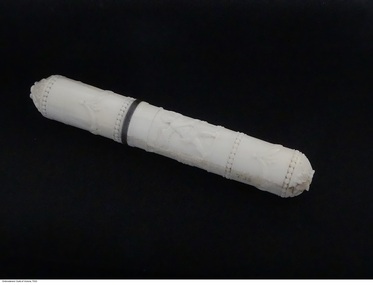
Tool - Ivory bodkin case, Bokin case
... Cylindrical ivory bodkin case decorated with bas relief classical design of two cherubs, four 'beaded' rings and flower and leaf motifs on each end. ...This is a luxury item in which to store bodkins Bodkin Cylindrical ivory bodkin case decorated with bas relief classical design of two cherubs, four 'beaded' rings and flower and leaf motifs on each end. ...A Bodkin is shaped like an oversized sewing needle with a blunt point and large eye and is used to pull a drawstring through a fabric casing- an essential to clothes fastenings for centuries.When most clothes were laced, bodkins were essential tool for dressing. This is a luxury item in which to store bodkins Cylindrical ivory bodkin case decorated with bas relief classical design of two cherubs, four 'beaded' rings and flower and leaf motifs on each end. Cap has horn edging. Containing three bodkinsbodkin -
 Embroiderers Guild, Victoria
Tool - Brass, Bodkin case
... Cylindrical ivory bodkin case decorated with bas relief classical design of two cherubs, four 'beaded' rings and flower and leaf motifs on each end. ...This is a luxury item in which to store bodkins Bodkin Cylindrical ivory bodkin case decorated with bas relief classical design of two cherubs, four 'beaded' rings and flower and leaf motifs on each end. ...A Bodkin is shaped like an oversized sewing needle with a blunt point and large eye and is used to pull a drawstring through a fabric casing- an essential to clothes fastenings for centuries.When most clothes were laced, bodkins were essential tool for dressing. This is a luxury item in which to store bodkins Cylindrical ivory bodkin case decorated with bas relief classical design of two cherubs, four 'beaded' rings and flower and leaf motifs on each end. Cap has horn edging. Containing three bodkinsbodkin -
Embroiderers Guild, Victoria
Tool - Bodkin, Bodkin case
... Cylindrical ivory bodkin case decorated with bas relief classical design of two cherubs, four 'beaded' rings and flower and leaf motifs on each end. ...This is a luxury item in which to store bodkins Bodkin Cylindrical ivory bodkin case decorated with bas relief classical design of two cherubs, four 'beaded' rings and flower and leaf motifs on each end. ...A Bodkin is shaped like an oversized sewing needle with a blunt point and large eye and is used to pull a drawstring through a fabric casing- an essential to clothes fastenings for centuries.When most clothes were laced, bodkins were essential tool for dressing. This is a luxury item in which to store bodkins Cylindrical ivory bodkin case decorated with bas relief classical design of two cherubs, four 'beaded' rings and flower and leaf motifs on each end. Cap has horn edging. Containing three bodkinsbodkin -
Embroiderers Guild, Victoria
Tool - Bodkin, Bodkin case
... Cylindrical ivory bodkin case decorated with bas relief classical design of two cherubs, four 'beaded' rings and flower and leaf motifs on each end. ...This is a luxury item in which to store bodkins Bodkin Cylindrical ivory bodkin case decorated with bas relief classical design of two cherubs, four 'beaded' rings and flower and leaf motifs on each end. ...A Bodkin is shaped like an oversized sewing needle with a blunt point and large eye and is used to pull a drawstring through a fabric casing- an essential to clothes fastenings for centuries.When most clothes were laced, bodkins were essential tool for dressing. This is a luxury item in which to store bodkins Cylindrical ivory bodkin case decorated with bas relief classical design of two cherubs, four 'beaded' rings and flower and leaf motifs on each end. Cap has horn edging. Containing three bodkinsbodkin -
Embroiderers Guild, Victoria
Tool - Bodkin, Bodkin case
... Cylindrical ivory bodkin case decorated with bas relief classical design of two cherubs, four 'beaded' rings and flower and leaf motifs on each end. ...This is a luxury item in which to store bodkins Bodkin Cylindrical ivory bodkin case decorated with bas relief classical design of two cherubs, four 'beaded' rings and flower and leaf motifs on each end. ...A Bodkin is shaped like an oversized sewing needle with a blunt point and large eye and is used to pull a drawstring through a fabric casing- an essential to clothes fastenings for centuries.When most clothes were laced, bodkins were essential tool for dressing. This is a luxury item in which to store bodkins Cylindrical ivory bodkin case decorated with bas relief classical design of two cherubs, four 'beaded' rings and flower and leaf motifs on each end. Cap has horn edging. Containing three bodkinsbodkin -
 Duldig Studio museum + sculpture garden
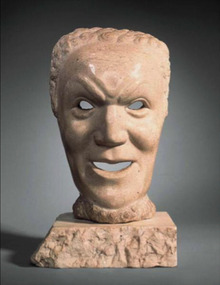
Sculpture, Karl Duldig, Mask by Karl Duldig 1921, 1921
... His interest may have been stimulated by his classical education, the Greek and Roman antiquities in the Kunsthistoriches Museum in Vienna, or the ethnological collections in Vienna’s Museum of Ethnology (now known as the Weltmuseum). The mask was a motif...His interest may have been stimulated by his classical education, the Greek and Roman antiquities in the Kunsthistoriches Museum in Vienna, or the ethnological collections in Vienna’s Museum of Ethnology (now known as the Weltmuseum). The mask was a motif ...Karl Duldig carved this marble sculpture of a mask in the Vienna Kunstgewerbeschule (School of Applied Arts) in 1921. His teacher, Anton Hanak, the Professor of Sculpture at the School, encouraged him to carve directly into the stone. It was an accomplished work for the 19 year-old student and was selected by Hanak to represent the students of the School at the Deutschen Gewerbeschau (German Applied Art exhibition) in Munich in 1922, an early accolade for the young artist. The sculpture and another Kneeling Nude were reproduced in the journal Deustche Kunst and Dekoration in 1923-24 in an article on the Hanak-Klasse. In 2011 Mask was exhibited in the National Gallery of Victoria exhibition Vienna: Art and Design. The sculpture is one of ten substantial sculptures in marble and stone, and a larger group terracotta sculptures and masks, portrait busts and small stone sculptures created by Karl Duldig in Vienna that are held in the Museum collection. These art works are complemented by an archive of contemporary documents including letters, photographs, documents and ephemera. In 1938 Duldig’s Viennese sculptures were sent to Paris in 1938 for a proposed exhibition, and were hidden in Paris by Slawa Duldig’s sister Rella, throughout the Second World War, and arrived in Australia post-war over 5 decades. Karl Duldig was a student of the Kunstgewerbeschule from 1921 until 1925, and then attended the Akademie Der Bildenden Künste (Academy of Fine Arts) from 1929 until 1933. He was accepted into the Professor Josef Mullner’s “Meisterschule” at the Academy of Fine Arts from 1929 until 1933. His teacher at the Kunstgwerebeschule was Austria’s foremost contemporary sculptor Anton Hanak, and he was a formative influence on Duldig’s work. Hanak had been a member of Viennese Secession, and worked with Josef Hoffman on architectural commissions prior to the First World War. Hanak shared both his love of the expressive quality of materials and a humanist vision with his students. Various writers have written about Duldig’s interest in masks. His interest may have been stimulated by his classical education, the Greek and Roman antiquities in the Kunsthistoriches Museum in Vienna, or the ethnological collections in Vienna’s Museum of Ethnology (now known as the Weltmuseum). The mask was a motif explored by expressionist and cubist artists whose work was exhibited at the Vienna Secession. Duldig would have been familiar with the psychological investigations of the neurologist and founder of psychoanalysis Sigmund Freud, who established his practice in Vienna. In the Duldig Studio library, Duldig’s keen interest in the arts of a myriad of visual cultures is apparent. Of particular note are two well-thumbed copies Rudolf Utzinger’s, Masken, published by Ernst Wasmuth in Berlin in 1923, depicting masks from around the world. It is likely that a multitude of influences were at play. Slawa Duldig also worked with this motif, and also carved a smaller mask in Salzburg marble as well as a remarkable mask in clay, and these are held in the collection. Ann Carew 2016The Mask has national and international aesthetic significance. It is one of the earliest works by Karl Duldig in the Studio collection, and is a subject that he would continue to explore throughout his working life. The sculpture demonstrates a high degree of technical skill and mastery at an early age. It is evidence of Duldig’s engagement with the art of his peers during this period – the mask is a motif that inspired contemporary expressionist and cubist artists. It also demonstrates his interests in portraiture, human psychology, and the creation of identity and transformation of personalities. The Mask also provides an important link to the studio practice in the Vienna Kunstgwerbeschule, the teaching of Anton Hanak, and the program of international art exhibitions in Europe during the period. It is also of historical significance: the story of its survival and eventual recovery provides a counterpoint to the story of the Nazis’ confiscation of art during the Second World War. Ann Carew 2016Carving in Salzburg Marble. Holes for eyes and mouth cut through the block. Highly polished finish at front contrasting with rough finish at back and stylised curled hair. Marble base separate (75 x 275 x 198, wt 9000) and added later by artist. Karl Duldig 1921 incised on back -
 Embroiderers Guild, Victoria
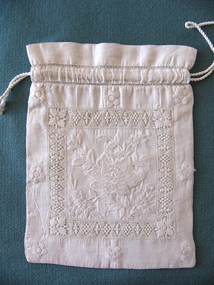
Accessory - Chinese Drawn Thread Reticule, Early 20th century
... classical Chinese bag of the period in the drawstring style fashionable for use with summer dresses. Made for European markets. Embroidery Bags Reticules 1900-20 China floral Reticule made in white "Grass" fabric, with a square of drawn thread work with a large chinese floral motif on back and front. ...A classical Chinese bag of the period in the drawstring style fashionable for use with summer dresses. Made for European markets.Reticule made in white "Grass" fabric, with a square of drawn thread work with a large chinese floral motif on back and front. There are 8 flower heads around the design. Drawstring top in encased between 2 rows of drawn hemstitching. embroidery, bags, reticules, 1900-20, china, floral -
 Embroiderers Guild, Victoria
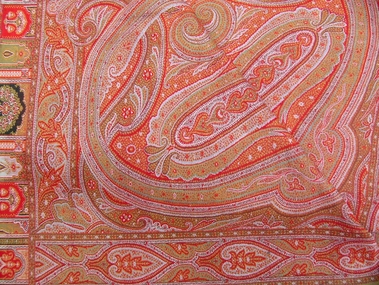
Accessory - Shawl, circa 1850
... Classical Paisley harness [loom} shawl woven in many colours with a red background and Persian style motifs....Well used Weaving Shawls 1840-60 Scotland Classical Paisley harness [loom} shawl woven in many colours with a red background and Persian style motifs. ...Brought to Australia by a pioneer family, 1849-51. Well usedClassical Paisley harness [loom} shawl woven in many colours with a red background and Persian style motifs.weaving, shawls, 1840-60, scotland -
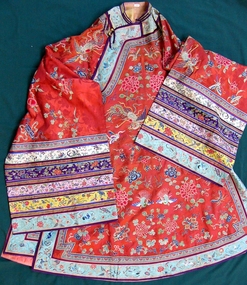 Embroiderers Guild, Victoria
Clothing - Chinese Mandarin Robe, Circa 17th century
... Classical style of garment, very long-sleeved in red silk with coloured embroidery. The symbols belong to a high ranking official, symbols of two white doves embroidered on the back, and also the long sleeves with their decorative embroidered bands of turquoise, blue, pink and yellow. The front of the garment overlaps the right side with five small decorative buttons fastened with loops. The buttons were gold and because of their value they were replaced with identical brass buttons. Motifs...Classical style of garment, very long-sleeved in red silk with coloured embroidery. The symbols belong to a high ranking official, symbols of two white doves embroidered on the back, and also the long sleeves with their decorative embroidered bands of turquoise, blue, pink and yellow. The front of the garment overlaps the right side with five small decorative buttons fastened with loops. The buttons were gold and because of their value they were replaced with identical brass buttons. Motifs ...Purchased by the donor from a Chinese family on a rubber estate in Malacca for 3 pound in 1922. The country was suffering a deep depression owing to a slump in rubber and many wealthy Chinese were in serious financial difficulties and were realising on anything they could. When the coat was on show at an exhibition the donor was told by someone who had lived in China for many years that it was a very fine example and was possibly 200-300 years old (identified by the cut and fastening of the front panel). The golden pheasants embroidered on the back indicated it came from a Southern state and from a family of high degree. Some years later it was dated as 17th century. Classical style of garment, very long-sleeved in red silk with coloured embroidery. The symbols belong to a high ranking official, symbols of two white doves embroidered on the back, and also the long sleeves with their decorative embroidered bands of turquoise, blue, pink and yellow. The front of the garment overlaps the right side with five small decorative buttons fastened with loops. The buttons were gold and because of their value they were replaced with identical brass buttons. Motifs include phoenix, butterflies, birds, pomegranate, flowers and auspicious symbols. Predominate stitch used is Pekinese Knot Stitch with couched gold outlines of the motifs. The birds and butterflies are worked in satin and long and short stitch. embroidery, garments, china, silk embroidery, oriental, 17th century
