
Showing 24 items matching "cleansing"
-
 Hume City Civic Collection
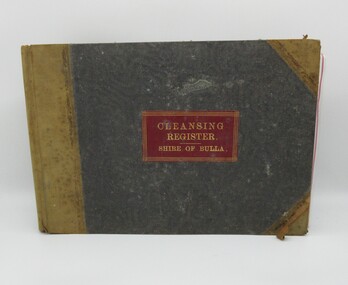
Cleansing Register, Cleansing Register Shire of Bulla, c1895
... Cleansing Register Shire of Bulla..."Cleansing/Register/..."...Green, black and red colour mottled pages inside front and back covers. Cleansing Register Shire of Bulla Cleansing Register Arnall & Jackson, Printers & Manufacturing Stationers Arnall & Jackson, Printers & Manufacturing Stationers ...This book is hand written in ink a list of occupiers and addresses of properties in Sunbury requiring cleaning of water closets between the years 1895 and 1908. Water closets were used before sewerage was connected to the town.Cloth covered hard cover book with tan colour corners and spine which have small embossed pattern on edges. Gold writing on red background on front cover. Green, black and red colour mottled pages inside front and back covers."Cleansing/Register/..."1890s, shire of bulla, sunbury, george evans collection -
 Warrnambool and District Historical Society Inc.
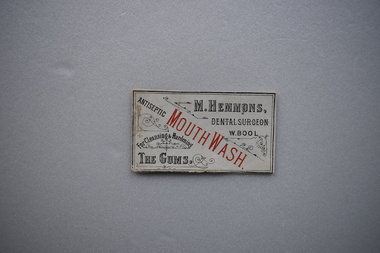
Label, Gaspars Modern Print, M.Hemmons, Dentist, Early 20th century
... Hemmons Dental Surgeon, W’bool Antiseptic Mouth Wash for Cleansing and Hardening the Gums ...Hemmons Dental Surgeon, W’bool Antiseptic Mouth Wash for Cleansing and Hardening the Gums This is a small white card with a black border, black and red printing and some decorative patterns. ...This is a label from the business of Melsom Hemmons, a Warrnambool dentist in the late 19th and early 20th centuries. He had a practice at first in the chemist’s shop of Richard F. Kennedy in Timor Street and was later in Kepler Street.This label is of interest as a memento of a prominent dentist with a business in Warrnambool a hundred years ago. This is a small white card with a black border, black and red printing and some decorative patterns.M. Hemmons Dental Surgeon, W’bool Antiseptic Mouth Wash for Cleansing and Hardening the Gums melsom hemmons, warrnambool dentist, history of warrnambool, label -
 Bendigo Historical Society Inc.
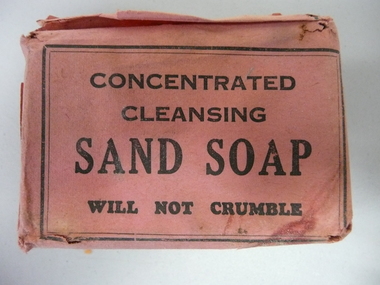
Domestic Object - SAND SOAP
... Cake of household sand soap for scrubbing floors, tables, woodwork and saucepans, made by Preservene Pty Ltd, pink wrapper reads concentrated cleansing sand soap will not crumble....DOMESTIC EQUIPMENT Cleaning soap Preservene pty Ltd Stawell St Burnley Cake of household sand soap for scrubbing floors, tables, woodwork and saucepans, made by Preservene Pty Ltd, pink wrapper reads concentrated cleansing sand soap will not crumble. Domestic Object SAND SOAP ...Cake of household sand soap for scrubbing floors, tables, woodwork and saucepans, made by Preservene Pty Ltd, pink wrapper reads concentrated cleansing sand soap will not crumble.Preservene pty Ltd Stawell St Burnleydomestic equipment, cleaning, soap -
 Yarra City Council
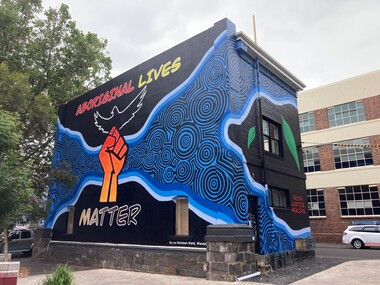
Artwork, other - Mural, Ky-ya Nicholson-Ward, Aboriginal Lives Matter, 2021
... On a black background a hand fist (strength, solidarity and justice) is placed at the centre of the building; Bunjil (wedge-tailed eagle) is depicted flying high on the building; blue circles and lines represent revival and waterways (Birrarung-Yarra River) and the leaves in the artwork highlight Wurundjeri people (cleansing of spirit and welcome to Country)...On a black background a hand fist (strength, solidarity and justice) is placed at the centre of the building; Bunjil (wedge-tailed eagle) is depicted flying high on the building; blue circles and lines represent revival and waterways (Birrarung-Yarra River) and the leaves in the artwork highlight Wurundjeri people (cleansing of spirit and welcome to Country) Aboriginal Lives Matter Artwork, other Mural Ky-ya Nicholson-Ward ..."The fist references the Black Lives Matter movement and also represents the strength of Indigenous peoples all over the world and symbolises solidarity and justice for everyone affected by systematic racism. Bunjil (wedge-tailed eagle) is flying high on the building. He is the creator spirit for Wurundjeri people who looks over us and protects us. Bunjil represents healing and power to our people. The blue circles and lines represent revival and waterways; in particular, they depict the Birrarung (Yarra River), which is very significant for the Wurundjeri people. Our people are known as the Manna Gum people. The leaves in the artwork highlight Wurundjeri people and their Country. These leaves also represent the cleansing of negative spirits. The Manna Gum leaf is also an important symbolic offering in our traditional Welcome to Country ceremony. Leaves are offered to visitors as they are granted safe passage through our land. They are made welcome to everything from the tops of the trees to the roots of the earth. We ask that they take care of the land, plants and animals and to respect the protocols and rules of the Traditional Owners whilst on our Country."In 2020 Council declared its support for the global Black Lives Matter (BLM) movement. In consultation with Yarra City Council's Yana Ngargna advisory group a motion was prepared and passed unanimously by all Councillors. A number of actions were generated from this decision; one of which was for Council to commission a large-scale mural that aligned with the movement. Emerging artist Ky-ya Nicholson-Ward, a proud Wurundjeri, Dja Dja Wurrung, Nguarai Illam-Wurrung, German and Irish woman, created the mural installed on a building in Peel Street Park, Collingwood. Selected by Council's Yana Ngargna, Black Lives Matter Working Group the artwork identifies the cultural importance of the local area to the Wurundjeri Woi Wurrung people as the Traditional Owners. With a strong focus on Aboriginal identity the mural outlines the local context of the Black Lives Matter movement, which is connected to racism, policing of Aboriginal and Torres Strait Islander peoples and associated deaths in custody. The artwork acknowledges the ongoing challenges faced by Aboriginal community members and their struggle to survive white systems, policies and institutions. Ky-ya's mural tells the story of Aboriginal resilience, strength and self-determination; and will support the process of healing. It is a celebration of the local Aboriginal and Torres Strait Islander community; the significant Aboriginal history of Fitzroy, Collingwood and surrounds; and community's continuing cultural connection to the area. Importantly, this artwork provides a platform to educate a broader audience about the local context of the Black Lives Matter movement and Aboriginal deaths in custody. The mural will activate this site, enliven the area, promote inclusion, incite conversation and contribute to the creative capital of this locale. A welcoming environment for Aboriginal and non-Aboriginal communities.Aboriginal Lives Matter Ky-ya Nicholson WardOn a black background a hand fist (strength, solidarity and justice) is placed at the centre of the building; Bunjil (wedge-tailed eagle) is depicted flying high on the building; blue circles and lines represent revival and waterways (Birrarung-Yarra River) and the leaves in the artwork highlight Wurundjeri people (cleansing of spirit and welcome to Country)The artist name 'Ky-ya Nicholson Ward' painted in white, low right of the wall facing into Peel Street Park. black lives matter (blm) movement, wurundjeri woi wurrung, bunjil, identity, birrarung, country -
 City of Moorabbin Historical Society (Operating the Box Cottage Museum)
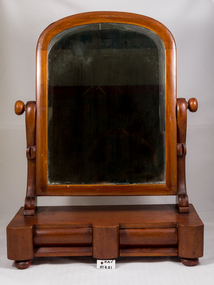
Furniture, Dressing table swing mirror c1900, c1900
... Accompanied by a wash stand , basin and water jug people cleansed, shaved and tidied their hair and themselves between their weekly bath. ...Accompanied by a wash stand , basin and water jug people cleansed, shaved and tidied their hair and themselves between their weekly bath. ...This dressing table with swing mirror was used by the early settler families of Moorabbin Shire c1900. Accompanied by a wash stand , basin and water jug people cleansed, shaved and tidied their hair and themselves between their weekly bath. This Dressing table mirror was owned by a pioneer family of Moorabbin Shire c1900 c1900 Mahogany Toilet / Swing Dressing table mirror A shaped mirror, domed top with thick frame, turned side supports finished with small finials and a solid base on 4 round supportseraly settlers, pioneers, furniture , mirrors, dressing tables, mahogany wood, carpenters, cabinet makers, market gardeners, moorabbin shire, bentleigh, cheltenham -
 Royal Australian and New Zealand College of Obstetricians & Gynaecologists (RANZCOG)
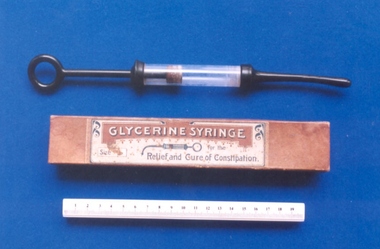
Rectal glycerin syringe with original box
... Glycerin rectal is used to treat occasional constipation or to cleanse the bowel before a rectal exam or other intestinal procedure. ...Glycerin rectal is used to treat occasional constipation or to cleanse the bowel before a rectal exam or other intestinal procedure. ...Glycerin is used as a laxative. It works by causing the intestines to hold more water, which softens the stool. Glycerin rectal is used to treat occasional constipation or to cleanse the bowel before a rectal exam or other intestinal procedure. (https://www.drugs.com/mtm/glycerin-rectal.html)Metal and glass syringe with cork plunger [125.2], used for rectal irrigation. In original manufacturers box which is printed, "Glycerine Syringe"/ For the relief and cure of constipation". Box [125.3].constipation, irrigation -
 Tatura Irrigation & Wartime Camps Museum
Photograph, Italian migrant boys
... The boys are from Fiume, Istria a Zara They were ethnically cleansed by the Yugoslavs between 1945 and 1950, and emigrated under the UN Sponsorship Plan IRD to Australia, arriving on the M.V. ...The boys are from Fiume, Istria a Zara They were ethnically cleansed by the Yugoslavs between 1945 and 1950, and emigrated under the UN Sponsorship Plan IRD to Australia, arriving on the M.V. ...The boys are from Fiume, Istria a Zara They were ethnically cleansed by the Yugoslavs between 1945 and 1950, and emigrated under the UN Sponsorship Plan IRD to Australia, arriving on the M.V. Castel Bianca on 27.12.1951. Held at Rushworth Migrant Centre, known as Camp Desperation 'fortimo".Black and white photo, group of 4 boys with toddler in front of barracks. February 1952 at Rushworth Migrant Centre.rushworth migrant centre, photography, camera, accessory, photograph, slides, film -
Port Melbourne Historical & Preservation Society
Book - Port Melbourne Council, Sanitary Inspectors Report Book, J L Cousland, Inspector et al, 1944 - 1955
... Detailing testing and immunisation programmes, mass x-ray, vaccination for smallpox, cleansing station opened, poor conditions in emergency housing areas, Lands Dept neglect of Crown land, rubbish dumped in air raid shelters, advice sought re football and cricket played on streets, wood for pensioners...Detailing testing and immunisation programmes, mass x-ray, vaccination for smallpox, cleansing station opened, poor conditions in emergency housing areas, Lands Dept neglect of Crown land, rubbish dumped in air raid shelters, advice sought re football and cricket played on streets, wood for pensioners Book Port Melbourne Council, Sanitary Inspectors Report Book J L Cousland, Inspector B E W Aitken, Health Inspector ...Sanitary Inspector's Reports to Port Melbourne Council 1944-1955. Detailing testing and immunisation programmes, mass x-ray, vaccination for smallpox, cleansing station opened, poor conditions in emergency housing areas, Lands Dept neglect of Crown land, rubbish dumped in air raid shelters, advice sought re football and cricket played on streets, wood for pensionersLabel on spine illegible; 'Inspectors reports' inside covertransport - motor vehicles, local government - city of port melbourne, environmental issues, health - general health, business and traders, industry, nightsoil, built environment, fishermans bend, livestock, engineering - canals and drainage, james llewellyn cousland, b e w aitken, harley grover, dr merrilees, mr hepburn -
 Warrnambool and District Historical Society Inc.
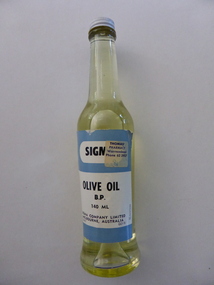
Bottle, Sigma Company Limited, Thomas Pharmacy Olive Oil, Mid 20th century
... Olive oil in the 1970's was used primarily to moisten and cleanse dry skin.It has also been used as a laxative. ...Olive oil in the 1970's was used primarily to moisten and cleanse dry skin.It has also been used as a laxative. ...Thomas' pharmacy operated from Fairy Street in Warrnambool, initially from 90 fairy Street on the corner of Fairy and Koroit Streets then later moving to 140 Fairy Street on the corner of Fairy and Lava Streets. Mrs W L Hobson is noted as the pharmacist in the 1970's. Olive oil in the 1970's was used primarily to moisten and cleanse dry skin.It has also been used as a laxative. It is generally well tolerated and considered safe for skin care for babies. A commonly used product which has multiple uses.Clear glass bottle with long narrowed neck. White screw top and dusty blue and white paper label with black text. Small sticker on right side of label. Filled with olive oil. Thomas' Pharmacy Warrnambool Phone 622907 on sticker. Sigma Company Limited Melbourne Australia on bottom of label. 1270 and crown on the bottom of the bottle.thomas pharmacy, warrnambool, olive oil -
 City of Greater Geelong
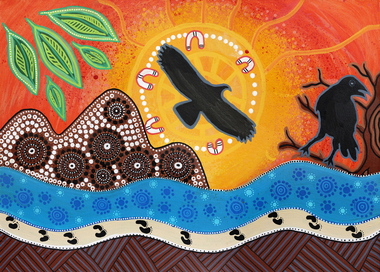
Painting - Acrylic on Canvas, Billy-Jay O'Toole, Wadawurrung Country and Connection, 2019
... The white creamy section represents our coastline with the footprints imbedded into the sand tells the story of our old people who have been so connected to this coastline for many thousands of years, the mountain represents the You Yangs which holds a special part of our history here on Wadawurrung country, the 7 gathering circles in the mountain represents the 7 family groups within Wadawurrung, WAA the crow he is our protector here on country and Bundjil is our creator which is why I have implemented these 2 birds into my painting, the u shape people symbols represents my family of 5 generations still living on Wadawurrung country, my great grandmother Joye Eccles my pop norm Eccles my mum Corrina Eccles myself and my beautiful daughter Alira, the eucalyptus leaves up the top is a part of cleansing I have incorporated therese leaves because this country is cleansed everyday by he family when conducting a smoking ceremony....The white creamy section represents our coastline with the footprints imbedded into the sand tells the story of our old people who have been so connected to this coastline for many thousands of years, the mountain represents the You Yangs which holds a special part of our history here on Wadawurrung country, the 7 gathering circles in the mountain represents the 7 family groups within Wadawurrung, WAA the crow he is our protector here on country and Bundjil is our creator which is why I have implemented these 2 birds into my painting, the u shape people symbols represents my family of 5 generations still living on Wadawurrung country, my great grandmother Joye Eccles my pop norm Eccles my mum Corrina Eccles myself and my beautiful daughter Alira, the eucalyptus leaves up the top is a part of cleansing I have incorporated therese leaves because this country is cleansed everyday by he family when conducting a smoking ceremony. ...The blue section of the paining represents our amazing ocean, bays, rivers, creeks and wetlands. The white creamy section represents our coastline with the footprints imbedded into the sand tells the story of our old people who have been so connected to this coastline for many thousands of years, the mountain represents the You Yangs which holds a special part of our history here on Wadawurrung country, the 7 gathering circles in the mountain represents the 7 family groups within Wadawurrung, WAA the crow he is our protector here on country and Bundjil is our creator which is why I have implemented these 2 birds into my painting, the u shape people symbols represents my family of 5 generations still living on Wadawurrung country, my great grandmother Joye Eccles my pop norm Eccles my mum Corrina Eccles myself and my beautiful daughter Alira, the eucalyptus leaves up the top is a part of cleansing I have incorporated therese leaves because this country is cleansed everyday by he family when conducting a smoking ceremony.Painting of Eagle and Crow with water and footprints below. Brown, orange, blue, green, black used.bundjil, you yangs, wadawurrung -
 Flagstaff Hill Maritime Museum and Village
Domestic object - Soap, Wright, Layman & Umney Ltd, ca 20th century
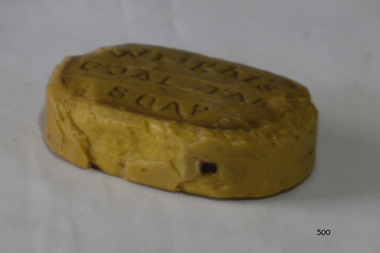
... ...cleansing...The oval yellow soap tablet was antiseptic, designed to cleanse the skin thoroughly. It was originally named Sapo Carbonis Detergens, which remains a registered trademark. ...The oval yellow soap tablet was antiseptic, designed to cleanse the skin thoroughly. It was originally named Sapo Carbonis Detergens, which remains a registered trademark. ...Wright’s Coal Tar Soap was a popular brand of household soap, manufactured by William Valentine Wright from 1867. The oval yellow soap tablet was antiseptic, designed to cleanse the skin thoroughly. It was originally named Sapo Carbonis Detergens, which remains a registered trademark. The product was developed from ‘liquor carbonis detergens’, the liquid by-product of the distillation of coal to make coke. The liquid was made into an antiseptic soap for treating skin diseases. William Valentine Wright was born in 1826 at Aldeburgh, Suffolk. He was a wholesale druggist and chemist who had a small business, W.V. Wright & Co., at 11 Old Fish Street Hill, City of London, where he first sold the soap. In 1863 Wright moved his firm to small premises at 50 Southwark Street, Southwark, London, and not long afterwards M. Sellers and Mr Charles Noel Layman joined the partnership. The company's name changed to Wright, Layman & Umney, when Charles Umney (1843–1909) was taken into the partnership on June 17, 1876, after the death of M. Sellers. William Valentine Wight 1877. Rob Umney, great-great-grandson of Charles Umney, provided further details about the firm, adding that in the late 1960s, the Wright’s Coal Tar Soap business was taken over by LRC Products Ltd who sold it to Smith & Nephew in 1994. The current owners of the brand, Simple Health and Beauty Ltd are based in Solihull and the soap is called Wright's Traditional Soap ‘With coal tar fragrance’. The coal tar has been replaced with tea tree oil. There were concerns that ingredients in coal tar could cause cancer when a person is exposed to very high concentrations, such as in roofing and road paving. In January 2025 the current manufacturers still produce the Wright's Coal Tar Soap.Wright's Coal Tar Soap was sold throughout the United Kingdom and Colonies, which includes Australia. The soap represents many consumer goods sold at pharmacies and chemist shops across the world, such as Sambell and Son, who operated a pharmacy in Fairy Street, Warrnambool in the 19th century. The product has endured for over 150 years.Soap; yellow oval tablet of soap engraved with the brand Wright's Coal Tar oval."WRIGHT'S / COAL TAR / SOAP"flagstaff hill, maritime museum, wright's, coal tar soap, soap, bathing, antiseptic, washing, personal hygiene, london, southwark, chemist, pharmacist, colonies, wright's coal tar soap, sapo carboni detergens, england, soap tablet, babies soap, nursery soap, wright, layman & umney ltd., w.t. wrifght & co., soap cake, soap bar, medical, cleansing, baby care -
 Flagstaff Hill Maritime Museum and Village
Domestic object - Vanity Jar, 1920s
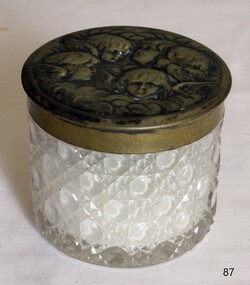
... Skincare cosmetics used for ageing skin have been a priority for over 3000 years, in ancient times masks were used to cleanse and maintain the moisture of the skin. ...Skincare cosmetics used for ageing skin have been a priority for over 3000 years, in ancient times masks were used to cleanse and maintain the moisture of the skin. ...Skincare cosmetics used for ageing skin have been a priority for over 3000 years, in ancient times masks were used to cleanse and maintain the moisture of the skin. The Egyptians used anti-wrinkle creams made with the essential oil of frankincense which claimed to possess anti-inflammatory properties. Thick creams use on the face were created to preserve moisture on mature skin. And were formulated from resin, wax, oil, grass, and plant juice, In the 1700s, face toners and scented water were popular. Cold cream made with scented oils, spermaceti, and wax mixed with rose water and ambergris was a common toilette preparation. But it was the 20th century when face cosmetics entered their golden era and mass production made cosmetics available to women of all classes. An item used to store face cream from the 1920s when face creams and other cosmetics started to become available to all classes of women and no longer were these types of preparations only available to women of financial means.Clear glass jar with "hobnail" pattern and brass lid used to hold face cream cosmetics.Lid decorated with a relief design of 5 cherub heads and cloudsflagstaff hill, warrnambool, shipwrecked coast, flagstaff hill maritime museum, maritime museum, shipwreck coast, flagstaff hill maritime village, great ocean road, glass jar, cosmetics jar, toilet article -
 Embroiderers Guild, Victoria
Textile - Mary Lain Drew Sampler 1827, Mary Lain Drew age eight years 1827, 1827
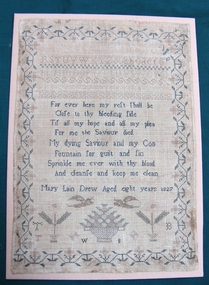
... "For ever here my rest shall be Close to thy bleeding side Tis all my hope and all my plea For me the Saviour died My dying Saviour and my God Fountain for guilt and sin Sprinkle me ever with thy blood And cleanse and keep me clean" Mary Lain Drew age eight years 1827 RHS T and T below Middle W S either side of Vase Motif LHS B...Embroidery Samplers Early 19th century England Cross stitch "For ever here my rest shall be Close to thy bleeding side Tis all my hope and all my plea For me the Saviour died My dying Saviour and my God Fountain for guilt and sin Sprinkle me ever with thy blood And cleanse and keep me clean" Mary Lain Drew age eight years 1827 RHS T and T below Middle W S either side of Vase Motif LHS B Sampler with alphabet, verse, spots of baskets of fruit, etc. and strawberry border. ...Bought by donor's husband at a Uniting Church sale 10-15 years ago.Sampler with alphabet, verse, spots of baskets of fruit, etc. and strawberry border. Soft colours, probably faded with dark green and blue. Cross stitch embroidery."For ever here my rest shall be Close to thy bleeding side Tis all my hope and all my plea For me the Saviour died My dying Saviour and my God Fountain for guilt and sin Sprinkle me ever with thy blood And cleanse and keep me clean" Mary Lain Drew age eight years 1827 RHS T and T below Middle W S either side of Vase Motif LHS Bembroidery, samplers, early 19th century, england, cross stitch -
Kew Historical Society Inc
Archive (Sub-series) - Subject File, Kew, City of - Management, 1958
... Interesting early primary sources include: 1914 Amendments to the Local Government Act of 1903 [copy owned by Mr W.J. Muntz C.E.]; a Cleansing Contract [for the removal of night-soil] (1913); an Annual Statement of Accounts (1923); and By-Law No.66 (1939) [relating to the “Erection Construction and Removal of Buildings, Advertising Signs, Etc.”; and the Councillor’s Handbook (1939). ...Interesting early primary sources include: 1914 Amendments to the Local Government Act of 1903 [copy owned by Mr W.J. Muntz C.E.]; a Cleansing Contract [for the removal of night-soil] (1913); an Annual Statement of Accounts (1923); and By-Law No.66 (1939) [relating to the “Erection Construction and Removal of Buildings, Advertising Signs, Etc.”; and the Councillor’s Handbook (1939). ...City of KewReference, Research, InformationKHS Imposed OrderKew in Victoria was declared a City in 1921, and remained so until it was amalgamated into the City of Boroondara in 1994. This is a single large archive file, primarily comprised of Kew Council documents, a number of which date from an earlier period. Interesting early primary sources include: 1914 Amendments to the Local Government Act of 1903 [copy owned by Mr W.J. Muntz C.E.]; a Cleansing Contract [for the removal of night-soil] (1913); an Annual Statement of Accounts (1923); and By-Law No.66 (1939) [relating to the “Erection Construction and Removal of Buildings, Advertising Signs, Etc.”; and the Councillor’s Handbook (1939). In addition to these, later publications relate to Financial Statements (1986, 1987, 1988); Model Local Laws (1989); a Municipal Emergency Management Plan (1990); Mobile Bin Recycling Trial (1991); a School Project Kit (1991-2); and Committee Minutes (1992). There are also a number of newspaper articles/clippings on Council management issueslocal government - kew (vic) - publications, city of kew - management, city of kew - amendments to the local government act 1903, city of kew - by-laws, city of kew - financial statements, city of kew - councillor's handbook, city of kew - municipal emergency management plan 1990, city of kew - mobile bin recycling trial (1991)local government - kew (vic) - publications, city of kew - management, city of kew - amendments to the local government act 1903, city of kew - by-laws, city of kew - financial statements, city of kew - councillor's handbook, city of kew - municipal emergency management plan 1990, city of kew - mobile bin recycling trial (1991) -
 Emerald Museum & Nobelius Heritage Park
Container - Medicinal tablet box, unknown
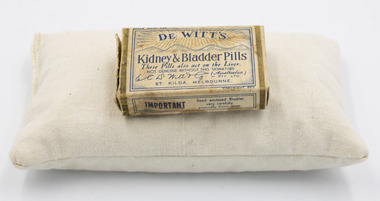
... /St.kilda, Melbourne/De Witt's Kidney & Bladder pills - for weak kidneys, rheumatism, inflammation of the bladder, bachache, scalding or scanty urine, too frequent desire to urinate, gravel and all uric acid complaints. Cleanse the system. Act surely but gently on the liver/Dose - Adults take 1 pill before each meal and 2 at bedtime, with glassful of pure water. .../St.kilda, Melbourne/De Witt's Kidney & Bladder pills - for weak kidneys, rheumatism, inflammation of the bladder, bachache, scalding or scanty urine, too frequent desire to urinate, gravel and all uric acid complaints. Cleanse the system. Act surely but gently on the liver/Dose - Adults take 1 pill before each meal and 2 at bedtime, with glassful of pure water. ...Off the shelf medication produced by a well known medications firm, who still exist today - De Witt.The pills and the associated instruction sheet give a view of how common ailments were dealt with in a previous era.A small pill box containing De Witts kidney & Bladder pills (3) & InstuctionsDe Witt's Kidney & Bladder Pills/These pills also act on the liver/Not genuine without this signature (Signed - E.C.De Witt)/Australia Pty. Ltd./St.kilda, Melbourne/De Witt's Kidney & Bladder pills - for weak kidneys, rheumatism, inflammation of the bladder, bachache, scalding or scanty urine, too frequent desire to urinate, gravel and all uric acid complaints. Cleanse the system. Act surely but gently on the liver/Dose - Adults take 1 pill before each meal and 2 at bedtime, with glassful of pure water. After taking these pills the urine will become a bluish or greenish colour. Do not be alarmed. Read enclosed booklet/enclosed lengthy instruction sheet -
 City of Moorabbin Historical Society (Operating the Box Cottage Museum)
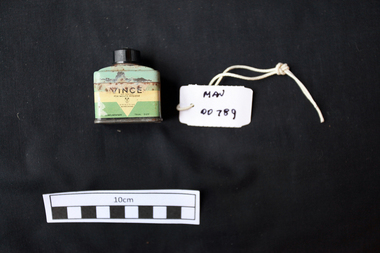
Containers, glass jar ‘Vince’ mouth hygeine, c1950
... Vince® is an oral rinse and dentifrice used to cleanse and refresh your gums. Vince is pleasantly flavoured and buffered for safe daily use. ...Vince® is an oral rinse and dentifrice used to cleanse and refresh your gums. Vince is pleasantly flavoured and buffered for safe daily use. ...Vince® is an oral rinse and dentifrice used to cleanse and refresh your gums. Vince is pleasantly flavoured and buffered for safe daily use. It releases oxygen – a helpful adjunct in promoting better oral hygiene for the mouth, teeth and gums. Vince also helps promote healing of the mouth and gums to relieve occasional soreness and irritation from dental appliances such as braces or dentures or mouth sores and wounds such as a split lip.. Ingredients : Sodium Alum, Calcium Carbonate, Sodium Perborate Monohydrate, Sodium Carbonate, Magnesium Trisillicate, Tricalcium Phosphate, Sodium Saccharin, Flavor, D&CRed#28. Lee Pharmaceuticals (Lee) incorporated in 1971 may have bought Vince Pty Ltd. It is a manufacturer of personal care and cosmetic products and is based in South El Monte, California. The Company’s portfolio of products includes aloe vera products, antacids, cosmetics and douche, cough and cold products, cough and cold products, baby care, laxatives, lip balm products, men's personal care, Monticello drug division, oral care, pain relievers, personal care, skin care, tobacco accessories, topical ointments and creams and vitamins and nutritional items. Vince may still be available from the Monticello Drug Division of Lee Pharmaceuticals Ltd Bocasan (British market name) and Amosan (U.S. market name) are oral rinse preparations that are similar to Vince they are now made by Oral-B Laboratories. A small green glass jar, with a screw top lid, containing 'VINCE' mouth hygiene solutionFront label : VINCE / Regd. Trade Mark / FOR/ MOUTH HYGIENE / EFFECTIVE / REFRESHING / COMPLEMENTARY TRIAL SIZE Back label : DIRECTIONS ................./ VINCE LABORATORIES / LTD / NEW YORK N.Y. SYDNEY N.S.W.toiletries, mouth wash, medications, chemicals, pharmacy, cheltenham, moorabbin, vince laboratories ltd., sydney, new york, early settlers -
 City of Ballarat
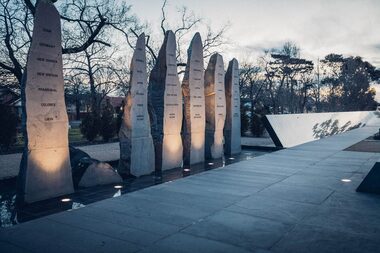
Artwork, other - Public Artwork, Ex-Prisoners of War Memorial by Peter Blizzard, 2004
... Water symbolizes the essential nature of man, sacrifice, suffering, spirituality, healing, cleansing, birth and re-birth. The memorial is created from natural materials and is designed to be in harmony with the Ballarat Botanical Gardens, and to create a sense of timeless, dignity and respect. ...Water symbolizes the essential nature of man, sacrifice, suffering, spirituality, healing, cleansing, birth and re-birth. The memorial is created from natural materials and is designed to be in harmony with the Ballarat Botanical Gardens, and to create a sense of timeless, dignity and respect. ...This memorial designed by Peter Blizzard is dedicated to more than 36,000 Australian men and women were held captive as prisoners by the enemy during the Boer War, World War 1, World War 2 and the Korean War. This memorial honours and names them, the names are etched into the black granite wall adjacent to the pathway. Water springs from beneath the 'Lest We Forget' stone then flows down the wall into the narrow watercourse in front of the first group of names and into the reflective pool, then continues past the second group of names. Finally it disappears under the pathway, returning to its source under the 'Lest We Forget' stone to start the journey again. Water symbolizes the essential nature of man, sacrifice, suffering, spirituality, healing, cleansing, birth and re-birth. The memorial is created from natural materials and is designed to be in harmony with the Ballarat Botanical Gardens, and to create a sense of timeless, dignity and respect. The long pathway of the monument is designed to create a visual perspective of the large distances that Australians travelled to the various conflicts. The paving is shaped like railway sleepers in recognition of the role that railways and railway journeys were relevant to many prisoners of war. The Memorial was declared the first military memorial of national significance located outside Canberra in 2008. Dedication services are held at the memorial on the Sunday closest to 6th of February, ANZAC day and on Remembrance Day. The memorial is of historical and aesthetic importance to the people of BallaratMonument made from carved bluestone, water feature and flagsInscribed with the names of 36,000 Australian men and women were held captive as prisoners by the enemy during the Boer War, World War 1, World War 2 and the Korean War. The listing is by surname and initials and shown by war.prisoners of war, boer war, world war 1, world war 2, korean war, lest we forget, peter blizzard -
 Flagstaff Hill Maritime Museum and Village
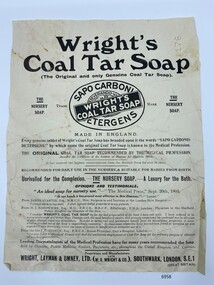
Flyer - Advertisement, Soap, Wright, Layman & Umney Ltd, Late 1940s
... The yellow soap was antiseptic, designed to cleanse the skin thoroughly. It was originally named Sapo Carbonis Detergens, which remains a registered trademark. ...The yellow soap was antiseptic, designed to cleanse the skin thoroughly. It was originally named Sapo Carbonis Detergens, which remains a registered trademark. ...Wright’s Coal Tar Soap was a popular brand of household soap, manufactured by William Valentine Wright from 1867. The yellow soap was antiseptic, designed to cleanse the skin thoroughly. It was originally named Sapo Carbonis Detergens, which remains a registered trademark. The product was developed from ‘liquor carbonis detergens’, the liquid by-product of the distillation of coal to make coke. The liquid was made into an antiseptic soap for treating skin diseases. William Valentine Wright was born in 1826 at Aldeburgh, Suffolk. He was a wholesale druggist and chemist who had a small business, W.V. Wright & Co., at 11 Old Fish Street Hill, City of London, where he first sold the soap. In 1863 Wright moved his firm to small premises at 50 Southwark Street, Southwark, London, and not long afterwards M. Sellers and Mr Charles Noel Layman joined the partnership. The company's name changed to Wright, Layman & Umney, when Charles Umney (1843–1909) was taken into the partnership on June 17, 1876, after the death of M. Sellers. William Valentine Wight 1877. Rob Umney, great-great-grandson of Charles Umney, provided further details about the firm, adding that in the late 1960s, the Wright’s Coal Tar Soap business was taken over by LRC Products Ltd who sold it to Smith & Nephew in 1994. The current owners of the brand, Simple Health and Beauty Ltd are based in Solihull and the soap is called Wright's Traditional Soap ‘With coal tar fragrance’. The coal tar has been replaced with tea tree oil. There were concerns that ingredients in coal tar could cause cancer when a person is exposed to very high concentrations, such as in roofing and road paving. In January 2025 the current manufacturers still produce the Wright's Coal Tar Soap.The flier states that Wright's Coal Tar Soap was sold throughout the United Kingdom and Colonies, which includes Australia. The soap is representative of the many consumer goods sold at pharmacies and chemist shops across the world, such as Sambell and Son, who operated a pharmacy in Fairy Street, Warrnambool in the 19th century. The paper flier is rectangular and has printed text and a logo. The top right corner has stamped punch marks. It promotes Wright's Coal Tar Soap, made by Wright, Layman & Umney Ltd. England.Punch mark; "1176"flagstaff hill, maritime museum, wright's, coal tar soap, soap, bathing, antiseptic, washing, personal hygiene, london, southwark, chemist, pharmacist, colonies, wright's coal tar soap, sapo carboni detergens, punch marks, england, soap tablet, babies soap, nursery soap, advertising, poster, flyer, wright, layman & umney ltd., w.t. wrifght & co., soap bar, soap cake -
 Kiewa Valley Historical Society
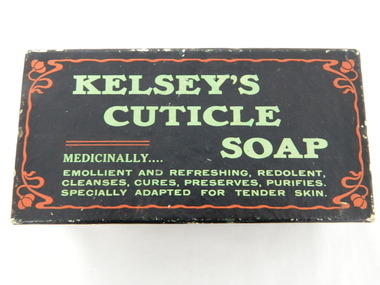
Box Cuticle Soap, mid to late 1900's
... Below this and in smaller print is "MEDICINALLY..." below this and in smaller print "EMOLLIENT AND REFRESHING, REDOLENT, CLEANSES, CURES, PRESERVES, PURIFIES." and last line underneath "SPECIALLY ADAPTED FOR TENDER SKIN" On each of the sides of the top lid are, side 1 "INVALUABLE FOR THE NURSERY." underneath in smaller print "JOHN M. ...Below this and in smaller print is "MEDICINALLY..." below this and in smaller print "EMOLLIENT AND REFRESHING, REDOLENT, CLEANSES, CURES, PRESERVES, PURIFIES." and last line underneath "SPECIALLY ADAPTED FOR TENDER SKIN" On each of the sides of the top lid are, side 1 "INVALUABLE FOR THE NURSERY." underneath in smaller print "JOHN M. ...The mid 1900's provided the start of "the body beautiful" revolution. The cosmetic industry, with the help of quasi scientific selling advertising slant targeted those "customers" that needed the "extra care" factor that only their product could offer. At this period in time their advertising power was based on in store, radio and newspaper media channels with saturation levels relatively low. In the later years of the 1900's saturation levels and a wider range of products and increased competition further increased the product saturation levels available to the buying residents. With the introduction of television the advertisements become more elaborate and "catchy" words, phrases and comedy type situations helped boost the advertising "pitch" and subliminal undertones to effective levels required for a highly competitive health related market place. 'sellingThis subliminally,"medically" endorsed product was one of many during the great "spin" revolution of product marketing and selling. This item is significant in that it demonstrates that greater infusion of product awareness throughout rural areas was highly successful through a greater variety of advertising media. It also demonstrates that in a highly competitive marketplace there are no physical boundaries that impinge upon the distribution of products and services. The rural sector is a highly lucrative region for any product that helps protect the body from all the "nasty's" that become more noticeable in a rural environment. This rectangular box which had contained cuticle soap is constructed from cardboard and reinforced by a black nylon impregnated sheeting. This impregnation was required to keep the box from soaking up any water from the user's hands. The top section of the box(lid) has and in large print "KELSEY'S" top line followed by "CUTICLE" off to the right and underneath and to the right "SOAP". Below this and in smaller print is "MEDICINALLY..." below this and in smaller print "EMOLLIENT AND REFRESHING, REDOLENT, CLEANSES, CURES, PRESERVES, PURIFIES." and last line underneath "SPECIALLY ADAPTED FOR TENDER SKIN" On each of the sides of the top lid are, side 1 "INVALUABLE FOR THE NURSERY." underneath in smaller print "JOHN M. KELSEY CO." to the left of this and on a green backed highlighter "No. 1744 - Guaranteed under Pure Food Act, 1908, N.S.W. by John M. Kelsey Co. - No. 1744. Melbourne, Victoria." On the right side and in large print "KELSEY'S CUTICLE SOAP" on the next side and also a similar sign on the opposite side "SPECIALLY ADAPTED FOR TENDER SKIN." below this "JOHN M. KELSEY CO." "Registered" and on the other long side in large print "SPECIALLY ADAPTED FOR TENDER SKIN" underneath in smaller print JOHN M. KELSEY CO. Registered"specialised soap, toilet requisites, nursery health., bathroom, domestic -
 Ballarat Heritage Services
Photograph, L.J. Gervasoni, Australian Ex-Prisoner of War Memorial, Ballarat, 2014, 04/11/2014
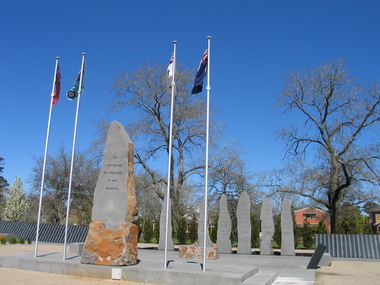
... This cycle of flowing water, symbolising spirituality, healing, cleansing, birth and rebirth, guides visitors on their journey through the Memorial." ...This cycle of flowing water, symbolising spirituality, healing, cleansing, birth and rebirth, guides visitors on their journey through the Memorial." ...The Trustees of the Australian Ex-Prisoners of War Memorial have defined a Prisoner of War to be a person who was captured by a common enemy and/or interned in a neutral or non-combatant country. To be defined an Australian Prisoner of War, the person needs to be either an Australian Born person serving in the Uniform of an Australian Service; or in the Uniform of a friendly country, or Born Elsewhere and serving in the Uniform of an Australian Service. A Prisoner is a person who has lost personal privileges, suffers deprivation of liberty or is unable to return home or dies in captivity.Colour photograph of a War Memorial designed by Peter Blizzard. The granite wall of the Australian Ex-Prisoners of War Memorial features a listing the names of Australian Prisoners and was opened on the 6th February 2004 by General Peter Cosgrove AM MC to recognise and remember over 36,000 Australians who became Prisoners of War during the Wars of the 20th Century. In 2008 the Memorial became the First Military Memorial of National Significance outside Canberra. The Memorial which was designed by Peter Blizzard OAM, symbolises that all Australian prisoners embarked on a journey to serve away from their homeland and acknowledges the hardship, deprivation, brutality, starvation and disease endured by Prisoners of War during their capture and the scars that many continued to endure upon their repatriation to Australia. Heritage Victoria describes the memorial in the following way" "A JOURNEY OF HONOUR, REMEMBRANCE AND HEALING - The Australian Ex-Prisoners of War Memorial is a dramatic and highly symbolic tribute to the sacrifice made by more than 35,000 young Australian service men and women in four theatres of war. At the heart of the monument is a stark, 130 metre long, highly polished black granite wall, engraved with the names of all Australian prisoners of war. The names on this 'honour roll' are listed in historical order from the Boer War in 1899, through to the Korean War in 1953. It is a testament to the contribution made by so many. Standing sentinel at the centre of the Memorial are six huge basalt obelisks, etched with the names of all the countries where Australians were held prisoner of war. The obelisks stand in a large reflective pool, set back from the central pathway, symbolising the distance that separated Australia's prisoners of war from their homes and their loved ones. Opposite the pool is a larger obelisk flanked by flagpoles and a ceremonial stone on which to lay wreaths. The central pathway is itself symbolic, with each of the paving stones cut in the shape of a railway sleeper. The pathway defines 'the journey' taken by the prisoners of war and the journey visitors take around the monument. At the end of the granite wall where the pathway ends, visitors face a large stone engraved simply 'Lest We Forget'. Water flows from beneath the stone, along the base of the granite wall and into the reflection pool in which the obelisks stand. This cycle of flowing water, symbolising spirituality, healing, cleansing, birth and rebirth, guides visitors on their journey through the Memorial." ballarat, ballarat botanical gardens, peter blizzard, ballarat north gardens, war memorial, prisoner of war, prisoners of war -
 Ballarat Heritage Services
Photograph, Australian Ex-Prisoner of War Memorial, Ballarat, 04/11/2014
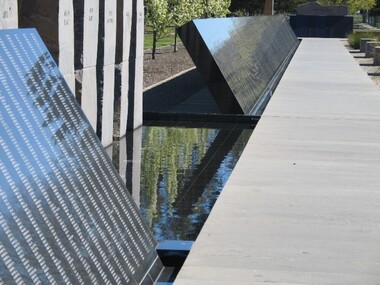
... This cycle of flowing water, symbolising spirituality, healing, cleansing, birth and rebirth, guides visitors on their journey through the Memorial."...This cycle of flowing water, symbolising spirituality, healing, cleansing, birth and rebirth, guides visitors on their journey through the Memorial." ...DESCRIPTIONColour photograph of a War Memorial designed by Peter Blizzard. The granite wall of the Australian Ex-Prisoners of War Memorial features a listing the names of Australian Prisoners and was opened on the 6th February 2004 by General Peter Cosgrove AM MC to recognise and remember over 36,000 Australians who became Prisoners of War during the Wars of the 20th Century. In 2008 the Memorial became the First Military Memorial of National Significance outside Canberra. The Memorial which was designed by Peter Blizzard OAM, symbolises that all Australian prisoners embarked on a journey to serve away from their homeland and acknowledges the hardship, deprivation, brutality, starvation and disease endured by Prisoners of War during their capture and the scars that many continued to endure upon their repatriation to Australia. Heritage Victoria describes the memorial in the following way" "A JOURNEY OF HONOUR, REMEMBRANCE AND HEALING - The Australian Ex-Prisoners of War Memorial is a dramatic and highly symbolic tribute to the sacrifice made by more than 35,000 young Australian service men and women in four theatres of war. At the heart of the monument is a stark, 130 metre long, highly polished black granite wall, engraved with the names of all Australian prisoners of war. The names on this 'honour roll' are listed in historical order from the Boer War in 1899, through to the Korean War in 1953. It is a testament to the contribution made by so many. Standing sentinel at the centre of the Memorial are six huge basalt obelisks, etched with the names of all the countries where Australians were held prisoner of war. The obelisks stand in a large reflective pool, set back from the central pathway, symbolising the distance that separated Australia's prisoners of war from their homes and their loved ones. Opposite the pool is a larger obelisk flanked by flagpoles and a ceremonial stone on which to lay wreaths. The central pathway is itself symbolic, with each of the paving stones cut in the shape of a railway sleeper. The pathway defines 'the journey' taken by the prisoners of war and the journey visitors take around the monument. At the end of the granite wall where the pathway ends, visitors face a large stone engraved simply 'Lest We Forget'. Water flows from beneath the stone, along the base of the granite wall and into the reflection pool in which the obelisks stand. This cycle of flowing water, symbolising spirituality, healing, cleansing, birth and rebirth, guides visitors on their journey through the Memorial."australian ex-prisoner of war memorial, peter blizzard, prisoner of war, ballarat north gardens -
 Ballarat Heritage Services
Photograph, Australian Ex-Prisoner of War Memorial, Ballarat, 2014, 04/11/2014
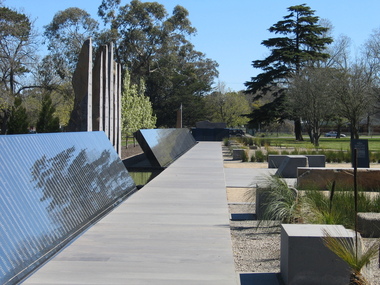
... This cycle of flowing water, symbolising spirituality, healing, cleansing, birth and rebirth, guides visitors on their journey through the Memorial."...This cycle of flowing water, symbolising spirituality, healing, cleansing, birth and rebirth, guides visitors on their journey through the Memorial." ...DESCRIPTIONColour photograph of a War Memorial designed by Peter Blizzard. The granite wall of the Australian Ex-Prisoners of War Memorial features a listing the names of Australian Prisoners and was opened on the 6th February 2004 by General Peter Cosgrove AM MC to recognise and remember over 36,000 Australians who became Prisoners of War during the Wars of the 20th Century. In 2008 the Memorial became the First Military Memorial of National Significance outside Canberra. The Memorial which was designed by Peter Blizzard OAM, symbolises that all Australian prisoners embarked on a journey to serve away from their homeland and acknowledges the hardship, deprivation, brutality, starvation and disease endured by Prisoners of War during their capture and the scars that many continued to endure upon their repatriation to Australia. Heritage Victoria describes the memorial in the following way" "A JOURNEY OF HONOUR, REMEMBRANCE AND HEALING - The Australian Ex-Prisoners of War Memorial is a dramatic and highly symbolic tribute to the sacrifice made by more than 35,000 young Australian service men and women in four theatres of war. At the heart of the monument is a stark, 130 metre long, highly polished black granite wall, engraved with the names of all Australian prisoners of war. The names on this 'honour roll' are listed in historical order from the Boer War in 1899, through to the Korean War in 1953. It is a testament to the contribution made by so many. Standing sentinel at the centre of the Memorial are six huge basalt obelisks, etched with the names of all the countries where Australians were held prisoner of war. The obelisks stand in a large reflective pool, set back from the central pathway, symbolising the distance that separated Australia's prisoners of war from their homes and their loved ones. Opposite the pool is a larger obelisk flanked by flagpoles and a ceremonial stone on which to lay wreaths. The central pathway is itself symbolic, with each of the paving stones cut in the shape of a railway sleeper. The pathway defines 'the journey' taken by the prisoners of war and the journey visitors take around the monument. At the end of the granite wall where the pathway ends, visitors face a large stone engraved simply 'Lest We Forget'. Water flows from beneath the stone, along the base of the granite wall and into the reflection pool in which the obelisks stand. This cycle of flowing water, symbolising spirituality, healing, cleansing, birth and rebirth, guides visitors on their journey through the Memorial."australian ex-prisoner of war memorial, prisoner of war, ballarat north gardens, peter blizzard -
 Coal Creek Community Park & Museum
Soap, TI-TROL ANTISEPTIC AND GERMICIDAL TOILET SOAP, c. 1928-1968
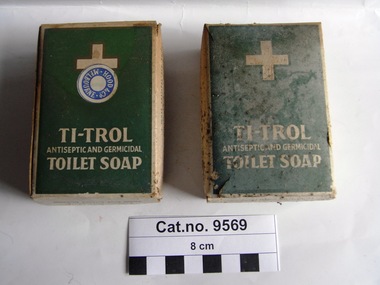
... In medical and clinical practice, both in Australia and abroad, Ti Trol has given remarkable results…particularly in its cleansing properties: its soothing HEALING action on dirty and inflamed septic wounds. ...In medical and clinical practice, both in Australia and abroad, Ti Trol has given remarkable results…particularly in its cleansing properties: its soothing HEALING action on dirty and inflamed septic wounds. ...TROVE : Evening News (Sydney, NSW : 1869 - 1931), Thursday 11 October 1928, page 13. NEW COMPANIES The following new companies were registered this afternoon :- Australian Essential Oils Ltd : Nominal capital. £50,000, in 93.000 ordinary and 7,000 deferred shares at 10/-. to engage in business of distillers, manufacturers of, and dealers in oils from vegetables and other sub-stances, chemists etc. First directors: N. H.B.Keynor, R.K.Allport, E.M Humphries, and H. James. Head office Sydney. TROVE : Government Gazette of the State of New South Wales (Sydney, NSW : 1901 - 2001), Friday 26 July 1968 (No.89), page 3028 IN the matter of the Companies Act, 1961-1966, and in the matter of AUSTRALIAN ESSENTIAL OILS LTD (Receiver and Manager Appointed).—Roy Leslie Pegler, Receiver and Manager of Australian Essential Oils Ltd (Receiver and Manager Appointed)„ appointed by debenture holders on the 11 th July, 1966, hereby gives notice that any debenture holders and others having any claim against or to Australian Essential Oils Ltd (Receiver and Manager Appointed) are required to send particulars of their debenture or claim to the Receiver, Roy Leslie Pegler, at c.o. Messrs Pegler, Ellis & Co., Chartered Accountants, 235-7 Elizabeth Street, Sydney, N.S.W., on or before the 27th September, 1968, at the expiration of which time the Receiver and Manager will distribute the assets of the said Company to the persons and/or companies entitled, having regard only to the claims of which he then has notice.—Dated 24th July, 1968. PEGLER, ELLIS & CO., Chartered Accountants, 235-7 Elizabeth Street, Sydney, N.S.W. 8744—$5 White cardboard box printed in dark green with a round blue and white sticker on one side, containing a cream paper leaflet printed in dark green, wrapped around a greaseproof paper wrapped rectangular cake of translucent brown soap with impressed text on one side.Impressed on one side of the cake of soap ' A PRODUCT OF AUSTRALIAN ESSENTIAL OILS LTD SYDNEY'. On reverse of soap impressed 'TI-TROL ANTISEPTIC TOU\ILET SOAP'. Printed on the box 'TI-TROL ANTISEPTIC AND GERMICIDAL TOILET SOAP. Printed Leaflet wrapped around cake of soap 'Germicide TI-TROL Antiseptic, Toilet Soap ELEVEN TIMES MORE POWERFUL THAN CARBOLIC. NON IRRITANT ………NON POISONOUS. “Ti –Trol” GERMICIDAL ANTISEPTIC SOAP is the most modern of all toilet soap …..Distilled and manufactured by Australian Essential Oils Ltd., the pioneers of Tea-Tree Oil Industry in Australia, and manufacturers of that famous antiseptic solution Melasol. It has taken years of patient research, of test, trial and experiment to reach the pinnacle of perfection which Ti-Trol Soap is now offering to the public. Ti-Trol is a hand-made glycerine base soap in which only the finest ingredients are used. One of its most attractive features is that it contains a full three per cent. of “Ti-trol”. In medical and clinical practice, both in Australia and abroad, Ti Trol has given remarkable results…particularly in its cleansing properties: its soothing HEALING action on dirty and inflamed septic wounds. By incorporating Ti-Trol in a glycerine base soap, experts are agreed that the result….. Ti-Trol soap is unequalled-anywhere- for its soft soothing healing and germicidal properties. Ti-Trol soap is non-irritant and non-poisonous and can be used on the tenderest skins…babies’ or the most delicate peach-bloom complexions, with most excellent results. . PRODUCT OF A SOAP MAKER OF INTERNATIONAL EXPERIENCE Australian Essential Oils Ltd., have been fortunate in procuring the services of a soap-maker of International experience and world-wide knowledge of Soap Production, whose genius has produced Ti-Trol, and whose uncanny sense of blending has made Ti-Trol the most famous of all Germicidal Toilet Soaps. Ti-Trol is non-irritant and non-poisonous and has been proved by medical and specialised authorities top\ possess great healing and cleansing properties. It is a powerful Germicide and antiseptic….ELEVEN TIMES QUICKER THAN PURE CARBOLIC. . DANDRUFF CAN’T LIVE WITH Ti-Trol. Dandruff ......that horrible “give away” which many men and women suffer from…..can easily be dispelled by using Ti-Trol Soap this way : Rub a little Olive Oil into the scalp before retiring at night, and the following morning wash your head thoroughly with Ti-Trol Soap, allowing the lather to remain on the scalp for about a minute and a half. Then rinse the hair thoroughly in warm water. .WASH BRUSHES AND COMBS WITH Ti-Trol SOAP When you’ve done this and dried your hair, wash all your brushes and combs in a strong, soapy solution made with Ti-Trol Soap, and then carefully sponge the inside of the hat bands with a flannel or cloth moistened with this soapy solution. Follow these directions and you’ll never need to fear dandruff. .Ti-Trol…WONDERFUL HEALER OF CUTS. SORES, WOUNDS, ETC. There never was a more patent healer of CUTS, SORES, WOUNDS, ABRASIONS AND SEPTIC SORES than Ti-Trol… Here’s how to use it : Wash the affected parts with a fairly strong Ti-Trol soapy solution made with warm water, and then apply with lint soaked with Melasol, which is the miscible form of Ti-Trol (Melasol is obtainable at all chemists and stores everywhere). . Ti-Trol SOAP……..A DEODORANT, A BEAUTIFIER……a safeguard for tender skins Ti-Trol Soap, because of its delicate, pungent, aroma and antiseptic properties, is unequalled as a deodorant, and is never failing when used for this purpose. Ti-Trol Soap can be used on the tenderest skins, and even baby’s skin, with greatest safety. It’s delightful fragrance will give added pleasure to your toilet. . DO NOT WASTE Ti-Trol Soap is too valuable to waste. Therefore, use it carefully. Do not leave it in the water. To obtain greatest economy it is preferable to use a face cloth when using Ti-Trol Soap. For health, for the most economical means of insuring against disease, use Ti-Trol Ointment…..for cuts, bruises etc. Ti-Trol….for boils, cuts, sores, abrasions and septic conditions. MELASOL…..for Tinea, Mouth Wash and as a Dentifice. . All are products containing Ti-Trol, distilled and provided by Australian Essential Oils Ltd. 18 Loftus Street, Sydney. N.S.W.'. tea tree oil, soap, glycerine, antisptic, germicide -
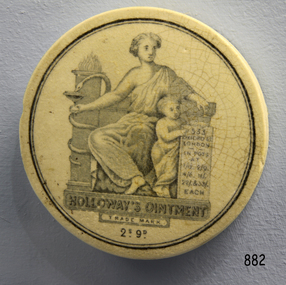 Flagstaff Hill Maritime Museum and Village
Ceramic - Lid, circa 1878
... The salve cream was said to penetrate the skin when rubbed on; purifying internal tissues and organs, cleansing all bodily fluids particularly the blood, and eradicating all disease from the body. ...The salve cream was said to penetrate the skin when rubbed on; purifying internal tissues and organs, cleansing all bodily fluids particularly the blood, and eradicating all disease from the body. ...This ceramic lid is from a Holloway’s Ointment pot. It was retrieved from the wreckage of the LOCH ARD. The vessel was laden with an up-to-date, high-value cargo, including luxury items intended for the Melbourne International Exhibition in 1880. Britain exported her manufactures to the Australasian colonies and the Americas. Holloway’s Ointment was one nineteenth-century pharmaceutical product that was advertised in both these markets. The price of this particular jar and its contents was printed on the label as “2S 9D” (2 shillings and nine pence). This value calculated to the approximate price in 2014, would be £51.31 (UK pounds and decimal pence) or $85 AU ― quite an expensive ointment. The label also shows a picture of a stone tablet with the inscription "IN POTS AT 1/½, 2/9, 4/6,11/-, 22/- & 33/- EACH”, which is most likely the alternative prices that the ointment was available for in differently sized containers. Holloway’s claims for his “great remedy” included the cure of sores, wounds, ulcers and boils, gout, rheumatism, diphtheria, bronchitis, influenza, sore throats, coughs and colds, “all varieties of skin diseases”, scrofula, ringworm, scurvy, “dropsical swellings” and liver disease, piles, fistulas, and internal inflammation. The salve cream was said to penetrate the skin when rubbed on; purifying internal tissues and organs, cleansing all bodily fluids particularly the blood, and eradicating all disease from the body. Purchasers were assured that if Holloway’s Ointment alone did not affect immediate cure, then the combination of it and Holloway’s Pills (sold separately) most certainly would. Thomas Holloway began manufacturing and marketing his miraculous ointment from premises at 244 Strand in the 1840s, moving to the more prestigious address of 533 Oxford in the late 1860s. The London address was an important part of his promotional appeal and was displayed prominently on the packaging of his products. Holloway’s attention to marketing is also observed in the pseudo-Classical emblems that decorated his containers. The sign of a snake curled around a staff is a longstanding and commonly recognised symbol of the physician’s power to heal. Similar reference on this lid is also being made to an ancient goddess of healing and her healthy young offspring. History of the Loch Ard: The Loch Ard got its name from ”Loch Ard” a loch which lies to the west of Aberfoyle, and the east of Loch Lomond. It means "high lake" in Scottish Gaelic. The vessel belonged to the famous Loch Line which sailed many vessels from England to Australia. The Loch Ard was built in Glasgow by Barclay, Curdle and Co. in 1873, the vessel was a three-masted square-rigged iron sailing ship that measured 79.87 meters in length, 11.58 m in width, and 7 m in depth with a gross tonnage of 1693 tons with a mainmast that measured a massive 45.7 m in height. Loch Ard made three trips to Australia and one trip to Calcutta before its fateful voyage. Loch Ard left England on March 2, 1878, under the command of 29-year-old Captain Gibbs, who was newly married. The ship was bound for Melbourne with a crew of 37, plus 17 passengers. The general cargo reflected the affluence of Melbourne at the time. Onboard were straw hats, umbrella, perfumes, clay pipes, pianos, clocks, confectionery, linen and candles, as well as a heavier load of railway irons, cement, lead and copper. There were other items included that were intended for display in the Melbourne International Exhibition of 1880. The voyage to Port Phillip was long but uneventful. Then at 3 am on June 1, 1878, Captain Gibbs was expecting to see land. But the Loch Ard was running into a fog which greatly reduced visibility. Captain Gibbs was becoming anxious as there was no sign of land or the Cape Otway lighthouse. At 4 am the fog lifted and a lookout aloft announced that he could see breakers. The sheer cliffs of Victoria's west coast came into view, and Captain Gibbs realised that the ship was much closer to them than expected. He ordered as much sail to be set as time would permit and then attempted to steer the vessel out to sea. On coming head-on into the wind, the ship lost momentum, the sails fell limp and Loch Ard's bow swung back towards land. Gibbs then ordered the anchors to be released in an attempt to hold its position. The anchors sank some 50 fathoms - but did not hold. By this time the ship was among the breakers and the tall cliffs of Mutton Bird Island rose behind. Just half a mile from the coast, the ship's bow was suddenly pulled around by the anchor. The captain tried to tack out to sea, but the ship struck a reef at the base of Mutton Bird Island, near Port Campbell. Waves subsequently broke over the ship and the top deck became loosened from the hull. The masts and rigging came crashing down knocking passengers and crew overboard. When a lifeboat was finally launched, it crashed into the side of Loch Ard and capsized. Tom Pearce, who had launched the boat, managed to cling to its overturned hull and shelter beneath it. He drifted out to sea and then on the flood tide came into what is now known as Lochard Gorge. He swam to shore, bruised and dazed, and found a cave in which to shelter. Some of the crew stayed below deck to shelter from the falling rigging but drowned when the ship slipped off the reef into deeper water. Eva Carmichael a passenger had raced onto the deck to find out what was happening only to be confronted by towering cliffs looming above the stricken ship. In all the chaos, Captain Gibbs grabbed Eva and said, "If you are saved Eva, let my dear wife know that I died like a sailor". That was the last Eva Carmichael saw of the captain. She was swept off the ship by a huge wave. Eva saw Tom Pearce on a small rocky beach and yelled to attract his attention. He dived in and swam to the exhausted woman and dragged her to shore. He took her to the cave and broke the open case of brandy which had washed up on the beach. He opened a bottle to revive the unconscious woman. A few hours later Tom scaled a cliff in search of help. He followed hoof prints and came by chance upon two men from nearby Glenample Station three and a half miles away. In a complete state of exhaustion, he told the men of the tragedy. Tom then returned to the gorge while the two men rode back to the station to get help. By the time they reached Loch Ard Gorge, it was cold and dark. The two shipwreck survivors were taken to Glenample Station to recover. Eva stayed at the station for six weeks before returning to Ireland by steamship. In Melbourne, Tom Pearce received a hero's welcome. He was presented with the first gold medal of the Royal Humane Society of Victoria and a £1000 cheque from the Victorian Government. Concerts were performed to honour the young man's bravery and to raise money for those who lost family in the disaster. Of the 54 crew members and passengers on board, only two survived: the apprentice, Tom Pearce and the young woman passenger, Eva Carmichael, who lost her family in the tragedy. Ten days after the Lochard tragedy, salvage rights to the wreck were sold at auction for £2,120. Cargo valued at £3,000 was salvaged and placed on the beach, but most washed back into the sea when another storm developed. The wreck of Lochard still lies at the base of Mutton Bird Island. Much of the cargo has now been salvaged and some items were washed up into Lochard Gorge. Cargo and artefacts have also been illegally salvaged over many years before protective legislation was introduced in March 1982. One of the most unlikely pieces of cargo to have survived the shipwreck was a Minton majolica peacock- one of only nine in the world. The peacock was destined for the Melbourne 1880 International Exhibition in. It had been well packed, which gave it adequate protection during the violent storm. Today the Minton peacock can be seen at the Flagstaff Hill Maritime Museum in Warrnambool. From Australia's most dramatic shipwreck it has now become Australia's most valuable shipwreck artifact and is one of very few 'objects' on the Victorian State Heritage Register.The shipwreck of the Loch Ard is of significance for Victoria and is registered on the Victorian Heritage Register ( S 417). Flagstaff Hill has a varied collection of artefacts from Loch Ard and its collection is significant for being one of the largest accumulation of artefacts from this notable Victorian shipwreck of which the subject items are a small part. The collections objects give us a snapshot of how we can interpret the story of this tragic event. The collection is also archaeologically significant as it represents aspects of Victoria's shipping history that allows us to interpret Victoria's social and historical themes of the time. Through is associated with the worst and best-known shipwreck in Victoria's history. The ceramic lid off a Holloway’s Ointment container, retrieved from the wreckage of the LOCH ARD. The artefact is white with the pale blue image of a woman (seated) and a child (standing). The woman is draped in a soft white robe and her throne is beside a pillar that is entwined by a serpent. The child points to an inscribed stone tablet he is holding on the other side of seated woman. The front face of the lid, at the base of the woman on the throne, bears the label “HOLLOWAY’S OINTMENT”. Below this, in smaller letters, is written “TRADE MARK” and “2S.9D.” On the stone tablet pointed to by the child is inscribed “533 OXFORD ST. LONDON”, and beneath this, “IN POTS AT 1/½, 2/9, 4/6,11/-, 22/- & 33/- EACH”.flagstaff hill, warrnambool, flagstaff hill maritime museum, shipwreck coast, flagstaff hill maritime village, great ocean road, loch line, loch ard, captain gibbs, eva carmichael, tom pearce, glenample station, mutton bird island, loch ard gorge, holloway’s ointment, ceramic lid, pot lid, nineteenth-century medicines, pharmaceutical marketing
