
Showing 27 items matching "clergymen"
-
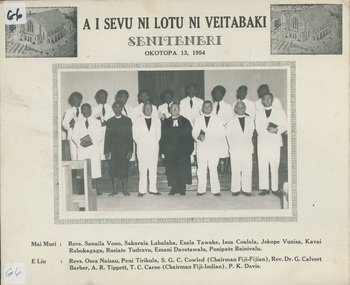 Uniting Church Archives - Synod of Victoria
photograph, 13 October 1954
... B & W studio photograph mounted on grey card of 16 clergymen. Images of the Centenary Methodist Church in Suva have been superimposed on the top left and top right hand side of the mount. ..."A I Sevu Ni Lotu Ni Veitabaki Seniteneri Okotopa 13, 1954" Names of the 16 clergymen listed on the mount below the photograph....Celebrating the centenary of the Methodist mission/church in Fiji Centenary Methodist Church, Suva, Fiji "A I Sevu Ni Lotu Ni Veitabaki Seniteneri Okotopa 13, 1954" Names of the 16 clergymen listed on the mount below the photograph. ...Celebrating the centenary of the Methodist mission/church in FijiB & W studio photograph mounted on grey card of 16 clergymen. Images of the Centenary Methodist Church in Suva have been superimposed on the top left and top right hand side of the mount. "A I Sevu Ni Lotu Ni Veitabaki Seniteneri Okotopa 13, 1954" Names of the 16 clergymen listed on the mount below the photograph.centenary methodist church, suva, fiji -
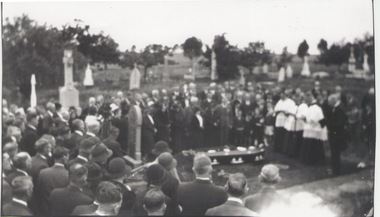 Sunbury Family History and Heritage Society Inc.
Photograph, 20 May 1933
... A non-digital black and white photograph of a crowd of people at a burial in a cemetery with three clergymen officiating. ...The burial of Michael Ford took place in the older Catholic section at Sunbury Cemetery. burials sunbury cemetery A non-digital black and white photograph of a crowd of people at a burial in a cemetery with three clergymen officiating. Photograph ...The burial of Michael Ford took place in the older Catholic section at Sunbury Cemetery. A non-digital black and white photograph of a crowd of people at a burial in a cemetery with three clergymen officiating. burials, sunbury cemetery -
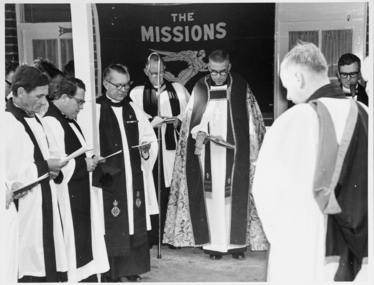 Mission to Seafarers Victoria
Photograph - Photograph, Black and white, Portland Guardian (1842-1964), 30 June 1962
... Large rectangular (landscape orientation) monochrome photo, depicting 6+ clergymen gathered in a 'U' shape, conducting an outdoor service...The Portland Mission was the fourth building to be opened in Victoria. mission to seamen portland victoria 1962 dedication opening Portland Guardian stamp Large rectangular (landscape orientation) monochrome photo, depicting 6+ clergymen gathered in a 'U' shape, conducting an outdoor service Photograph Photograph, Black and white Portland Guardian (1842-1964) ...The Port of Portland opened in 1959. Straight after the Mission had the desire to establish a Mission at this location. A building was found in November 1961 on Cliff Road (AR 1961). After alterations and renovations, it was officially dedicated and opened the 30 June 1962. The Portland Mission was the fourth building to be opened in Victoria.Large rectangular (landscape orientation) monochrome photo, depicting 6+ clergymen gathered in a 'U' shape, conducting an outdoor servicePortland Guardian stampmission to seamen, portland, victoria, 1962, dedication, opening -
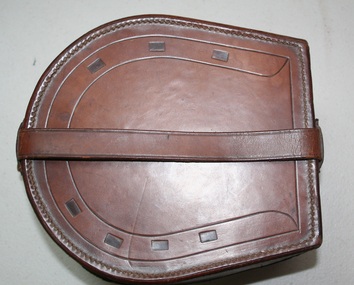 Trafalgar Holden Museum
Functional object - Collar bag, Circa 1900
... Leather carry bag to use to carry shirt collars i.e. clergymen...Leather carry bag to use to carry shirt collars i.e. clergymen Manufactured and sold by Holden and Frost leather collar bag Horse shoe imprint Leather collar bad with horse shoe imprint on lid leather strap to hold closed Functional object Collar bag ...Leather carry bag to use to carry shirt collars i.e. clergymenManufactured and sold by Holden and FrostLeather collar bad with horse shoe imprint on lid leather strap to hold closedHorse shoe imprintleather, collar bag -
 Sunshine and District Historical Society Incorporated
Archive - Synod of the Anglican Diocese of Melbourne: Report by Ken Hardman in 'Fellowship', Nov. 1966
... Edwin Warner, 1917-1919, wrote of 'That great gathering of clergymen and laity'....Edwin Warner, 1917-1919, wrote of 'That great gathering of clergymen and laity'. Archive Synod of the Anglican Diocese of Melbourne: Report by Ken Hardman in 'Fellowship', Nov. 1966 ...st john's church, churches, deer park -
 Uniting Church Archives - Synod of Victoria
Photograph, c.1926
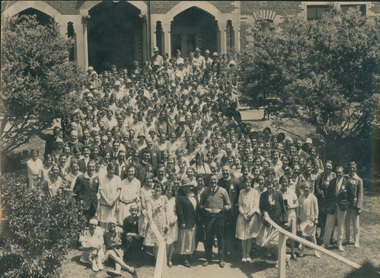
... B & W photograph of a large group of women, and some men, standing outside an unidentified building, probably in Ballarat. One of the clergymen at the front seems to be the Rev. Farquhar Chisholm, who was the minister of St Cuthbert's Presbyterian Church Ballarat 1926–31. ...B & W photograph of a large group of women, and some men, standing outside an unidentified building, probably in Ballarat. One of the clergymen at the front seems to be the Rev. Farquhar Chisholm, who was the minister of St Cuthbert's Presbyterian Church Ballarat 1926–31. ...B & W photograph of a large group of women, and some men, standing outside an unidentified building, probably in Ballarat. One of the clergymen at the front seems to be the Rev. Farquhar Chisholm, who was the minister of St Cuthbert's Presbyterian Church Ballarat 1926–31. B & W photographballarat, presbyterian, st. cuthbert's, rev. farquhar chisholm -
 Hume City Civic Collection
Photograph
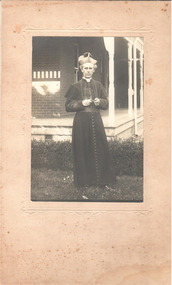
... clergymen...In 1963, at the senior age of 99, Daniel Mannix passed and was buried in St Patrick's Cathedral, Melbourne. clergymen mannix - (dr) george evans collection Stamped on back: ALF. ...Born in Ireland 1864, Daniel Mannix entered into the Catholic Church and in 1917, he became the Archbishop of Melbourne. Dedicated to the community and its issues, he was known to have spoken against conscription. In 1963, at the senior age of 99, Daniel Mannix passed and was buried in St Patrick's Cathedral, Melbourne. Mounted b/w photgraph of Dr. MannixStamped on back: ALF. H. WALL / PHOTOGRAPHER / "Espero," 40 Brighton Road / St. Kilda / Tel. Windsor 3678clergymen, mannix, - (dr), george evans collection -
 Mission to Seafarers Victoria
Photograph - Photograph, Black and white, Herald Sun, 18 May 1937
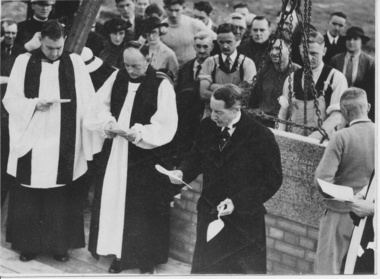
... Photograph of two clergymen standing to one side of the Governor of Victoria (1934-1939), Lord Huntingfield, who is holding a trowel in his left hand. ...Photograph of two clergymen standing to one side of the Governor of Victoria (1934-1939), Lord Huntingfield, who is holding a trowel in his left hand. ...On 18 May 1937, Lord Huntingfield, Governor of Victoria (14 May 1934 – 4 April 1939) layed the foundation stone of the last of the missions built in Melbourne. The Mission to Seamen, Port Melbourne opened in December 1937, superceded the original 19th C building and service point in Port.Demolished in the late 20th C by developers the building was of architectural significance and funded originally by Alfred Nicholas who gifted 18,000 pounds. An indicator of the importance of shipping and seafarer welfare as regarded by Industry and business during the interwar years of the 1930s. This photograph is a record of the founding of the building. The stone is now part of the bluestone wall on Beach Road, Port Melbourne. The Mission was given the name: George V Memorial Institute, and the concert hall was given the name Huntingfield Hall.A black and white photograph depicting the laying of a foundation stone. Photograph of two clergymen standing to one side of the Governor of Victoria (1934-1939), Lord Huntingfield, who is holding a trowel in his left hand. A foundation stone, resting on a low brick wall is thought to be the granite foundation stone of the Port Melbourne Mission. A small crowd of approximately 21 people are gathered behind the wall. Back of photograph stamped, "Herald Feature Service Melbourne".port melbourne, beach road, lord huntingfield, art deco, alfred nicholas, foundation stone, trowel, harry a. norris, george v memorial institute, port melbourne mission, 1937 -
 Warrnambool and District Historical Society Inc.
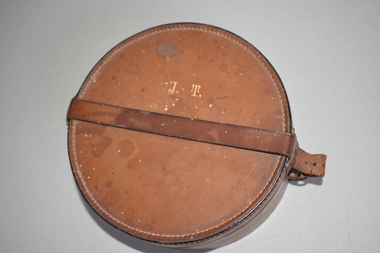
Collars and box
... Detachable collars could still be used today particularly by clergymen. Two are named E R Twomey....Detachable collars could still be used today particularly by clergymen. Two are named E R Twomey. This box and collars are retained as an example of vintage men's wear. ...Detachable collars enclosed in a leather box such as this one were used in the 19th and early 20th centuries, particularly by men in the business and clerical professions. The collars were attached by studs or buttons to a shirt. The collars were removed prior to shirt washing the shirt. The leather box was most useful for travelling. Detachable collars could still be used today particularly by clergymen. Two are named E R Twomey.This box and collars are retained as an example of vintage men's wear. It will be useful for display.A brown leather cylindrical case with a strap and buckle. It has white thread stitching around the rim and upper edge of the lid, the slot for the buckle, the rim and lower edge of the base . Inside are four detachable white winged collars for wearing with a shirt. Each has three holes, one for a button and two for a stud or for buttons at the front, two wings and a curved slot at the back.They are made of very fine cotton and linen.002215.1 J.T. MADE IN ENGLAND ESPECIALLY FOR Buckley & Nunn Ltd. MELBOURNE 002215.2 A stamped lion, WELCH MARCETSON 7 CO. LTD. 4 THE ALATUS TRADE MARK DES M 9 M 520 1 3/4 x 1/2 T14 002215.3 MADE IN ENGLAND FOR BUCKLEY & NUNN MELBOURNE EXTRA QUALITY , A deer head with antlers in a pointed elipse E.R. THOMEY a red inverted drawn triangle two dots Lindum 2x 151/2 002215.4 MADE IN ENGLAND FOR BUCKLEY & NUNN MELBOURNE EXTRA QUALITY, A Deer head with antlers in a pointed elipse . T indecipherable . E.R.T.4 indecipherable. Lindum 2x15 002215.5 E.R. THOMEY Indecipherable Lindum 2x 15 ? warrnambool, detachable vintage collars, detachable men's shirt collars -
 Hume City Civic Collection
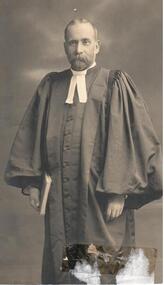
Photograph
... ...clergymen...He divided his time conducting morning services in Sunbury and afternoon services in Sydenham. st andrew's church sunbury churches clergymen postcards watt-leggatt t. (rev.) george evans collection POSTCARD / CORRESPONDENCE ADDRESS / KODAK A black and white photograph of the Rev. ...Rev. T. Watt-Leggatt came from Dunolly and had been a missionary in the New Hebrides before coming to St. Andrew's in Sunbury on 17 February 1910. He divided his time conducting morning services in Sunbury and afternoon services in Sydenham.A black and white photograph of the Rev. J. Watt-Leggatt in clerical gown and holding a book in his RH.POSTCARD / CORRESPONDENCE ADDRESS / KODAKst andrew's church, sunbury, churches, clergymen, postcards, watt-leggatt, t. (rev.), george evans collection -
 Glenelg Shire Council Cultural Collection
Photograph - Photograph - Annie Clarke's Ladies School, Gawler Street, 1970s
... It is thought that before coming to Australia, Anne taught at a school for the daughters of clergymen at Cowan Bridge, Lancashire, aptly named the Clergy Daughters' School. ...It is thought that before coming to Australia, Anne taught at a school for the daughters of clergymen at Cowan Bridge, Lancashire, aptly named the Clergy Daughters' School. ...Anne Clarke was born in Devon around 1814 and arrived in Portland in 1854 aboard the "Francis Henty". She opened Portland's first "Ladies School" which she operated until 1891. Many young ladies from the Western District passed through the school, and in some cases, two generations of girls. It is thought that before coming to Australia, Anne taught at a school for the daughters of clergymen at Cowan Bridge, Lancashire, aptly named the Clergy Daughters' School. It was attended by the Bronte sisters and is said to have inspired the Lowood School in Charlotte Bronte's "Jane Eyre". Anne Clarke never married and died in Portland in 1892.Photographic print of a rephotographed photograph. Image of single storey building, front view, verandah, wooden shingle roof. A number of girls of various ages and some adults, standing on verandah. Annie Clarke's ladies school, 52 Gawler Street.anne clarke, seminary for young ladies, gawler street, portland -
 Federation University Historical Collection
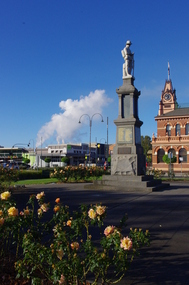
Photograph - Photograph - Colour, Alan Scarlett, Traralgon War Memorial, 2015, 2015
... H.Wise, and addresses were delivered by Mr W West, M.LA. the president of the shire and local clergymen. The memorial, which cost £700, and contains 54 names of young men who made the supreme sacrifice is a lifesized figure of an Australian soldier and is made white Italian marble. ...H.Wise, and addresses were delivered by Mr W West, M.LA. the president of the shire and local clergymen. The memorial, which cost £700, and contains 54 names of young men who made the supreme sacrifice is a lifesized figure of an Australian soldier and is made white Italian marble. ...The Traralgon War Memorial was originally erected in memory of the fallen soldiers of World War One. The Gippsland Times of 01 March 1923."On Sunday a memorial that has been erected in memory of the fallen soldiers of the district was unveiled. The ceremony was performed by Mr G. H.Wise, and addresses were delivered by Mr W West, M.LA. the president of the shire and local clergymen. The memorial, which cost £700, and contains 54 names of young men who made the supreme sacrifice is a lifesized figure of an Australian soldier and is made white Italian marble. It now commemorates Australian servicemen and women who have served in all wars and conflicts. It was re-dedicated on 11 November 1999.Colour photograph of the Traralgon War Memorial with surrounding townscape. The war memorial features a life sizes sculpture of an Australian world war soldier wearing a slouch hat. Loy Yang Power stations are evident in the background. Traralgon Post office on right foreground. traralgon, world war one, anzac day, loy yang, traralgon post office, anzac centenary -
 Ballarat and District Irish Association
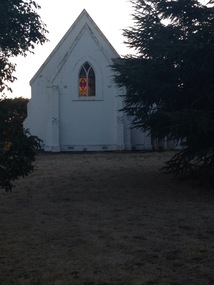
Photograph - digital, Shane Dunne, St Mary's Catholic Church Clarendon, 2014, 2014
... A procession, headed by the cross bearer and acolytes, was formed of the children and moved round the church, followed by the clergymen and the Bishop, who sprinkled the edifice with holy water. ...A procession, headed by the cross bearer and acolytes, was formed of the children and moved round the church, followed by the clergymen and the Bishop, who sprinkled the edifice with holy water. ...St Mary's Clarendon was dedicated on 09 November 1871. In 2014 it is part of St Alipius Parish, Ballarat East. "OPENING OF THE NEW CHURCH AT CLARENDON. On Thursday, November 9th, his Lordship the Bishop, accompanied by the various clergymen who assisted at the Mission, left Ballarat early in the morning, and proceeded through Buninyong to open the new church recently erected by the untiring exertions and liberality of the Catholics of Clarendon, and dedicated to the Blessed Virgin under the title of 'Auxilium Christianorum.' The church, which is composed of stone, with Lal Lal white brick facings, is 43 feet long by 20 feet wide, including a nice chancel, and has cost up to the present about £500. As the Bishop was approaching the locality, a large number of horsemen met and escorted, him to the church, arriving at 11 o'clock. Here also were a large number of children, 192, prepared for Confirmation, who were similarly attired as candidates in Ballarat. A procession, headed by the cross bearer and acolytes, was formed of the children and moved round the church, followed by the clergymen and the Bishop, who sprinkled the edifice with holy water. The building having been blessed and consecrated, High Mass, coram episcopo, was celebrated by the Very Rev. Dean Moore, the Rev. T. O'Donnell acting as deacon, Rev. M. J. Shanahan, as sub-deacon, and Rev. J. D. O' Sullivan, as master of ceremonies. After the Communion the Rev. J. D. O'Sullivan preached an impressive sermon on devotion to the Blessed Virgin. The collection amounted to about £40.9." (freeman's Journal, 25 November 1871)Six colour photographs of exterior and interior views of St Mary's Clarendon. st mary's clarendon, clarendon, st mary's, catholic -
 Hume City Civic Collection
Photograph
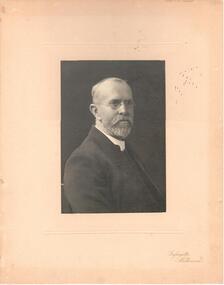
... ...clergymen...Inscription on back: 'With best wishes from you old Minister "The Manse" Canterbury Road, Middle Park. goyer - (rev.) clergymen churches st. andrew's presbyterian church sunbury canterbury road middle park st andrew's uniting church george evans collection Bottom Rh corner: Lafayette / Melbourne A b/w portrait of a minister - possibly Rev. ...It is possibly a portrait of the Rev. Goyer. The photo was sent while he was a minister at a church in Canterbury Road, Middle Park. Inscription on back: 'With best wishes from you old Minister "The Manse" Canterbury Road, Middle Park.A b/w portrait of a minister - possibly Rev. Goyer who was minister of St. Andrew's Church in Sunbury. The photo is mounted on cream cardboard with a cover sheet over it.Bottom Rh corner: Lafayette / Melbournegoyer, - (rev.), clergymen, churches, st. andrew's presbyterian church, sunbury, canterbury road, middle park, st andrew's uniting church, george evans collection -
 Bendigo Historical Society Inc.
Postcard - SYNAGOGUE - HEBREW - BENDIGO, 1889
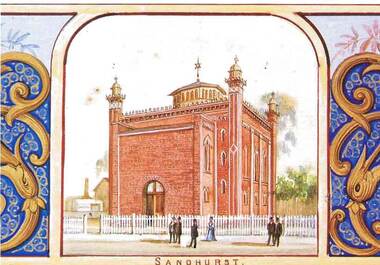
... Joseph, officiated temporarily as clergymen. In 1854 a wooden building was erected, in which REv. ...Joseph, officiated temporarily as clergymen. In 1854 a wooden building was erected, in which REv. ...The Synagogue was in Dowling Street, Bendigo. It was built in the Byzantine style. The building was square with thin square turrets at the corners, rising from the base to about 20 feet across the roof, each surmounted by a small dome with the double triangle at top. The fittings inside were the gift of Morris Samuel in 1875, at a cost of nearly 300 pounds and are of a beautifully rich appearance. The first synagogue was held in a tent early in 1853, when S. Moses of Sullivan and Moses, and J.P. Joseph, brother of the G.F. Joseph, officiated temporarily as clergymen. In 1854 a wooden building was erected, in which REv. Friedmann acted as minister till 1858. The new synagogue was erected by Vahland and Getschmann in 1870, costing over 2000 pounds and will hold 200 on the ground floor and nearly 100 in the gallery. Source: Herbrew Philanthropic Society - President S. Max, Treasurer J. Moody, Hon Secretary S. Herman. Water coloured Postcards - set 5 of. Hebrew Synagogue, coloured image of synagogue on postcard, ornate scrolling on both sides of depiction. Postcard No.1 - Sandhurst Hebrew Congregation. Congregation established 1854, Synagogue consecrated September 1872 in Hopetoun Street. Building demolished 1926. No.2 - Ballarat. No.3 - East Melbourne. No.4 - Melbourne. No.5 - Geelong.Printed Valentine Sands, Melbourne.bendigo, sandhurst hebrew synagogue. -
 Hume City Civic Collection
Photograph
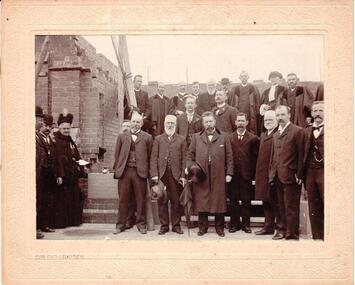
... clergymen...Andrew's Uniting Church) Sunbury 1904. clergymen st. andrew's uniting church churches foundation stones christiansen chris photographers sunbury clothing and dress men st. andrew's presbyterian church george evans collection CHR. ...The photo was taken to record the laying of the foundation stone of St. Andrew's Presbyterian Church (now St. Andrew's Uniting Church) Sunbury 1904.A mounted sepia photograph of a group of men and one woman standing on a construction site and in front of a foundation stone. There are 22 men in the photograph with 7 of them dressed in clerical attire. The other men are wearing dark suits. Cream mounting 1.5cm x 2.5 cm.CHR. CHRISTIANSENclergymen, st. andrew's uniting church, churches, foundation stones, christiansen, chris, photographers, sunbury, clothing and dress, men, st. andrew's presbyterian church, george evans collection -
 Hume City Civic Collection
Photograph
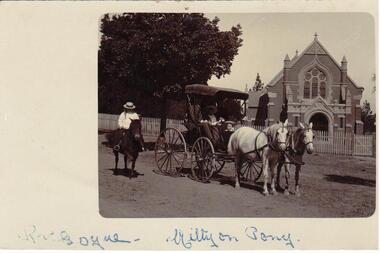
... ...clergymen...goyne - (rev.) milty boardman eric horses churches clergymen transport horse drawn vehicles st andrews presbyterian church george evans collection Handwritten on front: Rev. ...A sepia photograph of people outside the church, one on a pony and others in horse drawn carriage.Handwritten on front: Rev. Goyne, Milty on pony Handwritten on back: Eric Boardmangoyne, - (rev.), milty, boardman, eric, horses, churches, clergymen, transport, horse drawn vehicles, st andrews presbyterian church, george evans collection -
 Ballarat Heritage Services
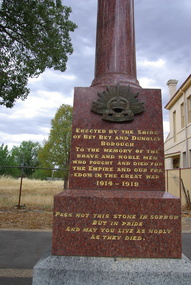
Photograph - War Memorial, Lisa Gervasoni, Dunolly War Memorial, 2025, 1921
... Groves and Pennington and local clergymen also spoke. The school children sang O God, Our Help in Ages Past, and a bugler sounded the Last Post after the unveiling. ...Groves and Pennington and local clergymen also spoke. The school children sang O God, Our Help in Ages Past, and a bugler sounded the Last Post after the unveiling. ...The Dunolly World War One Memorial Pillar, located in front of the Town Hall on Broadway Street, and was unveiled on November 18th 1921. The pillar is topped by an urn and rests on a square concrete plinth, which lists the names ninety-four locals who died serving during the First World War. On Friday afternoon the Premier, accompanied by Messrs. Pennington and Groves, M's.L.A., visited Dunolly, and unveiled a soldiers' memorial — a polished granite column on a square base, erected by the residents at a cost of £300. It bears the names of 94 district soldiers who were killed in action. The Premier, who is a native of Dunolly, referred to his early associations with the town and district. Speaking of the valiant service rendered by the Australian soldiers in the great war, he paid a tribute to those who enlisted from the country districts. He was not one of those who would withhold national memorials to the fallen because provision had not been made for all who had returned. It was right and proper to have these memorials as silent reminders of the great sacrifice made by the many as a lasting tribute to their memory. Messrs. Groves and Pennington and local clergymen also spoke. The school children sang O God, Our Help in Ages Past, and a bugler sounded the Last Post after the unveiling. The shire president entertained the visitors and committee at dinner. The Age (Melbourne), 19 November 1921. Colour photograph of the Dunolly War Memorial. Front Inscription "Erected by the Shire of Bet Bet and Dunolly Borough To the memory of the brave and noble men who fought and died for the Empire and our freedom in the Great War 1914 - 1918. Pass not this stone in sorrow but in pride, and may you live as nobly as they died." "Private L. Polinelli has written several letters to his mother at Dunolly, dated from from Tel el Kebir from January 13th till the 22nd. He had written every day or two, and this example, is a very fine one. He explains why there was an interval some weeks during which he sent no letters. This was just before the evacuation of Gallipoli, and no-one was permitted to send letters at such a critical time, as there were fears that carefully arranged plans might leak out in some way. Gallipoli had been evacuated on the 19th December, which happened to be Private Polinelli's 24th birthday, and he has cause, he says, to remember that birthday particularly, when this important movement, in which he participated, was so success-fully carried out. He was in the best of health. They had been on Lemnos Island for two weeks after leaving Galilipoli, and while there they got billeted and numerous gifts from Australia, which gave great delight. He (Private Polinelli) had got a big mail - 35 letters and a number of parcels. Both Norman Watson and himself were feeling well, although they had a pretty rough time at the front, but they were feeling better every day. Further letters speak of the arrival in Egypt and the Australian being encamped at Tel el Kebir, 40 miles from Cairo. He states that W. Lyndon had returned from England and was with them. He (W. Lyndon) looks splendid and had had a splendid time in England and Scotland. He saw Jack Lewis in England, and thinks he was to return to Australia. Reference is made to the Rev. Father Goidanich who was with their brigade, and who had been wounded at the front, but was all right again. Father Goidanich is well-known in this district. The letters were written in good spirits and many references were made to friends in Dunolly and district. A friend in Dunolly has received a letter from Private L. Polinelli, which is dated February 3rd, and written 'from the Arabian Desert.' This covers a vast extent of country, so that there is no use in speculating as to the locality, and portions of the letter which possibly would have given some indication have bean 'censored.' Private Polinelli wrote that Norman Watson and Himself were in the best of health and have stook the life well. They are right out of civilisation at time of writing. He referred to their Dtsojourns at Lemoos Island, where Christmas was spent, and where the billies and puddings assisted much in their enjoyment. But they were glad to leave Lemnos Island. After being in camp at Tel el E-bir for two weeks they were sent to where they were at the time of writing, all being in good xxxx and the open country suiting them well. He speaks with admiration of the desert work done by the camels so very largely used. The censoring was very strict so that he could not give much news. After alluding to the return to splendid health of W. Lyndon from England, he says he saw a lot of others from round Dunolly on returning to Egypt, including Tom Fishlock, R. Johnson, and J. Taylor, and some others from Betley, and all looked well. He had also seen Erie Williamson a few times, and he looked splendid. He concludes with remembrances to friends, and from himself and Norman Watson to the Loyal Prince Alfred Lodge." (Dunolly and Betbetshire Express and County of Gladstone Advertiser, Tue 14 Mar 1916) "SOLDIER'S LETTERS PRIVATE L. POLINELLI A friend in Dunolly has received another interesting letter from Private L Polinelli, son of Mrs J Davis, South Dunolly. It is from "Somewhere in France," and is dated July 23rd. He remarks with regret that a good deal of the soldiers' mail from Australia went down in the Arabia, and then goes on to say:- "Norman is back here with us again now and looking well. He had a splendid time over in England after he was able to get out of bed. It was two years on the 18th of this month (January) since Norman and I enlisted, and we celebrated the occasion by having a bit of an evening out. I am very pleased that he is back; we spend most of our time together. We are at present out of the line having a spell in a village, so we are not having a bad time just now but we will soon be going into the trenches again. I met Wally Bell a few days ago; they were going into the line to relieve our brigade. We did not have time to have a long talk. He looks rather thin, but he was always that way. He is feeling well, and wishes to be remembered to his friends in Dunolly. I also met C. Game the same day; he looked well but, as he was also going into the line, we could not have much of a talk J. Hughes and C. Atherton are also over here now; I often see them. W. Lyndon and T. Miles are well ; I was speaking to them yesterday. We are having very bad weather over here now ; it is either raining or snowing every day. The snow was about a fool deep a few days ago. When the rain comes after it, it makes things muddy, The mud is very bad over here; it takes us all our time to struggle through it in places. We will all be very glad when the winter is over. I was over in England on furlough last month, and had a splendid time. The people over there do all they can to give us a good time. I had several invitations to visit different people, and those that we did visit gave us a splendid time. At the place where I was staying they always had a guide waiting of a morning to show us any place of interest that we wanted to see. There was also always a supply of free tickets to the different theatres if we wanted them ; so you see that they go to some expense to give ns a good time. When they know yon are from France you are sure of a hearty welcome. was up in Scotland, and spent five days in Edinburgh. It is a very pretty place, especially when it is seen from Edinburgh Castle, which is on a high bill overlooking the place. We veil through the Castle; also Holyrood Palace. There are a lot of interesting things to be seen in the two places connected with the history of Scotland. It was snowing very heavily while v« were in Scotland, and we bad some fine snowballing with the Scotch people. I greatly enjoyed the trip to Scotland. It would take a very long time to see all round London. I saw a lot of the old historical places there, which were very interesting. The fogs are very bad in London. I had an experience of a London fog one day; it was the heaviest they experienced for a number of years. We could only see a few yards ahead of us. Nearly everyone carried torches; it looked very funny. . . . There are nearly always as many women drinking in the bars as men; it struck me as being very strange, a bit different to what we are used to in Australia, a trip through some parts of London is a real eye-opener to us. It is interesting to watch the traffic in some of the business parts of London it moves along in one big mass. It is a wonder that a lot more accidents do not happen. I saw Australia House, where the High Commissioner has his office, in the Strand. It is not yet finished. It looks a very fine place, and when completed will be 'some' place. Both Norman and I are well, and send remembrances to friends." (Since this letter was written we have had the sad news of the death from wounds of Privates Atherton and Hughes, and that Sergeant Miles and Corporal Norman Watson have been wounded.) (Dunolly and Betbetshire Express and County of Gladstone Advertiser , Friday 13 April 1917, page 2) "Private L Polinelli, from some of whose previous letters we have published interesting extracts, has written to a friend in Dunolly, the letter being from France, and dated April 28th. Private Polinelli says among other things, "I am pleased to say that, Norman (Watson), Les (Anderson) and myself are in the best of health. We now have been in France some time. It is a terrible place for rain ; It has been raining all the time we have been here. It has also been very cold, snowing at times, but it is starting to "fine up" now, and the last few days have been splendid. I hope it keeps like that for a while, as it makes things very miserable in the trenches when it is so wet. We get a few days spell out of the trenches every now and again; so things are not as bad here as they were at Gallipoli. It is not so lively here so far as it was over there either. I am sorry to say that Jack Sanderson, who had been Will Lyndon's mate since they joined the forces, got killed during a bombardment last night. He was terribly knocked about with a shell. I saw W. Lyndon to-day and he was telling me all about it. He seemed terribly cut up over it, and so am I, as I was with Jack a lot over at Gallipoli after Will got sent away sick. He was always bright and cheerful, always had a smile up whenever I met him. I feel very sad about it. We will do all we can to make the Germans pay for it. You will most likely know him, as be used to live in Dunolly before going to Bendigo. Will Lyndon had a narrow escape also, as he was not very far from where the shell burst. He escaped with a bit of a shock, otherwise he is in the best of health. We have a good time among the French people when we are out of the trenches. They do all they can to make us feel at home. I am getting quite expert at speaking French. They smile at us a treat trying to speak French, but we generally make ourselves understood and have a good time among them. It is very rarely we see a young Frenchman, they being all away fighting. The women do all the work on the farms themselves, and deserve every credit for it. . . . I was sorry to hear about the death of Nurse M'Mahon; she was a grand old nurse. I heard that her daughter Nelly was nurse in a hospital on Lemnos Island, and when we were there I went to two of the hospitals to try to see her, but she did not happen to be at either, and I had no time to visit any of the others, so I did not see her. I was also sorry to hear about Mrs Rokahr, as she has left so many little ones behind. (Reference is made to other happenings in Dunolly.) So far I am pleased to say Norman and I have had the luck not to have had a day's illness; I think we are very fortunate, as such a lot get sent to the hospital ill. We are also lucky to have escaped the bullets and shells so far. I hope that luck sticks to us. I am sorry that, owing to the censorship, I cannot give you any interesting news of our trip over to France and the places we have seen. I will have to keep that till I get back to Dunolly again. . . . I have just heard that the battalion that Teddy Game is in has arrived, so I am going to look him up first chance I get." (The letter concludes with remembrances to members of the Lodge and other friends.) (Dunolly and Betbetshire Express and County of Gladstone Advertiser, Tuesday 13 June 1916, page 3) "PRIVATE L POLINELLI Another very interesting letter has been received by a friend in Dunolly from Private L. Polinelli, from France dated May 4th, 1916- Private Polinelli says-" I was glad that you got the letter I wrote from the Arabian Desert. The Censor must have crossed a good deal of it out. They seem to cross out a lot more than is really necessary. We left out there all of a sudden, and in a very short while found ourselves over here. It does not take them very long to make a move. I was saying in the last letter that I was going to try and find " Teddy " Game. I met him a few days ago and had a good yarn with him; he looks real well. I also met S. Prew, and "Ted" Smyth and his son Ernie. They all looked splendid, and are in the same battalion. "Ted" Smyth sticks to it well, and looks better than he ever looked. They will be under fire for the first time in a few days. S. Prew was hit in the landing at Gallipoli, but be is quite well now. W. Smythe, who is in our brigade is well ; I see him very often. " Les " Peart is not with us now; he has joined a Pioneer battalion, and I have not seen him since he joined it. I gave all the Dunolly boys your best wishes and they all wish to be remembered to you— also the same remembrance from Dave Millar, who used to play football for Dunolly from Moliagul. He is in our battalion, having come over with reinforcements. I see him every day and he wished to be remembered to you. A brother of Mr A. J. Williamson, manager of the Bank of Victoria, Dunolly, is also in this battalion. He is a great friend of mine ; we often have a talk about Dunolly. He was not well a little while ago, having to go into a hospital, but is all right again and is back with me. Eric Williamson, son of Mr A. J. Williamson is over here ; Norman (Watson) saw him a few days ago and said he looked well. Norman has been a corporal for some time. I was also offered stripes lately, but preferred to remain a private. There is a lot of worry and running about when you are an N.C.O., so I think I will remain as I am. ... So football is about done this season. I don't think they should cut it right out. I suppose some of them have to stay at home, so they ought to have some amusement. I would very much like to have a game, but I think I would just about forget how to play now. It is very amusing for us to read some of the soldiers letters in the Australian papers. . . l told you in the last letter about xxx young "Jack "Sanderson ; I was terribly sorry about him." Private Polinelli mentions in a letter to his sister in Dunolly that he happened to be beach at Gallipoli where the late Lord Kitchener was xxxxx addressed the' soldiers and' xxxxxx to them the message from the King. Private Polinelli states that he was very proud to have been one of those addressed by the great man. He and Norman Watson have never been a day out of the lines since arriving first in Egypt. It is intended to grant special leave to all those who have been kept so close to their posts xxx three months, and they are looking forward to this relaxation with keen anticipation, hoping to visit England and Scotland. (Dunolly and Betbetshire Express and County of Gladstone Advertiser, Tue 27 Jun 1916) "SOLDIER'S LETTERS. CORPORAL L. POLINELLI. Two letters have been received by Mrs J. Davis, South Dunolly, from her son, Corporal L. Polinelli, both written subsequent to the time when he was wounded, as reported when word was received at the time. Corporal Polinelli writes from No. 12 General Hospital, Rouen, France, and his first letter is dated 7th May. He stated that he was in hospital, he having been wounded in the arm and shoulder on 3rd May. He continued— " It is not a bad wound, and will not take long to heal up, as it is a clean wound. I was very lucky to get out of the fight alive, as I was buried by a shell explosion about an hour before I was wounded. It was very rough, and the noise of all the shells was terrible. Four men were killed by the same shell that wounded me, so I was fortunate. I am feeling a bit " shook up," and my head is aching from the concussion of the shells, but after a few days' spell in bed here I will be feeling just the thing again. So you need not worry about me ; a week or two will see me quite right again. We are having very nice warm weather just now-pleasant change after all the bad weather we have had." The second letter is dated May 12, Corporal Polinelli saying— "I am getting along splendidly ; the wound is healing up fast, so it will not be very long before I am quite right. The doc-tor, the other day said it would be better not to take the piece of shell out of my shoulder yet, and that it would not interfere with me in any way ; so perhaps l will always carry it about with me. He feared lest taking it out at that time would interfere with an artery. Rouen, where the hospital is, is a very pretty city. They give us leave to visit all the places when we are well enough. It is a nice spell here, away from the firing line. We have nothing to trouble us at all, so I will soon be just the thing again. When I got buried by a shell it shook me up a good deal. I felt it far more than the wound I got after; but it has not done me any harm, as I feel hardly any effects now. My good luck sticks to me in getting out of it so lightly. I hope you are not worrying at all about me, as I am all right. We are having beautiful weather over here— sunny days just like the Australian spring. . . . The sisters in the hospital are very nice, and treat us well. They have a lot of work to do, as a good few men have been wounded lately. I would have liked to have been sent over to England, but they are not sending many over there now. They treat as many as they can in France on account of attacks on hospital ships. I would have been able to have a good time with Norman (Watson) had l got over. He was just about all right when I heard from him last." Corporal Polinelli sends kind remembrances to friends." (Dunolly and Betbetshire Express and County of Gladstone Advertiser, Friday 6 July 1917, page 2) "SOLDIERS' LETTERS. CORPORAL L. POLINELLI. The following letter, dated from London on December 27; has been received by a friend in Dunolly from Corporal L. Polinelli (son of Mrs J. Davis, South Donolly), who, at the time of writing, after long and hard service at the front, was on furlough in England. After an introduction he says:— I am having a very good time. I went over to Ireland for five days, spending the most of the time in Dublin. I like the place very much. War appearances are not so conspicuous in Ireland as in England. The hotels are open all day, and a good meal can be obtained anywhere, which is more than can be got in England. The war seems to be making things very bad in England. It is very hard to get a good meal in London ; everything is so restricted. The only way to get a good meal is to go into two places. The people have to line up outside the shops for hours to get sugar, tea, and butter, and then they sometimes fail to get any. So many of our boats getting sunk is the cause of it. If things continue to go on in this way I am afraid that there is a very hard time in store for the people in England. Several people that I have spoken to say that they are just beginning to feel the pinch now. I was in London while an air raid was on a few days ago; it caused a lot of excitement among the people. Ten were killed and 70 wounded in the raid. I was about half a mile from where the bombs fell, so I was pretty right. I thought I had left the war behind in France, but it seems to be on over here at times also. I spent Christmas day with a family at Grantham, a town between London and Newcastle; they were very nice people. I had a very enjoyable time with them. I went to a dance in the evening and enjoyed it very much. It was a bit strange for a start, as it is the first dance I have been to since Norman and I had the send off at Dunolly in January, 1915. They do the dances a bit different over here to what they are done in Australia, and that made it worse still. I went through Guinness's Brewery while I was in Dublin. It is a wonderful place, and covers 55 acres of ground. I got a great surprise when I was starting on my leave in France. We were taken to the station we had to start from in a motor lorry, and who should the driver of the lorry be but Syd. Richards (son of Mr W. Richards, South Dunolly), who used to work at the Post Office in Dunolly. I rode on the front with him, so we had a good yarn. I did not know that be had joined, so was surprised to see him. He has grown a lot since I saw him last, and is looking well. Norman and Bill Lyndon were both well when I left France. We had been having a good spell near Messines, in Flanders, but they will be in the trenches by now. We have been round about Ypres for this last four months, and had some pretty rough times there. dunolly, dunolly war memorial, l. polinelli, bet bet, world war one, world war two, j. deledio, b. battilana, c. fitzgerald, f.s. kendall, j.h. hogan, p. zampatti, louisa davis, louisa gervasoni, bill lyndon, norman lyndon, sydney lindsay -
 Wodonga & District Historical Society Inc
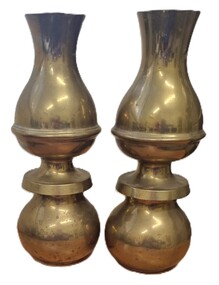
Decorative object - Brassware - St Augustines Church, Wodonga, T. Gaunt & Co, c1900
... St Augustine’s Church, Wodonga The Roman Catholic religion first came to the Wodonga area with travelling clergymen in about 1843. It was not until 4th October that 1860 Bishop Goold of the Chiltern parish visited Wodonga and consecrated St. ...St Augustine’s Church, Wodonga The Roman Catholic religion first came to the Wodonga area with travelling clergymen in about 1843. It was not until 4th October that 1860 Bishop Goold of the Chiltern parish visited Wodonga and consecrated St. ...St Augustine’s Church, Wodonga The Roman Catholic religion first came to the Wodonga area with travelling clergymen in about 1843. It was not until 4th October that 1860 Bishop Goold of the Chiltern parish visited Wodonga and consecrated St. Francis Chapel, a small weatherboard building which was erected on the site of the present St Augustine’s Church. Wodonga was officially separated from the Chiltern parish in 1899. Father James Ryan became the first Parish Priest of St Augustine's and oversaw the construction of the new church. The present St. Augustine’s was blessed and opened on 27 April 1902. Between 1918–1919 under Father Francis Flynn, the church was extended, and significant features such as the marble altar and stained-glass windows were added. Major refurbishments were completed in 1927, including further extension of the primary school. T. Gaunt & Co. Thomas Gaunt arrived in Melbourne in about 1856. He was a trained clockmaker and opened a business in Bourke Street, later moving to The Royal Arcade. Although he also made and sold wrist watches, jewellery, silver and brassware, Thomas was possibly most well-known for a chronometer he donated to the Victorian Racing Club for whom he was official timekeeper. It displayed the time of a race to an accuracy of .25 of a second. Gaunt had strong beliefs and connection to the Catholic Church of supplied much of its ecclesiastical silver and brassware such as this item. After Thomas Gaunt died in 1890, his executors continued the business, which was renamed T. Gaunt & Co. in 1893. The company operated for almost a century before closing in 1960. These items are significant because they were used in an important Wodonga church.A set of four brass vases manufactured by T Gaunt & Co.Beneath each vase T. GAUNT & Co.church brassware, st augustine's church wodonga, t gaunt & co -
 Flagstaff Hill Maritime Museum and Village
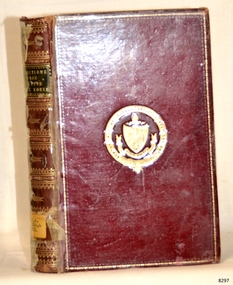
Book - Literary Work, John Milton, Selections from the Prose Works of John Milton, 1870
... He had a deep scholarly interest in Milton; in addition to this 1870 volume of selections, he also compiled and edited The Autobiography of John Milton: Or Milton's Life in His Own Words (published by Longmans in 1872). Clergymen of the Victorian era frequently edited historical texts to make them palatable and accessible to the contemporary reading public, often filtering them through a moral or educational lens. ...He had a deep scholarly interest in Milton; in addition to this 1870 volume of selections, he also compiled and edited The Autobiography of John Milton: Or Milton's Life in His Own Words (published by Longmans in 1872). Clergymen of the Victorian era frequently edited historical texts to make them palatable and accessible to the contemporary reading public, often filtering them through a moral or educational lens. ...Selections from the Prose Works of John Milton (1870) is a curated compilation of the non-poetic writings of John Milton. While Milton is globally famous for epic poems like Paradise Lost, he spent a significant portion of his adult life writing fiery political and religious tracts. This specific volume, compiled and annotated by the Rev. James J.G. Graham, extracts the most powerful segments of Milton’s prose. The book organizes his writings to give readers a cohesive look at Milton's philosophy, including his arguments for the freedom of the press known as Areopagitica. This was a famous 1644 prose pamphlet by Milton, written to protest Parliament's Licensing Order of 1643, which mandated government pre-approval for all published books. It remains one of the most historically significant defences of freedom of speech and the press. This work also encompasses his thoughts on the right to overthrow tyrannical rulers, his views on church reform, and various autobiographical passages.Selections from the Prose Works of John Milton Author: John Milton Edited by the Rev.James J G Graham Publisher: Hurst and Blackett Date: 1870 Further Information: Red embossed hardcover with a red spine and lettering in gold. The spine has a Library label with an inscription.fictionSelections from the Prose Works of John Milton (1870) is a curated compilation of the non-poetic writings of John Milton. While Milton is globally famous for epic poems like Paradise Lost, he spent a significant portion of his adult life writing fiery political and religious tracts. This specific volume, compiled and annotated by the Rev. James J.G. Graham, extracts the most powerful segments of Milton’s prose. The book organizes his writings to give readers a cohesive look at Milton's philosophy, including his arguments for the freedom of the press known as Areopagitica. This was a famous 1644 prose pamphlet by Milton, written to protest Parliament's Licensing Order of 1643, which mandated government pre-approval for all published books. It remains one of the most historically significant defences of freedom of speech and the press. This work also encompasses his thoughts on the right to overthrow tyrannical rulers, his views on church reform, and various autobiographical passages.flagstaff hill, warrnambool, shipwrecked coast, flagstaff hill maritime museum, maritime museum, shipwreck coast, flagstaff hill maritime village, great ocean road, selections from the prose works of john milton, colac municipal library, rev.james j ggraham -
Box Hill Historical Society
Book, Nichol, Bob, A Bank Manager - of sorts, 1994
... ...Clergymen...Box Hill Nichol> Bob Banks Bankers Box Hill Primary School Mont Albert Central School Schools Bank of Australasia Box Hill Presbyterian Church Perman> May Poustie> George Langham> George Poustie> Arch McKenzie> Alec Thomas> Eric Holmes> George Nichol> Ian Kelly> Hugh (Rev.) Clergymen ANZ Bank Nichol> Janene Station Street Air raid Wardens Box Hill Emergency Service Box Hill Athletics Club In his book, Bob Nichol has recalled his employment as a bank officer from 1929 to 1971. ...In his book, Bob Nichol has recalled his employment as a bank officer from 1929 to 1971. He worked for the Bank of Australasia which later became the ANZ Bank. He lived in Box Hill at 832 Station Street (p.56) and worked in Box Hill as well as many other locations.156p.In his book, Bob Nichol has recalled his employment as a bank officer from 1929 to 1971. He worked for the Bank of Australasia which later became the ANZ Bank. He lived in Box Hill at 832 Station Street (p.56) and worked in Box Hill as well as many other locations.box hill, nichol> bob, banks, bankers, box hill primary school, mont albert central school, schools, bank of australasia, box hill presbyterian church, perman> may, poustie> george, langham> george, poustie> arch, mckenzie> alec, thomas> eric, holmes> george, nichol> ian, kelly> hugh (rev.), clergymen, anz bank, nichol> janene, station street, air raid wardens, box hill emergency service, box hill athletics club -
 Ballarat Heritage Services
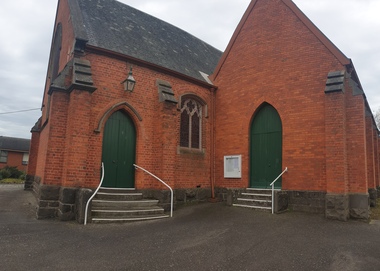
Photograph, St John the Evangelist church and Memorial Hall, Soldier's Hill, Ballarat
... There was a large congregation, in cluding many clergymen of the dis trict, and a number of returned soldiers under Major Lazarus. ...There was a large congregation, in cluding many clergymen of the dis trict, and a number of returned soldiers under Major Lazarus. ...St John the Evangelist Anglican Church was erected near the place where soldiers camped prior to the events of the Eureka Stockade in 1854. A decade later, as Ballarat continued to grow north of the railway line, a new Anglican presence was needed to serve the families who had settled on Soldiers Hill. On 15 March 1864, the foundation stone for St John’s was laid. Less than a year later, on 15 February 1865, the church was opened for worship — illuminated not by electricity, but by kerosene lamps. The sanctuary and chancel were added in 1870, giving St John’s the distinctive form the parish knows today. The church was consecrated in 1874. Among the early clergy, the Rev. R. J. Mercer holds a special place. Inducted in 1875, he served until 1892 and became one of the most respected priests of the newly formed Diocese of Ballarat. In 2026 the Memorial Hall was being used as an Opportunity Shop. "ST. JOHN'S, SOLDIERS' HILL NEW MEMORIAL HALL DEDICATION SERVICE ADDRESS BY ARCHDEACON TUCKER The Memorial Parish Hall of theSt. John's' Church of England, Soldiers Hill, wlas , dedicated by the Bishop of Ballarat, Dr Maxwell-Gumbleton, at a special service held last evening. The new hall, which faces Lydiard Street, is a spacious building, built of brick, and capable of seating several hun dred people. Branching of from the interior of the hall are a number of class-rooms. Altogether, the building cost £2000, of which sum £1000 is in hand, and £1600 has been promised. There was a large congregation, in cluding many clergymen of the dis trict, and a number of returned soldiers under Major Lazarus. The Bishop conducted the service, and was assisted by the Acting Vicar (the Rev. O. O. Andersen). The lessons were 'read by the Rev. O. F. Snell and Dean Lewis. After the recitation of the Creed and prayer, the Bishop dedicated the hall 'to the glory of God for the instruction off the childien of the churchm as a home for the missionary and social activities of the parish, and in memory of the soldiers of St. John's: Church who died in the great war." Prayers were offered for the parish of St. John's, for the teachers and child ren of the Sunday school, and for those in whose memory that hall was built, as well as for the soldiers of the Em pire. Archdeacon Tucker, in the course of a dedicatory address, said that fore most in their minds thatevening was the thought that the dedication service itself expressed their thankfulness to God for that building, which was|a neces ary equipment for the work of God. ... " (Ballarat Star (Vic. : 1865 - 1924), Tuesday 14 August 1917, page 6) stood out; and attracted their attentention. The first was the readiless with which the people of the parish took up the work of building the hall. It was taken in hand swifltly as something that ought to be done, and carried through, with a quickness that showed how in stinct with life the Church of St. John's was. That noble building was not the memorial, of one man's gener ally : it was the memorial of many men's - and many women's generosity : not the large gifts of a few, but the willing gifts of many, and which were indeed large gifts for a great number of them, Colour Photographs of a red brick church and memorial hall in Armstrong St North and Lydiard St North. Memorial Stone " To the Glory of God and in Memory of the Soldiers of this parish who fell in the Great War by Maxwell Homfray Lord Bishopof Ballarat 24rh March 1817st john's soldier's hill, st john the evangelist, memorial hall, maxwell homfray, world war one, world war one memorial -
Mission to Seafarers Victoria
Photograph - Reproduction, Jay Miller, 6 June 2019
... C'ros-.ley. ecu ducted a short dedication service, and the other clergymen who took part in the service were the Primate of Aus tralia. the Right Rev. ...C'ros-.ley. ecu ducted a short dedication service, and the other clergymen who took part in the service were the Primate of Aus tralia. the Right Rev. ...This photograph was published in the Geelong Advertiser on Friday 23 November 1906, page 4 with this article: "Owing to the generosity of an anonymous donor, the Victorian Missions to Seamen has been supplied with a long felt want in the shape of a modern motor launch to facilitate and render more efficient the work among the vessels in the Yarra and Hobson's Bay. The order for the construction of the boat, was placed with Mr. Chas. Blunt, of the Eastern Beach, and complimentary references were made to her graceful line- as she rode in light .trim after the launching on Wednesday afternoon. She is 31ft. long. Oft. beam, and has a depth of 3ft. The frame is of jarrah and ben* blackwood. and inch kauri planking has been used in building Iter. A neat deck-house with Oft. headroom is situat ed-umidsliip*. and a short mast is pro vided to carry the well-known blue flag of the -.fission. The launch motors will develop a speed of between nine and ten miles an hour: The finishing touches have yet to be given her. and she will afterwards be row«l to have her engines fitted in. -The launch will he ready for service for the busy wheat season com mencing at- the end of the year. The launching ceremony took place at 6 p.m. on Wednesday at the builder's yards, in the .presence of njarge gather ing of spectators. The Archdeacon of Geelong. the Rev. O. P. C'ros-.ley. ecu ducted a short dedication service, and the other clergymen who took part in the service were the Primate of Aus tralia. the Right Rev. Dr. Sauiuarcz Smith: the Rev. A. Giirney Goldsmith, the Missions chaplain: and the Rev. H. Kelly. The Bishop of Newcastle, Dr. Stretch, and the chaplain of the New castle Mission, the Rev. AYnddy. and Canon Nash were also present. The Primpte. addressing the gar boring as "My good friends of Geelong." said be had never been in sight of the hay before. bill had'gladly accepted the in vitation to say a few words in connec tion with the dedication of tiro launch. He had always been interested in mis sions of all sorts, as they ali as Christian men and women 110 doubt- were, and lie was particularly interested in Missions to Seamen, because in the Society at' borne, with which this Society was con nected, he had a son-in-law who was mission chaplain in the Medway. He therefore know something about a launch for the purpose of a mission like this, and also knew 'something about missions to seamen. In Sydney for some time past it had been doing good work—work which he was sure they would all feel was of the widest possible value. This year he was at the annual meeting of the Missions to Seamen in London presided over by the Bishop o-f Stcphney. -He (the Primate) at that meeting remarked that the Mission in it, value was personal, local and Im perial. It was of personal value to thee who came under the ministra tions of the church, and in the social as pect : it was local because where the Mission existed the feelings of the lo cality were thrown out. in sympathy with j tlie -Mission, and the people themselves thus benefited. It was also a matter of Imperial interest because it- was really i a world-wide Mission, inasmuch as the | sailors as they" went from one part of the world to another were in themselves j missionaries either for evil or for good, i Thev might he missionaries with a mcs i sago which might degrade and "work ail I evil influence amongst, men, and with i conduct which might reflect a reproach !' upon Christian profession. On the other hand, they might be Chrisian men endeavoring more and more to show the .example of the Christian life in the J midst of very big difficulties and tempta tions. • -Ho came to show liis sympathy with tlio appropriately-named '"'Southern Cross," and from what lie had boon told he believed she was a good boat, a good gift, and launched for a good purpose. They should be thankful that it was a good boat and .thankful because it was a good gift by an anonymous donor, whom he congratulated on doing such a useful thing." The idea of the launch ing ceremony was to ask the blessing of God because ".Except the Lord hless'the house their labor is hut lost'that build it." The Archdeacon expressed thanks to the Primate for attending the cere mony, and regretted that the Arch bishop was unable to attend. They dc- | sired that the boat- should always be as sociated with the.Church Congress 1906. I The opening hymn was "For those in j peril on the sea," followed hv Psalm I 107, "'They'that, go down to the sea in 1 Ships." Tlio prayers included an ap peal foiUDirine blessing on .the launch, and for tho preservation of those who may travel in her. ' Xlio Benediction was pronounced by the Primate, and the christening cere mony performed by Hiss Connibere. From the bow there was suspended a bottle of pure water covered with red, white and blue streamers and roses. Dashing the bottle in,fragments against the launch's bow. Miss Connibere named her the "Southern Cross." Cheers were given for the launch/and as she travell ed down the slip further cheers were given. She carried the Mission flag at tho masthead, and between Union Jacks at tho bow and stern, a long string of flags fluttered gaily* in the breeze. The collection was in aid of the Mis sions to Seamen and the Geelong Sailors' Rest.Reproduction of a photograph from a newspaper.Fujifilm / Quality Dry Photo papersouthern cross, motor boat, mission to seamen, seamen's mission, charles blunt, blunt boatbuilders, geelong -
 Flagstaff Hill Maritime Museum and Village
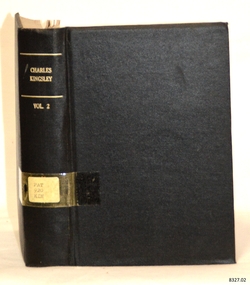
Book - Letters/Journals, Charles Kingsley, Charles Kingsley: His Letters and Memories of His Life Vol 2, 1879
... Furthermore, a major point of significance is that Kingsley was one of the first high-ranking Anglican clergymen to openly embrace Darwin’s theories. ...While Volume 1 introduces Charles Kingsley’s early development and his explosive rise as a radical social reformer, Volume 2 pivots to his mature years as an established public figure. It focuses on his high-profile intellectual battles and his global travels. The transition from Volume 1 to Volume 2 charts a shift from a young, controversial outsider to a celebrated, busy member of the Victorian elite. Volume 1 covers his early life from 1819 to 1856, while Volume 2 spans the years between 1857 and 1875. It documents his mature family life, his appointment as Royal Chaplain to Queen Victoria, his tenure as a professor of Modern History at Cambridge, and his time as Canon of Westminster. It was during these later years that his children's classic, The Water-Babies (1863), and his late historical fiction were published.Charles Kingsley: His Letters and Memories of His Life Vol 2 Author: Charles Kingsley Edited by his wife ( Frances "Fanny" Grenfell) Publisher: C Kegan Paul & Co Date: 1879 Further Information: Sixth Abridged Editionnon-fictionWhile Volume 1 introduces Charles Kingsley’s early development and his explosive rise as a radical social reformer, Volume 2 pivots to his mature years as an established public figure. It focuses on his high-profile intellectual battles and his global travels. The transition from Volume 1 to Volume 2 charts a shift from a young, controversial outsider to a celebrated, busy member of the Victorian elite. Volume 1 covers his early life from 1819 to 1856, while Volume 2 spans the years between 1857 and 1875. It documents his mature family life, his appointment as Royal Chaplain to Queen Victoria, his tenure as a professor of Modern History at Cambridge, and his time as Canon of Westminster. It was during these later years that his children's classic, The Water-Babies (1863), and his late historical fiction were published.flagstaff hill, warrnambool, shipwrecked coast, flagstaff hill maritime museum, maritime museum, shipwreck coast, flagstaff hill maritime village, great ocean road, book, pattison collection, warrnambool library, warrnambool mechanics’ institute, ralph eric pattison, corangamite regional library service, warrnambool city librarian, mechanics’ institute library, victorian library board, warrnambool books and records, warrnambool children’s library, charles kingsley: his letters and memories of his life vol 1, frances "fanny" grenfell, mrs kingsley -
 Flagstaff Hill Maritime Museum and Village
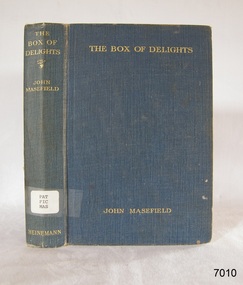
Book - A Fictional Story, John Masefield et al, The Box of Delights, 1935
... He's opposed by a wizard named Abner Brown and his gang of disguised bandits and witches masquerading as clergymen, and aided by talking animals, most memorably the cat Nibbins. ...The Box of Delights is a children's fantasy novel by John Masefield, a sequel to The Midnight Folk, first published in 1935. Kay Harker is returning from boarding school when he finds himself mixed up in a battle to possess a magical box which allows the owner to shrink in size, to fly swiftly, to go into the past and to experience the magical wonders contained within. He's opposed by a wizard named Abner Brown and his gang of disguised bandits and witches masquerading as clergymen, and aided by talking animals, most memorably the cat Nibbins. It's a Christmas story at heart, steeped in English folklore, magic, and the atmosphere of a snowy Midlands winter.Hard cover book. The Box of Delights Author: John Masefield Illustrator: Judith Masefield Publisher: William Heinemann Ltd Date: 1935 Further Information: Navy blue cloth with pictorial end papers hardcover with lettering and patterning to spine in black. The spine has a Library label with an inscription. fictionThe Box of Delights is a children's fantasy novel by John Masefield, a sequel to The Midnight Folk, first published in 1935. Kay Harker is returning from boarding school when he finds himself mixed up in a battle to possess a magical box which allows the owner to shrink in size, to fly swiftly, to go into the past and to experience the magical wonders contained within. He's opposed by a wizard named Abner Brown and his gang of disguised bandits and witches masquerading as clergymen, and aided by talking animals, most memorably the cat Nibbins. It's a Christmas story at heart, steeped in English folklore, magic, and the atmosphere of a snowy Midlands winter.warrnambool, shipwrecked-coast, flagstaff-hill, flagstaff-hill-maritime-museum, maritime-museum, shipwreck-coast, flagstaff-hill-maritime-village, shipwrecked-artefact, book, the box of delights, john masefield, warrnambool mechanics’ institute, pattison collection, warrnambool library, ralph eric pattison, corangamite regional library service, warrnambool city librarian, mechanics’ institute library, victorian library board, warrnambool books and records, warrnambool children’s library -
 Narre Warren and District Family History Group
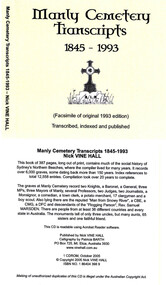
Document, Nick Vine Hall, Manly cemetery transcripts 1845 - 1993, 2005
... The graves at Manly Cemetery record two Knights, a Baronet, a General, three MPs, three Mayors of Manly, several Professors, two Judges, two Journalists, a Monsignor, a comedian, a town clerk, a potato merchant, 17 clergymen and a boy scout. Also lying there are the reputed "Man from Snowy River", a CBE, a CMG, a DFC and descendants of the "Flogging Parson", Rev. ...Manly Cemetery Transcripts 1845-1993 This book of 387 pages, long out of print, contains much of the social history of Sydney's Northern Beaches, where the compiler lived for many years. It records over 6,000 graves, some dating back more than 150 years. Index references to total 12,558 entries. Compilation took over 20 years to complete. The graves at Manly Cemetery record two Knights, a Baronet, a General, three MPs, three Mayors of Manly, several Professors, two Judges, two Journalists, a Monsignor, a comedian, a town clerk, a potato merchant, 17 clergymen and a boy scout. Also lying there are the reputed "Man from Snowy River", a CBE, a CMG, a DFC and descendants of the "Flogging Parson", Rev. Samuel MARSDEN. There are people from at least 38 different countries and every state in Australia. The monuments tell of only three uncles, but many aunts, 65 sisters and one faithful friend.1 optical discnon-fictionManly Cemetery Transcripts 1845-1993 This book of 387 pages, long out of print, contains much of the social history of Sydney's Northern Beaches, where the compiler lived for many years. It records over 6,000 graves, some dating back more than 150 years. Index references to total 12,558 entries. Compilation took over 20 years to complete. The graves at Manly Cemetery record two Knights, a Baronet, a General, three MPs, three Mayors of Manly, several Professors, two Judges, two Journalists, a Monsignor, a comedian, a town clerk, a potato merchant, 17 clergymen and a boy scout. Also lying there are the reputed "Man from Snowy River", a CBE, a CMG, a DFC and descendants of the "Flogging Parson", Rev. Samuel MARSDEN. There are people from at least 38 different countries and every state in Australia. The monuments tell of only three uncles, but many aunts, 65 sisters and one faithful friend.new south wales, manly (nsw) cemetery -
Linton Mechanics Institute and Free Library Collection
Book - Anecdotes, Larwood, Jacob, The book of clerical anecdotes : a gathering from many sources of the antiquities, humours, and eccentricities of "The Cloth", [n.d.] [First published c.1871, this edition c.1874]
... Humour Wit Clergy A collection of humourous stories about and sayings of clergymen. 336 p. : preface, table of contents. 40 page Chatto & Windus catalogue at end of text, dated 'December 1874-' The book of clerical anecdotes : a gathering from many sources of the antiquities, humours, and eccentricities of "The Cloth" Book Anecdotes Larwood, Jacob John Camden Hotten Chatto & Windus ...A collection of humourous stories about and sayings of clergymen.336 p. : preface, table of contents. 40 page Chatto & Windus catalogue at end of text, dated 'December 1874-'non-fictionA collection of humourous stories about and sayings of clergymen.humour, wit, clergy
