
Showing 80 items matching "cloth hall"
-
 Bendigo Historical Society Inc.
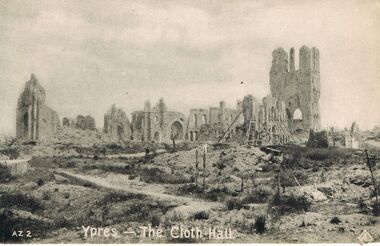
Postcard - ACC LOCK COLLECTION : YPRES - THE CLOTH HALL - POSTCARD, 1914-1918
... ACC LOCK COLLECTION : YPRES - THE CLOTH HALL - POSTCARD...... Cloth Hall...Postcard, WW1, B & W image of the ruins of The Cloth Hall at Ypres Two copies AZ 2 and Z 2 Copy AZ 2 Published by J.M.Hamilton & Coy. ...POSTCARD Postcard WW1 Ypres Ruins Cloth Hall Postcard, WW1, B & W image of the ruins of The Cloth Hall at Ypres Two copies AZ 2 and Z 2 Copy AZ 2 Published by J.M.Hamilton & Coy. ...Postcard, WW1, B & W image of the ruins of The Cloth Hall at Ypres Two copies AZ 2 and Z 2 Copy AZ 2 Published by J.M.Hamilton & Coy. Sydney, Australiapostcard, postcard, ww1, ypres, ruins, cloth hall -
 Dandenong/Cranbourne RSL Sub Branch
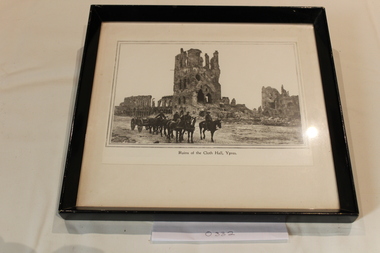
Photograph - Framed photograph
... Framed black and white photograph of mounted soldiers and wagons outside The Cloth Hall at Ypres. The Cloth Hall is a large cloth hall a medieval commercial building. ...Ruins of the Cloth Hall. Ypres....Ruins of the Cloth Hall. Ypres. Framed black and white photograph of mounted soldiers and wagons outside The Cloth Hall at Ypres. ...Framed black and white photograph of mounted soldiers and wagons outside The Cloth Hall at Ypres. The Cloth Hall is a large cloth hall a medieval commercial building. Erected in the 13th century at Ypres Belgium. Ruins of the Cloth Hall. Ypres. -
 Bendigo Military Museum
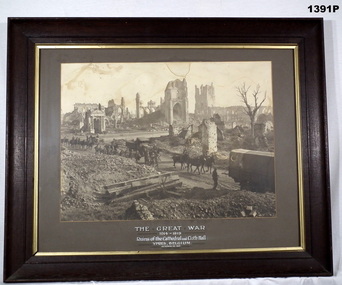
Photograph - PHOTOGRAPH WW1, FRAMED, C. WW1
... ...cloth hall...“The Great War 1914-1919 Ruins of the Cathedral and Cloth Hall Ypres, Belguim October 23 1917”...photography - photographs frame accessories military history - souvenirs Ypres cloth hall “The Great War 1914-1919 Ruins of the Cathedral and Cloth Hall Ypres, Belguim October 23 1917” Heavy wooden frame, brown with khaki border, glass front, sepia photo showing ruins in Ypres Belgium. ...Heavy wooden frame, brown with khaki border, glass front, sepia photo showing ruins in Ypres Belgium.“The Great War 1914-1919 Ruins of the Cathedral and Cloth Hall Ypres, Belguim October 23 1917”photography - photographs, frame accessories, military history - souvenirs, ypres, cloth hall -
 University of Melbourne, Burnley Campus Archives
Slide - Glass slide, 1891-1905
... Ypres, Belgium. The Great Cloth Hall and Belfry founded by Count Baldwin IX of Flanders.'...overseas images ypres belgium Ypres, Belgium. The Great Cloth Hall and Belfry founded by Count Baldwin IX of Flanders.' ...Ypres, Belgium. The Great Cloth Hall and Belfry founded by Count Baldwin IX of Flanders.'overseas images, ypres, belgium -
 The Beechworth Burke Museum
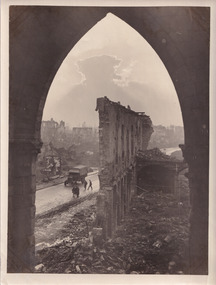
Photograph, 5 November 1917
... The shell damaged wall of the Cloth Hall is featured in the centre of the photograph, with an army vehicle and personal are located on the street beneath the ruined wall....The shell damaged wall of the Cloth Hall is featured in the centre of the photograph, with an army vehicle and personal are located on the street beneath the ruined wall. ...Taken on the 5 November 1917 by James Francis Hurley, this photograph depicts the a war damaged Ypres. The shell damaged wall of the Cloth Hall is featured in the centre of the photograph, with an army vehicle and personal are located on the street beneath the ruined wall.First Battle of Ypres, (October 19–November 22, 1914), first of three costly World War I battles centred on the city of Ypres (now Ieper) in western Flanders. Attempted flank attacks by both the Allies and the Germans failed to achieve significant breakthroughs, and both sides settled into the trench warfare that would characterize the remainder of the war on the Western Front.Black and white rectangular reproduced photograph printed on mate photographic paperReverse: 6525/ (A copyright and reproduction notice from the Australian War Museum, printed upside-down in blue ink)military album, burke museum, world war one, world war 1, ww1, ypres, belguim, ruins, first battle of ypres, james francis hurley -
 Mission to Seafarers Victoria
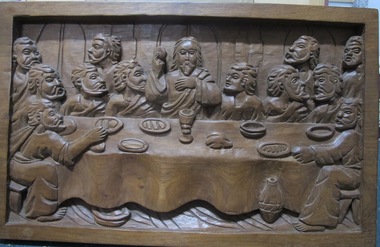
Artwork, other - Carved wood panel, The Last Supper, c. 1950
... hall. This sculpture is very likely to have been made for and on view in one of the several Mission to Seamen buildings. the last supper jesus disciples carving sculpture Solid heavy wood panel carved in relief depicting 12 bearded figures, robed and seated around a table covered with a cloth. ...The style suggests that it may have been part of the fittings of the newly opened 1937 George V memorial building at Port Melbourne. Possibly hung in the Dining hall.Religious artSolid heavy wood panel carved in relief depicting 12 bearded figures, robed and seated around a table covered with a cloth. The table is laid with seven dishes, a loaf of bread, a wine cup in front of the central figure and a dish below the table on the floor at left, and a wine or oil jar at right. The sculptor has carved the wood in a style reminiscent of the medieval or early renaissance craftsmen. There are three modern steel screw attachments for hanging attached at verso on sides and centre top edge. The subject is the Last Supper of Jesus and his twelve disciples, with Judas at left end of the table seeming to cover with his hand a bag, perhaps the 30 pieces of silver.the last supper, jesus, disciples, carving, sculpture -
 Mission to Seafarers Victoria
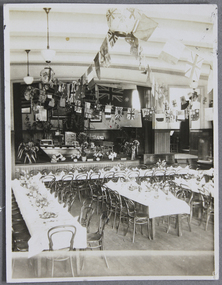
Photograph - Photograph, Sepia, Reverend John Reginald Weller, The Hall ready for New Year's dinner 1926, 1 January 1926
... Small photograph depicting the hall of the Flinders Street mission with tables and chairs placed in from of the stage. The tables are covered with a white cloth and decorated with flowers in vases. ...The photograph was taken by Reverend Weller and published in the Annual report for 1926. brig ship flags chinese lanterns paper lanterns flowers vases chairs tables meals dinner central hall mission to seafarers seamen's mission flinders street weller album reverend john reginald weller (1880-1969) new year's day 1926 Small photograph depicting the hall of the Flinders Street mission with tables and chairs placed in from of the stage. The tables are covered with a white cloth and decorated with flowers in vases. ...The photograph was taken by Reverend Weller and published in the Annual report for 1926.Small photograph depicting the hall of the Flinders Street mission with tables and chairs placed in from of the stage. The tables are covered with a white cloth and decorated with flowers in vases. Above the tables, are garland of banners representing flags from different country: Japan, England, USA and Chinese lanterns. On the stage are more vases with flowers, a Christmas Brig in the shape of a ship.brig, ship, flags, chinese lanterns, paper lanterns, flowers, vases, chairs, tables, meals, dinner, central hall, mission to seafarers, seamen's mission, flinders street, weller album, reverend john reginald weller (1880-1969), new year's day, 1926 -
 Federation University Historical Collection
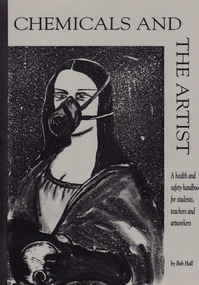
Book - Book - Handbook, VIOSH: Chemicals and the Artist; A health and safety handbook for students, teachers and artworkers by Bob Hall
... The importance of a safety hazard audit register for hazardous substances is detailed. viosh safety and health victorian institute of occupational safety and health art facilities chemicals ventilation safety audits hazardous chemicals and substances protective clothing bob hall Glued and cloth bound book of 161 pages. Cover light fawn with black print and binding. ...Victorian Institute of Occupational Safety and Health (VIOSH) Australia is the Asia-Pacific centre for teaching and research in occupational health and safety (OHS) and is known as one of Australia's leaders on the field. VIOSH has a global reputation for its innovative approach within the field of OHS management. VIOSH had its first intake of students in 1979. At that time the Institution was known as the Ballarat College of Advanced Education. In 1990 it became known as Ballarat University College, then in 1994 as University of Ballarat. It was 2014 that it became Federation University. VIOSH Australia students are safety managers, senior advisors and experienced OHS professionals. They come from all over Australia and industry. Students are taught active research and enquiry; rather than textbook learning and a one-size fits all approach. VIOSH accepts people into the Graduate Diploma of Occupational Hazard Management who have no undergraduate degree - on the basis of extensive work experience and knowledge. Book outlines the requirements to be considered - chemicals, conditions re ventilation, protective clothing such as respiratory devices, gloves and eye and face protectors. An understanding of the effects of various chemical solutions. A detailed Glossary of health and safety terms is included. Alternative options for solvents etc is also given. The importance of a safety hazard audit register for hazardous substances is detailed. Glued and cloth bound book of 161 pages. Cover light fawn with black print and binding.viosh, safety and health, victorian institute of occupational safety and health, art facilities, chemicals, ventilation, safety audits, hazardous chemicals and substances, protective clothing, bob hall -
Federation University Historical Collection
Book, Education Department Certificates 1908 - 1922
... Ellsworth Vera Fisher Una Fowles Colin Graham Victor Greenhalgh Clarence Grose Dororthy Hall Margaret Hannaby Leslie Henderson Harold Herbert Effie Holmes Herbert Hopkins Black cloth covered book with handwritten pages and loose foolscap pages at the front and sticer on front cover with CERTIFICATES written on it. ...School of Mines Ballarat was a predecessor of Federation UniversityBlack cloth covered book with handwritten pages and loose foolscap pages at the front and sticer on front cover with CERTIFICATES written on it.education department, school of mines ballarat, leslie bennett, eulali perry, hector osborne, doris mcdougall, mary mullins, john mclean, mary morrish, francis kelly, robert gullan, henry bull, clara clegg, john david, albert ferguson, ina westcott, vera walker, agnes walker, eileen tremain, florence smith, lizzie pier, annie reynolds, charles peverill, william pearson, doris patterson, rebecca mcphan, constance mchenry, jean mcgregor, florence mingst, gwen mann, roz kelly, edward jones, freddi jacobi, percy baker, doris carter, stephen chambers, ruth catt, arthur dousey, d'arcy, bessie doncaster, alan eggleston, lena featherstone, clarice fisher, sylvia williams, james walker, annie treloar, shearer, cora sandberg, elsie pearce, jan mcgregor, cyril mcgibbon, margaret moore, thomas kierce, william james, alice horan, lucy hamilton, beatrice blake, catherine bowers, mona callow, lillian cameron, joyce dopel, iva denovan, william thompson, irene hewitt, catheriine kardens, beatrice stuart, hugh ross, mavis regelhuth, isabelle bell, melba perriman, vera muny, alan bernaldo, kathleen conway, dorothy darling, walter dunston, mary dwyer, agnes fraser, enid gates, maude williams, violet wheeler, jean tunbridge, maud auberry, john b. allen, rose c. andrews, willie banagwanath, john n. bennett, alfred bayley, geo h. blake, ida bolte, allison brown, eva brown, harold r. brown, henry f. bull, arthur burge, olive cotton, gertrude f coxon, alice culph, curtain, r.l. cutter, florence davis, w.m davies, helen dempster, ed dopel, l.c.m. dovey, ernest duncan, hugh elliott, nelson h. ferguson, mary featherstone, amelia field, david cochrane, phyllis polson, frederick proctor, geoff richards, bessie robertson, catherine ronald, cora saudberg, mary sheppard, scott smith, leonard steele, j.b. suttcliffe, nellie thornhill, vernon fisher, gordon fletcher, elsie ford, constance furness, grace m. geddes, ada giacometti, mary gleeson, v. hall, harold herm, dorothy hambley, clemence hill, evelyn hodgson, annie holmes, glynis humphreys, augus henderson, joseph james, queenie johnson, harold jolly, francis n. king, william knott, mary kinnear, adelaide leash, doris lonie, a lilbourne, f.j. llewellyn, herb malui, muriel mathew, nellie moloney, mabel morris, ernest morshead, w.k. moss, winifred moyley, eileen mcinerney, jack mclean, chas mcnamara, maryanne medwell, alice osbourne, elsie pitts, percy trompf, basil tunbridge, david walker, ruby walton, annie whitla, kenneth whittle, walter wilberforce, alb e williams, masie wise, amy wolff, olive wunhym, beryl atkins, hector ashby, geo banagwanath, g.n.j. barker, marion r. bailey, kathleen bowe, lelia brough, cecil campbell, basil craddock, ida chapman, iris campbell, una campbell, eileen cleary, reg m.l. cuttter, lyle eves, violet elston, eric embling, violet evans, f.l. ellsworth, vera fisher, una fowles, colin graham, victor greenhalgh, clarence grose, dororthy hall, margaret hannaby, leslie henderson, harold herbert, effie holmes, herbert hopkins -
Federation University Historical Collection
Book, A text-book of Euclid's elements: for the use of schools, 1894
... hall f h stevens school of mines ballarat geology mathemathics In pen inside leaf - W. Baragwanath, SMB (crossed out), School of Mines, Ballarat Vic In pen on title page - Series of numbers and [illegible] be able to quote any by number. Inside in pencil and pen - various drawings and numbers. Worn, maroon cloth ...Owned by William Baragwanath who studied at Schools of Mines Ballarat. He became council member of the school of mines from 1916-50. William Baragwanath (1878-1966), surveyor, geologist and public servant, was born on 1 August 1878 at Durham Lead near Ballarat, Victoria.Worn, maroon cloth bound book with gold printing on the spine. It is illustrated and is 430 pages long.In pen inside leaf - W. Baragwanath, SMB (crossed out), School of Mines, Ballarat Vic In pen on title page - Series of numbers and [illegible] be able to quote any by number. Inside in pencil and pen - various drawings and numbers.william baragwanath, a text book of euclid's elements, h s hall, f h stevens, school of mines ballarat, geology, mathemathics -
Federation University Historical Collection
Book, Frederick Hovenden et al, What is Heat? and What is Electricity?, 1900
... Electricity HEat ballarat ironworkers' and polytechnic association James Oddie Bookplate on inside front cover "The Ballarat Ironworkers' and Polytechnic Association No 1660" Green cloth covered book of 329 pages with gold letters on the spine and cover. The book includes illustrations. What is Heat? and What is Electricity? Book Frederick Hovenden Chapman and Hall ...This book was originally part of the library of the Ballarat Ironworkers' and Polytechnic Association. It is one of the volumes of the library of the late James Oddie. He bequeathed the book to the Ironworkers' Association in 1911. Green cloth covered book of 329 pages with gold letters on the spine and cover. The book includes illustrations.Bookplate on inside front cover "The Ballarat Ironworkers' and Polytechnic Association No 1660"electricity, heat, ballarat ironworkers' and polytechnic association, james oddie -
 Flagstaff Hill Maritime Museum and Village
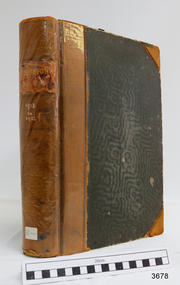
Book - Library Record Book, Ralph Eric Pattison, Warrnambool Mechanics’ Institute (WMI) Accessions Book (1913–1922), before 1918
... hall suitable for lectures, and a library. Funding was raised locally and often supplemented by grants from government agencies for the purchase of books and other resources. Activities were community based. In Australia, Mechanics' Institutes were set up in New South Wales and in Tasmania in the late 1820's. Mechanics' Institutes began in Victoria, with the first one in Melbourne dating from 1839, providing similar services but in time offered services tailored to their specific area. Hand written notes inside cover "RA 02749457 MEC,000451" Hard cover, olive green cover with brown protective cloth ...Library record book from the Warrnambool Mechanics Institute known as an "Accessions Book" the book shows the type and number of books as listed in the Mechanics Institute. This specific volume is part of the Pattison Collection, named after Ralph Eric Pattison, the city librarian who began the Herculean task of organising the (WMI) massive, disorganised collection in 1935. The Record books from this period are "meticulous records" that typically include. titles and Authors of all books purchased or donated. Acquisition Dates Providing a timeline of the districts literary and intellectual interests. Costs and Suppliers often showing books ordered from Melbourne or overseas. In addition how the books were classified and how the library was organised before modern Dewey Decimal systems were fully implemented. The Warrnambool Mechanics’ Institute (WMI) Accessions Book (1913–1922) is a primary historical record that documents the acquisition of library materials during a pivotal era for the institution. In UK in early 1800's the word 'mechanic' was applied to a broader range of skills such as working man, tradesman or artisan. Mechanics' Institutes were formed originally for voluntary, self-funded organisations, to improve the education of working men and to instruct them on their various trades. The germ of the idea came from a class formed in 1799 by Professor George Birbeck in Glasgow, Scotland, for journeymen mechanics (apprentice trade workers), with the first Institutes being organised in London and Manchester in the 1820's. By then the original aim had broadened and the Mechanics' Institutes were established as popular agencies of adult education. The Mechanics' Institutes were run by committees that provided facilities for a meeting room, hall suitable for lectures, and a library. Funding was raised locally and often supplemented by grants from government agencies for the purchase of books and other resources. Activities were community based. In Australia, Mechanics' Institutes were set up in New South Wales and in Tasmania in the late 1820's. Mechanics' Institutes began in Victoria, with the first one in Melbourne dating from 1839, providing similar services but in time offered services tailored to their specific area.Hard cover, olive green cover with brown protective cloth on corners. Page edges have colored marble pattern. non-fictionLibrary record book from the Warrnambool Mechanics Institute known as an "Accessions Book" the book shows the type and number of books as listed in the Mechanics Institute. This specific volume is part of the Pattison Collection, named after Ralph Eric Pattison, the city librarian who began the Herculean task of organising the (WMI) massive, disorganised collection in 1935. The Record books from this period are "meticulous records" that typically include. titles and Authors of all books purchased or donated. Acquisition Dates Providing a timeline of the districts literary and intellectual interests. Costs and Suppliers often showing books ordered from Melbourne or overseas. In addition how the books were classified and how the library was organised before modern Dewey Decimal systems were fully implemented. The Warrnambool Mechanics’ Institute (WMI) Accessions Book (1913–1922) is a primary historical record that documents the acquisition of library materials during a pivotal era for the institution. In UK in early 1800's the word 'mechanic' was applied to a broader range of skills such as working man, tradesman or artisan. Mechanics' Institutes were formed originally for voluntary, self-funded organisations, to improve the education of working men and to instruct them on their various trades. The germ of the idea came from a class formed in 1799 by Professor George Birbeck in Glasgow, Scotland, for journeymen mechanics (apprentice trade workers), with the first Institutes being organised in London and Manchester in the 1820's. By then the original aim had broadened and the Mechanics' Institutes were established as popular agencies of adult education. The Mechanics' Institutes were run by committees that provided facilities for a meeting room, hall suitable for lectures, and a library. Funding was raised locally and often supplemented by grants from government agencies for the purchase of books and other resources. Activities were community based. In Australia, Mechanics' Institutes were set up in New South Wales and in Tasmania in the late 1820's. Mechanics' Institutes began in Victoria, with the first one in Melbourne dating from 1839, providing similar services but in time offered services tailored to their specific area.flagstaff hill, warrnambool, shipwrecked coast, flagstaff hill maritime museum, maritime museum, shipwreck coast, flagstaff hill maritime village, great ocean road, warrnambool mechanics' institute, mechanics' institute records warrnambool, record book c1918, patterson collection, library books, ralph patterson, mechanics institute, warrnambool council, book collection -
 Flagstaff Hill Maritime Museum and Village
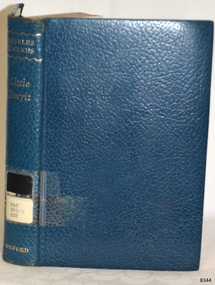
Book - A Fictional story, Chapman & Hall Ltd, Little Dorrit, 1890s
... Hall Ltd, London. Date: 1890s. (See note section this document for more information on Edition). Green cloth...Hall Ltd, London. Date: 1890s. (See note section this document for more information on Edition). Green cloth ...Charles Dickens (1812–1870) was one of the great English novelists of the Victorian era, famous for vivid characters, social criticism, and stories that were first published in serial form. He began as a journalist, rose to enormous popularity during his lifetime, and wrote major works such as Oliver Twist, David Copperfield, and Great Expectations. Little Dorrit is about Amy “Little” Dorrit, a gentle, selfless woman born and raised in the Marshalsea debtors’ prison where her father, William Dorrit, has been imprisoned for unpaid debts. The story follows her as she works as a seamstress outside the prison, gradually becoming entangled with Arthur Clennam, a businessman returning from abroad. Dickens interweaves a sharp critique of Victorian bureaucracy, finance, and class throughout the story. The theme centres around Amy Dorrit who lives her whole early life in Marshalsea, supporting her family with quiet dignity while her father clings to fragile genteel pretensions. Arthur Clennam, disillusioned after years in China, becomes involved with the Dorrits and uncovers a web of secrets involving his own mother, a hidden inheritance, and shady business dealings. William Dorrit suddenly inherits a fortune and is able to lift the family out of poverty and into fashion conscious society.The novel shows how money distorts their characters and relationships, while Amy remains the moral centre.Little Dorrit. Author: Charles Dickens. Publisher: Chapman & Hall Ltd, London. Date: 1890s. (See note section this document for more information on Edition). Green cloth hardcover with Authors name to front cover in gold. Spine has gold title lettering. The spine has a Library label.fictionCharles Dickens (1812–1870) was one of the great English novelists of the Victorian era, famous for vivid characters, social criticism, and stories that were first published in serial form. He began as a journalist, rose to enormous popularity during his lifetime, and wrote major works such as Oliver Twist, David Copperfield, and Great Expectations. Little Dorrit is about Amy “Little” Dorrit, a gentle, selfless woman born and raised in the Marshalsea debtors’ prison where her father, William Dorrit, has been imprisoned for unpaid debts. The story follows her as she works as a seamstress outside the prison, gradually becoming entangled with Arthur Clennam, a businessman returning from abroad. Dickens interweaves a sharp critique of Victorian bureaucracy, finance, and class throughout the story. The theme centres around Amy Dorrit who lives her whole early life in Marshalsea, supporting her family with quiet dignity while her father clings to fragile genteel pretensions. Arthur Clennam, disillusioned after years in China, becomes involved with the Dorrits and uncovers a web of secrets involving his own mother, a hidden inheritance, and shady business dealings. William Dorrit suddenly inherits a fortune and is able to lift the family out of poverty and into fashion conscious society.The novel shows how money distorts their characters and relationships, while Amy remains the moral centre. flagstaff hill, warrnambool, shipwrecked coast, flagstaff hill maritime museum, maritime museum, shipwreck coast, flagstaff hill maritime village, great ocean road, book, pattison collection, warrnambool library, warrnambool mechanics’ institute, ralph eric pattison, corangamite regional library service, warrnambool city librarian, mechanics’ institute library, victorian library board, warrnambool books and records, warrnambool children’s library, little dorrit, charles dickens -
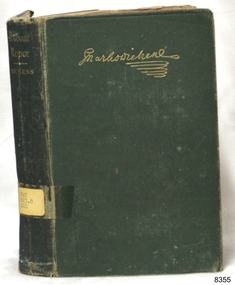 Flagstaff Hill Maritime Museum and Village
Book - A Fictional Story, Charles Dickens, Barnaby Rudge, (1871–1879)
... Barnaby Rudge Author: Charles Dickens Publisher: Chapman & Hall Ltd Date: Household Edition (1871–1879) (See note section this document for more information on Edition). Green cloth...Barnaby Rudge Author: Charles Dickens Publisher: Chapman & Hall Ltd Date: Household Edition (1871–1879) (See note section this document for more information on Edition). Green cloth ...Charles Dickens (1812–1870) was one of the great English novelists of the Victorian era, famous for vivid characters, social criticism, and stories that were first published in serial form. He began as a journalist, rose to enormous popularity during his lifetime, and wrote major works such as Oliver Twist, David Copperfield, and Great Expectations. Barnaby Rudge is a historical Dickens novel set against the Gordon Riots of 1780, mixing mystery, political unrest, family secrets, and the story of a simple minded young man, Barnaby, and his pet raven Grip. It is considered Dickens’s first historical novel and one of his less widely read works, but it remains important for its treatment of mob violence and social disorder. The novel begins with a murder mystery linked to the Haredale and Rudge families, then broadens into the chaos of the anti Catholic Gordon Riots in London. Barnaby, an innocent and impressionable character, is drawn into the riotous crowd. Other threads involve love, family conflict, imprisonment, and eventual reckoning. Dickens uses the riot setting to show how crowd panic and prejudice can spread destructively through society.Barnaby Rudge Author: Charles Dickens Publisher: Chapman & Hall Ltd Date: Household Edition (1871–1879) (See note section this document for more information on Edition). Green cloth hardcover with a black spine with authors name signed on front cover, lettering in gold. The spine has a Library label. First Published as part of the weekly Master Humphrey's Clock series (1840-1841)fictionCharles Dickens (1812–1870) was one of the great English novelists of the Victorian era, famous for vivid characters, social criticism, and stories that were first published in serial form. He began as a journalist, rose to enormous popularity during his lifetime, and wrote major works such as Oliver Twist, David Copperfield, and Great Expectations. Barnaby Rudge is a historical Dickens novel set against the Gordon Riots of 1780, mixing mystery, political unrest, family secrets, and the story of a simple minded young man, Barnaby, and his pet raven Grip. It is considered Dickens’s first historical novel and one of his less widely read works, but it remains important for its treatment of mob violence and social disorder. The novel begins with a murder mystery linked to the Haredale and Rudge families, then broadens into the chaos of the anti Catholic Gordon Riots in London. Barnaby, an innocent and impressionable character, is drawn into the riotous crowd. Other threads involve love, family conflict, imprisonment, and eventual reckoning. Dickens uses the riot setting to show how crowd panic and prejudice can spread destructively through society.flagstaff hil, warrnambool, flagstaff hill maritime museum, maritime museum, shipwreck coast, flagstaff hill maritime village, great ocean road, book, pattison collection, warrnambool library, warrnambool mechanics’ institute, ralph eric pattison, corangamite regional library service, warrnambool city librarian, mechanics’ institute library, victorian library board, warrnambool books and records, warrnambool children’s library, barnaby rudge, charles dickens -
 Flagstaff Hill Maritime Museum and Village
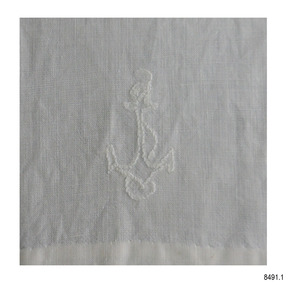
Ceremonial object - Ecclesiastical Linen set, 1907 to mid 20th century
... Cloths, Matts, Priest's scarf, armband and sashes, and a bag that is a cover for the Baptismal Towel. HISTORY OF ST ANDREWS, DENNINGTON The land on which St Andrews Church was built in Dennington was surveyed in the 1840s and reserved for church purposes in 1855. In 1889 the Farnham Dairy factory relocated to Dennington and the town began to grow as involvement in the dairy industry increased in the area. In 1896 plans for a church hall...Cloths, Matts, Priest's scarf, armband and sashes, and a bag that is a cover for the Baptismal Towel. HISTORY OF ST ANDREWS, DENNINGTON The land on which St Andrews Church was built in Dennington was surveyed in the 1840s and reserved for church purposes in 1855. In 1889 the Farnham Dairy factory relocated to Dennington and the town began to grow as involvement in the dairy industry increased in the area. In 1896 plans for a church hall ...The items in this collection of Ecclesiastical Linen were used by St. Andrews Anglican Church on the corner of the Esplanade and 14 Drummond St, Dennington, Victoria. The first Anglican service was conducted on December 22nd, 1907. The church was decommissioned in January 2003. The items donated include Maniples, Chalice Covers, a Goblet Cover, Altar Cloths, Matts, Priest's scarf, armband and sashes, and a bag that is a cover for the Baptismal Towel. HISTORY OF ST ANDREWS, DENNINGTON The land on which St Andrews Church was built in Dennington was surveyed in the 1840s and reserved for church purposes in 1855. In 1889 the Farnham Dairy factory relocated to Dennington and the town began to grow as involvement in the dairy industry increased in the area. In 1896 plans for a church hall on the reserved land were considered and on 22nd December 1907, the first Anglican Service was conducted in Dennington, with 60 people attending. In August 1909 the first building was opened with a midweek evening service conducted by the Rev. J.A. Coe. The Sunday School was opened the following year. In that same year, Nestle took over the Farnham dairy plant. On December 20th, 1914, a new church was opened in memory of Andrew Peacock, who passed away in 1912. The funds had been raised by the community and 150 attended the morning service. The building was described as a simple edifice with a plain exterior and high, wide pointed windows, and a comfortable porch entrance, all of which gave a pleasing impression of light and space. In 1935 the average attendance for morning services was just over 22 people. In 1936 extensive repairs and replacements were carried out. In 1947 the first recorded Pastoral Festival took place and in the same year, a Ladies Guild was formed. In 1954 water services were connected to the church building. Many items of furniture, furnishings and books were donated over the life of the church, including handworked linen items. Further items were added due to the work of the Ladies Guild, as well as donations in memory of church and community members.These items of Ecclesiastical Linen are significant as examples of handworked embroidery and drawn-thread work from the early 20th century. They are also examples of a collection of items used for church services during this period. The Ecclesiastical Linen is also significant for its association with the early development of the local township of Dennington and the importance of setting aside land in the 1850s for the purpose of religious worship. The Ecclesiastical Linen is also significant for its connection to St Andrews Anglican Church, Dennington. The church was funded and attended by the local community in the early 1900s and is now listed on the Victorian Heritage Database (VHD 118083) as a building of historical and social significance. Set of Ecclesiastical Linen. The items were once used in St. Andrew's Anglican Church, Dennington, Victoria, between the years 1907 and 2003. All of the handmade items are in white fabric. Some also have embroidered emblems, tassels and drawn-thread work. White embroidery thread has been used for most of the decorated items, with the following exceptions, which have been embroidered with coloured thread; the communion linen, the Priest's scarf, armband and sash, the altar cloths, mats and a cover for the baptismal towel. Two items have hand written inscriptions.(See individual objects for details)flagstaff hill, warrnambool, maritime museum, shipwreck coast, great ocean road, st andrews anglican church dennington, dennington church, warrnambool church 1907, ecclesiastical linen, linen for religious service, communion linen, priest's sash, baptismal towel, maniple, eucharist, emblem of rope and cross, embroidered religious cloths, embroidered celtic cross, drawn thread, chalice covers, handmade linen, embroidered linen, stylised cross, the english church, ladies guild dennington, nestle, farnham dairy, andrew peacock, victorian heritage register vhr 118083, hand worked linen, handworked embroidery, j.a. coe -
 Flagstaff Hill Maritime Museum and Village
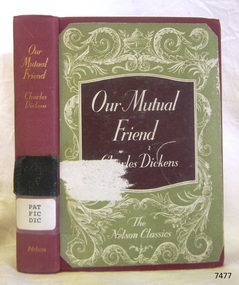
Book - A Fictional Story, Charles Dickens, Our Mutual Friend, 1900
... cloth hardcover with green patterned paper stick on title to front cover. Spine has gold lettering. The spine has a Library label and no Volume information. Our Mutual Friend Book A Fictional Story Charles Dickens Chapman & Hall ...Charles Dickens (1812–1870) was one of the great English novelists of the Victorian era, famous for vivid characters, social criticism, and stories that were first published in serial form. He began as a journalist, rose to enormous popularity during his lifetime, and wrote major works such as Oliver Twist, David Copperfield, and Great Expectations. “Our Mutual Friend” is Charles Dickens’s final completed novel, and it’s a dark social satire about money, greed, inheritance, identity, and moral redemption in Victorian London. The plot begins with an apparent drowning, a dust heap fortune, and a marriage condition in a will. It then expands into a tangled set of stories involving the river Thames, corrupt social climbers, and several characters who are tested and changed by wealth.Our Mutual Friend. Author: Charles Dickens. Publisher: Nelson & Sons, London. Date: 1900. (See note section this document for more information on Edition). Red cloth hardcover with green patterned paper stick on title to front cover. Spine has gold lettering. The spine has a Library label and no Volume information.fictionCharles Dickens (1812–1870) was one of the great English novelists of the Victorian era, famous for vivid characters, social criticism, and stories that were first published in serial form. He began as a journalist, rose to enormous popularity during his lifetime, and wrote major works such as Oliver Twist, David Copperfield, and Great Expectations. “Our Mutual Friend” is Charles Dickens’s final completed novel, and it’s a dark social satire about money, greed, inheritance, identity, and moral redemption in Victorian London. The plot begins with an apparent drowning, a dust heap fortune, and a marriage condition in a will. It then expands into a tangled set of stories involving the river Thames, corrupt social climbers, and several characters who are tested and changed by wealth.book, the old curiosity shop, charles dickens, shipwrecked-coast, flagstaff-hill, flagstaff-hill-maritime-museum, warrnambool, maritime-museum, flagstaff-hill-maritime-village, pattison collection, warrnambool library, warrnambool mechanics’ institute, ralph eric pattison, corangamite regional library service, warrnambool city librarian, mechanics’ institute library, victorian library board, warrnambool books and records, warrnambool children’s library, great ocean road -
 Flagstaff Hill Maritime Museum and Village
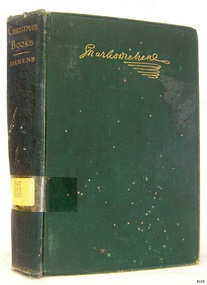
Book - A Fictional Story, Charles Dickens, Christmas Books, 1894
... Hall Ltd, London. Date: 1894. (See note section this document for more information on Edition). Green cloth...Hall Ltd, London. Date: 1894. (See note section this document for more information on Edition). Green cloth ...Charles Dickens (1812–1870) was one of the great English novelists of the Victorian era, famous for vivid characters, social criticism, and stories that were first published in serial form. He began as a journalist, rose to enormous popularity during his lifetime, and wrote major works such as Oliver Twist, David Copperfield, and Great Expectations. This volume gathers five separate Christmas stories rather than one continuous novel. The best known of them, “A Christmas Carol”, follows Ebenezer Scrooge’s moral transformation after visits from supernatural spirits, while the others mix ghostly, sentimental, and domestic themes around Christmas, memory, family, and social feeling. Together they show Dickens using Christmas as a setting for moral instruction, sympathy for the poor, and festive storytelling. This Nelson and Sons London Christmas Books volume is a collected edition of Dickens’s five Christmas novellas, “A Christmas Carol,” “The Chimes”, “The Cricket on the Hearth”, “The Battle of Life”, and “The Haunted Man”. It is not the original 1840's publication; the Nelson publication is a later reprint in the company’s “Nelson’s Classics series, with examples catalogued from 1941 to 1959.Christmas Books. Author: Charles Dickens. Publisher: Chapman & Hall Ltd, London. Date: 1894. (See note section this document for more information on Edition). Green cloth hardcover with Authors name to front cover in gold. Spine has gold title lettering. The spine has a Library label.fictionCharles Dickens (1812–1870) was one of the great English novelists of the Victorian era, famous for vivid characters, social criticism, and stories that were first published in serial form. He began as a journalist, rose to enormous popularity during his lifetime, and wrote major works such as Oliver Twist, David Copperfield, and Great Expectations. This volume gathers five separate Christmas stories rather than one continuous novel. The best known of them, “A Christmas Carol”, follows Ebenezer Scrooge’s moral transformation after visits from supernatural spirits, while the others mix ghostly, sentimental, and domestic themes around Christmas, memory, family, and social feeling. Together they show Dickens using Christmas as a setting for moral instruction, sympathy for the poor, and festive storytelling. This Nelson and Sons London Christmas Books volume is a collected edition of Dickens’s five Christmas novellas, “A Christmas Carol,” “The Chimes”, “The Cricket on the Hearth”, “The Battle of Life”, and “The Haunted Man”. It is not the original 1840's publication; the Nelson publication is a later reprint in the company’s “Nelson’s Classics series, with examples catalogued from 1941 to 1959.book, the old curiosity shop, charles dickens, shipwrecked-coast, flagstaff-hill, flagstaff-hill-maritime-museum, warrnambool, maritime-museum, flagstaff-hill-maritime-village, pattison collection, warrnambool library, warrnambool mechanics’ institute, ralph eric pattison, corangamite regional library service, warrnambool city librarian, mechanics’ institute library, victorian library board, warrnambool books and records, warrnambool children’s library, great ocean road -
 Flagstaff Hill Maritime Museum and Village
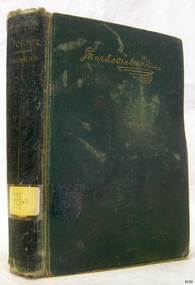
Book - A Fictional Story, Charles Dickens, Little Dorrit, 1890s
... Hall Ltd, London. Date: 1890s. (See note section this document for more information on Edition). Green cloth...Hall Ltd, London. Date: 1890s. (See note section this document for more information on Edition). Green cloth ...Charles Dickens (1812–1870) was one of the great English novelists of the Victorian era, famous for vivid characters, social criticism, and stories that were first published in serial form. He began as a journalist, rose to enormous popularity during his lifetime, and wrote major works such as Oliver Twist, David Copperfield, and Great Expectations. Little Dorrit is about Amy “Little” Dorrit, a gentle, selfless woman born and raised in the Marshalsea debtors’ prison where her father, William Dorrit, has been imprisoned for unpaid debts. The story follows her as she works as a seamstress outside the prison, gradually becoming entangled with Arthur Clennam, a businessman returning from abroad. Dickens interweaves a sharp critique of Victorian bureaucracy, finance, and class throughout the story. The theme centers around Amy Dorrit who lives her whole early life in Marshalsea, supporting her family with quiet dignity while her father clings to fragile genteel pretensions. Arthur Clennam, disillusioned after years in China, becomes involved with the Dorrits and uncovers a web of secrets involving his own mother, a hidden inheritance, and shady business dealings. William Dorrit suddenly inherits a fortune and is able to lift the family out of poverty and into fashion conscious society.The novel shows how money distorts their characters and relationships, while Amy remains the moral centre.Little Dorrit. Author: Charles Dickens. Publisher: Chapman & Hall Ltd, London. Date: 1890s. (See note section this document for more information on Edition). Green cloth hardcover with Authors name to front cover in gold. Spine has gold title lettering. The spine has a Library label.fictionCharles Dickens (1812–1870) was one of the great English novelists of the Victorian era, famous for vivid characters, social criticism, and stories that were first published in serial form. He began as a journalist, rose to enormous popularity during his lifetime, and wrote major works such as Oliver Twist, David Copperfield, and Great Expectations. Little Dorrit is about Amy “Little” Dorrit, a gentle, selfless woman born and raised in the Marshalsea debtors’ prison where her father, William Dorrit, has been imprisoned for unpaid debts. The story follows her as she works as a seamstress outside the prison, gradually becoming entangled with Arthur Clennam, a businessman returning from abroad. Dickens interweaves a sharp critique of Victorian bureaucracy, finance, and class throughout the story. The theme centers around Amy Dorrit who lives her whole early life in Marshalsea, supporting her family with quiet dignity while her father clings to fragile genteel pretensions. Arthur Clennam, disillusioned after years in China, becomes involved with the Dorrits and uncovers a web of secrets involving his own mother, a hidden inheritance, and shady business dealings. William Dorrit suddenly inherits a fortune and is able to lift the family out of poverty and into fashion conscious society.The novel shows how money distorts their characters and relationships, while Amy remains the moral centre. book, the old curiosity shop, charles dickens, shipwrecked-coast, flagstaff-hill, flagstaff-hill-maritime-museum, warrnambool, maritime-museum, flagstaff-hill-maritime-village, pattison collection, warrnambool library, warrnambool mechanics’ institute, ralph eric pattison, corangamite regional library service, warrnambool city librarian, mechanics’ institute library, victorian library board, warrnambool books and records, warrnambool children’s library, great ocean road -
 Flagstaff Hill Maritime Museum and Village
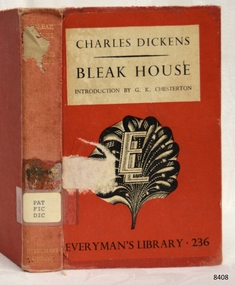
Book - A Fictional Story, Charles Dickens, Bleak House, 1925
... Hall Ltd, London. Date: 1925. (See note section this document for more information on Edition). Cloth...Hall Ltd, London. Date: 1925. (See note section this document for more information on Edition). Cloth ...Charles Dickens (1812–1870) was one of the great English novelists of the Victorian era, famous for vivid characters, social criticism, and stories that were first published in serial form. He began as a journalist, rose to enormous popularity during his lifetime, and wrote major works such as Oliver Twist, David Copperfield, and Great Expectations. Bleak House is one of Charles Dickens’s major novels, a sprawling, multi plot story built around the endless Court of Chancery lawsuit known as “Jarndyce and Jarndyce” and its ruinous effect on several families. It is widely regarded as among his finest and most complex works, central to any serious study of his fiction.Bleak House. Author: Charles Dickens. Publisher: Chapman & Hall Ltd, London. Date: 1925. (See note section this document for more information on Edition). Cloth hardcover with title on spine in gold lettering, Front cover has a paper stick on title. The spine has a Library label.fictionCharles Dickens (1812–1870) was one of the great English novelists of the Victorian era, famous for vivid characters, social criticism, and stories that were first published in serial form. He began as a journalist, rose to enormous popularity during his lifetime, and wrote major works such as Oliver Twist, David Copperfield, and Great Expectations. Bleak House is one of Charles Dickens’s major novels, a sprawling, multi plot story built around the endless Court of Chancery lawsuit known as “Jarndyce and Jarndyce” and its ruinous effect on several families. It is widely regarded as among his finest and most complex works, central to any serious study of his fiction.book, the old curiosity shop, charles dickens, shipwrecked-coast, flagstaff-hill, flagstaff-hill-maritime-museum, warrnambool, maritime-museum, flagstaff-hill-maritime-village, pattison collection, warrnambool library, warrnambool mechanics’ institute, ralph eric pattison, corangamite regional library service, warrnambool city librarian, mechanics’ institute library, victorian library board, warrnambool books and records, warrnambool children’s library, great ocean road -
 Flagstaff Hill Maritime Museum and Village
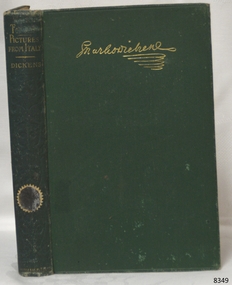
Book - A Travel & Political Critique, Charles Dickens, Hard Times and Pictures from Italy, 1866-1870’s
... Hall Ltd, London. Date: 1866-1870’s first published in book form 1846 (See note section this document for more information on Edition). Green cloth...Hall Ltd, London. Date: 1866-1870’s first published in book form 1846 (See note section this document for more information on Edition). Green cloth ...Charles Dickens (1812–1870) was one of the great English novelists of the Victorian era, famous for vivid characters, social criticism, and stories that were first published in serial form. He began as a journalist, rose to enormous popularity during his lifetime, and wrote major works such as Oliver Twist, David Copperfield, and Great Expectations. Pictures from Italy first published 1846 is a travelogue describing Dickens’s 1844 journey through Italy with his family that included Rome, Venice, Florence, and other cities. It mixes vivid descriptions of art, landscape, and carnival life with his characteristic observations on social inequality and political fragmentation in pre unification Italy. Together this combined volume offers both a major insight on Victorian industrial England and a lighter, more personal travel narrative showing Dickens from two sides, the social reformer and the acute observer tourist.Hard Cover edition, Hard Times and Pictures for Italy. Author: Charles Dickens. Publisher: Chapman & Hall Ltd, London. Date: 1866-1870’s first published in book form 1846 (See note section this document for more information on Edition). Green cloth hardcover, Spine black has Author and Title in gold lettering. The spine has a Library label and no Volume information.non-fictionCharles Dickens (1812–1870) was one of the great English novelists of the Victorian era, famous for vivid characters, social criticism, and stories that were first published in serial form. He began as a journalist, rose to enormous popularity during his lifetime, and wrote major works such as Oliver Twist, David Copperfield, and Great Expectations. Pictures from Italy first published 1846 is a travelogue describing Dickens’s 1844 journey through Italy with his family that included Rome, Venice, Florence, and other cities. It mixes vivid descriptions of art, landscape, and carnival life with his characteristic observations on social inequality and political fragmentation in pre unification Italy. Together this combined volume offers both a major insight on Victorian industrial England and a lighter, more personal travel narrative showing Dickens from two sides, the social reformer and the acute observer tourist.book, the old curiosity shop, charles dickens, shipwrecked-coast, flagstaff-hill, flagstaff-hill-maritime-museum, warrnambool, maritime-museum, flagstaff-hill-maritime-village, pattison collection, warrnambool library, warrnambool mechanics’ institute, ralph eric pattison, corangamite regional library service, warrnambool city librarian, mechanics’ institute library, victorian library board, warrnambool books and records, warrnambool children’s library, great ocean road, hard times for these times -
 Orbost & District Historical Society
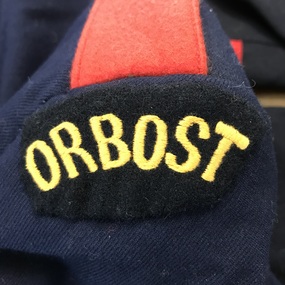
Uniform - Orbost Municipal Band, F Maxey & Son P/L, c. 1960s - 1970s
... Hall The items are significant because they are authentic parts of the Orbost Municipal Band. Orbost Municipal Band Orbost Bands labels on clothing: F. Maxey & Son P/L - on cap Simpson's Gloves P/L Vic. - gloves Hersh's - on badges, also trousers, and jacket OMB - Orbost Municipal Band - on banner ORBOST - on cloth badges A number of items of clothing (cap, coat, gloves, jacket, badges, trousers), banner, insignias, whistle. ...In 2024, while doing some renovations at the Orbost Customer Service Centre / Library, Council staff have found some boxes of old Orbost Municipal Band uniforms and flags which date back to the late 1970s (when it’s understood the band wound up). These items were offered to the O D Historical Society for its collection. A selection was made (3364). The first Orbost Brass Band was formed in 1889. Around 1908 the town band split and the Orbost Workers' Band was formed. Eventually the two bands merged in 1913 to reform as the Orbost Municipal Band under conductorship of Charles Spink. The band continued for many years but was later disbanded and again reformed. This was to happen a number of times, the last time being in 1961 and continuing through to the late 1970's. Also refer to items in the O D H S collection. Further info and Ref: In Times Gone By - Deborah Hall The items are significant because they are authentic parts of the Orbost Municipal Band. A number of items of clothing (cap, coat, gloves, jacket, badges, trousers), banner, insignias, whistle. These are all items associated with the Orbost Municipal Band. The costume items are all dark blue/black with gold and red trims. Gloves are white/cream gauntlet style. Whistle is silver. The banner is red background with gold trims and O M B appliqued. 3364.1 cap, dark blue with front visor, red ribbon decoration, 2 gold buttons on sides; large gold metal decoration of a lyre with crown on top a the front. 3364.2 pair of gloves, gauntlet style, white/cream leather, silver studs 3364.6 large jacket, dark blue/black, woollen, red epaulets on shoulders with gold buttons, 4 gold buttons on front, 6 on sleeves, gold braiding; drum badge on sleeves, 2 lyre badges; gold lanyard on right sleeve. Gold on black cloth badge on shoulders. A whistle is also with this jacket. 3364.4 small jacket, dark blue/black, woollen, red epaulets, gold studs, 2 lyre studs on lapels 3364.5 small trousers. dark blue/black, woollen. Red stripe down outside of both legs. 3364.3 a 41 cm square square red cloth banner, with gold fringe on the bottom, gold tassle on top with gold cord. Has O M B in large lettering appliqued to the banner. labels on clothing: F. Maxey & Son P/L - on cap Simpson's Gloves P/L Vic. - gloves Hersh's - on badges, also trousers, and jacket OMB - Orbost Municipal Band - on banner ORBOST - on cloth badges orbost municipal band, orbost bands -
Ringwood and District Historical Society
Book, Ringwood Philatelic Society Minute Book 1952 to 1959, 1952
... Hall with J.K. McCaskill J.P. in the chair. Last monthly meeting recorded in book on 5-Jun-1959. 'Stamp Club 1952' on spine Brown covered book with red cloth spine. ...Given to the Ringwood Historical Research Group by the Ringwood and District Philatelic Society from the inaugural meeting on Friday 6-Jun-1952 held in the Ringwood Town Hall with J.K. McCaskill J.P. in the chair. Last monthly meeting recorded in book on 5-Jun-1959.Brown covered book with red cloth spine. 'Faint' printed on the front. All pages used. +Additional Keywords: McCaskill, J.K.'Stamp Club 1952' on spine -
 Ringwood and District Historical Society
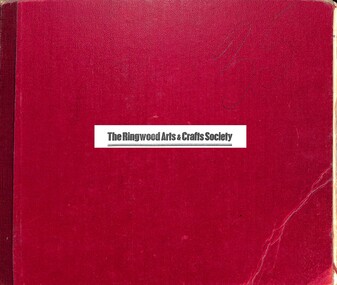
Book - Account Books, Ringwood Arts and Crafts Society with Ringwood Eisteddfod Programmes, 1946-1972
... The society rented the lower Ringwood Town Hall for meetings. Red cardboard covered ledger with red cloth spine: 1-Dec-1946 to 15-Nov-1972 91pp.; Included are copies of Ringwood Eisteddfod Programmes 28-Aug-1955 to the 18th Ringwood Eisteddfod 1-Sep-1972 +Additional Keywords: McKerrow / McLean / Rob / Corr / Frank / Dowsing, Mrs Irene (Foundation Member) Ringwood Arts and Crafts Society with Ringwood Eisteddfod Programmes. ...This expenditure ledger was used by the Ringwood Arts & Crafts Society between 1946 and 1972. Included are programs for the Ringwood Eisteddfod from the first to the 18th Eisteddfod: i.e. from 1955 to 1972.|Statement by Ms McKerrow relating to short history typed and pasted into the back of the ledger.|The Society started in 1946 and also associated societies. The society rented the lower Ringwood Town Hall for meetings.Red cardboard covered ledger with red cloth spine: 1-Dec-1946 to 15-Nov-1972 91pp.; Included are copies of Ringwood Eisteddfod Programmes 28-Aug-1955 to the 18th Ringwood Eisteddfod 1-Sep-1972 +Additional Keywords: McKerrow / McLean / Rob / Corr / Frank / Dowsing, Mrs Irene (Foundation Member) -
Glenelg Shire Council Cultural Collection
Book, The Victorian Statues, 1887, Vol 1, n.d
... Hall (nee Smallpage) - great grand-daughter of Stephen George Henty. Taken in 1934 Centenary celebrations in Portland. local courts local government government administration gazette Victorian Government Fawn cloth bound spine and covers. ...Fawn cloth bound spine and covers. Black text on spine. Volumes 1 -1V only. Volume V not in set.local courts, local government, government administration, gazette, victorian government -
 Halls Gap & Grampians Historical Society
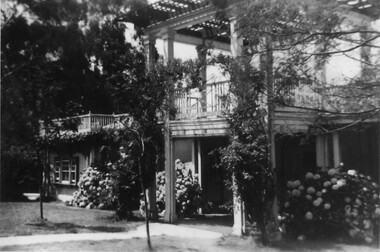
Photograph - B/W, C 1931
... Ladies & gentlemen dressed for dinner, the ladies resplendent in their long evening gowns and jewellery would come down the stairway from the entrance hall to the lounge then the dining room. The tables were beautifully appointed with damask table cloths & fine silverware. ...Ladies & gentlemen dressed for dinner, the ladies resplendent in their long evening gowns and jewellery would come down the stairway from the entrance hall to the lounge then the dining room. The tables were beautifully appointed with damask table cloths & fine silverware. ...A major rebuilding project took place. Brothers John & Thomas Morgan with local storekeeper Harold Goodwin Taylor designing and building a grand new Guest House with 22 bedrooms plus the original bungalows. Unheard of at the time the guests bedrooms had hand basins with hot & cold running water. This was achieved by building a weir on Stony Creek and piping the water to a high holding tank at the guest house. The dining room was a grand affair, a 4.5 metre high ceiling with beautiful gold leaf cornices, art deco ceiling and wall lights with feature plaster lights in the form of blue bells, wall to wall carpet and Kentia palms completed the picture. Ladies & gentlemen dressed for dinner, the ladies resplendent in their long evening gowns and jewellery would come down the stairway from the entrance hall to the lounge then the dining room. The tables were beautifully appointed with damask table cloths & fine silverware. The kitchen was well appointed with a huge coal fired range and a donkey for hot water. Milk & cream, bacon & pork, chicken & eggs together with vegetables were all home grown on the property. A large ballroom with a beautiful timber floor was the scene after dinner for many dances and party nights with guests from other establishments and locals joining in for the night. A huge fernery was also a feature of the gardens. During the day tennis parties would be held on the courts, together with horse riding and guided walks were taken out by local guide Gilbert Rogers.Photo of newly built Grampian Houseaccommodation, guesthouses, accommodation, grampian house -
 Halls Gap & Grampians Historical Society
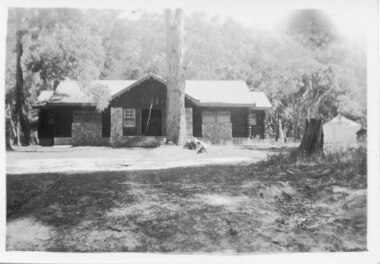
Photograph - B/W, C 1946
... Halls Gap Picnic and Camping Reserve. BUILDINGS Mountain Grand The photo shows a wood and stone building at the rear of a clearing with a large eucalyptus tree growing close to the front of it. In the background is heavy bush. A tent or large cloth ...A photo of the Comfort Station in the Halls Gap Picnic and Camping Reserve.The photo shows a wood and stone building at the rear of a clearing with a large eucalyptus tree growing close to the front of it. In the background is heavy bush. A tent or large cloth can be seen on the right beside a large tree stump.buildings, mountain grand -
 Orbost & District Historical Society
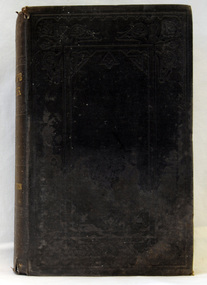
book, Stanhope Sermons, 1878
... In Times Gone By - Deborah Hall) Richard Weston was the vicar at Burntwood in Staffordshire, England from 1886–1922. sermons Dicken-Frank Weston-Richard Burntwood religious-literature Inside- To Frank Dicken, in memory of Burntwood days from Vicar Richard Weston 1926 A book with a brown cloth cover. ...This book was owned by F.B. Dicken. Frank and May Dicken moved to Orbost in 1936 where Frank became manager of Pardew Brothers store in Nicholson Street. In 1945, Frank purchased the business and in 1947, formed a partnership with his son, Selwyn. The store was then called F.B. Dicken and Son. The premises are still retained by the Dicken family although the shop business was sold in 1981. (ref. In Times Gone By - Deborah Hall) Richard Weston was the vicar at Burntwood in Staffordshire, England from 1886–1922.A book with a brown cloth cover. Stanhope Sermons - second edition.Inside- To Frank Dicken, in memory of Burntwood days from Vicar Richard Weston 1926sermons dicken-frank weston-richard burntwood religious-literature -
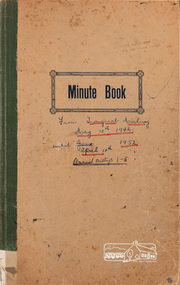 Eltham District Historical Society Inc
Minute Book, Minute Book No. 1, Women's Auxiliary, Eltham War Memorial Trust, 10 May 1946 to 10 April 1952
... Whilst the Senior Citizens Centre is contained within the original Eltham War Memorial building precinct, it was not part of the original Memorial and was not funded by the Eltham War Memorial Trust. eltham children's library, eltham infant welfare centre, eltham pre-school, eltham war memorial hall, eltham war memorial trust, meeting minutes, minute book, women's auxiliary At rear of book are the minutes of the 1st to 5th Annual Meetings (1947-1951) and a list of financial members 33 x 21 x 1 cm; beige cardboard endcovers with green cloth spine binding; 132 pages Minute Book No. 1, Women's Auxiliary, Eltham War Memorial Trust, 10 May 1946 to 10 April 1952 Minute Book ...History of the War Memorial Following the end of the First World War, communities across Victoria and Australia typically erected memorials which were predominantly statues, cenotaphs, avenues of honour and plaques. The Shire of Eltham established the Avenue of Honour at the gateway to the shire as well as an obelisk at the corner of Main Road and Bridge street and the Shire of Eltham War Memorial Tower at Kangaroo Ground. After the Second World War communities once again desired to preserve the memories of those who served and paid the ultimate sacrifice. Resources were scarce so there was a transition away from the traditional style memorials that sprang up post 1918 to one of building facilities that would provide ongoing benefit to the community. Even before the end of the Second World War, the citizens of Eltham began to consider an appropriate form of memorial for those from the area who fought and died in the First and Second World Wars. In 1943 the Eltham Women’s Auxiliary raised funds for the construction of buildings to be established on land to be purchased for the proposed War Memorial. On March 27th, 1945, the Eltham District Progress Association called a meeting of local people who in turn set up and registered the Eltham War Memorial Trust Inc. As a focus for the purpose of the memorial, the newspaper notice read:- ‘Those who have had a member of their family in the fighting services will want to see that the form of a memorial we are concerned with is the one which will be a constant reminder to us of those who fought for us and the little ones for whom they fought and died.’ At that meeting it was decided the Memorial should take the form of a baby health centre along with a creche and children’s library. In late 1945, the newly formed Eltham War Memorial Trust purchased the land at 903-907 Main Road Eltham from Miss Shillinglaw, which once formed part of the Shillinglaw farm on Lot 90 of Holloway’s 1851 “Little Eltham” subdivision. The Governor of Victoria, General Sir Dallas Brooks, laid the foundation stone on November 24th, 1950, in memory of those who fell in the Second World War. The Eltham Infant Welfare Centre was opened November 15th, 1952, the Pre-school on December 1st, 1956, and the Children’s Library in 1961. In late 1966 the children’s library service was integrated into the Heideberg Regional Library Service and the building was officially renamed the Eltham War Memorial Hall. Following the opening of the Eltham Infant Welfare Centre, work began in 1953 planning for the entrance to the grounds, which is signaled by a wrought iron arch entitled “Eltham War Memorial” . In 1954 the Eltham War Memorial Trust decided that a legacy provided by the late Councillor Ernest James Andrew (d. 29 March 1950) in memory of his wife, Mrs. Ellen Andrew (d. 13 July 1946) and who are both buried at Eltham Cemetery, should be used to fund the construction of the entrance. A metal plate inscribed to this effect was attached to the gates. Work on the Memorial Gardens was undertaken throughout the following decade, with a Memorial Forecourt included in the final 1956 plans for the Pre-School Centre. A quote was accepted by the Trust in 1963 for the implementation of a memorial garden, which included grading of a sixty-five foot strip at the rear of the Trust buildings and construction of concrete paths. The stone retaining walls at the front of the site were installed in 1968 when Main Road was widened and it is believed that the Memorial Gates were relocated at that time also. Eltham Senior Citizens Centre In 1964, Eltham Shire Council purchased a section of land from the Trust at the northern end of the site, as a provision for Country Fire Authority buildings. At the same time the Elderly Citizens Club proposed a Senior Citizens Centre on the south western section of the Trust’s property. This was approved by the Trust with the provision that the building was constructed in ‘accord’ with those already existing. In 1965 Council took on board the plans for the Senior Citizens Centre and applied for a government grant. These could only be awarded if Council owned the site. In 1962 the Trust had resolved to hand over the assets to Council once the Memorial Gardens were completed. This was in line with Health Department requirements that grants for the ongoing operation and maintenance of the three facilities would only be made once the the facilities were completed and handed over to Council. In 1965 the Department of Health further demanded substantial alterations to the Pre-School playground as a result of the pending impact of the planned Senior Citizens Centre and Main Road duplication. As a consequence, handover of the Trust’s assets to Council was initiated with a formal ceremony held in the Children’s Library on August 28th, 1965. The Trust continued on as a committee of management for another twelve months. Plans and specifications for the Senior Citizens Centre were prepared by March 1966. Council obtained a grant from the Government which covered one third of the cost and the building was completed by April 1967. Whilst the Senior Citizens Centre is contained within the original Eltham War Memorial building precinct, it was not part of the original Memorial and was not funded by the Eltham War Memorial Trust.At rear of book are the minutes of the 1st to 5th Annual Meetings (1947-1951) and a list of financial members 33 x 21 x 1 cm; beige cardboard endcovers with green cloth spine binding; 132 pageseltham children's library, eltham infant welfare centre, eltham pre-school, eltham war memorial hall, eltham war memorial trust, meeting minutes, minute book, women's auxiliary -
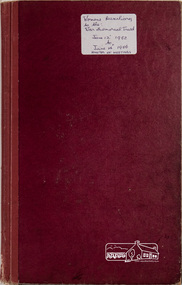 Eltham District Historical Society Inc
Minute Book, Minute Book No. 2, Women's Auxiliary, Eltham War Memorial Trust, 12 June 1952 to 14 June 1956
... Whilst the Senior Citizens Centre is contained within the original Eltham War Memorial building precinct, it was not part of the original Memorial and was not funded by the Eltham War Memorial Trust. eltham children's library, eltham infant welfare centre, eltham pre-school, eltham war memorial hall, eltham war memorial trust, meeting minutes, minute book, women's auxiliary At centre of book are the minutes of the 6th, 7th, 8th and 9th Annual Meetings (1952-1955) 32.5 x 20.5 x 1 cm; burgundy hard endcovers with burgundy cloth spine binding; contents almost separated from spine and cover plates; 94 pages Minute Book No. 2, Women's Auxiliary, Eltham War Memorial Trust, 12 June 1952 to 14 June 1956 Minute Book ...History of the War Memorial Following the end of the First World War, communities across Victoria and Australia typically erected memorials which were predominantly statues, cenotaphs, avenues of honour and plaques. The Shire of Eltham established the Avenue of Honour at the gateway to the shire as well as an obelisk at the corner of Main Road and Bridge street and the Shire of Eltham War Memorial Tower at Kangaroo Ground. After the Second World War communities once again desired to preserve the memories of those who served and paid the ultimate sacrifice. Resources were scarce so there was a transition away from the traditional style memorials that sprang up post 1918 to one of building facilities that would provide ongoing benefit to the community. Even before the end of the Second World War, the citizens of Eltham began to consider an appropriate form of memorial for those from the area who fought and died in the First and Second World Wars. In 1943 the Eltham Women’s Auxiliary raised funds for the construction of buildings to be established on land to be purchased for the proposed War Memorial. On March 27th, 1945, the Eltham District Progress Association called a meeting of local people who in turn set up and registered the Eltham War Memorial Trust Inc. As a focus for the purpose of the memorial, the newspaper notice read:- ‘Those who have had a member of their family in the fighting services will want to see that the form of a memorial we are concerned with is the one which will be a constant reminder to us of those who fought for us and the little ones for whom they fought and died.’ At that meeting it was decided the Memorial should take the form of a baby health centre along with a creche and children’s library. In late 1945, the newly formed Eltham War Memorial Trust purchased the land at 903-907 Main Road Eltham from Miss Shillinglaw, which once formed part of the Shillinglaw farm on Lot 90 of Holloway’s 1851 “Little Eltham” subdivision. The Governor of Victoria, General Sir Dallas Brooks, laid the foundation stone on November 24th, 1950, in memory of those who fell in the Second World War. The Eltham Infant Welfare Centre was opened November 15th, 1952, the Pre-school on December 1st, 1956, and the Children’s Library in 1961. In late 1966 the children’s library service was integrated into the Heideberg Regional Library Service and the building was officially renamed the Eltham War Memorial Hall. Following the opening of the Eltham Infant Welfare Centre, work began in 1953 planning for the entrance to the grounds, which is signaled by a wrought iron arch entitled “Eltham War Memorial” . In 1954 the Eltham War Memorial Trust decided that a legacy provided by the late Councillor Ernest James Andrew (d. 29 March 1950) in memory of his wife, Mrs. Ellen Andrew (d. 13 July 1946) and who are both buried at Eltham Cemetery, should be used to fund the construction of the entrance. A metal plate inscribed to this effect was attached to the gates. Work on the Memorial Gardens was undertaken throughout the following decade, with a Memorial Forecourt included in the final 1956 plans for the Pre-School Centre. A quote was accepted by the Trust in 1963 for the implementation of a memorial garden, which included grading of a sixty-five foot strip at the rear of the Trust buildings and construction of concrete paths. The stone retaining walls at the front of the site were installed in 1968 when Main Road was widened and it is believed that the Memorial Gates were relocated at that time also. Eltham Senior Citizens Centre In 1964, Eltham Shire Council purchased a section of land from the Trust at the northern end of the site, as a provision for Country Fire Authority buildings. At the same time the Elderly Citizens Club proposed a Senior Citizens Centre on the south western section of the Trust’s property. This was approved by the Trust with the provision that the building was constructed in ‘accord’ with those already existing. In 1965 Council took on board the plans for the Senior Citizens Centre and applied for a government grant. These could only be awarded if Council owned the site. In 1962 the Trust had resolved to hand over the assets to Council once the Memorial Gardens were completed. This was in line with Health Department requirements that grants for the ongoing operation and maintenance of the three facilities would only be made once the the facilities were completed and handed over to Council. In 1965 the Department of Health further demanded substantial alterations to the Pre-School playground as a result of the pending impact of the planned Senior Citizens Centre and Main Road duplication. As a consequence, handover of the Trust’s assets to Council was initiated with a formal ceremony held in the Children’s Library on August 28th, 1965. The Trust continued on as a committee of management for another twelve months. Plans and specifications for the Senior Citizens Centre were prepared by March 1966. Council obtained a grant from the Government which covered one third of the cost and the building was completed by April 1967. Whilst the Senior Citizens Centre is contained within the original Eltham War Memorial building precinct, it was not part of the original Memorial and was not funded by the Eltham War Memorial Trust.At centre of book are the minutes of the 6th, 7th, 8th and 9th Annual Meetings (1952-1955) 32.5 x 20.5 x 1 cm; burgundy hard endcovers with burgundy cloth spine binding; contents almost separated from spine and cover plates; 94 pageseltham children's library, eltham infant welfare centre, eltham pre-school, eltham war memorial hall, eltham war memorial trust, meeting minutes, minute book, women's auxiliary -
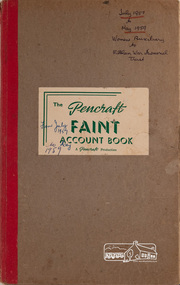 Eltham District Historical Society Inc
Minute Book, Minute Book No. 3, Women's Auxiliary, Eltham War Memorial Trust, 12 July 1957 to 14 May 1959
... Whilst the Senior Citizens Centre is contained within the original Eltham War Memorial building precinct, it was not part of the original Memorial and was not funded by the Eltham War Memorial Trust. eltham children's library, eltham infant welfare centre, eltham pre-school, eltham war memorial hall, eltham war memorial trust, meeting minutes, minute book, women's auxiliary At rear of book are the minutes of the 10th, 11th and 12th Annual Meetings (1956-1958) The Pencraft Faint Account Book 32.5 x 20.5 x 0.5 cm; beige cardboard endcovers with red cloth spine binding; 66 pages Minute Book No. 3, Women's Auxiliary, Eltham War Memorial Trust, 12 July 1957 to 14 May 1959 Minute Book ...History of the War Memorial Following the end of the First World War, communities across Victoria and Australia typically erected memorials which were predominantly statues, cenotaphs, avenues of honour and plaques. The Shire of Eltham established the Avenue of Honour at the gateway to the shire as well as an obelisk at the corner of Main Road and Bridge street and the Shire of Eltham War Memorial Tower at Kangaroo Ground. After the Second World War communities once again desired to preserve the memories of those who served and paid the ultimate sacrifice. Resources were scarce so there was a transition away from the traditional style memorials that sprang up post 1918 to one of building facilities that would provide ongoing benefit to the community. Even before the end of the Second World War, the citizens of Eltham began to consider an appropriate form of memorial for those from the area who fought and died in the First and Second World Wars. In 1943 the Eltham Women’s Auxiliary raised funds for the construction of buildings to be established on land to be purchased for the proposed War Memorial. On March 27th, 1945, the Eltham District Progress Association called a meeting of local people who in turn set up and registered the Eltham War Memorial Trust Inc. As a focus for the purpose of the memorial, the newspaper notice read:- ‘Those who have had a member of their family in the fighting services will want to see that the form of a memorial we are concerned with is the one which will be a constant reminder to us of those who fought for us and the little ones for whom they fought and died.’ At that meeting it was decided the Memorial should take the form of a baby health centre along with a creche and children’s library. In late 1945, the newly formed Eltham War Memorial Trust purchased the land at 903-907 Main Road Eltham from Miss Shillinglaw, which once formed part of the Shillinglaw farm on Lot 90 of Holloway’s 1851 “Little Eltham” subdivision. The Governor of Victoria, General Sir Dallas Brooks, laid the foundation stone on November 24th, 1950, in memory of those who fell in the Second World War. The Eltham Infant Welfare Centre was opened November 15th, 1952, the Pre-school on December 1st, 1956, and the Children’s Library in 1961. In late 1966 the children’s library service was integrated into the Heideberg Regional Library Service and the building was officially renamed the Eltham War Memorial Hall. Following the opening of the Eltham Infant Welfare Centre, work began in 1953 planning for the entrance to the grounds, which is signaled by a wrought iron arch entitled “Eltham War Memorial” . In 1954 the Eltham War Memorial Trust decided that a legacy provided by the late Councillor Ernest James Andrew (d. 29 March 1950) in memory of his wife, Mrs. Ellen Andrew (d. 13 July 1946) and who are both buried at Eltham Cemetery, should be used to fund the construction of the entrance. A metal plate inscribed to this effect was attached to the gates. Work on the Memorial Gardens was undertaken throughout the following decade, with a Memorial Forecourt included in the final 1956 plans for the Pre-School Centre. A quote was accepted by the Trust in 1963 for the implementation of a memorial garden, which included grading of a sixty-five foot strip at the rear of the Trust buildings and construction of concrete paths. The stone retaining walls at the front of the site were installed in 1968 when Main Road was widened and it is believed that the Memorial Gates were relocated at that time also. Eltham Senior Citizens Centre In 1964, Eltham Shire Council purchased a section of land from the Trust at the northern end of the site, as a provision for Country Fire Authority buildings. At the same time the Elderly Citizens Club proposed a Senior Citizens Centre on the south western section of the Trust’s property. This was approved by the Trust with the provision that the building was constructed in ‘accord’ with those already existing. In 1965 Council took on board the plans for the Senior Citizens Centre and applied for a government grant. These could only be awarded if Council owned the site. In 1962 the Trust had resolved to hand over the assets to Council once the Memorial Gardens were completed. This was in line with Health Department requirements that grants for the ongoing operation and maintenance of the three facilities would only be made once the the facilities were completed and handed over to Council. In 1965 the Department of Health further demanded substantial alterations to the Pre-School playground as a result of the pending impact of the planned Senior Citizens Centre and Main Road duplication. As a consequence, handover of the Trust’s assets to Council was initiated with a formal ceremony held in the Children’s Library on August 28th, 1965. The Trust continued on as a committee of management for another twelve months. Plans and specifications for the Senior Citizens Centre were prepared by March 1966. Council obtained a grant from the Government which covered one third of the cost and the building was completed by April 1967. Whilst the Senior Citizens Centre is contained within the original Eltham War Memorial building precinct, it was not part of the original Memorial and was not funded by the Eltham War Memorial Trust.At rear of book are the minutes of the 10th, 11th and 12th Annual Meetings (1956-1958) The Pencraft Faint Account Book 32.5 x 20.5 x 0.5 cm; beige cardboard endcovers with red cloth spine binding; 66 pageseltham children's library, eltham infant welfare centre, eltham pre-school, eltham war memorial hall, eltham war memorial trust, meeting minutes, minute book, women's auxiliary
