
Showing 35 items matching "coaching industry"
-
 Buninyong & District Historical Society
Audio - Oral history, Gordon Hale, and talk by Clive Brooks on Coaching Industry, Oral history, Gordon Hale, talk by Clive Brooks on Coaching Industry
... Oral history, Gordon Hale, and talk by Clive Brooks on Coaching Industry...Oral history, Gordon Hale, talk by Clive Brooks on Coaching Industry......Coaching Industry...People, activities Sports Hale Family Buninyong School. Businesses Coaching Industry Oral history, Gordon Hale, audio cassette and digital MP3 Oral history, Gordon Hale, talk by Clive Brooks on Coaching Industry Audio Oral history, Gordon Hale, and talk by Clive Brooks on Coaching Industry ...People, activitiesOral history, Gordon Hale, audio cassette and digital MP3sports, hale family, buninyong school., businesses, coaching industry -
Buninyong & District Historical Society
Audio - Oral history, Gordon Hale, and talk by Clive Brooks on Coaching Industry, Oral history, Gordon Hale, talk by Clive Brooks on Coaching Industry
... Oral history, Gordon Hale, and talk by Clive Brooks on Coaching Industry...Oral history, Gordon Hale, talk by Clive Brooks on Coaching Industry......Coaching Industry...People, activities Sports Hale Family Buninyong School. Businesses Coaching Industry Oral history, Gordon Hale, audio cassette and digital MP3 Oral history, Gordon Hale, talk by Clive Brooks on Coaching Industry Audio Oral history, Gordon Hale, and talk by Clive Brooks on Coaching Industry ...People, activitiesOral history, Gordon Hale, audio cassette and digital MP3sports, hale family, buninyong school., businesses, coaching industry -
 Orbost & District Historical Society
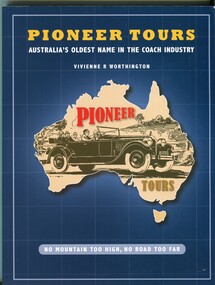
Book, Worthington, Vivienne, PIONEER TOURS, December 1 2009
... The cover is dark blue with the title, " Pioneer Tours" in yellow print at the top and "oldest name in the coach industry / Vivienne R Worthington" in white print beneath it. ...on cover at bottom in white "NO MOUNTAIN TOO HIGH NO ROAD TOO FAR" on cover at top - "PIONEER TOURS : AUSTRALIA'S OLDEST NAME IN THE COACH INDUSTRY / VIVIENNE R WORTHINGTON."...The cover is dark blue with the title, " Pioneer Tours" in yellow print at the top and "oldest name in the coach industry / Vivienne R Worthington" in white print beneath it. ...This book was written by Vivienne Worthington, a relative of the family of Albert Withers, the founder of Pioneer Coach Tours. From the hire of his first vehicle in 1905 Albert Withers always used the name 'Pioneer', until he ultimately established Pioneer Tourist Coaches, which became 'the largest of its kind in the Commonwealth' and in many respects unique. It began with motoring in Victoria and eventually covered the whole of Australia.This book is a useful reference tool.A paperback book of 136 pp. The cover is dark blue with the title, " Pioneer Tours" in yellow print at the top and "oldest name in the coach industry / Vivienne R Worthington" in white print beneath it. In the centre is an outline of a fawn coloured map of Australia with a black drawing of a family in a touring car. - probably from 1930s. At the top in red print is "PIONEER" and below the drawing in brown print is "TOURS" At the bottom of the page is "NO MOUNTAIN TOO HIGH NO ROAD TOO FAR" in white print inside a pale blue rectangle with rounded ends. It contains black / white photographs and the history of the Pioneer Travel Company. on cover at bottom in white "NO MOUNTAIN TOO HIGH NO ROAD TOO FAR" on cover at top - "PIONEER TOURS : AUSTRALIA'S OLDEST NAME IN THE COACH INDUSTRY / VIVIENNE R WORTHINGTON."transport tourism pioneer-coach-tours worthington-vivienne -
 Stawell Historical Society Inc
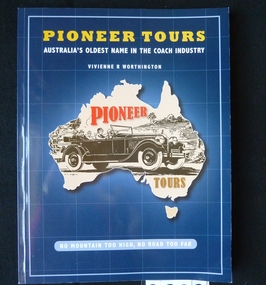
Book, Vivienne Worthington, Pioneer Tours - Previously Cat No 3622, 2009
... Yellow Print: Pioneer Tours White Print: Australia's Oldest name in the Coach Industry Vivienne R Worthington No Mountain too high, No road to Far Inside: Presented with Thanks to Stawell Historical Society Inc, for their research which helped me write this book. ...A History of the Pioneer Tours stawell transport Tourism Yellow Print: Pioneer Tours White Print: Australia's Oldest name in the Coach Industry Vivienne R Worthington No Mountain too high, No road to Far Inside: Presented with Thanks to Stawell Historical Society Inc, for their research which helped me write this book. ...A History of the Pioneer ToursBlue card cover with outline of Australia with a car insideYellow Print: Pioneer Tours White Print: Australia's Oldest name in the Coach Industry Vivienne R Worthington No Mountain too high, No road to Far Inside: Presented with Thanks to Stawell Historical Society Inc, for their research which helped me write this book. Best Wishes Vivienne Worthington 2010stawell transport, tourism -
 Bendigo Historical Society Inc.
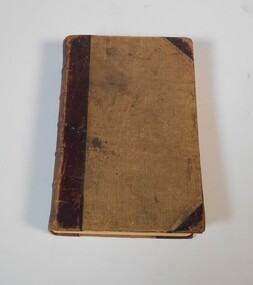
Book - Geographical dictionary
... Entries include latitude and longitude, populations, proximity to other towns, local industries, coach and mail runs, hotels, churches and schools....Entries include latitude and longitude, populations, proximity to other towns, local industries, coach and mail runs, hotels, churches and schools. ...The Gazetteer presents an extensive a to z list of Victorian towns and villages, lakes, rivers and creeks, islands, bays, hills and mountains, runs and other localities and features. Entries include latitude and longitude, populations, proximity to other towns, local industries, coach and mail runs, hotels, churches and schools.Bailliere's Victorian Gazetteer and road guide containing the most recent and accurate information as to every place in the colony. Brown hardcover book, on the spine: Victorian Gazetteer with map 1865. The first and last pages are advertisements. The book has 442 pages listing every place in the colony. The map is not included. Compiled by Robert P. Whitworth. Published by Bailliere, Regent Street Unreadable name on first page and the name of F. Houston in blue pen on first page geographic dictionary, colony of victoria -
 The Beechworth Burke Museum
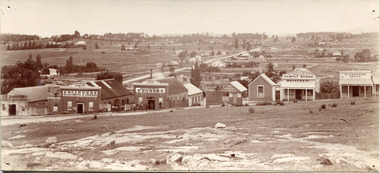
Photograph, c1900
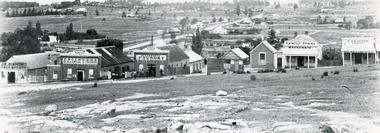
... Bishop, Coach Builders; Straughair Duncan, Engineers, Blacksmiths & Farriers; Straughair Duncan, Beechworth Foundry; Wholesale & Retail Est. 1855, Mackenzie Family Store ; and T. Pratten, Grocer. The Mental Hospital can be seen in the background. Mark Straughair and John Duncan, established the Beechworth Foundry, Newtown in 1858 and went on to build an important industry...Bishop, Coach Builders; Straughair Duncan, Engineers, Blacksmiths & Farriers; Straughair Duncan, Beechworth Foundry; Wholesale & Retail Est. 1855, Mackenzie Family Store ; and T. Pratten, Grocer. The Mental Hospital can be seen in the background. Mark Straughair and John Duncan, established the Beechworth Foundry, Newtown in 1858 and went on to build an important industry ...Taken around 1858, depicting a row of five business buildings on a rocky, sloping hillside at New Town, with a view across to residences and open land. Businesses included, Joseph E. Bishop, Coach Builders; Straughair Duncan, Engineers, Blacksmiths & Farriers; Straughair Duncan, Beechworth Foundry; Wholesale & Retail Est. 1855, Mackenzie Family Store ; and T. Pratten, Grocer. The Mental Hospital can be seen in the background. Mark Straughair and John Duncan, established the Beechworth Foundry, Newtown in 1858 and went on to build an important industry, employing around sixteen men, after acquiring Alexander Roger's New Ford Street Foundry in the late 1860s. Making and repairing mostly mining and agricultural machinery for the Ovens District and a Beechworth brewery, the business continued to function after Straughair's death in 1882, up until the death of Duncan in 1896, when the business folded. This photograph is historically significant because it shows the development of the businesses in Beechworth from the early establishment of the town.Sepia rectangular photograph printed on photographic paper mounted on boardObverse: [Pin holes from circular tacks in all four corners] Reverse: 84.216-1/ Newtown/ 1997.2650/ 21/ BMM3056/new town, newtown, newtown beechworth, local business, 1858, 1850s beechworth, joseph e. bishop, coach builder, coach, mark straughair, m. straughair, straughair and duncan, john duncan, j. duncan, beechworth foundry, mackenzie family store, t. pratten, grocer, beechworth grocers, beechworth mental asylum, beechworth mental hospital, mayday hills mental asylum, mental hospital, alexander rogers, new ford street foundry, 1860s beechworth, 1860s, mining machinery, agricultural machinery, manufacturing, bridge road -
 The Beechworth Burke Museum
Photograph, Circa 1858
... Coach Builders; Straughair Duncan, Engineers, Blacksmiths & Farriers; Straughair Duncan, Beechworth Foundry; Wholesale & Retail Est. 1855, Mackenzie Family Store ; and T. Pratten, Grocer. Eleven men may be seen outside the Foundry building. The Mental Hospital can be seen in the background. Mark Straughair and John Duncan, established the Beechworth Foundry, Newtown in 1858 and went on to build an important industry...Coach Builders; Straughair Duncan, Engineers, Blacksmiths & Farriers; Straughair Duncan, Beechworth Foundry; Wholesale & Retail Est. 1855, Mackenzie Family Store ; and T. Pratten, Grocer. Eleven men may be seen outside the Foundry building. The Mental Hospital can be seen in the background. Mark Straughair and John Duncan, established the Beechworth Foundry, Newtown in 1858 and went on to build an important industry ...Taken around 1858, depicting a row of five business buildings on a rocky, sloping hillside at New Town, with a view across to residences and open land. Businesses included, Joseph E. Bishop, Coach Builders; Straughair Duncan, Engineers, Blacksmiths & Farriers; Straughair Duncan, Beechworth Foundry; Wholesale & Retail Est. 1855, Mackenzie Family Store ; and T. Pratten, Grocer. Eleven men may be seen outside the Foundry building. The Mental Hospital can be seen in the background. Mark Straughair and John Duncan, established the Beechworth Foundry, Newtown in 1858 and went on to build an important industry, employing around sixteen men, after acquiring Alexander Roger's New Ford Street Foundry in the late 1860s. Making and repairing mostly mining and agricultural machinery for the Ovens District and a Beechworth brewery, the business continued to function after Straughair's death in 1882, up until the death of Duncan in 1896, when the business folded. This photograph is historically significant because it shows the development of the businesses in Beechworth from the early establishment of the town.Black and white rectangular photograph printed on photographic paperReverse: [Agfa wordmarks: diamond-shaped watermarks for Agfa photographic paper] 1997.2642/ refer to/ 1997 2650/ 3056joseph e. bishop, mark straughair, john duncan, mackenzie family store, beechworth foundry, coach, coach builder, engineer, blacksmith, farrier, t. pratten, beechworth grocers, grocer, new town, newtown beechworth, newtown, foundry, 1858, local business, new ford street foundry, alexander rogers, victorian agricultural history, mining machinery, beechworth brewery, ovens district, mayday hills mental asylum, beechworth mental hospital, beechworth mental asylum, mental hospital, mental -
 Federation University Historical Collection
Report, Echuca Moama Tourism Strategy Environmental Sub-Plan, 1993, 12/06/1998
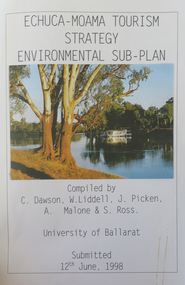
... industry...tourism...alumni...echuca...moama...hopwood's ferry...murray river...goulburn river...campaspe river...gaming...port of echuca...river red gums...wetlands...emmy lou...paddle steamer...star hotel...echuca farmyard...echuca coach...victorian tourism industry tourism alumni echuca moama hopwood's ferry murray river goulburn river campaspe river gaming port of echuca river red gums wetlands emmy lou paddle steamer star hotel echuca farmyard echuca coach house Report compiled by five students of Tourism at the University of Ballarat (later Federation University Australia). ...Report compiled by five students of Tourism at the University of Ballarat (later Federation University Australia).victorian tourism industry, tourism, alumni, echuca, moama, hopwood's ferry, murray river, goulburn river, campaspe river, gaming, port of echuca, river red gums, wetlands, emmy lou, paddle steamer, star hotel, echuca farmyard, echuca coach house -
 Eltham District Historical Society Inc
Photograph, E. Gadd Coach Builder, Eltham, c. March 1930
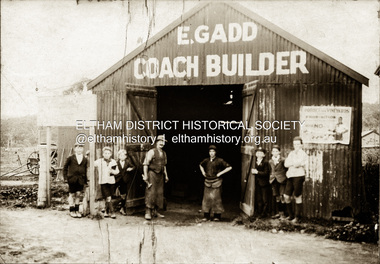
... industry for dried fruits and table grapes, etc as well and how it was in direct conflict with the federal government's actions of WW1 Soldiers Settlements on vineyards as it would ruin them. [HOW VINE GROWERS WOULD BE PENALISED (1930, March 28). Advertiser (Hurstbridge, Vic. : 1922 - 1939), p. 4 (AFTERNOON). Retrieved July 31, 2025, from http://nla.gov.au/nla.news-article57762063] Edward Gadd died of pneumonia, July 1937. He had operated his coach... - Research by Peter Pidgeon, EDHS, July 2026 coaches dance band edward gadd eltham harold norman jock read mrs read prohibition vote research (vic.) sam howard vineyards industry school children Sepia photograph E. ...Edward Gadd’s coach building and blacksmith shop was on the western side of Main Road, just south of Arthur Street and alongside Hannah Lloyd’s Railway General Store. The site was later home to the Eltham Produce Store, then a BP Petrol Station and in present-day home to Healthability at 911-917 Main Road. https://maps.app.goo.gl/az9GzxmVYFRGgYa39 Note with photo: "Man with hammer is Mr Gadd; always wore leggings and played violin at local dances. On his left is Harold Norman of Research. (Sam Howard played banjo). Mrs Read (Jock's mother) played piano by ear. Research called Normantown because no one could remember who was related to who." Note the school children; one of whom may be Jock Read. In April 1922, E.Gadd took over the West Bros. blacksmithing business at Eltham. He had many prior years’ experiences with horses and their ailments, such as diseased feet and bad breath. He advertised that he kept horse medicines in stock and was prepared to undertake clipping. [THE Eltham and Whittlesea Shires Advertiser AND Diamond Creek Valley Advocate. (1922, April 7). Eltham and Whittlesea Shires Advertiser and Diamond Creek Valley Advocate (Vic. : 1917 - 1922), p. 3 (AFTERNOON.). Retrieved July 31, 2025, from http://nla.gov.au/nla.news-article57640818] A poster on the exterior wall of the shed promotes protection of vineyards from Prohibition by voting No. This would date this photo around March 1930. A vote was being held by the Victorian government which the vineyard growers were opposed to due to the ramifications it would have upon the wider industry for dried fruits and table grapes, etc as well and how it was in direct conflict with the federal government's actions of WW1 Soldiers Settlements on vineyards as it would ruin them. [HOW VINE GROWERS WOULD BE PENALISED (1930, March 28). Advertiser (Hurstbridge, Vic. : 1922 - 1939), p. 4 (AFTERNOON). Retrieved July 31, 2025, from http://nla.gov.au/nla.news-article57762063] Edward Gadd died of pneumonia, July 1937. He had operated his coach building business in Eltham for 15 years (1922-1937). He lived in Research and left a wife and three sons. He was actively involved with the Research Hall and was largely instrumental in its establishment. [Death of Mr. Edward Gadd. (1937, July 23). Advertiser (Hurstbridge, Vic. : 1922 - 1939), p. 1. Retrieved July 31, 2025, from http://nla.gov.au/nla.news-article56845399] Following Gadd’s death, P. Sloan of Warrandyte took over the business, which he advertised as 'Eltham Shoeing Forge'. [Advertising (1937, July 30). Advertiser (Hurstbridge, Vic. : 1922 - 1939), p. 6. Retrieved July 31, 2025, from http://nla.gov.au/nla.news-article56845470] The photo was taken around March 1930 and Gadd operated his business between 1922 and 1937. This would suggest the shed would be visible in the November 1931 aerial photograph. Looking past the shed to the left the topography is relatively flat. The most probable location for the blacksmith shop, being a coach builder, would be near or on the main road. The only area in Eltham relative to other businesses that has a flattish topography with hills in the distant is around the railway station. E. Gadd’s Blacksmith shop was situated on the western side of Main Road, between Arthur and Dudley Streets and does appear to be visible in the 1931 aerial photo held by the Society. A map drawn up by Doug Orford of businesses and homes along Main Road in the 1930s shows the Gadd blacksmith shop in this precise location, just south of Staff’s general store. (See EDHS_05122). Other photos show the blacksmith shop adjacent to the Railway store and it had “Electrine Candles” advertising painted on the roof facing the southern approach along Main Road (SEPP_0611) and is just visible to the left of Lloyd’s Store c.1916-c.1922 (EDHS_02160). The rear of the shop facing the railway line is visible in EDHS_05593 Panorama at Eltham c. 1925. - Research by Peter Pidgeon, EDHS, July 2026 Sepia photographcoaches, dance band, edward gadd, eltham, harold norman, jock read, mrs read, prohibition vote, research (vic.), sam howard, vineyards, industry, school children -
Glen Eira Historical Society
Document - Robertson, Alexander William
... Coaches House Names Judge Carriers Robertson Emily Davidson Pastoralists Robertson Hannah Elizabeth Goldsburgh Caulfield Mansion Houses Goldsbrough and Co. Wool Industry ...Two items. Photocopied typed pages from the National Trust of Australia, includes forty-two poor copies of family photographs and a summary of information about Alexander William Robertson and LABASSA. 2 Manor Grove, Caulfield, by C. Kelloway, dated 03/02/1981. One handwritten page of references relating to Alexander William Robertson, life and business connections, undated, author unknownrobertson a.w., ontario, labassa, billing richard annersley, orrong road, cobb and co., coaches, house names, judge, carriers, robertson emily davidson, pastoralists, robertson hannah elizabeth goldsburgh, caulfield, mansion houses, goldsbrough and co., wool industry, koch j.a.b., architects -
 Warrnambool and District Historical Society Inc.
Book, Registered Office E Morse, Early 20th century
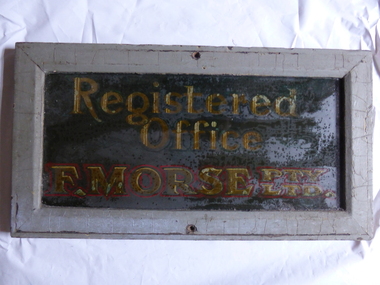
... Coach Building in Warrnambool...Automotive Industry...industry for more than 100 years from the horse-drawn era to the advent of motorized transport. Frederick Morse was the son of Henry Morse, a teacher at The Grange, Hamilton and at Grasmere in the early 1870s. In 1883 Frederick Morse started business in Fairy Street as a coach...industry for 120 years. It is also a memento of the Morse family, notable 19th century settlers in the town and important in local community affairs since that time. Frederick Morse Robinson and Morse Morse & Co. History of Warrnambool Coach ...This plate comes from the Registered Office of F. Morse Pty Ltd. The name ‘Morse’ has been associated with the local Warrnambool transport industry for more than 100 years from the horse-drawn era to the advent of motorized transport. Frederick Morse was the son of Henry Morse, a teacher at The Grange, Hamilton and at Grasmere in the early 1870s. In 1883 Frederick Morse started business in Fairy Street as a coach builder in a partnership known as Robinson and Morse and in 1891 he set up a business on his own, the Victoria Carriage Works in Lava Street with branches in Port Fairy and Koroit. By the 1890s he was employing 27 people and winning State awards for his Abbot buggies. By the 1920s the Morse business had moved to motorized transport, expanding over the years to car dealerships, caravans, panel works and reconditioning and truck building with the subsidiary businesses of Morsmilk and Morsbearings (both later sold).This plate is of strong significance as a memento of a business in Warrnambool that has been prominent in the local transport industry for 120 years. It is also a memento of the Morse family, notable 19th century settlers in the town and important in local community affairs since that time. This is a wooden frame with a glass front. The frame is painted a grey colour and has holes at the top and bottom for affixing the frame to a wall or door. Behind the glass the words ‘Registered Office F. Morse Pty Ltd’ are painted or incised on to a wooden slab. The words are in yellow and red paint. The frame is a little chipped and the inside of the glass is somewhat blotchy and stained. ‘Registered Office’ ‘F. Morse Pty Ltd’ frederick morse, robinson and morse, morse & co., history of warrnambool, coach building in warrnambool, automotive industry in warrnambool -
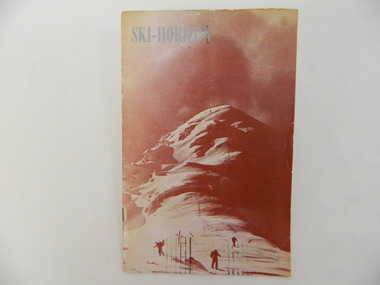 Kiewa Valley Historical Society
Journal - Ski-Horizon, Vol. 4. No. 11. July 1953, 1953
... Coaching etc. contact Bob Hymans c/o Bogong P.O. Member Clubs of the Federation of Victorian Ski clubs included Bogong Ski Club which was located at Falls Creek. This journal includes articles and advertisements that give an insight into the history of the ski industry and resorts. skiing. bogong ski club. bob hymans. jim curtis. victorian ski clubs. falls creek. ...The Ski-Horizon is the official journal of the Federation of Victorian Ski Clubs. Articles refer to Jim Curtis, Honorary Secretary of Bogong Ski Club - nightly fees are 8/6 for members and 10/6 for non members, the 6d being for the Ski-ing Improvements Fund. Tensing and Sir Edmund Hillary succeeded in climbing Mt Everest in that year. Advertisements include Accommodation at Falls Creek for Skiers only, Instruction , Day Tours and Coaching etc. contact Bob Hymans c/o Bogong P.O.Member Clubs of the Federation of Victorian Ski clubs included Bogong Ski Club which was located at Falls Creek. This journal includes articles and advertisements that give an insight into the history of the ski industry and resorts.Small journal with shiny white and reddish cover with 24 pages and writing on the back of the cover. It includes short and long articles a few photographs and advertisements.skiing. bogong ski club. bob hymans. jim curtis. victorian ski clubs. falls creek. -
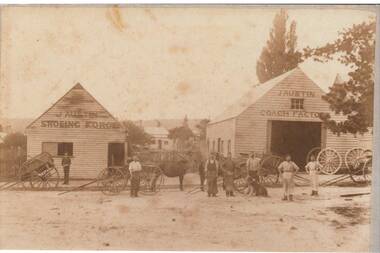 Buninyong & District Historical Society
Photograph - Photo of Original Photograph, John William Henry Austin, Photograph of Austin's Shoeing Forge and Coach factory, Learmonth St, c1899
... historic, industry John William Henry Austin photographer Durham Lead Austin Shoeing Forge Austin Carriage Factory on rear; "John Purcell Austin, Blacksmith, Buninyong, 1899. Took over from Caffrey. By 1906 Bourke had the forge. See p.34 Closed down 1938. JWH Austin Photographer, Durham Lead" Photograph of Austin's Shoeing Forge and Coach ...historic, industryPhotograph of Austin's Shoeing Forge and Coach factory, Learmonth St. taken by John William Henry Austin, photographer of Durham Lead. on rear; "John Purcell Austin, Blacksmith, Buninyong, 1899. Took over from Caffrey. By 1906 Bourke had the forge. See p.34 Closed down 1938. JWH Austin Photographer, Durham Lead"john william henry austin, photographer, durham lead, austin shoeing forge, austin carriage factory -
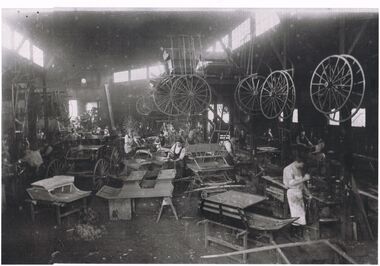 Bendigo Historical Society Inc.
Photograph - COACH BUILDING WORKS
... BHS Collection INDUSTRIES Coach Building Black and white photograph of a coach building business. ...BHS CollectionBlack and white photograph of a coach building business. Note the number of workers involved in the manufacture of the different styles required by customers. To the right of photo there are a number of workers using machines to manufacture the different body parts that are required. One cart to left of photo appears to be the finished product. Centre top there is a cantilever structure with bodywork stacked on top and a number of wheels, large and small, hanging from the side. There are also a number of wheels hanging from posts of the building framework. Note the differing clothing styles of the workers from shirt, trousers and apron to hats shirts, waistcoats, trousers. Differing stages of construction have bodies on tables, wooden frameworks, boxes and wooden horses.industries, coach building -
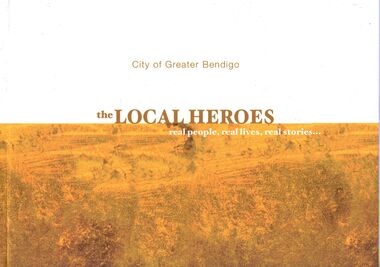 Bendigo Historical Society Inc.
Book - IAN DYETT COLLECTION: THE LOCAL HEROES
... The following pages have a short synopsis and photo of Barry Ackerman - Expert in the Rubber Industry & Twice Mayor, Joanne Baker - Founder of Righteous Pups Australia, Linda Beilharz OAM - Intrepid Adventurer, Valerie Broad OAM - Founder & Artistic Director of Youth Choir, Paul Chapman - Co-Founder of The Australian Turntable Company, Susanne Clarke - Passionate about Community Engagement, Patrick (Pat) James Connolly - Bendigo Amateur Boxing Club Coach, Robert Jackson (Cookie) Cook - Founder of Horizon House, Geoff Curnow - Farmer & Community Volunteer, Merna Curnow - Farmer & Agricultural Consultant, Jenny Dawson - Accounting & Banking, Laura Dusseljee - Choir Director & Music Teacher, Ian Maxwell Dyett JP - Life Dedicated to Volunteering, Donald James Erskine - Founder of Industrial Conveying Australia, James Victor Evans - Teacher, Historian & Actor, Rod Fyffe - Champion of Arts & Culture, Richard Guy OAM - banker & Philatelist, Edwin Richard (Dick) Hazeldene OAM - Chicken Farmer to Poultry Entrepreneur, Robert (Rob) Hunt AM - Head of Bendigo Adelaide Bank and Founder of Community Banking Model, Russell Goldfield Jack AM - Founder of Golden Dragon Museum, Jack Kelly - Teacher Sharing Experience, Ian George Mansbridge - Farmer, Accountant & Banker, Ken Marchingo - Instigator of Haven; Home Safe, Elizabeth (Beth) McKerlie OAM - Dedicated to Scouting, Gordon McKern OAM - Founder of McKern Steel, Sharelle McMahon - Netballer Extraordinaire, Lola Mary Miller AM BEM - Teacher of Health & Physical Education, Julie Millowick - Accomplished Photographer, Educator & Artist, Dennis Reginald O'Hoy - Academic & Historian, Margaret O'Rourke - A Champion for Connected Communities, Karen Quinlan - Director of Bendigo Art Gallery, Jonathan William Ridnell - Broadcaster, Leon Maxwell Scott OAM - Business Entrepreneur & Rotary Volunteer, Margot Elizabeth Spalding - Co-founder of Jimmy Possum Designer Furniture, Wendy Diane Stavrianos - Painter, Sculptor & Installation Artist, Jack Taylor OAM JP - An Eaglehawk Legend, Wes Vine - School Principal & Vigneron, Lynn Warren - Aboriginal Elder, Raymond James Wild - A Plumber's Story, Diana Williams - Founder of Fernwood Fitness and John Wolseley - International Artist. ...The following pages have a short synopsis and photo of Barry Ackerman - Expert in the Rubber Industry & Twice Mayor, Joanne Baker - Founder of Righteous Pups Australia, Linda Beilharz OAM - Intrepid Adventurer, Valerie Broad OAM - Founder & Artistic Director of Youth Choir, Paul Chapman - Co-Founder of The Australian Turntable Company, Susanne Clarke - Passionate about Community Engagement, Patrick (Pat) James Connolly - Bendigo Amateur Boxing Club Coach, Robert Jackson (Cookie) Cook - Founder of Horizon House, Geoff Curnow - Farmer & Community Volunteer, Merna Curnow - Farmer & Agricultural Consultant, Jenny Dawson - Accounting & Banking, Laura Dusseljee - Choir Director & Music Teacher, Ian Maxwell Dyett JP - Life Dedicated to Volunteering, Donald James Erskine - Founder of Industrial Conveying Australia, James Victor Evans - Teacher, Historian & Actor, Rod Fyffe - Champion of Arts & Culture, Richard Guy OAM - banker & Philatelist, Edwin Richard (Dick) Hazeldene OAM - Chicken Farmer to Poultry Entrepreneur, Robert (Rob) Hunt AM - Head of Bendigo Adelaide Bank and Founder of Community Banking Model, Russell Goldfield Jack AM - Founder of Golden Dragon Museum, Jack Kelly - Teacher Sharing Experience, Ian George Mansbridge - Farmer, Accountant & Banker, Ken Marchingo - Instigator of Haven; Home Safe, Elizabeth (Beth) McKerlie OAM - Dedicated to Scouting, Gordon McKern OAM - Founder of McKern Steel, Sharelle McMahon - Netballer Extraordinaire, Lola Mary Miller AM BEM - Teacher of Health & Physical Education, Julie Millowick - Accomplished Photographer, Educator & Artist, Dennis Reginald O'Hoy - Academic & Historian, Margaret O'Rourke - A Champion for Connected Communities, Karen Quinlan - Director of Bendigo Art Gallery, Jonathan William Ridnell - Broadcaster, Leon Maxwell Scott OAM - Business Entrepreneur & Rotary Volunteer, Margot Elizabeth Spalding - Co-founder of Jimmy Possum Designer Furniture, Wendy Diane Stavrianos - Painter, Sculptor & Installation Artist, Jack Taylor OAM JP - An Eaglehawk Legend, Wes Vine - School Principal & Vigneron, Lynn Warren - Aboriginal Elder, Raymond James Wild - A Plumber's Story, Diana Williams - Founder of Fernwood Fitness and John Wolseley - International Artist. ...66 page booklet titled The Local Heroes real people, real lives, real stories… Front cover is off white at the top and patterned yellow shades at the bottom with the title in the centre, City of Greater Bendigo above. Background to the Local Heroes Project, drafted by Dr Gan Che ng PhD. MA. Inside the front cover. Photos, names of Students, Principal and Teachers of Bendigo South East College Team, Catholic College Bendigo Team, Eaglehawk Secondary College Team, Girton Grammar School Team and Weeroona College Bendigo team are in the front of the book. There is information about the project. Photo and information about Simmon Pang - Project Initiator/Photographer. Foreword by The Hon. Martin Dixon MP - Minister for Education Victoria with photo and Foreword - Cr Lisa Ruffell - Mayor of the City of Greater Bendigo. The following pages have a short synopsis and photo of Barry Ackerman - Expert in the Rubber Industry & Twice Mayor, Joanne Baker - Founder of Righteous Pups Australia, Linda Beilharz OAM - Intrepid Adventurer, Valerie Broad OAM - Founder & Artistic Director of Youth Choir, Paul Chapman - Co-Founder of The Australian Turntable Company, Susanne Clarke - Passionate about Community Engagement, Patrick (Pat) James Connolly - Bendigo Amateur Boxing Club Coach, Robert Jackson (Cookie) Cook - Founder of Horizon House, Geoff Curnow - Farmer & Community Volunteer, Merna Curnow - Farmer & Agricultural Consultant, Jenny Dawson - Accounting & Banking, Laura Dusseljee - Choir Director & Music Teacher, Ian Maxwell Dyett JP - Life Dedicated to Volunteering, Donald James Erskine - Founder of Industrial Conveying Australia, James Victor Evans - Teacher, Historian & Actor, Rod Fyffe - Champion of Arts & Culture, Richard Guy OAM - banker & Philatelist, Edwin Richard (Dick) Hazeldene OAM - Chicken Farmer to Poultry Entrepreneur, Robert (Rob) Hunt AM - Head of Bendigo Adelaide Bank and Founder of Community Banking Model, Russell Goldfield Jack AM - Founder of Golden Dragon Museum, Jack Kelly - Teacher Sharing Experience, Ian George Mansbridge - Farmer, Accountant & Banker, Ken Marchingo - Instigator of Haven; Home Safe, Elizabeth (Beth) McKerlie OAM - Dedicated to Scouting, Gordon McKern OAM - Founder of McKern Steel, Sharelle McMahon - Netballer Extraordinaire, Lola Mary Miller AM BEM - Teacher of Health & Physical Education, Julie Millowick - Accomplished Photographer, Educator & Artist, Dennis Reginald O'Hoy - Academic & Historian, Margaret O'Rourke - A Champion for Connected Communities, Karen Quinlan - Director of Bendigo Art Gallery, Jonathan William Ridnell - Broadcaster, Leon Maxwell Scott OAM - Business Entrepreneur & Rotary Volunteer, Margot Elizabeth Spalding - Co-founder of Jimmy Possum Designer Furniture, Wendy Diane Stavrianos - Painter, Sculptor & Installation Artist, Jack Taylor OAM JP - An Eaglehawk Legend, Wes Vine - School Principal & Vigneron, Lynn Warren - Aboriginal Elder, Raymond James Wild - A Plumber's Story, Diana Williams - Founder of Fernwood Fitness and John Wolseley - International Artist. The back cover also has small photos and the names of people mentioned.ian dyett collection - the local heroes, city of greater bendigo, dr gan che ng, la trobe ubiversity bendigo, bendigo south east college, catholic college bendigo, eaglehawk secondary college, girton grammar school, weeroona college bendigo, simmon pang, the hon martin dixon mp, cr lisa ruffell, bendigo art gallery, city of greater bendigo, the capital - bendigo's performing arts centre, la trobe university australia, catholic kiocese of sandhirst, haven home safe, the hotel shamrock bendigo, hazendene's, bendigo & district aboriginal co-operative, mr baillieu myer ac, bendigo advertiser, australian broadcasting corporation, bendigo chinese association inc - lion team, wannik dance academy dancers, bendigo forever young choir, bendigo youth choir -
 Port Melbourne Historical & Preservation Society
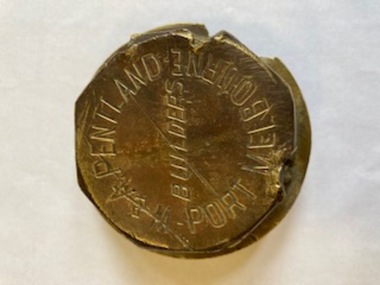
Machine - W & A PENTLAND Wheel Hub, c.1950
... As well as coach building - and later motor body building - the firm were wheelwrights and blacksmiths. W & A PENTLAND William PENTLAND Industry - Manufacturing W & A Pentland Port Melbourne Builders Round brass wheel hub cap from W & A PENTLAND, Port Melbourne Machine W & A PENTLAND Wheel Hub ...William PENTLAND arrived in Sandrisge in 1864 and set up his own coach building business in 1880.The firm was located between Ingles & Raglan Streets on the east side of Crockford Street. As well as coach building - and later motor body building - the firm were wheelwrights and blacksmiths.Round brass wheel hub cap from W & A PENTLAND, Port MelbourneW & A Pentland Port Melbourne Buildersw & a pentland, william pentland, industry - manufacturing -
 Stawell Historical Society Inc
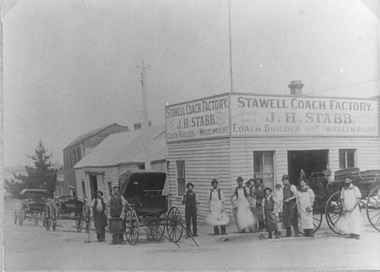
Photograph, Stabb and Fair Coachbuilders Corner of Main and Wimmera Streets Stawell 1890's, C 1890's
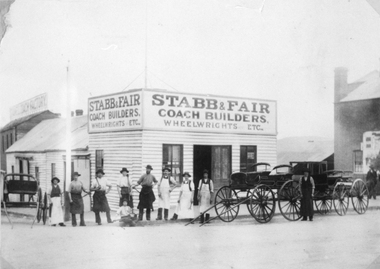
... Industry...J.H. Stabb...Coach...coaches in the street. 1890's. This buisness was started by Mr. Aldred, who came to Stawell in 1874. Mr Stabb had served his apprenticeship in Ballarat with mr Aldred. Some time later Mr Stabb took over. Stawell Industry ...Sepia Photograph of Stabb and Fair Coachbuilders Corner of Main and Wimmera Streets. Row of workmen and horse drawn coaches in the street. 1890's. This buisness was started by Mr. Aldred, who came to Stawell in 1874. Mr Stabb had served his apprenticeship in Ballarat with mr Aldred. Some time later Mr Stabb took over.Sepia Photograph of a weatherboard factory with a row of workmen and horse drawn vechicles i the street.Sign above the Factory. STAWELL COACH FACTORY J.H. STABB COACH BUILDER WHEELWRIGHT on both sides of stawell industry, j.h. stabb, coach builder -
 Stawell Historical Society Inc
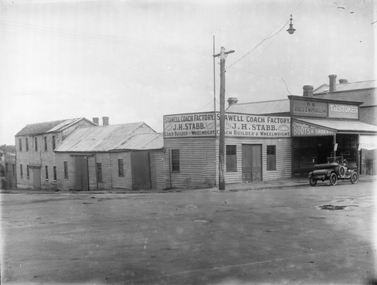
Photograph, J.H. Stabb coach building factory with car parked in front c1920's, c 1920's
... Stabb coach building factory 1920's with car parked in front. Stawell Industry J.H. ...J.H. Stabb coach building factory 1920's with car parked in front. B/W Photograph of weatherboard factory. with a two sided sign reaing Stawell Coach Factory J.H. Stabb Coach Builders & Wheelwright. There is a car on the right of the photgraph. Tow shop to the right of factory with a veranda. There is Light pole on the corner.Sign Reads Stawell Coach Factory Trimming a Speciality J.H. Stabb Coach Builders & Wheelwrightstawell industry, j.h. stabb, coachbilders -
 Stawell Historical Society Inc
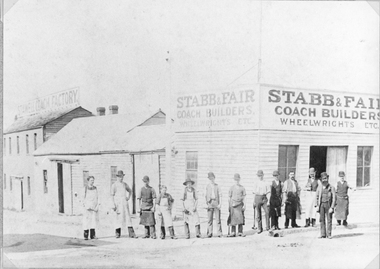
Photograph, Stabb and Fair Coachbuilders Corner of Main and Wimmera Streets Stawell c1890s
... Stawell Industry...Coach...Row of workmen at front. c1890s Stawell Industry Coach Bulders J.H. Stabb Sepia Photgraph of a weatherbord factory with a Parapere front with advertisment. ...Sepia Photograph of Stabb and Fair Coachbuilders Corner of Main and Wimmera Streets. Row of workmen at front. c1890sSepia Photgraph of a weatherbord factory with a Parapere front with advertisment. A row of workmen in the foreground Sign above othe factory reads STABB & FAIR COACH BUILDERS WHEELWRIGHTS ETC.stawell industry, coach bulders, j.h. stabb -
 Stawell Historical Society Inc
Photograph, Stabb and Fair Coachbuilders Corner of Main and Wimmera Streets Stawell, c 1890's
... Industry Coachbuilders J.H. STABB STABB & FAIR STABB & FAIR COACHBUILDERS WHEELWRIGHTS ETC is on two sided sign in the foreground, STAWELL COACH FACTORY is on a sign above the building on the left. ...Sepia Photograph of Stabb and Fair Coachbuilders Corner of Main and Wimmera Streets. Row of workmen at front.Sepia Photograph of a weatherboard factory, with a sign on two fronts reading STABB & FAIR COACHBUILDERS WHEELWRIGHTS ETC. A group of workmen standing in the street in the foregroundSTABB & FAIR COACHBUILDERS WHEELWRIGHTS ETC is on two sided sign in the foreground, STAWELL COACH FACTORY is on a sign above the building on the left.stawell industry, coachbuilders, j.h. stabb, stabb & fair -
 Stawell Historical Society Inc
Photograph, J.H. Stabb coach building factory
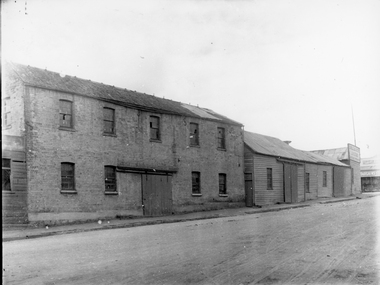
... Stabb coach building factory. Stawell Industry J.H. Stabb Coachbuilders A two strory brick building with five windwos on second story and four on the ground floor with a large sliding dor in the middle. to the right of the building is a weatehrbord single story factory with a large sliding door next to another building. ...Two story brick building shingle roof with single story weatherboard continuing along the street. J.H. Stabb coach building factory. A two strory brick building with five windwos on second story and four on the ground floor with a large sliding dor in the middle. to the right of the building is a weatehrbord single story factory with a large sliding door next to another building. The brick building has a shingle roof. The building belong to J.H. Stabb coachbuilders. stawell industry, j.h. stabb, coachbuilders -
 Stawell Historical Society Inc
Photograph, Mr John Rickard -- owner of the Coach Factory 1872 -- Studio Portrait
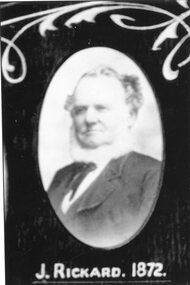
... Portrait of J Rickard 1872 of Coach Factory Stawell Business Industry Mr John Rickard -- owner of the Coach Factory 1872 -- Studio Portrait Photograph ...Portrait of J Rickard 1872 of Coach Factorystawell business industry -
 Stawell Historical Society Inc
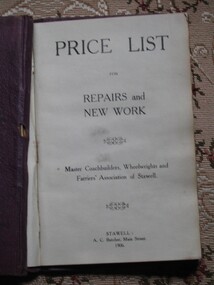
Book, A.C. Butcher Master Coachbuilders Wheelwrights, Master Coachbuilders Wheelwrights and Farrier Association of Stawell Price List for Repair and New Work, 1906
... Price List fro Repairs & New work for the Master coachbuilders, Wheelwrights and Farriers Association of Stawell stawell industry Master Coach Builders and Wheelwrights and Farriers Association of Stawell. ...Price List fro Repairs & New work for the Master coachbuilders, Wheelwrights and Farriers Association of StawellMaster Coach Builders and Wheelwrights and Farriers Association of Stawell. In Faded Printstawell industry -
 Stawell Historical Society Inc
Book, A.C. Butcher Master Coachbuilders Wheelwrights, Master Coachbuilders Wheelwrights and Farrier Association of Stawell Price List for Repair and New Work, 1906
... Price list for repairs & New Work used by coach builders in Stawell stawell industry Master Coachbuilders, Wheelwrights and Farriers' Association of Stawell. ...Price list for repairs & New Work used by coach builders in StawellWater stained Purple cover, black faded Print.Master Coachbuilders, Wheelwrights and Farriers' Association of Stawell. In Faded Printstawell industry -
 Sunshine and District Historical Society Incorporated
Photograph - White City Aerial photographs of White City greyhound racing venue, Pratt, Charles Daniel, (1892 - 1968)
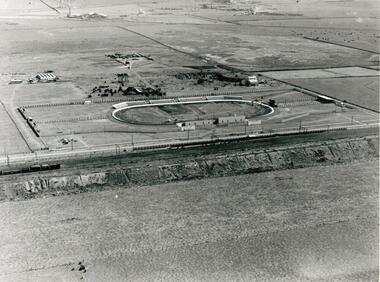
... industry (Olex Cables) took over the White City site. Transport to the White City stadium was provided by train, with only a single platform available on the Down side of Tottenham, even though double train lines existed. Special train services were run from Flinders Street to the White City platform, and for a while a parcels coach...industry (Olex Cables) took over the White City site. Transport to the White City stadium was provided by train, with only a single platform available on the Down side of Tottenham, even though double train lines existed. Special train services were run from Flinders Street to the White City platform, and for a while a parcels coach ...The White City Greyhound racing stadium was built at Tottenham in 1927, with the intention that mechanical lures and not live hares be used as pacemakers. The first meeting was held on 10 December 1927 but within 3 days, after strong lobbying by other sports bodies, the Victorian Government banned betting on greyhound racing if mechanical lures were used instead of live hares. This caused some financial problems to the shareholders. For a time the average weekly attendances were 9000, and races were held on Mondays, Wednesdays, and Saturdays. Whippet Races, Goat Races, Monkeys on greyhounds, and Professional Foot racing were also tried to attract attendances. After 28 years of bureaucratic interference, and using live hares as greyhound pacemakers, the White City stadium held its last meeting on 29 December 1955. On 31 December the Victorian Government finally allowed betting on greyhound races that used mechanical lures. Manufacturing industry (Olex Cables) took over the White City site. Transport to the White City stadium was provided by train, with only a single platform available on the Down side of Tottenham, even though double train lines existed. Special train services were run from Flinders Street to the White City platform, and for a while a parcels coach was provided for the transport of dogs. As industry developed in the area some trains also stopped at the White City platform in the mornings and late afternoons to transport workers. In 1981 when the grade separation at Ashley Street next to the Tottenham station was completed, the new train lines on the Upper Level came into operation, and so the White City platform was closed down and eventually demolished. Greyhound racing has always been popular in Melbourne's western suburbs. The White City stadium in Tottenham was a major centre for the sport until 1955, enabling those who could not afford race horses to take part in an animal racing sport. The demolition of first the stadium and years later the railway platform, has relegated the name White City and its past relevance to the western suburbs, into history.Only on the negatives at the State Library. We do not hold a copy of these.white city, greyhound racing stadium, coursing track, white city station, tottenham, whippet, gambling, live hare, mechanical lure -
 Stawell Historical Society Inc
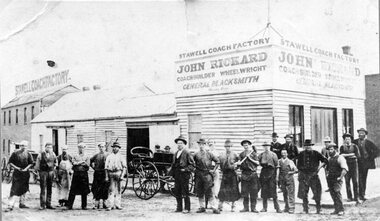
Photograph, Mr John Rickard's Coach Factory, Wheelwright & Black Smith on the corner of Main and Wimmera Street Stawell
... Workers in Front of Coach Factory Wheelwright & Black Smith (John Rickard) Cnr. Main Street and Wimmera Street Stawell Business Industry Mr John Rickard's Coach Factory, Wheelwright & Black Smith on the corner of Main and Wimmera Street Stawell Photograph ...Workers in Front of Coach Factory Wheelwright & Black Smith (John Rickard) Cnr. Main Street and Wimmera Streetstawell business industry -
 Melton City Libraries
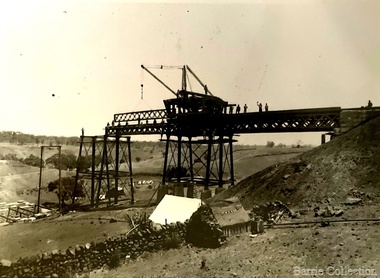
Photograph, Melton Railway Bridge, c.1884
... The railway enabled the development of new industries in the Melton area, notably the timber industry and a chaff industry of national importance, greatly facilitated the later transition of the Shire from a pastoral to a farming economy, and struck a major blow to Melton township’s era as a wayside town servicing Ballarat road (especially coach) traffic". ...The railway enabled the development of new industries in the Melton area, notably the timber industry and a chaff industry of national importance, greatly facilitated the later transition of the Shire from a pastoral to a farming economy, and struck a major blow to Melton township’s era as a wayside town servicing Ballarat road (especially coach) traffic". ..."The Melton Viaduct, opened in 1886, is of State heritage significance as a very large and visually distinctive wrought iron, lattice girder trestle bridge over the Werribee River (now Melton Reservoir). It comprises 18.3 and 9.1 metre spans, in a generally alternate arrangement, of total length 375 metres, and standing 38 metres over the Werribee River. Wrought iron small section iron was used to build tension trussed trestle legs, which supported four lines of rivetted wrought-iron deck-type double lattice trusses. It has bluestone abutments and pier bases of coursed rock-faced bluestone with drafted margins. The larger half-piers, now usually submerged in the Melton Reservoir have sharp tapered cutwaters and curved coping at the tops. While designed to carry two rail tracks it has only ever been used as a single track line. Despite several alterations to its deck structure, it remains an outstanding example of a lighter structural design employing open metal trestle supports and metal truss girders. The direct Melbourne to Ballarat railway link of which the Melton viaduct was the major engineering work contributed significantly to the history and development of Victoria. This new link reflected Ballarat’s diversifying economy as well as the commercial and political influence of the metropolis. Construction of the bridge, and the associated large workers camp, were extensively photographed, documenting an important episode in local history. The railway enabled the development of new industries in the Melton area, notably the timber industry and a chaff industry of national importance, greatly facilitated the later transition of the Shire from a pastoral to a farming economy, and struck a major blow to Melton township’s era as a wayside town servicing Ballarat road (especially coach) traffic". Melton Railway Bridge being built across the Werribee Rivertransport -
 Tarnagulla History Archive
Photograph of blacksmith's shop, Tarnagulla, Blacksmith's shop, Tarnagulla, c. 1960
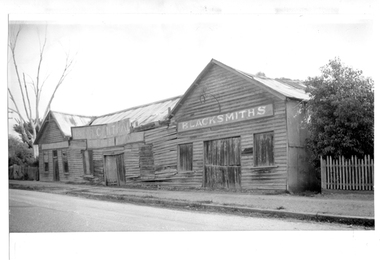
... coaches from the George Hotel stables. John Ousley took over the stables for use as a blacksmith's shop. He sold out to Stafford & Sons in 1908. Staffords found the existing premises at the George Hotel too small and built this building. Frank McNamee later took over the premises and operated it for many years. This photograph is a reasonable copy created from an older original. Copy probably made by Murray Comrie in the 1970s. tarnagulla commerce industry ...Murray Comrie Collection. This photograph shows the blacksmiths premises on the north end of Commercial Road, Tarnagulla. Information collated by Murray Comrie: This building was demolished in the 1970s. The first use of the site was as the George Hotel licensed to an A.B. Clay in 1858, then Waller and Robinson. Charles Waller operated his Excelsior Line of coaches from the George Hotel stables. John Ousley took over the stables for use as a blacksmith's shop. He sold out to Stafford & Sons in 1908. Staffords found the existing premises at the George Hotel too small and built this building. Frank McNamee later took over the premises and operated it for many years. This photograph is a reasonable copy created from an older original. Copy probably made by Murray Comrie in the 1970s. Monochrome photograph depicting a large run-down weatherboard building at the north end of Commercial Road, Tarnagulla. Written in a sign on right side of building: 'Blacksmiths'.tarnagulla, commerce, industry, blacksmithing, smithing, coachbuilding, businesses, stafford & sons, norwood, mcnamee, buildings, hotels, horses, stables, commercial road, main street -
 Tarnagulla History Archive
Photograph of blacksmith's shop, Tarnagulla, Blacksmith's shop, Tarnagulla, c. 1960
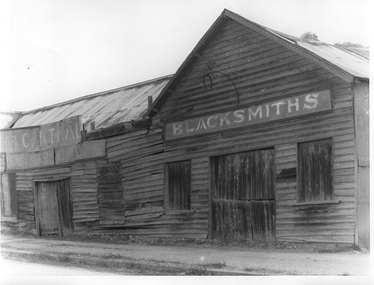
... coaches from the George Hotel stables. John Ousley took over the stables for use as a blacksmith's shop. He sold out to Stafford & Sons in 1908. Staffords found the existing premises at the George Hotel too small and built this building. Frank McNamee later took over the premises and operated it for many years. This photograph is a reasonable copy created from an older original. Copy probably made by Murray Comrie in the 1970s. tarnagulla commerce industry ...Murray Comrie Collection. This photograph shows the blacksmiths premises on the north end of Commercial Road, Tarnagulla. Information collated by Murray Comrie: This building was demolished in the 1970s. The first use of the site was as the George Hotel licensed to an A.B. Clay in 1858, then Waller and Robinson. Charles Waller operated his Excelsior Line of coaches from the George Hotel stables. John Ousley took over the stables for use as a blacksmith's shop. He sold out to Stafford & Sons in 1908. Staffords found the existing premises at the George Hotel too small and built this building. Frank McNamee later took over the premises and operated it for many years. This photograph is a reasonable copy created from an older original. Copy probably made by Murray Comrie in the 1970s. Monochrome photograph depicting a large run-down weatherboard building at the north end of Commercial Road, Tarnagulla. Written in a sign on right side of building: 'Blacksmiths'. Same as image THA-2019.0053tarnagulla, commerce, industry, blacksmithing, smithing, coachbuilding, businesses, stafford & sons, norwood, mcnamee, buildings, hotels, horses, stables, commercial road, main street -
 Bacchus Marsh & District Historical Society
Photograph, James Reid's Wheelwright and Blacksmith's Shop 182 Main Street 1883
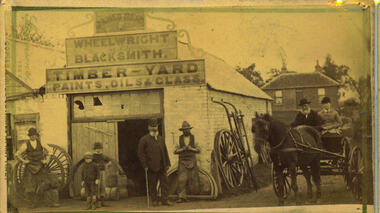
... coach builders business in Bacchus Marsh. In the nineteenth and early twentieth centuries, wheelwrights and blacksmiths played an essential role in the functioning of the whole community. Before the industrialisation of manufacturing, wheels and other components of vehicles for transport, all metal objects, including farm implements, building requirements and domestic utensils were made by hand. As mechanisation of industry...coach builders business in Bacchus Marsh. In the nineteenth and early twentieth centuries, wheelwrights and blacksmiths played an essential role in the functioning of the whole community. Before the industrialisation of manufacturing, wheels and other components of vehicles for transport, all metal objects, including farm implements, building requirements and domestic utensils were made by hand. As mechanisation of industry ...James Reid was born in Scotland near Glasgow and came to Victoria as a young man in 1854. Shortly after arriving he came to Bacchus Marsh where he lived until his death in 1902 at the age of 74 years. For most of these years he conducted a wheelwrights and coach builders business in Bacchus Marsh. In the nineteenth and early twentieth centuries, wheelwrights and blacksmiths played an essential role in the functioning of the whole community. Before the industrialisation of manufacturing, wheels and other components of vehicles for transport, all metal objects, including farm implements, building requirements and domestic utensils were made by hand. As mechanisation of industry increased, the smith commonly performed the role of farrier in the times when horse power was pivotal to all aspects of society. Complementing this work, the forge was often allied with a wheelwright's shop. These premises also acted as a meeting place for the men of the town, where news was shared and friendships forged.Small sepia 'carte de viste' style unframed photograph on card with gold border framing photograph. Housed in the album, 'Photographs of Bacchus Marsh and District in 1883 by Stevenson and McNicoll'. An image depicting a wheelwright and blacksmith's shop, with a group of men, boys and a woman shown in front. Two men are wearing the work clothes of the blacksmith, including the split leather apron worn by farriers to enable them to work on the hooves of the horses needing shoeing. Two young boys are standing by the door. A portly gentleman in formal clothes stands before the shop. The house shown at the rear was James Reid's residence. Two people, an elderly gentleman and a younger woman, are seated in a jinker on the road to the side of the shop. A collection of wheels and farm tools leans on the walls. A triple-tiered sign above the shop reads: JAMES REID WHEELWRIGHT BLACKSMITH. TIMBER - YARD PAINTS, OILS & GLASS.Printed On the front: Stevenson & McNicoll. Photo. 108 Elizabeth St. Melbourne. COPIES CAN BE OBTAINED AT ANY TIME. On the back: LIGHT & TRUTH inscribed on a banner surmounted by a representation of the rising sun. Copies of this Portrait can be had at any time by sending the Name and Post Office Money Order or Stamps for the amount of order to STEVENSON & McNICOLL LATE BENSON & STEVENSON, Photographers. 108 Elizabeth Street, MELBOURNE.wheelwrights, james reid 1828?-1902, stevenson and mcnicoll 1883 photographs of bacchus marsh and district
