
Showing 255 items matching "coates family."
-
 Buninyong & District Historical Society
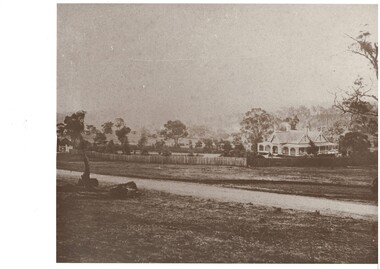
Photograph - Sepia photograph of "Ballantrae" homestead, Coates Family home, formerly known as "La Maisonette" latterly as "Ballantrae"
... Coates Family home, formerly known as "La Maisonette" latterly as "Ballantrae"....Coates Family....Style of fencing with palings. Good Coates Family home, formerly known as "La Maisonette" latterly as "Ballantrae". ...One of a series donated by D. Leather. Of significant value due to the detail in the photograph of the house and surrounding country.Goodcoates family., historic buildings., geelong road in 1865., style of fencing with palings. -
 Lakes Entrance Historical Society
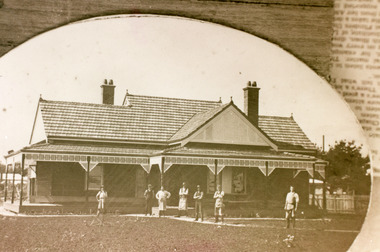
Photograph - Coates family Lakes Entrance, Victoria. c1920
... Coates family Lakes Entrance, Victoria. c1920...Lakes Entrance Victoria Photograph Coates family Lakes Entrance, Victoria. c1920 ...This image was photographed from an original oval framed photograph in possession of Mrs Vi Symmons, nee Coate, daughter of Joseph and Isabella Coate. The Coate home was moved to Kalimna West 1960-1970c.Sepia photograph of the family home of Joseph and Isabella Coate, situated on Esplanade. It shows a tile roofed California style bungalow residence, two internal chimneys each topped with twin chimney pots. Veranda has decorative frieze under roof, seven men standing in front of house, five in workman's aprons. Lakes Entrance Victoriatownship, architecture, people, clothing, room display -
 Lakes Entrance Historical Society
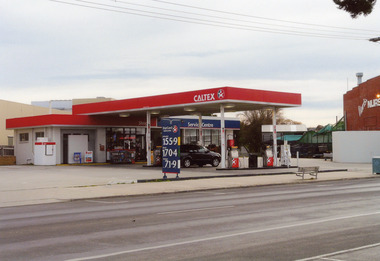
Photograph - Site of Coates family home, Esplanade Lakes Entrance Victoria 2008
... Site of Coates family home, Esplanade Lakes Entrance Victoria 2008...Photograph Site of Coates family home, Esplanade Lakes Entrance Victoria 2008 ...Date made August 2008Colour photograph of the Caltex garage on the Esplanade, garden nursery on the right. This was the site of Joseph Coates residence. retail trade, room display, genealogy, local history -
 Stawell Historical Society Inc
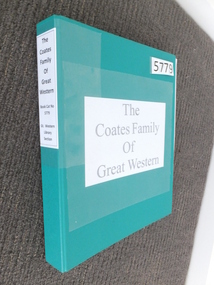
Book, Dorothy Brumby, The Coates Family of Great Western, 2016
... The Coates Family of Great Western...stawell The Coates Family of Great Western Book Dorothy Brumby ...stawell -
 Bendigo Military Museum
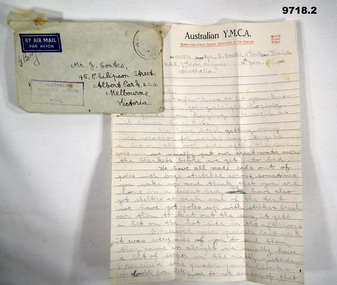
Letter - LETTER & ENVELOPE, 14 Jan '43
... ...Coates family 1...Part of the Coates Family Collection. Refer Cat No 9654.4...Part of the Coates Family Collection. Refer Cat No 9654.4 Letter Envelope Coates family 1 2. ...Part of the Coates Family Collection. Refer Cat No 9654.41 -Two page letter to Dad/Maise in black and blue handwriting on lined white pages with YMCA letter head on top. On top of page one is no. name and Unit of writer. 2. - White envelope by Air Mail and stamped. Torn open.2. Addressed to "Mr. J. Coates, 45 Philipson St. Albert Park, SCG, Melbourne, Victoria".letter, envelope, coates family 1 -
 Bendigo Military Museum
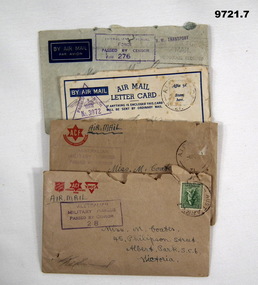
Letter - LETTERS & ENVELOPES, Len Coates, 14/1/44
... ...Coates family 1...Letters, part of the Collection of Coates Family. The letter re Tom will be Thomas Coates, refer Cat No 9654.4 for his service details....Letters, part of the Collection of Coates Family. The letter re Tom will be Thomas Coates, refer Cat No 9654.4 for his service details. ...Letters, part of the Collection of Coates Family. The letter re Tom will be Thomas Coates, refer Cat No 9654.4 for his service details.1. White folded single sheet Air Mail Letter with 3 pages of small writing from Thomas. Address and stamps on 4th page. 2. Open envelope, white, ink stamp on front and address. 3. Single white sheet dated 7.4.41 with pencil letter on one side and identification of sender on top. 4. Open brown envelope, YMCA emblem, address and stamps in ink. 5. Small page letter, brown paper, headed Australian Comforts Fund, paper lined and dated 1.8.44. 6. Open brown envelope, address and censor stamp. 7. Four page letter, brown lined paper. Identity at top and ACF/YMCA headers.All addressed to "Miss M. Coates, 45 Philipson St., Albert Park, SCG, Melbourne, Victoria, Australia”letters and envelopes, coates family 1 -
 Bendigo Military Museum
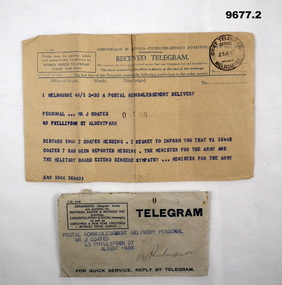
Letter - TELEGRAM AND ENVELOPE, Australian Army, 29 June 1941
... ...Coates family 1...Part of the Coates Family Collection. This refers to "Thomas Coates" and a telegram advising that he is Missing in Action in June 1941. ...Telegram Missing in Action Tom Coates Coates family 1 1. Stamped "Postal acknowledgement Delivery Personal, Mr. ...Part of the Coates Family Collection. This refers to "Thomas Coates" and a telegram advising that he is Missing in Action in June 1941. Refer cat No 9654.4 for his service details.1. Small white envelope marked in blue "Telegram" and stamp on front acknowledging personal delivery. 2. Telegram on brown paper with a date stamp and message in blue, giving addressee and address and the fact that Tom Coates was missing. Note folded in four.1. Stamped "Postal acknowledgement Delivery Personal, Mr. J. Coates, 45 Phillipson St. Albert Park”, In pencil, "114 Richardson". 2. Date stamp “29 JE 41” at Melb. Message sent on behalf of Minister for the Army.telegram, missing in action, tom coates, coates family 1 -
 Bendigo Military Museum
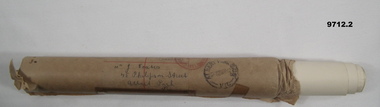
Memorabilia - MEMORIAL SCROLL, Australian Army Medal Section, c.1942
... ...Coates family 1...Item is part of the Coates Family Collection. Refer 9654.4 for Tom’s service details....Item is part of the Coates Family Collection. Refer 9654.4 for Tom’s service details. ...Scroll re death of "Thomas Coates", VX18443. Died 5/3/42. Item is part of the Coates Family Collection. Refer 9654.4 for Tom’s service details.White paper scroll rolled up and contained in a brown paper tubal postal container. Container has postal delivery address and return address and various ink stamps. Actual scroll is in very delicate condition so not taken out for inspection of description. 1, Scroll. 2. Postal tube.1. Addressed to "Mr J. Coates, 45 Philipson Street, Albert Park, Vi If not delivered return address "Army Medal Section, Victoria Barracks, Melbourne, Australia” thomas coates, memorial scroll, coates family 1 -
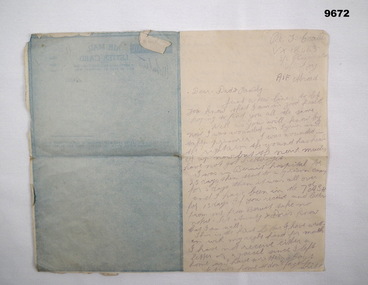 Bendigo Military Museum
Letter, Tom Coates, C.1941/42
... ...Coates family 1...Part of the Coates Family Collection. Letter from Tom Coates to father John Coates. ...Part of the Coates Family Collection. Letter from Tom Coates to father John Coates. ...Part of the Coates Family Collection. Letter from Tom Coates to father John Coates. Tom died 5/3/42, refer Cat No 9654.4 for his service details.Letter on single sheet Air Mail Folded into 4 with faded letter scribbled across 2 pages. Cream colour paper and blue writing.Addressed to “Mr John Coates - 48 Phillipson Street, Albert Park, Melbourne, Victoria, Australia”2/2 pioneers, letter, coates family 1 -
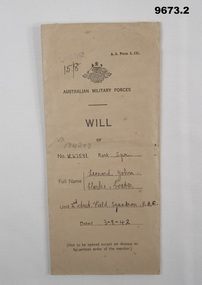 Bendigo Military Museum
Legal record - WILL, Leonard John Clarke Coates, 3 Aug 1942
... ...Coates family 1...Part of the collection of the Coates Family. Refer 9654.4 for more family....Part of the collection of the Coates Family. Refer 9654.4 for more family. Will and Testament Leonard John Clarke Coates Coates family 1 1. ...Leonard John Clarke Coates V27591 2nd Aust Field Squadron R.A.E. Mandatory for all soldiers to complete a Will. Part of the collection of the Coates Family. Refer 9654.4 for more family..1) Light brown envelope contains one foolscap piece of paper, also brown with last Will and Testament for Leonard John Clarke Coates. .2) Will handwritten on one side of a standard form with notes and instructions hand typed on other side, Paper folded 4 times and in envelope. Both form and front of the envelope have name, no, rank, and unit of soldier.1. Stamped “15 Aug 1942”, also filled in No, name, rank and Unit. .....”VX No, 134253 pencilled in and date “3/8/42” 2. On form same as above and dated “3/8/42” and back page in pen details of Willwill and testament, leonard john clarke coates, coates family 1 -
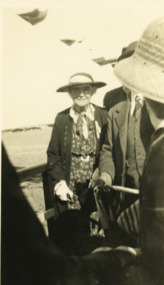 Lakes Entrance Historical Society
Photograph - Mrs Alice Roadknight, Opening Footbridge Lakes Entrance - Roadnight Collection, 1937 and 1940
... On back of photograph: W T Roadknight and Coates family. W T Roadknight Malcolm and Mum and Dad...Plus a second postcard of William Tasman Roadknight with Coates family 1940 c Second black and white ...Plus a second postcard of William Tasman Roadknight with Coates family 1940 c Second black and white Opening Footbridge Lakes Entrance - Roadnight Collection Photograph Mrs Alice Roadknight ...On back of photograph: W T Roadknight and Coates family. W T Roadknight Malcolm and Mum and DadBlack and white photograph of oldest resident Mrs Alice Roadknight after cutting the ribbon to open the Cunninghame Arm pedestrian bridge Lakes Entrance Victoria 1937. Plus a second postcard of William Tasman Roadknight with Coates family 1940 c Second black and white genealogy, celebration, bridges, correspondence -
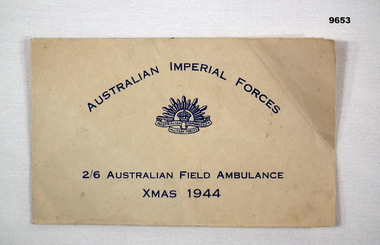 Bendigo Military Museum
Card - CHRISTMAS CARD 1944
... ...coates family 1...CMF Christmas Card William Fawcett coates family 1 Inside written "To Ritchie from your Loving Dad". ...Part of the collection of "William Fawcett" V246452, re 9627.Small cream coloured Christmas card from 1944. On front is Commonwealth Rising Sun emblem. Above that Australian Imperial Forces and below is 2/6 Australian Field Ambulance Xmas 1944. The card is plain paper folded over.Inside written "To Ritchie from your Loving Dad".cmf, christmas card, william fawcett, coates family 1 -
 Bendigo Military Museum
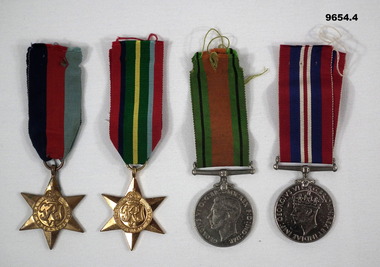
Award - MEDALS WW2, Post 1945
... ...Coates family 1...Part of the Coates collection covering several members of the family involved in WW2. ...Other items also refer to "Leonard John Clark Coates" V2791 and possibly brother "John Coates" VX18448. 2/2 Pioneers War Medals Coates family 1 1. On back, “VX18443 T. Coates” 2. ...Part of the Coates collection covering several members of the family involved in WW2. Medals regarding"Thomas Coates" VX18443, Enlisted 29 May 1940 in 2/2 Pioneers. Died 5 March 1942. Other items also refer to "Leonard John Clark Coates" V2791 and possibly brother "John Coates" VX18448.Four WW2 medals unmounted. 1. The 1939-45 Star. 2. Pacific Star. 3. Defence Medal. 4. War Medal 1939-45.1. On back, “VX18443 T. Coates” 2. On back, “VX18443 T. Coates” 3. 4. Both have the same on the rim as 1. & 2.2/2 pioneers, war medals, coates family 1 -
 Bendigo Military Museum
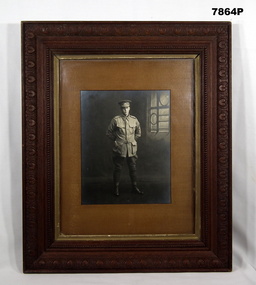
Photograph - PORTRAIT, FRAMED, c WW1
... ...coates family 1...Framed Accessories Portrait Army coates family 1 On back of photograph - handwritten grey lead pencil "Mrs Long/ 20 Irvine St/ 3 1/2 Oak ??? ...Framed photographs 7864P and 7865P. Both unknown persons. Photograph - black and white full length portrait photograph of a soldier in uniform. Studio type photograph with wall and window in the background. C.WW1. Frame - timber with dark brown stain. decorative moulding with inner edge of gold colour plain timber. Mount - timber ply wood with light brown finish and glass front. Backing - cardboard (replaced).On back of photograph - handwritten grey lead pencil "Mrs Long/ 20 Irvine St/ 3 1/2 Oak ??? 3/4 ???/ Dark oak 10/-"framed accessories, portrait, army, coates family 1 -
 Bendigo Military Museum
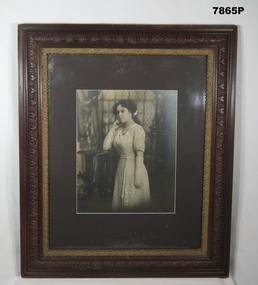
Photograph - PORTRAIT, FRAMED, c.WW1
... ...coates family 1...Framed accessories Portrait coates family 1 Photograph - black and white mid length portrait photograph of a woman dressed in evening wear. ...Framed photographs 7864P and 7865P - both unknown persons.Photograph - black and white mid length portrait photograph of a woman dressed in evening wear. Studio type photograph with window, plants and plant stand in background. c.WW1. Frame - timber with dark brown stain. Decorative moulding with inner edge of gold colour decorative timber. Mount - dark brown cardboard, glass front and cardboard backing.framed accessories, portrait, coates family 1 -
 Bendigo Historical Society Inc.
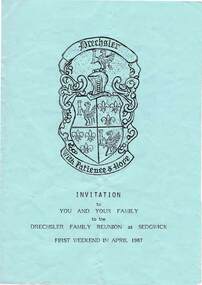
Document - INVITATION
... Printed on blue paper with family Coat of Arms on the front....Printed on blue paper with family Coat of Arms on the front. Document INVITATION ...Invitation to the Drechsler Family Reunion at Sedgwick. First weekend in April 1987. Printed on blue paper with family Coat of Arms on the front.person, family, reunion, invitation, wilhelm drechsler, anna flood, heinrich & edith drechsler, miss margaret brennan, bill drechsler, jessie drechsler, max drechsler -
 Hymettus Cottage & Garden Ballarat
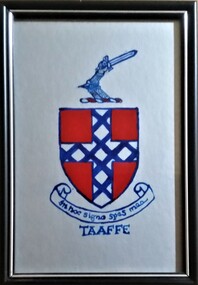
Painting, Taaffe Coat of Arms
... A small painting of the Taaffe family coat of arms painted on glass in reverse by Glen Taffe in 1992 as a Father's Day present for Michael Taffe....A small painting of the Taaffe family coat of arms painted on glass in reverse by Glen Taffe in 1992 as a Father's Day present for Michael Taffe. ...A small painting of the Taaffe family coat of arms painted on glass in reverse by Glen Taffe in 1992 as a Father's Day present for Michael Taffe.painting, glass, fathers' day., armorial, art, glass -
 Hymettus Cottage & Garden Ballarat
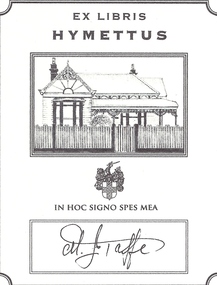
Work on paper - Bookplate, Hymettus Bookplate, 1995
... It incorporates the generational family home, Hymettus and the family coat of arms with the owner's signature....It incorporates the generational family home, Hymettus and the family coat of arms with the owner's signature. ...After a quiet period, interest in bookplates in Australia began to increase in the early 1970s, This example was commissioned from Andrew Thomas a Ballarat photographer and designer by Michael Taffe owner of Hymettus at Ballarat in the 1990s and is a computer assisted design. It incorporates the generational family home, Hymettus and the family coat of arms with the owner's signature.Bookplate from Hymettus Cottage and Garden, first open to the public in 1917 as champion garden City of Ballaarat. the bookmark indicates the book it is affixed to was part of the family library in the house and represents four generations from 19th, 20th and 21st centuries a rare phenomenon in urban Australia.Bookplate depicts "Hymettus", a weatherboard cottage behind a paling fence with cottage name above image and family crest below.Signature of M. J. Taffe.ballarat, bookplate, hymettus, taaffe, taffe, andrew thomas -
 Northern District School of Nursing. Managed by Bendigo Historical Society Inc.
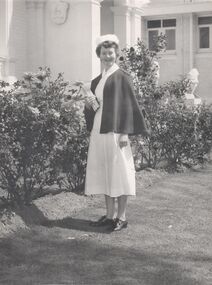
Photograph - 2nd Year nurse
... Shield on wall in background - Dr Neptune Scott's family coat of arms. ...Shield on wall in background - Dr Neptune Scott's family coat of arms. Photograph 2nd Year nurse. ...The Northern District School of Nursing opened in 1950 in to address the issues around nurse recruitment, training and education that had previously been hospital based. The residential school was to provide theoretical and in-house education and practical training over three years. The students would also receive practical hands-on training in the wards of associated hospitals. The Northern District School of Nursing operated from Lister House, Rowan Street, Bendigo. It was the first independent school of nursing in Victoria and continued until it closed in 1989.Photo of second year nurse School 23A Ten in uniform in front of Lister House Bendigo 1954. Lister House - Front garden. Nr Elizabeth Joan Thorpe, Mildura, 2nd year. 1954 -57 School 23A. Shield on wall in background - Dr Neptune Scott's family coat of arms. second year mildura nurse e.j. thorpe, standing in front of lister house -
 Linton and District Historical Society Inc
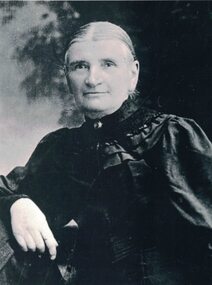
Photograph, Anna Rankin
... Anna Woods, 1848-1920, was a daughter of James Burns Woods and his wife Anna, née Coates. The Woods family migrated to Victoria in 1864. ...Anna Woods, 1848-1920, was a daughter of James Burns Woods and his wife Anna, née Coates. The Woods family migrated to Victoria in 1864. ...Anna Woods, 1848-1920, was a daughter of James Burns Woods and his wife Anna, née Coates. The Woods family migrated to Victoria in 1864. In 1974, Anna married Ewen Rankin, who held land adjoining her father's property near Linton. Ewen and Anna build a house which they called 'Glenree'. Anna and Ewen Rankin had eight children - Catherine (Kate), James, John, Anna, Mary, Lucy, William (Bill) and Ewen. The Rankins were active members of the Presbyterian congregation in Linton.Black and white photograph which shows a woman wearing a dark dress with full sleeves and a wide decorative collar. A small brooch is pinned on the collar. The woman's hair is parted in the centre and drawn back. Anna Rankin née Woods.anna rankin (née woods) -
 City of Moorabbin Historical Society (Operating the Box Cottage Museum)
Newsletter - City of Moorabbin Historical Society, Newsletter No 1 August 1961, 1961
... Local residents attended including descendants of early settler families - Coates, LePage, Shipston - and a Committee was elected. ...Local residents attended including descendants of early settler families - Coates, LePage, Shipston - and a Committee was elected. ...This is No.1 the first Newsletter produced by CMHS members in August 1961. Topics : October 1960 Mayor Cr. D.H. Clark called a meeting in the Moorabbin Town Hall to form the City of Moorabbin Historical Society. Local residents attended including descendants of early settler families - Coates, LePage, Shipston - and a Committee was elected. Mr T.A.Sheehy, President, Mr R.Colbourne, Secretary, Mrs F.Wright, Treasurer set the Annual Membership Fee at 5/- ( shillings), arranged the next meetings at the Moorabbin Town Hall and began to compile a Newsletter to tell the ' story of Moorabbin'. The Cheltenham & District Society Co-operative Limited (est.1896) sponsored this 1st CMHS Newsletter published August 1961. The Aims of the CMHS are ‘to record the history of the City, and register something of the Australian Atmosphere, which the necessary speed-up in post-world-war two (WW11) immigration has caused to be lost; to produce a magazine at regular intervals, featuring the work of pioneers and the changing Australian scene; to work constantly with a long range view towards building a hall where records and exhibits can be housed’ The Original Newsletters reflect the history and heritage of the former City of Moorabbin — derived from Mooroobin, ‘a resting place’ in the Bunurrung spoken language. In 1994, the City of Moorabbin was integrated into the Cities of Bayside, Glen Eira, Kingston and Monash. This is the 1st Newsletter of CMHS in August 1961 CMHS obtained a Kingston City Council Community Grant 2016 for the digitization and preservation of these Original CMHS Newsletters commenced in 1961 Foolscap paper printed on 1 side.CITY OF MOORABBIN HISTORICAL / SOCIETY / NEWSLETTER No 1 / AUGUST 1961moorabbin, cheltenham, bentleigh, newsletters,, sheehy thomas, coates l.r, shipston h, lepage e.a, lepage f.w., blackburn nance, clark d.h., wright f, moorabbin city council, cheltenham and district society co-operative limited, moorabbin town hall, early settlers, market gardeners, pioneers, dendy henry, brighton, box william, bent thomas -
 Melton City Libraries
Photograph, Horace Lang, 1917
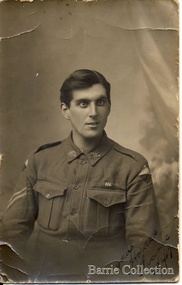
... Date of birth 27th April 1893 Born at Spring Hill – Kyneton Parents – Thomas and Mary Elizabeth nee Coates Lang. The family lived in High Street Melton 1896. ...Date of birth 27th April 1893 Born at Spring Hill – Kyneton Parents – Thomas and Mary Elizabeth nee Coates Lang. The family lived in High Street Melton 1896. ...Date of birth 27th April 1893 Born at Spring Hill – Kyneton Parents – Thomas and Mary Elizabeth nee Coates Lang. The family lived in High Street Melton 1896. He started his schooling at Melton State School in Nov 1897. Mr Lang was the Head Teacher from 1896 – 1917. Horace enlisted on the 29th March 1915 24th Battalion D Company and sailed on the Euripides on the 8th May to Egypt. They landed on Gallipoli in early September returning to Egypt at the end of the year. In April on 1916 Horace and his brother Thomas had an opportunity to meet for a few hours before he moved onto France. He received the military medal in 1916 “For conspicuous gallantry in constructing and holding an advanced bombing post near Flers on 18/19 November within close range of the enemy. The garrison had to remain motionless throughout the day but Corpl. Lang refused to be relieved until his company left the trenches, setting a most encouraging example of endurance.” In May 1917 the Battalion was near Arras – Bullecourt. On 3rd May he was last seen alive carrying a Lewis Gun, and wounded making his way to the casualty station according to witnesses reporting to the court of enquiry. The family, in Melton had a first heard that he had been wounded, or was a prisoner. My grandmother Jessie Barrie and the Lang family went to Port Melbourne as the troop ships arrived hoping they would find someone who might know of his fate. AWM records and Red Cross files reveal the extent of the efforts that family and friends made enquiring about his fate. In December 1917 he was declared Killed in Action on May 3rd at Bullecourt where he is commemorated. Horace Lang postcardRear: Dear Jessie & All, I am in the pink not doing to bad. Haven't had any letters from you for some time. Hope you haven't forgotte me. Don't be so long nest time. Letter later from your loving bro Horace. (PS) Photo is very crook. (Front: Yours Horace, France 28/2/17)local identities -
 Flagstaff Hill Maritime Museum and Village
Formal suit, 1925
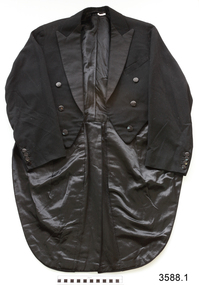
... This formal suit, comprising tails coat, trousers, waistcoat and shirt, is believed by Berry McDade (daughter of Dr Angus) to be the one donated to Flagstaff Hill Maritime Village by the family of Doctor William Roy Angus, Surgeon and Oculist, according to the doner.. ...This formal suit, comprising tails coat, trousers, waistcoat and shirt, is believed by Berry McDade (daughter of Dr Angus) to be the one donated to Flagstaff Hill Maritime Village by the family of Doctor William Roy Angus, Surgeon and Oculist, according to the doner.. ...This formal suit, comprising tails coat, trousers, waistcoat and shirt, is believed by Berry McDade (daughter of Dr Angus) to be the one donated to Flagstaff Hill Maritime Village by the family of Doctor William Roy Angus, Surgeon and Oculist, according to the doner.. There is another name on some of the garments, possibly because the suit components were acquired second hand at the time when Dr Angus was in his early practice days. It is part of the “W.R. Angus Collection” that includes historical medical equipment, surgical instruments and material once belonging to Dr Edward Ryan and Dr Thomas Francis Ryan, (both of Nhill, Victoria) as well as Dr Angus’ own belongings. The Collection’s history spans the medical practices of the two Doctors Ryan, from 1885-1926 plus that of Dr Angus, up until 1969. ABOUT THE “W.R.ANGUS COLLECTION” Doctor William Roy Angus M.B., B.S., Adel., 1923, F.R.C.S. Edin.,1928 (also known as Dr Roy Angus) was born in Murrumbeena, Victoria in 1901 and lived until 1970. He qualified as a doctor in 1923 at University of Adelaide, was Resident Medical Officer at the Royal Adelaide Hospital in 1924 and for a period was house surgeon to Sir (then Mr.) Henry Simpson Newland. Dr Angus was briefly an Assistant to Dr Riddell of Kapunda, then commenced private practice at Curramulka, Yorke Peninsula, SA, where he was physician, surgeon and chemist. In 1926, he was appointed as new Medical Assistant to Dr Thomas Francis Ryan (T.F. Ryan, or Tom), in Nhill, Victoria, where his experiences included radiology and pharmacy. In 1927 he was Acting House Surgeon in Dr Tom Ryan’s absence. Dr Angus had become engaged to Gladys Forsyth and they decided he would take time to further his studies overseas in the UK in 1927. He studied at London University College Hospital and at Edinburgh Royal Infirmary and in 1928, was awarded FRCS (Fellow from the Royal College of Surgeons), Edinburgh. He worked his passage back to Australia as a Ship’s Surgeon on the on the Australian Commonwealth Line’s SS Largs Bay. Dr Angus married Gladys in 1929, in Ballarat. (They went on to have one son (Graham 1932, born in SA) and two daughters (Helen (died 12/07/1996) and Berenice (Berry), both born at Mira, Nhill ) Dr Angus was a ‘flying doctor’ for the A.I.M. (Australian Inland Ministry) Aerial Medical Service in 1928 . The organisation began in South Australia through the Presbyterian Church in that year, with its first station being in the remote town of Oodnadatta, where Dr Angus was stationed. He was locum tenens there on North-South Railway at 21 Mile Camp. He took up this ‘flying doctor’ position in response to a call from Dr John Flynn; the organisation was later known as the Flying Doctor Service, then the Royal Flying Doctor Service. A lot of his work during this time involved dental surgery also. Between 1928-1932 he was surgeon at the Curramulka Hospital, Yorke Peninsula, South Australia. In 1933 Dr Angus returned to Nhill where he’d previously worked as Medical Assistant and purchased a share of the Nelson Street practice and Mira hospital from Dr Les Middleton one of the Middleton Brothers, the current owners of what was once Dr Tom Ryan’s practice. Dr L Middleton was House Surgeon to the Nhill Hospital 1926-1933, when he resigned. [Dr Tom Ryan’s practice had originally belonged to his older brother Dr Edward Ryan, who came to Nhill in 1885. Dr Edward saw patients at his rooms, firstly in Victoria Street and in 1886 in Nelson Street, until 1901. The Nelson Street practice also had a 2 bed ward, called Mira Private Hospital ). Dr Edward Ryan was House Surgeon at the Nhill Hospital 1884-1902 . He also had occasions where he successfully performed veterinary surgery for the local farmers too. Dr Tom Ryan then purchased the practice from his brother in 1901. Both Dr Edward and Dr Tom Ryan work as surgeons included eye surgery. Dr Tom Ryan performed many of his operations in the Mira private hospital on his premises. He too was House Surgeon at the Nhill Hospital 1902-1926. Dr Tom Ryan had one of the only two pieces of radiology equipment in Victoria during his practicing years – The Royal Melbourne Hospital had the other one. Over the years Dr Tom Ryan gradually set up what was effectively a training school for country general-practitioner-surgeons. Each patient was carefully examined, including using the X-ray machine, and any surgery was discussed and planned with Dr Ryan’s assistants several days in advance. Dr Angus gained experience in using the X-ray machine there during his time as assistant to Dr Ryan. Dr Tom Ryan moved from Nhill in 1926. He became a Fellow of the Royal Australasian College of Surgeons in 1927, soon after its formation, a rare accolade for a doctor outside any of the major cities. He remained a bachelor and died suddenly on 7th Dec 1955, aged 91, at his home in Ararat. Scholarships and prizes are still awarded to medical students in the honour of Dr T.F. Ryan and his father, Dr Michael Ryan, and brother, John Patrick Ryan. ] When Dr Angus bought into the Nelson Street premises in Nhill he was also appointed as the Nhill Hospital’s Honorary House Surgeon 1933-1938. His practitioner’s plate from his Nhill surgery states “HOURS Daily, except Tuesdays, Fridays and Saturday afternoons, 9-10am, 2-4pm, 7-8pm. Sundays by appointment”. This plate is now mounted on the doorway to the Port Medical Office at Flagstaff Hill Maritime Village, Warrnambool. Dr Edward Ryan and Dr Tom Ryan had an extensive collection of historical medical equipment and materials spanning 1884-1926 and when Dr Angus took up practice in their old premises he obtained this collection, a large part of which is now on display at the Port Medical Office at Flagstaff Hill Maritime Village in Warrnambool. During his time in Nhill Dr Angus was involved in the merging of the Mira Hospital and Nhill Public Hospital into one public hospital and the property titles passed on to Nhill Hospital in 1939. In 1939 Dr Angus and his family moved to Warrnambool where he purchased “Birchwood,” the 1852 home and medical practice of Dr John Hunter Henderson, at 214 Koroit Street. (This property was sold in1965 to the State Government and is now the site of the Warrnambool Police Station. ). The Angus family was able to afford gardeners, cooks and maids; their home was a popular place for visiting dignitaries to stay whilst visiting Warrnambool. Dr Angus had his own silk worm farm at home in a Mulberry tree. His young daughter used his centrifuge for spinning the silk. Dr Angus was appointed on a part-time basis as Port Medical Officer (Health Officer) in Warrnambool and held this position until the 1940’s when the government no longer required the service of a Port Medical Officer in Warrnambool; he was thus Warrnambool’s last serving Port Medical Officer. (The duties of a Port Medical Officer were outlined by the Colonial Secretary on 21st June, 1839 under the terms of the Quarantine Act. Masters of immigrant ships arriving in port reported incidents of diseases, illness and death and the Port Medical Officer made a decision on whether the ship required Quarantine and for how long, in this way preventing contagious illness from spreading from new immigrants to the residents already in the colony.) Dr Angus was a member of the Australian Medical Association, for 35 years and surgeon at the Warrnambool Base Hospital 1939-1942, He served as a Surgeon Captain during WWII1942-45, in Ballarat, Victoria, and in Bonegilla, N.S.W., completing his service just before the end of the war due to suffering from a heart attack. During his convalescence he carved an intricate and ‘most artistic’ chess set from the material that dentures were made from. He then studied ophthalmology at the Royal Melbourne Eye and Ear Hospital and created cosmetically superior artificial eyes by pioneering using the intrascleral cartilage. Angus received accolades from the Ophthalmological Society of Australasia for this work. He returned to Warrnambool to commence practice as an ophthalmologist, pioneering in artificial eye improvements. He was Honorary Consultant Ophthalmologist to Warrnambool Base Hospital for 31 years. He made monthly visits to Portland as a visiting surgeon, to perform eye surgery. He represented the Victorian South-West subdivision of the Australian Medical Association as its secretary between 1949 and 1956 and as chairman from 1956 to 1958. In 1968 Dr Angus was elected member of Spain’s Barraquer Institute of Barcelona after his research work in Intrasclearal cartilage grafting, becoming one of the few Australian ophthalmologists to receive this honour, and in the following year presented his final paper on Living Intrasclearal Cartilage Implants at the Inaugural Meeting of the Australian College of Ophthalmologists in Melbourne In his personal life Dr Angus was a Presbyterian and treated Sunday as a Sabbath, a day of rest. He would visit 3 or 4 country patients on a Sunday, taking his children along ‘for the ride’ and to visit with him. Sunday evenings he would play the pianola and sing Scottish songs to his family. One of Dr Angus’ patients was Margaret MacKenzie, author of a book on local shipwrecks that she’d seen as an eye witness from the late 1880’s in Peterborough, Victoria. In the early 1950’s Dr Angus, painted a picture of a shipwreck for the cover jacket of Margaret’s book, Shipwrecks and More Shipwrecks. She was blind in later life and her daughter wrote the actual book for her. Dr Angus and his wife Gladys were very involved in Warrnambool’s society with a strong interest in civic affairs. Their interests included organisations such as Red Cross, Rostrum, Warrnambool and District Historical Society (founding members), Wine and Food Society, Steering Committee for Tertiary Education in Warrnambool, Local National Trust, Good Neighbour Council, Housing Commission Advisory Board, United Services Institute, Legion of Ex-Servicemen, Olympic Pool Committee, Food for Britain Organisation, Warrnambool Hospital, Anti-Cancer Council, Boys’ Club, Charitable Council, National Fitness Council and Air Raid Precautions Group. He was also a member of the Steam Preservation Society and derived much pleasure from a steam traction engine on his farm. He had an interest in people and the community He and his wife Gladys were both involved in the creation of Flagstaff Hill, including the layout of the gardens. After his death (28th March 1970) his family requested his practitioner’s plate, medical instruments and some personal belongings be displayed in the Port Medical Office surgery at Flagstaff Hill Maritime Village, and be called the “W. R. Angus Collection”. The W.R. Angus Collection is significant for still being located at the site it is connected with, Doctor Angus being the last Port Medical Officer in Warrnambool. The collection of medical instruments and other equipment is culturally significant, being an historical example of medicine from late 19th to mid-20th century. Dr Angus assisted Dr Tom Ryan, a pioneer in the use of X-rays and in ocular surgery. Formal suit, worn by Dr Angus, Coat (.1): black double-breasted with tails, black round flat, shank buttons, quilting inside (under armholes), label "BRAHAM & CO / 614 ALDERSGATE ST E.C / Mr G Hobson, 1925 Aug". Trousers (.2): black, button fly, black braid stripe, nametag "J.C. RENYARD" stamped number on front right pocket lining "163332-2-3398F" Waistcoat (.3): black, 4x 4-holed black buttons. Shirt (.4); white cotton, long sleeves, round neck, long tailed, bib front, 4x button holes each side, stamp around neck "4.AM:25", label "THE AINSLY SHIRT", name in pen "R115 RENYARD", remnants of red cotton stitching on neck (W.R. Angus Collection)Jacket has label label "BRAHAM & CO / 614 ALDERSGATE ST E.C / Mr G Hobson, 1925 Aug Trousers nametag "J.C. RENYARD" stamped number on front right pocket lining "163332-2-3398F" Shirt has stamp around neck label "THE AINSLY SHIRT", name in pen "R115 RENYARDflagstaff hill, warrnambool, shipwrecked-coast, flagstaff-hill, flagstaff-hill-maritime-museum, maritime-museum, shipwreck-coast, flagstaff-hill-maritime-village, formal sout, tails suit, dr w r angus, the ailsley shirt, ophthalmology, formal clothing, mira hospital, nhill base hospital -
 Flagstaff Hill Maritime Museum and Village
Coat hanger, mid 1900's
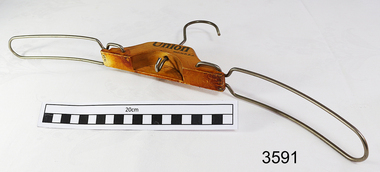
... This wooden and wire, folding coat hanger was donated to Flagstaff Hill Maritime Village by the family of Doctor William Roy Angus, Surgeon and Oculist. ...This wooden and wire, folding coat hanger was donated to Flagstaff Hill Maritime Village by the family of Doctor William Roy Angus, Surgeon and Oculist. ...This wooden and wire, folding coat hanger was donated to Flagstaff Hill Maritime Village by the family of Doctor William Roy Angus, Surgeon and Oculist. It is part of the “W.R. Angus Collection” that includes historical medical equipment, surgical instruments and material once belonging to Dr Edward Ryan and Dr Thomas Francis Ryan, (both of Nhill, Victoria) as well as Dr Angus’ own belongings. The Collection’s history spans the medical practices of the two Doctors Ryan, from 1885-1926 plus that of Dr Angus, up until 1969. ABOUT THE “W.R.ANGUS COLLECTION” Doctor William Roy Angus M.B., B.S., Adel., 1923, F.R.C.S. Edin.,1928 (also known as Dr Roy Angus) was born in Murrumbeena, Victoria in 1901 and lived until 1970. He qualified as a doctor in 1923 at University of Adelaide, was Resident Medical Officer at the Royal Adelaide Hospital in 1924 and for a period was house surgeon to Sir (then Mr.) Henry Simpson Newland. Dr Angus was briefly an Assistant to Dr Riddell of Kapunda, then commenced private practice at Curramulka, Yorke Peninsula, SA, where he was physician, surgeon and chemist. In 1926, he was appointed as new Medical Assistant to Dr Thomas Francis Ryan (T.F. Ryan, or Tom), in Nhill, Victoria, where his experiences included radiology and pharmacy. In 1927 he was Acting House Surgeon in Dr Tom Ryan’s absence. Dr Angus had become engaged to Gladys Forsyth and they decided he would take time to further his studies overseas in the UK in 1927. He studied at London University College Hospital and at Edinburgh Royal Infirmary and in 1928, was awarded FRCS (Fellow from the Royal College of Surgeons), Edinburgh. He worked his passage back to Australia as a Ship’s Surgeon on the on the Australian Commonwealth Line’s SS Largs Bay. Dr Angus married Gladys in 1929, in Ballarat. (They went on to have one son (Graham 1932, born in SA) and two daughters (Helen (died 12/07/1996) and Berenice (Berry), both born at Mira, Nhill ) Dr Angus was a ‘flying doctor’ for the A.I.M. (Australian Inland Ministry) Aerial Medical Service in 1928 . The organisation began in South Australia through the Presbyterian Church in that year, with its first station being in the remote town of Oodnadatta, where Dr Angus was stationed. He was locum tenens there on North-South Railway at 21 Mile Camp. He took up this ‘flying doctor’ position in response to a call from Dr John Flynn; the organisation was later known as the Flying Doctor Service, then the Royal Flying Doctor Service. A lot of his work during this time involved dental surgery also. Between 1928-1932 he was surgeon at the Curramulka Hospital, Yorke Peninsula, South Australia. In 1933 Dr Angus returned to Nhill where he’d previously worked as Medical Assistant and purchased a share of the Nelson Street practice and Mira hospital from Dr Les Middleton one of the Middleton Brothers, the current owners of what was once Dr Tom Ryan’s practice. Dr L Middleton was House Surgeon to the Nhill Hospital 1926-1933, when he resigned. [Dr Tom Ryan’s practice had originally belonged to his older brother Dr Edward Ryan, who came to Nhill in 1885. Dr Edward saw patients at his rooms, firstly in Victoria Street and in 1886 in Nelson Street, until 1901. The Nelson Street practice also had a 2 bed ward, called Mira Private Hospital ). Dr Edward Ryan was House Surgeon at the Nhill Hospital 1884-1902 . He also had occasions where he successfully performed veterinary surgery for the local farmers too. Dr Tom Ryan then purchased the practice from his brother in 1901. Both Dr Edward and Dr Tom Ryan work as surgeons included eye surgery. Dr Tom Ryan performed many of his operations in the Mira private hospital on his premises. He too was House Surgeon at the Nhill Hospital 1902-1926. Dr Tom Ryan had one of the only two pieces of radiology equipment in Victoria during his practicing years – The Royal Melbourne Hospital had the other one. Over the years Dr Tom Ryan gradually set up what was effectively a training school for country general-practitioner-surgeons. Each patient was carefully examined, including using the X-ray machine, and any surgery was discussed and planned with Dr Ryan’s assistants several days in advance. Dr Angus gained experience in using the X-ray machine there during his time as assistant to Dr Ryan. Dr Tom Ryan moved from Nhill in 1926. He became a Fellow of the Royal Australasian College of Surgeons in 1927, soon after its formation, a rare accolade for a doctor outside any of the major cities. He remained a bachelor and died suddenly on 7th Dec 1955, aged 91, at his home in Ararat. Scholarships and prizes are still awarded to medical students in the honour of Dr T.F. Ryan and his father, Dr Michael Ryan, and brother, John Patrick Ryan. ] When Dr Angus bought into the Nelson Street premises in Nhill he was also appointed as the Nhill Hospital’s Honorary House Surgeon 1933-1938. His practitioner’s plate from his Nhill surgery states “HOURS Daily, except Tuesdays, Fridays and Saturday afternoons, 9-10am, 2-4pm, 7-8pm. Sundays by appointment”. This plate is now mounted on the doorway to the Port Medical Office at Flagstaff Hill Maritime Village, Warrnambool. Dr Edward Ryan and Dr Tom Ryan had an extensive collection of historical medical equipment and materials spanning 1884-1926 and when Dr Angus took up practice in their old premises he obtained this collection, a large part of which is now on display at the Port Medical Office at Flagstaff Hill Maritime Village in Warrnambool. During his time in Nhill Dr Angus was involved in the merging of the Mira Hospital and Nhill Public Hospital into one public hospital and the property titles passed on to Nhill Hospital in 1939. In 1939 Dr Angus and his family moved to Warrnambool where he purchased “Birchwood,” the 1852 home and medical practice of Dr John Hunter Henderson, at 214 Koroit Street. (This property was sold in1965 to the State Government and is now the site of the Warrnambool Police Station. ). The Angus family was able to afford gardeners, cooks and maids; their home was a popular place for visiting dignitaries to stay whilst visiting Warrnambool. Dr Angus had his own silk worm farm at home in a Mulberry tree. His young daughter used his centrifuge for spinning the silk. Dr Angus was appointed on a part-time basis as Port Medical Officer (Health Officer) in Warrnambool and held this position until the 1940’s when the government no longer required the service of a Port Medical Officer in Warrnambool; he was thus Warrnambool’s last serving Port Medical Officer. (The duties of a Port Medical Officer were outlined by the Colonial Secretary on 21st June, 1839 under the terms of the Quarantine Act. Masters of immigrant ships arriving in port reported incidents of diseases, illness and death and the Port Medical Officer made a decision on whether the ship required Quarantine and for how long, in this way preventing contagious illness from spreading from new immigrants to the residents already in the colony.) Dr Angus was a member of the Australian Medical Association, for 35 years and surgeon at the Warrnambool Base Hospital 1939-1942, He served as a Surgeon Captain during WWII1942-45, in Ballarat, Victoria, and in Bonegilla, N.S.W., completing his service just before the end of the war due to suffering from a heart attack. During his convalescence he carved an intricate and ‘most artistic’ chess set from the material that dentures were made from. He then studied ophthalmology at the Royal Melbourne Eye and Ear Hospital and created cosmetically superior artificial eyes by pioneering using the intrascleral cartilage. Angus received accolades from the Ophthalmological Society of Australasia for this work. He returned to Warrnambool to commence practice as an ophthalmologist, pioneering in artificial eye improvements. He was Honorary Consultant Ophthalmologist to Warrnambool Base Hospital for 31 years. He made monthly visits to Portland as a visiting surgeon, to perform eye surgery. He represented the Victorian South-West subdivision of the Australian Medical Association as its secretary between 1949 and 1956 and as chairman from 1956 to 1958. In 1968 Dr Angus was elected member of Spain’s Barraquer Institute of Barcelona after his research work in Intrasclearal cartilage grafting, becoming one of the few Australian ophthalmologists to receive this honour, and in the following year presented his final paper on Living Intrasclearal Cartilage Implants at the Inaugural Meeting of the Australian College of Ophthalmologists in Melbourne In his personal life Dr Angus was a Presbyterian and treated Sunday as a Sabbath, a day of rest. He would visit 3 or 4 country patients on a Sunday, taking his children along ‘for the ride’ and to visit with him. Sunday evenings he would play the pianola and sing Scottish songs to his family. One of Dr Angus’ patients was Margaret MacKenzie, author of a book on local shipwrecks that she’d seen as an eye witness from the late 1880’s in Peterborough, Victoria. In the early 1950’s Dr Angus, painted a picture of a shipwreck for the cover jacket of Margaret’s book, Shipwrecks and More Shipwrecks. She was blind in later life and her daughter wrote the actual book for her. Dr Angus and his wife Gladys were very involved in Warrnambool’s society with a strong interest in civic affairs. Their interests included organisations such as Red Cross, Rostrum, Warrnambool and District Historical Society (founding members), Wine and Food Society, Steering Committee for Tertiary Education in Warrnambool, Local National Trust, Good Neighbour Council, Housing Commission Advisory Board, United Services Institute, Legion of Ex-Servicemen, Olympic Pool Committee, Food for Britain Organisation, Warrnambool Hospital, Anti-Cancer Council, Boys’ Club, Charitable Council, National Fitness Council and Air Raid Precautions Group. He was also a member of the Steam Preservation Society and derived much pleasure from a steam traction engine on his farm. He had an interest in people and the community He and his wife Gladys were both involved in the creation of Flagstaff Hill, including the layout of the gardens. After his death (28th March 1970) his family requested his practitioner’s plate, medical instruments and some personal belongings be displayed in the Port Medical Office surgery at Flagstaff Hill Maritime Village, and be called the “W. R. Angus Collection”. The W.R. Angus Collection is significant for still being located at the site it is connected with, Doctor Angus being the last Port Medical Officer in Warrnambool. The collection of medical instruments and other equipment is culturally significant, being an historical example of medicine from late 19th to mid-20th century. Dr Angus assisted Dr Tom Ryan, a pioneer in the use of X-rays and in ocular surgery. Folding coat hanger owned by Dr Angus. Wooden centre piece and looped metal shoulder pieces and metal hook. Wood is stamped “UNION / Made in U.S.A.” and hand engraved “W.R.A.”. Folded measurements (W.R. Angus Collection) Wood is stamped “UNION / Made in U.S.A.” and hand engraved “W.R.A.”. flagstaff hill, warrnambool, shipwrecked-coast, flagstaff-hill, flagstaff-hill-maritime-museum, maritime-museum, shipwreck-coast, flagstaff-hill-maritime-village, dr w r angus, medical equipment, surgical instrument, dr ryan, ophthalmology, warrnambool base hospital, nhill base hospital, flying doctor, medical history, medical treatment, mira hospital, medical education, medical text book, t.s.s largs bay -
 Federation University Historical Collection
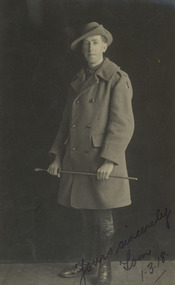
Photograph, Tom (possibly from Clunes), 1918
... Tom is probably a part of the Pickford family world war one world war 1 world war i chatham chatham family collection pickford soldier In ink on lower right corner: "Yours sincerely Tom 1.3.18 An AIF soldier stand in coat. ...Tom is probably a part of the Pickford familyAn AIF soldier stand in coat. He is wearing a slouch hat and holds a stick.In ink on lower right corner: "Yours sincerely Tom 1.3.18world war one, world war 1, world war i, chatham, chatham family collection, pickford, soldier -
 Federation University Historical Collection
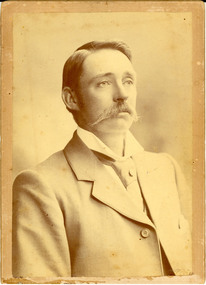
Photograph, William Smerdon Holmes, c1890, c1890
... William Smerdon Holmes died in June 1914 and is buried at the Ballarat New Cemetery. chatham family archive chatham holmes william holmes william smerdon holmes ascot sauchieburn A black and white photograph glued into card. It shows a moustached man in coat ...William Smerdon Holmes married Violet Mary Macfie (1859 – 1942) on 9 April 1890 at Geelong. William and Violet lived at "Sauchieburn", Ascot on the 291 ha (720 acre) property that William inherited from his aunt Catherine Coghill (nee Holmes). William and Violet Holmes had four children: • Violet Catherine (1891- 1949) married Samuel Gordon Spittle 11 August 1920; Mary Coghill (1892 - 1979); • William Edward (1894 - 1964) married Charlotte Anne Alexander 20 June 1933; • Henry Smerdon (1897 - 1954) married Edith Sarah Pickford 28/2/1922. William Smerdon Holmes was the grandfather of Henry John (Jack) Holmes (1922-1972) William Smerdon Holmes (1927-1993), David Coghill Holmes (1929-1950) and Mary Elizabeth Chatham (Elizabeth) (nee Holmes) (1932 - 2006). William Smerdon Holmes died in June 1914 and is buried at the Ballarat New Cemetery. A black and white photograph glued into card. It shows a moustached man in coat, collar, tie and tie-pin. It is William Smerdon Holmeschatham family archive, chatham, holmes, william holmes, william smerdon holmes, ascot, sauchieburn -
 Federation University Historical Collection
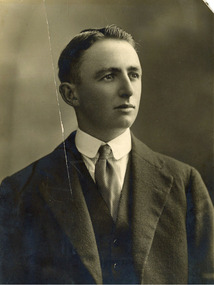
Photograph - black and white, David Coghill Holmes of Ascot, Victoria
... Black and white photograph of a man in coat, collar and tie. He is David Coghill Holmes as a young man. The Holmes family lived at Ascot, Victoria....Chatham 1932 - 2006) and son of Henry (Harry} Smerdon and Edith Holmes (nee Pickford) harry holmes ascot holmes family collection chatham-holmes collection Black and white photograph of a man in coat, collar and tie. ...David Coghill Holmes (1929- 1950) of Ascot was the youngest brother of Henry John (Jack), William Smerdon (Bill) and Mary Elizabeth Holmes (m M. E. Chatham 1932 - 2006) and son of Henry (Harry} Smerdon and Edith Holmes (nee Pickford)Black and white photograph of a man in coat, collar and tie. He is David Coghill Holmes as a young man. The Holmes family lived at Ascot, Victoria.harry holmes, ascot, holmes family collection, chatham-holmes collection -
 Federation University Historical Collection
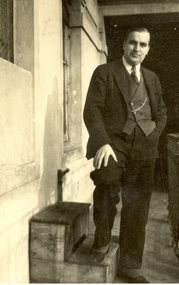
Photograph - Photograph - Black and White, Navarre (Alexander Wright of Smeaton), c1935
... family won many singing and instrumental awards. Alexander Wright Navarre Frank Wright Smeaton performing arts Written on the back in black ink " a snap taken on the balcony. I'm beginning to get the tenor spread about the bottom-jaw" A black and white photograph of a man in a suit with a waist coat and fob chain standing with one foot on the lower step of a stone building. ...Alexander Wright and Frank Wright were brothers. Both born in Smeaton, lived at Laura Villa, and attended Smeaton State School. His father William was a gold miner and his mother's name was Sarah. Their family won many singing and instrumental awards. A black and white photograph of a man in a suit with a waist coat and fob chain standing with one foot on the lower step of a stone building. He is Navarre (Alexander Wright of Smeaton)Written on the back in black ink " a snap taken on the balcony. I'm beginning to get the tenor spread about the bottom-jaw"alexander wright, navarre, frank wright, smeaton, performing arts -
 Federation University Historical Collection
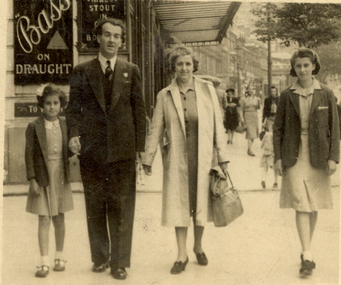
Photograph - Black and White, Harry Mortimer and family?, mid 1900's
... coat and carrying a handbag and large paper parcel. On the left side of this couple is a young girl and on the right is a teenage girl. They are both wearing school uniforms. In the background is a busy inner city scene. The man is probably Harry Mortimer and he is with his family...coat and carrying a handbag and large paper parcel. On the left side of this couple is a young girl and on the right is a teenage girl. They are both wearing school uniforms. In the background is a busy inner city scene. The man is probably Harry Mortimer and he is with his family ...Frank Wright was a renown resident of Smeaton, where he was born on 2 August 1901. He lived at Laura Villa, and attended Smeaton State School. His father William was a gold miner and his mother's name was Sarah. Their family won many singing and instrumental awards. Frank was tutored by Percy Code and was awarded a gold medal for the highest marks in the ALCM examinations in the British Colonies at the age of seventeen years. He became the Australian Open Cornet Champion by the age of eighteen. A year later, Frank conducted the City of Ballarat Band, and later the Ballarat Soldiers’ Memorial Band. He formed the Frank Wright Frisco Band and Frank Wright and his Coliseum Orchestra. These bands won many South Street awards, and Frank as conductor won many awards in the Australian Band Championship contest. In 1933 Frank Wright sailed to England to conduct the famous St Hilda’s Band and was later appointed Musical Director of the London County Council, where he organized many amazing concerts in parks, in and around the London district. He was made Professor of Brass and Military Band Scoring and conducted at the Guildhall of Music and Drama. Frank was often invited to adjudicate Brass Band Championships around Europe, in Australia, including South Street and in New Zealand. The Frank Wright Medal at the Royal South Street competition is awarded to an individual recognized as making an outstanding contribution to brass music in Australia.Black and white photograph of a man in a three piece suit, holding the hand of a lady clad in a dress and coat and carrying a handbag and large paper parcel. On the left side of this couple is a young girl and on the right is a teenage girl. They are both wearing school uniforms. In the background is a busy inner city scene. The man is probably Harry Mortimer and he is with his family. They are friends of Frank Wright.harry mortimer, frank wright, school uniforms, city scene -
 Flagstaff Hill Maritime Museum and Village
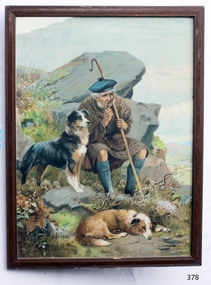
Print - Picture of a Scottish Shepherd and his Two Dogs, A Shepherd and His Friends, 20th Century
... family pet. https://en.wikipedia.org/wiki/Shetland_Sheepdog The Rough Collie (also known as the Long-Haired Collie) is a long-coated dog breed of medium to large size that, in its original form, was a type of collie used and bred for herding sheep in Scotland. ...family pet. https://en.wikipedia.org/wiki/Shetland_Sheepdog The Rough Collie (also known as the Long-Haired Collie) is a long-coated dog breed of medium to large size that, in its original form, was a type of collie used and bred for herding sheep in Scotland. ...Shepherding is among the oldest occupations, beginning some 5,000 years ago in Asia Minor. Sheep were kept for their milk, meat and especially their wool. Over the next thousand years, sheep and shepherding spread throughout Eurasia. Henri Fleisch tentatively suggested the Shepherd Neolithic industry of Lebanon may date to the Epipaleolithic and that it may have been used by one of the first cultures of nomadic shepherds in the Beqaa Valley. Some sheep were integrated in the family farm along with other animals such as chickens and pigs. To maintain a large flock, the sheep must be able to move from pasture to another pasture. This required the development of an occupation separate from that of the farmer. The duty of shepherds was to keep their flock intact, protect it from predators and guide it to market areas in time for shearing. In ancient times, shepherds also commonly milked their sheep, and made cheese from this milk; few shepherds still do this today. In many societies, shepherds were an important part of the economy. Unlike farmers, shepherds were often wage earners, being paid to watch the sheep of others. Shepherds also lived apart from society, being largely nomadic. It was mainly a job of solitary males without children, and new shepherds thus needed to be recruited externally. Shepherds were most often the younger sons of farming peasants who did not inherit any land. In other societies, each family would have a family member to shepherd its flock, often a child, youth or an elder who couldn't help much with harder work; these shepherds were fully integrated in society. Shepherds would normally work in groups either looking after one large flock, or each bringing their own and merging their responsibilities. They would live in small cabins, often shared with their sheep, and would buy food from local communities. Less often shepherds lived in covered wagons that travelled with their flocks. Shepherding developed only in certain areas. In the lowlands and river valleys, it was far more efficient to grow grain and cereals than to allow sheep to graze, thus the raising of sheep was confined to rugged and mountainous areas. In pre-modern times shepherding was thus centred on regions such as the Middle East, Greece, the Pyrenees, the Carpathian Mountains, Scotland and Northern England. https://en.wikipedia.org/wiki/Shepherd The Shetland Sheepdog, often known as the Sheltie, is a breed of herding dog that originated in the Shetland Islands of Scotland. The original name was Shetland Collie, but this caused controversy amongst Rough Collie breeders of the time, so the breed's name was formally changed. This diligent small dog is clever, vocal, excitable and willing to please. They are incredibly trustworthy to their owners to the point where they are often referred to as "shadows" due to their attachment to family. This breed was formally recognized by The Kennel Club (UK) in 1909. Like the Shetland pony, Shetland cattle and the Shetland sheep, the Shetland Sheepdog is a hardy but diminutive breed developed to thrive amidst the harsh and meagre conditions of its native islands. While the Sheltie still excels at herding, today it is often raised as a working dog and/or family pet. https://en.wikipedia.org/wiki/Shetland_Sheepdog The Rough Collie (also known as the Long-Haired Collie) is a long-coated dog breed of medium to large size that, in its original form, was a type of collie used and bred for herding sheep in Scotland. More recent breeding has focused on the Collie as a show dog, and also companion. The breed specifications call for a distinctive long narrow tapered snout and tipped (semiprick) ears, so some dogs have their ears taped when young. Rough Collies generally come in shades of sable and white (sometimes mahogany), blue merle, tri-coloured, and colour-headed white. There is a smooth-coated variety known as a Smooth Collie; some breed organisations, including both the American and Canadian Kennel Clubs, consider smooth-coat and rough-coat collies to be variations of the same breed. Rough Collies closely resemble the smaller Shetland Sheepdogs or "Shelties", but the two breeds do not have an exclusive linear relationship. https://en.wikipedia.org/wiki/Rough_Collie This picture shows a typical Scottish scene with a shepherd in kilt and his two sheepdogs.Picture, print of old Scotsman sitting on a stone slab with his dogs nearby. Framed, glass covered colour print. Marked "A SHEPHERD AND HIS FRIENDS", "1897" , "Drummonds" (on picture). Marked "A SHEPHERD AND HIS FRIENDS", "1897" , "Drummonds" (on picture). flagstaff hill, warrnambool, shipwrecked-coast, flagstaff-hill, flagstaff-hill-maritime-museum, maritime-museum, shipwreck-coast, flagstaff-hill-maritime-village, print, picture, wall decoration, shepherd and dogs, a shepherd and his friends, shetland sheep dog, rough collie
