
Showing 35 items matching "cob "
-
 Dandenong & District Historical Society
Document - Country Cob, Articles Concerning Country Cob
... Articles Concerning Country Cob...Country Cob, Newspaper Article, History...Articles concerning Country Cob...Country Cob, Newspaper Article, History Articles concerning Country Cob Articles Concerning Country Cob Document Country Cob ...Country Cob, Newspaper Article, History -
 University of Melbourne, Burnley Campus Archives
Photograph - Black and white print, Publicity Branch Victorian Department of Agriculture, Student Examining Corn Cob, UNknown
... Student Examining Corn Cob...Student Examining corn cob on plant in the Orchard....Student Examining corn cob on plant in the Orchard. Student Examining Corn Cob Photograph Black and white print Publicity Branch Victorian Department of Agriculture ...Black and white photograph. Student Examining corn cob on plant in the Orchard.On reverse, "Photograph by Publicity Branch Victorian Department Of Agriculture Ref. No. D.473.E."student working outside, vegetables, orchard, corn -
 Stawell Historical Society Inc
Photograph, Constitution Hotel in Longfield Street Pleasant Creekwith a Cob & Co Coach at the front c1866
... Constitution Hotel in Longfield Street Pleasant Creekwith a Cob & Co Coach at the front c1866...Constitution Hotel Longfield Street Pleasant Creek. Cob & Co Coach at front. c1866...Constitution Hotel Longfield Street Pleasant Creek. Cob & Co Coach at front. c1866 Stawell Constitution Hotel in Longfield Street Pleasant Creekwith a Cob & Co Coach at the front c1866 Photograph ...Constitution Hotel Longfield Street Pleasant Creek. Cob & Co Coach at front. c1866stawell -
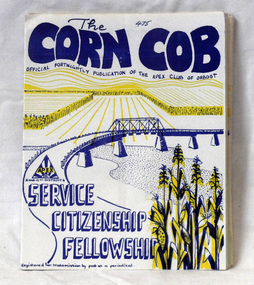 Orbost & District Historical Society
magazines, The Corn Cob, 1976, 1977
... The Corn Cob...Thirteen magazines which were a fortnightly publication of the Orbost Apex Club. Titled, The Corn Cob, it has a white cover with blue and yellow print. ...Titled, The Corn Cob, it has a white cover with blue and yellow print. ...These magazines were published fortnightly and distributed to the members of Orbost Apex Club. Apex clubs are volunteer service clubs whose members work in local clubs across urban, regional and rural Australia to raise awareness about social justice issues, assist the needy in a practical way and contribute resources to worthwhile causes.The Orbost Apex Club was a volunteer service club which contributed to the local community. As the population of the area declined so did the number of social clubs.Thirteen magazines which were a fortnightly publication of the Orbost Apex Club. Titled, The Corn Cob, it has a white cover with blue and yellow print. Inside each cover is duplicated material usually two sheets.On front in pen - the number of the issuemagazines orbost-apex corn-cob -
 Stawell Historical Society Inc
Photograph, Lodestone Service Station Cnr Seaby & Longfield Streets Stawell with the Stone Cob & Co Stables in Seaby Street clearly seen in background of photo
... Lodestone Service Station Cnr Seaby & Longfield Streets Stawell with the Stone Cob & Co Stables in Seaby Street clearly seen in background of photo...Lodestone Service Station Cnr Seaby & Longfield Sts. Stone Cob & Co Stables in Seaby Street clearly seen in background of photo....Lodestone Service Station Cnr Seaby & Longfield Sts. Stone Cob & Co Stables in Seaby Street clearly seen in background of photo. ...Lodestone Service Station Cnr Seaby & Longfield Sts. Stone Cob & Co Stables in Seaby Street clearly seen in background of photo.stawell -
 Stawell Historical Society Inc
Photograph, Shamrock Hotel on the corner of Seaby & Longfield Streets Stawell West with Mary Jenkins and Agnes Jenkins nee Keegan 1914
... Standing in Front are Mary Jenkins and Agnes Jenkins nee Keegan second and third from left. Granite Cob & Co Stables on left ...Buildings behind three large trees, telegraph pole front centre of image. Granite Cob & Co Stables on left ...Granite Cob & Co Stables on left Shamrock Hotel on the corner of Seaby & Longfield Streets Stawell West with Mary Jenkins and Agnes Jenkins nee Keegan 1914 Photograph ...Two story weatherboard Shamrock Hotel 1914? corner of Seaby Street and Longfield Streets Pleasant Creek, Stawell West. Standing in Front are Mary Jenkins and Agnes Jenkins nee Keegan second and third from left. Granite Cob & Co Stables on left Buildings behind three large trees, telegraph pole front centre of image. Granite Cob & Co Stables on left Shamrock Hotelstawell business -
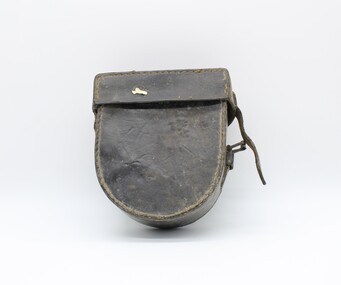 Shepparton RSL Sub Branch
Case, c. 1916
... Manufacturer's stamp reads "FRANZ COBAL/BERLIN/1916"...This case may have once attached to the belt of a soldier as a carry case for an artillery sight. carry case bag accessory acoutrement world war one military uniform world war i first world war the great war germany german berlin franz cobal franz cobalt artillery sight Manufacturer's stamp reads "FRANZ COBAL/BERLIN/1916" Dark leather case constructed of two elongated semi-circle shapes, hand or machine stitched with a gusset. ...This case may have once attached to the belt of a soldier as a carry case for an artillery sight.Dark leather case constructed of two elongated semi-circle shapes, hand or machine stitched with a gusset. Edges trimmed in leather binding and rectangular lid held in place on one side by stitched leather hinge and fastened with metal buckle on other side. Reverse of the case has a leather loop held in place with stitching and 6 metal studs or rivets; a metal rectangular loop is stitched in place with fine wire twisted and attached to loop. Interior of case appears to be felted wool or fibre, cream in colour with small leather loop on right side, perhaps to hold a small accessory. Front of case is stamped with manufacturer's name; lid has remnants of a circular adhesive label.Manufacturer's stamp reads "FRANZ COBAL/BERLIN/1916"carry case, bag, accessory, acoutrement, world war one, military, uniform, world war i, first world war, the great war, germany, german, berlin, franz cobal, franz cobalt, artillery sight -
Rutherglen Historical Society
Horse collar
... Leather horse collar, possibly for pony or cob, 2 buckled, one strap missing. Straw packing....Leather horse collar, possibly for pony or cob, 2 buckled, one strap missing. Straw packing. ...Thought to be for light horse harness work. 1- Thought to be one of a pair.Leather horse collar, possibly for pony or cob, 2 buckled, one strap missing. Straw packing. -
Rutherglen Historical Society
Horse collar
... Leather horse collar, possibly for pony or cob, 2 buckled, one strap missing. Protective flap under buckle....Leather horse collar, possibly for pony or cob, 2 buckled, one strap missing. Protective flap under buckle. ...Thought to be for light horse harness work. 1- Thought to be one of a pair.Leather horse collar, possibly for pony or cob, 2 buckled, one strap missing. Protective flap under buckle. -
Glenelg Shire Council Cultural Collection
Accessory - Hair comb, n.d
... Tortoiseshell hair comb, translucent, light and dark gold colourings. Five teeth, cob shaped like sunray's, 'stepped' border, art deco style....Tortoiseshell hair comb, translucent, light and dark gold colourings. Five teeth, cob shaped like sunray's, 'stepped' border, art deco style. ...Tortoiseshell hair comb, translucent, light and dark gold colourings. Five teeth, cob shaped like sunray's, 'stepped' border, art deco style. -
Malmsbury Historical Society
Photograph (Item), Cobb & Co Depot Cnr Of Patterson & Dalesford Rd, Malmsbury ca1970
... Buildings - Cob & Co Depot...Buildings - Cob & Co Depot Cobb & Co Depot Cnr Of Patterson & Dalesford Rd, Malmsbury ca1970 Photograph Photograph ...Buildings - Cob & Co Depot -
Clunes Museum
Book - BOOK SOLDIERS MEMORIAL PANEL, ROB WIGHT, CLUNES SOLDIERS MEMORIAL PANEL
... CLEAR PLASTIC FRONT COVER, BLACK BACK COBER, BLACK BLACK SPIRAL BOUND THE LIFE OF THE SOLDIERS IN WW 1 WHOSE NAMES ARE ON THE WAR MEMORIAL PANEL IN CLUNES...WW1 MEMORIAL PANEL SOLDIERS WW1 ROB WIGHT DESCRITION OF THE LIFE OF THE SOLDIERS IN WW1 WHOSE NAMES ARE ON THE MEMORIAL PANEL IN CLUNES CLEAR PLASTIC FRONT COVER, BLACK BACK COBER, BLACK BLACK SPIRAL BOUND THE LIFE OF THE SOLDIERS IN WW 1 WHOSE NAMES ARE ON THE WAR MEMORIAL PANEL IN CLUNES CLUNES SOLDIERS MEMORIAL PANEL Book BOOK SOLDIERS MEMORIAL PANEL ROB WIGHT ...DESCRITION OF THE LIFE OF THE SOLDIERS IN WW1 WHOSE NAMES ARE ON THE MEMORIAL PANEL IN CLUNESCLEAR PLASTIC FRONT COVER, BLACK BACK COBER, BLACK BLACK SPIRAL BOUND THE LIFE OF THE SOLDIERS IN WW 1 WHOSE NAMES ARE ON THE WAR MEMORIAL PANEL IN CLUNESnon-fictionDESCRITION OF THE LIFE OF THE SOLDIERS IN WW1 WHOSE NAMES ARE ON THE MEMORIAL PANEL IN CLUNESww1, memorial panel, soldiers ww1, rob wight -
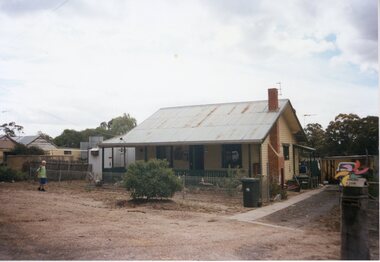 Stawell Historical Society Inc
Photograph, Don Rickard, Post Office Armstrong, c1990's
... Armstrong Post Office and Cob & Co Staging Depot. Next to Station Masters Residence....Armstrong Post Office and Cob & Co Staging Depot. Next to Station Masters Residence. ...Armstrong Post Office and Cob & Co Staging Depot. Next to Station Masters Residence.Colour photograph of Weatherboard Building, Iron Roof. Other Buildings in Background. -
 Melbourne Legacy
Photograph, Operation Firewood, 1987
... (L) L/ Jack Gunn (Melb) (R) L/ Ken Markey (Cob/Yarrawonga)...(L) L/ Jack Gunn (Melb) (R) L/ Ken Markey (Cob/Yarrawonga) Black and white photo of a pile of firewood and legatees. ...A photo of Operation Firewood which provided help to widows by supplying and stacking firewood for the winter. Legatees Jack Gunn and Ken Markey working on loading firewood to bring to Melbourne widows. See colour photo at 00847.A record of Legacy helping widows with supplying and stacking firewood. When open fires were the main source of heating a load of firewood, and help moving it, would have been very important to the widowsBlack and white photo of a pile of firewood and legatees.Written on the back "Operation Firewood" Melbourne Legacy Sat/Sun 28/29 March 1987. (L) L/ Jack Gunn (Melb) (R) L/ Ken Markey (Cob/Yarrawonga)operation firewood, widows -
 Orbost & District Historical Society
seed bag
... On front of bag - Logo of Man From Snowy River in outline map of Australia with a hand holding corn cob in the centre, Produce of Snowy River Co-Op Ltd Orbost- Victoria V73 25kg NET...Snowy River Co-op were the original creators of Snowy Seeds.This item is significant because it was specially made for the seed bean industry which is a major industry in the Orbost district. sweet-corn seed-bags snowy-river-co-op On front of bag - Logo of Man From Snowy River in outline map of Australia with a hand holding corn cob in the centre, Produce of Snowy River Co-Op Ltd Orbost- Victoria V73 25kg NET A white synthetic woven fibre bag used to pack sweet corn prior to sale. ...This unused bag would have been used by Snowy River Co-Op Ltd to pack sweet corn in the late 1960's -1980's Snowy River Seeds started life as a farmers' co-operative (Snowy River Co-op) in 1967 specialising in horticulture. Snowy River Co-op were the original creators of Snowy Seeds.This item is significant because it was specially made for the seed bean industry which is a major industry in the Orbost district.A white synthetic woven fibre bag used to pack sweet corn prior to sale. It has red, green, yellow print.On front of bag - Logo of Man From Snowy River in outline map of Australia with a hand holding corn cob in the centre, Produce of Snowy River Co-Op Ltd Orbost- Victoria V73 25kg NETsweet-corn seed-bags snowy-river-co-op -
 Mission to Seafarers Victoria
Photograph - Photograph, Black and white, Allan Charles Quinn, 5 June 1949
... It was taken in the medieval city of Rouen, a city heavily damaged by the Allied bombings during the Battle of Normandy in May 1944 and shows a cob house, typical of the period. There are several letters relating to this journey....It was taken in the medieval city of Rouen, a city heavily damaged by the Allied bombings during the Battle of Normandy in May 1944 and shows a cob house, typical of the period. There are several letters relating to this journey. ...This photograph is one of a series taken by Allan while travelling through France in mid-1946. It was taken in the medieval city of Rouen, a city heavily damaged by the Allied bombings during the Battle of Normandy in May 1944 and shows a cob house, typical of the period. There are several letters relating to this journey.This is a photograph from the Allan Charles Quinn collection which is a collection of letters and photograph depicting aspects of life at sea for a young man in the era immediately following World War II.Black and white photograph of a historical building and street scape in Rouen.On reverse: ROUEN 5-6-49 handwritten in blue ink. Below this is a mark "ItI"in pencil, written sideways.allan-quinn, photograph, rouen, france, ww2, battle of normandy, normandy, cob house, middle ages, medieval -
 Orbost & District Historical Society
black and white photograph, Vogt, Stanley, 1918
... The problem then was to thresh and deliver the product to the market. A small single cob machine was brought here and one man turned the handle, while the boy or Mum fed the cobs singly into the machine. ...The problem then was to thresh and deliver the product to the market. A small single cob machine was brought here and one man turned the handle, while the boy or Mum fed the cobs singly into the machine. ...Maize,has been grown on the Orbost flats for at least 70 years. When early settlers began to arrive on the Snowy River somewhere in the 1880s, the land was mostly swamps and heavily timbered jungle on the river frontages. The swamps were drained, bit by bit, by men with short handled shovels and working in mud and water. The frontages were cleared by axe and shovel and fire. Several kinds of crops were experimented with such as hops, hemp and maize, the latter grew particularly well and became the main crop of district. The problem then was to thresh and deliver the product to the market. A small single cob machine was brought here and one man turned the handle, while the boy or Mum fed the cobs singly into the machine. A good day’s work would thresh about 50 bushels or about 12 bags (4 bushels). The task then was to cart the maize to market. For a few years this was done by horses and dray carrying about 60 bushels to Mossiface, where it was loaded onto river boats to Lakes Entrance, and then by ocean boats to Melbourne. Later it was taken to Bairnsdale by foot and loaded onto the trains to Melbourne. (more information in Newsletter October 2006) This crib, measuring seven chains, sixteen feet, contained 10,000 bags of maize cobs which were grown by Linc Timmons on Peter Irvine's farm (Fairlea?) in Orbost, East Gippsland. The growing of maize in the Orbost district contributed significantly to the economy of the township for many years, The many maize cribs once seen on the surrounding farms have now disappeared and this photograph is a pictorial record of that significance.A black / white photograph of a large maize crib full of maize in a paddock. There is a large framed copy of the original.agriculture-orbost farming-maize-orbost maize-crib-orbost -
 Uniting Church Archives - Synod of Victoria
Banner - Banners
... BN068.17 "O" with painted corn cobs in each corner ...BN068.17 "O" with painted corn cobs in each corner Banner Banners ...The letters of the completed banner were made by different churches within in the presbytery and spelled a sentence, presumably "BUILD YOUR CHURCH LORD!" Orbost was one of the churches that had the finished banner on display. One of 24 small banners with tabs at the top of each for hanging on a rod. 19 have large blue letters appliqued on them. Twenty two of the banners are roughly square and two are smaller and oblong. Three have no letters and are used as spacers in the four word sentence that the letters make. The banners are decorated with rural and coastal images. BN068.17 "O" with painted corn cobs in each corner "O"uniting church adult fellowship -
 Orbost & District Historical Society
Photograph, 1930s
... The problem then was to thresh and deliver the product to the market. A small single cob machine was brought here and one man turned the handle, while the boy or Mum fed the cobs singly into the machine. ...The problem then was to thresh and deliver the product to the market. A small single cob machine was brought here and one man turned the handle, while the boy or Mum fed the cobs singly into the machine. ...Maize has been grown on the Orbost flats for at least 70 years. When early settlers began to arrive on the Snowy River somewhere in the 1880s, the land was mostly swamps and heavily timbered jungle on the river frontages. The swamps were drained, bit by bit, with short handled shovels working in mud and water. The frontages were cleared by axe and shovel and fire. Several kinds of crops were experimented with such as hops, hemp and maize which grew particularly well and became the main crop of district. The problem then was to thresh and deliver the product to the market. A small single cob machine was brought here and one man turned the handle, while the boy or Mum fed the cobs singly into the machine. A good day’s work would thresh about 50 bushels or about 12 bags (4 bushels). The task then was to cart the maize to market. For a few years this was done by horses and dray carrying about 60 bushels to Mossiface, where it was loaded onto river boats to Lakes Entrance, and then by ocean boats to Melbourne. (information from NEWSLETTER OCTOBER, 2006)The growing of maize in the Orbost district contributed significantly to the economy of the township for many years, The many maize cribs once seen on the surrounding farms have now disappeared and this photograph is a pictorial record of that significance.A small sepia photograph with six men in front of a wooden barn. They are bagging maize. In the foreground are two rows of filled bags. On the right is a lifting machine to take the bags to the top storey. On the far right is a water tank on a stand"on back - "Thrashing Maize"maize-orbost agriculture-maize industry -
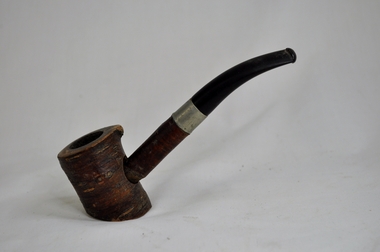 Kiewa Valley Historical Society
Pipe Tobacco Smoking, Circa 1900s
... Originally made from corn cobs the pipe was light in weight and easy to hold in the mouth. ...Originally made from corn cobs the pipe was light in weight and easy to hold in the mouth. ...Pipe smoking has been in vogue for centuries, and in Australia it was a symbol of the "discerning smoker" such as the landed gentry, men of professional status or student. This pipe, however,of the "corncob" style, would have suited the younger professional or student/undergraduate(male or female) of the mid and late 1900s because it was relatively inexpensive to purchase and was regarded as a "beginners pipe". It is the type of pipe well suited to the rural backdrop. In the late 1900s, with the health related restrictions placed on public smoking these tobacco pipes were not immune from the legislation, and even though the pipe smoke was not as offensive as cigarette smoke it still came under the umbrella of smoking. Pipes were also used in the process of inhaling illicit drugs i.e. marijuana, but this use was limited to a very few. Smoking in the second millennium is being phased out as a social habit in Australia but may affect the few "private" smoker and has, as the United States prohibition era (alcoholic drinks) did, spawn an illicit trade in cheap contraband tobacco.This type of pipe lends itself well to the rural setting of the Kiewa Valley and although it is a bit rough in appearance its corncob barrel blended into the environment. The Kiewa Valley region was up until the late 1900s part of the Australian Tobacco Industry and the levels of men smoking pipes was enhanced by the ready supply, "off the fields", of tobacco leaves and the attitude to city based smoking restrictions was one of resentment.This pipe has a straight stem and its "style" is corncob. Originally made from corn cobs the pipe was light in weight and easy to hold in the mouth. The pipe has a permanent filter and a black coloured tin band at the stem/shank junction. The stem fits into the wooden shank which is fastened into the bowl. The stem is made from clear plastic (orange in colour). This stem is longer(70mm) than the shank(45mm). Both are horizontal and extrude 7mm from the bottom of the bowl.tobacco, pipe smoking, smoking accessories -
 Orbost & District Historical Society
black and white photograph
... The problem then was to thresh and deliver the product to the market. A small single cob machine was brought here and one man turned the handle, while the boy or Mum fed the cobs singly into the machine. ...The problem then was to thresh and deliver the product to the market. A small single cob machine was brought here and one man turned the handle, while the boy or Mum fed the cobs singly into the machine. ...Maize,has been grown on the Orbost flats for at least 70 years. When early settlers began to arrive on the Snowy River somewhere in the 1880s, the land was mostly swamps and heavily timbered jungle on the river frontages. The swamps were drained, bit by bit, by men with short handled shovels and working in mud and water. The frontages were cleared by axe and shovel and fire. Several kinds of crops were experimented with such as hops, hemp and maize, the latter grew particularly well and became the main crop of district. The problem then was to thresh and deliver the product to the market. A small single cob machine was brought here and one man turned the handle, while the boy or Mum fed the cobs singly into the machine. A good day’s work would thresh about 50 bushels or about 12 bags (4 bushels). The task then was to cart the maize to market. For a few years this was done by horses and dray carrying about 60 bushels to Mossiface, where it was loaded onto river boats to Lakes Entrance, and then by ocean boats to Melbourne. Later it was taken to Bairnsdale by foot and loaded onto the trains to Melbourne. (more information in Newsletter October 2006)The growing of maize in the Orbost district contributed significantly to the economy of the township for many years, The many maize cribs once seen on the surrounding farms have now disappeared and this photograph is a pictorial record of that significance.A black / white photograph of a man unloading maize from a horse-drawn wagon into a maize crib. Another man is standing by the horse.maize-crib-orbost agriculture maize-corn-orbost -
 Orbost & District Historical Society
black and white photograph, late 19th century - early 20th century
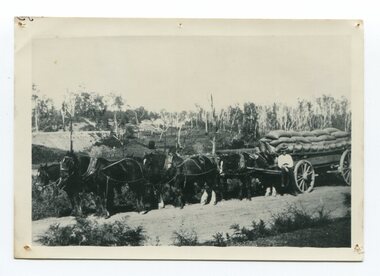
... The problem then was to thresh and deliver the product to the market. A small single cob machine was brought here and one man turned the handle, while the boy or Mum fed the cobs singly into the machine. ...The problem then was to thresh and deliver the product to the market. A small single cob machine was brought here and one man turned the handle, while the boy or Mum fed the cobs singly into the machine. ...Maize, or corn as it is called in America and New South Wales, has been grown on the Orbost flats for at least 70 years. When early settlers began to arrive on the Snowy River somewhere in the 1880s, the land was mostly swamps and heavily timbered jungle on the river frontages. The swamps were drained, bit by bit, by stout hearted men with short handled shovels and working in mud and water. The frontages were cleared by axe and shovel and fire. Several kinds of crops were experimented with such as hops, hemp and maize, the latter grew particularly well and became the main crop of district. The problem then was to thresh and deliver the product to the market. A small single cob machine was brought here and one man turned the handle, while the boy or Mum fed the cobs singly into the machine. A good day’s work would thresh about 50 bushels or about 12 bags (4 bushels). The task then was to cart the maize to market. For a few years this was done by horses and dray carrying about 60 bushels to Mossiface, where it was loaded onto river boats to Lakes Entrance, and then by ocean boats to Melbourne. ( from NEWSLETTER OCTOBER, 2006) This is a pictorial record of farming practices in Orbost in the early 20th century.A black / white photograph of a horse team hauling a wagon loaded with bags of maize.A man is sitting on the edge of the wagon.farming-orbost agriculture maize corn transport -
 Orbost & District Historical Society
Tool - Maize tool
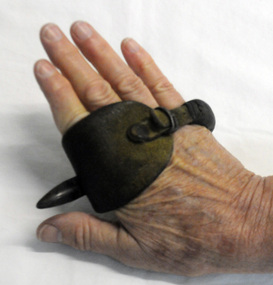
... Prior to machine harvesting coming about in the 1960s, each cob of maize had to picked by hand using this tool. ...Prior to machine harvesting coming about in the 1960s, each cob of maize had to picked by hand using this tool. ...This small hand-held tool was used in the maize industry in Murrungowar and Orbost district during 1900-1960s. Prior to machine harvesting coming about in the 1960s, each cob of maize had to picked by hand using this tool. Maize growing was a huge industry in the Orbost district and the job of picking the maize involved hand labour by many employees. This small hand-tool would have been common, but is now rare. This particular tool was owned and used by Nelson Northrope (from Orbost) in the early 20th Century and used at Murrungowar by Frances Eilman (nee Somerville). A highly significant small hand tool associated with the maize industry. This item is rare. A small hand-held metal and leather tool. A metal 'knife' has a curved shape and is attached to 2 leather straps which are connected by a small buckle. maize growing, agriculture, orbost district -
 Orbost & District Historical Society
black and white photographs, March 1937
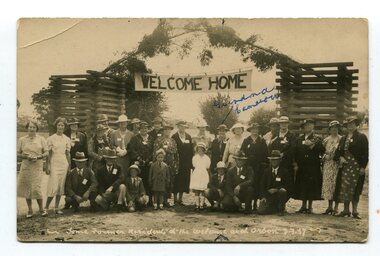
... On the left-hand side in brown print circle is a boomerang with "Back To Orbost 1937", two corn cobs and pumpkins. Underneath is "27/2/37 to 6/3/37" with the names of the committee....On the left-hand side in brown print circle is a boomerang with "Back To Orbost 1937", two corn cobs and pumpkins. Underneath is "27/2/37 to 6/3/37" with the names of the committee. black and white photographs N.R. ...3134.2 has been taken inside the Mechanics Institute hall. 3134.3 was taken in Munro Street. Cr J. Perry was the president of the organising committee for the Back To Orbost celebrations in March 1937. M.W. Cowell was the Secretary.These photographs are pictorial records of a significant community event in Orbost's history.Three black / white photographs and an envelope. 3134.1 is of a group standing in front of a banner - WELCOME HOME - and a welcome arch - 3-3-1937. A group of men, women and children are standing or sitting in front of the arch. 3134.2 is of a large group of men and women seated and standing dressed in formal outfits in front a stage inside a hall. 3134.3 is of two men in a jinker pulled by one horse. The person holding the reins appears to be wearing a false beard and wig. 3143.4 is an unused white envelope. On the left-hand side in brown print circle is a boomerang with "Back To Orbost 1937", two corn cobs and pumpkins. Underneath is "27/2/37 to 6/3/37" with the names of the committee.3134.1 - on front - handwritten with an arrow pointing to "Grndma Cameron" bottom front - "Some Former Residents at the Welcome Arch Orbost 3.3.37" 3134.2 - on front - " a memento of the Ball at Orbost. Back to Celebrations 4.3.37"back-to-orbost-1937 celebrations community-events -
 Flagstaff Hill Maritime Museum and Village
Leisure object - Tobacco Pipe, Early 20th century
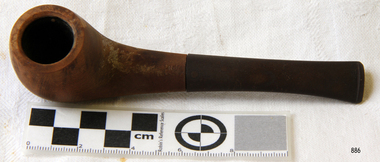
... From that time, tobacco pipes were fashioned from many materials ranging from gold and silver to corn cobs and clay. A popular material was meerschaum, an expensive, soft, white stone from Turkey. ...From that time, tobacco pipes were fashioned from many materials ranging from gold and silver to corn cobs and clay. A popular material was meerschaum, an expensive, soft, white stone from Turkey. ...People in ancient civilisations smoked pipes during various healing and religious ceremonies. By the end of the 15th century, after tobacco was discovered in America, smoking had become a common pastime for everyday people. From that time, tobacco pipes were fashioned from many materials ranging from gold and silver to corn cobs and clay. A popular material was meerschaum, an expensive, soft, white stone from Turkey. In the 1820s, French craftsmen carved pipes out of the wood from the growth on the root of a Mediterranean White Heath. This material became increasingly popular due to its durable, heat-resistant qualities. The growth was called ‘bruyere’, now anglicised to ‘briar’ wood. Bakelite was the first plastic made from synthetic components. It was developed by Leo Baekeland of New York in 1907. The material was heat-resistant and could be moulded into any shape and hardened to keep its shape. This invention greatly impacted the industrial world and the products available to the domestic market, making more objects available at reduced cost.This smoker's tobacco pipe symbolises one of the leisure activities of the early 20th century that has continued into modern times. The shape and materials of the pipe represent a point in time in the evolution of tobacco pipes, including the revolutionary impact that the 1900s invention of Bakelite had on objects available in the domestic and industrial markets.Smoker's tobacco pipe; a round brown wooden pipe bowl joined to a dark brown mouthpiece. The French pipe's bowl is made from briar wood, and its mouthpiece is Bakelite. There is an inscription on the pipe."French Briar Pipe"warrnambool, shipwreck coast, flagstaff hill, flagstaff hill maritime museum, flagstaff hill maritime village, smoker's pipe, tobacco pipe, briar wood pipe, wooden pipe, smoking, french pipe, bakelite, smoker's equipment -
 Flagstaff Hill Maritime Museum and Village
Leisure object - Pipe Stand, c. 1930's
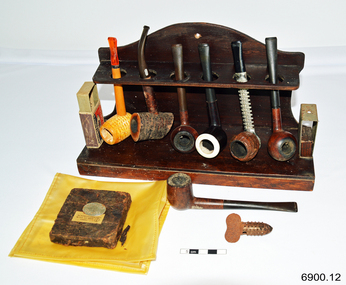
... Smoker's pipes: (1) corn cob pipe, orange mouthpiece (2) 'bushman's pipe', bowl carved from branch, etched in stem "ROPE" (3,4) 2x wooden bowl, Bakelite mouthpiece (5) Dark Bakelite with white rim on bowl, stamped "PHOENIX REG APP / MADE IN LONDON" (6) Bakelite mouthpiece, metal stem, wooden bowl "TUNFLOW PAT. ...Smoker's pipes: (1) corn cob pipe, orange mouthpiece (2) 'bushman's pipe', bowl carved from branch, etched in stem "ROPE" (3,4) 2x wooden bowl, Bakelite mouthpiece (5) Dark Bakelite with white rim on bowl, stamped "PHOENIX REG APP / MADE IN LONDON" (6) Bakelite mouthpiece, metal stem, wooden bowl "TUNFLOW PAT. ...This pipe stand or rack, together with pipes, tobacco and match box holder, was donated to Flagstaff Hill Maritime Village by the family of Doctor William Roy Angus, Surgeon and Oculist. It is part of the “W.R. Angus Collection” includes historical medical equipment, surgical instruments and material once belonging to Dr Edward Ryan and Dr Thomas Francis Ryan, (both of Nhill, Victoria) as well as Dr Angus’ own belongings. The Collection’s history spans the medical practices of the two Doctors Ryan, from 1885-1926 plus that of Dr Angus, up until 1969. ABOUT THE “W.R.ANGUS COLLECTION” Doctor William Roy Angus M.B., B.S., Adel., 1923, F.R.C.S. Edin.,1928 (also known as Dr Roy Angus) was born in Murrumbeena, Victoria in 1901 and lived until 1970. He qualified as a doctor in 1923 at University of Adelaide, was Resident Medical Officer at the Royal Adelaide Hospital in 1924 and for a period was house surgeon to Sir (then Mr.) Henry Simpson Newland. Dr Angus was briefly an Assistant to Dr Riddell of Kapunda, then commenced private practice at Curramulka, Yorke Peninsula, SA, where he was physician, surgeon and chemist. In 1926, he was appointed as new Medical Assistant to Dr Thomas Francis Ryan (T.F. Ryan, or Tom), in Nhill, Victoria, where his experiences included radiology and pharmacy. In 1927 he was Acting House Surgeon in Dr Tom Ryan’s absence. Dr Angus had become engaged to Gladys Forsyth and they decided he further his studies overseas in the UK in 1927. He studied at London University College Hospital and at Edinburgh Royal Infirmary and in 1928, was awarded FRCS (Fellow from the Royal College of Surgeons), Edinburgh. He worked his passage back to Australia as a Ship’s Surgeon on the on the Australian Commonwealth Line’s T.S.S. Largs Bay. Dr Angus married Gladys in 1929, in Ballarat. (They went on to have one son (Graham 1932, born in SA) and two daughters (Helen (died 12/07/1996) and Berenice (Berry), both born at Mira, Nhill ) According to Berry, her mother Gladys made a lot of their clothes. She was very talented and did some lovely embroidery including lingerie for her trousseau and beautifully handmade baby clothes. Dr Angus was a ‘flying doctor’ for the A.I.M. (Australian Inland Ministry) Aerial Medical Service in 1928 . Its first station was in the remote town of Oodnadatta, where Dr Angus was stationed. He was locum tenens there on North-South Railway at 21 Mile Camp. He took up this ‘flying doctor’ position in response to a call from Dr John Flynn; the organisation was later known as the Flying Doctor Service, then the Royal Flying Doctor Service. A lot of his work during this time involved dental surgery also. Between 1928-1932 he was surgeon at the Curramulka Hospital, Yorke Peninsula, South Australia. In 1933 Dr Angus returned to Nhill and purchased a share of the Nelson Street practice and Mira hospital (a 2 bed ward at the Nelson Street Practice) from Dr Les Middleton one of the Middleton Brothers, the current owners of what previously once Dr Tom Ryan’s practice. Dr Tom and his brother had worked as surgeons included eye surgery. Dr Tom Ryan performed many of his operations in the Mira private hospital on his premises. He had been House Surgeon at the Nhill Hospital 1902-1926. Dr Tom Ryan had one of the only two pieces of radiology equipment in Victoria during his practicing years – The Royal Melbourne Hospital had the other one. Over the years Dr Tom Ryan had gradually set up what was effectively a training school for country general-practitioner-surgeons. Each patient was carefully examined, including using the X-ray machine, and any surgery was discussed and planned with Dr Ryan’s assistants several days in advance. Dr Angus gained experience in using the X-ray machine there during his time as assistant to Dr Ryan. When Dr Angus bought into the Nelson Street premises in Nhill he was also appointed as the Nhill Hospital’s Honorary House Surgeon 1933-1938. His practitioner’s plate from his Nhill surgery is now mounted on the doorway to the Port Medical Office at Flagstaff Hill Maritime Village, Warrnambool. When Dr Angus took up practice in the Dr Edward and Dr Tom Ryan’s old premises he obtained their extensive collection of historical medical equipment and materials spanning 1884-1926. A large part of this collection is now on display at the Port Medical Office at Flagstaff Hill Maritime Village in Warrnambool. In 1939 Dr Angus and his family moved to Warrnambool where he purchased “Birchwood,” the 1852 home and medical practice of Dr John Hunter Henderson, at 214 Koroit Street. (This property was sold in1965 to the State Government and is now the site of the Warrnambool Police Station. and an ALDI sore is on the land that was once their tennis court). The Angus family was able to afford gardeners, cooks and maids; their home was a popular place for visiting dignitaries to stay whilst visiting Warrnambool. Dr Angus had his own silk worm farm at home in a Mulberry tree. His young daughter used his centrifuge for spinning the silk. Dr Angus was appointed on a part-time basis as Port Medical Officer (Health Officer) in Warrnambool and held this position until the 1940’s when the government no longer required the service of a Port Medical Officer in Warrnambool; he was thus Warrnambool’s last serving Port Medical Officer. (Masters of immigrant ships arriving in port reported incidents of diseases, illness and death and the Port Medical Officer made a decision on whether the ship required Quarantine and for how long, in this way preventing contagious illness from spreading from new immigrants to the residents already in the colony.) Dr Angus was a member of the Australian Medical Association, for 35 years and surgeon at the Warrnambool Base Hospital 1939-1942, He served as a Surgeon Captain during WWII1942-45, in Ballarat, Victoria, and in Bonegilla, N.S.W., completing his service just before the end of the war due to suffering from a heart attack. During his convalescence he carved an intricate and ‘most artistic’ chess set from the material that dentures were made from. He then studied ophthalmology at the Royal Melbourne Eye and Ear Hospital and created cosmetically superior artificial eyes by pioneering using the intrascleral cartilage. Angus received accolades from the Ophthalmological Society of Australasia for this work. He returned to Warrnambool to commence practice as an ophthalmologist, pioneering in artificial eye improvements. He was Honorary Consultant Ophthalmologist to Warrnambool Base Hospital for 31 years. He made monthly visits to Portland as a visiting surgeon, to perform eye surgery. He represented the Victorian South-West subdivision of the Australian Medical Association as its secretary between 1949 and 1956 and as chairman from 1956 to 1958. In 1968 Dr Angus was elected member of Spain’s Barraquer Institute of Barcelona after his research work in Intrasclearal cartilage grafting, becoming one of the few Australian ophthalmologists to receive this honour, and in the following year presented his final paper on Living Intrasclearal Cartilage Implants at the Inaugural Meeting of the Australian College of Ophthalmologists in Melbourne In his personal life Dr Angus was a Presbyterian and treated Sunday as a Sabbath, a day of rest. He would visit 3 or 4 country patients on a Sunday, taking his children along ‘for the ride’ and to visit with him. Sunday evenings he would play the pianola and sing Scottish songs to his family. One of Dr Angus’ patients was Margaret MacKenzie, author of a book on local shipwrecks that she’d seen as an eye witness from the late 1880’s in Peterborough, Victoria. In the early 1950’s Dr Angus, painted a picture of a shipwreck for the cover jacket of Margaret’s book, Shipwrecks and More Shipwrecks. She was blind in later life and her daughter wrote the actual book for her. Dr Angus and his wife Gladys were very involved in Warrnambool’s society with a strong interest in civic affairs. He had an interest in people and the community They were both involved in the creation of Flagstaff Hill, including the layout of the gardens. After his death (28th March 1970) his family requested his practitioner’s plate, medical instruments and some personal belongings be displayed in the Port Medical Office surgery at Flagstaff Hill Maritime Village, and be called the “W. R. Angus Collection”. The W.R. Angus Collection is significant for still being located at the site it is connected with, Doctor Angus being the last Port Medical Officer in Warrnambool. The collection of medical instruments and other equipment is culturally significant, being an historical example of medicine from late 19th to mid-20th century. Dr Angus assisted Dr Tom Ryan, a pioneer in the use of X-rays and in ocular surgery. Timber smoker's pipe stand set, including 7 pipes and a pouch of cut tobacco, Part of the W.R. Angus Collection. Stand holds 6 pipes upright in the rack, with metal matchbox holder on end. Stand has hanging hole in top back. Smoker's pipes: (1) corn cob pipe, orange mouthpiece (2) 'bushman's pipe', bowl carved from branch, etched in stem "ROPE" (3,4) 2x wooden bowl, Bakelite mouthpiece (5) Dark Bakelite with white rim on bowl, stamped "PHOENIX REG APP / MADE IN LONDON" (6) Bakelite mouthpiece, metal stem, wooden bowl "TUNFLOW PAT. PAT PE ND" (7) Bakelite mouthpiece and stem, wooden bowl (bowl is split). Plus metal pipe reamer/cleaner and plug of tobacco in paque tobacco pouch. Note inside pouch - “from Old Mr Bant, Panmure. He always cut a pipe full for Dr. A. when he visited him.” Pouch is stamped "O P L" (each letter in a diamond symbol). Tobacco has metal disc stamped "HAVELOCK TOBACCO" and label "The British-Ambassador Tobacco Co. Ppty. Ltd, Sydney, Australia" , "2 [above] 4 in circle" Etched into bushman's pipe "ROPE" Bakelite pipe is stamped "PHOENIX REG APP / MADE IN LONDON" Another Bakelite pipe is stamped "TUNFLOW PAT. PAT PE ND" Pouch is stamped "O P L" Tobacco has metal disc stamped "HAVELOCK TOBACCO" and label "The British-Ambassador Tobacco Co. Ppty. Ltd, Sydney, Australia" , "2 [above] 4 in circle" flagstaff hill, warrnambool, shipwrecked coast, flagstaff hill maritime museum, maritime museum, shipwreck coast, flagstaff hill maritime village, great ocean road, dr w r angu, pipe stand, pipe rack, pipe collection, smokers' pipes, smoker's accessories, matchbox holder, pipe reamer, pipe cleaner, bushman's smoker's pipe brand rope, bakelite smoker's pipe phoenix reg app, made in london, smoker's pipe tunflow pat. pat pe nd, tobacco pouch havelock tobacco, tobacco the british-ambassador tobacco co. ppty. ltd, sydney, australia -
 Stawell Historical Society Inc
Photograph - Slides, Ian McCann, Stawell Views, 1976 - 1984
... , Peter Odd June 1983 6928-13 Cob & Co Stables, Shell Service Station 6928-14 Demolition Comfort Station Wimmera Street June 1984 6928-15 Central Park Gates Nov 1984 6928-16 Football Aug 1984 6928-17 Central Park Gates Nov 1984 6928-18 New Pool 6928-19, 6928-20 Crowd 1960’s 6928-21 Dalton Fountain 6928-22,6928-23 Stawell from air 6928-24 No4 Reservoir Big Hill 6928-25 Stawell from air 6928-26 Upper Main Street May 1967 6928-27 Sunrise from Big Hill Easter Morning 1969 6928-28 Stawell from Clock Tower 6928-29 Declaration of Town of Stawell 15 Nov 1958 6928-30 Crowd Scene 1958? ..., Peter Odd June 1983 6928-13 Cob & Co Stables, Shell Service Station 6928-14 Demolition Comfort Station Wimmera Street June 1984 6928-15 Central Park Gates Nov 1984 6928-16 Football Aug 1984 6928-17 Central Park Gates Nov 1984 6928-18 New Pool 6928-19, 6928-20 Crowd 1960’s 6928-21 Dalton Fountain 6928-22,6928-23 Stawell from air 6928-24 No4 Reservoir Big Hill 6928-25 Stawell from air 6928-26 Upper Main Street May 1967 6928-27 Sunrise from Big Hill Easter Morning 1969 6928-28 Stawell from Clock Tower 6928-29 Declaration of Town of Stawell 15 Nov 1958 6928-30 Crowd Scene 1958? ...6928-1, 6928-2 Town Cryer 6928-3 Ariel View Sept 1976 6928-4 Crowd with horses Sept 1976 6928-5 Crane July 1980 6928-6 Flowers July 1980 6928-7 Stawell Snow July 1981 6928-8 Seaby Street construction Nov 1982 6928-9 Stawell from Big Hill Dec 1982 6928-10 Senior Citizens Opening Dec 1982 6928-11 Seaby Street Construction Nov 1982 6928-12 Barry Sherwell, ?, Peter Odd June 1983 6928-13 Cob & Co Stables, Shell Service Station 6928-14 Demolition Comfort Station Wimmera Street June 1984 6928-15 Central Park Gates Nov 1984 6928-16 Football Aug 1984 6928-17 Central Park Gates Nov 1984 6928-18 New Pool 6928-19, 6928-20 Crowd 1960’s 6928-21 Dalton Fountain 6928-22,6928-23 Stawell from air 6928-24 No4 Reservoir Big Hill 6928-25 Stawell from air 6928-26 Upper Main Street May 1967 6928-27 Sunrise from Big Hill Easter Morning 1969 6928-28 Stawell from Clock Tower 6928-29 Declaration of Town of Stawell 15 Nov 1958 6928-30 Crowd Scene 1958? 6928-31, 6928-32, 6928-33 Stawell Grampians Gate Caravan Park 9 April 1971 6928-34 Main Street from Town Hall Sept 1969 6928-35 No 4 Reservoir Big Hill Aug 1968 6928-36 Town Hall Ceremony Oct 1969 6928-37 Stawell Grain Silo 11 April 1972 6928-38 Stawell Victoria Street from Clock Tower Aug 1972 6928-39, 6928-40, 6928-41 Grampian Gate Caravan Park 17 Jan 1971 6928-42 Town Hall Ceremony 6928-43 Stawell from Air Dec 1975 6928-44 Sewerage? Oct 1974 6928-45 Frazer Park 8 Sept 1973 6928-46 Earthworks? Nov 1973 Set of slides -
 Uniting Church Archives - Synod of Victoria
Banner - Banners
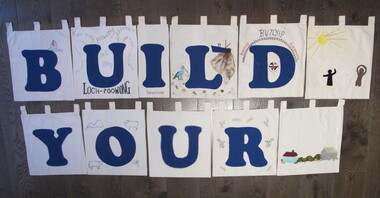
... BN068.2 "U" fabric paint words: "LOCH POOWONG east poowong nyora strezlecki kernang athlone" BN068.3 "I" "Korumburra" BN068.4 "L" with a pelican, fishing boat with a net, shells and sand BN068.5 "D" with the UCA emblem and "BUNYIP Garfield Longwarry" BN068.6 "Y" BN068.7 "O" with fabric paint flag, ram, road and trees and a cow BN068.8 "U" BN068.9 "R" with green and yellow wattle in fabric paint BN068.10 "C" with ric-rac round the letter and three churches appliqued in the top left corner BN068.11 "H" edged with pale blue metallic fabric paint BN068.12 "U" with sunrise over the sea with gold chain sunbeams and sequins BN068.13 "R" with fine blue embroidery at each corner and only two tabs BN068.14 "C" with appliqued boat, sky and sun BN068.15 "H" with a black swan with a red beak BN068.16 "L" with appliqued and fabric painted scene of a beach, hills and city smoke on the horizon BN068.17 "O" with painted corn cobs in each corner BN068.18 "R" with cows, hills, sheep and a sack BN068.19 "D" with machine embroidered church "St Matthews Yinnar", hands "Friendship", building "UCA Yinnar", chuch "Holy Innocents YINNAR STH" "(Californian RED WOOD)", tree "BIG TREE grows at Christ Church Boolarra" BN068.20 "!" ...BN068.2 "U" fabric paint words: "LOCH POOWONG east poowong nyora strezlecki kernang athlone" BN068.3 "I" "Korumburra" BN068.4 "L" with a pelican, fishing boat with a net, shells and sand BN068.5 "D" with the UCA emblem and "BUNYIP Garfield Longwarry" BN068.6 "Y" BN068.7 "O" with fabric paint flag, ram, road and trees and a cow BN068.8 "U" BN068.9 "R" with green and yellow wattle in fabric paint BN068.10 "C" with ric-rac round the letter and three churches appliqued in the top left corner BN068.11 "H" edged with pale blue metallic fabric paint BN068.12 "U" with sunrise over the sea with gold chain sunbeams and sequins BN068.13 "R" with fine blue embroidery at each corner and only two tabs BN068.14 "C" with appliqued boat, sky and sun BN068.15 "H" with a black swan with a red beak BN068.16 "L" with appliqued and fabric painted scene of a beach, hills and city smoke on the horizon BN068.17 "O" with painted corn cobs in each corner BN068.18 "R" with cows, hills, sheep and a sack BN068.19 "D" with machine embroidered church "St Matthews Yinnar", hands "Friendship", building "UCA Yinnar", chuch "Holy Innocents YINNAR STH" "(Californian RED WOOD)", tree "BIG TREE grows at Christ Church Boolarra" BN068.20 "!" ...The letters of the completed banner were made by different churches within in the presbytery of Gippsland and spell a sentence, presumably, "BUILD YOUR CHURCH LORD!" Orbost was one of the churches that had the finished banner on display. 24 small banners with tabs at the top of each for hanging on a rod. 19 have large blue letters appliqued on them. Twenty two of the banners are roughly square and two are smaller and oblong. Three have no letters and are used as spacers in the four word sentence that the letters make. The banners are decorated with rural and coastal images. BN068.1 "B" with an embroidered boat with the number 1 on the sail. BN068.2 "U" fabric paint words: "LOCH POOWONG east poowong nyora strezlecki kernang athlone" BN068.3 "I" "Korumburra" BN068.4 "L" with a pelican, fishing boat with a net, shells and sand BN068.5 "D" with the UCA emblem and "BUNYIP Garfield Longwarry" BN068.6 "Y" BN068.7 "O" with fabric paint flag, ram, road and trees and a cow BN068.8 "U" BN068.9 "R" with green and yellow wattle in fabric paint BN068.10 "C" with ric-rac round the letter and three churches appliqued in the top left corner BN068.11 "H" edged with pale blue metallic fabric paint BN068.12 "U" with sunrise over the sea with gold chain sunbeams and sequins BN068.13 "R" with fine blue embroidery at each corner and only two tabs BN068.14 "C" with appliqued boat, sky and sun BN068.15 "H" with a black swan with a red beak BN068.16 "L" with appliqued and fabric painted scene of a beach, hills and city smoke on the horizon BN068.17 "O" with painted corn cobs in each corner BN068.18 "R" with cows, hills, sheep and a sack BN068.19 "D" with machine embroidered church "St Matthews Yinnar", hands "Friendship", building "UCA Yinnar", chuch "Holy Innocents YINNAR STH" "(Californian RED WOOD)", tree "BIG TREE grows at Christ Church Boolarra" BN068.20 "!" with fabric brown cow in grass BN068.21 spacer with appliqued house, bushes and barn BN068.22 spacer with appliqued sun with ribbon rays and black white and brown figures BN068.23 & BN068.24 spacer with a small UCA red dove in the centre "B U I L D Y O U R C H U R C H L O R D !"uniting church adult fellowship -
 Flagstaff Hill Maritime Museum and Village
Book, Happy Dispatches
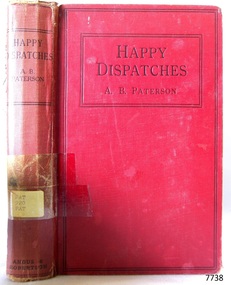
... The family moved to the Yass district and lived near the main route from Sydney to Melbourne where he saw a great many bullock teams, drovers with herds of stock, gold escorts and Cob & Co coaches. His lifelong love of horses and horsemen was forged from the riders and their horses he saw at the picnic races and polo matches the family attended. ...The family moved to the Yass district and lived near the main route from Sydney to Melbourne where he saw a great many bullock teams, drovers with herds of stock, gold escorts and Cob & Co coaches. His lifelong love of horses and horsemen was forged from the riders and their horses he saw at the picnic races and polo matches the family attended. ...This item is from the ‘Pattison Collection’, a collection of books and records that was originally owned by the Warrnambool Mechanics’ Institute, which was founded in Warrnambool in 1853. By 1886 the Warrnambool Mechanics’ Institute (WMI) had grown to have a Library, Museum and Fine Arts Gallery, with a collection of “… choice productions of art, and valuable specimens in almost every branch and many wonderful national curiosities are now to be seen there, including historic relics of the town and district.” It later included a School of Design. Although it was very well patronised, the lack of financial support led the WMI in 1911 to ask the City Council to take it over. In 1935 Ralph Pattison was appointed as City Librarian to establish and organise the Warrnambool Library as it was then called. When the WMI building was pulled down in 1963 a new civic building was erected on the site and the new Warrnambool Library, on behalf of the City Council, took over all the holdings of the WMI. At this time some of the items were separated and identified as the ‘Pattison Collection’, named after Ralph Pattison. Eventually the components of the WMI were distributed from the Warrnambool Library to various places, including the Art Gallery, Historical Society and Flagstaff Hill. Later some were even distributed to other regional branches of Corangamite Regional Library and passed to and fro. It is difficult now to trace just where all of the items have ended up. The books at Flagstaff Hill Maritime Village generally display stamps and markings from Pattison as well as a variety of other institutions including the Mechanics’ Institute itself. RALPH ERIC PATTISON Ralph Eric Pattison was born in Rockhampton, Queensland, in 1891. He married Maude Swan from Warrnambool in 1920 and they set up home in Warrnambool. In 1935 Pattison accepted a position as City Librarian for the Warrnambool City Council. His huge challenge was to make a functional library within two rooms of the Mechanics’ Institute. He tirelessly cleaned, cleared and sorted a disarrayed collection of old books, jars of preserved specimens and other items reserved for exhibition in the city’s museum. He developed and updated the library with a wide variety of books for all tastes, including reference books for students; a difficult task to fulfil during the years following the Depression. He converted all of the lower area of the building into a library, reference room and reading room for members and the public. The books were sorted and stored using a cataloguing and card index system that he had developed himself. He also prepared the upper floor of the building and established the Art Gallery and later the Museum, a place to exhibit the many old relics that had been stored for years for this purpose. One of the treasures he found was a beautiful ancient clock, which he repaired, restored and enjoyed using in his office during the years of his service there. Ralph Pattison was described as “a meticulous gentleman whose punctuality, floorless courtesy and distinctive neat dress were hallmarks of his character, and ‘his’ clock controlled his daily routine, and his opening and closing of the library’s large heavy doors to the minute.” Pattison took leave during 1942 to 1945 to serve in the Royal Australian Navy, Volunteer Reserve as Lieutenant. A few years later he converted one of the Museum’s rooms into a Children’s Library, stocking it with suitable books for the younger generation. This was an instant success. In the 1950’s he had the honour of being appointed to the Victorian Library Board and received more inspiration from the monthly conferences in Melbourne. He was sadly retired in 1959 after over 23 years of service, due to the fact that he had gone over the working age of council officers. However he continued to take a very keen interest in the continual development of the Library until his death in 1969. About A. B. ‘Banjo’ Paterson Andrew Barton Paterson was born at Narrambla Station in New South Wales, Australia, on 17th February 1864 and died 5th February 1941. His first seven years were spent on his father’s station, where like so many Australian children he enjoyed a bush boyhood. This property was at Obley in the Orange district of New South Wales. The family moved to the Yass district and lived near the main route from Sydney to Melbourne where he saw a great many bullock teams, drovers with herds of stock, gold escorts and Cob & Co coaches. His lifelong love of horses and horsemen was forged from the riders and their horses he saw at the picnic races and polo matches the family attended. These horses and riders where from the Murrumbidgee River and Snowy Mountain areas of New South Wales. Patterson lived most of his life in Sydney. He became a journalist, army officer, novelist, poet, solicitor and a war correspondent. He enjoyed many different sports such as tennis, rowing and, most of all, he delighted in his horsemanship. His first poem ‘El Mahdi to the Australian Troop’ was published in the Bulletin in 1885 under the pen name of “The Banjo”, which was the name of his favourite horse. In 1895 his first book was published and was sold out in the week of publication; he sold 7000 copies in a few months. This book was “The Man From Snowy River, and other Verses” and it contained such ballads as ‘Clancy of the Overflow’, ‘The Geebung Polo Club’, ‘The Man from Ironbark’, and ‘Saltbush Bill’. The tittle poem was first published in 1890. In 1895 Patterson visited his fiancé (at that time), Sarah Riley, who was staying with her friends the Macphersons at Dagworth Station in Queensland. Sarah’s old school friend Christina McPherson. Christina replayed to them an old Scottish tune called “The Craigielee March” that she had heard played by the Garrison Artillery band at the Warrnambool picnic races in Victoria, 1894. Patterson wrote words to fit the tune and it became the now famous ‘Waltzing Matilda’. He was commissioned by the Sydney Morning Herald and the Melbourne Age as they correspondent to report on the South African War. After being a roving reporter in China he went to England and spent time with Rudyard Kipling. In April 1903 Paterson married Alice Walker in Tenterfield, New South Wales, and they had two children, Grace and Hugh. At the outbreak of World War 1 Paterson sailed for England in the hope of covering the fighting in Flanders as a correspondent but finished up driving an ambulance for the Australian Voluntary Hospital, Wimereux, France. In 1915 as an honorary vet he made three voyages taking horse to Africa, China and Egypt. On 18th October 1915 he was commissioned in the 2nd Remount Unit in the Australian Imperial Force and was promoted to Captain serving in the Middle East. He was wounded in April 1916, when he re-joined his unit he was promoted to major and commanded the Australian Remount Squadron from October 1916 to his return to Australia in 1919. Once the War was over he resumed his work as a journalist until he retired in 1930 so that he could devote time to creative writing. He became a successful radio broadcaster with the Australian Broadcasting Commission using his travel experiences. He wrote the children’s book “The Animals Noah Forgot” in 1933 and then in 1934 “Happy Dispatches” in which he told of his meetings with people like Winston Churchill and Kipling. “The Shearer’s Colt was published in 1936 and in 1939 he wrote for the Sydney Morning Herald. After a short illness he passed away in Sydney on 5th February 1941. The Pattison Collection, along with other items at Flagstaff Hill Maritime Village, was originally part of the Warrnambool Mechanics' Institute’s collection. The Warrnambool Mechanics’ Institute Collection is primarily significant in its totality, rather than for the individual objects it contains. Its contents are highly representative of the development of Mechanics' Institute libraries across Australia, particularly Victoria. A diversity of publications and themes has been amassed, and these provide clues to our understanding of the nature of and changes in the reading habits of Victorians from the 1850s to the middle of the 20th century. The collection also highlights the Warrnambool community’s commitment to the Mechanics’ Institute, reading, literacy and learning in the regions, and proves that access to knowledge was not impeded by distance. These items help to provide a more complete picture of our community’s ideals and aspirations. The Warrnambool Mechanics Institute book collection has historical and social significance for its strong association with the Mechanics Institute movement and the important role it played in the intellectual, cultural and social development of people throughout the latter part of the nineteenth century and the early twentieth century. The collection of books is a rare example of an early lending library and its significance is enhanced by the survival of an original collection of many volumes. The Warrnambool Mechanics' Institute’s publication collection is of both local and state significance. Happy Dispatches Author: A B ("Banjo") Paterson Publisher: Angus & Robertson Ltd Date: 1935Label on spine cover with typed text PAT 920 PAT Pastedown front endpaper has sticker from Warrnambool Public Library covered by a sticker from Corangamite Regional Library Service Front loose endpaper has a stamp from Corangamite Regional Library Service warrnambool, shipwrecked-coast, flagstaff-hill, flagstaff-hill-maritime-museum, maritime-museum, shipwreck-coast, flagstaff-hill-maritime-village, shipwrecked-artefact, book, pattison collection, warrnambool library, warrnambool mechanics’ institute, ralph eric pattison, corangamite regional library service, warrnambool city librarian, mechanics’ institute library, victorian library board, warrnambool books and records, warrnambool children’s library, great ocean road, happy dispatches, a b paterson, banjo paterson -
 Flagstaff Hill Maritime Museum and Village
Book, Three Elephant Power
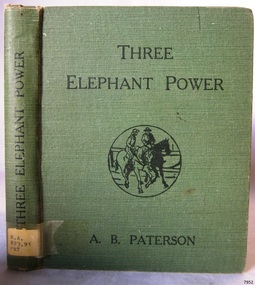
... The family moved to the Yass district and lived near the main route from Sydney to Melbourne where he saw a great many bullock teams, drovers with herds of stock, gold escorts and Cob & Co coaches. His lifelong love of horses and horsemen was forged from the riders and their horses he saw at the picnic races and polo matches the family attended. ...The family moved to the Yass district and lived near the main route from Sydney to Melbourne where he saw a great many bullock teams, drovers with herds of stock, gold escorts and Cob & Co coaches. His lifelong love of horses and horsemen was forged from the riders and their horses he saw at the picnic races and polo matches the family attended. ...This item is from the ‘Pattison Collection’, a collection of books and records that was originally owned by the Warrnambool Mechanics’ Institute, which was founded in Warrnambool in 1853. By 1886 the Warrnambool Mechanics’ Institute (WMI) had grown to have a Library, Museum and Fine Arts Gallery, with a collection of “… choice productions of art, and valuable specimens in almost every branch and many wonderful national curiosities are now to be seen there, including historic relics of the town and district.” It later included a School of Design. Although it was very well patronised, the lack of financial support led the WMI in 1911 to ask the City Council to take it over. In 1935 Ralph Pattison was appointed as City Librarian to establish and organise the Warrnambool Library as it was then called. When the WMI building was pulled down in 1963 a new civic building was erected on the site and the new Warrnambool Library, on behalf of the City Council, took over all the holdings of the WMI. At this time some of the items were separated and identified as the ‘Pattison Collection’, named after Ralph Pattison. Eventually the components of the WMI were distributed from the Warrnambool Library to various places, including the Art Gallery, Historical Society and Flagstaff Hill. Later some were even distributed to other regional branches of Corangamite Regional Library and passed to and fro. It is difficult now to trace just where all of the items have ended up. The books at Flagstaff Hill Maritime Village generally display stamps and markings from Pattison as well as a variety of other institutions including the Mechanics’ Institute itself. RALPH ERIC PATTISON Ralph Eric Pattison was born in Rockhampton, Queensland, in 1891. He married Maude Swan from Warrnambool in 1920 and they set up home in Warrnambool. In 1935 Pattison accepted a position as City Librarian for the Warrnambool City Council. His huge challenge was to make a functional library within two rooms of the Mechanics’ Institute. He tirelessly cleaned, cleared and sorted a disarrayed collection of old books, jars of preserved specimens and other items reserved for exhibition in the city’s museum. He developed and updated the library with a wide variety of books for all tastes, including reference books for students; a difficult task to fulfil during the years following the Depression. He converted all of the lower area of the building into a library, reference room and reading room for members and the public. The books were sorted and stored using a cataloguing and card index system that he had developed himself. He also prepared the upper floor of the building and established the Art Gallery and later the Museum, a place to exhibit the many old relics that had been stored for years for this purpose. One of the treasures he found was a beautiful ancient clock, which he repaired, restored and enjoyed using in his office during the years of his service there. Ralph Pattison was described as “a meticulous gentleman whose punctuality, floorless courtesy and distinctive neat dress were hallmarks of his character, and ‘his’ clock controlled his daily routine, and his opening and closing of the library’s large heavy doors to the minute.” Pattison took leave during 1942 to 1945 to serve in the Royal Australian Navy, Volunteer Reserve as Lieutenant. A few years later he converted one of the Museum’s rooms into a Children’s Library, stocking it with suitable books for the younger generation. This was an instant success. In the 1950’s he had the honour of being appointed to the Victorian Library Board and received more inspiration from the monthly conferences in Melbourne. He was sadly retired in 1959 after over 23 years of service, due to the fact that he had gone over the working age of council officers. However he continued to take a very keen interest in the continual development of the Library until his death in 1969. About A. B. ‘Banjo’ Paterson Andrew Barton Paterson was born at Narrambla Station in New South Wales, Australia, on 17th February 1864 and died 5th February 1941. His first seven years were spent on his father’s station, where like so many Australian children he enjoyed a bush boyhood. This property was at Obley in the Orange district of New South Wales. The family moved to the Yass district and lived near the main route from Sydney to Melbourne where he saw a great many bullock teams, drovers with herds of stock, gold escorts and Cob & Co coaches. His lifelong love of horses and horsemen was forged from the riders and their horses he saw at the picnic races and polo matches the family attended. These horses and riders where from the Murrumbidgee River and Snowy Mountain areas of New South Wales. Patterson lived most of his life in Sydney. He became a journalist, army officer, novelist, poet, solicitor and a war correspondent. He enjoyed many different sports such as tennis, rowing and, most of all, he delighted in his horsemanship. His first poem ‘El Mahdi to the Australian Troop’ was published in the Bulletin in 1885 under the pen name of “The Banjo”, which was the name of his favourite horse. In 1895 his first book was published and was sold out in the week of publication; he sold 7000 copies in a few months. This book was “The Man From Snowy River, and other Verses” and it contained such ballads as ‘Clancy of the Overflow’, ‘The Geebung Polo Club’, ‘The Man from Ironbark’, and ‘Saltbush Bill’. The tittle poem was first published in 1890. In 1895 Patterson visited his fiancé (at that time), Sarah Riley, who was staying with her friends the Macphersons at Dagworth Station in Queensland. Sarah’s old school friend Christina McPherson. Christina replayed to them an old Scottish tune called “The Craigielee March” that she had heard played by the Garrison Artillery band at the Warrnambool picnic races in Victoria, 1894. Patterson wrote words to fit the tune and it became the now famous ‘Waltzing Matilda’. He was commissioned by the Sydney Morning Herald and the Melbourne Age as they correspondent to report on the South African War. After being a roving reporter in China he went to England and spent time with Rudyard Kipling. In April 1903 Paterson married Alice Walker in Tenterfield, New South Wales, and they had two children, Grace and Hugh. At the outbreak of World War 1 Paterson sailed for England in the hope of covering the fighting in Flanders as a correspondent but finished up driving an ambulance for the Australian Voluntary Hospital, Wimereux, France. In 1915 as an honorary vet he made three voyages taking horse to Africa, China and Egypt. On 18th October 1915 he was commissioned in the 2nd Remount Unit in the Australian Imperial Force and was promoted to Captain serving in the Middle East. He was wounded in April 1916, when he re-joined his unit he was promoted to major and commanded the Australian Remount Squadron from October 1916 to his return to Australia in 1919. Once the War was over he resumed his work as a journalist until he retired in 1930 so that he could devote time to creative writing. He became a successful radio broadcaster with the Australian Broadcasting Commission using his travel experiences. He wrote the children’s book “The Animals Noah Forgot” in 1933 and then in 1934 “Happy Dispatches” in which he told of his meetings with people like Winston Churchill and Kipling. “The Shearer’s Colt was published in 1936 and in 1939 he wrote for the Sydney Morning Herald. After a short illness he passed away in Sydney on 5th February 1941. The Pattison Collection, along with other items at Flagstaff Hill Maritime Village, was originally part of the Warrnambool Mechanics' Institute’s collection. The Warrnambool Mechanics’ Institute Collection is primarily significant in its totality, rather than for the individual objects it contains. Its contents are highly representative of the development of Mechanics' Institute libraries across Australia, particularly Victoria. A diversity of publications and themes has been amassed, and these provide clues to our understanding of the nature of and changes in the reading habits of Victorians from the 1850s to the middle of the 20th century. The collection also highlights the Warrnambool community’s commitment to the Mechanics’ Institute, reading, literacy and learning in the regions, and proves that access to knowledge was not impeded by distance. These items help to provide a more complete picture of our community’s ideals and aspirations. The Warrnambool Mechanics Institute book collection has historical and social significance for its strong association with the Mechanics Institute movement and the important role it played in the intellectual, cultural and social development of people throughout the latter part of the nineteenth century and the early twentieth century. The collection of books is a rare example of an early lending library and its significance is enhanced by the survival of an original collection of many volumes. The Warrnambool Mechanics' Institute’s publication collection is of both local and state significance. Three Elephant Power Author: A B Paterson Publisher: Angus & Robertson Date: 1917Label on spine cover with typed text RA 823.91 PAT Pastedown front endpaper has sticker from Warrnambool Mechanics Institute and Free Library Front loose endpaper has a stamp from Warrnambool Mechanics Institute Fly paper has a stamp from Warrnambool Mechanics Institutewarrnambool, shipwrecked-coast, flagstaff-hill, flagstaff-hill-maritime-museum, maritime-museum, shipwreck-coast, flagstaff-hill-maritime-village, shipwrecked-artefact, book, pattison collection, warrnambool library, warrnambool mechanics’ institute, ralph eric pattison, corangamite regional library service, warrnambool city librarian, mechanics’ institute library, victorian library board, warrnambool books and records, warrnambool children’s library, great ocean road, three elephant power, a b paterson
