
Showing 141 items matching "collins street hill"
-
 Melbourne Tram Museum
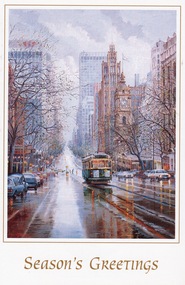
Card - Season's Greetings, AGCC, 1970s
... ...Collins Street hill...This familiar scene of a tram descending the Collins Street hill to Swanston Street has been included in the work of many artists and photographers since the 1890s. ...This familiar scene of a tram descending the Collins Street hill to Swanston Street has been included in the work of many artists and photographers since the 1890s. ...An example of greeting cards produced by charities as fundraisers. This familiar scene of a tram descending the Collins Street hill to Swanston Street has been included in the work of many artists and photographers since the 1890s. Here the accomplished artist, Eliza Szarukan, depicts a W class tram and motor vehicles along a rain-drenched Collins Street under clouded skies. The wet road reflects the outline of some of the buildings above. Eliza Szarukan (1927-2015) studied art in Hungary and moved to Australia in 1949, becoming a member of the Australian Guild of Realist Artists.Yields information about artistic representation of Melbourne's streetscapesColoured greeting card with copy of a painting and greeting on front, words of greeting inside and artist's name on rear.On front: 'Season's Greetings; inside 'Proceeds of the sale of this card to the Royal Flying Doctor Service. Christmas Greetings and Every Good Wish for the New Year'; on the rear: 'Collins Street, Melbourne by Eliza Szarukan, AGCC Printed in Australia'greeting cards, fundraisers, collins street hill, swanston street, eliza szarukan, w class tram, hungary, australian guild of realist artists, 1890s -
 Melbourne Tram Museum
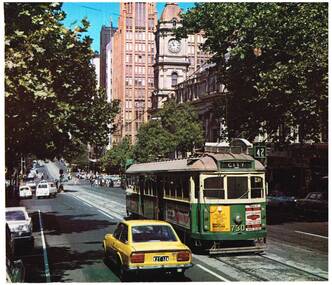
Photograph - Illustration/s, 1975
... Illustration from a Calendar (Feb. 1976 (checked dates - leap year)) of W5 class No. 730 descending the Collins Street hill, early 1970's. Has the Melbourne Town Hall and Manchester Unity Building in the background. ...Trams tramways Collins St tram 730 W5 class route 42 Melbourne Town Hall Illustration from a Calendar (Feb. 1976 (checked dates - leap year)) of W5 class No. 730 descending the Collins Street hill, early 1970's. Has the Melbourne Town Hall and Manchester Unity Building in the background. ...Illustration from a Calendar (Feb. 1976 (checked dates - leap year)) of W5 class No. 730 descending the Collins Street hill, early 1970's. Has the Melbourne Town Hall and Manchester Unity Building in the background. The tram has the destination of City, showing route 42. On rear is part of the calendar sheet for Feb. 1976. Source of calendar unknown. See Reg Item 2637 for a postcard photo.trams, tramways, collins st, tram 730, w5 class, route 42, melbourne town hall -
 Melbourne Tram Museum
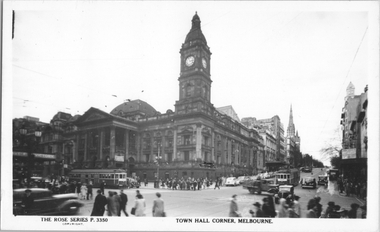
Postcard, Rose Stereograph Co, "Town Hall Corner Melbourne", early 1940s
... Rose Series postcard P.3350, titled "Town Hall Corner Melbourne", with a W2 southbound in Swanston Street and W2 class 543 (City Route 47) in Collins Street with another W2 climbing the Collins Street hill eastbound. ...Rose Series postcard P.3350, titled "Town Hall Corner Melbourne", with a W2 southbound in Swanston Street and W2 class 543 (City Route 47) in Collins Street with another W2 climbing the Collins Street hill eastbound. ...Rose Series postcard P.3350, titled "Town Hall Corner Melbourne", with a W2 southbound in Swanston Street and W2 class 543 (City Route 47) in Collins Street with another W2 climbing the Collins Street hill eastbound. All trams have a white stripe and part white bumper bars as part of the WW2 blackout measures. The Melbourne Town Hall is in the background.Yields information the Melbourne Town Hall, early 1940sPostcard - printed real photograph with Rose Stereograph Co. name on the rear. Two copies held.On rear of 2nd copy in ink "To Kiwi No. 2975 from Kiwi No. 4755"tramways, trams, swanston st, collins st, w2 class, tram 543, world war ii, melbourne town hall, route 47, rose series -
 Flagstaff Hill Maritime Museum and Village
Domestic object - Colander, Kande Kitchenware, Circa 1924
... Kande Kitchenware was established by Patrick Kavanagh and William English (the name Kande was formed from their initials, K and E) in 1922 and had its Sydney factory in Little Collins Street, Surrey Hills. Kavanagh and English, a subsidiary of Kande Kitchenware, became a limited company in 1924, with both founders as directors. ...Kande Kitchenware was established by Patrick Kavanagh and William English (the name Kande was formed from their initials, K and E) in 1922 and had its Sydney factory in Little Collins Street, Surrey Hills. Kavanagh and English, a subsidiary of Kande Kitchenware, became a limited company in 1924, with both founders as directors. ...Kande Kitchenware was established by Patrick Kavanagh and William English (the name Kande was formed from their initials, K and E) in 1922 and had its Sydney factory in Little Collins Street, Surrey Hills. Kavanagh and English, a subsidiary of Kande Kitchenware, became a limited company in 1924, with both founders as directors. Another director was Test cricketer Jack Gregory, an all-rounder who slipped easily into the role of businessman. Gregory enjoyed success in business as on the cricket field, helping the company grow from a tiny operation to a major manufacturer and exporter that employed 80 people in 1931. They managed to survive the Depression and kept manufacturing at least until the late 1960s.An appliance made by an early and successful Australian company that manufactured metal kitchen items during the first half of the 20th century. Colander enamel rusty holes in base of bowls, 2 handles, bowl shape.flagstaff hill, warrnambool, shipwrecked-coast, flagstaff-hill-maritime-museum, shipwreck-coast, flagstaff-hill-maritime-village, colander, kitchen item, domestic item, kitchen strainer -
 Wodonga & District Historical Society Inc
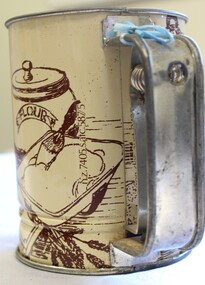
Domestic object - Flour Sifter made by KANDE Australia, Kande Kitchenware Ltd, 1920 - 1960
... It had its Sydney factory in Little Collins Street, Surrey Hills. Kavanagh and English, a subsidiary of Kande Kitchenware, became a limited company in 1924, with both founders as directors. ...It had its Sydney factory in Little Collins Street, Surrey Hills. Kavanagh and English, a subsidiary of Kande Kitchenware, became a limited company in 1924, with both founders as directors. ...Kande Kitchenware was established by Patrick Kavanagh and William English in 1922. The name Kande was formed from their initials, K and E. It had its Sydney factory in Little Collins Street, Surrey Hills. Kavanagh and English, a subsidiary of Kande Kitchenware, became a limited company in 1924, with both founders as directors. Another director was Test cricketer Jack Gregory, an all-rounder who slipped easily into the role of businessman. Gregory enjoyed success in business as on the cricket field, helping the company grow from a tiny operation to a major manufacturer and exporter that employed 80 people in 1931. They produced a wide range of utensils including cake tins, pastry cutters, pans and baking dishes. They managed to survive the difficulties of the Depression and were listed as a public company in 1949. Kande Kitchenware Ltd were taken over by Hackshalls Limited 6 July 1960.An appliance made by an early and successful Australian company which manufactured metal kitchen items during the first half of the 20th century. Th.ese utensils were widely used throughout AustraliaFlour sifter manufactured by KANDE Australia. The sifter / sieve is made of metal with a wire mesh and is decororated with images of other kitchen utensils and ingredients. It has a spring-loaded handle to which would be squeezed to operate the internal sifting mechanism.At botton of illustrations on one side "Kande AUSTRALIA"australian business, kande kitchenware, kitchen utensils, kitchenware early 20th century -
 Flagstaff Hill Maritime Museum and Village
Document - Bank notice, List of Offices, ca Nov. 1877
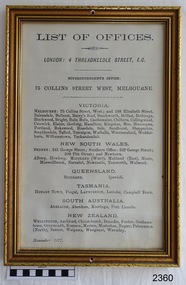
... The Bank was an integral part of the establishment and growth of commerce in Colonial Warrnambool and throughout Australia. flagstaff hill warrnambool Bank of Australasia 1877 Branches of Bank of Australasia 1877 Banks in Australia 1877 Commerce 1877 shipwreck-coast document bank document Flagstaff Hill Maritime Museum & Village Bank of Australasia 1877 Branches in Australia Bank of London Offices in Australia Offices in New Zealand Commerce Banking Finance Shipwrecked coast Flagstaff Hill Maritime Museum Maritime Museum Shipwreck coast Flagstaff Hill Maritime Village Great Ocean Road BoA Union Bank Australia & New Zealand Bank ANZ Bank David Charters McArthur D C McArthur Sydney New South Wales Currency Banknote Legal tender List of bank offices Text includes: "LONDON: 4 THREADNEEDLE STREET, E.C." "SUPERINTENDENT'S OFFICE: / 75 COLLINS ...The addresses given on the List for the London and Melbourne offices have connected the document to the Bank of Australasia. The List is dated November 1877 and shows the number and the location of all of the branches of the Bank at that point in time., a total of 77. - Victoria 35, New South Wales 14, Queensland 2, Tasmania 5, South Australia 5, New Zealand 16 Copies of the notice would have been displayed in all branches of the bank in both Australia and New Zealand to inform customers and perhaps impress them too with a large number of locations and the reference to the bank's connection with London. This document gives information on all bank offices throughout Australia and New Zealand. It refers to the Superintendent's Office address at 75 Collins Street West, Melbourne and is dated November 1877. This places the document at the time just before the new Melbourne office opened on the corner of Collins Street and Queen's Street in 1879. The Bank of Australasia was incorporated by Royal Charter of England in March 1834. It came to Australia on 14th December 1835, opening in Sydney. The Acting Superintendent of the Bank of Australasia in Sydney at that time was David Charters McArthur. He was Superintendent from 1867-to 1876. The Melbourne branch of the Bank of Australasia opened on 28th August 1838 in a two-roomed brick cottage on the north side of Little Collins Street. Two huge mastiff dogs were kept in the backyard and let loose at night to guard the bank. The government also provided an armed military sentinel. Due to the bank's rapid growth, a new building for the Melbourne branch was opened in 1840 at 75 Collins Street West. By 1879 the bank had been upgraded to a magnificent two-storey building on the corners of Collins and Queens Streets, with the entry on Collins Street. In 1951 the Bank of Australasia amalgamated with the Union Bank to form the Australia and New Zealand Bank, now known as the ANZ. Then in 1970, the ANZ merged with both the ES&A and the London Bank of Australia to form the ANZ Banking Group Limited. The ANZ Banking Group Ltd kindly donated a variety of historic items from the Bank of Australasia. BANK of AUSTRALASIA, WARRNAMBOOL – In 1854 Warrnambool had two banks, the Union Back and the Bank of Australasia. Later, completely different bank businesses opened; in 1867 the National Bank of Australasia, then in 1875 the Colonial Bank of Australasia. The original Bank of Australasia was established in Warrnambool in July 1854, and operated from a leased cottage on Merri Street, close to Liebig Street. The bank bought a stone building previously erected by drapers Cramond & Dickson on the corner of Timor and Gibson Streets. Samuel Hannaford was a teller and then Manager at the Warrnambool branch from 1855 to 1856. Warrnambool’s Council chose the Bank of Australasia as its bank 1856-57. In 1859 Roberts & Co. was awarded the contract to build the new Bank of Australasia branch for the sum of £3,000. The land was on a sand hill on the northeast corner of Timor and Kepler Streets and had been bought in 1855 from investor James Cust. The new building opened on May 21, 1860. The bank continued to operate there until 1951 when it merged with the Union Bank to form the ANZ Bank, which continued operating from its Liebig Street building. Warrnambool City Council purchased the former Bank of Australasia building in 1971 and renovated it, then on 3rd December 1973 it was officially opened as the Art Gallery by Cr. Harold Stephenson and Gallery Director John Welsh. The Gallery transferred to the purpose-built building in Liebig Street in 1986 and the old bank building is now the Gallery club. The List of Offices of the Bank of Australasia has early Australian historical significance through its association with the Bank, which was established in 1834 by Royal Charter and opened in Sydney, Australia, in Sydney in 1835. The List is significant for showing the number and location of all of the Offices of the Bank of Australia in November 1877. This shows that Victoria had 45 percent of all Offices. The framed document is locally significant for its association with the Bank of Australasia, Warrnambool's first bank, established in 1854. The bank continued to operate until the organisation's merger in 1951. It became the ANZ Bank, which is still in operation today. The Bank was an integral part of the establishment and growth of commerce in Colonial Warrnambool and throughout Australia.Document in a decorative gilt frame. Titled List of Bank Offices and dated November 1877, facsimile. Offices include London, and a variety of offices in Victoria, New South Wales, Queensland, Tasmania, South Australia and New Zealand. Round holes in the centre top and bottom of the frame. Text includes: "LONDON: 4 THREADNEEDLE STREET, E.C." "SUPERINTENDENT'S OFFICE: / 75 COLLINS STREET WEST, MELBOURNE" "Warrnambool" " November 1877" flagstaff hill, warrnambool, bank of australasia 1877, branches of bank of australasia 1877, banks in australia 1877, commerce 1877, shipwreck-coast, document, bank document, flagstaff hill maritime museum & village, bank of australasia, 1877, branches in australia, bank of london, offices in australia, offices in new zealand, commerce, banking, finance, shipwrecked coast, flagstaff hill maritime museum, maritime museum, shipwreck coast, flagstaff hill maritime village, great ocean road, boa, union bank, australia & new zealand bank, anz bank, david charters mcarthur, d c mcarthur, sydney, new south wales, currency, banknote, legal tender, list of bank offices -
 Flagstaff Hill Maritime Museum and Village
Book - Portfolio, Newcraft Pulicity, The Line of Sail; Magnificent Clipper Ships, 1969
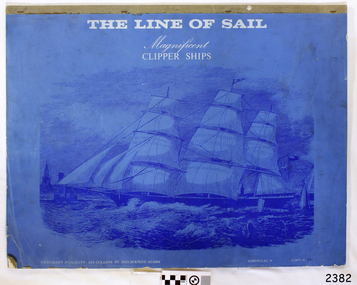
... Collins Street, Melbourne. This portfolio book of clipper ship prints is historically significant as it shows an important part of Australia's history, It includes some of the shipping lines famous in the 19th century for transporting passengers and goods to Australia. The prints are also significant for their origin in the carved wooden blocks used a century ago for creating images for the newspapers of the time. Book is also significant from being one of a limited edition of books produced. There are copes in both the Victorian State Library and the National Library of Australia. flagstaff hill ...These prints include large sailing ships that were also referred to as Clippers and Tall Ships. These ships were used to transport cargo and passengers across the world in the 19th century. They were powered purely by harnessing the wind. It could take three to four months to sail in this manner from England to Australia. On many occasions the ships were wrecked, often close to their destination, through errors of navigation. The method of production of the original images is over a century old. The Melbourne publisher of this portfolio book, Newcraft Publicity, describes the contents as follows-' Magnificent Clipper Ships: Clipper ships in the line of sail make the most romantic and spectacular pictorial chapter of marine history. This collection depicting early clippers and other types of sailing ships were originally fine engravings on wooden printing blocks used in newspapers a century ago. They were taken directly from the original newspaper prints, and reproduced in enamel inks to provide a choice of fine line prints suitable for framing. LIST OF PRINTS- The New Australian Clipper "BLUE JACKET" The Clipper Ship “CHRYSOLIER” The “GAUNTLET” Clipper Ship The New American Clipper “GREAT REPUBLIC” The Clipper Ship “GUIDING STAR” New Emigrant Ship “HESPERIDES” for the South Australian Line Capt. Beatson’s Expedition in search of Sir John Franklin – the “ISABEL” The Black Ball Line Clipper Ship “JAMES BAINES” The “MERCHANT PRINCE” – Australian Clipper The White Star Line Clipper Ship “MORNING LIGHT” The Aberdeen Clipper Built Barque “PHOENICIAN” New Australian Clipper Ship the “ROYAL FAMILY” The “SOVEREIGN OF THE SEAS” American Clipper The New Iron Clipper Built Ship “TAYLEUR” for Australia H.M. New Frigate “THETIS” The American Clipper Ship “WITCH OF THE WAVE” ABOUT THE PUBLISHER- The Newcraft Publicity was a Melbourne business that operated in the 1960s at 243 Collins Street, Melbourne.This portfolio book of clipper ship prints is historically significant as it shows an important part of Australia's history, It includes some of the shipping lines famous in the 19th century for transporting passengers and goods to Australia. The prints are also significant for their origin in the carved wooden blocks used a century ago for creating images for the newspapers of the time. Book is also significant from being one of a limited edition of books produced. There are copes in both the Victorian State Library and the National Library of Australia.The Line of Sail is a portfolio of sixteen fine line, black and white prints on paper. The subject is clipper ships. The covers are paper-covered card, coloured a strong blue with white line images and text. The image side of the pages has a sheen, the back is matt. Each print has a caption. The top of the book is stapled and bound with grey tape. Produced by Newcraft Publicity, Melbourne. Limited Edition - Copy Number 086. Stamped on front cover "086"flagstaff hill, warrnambool, shipwrecked-coast, flagstaff-hill, flagstaff-hill-maritime-museum, maritime-museum, shipwreck-coast, flagstaff-hill-maritime-village, lithographs, newscraft publicity, book, the line of sail, dlipper ships, tall shipos, sailing ships, wood block print, newspaper drawings, newcraft productions, newcraft melbourne, portfolio of clipper ships, limited edition, wooden engravings, magnificent clipper ships -
 Flagstaff Hill Maritime Museum and Village
Decorative object - Bookends
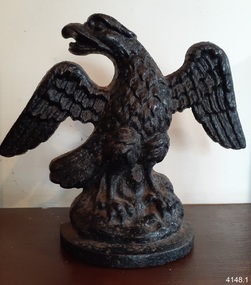
... Collins Street. By 1879 the bank had been upgraded to a magnificent two-storey building on the corners of Collins and Queens Streets, with the entry on Collins Street. In 1951 the Bank of Australasia amalgamated with the Union Bank to form the Australia and New Zealand Bank, now known as the ANZ. Then in 1970, the ANZ merged with the ES&A and the London Bank of Australia to form the ANZ Banking Group Limited. The ANZ Banking Group Ltd kindly donated to Flagstaff Hill...Collins Street. By 1879 the bank had been upgraded to a magnificent two-storey building on the corners of Collins and Queens Streets, with the entry on Collins Street. In 1951 the Bank of Australasia amalgamated with the Union Bank to form the Australia and New Zealand Bank, now known as the ANZ. Then in 1970, the ANZ merged with the ES&A and the London Bank of Australia to form the ANZ Banking Group Limited. The ANZ Banking Group Ltd kindly donated to Flagstaff Hill ...The individual eagles in this pair of Napoleonic Eagle bookends are made so that each eagle faces the opposite direction to the other, one left and one right. The Napoleonic Eagle is the name given to the eagle symbol used by Napoleon Bonaparte 1799-1815 and the French Regiments, mounted on a standard to represent the honour and pride of fighting French men. It is believed that the Napoleonic Eagle was chosen as a symbol for the Tamar Bank in Launceston, Tasmania, established in 1834. The bank was formed after the separation of one of the branches of the Bank of Van Diemen’s Land. The Managing Director in 1834 was Lewis Gilles, previously a naval officer. Other directors were T. Williams, M. Connolly, F. D. Wickham, and P. Oakden. The bank was dissolved in 1838 and became the basis of the Launceston branch of the British-founded Union Bank of Australia Limited, established in 1837 and had its own emblem. The Union Bank of Australia merged with the Bank of Australasia in 1951 and went on to eventually become part of the Australia and New Zealand (ANZ) Banking Group. The Bank of Australasia was incorporated by Royal Charter of England in March 1834. It had its Australian beginning on 14th December 1835, opening in Sydney. The Acting Superintendent of the bank at that time was David Charters McArthur. He was Superintendent from 1867 to 1876. The Melbourne branch opened on 28th August 1838 in a two-roomed brick cottage on the north side of Little Collins Street. By 1879 the bank had been upgraded to a magnificent two-storey building on the corners of Collins and Queens Streets, with the entry on Collins Street. In 1951 the Bank of Australasia amalgamated with the Union Bank to form the Australia and New Zealand Bank, now known as the ANZ. Then in 1970, the ANZ merged with the ES&A and the London Bank of Australia to form the ANZ Banking Group Limited. The ANZ Banking Group Ltd kindly donated to Flagstaff Hill various historic items from the Bank of Australasia. BANK of AUSTRALASIA, WARRNAMBOOL – In 1854 Warrnambool had two banks, the Union Bank and the Bank of Australasia. Later, completely different bank businesses opened; in 1867 the National Bank of Australasia, then in 1875 the Colonial Bank of Australasia. The original Warrnambool branch of the Bank of Australasia was established in July 1854, and operated from a leased cottage on Merri Street, close to Liebig Street. The bank next bought a stone building previously erected by drapers Cramond & Dickson on the corner of Timor and Gibson Streets. Samuel Hannaford was a teller and then Manager at the Warrnambool branch from 1855 to 1856 and the Warrnambool Council chose that bank for its dealings during 1856-57. In 1859 Roberts & Co. was awarded the contract to build the new Bank of Australasia branch for the sum of £3,000; the firm built the Warrnambool Post Office in 1856 and purchased land in Timor Street in 1858. The land was on a sand hill on the northeast corner of Timor and Kepler Streets and had been bought in 1855 by investor James Cust. The new building opened on May 21, 1860. The bank continued to operate there until 1951 when it merged with the Union Bank to form the ANZ Bank, which continued operating from its Liebig Street building. Warrnambool City Council purchased the former Bank of Australasia building in 1971 and renovated it, then on 3rd December 1973 it was officially opened as the Art Gallery by Cr. Harold Stephenson and Gallery Director John Welsh. The Gallery transferred to the purpose-built building on Liebig Street in 1986 and the old bank building is now the Gallery Club. Staff at the Bank of Australasia in Warrnambool included the following men but others were also involved: Samuel Hannaford, Teller then Manager from 1855-1856; Hawkins, Manager in 1856, W H Palmer, Manager from January 1857 until November 1869 when the Teller Basil Spence was promoted to Manager; H B Chomley, Manager from April 1873 and still there in 1886; A Butt, Manager in 1895-1904; J R McCleary Accountant and Acting Manager for 12 months, until 1900; A Kirk, Manager 1904; J Moore, staff until his transfer to Bendigo in December 1908; J S Bath was Manager until 1915; C C Cox, Manager until April 1923; Richard C Stanley, Manager 1923 to April 1928. This pair of Napoleonic Eagle bookends represents the type of ornaments appropriate for 19th and 20th-century business associated with finance and commerce. They symbolise strength, reliability and power. It is believed that the Napoleonic Eagle was the seal of the Tamar Bank, established in 1834 in Launceston, Tasmania. The Tamar bank was taken over by the Australia-wide Union Bank in 1838, which later merged with the Bank of Australasia, which had a branch in Warrnambool. In 1851 it became the Australia and New Zealand Bank, which is still active in Warrnambool in 2023. Bookends; two (2) black metal eagles, standing, beaks open, tail to the side, wings spread, claws open. The black figures are cast metal and the backs are hollow, with flat even edges. The front is textured and shiny. The eagles are facing opposite directions; one left, one right. The figures are commonly known as Napoleonic eagles.flagstaff hill maritime museum and village, warrnambool, great ocean road, shipwreck coast, bookends, eagle bookends, napoleonic eagles, tamar bank, launceston bank, bank of australasia, eagle symbol, 1834-1838, commerce, financial institution, colonial bank, lewis gilles, m. connolly, f. d. wickham, and p. oakden., t. williams, anz bank, australia and new zealand bank, union bank of australia -
 Flagstaff Hill Maritime Museum and Village
Machine - Steam Engine, Tangyes engineering, Mid-1880s
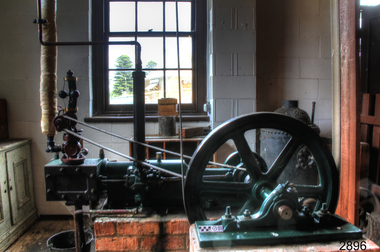
... Hill Maritime Museum and Village...Shipwreck coast...Great Ocean Road...machine...invention...engine...steam...steam engine...horizontal steam engine...Tangyes horizontal steam engine...stationary steam engine...single cylinder steam engine...manufacturing...farming...pumps...lifting equipment...engines...machine tools...hydraulic rams...hydraulic pumps...steam pumps...differential pulleys...Mill type steam engine...4 inch cylinder...Weston’s differential pulley...Thomas Aldridge Weston...1862 International Exhibition in London...Brunel...SS Great Eastern...Cleopatra’s Needle...Forth Road Bridge...Cornwall House...Collins Street...Flagstaff Hill Warrnambool Maritime Village Maritime Museum Flagstaff Hill Maritime Museum and Village Shipwreck coast Great Ocean Road machine invention engine steam steam engine horizontal steam engine Tangyes horizontal steam engine stationary steam engine single cylinder steam engine manufacturing farming pumps lifting equipment engines machine tools hydraulic rams hydraulic pumps steam pumps differential pulleys Mill type steam engine 4 inch cylinder Weston’s differential pulley Thomas Aldridge Weston 1862 International Exhibition in London Brunel SS Great Eastern Cleopatra’s Needle Forth Road Bridge Cornwall House Collins Street Melbourne agricultural machinery industrial machinery Allspeeds dairy pump Richard Tangye & Brothers James Tangye and Brothers Tangye Brothers and Price Tangye Brothers Tangye Brothers & Holman Tangyes Ltd. ...This Tangye B-size, single-cylinder, horizontal steam engine was likely manufactured in England around the mid-1880s. It was distributed by Melbourne machinery merchants Cameron & Sutherland, which also operated in Bendigo and Ballarat. A local cheese maker once used the engine to drive factory equipment. It was later donated to the Warrnambool Technical School, which then donated it to Flagstaff Hill to add to its historical steam engine collection. Between its manufacture and its donation to Flagstaff Hill, the governor had been replaced by the current Pickering governor. This engine design was very popular in the late 19th and early 20th centuries. When connected and powered up, the engine could drive an overhead line shaft via a flat belt off its flywheel. The line shaft would then drive the machinery via flat belts. It could drive virtually any type of machinery, such as water and sewerage pumps, mine elevators, winches, cranes, metal forges, air blowers, and marine machinery. This engine features a mechanical governor, which controls the speed of the engine regardless of whether it is under load. It also has a water pump built into the valve rod, which is used to supply the boiler with water. Steam enters the cylinder via a slide valve and applies pressure to the piston; it is like a modern internal combustion engine, but in the case of the steam engine, the pressure is exerted in turn on either side of the piston. In other words, the connecting rod is pushed by steam via the piston and piston rod and then pulled back again by steam pushing on the opposite side of the piston. Thus, power is exerted almost continuously, except at the end of each piston stroke, when it reverses direction. In the 1880s, many local butter and cheese manufacturers installed Tangye steam engines to power their machinery. A comprehensive article in the Gippsland Mercury in September 1889 extolled the magnificence of the Farnham Butter Factory in Dennington, Warrnambool, and described how one Tangye engine was used to drive several machines in the cheese- and butter-making processes. A report in the Warragul Guardian in December 1890 notes that the newly opened Warrnambool Butter Factory used a Tangye steam engine to pump water from a 60-foot well. Tangye: Richard Tangye (1833–1906) and four of his brothers—James, Joseph, Edward, and George—were the sons of Joseph Tangye, a Quaker Cornish miner. In 1857, they founded the engineering firm Richard Tangye & Brothers in Birmingham, UK. In 1860, the firm became Tangye Brothers and moved to Cornwall Works in Birmingham. The business encouraged inventors to join the company and develop their patents there, as happened with Weston’s differential pulley block, invented by the Englishman Thomas Aldridge Weston in 1854. Tangye bought the patent in 1858, giving the firm the sole right to manufacture it. The design received a medal for “original application, practical utility and success” at the 1862 International Exhibition in London. Also in 1858, the Tangye firm was commissioned by Brunel’s shipping company to manufacture hydraulic lifting jacks, or rams, to launch the steamship SS Great Eastern. The success of this project brought favourable attention to the firm, and it became involved in other notable projects, including the erection of Cleopatra’s Needle in London in 1878 and work on the Forth Road Bridge in Scotland. The firm underwent several name changes over the years, including James Tangye and Brothers (1857), Tangye Brothers and Price (1859), Tangye Brothers (1860), Tangye Brothers & Holman (1876), Tangye Brothers (by 1878), Tangye Ltd. (1881), and then simply Tangye. Its machinery and equipment were exported worldwide. In 1884, a branch with showrooms, offices, and a warehouse was opened in Melbourne at Cornwall House, Collins Street West. The firm was well known for producing high-quality machinery for agriculture and industry. Even today, new Tangye machinery is available for a subsidiary of Allspeeds. An extensive account of the firm’s history, names, inventions, and further references is available in Grace’s Guide, which also includes references to and diagrams of the Tangye horizontal steam engine. The horizontal steam engine was made by the well-known engineering firm Tangye, known for its high quality of manufacture. It was an important development in machinery because it helped improve productivity. Engines of this type are still used in some parts of the world today. This engine is a good example of a late 19th-century steam engine used in industry and agriculture and adapted for many different purposes. It is also important locally because it was connected to a local cheese making business and part of the thriving western district dairy industry. It may have been one of the Tangyes engines used at the Farnham butter factory or the Warrnambool Butter Factory, which was reported to be one of the most important in the Colony. It is also connected to the Warrnambool Technical School, established in 1968. Steam engine: stationary Tangye Size B, single-cylinder, horizontal Mill type steam engine. It has a 4-inch diameter cylinder with an 8-inch stroke. The body is painted green, and the Pickering governor is red. It was manufactured in Birmingham, England, in accordance with Tangye's Patent 238930, and distributed by Cameron and Sunderland, Melbourne, in the mid-1880s. TANGEYS PATENT BIRMINGHAM B SIZE 238930 CAMERON & SUTHERLAND MELBOURNE THE PICKERING PORTLAND . GOVERNOR . CONN. U.S.A.flagstaff hill, warrnambool, maritime village, maritime museum, flagstaff hill maritime museum and village, shipwreck coast, great ocean road, machine, invention, engine, steam, steam engine, horizontal steam engine, tangyes horizontal steam engine, stationary steam engine, single cylinder steam engine, manufacturing, farming, pumps, lifting equipment, engines, machine tools, hydraulic rams, hydraulic pumps, steam pumps, differential pulleys, mill type steam engine, 4 inch cylinder, weston’s differential pulley, thomas aldridge weston, 1862 international exhibition in london, brunel, ss great eastern, cleopatra’s needle, forth road bridge, cornwall house, collins street melbourne, agricultural machinery, industrial machinery, allspeeds, dairy, pump, richard tangye & brothers, james tangye and brothers, tangye brothers and price, tangye brothers, tangye brothers & holman, tangyes ltd., tangye, richard tangye, james tangye, joseph tangye, edward tangye, george tangye, cornwall works, birmingham, pickering governor, pickering portland connecticut usa, 19th century, dairy plant, steam power, tangye's patent 238930, tangye b size engine, cameron & sutherland, machine merchants, 1880s, mid-1880s, cheese manufacturer, butter manufacturer, diary industry, warrnambool technical school, belt driven machinery, agriculture, mechanical governor, farnham butter factory, warrnambool butter factory -
 Flagstaff Hill Maritime Museum and Village
Equipment - Pump, circa 1930's - 1940's
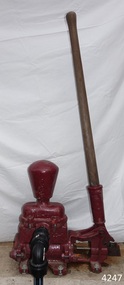
... The former McPherson’s Pty Ltd building in Collins Street Melbourne is now on the Victorian Heritage Register VHR H0942 This pump is representative of mechanical pumps popular in the early to mid-1900’s and still used today. flagstaff hill warrnambool flagstaff hill maritime museum shipwreck coast flagstaff hill maritime village great ocean road ajax pump works tottenham melbourne ajax pump factory kyneton william edward mcpherson thomas mcpherson of melbourne mcpherson’s pty ltd melbourne acme bolt company tool equipment co. pty. ltd associated machine tools australia pty ltd ajax bolt and rivet co. pty ltd new zealand forrers company ipswich queensland ksb ajax pumps ksb australia pty ltd macson lathes tool manufacturer early to mid- 20th century ajax double acting hand pump ajax type l2 series a pump qisjax pumps water pump 1940’s fuel pump 1940’s hand operated constant flow pressure pump reciprocating suction pump agricultural hand pump plumber’s hand pump portable hand pump Embossed on lower section of pump "L2 - 10", "L2 - -1", "AJAX" “(?) ...This pump is an Ajax Type L2 Series A model, made and sold by McPherson’s Pty Ltd of Melbourne circa 1930’s to 1940’s, is a mechanical, hand operated, constant flow pressure pump. It would have been used to pump fluids from one area to another, for example from a dam to a tank or used as a bilge pump on a small vessel, mounted on the vessel’s bulkhead, floor or deck. This type of hand pump is sometimes called a ‘Reciprocating Suction Pump’. It has a mechanical pumping action of the lever moves the piston inside the pump up and down. The water is lifted from below the pump through the inlet pipe and into the pump’s cylinder. This action causes the lower valve to close and the piston’s valve opens and the pressure within the pump forces the water out of the pump through the exit pipe. The limitation of this type of pump is that it can only raise the water a maximum of about 7 metres from beneath the ground and yields 24-26 Litres per minute. This type of pump could be used for many purposes such as pumping water or fuel. McPherson’s 1940’s advertisement proclaims “For all jobs on the land – irrigation, spraying, tank, plumbing, fire-fighting – there’s a suitable “Ajax” pump. Send us the details of you pumping problem. Our Expert’s advice will help you choose the right pump – the one that will give you most years of PROFITABLE PUMPING.” (The Australasian (Melbourne) Sat. 26th October 1940.) McPherson’s Pty Ltd, the manufacturer, advertised a similar pump to this one in The Australasian (Melbourne) in 1936, calling it the Ajax Double Acting Hand Pump. In 1942 another advertisement advised that a representative for a fire-fighting equipment supplier was visiting the western district of Victoria. The company could now supply double-action two-spray Ajax pumps at lower prices than similar pumps the district had recently purchased from Adelaide. McPHERSON’S FOUNDER and COMPANY TIMELINE 1860 – Thomas McPherson, a Scottish immigrant (c. 1853 ), founded McPherson’s in Melbourne, supplying pig iron (lead ingots imported as ballast in ships) to local manufacturers. 1882 – Thomas McPherson established a warehouse in Collins St Melbourne and included tools, steam fittings and machinery in his wares. The business expanded to include steam saw mills and became known as Thomas McPherson and Sons (William Murray and Edward). 1888 – Thomas passed away and his sons inherited the business. In 1896 William Murray became the sole proprietor after his brother Edward’s death. 1900 – The firm expanded, establishing Acme Bolt Company to manufacture nuts and bolts. 1912 – McPhersons Pty Ltd established a machinery warehouse and showroom in 554-556 Collins St Melbourne. McPherson’s went on to establish branches in Sydney (1911), Adelaide (1921) and Perth (1930) 1917 - McPherson’s supplied ‘dog spikes’ for the transcontinental railway, running from Eastern to Western Australia. 1918 – A tool works set up in Kensington, Melbourne, manufacturing Macson lathes and made machine tools that previously had to be imported. 1924 – The Bolt Works was transferred to a new building in Melbourne. McPhersons began making pumps. 1929 – McPherson retired. His son (Sir) William Edward McPherson (known as ‘WE’), was born in Hawthorne, Melbourne, in 1898. After his education he began work in his father’s Melbourne hardware and machinery business He took over as governing director when his father retired. 1929-1932 – McPherson’s supplied thousands of tons of rivets from its Richmond (Melbourne) Bolt Works for the construction of the Sydney Harbour Bridge. 1936 – McPherson’s Pty Ltd is advertising Ajax Pumps in newspapers 1934 – McPhersons purchased the property adjoining the warehouse in Collins Street, and during 1935-1936 built a new office and showrooms on the site of 546-445 Collins St. 1939 - McPherson’s acquired the Tool Equipment Co. Pty. Ltd and Associated Machine Tools Australia Pty Ltd was formed to separate McPherson’s machine-tool manufacturing and merchandising interests. 1939 – Ajax Pump Works, a foundry and pump manufacturing plant, was established in Tottenham, Melbourne, and the Ajax Bolt and Rivet Co Pty Ltd began manufacturing in New Zealand. 1944 - McPherson’s became a public company, McPherson’s Ltd. 1948 - The Ajax Pump Foundry opened at Kyneton, Victoria and in the post war years it grew to became a large manufacturer. 1980’s – Ajax Pumps brochure lists the address as 6 Buckhurst St, South Melbourne, Vic 3205 with the Telephone number 03 669 3588 1988 - Ajax Pumps acquired the Forrers Company, which was established in 1921. Manufacturing in Ipswich, Queensland, specialising in submersible sewage pumps. 1991 – KSB Ajax was formed, bringing together the companies KSB and Ajax Pumps 1993 – Manufacturing was moved to state-of-the-art premises in Tottenham, Victoria 2001 - The Forrers facility was moved to Tottenham. 2007 - Company name KSB Ajax Pumps was changed to KSB Australia Pty Ltd. 2009 - KSB Australia opened a branch in Townsville, Queensland. 2011 - KSB Australia moved to its dedicated Water and Waste Water Competence Centre in Bundamba, Queensland. DISPLAY OF THIS AJAX PUMP This pump was installed at Flagstaff Hill Maritime Village as part of a working display in the village by the Friends of Flagstaff Hill, in acknowledgement of the dedicated involvement of one of its long serving members, Bob Crossman. The display was officially opened 31st March 2018 and incorporates a restored Furphy Tank and Water Pipe Stand. The pump is used to draw water from the lake, through the water stand pipe and into the reconditioned Furphy Tank. This Ajax pump made by McPherson’s Pty Ltd is significant for its association with McPherson’s, a prominent manufacturer of hardware in Victoria. McPherson’s is famous for supplying ‘dog-spikes’ for the transcontinental railway (eastern to western Australia, 1917) and rivets for the Sydney Harbour Bridge (1929-1932). The Ajax pump is also of significance because of its association with McPherson’s Governing Director (Sir) William McPherson, former premier and treasurer in Victoria 1928-1929. The former McPherson’s Pty Ltd building in Collins Street Melbourne is now on the Victorian Heritage Register VHR H0942 This pump is representative of mechanical pumps popular in the early to mid-1900’s and still used today. Hand operated pressure pump, double acting. Cast metal case, painted red, with steel hose attachments and long metal lever. Pump is bolted to wooden plank. Model of pump is AJAX, Type L2, Series A pump. Embossed on lower section of pump "L2 - 10", "L2 - -1", "AJAX" “(?) –2-1” Embossed on lower handle “3-7” “L – 4” Embossed on attached plate “FOR SPARE PARTS / TYPE L2 / SERIES A / PUMP ASSEMBLED BY T R” Manufactured by McPherson’s Pty Ltd of Melbourne circa 1930’s - 1940’s.flagstaff hill, warrnambool, flagstaff hill maritime museum, shipwreck coast, flagstaff hill maritime village, great ocean road, ajax pump works tottenham melbourne, ajax pump factory kyneton, william edward mcpherson, thomas mcpherson of melbourne, mcpherson’s pty ltd melbourne, acme bolt company, tool equipment co. pty. ltd, associated machine tools australia pty ltd, ajax bolt and rivet co. pty ltd new zealand, forrers company ipswich queensland, ksb ajax pumps, ksb australia pty ltd, macson lathes, tool manufacturer early to mid- 20th century, ajax double acting hand pump, ajax type l2 series a pump, qisjax pumps, water pump 1940’s, fuel pump 1940’s, hand operated constant flow pressure pump, reciprocating suction pump, agricultural hand pump, plumber’s hand pump, portable hand pump -
 Federation University Historical Collection
Photograph - Black and White, Ballarat Teachers' College, 1947, 1947
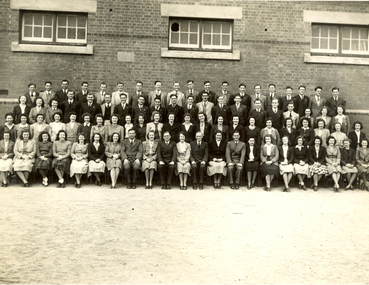
... Street Primary School. Back Row: Jim Howlett; Milton Rice; Keith McLean; Jim Williams; George Nield, David Cooper, Ray Terrill, William Gleeson; Tom Pascoe; Lindsay Harley; Ron Carless; Robert Giddings; Colin Connelly; Alex Magill; Eddie Blake; William Punshon; Athol Aisbett; Kevin Collins; John O'Shannessy. Second Row: Beth Leslie; Faye Dreher; Gwen Pamphilon; Arthur Lelean; Howard Pattenden; Jack Tyers; Hugh Fraser; William Henderson; Jack Mallett; Alan Martin; Keith Boyd; John Ellifson; John Collins; Tom Hill...Street Primary School. Back Row: Jim Howlett; Milton Rice; Keith McLean; Jim Williams; George Nield, David Cooper, Ray Terrill, William Gleeson; Tom Pascoe; Lindsay Harley; Ron Carless; Robert Giddings; Colin Connelly; Alex Magill; Eddie Blake; William Punshon; Athol Aisbett; Kevin Collins; John O'Shannessy. Second Row: Beth Leslie; Faye Dreher; Gwen Pamphilon; Arthur Lelean; Howard Pattenden; Jack Tyers; Hugh Fraser; William Henderson; Jack Mallett; Alan Martin; Keith Boyd; John Ellifson; John Collins; Tom Hill ...Ballarat Teachers' College was opened on may 4th, 1926, at S.S. 33, Dana Street, with an enrollment of sixty-one students, its original staff consisted of the Principal, Mr W. H. Ellwood, M.A., m.Ed. (Chairman of the Teachers' tribunal from its inception in 1946 until 1954), Miss A. Bouchier, B.A., and Mr A.B. Jones, B.A. (Lecturers). In 1927 Miss P.A. Hamano joined the staff. Teaching practice and special rural school work were carried on in schools in or near Ballarat - drawing, crafts and singing were taught by local teachers. In 1927 the college moved to the old Ballarat East Town Hall (remodelled for their use) in Barkly Street. During 1927 the numbers in the College were augmented by twenty-six Manual arts students who had formerly received their training at Ballarat High School. Manual Arts students continued till 1930, when, on grounds of economy, their training was concentrated at Melbourne Teachers' College.\During the four succeeding years approximately sixty students annually entered the primary course. Inclusive of Manual Arts students, and private fee-paying students, exactly 400 trainees passed through the college in its brief span of life (1926-1931) Fourteen years were to pass before they were again opened to students on February 2nd, 1946. The college was re-commenced at S.S. Dana Street under the guidance of Mr W.F. Lord, M.C., M.M., B.A., Dip.Ed., (Acting Principal 1946-1950), and a staff consisting of Miss E.B. Hughes, B.A., Dip. Ed., Mr C.B. Bryan, B.A., V.Com., Dip.Ed., Miss M.H. Miller, L.Mus.A., and Miss G. Kentish, Dip.Phys.Ed. The opening ceremony was performed by the Minister for education at that time, the Hon. F. Field, M.L.A., accompanied by the Hon. T.T. Hollway, M.L.A., and the then Director of Education, Mr J.A. Seitz. It was originally intended to cater for women students only (for whom 130 Victoria Street was purchased as a hostel) but, at the last moment, men were also accepted. A co-educational college was thus set up instead, and has continued as such. The original Staff has been considerable augmented, and the number of Students has been more than trebled. 1951 saw the introduction of the two-year course, successful students being presented with the Trained Primary Teachers' Certificate at the final College assembly each year. In December, 1855, College held its first Graduation Ceremony, with its own Graduation hymn, the words of which were written by Miss C.M. Canty of the staff. Mr Ellwood, former Principal,delivered the occasional address and presented the Ellwood Prize to the outstading student of the year (Mr C.P. Handreck). Students who had successfully completed the course received their certificates from Mr E.B. Pederick, Chief Inspector of Primary Schools. College accomodation having been strained for several years, it was pleasant news when tenders were called in July, 1956, for the building of the first section of the new Ballarat Teachers' College in Gillies Street, near the Botanical Gardens. At the beginning of 1958 the new College was occupied, and staff and students have appreciated greatly the appointments and cacilities of the new buildign. In 1968 the three-year Diploma Course began, co-existent with the other courses which will continue during the transitional period. Successful students in the course receive the Diploma of Teaching (Primary).Black and white photograph of students and staff of the Ballarat Teachers' College. The people are in four rows, and they stand in front of the Dana Street Primary School. Back Row: Jim Howlett; Milton Rice; Keith McLean; Jim Williams; George Nield, David Cooper, Ray Terrill, William Gleeson; Tom Pascoe; Lindsay Harley; Ron Carless; Robert Giddings; Colin Connelly; Alex Magill; Eddie Blake; William Punshon; Athol Aisbett; Kevin Collins; John O'Shannessy. Second Row: Beth Leslie; Faye Dreher; Gwen Pamphilon; Arthur Lelean; Howard Pattenden; Jack Tyers; Hugh Fraser; William Henderson; Jack Mallett; Alan Martin; Keith Boyd; John Ellifson; John Collins; Tom Hill; Wal Henning; Burns Roddis; Fred Marshman; Dawn Doney; Pat Watts; Ann McKinnon. Third Row: Ethel Esmore; Joy Love; Pat Luxford; Jean Elliott; Josie Bunny; Phyllis Borley; Joyce Matheson; Val Witney; Ruth Tozer; Nancy Kerr; K.ath Tobin; Muriel Morrish; Jean Clode; Peg Purdue; Joyce Kennedy; Margaret Palmer; Marie Faulds; Thelma Ritchie. Fourth Row: Pat Lewin; Mavis Poland; Lorna Welsh; Lynette Lynch; Nancy Alexander; Betty Williams, Val Gorrie; Alan Sonsee; Trudy Kentish; Carl Bryan; Monica Miller; W.F. Lord; Beth Hughes; Mephan McMcEwin; Mattie Hayes; Neila Vallance; Pat Robinson; Elva Surman; Joan Gunning; Norma Dally; Beatrice Freeman; Kath Crossett.ballarat teachers' college, education, dana street primary school, 1947 -
Federation University Historical Collection
Image, Ballarat Teachers' College students and staff, 1947
... Street State School black and white laminated phiotocopied photograph of men and women in front of brick building, with names typed underneath. Surnames are: Howlett, Rice, McLean, Williams, Nield, Cooper, Terrill, Gleeson, Pascoe, Harley, Carless, Giddings, Connelly, Magill, Blake, Punshon, Aisbett, Collins, O'Shannessy, Leslie, Dreher, Pamphilon, Lelean, Pattenden, Tyers, Fraser, Henderson, Mallett, martin, Boyd, Ellifson, Collins, Hill, Henning, roddis, Marshman, Doney, Watts, McKinnon, Esmore, Love, Luxford, Elliott, Bunney, Borley, Mathison, Domaschenz, Hannan, Perry, Merlin, Batson, Witney, Tozer, Kerr, Tobin, Morrish, Clode, Purdue, Kennedy, Palmer, Faulds, Ritchie, Lewin, Poland, Welsh, Lynch, Alexander, Williams, Gorris, Sonsee, Miss Kentish, Bryan, Miss Miller, Lord, Miss Hughes, McEwin, Miss Hayes, Vallance, Robinson, Surman, Gunning, Dally, Freeman, Crossett Ballarat Teachers' College students and staff, 1947 Image ...This image was used by the Ballarat Teachers' College Class of 1947 during their reunions. black and white laminated phiotocopied photograph of men and women in front of brick building, with names typed underneath. Surnames are: Howlett, Rice, McLean, Williams, Nield, Cooper, Terrill, Gleeson, Pascoe, Harley, Carless, Giddings, Connelly, Magill, Blake, Punshon, Aisbett, Collins, O'Shannessy, Leslie, Dreher, Pamphilon, Lelean, Pattenden, Tyers, Fraser, Henderson, Mallett, martin, Boyd, Ellifson, Collins, Hill, Henning, roddis, Marshman, Doney, Watts, McKinnon, Esmore, Love, Luxford, Elliott, Bunney, Borley, Mathison, Domaschenz, Hannan, Perry, Merlin, Batson, Witney, Tozer, Kerr, Tobin, Morrish, Clode, Purdue, Kennedy, Palmer, Faulds, Ritchie, Lewin, Poland, Welsh, Lynch, Alexander, Williams, Gorris, Sonsee, Miss Kentish, Bryan, Miss Miller, Lord, Miss Hughes, McEwin, Miss Hayes, Vallance, Robinson, Surman, Gunning, Dally, Freeman, Crossettballarat teachers' college, lindsay harley, nancy cooper, david cooper, dana street primary school, alan sonsee, dana street state school -
 Flagstaff Hill Maritime Museum and Village
Instrument - Hydrometer, 1878 to 1930s
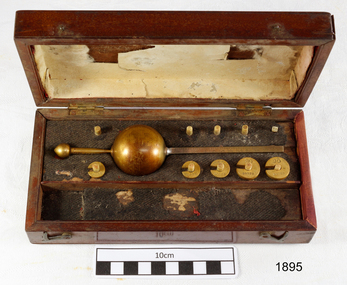
... Collins Street West, Melbourne, in the latter part of the nineteenth century. The firm adverted hydrometers, as well as optical instruments, as early as August 13th, 1864, in The Age, Melbourne. This hydrometer set was donated to Flagstaff Hill...Collins Street West, Melbourne, in the latter part of the nineteenth century. The firm adverted hydrometers, as well as optical instruments, as early as August 13th, 1864, in The Age, Melbourne. This hydrometer set was donated to Flagstaff Hill ...This Sikes brass hydrometer was manufactured by the optical and scientific instrument makers Kasner & Moss of 17 Collins Street West, Melbourne, in the latter part of the nineteenth century. The firm adverted hydrometers, as well as optical instruments, as early as August 13th, 1864, in The Age, Melbourne. This hydrometer set was donated to Flagstaff Hill in 1979 by local wine and spirits merchants Lynch Bros of Fairy Street, Warrnambool. Giffen Russell had established the business in 1878, and Harry Lynch took it over in the 1930s, and after he passed away in 1953 Kevin Matthew Lynch became proprietor of K M Lynch Food and Liquor. The business closed in the 2010s. The hydrometer may date back to the establishment of the business in 1878, as Kasner & Moss were selling hydrometers in Melbourne from 1864. Hydrometers were used to measure the density, or relative density, of liquids from the late 1600s. In 1816 Bartholomew Sikes won the competition for the most useful accurate hydrometer. Hydrometers were commonly used by distillers, vintners, and brewers to establish accurate measures of alcohol concentration in their beverages. Following this manufacturing process, government inspectors and excise officers used them to check that the labelled indications of alcohol-proof were correct and that the right amounts of duty were being paid. This hydrometer and its fitted and hinged wooden container show signs of heavy and protracted use in a working environment. Although the instrument has some parts missing and has been recently repaired, the original quality of the inlaid box and the fine engraving on the instrument and the attachable weights, are indications of the hydrometer’s very real value when new. This Sikes hydrometer, bearing the maker's mark of “Kasner & Moss Melbourne” and the registered number “20373”, was presented to the purchasing public as a precision-made instrument designed for professional use. The Sikes hydrometer is of local significance because of its implied association with the alcohol trade in the southwest region of Victoria. It was donated by a family member of Lynch Bros, a local licensed outlet for wines and spirits in the period before the general relaxation of liquor licensing laws in the State of Victoria. It may have belonged to Griffin Russell who established the liquor store in 1878.Hydrometer; original Sikes brass hydrometer in a polished wooden case with an inlaid plaque on the lid. The brass float is a sphere with a thin flat upper stem and a short, lower stem with a bulb-shaped end. The upper stem is engraved scale on both sides with the numbers 1 to 10, and five divisions between each number. There are ten fixed pegs in the base to secure the thick brass horseshoe-shaped, numbered, various-sized weights (20, 30, 40, 80, 90); the free pegs would have originally stored another five weights (10, 50, 60, 70, and 100). The empty compartment in the box suggests another part in the initial set, probably a thermometer. The fitted, fabric-lined box has two brass closures and two brass hinges. The scientific instrument shows signs of heavy use and repairs. The Serial Number on the float matches the Serial Numbers on the weights. The plaque on the lid, the float and the weights have inscriptions. Made by Kasner & Moss, Melbourne. Plaque: “SIKES HYDROMETER / KASNER & MOSS / MELBOURNE” On float's lower stem: “SIKES 20373” On one thin edge of the float's scale, engraved in script “Kasner & Moss” and stamped “MELBOURNE”, and symbol“P” rotated 90 degrees. On the opposite thin edge of the float: “N20.373”, “SIKES”, “I P % II O” (in ornate capitals). Each weight has s unique number, and the same serial number “20373”.flagstaff hill, flagstaff hill maritime museum and village, warrnambool, maritime museum, maritime village, great ocean road, shipwreck coast, sikes hydrometer, scientific instrument, pressure measurement, measuring instrument, ullage tool, customs, excise duty, tax, alcohol content, proof, calibrate, standard weights and measures, tariff, kasner & moss, scientific instrument makers, specific gravity, liquid density, alcohol testing, technology, alcohol measurement, proof spirit, wine and spirits merchants, local business, brass measuring instrument, k m lynch, giffen russell, harry lynch -
 Flagstaff Hill Maritime Museum and Village
Medal - Token, Richard Parker, ironmonger, Mid-to-late 19th century
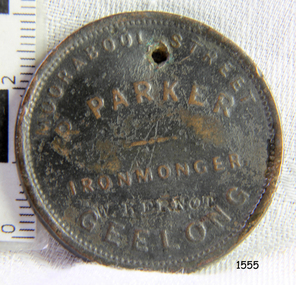
... Collins Street, Melbourne for five years before moving to Geelong in 1844. He soon established several branches of his ironmonger business in towns around Victoria. He encouraged trade by providing customers with the small change of penny tokens in exchange for their more valuable and less convenient silver coins. The token carried a surcharge and was overstamped with the mane of W. Kernot. William Charles Kernot was a chemist at Chillwell, Geelong. The token is of historical significance, representing a form of currency used in Australia's colonial era before Australia had official currency. Warrnambool Shipwreck Coast Flagstaff Hill ...This copper penny token was issued in Geelong by ironmonger R. Parker. Richard Parker was an early settler in Victoria. He had a general store in Elizabeth Street, then Collins Street, Melbourne for five years before moving to Geelong in 1844. He soon established several branches of his ironmonger business in towns around Victoria. He encouraged trade by providing customers with the small change of penny tokens in exchange for their more valuable and less convenient silver coins. The token carried a surcharge and was overstamped with the mane of W. Kernot. William Charles Kernot was a chemist at Chillwell, Geelong. The token is of historical significance, representing a form of currency used in Australia's colonial era before Australia had official currency.Token coin; a round copper one penny token. Obverse had promotional text and a sketch and was overstamped with a name. Reverse had the image of a woman holding up a set of balance scales in one hand and a cornucopia in the other, standing beside the sea, with a three-masted sailing ship in the background, There is a formed hole in the metal; on the obverse, it is on the top of the design, on the reverse it is on the bottom of the design. It advertises R. Parker, Ironmonger, Moorabool Street, Geelong, overstamped with the name W. Kernot.Embossed on the obverse: "R. PARKER / IRONMONGER. / MOORABOOL STREET / GEELONG" "W. KERNOT" Embossed on reverse: "AUSTRALIA"warrnambool, shipwreck coast, flagstaff hill, flagstaff hill maritime museum, flagstaff hill maritime village, medallion, coin, token, promotional medallion, one penny, r parker, ironmonger, moorabool street geelong, w. kernot, richard parker, currency, australian currency -
 Marysville & District Historical Society
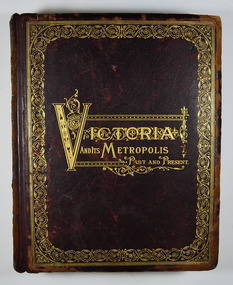
Book - Hardcover book, McCarron, Bird & Co, Victoria and its Metropolis-Past and Present-Volume 2, 1888
... LE SOUEF/ HENRY GYLES TURNER MELBOURNE: McCARRON, BIRD & CO., PUBLISHERS/ "RECORD CHAMBERS," COLLINS STREET WEST/ 1888 Land of hope! Thy hills aflame/ Proclaim the dawn of days of fame;/ The winds that sway thy forests free/ Sing of the pride of years to be/ The Starry Cross that decks thy skies/ Shall watch thy gath'ring greatness rise;/ Renewing on this Southern strand/ The glories of our Fatherland/ J.W. ...LE SOUEF/ HENRY GYLES TURNER MELBOURNE: McCARRON, BIRD & CO., PUBLISHERS/ "RECORD CHAMBERS," COLLINS STREET WEST/ 1888 Land of hope! Thy hills aflame/ Proclaim the dawn of days of fame;/ The winds that sway thy forests free/ Sing of the pride of years to be/ The Starry Cross that decks thy skies/ Shall watch thy gath'ring greatness rise;/ Renewing on this Southern strand/ The glories of our Fatherland/ J.W. ...A history of the various colonies and districts of Victoria from the time of the discovery of Australia through until 1888.Hardback. Dark brown cover with the title in gold lettering. There is also a border in gold decorating the outer edge of the front cover. The spine is also decorated in gold along with the title and the volume number.non-fictionA history of the various colonies and districts of Victoria from the time of the discovery of Australia through until 1888.melbourne, victoria, pioneers, colonisation, history, fauna, flora, banking, finance, medicine, western district, south-western district, wimmera district, geelong district, ballarat district, avoca district, coliban district, campase district, loddon district, lower goulburn district, upper goulburn district, ovens district, north-east district, gippsland district, mornington district, westernport district, upper yarra district, evelyn district, bourke district -
 Flagstaff Hill Maritime Museum and Village
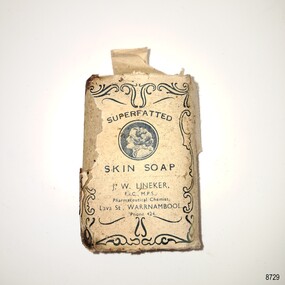
Domestic object - Soap, J W Lineker (Jean Winter Lineker) Pharmacist and Chemist, Mid-20th century
... Hill. The soap was likely part of a display inside the Rowitta. The wrapper identifies Jean Winder Lineker as a pharmaceutical chemist and lists her credentials, including Master of Pharmacy. In her earlier studies, she had passed the Pharmacy Board’s Intermediate Examination in 1924. By 1940, when she was granted probate from her late father’s will, Jean had relocated from Ballarat to 127 Fairy Street, Warrnambool, just around the corner from her Lava Street pharmacy. Jean was born at Dunkeld in 1900 to Adolphus Winter Lineker (ca. 1863–1934) and Jane Sophia Lineker, born Collins...Hill. The soap was likely part of a display inside the Rowitta. The wrapper identifies Jean Winder Lineker as a pharmaceutical chemist and lists her credentials, including Master of Pharmacy. In her earlier studies, she had passed the Pharmacy Board’s Intermediate Examination in 1924. By 1940, when she was granted probate from her late father’s will, Jean had relocated from Ballarat to 127 Fairy Street, Warrnambool, just around the corner from her Lava Street pharmacy. Jean was born at Dunkeld in 1900 to Adolphus Winter Lineker (ca. 1863–1934) and Jane Sophia Lineker, born Collins ...This early-to-mid 20th century bar, or cake, of Australian-made soap is carefully wrapped in card and finished with an attractive outer wrapper that promotes its gentle, moisturising qualities. The wrapper also records its origin: J. W. Lineker, pharmaceutical chemist, of Lava Street, Warrnambool. Although the manufacturer is unclear, the soap may have been made by the chemist herself. It was one of several items removed from the steam ferry Rowitta before the vessel was demolished in 2015, after around 40 years as a popular exhibit at Flagstaff Hill. The soap was likely part of a display inside the Rowitta. The wrapper identifies Jean Winder Lineker as a pharmaceutical chemist and lists her credentials, including Master of Pharmacy. In her earlier studies, she had passed the Pharmacy Board’s Intermediate Examination in 1924. By 1940, when she was granted probate from her late father’s will, Jean had relocated from Ballarat to 127 Fairy Street, Warrnambool, just around the corner from her Lava Street pharmacy. Jean was born at Dunkeld in 1900 to Adolphus Winter Lineker (ca. 1863–1934) and Jane Sophia Lineker, born Collins, who had married in 1899. The Lineker family had long associations with tailoring in western Victoria. An article in the Warrnambool Standard in October 1897 reported that A. W. Lineker, late of Melbourne, planned to open a tailoring establishment in Liebig Street, Warrnambool. By 1909, the family was in Portland, where they established the West End Tailoring Establishment in Julia Street. A comment in the local newspaper commends his window display; “Mr Lineker's windows attracted much attention throughout the evening, and most complimentary references were made to his neat dressing.” In 1912, they moved to Geelong and opened another tailor shop, before later moves to Ballarat, Brighton and Koroit. Adolphus died at Koroit in 1934, while Jane later returned to Dunkeld, where she died in 1940. Jane and Jean had been named joint executors of Adolphus’ will, but Jane died before probate was granted later that year. Other members of the Lineker family also operated tailoring businesses across the Western District in the late 19th and early 20th centuries. Everyday toiletries such as this offer a small but revealing insight into local retailing, personal care and pharmacy practice in regional Victoria during the mid-20th century. It is connected to pharmaceutical chemist Jean Winter Lineker, who lived in Warrnambool and ran her business there. Jean came from the well-known Lineker family: her father and other relatives operated several tailoring businesses across the western district of Victoria during the late 19th and early 20th centuries. Bar of soap: Superfatted Skin Soap within a rectangular, light coloured paper packet with navy-blue printed inscriptions on the front. The unsealed packet exposes a grey card lining and grey-fawn coloured soap. A decorative border encloses a female cameo portrait and details of the soap’s distributer. The soap originated from J. W. Lineker, pharmaceutical chemist, Lava St, Warrnambool. “SUPERFATTED / SKIN SOAP / J. W. LINEKER / FN. C., M.P.S.. / Pharmaceutical Chemist / Lava St, WARRNAMBOOL, / ‘Phone 424.” Logo within a circle: Portrait of a young lady showing the left side of her face.flagstaff hill maritime museum and village, great ocean road, shipwreck coast, warrnambool, superfatted skin soap, j. w. lineker, pharmaceutical chemist, lava st, fn. c, m.p.s., phone 424, australian made, soap, the rowitta, jean winder lineker, master of pharmacy, pharmacy board, intermediate examination, ballarat, 127 fairy street, adolphus winter lineker, jane sophia lineker, western victoria, tailor, portland, geelong, brighton, koroit, chemist, pharmacy -
 Ringwood and District Historical Society
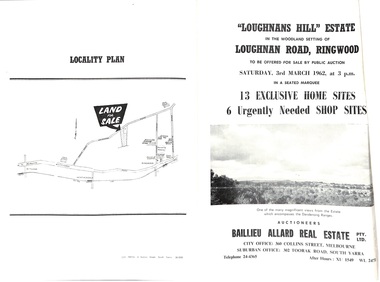
Document - Folder, Subdivision Auction - Loughnans Hill Estate 1962, Ringwood, Victoria
... Collins Street, Melbourne, and 302 Toorak Road, South Yarra. Telephone 24-4365, After hours XU1549, WL2471. Double-sided bifold page advertising auction on Saturday 3rd March, 1962 - 13 residential allotments in Hearthside Court and 6 shop sites in Loughnan Road, with map of subdivision, terms of sale, and summary of features and services. Adjoining service station shown on accompanying Plan of Subdivision - Part of Crown Allotment 28 Parish of Warrandyte, also showing location of property known as "Hearth", hence Hearthside Court. Subdivision Auction - Loughnans Hill ...Double-sided bifold page advertising auction on Saturday 3rd March, 1962 - 13 residential allotments in Hearthside Court and 6 shop sites in Loughnan Road, with map of subdivision, terms of sale, and summary of features and services. Adjoining service station shown on accompanying Plan of Subdivision - Part of Crown Allotment 28 Parish of Warrandyte, also showing location of property known as "Hearth", hence Hearthside Court.Auctioneers - Baillieu Allard Real Estate Pty Ltd., 360 Collins Street, Melbourne, and 302 Toorak Road, South Yarra. Telephone 24-4365, After hours XU1549, WL2471. -
 Ringwood and District Historical Society
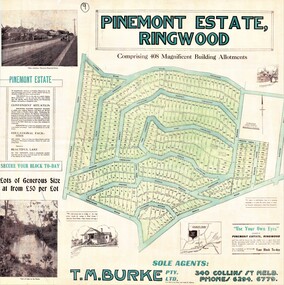
Poster, Land Sale Advertisement - Pinemont Estate, Ringwood, Victoria - circa 1924
... Collins Street Melbourne Phones 6294, 6779. Map by S. Callanan, Licensed Surveyor, 107 Elizabeth Street Melbourne. Date of poster estimated from railway services information extract " ... 36 fast electric trains to Flinders Street daily ... proposed electrification to Croydon ..." . Timeline for electrification of Lilydale Line record indicates Box Hill...Collins Street Melbourne Phones 6294, 6779. Map by S. Callanan, Licensed Surveyor, 107 Elizabeth Street Melbourne. Date of poster estimated from railway services information extract " ... 36 fast electric trains to Flinders Street daily ... proposed electrification to Croydon ..." . Timeline for electrification of Lilydale Line record indicates Box Hill ...Map of residential allotments for sale, with terms of sale, summary of subdivision features and local services and facilities, and photographs of local street scene and lake (Loughnan's Lake - location not marked), Subdivision includes Wonga Road (later Loughnan's Road), Glenvale Road, Kubba Road, Felix Crescent, Summit Crescent, Pine Crescent, Aurum Crescent, Hygeia Parade, Panorama Avenue, Avalon Grove, Montalbo Road, Cielterre Avenue. Sole Agents T.M. Burke Pty Ltd, 340 Collins Street Melbourne Phones 6294, 6779. Map by S. Callanan, Licensed Surveyor, 107 Elizabeth Street Melbourne. Date of poster estimated from railway services information extract " ... 36 fast electric trains to Flinders Street daily ... proposed electrification to Croydon ..." . Timeline for electrification of Lilydale Line record indicates Box Hill to Ringwood January 1923, Ringwood to Croydon November 1924 (Source: History of Croydon - McGivern, Vol.1 p20). -
 Ringwood and District Historical Society
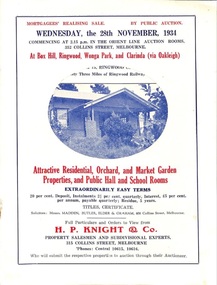
Flyer, Stillwell & Stephens Pty. Ltd, Brochure - Multiple Properties for Public Auction at Box Hill, Ringwood, Wonga Park and Clarinda - 28th November, 1934
... Collins Street, Melbourne. Solicitors: Messrs. Madden, Butler, Elder & Graham, 406 Collins Street, Melbourne. (Agents) H.P. Knight & Co. Property Salesmen and Subidivisional Experts, 315 Collins Street, Melbourne, 'Phones: Central 10615, 10616. Attractive Residential, Orchard, and Market Garden Properties, and Public Hall and School Rooms. 1. Wonga Park via Ringwood - "Holme Bush" off Warrandyte Road, Part of Lots 14 and 15, Ringwood Orchard Estate, approximatgely three miles (north) of Ringwood Railway Station - 64 Acres. 2. 17 Bishop Street, Box Hill...Collins Street, Melbourne. Solicitors: Messrs. Madden, Butler, Elder & Graham, 406 Collins Street, Melbourne. (Agents) H.P. Knight & Co. Property Salesmen and Subidivisional Experts, 315 Collins Street, Melbourne, 'Phones: Central 10615, 10616. Attractive Residential, Orchard, and Market Garden Properties, and Public Hall and School Rooms. 1. Wonga Park via Ringwood - "Holme Bush" off Warrandyte Road, Part of Lots 14 and 15, Ringwood Orchard Estate, approximatgely three miles (north) of Ringwood Railway Station - 64 Acres. 2. 17 Bishop Street, Box Hill ...Seven-page brochure advertising Mortgagees' Realising Sale by Public Auction on Wednesday, 28th November, 1934 for properties at Box Hill, Ringwood, Wonga Park, and Clarinda (via Oakleigh), including photographs, property descriptions, and terms of sale.Auction Commencing at 2.15 p.m. in the Orient Line Auction Rooms, 352 Collins Street, Melbourne. Solicitors: Messrs. Madden, Butler, Elder & Graham, 406 Collins Street, Melbourne. (Agents) H.P. Knight & Co. Property Salesmen and Subidivisional Experts, 315 Collins Street, Melbourne, 'Phones: Central 10615, 10616. Attractive Residential, Orchard, and Market Garden Properties, and Public Hall and School Rooms. 1. Wonga Park via Ringwood - "Holme Bush" off Warrandyte Road, Part of Lots 14 and 15, Ringwood Orchard Estate, approximatgely three miles (north) of Ringwood Railway Station - 64 Acres. 2. 17 Bishop Street, Box Hill - timber residence. 3. Greenwood Avenue, Ringwood - On East Side, 150 feet 3 inches South of Bedford Road - timber attic residence. 4. Ringwood - Wantirna Road, South-east corner of Canterbury Road - Orchard Property of approx. 11-1/2 Acres. 5. Box Hill - Whitehorse Road, South-east corner of Linsley Street - Timber building utilised as a Public Hall and Private School. 6. Clarinda vic Oakleigh, Talbot Crescent, off Centre Road - Home on 10 acres of land. -
 Flagstaff Hill Maritime Museum and Village
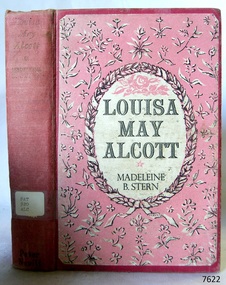
Book, Louisa May Alcott
... His aim was to foster portraiture, as well as support artists, and perpetuate the memory of great Australians. warrnambool shipwrecked-coast flagstaff-hill flagstaff-hill-maritime-museum maritime-museum shipwreck-coast flagstaff-hill-maritime-village shipwrecked-artefact book pattison collection warrnambool library warrnambool mechanics’ institute ralph eric pattison corangamite regional library service warrnambool city librarian mechanics’ institute library victorian library board warrnambool books and records warrnambool children’s library great ocean road louisa may alcott peter nevill Label on spine cover with typed text PAT 920 ALC Pastedown front endpaper has sticker from Warrnambool Mechanics Institute and Free Library covered by a sticker from Corangamite Regional Library Service Front endpaper has a small sticker that reads " F. W. Cheshire Pty. Ltd., 338 Little Collins Street ...This item is from the ‘Pattison Collection’, a collection of books and records that was originally owned by the Warrnambool Mechanics’ Institute, which was founded in Warrnambool in 1853. By 1886 the Warrnambool Mechanics’ Institute (WMI) had grown to have a Library, Museum and Fine Arts Gallery, with a collection of “… choice productions of art, and valuable specimens in almost every branch and many wonderful national curiosities are now to be seen there, including historic relics of the town and district.” It later included a School of Design. Although it was very well patronised, the lack of financial support led the WMI in 1911 to ask the City Council to take it over. In 1935 Ralph Pattison was appointed as City Librarian to establish and organise the Warrnambool Library as it was then called. When the WMI building was pulled down in 1963 a new civic building was erected on the site and the new Warrnambool Library, on behalf of the City Council, took over all the holdings of the WMI. At this time some of the items were separated and identified as the ‘Pattison Collection’, named after Ralph Pattison. Eventually the components of the WMI were distributed from the Warrnambool Library to various places, including the Art Gallery, Historical Society and Flagstaff Hill. Later some were even distributed to other regional branches of Corangamite Regional Library and passed to and fro. It is difficult now to trace just where all of the items have ended up. The books at Flagstaff Hill Maritime Village generally display stamps and markings from Pattison as well as a variety of other institutions including the Mechanics’ Institute itself. RALPH ERIC PATTISON Ralph Eric Pattison was born in Rockhampton, Queensland, in 1891. He married Maude Swan from Warrnambool in 1920 and they set up home in Warrnambool. In 1935 Pattison accepted a position as City Librarian for the Warrnambool City Council. His huge challenge was to make a functional library within two rooms of the Mechanics’ Institute. He tirelessly cleaned, cleared and sorted a disarrayed collection of old books, jars of preserved specimens and other items reserved for exhibition in the city’s museum. He developed and updated the library with a wide variety of books for all tastes, including reference books for students; a difficult task to fulfil during the years following the Depression. He converted all of the lower area of the building into a library, reference room and reading room for members and the public. The books were sorted and stored using a cataloguing and card index system that he had developed himself. He also prepared the upper floor of the building and established the Art Gallery and later the Museum, a place to exhibit the many old relics that had been stored for years for this purpose. One of the treasures he found was a beautiful ancient clock, which he repaired, restored and enjoyed using in his office during the years of his service there. Ralph Pattison was described as “a meticulous gentleman whose punctuality, floorless courtesy and distinctive neat dress were hallmarks of his character, and ‘his’ clock controlled his daily routine, and his opening and closing of the library’s large heavy doors to the minute.” Pattison took leave during 1942 to 1945 to serve in the Royal Australian Navy, Volunteer Reserve as Lieutenant. A few years later he converted one of the Museum’s rooms into a Children’s Library, stocking it with suitable books for the younger generation. This was an instant success. In the 1950’s he had the honour of being appointed to the Victorian Library Board and received more inspiration from the monthly conferences in Melbourne. He was sadly retired in 1959 after over 23 years of service, due to the fact that he had gone over the working age of council officers. However he continued to take a very keen interest in the continual development of the Library until his death in 1969. WARRNAMBOOL PUBLIC LIBRARY The Warrnambool Mechanics’ Institute (WMI) was formed by a voluntary community group in 1863, within six years of Warrnambool’s beginnings, and its Reading Room opened in 1854. The WMI operated until 1963, at which time it was one of the oldest Mechanics’ Institutes in Victoria. Mechanics’ Institutes offered important services to the public including libraries, reading rooms and places to display and store collections of all sorts such as curiosities and local historical relics. In 1886 a Museum and Fine Arts Gallery were added to the WMI and by the beginning of the 20th century there was also a billiards room and a School of Art. By this time all Mechanics’ Institutes in country Victoria had museums attached. Over the years the Warrnambool Mechanics’ Institute Library was also known as the Warrnambool Public Library the Warrnambool Library and the Free Library. Early funding from the government was for the “Free Library”. The inscription in a book “Science of Man” was for the “Warrnambool Public Library”, donated by Joseph Archibald in 1899. Another inscription in the book “Catalogue of Plants Under Cultivation in the Melbourne Botanic Gardens 1 & 2, 1883” was presented to the “Warrnambool Library” and signed by the author W.R. Guilfoyle. In 1903 the Warrnambool Public Library decided to add a Juvenile Department to library and stock it with hundreds of books suitable for youth. In 1905 the Public Library committee decided to update the collection of books and added 100 new novels plus arrangements for the latest novels to be included as soon as they were available in Victoria. In July 1911 the Warrnambool Council took over the management of the Public Library, Art Gallery, Museum and Mechanics’ Institute and planned to double the size of the then-current building. In 1953, when Mr. R. Pattison was Public Librarian, the Warrnambool Public Library’s senior section 10,000 of the 13,000 books were fiction. The children’s section offered an additional 3,400 books. The library had the equivalent of one book per head of population and served around 33 percent of the reading population. The collection of books was made up of around 60 percent reference and 40 percent fiction. The library was lending 400 books per day. In 1963 the Warrnambool City Council allocated the site of the Mechanics’ Institute building, which included the Public Library, Museum and Art Gallery, for the new Municipal Offices and the Collections were dispersed until 1971. The Warrnambool Library took over the Mechanics’ Institute Library’s holdings on behalf of the Warrnambool City Council. Since the closure of the Warrnambool Mechanics’ Institute the exact location and composition of the original WMI books and items has become unclear. Other materials have been added to the collection, including items from Terang MI, Warrnambool Court House and Customs House. Many of the books have been identified as the Pattison Collection, named after the Librarian who catalogued and numbered the books during his time as Warrnambool Public Librarian in the time before the Mechanics’ Institute closed. It seems that when Warrnambool became part of the Corangamite Regional Library some of the books and materials went to its head office in Colac and then back to Warrnambool where they were stored at the Art Gallery for quite some time. Some then went to the Warrnambool Historical Society, some stayed at the Art Gallery and some were moved to Flagstaff Hill Maritime Village. The various stamps and labels on the books held at Flagstaff Hill show the variety of the collection’s distribution and origin. The books in the collection at Flagstaff Hill Maritime Village date from the 1850’s to the late 1950’s and include rare and valuable volumes. Many of the books are part of the “Pattison Collection” after the Warrnambool’s Public Librarian, Mr. R. Pattison. The Pattison Collection, along with other items at Flagstaff Hill Maritime Village, was originally part of the Warrnambool Mechanics' Institute’s collection. The Warrnambool Mechanics’ Institute Collection is primarily significant in its totality, rather than for the individual objects it contains. Its contents are highly representative of the development of Mechanics' Institute libraries across Australia, particularly Victoria. A diversity of publications and themes has been amassed, and these provide clues to our understanding of the nature of and changes in the reading habits of Victorians from the 1850s to the middle of the 20th century. The collection also highlights the Warrnambool community’s commitment to the Mechanics’ Institute, reading, literacy and learning in the regions, and proves that access to knowledge was not impeded by distance. These items help to provide a more complete picture of our community’s ideals and aspirations. The Warrnambool Mechanics Institute book collection has historical and social significance for its strong association with the Mechanics Institute movement and the important role it played in the intellectual, cultural and social development of people throughout the latter part of the nineteenth century and the early twentieth century. The collection of books is a rare example of an early lending library and its significance is enhanced by the survival of an original collection of many volumes. The Warrnambool Mechanics' Institute’s publication collection is of both local and state significance. The Warrnambool Mechanics' Institute Collection is primarily significant in its totality, rather than for the individual objects it contains. Its contents are highly representative of the development of Mechanics' Institute libraries across Australia, particularly Victoria. A diversity of publications and themes has been amassed, and these provide clues to our understanding of the nature of and changes in the reading habits of Victorians from the 1850s to the middle of the 20th century. The collection also highlights the Warrnambool community’s commitment to the Mechanics’ Institute, and to reading, literacy and learning in the regions, and proves that access to knowledge was not impeded by distance. These items help to provide a more complete picture of our community’s ideals and aspirations. As with many Mechanics' Institutes in Australia, the one which operated in Warrnambool was established and overseen for many years by key individuals associated with the development of the city itself. The WMI publication collection is historically significant because of its association with local people, places and the key historical themes in the development of Warrnambool of rural development, industry, farming, education, and community. The collection documents and illustrates the changing interests, focus and tastes of Victorians, especially those in regional cities. Generally the individual items in the collection are not particularly rare, as examples of all probably exist in other public collections in Victoria. It is primarily because there are so very few surviving Mechanics' Institute collections in Victoria, which lends this overall collection its significance. Many items in the WMI Collection have the potential to support further research, both as individual objects and through the collection in its entirety. This material is significant for its ability to assist in the interpretation of the history of the area and adds to the general understanding of the development of the township. Many components of the WMI publication collection complement and reinforce the Flagstaff Hill Maritime Museum Collection, the Warrnambool Art Gallery Collection, and that in the Warrnambool Historical Society, and also contribute to a clearer understanding of the original Warrnambool Mechanics' Institute collections. This will greatly enhance the appreciation of the few surviving Mechanics' Institute collections across Victoria, and also in New South Wales. The similarities and differences between the small number of collections that have survived can provide further insights into how the people of Victoria in general, and Warrnambool in particular, constructed a civic culture of adult learning to foster an informed citizenry. The Warrnambool Mechanics' Institute publication collection is of both local and state significance. (This Statement of Significance is quoted from the Significance Assessment : Warrnambool Mechanics’ Institute Book Collection at Flagstaff Hill Maritime Museum, February 2009, by Annette Welkamp, Cultural Connections, for Delise Oldfied, FHMV) References Juvenile Department in Warrnambool Public Library In August 1903 The Age newspaper reported in its Warrnambool news section that “With the object of discouraging boys from reading literature of the “penny dreadful” class, the committee of the local public library has decided to open a juvenile department and to stock it with hundreds of suitable books attractive to the youthful mind.” 100 new novels added to Warrnambool Public Library Shelves In November 1905 The Argue newspaper’s Warrnambool news section announced “The committee of the Public Library is bringing the collection of books more up to date. It has recently added 100 new novels to the shelves, and arrangements have been made for a supply of the latest novels immediately they arrive in the state.” Warrnambool Town Council takes over Mechanics’ Institute, Art Gallery, Public Library, Museum – and will double the building’s size In 1912 The Age reported in its Warrnambool news section “Considerable improvements are being effected by the town council in the most picturesque part of Liebig Street. Between the fire brigade station and the mechanics’ institute and art gallery a vacant block of land is being transformed a garden for carpet bedding and flowering plants. The council, which recently took over the control of the art gallery, public library, museum and mechanics’ institute, is doubling the size of the substantial stone building containing these institutions. The new building will contain a supper room for use in conjunction with functions in the town hall, adjoining, and a new reading room.” Mr Pattison, Public Librarian, says Library has a book per head of population In 1953 The Age reported an interview with the Public Librarian, Mr. R. Pattison, who said “Warrnambool has an insatiable thirst for reading. And its reading recipe contains a strong dash of fiction – 73 percent of it. Fiction makes up 10,000 of the 13,000 books in the senior section of the public library. That works out at a book per head of population. Warrnambool today is really book minded. This city has an almost insatiable thirst for knowledge as well as fiction. We’re lending 400 books a day. We supply 33 percent of the reading population of Warrnambool.” The reporter goes on to say “Warrnambool Public Library also has an ultra-modern children’s section of 3,400 books, open to every boy and girl attending school in Warrnambool. Mr Pattison hopes to show travel-talk films and install a radiogram in the children’s section “later on”. But it won’t disturb adult reading next door because the junior section is sound proof. “ Mechanics’ Institutes and Museums Mechanics’ Institutes were important sites for collecting in country Victoria … Warrnambool … all had museums attached to Mechanics’ Institutes before the end of the twentieth century” Warrnambool Mechanics’ Institute Ms Tierney said FHMV holds the collection of the Warrnambool Mechanics’ Institute in three different locations on its site. “The Mechanics’ Institute opened in 1871, was demolished in the 1960s and was one of the oldest in Victoria. “FHMV intends to create a new storage area and bring the collection together in one place which will greatly facilitate access and research. “The collection consists of books and archives dating from the 1850s to 1959s. “Some of the books are rare and valuable but it is unclear as to their relevance to the history of Warrnambool or Victoria,” Ms Tierney said. Warrnambool TAFE History South West TAFE has a long and proud history of providing technical and specialist education, with links back to the formation of the Mechanic’s Institute in 1853. Warrnambool Art Gallery’s History The Warrnambool Art Gallery began in 1886 when retired police officer Joseph Archibald opened its doors in a building behind the mechanics institute in Liebig Street. The Gallery began with an eclectic mix of artworks and museum curios. Before long Archibald mobilised public support and paid for a new gallery annex. Loans and grants allowed the Gallery collection to grow with significant early acquisitions by French, German, and Belgian artists, which were less expensive than British works. Despite its enthusiastic start the economic downturn of the 1890s brought the Collection to a halt. In 1910 the Council took control of the Mechanics Institute and ran the Gallery there until 1963 when the building was allocated for municipal offices. The Collection was dispersed on loan to galleries in Shepparton and Hamilton and not reunited until 1971. In 1986 the Gallery’s Centenary year, a permanent home was built next to the ‘Civic Green’ and named in memory of one its champions Sir Fletcher Jones O.B.E. 2016 Warrnibald Entries Joseph Archibald established the Warrnambool Museum and Art Gallery in 1886 while his son Jules Francois Archibald founded the Archibald Prize through his bequest of 1919. His aim was to foster portraiture, as well as support artists, and perpetuate the memory of great Australians. Louisa May Alcott Author: Madeleine B Stern Publisher: Peter Nevill Date: 1952Label on spine cover with typed text PAT 920 ALC Pastedown front endpaper has sticker from Warrnambool Mechanics Institute and Free Library covered by a sticker from Corangamite Regional Library Service Front endpaper has a small sticker that reads " F. W. Cheshire Pty. Ltd., 338 Little Collins Street, Melbourne."warrnambool, shipwrecked-coast, flagstaff-hill, flagstaff-hill-maritime-museum, maritime-museum, shipwreck-coast, flagstaff-hill-maritime-village, shipwrecked-artefact, book, pattison collection, warrnambool library, warrnambool mechanics’ institute, ralph eric pattison, corangamite regional library service, warrnambool city librarian, mechanics’ institute library, victorian library board, warrnambool books and records, warrnambool children’s library, great ocean road, louisa may alcott, peter nevill -
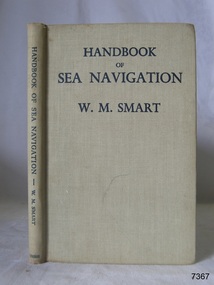 Flagstaff Hill Maritime Museum and Village
Book - Reference guide, William Marshall Smart (W M Smart), Professor of Astronomy, A Handbook of Sea Navigation, 1943
... Hill Maritime Museum and Village...Warrnambool...Maritime Museum...Maritime Village...Great Ocean Road...Shipwreck Coast...Longmans Green and Co....Thomas Longman...Paternoster Row London...W M Smart...William Marshall Smart...Astronomer...Navigator...Professor of Astronomy...1943...G.F. Byrne...Collins Book Depot...Technical Book Department...361 Swanston St....Melbourne...Frederick Henry (Harry) Slamen...361 Swanston Street...Hill Maritime Museum and Village Warrnambool Maritime Museum Maritime Village Great Ocean Road Shipwreck Coast Longmans Green and Co. Thomas Longman Paternoster Row London W M Smart William Marshall Smart Astronomer Navigator Professor of Astronomy 1943 G.F. Byrne Collins Book Depot Technical Book Department 361 Swanston St. Melbourne Frederick Henry (Harry) Slamen 361 Swanston Street ...Author W M Smart, M.A., D.SC., F.R.A.S. (William Marshall Smart), (1889-1975) Regius Professor of Astronomy in the University of Glasgow, Instructor-Lieut. in the Royal Navy during World War I. and John Couch Adams Astronomer in the University of Cambridge. In 1943 he was elected as a fellow of the Royal Society of Edinburg. From 1949-1951 he was President of the Royal Astronomical Society and a member of the Royal Institute of Navigation. In 1958 he was awarded the Lorimer Medal of the Astronomical Society of Edinburgh. The publisher firm, Longmans, Green & Co, was originally founded in 1724 in London by Thomas Longman under the name Longman. In August of that year, he bought the two shops and goods of William Taylor and set up his publishing house there at 39 Paternoster Row. The shops were called Black Swan and Ship, and it is said that the 'ship' sign was the inspiration for Longman's Logo. After many changes of name and management, the firm was incorporated in 1926 as Longmans, Green & Co. Pty Ltd. The firm was acquired by Pearson in 1968 and was known as Pearson Longman or Pearson PLC. The book was sold by Collins Book Depot which was founded by Frederick Henry (Harry) Slamen in 1922. In 1929 the form became a Proprietary Limited Company with an additional two stores, at 95 Elizabeth and 361 Swanston Streets, Melbourne. Collins Booksellers is still owned by the Stamen family. It is the largest Australian-owned bookselling chain.The book is significant due to its connection with navigation at sea. Its author W M Smart was a learned astronomer and an Instructor-Lieutenant for the Royal Navy during World War I. His achievements were recognised in 1958 when he was awarded the Lorimer Medal of the Astronomical Society of Edinburgh.A Handbook of Sea Navigation: The Theory & Practice of Astronomical Navigation at Sea, with diagrams and charts Author: W M Smart, M.A., D.SC., F.R.A.S. (William Marshall Smart) Publisher: Longmans, Green and Co Printer: Collins Book Depot Date: 1943 Textured green hardcover book. Inscriptions on the Fly page.Pencil: "12/6" [12 shillings 6 pence] Sticker: "G.F. Byrne / Faunce Crescent / O'Connor, A.C.T. / Australia 2001" Stamp: "COLLINS BOOK DEPOT PTY. LTD. / Technical Book Department / 361 Swanston St., Melb. G - - -"flagstaff hill, flagstaff hill maritime museum and village, warrnambool, maritime museum, maritime village, great ocean road, shipwreck coast, longmans green and co., thomas longman, paternoster row london, w m smart, william marshall smart, astronomer, navigator, professor of astronomy, 1943, g.f. byrne, collins book depot, technical book department, 361 swanston st., melbourne, frederick henry (harry) slamen, 361 swanston street melbourne, a handbook of sea navigation, maritime handbook, navigation instructiono, sea navigation -
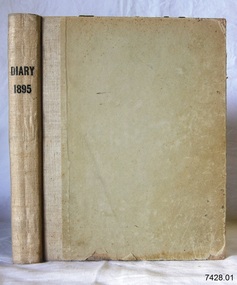 Flagstaff Hill Maritime Museum and Village
Book - Diary, Sands & McDougall Limited, Diary 1895, ca. 1895
... Flagstaff Hill Warrnambool Shipwrecked coast Flagstaff Hill Maritime Museum Maritime Museum Shipwreck coast Flagstaff Hill Maritime Village Great Ocean Road Bank of Australasia BoA Union Bank Australia & New Zealand Bank ANZ Bank Commerce David Charters McArthur D C McArthur Bank of Australasia Warrnambool Sands & McDougall Diary Set of 5 diaries 1895-1899 1895 Samuel Hannaford W H Palmer Basil Spence H B Chomley A Butt J R McCleary A Kirk J Moore J S Bath C C Cox Richard C Stanley Printed on spine "DIARY / 1895" Printed on label in blue ink "NO. __ Date __ 18 __ / Sands & McDougall Limited / Manufacturing Stationers / 365 Collins Street / Melbourne" "IN RE-ORDERING THIS BOOK IT IS NECESSARY THE NO. & DATE ONLY" In pencil "R- - - - - 5/-" [Five shillings] Bank Manager's Diary, 1895. ...This Bank Manager’s Diary is one of a set of five Bank of Australasia, Warrnambool branch, diaries that span the years 1895 to 1899. A Butt was Manager from 1895-1904 and J R McCleary was Accountant and Acting Manager for 12 months, until 1900. Either or both of these men could have filled in the bank’s Diary. This diary cost five shillings (5//-). Each of the diaries in the set was manufactured by the famous Melbourne stationers, Sands & Mc Dougall Limited. The business was established as a printing partnership in 1851 by John Sands and his brother-in-law Thomas Kenny, and in 1860 Dugald McDougal joined them. The firm was re-named Sands & McDougall a year later after Kenny retired. The company was renowned as stationers, booksellers, printers and account book manufacturers and by the 1870s was one of the largest businesses in Australia. The Bank of Australasia was incorporated by Royal Charter of England in March 1834. It had its Australian beginning on 14th December 1835, opening in Sydney. The Acting Superintendent of the bank at that time was David Charters McArthur. He was Superintendent from 1867 to 1876. The Melbourne branch opened on 28th August 1838 in a two-roomed brick cottage on the north side of Little Collins Street. By 1879 the bank had been upgraded to a magnificent two-storey building on the corners of Collins and Queens Streets, with the entry on Collins Street In 1951 the Bank of Australasia amalgamated with the Union Bank to form the Australia and New Zealand Bank, now known as the ANZ. Then in 1970, the ANZ merged with both the ES&A and the London Bank of Australia to form the ANZ Banking Group Limited. The ANZ Banking Group Ltd kindly donated a variety of historic items from the Bank of Australasia. BANK of AUSTRALASIA, WARRNAMBOOL – In 1854 Warrnambool had two banks, the Union Bank and the Bank of Australasia. Later, completely different bank businesses opened; in 1867 the National Bank of Australasia, then in 1875 the Colonial Bank of Australasia. The original Warrnambool branch of the Bank of Australasia was established in July 1854, and operated from a leased cottage on Merri Street, close to Liebig Street. The bank next bought a stone building previously erected by drapers Cramond & Dickson on the corner of Timor and Gibson Streets. Samuel Hannaford was a teller and then Manager at the Warrnambool branch from 1855 to 1856 and the Warrnambool Council chose that bank for its dealings during 1856-57. In 1859 Roberts & Co. was awarded the contract to build the new Bank of Australasia branch for the sum of £3,000; the firm built the Warrnambool Post Office in 1856 and purchased land in Timor Street in 1858. The land was on a sand hill on the northeast corner of Timor and Kepler Streets and had been bought in 1855 by investor James Cust. The new building opened on May 21, 1860. The bank continued to operate there until 1951 when it merged with the Union Bank to form the ANZ Bank, which continued operating from its Liebig Street building. Warrnambool City Council purchased the former Bank of Australasia building in 1971 and renovated it, then on 3rd December 1973 it was officially opened as the Art Gallery by Cr. Harold Stephenson and Gallery Director John Welsh. The Gallery transferred to the purpose-built building in Liebig Street in 1986 and the old bank building is now the Gallery club. Staff at the Bank of Australasia in Warrnambool included the following men but others were also involved: Samuel Hannaford, Teller then Manager from 1855-1856; Hawkins, Manager in 1856, W H Palmer, Manager from January 1857 until November 1869 when the Teller Basil Spence was promoted to Manager; H B Chomley, Manager from April 1873 and still there in 1886; A Butt, Manager in 1895-1904; J R McCleary Accountant and Acting Manager for 12 months, until 1900; A Kirk, Manager 1904; J Moore, staff until his transfer to Bendigo in December 1908; J S Bath was Manager until 1915; C C Cox, Manager until April 1923; Richard C Stanley, Manager 1923 to April 1928. The set of diaries has significance through its association with the Bank of Australasia. The early Australian bank was established in 1834 by Royal Charter and opened in Sydney, Australia, in Sydney in 1835. The bank had many Australian offices in November 1877, particularly on the east and south coasts. Victoria had 45 per cent of all Offices. The set of diaries is locally significant for its association with the Warrnambool Bank of Australasia, which was established in 1854. It was Warrnambool Council’s first bank. The bank continued to operate until the organisation's merger in 1951 when it became the ANZ Bank Group today. The Bank was an integral part of the growth of local commerce and the community.Bank Manager's Diary, 1895. One of a set of five diaries of the Bank of Australasia, Warrnambool, from 1895 to 1899. The front endpper has a pencil inscription and printed label attached. Manufactured by Sands McDougall Limited, Melbourne.Printed on spine "DIARY / 1895" Printed on label in blue ink "NO. __ Date __ 18 __ / Sands & McDougall Limited / Manufacturing Stationers / 365 Collins Street / Melbourne" "IN RE-ORDERING THIS BOOK IT IS NECESSARY THE NO. & DATE ONLY" In pencil "R- - - - - 5/-" [Five shillings]flagstaff hill, warrnambool, shipwrecked coast, flagstaff hill maritime museum, maritime museum, shipwreck coast, flagstaff hill maritime village, great ocean road, bank of australasia, boa, union bank, australia & new zealand bank, anz bank, commerce, david charters mcarthur, d c mcarthur, bank of australasia warrnambool, sands & mcdougall, diary, set of 5 diaries 1895-1899, 1895, samuel hannaford, w h palmer, basil spence, h b chomley, a butt, j r mccleary, a kirk, j moore, j s bath, c c cox, richard c stanley -
 Flagstaff Hill Maritime Museum and Village
Book - Diary, Sands & McDougall Limited, Diary 1896, 1896
... Flagstaff Hill Warrnambool Shipwrecked coast Flagstaff Hill Maritime Museum Maritime Museum Shipwreck coast Flagstaff Hill Maritime Village Great Ocean Road Bank of Australasia BoA Union Bank Australia & New Zealand Bank ANZ Bank Commerce David Charters McArthur D C McArthur Bank of Australasia Warrnambool Sands & McDougall Diary Set of 5 diaries 1895-1899 1896 Samuel Hannaford W H Palmer Basil Spence H B Chomley A Butt J R McCleary A Kirk J Moore J S Bath C C Cox Richard C Stanley Printed on spine "DIARY / 1896" Printed on label in blue ink "NO a 41969 Date 3 7 1895/ Sands & McDougall Limited / Manufacturing Stationers / 365 Collins Street / Melbourne" "IN RE-ORDERING THIS BOOK IT IS NECESSARY THE NO. & DATE ONLY" Bank Manager's Diary, 1896. ...This Bank Manager’s Diary is one of a set of five Bank of Australasia, Warrnambool branch, diaries that span the years 1895 to 1899. A Butt was Manager from 1895-1904 and J R McCleary was Accountant and Acting Manager for 12 months, until 1900. Either or both of these men could have filled in the bank’s Diary. Each of the diaries in the set was manufactured by the famous Melbourne stationers, Sands & Mc Dougall Limited. The business was established as a printing partnership in 1851 by John Sands and his brother-in-law Thomas Kenny, and in 1860 Dugald McDougal joined them. The firm was re-named Sands & McDougall a year later after Kenny retired. The company was renowned as stationers, booksellers, printers and account book manufacturers and by the 1870s was one of the largest businesses in Australia. The Bank of Australasia was incorporated by Royal Charter of England in March 1834. It had its Australian beginning on 14th December 1835, opening in Sydney. The Acting Superintendent of the bank at that time was David Charters McArthur. He was Superintendent from 1867 to 1876. The Melbourne branch opened on 28th August 1838 in a two-roomed brick cottage on the north side of Little Collins Street. By 1879 the bank had been upgraded to a magnificent two-storey building on the corners of Collins and Queens Streets, with the entry on Collins Street In 1951 the Bank of Australasia amalgamated with the Union Bank to form the Australia and New Zealand Bank, now known as the ANZ. Then in 1970, the ANZ merged with both the ES&A and the London Bank of Australia to form the ANZ Banking Group Limited. The ANZ Banking Group Ltd kindly donated a variety of historic items from the Bank of Australasia. BANK of AUSTRALASIA, WARRNAMBOOL – In 1854 Warrnambool had two banks, the Union Bank and the Bank of Australasia. Later, completely different bank businesses opened; in 1867 the National Bank of Australasia, then in 1875 the Colonial Bank of Australasia. The original Warrnambool branch of the Bank of Australasia was established in July 1854, and operated from a leased cottage on Merri Street, close to Liebig Street. The bank next bought a stone building previously erected by drapers Cramond & Dickson on the corner of Timor and Gibson Streets. Samuel Hannaford was a teller and then Manager at the Warrnambool branch from 1855 to 1856 and the Warrnambool Council chose that bank for its dealings during 1856-57. In 1859 Roberts & Co. was awarded the contract to build the new Bank of Australasia branch for the sum of £3,000; the firm built the Warrnambool Post Office in 1856 and purchased land in Timor Street in 1858. The land was on a sand hill on the northeast corner of Timor and Kepler Streets and had been bought in 1855 by investor James Cust. The new building opened on May 21, 1860. The bank continued to operate there until 1951 when it merged with the Union Bank to form the ANZ Bank, which continued operating from its Liebig Street building. Warrnambool City Council purchased the former Bank of Australasia building in 1971 and renovated it, then on 3rd December 1973 it was officially opened as the Art Gallery by Cr. Harold Stephenson and Gallery Director John Welsh. The Gallery transferred to the purpose-built building in Liebig Street in 1986 and the old bank building is now the Gallery club. Staff at the Bank of Australasia in Warrnambool included the following men but others were also involved: Samuel Hannaford, Teller then Manager from 1855-1856; Hawkins, Manager in 1856, W H Palmer, Manager from January 1857 until November 1869 when the Teller Basil Spence was promoted to Manager; H B Chomley, Manager from April 1873 and still there in 1886; A Butt, Manager in 1895-1904; J R McCleary Accountant and Acting Manager for 12 months, until 1900; A Kirk, Manager 1904; J Moore, staff until his transfer to Bendigo in December 1908; J S Bath was Manager until 1915; C C Cox, Manager until April 1923; Richard C Stanley, Manager 1923 to April 1928. The set of diaries has significance through its association with the Bank of Australasia. The early Australian bank was established in 1834 by Royal Charter and opened in Sydney, Australia, in Sydney in 1835. The bank had many Australian offices in November 1877, particularly on the east and south coasts. Victoria had 45 per cent of all Offices. The set of diaries is locally significant for its association with the Warrnambool Bank of Australasia, which was established in 1854. It was Warrnambool Council’s first bank. The bank continued to operate until the organisation's merger in 1951 when it became the ANZ Bank Group today. The Bank was an integral part of the growth of local commerce and the community.Bank Manager's Diary, 1896. One of a set of five diaries of the Bank of Australasia, Warrnambool, from 1885 to 1899. Printed label attached on front endpaper. Manufactured by Sands McDougall Limited, Melbourne.Printed on spine "DIARY / 1896" Printed on label in blue ink "NO a 41969 Date 3 7 1895/ Sands & McDougall Limited / Manufacturing Stationers / 365 Collins Street / Melbourne" "IN RE-ORDERING THIS BOOK IT IS NECESSARY THE NO. & DATE ONLY"flagstaff hill, warrnambool, shipwrecked coast, flagstaff hill maritime museum, maritime museum, shipwreck coast, flagstaff hill maritime village, great ocean road, bank of australasia, boa, union bank, australia & new zealand bank, anz bank, commerce, david charters mcarthur, d c mcarthur, bank of australasia warrnambool, sands & mcdougall, diary, set of 5 diaries 1895-1899, 1896, samuel hannaford, w h palmer, basil spence, h b chomley, a butt, j r mccleary, a kirk, j moore, j s bath, c c cox, richard c stanley -
 Flagstaff Hill Maritime Museum and Village
Book - Diary, Sands & McDougall Limited, Diary 1897, 1897
... Flagstaff Hill Warrnambool Shipwrecked coast Flagstaff Hill Maritime Museum Maritime Museum Shipwreck coast Flagstaff Hill Maritime Village Great Ocean Road Bank of Australasia BoA Union Bank Australia & New Zealand Bank ANZ Bank Commerce David Charters McArthur D C McArthur Bank of Australasia Warrnambool Sands & McDougall Diary Set of 5 diaries 1895-1899 1897 Samuel Hannaford W H Palmer Basil Spence H B Chomley A Butt J R McCleary A Kirk J Moore J S Bath C C Cox Richard C Stanley Printed on spine "DIARY / 1897" Printed on label in blue ink "NO. __ Date __ 18 __ / Sands & McDougall Limited / Manufacturing Stationers / 365 Collins Street / Melbourne" "IN RE-ORDERING THIS BOOK IT IS NECESSARY THE NO. & DATE ONLY" Bank Manager's Diary, 1897. ...This Bank Manager’s Diary is one of a set of five Bank of Australasia, Warrnambool branch, diaries that span the years 1895 to 1899. A Butt was Manager from 1895-1904 and J R McCleary was Accountant and Acting Manager for 12 months, until 1900. Either or both of these men could have filled in the bank’s Diary. Each of the diaries in the set was manufactured by the famous Melbourne stationers, Sands & Mc Dougall Limited. The business was established as a printing partnership in 1851 by John Sands and his brother-in-law Thomas Kenny, and in 1860 Dugald McDougal joined them. The firm was re-named Sands & McDougall a year later after Kenny retired. The company was renowned as stationers, booksellers, printers and account book manufacturers and by the 1870s was one of the largest businesses in Australia. The Bank of Australasia was incorporated by Royal Charter of England in March 1834. It had its Australian beginning on 14th December 1835, opening in Sydney. The Acting Superintendent of the bank at that time was David Charters McArthur. He was Superintendent from 1867 to 1876. The Melbourne branch opened on 28th August 1838 in a two-roomed brick cottage on the north side of Little Collins Street. By 1879 the bank had been upgraded to a magnificent two-storey building on the corners of Collins and Queens Streets, with the entry on Collins Street In 1951 the Bank of Australasia amalgamated with the Union Bank to form the Australia and New Zealand Bank, now known as the ANZ. Then in 1970, the ANZ merged with both the ES&A and the London Bank of Australia to form the ANZ Banking Group Limited. The ANZ Banking Group Ltd kindly donated a variety of historic items from the Bank of Australasia. BANK of AUSTRALASIA, WARRNAMBOOL – In 1854 Warrnambool had two banks, the Union Bank and the Bank of Australasia. Later, completely different bank businesses opened; in 1867 the National Bank of Australasia, then in 1875 the Colonial Bank of Australasia. The original Warrnambool branch of the Bank of Australasia was established in July 1854, and operated from a leased cottage on Merri Street, close to Liebig Street. The bank next bought a stone building previously erected by drapers Cramond & Dickson on the corner of Timor and Gibson Streets. Samuel Hannaford was a teller and then Manager at the Warrnambool branch from 1855 to 1856 and the Warrnambool Council chose that bank for its dealings during 1856-57. In 1859 Roberts & Co. was awarded the contract to build the new Bank of Australasia branch for the sum of £3,000; the firm built the Warrnambool Post Office in 1856 and purchased land in Timor Street in 1858. The land was on a sand hill on the northeast corner of Timor and Kepler Streets and had been bought in 1855 by investor James Cust. The new building opened on May 21, 1860. The bank continued to operate there until 1951 when it merged with the Union Bank to form the ANZ Bank, which continued operating from its Liebig Street building. Warrnambool City Council purchased the former Bank of Australasia building in 1971 and renovated it, then on 3rd December 1973 it was officially opened as the Art Gallery by Cr. Harold Stephenson and Gallery Director John Welsh. The Gallery transferred to the purpose-built building in Liebig Street in 1986 and the old bank building is now the Gallery club. Staff at the Bank of Australasia in Warrnambool included the following men but others were also involved: Samuel Hannaford, Teller then Manager from 1855-1856; Hawkins, Manager in 1856, W H Palmer, Manager from January 1857 until November 1869 when the Teller Basil Spence was promoted to Manager; H B Chomley, Manager from April 1873 and still there in 1886; A Butt, Manager in 1895-1904; J R McCleary Accountant and Acting Manager for 12 months, until 1900; A Kirk, Manager 1904; J Moore, staff until his transfer to Bendigo in December 1908; J S Bath was Manager until 1915; C C Cox, Manager until April 1923; Richard C Stanley, Manager 1923 to April 1928. The set of diaries has significance through its association with the Bank of Australasia. The early Australian bank was established in 1834 by Royal Charter and opened in Sydney, Australia, in Sydney in 1835. The bank had many Australian offices in November 1877, particularly on the east and south coasts. Victoria had 45 per cent of all Offices. The set of diaries is locally significant for its association with the Warrnambool Bank of Australasia, which was established in 1854. It was Warrnambool Council’s first bank. The bank continued to operate until the organisation's merger in 1951 when it became the ANZ Bank Group today. The Bank was an integral part of the growth of local commerce and the community.Bank Manager's Diary, 1897. One of a set of five diaries of the Bank of Australasia, Warrnambool, from 1885 to 1899. Printed label attached on front endpaper. Manufactured by Sands McDougall Limited, Melbourne.Printed on spine "DIARY / 1897" Printed on label in blue ink "NO. __ Date __ 18 __ / Sands & McDougall Limited / Manufacturing Stationers / 365 Collins Street / Melbourne" "IN RE-ORDERING THIS BOOK IT IS NECESSARY THE NO. & DATE ONLY"flagstaff hill, warrnambool, shipwrecked coast, flagstaff hill maritime museum, maritime museum, shipwreck coast, flagstaff hill maritime village, great ocean road, bank of australasia, boa, union bank, australia & new zealand bank, anz bank, commerce, david charters mcarthur, d c mcarthur, bank of australasia warrnambool, sands & mcdougall, diary, set of 5 diaries 1895-1899, 1897, samuel hannaford, w h palmer, basil spence, h b chomley, a butt, j r mccleary, a kirk, j moore, j s bath, c c cox, richard c stanley -
 Flagstaff Hill Maritime Museum and Village
Book - Diary, Sands & McDougall Limited, Diary 1898, 1897
... Flagstaff Hill Warrnambool Shipwrecked coast Flagstaff Hill Maritime Museum Maritime Museum Shipwreck coast Flagstaff Hill Maritime Village Great Ocean Road Bank of Australasia BoA Union Bank Australia & New Zealand Bank ANZ Bank Commerce David Charters McArthur D C McArthur Bank of Australasia Warrnambool Sands & McDougall Diary Set of 5 diaries 1895-1899 1898 Samuel Hannaford W H Palmer Basil Spence H B Chomley A Butt J R McCleary A Kirk J Moore J S Bath C C Cox Richard C Stanley Printed on spine "DIARY / 1898" Printed on label in blue ink "NO.a 08005_ Date 27 5 1887 / Sands & McDougall Limited / Manufacturing Stationers / 365 Collins Street / Melbourne" "IN RE-ORDERING THIS BOOK IT IS NECESSARY THE NO. & DATE ONLY" Bank Manager's Diary, 1898. ...This Bank Manager’s Diary is one of a set of five Bank of Australasia, Warrnambool branch, diaries that span the years 1895 to 1899. A Butt was Manager from 1895-1904 and J R McCleary was Accountant and Acting Manager for 12 months, until 1900. Either or both of these men could have filled in the bank’s Diary. Each of the diaries in the set was manufactured by the famous Melbourne stationers, Sands & Mc Dougall Limited. The business was established as a printing partnership in 1851 by John Sands and his brother-in-law Thomas Kenny, and in 1860 Dugald McDougal joined them. The firm was re-named Sands & McDougall a year later after Kenny retired. The company was renowned as stationers, booksellers, printers and account book manufacturers and by the 1870s was one of the largest businesses in Australia. The Bank of Australasia was incorporated by Royal Charter of England in March 1834. It had its Australian beginning on 14th December 1835, opening in Sydney. The Acting Superintendent of the bank at that time was David Charters McArthur. He was Superintendent from 1867 to 1876. The Melbourne branch opened on 28th August 1838 in a two-roomed brick cottage on the north side of Little Collins Street. By 1879 the bank had been upgraded to a magnificent two-storey building on the corners of Collins and Queens Streets, with the entry on Collins Street In 1951 the Bank of Australasia amalgamated with the Union Bank to form the Australia and New Zealand Bank, now known as the ANZ. Then in 1970, the ANZ merged with both the ES&A and the London Bank of Australia to form the ANZ Banking Group Limited. The ANZ Banking Group Ltd kindly donated a variety of historic items from the Bank of Australasia. BANK of AUSTRALASIA, WARRNAMBOOL – In 1854 Warrnambool had two banks, the Union Bank and the Bank of Australasia. Later, completely different bank businesses opened; in 1867 the National Bank of Australasia, then in 1875 the Colonial Bank of Australasia. The original Warrnambool branch of the Bank of Australasia was established in July 1854, and operated from a leased cottage on Merri Street, close to Liebig Street. The bank next bought a stone building previously erected by drapers Cramond & Dickson on the corner of Timor and Gibson Streets. Samuel Hannaford was a teller and then Manager at the Warrnambool branch from 1855 to 1856 and the Warrnambool Council chose that bank for its dealings during 1856-57. In 1859 Roberts & Co. was awarded the contract to build the new Bank of Australasia branch for the sum of £3,000; the firm built the Warrnambool Post Office in 1856 and purchased land in Timor Street in 1858. The land was on a sand hill on the northeast corner of Timor and Kepler Streets and had been bought in 1855 by investor James Cust. The new building opened on May 21, 1860. The bank continued to operate there until 1951 when it merged with the Union Bank to form the ANZ Bank, which continued operating from its Liebig Street building. Warrnambool City Council purchased the former Bank of Australasia building in 1971 and renovated it, then on 3rd December 1973 it was officially opened as the Art Gallery by Cr. Harold Stephenson and Gallery Director John Welsh. The Gallery transferred to the purpose-built building in Liebig Street in 1986 and the old bank building is now the Gallery club. Staff at the Bank of Australasia in Warrnambool included the following men but others were also involved: Samuel Hannaford, Teller then Manager from 1855-1856; Hawkins, Manager in 1856, W H Palmer, Manager from January 1857 until November 1869 when the Teller Basil Spence was promoted to Manager; H B Chomley, Manager from April 1873 and still there in 1886; A Butt, Manager in 1895-1904; J R McCleary Accountant and Acting Manager for 12 months, until 1900; A Kirk, Manager 1904; J Moore, staff until his transfer to Bendigo in December 1908; J S Bath was Manager until 1915; C C Cox, Manager until April 1923; Richard C Stanley, Manager 1923 to April 1928. The set of diaries has significance through its association with the Bank of Australasia. The early Australian bank was established in 1834 by Royal Charter and opened in Sydney, Australia, in Sydney in 1835. The bank had many Australian offices in November 1877, particularly on the east and south coasts. Victoria had 45 per cent of all Offices. The set of diaries is locally significant for its association with the Warrnambool Bank of Australasia, which was established in 1854. It was Warrnambool Council’s first bank. The bank continued to operate until the organisation's merger in 1951 when it became the ANZ Bank Group today. The Bank was an integral part of the growth of local commerce and the community.Bank Manager's Diary, 1898. One of a set of five diaries of the Bank of Australasia, Warrnambool, from 1885 to 1899. Handwritten inscription on a printed label attached on front endpaper. Manufactured by Sands McDougall Limited, Melbourne.Printed on spine "DIARY / 1898" Printed on label in blue ink "NO.a 08005_ Date 27 5 1887 / Sands & McDougall Limited / Manufacturing Stationers / 365 Collins Street / Melbourne" "IN RE-ORDERING THIS BOOK IT IS NECESSARY THE NO. & DATE ONLY"flagstaff hill, warrnambool, shipwrecked coast, flagstaff hill maritime museum, maritime museum, shipwreck coast, flagstaff hill maritime village, great ocean road, bank of australasia, boa, union bank, australia & new zealand bank, anz bank, commerce, david charters mcarthur, d c mcarthur, bank of australasia warrnambool, sands & mcdougall, diary, set of 5 diaries 1895-1899, 1898, samuel hannaford, w h palmer, basil spence, h b chomley, a butt, j r mccleary, a kirk, j moore, j s bath, c c cox, richard c stanley -
 Flagstaff Hill Maritime Museum and Village
Financial record - Bank Transaction Book, Commercial Banking Company of Sydney Limited, before 1931
... Hill Maritime Village opened in 1975 and began renovating the Cottage, in stages. Text on the fly page of the book is as follows – “The Commercial Banking Company of Sydney Limited with which is Amalgamated THE BANK OF VICTORIA LIMITED. Head Office – SYDNEY. Melbourne Office: 237 COLLINS STREET...Hill Maritime Village opened in 1975 and began renovating the Cottage, in stages. Text on the fly page of the book is as follows – “The Commercial Banking Company of Sydney Limited with which is Amalgamated THE BANK OF VICTORIA LIMITED. Head Office – SYDNEY. Melbourne Office: 237 COLLINS STREET ...The financial account book was used by the Warrnambool Harbour Board for its Emergency Account. It records transactions made with The Warrnambool branch of the Commercial Banking Company of Sydney Limited during the year 1931. The Secretary of the Warrnambool Harbour Board would have used this book in 1931. James Menzies, Pilot arid Harbour Master from 1929, was appointed as Acting Secretary for the Board in 1932 and held this office until the Board ceased in 1936. Warrnambool’s CBC Manager during this time was L E Whitney; he was Manager from 1924 to 1939. The Commercial Banking Company of Sydney Limited opened in 1893. On January 1, 1927 the CBC amalgamated with the Bank of Victoria. In 1981 the CBC merged with the National Bank of Australasia Limited and on January 1, 1983 the bank started using the abbreviated name of the National Australia Bank (NAB). Warrnambool Harbour Board- The Warrnambool Harbour Board was constituted by Order of Council on May 29, 1928, under the Harbour Board’s Act of 1927, taking over from the Ports and Harbours Branch of the Public Works Department of Victoria. The Board was then the only body with power to manage and control the whole Port, including shipping, facilities upkeep and improvements of the port. The work it carried out involved dredging, building of port facilities and drafting of port regulations, and collecting taxes, tolls, rates and charges. The Board was officially dissolved on June 30, 1936, at which time the Public Works Department again had control. The Warrnambool Harbour Board had rented out the Lighthouse Keeper’s Quarters from the 1920s until 1936, when the Board closed down. However, rentals continued with other currently unknown landlords until Flagstaff Hill Maritime Village opened in 1975 and began renovating the Cottage, in stages. Text on the fly page of the book is as follows – “The Commercial Banking Company of Sydney Limited with which is Amalgamated THE BANK OF VICTORIA LIMITED. Head Office – SYDNEY. Melbourne Office: 237 COLLINS STREET. BANKING Business of every description transacted. BRANCHES throughout VICTORIA, NEW SOUTH WALES and QUEENSLAND, and ADELAIDE BRANCH, SOUTH AUSTRALIA, and AGENCIES throughout AUSTRALASIA and NEW ZEALAND on which DRAFTS AND LETTERS OF CREDIT Are issued and also on LONDON BRANCH and AGENCIES in all the PRINCIPAL CITIES of the world. Telegraphic Remittances made, Bills Negotiated or Forwarded for Collection, Advances made, Deposits received, Current Accounts kept. FURTHER PARTICULARS ON APPLICATON. “ This bank transaction book is of local and state significance for its association with the Port of Warrnambool and the Warrnambool Harbour Board. The Warrnambool Harbour Board was the only board formed under the 1927 Harbour Boards Acts, even though other Victorian ports were eligible. The book is also significant as an example of bank records used by Australian and overseas branches of the Commercial Banking Company of Sydney Limited, and the Bank of Victoria Limited.Maroon coloured rectangular book with textured cover and cream coloured label attached. Label has a printed title on book plus hand written titles added in black and red. The corners of the book are rounded. The white pages have pre-printed text and lines. The book was used for transactions between the Warrnambool Harbour Board’s Emergency Account and the Commercial Banking Company of Sydney Limited during the year 1931.Handwritten in black “WARRNAMBOOL HARBOUR BOARD “, “EMERGENCY A/C” Printed in black “IN ACCOUNT CURRENT WITH”, “The Commercial Banking Coy. Of Sydney Ltd.”, “WITH WHICH IS AMALGAMATED”, “THE BANK OF VICTORIA LIMITED”, “Page …”warrnambool, shipwrecked-coast, flagstaff-hill, flagstaff-hill-maritime-museum, maritime-museum, shipwreck-coast, flagstaff-hill-maritime-village, warrnambool harbour board, financial account, emergency account, financial record, commercial banking company of sydney limited, 1931 bank book, bank of victoria limited, transaction book, financial management, stationery, deposit book, public works department, ports and harbours, commercial banking company of sydney ltd., james menzies, harbour master, l e whitney, cbc manager warrnambool, harbour board act, port of warrnambool, warrnambool harbour, lady bay, harbour pilot -
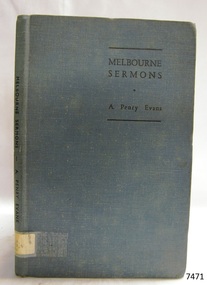 Flagstaff Hill Maritime Museum and Village
Book, Melbourne Sermons
... Hill-Maritime-Village Shipwrecked-artefact Book Melbourne Sermons Rev. A Penry Evans Label on spine cover with typed text RA 252.4 EVA Melbourne Sermons Author: Rev. A Penry Evans Publisher: Collins Street ...Melbourne Sermons Author: Rev. A Penry Evans Publisher: Collins Street Independant Church Date: 1946Label on spine cover with typed text RA 252.4 EVA warrnambool, shipwrecked-coast, flagstaff-hill, flagstaff-hill-maritime-museum, maritime-museum, shipwreck-coast, flagstaff-hill-maritime-village, shipwrecked-artefact, book, melbourne sermons, rev. a penry evans -
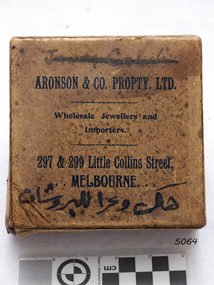 Flagstaff Hill Maritime Museum and Village
Box
... flagstaff hill warrnambool shipwrecked-coast flagstaff-hill flagstaff-hill-maritime-museum maritime-museum shipwreck-coast flagstaff-hill-maritime-village box Aronson & Co Propty Ltd Square cardboard box with metal corner supports. Has "Aronson & Co Propty Ltd. Wholesale Jewellers and Importers 297 & 299 Little Collins Street Melbourne". ...Square cardboard box with metal corner supports. Has "Aronson & Co Propty Ltd. Wholesale Jewellers and Importers 297 & 299 Little Collins Street Melbourne". Has small items in box.flagstaff hill, warrnambool, shipwrecked-coast, flagstaff-hill, flagstaff-hill-maritime-museum, maritime-museum, shipwreck-coast, flagstaff-hill-maritime-village, box, aronson & co propty ltd -
 Ringwood and District Historical Society
Document - Property Lease Agreement, "Kilalla", Wonga Park Road, Warranwood, Victoria - 31st May 1949
... Collins Street, Melbourne, C.1. Single sheet legal document folded to 4 pages (one page blank). Lease agreement between GRACE MABEL DARBYSHIRE of "Kialla" Wonga Park Road Warranwood in the State of Victoria (lessor) and JOHN HENRY GUNN of 56 Grant Street Clifton Hill in the State of Victoria (lessee). ...Single sheet legal document folded to 4 pages (one page blank). Lease agreement between GRACE MABEL DARBYSHIRE of "Kialla" Wonga Park Road Warranwood in the State of Victoria (lessor) and JOHN HENRY GUNN of 56 Grant Street Clifton Hill in the State of Victoria (lessee). Two copies - original and "counterpart".Victorian Stamp Duty imprint - one shilling - date stamped 20 June 1949. One of the 2 copies is rubber stamped "The original instrument of which this is a counterpart is duly stamped" and signed by the Deputy Comptroller of Stamps. Signature section includes witness - Charles E Carter, Commissioner for taking Affidavits and Declarations under Evidence Act 1915. Solicitor details on cover panel - E.L. Moran, LL.B., 281 Collins Street, Melbourne, C.1. -
 Eltham District Historical Society Inc
Binder, Eltham District History, Eltham Road Board, 1856-1871; Research by Keith Chappel, 1971-1974
... collins...the explorers and early colonists of victoria...the story of the camera in australia...thomas bell darling...thomas clarke...thomas darling...thomas foster chuck...thomas grant...thomas henry bowman...thomas herbert power...thomas irvine...thomas maltby...thomas mccombie...thomas scarce...thomas sweeny...thornton street...town of eltham...vaccinations act...victorian government gazette...virtue hall station...virtue hill...francis watson rosier frank haley frank wayne maas franklin william nankervis frederick charles barrett frederick edward falkiner frederick eldred griffith frederick filed durham frederick gration frederick kirk gration frederick vincent squire fredrick ninck g. drabble g. haley g. hodgkins g. lee g. thomas g. thomson g.d. boursiquot g.f. belcher garden hill geoffrey charles dreverman geology george d'arley boursiquot george ellis parker george fletcher george frederick belcher george haley george hirt george louie cresp george love george robertson george turnbull george wise godalmin street gold mining goodman gordon melville government gazette graham lindsay bride grazing greenhill greensborough grierson gun maker h. g. james h. stooke h. taylor h.g. jhones h.t. beams harold edward bartlett heatherleigh heidelberg helen louise wells henry creswell henry gilbert jones henry holloway henry peers herbert eric rundle herbert hewitt herbert rutter hoddle holiday resort horace hilton house of assembly hugh larimour hurst i. barrow i. rooks ian g smedley ian gordon smedley industry isaac rooks isidore t. wilmor j. alison j. brown j. cameron j. carfrae & co. j. ferguson j. frank j. garthwaite j. greaves j. greitzner j. irish j. lindsay j. murray j. o'brien j. stevenson j. wilson j.b. phipps j.b. rodda j.f. imley j.g. foxton j.g. fraser j.h.f. hawke j.k. zahn j.m. holloway j.p. imley jack cato jack clendinnen gill jacob belcham jacob greitzner jakeb greitzner james bailey james cox james d mealy james darley mealy james frank james frederick mackay james graham james johnstone james kay bryce james mclaren james murray james oliver white james pearson imley james pearsons imley james rosier james ryan jane thompson jersey johann karl zahn john a porter john alexander hampton lewis john alison john b. wilson john barter bennett john blackmore phipps john blakemore phipps john carfrae john dane john g. foxton john gerald searle john greaves john green foxton john greenlaw foxton john henry sabelberg john johnstone john lee smith john lindsay john lindsay beale john mann john mason john pape john porter john samuel lithgow john stevenson john verran mcconnell john wilson jonathan scott joseph anderson panton joseph bromley shallard joseph garthwaite joseph smedley joseph walter henry bradbury josiah morris holloway k.e. dunstan m kinglake keelbundora kenneth chareles crompton kenneth donald macmillan kenneth frederick hines kenyon kerby street kinglake school krelbundora l. jenyns l.m. bill lancefield land act 1862 land act 1865 land act 1869 land alienation land settlement legislative council leopold kershaw lawry leslie christopher docksey leslie edward clarke little eltham school m. o'shea m.h. fitzpatrick mail run mail service main road map margaret moody martin fogarty mary leak maxwell alexander spence medical practitioner michael o'shea miss haley moira morang mr. ford mrs galbraith n. gillies n. rodda name names neil stewart roberts norman ernest charles williams opening orchard district p. ryan p.a.c o'farrell p.p. cotter parish of nillumbik parish of nillumbik 1856 patrick costello patrick turnbull percy downer peter andrew charles o'farrell peter fair peter graham petr lawlor phillip cumming photographer plenty river polling place polling places porter street portrait post office post office directory 1868 princes bridge proclamation r. boston r. hepburn r. lane r. wadeson r.d. mess r.s.h. moody radley (rodney) douglas quin rag mill railway lines raymond clive duncan registrar research state school no. 2959 reserve for aborigines reynolds road richard jones and co richard robert woolcott river plenty robert alan bell robert benn (ship) robert cadden robert cunningham white robert david taylor robert hepburn robert kenneth marshall robert miller robert reid robert stewart hull moody robinia joyce rodda family rosemount rupert norman maskell ryans road s. evans s. wekey samuel evans samuel phillips samuel ramsden samuel w. scott searle shire of diamond valley sigismund wekey sly grog seller sources south province south yarra st kilda stanley simpson addison strathbogie strippers of bark stuart alexander donaldson sweeneys lane sweeny sylvia ruth houston t. archer t. huntley t. murray t. stephens t. watkins t.a. stork t.b. daling t.b. darling t.c. darling t.milthorpe t.p. cross tannery tenders terence alphonsus collins the explorers and early colonists of victoria the story of the camera in australia thomas bell darling thomas clarke thomas darling thomas foster chuck thomas grant thomas henry bowman thomas herbert power thomas irvine thomas maltby thomas mccombie thomas scarce thomas sweeny thornton street town of eltham vaccinations act victorian government gazette virtue hall station virtue hill w. archer w. brown w. gordon w. inglis w. jones w. matthew w. mcdonald w. williams w. wilson w.r. belcher w.t. fitzpatrick walter craig walter wipple warringal water wheel wattle glen whittlesea william acland william adams william b. burnley william buckingham william c. farrell william cleve william craig william frederick ford william george gray william henry hull william john taylor william john turner clarke william johnson william jones william lorimer william morris william redmond belcher william thomas cochrane william vasey houghton william walker william wandliss herbert william white willie haley willie stanley dawson yan yean yarra flats yarra river yielima york street yow yow gully zig zag road Frederick George hurst Grimshaw mrs s marshall mrs mcclelland bushfire parish of greensborough f. baker h. hude j.l. caudwell m. borelli p.e. clarke church of england reserve m. miller t.j. carr i.d. marshall t.c. pickering m.e. lazarus w.r. gathercole j.p. adam p.f. plunkett state school reserve t. wilkinson a.e. hopkinson m.l. merritt w.e. apted e. cohen g. brandt j.j. foubister h. foubister w.h. hopkinson mechanics institute & free library j.o. hughes church of england trusts corporation c.a. brennan j.a.d. brennan e.m. tucker j. carter e. carter p.e. plunkett j. plunkett cricket and recreation reserve d.j. & e.i. ross w. wigham l.s. mendes Two binders containing 486 A4 pages (photocopied) of mostly handwritten notes from research undertaken of Public Office Records of Victoria various holdings. ...Eltham District History, Eltham Road Board, 1856-1871Two binders containing 486 A4 pages (photocopied) of mostly handwritten notes from research undertaken of Public Office Records of Victoria various holdings. Some photocopies from source reference books. Includes 20 page subject index (handwritten) at front and 5 pages of notes and sources at rear and a photocopy of short biography of Keith Chappel.a. foley, a. harkness, a. mackie, a. mcintyre, a. von ziegler, a.a. vivian, a.d. kinninmont, a.d. quadri, a.h. grimshaw, a.w. page, aboriginal reserve, aborigines, abraham quarman, abraham rooks, abraham taylor, adam goudie, aenaes harrison, agnes black, agnes charlton, agnes dalrymple, ah chong, ah cock, ah hein, ah lie, ah sing, albert lunson, albert ness, albert parker, albert ramseyor, alert hunt, alex cameron, alex eason, alex mcandrew, alexander crichton, alexander donaldson, alexander falconer, alexander innes, alexander james, alexander mcdonald, alexander miller, alexander thompson, alexander walker, alexander white, alfred armstrong, alfred burgess, alfred davey, alfred deschamp, alfred eddy, alfred hinley, alfred hooper, alfred hubbard, alfred lowman, alfred smith, alfred whelpton, alice power, allen heeps, allwood, amelia neuman, amos taylor, anderson, andersons creek, andrew brown, andrew byrne, andrew harkness, andrew herbert, andrew ross, andrew smith, angus mcdonald, ann emmott, ann mcphee, ann odea, ann plunkett, ann snell, ann tatty, annie ashmore, annie herbert, annie stuart, anthony beale, anthony currie, ants nest, archibald mcphee, arthur connor, arthur lyttle, arthur rooke, arthur young, arthurs creek, arthurs creek school, august ostling, b.o. wallis, barkers creek, barr, belton, benjamin bain, benjamin jenken, benjamin lawford, benjamin rice, benjamin shaw, benjamin smith, benjamin wallis, benjamin walton, berry, bismark hotel, black calf gully, black thursday, boomers gully, bridget bunker, bridget hailes, bridget kearse, bruno hirt, burns, bushranger, c. twiss, c.h. bade, caleb sherar, caledonia, caledonia diggings, campbell hunter, carl euman, caroline davey, catherine kennedy, cathren brock, cecilia farman, chamberlain, chapman, charles caldwell, charles campbell, charles dale, charles draper, charles fowler, charles green, charles hawkins, charles hempel, charles hirt, charles hirtson, charles jefer, charles jesse, charles kerchevell, charles lidgerwood, charles morris, charles peake, charles prince, charles rielly, charles roberts, charles rowand, charles simms, charles souter, charles swan, charles verso, charles wells, charles whelpton, charles williams, charles wingrove, charles woodley, charleys gully, charlotte beltison, charlotte goodwin, ching ah hock, christine brennan, christine mckenzie, christmas hills hotel, christmas hills school, christopher battaila, christopher twiss, chune grove, church of england, church of england school, clarissa milton, cleir hills, colin amos, constable quirke, constable talty, cornelius haley, cornelius stewart, cottles bridge, councillors hotel, cricket, cucksons brewery, d. nicholson, d.w. morrissey, dalry, daniel charleston, daniel harding, daniel jepps, daniel mccarthy, daniel mckenzie, daniel mcloughlin, daniel oloughlin, david boyd, david christian, david clark, david creighton, david rogers, david rolfe, david sharp, david shawcross, david smith, david stevenson, diamond accommodation store, diamond reef mine, dickson, dixon bertram, donald cameron, donald mcmillan, donaldson, dougald mcphee, dr barclay, dugald mcphee, dugald taylor, duncan fraser, duncan smith, dungey, e. hildebrand, e. stichlins, e.f. falkiner, e.j. hughes, e.m. garsed, e.w. morrissey, edith staff, edmund clarke, edmund cuckson, edmund hall, edmund picket, edward bage, edward beltison, edward bunker, edward ford, edward hindley, edward jackson, edward jones, edward kelly, edward qualtrough, edward staff, edward tresain, edward weller, edward whelpton, edward whilpson, edwin biley, edwin cartwright, edwin cohen, edwin deschamp, edwin mcleish, edwin rodda, edwin smith, effie rodda, eliza bellamy, eliza dawson, eliza howell, eliza nield, eliza smith, elizabeth cockshutt, elizabeth eiles, elizabeth fitch, elizabeth gillespie, elizabeth harris, elizabeth herbert, elizabeth hollow, elizabeth le juge, elizabeth plunkett, elizabeth whelpton, ellen hurst, ellen kearse, ellen quarman, ellen sweeney, ellen white, ellis, eltham cemetery, eltham hotel, eltham lower park, eltham market, eltham police station, eltham pound, eltham quarry, eltham racecourse, eltham roads board, eltham school, emile hude, emily anderson, emily blamire, emily coutie, emma smith, emma taylor, ephraim wyett, ernest baillie, ernest henrick, ernest steer, esther porter, ethel baillie, evan jones, evelyn hotel, evelyn observer, ewen cameron, ewen jones, f. chrimes, f. grundel, f.e. falkiner, f.r. howard, fanny benson, fanny white, felix hude, felix noisette, ferdinand ramseyer, flora vale, florence hurst, fogarty, forbes mackenzie, fords creek, frances kearse, francis baker, francis hales, francis raselli, francis steer, frank eiles, frank rogerson, frank tanner, fraser, fred hurst, frederick falkiner, frederick hurst, frederick muller, frederick nink, frederick walker, frederick wharington, friedrich muller, fryers gully, furphy, g. donaldson, g. houghton, g. turnbull, geanetta hude, george assender, george bear, george beare, george benson, george bird, george boston, george brain, george brandt, george burley, george buswell, george coutie, george eiles, george ewings, george ford, george godber, george goodman, george gray, george griffiths, george hall, george herbert, george horn, george kirk, george langhorne, george mann, george mclelland, george mosely, george neumayer, george orchard, george parish, george porter, george purcell, george ralph, george reid, george rocke, george rogers, george rolfe, george stebbing, george stebbings, george stebbins, george switzer, george symons, george thompson, georgina hilton, glenda moriss, glengloy, gold, goulstone, greensborough police station, gulf station, h. jennings, h. mann, h.h. farquason, hannah sunderland, happy valley, harkness, harold scarce, harriet hunt, harriet smith, harry hollow, hazel glen, healesville, heinrich hirt, helena peters, henrietta hill, henry arthur, henry ashmore, henry austin, henry brown, henry dendy, henry dineen, henry fowler, henry gardner, henry green, henry griffin, henry hart, henry hirst, henry hirt, henry hopkinson, henry hude, henry hurst, henry inch, henry jones, henry mills, henry scarce, henry st paul, henry stevens, henry stooke, henry thomson, henry vogt, henry wallace, henry wilson, herbert rodda, herman henrick, hermann lampe, hermann steinmann, hester staff, hitchill, holbert, honoree hude, hotel de france, hugh mccann, humphrey peers, humphrey spicer, hurstbridge, hurstbridge general store, i.h. clarke, ida adelskold, ignatz kinzel, ira pimm, irene donaldson, isaac briggs, isaac hickson, isaac hill, isaac kerr, isaac varby, isaac williams, isabella donaldson, isabelle herbert, j. dungate, j. eccleston, j. harkness, j. hartley, j. hude, j. irvine, j. jones, j. manduell, j. mason, j. mcdonald, j. mcnamara, j. nichenson, j. renahen, j. scott, j. seymour, j.a. goold, j.a. panton, j.c. hughes, j.d. thompson, j.f. hughes, j.f. johnstone, j.g. walter, j.h. taylor, j.p. morris, jack ewart, jacob belsham, jacob goldstein, jacob morast, jam loon, james alexander, james anderson, james andrew, james andrews, james baines, james batchelor, james bond, james bradford, james brennan, james brock, james brown, james brunning, james buchanan, james cockburn, james cowan, james dalrymple, james donaldson, james duckworth, james goodwin, james harding, james harrison, james hartley, james hawkins, james hewish, james holinger, james hughes, james inglis, james jamieson, james johnson, james johnston, james kaye, james kew, james lindsay, james lindsey, james lynan, james macpherson, james mann, james martley, james mayger, james mccutcheon, james mcmahon, james mcpherson, james mess, james miller, james mitton, james morton, james murdoch, james murdock, james nickinson, james orford, james purcell, james qualtrough, james rudall, james simpson, james smith, james spence, james stonachan, james stuart, james suman, james surman, james sutherland, james thompson, james thomson, james walker, james walters, james watts, jane cleave, jane donaldson, jane mess, jane sadler, jane shaw, jane thomson, janefield, jean borelli, jeanette hudi, jeanne hude, johann muller, john ainsworth, john andrew, john baillie, john barr, john beale, john bell, john bellin, john blake, john blyth, john brock, john brown, john byers, john cameron, john candler, john carter, john cobbock, john cockshank, john cockshutt, john coleman, john connell, john crozier, john darroch, john dennis, john donaldson, john elsworthy, john fenton, john fitch, john gardner, john gast, john graham, john grimshaw, john haines, john haley, john harper, john harris, john hassall, john hayes, john heales, john herbert, john holland, john holman, john hood, john horner, john horton, john hughes, john jardine, john johns, john johnston, john jones, john kearse, john kilpatrick, john knell, john lawrey, john macadam, john mandell, john manduell, john marker, john mccoll, john mccolly, john mcdonald, john mcintyre, john mckimmie, john mcnamara, john mitchell, john moore, john morgan, john muller, john murray, john pearson, john peterson, john petty, john pullen, john quinn, john rawlings, john ryder, john sabelberg, john scott, john semar, john serman, john seymour, john shawcross, john smith, john staff, john steer, john stephens, john sweeney, john thompson, john thomson, john trahy, john walker, john weller, john wells, john williams, john williamson, john yates, john yeoman, john young, johnn mcdonnell, joseph bull, joseph burns, joseph caldwell, joseph caudwell, joseph coutie, joseph elliott, joseph emmott, joseph fayver, joseph furphy, joseph hall, joseph hibbert, joseph hilton, joseph johns, joseph lithgow, joseph panton, joseph rodda, joseph sands, joseph sanson, joseph schubert, joseph scott, joseph shaw, joseph smith, joseph spedder, joseph stevenson, joseph verco, joseph wilson, josiah hollis, josiah hullis, josiah thomas, judith furphy, julie williams, junction hotel, kangaroo forest, kangaroo ground, kangaroo ground cemetery, kangaroo ground general store, kangaroo ground hotel, kangaroo ground police station, kangaroo ground post office, kangaroo ground school, kate bolger, kath scarce, katherine kearse, kidd, kinglake, kinglake hotel, kingstown, l. storey, lan quan, lang, latimour, laura henrick, laurence paterson, leon berlioz, levinia henrick, lillian gillan, linton, little eltham, long gully, louis henrick, louis le juge, louis smith, louisa steinmann, louise miller, lower plenty bridge hotel, lucy tidell, lydia qualtrough, m.j. careton, m.s. adams, macrudden, maggs, mail coach, maplestone, margaret graham, margaret hollins, margaret kearse, margaret kennedy, margaret kinrade, margaret lynch, margaret mcbirney, margaret steinmann, marguerite borelli, maria reilly, maria st paul, maria trew, marian trew, marianne miller, marie wright, marion hillier, mark bunker, martha herbert, martin brennan, mary alexander, mary beltison, mary bradford, mary bridgman, mary brock, mary bull, mary eiles, mary hopkinson, mary kearse, mary lean, mary mcinerney, mary miller, mary parmington, mary pearson, mary pickles, mary robertson, mary rodda, mary ross, mary smith, mary surman, mary weller, matilda jordan, matilda mcmillan, matthias watson, mawson, mechanics institute, michael callanan, michael fenton, michael kearse, michael mctyne, michael merritt, michael oday, michael odea, midgley hall, mills, minnie watts, miss bellon, morgans gully, mount joy, mr donnan, mr omeare, mr page, mrs greenaway, mrs havard, mrs hude, mrs morris, muller, murrays bridge, n.d. whyte, ned kelly, new caledonia creek, nicholas rodda, nillumbik, norman mcphee, old caledonia gully, oliver gourlay, one tree hill, owen finnegan, panton hill, panton hill hotel, panton hill post office, panton hill school, parambool, patrick armstrong, patrick bourke, patrick burke, patrick callaghan, patrick green, patrick harrington, patrick kearse, patrick lynch, patrick mcintyre, patrick o'callaghan, patrick rodgers, patrick sheahan, peach grove, perinella bull, perry, peter carrucan, peter flyn, peter ford, peter lawlor, peter patterson, peter snodgrass, peter watson, philip korfman, phillip gakden, phillip kaufman, phillip korfman, pierce brennan, pierce power, poo long, pound bend, pretty hill, queenstown, queenstown cemetery, queenstown police station, queenstown school, r. mackie, r.a. davidson, rebecca noisette, rebecca weller, reefers hotel, research, research gully, research gully hotel, research hotel, research school, rev dobinson, rhoda coutie, richard brook, richard capper, richard dunstan, richard goulding, richard heales, richard lane, richard matthews, richard rodda, richard searle, richard smith, richard wallis, richard warren, richard woolcott, robert alice, robert bourke, robert burke, robert charlton, robert clarke, robert cunningham, robert dugdale, robert grant, robert hall, robert harris, robert hempel, robert hill, robert hurst, robert lowman, robert mcadam, robert mckee, robert nink, robert norman, robert pontessey, robert sharp, robert smith, robert steel, robert stevenson, robert strong, robert surnam, robert wood, robina joyce, rogerson, roman catholic church, rossiter, rudolph muller, ruth mess, ruth sadler, ruth stevenson, s. smith, s. stewart, salters rush, sam deacon, samuel bird, samuel brace, samuel cameron, samuel candler, samuel cole, samuel cracknell, samuel dagley, samuel flier, samuel furphy, samuel merriman, samuel moseley, samuel mosley, samuel smith, sarah howard, sarah moseley, sarah raston, sarah walters, second watery gully school, self, shin hun, simon armstrong, smiths gully, smiths gully mechanics institute, smiths gully school, sophia greenaway, spanish gully, st andrews, st andrews hotel, st helena, stack, stanley smith, stephen gonnet, stephenson turner, stephensons bridge, steven anderson, stevensons corner, sumner, susan dickson, susan street, susan walke, sutherland, t. davidson, t. mclaughlin, t. symons, t.a. aldwell, t.b. drummond, t.b. henderson, t.e. johnston, t.h. subelly, tarrawarra, theis, theodore sabelberg, theresa lynch, thomas anderson, thomas armstrong, thomas baillie, thomas batt, thomas bell, thomas benson, thomas bibbs, thomas boardman, thomas bradford, thomas bull, thomas cattery, thomas cochrane, thomas cook, thomas cottle, thomas cousins, thomas downward, thomas edwards, thomas evans, thomas grierson, thomas haines, thomas harmer, thomas hunniford, thomas huntford, thomas hurry, thomas jardine, thomas jones, thomas kearse, thomas kennedy, thomas marland, thomas martin, thomas mcinerney, thomas morrison, thomas mundy, thomas murphy, thomas murray, thomas peacock, thomas plunkett, thomas postlethwaite, thomas prior, thomas qualtrough, thomas smith, thomas stone, thomas sunderland, thomas swatling, thomas sweeney, thomas symons, thomas walke, thomas wall, thomas wright, thomas young, tim shaw, toll gate, tom collins, tommys hut, true, upper diamond creek, upper diamond creek school, view hill, virtue hall, w. cockayne, w. craig, w. foster, w. marriott, w. ridley, w. trenoweth, w.a. page, w.b. andrew, w.b. burnley, w.b. phillips, w.c. shortt, w.w. herbert, walter barlow, walter hillier, walter joyce, walter knell, walter mckimmie, walter mcnicoll, walter thomson, walter wippell, warburton carr, warrandyte, warrens hotel, watery gully, watsons creek, watsons creek hotel, wattle glen school, wellers hotel, weymss donaldson, whipstick gully, white cloud, wild dog creek, wild dog gully, wiliam albert, william aitken, william albert, william anderson, william andrews, william barr, william barrow, william bell, william bond, william bowden, william bremmer, william brewer, william bridgman, william burnley, william buswell, william cant, william clarke, william cleave, william crozier, william dawson, william dodging, william ellis, william finn, william fitzgibbon, william ford, william foster, william garland, william ghosley, william golding, william goodwin, william graham, william gray, william grimshaw, william hall, william harding, william herbert, william hoilett, william hopkinson, william howitt, william howlett, william hubbard, william hunt, william inglis, william jarrold, william joyce, william kidd, william kilpatrick, william kommer, william lodge, william mclaughlin, william mcmurray, william mitton, william moore, william mosley, william murphy, william nicholson, william normage, william norman, william nuttall, william phillips, william quarman, william ronald, william sadler, william scott, william seaville, william sharp, william smith, william spicer, william taylor, william thomson, william tobin, william underwood, william walsh, william walshe, william walters, william watkins, william west, william wilmot, william wilson, william wolverston, william woods, wolfe, woodley, yarra bank, yow yow creek, a. brewer, a. easson, a. edwards, a. melville, a.m. ross, a.r. larrimour, aborigine reserve, advertisements, agricultural district, alan bernhard horsley, albert frederick charles glover, albert h price, albert h.c. price, albert henry charles price, alex easson, alexander campbell, alexander melville, alexander thomas haley, alexander thomson, alfred j. lowman, alice may peake, alie haley, alistair knox, alistair samuel knox, allandale road, allendale road, allwood run, andrew, andrew mckay, anton william brinkkotter, archibald brown, argus, arthur chichester allen, arthur edwin cracknell, arthur john braid, arthur robert traynor, atlas of australia 1886, b. lawford, b. mess, barry thale houston, basil y hall, basil yaldwyn hall, bell street, benjamin baxter, benjamin bowater, benjamin thomas taylor, benjaomin o. wallis, bible street, billis, bolton street, brewery, brisbane street, buckingham, bushrangers, c. brown, c. carroll, c. hirt, c.s. haley, c.s. wingrove, c.t. harris, caledonia run, cam, cattle, charis meta alexander pelling, charles brown, charles ellis, charles hicks bath, charles newman, clara gonnet, claude bryan gibbs, clifford henry goulding seear, coleraine, colin t. bell, collectors, collingwood, commissioner airey, coplin thomas bell, cornelius john stewart, cornelius sharp haley, cornelius sharpe haley, county of evelyn, culla hill, cutto hill, d. ryan, daily news newspaper, dalton street, daniel jepp, derek cecil o'beirne, diamond creek, diamond creek post office, diamond creek railway station, diamond creek run, diamond creek station, diamond creek township, divisions, doctor, donald alfred neil, donald charles maling, donald ingersole, donald kennedy, douglas anderson, e. cameron, e. falkiner, e. stooke, e.t. peers, edward dumaresq, edward heller, edward james, edward wilson, edwin stooke, elections, electoral districts, electoral roll, electrified railway, eltham, eltham district description, eltham district history, eltham district road board, eltham post office, eltham railway station, eltham road district, eltham road district board, eltham shire council, eltham shire councillors, eltham shire history, eltham town common, eltham village, eltham-hurstbridge railway, ely street, eric dudley butler, eric nichol staff, eric percival harmer, ernest james andrews, eve may edwards, evelyn and mornington division, evelyn division, everard albert hale, ewn hugh cameron, f. stone, f.d. wickham, flour mill, fountain of friendship hotel, francis bradley, francis joseph favier, francis regiereals(?), francis watson rosier, frank haley, frank wayne maas, franklin william nankervis, frederick charles barrett, frederick edward falkiner, frederick eldred griffith, frederick filed durham, frederick gration, frederick kirk gration, frederick vincent squire, fredrick ninck, g. drabble, g. haley, g. hodgkins, g. lee, g. thomas, g. thomson, g.d. boursiquot, g.f. belcher, garden hill, geoffrey charles dreverman, geology, george d'arley boursiquot, george ellis parker, george fletcher, george frederick belcher, george haley, george hirt, george louie cresp, george love, george robertson, george turnbull, george wise, godalmin street, gold mining, goodman, gordon melville, government gazette, graham lindsay bride, grazing, greenhill, greensborough, grierson, gun maker, h. g. james, h. stooke, h. taylor, h.g. jhones, h.t. beams, harold edward bartlett, heatherleigh, heidelberg, helen louise wells, henry creswell, henry gilbert jones, henry holloway, henry peers, herbert eric rundle, herbert hewitt, herbert rutter, hoddle, holiday resort, horace hilton, house of assembly, hugh larimour, hurst, i. barrow, i. rooks, ian g smedley, ian gordon smedley, industry, isaac rooks, isidore t. wilmor, j. alison, j. brown, j. cameron, j. carfrae & co., j. ferguson, j. frank, j. garthwaite, j. greaves, j. greitzner, j. irish, j. lindsay, j. murray, j. o'brien, j. stevenson, j. wilson, j.b. phipps, j.b. rodda, j.f. imley, j.g. foxton, j.g. fraser, j.h.f. hawke, j.k. zahn, j.m. holloway, j.p. imley, jack cato, jack clendinnen gill, jacob belcham, jacob greitzner, jakeb greitzner, james bailey, james cox, james d mealy, james darley mealy, james frank, james frederick mackay, james graham, james johnstone, james kay bryce, james mclaren, james murray, james oliver white, james pearson imley, james pearsons imley, james rosier, james ryan, jane thompson, jersey, johann karl zahn, john a porter, john alexander hampton lewis, john alison, john b. wilson, john barter bennett, john blackmore phipps, john blakemore phipps, john carfrae, john dane, john g. foxton, john gerald searle, john greaves, john green foxton, john greenlaw foxton, john henry sabelberg, john johnstone, john lee smith, john lindsay, john lindsay beale, john mann, john mason, john pape, john porter, john samuel lithgow, john stevenson, john verran mcconnell, john wilson, jonathan scott, joseph anderson panton, joseph bromley shallard, joseph garthwaite, joseph smedley, joseph walter henry bradbury, josiah morris holloway, k.e. dunstan, m kinglake, keelbundora, kenneth chareles crompton, kenneth donald macmillan, kenneth frederick hines, kenyon, kerby street, kinglake school, krelbundora, l. jenyns, l.m. bill, lancefield, land act 1862, land act 1865, land act 1869, land alienation, land settlement, legislative council, leopold kershaw lawry, leslie christopher docksey, leslie edward clarke, little eltham school, m. o'shea, m.h. fitzpatrick, mail run, mail service, main road, map, margaret moody, martin fogarty, mary leak, maxwell alexander spence, medical practitioner, michael o'shea, miss haley, moira, morang, mr. ford, mrs galbraith, n. gillies, n. rodda, name, names, neil stewart roberts, norman ernest charles williams, opening, orchard district, p. ryan, p.a.c o'farrell, p.p. cotter, parish of nillumbik, parish of nillumbik 1856, patrick costello, patrick turnbull, percy downer, peter andrew charles o'farrell, peter fair, peter graham, petr lawlor, phillip cumming, photographer, plenty river, polling place, polling places, porter street, portrait, post office, post office directory 1868, princes bridge, proclamation, r. boston, r. hepburn, r. lane, r. wadeson, r.d. mess, r.s.h. moody, radley (rodney) douglas quin, rag mill, railway lines, raymond clive duncan, registrar, research state school no. 2959, reserve for aborigines, reynolds road, richard jones and co, richard robert woolcott, river plenty, robert alan bell, robert benn (ship), robert cadden, robert cunningham white, robert david taylor, robert hepburn, robert kenneth marshall, robert miller, robert reid, robert stewart hull moody, robinia joyce, rodda family, rosemount, rupert norman maskell, ryans road, s. evans, s. wekey, samuel evans, samuel phillips, samuel ramsden, samuel w. scott, searle, shire of diamond valley, sigismund wekey, sly grog seller, sources, south province, south yarra, st kilda, stanley simpson addison, strathbogie, strippers of bark, stuart alexander donaldson, sweeneys lane, sweeny, sylvia ruth houston, t. archer, t. huntley, t. murray, t. stephens, t. watkins, t.a. stork, t.b. daling, t.b. darling, t.c. darling, t.milthorpe, t.p. cross, tannery, tenders, terence alphonsus collins, the explorers and early colonists of victoria, the story of the camera in australia, thomas bell darling, thomas clarke, thomas darling, thomas foster chuck, thomas grant, thomas henry bowman, thomas herbert power, thomas irvine, thomas maltby, thomas mccombie, thomas scarce, thomas sweeny, thornton street, town of eltham, vaccinations act, victorian government gazette, virtue hall station, virtue hill, w. archer, w. brown, w. gordon, w. inglis, w. jones, w. matthew, w. mcdonald, w. williams, w. wilson, w.r. belcher, w.t. fitzpatrick, walter craig, walter wipple, warringal, water wheel, wattle glen, whittlesea, william acland, william adams, william b. burnley, william buckingham, william c. farrell, william cleve, william craig, william frederick ford, william george gray, william henry hull, william john taylor, william john turner clarke, william johnson, william jones, william lorimer, william morris, william redmond belcher, william thomas cochrane, william vasey houghton, william walker, william wandliss herbert, william white, willie haley, willie stanley dawson, yan yean, yarra flats, yarra river, yielima, york street, yow yow gully, zig zag road, frederick george hurst, grimshaw, mrs s marshall, mrs mcclelland, bushfire, parish of greensborough, f. baker, h. hude, j.l. caudwell, m. borelli, p.e. clarke, church of england reserve, m. miller, t.j. carr, i.d. marshall, t.c. pickering, m.e. lazarus, w.r. gathercole, j.p. adam, p.f. plunkett, state school reserve, t. wilkinson, a.e. hopkinson, m.l. merritt, w.e. apted, e. cohen, g. brandt, j.j. foubister, h. foubister, w.h. hopkinson, mechanics institute & free library, j.o. hughes, church of england trusts corporation, c.a. brennan, j.a.d. brennan, e.m. tucker, j. carter, e. carter, p.e. plunkett, j. plunkett, cricket and recreation reserve, d.j. & e.i. ross, w. wigham, l.s. mendes
