
Showing 60 items matching "commercial enterprise"
-
 Bendigo Historical Society Inc.
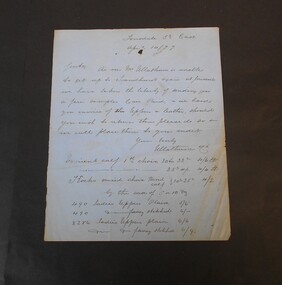
Letter - Abbott Collection: letter from Mr. Willthorne (?), April 14th 1877
... ...commercial enterprise....Business letter commercial Abbott family shoe manufacturing commercial enterprise. Four pages handwritten from Willathorne Co. dated 14th April, 1877 detailing a list of items relating to the stock of the Abbott Company sent to Sandhurst as samples on credit because Mr. ...Four pages handwritten from Willathorne Co. dated 14th April, 1877 detailing a list of items relating to the stock of the Abbott Company sent to Sandhurst as samples on credit because Mr. Willathorne (?) was unable to get up there. The sender address is stated as Lonsdale Street East.business letter, commercial, abbott family, shoe manufacturing, commercial enterprise. -
 Port Fairy Historical Society Museum and Archives
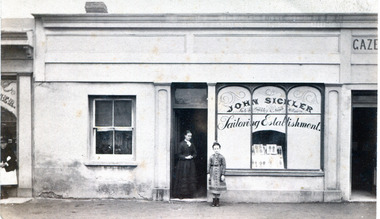
Photograph
... ...commercial enterprise...Tailor's shop next door to the Port Fairy Gazette Office (local newspaper office) in Sackville Street owned by John Sickler and later W. george tailor shop commercial enterprise shop Store sackville street Black and white photograph of shop front with arched windows on right hand side and a female and a young girl standing in the doorway Photograph Photograph ...Tailor's shop next door to the Port Fairy Gazette Office (local newspaper office) in Sackville Street owned by John Sickler and later W. georgeBlack and white photograph of shop front with arched windows on right hand side and a female and a young girl standing in the doorwaytailor shop, commercial enterprise, shop, store, sackville street -
 Bendigo Historical Society Inc.
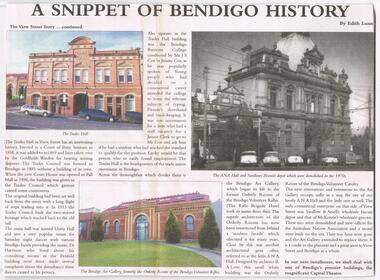
Newspaper - JENNY FOLEY COLLECTION: A SNIPPET OF BENDIGO HISTORY
... Also mentioned are the only two commercial enterprises on that side of View street: Swallow & Ariell's wholesale biscuit depot and McKenzie's wholesale grocers. ...Also mentioned are the only two commercial enterprises on that side of View street: Swallow & Ariell's wholesale biscuit depot and McKenzie's wholesale grocers. ...BHS CollectionBendigo Weekly article by Edith Lunn ''A snippet of Bendigo history'', the View Street story, continued. In this article Edith details the history of the Trades Hall building erected in 1858 as a Court of Petty Sessions and of the Bendigo Art Gallery Building. Also mentioned are the only two commercial enterprises on that side of View street: Swallow & Ariell's wholesale biscuit depot and McKenzie's wholesale grocers. The clip is in a folder.newspaper, bendigo, bendigo weekly -
 Kiewa Valley Historical Society
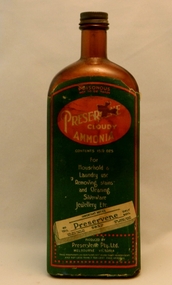
Bottle - Stain Remover, circa mid to late 1900's
... This publication was not only a self promotion but also a useful tool for the rural household and commercial enterprises....This publication was not only a self promotion but also a useful tool for the rural household and commercial enterprises. This bottle is very significant as it details the type of household cleaning methods and products used in the early 1900's up until the mid 1900's, when greater product diversities became available for rural areas. ...The Trade Mark "Preservene" was registered on 23 June 1914 and traded in that name until 1930 when Cussons Australia Pty Ltd incorporated the name and its products including the Preservene Cloudy Ammonia. The Preservene Company produced a book (19 pages) "The Presevene Method Of Housework" in 1911. This publication was not only a self promotion but also a useful tool for the rural household and commercial enterprises.This bottle is very significant as it details the type of household cleaning methods and products used in the early 1900's up until the mid 1900's, when greater product diversities became available for rural areas. This product was a general cleaning agent that could be used for a variety of household items. It was the one product that "fits all cleaning". This attitude by the manufacturer fits into the mores held by the populous not only in cities but especially in the rural sector. This was an era where the success of a product was measured by the degree of versatility that came with it. The war years, the great depression had a lingering affect upon those who lived through them not to "waste" money on a multitude of products if one product had multiple uses. This was more so in rural areas where semi remote locations (as the case of the Kiewa Valley in the early 1900's) did not have the market place choices of city dwellers.This oblong shaped brown stained bottle has a red,green and faded white label covering 90% of the bottle. The bottle has a screw on lid. The bottle has embossed at the top back "POISON NOT TO BE TAKEN"on front label starting from top down "POISONOUS" IN SMALLER LETTERS "NOT TO BE TAKEN", below in an eclipse red backed sphere "PRESERVENE CLOUDY AMMONIA" below this in smaller print "CONTENTS 15 1/2 ozs", "For Household & Laundry use " below this "Removing stains and clearing Silverware Jewellery Etc". On a slant with green lettering on off white background, "IMPORTANT NOTICE (underlined) NO TOIL PRESERVENE ONLY BOIL(underlined) SOAP". Below within a red dotted boundary "PRODUCED BY Preservene Pty. Ltd. Melbourne Victoria". Below this and in smaller print "This preparation contains not more than 10 percent and not less than 7 percent free ammonia" Both sides of the label detail manufacturers instructions for different applications.laundry cleaners, stain removers, preservene label -
 Warrnambool and District Historical Society Inc.
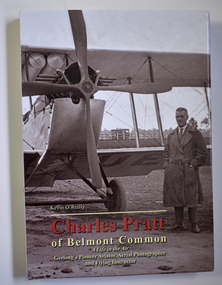
Book - Biography of Charles Pratt, Kevin O'Reilly, Charles Pratt of Belmont Common, 2016
... This book contains biographical details of a New Zealander, Charles Pratt who, between the Two World Wars, had several commercial enterprises based in in Geelong, Victoria. ...This book contains biographical details of a New Zealander, Charles Pratt who, between the Two World Wars, had several commercial enterprises based in in Geelong, Victoria. ...Biographical material of Charles Pratt and diary extractsThis is a book of 280 pages with a blue and brown hard cover with sepia -coloured photographs on the front and back covers and multi-coloured print on the cover and spine. The dust cover has the same content as the hard cover. The pages contain printed text, black and white photographs, charts and sketches. non-fictionBiographical material of Charles Pratt and diary extracts charles pratt, 1920s aerial photographs, warrnambool history -
 City of Greater Bendigo - Civic Collection
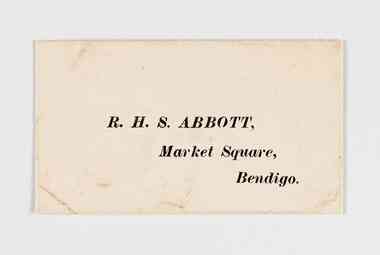
Document - Envelope, RHS Abbott
... Richard Hartley Smith Abbott was the step son of Joseph Henry Abbott and inherited his families business interests, building successful commercial enterprises such as Abbott Supply Co. He was elected a representative in the Mandurang riding in the Shire of Strathfieldsaye in 1887, served as Mayor of the City of Bendigo from 1917 - 1918 and a member of the legislative Council of Victoria. ...Richard Hartley Smith Abbott was the step son of Joseph Henry Abbott and inherited his families business interests, building successful commercial enterprises such as Abbott Supply Co. He was elected a representative in the Mandurang riding in the Shire of Strathfieldsaye in 1887, served as Mayor of the City of Bendigo from 1917 - 1918 and a member of the legislative Council of Victoria. ...Richard Hartley Smith Abbott was the step son of Joseph Henry Abbott and inherited his families business interests, building successful commercial enterprises such as Abbott Supply Co. He was elected a representative in the Mandurang riding in the Shire of Strathfieldsaye in 1887, served as Mayor of the City of Bendigo from 1917 - 1918 and a member of the legislative Council of Victoria. He was Secretary of the Bendigo Art Gallery for over 20 years.Small envelope with RHS Abbott address printed on front. Open at back. R. H. S. Abbott, / Market Square, / Bendigo.mayor rhs abbott, shire of strathfieldsaye, bendigo art gallery, city of greater bendigo commerce -
 Falls Creek Historical Society
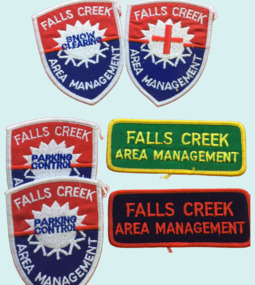
Badge - Falls Creek Area Management Cloth Badges
... Its composition changed over time but generally the Committee was composed of representatives of the State Electricity Commission, Representatives from Ski Clubs and commercial enterprises, the Country Roads Board, the Ski Tow company and a Representative of the Upper Murray Regional Committee of the Central Planning Authority. ...Its composition changed over time but generally the Committee was composed of representatives of the State Electricity Commission, Representatives from Ski Clubs and commercial enterprises, the Country Roads Board, the Ski Tow company and a Representative of the Upper Murray Regional Committee of the Central Planning Authority. ...Falls Creek was operated by the Falls Creek Area Management Committee. Its composition changed over time but generally the Committee was composed of representatives of the State Electricity Commission, Representatives from Ski Clubs and commercial enterprises, the Country Roads Board, the Ski Tow company and a Representative of the Upper Murray Regional Committee of the Central Planning Authority. This Committee was responsibility for long term planning for the Falls Creek Tourist Area as well as the day to day running of the Village, These patches were part of the uniform of people employed by the Management Committee.These cloth badges are significant because they indicated employees of the Area Management Committee and the role they played in Falls Creek.A group of cloth badges indicating the role of personnel employed by the Falls Creek Area Management. Shield shaped badges - 2 Falls Creek Area Management - PARKING CONTROL 1 Falls Creek Area Management - with red cross of SKI PATROL Rectangular - Green and yellow - FALLS CREEK AREA MANAGEMENT Red and blue - FALLS CREEK AREA MANAGEMENTfalls creek village, falls creek area management committee -
 City of Greater Bendigo - Civic Collection
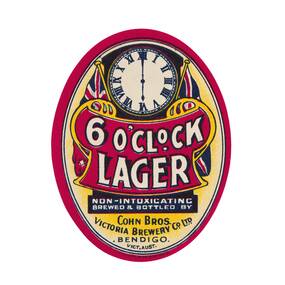
Artwork, other - Label, Cohns, Cohn Bros, c 1923
... Danish brothers, Moritz, Julius and Jacob Cohn arrived in Bendigo in 1853 and by 1856 started making cider and soft drinks, building a brewery 1880 to further extend their commercial enterprises and stock their hotels with their own brand of beer. ...Danish brothers, Moritz, Julius and Jacob Cohn arrived in Bendigo in 1853 and by 1856 started making cider and soft drinks, building a brewery 1880 to further extend their commercial enterprises and stock their hotels with their own brand of beer. ...Danish brothers, Moritz, Julius and Jacob Cohn arrived in Bendigo in 1853 and by 1856 started making cider and soft drinks, building a brewery 1880 to further extend their commercial enterprises and stock their hotels with their own brand of beer. Having sent Moritz's son, (also Julius) to Germany to learn to brew, the Cohn Brothers began to produce Excelsior Lager in 1882, which was traditionally served cold, the first time this had been done in Australia. Overtime the Cohn brothers expanded their operations adding cordials and in 1916 produced a non-alcoholic beer to satisfy the temperance activists. This label is associated with a non alcoholic larger originally named Tonic Ale but re-named 6 o’clock Lager after the temperance advocates succeeded in having pubs close at six o’clock. Cohn Brothers built an empire of breweries, cordial factories, hotels and liquor stores and ice works. In 1925 they sold the hotels and breweries to Carlton & United but continued to make their other products until the 1970s when the company became part of the Coca Cola Amatil Group. Jacob Isaac Cohn was born in 1830 (died 1911) in Horsens Denmark and entered the Sandhurst Borough Council in 1863 where he served as a member for three years, returning again in 1887 to serve as Mayor of the City of Bendigo from 1888-1889. Jacob Cohn was a great supporter of the Mechanics Institute, the Hospital and the Benevolent Asylum. It is believed that through his connection with the Mechanics Institute he exhibited some loaned engravings from the Dresden Art Gallery which were then donated to the City of Bendigo, forming the nuclei of the Art Gallery's collection. Jacob Cohn held the position of President of the Art Gallery for 18 years.Oval larger label. Multicoloured.6 o'clock / Lager / non- intoxicating / Brewed & Bottled by / Cohn Bros. / Victoria Brewery Co Ltd / Bendigo / Vict. Austmayor jacob cohn, bendigo art gallery, bendigo masonic lodge, making a nation, city of bendigo commerce, cohns, cohn brothers -
 City of Greater Bendigo - Civic Collection
Functional object - Drinks Tray, Cohns
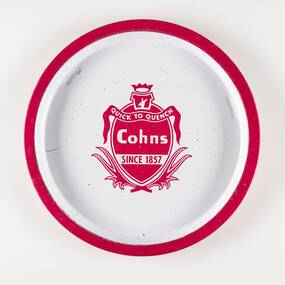
... Danish brothers, Moritz, Julius and Jacob Cohn arrived in Bendigo in 1853 and by 1856 started making cider and soft drinks, building a brewery 1880 to further extend their commercial enterprises and stock their hotels with their own brand of beer. ...Danish brothers, Moritz, Julius and Jacob Cohn arrived in Bendigo in 1853 and by 1856 started making cider and soft drinks, building a brewery 1880 to further extend their commercial enterprises and stock their hotels with their own brand of beer. ...Danish brothers, Moritz, Julius and Jacob Cohn arrived in Bendigo in 1853 and by 1856 started making cider and soft drinks, building a brewery 1880 to further extend their commercial enterprises and stock their hotels with their own brand of beer. Having sent Moritz's son, (also Julius) to Germany to learn to brew, the Cohn Brothers began to produce Excelsior Lager in 1882, which was traditionally served cold, the first time this had been done in Australia. Overtime the Cohn brothers expanded their operations adding cordials and in 1916 produced a non-alcoholic beer to satisfy the temperance activists. Originally named Tonic Ale but re-named 6 o’clock Lager after the temperance advocates succeeded in having pubs close at six o’clock. This drinks tray is just one example of branded bar items which would have been supplied to hotels who served Cohns beverage to further promote the company. Cohn Brothers built an empire of breweries, cordial factories, hotels and liquor stores and ice works. In 1925 they sold the hotels and breweries to Carlton & United but continued to make their other products until the 1970s when the company became part of the Coca Cola Amatil Group. Jacob Isaac Cohn was born in 1830 (died 1911) in Horsens Denmark and entered the Sandhurst Borough Council in 1863 where he served as a member for three years, returning again in 1887 to serve as Mayor of the City of Bendigo from 1888-1889. Jacob Cohn was a great supporter of the Mechanics Institute, the Hospital and the Benevolent Asylum. It is believed that through his connection with the Mechanics Institute he exhibited some loaned engravings from the Dresden Art Gallery which were then donated to the City of Bendigo, forming the nuclei of the Art Gallery's collection. Jacob Cohn held the position of President of the Art Gallery for 18 years.Circular metal drinks tray. White tray with red rim and red 'Cohns Since 1857' logo and 'Quick to Quench' slogan printed in centre.'Quick to Quench' / Cohns / Since 1857mayor jacob cohn, bendigo art gallery, bendigo masonic lodge, making a nation, city of bendigo commerce, cohns, cohn brothers -
 City of Greater Bendigo - Civic Collection
Functional object - Ashtray, Cohn Brothers, Cohns
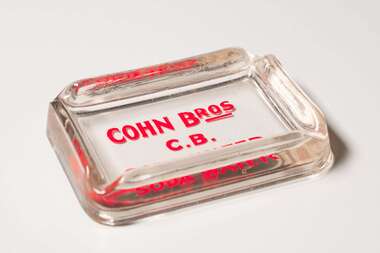
... Danish brothers, Moritz, Julius and Jacob Cohn arrived in Bendigo in 1853 and by 1856 started making cider and soft drinks, building a brewery 1880 to further extend their commercial enterprises and stock their hotels with their own brand of beer. ...Danish brothers, Moritz, Julius and Jacob Cohn arrived in Bendigo in 1853 and by 1856 started making cider and soft drinks, building a brewery 1880 to further extend their commercial enterprises and stock their hotels with their own brand of beer. ...Danish brothers, Moritz, Julius and Jacob Cohn arrived in Bendigo in 1853 and by 1856 started making cider and soft drinks, building a brewery 1880 to further extend their commercial enterprises and stock their hotels with their own brand of beer. Having sent Moritz's son, (also Julius) to Germany to learn to brew, the Cohn Brothers began to produce Excelsior Lager in 1882, which was traditionally served cold, the first time this had been done in Australia. Overtime the Cohn brothers expanded their operations adding cordials and in 1916 produced a non-alcoholic beer to satisfy the temperance activists. Originally named Tonic Ale but re-named 6 o’clock Lager after the temperance advocates succeeded in having pubs close at six o’clock. This ashtray is just one example of branded bar items which would have been supplied to hotels who served Cohns beverage to further promote the company. Cohn Brothers built an empire of breweries, cordial factories, hotels and liquor stores and ice works. In 1925 they sold the hotels and breweries to Carlton & United but continued to make their other products until the 1970s when the company became part of the Coca Cola Amatil Group. Jacob Isaac Cohn was born in 1830 (died 1911) in Horsens Denmark and entered the Sandhurst Borough Council in 1863 where he served as a member for three years, returning again in 1887 to serve as Mayor of the City of Bendigo from 1888-1889. Jacob Cohn was a great supporter of the Mechanics Institute, the Hospital and the Benevolent Asylum. It is believed that through his connection with the Mechanics Institute he exhibited some loaned engravings from the Dresden Art Gallery which were then donated to the City of Bendigo, forming the nuclei of the Art Gallery's collection. Jacob Cohn held the position of President of the Art Gallery for 18 years.Glass rectangle ashtray with shaped corners for resting cigarettes. Text printed in reverse in red ink on bottom of ashtray.Cohn Bros / C.B. / Soda Watermayor jacob cohn, bendigo art gallery, bendigo masonic lodge, making a nation, city of bendigo commerce, cohn brothers, cohns -
 City of Greater Bendigo - Civic Collection
Badge, Cohn Brothers, Cohns
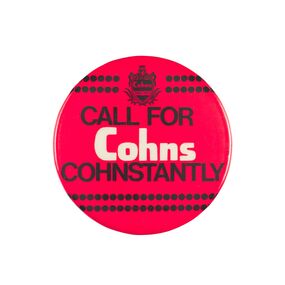
... Danish brothers, Moritz, Julius and Jacob Cohn arrived in Bendigo in 1853 and by 1856 started making cider and soft drinks, building a brewery 1880 to further extend their commercial enterprises and stock their hotels with their own brand of beer. ...Danish brothers, Moritz, Julius and Jacob Cohn arrived in Bendigo in 1853 and by 1856 started making cider and soft drinks, building a brewery 1880 to further extend their commercial enterprises and stock their hotels with their own brand of beer. ...Danish brothers, Moritz, Julius and Jacob Cohn arrived in Bendigo in 1853 and by 1856 started making cider and soft drinks, building a brewery 1880 to further extend their commercial enterprises and stock their hotels with their own brand of beer. Having sent Moritz's son, (also Julius) to Germany to learn to brew, the Cohn Brothers began to produce Excelsior Lager in 1882, which was traditionally served cold, the first time this had been done in Australia. Overtime the Cohn brothers expanded their operations adding cordials and in 1916 produced a non-alcoholic beer to satisfy the temperance activists. Originally named Tonic Ale but re-named 6 o’clock Lager after the temperance advocates succeeded in having pubs close at six o’clock. This badge is just one example of branded items which would have been used to further promote the company. Cohn Brothers built an empire of breweries, cordial factories, hotels and liquor stores and ice works. In 1925 they sold the hotels and breweries to Carlton & United but continued to make their other products until the 1970s when the company became part of the Coca Cola Amatil Group. Jacob Isaac Cohn was born in 1830 (died 1911) in Horsens Denmark and entered the Sandhurst Borough Council in 1863 where he served as a member for three years, returning again in 1887 to serve as Mayor of the City of Bendigo from 1888-1889. Jacob Cohn was a great supporter of the Mechanics Institute, the Hospital and the Benevolent Asylum. It is believed that through his connection with the Mechanics Institute he exhibited some loaned engravings from the Dresden Art Gallery which were then donated to the City of Bendigo, forming the nuclei of the Art Gallery's collection. Jacob Cohn held the position of President of the Art Gallery for 18 years.Large metal badge Call for / Cohn / Cohnstantlymayor jacob cohn, making a nation, city of bendigo commerce, cohn brothers, cohns -
 City of Greater Bendigo - Civic Collection
Badge - Member Pins, Cohn Brothers, Cohns
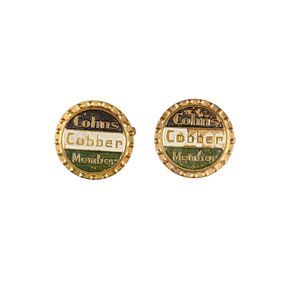
... Danish brothers, Moritz, Julius and Jacob Cohn arrived in Bendigo in 1853 and by 1856 started making cider and soft drinks, building a brewery 1880 to further extend their commercial enterprises and stock their hotels with their own brand of beer. ...Danish brothers, Moritz, Julius and Jacob Cohn arrived in Bendigo in 1853 and by 1856 started making cider and soft drinks, building a brewery 1880 to further extend their commercial enterprises and stock their hotels with their own brand of beer. ...Danish brothers, Moritz, Julius and Jacob Cohn arrived in Bendigo in 1853 and by 1856 started making cider and soft drinks, building a brewery 1880 to further extend their commercial enterprises and stock their hotels with their own brand of beer. Having sent Moritz's son, (also Julius) to Germany to learn to brew, the Cohn Brothers began to produce Excelsior Lager in 1882, which was traditionally served cold, the first time this had been done in Australia. Overtime the Cohn brothers expanded their operations adding cordials and in 1916 produced a non-alcoholic beer to satisfy the temperance activists. Cohn Brothers built an empire of breweries, cordial factories, hotels and liquor stores and ice works. In 1925 they sold the hotels and breweries to Carlton & United but continued to make their other products until the 1970s when the company became part of the Coca Cola Amatil Group. These Cohn's Cobber Member pins relate to the Cohn's Cobbers TV Club which was sponsored by Cohn's Soft drinks. The Cobbers TV Club was an afternoon children's variety program modelled on the Tarax Show. When local TV station BCV8 opened in Bendigo they broadcast Cobber’s teleclub in their afternoon timeslot for young viewers. Jacob Isaac Cohn was born in 1830 (died 1911) in Horsens Denmark and entered the Sandhurst Borough Council in 1863 where he served as a member for three years, returning again in 1887 to serve as Mayor of the City of Bendigo from 1888-1889. Jacob Cohn was a great supporter of the Mechanics Institute, the Hospital and the Benevolent Asylum. It is believed that through his connection with the Mechanics Institute he exhibited some loaned engravings from the Dresden Art Gallery which were then donated to the City of Bendigo, forming the nuclei of the Art Gallery's collection. Jacob Cohn held the position of President of the Art Gallery for 18 years.Two small multi coloured member pins. Gold coloured metal and fastening pin on back. Brown, white and green inner sections with gold text on front.Cohns / Cobber / Membermayor jacob cohn, city of bendigo commerce, cohn brothers, cohns -
 City of Greater Bendigo - Civic Collection
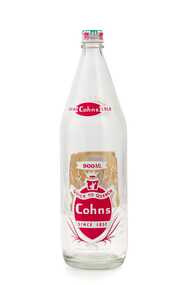
Domestic object - Soft drink bottle, Cohns
... Danish brothers, Moritz, Julius and Jacob Cohn arrived in Bendigo in 1853 and by 1856 started making cider and soft drinks, building a brewery 1880 to further extend their commercial enterprises and stock their hotels with their own brand of beer. ...Danish brothers, Moritz, Julius and Jacob Cohn arrived in Bendigo in 1853 and by 1856 started making cider and soft drinks, building a brewery 1880 to further extend their commercial enterprises and stock their hotels with their own brand of beer. ...Danish brothers, Moritz, Julius and Jacob Cohn arrived in Bendigo in 1853 and by 1856 started making cider and soft drinks, building a brewery 1880 to further extend their commercial enterprises and stock their hotels with their own brand of beer. Having sent Moritz's son, (also Julius) to Germany to learn to brew, the Cohn Brothers began to produce Excelsior Lager in 1882, which was traditionally served cold, the first time this had been done in Australia. Overtime the Cohn brothers expanded their operations adding cordials and in 1916 produced a non-alcoholic beer to satisfy the temperance activists. Originally named Tonic Ale but re-named 6 o’clock Lager after the temperance advocates succeeded in having pubs close at six o’clock. This drinks tray is just one example of branded bar items which would have been supplied to hotels who served Cohns beverage to further promote the company. Cohn Brothers built an empire of breweries, cordial factories, hotels and liquor stores and ice works. In 1925 they sold the hotels and breweries to Carlton & United but continued to make their other products until the 1970s when the company became part of the Coca Cola Amatil Group. Jacob Isaac Cohn was born in 1830 (died 1911) in Horsens Denmark and entered the Sandhurst Borough Council in 1863 where he served as a member for three years, returning again in 1887 to serve as Mayor of the City of Bendigo from 1888-1889. Jacob Cohn was a great supporter of the Mechanics Institute, the Hospital and the Benevolent Asylum. It is believed that through his connection with the Mechanics Institute he exhibited some loaned engravings from the Dresden Art Gallery which were then donated to the City of Bendigo, forming the nuclei of the Art Gallery's collection. Jacob Cohn held the position of President of the Art Gallery for 18 years.Clear glass bottle with iconic red and white Cohns label printed on front and back. Bottle has been rebranded and had an extra label stuck to one side for Z Cal Low Calorie Orange beverage. Screw cap is also related to Z Cal Orange drink.'Quick to Quench' / Cohns / Since 1857 Cohns / Z-Cal / Low Calorie / Orange mayor jacob cohn, bendigo art gallery, bendigo masonic lodge, making a nation, city of bendigo commerce, cohns, cohn brothers -
 City of Greater Bendigo - Civic Collection
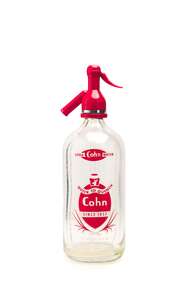
Domestic object - Soda Syphon, Cohns
... Danish brothers, Moritz, Julius and Jacob Cohn arrived in Bendigo in 1853 and by 1856 started making cider and soft drinks, building a brewery 1880 to further extend their commercial enterprises and stock their hotels with their own brand of beer. ...Danish brothers, Moritz, Julius and Jacob Cohn arrived in Bendigo in 1853 and by 1856 started making cider and soft drinks, building a brewery 1880 to further extend their commercial enterprises and stock their hotels with their own brand of beer. ...Danish brothers, Moritz, Julius and Jacob Cohn arrived in Bendigo in 1853 and by 1856 started making cider and soft drinks, building a brewery 1880 to further extend their commercial enterprises and stock their hotels with their own brand of beer. Having sent Moritz's son, (also Julius) to Germany to learn to brew, the Cohn Brothers began to produce Excelsior Lager in 1882, which was traditionally served cold, the first time this had been done in Australia. Overtime the Cohn brothers expanded their operations adding cordials and in 1916 produced a non-alcoholic beer to satisfy the temperance activists. Originally named Tonic Ale but re-named 6 o’clock Lager after the temperance advocates succeeded in having pubs close at six o’clock. This drinks tray is just one example of branded bar items which would have been supplied to hotels who served Cohns beverage to further promote the company. Cohn Brothers built an empire of breweries, cordial factories, hotels and liquor stores and ice works. In 1925 they sold the hotels and breweries to Carlton & United but continued to make their other products until the 1970s when the company became part of the Coca Cola Amatil Group. Jacob Isaac Cohn was born in 1830 (died 1911) in Horsens Denmark and entered the Sandhurst Borough Council in 1863 where he served as a member for three years, returning again in 1887 to serve as Mayor of the City of Bendigo from 1888-1889. Jacob Cohn was a great supporter of the Mechanics Institute, the Hospital and the Benevolent Asylum. It is believed that through his connection with the Mechanics Institute he exhibited some loaned engravings from the Dresden Art Gallery which were then donated to the City of Bendigo, forming the nuclei of the Art Gallery's collection. Jacob Cohn held the position of President of the Art Gallery for 18 years.Clear glass bottle with iconic red and white Cohns label printed on front and back. Bottle has been rebranded and had an extra label stuck to one side for Z Cal Low Calorie Orange beverage. Screw cap is also related to Z Cal Orange drink.'Quick to Quench' / Cohns / Since 1857 Cohns / Z-Cal / Low Calorie / Orange mayor jacob cohn, bendigo art gallery, bendigo masonic lodge, making a nation, city of bendigo commerce, cohns, cohn brothers -
 Flagstaff Hill Maritime Museum and Village
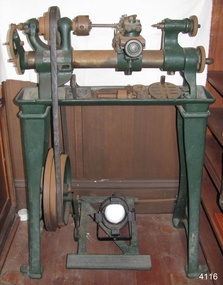
Machine - Treadle Lathe, 1920-1923
... commercially. Land was acquired nearby, at Rydes Hill, and the first factory built. The enterprise was a success, and the company quickly established ‘a high reputation in this country and abroad for multi-tool and copying lathes, and gear-cutting machines’. ...commercially. Land was acquired nearby, at Rydes Hill, and the first factory built. The enterprise was a success, and the company quickly established ‘a high reputation in this country and abroad for multi-tool and copying lathes, and gear-cutting machines’. ...The lathe-making business incorporated in 1902 as Drummond Bros Ltd originated in the fertile mind of Mr Arthur Drummond, said to have been living at that time at Pinks Hill, on the southern edge of Broad Street Common, west of Guildford. Mr Drummond, whose accomplishments included several pictures hung in the Royal Academy, was unable to find a lathe suitable for use in model engineering. In 1896 he designed for himself a ‘small centre lathe … which had a compound slide rest with feed-screws and adjustable slides’. He also designed and built ‘lathes of 4.5 inch and 5 inch centre height, which had beds of a special form whereby the use of a gap piece was eliminated but the advantages of a gap-bed lathe were retained’. Assisted by his brother, Mr Frank Drummond, who had served an apprenticeship to an engineering firm at Tunbridge Wells, the first lathes were made in a workshop adjoining Arthur Drummond’s house. The demand that speedily built up led to the decision to form a company and manufacture the lathes for sale commercially. Land was acquired nearby, at Rydes Hill, and the first factory built. The enterprise was a success, and the company quickly established ‘a high reputation in this country and abroad for multi-tool and copying lathes, and gear-cutting machines’. Other lathes were added to the range, including the first of the ’round bed’ machines for which the firm became widely known. A Drummond 3.5 inch lathe was among the equipment of Captain Scott’s 1912 expedition to the South Pole, and large numbers of 3.5 inch and 4 inch designs were exported to Australia, Canada and India. By the outbreak of war in 1914, 5 inch, 6 inch and 7 inch screw cutting lathes, arranged for power drive, were on sale. Large orders were received from the government for 3.5 inch lathes, for use in destroyers and submarines, and 5 inch lathes for the mechanised section of the Army Service Corps. The latter were used in mobile workshops. The factory worked night and day to supply the forces’ needs, until production was disrupted by a fire which destroyed a large part of the works in May 1915. As soon as rebuilding was complete work restarted. At the end of the war the entire production was being taken by the Government departments, a special feature being a precision screw lathe, bought by the Ministry of Munitions in 1918. Between the wars Drummond Bros Ltd introduced new machines for the motor vehicle, and later the aircraft industry, and the works were extended on many occasions to fulfill the increasing orders. The Maxicut multi-tool lathe (1925), designed for high-production turning operations, was one of the first machines of this type to be built in England. It was followed (1928) by an hydraulic version for turning gear blanks, and similar work. Further developments provided machines which, during the Second World War, turned all the crankshafts and propeller shafts for Bristol engines. Others, ordered by the Ministry of Supply were employed in turning shells, and many other specific needs of vehicle and aircraft manufacture were catered for by new types of Drummond lathes. Production of the small centre lathes ceased during the war when the company needed to concentrate on building multi-tool lathes and gear shapers. After the war a completely new Maxicut range was introduced, replacing the older versions, and fully automatic. The types were continually developed, and new versions manufactured until the end of the company’s life in 1980. The disappearance from the scene of Mr Arthur Drummond in 1946, and the end of the company’s autonomous existence in 1953 when the company was acquired by William Asquith Ltd, which was in turn bought by Staveley in 1966, meant that the factory at Rydes Hill became one – albeit very effective – part of a large national engineering company. Achievements at the Guildford works during its last years included the development of automated Maxicut gear-shapers in what was ‘probably the most fully automated gear shop in the country’, while a machine from Guildford was sent to the Osaka Fair in 1962. In 1963 an agreement was signed with Hindustan Machine Tools for the manufacture of Maxicut gear-shapers in state owned factories in Bangalore and Chandigarh. During 1963 the two largest multi-tool lathes ever made in the UK were installed in Ambrose Shardlow’s works in Sheffield for handling cranks up to 14 foot long. In 1976 Drummond lathes were included in Staveley’s £14,000,000 installation in Moscow of an automated production line for Zil motor cars. Up to the end invention continued at Guildford: a new Drummond Multi-turn memory-controlled machine was shown at the International Machine Tool Exhibition in 1977. This could not save the works from the pressures of the late 1970s, and Staveley Industries closed its Guildford site in 1980.An early example of a lathe that was designed primarily for the hobbyist model maker. It is in good condition and sought today by collectors as many of it's attributes were innovative at the time and lead to further development and incorporation of some of its features into more industrial models of production machinery. Lathe, round bed, treadle powered lathe, Drummond Type A, Serial number and maker's inscription. 1920-1923, Made by Drummond Brothers in Guildford, Surrey, England. Lathe is complete with Chuck, Tool post and Tail Stock in situ (30 extra parts)"MADE BY DRUMMOND BROTHERS LIMITED - PATENT TEES - RYDE'S HILL n GUILDFORD SURREY", "Serial Number 01470," "L44" or "L45 " flagstaff hill, warrnambool, shipwrecked coast, flagstaff hill maritime museum, maritime museum, shipwreck coast, flagstaff hill maritime village, great ocean road, lathe 1920-1923, round bed lathe, treadle lathe, drummond type a, guildford surrey, drummond brothers guildford surrey england, tread'e -
 Flagstaff Hill Maritime Museum and Village
Equipment - Rowing Oar
... commercial painter to make a ladder, and the founder set up shop in a garage on Ruahine St. According to the company website, Pelco made its name in New Zealand with its Oregon Extension Ladders, and up until its closure, manufactured non-conductive Lamilite Ladders for the electrical supply and service industry worldwide. The company was incorporated as a joinery business in 1946 and continued making high-end cabinetry for seven decades. Under director Geoff Woodfield, in the 1950s, the company embarked on the production of Fleetcraft plywood boats. Another water-related enterprise...commercial painter to make a ladder, and the founder set up shop in a garage on Ruahine St. According to the company website, Pelco made its name in New Zealand with its Oregon Extension Ladders, and up until its closure, manufactured non-conductive Lamilite Ladders for the electrical supply and service industry worldwide. The company was incorporated as a joinery business in 1946 and continued making high-end cabinetry for seven decades. Under director Geoff Woodfield, in the 1950s, the company embarked on the production of Fleetcraft plywood boats. Another water-related enterprise ...The family-owned timber manufacturing business Pelco was started by Cecil Victor Woodfield in 1937. The joinery company Pelco began by making wooden ladders and was registered as the Palmerston Extension Ladder Company. C V Woodfield, who lived from 1884 -1959, arrived in Palmerston North from Canterbury NZ in the aftermath of the Great Depression to work in construction. The company got its first step up when Woodfield was asked by a commercial painter to make a ladder, and the founder set up shop in a garage on Ruahine St. According to the company website, Pelco made its name in New Zealand with its Oregon Extension Ladders, and up until its closure, manufactured non-conductive Lamilite Ladders for the electrical supply and service industry worldwide. The company was incorporated as a joinery business in 1946 and continued making high-end cabinetry for seven decades. Under director Geoff Woodfield, in the 1950s, the company embarked on the production of Fleetcraft plywood boats. Another water-related enterprise followed, with the manufacture of oars and paddles. Its branded Gull Superior Oars and Paddles business began exporting in 1972 to Australia and subsequently to the United States, UK and Japan. The company ceased trading in April 2018 and was placed into receivership.This pair of lightweight oars represents the maritime tradition of handmade oar making, which has evolved over the centuries. Their shape is still similar to early oars and continues to serve the same purpose, to steer and propel a boat. Pair of blonde varnished Tasman Fir oars with a flattened paddle at one end. Made by Gull of New Zealand, sold by James Edwards & Sons of Melbourne. Inscriptions on printed labels on the oars."GULL Superior Oars and Paddles, Pelco, Palmerston North NZ" "JAS. EDWARDS & SONS, Boat Builders, Oar and Skull Makers, & Importers, PRINCES BRIDGE MELBOURNE"warrnambool, flagstaff-hill, flagstaff-hill-maritime-museum, maritime-museum, shipwreck-coast, flagstaff-hill-maritime-village, oar, oars, gull oars and paddles, new zealand oars and paddles, jas edwards and sons melbourne, rowing equipment, new zealand oak, paddle, james edwards and sons melbourne, james edwards, tasman fir, gull superior oars, marine equipment, marine technology, ship fitting, boat fitting, rowing oar, boat oar -
 Flagstaff Hill Maritime Museum and Village
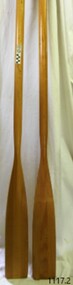
Equipment - Rowing Oars
... commercial painter to make a ladder, and the founder set up shop in a garage on Ruahine St. According to the company website, Pelco made its name in New Zealand with its Oregon Extension Ladders, and up until its closure, manufactured non-conductive Lamilite Ladders for the electrical supply and service industry worldwide. The company was incorporated as a joinery business in 1946, and continued making high-end cabinetry for seven decades. Under director Geoff Woodfield, in the 1950s, the company embarked on the production of Fleetcraft plywood boats. Another water-related enterprise...commercial painter to make a ladder, and the founder set up shop in a garage on Ruahine St. According to the company website, Pelco made its name in New Zealand with its Oregon Extension Ladders, and up until its closure, manufactured non-conductive Lamilite Ladders for the electrical supply and service industry worldwide. The company was incorporated as a joinery business in 1946, and continued making high-end cabinetry for seven decades. Under director Geoff Woodfield, in the 1950s, the company embarked on the production of Fleetcraft plywood boats. Another water-related enterprise ...The family-owned timber manufacturing business Pelco was started by Cecil Victor Woodfield in 1937. The joinery company Pelco began by making wooden ladders and was registered as the Palmerston Extension Ladder Company. C V Woodfield, who lived from 1884 -1959, arrived in Palmerston North from Canterbury NZ in the aftermath of the Great Depression to work in construction. The company got its first step up when Woodfield was asked by a commercial painter to make a ladder, and the founder set up shop in a garage on Ruahine St. According to the company website, Pelco made its name in New Zealand with its Oregon Extension Ladders, and up until its closure, manufactured non-conductive Lamilite Ladders for the electrical supply and service industry worldwide. The company was incorporated as a joinery business in 1946, and continued making high-end cabinetry for seven decades. Under director Geoff Woodfield, in the 1950s, the company embarked on the production of Fleetcraft plywood boats. Another water-related enterprise followed, with the manufacture of oars and paddles Its branded Gull Superior Oars and Paddles business began exporting in 1972 to Australia and subsequently to the United States, UK and Japan. The company ceased trading in April 2018 and was placed into receivership.This pair of lightweight oars represents the maritime tradition of handmade oar making, which has evolved over the centuries. Their shape is still similar to early oars and continues to serve the same purpose, to steer and propel a boat. The oars are associated with a significant family business situated in Palmerston New Zealand that along with making ladders also graduated into making wooden boats and oars.Pair of blonde varnished Tasman Fir oars with a flattened paddle at one end. Made by Gull of New Zealand, sold by James Edwards & Sons of Melbourne. Inscriptions on printed labels on the oars.(1) "GULL Superior Oars and Paddles, Pelco, Palmerston North NZ" (2) "JAS. EDWARDS & SONS, Boat Builders, Oar and Skull Makers, & Importers, PRINCES BRIDGE MELBOURNE"warrnambool, flagstaff-hill, flagstaff-hill-maritime-museum, maritime-museum, shipwreck-coast, flagstaff-hill-maritime-village, oar, oars, gull oars and paddles, new zealand oars and paddles, jas edwards and sons melbourne, rowing equipment, new zealand oak, paddle, james edwards and sons melbourne, james edwards, tasman fir, gull superior oars, marine equipment, marine technology, ship fitting, boat fitting, rowing oar, boat oar -
 Flagstaff Hill Maritime Museum and Village
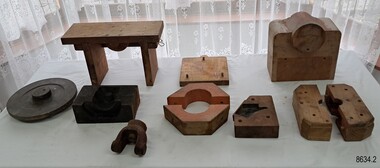
Equipment - Foundry Patterns set, Briggs Brass Foundry, 1912-1972
... commercial businesses. Through its presence, its reputation was reinforced as both a skilled manufacturer and a community-minded enterprise. ...The wooden pattern forms part of a larger collection; some of them were secured within a durable wooden crate. The cast pattern was an essential tool at Briggs Brass Foundry, specifically designed for creating sand casts. Sand casting is a time-honoured technique, with a history exceeding 2,000 years. The handcrafted nature of this process produces brass and copper alloy items particularly suitable for maritime applications. Typical products include bells, boat hooks, cowls, propellers, handles, lids, rowlocks, hooks, letters, bolts, rail holders, brackets, deck plates, flanges, rudder guides, portholes and covers. The distinctive bronze mixture used at Briggs’ Foundry is copper based. It is composed of local ingots of copper, tin, zinc and lead, blended in precisely measured quantities. The resulting alloy is non-ferrous, known for its exceptional durability and longevity. HISTORY OF BRIGGS MARINE: The Briggs Brass Foundry, trading as Briggs & Son Foundry, was established in 1912 by Herbert Harrison Briggs (1863-1931) with his son George Edward Briggs. In 1922, the youngest son, Cyril Falkiner McKinnon Briggs, joined the foundry. After Herbert died in 1931, his sons George and Cyril ran the foundry. The business became known as Briggs Marine Foundry, the “non-ferrous founders” and “bell specialists”. The foundry products were made using the traditional sand-casting method, which is now over two thousand years old and is becoming a dying art. The foundry operated at 70 Wellington St, Collingwood, and specialised in casting ship bells and other marine equipment and fittings. It also made decorative items such as miniature ship propellers. The great-granddaughter of Herbert Briggs inherited a Briggs brass bell, similar to one at Flagstaff Hill Maritime Village. In 1965, Cyril was the only remaining family member involved in Briggs Marine Products. The firm relocated to Chesterville Rd, Moorabbin and Cyril went into partnership with Frank Lee. In the same year, the firm exhibited its products at the 1965 Boat Show. When Cyril passed away in 1967, Frank took over the business with two new partners. After Frank Lee died in 1971, the foundry was run by his son and daughter-in-law, Les and Eva Lee. Briggs Marine still exists today, but the Briggs family is no longer involved. Briggs Foundry had a community-minded retail branch in Warrnambool, selling cast boat fittings and equipment to fishermen and others in the regional marine industry. The branch closed in 1972. In Flagstaff Hill’s formative years, 1972-1975, many Briggs Marine brassware products were generously donated from its Melbourne foundry, along with casting patterns, tools, machinery and a cupboard. EXHIBITION and LEGACY: The donated items were displayed in a simulated Brass Foundry within the Village, where visitors could view them and gain insight into the foundering and metalwork trades that supported maritime industries, including shipwrights and boatbuilders. The castings produced at the foundry were also vital for farmers, manufacturers and other local industries. This exhibit was part of a broader showcase of working crafts, trades and services typical of a Maritime town. The display was available to the public from the completion of the building in 1986 until 1994, when the space was repurposed. It is believed that Briggs Marine’s family members gave personal assistance in setting up the displays in the original village shops, particularly the ‘Brass Foundry’ building. A notable feature of the Village Brass Foundry was the historic Cornish chimney, presented as a working model. This chimney visually demonstrated the process of smelting metal in furnaces and pouring it into sand moulds. Constructed from specially curved bricks, the chimney now stands at about two-thirds of its original height, having been relocated from the Grassmere Cheese factory. The hand-cast sand patterns hold considerable significance due to their association with Briggs Brass Founders, a firm established in the early 20th century and widely recognised for its expertise in producing, repairing, and restoring ship bells and marine equipment. Known for their specialisation in non-ferrous metal casting, Briggs Brass Founders supplied high-quality fittings and equipment for maritime use. The company extended its operations by opening a branch in Warrnambool, where it actively supported the local community. The foundry’s ability to cast essential products was important to local and regional industries, like fishing, farming, manufacturing and commercial businesses. Through its presence, its reputation was reinforced as both a skilled manufacturer and a community-minded enterprise. The foundry is notably associated with the Schomberg Bell at Flagstaff Hill, having restored this small, historic bell to its original condition. The Schomberg Bell is a fine example from a luxury migrant vessel dating back to the mid-19th century, reflecting the craftsmanship and heritage preserved by Briggs Brass Foundry. Wooden rectangular crate with removable wooden lid. Inside is a set of wooden patterns of various shapes and sizes for making sand moulds in a metal foundry. The crate is made from thick wooden planks nailed together. The extended wooden struts on the long sides form a frame to hold the wooden lid. A pair of metal handles is at each short end of the crate, fixed with strong metal bolts. Between each pair of handles is an inscription stamped into the wood. The underside of the crate has red paint splashes. There are insect holes in the wood, but no active infestation. The patterns were made and used at Briggs Brass Foundry in Melbourne.Stamped: "H.33 / II" (H may be N or a square B)flagstaff hill maritime museum and village, great ocean road, shipwreck coast, pattern, mould, foundry, brass foundry, metal foundry, crate, box, wooden container, briggs, traditional method, trade, sand cast, cast, brass alloy, copper alloy, marine equipment, marine tools, marine fittings, briggs' bronze, copper tin zinc lead, non-corrosive, briggs family, brassware, metalware, foundering, metalwork, maritime, casting, cornish chimney, curved bricks, grassmere cheese factory, 1912, herbert harrison briggs, h h briggs, george edward briggs, briggs & son foundry, collingwood, cyril falkiner mckinnon briggs, cyril briggs, h h briggs & sons foundry, bell founders, schomberg bell, alliance casting & engineering solutions, collingwood foundry, ship chandlers, marine products, flagstaff hill, warrnambool, maritime museum, maritime village, briggs & son brass foundry, briggs marine, moorabbin, briggs brass foundry, briggs marine foundry, briggs marine products, frank lee, les lee, eva lee, briggs marine warrnambool, non-ferrous founders, bell specialists, ship bell specialists, founders, metalworking, traditional sand casting, casting pattern, foundry pattern -
 Flagstaff Hill Maritime Museum and Village
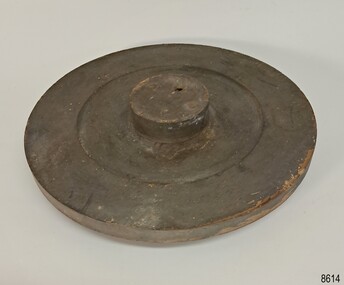
Equipment - Pattern, Briggs Brass Foundry, 1912-1972
... commercial businesses. Through its presence, its reputation was reinforced as both a skilled manufacturer and a community-minded enterprise. ...The wooden pattern forms part of a larger collection; some of them were secured within a durable wooden crate. The cast pattern was an essential tool at Briggs Brass Foundry, specifically designed for creating sand casts. Sand casting is a time-honoured technique, with a history exceeding 2,000 years. The handcrafted nature of this process produces brass and copper alloy items particularly suitable for maritime applications. Typical products include bells, boat hooks, cowls, propellers, handles, lids, rowlocks, hooks, letters, bolts, rail holders, brackets, deck plates, flanges, rudder guides, portholes and covers. The distinctive bronze mixture used at Briggs’ Foundry is copper based. It is composed of local ingots of copper, tin, zinc and lead, blended in precisely measured quantities. The resulting alloy is non-ferrous, known for its exceptional durability and longevity. HISTORY OF BRIGGS MARINE: The Briggs Brass Foundry, trading as Briggs & Son Foundry, was established in 1912 by Herbert Harrison Briggs (1863-1931) with his son George Edward Briggs. In 1922, the youngest son, Cyril Falkiner McKinnon Briggs, joined the foundry. After Herbert died in 1931, his sons George and Cyril ran the foundry. The business became known as Briggs Marine Foundry, the “non-ferrous founders” and “bell specialists”. The foundry products were made using the traditional sand-casting method, which is now over two thousand years old and is becoming a dying art. The foundry operated at 70 Wellington St, Collingwood, and specialised in casting ship bells and other marine equipment and fittings. It also made decorative items such as miniature ship propellers. The great-granddaughter of Herbert Briggs inherited a Briggs brass bell, similar to one at Flagstaff Hill Maritime Village. In 1965, Cyril was the only remaining family member involved in Briggs Marine Products. The firm relocated to Chesterville Rd, Moorabbin and Cyril went into partnership with Frank Lee. In the same year, the firm exhibited its products at the 1965 Boat Show. When Cyril passed away in 1967, Frank took over the business with two new partners. After Frank Lee died in 1971, the foundry was run by his son and daughter-in-law, Les and Eva Lee. Briggs Marine still exists today, but the Briggs family is no longer involved. Briggs Foundry had a community-minded retail branch in Warrnambool, selling cast boat fittings and equipment to fishermen and others in the regional marine industry. The branch closed in 1972. In Flagstaff Hill’s formative years, 1972-1975, many Briggs Marine brassware products were generously donated from its Melbourne foundry, along with casting patterns, tools, machinery and a cupboard. EXHIBITION and LEGACY: The donated items were displayed in a simulated Brass Foundry within the Village, where visitors could view them and gain insight into the foundering and metalwork trades that supported maritime industries, including shipwrights and boatbuilders. The castings produced at the foundry were also vital for farmers, manufacturers and other local industries. This exhibit was part of a broader showcase of working crafts, trades and services typical of a Maritime town. The display was available to the public from the completion of the building in 1986 until 1994, when the space was repurposed. It is believed that Briggs Marine’s family members gave personal assistance in setting up the displays in the original village shops, particularly the ‘Brass Foundry’ building. A notable feature of the Village Brass Foundry was the historic Cornish chimney, presented as a working model. This chimney visually demonstrated the process of smelting metal in furnaces and pouring it into sand moulds. Constructed from specially curved bricks, the chimney now stands at about two-thirds of its original height, having been relocated from the Grassmere Cheese factory. The hand-cast sand patterns hold considerable significance due to their association with Briggs Brass Founders, a firm established in the early 20th century and widely recognised for its expertise in producing, repairing, and restoring ship bells and marine equipment. Known for their specialisation in non-ferrous metal casting, Briggs Brass Founders supplied high-quality fittings and equipment for maritime use. The company extended its operations by opening a branch in Warrnambool, where it actively supported the local community. The foundry’s ability to cast essential products was important to local and regional industries, like fishing, farming, manufacturing and commercial businesses. Through its presence, its reputation was reinforced as both a skilled manufacturer and a community-minded enterprise. The foundry is notably associated with the Schomberg Bell at Flagstaff Hill, having restored this small, historic bell to its original condition. The Schomberg Bell is a fine example from a luxury migrant vessel dating back to the mid-19th century, reflecting the craftsmanship and heritage preserved by Briggs Brass Foundry. Pattern; round wooden shape with a wide concave centre and a round flat handle in the middle, painted dark brown. The underside has a large wooden disc added to the centre. The pattern is part of a set of foundry patterns from Briggs Brass Foundry.flagstaff hill, flagstaff hill maritime museum and village, warrnambool, maritime museum, maritime village, great ocean road, shipwreck coast, briggs' bronze, traditional method, trade, sand cast, cast, brass alloy, copper alloy, pattern, mould, foundry, brass foundry, metal foundry, casting, sand mould, sand casting, marine equipment, marine tools, marine fittings, copper tin zinc lead, non-ferrous, non-corrosive, brassware, metalware, foundering, metalwork, maritime, bell founders, ship chandlers, marine products, biggs, briggs family, herbert harrison briggs, h h briggs, george edward briggs, cyril falkiner mckinnon briggs, cyril briggs, briggs & son brass foundry, h h briggs & sons foundry, briggs marine, alliance casting & engineering solutions, grassmere cheese factory, cornish chimney, curved bricks, collingwood, moorabbin, collingwood foundry, moorabbin foundry, 1912, briggs, briggs brass foundry, briggs marine foundry, briggs marine products, frank lee, les lee, eva lee, briggs marine warrnambool, non-ferrous founders, bell specialists, ship bell specialists, founders, metalworking, traditional sand casting, casting pattern, foundry pattern -
 Flagstaff Hill Maritime Museum and Village
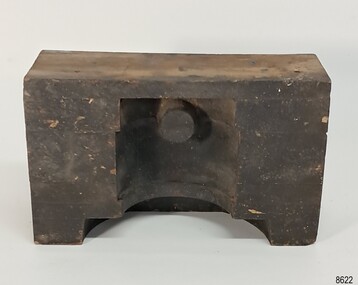
Equipment - Pattern, Briggs Brass Foundry, 1912-1972
... commercial businesses. Through its presence, its reputation was reinforced as both a skilled manufacturer and a community-minded enterprise. ...The wooden pattern forms part of a larger collection; some of them were secured within a durable wooden crate. The cast pattern was an essential tool at Briggs Brass Foundry, specifically designed for creating sand casts. Sand casting is a time-honoured technique, with a history exceeding 2,000 years. The handcrafted nature of this process produces brass and copper alloy items particularly suitable for maritime applications. Typical products include bells, boat hooks, cowls, propellers, handles, lids, rowlocks, hooks, letters, bolts, rail holders, brackets, deck plates, flanges, rudder guides, portholes and covers. The distinctive bronze mixture used at Briggs’ Foundry is copper based. It is composed of local ingots of copper, tin, zinc and lead, blended in precisely measured quantities. The resulting alloy is non-ferrous, known for its exceptional durability and longevity. HISTORY OF BRIGGS MARINE: The Briggs Brass Foundry, trading as Briggs & Son Foundry, was established in 1912 by Herbert Harrison Briggs (1863-1931) with his son George Edward Briggs. In 1922, the youngest son, Cyril Falkiner McKinnon Briggs, joined the foundry. After Herbert died in 1931, his sons George and Cyril ran the foundry. The business became known as Briggs Marine Foundry, the “non-ferrous founders” and “bell specialists”. The foundry products were made using the traditional sand-casting method, which is now over two thousand years old and is becoming a dying art. The foundry operated at 70 Wellington St, Collingwood, and specialised in casting ship bells and other marine equipment and fittings. It also made decorative items such as miniature ship propellers. The great-granddaughter of Herbert Briggs inherited a Briggs brass bell, similar to one at Flagstaff Hill Maritime Village. In 1965, Cyril was the only remaining family member involved in Briggs Marine Products. The firm relocated to Chesterville Rd, Moorabbin and Cyril went into partnership with Frank Lee. In the same year, the firm exhibited its products at the 1965 Boat Show. When Cyril passed away in 1967, Frank took over the business with two new partners. After Frank Lee died in 1971, the foundry was run by his son and daughter-in-law, Les and Eva Lee. Briggs Marine still exists today, but the Briggs family is no longer involved. Briggs Foundry had a community-minded retail branch in Warrnambool, selling cast boat fittings and equipment to fishermen and others in the regional marine industry. The branch closed in 1972. In Flagstaff Hill’s formative years, 1972-1975, many Briggs Marine brassware products were generously donated from its Melbourne foundry, along with casting patterns, tools, machinery and a cupboard. EXHIBITION and LEGACY: The donated items were displayed in a simulated Brass Foundry within the Village, where visitors could view them and gain insight into the foundering and metalwork trades that supported maritime industries, including shipwrights and boatbuilders. The castings produced at the foundry were also vital for farmers, manufacturers and other local industries. This exhibit was part of a broader showcase of working crafts, trades and services typical of a Maritime town. The display was available to the public from the completion of the building in 1986 until 1994, when the space was repurposed. It is believed that Briggs Marine’s family members gave personal assistance in setting up the displays in the original village shops, particularly the ‘Brass Foundry’ building. A notable feature of the Village Brass Foundry was the historic Cornish chimney, presented as a working model. This chimney visually demonstrated the process of smelting metal in furnaces and pouring it into sand moulds. Constructed from specially curved bricks, the chimney now stands at about two-thirds of its original height, having been relocated from the Grassmere Cheese factory. The hand-cast sand patterns hold considerable significance due to their association with Briggs Brass Founders, a firm established in the early 20th century and widely recognised for its expertise in producing, repairing, and restoring ship bells and marine equipment. Known for their specialisation in non-ferrous metal casting, Briggs Brass Founders supplied high-quality fittings and equipment for maritime use. The company extended its operations by opening a branch in Warrnambool, where it actively supported the local community. The foundry’s ability to cast essential products was important to local and regional industries, like fishing, farming, manufacturing and commercial businesses. Through its presence, its reputation was reinforced as both a skilled manufacturer and a community-minded enterprise. The foundry is notably associated with the Schomberg Bell at Flagstaff Hill, having restored this small, historic bell to its original condition. The Schomberg Bell is a fine example from a luxury migrant vessel dating back to the mid-19th century, reflecting the craftsmanship and heritage preserved by Briggs Brass Foundry. Pattern; rectangular wooden block made from laminated sections of wood painted black. A half-cylinder shape was carved into the long side, and a dowel shape was placed at the lower side. The pattern is part of a set of foundry patterns from Briggs Brass Foundry.flagstaff hill, flagstaff hill maritime museum and village, warrnambool, maritime museum, maritime village, great ocean road, shipwreck coast, briggs' bronze, traditional method, trade, sand cast, cast, brass alloy, copper alloy, pattern, mould, foundry, brass foundry, metal foundry, casting, sand mould, sand casting, marine equipment, marine tools, marine fittings, copper tin zinc lead, non-ferrous, non-corrosive, brassware, metalware, foundering, metalwork, maritime, bell founders, ship chandlers, marine products, biggs, briggs family, herbert harrison briggs, h h briggs, george edward briggs, cyril falkiner mckinnon briggs, cyril briggs, briggs & son brass foundry, h h briggs & sons foundry, briggs marine, alliance casting & engineering solutions, grassmere cheese factory, cornish chimney, curved bricks, collingwood, moorabbin, collingwood foundry, moorabbin foundry, 1912, briggs, briggs brass foundry, briggs marine foundry, briggs marine products, frank lee, les lee, eva lee, briggs marine warrnambool, non-ferrous founders, bell specialists, ship bell specialists, founders, metalworking, traditional sand casting, casting pattern, foundry pattern -
 Flagstaff Hill Maritime Museum and Village
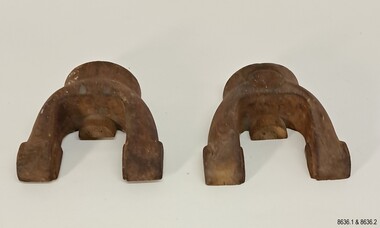
Equipment - Pattern, Briggs Brass Foundry, 1912-1972
... commercial businesses. Through its presence, its reputation was reinforced as both a skilled manufacturer and a community-minded enterprise. ...The wooden pattern forms part of a larger collection; some of them were secured within a durable wooden crate. The cast pattern was an essential tool at Briggs Brass Foundry, specifically designed for creating sand casts. Sand casting is a time-honoured technique, with a history exceeding 2,000 years. The handcrafted nature of this process produces brass and copper alloy items particularly suitable for maritime applications. Typical products include bells, boat hooks, cowls, propellers, handles, lids, rowlocks, hooks, letters, bolts, rail holders, brackets, deck plates, flanges, rudder guides, portholes and covers. The distinctive bronze mixture used at Briggs’ Foundry is copper based. It is composed of local ingots of copper, tin, zinc and lead, blended in precisely measured quantities. The resulting alloy is non-ferrous, known for its exceptional durability and longevity. HISTORY OF BRIGGS MARINE: The Briggs Brass Foundry, trading as Briggs & Son Foundry, was established in 1912 by Herbert Harrison Briggs (1863-1931) with his son George Edward Briggs. In 1922, the youngest son, Cyril Falkiner McKinnon Briggs, joined the foundry. After Herbert died in 1931, his sons George and Cyril ran the foundry. The business became known as Briggs Marine Foundry, the “non-ferrous founders” and “bell specialists”. The foundry products were made using the traditional sand-casting method, which is now over two thousand years old and is becoming a dying art. The foundry operated at 70 Wellington St, Collingwood, and specialised in casting ship bells and other marine equipment and fittings. It also made decorative items such as miniature ship propellers. The great-granddaughter of Herbert Briggs inherited a Briggs brass bell, similar to one at Flagstaff Hill Maritime Village. In 1965, Cyril was the only remaining family member involved in Briggs Marine Products. The firm relocated to Chesterville Rd, Moorabbin and Cyril went into partnership with Frank Lee. In the same year, the firm exhibited its products at the 1965 Boat Show. When Cyril passed away in 1967, Frank took over the business with two new partners. After Frank Lee died in 1971, the foundry was run by his son and daughter-in-law, Les and Eva Lee. Briggs Marine still exists today, but the Briggs family is no longer involved. Briggs Foundry had a community-minded retail branch in Warrnambool, selling cast boat fittings and equipment to fishermen and others in the regional marine industry. The branch closed in 1972. In Flagstaff Hill’s formative years, 1972-1975, many Briggs Marine brassware products were generously donated from its Melbourne foundry, along with casting patterns, tools, machinery and a cupboard. EXHIBITION and LEGACY: The donated items were displayed in a simulated Brass Foundry within the Village, where visitors could view them and gain insight into the foundering and metalwork trades that supported maritime industries, including shipwrights and boatbuilders. The castings produced at the foundry were also vital for farmers, manufacturers and other local industries. This exhibit was part of a broader showcase of working crafts, trades and services typical of a Maritime town. The display was available to the public from the completion of the building in 1986 until 1994, when the space was repurposed. It is believed that Briggs Marine’s family members gave personal assistance in setting up the displays in the original village shops, particularly the ‘Brass Foundry’ building. A notable feature of the Village Brass Foundry was the historic Cornish chimney, presented as a working model. This chimney visually demonstrated the process of smelting metal in furnaces and pouring it into sand moulds. Constructed from specially curved bricks, the chimney now stands at about two-thirds of its original height, having been relocated from the Grassmere Cheese factory. The hand-cast sand patterns hold considerable significance due to their association with Briggs Brass Founders, a firm established in the early 20th century and widely recognised for its expertise in producing, repairing, and restoring ship bells and marine equipment. Known for their specialisation in non-ferrous metal casting, Briggs Brass Founders supplied high-quality fittings and equipment for maritime use. The company extended its operations by opening a branch in Warrnambool, where it actively supported the local community. The foundry’s ability to cast essential products was important to local and regional industries, like fishing, farming, manufacturing and commercial businesses. Through its presence, its reputation was reinforced as both a skilled manufacturer and a community-minded enterprise. The foundry is notably associated with the Schomberg Bell at Flagstaff Hill, having restored this small, historic bell to its original condition. The Schomberg Bell is a fine example from a luxury migrant vessel dating back to the mid-19th century, reflecting the craftsmanship and heritage preserved by Briggs Brass Foundry Pattern: pair of U-shaped carved blocks, unpainted. The blocks have opposing metal pins and holes to hold them together. One block has a disc shape carved into the base. The pattern is part of a set of foundry patterns from Briggs Brass Foundry.flagstaff hill, flagstaff hill maritime museum and village, warrnambool, maritime museum, maritime village, great ocean road, shipwreck coast, briggs' bronze, traditional method, trade, sand cast, cast, brass alloy, copper alloy, pattern, mould, foundry, brass foundry, metal foundry, casting, sand mould, sand casting, marine equipment, marine tools, marine fittings, copper tin zinc lead, non-ferrous, non-corrosive, brassware, metalware, foundering, metalwork, maritime, bell founders, ship chandlers, marine products, biggs, briggs family, herbert harrison briggs, h h briggs, george edward briggs, cyril falkiner mckinnon briggs, cyril briggs, briggs & son brass foundry, h h briggs & sons foundry, briggs marine, alliance casting & engineering solutions, grassmere cheese factory, cornish chimney, curved bricks, collingwood, moorabbin, collingwood foundry, moorabbin foundry, 1912, briggs, briggs brass foundry, briggs marine foundry, briggs marine products, frank lee, les lee, eva lee, briggs marine warrnambool, non-ferrous founders, bell specialists, ship bell specialists, founders, metalworking, traditional sand casting, casting pattern, foundry pattern -
 Flagstaff Hill Maritime Museum and Village
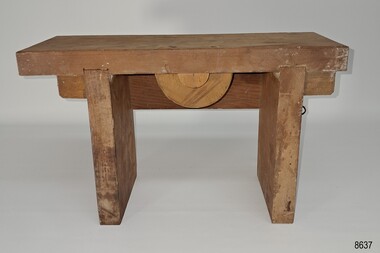
Equipment - Pattern, Briggs Brass Foundry, 1912-1972
... commercial businesses. Through its presence, its reputation was reinforced as both a skilled manufacturer and a community-minded enterprise. ...The wooden pattern forms part of a larger collection; some of them were secured within a durable wooden crate. The cast pattern was an essential tool at Briggs Brass Foundry, specifically designed for creating sand casts. Sand casting is a time-honoured technique, with a history exceeding 2,000 years. The handcrafted nature of this process produces brass and copper alloy items particularly suitable for maritime applications. Typical products include bells, boat hooks, cowls, propellers, handles, lids, rowlocks, hooks, letters, bolts, rail holders, brackets, deck plates, flanges, rudder guides, portholes and covers. The distinctive bronze mixture used at Briggs’ Foundry is copper based. It is composed of local ingots of copper, tin, zinc and lead, blended in precisely measured quantities. The resulting alloy is non-ferrous, known for its exceptional durability and longevity. HISTORY OF BRIGGS MARINE: The Briggs Brass Foundry, trading as Briggs & Son Foundry, was established in 1912 by Herbert Harrison Briggs (1863-1931) with his son George Edward Briggs. In 1922, the youngest son, Cyril Falkiner McKinnon Briggs, joined the foundry. After Herbert died in 1931, his sons George and Cyril ran the foundry. The business became known as Briggs Marine Foundry, the “non-ferrous founders” and “bell specialists”. The foundry products were made using the traditional sand-casting method, which is now over two thousand years old and is becoming a dying art. The foundry operated at 70 Wellington St, Collingwood, and specialised in casting ship bells and other marine equipment and fittings. It also made decorative items such as miniature ship propellers. The great-granddaughter of Herbert Briggs inherited a Briggs brass bell, similar to one at Flagstaff Hill Maritime Village. In 1965, Cyril was the only remaining family member involved in Briggs Marine Products. The firm relocated to Chesterville Rd, Moorabbin and Cyril went into partnership with Frank Lee. In the same year, the firm exhibited its products at the 1965 Boat Show. When Cyril passed away in 1967, Frank took over the business with two new partners. After Frank Lee died in 1971, the foundry was run by his son and daughter-in-law, Les and Eva Lee. Briggs Marine still exists today, but the Briggs family is no longer involved. Briggs Foundry had a community-minded retail branch in Warrnambool, selling cast boat fittings and equipment to fishermen and others in the regional marine industry. The branch closed in 1972. In Flagstaff Hill’s formative years, 1972-1975, many Briggs Marine brassware products were generously donated from its Melbourne foundry, along with casting patterns, tools, machinery and a cupboard. EXHIBITION and LEGACY: The donated items were displayed in a simulated Brass Foundry within the Village, where visitors could view them and gain insight into the foundering and metalwork trades that supported maritime industries, including shipwrights and boatbuilders. The castings produced at the foundry were also vital for farmers, manufacturers and other local industries. This exhibit was part of a broader showcase of working crafts, trades and services typical of a Maritime town. The display was available to the public from the completion of the building in 1986 until 1994, when the space was repurposed. It is believed that Briggs Marine’s family members gave personal assistance in setting up the displays in the original village shops, particularly the ‘Brass Foundry’ building. A notable feature of the Village Brass Foundry was the historic Cornish chimney, presented as a working model. This chimney visually demonstrated the process of smelting metal in furnaces and pouring it into sand moulds. Constructed from specially curved bricks, the chimney now stands at about two-thirds of its original height, having been relocated from the Grassmere Cheese factory. The hand-cast sand patterns hold considerable significance due to their association with Briggs Brass Founders, a firm established in the early 20th century and widely recognised for its expertise in producing, repairing, and restoring ship bells and marine equipment. Known for their specialisation in non-ferrous metal casting, Briggs Brass Founders supplied high-quality fittings and equipment for maritime use. The company extended its operations by opening a branch in Warrnambool, where it actively supported the local community. The foundry’s ability to cast essential products was important to local and regional industries, like fishing, farming, manufacturing and commercial businesses. Through its presence, its reputation was reinforced as both a skilled manufacturer and a community-minded enterprise. The foundry is notably associated with the Schomberg Bell at Flagstaff Hill, having restored this small, historic bell to its original condition. The Schomberg Bell is a fine example from a luxury migrant vessel dating back to the mid-19th century, reflecting the craftsmanship and heritage preserved by Briggs Brass Foundry. Pattern; an unpainted, rectangular wooden frame with a top and sides, similar to a small rectangular stool. A solid half-cylinder shape was added under the horizontal 'seat' with another smaller half-cylinder attached to it, end-to-end. A string is tied between two metal loops attached to the back. There are two X marks stamped into the back. The pattern is part of a set of foundry patterns from Briggs Brass Foundry.Stamped: "X" "X"flagstaff hill, flagstaff hill maritime museum and village, warrnambool, maritime museum, maritime village, great ocean road, shipwreck coast, briggs' bronze, traditional method, trade, sand cast, cast, brass alloy, copper alloy, pattern, mould, foundry, brass foundry, metal foundry, casting, sand mould, sand casting, marine equipment, marine tools, marine fittings, copper tin zinc lead, non-ferrous, non-corrosive, brassware, metalware, foundering, metalwork, maritime, bell founders, ship chandlers, marine products, biggs, briggs family, herbert harrison briggs, h h briggs, george edward briggs, cyril falkiner mckinnon briggs, cyril briggs, briggs & son brass foundry, h h briggs & sons foundry, briggs marine, alliance casting & engineering solutions, grassmere cheese factory, cornish chimney, curved bricks, collingwood, moorabbin, collingwood foundry, moorabbin foundry, 1912, briggs, briggs brass foundry, briggs marine foundry, briggs marine products, frank lee, les lee, eva lee, briggs marine warrnambool, non-ferrous founders, bell specialists, ship bell specialists, founders, metalworking, traditional sand casting, casting pattern, foundry pattern -
 Flagstaff Hill Maritime Museum and Village
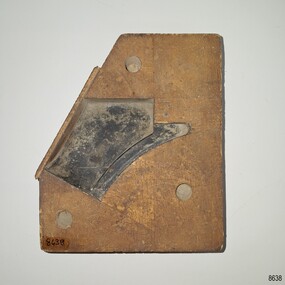
Equipment - Pattern, Briggs Brass Foundry, 1912-1972
... commercial businesses. Through its presence, its reputation was reinforced as both a skilled manufacturer and a community-minded enterprise. ...The wooden pattern was possibly made for casting a part for Craftman Marine, makers of engines for boats and other applications. It is part of a larger collection; some of them were secured within a durable wooden crate. The cast pattern was an essential tool at Briggs Brass Foundry, specifically designed for creating sand casts. Sand casting is a time-honoured technique, with a history exceeding 2,000 years. The handcrafted nature of this process produces brass and copper alloy items particularly suitable for maritime applications. Typical products include bells, boat hooks, cowls, propellers, handles, lids, rowlocks, hooks, letters, bolts, rail holders, brackets, deck plates, flanges, rudder guides, portholes and covers. The distinctive bronze mixture used at Briggs’ Foundry is copper based. It is composed of local ingots of copper, tin, zinc and lead, blended in precisely measured quantities. The resulting alloy is non-ferrous, known for its exceptional durability and longevity. HISTORY OF BRIGGS MARINE: The Briggs Brass Foundry, trading as Briggs & Son Foundry, was established in 1912 by Herbert Harrison Briggs (1863-1931) with his son George Edward Briggs. In 1922, the youngest son, Cyril Falkiner McKinnon Briggs, joined the foundry. After Herbert died in 1931, his sons George and Cyril ran the foundry. The business became known as Briggs Marine Foundry, the “non-ferrous founders” and “bell specialists”. The foundry products were made using the traditional sand-casting method, which is now over two thousand years old and is becoming a dying art. The foundry operated at 70 Wellington St, Collingwood, and specialised in casting ship bells and other marine equipment and fittings. It also made decorative items such as miniature ship propellers. The great-granddaughter of Herbert Briggs inherited a Briggs brass bell, similar to one at Flagstaff Hill Maritime Village. In 1965, Cyril was the only remaining family member involved in Briggs Marine Products. The firm relocated to Chesterville Rd, Moorabbin and Cyril went into partnership with Frank Lee. In the same year, the firm exhibited its products at the 1965 Boat Show. When Cyril passed away in 1967, Frank took over the business with two new partners. After Frank Lee died in 1971, the foundry was run by his son and daughter-in-law, Les and Eva Lee. Briggs Marine still exists today, but the Briggs family is no longer involved. Briggs Foundry had a community-minded retail branch in Warrnambool, selling cast boat fittings and equipment to fishermen and others in the regional marine industry. The branch closed in 1972. In Flagstaff Hill’s formative years, 1972-1975, many Briggs Marine brassware products were generously donated from its Melbourne foundry, along with casting patterns, tools, machinery and a cupboard. EXHIBITION and LEGACY: The donated items were displayed in a simulated Brass Foundry within the Village, where visitors could view them and gain insight into the foundering and metalwork trades that supported maritime industries, including shipwrights and boatbuilders. The castings produced at the foundry were also vital for farmers, manufacturers and other local industries. This exhibit was part of a broader showcase of working crafts, trades and services typical of a Maritime town. The display was available to the public from the completion of the building in 1986 until 1994, when the space was repurposed. It is believed that Briggs Marine’s family members gave personal assistance in setting up the displays in the original village shops, particularly the ‘Brass Foundry’ building. A notable feature of the Village Brass Foundry was the historic Cornish chimney, presented as a working model. This chimney visually demonstrated the process of smelting metal in furnaces and pouring it into sand moulds. Constructed from specially curved bricks, the chimney now stands at about two-thirds of its original height, having been relocated from the Grassmere Cheese factory. The hand-cast sand patterns hold considerable significance due to their association with Briggs Brass Founders, a firm established in the early 20th century and widely recognised for its expertise in producing, repairing, and restoring ship bells and marine equipment. Known for their specialisation in non-ferrous metal casting, Briggs Brass Founders supplied high-quality fittings and equipment for maritime use. The company extended its operations by opening a branch in Warrnambool, where it actively supported the local community. The foundry’s ability to cast essential products was important to local and regional industries, like fishing, farming, manufacturing and commercial businesses. Through its presence, its reputation was reinforced as both a skilled manufacturer and a community-minded enterprise. The foundry is notably associated with the Schomberg Bell at Flagstaff Hill, having restored this small, historic bell to its original condition. The Schomberg Bell is a fine example from a luxury migrant vessel dating back to the mid-19th century, reflecting the craftsmanship and heritage preserved by Briggs Brass Foundry. Pattern; rectangular wooden block with a corner cut diagonally. A five-sided shape has been carved into the centre, with one side curved inwards and slightly shallower than the other sides. The cut-out area is painted black. Three holes are drilled in the cut-out side to align the pattern with another piece of work. A wooden slat is fixed across the diagonal side. The back of the pattern has a handwritten inscription, possibly by two writers. The pattern is part of a set of foundry patterns from Briggs Brass Foundry and is connected to Craftman Marine.In black handwriting: "1 # H AL" Handwritten in a different hand: "CRAFTMAN MARINE" Written the the first hand: BRIGGS" (or "BRICK")flagstaff hill, flagstaff hill maritime museum and village, warrnambool, maritime museum, maritime village, great ocean road, shipwreck coast, briggs' bronze, traditional method, trade, sand cast, cast, brass alloy, copper alloy, pattern, mould, foundry, brass foundry, metal foundry, casting, sand mould, sand casting, marine equipment, marine tools, marine fittings, copper tin zinc lead, non-ferrous, non-corrosive, brassware, metalware, foundering, metalwork, maritime, bell founders, ship chandlers, marine products, biggs, briggs family, herbert harrison briggs, h h briggs, george edward briggs, cyril falkiner mckinnon briggs, cyril briggs, briggs & son brass foundry, h h briggs & sons foundry, briggs marine, alliance casting & engineering solutions, grassmere cheese factory, cornish chimney, curved bricks, collingwood, moorabbin, collingwood foundry, moorabbin foundry, 1912, craftman marine, craftsman marine, briggs, briggs brass foundry, briggs marine foundry, briggs marine products, frank lee, les lee, eva lee, briggs marine warrnambool, non-ferrous founders, bell specialists, ship bell specialists, founders, metalworking, traditional sand casting, casting pattern, foundry pattern -
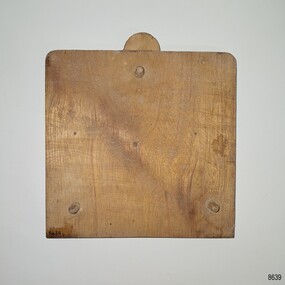 Flagstaff Hill Maritime Museum and Village
Equipment - Pattern, Briggs Brass Foundry, 1912-1972
... commercial businesses. Through its presence, its reputation was reinforced as both a skilled manufacturer and a community-minded enterprise. ...The wooden pattern is part of a set that is stored in a strong wooden crate and may be part of another similar pattern. It was used at Briggs’ Brass Foundry for making sand casts. The traditional craft of sand casting is over 2000 years old. The handcrafted process produces brass and copper alloy goods that are well suited to marine use; bells, boat hooks, cowls, propellers, handles, lids, rowlocks, hooks, letters, bolts, rail holders, brackets, deck plates, flanges, rudder guides, portholes and covers. Briggs’ Bronze mixture is a copper-based alloy made from local ingots of copper, tin, zinc and lead in carefully measured quantities. The finished product is non-ferrous and can last indefinitely. The crate of patterns was donated by the Briggs family in the early years of Flagstaff Hill, along with other related items such as brassware, tools and machinery. The donated items were displayed in a simulated Brass Foundry in the Village along with other working crafts, trades and services found in a Maritime town. The items were on show from the completion of the building in 1986 until 1994 when the building was repurposed. The patterns represent the trades of foundering and metalwork, both supporting maritime industries such as shipwrights and boatbuilders. Farmers, manufacturers and other local industries also needed the castings made by foundries. The Brass Foundry included a historic Cornish chimney set up as a working model, to tell the story of smelted metal heated in furnaces then be poured into the sand moulds. This chimney was made from specially curved bricks and is now about two-thirds of its full height when originally located at the Grassmere Cheese factory. The hand-cast sand patterns hold considerable significance due to their association with Briggs Brass Founders, a firm established in the early 20th century and widely recognised for its expertise in producing, repairing, and restoring ship bells and marine equipment. Known for their specialisation in non-ferrous metal casting, Briggs Brass Founders supplied high-quality fittings and equipment for maritime use. The company extended its operations by opening a branch in Warrnambool, where it actively supported the local community. The foundry’s ability to cast essential products was important to local and regional industries, like fishing, farming, manufacturing and commercial businesses. Through its presence, its reputation was reinforced as both a skilled manufacturer and a community-minded enterprise. The foundry is notably associated with the Schomberg Bell at Flagstaff Hill, having restored this small, historic bell to its original condition. The Schomberg Bell is a fine example from a luxury migrant vessel dating back to the mid-19th century, reflecting the craftsmanship and heritage preserved by Briggs Brass Foundry. Pattern; unpainted, square wooden block with a semi-circle of dowel added to the centre of the side with rounded corners. Three short dowel pegs are inserted on one flat side; one below the semi-circle and one near the lower corners in an overall triangle configuration. The pattern is part of a set of foundry patterns from Briggs Brass Foundry.flagstaff hill, flagstaff hill maritime museum and village, warrnambool, maritime museum, maritime village, great ocean road, shipwreck coast, briggs' bronze, traditional method, trade, sand cast, cast, brass alloy, copper alloy, pattern, mould, foundry, brass foundry, metal foundry, casting, sand mould, sand casting, marine equipment, marine tools, marine fittings, copper tin zinc lead, non-ferrous, non-corrosive, brassware, metalware, foundering, metalwork, maritime, bell founders, ship chandlers, marine products, biggs, briggs family, herbert harrison briggs, h h briggs, george edward briggs, cyril falkiner mckinnon briggs, cyril briggs, briggs & son brass foundry, h h briggs & sons foundry, briggs marine, alliance casting & engineering solutions, grassmere cheese factory, cornish chimney, curved bricks, collingwood, moorabbin, collingwood foundry, moorabbin foundry, 1912, briggs, briggs brass foundry, briggs marine foundry, briggs marine products, frank lee, les lee, eva lee, briggs marine warrnambool, non-ferrous founders, bell specialists, ship bell specialists, founders, metalworking, traditional sand casting, casting pattern, foundry pattern -
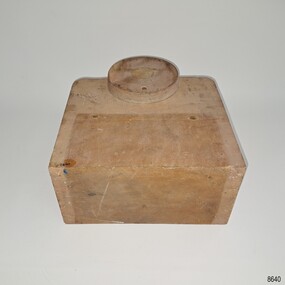 Flagstaff Hill Maritime Museum and Village
Equipment - Pattern, Briggs Brass Foundry, 1912-1972
... commercial businesses. Through its presence, its reputation was reinforced as both a skilled manufacturer and a community-minded enterprise. ...The wooden pattern forms part of a larger collection; some of them were secured within a durable wooden crate. The cast pattern was an essential tool at Briggs Brass Foundry, specifically designed for creating sand casts. Sand casting is a time-honoured technique, with a history exceeding 2,000 years. The handcrafted nature of this process produces brass and copper alloy items particularly suitable for maritime applications. Typical products include bells, boat hooks, cowls, propellers, handles, lids, rowlocks, hooks, letters, bolts, rail holders, brackets, deck plates, flanges, rudder guides, portholes and covers. The distinctive bronze mixture used at Briggs’ Foundry is copper based. It is composed of local ingots of copper, tin, zinc and lead, blended in precisely measured quantities. The resulting alloy is non-ferrous, known for its exceptional durability and longevity. HISTORY OF BRIGGS MARINE: The Briggs Brass Foundry, trading as Briggs & Son Foundry, was established in 1912 by Herbert Harrison Briggs (1863-1931) with his son George Edward Briggs. In 1922, the youngest son, Cyril Falkiner McKinnon Briggs, joined the foundry. After Herbert died in 1931, his sons George and Cyril ran the foundry. The business became known as Briggs Marine Foundry, the “non-ferrous founders” and “bell specialists”. The foundry products were made using the traditional sand-casting method, which is now over two thousand years old and is becoming a dying art. The foundry operated at 70 Wellington St, Collingwood, and specialised in casting ship bells and other marine equipment and fittings. It also made decorative items such as miniature ship propellers. The great-granddaughter of Herbert Briggs inherited a Briggs brass bell, similar to one at Flagstaff Hill Maritime Village. In 1965, Cyril was the only remaining family member involved in Briggs Marine Products. The firm relocated to Chesterville Rd, Moorabbin and Cyril went into partnership with Frank Lee. In the same year, the firm exhibited its products at the 1965 Boat Show. When Cyril passed away in 1967, Frank took over the business with two new partners. After Frank Lee died in 1971, the foundry was run by his son and daughter-in-law, Les and Eva Lee. Briggs Marine still exists today, but the Briggs family is no longer involved. Briggs Foundry had a community-minded retail branch in Warrnambool, selling cast boat fittings and equipment to fishermen and others in the regional marine industry. The branch closed in 1972. In Flagstaff Hill’s formative years, 1972-1975, many Briggs Marine brassware products were generously donated from its Melbourne foundry, along with casting patterns, tools, machinery and a cupboard. EXHIBITION and LEGACY: The donated items were displayed in a simulated Brass Foundry within the Village, where visitors could view them and gain insight into the foundering and metalwork trades that supported maritime industries, including shipwrights and boatbuilders. The castings produced at the foundry were also vital for farmers, manufacturers and other local industries. This exhibit was part of a broader showcase of working crafts, trades and services typical of a Maritime town. The display was available to the public from the completion of the building in 1986 until 1994, when the space was repurposed. It is believed that Briggs Marine’s family members gave personal assistance in setting up the displays in the original village shops, particularly the ‘Brass Foundry’ building. A notable feature of the Village Brass Foundry was the historic Cornish chimney, presented as a working model. This chimney visually demonstrated the process of smelting metal in furnaces and pouring it into sand moulds. Constructed from specially curved bricks, the chimney now stands at about two-thirds of its original height, having been relocated from the Grassmere Cheese factory. The hand-cast sand patterns hold considerable significance due to their association with Briggs Brass Founders, a firm established in the early 20th century and widely recognised for its expertise in producing, repairing, and restoring ship bells and marine equipment. Known for their specialisation in non-ferrous metal casting, Briggs Brass Founders supplied high-quality fittings and equipment for maritime use. The company extended its operations by opening a branch in Warrnambool, where it actively supported the local community. The foundry’s ability to cast essential products was important to local and regional industries, like fishing, farming, manufacturing and commercial businesses. Through its presence, its reputation was reinforced as both a skilled manufacturer and a community-minded enterprise. The foundry is notably associated with the Schomberg Bell at Flagstaff Hill, having restored this small, historic bell to its original condition. The Schomberg Bell is a fine example from a luxury migrant vessel dating back to the mid-19th century, reflecting the craftsmanship and heritage preserved by Briggs Brass Foundry. Pattern: thick square mostly unopainted wooden block with a solid half-cylinder added to the top, which has rounded shoulders. A disc is added to the front, aligned with the curve at the top. The top curve has orange paint, and the dial is pink. Three holes are drilled in the back, in a triangular configuration. It is similar in shape to a mantle clock or an early-style radio. The pattern is part of a set of foundry patterns from Briggs Brass Foundry.flagstaff hill, flagstaff hill maritime museum and village, warrnambool, maritime museum, maritime village, great ocean road, shipwreck coast, briggs' bronze, traditional method, trade, sand cast, cast, brass alloy, copper alloy, pattern, mould, foundry, brass foundry, metal foundry, casting, sand mould, sand casting, marine equipment, marine tools, marine fittings, copper tin zinc lead, non-ferrous, non-corrosive, brassware, metalware, foundering, metalwork, maritime, bell founders, ship chandlers, marine products, biggs, briggs family, herbert harrison briggs, h h briggs, george edward briggs, cyril falkiner mckinnon briggs, cyril briggs, briggs & son brass foundry, h h briggs & sons foundry, briggs marine, alliance casting & engineering solutions, grassmere cheese factory, cornish chimney, curved bricks, collingwood, moorabbin, collingwood foundry, moorabbin foundry, 1912, briggs, briggs brass foundry, briggs marine foundry, briggs marine products, frank lee, les lee, eva lee, briggs marine warrnambool, non-ferrous founders, bell specialists, ship bell specialists, founders, metalworking, traditional sand casting, casting pattern, foundry pattern -
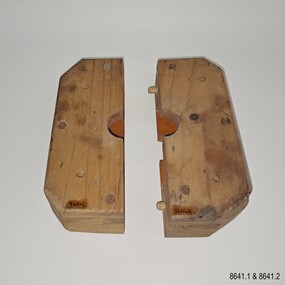 Flagstaff Hill Maritime Museum and Village
Equipment - Pattern, Briggs Brass Foundry, 1912-1972
... commercial businesses. Through its presence, its reputation was reinforced as both a skilled manufacturer and a community-minded enterprise. ...The wooden pattern forms part of a larger collection; some of them were secured within a durable wooden crate. The cast pattern was an essential tool at Briggs Brass Foundry, specifically designed for creating sand casts. Sand casting is a time-honoured technique, with a history exceeding 2,000 years. The handcrafted nature of this process produces brass and copper alloy items particularly suitable for maritime applications. Typical products include bells, boat hooks, cowls, propellers, handles, lids, rowlocks, hooks, letters, bolts, rail holders, brackets, deck plates, flanges, rudder guides, portholes and covers. The distinctive bronze mixture used at Briggs’ Foundry is copper based. It is composed of local ingots of copper, tin, zinc and lead, blended in precisely measured quantities. The resulting alloy is non-ferrous, known for its exceptional durability and longevity. HISTORY OF BRIGGS MARINE: The Briggs Brass Foundry, trading as Briggs & Son Foundry, was established in 1912 by Herbert Harrison Briggs (1863-1931) with his son George Edward Briggs. In 1922, the youngest son, Cyril Falkiner McKinnon Briggs, joined the foundry. After Herbert died in 1931, his sons George and Cyril ran the foundry. The business became known as Briggs Marine Foundry, the “non-ferrous founders” and “bell specialists”. The foundry products were made using the traditional sand-casting method, which is now over two thousand years old and is becoming a dying art. The foundry operated at 70 Wellington St, Collingwood, and specialised in casting ship bells and other marine equipment and fittings. It also made decorative items such as miniature ship propellers. The great-granddaughter of Herbert Briggs inherited a Briggs brass bell, similar to one at Flagstaff Hill Maritime Village. In 1965, Cyril was the only remaining family member involved in Briggs Marine Products. The firm relocated to Chesterville Rd, Moorabbin and Cyril went into partnership with Frank Lee. In the same year, the firm exhibited its products at the 1965 Boat Show. When Cyril passed away in 1967, Frank took over the business with two new partners. After Frank Lee died in 1971, the foundry was run by his son and daughter-in-law, Les and Eva Lee. Briggs Marine still exists today, but the Briggs family is no longer involved. Briggs Foundry had a community-minded retail branch in Warrnambool, selling cast boat fittings and equipment to fishermen and others in the regional marine industry. The branch closed in 1972. In Flagstaff Hill’s formative years, 1972-1975, many Briggs Marine brassware products were generously donated from its Melbourne foundry, along with casting patterns, tools, machinery and a cupboard. EXHIBITION and LEGACY: The donated items were displayed in a simulated Brass Foundry within the Village, where visitors could view them and gain insight into the foundering and metalwork trades that supported maritime industries, including shipwrights and boatbuilders. The castings produced at the foundry were also vital for farmers, manufacturers and other local industries. This exhibit was part of a broader showcase of working crafts, trades and services typical of a Maritime town. The display was available to the public from the completion of the building in 1986 until 1994, when the space was repurposed. It is believed that Briggs Marine’s family members gave personal assistance in setting up the displays in the original village shops, particularly the ‘Brass Foundry’ building. A notable feature of the Village Brass Foundry was the historic Cornish chimney, presented as a working model. This chimney visually demonstrated the process of smelting metal in furnaces and pouring it into sand moulds. Constructed from specially curved bricks, the chimney now stands at about two-thirds of its original height, having been relocated from the Grassmere Cheese factory. The hand-cast sand patterns hold considerable significance due to their association with Briggs Brass Founders, a firm established in the early 20th century and widely recognised for its expertise in producing, repairing, and restoring ship bells and marine equipment. Known for their specialisation in non-ferrous metal casting, Briggs Brass Founders supplied high-quality fittings and equipment for maritime use. The company extended its operations by opening a branch in Warrnambool, where it actively supported the local community. The foundry’s ability to cast essential products was important to local and regional industries, like fishing, farming, manufacturing and commercial businesses. Through its presence, its reputation was reinforced as both a skilled manufacturer and a community-minded enterprise. The foundry is notably associated with the Schomberg Bell at Flagstaff Hill, having restored this small, historic bell to its original condition. The Schomberg Bell is a fine example from a luxury migrant vessel dating back to the mid-19th century, reflecting the craftsmanship and heritage preserved by Briggs Brass Foundry. Pattern: a pair of blocks that form a rectangle with a carved centre hole and a disc shape inside. The block is made from laminated pieces of wood with cut corners. Both sides have four drilled holes in a square configuration, but in different positions. The cut faces, and the space carved into them, are painted red; one piece has two dowel pins that fit into two drilled holes on the other. The pattern is part of a set of foundry patterns from Briggs Brass Foundry.flagstaff hill, flagstaff hill maritime museum and village, warrnambool, maritime museum, maritime village, great ocean road, shipwreck coast, briggs' bronze, traditional method, trade, sand cast, cast, brass alloy, copper alloy, pattern, mould, foundry, brass foundry, metal foundry, casting, sand mould, sand casting, marine equipment, marine tools, marine fittings, copper tin zinc lead, non-ferrous, non-corrosive, brassware, metalware, foundering, metalwork, maritime, bell founders, ship chandlers, marine products, biggs, briggs family, herbert harrison briggs, h h briggs, george edward briggs, cyril falkiner mckinnon briggs, cyril briggs, briggs & son brass foundry, h h briggs & sons foundry, briggs marine, alliance casting & engineering solutions, grassmere cheese factory, cornish chimney, curved bricks, collingwood, moorabbin, collingwood foundry, moorabbin foundry, 1912, briggs, briggs brass foundry, briggs marine foundry, briggs marine products, frank lee, les lee, eva lee, briggs marine warrnambool, non-ferrous founders, bell specialists, ship bell specialists, founders, metalworking, traditional sand casting, casting pattern, foundry pattern -
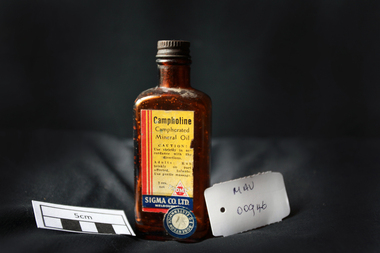 City of Moorabbin Historical Society (Operating the Box Cottage Museum)
Manufactured Glass, brown bottle 'Campholine', c1950
... The entrepreneurial Leete had been part of a move in 1904 among a group of commercially-minded chemists to put up proprietary preparations. 1913 - 1927 Initially, the fortunes of the Sigma enterprise relied on E. ...The entrepreneurial Leete had been part of a move in 1904 among a group of commercially-minded chemists to put up proprietary preparations. 1913 - 1927 Initially, the fortunes of the Sigma enterprise relied on E. ...Sigma was founded by two Melbourne pharmacists in 1912, it has grown to become one of the key players in Australia’s pharmacy industry .Edwin Thomas Church (1864 – 1947) and Ernest Holloway Leete a prominent chemist and a member of the College of Pharmacy who had established his own pharmacy in 1897. The entrepreneurial Leete had been part of a move in 1904 among a group of commercially-minded chemists to put up proprietary preparations. 1913 - 1927 Initially, the fortunes of the Sigma enterprise relied on E. H. Leete ‘working from home’, and even as late as 1915 company address was in Claremont Avenue Malvern. Following the establishment of the business in 1912, the Sigma Company Limited was located at Flinders Lane, Melbourne. Sigma – Tromax, 1928 E.H. Leete after sixteen years, said he would not stand again as a director of the company because interests were also turning elsewhere. He was assisting another company as its agent in the motor trade. 1938 to1953 was characterised by steady growth for Sigma, accelerated by manufacturing opportunities during World War Two. Between 1975 and 1996 the company was transformed as it entered a period of both consolidation and rapid growth. The appointment, in 1996, of new Managing Director, George Savvides, marked a break from the past. Today Sigma is a leading full line wholesale and distribution business to pharmacy. Sigma is also the owner of some of Australia’s best known pharmacy brands in Amcal, Guardian and Amcal MaxA triangular shaped, brown glass, bottle with a metal screw top containing ‘Campholine’Front label : Campholine / Camphorated / Mineral Oil / CAUTION ! / Use strictly in accordance / with the directions / Adults : Rub briskly on parts affected . Infants ; Use gentle massage . / 20z. / TROMAX / SIGMA CO. Ltd. / MELBOURNE / Label Sticker : ROBERTSON OF ELSTERNWICK 1/ 8 pharmacy, medicines, campholine, glassware, bottles, moorabbin, bentleigh, cheltenham, melbourne, tromax-sigma co ltd, leete ernest, church edwin, sigma company pty ltd -
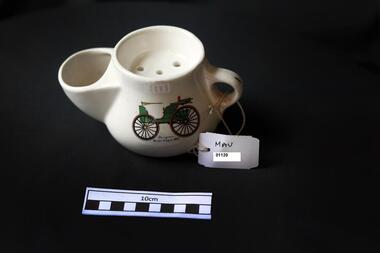 City of Moorabbin Historical Society (Operating the Box Cottage Museum)
Personal Effects, china shaving mug / scuttle, c1950
... Their enterprise followed the first commercially available automobile which was patented by Karl Benz on January 29, 1886, and put into production in 1888. ...Their enterprise followed the first commercially available automobile which was patented by Karl Benz on January 29, 1886, and put into production in 1888. ...Shaving soap scuttles are distinguished from shaving mugs by having a separate area for hot water. The hot water is for dipping a shaving brush into to make a lather with the soap which is then applied to the skin before using the razor. Vintage scuttles are often elaborately decorated. Between 1880 and 1920 is the original time period for the occupational shaving mug. Most men owned a shaving mug, either at home or at a barber shop. Mugs purchased for home use typically were purchased through local stores, had more variety in style but usually went without a name. Barber shops sold mugs with the owners’ names on them partly because they thought that shaving rash came from sharing the same soap. In reality, the rash was not a result of soap but of unsterilized razors. Transfer ; The Duryea Motor Wagon was among the first standardized automobiles and among the first powered by gasoline. Fifteen examples were built by the Duryea Motor Wagon Company of Chicopee, Massachusetts, between 1893 and 1896. Their enterprise followed the first commercially available automobile which was patented by Karl Benz on January 29, 1886, and put into production in 1888. The Duryea Motor Wagon remained in production until 1917. The Duryea brothers entered their horseless carriage in many shows and races. A china shaving mug / scuttle with a car transfer. The mug has a wide spout to hold / insert the shaving brush , a perforated tray opening at the top to hold the soap and a bulbous base for the hot water. car transfershaving equipment, safety razors, cheltenham, early settlers, moorabbin, shaving soap sticks, shaving brushes, shaving scuttles, shaving rash, infectious diseases, barber shops, -
 Orbost & District Historical Society
ink bottle, early 20th century from mid 1930's
... This item is an example of early stationery equipment commonly used in schools, households and commercial enterprises. container ceramic stephens'-inks writing-equipment communication bottle stationery Near base - This bottle is the property of Stephens' Inks Aust. ...An ink bottle was made of glass or ceramic and typically sat on a desk. The writer would dip the pen (or quill) into the bottle to put more ink on the pen. Because they sat on a desk, ink bottles were often decorative. 'Stephens' Ink' was invented by the British physician, Dr Henry Stephens (1796-1864), who in 1832 first developed his indelible "blue-black writing fluid" that became the basis of a successful manufacturing enterprise lasting over 130 years. Stephens' ink revolutionised office life in the latter half of the 19th century saving clerical workers much time previously spent mixing powdered inks and cleaning nibs. It was indelible and non-fading. After changes to the Australian import duties on inks, a local manufacturing works was established in the early 1930s by Stephens Inks (Australia) Ltd.We have mostly dispensed with ink bottles and quills. This item is an example of early stationery equipment commonly used in schools, households and commercial enterprises. A cylindrical brown glazed ceramic bottle with a pourer lip. This would have contained ink and had a cork seal. It would have had a paper label.Near base - This bottle is the property of Stephens' Inks Aust. Ltdcontainer ceramic stephens'-inks writing-equipment communication bottle stationery -
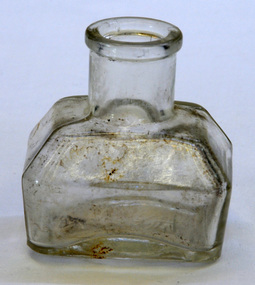 Orbost & District Historical Society
ink bottle, 1920's
... This item is an example of early stationery equipment commonly used in schools, households and commercial enterprises. bottle ink stationery personal-effects glass container On the base- AGM F1173 M A clear glass ink bottle with flat sloping shoulders. ink bottle Australian Glass Manufacturers ...An ink bottle was made of glass or ceramic and typically sat on a desk. The writer would dip the pen (or quill) into the bottle to put more ink on the pen. Because they sat on a desk, ink bottles were often decorative.We have mostly dispensed with ink bottles and quills. This item is an example of early stationery equipment commonly used in schools, households and commercial enterprises.A clear glass ink bottle with flat sloping shoulders.On the base- AGM F1173 Mbottle ink stationery personal-effects glass container
