
Showing 97 items matching "community groups -- kew (vic.)"
-
 Kew Historical Society Inc
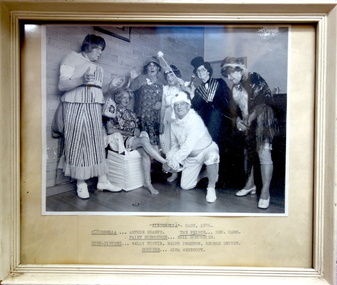
Photograph, Kew Elder Citizens' Club, Cast of 'Cinderella', Kew Elder Citizens' Association, 1976
... ...community groups -- kew (vic.)...Later the Club moved to its current headquarters in High Street. kew elder citizens' club -- association community groups -- kew (vic.) kew senior citizens theatre -- kew (vic.) ...The Kew Elder Citizen's Association was formally established in 1952. During its initial years it met at South Esk in Cotham Road. Later the Club moved to its current headquarters in High Street.Framed photograph of a theatrical performance of 'Cinderella' by the Kew Elder Citizens' Club in 1976. Handwritten insert below photograph: "Cinderella - Cast, 1976 / Arthur Sharpe; The Prince - Hec Camm; Fairy Godmother - Bill Humphries; Step-sisters - Wally Tustin, Ralph Preston, George Driver; Compere - Alma Westcott".kew elder citizens' club -- association, community groups -- kew (vic.), kew senior citizens, theatre -- kew (vic.) -
 Kew Historical Society Inc
Archive (Sub-series) - Subject File, Community Clubs (Kew), 1958
... community groups -- kew (vic.)...Typically files will contain primary and secondary sources. community groups -- kew (vic.) Archive file containing a newspaper article/clipping from 2010 relating to an event held by the Kew Toastmasters. ...Various partiesReference, Research, InformationSecondary Values (KHS Imposed Order)Subject file containing a newspaper article/clipping from 2010 relating to an event held by the Kew Toastmasters.community groups -- kew (vic.)community groups -- kew (vic.) -
Kew Historical Society Inc
Archive (Series) - Subject File, Eastern Freeway (Kew), 1979
... kew east (vic) - community groups...kew (vic...Typically files will contain primary and secondary sources. kew (vic) - history kew east (vic) - community groups kew (vic) - roads Archive file containing sundry newspaper files about protests against the freeway’s construction, land acquisition, speeding, noise etc. ...Organisation generatedReference, Research, InformationSecondary Values (KHS Imposed Order)Subject file containing sundry newspaper files about protests against the freeway’s construction, land acquisition, speeding, noise etc. There is also a CRB brochure of ‘Your Eastern Freeway Driver’s Guide’kew (vic) - history, kew east (vic) - community groups, kew (vic) - roadskew (vic) - history, kew east (vic) - community groups, kew (vic) - roads -
Kew Historical Society Inc
Archive (Sub-series) - Subject File, Kew Historical Society, Friends of Kew Library, 1958
... ...community groups -- kew (vic.)...Typically files will contain primary and secondary sources. friends of kew library community groups -- kew (vic.) An archive file with material relating to the Friends of the Kew Library. ...Various partiesReference, Research, InformationSecondary Values (KHS Imposed Order)A Subject file with material relating to the Friends of the Kew Library. The file includes correspondence, notices of meetings, and a collection of brass plates given by the Friends with gifts to the Library.friends of kew library, community groups -- kew (vic.)friends of kew library, community groups -- kew (vic.) -
Kew Historical Society Inc
Archive (Sub-series) - Subject File, Kew Historical Society, Friends of Walmer Street, 1958
... ...community groups - kew (vic)...Typically files will contain primary and secondary sources. kew historical society - archives community groups - kew (vic) walmer street - kew (vic) xavier college - junior school - kew (vic) action groups -- kew (vic.) ...Various partiesReference, Research, InformationSecondary Values (KHS Imposed Order)Single item subject file containing a newspaper article/clipping about a Friends of Walmer Street activity involving Xavier College students.kew historical society - archives, community groups - kew (vic), walmer street - kew (vic), xavier college - junior school - kew (vic), action groups -- kew (vic.)kew historical society - archives, community groups - kew (vic), walmer street - kew (vic), xavier college - junior school - kew (vic), action groups -- kew (vic.) -
Kew Historical Society Inc
Archive (Sub-series) - Subject File, Kew Historical Society, Kew Association, 1974
... ...community groups - kew (vic)...Typically files will contain primary and secondary sources. kew - history kew association - kew (vic) community groups - kew (vic) heritage - kew (vic) Information file on ‘The Kew Association’ formed in 1974 as a separate group to the Kew Historical Society. ...Various partiesReference, Research, InformationSecondary valuesSubject file on ‘The Kew Association’ formed in 1974 as a separate group to the Kew Historical Society. Its constitution, which is filed, is general in nature. One part of the Association’s interests was the formation of a Historical Working Group to ‘examine historic buildings and other aspects of Kew’s history’. A founding member of the Society, Joy Stewart, was its convenor. By June 1974 it had 133 members. It differed from the Society in that it specifically aimed to improve Council services. One of its achievements was to begin a ‘historical home survey’ by street. The survey documents in the file list street name, number of house, side of street, size of house and general observations. Other information in the archive file includes correspondence, agendas, minutes etc. of the Association. As these only cover the years 1974-5, this may have been the period in which the group operated.kew - history, kew association - kew (vic), community groups - kew (vic), heritage - kew (vic)kew - history, kew association - kew (vic), community groups - kew (vic), heritage - kew (vic) -
 Kew Historical Society Inc
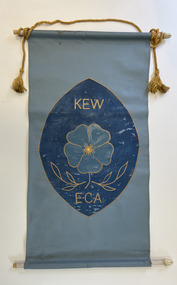
Banner - Kew Elder Citizens Association banner
... ...Community groups -- Kew (Vic.)...Kew Elderly Citizens association Kew Elder Citizens Kew Senior citizens Community groups -- Kew (Vic.) Banners "KEW / E.C.A." Handmade and painted canvas banner in shades of blue with a golden cord with tassels. ...The Kew Elderly Citizen's Association was formally established in 1952. During its initial years it met at South Esk in Cotham Road. Later the Club moved to its headquarters in High Street. During the period of its existence, the club changed its name a number of times It finally became known as the Kew Senior Citizens.Handmade and painted canvas banner in shades of blue with a golden cord with tassels. The banner represents the symbol of the Kew Elder Citizens Association: a forget-me-not in the centre with laurel leaves below. "KEW / E.C.A."kew elderly citizens association, kew elder citizens, kew senior citizens, community groups -- kew (vic.), banners -
 Kew Historical Society Inc
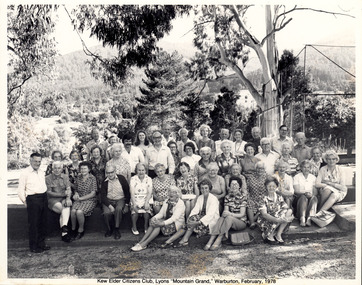
Photograph - Kew Elder Citizens' Club, Lyons 'Mountain Grand' Warburton, Unknown, 1978
... community groups -- kew (vic.)...The Association is still active in Kew and is currently located at Hamer Court, opposite the Boroondara General (Kew) Cemetery in High Street, Kew. community groups -- kew (vic.) senior citizens clubs -- kew (vic) club tours Framed and titled black and white photograph taken on the occasion of a visit by members of the Kew Elder Citizens Club to Lyons "Mountain Grand" Warburton, in February 1978. ...The orthodox version of the origins and history of the Kew Elder(ly) Citizens’ Association was established by Cr. W. D. Vaughan in his book Kew’s Civic Century (1960), when he wrote that: "When Mrs. C. H. Simpson was Mayoress in 1952 she set up the Elderly Citizens’ Association to care for the needs of ages persons in Kew. The idea was strongly supported and a start was made by providing social afternoons for elderly folk at Southesk. Visiting sick people in their homes, providing firewood where needed, and other activities were undertaken by the Association. The aid of Council was sought to further the work. It was decided that a social unit for elderly folk be established at Southesk." (p.126-7). In the following pages, he describes in detail Council’s role in formally establishing the Association. This ‘official’ version was reasserted in the later Thematic Environmental History of the City of Boroondara (2012). However the origins and gestation of community of organisations is rarely straightforward. In 1965, five years after Vaughan’s book was published, the author of East Kew Women’s Club : Twenty Years : 20-7-1945-30-7-1965, writing about the period July 1947 to July 1950, described the role the Club played in establishing the Kew Elder Citizens Association. The author wrote: "At a meeting of the Kew Community Aid, the plight of many elderly people in Kew who were dependent on pensions was raised and in order to ascertain their needs the practice was begun of serving morning tea at the Masonic Hall in Walpole Street, where pensions were then paid. From this beginning the Kew Elder Citizens Association was formed in Kew with wide support, and Club members gave willing support on the committee, in helping serve afternoon tea and in entertainment." (p.4) Photographic evidence also leads to questions about Vaughan’s version of events. A framed photograph in the Society’s Collection shows a Public Meeting to form the Kew Elder Citizens Association in a room at Southesk a year earlier in 1951. Whatever version of the origins of the Association is correct, a later framed photograph in the Society’s collection shows the opening of the completed Clubrooms of the Kew Elder Citizens at South Esk by the Hon. E.P. Cameron M.L.C, Minister of Health, on 12 November 1956. The Association is still active in Kew and is currently located at Hamer Court, opposite the Boroondara General (Kew) Cemetery in High Street, Kew.Framed and titled black and white photograph taken on the occasion of a visit by members of the Kew Elder Citizens Club to Lyons "Mountain Grand" Warburton, in February 1978.community groups -- kew (vic.), senior citizens clubs -- kew (vic), club tours -
 Kew Historical Society Inc
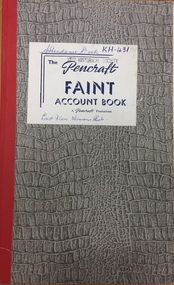
Administrative record, East Kew Women's Club, Attendance Register, 1971-1973
... ...community groups -- kew (vic.)...Community Spirit”. The first twenty years of the Club was recorded in a small, nine-page publication “East Kew Women’s Club : Twenty Years 20-7-1945 - 30-7-1965”. Following the closure of the Club in 1973, after twenty-eight years, its records were deposited with the Kew Historical Society and are thus available for research into the history of women’s groups in the post war period in Australia. The Society holds the Club’s Minute Books of Meetings (1953-73), Attendance Registers (1959-73), Visitors Book, and sundry items of print ephemera published by the Club. east kew women's club community groups -- kew (vic ...The East Kew Women’s Club was formed on 20 July 1945 as an experiment amongst local women, who felt that there was a need for some organised group to give full scope to their various interests and hobbies. In the beginning, they met at the house of their founder, Mrs Eric Thake, 48 Harp Road, East Kew, but the growth and interest was so rapid that it was soon necessary to find a larger meeting place, so the group moved to the Harrier’s Pavilion in Victoria Park, Kew. At the fifth meeting of the group, a committee was formed, and a constitution adopted on 4 December 1945.The Club was aimed to be non-political, non-sectarian and open to women from any locality. The Club’s motto was “To Help others, Improve Ourselves, and Foster the Community Spirit”. The first twenty years of the Club was recorded in a small, nine-page publication “East Kew Women’s Club : Twenty Years 20-7-1945 - 30-7-1965”. Following the closure of the Club in 1973, after twenty-eight years, its records were deposited with the Kew Historical Society and are thus available for research into the history of women’s groups in the post war period in Australia. The Society holds the Club’s Minute Books of Meetings (1953-73), Attendance Registers (1959-73), Visitors Book, and sundry items of print ephemera published by the Club.Document: Attendance Register, East Kew Women’s Club, 1971-73east kew women's club, community groups -- kew (vic.) -
Kew Historical Society Inc
Archive (Series) - North Kew Progress Association
... Community groups -- Kew (Vic.)...Community groups -- Kew (Vic.) North Kew Progress Association – Kew (Vic.) ...Various PartiesReference, Research, InformationArranged by Secondary Values (value of records to users)The North Kew Progress Association was a community organisation formed in 1939 and disbanded in 1980 that looked to petition the local and state governments on behalf of the residents of Kew to improve the area of North Kew specifically, and also to organise social gatherings between members. The association was highly organised and bureaucratic with a formalised structure as detailed in its constitutions. Part of the association was a failed attempt to create a kindergarten for the area, an objective which failed to materialise. The organisation was created and spearheaded by a Mr. Robert Morhead, and would petition the government for many things, including traffic police, superannuation for the council workers, subdivisions and even an internationally standardised Kayaking Course along the Yarra River. The file includes: A 1951 proposed constitution, a revised 1975 constitution, correspondences from the association between fellow members and the local council, invites to meetings, an account authorisation for the association’s finances, an account book with balance sheets, newspaper articles, and many annual reports ranging from the 30th to the 42nd annual report.community groups -- kew (vic.), north kew progress association – kew (vic.), robert morhead – kew (vic.)community groups -- kew (vic.), north kew progress association – kew (vic.), robert morhead – kew (vic.) -
Kew Historical Society Inc
Archive (Sub-series) - Subject File, East Kew Women’s Club, 1945-70, 1958
... kew east (vic) - community groups...kew east (vic...Kew Historical Society and are thus available for research into the history of women’s groups in the post war period in Australia. The Society holds the Club’s Minute Books of Meetings (1953-73), Attendance Registers (1959-73), Visitors Book, and sundry items of print ephemera published by the Club. kew (vic) - history kew east (vic) - community groups kew east (vic) - women Most of the original manuscripts of the Club (attendance registers, minutes of meetings, histories etc.,) are kept separately in archival boxes. ...Various partiesReference, Research, InformationSecondary Values (KHS Imposed Order)Most of the original manuscripts of the Club (attendance registers, minutes of meetings, histories etc.,) are kept separately in archival boxes. The reference file contains a copy of the 9-page history of the Club’s history from 1945-65 a newspaper clipping relating to a 25-year anniversary lunch.kew (vic) - history, kew east (vic) - community groups, kew east (vic) - womenkew (vic) - history, kew east (vic) - community groups, kew east (vic) - women -
 Kew Historical Society Inc
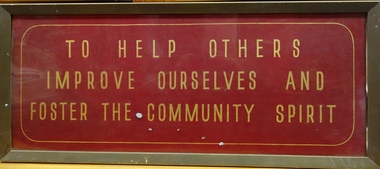
Plaque, East Kew Women's Club, To Help Others - Improve Ourselves And - Foster The Community Spirit, 1947
... ...community groups -- kew east (vic.)...Kew Women's Community Club, also called the East Kew Women's Community Club functioned from c. 1947 to the end of the 1960s (to be verified). The records of the Club were placed with Kew Historical Society to preserve them for posterity. The records and objects belonging to the East Kew Women's Community Club have significance socially for their capacity to illuminate women's associations in the post war period in Australia. east kew women's social club community groups -- kew east (vic.) ...On Saturday 17 May 1947, an article on page 25 of the Australian Women’s Weekly reported on the formation of a new women's club: the East Kew Women’s Community Club. The article reads: "Wives and mothers in a Melbourne suburb, East Kew, have formed the East Kew Women's Community Club. While babies and young children are under the supervision of a play leader, wives and mothers follow up their own interests. The club caters for varying tastes, has musical appreciation, drama, and "Keep Fit" classes. President Mrs. Grace Thake says that the club hopes soon to have tennis, debating, and discussion groups. The club originated from a debate, "Should women take an active part in social and civic affairs?" Two days later their interest in these matters was proved by the forming of the club, which took for its motto: "To help others, improve ourselves, and foster the community spirit." Membership is open to all women, regardless of age, politics, and religion, and aims to co-operate with all societies working for the improvement of health and cultural standards." The article relates particularly to the plaque in the collection of the Kew Historical Society.The East Kew Women's Community Club, also called the East Kew Women's Community Club functioned from c. 1947 to the end of the 1960s (to be verified). The records of the Club were placed with Kew Historical Society to preserve them for posterity. The records and objects belonging to the East Kew Women's Community Club have significance socially for their capacity to illuminate women's associations in the post war period in Australia.Framed red and gold enamelled plaque belonging to the East Kew Women's Community Club."TO HELP OTHERS / IMPROVE OURSELVES AND / FOSTER THE COMMUNITY SPIRIT"east kew women's social club, community groups -- kew east (vic.) -
Kew Historical Society Inc
Document, Summary History of the East Kew Women's Club, 1970s
... ...community groups -- Kew East (vic.)...Kew Historical Society and are thus available for research into the history of women’s groups in the post war period in Australia. The Society holds the Club’s Minute Books of Meetings (1953-73), Attendance Registers (1959-73), Visitors Book, and sundry items of print ephemera published by the Club. east kew women's club community groups -- Kew East (vic.) 1-page summary of the history of the East Kew Women's Club. ...The East Kew Women’s Club was formed on 20 July 1945 as an experiment amongst local women, who felt that there was a need for some organised group to give full scope to their various interests and hobbies. In the beginning, they met at the house of their founder, Mrs Eric Thake, 48 Harp Road, East Kew, but the growth and interest was so rapid that it was soon necessary to find a larger meeting place, so the group moved to the Harrier’s Pavilion in Victoria Park, Kew. At the fifth meeting of the group, a committee was formed, and a constitution adopted on 4 December 1945.The Club was aimed to be non-political, non-sectarian and open to women from any locality. The Club’s motto was “To Help others, Improve Ourselves, and Foster the Community Spirit”. The first twenty years of the Club was recorded in a small, nine-page publication “East Kew Women’s Club : Twenty Years 20-7-1945 - 30-7-1965”. Following the closure of the Club in 1973, after twenty-eight years, its records were deposited with the Kew Historical Society and are thus available for research into the history of women’s groups in the post war period in Australia. The Society holds the Club’s Minute Books of Meetings (1953-73), Attendance Registers (1959-73), Visitors Book, and sundry items of print ephemera published by the Club.1-page summary of the history of the East Kew Women's Club. Undated with no author name.east kew women's club, community groups -- kew east (vic.) -
![Minute Book [of the Committee] of the East Kew Womens Club, 1953-56](/media/collectors/550653872162f11fb04854aa/items/582d1272d0cdd12558e1e2fd/item-media/5834b9f0d0cdd10ccc54d66f/item-fit-380x285.jpg?cb=6) Kew Historical Society Inc
Kew Historical Society IncAdministrative record, East Kew Women's Club, Minute Book [of the Committee] of the East Kew Womens Club, 1953-1956
... ...community groups -- kew east (vic.)...Kew Historical Society and are thus available for research into the history of women’s groups in the post war period in Australia. The Society holds the Club’s Minute Books of Meetings (1953-73), Attendance Registers (1959-73), Visitors Book, and sundry items of print ephemera published by the Club. east kew women's club community groups -- kew east (vic.) ...The East Kew Women’s Club was formed on 20 July 1945 as an experiment amongst local women, who felt that there was a need for some organised group to give full scope to their various interests and hobbies. In the beginning, they met at the house of their founder, Mrs Eric Thake, 48 Harp Road, East Kew, but the growth and interest was so rapid that it was soon necessary to find a larger meeting place, so the group moved to the Harrier’s Pavilion in Victoria Park, Kew. At the fifth meeting of the group, a committee was formed, and a constitution adopted on 4 December 1945.The Club was aimed to be non-political, non-sectarian and open to women from any locality. The Club’s motto was “To Help others, Improve Ourselves, and Foster the Community Spirit”. The first twenty years of the Club was recorded in a small, nine-page publication “East Kew Women’s Club : Twenty Years 20-7-1945 - 30-7-1965”. Following the closure of the Club in 1973, after twenty-eight years, its records were deposited with the Kew Historical Society and are thus available for research into the history of women’s groups in the post war period in Australia. The Society holds the Club’s Minute Books of Meetings (1953-73), Attendance Registers (1959-73), Visitors Book, and sundry items of print ephemera published by the Club.Register containing the minutes of committee meetings of the East Kew Womens Club, 1953-56east kew women's club, community groups -- kew east (vic.) -
![Minute Book [of the Committee] of the East Kew Womens Club, 1955-59](/media/collectors/550653872162f11fb04854aa/items/582d135ad0cdd12558e2d900/item-media/5834b9aad0cdd10ccc54a75d/item-fit-380x285.jpg?cb=6) Kew Historical Society Inc
Kew Historical Society IncAdministrative record, East Kew Women's Club, Minute Book [of the Committee] of the East Kew Womens Club, 1955-1959
... ...community groups -- kew east (vic.)...Kew Historical Society and are thus available for research into the history of women’s groups in the post war period in Australia. The Society holds the Club’s Minute Books of Meetings (1953-73), Attendance Registers (1959-73), Visitors Book, and sundry items of print ephemera published by the Club. east kew women's club community groups -- kew east (vic.) ...The East Kew Women’s Club was formed on 20 July 1945 as an experiment amongst local women, who felt that there was a need for some organised group to give full scope to their various interests and hobbies. In the beginning, they met at the house of their founder, Mrs Eric Thake, 48 Harp Road, East Kew, but the growth and interest was so rapid that it was soon necessary to find a larger meeting place, so the group moved to the Harrier’s Pavilion in Victoria Park, Kew. At the fifth meeting of the group, a committee was formed, and a constitution adopted on 4 December 1945.The Club was aimed to be non-political, non-sectarian and open to women from any locality. The Club’s motto was “To Help others, Improve Ourselves, and Foster the Community Spirit”. The first twenty years of the Club was recorded in a small, nine-page publication “East Kew Women’s Club : Twenty Years 20-7-1945 - 30-7-1965”. Following the closure of the Club in 1973, after twenty-eight years, its records were deposited with the Kew Historical Society and are thus available for research into the history of women’s groups in the post war period in Australia. The Society holds the Club’s Minute Books of Meetings (1953-73), Attendance Registers (1959-73), Visitors Book, and sundry items of print ephemera published by the Club.Register containing the minutes of committee meetings of the East Kew Womens Club, 1955-59east kew women's club, community groups -- kew east (vic.) -
![Minute Book [of the Committee] of the East Kew Womens Club, 1960-65](/media/collectors/550653872162f11fb04854aa/items/582d1436d0cdd12558e421f5/item-media/5834b944d0cdd10ccc547b6b/item-fit-380x285.jpg?cb=6) Kew Historical Society Inc
Kew Historical Society IncAdministrative record, East Kew Women's Club, Minute Book [of the Committee] of the East Kew Womens Club, 1960-1965
... ...community groups -- kew east (vic)...Kew Historical Society and are thus available for research into the history of women’s groups in the post war period in Australia. The Society holds the Club’s Minute Books of Meetings (1953-73), Attendance Registers (1959-73), Visitors Book, and sundry items of print ephemera published by the Club. east kew women's club community groups -- kew east (vic) Register containing the minutes of committee meetings of the East Kew Womens Club, 1960-65 Minute Book [of the Committee] of the East Kew Womens Club Administrative record Administrative record East Kew Women's Club ...The East Kew Women’s Club was formed on 20 July 1945 as an experiment amongst local women, who felt that there was a need for some organised group to give full scope to their various interests and hobbies. In the beginning, they met at the house of their founder, Mrs Eric Thake, 48 Harp Road, East Kew, but the growth and interest was so rapid that it was soon necessary to find a larger meeting place, so the group moved to the Harrier’s Pavilion in Victoria Park, Kew. At the fifth meeting of the group, a committee was formed, and a constitution adopted on 4 December 1945.The Club was aimed to be non-political, non-sectarian and open to women from any locality. The Club’s motto was “To Help others, Improve Ourselves, and Foster the Community Spirit”. The first twenty years of the Club was recorded in a small, nine-page publication “East Kew Women’s Club : Twenty Years 20-7-1945 - 30-7-1965”.Following the closure of the Club in 1973, after twenty-eight years, its records were deposited with the Kew Historical Society and are thus available for research into the history of women’s groups in the post war period in Australia. The Society holds the Club’s Minute Books of Meetings (1953-73), Attendance Registers (1959-73), Visitors Book, and sundry items of print ephemera published by the Club.Register containing the minutes of committee meetings of the East Kew Womens Club, 1960-65east kew women's club, community groups -- kew east (vic) -
![Minute Book [of the Committee] of the East Kew Womens Club, 1965-68](/media/collectors/550653872162f11fb04854aa/items/582d2732d0cdd125580cc7df/item-media/5834b905d0cdd10ccc545af1/item-fit-380x285.jpg?cb=6) Kew Historical Society Inc
Kew Historical Society IncAdministrative record, East Kew Women's Club, Minute Book [of the Committee] of the East Kew Womens Club, 1965-1968
... ...community groups -- kew east (vic)...Kew Historical Society and are thus available for research into the history of women’s groups in the post war period in Australia. The Society holds the Club’s Minute Books of Meetings (1953-73), Attendance Registers (1959-73), Visitors Book, and sundry items of print ephemera published by the Club. est kew women's club community groups -- kew east (vic) Register containing the minutes of committee meetings of the East Kew Womens Club, 1965-68 Minute Book [of the Committee] of the East Kew Womens Club Administrative record Administrative record East Kew Women's Club ...The East Kew Women’s Club was formed on 20 July 1945 as an experiment amongst local women, who felt that there was a need for some organised group to give full scope to their various interests and hobbies. In the beginning, they met at the house of their founder, Mrs Eric Thake, 48 Harp Road, East Kew, but the growth and interest was so rapid that it was soon necessary to find a larger meeting place, so the group moved to the Harrier’s Pavilion in Victoria Park, Kew. At the fifth meeting of the group, a committee was formed, and a constitution adopted on 4 December 1945.The Club was aimed to be non-political, non-sectarian and open to women from any locality. The Club’s motto was “To Help others, Improve Ourselves, and Foster the Community Spirit”. The first twenty years of the Club was recorded in a small, nine-page publication “East Kew Women’s Club : Twenty Years 20-7-1945 - 30-7-1965”.Following the closure of the Club in 1973, after twenty-eight years, its records were deposited with the Kew Historical Society and are thus available for research into the history of women’s groups in the post war period in Australia. The Society holds the Club’s Minute Books of Meetings (1953-73), Attendance Registers (1959-73), Visitors Book, and sundry items of print ephemera published by the Club.Register containing the minutes of committee meetings of the East Kew Womens Club, 1965-68est kew women's club, community groups -- kew east (vic) -
![Minute Book [of the Committee] of the East Kew Womens Club, 1968-73](/media/collectors/550653872162f11fb04854aa/items/582d27ced0cdd125580e3528/item-media/5834b8bdd0cdd10ccc5422e6/item-fit-380x285.jpg?cb=6) Kew Historical Society Inc
Kew Historical Society IncAdministrative record, East Kew Women's Club, Minute Book [of the Committee] of the East Kew Womens Club, 1968-1973
... ...community groups -- kew east (vic)...Kew Historical Society and are thus available for research into the history of women’s groups in the post war period in Australia. The Society holds the Club’s Minute Books of Meetings (1953-73), Attendance Registers (1959-73), Visitors Book, and sundry items of print ephemera published by the Club. east kew women's club community groups -- kew east (vic) Register containing the minutes of committee meetings of the East Kew Womens Club, 1968-73 Minute Book [of the Committee] of the East Kew Womens Club Administrative record Administrative record East Kew Women's Club ...The East Kew Women’s Club was formed on 20 July 1945 as an experiment amongst local women, who felt that there was a need for some organised group to give full scope to their various interests and hobbies. In the beginning, they met at the house of their founder, Mrs Eric Thake, 48 Harp Road, East Kew, but the growth and interest was so rapid that it was soon necessary to find a larger meeting place, so the group moved to the Harrier’s Pavilion in Victoria Park, Kew. At the fifth meeting of the group, a committee was formed, and a constitution adopted on 4 December 1945.The Club was aimed to be non-political, non-sectarian and open to women from any locality. The Club’s motto was “To Help others, Improve Ourselves, and Foster the Community Spirit”. The first twenty years of the Club was recorded in a small, nine-page publication “East Kew Women’s Club : Twenty Years 20-7-1945 - 30-7-1965”. Following the closure of the Club in 1973, after twenty-eight years, its records were deposited with the Kew Historical Society and are thus available for research into the history of women’s groups in the post war period in Australia. The Society holds the Club’s Minute Books of Meetings (1953-73), Attendance Registers (1959-73), Visitors Book, and sundry items of print ephemera published by the Club.Register containing the minutes of committee meetings of the East Kew Womens Club, 1968-73east kew women's club, community groups -- kew east (vic) -
 Kew Historical Society Inc
Administrative record, East Kew Women's Club, Visitors Book, East Kew Women's Club, 1945-1973
... ...community groups -- kew east (vic.)...Kew Historical Society and are thus available for research into the history of women’s groups in the post war period in Australia. The Society holds the Club’s Minute Books of Meetings (1953-73), Attendance Registers (1959-73), Visitors Book, and sundry items of print ephemera published by the Club. east kew women's club community groups -- kew east (vic.) ...The East Kew Women’s Club was formed on 20 July 1945 as an experiment amongst local women, who felt that there was a need for some organised group to give full scope to their various interests and hobbies. In the beginning, they met at the house of their founder, Mrs Eric Thake, 48 Harp Road, East Kew, but the growth and interest was so rapid that it was soon necessary to find a larger meeting place, so the group moved to the Harrier’s Pavilion in Victoria Park, Kew. At the fifth meeting of the group, a committee was formed, and a constitution adopted on 4 December 1945.The Club was aimed to be non-political, non-sectarian and open to women from any locality. The Club’s motto was “To Help others, Improve Ourselves, and Foster the Community Spirit”. The first twenty years of the Club was recorded in a small, nine-page publication “East Kew Women’s Club : Twenty Years 20-7-1945 - 30-7-1965”. Following the closure of the Club in 1973, after twenty-eight years, its records were deposited with the Kew Historical Society and are thus available for research into the history of women’s groups in the post war period in Australia. The Society holds the Club’s Minute Books of Meetings (1953-73), Attendance Registers (1959-73), Visitors Book, and sundry items of print ephemera published by the Club.Register which visitors signed when attending meetings of the East Kew Women's Club. The register contains names and addresses.east kew women's club, community groups -- kew east (vic.) -
Kew Historical Society Inc
Administrative record, East Kew Women's Club, Attendance Register, East Kew Women’s Club, 1959-1964
... ...community groups -- kew east (vic)...Kew Historical Society and are thus available for research into the history of women’s groups in the post war period in Australia. The Society holds the Club’s Minute Books of Meetings (1953-73), Attendance Registers (1959-73), Visitors Book, and sundry items of print ephemera published by the Club. east kew women's club community groups -- kew east (vic) Document: Attendance Register, East Kew Women’s Club, 1959-64 Attendance Register, East Kew Women’s Club Administrative record Administrative record East Kew Women's Club ...The East Kew Women’s Club was formed on 20 July 1945 as an experiment amongst local women, who felt that there was a need for some organised group to give full scope to their various interests and hobbies. In the beginning, they met at the house of their founder, Mrs Eric Thake, 48 Harp Road, East Kew, but the growth and interest was so rapid that it was soon necessary to find a larger meeting place, so the group moved to the Harrier’s Pavilion in Victoria Park, Kew. At the fifth meeting of the group, a committee was formed, and a constitution adopted on 4 December 1945.The Club was aimed to be non-political, non-sectarian and open to women from any locality. The Club’s motto was “To Help others, Improve Ourselves, and Foster the Community Spirit”. The first twenty years of the Club was recorded in a small, nine-page publication “East Kew Women’s Club : Twenty Years 20-7-1945 - 30-7-1965”. Following the closure of the Club in 1973, after twenty-eight years, its records were deposited with the Kew Historical Society and are thus available for research into the history of women’s groups in the post war period in Australia. The Society holds the Club’s Minute Books of Meetings (1953-73), Attendance Registers (1959-73), Visitors Book, and sundry items of print ephemera published by the Club.Document: Attendance Register, East Kew Women’s Club, 1959-64east kew women's club, community groups -- kew east (vic) -
 Kew Historical Society Inc
Administrative record, East Kew Women's Club, Attendance Register, East Kew Women’s Club, 1965-1967
... ...community groups -- kew east (vic)...Kew Historical Society and are thus available for research into the history of women’s groups in the post war period in Australia. The Society holds the Club’s Minute Books of Meetings (1953-73), Attendance Registers (1959-73), Visitors Book, and sundry items of print ephemera published by the Club. east kew women's club community groups -- kew east (vic) Document: Attendance Register, East Kew Women’s Club, 1965-67 Attendance Register, East Kew Women’s Club Administrative record Administrative record East Kew Women's Club ...The East Kew Women’s Club was formed on 20 July 1945 as an experiment amongst local women, who felt that there was a need for some organised group to give full scope to their various interests and hobbies. In the beginning, they met at the house of their founder, Mrs Eric Thake, 48 Harp Road, East Kew, but the growth and interest was so rapid that it was soon necessary to find a larger meeting place, so the group moved to the Harrier’s Pavilion in Victoria Park, Kew. At the fifth meeting of the group, a committee was formed, and a constitution adopted on 4 December 1945.The Club was aimed to be non-political, non-sectarian and open to women from any locality. The Club’s motto was “To Help others, Improve Ourselves, and Foster the Community Spirit”. The first twenty years of the Club was recorded in a small, nine-page publication “East Kew Women’s Club : Twenty Years 20-7-1945 - 30-7-1965”. Following the closure of the Club in 1973, after twenty-eight years, its records were deposited with the Kew Historical Society and are thus available for research into the history of women’s groups in the post war period in Australia. The Society holds the Club’s Minute Books of Meetings (1953-73), Attendance Registers (1959-73), Visitors Book, and sundry items of print ephemera published by the Club.Document: Attendance Register, East Kew Women’s Club, 1965-67east kew women's club, community groups -- kew east (vic) -
 Kew Historical Society Inc
Administrative record, East Kew Women's Club, Attendance Register, 1967-1971
... ...community groups -- kew east (vic.)...Kew Historical Society and are thus available for research into the history of women’s groups in the post war period in Australia. The Society holds the Club’s Minute Books of Meetings (1953-73), Attendance Registers (1959-73), Visitors Book, and sundry items of print ephemera published by the Club. east kew women's club community groups -- kew east (vic.) ...The East Kew Women’s Club was formed on 20 July 1945 as an experiment amongst local women, who felt that there was a need for some organised group to give full scope to their various interests and hobbies. In the beginning, they met at the house of their founder, Mrs Eric Thake, 48 Harp Road, East Kew, but the growth and interest was so rapid that it was soon necessary to find a larger meeting place, so the group moved to the Harrier’s Pavilion in Victoria Park, Kew. At the fifth meeting of the group, a committee was formed, and a constitution adopted on 4 December 1945.The Club was aimed to be non-political, non-sectarian and open to women from any locality. The Club’s motto was “To Help others, Improve Ourselves, and Foster the Community Spirit”. The first twenty years of the Club was recorded in a small, nine-page publication “East Kew Women’s Club : Twenty Years 20-7-1945 - 30-7-1965”. Following the closure of the Club in 1973, after twenty-eight years, its records were deposited with the Kew Historical Society and are thus available for research into the history of women’s groups in the post war period in Australia. The Society holds the Club’s Minute Books of Meetings (1953-73), Attendance Registers (1959-73), Visitors Book, and sundry items of print ephemera published by the Club.Register, East Kew Women’s Club, 1967-71east kew women's club, community groups -- kew east (vic.) -
Kew Historical Society Inc
Archive (Sub-series) - Subject File, Kew Historical Society, Kew Association of Boroondara Inc, 1994
... kew (vic) This v file contains information about the second Kew Association, formed in 1994 to ensure that residents of Kew were adequately represented in the new amalgamated City of Boroondara. In 2000, the group mounted a case [unsuccessfully] for Kew to secede from the new City. The Discussion Paper for Secession is included in the file. The latest reference to the Association is a newspaper article form 2004. The file mainly contains proposals, agendas and minutes of meetings, and the Association’s Constitution. Many of its office bearers were active in other community ...Various partiesReference, Research, InformationSecondary Values (KHS Imposed Order)This subject file contains information about the second Kew Association, formed in 1994 to ensure that residents of Kew were adequately represented in the new amalgamated City of Boroondara. In 2000, the group mounted a case [unsuccessfully] for Kew to secede from the new City. The Discussion Paper for Secession is included in the file. The latest reference to the Association is a newspaper article form 2004. The file mainly contains proposals, agendas and minutes of meetings, and the Association’s Constitution. Many of its office bearers were active in other community groups.kew - history, kew association - kew (vic), kew association of boroondara inc, local government restructure - kew (vic)kew - history, kew association - kew (vic), kew association of boroondara inc, local government restructure - kew (vic) -
 Kew Historical Society Inc
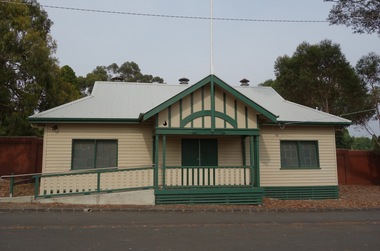
Photograph - Digital Photograph, Robert Baker, Harriers' Pavilion, Victoria Park (Kew), 2014, 2014
... While initially a pavilion at Victoria Park used by the Kew Harriers Club, the building was subsequently used by a range of community groups, including the East Kew Women's Club. kew - sport pavilions victoria park - kew (vic) kew harriers club Born digital image of the exterior of the renovated Harriers' Pavilion at Victoria Park (Kew) Harriers' Pavilion, Victoria Park (Kew), 2014 Photograph Digital Photograph Robert Baker ...While initially a pavilion at Victoria Park used by the Kew Harriers Club, the building was subsequently used by a range of community groups, including the East Kew Women's Club.Born digital image of the exterior of the renovated Harriers' Pavilion at Victoria Park (Kew)kew - sport pavilions, victoria park - kew (vic), kew harriers club -
 Kew Historical Society Inc
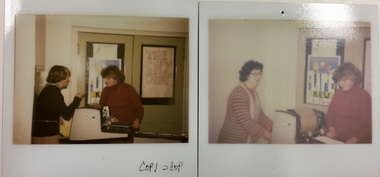
Photograph - 'Copy Shop', Old Masonic Hall, Walpole Street
... Kew was located in the former Masonic Hall. It was a community operated facility. The 'shop' was designed for use by groups to run off leaflets or newsletters. It also served as a community space where people could drop in for a coffee and leave leaflets and information about events in the City of Kew. copy shop - walpole street - kew (vic) community facilities -- city of kew masonic hall -- kew (vic.) front: "Copy Shop" Two polaroid photographs, Thea Sartori in a red jumper is in both photographs. ...The 'Copy Shop' in Walpole Street, Kew was located in the former Masonic Hall. It was a community operated facility. The 'shop' was designed for use by groups to run off leaflets or newsletters. It also served as a community space where people could drop in for a coffee and leave leaflets and information about events in the City of Kew. Two polaroid photographs, Thea Sartori in a red jumper is in both photographs. The woman in the pink cardigan is Aileen Cahill. Both photos were taken at the 'Copy Shop' in the old Masonic Hall [demolished] in Walpole Street. front: "Copy Shop"copy shop - walpole street - kew (vic), community facilities -- city of kew, masonic hall -- kew (vic.) -
 Kew Historical Society Inc
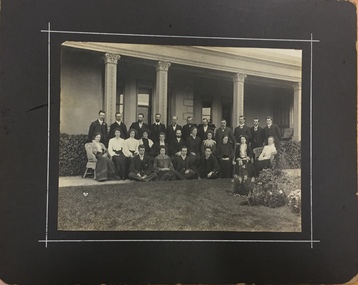
Photograph, Kew Congregational Church members at South Esk, circa 1900, c.1900
... Kew City Council. For 23 years it was used as a meeting place for community groups. The house was then demolished in 1970 to make way for a new Town Hall. This is the earliest known photograph of Ordsall / South Esk, a significant mansion in Kew, built for John Halfey and now demolished congregational church - kew (vic) south esk - south esk - ordsall - kew (vic) Members of the Kew Congregational Church in front of one of the verandas of Southesk, circa 1900. ...Ordsall, renamed Southesk in the 20th century was built for John Halfey in or before 1865. The house was rebuilt in the 1870s to designs by architect Michael Hennessy. In 1882 the house was redecorated by the firm of Culls Hill & Co., who hired the artists 'Mr Vandenbrandt' and 'Signor Rizzi" to paint the ceilings of the ballroom and the drawingroom. The artistic triumph was described in detail in The Argus, 30 October, 1882. In 1947, Southesk was purchased by the Kew City Council. For 23 years it was used as a meeting place for community groups. The house was then demolished in 1970 to make way for a new Town Hall.This is the earliest known photograph of Ordsall / South Esk, a significant mansion in Kew, built for John Halfey and now demolishedMembers of the Kew Congregational Church in front of one of the verandas of Southesk, circa 1900.congregational church - kew (vic), south esk - south esk - ordsall - kew (vic) -
 Kew Historical Society Inc
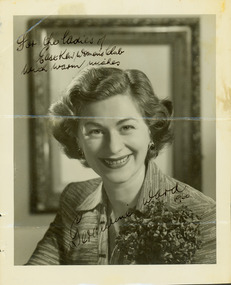
Photograph - Geraldine Ward, 1960
... group moved to the Harrier’s Pavilion in Victoria Park, Kew. At the fifth meeting of the group, a committee was formed, and a constitution adopted on 4 December 1945.The Club was aimed to be non-political, non-sectarian and open to women from any locality. The Club’s motto was “To Help others, Improve Ourselves, and Foster the Community Spirit”. The first twenty years of the Club was recorded in a small, nine-page publication “East Kew Women’s Club : Twenty Years 20-7-1945 - 30-7-1965”. clubs -- kew east (vic ...The East Kew Women’s Club was formed on 20 July 1945 as an experiment amongst local women, who felt that there was a need for some organised group to give full scope to their various interests and hobbies. In the beginning, they met at the house of their founder, Mrs Eric Thake, 48 Harp Road, East Kew, but the growth and interest was so rapid that it was soon necessary to find a larger meeting place, so the group moved to the Harrier’s Pavilion in Victoria Park, Kew. At the fifth meeting of the group, a committee was formed, and a constitution adopted on 4 December 1945.The Club was aimed to be non-political, non-sectarian and open to women from any locality. The Club’s motto was “To Help others, Improve Ourselves, and Foster the Community Spirit”. The first twenty years of the Club was recorded in a small, nine-page publication “East Kew Women’s Club : Twenty Years 20-7-1945 - 30-7-1965”.Portrait photograph of Geraldine Ward, signed, dated and addressed to the Ladies of the East Kew Women's Club.Obverse: [Signed in ink] For the ladies of the East Kew Women's Club with warm wishes, Geraldine Ward 1960." [Reverse annotated] Presented to Society with Minute Books from East Kew Women's Club. / Signed Geraldine Ward across photo / KH-217 / {Stamped] Hand Hasenpflug Illustrative Photography, 62 Swanston Street, Melbourne, Phone CENT 2187.clubs -- kew east (vic.), east kew women's club, glenda ward -
 Kew Historical Society Inc
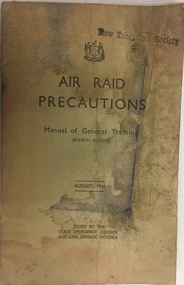
Manual, H E Daw, Air Raid Precautions : Manual of General Training, 1941
... groups of people in using air raid facilities that were constructed throughout the district. The ARP scheme was based on that developed in the United Kingdom. Primary resources showing the materials and advice developed to protect civilians on the home front. Examples of such support in the Kew Historical Society's collection includes advice for authorised community representatives, insignia and equipment. second world war 1939-1945 second world war - air raid precautions air raid precautions - manuals arp air raid precautions state emergency services victoria 1939-1945 second world war — air raid precautions world war 2 — 1939-1945 home front — kew (vic.) 72-page manual provided to air raid wardens following their training during the Second World War. ...Part of a suite of materials used by Air Raid Precautions (ARP) wardens in Kew in the Second World War. Air raid wardens managed groups of people in using air raid facilities that were constructed throughout the district. The ARP scheme was based on that developed in the United Kingdom.Primary resources showing the materials and advice developed to protect civilians on the home front. Examples of such support in the Kew Historical Society's collection includes advice for authorised community representatives, insignia and equipment.72-page manual provided to air raid wardens following their training during the Second World War. The booklet was issued by the State Emergency Council for Civil Defence, Victoria. Fourth Edition, 1941second world war 1939-1945, second world war - air raid precautions, air raid precautions - manuals, arp, air raid precautions, state emergency services victoria 1939-1945, second world war — air raid precautions, world war 2 — 1939-1945, home front — kew (vic.) -
 Kew Historical Society Inc
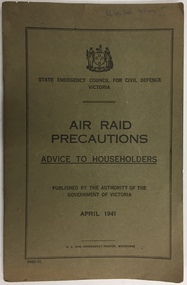
Booklet, State Emergency Council for Civil Defence, Air Raid Precautions: Advice to Householders, 1941
... groups of people in using air raid facilities that were constructed throughout the district. The ARP scheme was based on that developed in the United Kingdom. Primary resources showing the materials and advice developed to protect civilians on the home front. Examples of such support in the Kew Historical Society's collection includes advice for authorised community representatives, insignia and equipment. second world war - air raid precautions state emergency council for civil defence victoria - 1939-45 arp air raid precautions second world war — air raid precautions state emergency council for civil defence victoria — 1939-1945 world war 2 — 1939-1945 home front — kew (vic.) ...Air raid precautions distributed to householders in Victoria. The booklet is part of a suite of materials used to support Air Raid Precautions (ARP) during the Second World War. Air raid wardens managed groups of people in using air raid facilities that were constructed throughout the district. The ARP scheme was based on that developed in the United Kingdom.Primary resources showing the materials and advice developed to protect civilians on the home front. Examples of such support in the Kew Historical Society's collection includes advice for authorised community representatives, insignia and equipment.This booklet was published by the State Emergency Council for Civil Defence Victoria in April 1941. The 37-page work provides advice about what to do in an air raid, lighting restrictions, the use of road vehicles and safety for pedestrians, and shelters. The final pages of the book include a number of illustrations providing guidelines for air raid shelter construction. second world war - air raid precautions, state emergency council for civil defence victoria - 1939-45, arp, air raid precautions, second world war — air raid precautions, state emergency council for civil defence victoria — 1939-1945, world war 2 — 1939-1945, home front — kew (vic.) -
 Kew Historical Society Inc
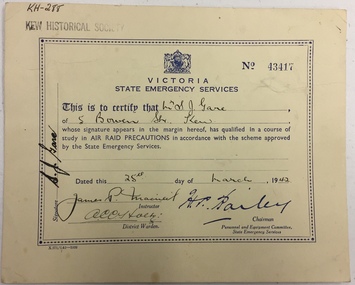
Certificate, State Emergency Services Victoria, Air Raid Precautions Certificate No.43417, Mr S J Gare, 5 Bowen St., Kew, 1942
... Kew in the Second World War. Air raid wardens managed groups of people in using air raid facilities that were constructed throughout the district. The ARP scheme was based on that developed in the United Kingdom. Primary resources showing the materials and advice developed to protect civilians on the home front. Examples of such support in the Kew Historical Society's collection includes advice for authorised community representatives, insignia and equipment. second world war 1939-1945 - kew (vic ...Part of a suite of materials used by Air Raid Precautions (ARP) wardens in Kew in the Second World War. Air raid wardens managed groups of people in using air raid facilities that were constructed throughout the district. The ARP scheme was based on that developed in the United Kingdom.Primary resources showing the materials and advice developed to protect civilians on the home front. Examples of such support in the Kew Historical Society's collection includes advice for authorised community representatives, insignia and equipment.Certificate awarded to Mr. S. J. Gare of 5 Bowen Street, Kew in 1942 after successfully completing an air raid precautions course, dated 25th March 1942.second world war 1939-1945 - kew (vic), arp, state emergency services victoria 1939-1945, second world war — air raid precautions, world war 2 — 1939-1945, home front — kew (vic.)
