
Showing 44 items matching "compositor"
-
 Bendigo Historical Society Inc.
Ceramic - Child's tea set, 1/10/2024
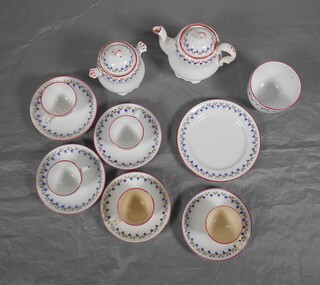
... ...Compositor...Her father worked for The Bendigo Independent news newspaper as compositor and printer until his retirement in 1913 from lead poisoning. ...Her father worked for The Bendigo Independent news newspaper as compositor and printer until his retirement in 1913 from lead poisoning. ...Irene Mildred Wharton (1888 - 1983) the only child of Thomas Llewellyn Wharton and his wife Mildred, lived most of her early life in Bendigo until her marriage in 1911. Her father worked for The Bendigo Independent news newspaper as compositor and printer until his retirement in 1913 from lead poisoning. Apparently, printer's ink contained lead in those days, and he had health problems from a build up of lead in his system. Child's teaset made of China - originally belonging to Mildred Wharton; used by three generations. Tea set has blue and green leaves on a white background. There are no maker's marks. The tea set consists of: 1 tea pot and lid 1 sugar bowl and lid 5 small cups and saucers 1 small cake plate (for cakes / biscuits) 1 small bowl for jam / creamtea set, wharton, cambria, barkly street, bendigo independent, lead poisoning, compositor, printer -
 Bendigo Historical Society Inc.
Newspaper - JENNY FOLEY COLLECTION: SKILLED TRADESMAN
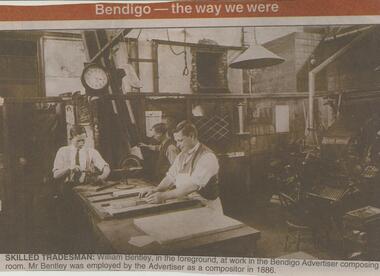
... Bentley was employed by the Advertiser as a compositor in 1886. The clip is in a folder....Bentley was employed by the Advertiser as a compositor in 1886. The clip is in a folder. Newspaper JENNY FOLEY COLLECTION: SKILLED TRADESMAN ...Bendigo Advertiser ''The way we were'' from 2001. Skilled tradesman: William Bentley, in the foreground, at work in the Bendigo Advertiser composing room. Mr. Bentley was employed by the Advertiser as a compositor in 1886. The clip is in a folder.newspaper, bendigo advertiser, the way we were -
 Orbost & District Historical Society
Book, Associated Pulp & Paper Mills Ltd, August 1973
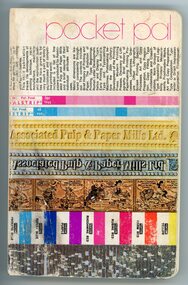
... This actual booklet was used by a compositor working at the 'Snowy River Mail' in Orbost. ...This actual booklet was used by a compositor working at the 'Snowy River Mail' in Orbost. ...This booklet is a 'graphic arts digest' used in the printing industry. Used by commercial artists, in advertising, and by production managers, all of whom are concerned with the graphic arts. This actual booklet was used by a compositor working at the 'Snowy River Mail' in Orbost. The 'S R Mail' did all types of printing, including the local newspaper. 196 pages.This item is significant because it was used by a local compositor working at the 'Snowy River Mail', Orbost, c. 1970s, 1980s.A medium size book with a creamy pink background colour on the cover, overlaid with a multi-coloured graphics and photos in bands across the page. The words Pocket pal are at the top of the page.Pocket pal Associated Pulp and Paper Mills Ltdorbost, printing, snowy river mail, pocket pal -
 Surrey Hills Historical Society Collection
Booklet - Digger Cookery Book, George Robert Riley, Brennan-Baldie Collection, c1948
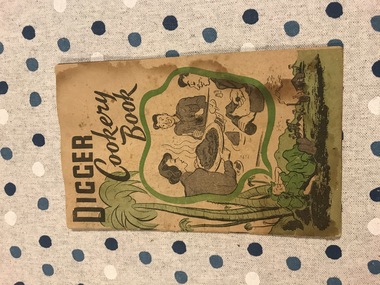
... He trained as a compositor. Served in France and was partially blinded during WWI. ...He trained as a compositor. Served in France and was partially blinded during WWI. ...Published in c1948 by Wightons Print, 215 Moreland Road, Coburg. These chapbooks were sold door to door after WWII by members of the Partially Blinded Soldiers Association in Victoria to fundraise for the association. The Association was established in 1924 to serve the interests and welfare of partially blinded returned soldiers. The author, George Robert Riley (late AIF and AMF) was born in Drouin in 1890; died in 1952. He trained as a compositor. Served in France and was partially blinded during WWI. He also enlisted during WW2 when he seems to have lowered his age. There do not appear to be many copies of this publication that have survived. It does not appear in either the State Library of Victoria or the National Library of Australia catalogue. The Museum of Victoria may have a copy. Apart from its significance as a fundraiser for returned soldiers, it documents culinary fashions in the post-WW2 period. Although a number of the recipes in Part 1 have exotic names, they are yet to be influenced by post-war migration to Australia.A 32 page booklet held by 2 metal staples. The paper is stained and embrittled but was probably originally cream. The cover depicts a soldier at rest under a palm tree dreaming of home and a hearty meal. Printed in shades of green and grey-black. This is Part One of Two. The chapbook contains 140 recipes, mostly broadly Anglo-European. Nilchapbooks, ww2, wightons print, mrs kate brennan, partially blind soldiers association, george robert riley -
 Ballarat Tramway Museum
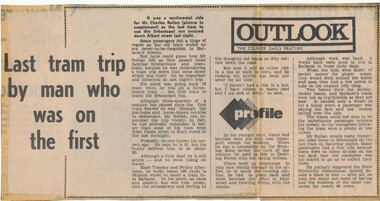
Newspaper, The Courier Ballarat, "Last trip by man who was on the first", 20/09/1971 12:00:00 AM
... Rollan, 91, who was a compositor for the Evening Echo newspaper, retold stories about the horse tram days. ...Rollan, 91, who was a compositor for the Evening Echo newspaper, retold stories about the horse tram days. ...Newspaper clipping from The Courier, Ballarat, of Monday 20/9/1971, titled "Last trip by man who was on the first" in the Outlook profile Section of the newspaper about Mr. Charles Rollan who was a passenger on the last Sebastopol tram and rode on the horse trams on the Sebastopol line. Noted that a photo of Mr. Rollan was in the supplement Section of the newspaper. See Reg. Item 269. Mr. Rollan, 91, who was a compositor for the Evening Echo newspaper, retold stories about the horse tram days. One of a large group of newspaper cuttings from John Bainbridge, 7/4/02. Item has been folded for inclusion within a scrap book. Has a piece of plain paper Secured to the back of the portion that was not Secured to the scrap book itself.horse trams, sebastopol, last tram -
 Federation University Historical Collection
Photograph - Photograph - Colour, Edith Lawn
... She taught for a time before marrying compositor James Lawn in 1937. She reportedly continued to teach at the Ballarat Technical Art School as Edith Lawn. ...She taught for a time before marrying compositor James Lawn in 1937. She reportedly continued to teach at the Ballarat Technical Art School as Edith Lawn. ...Edith CURNOW (1913–2003) Ballarat | Australia Edith Gertrude Curnow undertook Industrial Art teacher training at the Ballarat Technical Art School, with a five-year Senior Technical Scholarship, between 1926 and 1931. She taught for a time before marrying compositor James Lawn in 1937. She reportedly continued to teach at the Ballarat Technical Art School as Edith Lawn. She retired in 1972 at which time she was the Lecturer in Charge of Craft Edith Lawn was a member of inaugural Ballarat School of Mines Old Girls Association, and served as first Press Correspondent. Her daughter, Valda Lawn (later D'Angri) also attended and taught at the School.Colour photograph of Edith Lawn nee Curnowedith lawn, ballarat school of mines, edith curnow, univesity women -
 Bacchus Marsh & District Historical Society
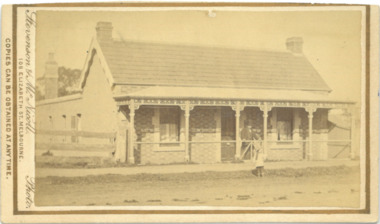
Photograph, House of Christopher Crisp Bacchus Marsh 1883
... This syndicate failed after three months and the ownership was then taken over by Christopher Crisp, a compositor working for the company. Crisp remained the editor from 1866 to his death in 1915, when he was succeeded by his son, also called Christopher Crisp, and later by his grandson. ...This syndicate failed after three months and the ownership was then taken over by Christopher Crisp, a compositor working for the company. Crisp remained the editor from 1866 to his death in 1915, when he was succeeded by his son, also called Christopher Crisp, and later by his grandson. ...The former Christopher Crisp residence was constructed in 1868 by William Watson, one of the members of the Bacchus Marsh Express printing company which took over the management of The Express after the first edition, 7 July 1866, was published by its founder, George Lane, a book binder. This syndicate failed after three months and the ownership was then taken over by Christopher Crisp, a compositor working for the company. Crisp remained the editor from 1866 to his death in 1915, when he was succeeded by his son, also called Christopher Crisp, and later by his grandson. Under the Crisp family leadership, The Express widened its readership and was subscribed to by influential men and public servants in Melbourne. (Heritage Victoria Council. Places. Entry no. 45.)Small sepia unframed photograph on card with gold border framing photograph. Housed in the album, 'Photographs of Bacchus Marsh and District in 1883 by Stevenson and McNicoll'. The photograph is of a single-storey cottage of rendered brick and sandstone with a shingled roof of slate tiles and ornate concave verandah. A chimney stands at either end of the house. A carved barge board decorates the northern end of the hip roof. A skillion with windows and a chimney adjoins the rear of the cottage. The front facade is symmetrical with two sash windows placed either side of the central door. A wire fence runs along the front of the cottage. Standing at the gate is a formally dressed gentleman wearing a top hat. A young child is standing on the road. This child is possibly Christopher Crisp, Jnr., who later took over the role of editor of the Bacchus Marsh Express in 1915 on the death of his father. At the time of this photo, he would have been 4 years old. On the front: Stevenson & McNicoll. Photo. 108 Elizabeth St. Melbourne. COPIES CAN BE OBTAINED AT ANY TIME. On the back: LIGHT & TRUTH inscribed on a banner surmounted by a representation of the rising sun. Copies of this Portrait can be had at any time by sending the Name and Post Office Money Order or Stamps for the amount of order to STEVENSON & McNICOLL LATE BENSON & STEVENSON, Photographers. 108 Elizabeth Street, MELBOURNE. stevenson and mcnicoll 1883 photographs of bacchus marsh and district, houses bacchus marsh, christopher crisp 1844-1915 -
 Linton and District Historical Society Inc
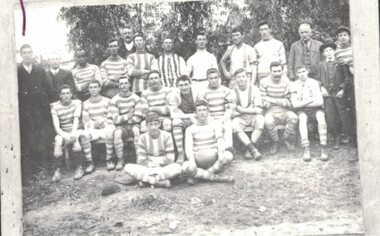
Photograph, Linton Football Team, circa 1916
... (Prior to enlisting, he worked as a compositor's assistant at the Grenville Standard.)...(Prior to enlisting, he worked as a compositor's assistant at the Grenville Standard.) ...L-R back row: W. Bonthorn, Dave Nicol, Tom Andrews ("Black Tom"), Con Hogan, J. Steele, Jim Stoddart, Dave Allen, (Umpire), Bill Megee, -?- Maloney, Jack Wise, Fred White, Foster Watkinson. Centre row: Bob Allen, George Ah Lyee (spelled 'Ahlie'), Alex? Thomson, Bill Lewers or Lewis, Eugene Sandow, Les Ching, Bill Commons, Bob Hogan, George Allen. Front row: George Cluff, Ewen (Hughie) Ching. Date is estimated from team member Foster Watkinson's age and history. He was born in 1897, joined the army in 1916, and although he is known to have visited Linton in the closing stages of WWI, it is understood he did not live in Linton after the war. (Prior to enlisting, he worked as a compositor's assistant at the Grenville Standard.)Black and white photograph of a football team, umpire and officials.football, linton football club, w. bonthorn, dave nicol, tom andrews, j. steele, jim stoddart, dave allen, bill megee, maloney, jack wise, fred white, foster watkinson, bob allen, george ah lyee (?), alex? thomson, bill lewers, eugene sandow, les ching, bill commons, bob hogan, george allen, george cluff, ewen ching (hughie ching) -
 Federation University Historical Collection
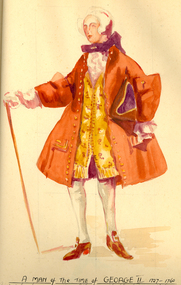
Book, Historic Ornament Parts I and II. Ballarat Technical Art School Art History Books, 1931, 1931
... She taught for a time before marrying compositor James Lawn in 1937. She reportedly continued to teach at the Ballarat Technical Art School as Edith Lawn. ...She taught for a time before marrying compositor James Lawn in 1937. She reportedly continued to teach at the Ballarat Technical Art School as Edith Lawn. ...Edith CURNOW (1913–2003) Ballarat | Australia Edith Gertrude Curnow undertook Industrial Art teacher training at the Ballarat Technical Art School, with a five-year Senior Technical Scholarship, between 1926 and 1931. She taught for a time before marrying compositor James Lawn in 1937. She reportedly continued to teach at the Ballarat Technical Art School as Edith Lawn. She retired in 1972 at which time she was the Lecturer in Charge of Craft Edith Lawn was a member of inaugural Ballarat School of Mines Old Girls Association, and served as first Press Correspondent. Her daughter, Valda Lawn (later D'Angri) also attended and taught at the School. One of the subjects Curnow studied was Historic Ornament. This subject spanned time and space to inform and inspire designers. Students studied the influences of history, geography, culture and climate on ornamental aesthetics, including the tools, materials and methods applied to decorative objects, interior design and architecture.Two books containing student notes and drawing relating to courses at the Ballarat techncial Art School in 1931. The work was undertaken by Edith Curnow. .1) - Foolscap red covered book on Historic Ornament. Includes History of Ornament, Egyptian Ornament, Assyrian Ornament; Greek Ornament, Roman Ornament, Pompeian Ornament, Byzantine, Romanesque Ornament, Norman, Decorated Gothic, Perpendicular Gothic, Renaissance. .2) Green quarto book on Historic Ornament Part 2: Costume. The work includes Egyptian Costume, Greek Costume, Roman Costume, Richard I, Crusades, Edward III, Charles I, Charles II, George II.ballarat school of mines, ballarat technical art school, art history, edith lawn, edith curnow, val lawn, val d'angri, curnow, lawn, ornament, costume., ballarat technical art school library, artists workbook, journal, historic ornament, university women, ballarat school of mines old girls association -
 Ballarat Heritage Services
Photograph - Poster, Wizard of the South, October 1855
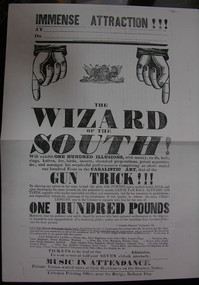
... Amott was assigned to work as a compositor in Hobart for James Ross, a Scottish free immigrant to Van Diemen’s Land in 1822. ...Amott was assigned to work as a compositor in Hobart for James Ross, a Scottish free immigrant to Van Diemen’s Land in 1822. ...Thomas Arnott (Also known as Thomas Amott and Monsieur Du Pree) was the Wizard of the South who performed in Ballarat in 1855. A convict who served in Tasmania, he was a magician performing one of the earliest known magic shows in Australia. Thomas Amott was found guilty of grand larceny, and sentenced to transportation for seven years. He sailed to Australia on vessel 'Asia'. The register and conduct record noted that Amott was a Protestant, married, 5’11” tall with a mole on his neck , well behaved in both the Hulks and on the ship. The only disciplinary action noted in his conduct record was a fairly lenient two hours in public stocks for insolence to his assigned master in Hobart. The 'Asia' sailed from Portsmouth on 17 August 1827 and arrived at Van Diemen’s Land (Tasmania) on 07 December, offloading 198 convicts. Amott was assigned to work as a compositor in Hobart for James Ross, a Scottish free immigrant to Van Diemen’s Land in 1822. In April 1833 Amott was granted a ticket of leave, giving him increased freedom of movement in the colony prior to his being granted final Certificate of Freedom at the end of May 1834. He re-married at the Holy Trinity Church Hobart on 02 December 1833. Permission had been sought back in 1830 to marry Catherine (or Caroline) Fitzallen, a convict whose ticket-of-leave was granted in 1831. (This record draws on the research of Mary Christine Patterson)Copy of an entertainment poster and Licence to hold Theatrical Entertainments. wizard of the south, thomas arnott, thomas amott, monsieur du pree, entertainment -
 Ringwood and District Historical Society
Document - Folder, Landata Certificates - Part of Crown Portion Six, (Lots 1-4 and numbers 70-90) Maroondah Highway, Parish of Ringwood, Victoria
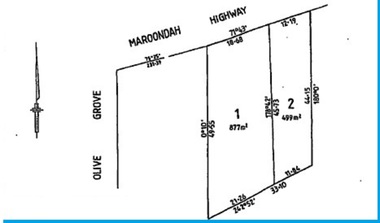
... Proprietors and transferees include: William Astley of Richmond, Compositor, Marianne Thomson of Jolimont, Spinster, Margaret McGillivray of Ringwood, Spinster, George Frederick Burgess Wilsmore of Ringwood, Railway Employee, Leslie Wilsmore, John Wilsmore, Lionel Wilsmore, 90 Whitehorse Road Ringwood, B.T. ...Proprietors and transferees include: William Astley of Richmond, Compositor, Marianne Thomson of Jolimont, Spinster, Margaret McGillivray of Ringwood, Spinster, George Frederick Burgess Wilsmore of Ringwood, Railway Employee, Leslie Wilsmore, John Wilsmore, Lionel Wilsmore, 90 Whitehorse Road Ringwood, B.T. ...27 A4 pages of colour photocopied certificates with typewritten summaries, including Certificate of Title Vol 1156 Fol 231096, 8th March 1880. Certificate of Title Vol 1440 Fol 930, 14th March 1883. Certificate of Title Vol 8487 Fol 090, 28th January 1964. Certificate of Title Vol 9019 Fol 634, 5th December 1973. Certificate of Title Vol 3711 Fol 742129, William John Harnwell, 1st August 1913. Certificate ot Title Vol 6552 Fol 1310305, 5th June 1942. Certificate of Title Vol 5282 Fol 1056207, Arthur Clifton Beilby, 19th July 1927. Certificate of Title Vol 6573 Fol 1314497, Florence Beatrice McGoldrick, Lot 4 on Subdivision 14786, Whitehorse Road, Ringwood, 18th August 1942. Proprietors and transferees include: William Astley of Richmond, Compositor, Marianne Thomson of Jolimont, Spinster, Margaret McGillivray of Ringwood, Spinster, George Frederick Burgess Wilsmore of Ringwood, Railway Employee, Leslie Wilsmore, John Wilsmore, Lionel Wilsmore, 90 Whitehorse Road Ringwood, B.T. Building Aust P/L, Lot 1 of subidivision 35788, Whitehorse Road Ringwood, Maliblue P/L 33-35 Ruthven Way Ringwood East, Hesketh Motor Cycles P/L, 70 Maroondah Highway Ringwood, Arthur Clifton Beilby of Ringwood, Storekeeper, Florence Beatrice McGoldrick and Oscar Edward John McGoldrick of "Carrum", Whitehorse Road Ringwood, Elsie May McGoldrick, 82 Whitehorse Road Ringwood, Douglas Murray and Ronald Arthur Mason, H.W.P Tortice and D.M. Tortice, V.B. Rowe. -
 Flagstaff Hill Maritime Museum and Village
Book - Reference/Legal Statutes, John Ferres, Government Printer, The Victorian Imperial Statutes Vol 5 Customs Warrnambool, 1868
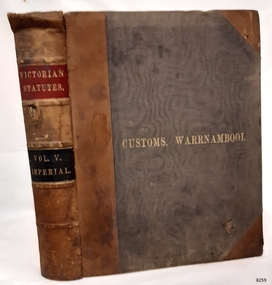
... Ferres joined the staff of the Melbourne Morning Herald as a compositor (typesetter). He rose through the ranks rapidly to become sub-overseer and then manager. ...Ferres joined the staff of the Melbourne Morning Herald as a compositor (typesetter). He rose through the ranks rapidly to become sub-overseer and then manager. ...This volume is part of the first comprehensive consolidation of laws for the Colony of Victoria after it separated from New South Wales and established its own parliament. Specifically, Volume 5 (published in 1868) is dedicated to "A selection of the imperial statutes apparently in force in Victoria". Because Victoria was still a British colony, laws passed by the British (Imperial) Parliament in Westminster still applied locally if they hadn't been superseded by local Victorian colonial acts. Volume 5 was the legal handbook used by lawyers, judges, and government officials to determine exactly which British laws still governed colonial matters, ranging from shipping and trade to criminal law and merchant customs.The Victorian Statutes Vol 5 Customs Warrnambool Publisher: John Ferres Government Printer Melbourne Date: 1868 Further Information: Three quarter leather. Junction between front board and spine slightly exposed. Top section of leather on spine damaged. non-fictionThis volume is part of the first comprehensive consolidation of laws for the Colony of Victoria after it separated from New South Wales and established its own parliament. Specifically, Volume 5 (published in 1868) is dedicated to "A selection of the imperial statutes apparently in force in Victoria". Because Victoria was still a British colony, laws passed by the British (Imperial) Parliament in Westminster still applied locally if they hadn't been superseded by local Victorian colonial acts. Volume 5 was the legal handbook used by lawyers, judges, and government officials to determine exactly which British laws still governed colonial matters, ranging from shipping and trade to criminal law and merchant customs.flagstaff hill, warrnambool, shipwrecked coast, flagstaff hill maritime museum, maritime museum, shipwreck coast, flagstaff hill maritime village, great ocean road, book, pattison collection, warrnambool library, warrnambool mechanics’ institute, ralph eric pattison, corangamite regional library service, warrnambool city librarian, mechanics’ institute library, victorian library board, warrnambool books and records, warrnambool children’s library -
 Flagstaff Hill Maritime Museum and Village
Book - Reference/Legal Statutes, John Ferres, Government Printer, The Victorian Statutes Vol 4 Various Legal Statues /Warrnambool, 1866
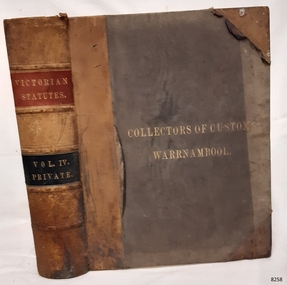
... Ferres joined the staff of the Melbourne Morning Herald as a compositor (typesetter). He rose through the ranks rapidly to become sub-overseer and then manager. ...Ferres joined the staff of the Melbourne Morning Herald as a compositor (typesetter). He rose through the ranks rapidly to become sub-overseer and then manager. ...This volume is part of the first comprehensive consolidation of laws for the Colony of Victoria after it separated from New South Wales and established its own parliament. Specifically, Volume 4 (published in 1866) contains Local Colonial Acts. These were laws debated, passed, and enacted right here in Melbourne by the newly formed Parliament of the Colony of Victoria. They dealt with purely domestic, local matters, such as Victorian land selection, goldfields regulations, local municipal boundaries, and colonial courts. Volume 4 was the handbook for everyday domestic Victorian life, governing how a local town council operated, how gold claims were filed, or how local debts were settled in a Victorian county court.The Victorian Statutes Vol 4 Various Legal Statues /Warrnambool Publisher: John Ferres Government Printer Melbourne Date: 1866 Further Information: Three quarter leather. Junction between front board and spine slightly exposed. non-fictionThis volume is part of the first comprehensive consolidation of laws for the Colony of Victoria after it separated from New South Wales and established its own parliament. Specifically, Volume 4 (published in 1866) contains Local Colonial Acts. These were laws debated, passed, and enacted right here in Melbourne by the newly formed Parliament of the Colony of Victoria. They dealt with purely domestic, local matters, such as Victorian land selection, goldfields regulations, local municipal boundaries, and colonial courts. Volume 4 was the handbook for everyday domestic Victorian life, governing how a local town council operated, how gold claims were filed, or how local debts were settled in a Victorian county court.flagstaff hill, warrnambool, shipwrecked coast, flagstaff hill maritime museum, maritime museum, shipwreck coast, flagstaff hill maritime village, great ocean road, book, pattison collection, warrnambool library, warrnambool mechanics’ institute, ralph eric pattison, corangamite regional library service, warrnambool city librarian, mechanics’ institute library, victorian library board, warrnambool books and records, warrnambool children’s library -
 Flagstaff Hill Maritime Museum and Village
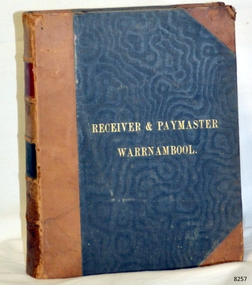
Book - Reference/Legal Statutes, John Ferres, Government Printer, The Victorian Legal Statutes Vol 3, Receiver Paymaster/Warrnambool, 1866
... Ferres joined the staff of the Melbourne Morning Herald as a compositor (typesetter). He rose through the ranks rapidly to become sub-overseer and then manager. ...Ferres joined the staff of the Melbourne Morning Herald as a compositor (typesetter). He rose through the ranks rapidly to become sub-overseer and then manager. ...This volume is part of the first comprehensive consolidation of laws for the Colony of Victoria after it separated from New South Wales and established its own parliament. Specifically, Volume 3 is the final part of the core "Public and General" Victorian colonial laws. The first three volumes of the 1866 consolidation were organised alphabetically by legal topic. Volume 3 specifically contains all the major public acts running from P to W. Because it covers the tail end of the alphabet, it holds some of the most critical laws that built day-to-day society in 19th-century Victoria. These include: · Police Offences and Public Order: The legal frameworks for policing the goldfield boomtowns, managing public behaviour, and running early colonial prisons. · Public Works and Infrastructure: The acts authorising the construction of roads, bridges, and early municipal water supplies across the fast-growing colony. · Railways: The specific general legislation governing the expansion of Victoria's heavily subsidised, state-expanding railway networks. · Property and Land Transfer: Crucial laws managing land ownership, inheritance, and the foundational transfers of property as the colony shifted away from old squatter runs to permanent towns. · Wines, Beer, and Spirits: The colonial acts regulating the licensing of hotels and public houses, and managing the highly lucrative, tightly controlled alcohol trade.The Victorian Statutes Vol 3 Various Legal Statues /Warrnambool Publisher: John Ferres Government Printer Melbourne Date: 1866 Further Information: Three quarter leather. Corners worn lettering in gilt. non-fictionThis volume is part of the first comprehensive consolidation of laws for the Colony of Victoria after it separated from New South Wales and established its own parliament. Specifically, Volume 3 is the final part of the core "Public and General" Victorian colonial laws. The first three volumes of the 1866 consolidation were organised alphabetically by legal topic. Volume 3 specifically contains all the major public acts running from P to W. Because it covers the tail end of the alphabet, it holds some of the most critical laws that built day-to-day society in 19th-century Victoria. These include: · Police Offences and Public Order: The legal frameworks for policing the goldfield boomtowns, managing public behaviour, and running early colonial prisons. · Public Works and Infrastructure: The acts authorising the construction of roads, bridges, and early municipal water supplies across the fast-growing colony. · Railways: The specific general legislation governing the expansion of Victoria's heavily subsidised, state-expanding railway networks. · Property and Land Transfer: Crucial laws managing land ownership, inheritance, and the foundational transfers of property as the colony shifted away from old squatter runs to permanent towns. · Wines, Beer, and Spirits: The colonial acts regulating the licensing of hotels and public houses, and managing the highly lucrative, tightly controlled alcohol trade.flagstaff hill, warrnambool, shipwrecked coast, flagstaff hill maritime museum, maritime museum, shipwreck coast, flagstaff hill maritime village, great ocean road, book, pattison collection, warrnambool library, warrnambool mechanics’ institute, ralph eric pattison, corangamite regional library service, warrnambool city librarian, mechanics’ institute library, victorian library board, warrnambool books and records, warrnambool children’s library -
 Flagstaff Hill Maritime Museum and Village
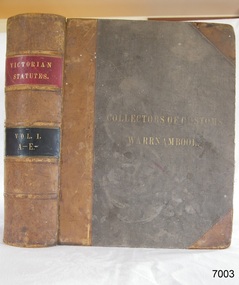
Book - Reference Colonial Legal Statutes, John Ferres, Government Printer, The Victorian Statutes Vol 1 Collectors of Customs A-E, 1866
... Ferres joined the staff of the Melbourne Morning Herald as a compositor (typesetter). He rose through the ranks rapidly to become sub-overseer and then manager. ...Ferres joined the staff of the Melbourne Morning Herald as a compositor (typesetter). He rose through the ranks rapidly to become sub-overseer and then manager. ...This volume is part of the first comprehensive consolidation of laws for the Colony of Victoria after it separated from New South Wales and established its own parliament. Specifically, Volume 1 (published in 1866) contains Local Colonial Acts. These were laws debated, passed, and enacted right here in Melbourne by the newly formed Parliament of the Colony of Victoria. They dealt with purely domestic, local matters, such as Victorian land selection, goldfields regulations, local municipal boundaries, and colonial courts. Volume 1 was the handbook for everyday domestic Victorian life, governing how a local town council operated, how gold claims were filed, or how local debts were settled in a Victorian county court or how customs should operate.Hard cover book,The Victorian Statutes Vol 1. Collectors of Customs A-E Author: Corporate Author “The Colony of Victoria” Publisher: John Ferres Government Printer Melbourne. Date: 1866 The Victorian Statutes Vol 1, front cover has title Collectors of Customs Warrnambool. Brown leather binding and corners, black canvas cover, red and black bands on spine. non-fictionThis volume is part of the first comprehensive consolidation of laws for the Colony of Victoria after it separated from New South Wales and established its own parliament. Specifically, Volume 1 (published in 1866) contains Local Colonial Acts. These were laws debated, passed, and enacted right here in Melbourne by the newly formed Parliament of the Colony of Victoria. They dealt with purely domestic, local matters, such as Victorian land selection, goldfields regulations, local municipal boundaries, and colonial courts. Volume 1 was the handbook for everyday domestic Victorian life, governing how a local town council operated, how gold claims were filed, or how local debts were settled in a Victorian county court or how customs should operate.warrnambool, shipwrecked-coast, flagstaff-hill, flagstaff-hill-maritime-museum, maritime-museum, shipwreck-coast, flagstaff-hill-maritime-village, shipwrecked-artefact, book, government statutes for victoria 1866, warrnambool's copy of government statutes 1866 -
 Flagstaff Hill Maritime Museum and Village
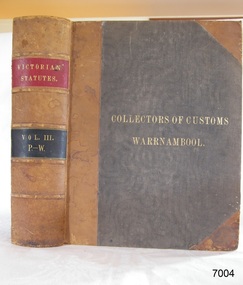
Book - Reference Colonial Legal Statutes, John Ferres, Government Printer, The Victorian Statutes Vol 3 Collectors of Customs P-W, 1866
... Ferres joined the staff of the Melbourne Morning Herald as a compositor (typesetter). He rose through the ranks rapidly to become sub-overseer and then manager. ...Ferres joined the staff of the Melbourne Morning Herald as a compositor (typesetter). He rose through the ranks rapidly to become sub-overseer and then manager. ...This volume is part of the first comprehensive consolidation of laws for the Colony of Victoria after it separated from New South Wales and established its own parliament. Specifically, Volume 3 (published in 1866) contains Local Colonial Acts. These were laws debated, passed, and enacted right here in Melbourne by the newly formed Parliament of the Colony of Victoria. They dealt with purely domestic, local matters, such as Victorian land selection, goldfields regulations, local municipal boundaries, and colonial courts. Volume 3 was the handbook for everyday domestic Victorian life, governing how a local town council operated, how gold claims were filed, or how local debts were settled in a Victorian county court or how customs should operate.Hard cover book,The Victorian Statutes Vol 3. Collectors of Customs P-W Author: Corporate Author “The Colony of Victoria” Publisher: John Ferres Government Printer Melbourne. Date: 1866 The Victorian Statutes Vol 3, front cover has title Collectors of Customs Warrnambool. Brown leather binding and corners, black canvas cover, red and black bands on spine. non-fictionThis volume is part of the first comprehensive consolidation of laws for the Colony of Victoria after it separated from New South Wales and established its own parliament. Specifically, Volume 3 (published in 1866) contains Local Colonial Acts. These were laws debated, passed, and enacted right here in Melbourne by the newly formed Parliament of the Colony of Victoria. They dealt with purely domestic, local matters, such as Victorian land selection, goldfields regulations, local municipal boundaries, and colonial courts. Volume 3 was the handbook for everyday domestic Victorian life, governing how a local town council operated, how gold claims were filed, or how local debts were settled in a Victorian county court or how customs should operate.warrnambool, shipwrecked-coast, flagstaff-hill, flagstaff-hill-maritime-museum, maritime-museum, shipwreck-coast, flagstaff-hill-maritime-village, shipwrecked-artefact, book, government statutes for victoria 1866, warrnambool's copy of government statutes 1866 -
 Flagstaff Hill Maritime Museum and Village
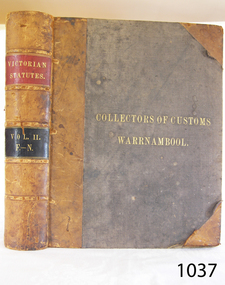
Book - Reference/Legal Acts, John Ferres, Government Printer, The Victorian Statutes Vol 2 Collectors of Customs, 1866
... Ferres joined the staff of the Melbourne Morning Herald as a compositor (typesetter). He rose rapidly through the ranks to become sub-overseer and then manager. ...Ferres joined the staff of the Melbourne Morning Herald as a compositor (typesetter). He rose rapidly through the ranks to become sub-overseer and then manager. ...Because the subject item is a book of law, it would not traditionally have a singular author, but rather a corporate author, specifically the Colony of Victoria and, more precisely, the Parliament of Victoria. The Victorian Statutes of 1866 is an official compilation of the statute law of the Colony of Victoria, Australia, 'Published by Authority', and printed by John Ferres, who was the Victorian Government Printer at the time. Ferres was the printer/publisher, not an author or editor in the usual sense, as this is a government publication rather than an individually authored work.Hard cover book, The Victorian Statutes Vol 2 Author: Corporate Author “The Colony of Victoria” Publisher: John Ferres Government Printer Melbourne. Date: 1866 Three quarter leather, Olive Front Cover, Brown Spine with Gold embossed Title on spine & front cover "Collector of Customs Warrnambool"non-fictionBecause the subject item is a book of law, it would not traditionally have a singular author, but rather a corporate author, specifically the Colony of Victoria and, more precisely, the Parliament of Victoria. The Victorian Statutes of 1866 is an official compilation of the statute law of the Colony of Victoria, Australia, 'Published by Authority', and printed by John Ferres, who was the Victorian Government Printer at the time. Ferres was the printer/publisher, not an author or editor in the usual sense, as this is a government publication rather than an individually authored work.flagstaff hill, warrnambool, shipwrecked-coast, flagstaff-hill, flagstaff-hill-maritime-museum, maritime-museum, shipwreck-coast, flagstaff-hill-maritime-village, the victorian statutes vol 2 collectors of customs, book -
 Flagstaff Hill Maritime Museum and Village
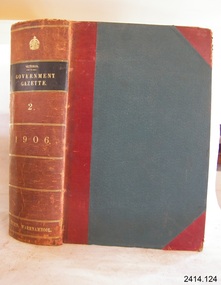
Book - Reference/Colonial Government Notification Gazette, James Kemp, The Victorian Government Gazette 1906 Vol 2 /129, 1906
... Kemp trained as a practical printer and compositor, advancing through the ranks of the printing trade in Victoria. ...Kemp trained as a practical printer and compositor, advancing through the ranks of the printing trade in Victoria. ...The Victoria Government Gazette and other government documents from 1887 were printed and published by Robert S. Brain, Government Printer, Melbourne. Brain held the position of Victorian Government Printer through the 1890s and into the early 1900s. The same imprint appears on other official Victorian publications from that era, such as the annual reports of the Board for the Protection of the Aborigines and the colony's Statistical Register. There wasn't really an editor in the modern sense the Gazette was compiled and issued under the authority of the colonial government, via the Chief Secretary's Department, with Brain's printing office producing and publishing it. In May 1906, James Kemp succeeded him, serving as Government Printer from May 1906 to August 1912, with the title of Acting Government Printer right at the very start of his tenure he was stepping into the role Brain had just vacated, and by later in December 1906 he was signing gazettes in that capacity, apparently before his appointment was made permanent. Then in 1913 Albert James Mullett took over the role starting from January 1913.Hard cover book. The Victorian Government Gazette 1906 Vol 2 /129 Printer: James Kemp Publisher: James Kemp Publisher: Authority of The Colonial Government Date: 1906 Further Information: Textured hard cover bound book leather burgundy colour spine with gilt lettering, covers embossed blue cloth & reinforced corners to front and back cover. non-fictionThe Victoria Government Gazette and other government documents from 1887 were printed and published by Robert S. Brain, Government Printer, Melbourne. Brain held the position of Victorian Government Printer through the 1890s and into the early 1900s. The same imprint appears on other official Victorian publications from that era, such as the annual reports of the Board for the Protection of the Aborigines and the colony's Statistical Register. There wasn't really an editor in the modern sense the Gazette was compiled and issued under the authority of the colonial government, via the Chief Secretary's Department, with Brain's printing office producing and publishing it. In May 1906, James Kemp succeeded him, serving as Government Printer from May 1906 to August 1912, with the title of Acting Government Printer right at the very start of his tenure he was stepping into the role Brain had just vacated, and by later in December 1906 he was signing gazettes in that capacity, apparently before his appointment was made permanent. Then in 1913 Albert James Mullett took over the role starting from January 1913. flagstaff hill, warrnambool, shipwrecked-coast, flagstaff-hill, flagstaff-hill-maritime-museum, maritime-museum, shipwreck-coast, flagstaff-hill-maritime-village, book, the victoria government gazette 1906 2 vol 129, the victoria government gazette 1906, the victoria government gazette -
 Flagstaff Hill Maritime Museum and Village
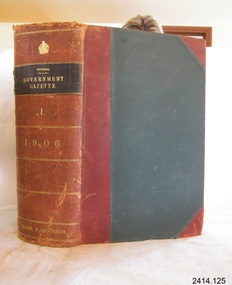
Book - Reference/Colonial Government Notification Gazette, James Kemp, The Victorian Government Gazette 1906 Vol 1 /128, 1906
... Kemp trained as a practical printer and compositor, advancing through the ranks of the printing trade in Victoria. ...Kemp trained as a practical printer and compositor, advancing through the ranks of the printing trade in Victoria. ...The Victoria Government Gazette and other government documents from 1887 were printed and published by Robert S. Brain, Government Printer, Melbourne. Brain held the position of Victorian Government Printer through the 1890s and into the early 1900s. The same imprint appears on other official Victorian publications from that era, such as the annual reports of the Board for the Protection of the Aborigines and the colony's Statistical Register. There wasn't really an editor in the modern sense the Gazette was compiled and issued under the authority of the colonial government, via the Chief Secretary's Department, with Brain's printing office producing and publishing it. In May 1906, James Kemp succeeded him, serving as Government Printer from May 1906 to August 1912, with the title of Acting Government Printer right at the very start of his tenure he was stepping into the role Brain had just vacated, and by later in December 1906 he was signing gazettes in that capacity, apparently before his appointment was made permanent. Then in 1913 Albert James Mullett took over the role starting from January 1913.Hard cover book. The Victorian Government Gazette 1906 Vol 1 /128 Printer: James Kemp Publisher: James Kemp Publisher: Authority of The Colonial Government Date: 1906 Further Information: Textured hard cover bound book leather burgundy colour spine with gilt lettering, covers embossed blue cloth & reinforced corners to front and back cover. non-fictionThe Victoria Government Gazette and other government documents from 1887 were printed and published by Robert S. Brain, Government Printer, Melbourne. Brain held the position of Victorian Government Printer through the 1890s and into the early 1900s. The same imprint appears on other official Victorian publications from that era, such as the annual reports of the Board for the Protection of the Aborigines and the colony's Statistical Register. There wasn't really an editor in the modern sense the Gazette was compiled and issued under the authority of the colonial government, via the Chief Secretary's Department, with Brain's printing office producing and publishing it. In May 1906, James Kemp succeeded him, serving as Government Printer from May 1906 to August 1912, with the title of Acting Government Printer right at the very start of his tenure he was stepping into the role Brain had just vacated, and by later in December 1906 he was signing gazettes in that capacity, apparently before his appointment was made permanent. Then in 1913 Albert James Mullett took over the role starting from January 1913. flagstaff hill, warrnambool, shipwrecked-coast, flagstaff-hill, flagstaff-hill-maritime-museum, maritime-museum, shipwreck-coast, flagstaff-hill-maritime-village, book, the victoria government gazette 1906 2 vol 129, the victoria government gazette 1906, the victoria government gazette -
 Flagstaff Hill Maritime Museum and Village
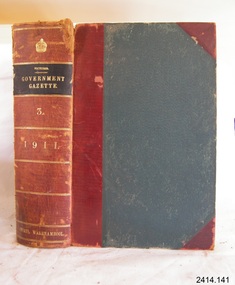
Book - Reference/Colonial Government Notification Gazette, James Kemp, The Victorian Government Gazette 1911 Vol 3 /145, 1911
... Kemp trained as a practical printer and compositor, advancing through the ranks of the printing trade in Victoria. ...Kemp trained as a practical printer and compositor, advancing through the ranks of the printing trade in Victoria. ...The Victoria Government Gazette and other government documents from 1887 were printed and published by Robert S. Brain, Government Printer, Melbourne. Brain held the position of Victorian Government Printer through the 1890s and into the early 1900s. The same imprint appears on other official Victorian publications from that era, such as the annual reports of the Board for the Protection of the Aborigines and the colony's Statistical Register. There wasn't really an editor in the modern sense the Gazette was compiled and issued under the authority of the colonial government, via the Chief Secretary's Department, with Brain's printing office producing and publishing it. In May 1906, James Kemp succeeded him, serving as Government Printer from May 1906 to August 1912, with the title of Acting Government Printer right at the very start of his tenure he was stepping into the role Brain had just vacated, and by later in December 1906 he was signing gazettes in that capacity, apparently before his appointment was made permanent. Then in 1913 Albert James Mullett took over the role starting from January 1913.Hard cover book. The Victorian Government Gazette 1911 Vol 3 /145 Printer: James Kemp Publisher: James Kemp Publisher: Authority of The Colonial Government Date: 1911 Further Information: Textured hard cover bound book leather burgundy colour spine with gilt lettering, covers embossed blue cloth & reinforced corners to front and back cover. non-fictionThe Victoria Government Gazette and other government documents from 1887 were printed and published by Robert S. Brain, Government Printer, Melbourne. Brain held the position of Victorian Government Printer through the 1890s and into the early 1900s. The same imprint appears on other official Victorian publications from that era, such as the annual reports of the Board for the Protection of the Aborigines and the colony's Statistical Register. There wasn't really an editor in the modern sense the Gazette was compiled and issued under the authority of the colonial government, via the Chief Secretary's Department, with Brain's printing office producing and publishing it. In May 1906, James Kemp succeeded him, serving as Government Printer from May 1906 to August 1912, with the title of Acting Government Printer right at the very start of his tenure he was stepping into the role Brain had just vacated, and by later in December 1906 he was signing gazettes in that capacity, apparently before his appointment was made permanent. Then in 1913 Albert James Mullett took over the role starting from January 1913. flagstaff hill, warrnambool, shipwrecked-coast, flagstaff-hill, flagstaff-hill-maritime-museum, maritime-museum, shipwreck-coast, flagstaff-hill-maritime-village, book, the victoria government gazette 1906 2 vol 129, the victoria government gazette 1906, the victoria government gazette -
 Flagstaff Hill Maritime Museum and Village
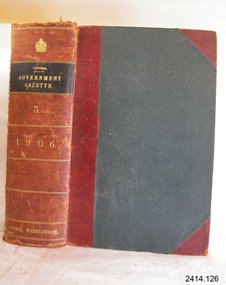
Book - Reference/Colonial Government Notification Gazette, James Kemp, The Victorian Government Gazette 1906 Vol 3 /130, 1906
... Kemp trained as a practical printer and compositor, advancing through the ranks of the printing trade in Victoria. ...Kemp trained as a practical printer and compositor, advancing through the ranks of the printing trade in Victoria. ...The Victoria Government Gazette and other government documents from 1887 were printed and published by Robert S. Brain, Government Printer, Melbourne. Brain held the position of Victorian Government Printer through the 1890s and into the early 1900s. The same imprint appears on other official Victorian publications from that era, such as the annual reports of the Board for the Protection of the Aborigines and the colony's Statistical Register. There wasn't really an editor in the modern sense the Gazette was compiled and issued under the authority of the colonial government, via the Chief Secretary's Department, with Brain's printing office producing and publishing it. In May 1906, James Kemp succeeded him, serving as Government Printer from May 1906 to August 1912, with the title of Acting Government Printer right at the very start of his tenure he was stepping into the role Brain had just vacated, and by later in December 1906 he was signing gazettes in that capacity, apparently before his appointment was made permanent. Then in 1913 Albert James Mullett took over the role starting from January 1913.Hard cover book. The Victorian Government Gazette 1906 Vol 3 /130 Printer: James Kemp Publisher: James Kemp Publisher: Authority of The Colonial Government Date: 1906 Further Information: Textured hard cover bound book leather burgundy colour spine with gilt lettering, covers embossed blue cloth & reinforced corners to front and back cover. non-fictionThe Victoria Government Gazette and other government documents from 1887 were printed and published by Robert S. Brain, Government Printer, Melbourne. Brain held the position of Victorian Government Printer through the 1890s and into the early 1900s. The same imprint appears on other official Victorian publications from that era, such as the annual reports of the Board for the Protection of the Aborigines and the colony's Statistical Register. There wasn't really an editor in the modern sense the Gazette was compiled and issued under the authority of the colonial government, via the Chief Secretary's Department, with Brain's printing office producing and publishing it. In May 1906, James Kemp succeeded him, serving as Government Printer from May 1906 to August 1912, with the title of Acting Government Printer right at the very start of his tenure he was stepping into the role Brain had just vacated, and by later in December 1906 he was signing gazettes in that capacity, apparently before his appointment was made permanent. Then in 1913 Albert James Mullett took over the role starting from January 1913. flagstaff hill, warrnambool, shipwrecked-coast, flagstaff-hill, flagstaff-hill-maritime-museum, maritime-museum, shipwreck-coast, flagstaff-hill-maritime-village, book, the victoria government gazette 1906 2 vol 129, the victoria government gazette 1906, the victoria government gazette -
 Flagstaff Hill Maritime Museum and Village
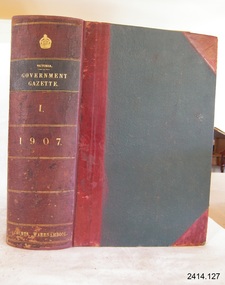
Book - Reference/Colonial Government Notification Gazette, James Kemp, The Victorian Government Gazette 1907 Vol 1 /131, 1907
... Kemp trained as a practical printer and compositor, advancing through the ranks of the printing trade in Victoria. ...Kemp trained as a practical printer and compositor, advancing through the ranks of the printing trade in Victoria. ...The Victoria Government Gazette and other government documents from 1887 were printed and published by Robert S. Brain, Government Printer, Melbourne. Brain held the position of Victorian Government Printer through the 1890s and into the early 1900s. The same imprint appears on other official Victorian publications from that era, such as the annual reports of the Board for the Protection of the Aborigines and the colony's Statistical Register. There wasn't really an editor in the modern sense the Gazette was compiled and issued under the authority of the colonial government, via the Chief Secretary's Department, with Brain's printing office producing and publishing it. In May 1906, James Kemp succeeded him, serving as Government Printer from May 1906 to August 1912, with the title of Acting Government Printer right at the very start of his tenure he was stepping into the role Brain had just vacated, and by later in December 1906 he was signing gazettes in that capacity, apparently before his appointment was made permanent. Then in 1913 Albert James Mullett took over the role starting from January 1913.Hard cover book. The Victorian Government Gazette 1907 Vol 1 /131 Printer: James Kemp Publisher: James Kemp Publisher: Authority of The Colonial Government Date: 1907 Further Information: Textured hard cover bound book leather burgundy colour spine with gilt lettering, covers embossed blue cloth & reinforced corners to front and back cover. non-fictionThe Victoria Government Gazette and other government documents from 1887 were printed and published by Robert S. Brain, Government Printer, Melbourne. Brain held the position of Victorian Government Printer through the 1890s and into the early 1900s. The same imprint appears on other official Victorian publications from that era, such as the annual reports of the Board for the Protection of the Aborigines and the colony's Statistical Register. There wasn't really an editor in the modern sense the Gazette was compiled and issued under the authority of the colonial government, via the Chief Secretary's Department, with Brain's printing office producing and publishing it. In May 1906, James Kemp succeeded him, serving as Government Printer from May 1906 to August 1912, with the title of Acting Government Printer right at the very start of his tenure he was stepping into the role Brain had just vacated, and by later in December 1906 he was signing gazettes in that capacity, apparently before his appointment was made permanent. Then in 1913 Albert James Mullett took over the role starting from January 1913. flagstaff hill, warrnambool, shipwrecked-coast, flagstaff-hill, flagstaff-hill-maritime-museum, maritime-museum, shipwreck-coast, flagstaff-hill-maritime-village, book, the victoria government gazette 1906 2 vol 129, the victoria government gazette 1906, the victoria government gazette -
 Flagstaff Hill Maritime Museum and Village
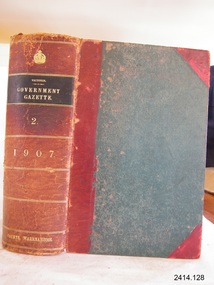
Book - Reference/Colonial Government Notification Gazette, James Kemp, The Victorian Government Gazette 1907 Vol 2 /132, 1907
... Kemp trained as a practical printer and compositor, advancing through the ranks of the printing trade in Victoria. ...Kemp trained as a practical printer and compositor, advancing through the ranks of the printing trade in Victoria. ...The Victoria Government Gazette and other government documents from 1887 were printed and published by Robert S. Brain, Government Printer, Melbourne. Brain held the position of Victorian Government Printer through the 1890s and into the early 1900s. The same imprint appears on other official Victorian publications from that era, such as the annual reports of the Board for the Protection of the Aborigines and the colony's Statistical Register. There wasn't really an editor in the modern sense the Gazette was compiled and issued under the authority of the colonial government, via the Chief Secretary's Department, with Brain's printing office producing and publishing it. In May 1906, James Kemp succeeded him, serving as Government Printer from May 1906 to August 1912, with the title of Acting Government Printer right at the very start of his tenure he was stepping into the role Brain had just vacated, and by later in December 1906 he was signing gazettes in that capacity, apparently before his appointment was made permanent. Then in 1913 Albert James Mullett took over the role starting from January 1913.Hard cover book. The Victorian Government Gazette 1907 Vol 2 /132 Printer: James Kemp Publisher: James Kemp Publisher: Authority of The Colonial Government Date: 1907 Further Information: Textured hard cover bound book leather burgundy colour spine with gilt lettering, covers embossed blue cloth & reinforced corners to front and back cover. non-fictionThe Victoria Government Gazette and other government documents from 1887 were printed and published by Robert S. Brain, Government Printer, Melbourne. Brain held the position of Victorian Government Printer through the 1890s and into the early 1900s. The same imprint appears on other official Victorian publications from that era, such as the annual reports of the Board for the Protection of the Aborigines and the colony's Statistical Register. There wasn't really an editor in the modern sense the Gazette was compiled and issued under the authority of the colonial government, via the Chief Secretary's Department, with Brain's printing office producing and publishing it. In May 1906, James Kemp succeeded him, serving as Government Printer from May 1906 to August 1912, with the title of Acting Government Printer right at the very start of his tenure he was stepping into the role Brain had just vacated, and by later in December 1906 he was signing gazettes in that capacity, apparently before his appointment was made permanent. Then in 1913 Albert James Mullett took over the role starting from January 1913. flagstaff hill, warrnambool, shipwrecked-coast, flagstaff-hill, flagstaff-hill-maritime-museum, maritime-museum, shipwreck-coast, flagstaff-hill-maritime-village, book, the victoria government gazette 1906 2 vol 129, the victoria government gazette 1906, the victoria government gazette -
 Flagstaff Hill Maritime Museum and Village
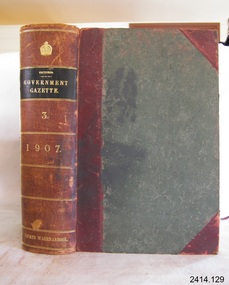
Book - Reference/Colonial Government Notification Gazette, James Kemp, The Victorian Government Gazette 1907 Vol 3 /133, 1907
... Kemp trained as a practical printer and compositor, advancing through the ranks of the printing trade in Victoria. ...Kemp trained as a practical printer and compositor, advancing through the ranks of the printing trade in Victoria. ...The Victoria Government Gazette and other government documents from 1887 were printed and published by Robert S. Brain, Government Printer, Melbourne. Brain held the position of Victorian Government Printer through the 1890s and into the early 1900s. The same imprint appears on other official Victorian publications from that era, such as the annual reports of the Board for the Protection of the Aborigines and the colony's Statistical Register. There wasn't really an editor in the modern sense the Gazette was compiled and issued under the authority of the colonial government, via the Chief Secretary's Department, with Brain's printing office producing and publishing it. In May 1906, James Kemp succeeded him, serving as Government Printer from May 1906 to August 1912, with the title of Acting Government Printer right at the very start of his tenure he was stepping into the role Brain had just vacated, and by later in December 1906 he was signing gazettes in that capacity, apparently before his appointment was made permanent. Then in 1913 Albert James Mullett took over the role starting from January 1913.Hard cover book. The Victorian Government Gazette 1907 Vol 3 /133 Printer: James Kemp Publisher: James Kemp Publisher: Authority of The Colonial Government Date: 1907 Further Information: Textured hard cover bound book leather burgundy colour spine with gilt lettering, covers embossed blue cloth & reinforced corners to front and back cover. non-fictionThe Victoria Government Gazette and other government documents from 1887 were printed and published by Robert S. Brain, Government Printer, Melbourne. Brain held the position of Victorian Government Printer through the 1890s and into the early 1900s. The same imprint appears on other official Victorian publications from that era, such as the annual reports of the Board for the Protection of the Aborigines and the colony's Statistical Register. There wasn't really an editor in the modern sense the Gazette was compiled and issued under the authority of the colonial government, via the Chief Secretary's Department, with Brain's printing office producing and publishing it. In May 1906, James Kemp succeeded him, serving as Government Printer from May 1906 to August 1912, with the title of Acting Government Printer right at the very start of his tenure he was stepping into the role Brain had just vacated, and by later in December 1906 he was signing gazettes in that capacity, apparently before his appointment was made permanent. Then in 1913 Albert James Mullett took over the role starting from January 1913. flagstaff hill, warrnambool, shipwrecked-coast, flagstaff-hill, flagstaff-hill-maritime-museum, maritime-museum, shipwreck-coast, flagstaff-hill-maritime-village, book, the victoria government gazette 1906 2 vol 129, the victoria government gazette 1906, the victoria government gazette -
 Flagstaff Hill Maritime Museum and Village
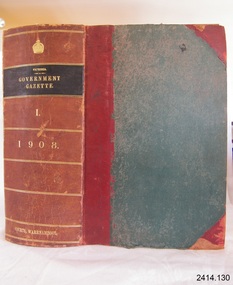
Book - Reference/Colonial Government Notification Gazette, James Kemp, The Victorian Government Gazette 1908 Vol 1 /134, 1908
... Kemp trained as a practical printer and compositor, advancing through the ranks of the printing trade in Victoria. ...Kemp trained as a practical printer and compositor, advancing through the ranks of the printing trade in Victoria. ...The Victoria Government Gazette and other government documents from 1887 were printed and published by Robert S. Brain, Government Printer, Melbourne. Brain held the position of Victorian Government Printer through the 1890s and into the early 1900s. The same imprint appears on other official Victorian publications from that era, such as the annual reports of the Board for the Protection of the Aborigines and the colony's Statistical Register. There wasn't really an editor in the modern sense the Gazette was compiled and issued under the authority of the colonial government, via the Chief Secretary's Department, with Brain's printing office producing and publishing it. In May 1906, James Kemp succeeded him, serving as Government Printer from May 1906 to August 1912, with the title of Acting Government Printer right at the very start of his tenure he was stepping into the role Brain had just vacated, and by later in December 1906 he was signing gazettes in that capacity, apparently before his appointment was made permanent. Then in 1913 Albert James Mullett took over the role starting from January 1913.Hard cover book. The Victorian Government Gazette 1908 Vol 1 /134 Printer: James Kemp Publisher: James Kemp Publisher: Authority of The Colonial Government Date: 1908 Further Information: Textured hard cover bound book leather burgundy colour spine with gilt lettering, covers embossed blue cloth & reinforced corners to front and back cover. non-fictionThe Victoria Government Gazette and other government documents from 1887 were printed and published by Robert S. Brain, Government Printer, Melbourne. Brain held the position of Victorian Government Printer through the 1890s and into the early 1900s. The same imprint appears on other official Victorian publications from that era, such as the annual reports of the Board for the Protection of the Aborigines and the colony's Statistical Register. There wasn't really an editor in the modern sense the Gazette was compiled and issued under the authority of the colonial government, via the Chief Secretary's Department, with Brain's printing office producing and publishing it. In May 1906, James Kemp succeeded him, serving as Government Printer from May 1906 to August 1912, with the title of Acting Government Printer right at the very start of his tenure he was stepping into the role Brain had just vacated, and by later in December 1906 he was signing gazettes in that capacity, apparently before his appointment was made permanent. Then in 1913 Albert James Mullett took over the role starting from January 1913. flagstaff hill, warrnambool, shipwrecked-coast, flagstaff-hill, flagstaff-hill-maritime-museum, maritime-museum, shipwreck-coast, flagstaff-hill-maritime-village, book, the victoria government gazette 1906 2 vol 129, the victoria government gazette 1906, the victoria government gazette -
 Flagstaff Hill Maritime Museum and Village
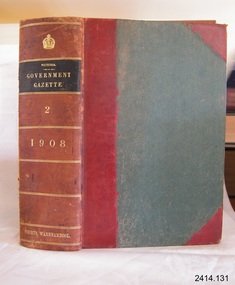
Book - Reference/Colonial Government Notification Gazette, James Kemp, The Victorian Government Gazette 1908 Vol 2 /135, 1908
... Kemp trained as a practical printer and compositor, advancing through the ranks of the printing trade in Victoria. ...Kemp trained as a practical printer and compositor, advancing through the ranks of the printing trade in Victoria. ...The Victoria Government Gazette and other government documents from 1887 were printed and published by Robert S. Brain, Government Printer, Melbourne. Brain held the position of Victorian Government Printer through the 1890s and into the early 1900s. The same imprint appears on other official Victorian publications from that era, such as the annual reports of the Board for the Protection of the Aborigines and the colony's Statistical Register. There wasn't really an editor in the modern sense the Gazette was compiled and issued under the authority of the colonial government, via the Chief Secretary's Department, with Brain's printing office producing and publishing it. In May 1906, James Kemp succeeded him, serving as Government Printer from May 1906 to August 1912, with the title of Acting Government Printer right at the very start of his tenure he was stepping into the role Brain had just vacated, and by later in December 1906 he was signing gazettes in that capacity, apparently before his appointment was made permanent. Then in 1913 Albert James Mullett took over the role starting from January 1913.Hard cover book. The Victorian Government Gazette 1908 Vol 2 /135 Printer: James Kemp Publisher: James Kemp Publisher: Authority of The Colonial Government Date: 1908 Further Information: Textured hard cover bound book leather burgundy colour spine with gilt lettering, covers embossed blue cloth & reinforced corners to front and back cover. non-fictionThe Victoria Government Gazette and other government documents from 1887 were printed and published by Robert S. Brain, Government Printer, Melbourne. Brain held the position of Victorian Government Printer through the 1890s and into the early 1900s. The same imprint appears on other official Victorian publications from that era, such as the annual reports of the Board for the Protection of the Aborigines and the colony's Statistical Register. There wasn't really an editor in the modern sense the Gazette was compiled and issued under the authority of the colonial government, via the Chief Secretary's Department, with Brain's printing office producing and publishing it. In May 1906, James Kemp succeeded him, serving as Government Printer from May 1906 to August 1912, with the title of Acting Government Printer right at the very start of his tenure he was stepping into the role Brain had just vacated, and by later in December 1906 he was signing gazettes in that capacity, apparently before his appointment was made permanent. Then in 1913 Albert James Mullett took over the role starting from January 1913. flagstaff hill, warrnambool, shipwrecked-coast, flagstaff-hill, flagstaff-hill-maritime-museum, maritime-museum, shipwreck-coast, flagstaff-hill-maritime-village, book, the victoria government gazette 1906 2 vol 129, the victoria government gazette 1906, the victoria government gazette -
 Flagstaff Hill Maritime Museum and Village
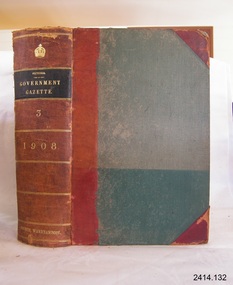
Book - Reference/Colonial Government Notification Gazette, James Kemp, The Victorian Government Gazette 1908 Vol 3 /136, 1908
... Kemp trained as a practical printer and compositor, advancing through the ranks of the printing trade in Victoria. ...Kemp trained as a practical printer and compositor, advancing through the ranks of the printing trade in Victoria. ...The Victoria Government Gazette and other government documents from 1887 were printed and published by Robert S. Brain, Government Printer, Melbourne. Brain held the position of Victorian Government Printer through the 1890s and into the early 1900s. The same imprint appears on other official Victorian publications from that era, such as the annual reports of the Board for the Protection of the Aborigines and the colony's Statistical Register. There wasn't really an editor in the modern sense the Gazette was compiled and issued under the authority of the colonial government, via the Chief Secretary's Department, with Brain's printing office producing and publishing it. In May 1906, James Kemp succeeded him, serving as Government Printer from May 1906 to August 1912, with the title of Acting Government Printer right at the very start of his tenure he was stepping into the role Brain had just vacated, and by later in December 1906 he was signing gazettes in that capacity, apparently before his appointment was made permanent. Then in 1913 Albert James Mullett took over the role starting from January 1913.Hard cover book. The Victorian Government Gazette 1908 Vol 3 /136 Printer: James Kemp Publisher: James Kemp Publisher: Authority of The Colonial Government Date: 1908 Further Information: Textured hard cover bound book leather burgundy colour spine with gilt lettering, covers embossed blue cloth & reinforced corners to front and back cover. non-fictionThe Victoria Government Gazette and other government documents from 1887 were printed and published by Robert S. Brain, Government Printer, Melbourne. Brain held the position of Victorian Government Printer through the 1890s and into the early 1900s. The same imprint appears on other official Victorian publications from that era, such as the annual reports of the Board for the Protection of the Aborigines and the colony's Statistical Register. There wasn't really an editor in the modern sense the Gazette was compiled and issued under the authority of the colonial government, via the Chief Secretary's Department, with Brain's printing office producing and publishing it. In May 1906, James Kemp succeeded him, serving as Government Printer from May 1906 to August 1912, with the title of Acting Government Printer right at the very start of his tenure he was stepping into the role Brain had just vacated, and by later in December 1906 he was signing gazettes in that capacity, apparently before his appointment was made permanent. Then in 1913 Albert James Mullett took over the role starting from January 1913. flagstaff hill, warrnambool, shipwrecked-coast, flagstaff-hill, flagstaff-hill-maritime-museum, maritime-museum, shipwreck-coast, flagstaff-hill-maritime-village, book, the victoria government gazette 1906 2 vol 129, the victoria government gazette 1906, the victoria government gazette -
 Flagstaff Hill Maritime Museum and Village
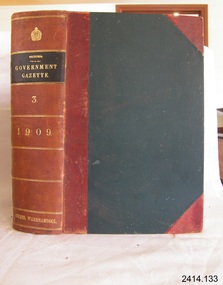
Book - Reference/Colonial Government Notification Gazette, James Kemp, The Victorian Government Gazette 1909 Vol 3 /139, 1909
... Kemp trained as a practical printer and compositor, advancing through the ranks of the printing trade in Victoria. ...Kemp trained as a practical printer and compositor, advancing through the ranks of the printing trade in Victoria. ...The Victoria Government Gazette and other government documents from 1887 were printed and published by Robert S. Brain, Government Printer, Melbourne. Brain held the position of Victorian Government Printer through the 1890s and into the early 1900s. The same imprint appears on other official Victorian publications from that era, such as the annual reports of the Board for the Protection of the Aborigines and the colony's Statistical Register. There wasn't really an editor in the modern sense the Gazette was compiled and issued under the authority of the colonial government, via the Chief Secretary's Department, with Brain's printing office producing and publishing it. In May 1906, James Kemp succeeded him, serving as Government Printer from May 1906 to August 1912, with the title of Acting Government Printer right at the very start of his tenure he was stepping into the role Brain had just vacated, and by later in December 1906 he was signing gazettes in that capacity, apparently before his appointment was made permanent. Then in 1913 Albert James Mullett took over the role starting from January 1913.Hard cover book. The Victorian Government Gazette 1909 Vol 3 /139 Printer: James Kemp Publisher: James Kemp Publisher: Authority of The Colonial Government Date: 1909 Further Information: Textured hard cover bound book leather burgundy colour spine with gilt lettering, covers embossed blue cloth & reinforced corners to front and back cover. non-fictionThe Victoria Government Gazette and other government documents from 1887 were printed and published by Robert S. Brain, Government Printer, Melbourne. Brain held the position of Victorian Government Printer through the 1890s and into the early 1900s. The same imprint appears on other official Victorian publications from that era, such as the annual reports of the Board for the Protection of the Aborigines and the colony's Statistical Register. There wasn't really an editor in the modern sense the Gazette was compiled and issued under the authority of the colonial government, via the Chief Secretary's Department, with Brain's printing office producing and publishing it. In May 1906, James Kemp succeeded him, serving as Government Printer from May 1906 to August 1912, with the title of Acting Government Printer right at the very start of his tenure he was stepping into the role Brain had just vacated, and by later in December 1906 he was signing gazettes in that capacity, apparently before his appointment was made permanent. Then in 1913 Albert James Mullett took over the role starting from January 1913. flagstaff hill, warrnambool, shipwrecked-coast, flagstaff-hill, flagstaff-hill-maritime-museum, maritime-museum, shipwreck-coast, flagstaff-hill-maritime-village, book, the victoria government gazette 1906 2 vol 129, the victoria government gazette 1906, the victoria government gazette -
 Flagstaff Hill Maritime Museum and Village
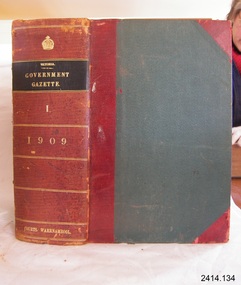
Book - Reference/Colonial Government Notification Gazette, James Kemp, The Victorian Government Gazette 1909 Vol 1 /137, 1909
... Kemp trained as a practical printer and compositor, advancing through the ranks of the printing trade in Victoria. ...Kemp trained as a practical printer and compositor, advancing through the ranks of the printing trade in Victoria. ...The Victoria Government Gazette and other government documents from 1887 were printed and published by Robert S. Brain, Government Printer, Melbourne. Brain held the position of Victorian Government Printer through the 1890s and into the early 1900s. The same imprint appears on other official Victorian publications from that era, such as the annual reports of the Board for the Protection of the Aborigines and the colony's Statistical Register. There wasn't really an editor in the modern sense the Gazette was compiled and issued under the authority of the colonial government, via the Chief Secretary's Department, with Brain's printing office producing and publishing it. In May 1906, James Kemp succeeded him, serving as Government Printer from May 1906 to August 1912, with the title of Acting Government Printer right at the very start of his tenure he was stepping into the role Brain had just vacated, and by later in December 1906 he was signing gazettes in that capacity, apparently before his appointment was made permanent. Then in 1913 Albert James Mullett took over the role starting from January 1913.Hard cover book. The Victorian Government Gazette 1909 Vol 1 /137 Printer: James Kemp Publisher: James Kemp Publisher: Authority of The Colonial Government Date: 1909 Further Information: Textured hard cover bound book leather burgundy colour spine with gilt lettering, covers embossed blue cloth & reinforced corners to front and back cover. non-fictionThe Victoria Government Gazette and other government documents from 1887 were printed and published by Robert S. Brain, Government Printer, Melbourne. Brain held the position of Victorian Government Printer through the 1890s and into the early 1900s. The same imprint appears on other official Victorian publications from that era, such as the annual reports of the Board for the Protection of the Aborigines and the colony's Statistical Register. There wasn't really an editor in the modern sense the Gazette was compiled and issued under the authority of the colonial government, via the Chief Secretary's Department, with Brain's printing office producing and publishing it. In May 1906, James Kemp succeeded him, serving as Government Printer from May 1906 to August 1912, with the title of Acting Government Printer right at the very start of his tenure he was stepping into the role Brain had just vacated, and by later in December 1906 he was signing gazettes in that capacity, apparently before his appointment was made permanent. Then in 1913 Albert James Mullett took over the role starting from January 1913. flagstaff hill, warrnambool, shipwrecked-coast, flagstaff-hill, flagstaff-hill-maritime-museum, maritime-museum, shipwreck-coast, flagstaff-hill-maritime-village, book, the victoria government gazette 1906 2 vol 129, the victoria government gazette 1906, the victoria government gazette -
 Flagstaff Hill Maritime Museum and Village
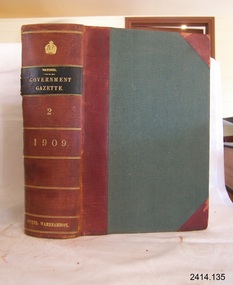
Book - Reference/Colonial Government Notification Gazette, James Kemp, The Victorian Government Gazette 1909 Vol 2 /138, 1909
... Kemp trained as a practical printer and compositor, advancing through the ranks of the printing trade in Victoria. ...Kemp trained as a practical printer and compositor, advancing through the ranks of the printing trade in Victoria. ...The Victoria Government Gazette and other government documents from 1887 were printed and published by Robert S. Brain, Government Printer, Melbourne. Brain held the position of Victorian Government Printer through the 1890s and into the early 1900s. The same imprint appears on other official Victorian publications from that era, such as the annual reports of the Board for the Protection of the Aborigines and the colony's Statistical Register. There wasn't really an editor in the modern sense the Gazette was compiled and issued under the authority of the colonial government, via the Chief Secretary's Department, with Brain's printing office producing and publishing it. In May 1906, James Kemp succeeded him, serving as Government Printer from May 1906 to August 1912, with the title of Acting Government Printer right at the very start of his tenure he was stepping into the role Brain had just vacated, and by later in December 1906 he was signing gazettes in that capacity, apparently before his appointment was made permanent. Then in 1913 Albert James Mullett took over the role starting from January 1913.Hard cover book. The Victorian Government Gazette 1909 Vol 2 /138 Printer: James Kemp Publisher: James Kemp Publisher: Authority of The Colonial Government Date: 1909 Further Information: Textured hard cover bound book leather burgundy colour spine with gilt lettering, covers embossed blue cloth & reinforced corners to front and back cover. non-fictionThe Victoria Government Gazette and other government documents from 1887 were printed and published by Robert S. Brain, Government Printer, Melbourne. Brain held the position of Victorian Government Printer through the 1890s and into the early 1900s. The same imprint appears on other official Victorian publications from that era, such as the annual reports of the Board for the Protection of the Aborigines and the colony's Statistical Register. There wasn't really an editor in the modern sense the Gazette was compiled and issued under the authority of the colonial government, via the Chief Secretary's Department, with Brain's printing office producing and publishing it. In May 1906, James Kemp succeeded him, serving as Government Printer from May 1906 to August 1912, with the title of Acting Government Printer right at the very start of his tenure he was stepping into the role Brain had just vacated, and by later in December 1906 he was signing gazettes in that capacity, apparently before his appointment was made permanent. Then in 1913 Albert James Mullett took over the role starting from January 1913. flagstaff hill, warrnambool, shipwrecked-coast, flagstaff-hill, flagstaff-hill-maritime-museum, maritime-museum, shipwreck-coast, flagstaff-hill-maritime-village, book, the victoria government gazette 1906 2 vol 129, the victoria government gazette 1906, the victoria government gazette
