
Showing 21 items matching "construction strength"
-
 Moorabbin Air Museum
Book - Advisory Committee for Aeronautics technical reports, Technical Report of the Advisory Committee for Aeronautics for the Year 1914 - 1915
... ...Construction strength...Advisory Committee for Aeronautics technical reports Committee report for 1914-1915 Experiments on airship models Tests on models of aircraft bodies Stabililty Rotary & resistance derivatives Airscrews Construction strength Sea planes Fabrics Meteorology Collection of technical studies for 1914-1915 Technical Report of the Advisory Committee for Aeronautics for the Year 1914 - 1915 Book Advisory Committee for Aeronautics technical reports ...Collection of technical studies for 1914-1915non-fictionCollection of technical studies for 1914-1915committee report for 1914-1915, experiments on airship models, tests on models of aircraft bodies, stabililty, rotary & resistance derivatives, airscrews, construction strength, sea planes, fabrics, meteorology -
Moorabbin Air Museum
Book - Advisory Committee for Aeronautics technical reports, Technical Report of the Advisory Committee for Aeronautics for the Year 1915 - 1916
... ...Construction strength...Advisory Committee for Aeronautics technical reports Committee report for 1915 - 1916 Wind channels Experiments on airship models/kite balloons/aircraft wings Experiments on aerofoils/biplane wings/complete aircraft models Stability Construction strength Seaplanes Fabrics Instruments Collection of technical studies for 1915 - 1916 Technical Report of the Advisory Committee for Aeronautics for the Year 1915 - 1916 Book Advisory Committee for Aeronautics technical reports ...Collection of technical studies for 1915 - 1916non-fictionCollection of technical studies for 1915 - 1916committee report for 1915 - 1916, wind channels, experiments on airship models/kite balloons/aircraft wings, experiments on aerofoils/biplane wings/complete aircraft models, stability, construction strength, seaplanes, fabrics, instruments -
 Flagstaff Hill Maritime Museum and Village
Container - Barrel, 19th century
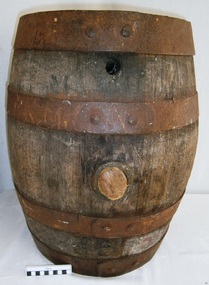
... strength and the iron bands helped the wooden sheaves stay in place. The tops and bottoms allowed for easy grip. The bungholes gave access to government representatives, who would sample the contents, measure the alcohol percentage, and charge the appropriate duty or tax; the process was called Ullaging and the instrument they used was a Hydrometer. Hundreds of barrels of cement were imported into Warrnambool in the late 19th century for the construction...strength and the iron bands helped the wooden sheaves stay in place. The tops and bottoms allowed for easy grip. The bungholes gave access to government representatives, who would sample the contents, measure the alcohol percentage, and charge the appropriate duty or tax; the process was called Ullaging and the instrument they used was a Hydrometer. Hundreds of barrels of cement were imported into Warrnambool in the late 19th century for the construction ...This small barrel looks well used. Unfortunately, the inscription on the barrel is indecipherable so its story is a mystery. However, the bungholes on the side are a clue that it was once used for storing liquid, likely to have been liquor. Barrels have been used over many centuries for transporting and storing a wide range of dry and liquid goods. They are made by tradesmen called coopers, who use heat and steam to bend and shape the wood to suit the work in hand. They add metal reinforcing, handles, spouts and suchlike, to complete they process. Their produce also includes buckets, casks and tubs. Ships transported bulk liquor in their cargo, stored in wooden barrels. The barrels' round shape allowed them to be easily moved by rolling them into place. The body's shape gave the barrels added strength and the iron bands helped the wooden sheaves stay in place. The tops and bottoms allowed for easy grip. The bungholes gave access to government representatives, who would sample the contents, measure the alcohol percentage, and charge the appropriate duty or tax; the process was called Ullaging and the instrument they used was a Hydrometer. Hundreds of barrels of cement were imported into Warrnambool in the late 19th century for the construction of the Warrnambool Breakwater. Barrel-shaped concrete blocks are still visible at shipwreck sites such as on the LOCH ARD wreck, which carried cement among its cargo.This small barrel is representative of 19th century containers used for transportation and storage of liquid such as liquor. It is a historic shape that is still used in modern times.Barrel; wooden barrel, cylindrical shape with metal bands or ribs for reinforcement. The side has two bungholes; one has a bung or stopper. Inscription on top (indecipherable). (indecipherable)flagstaff hill, warrnambool, shipwrecked-coast, flagstaff-hill, flagstaff-hill-maritime-museum, maritime-museum, shipwreck-coast, flagstaff-hill-maritime-village, barrel, cask, small barrel, trade, coopering, cooper, casket, transport, storage, bunghole -
 Flagstaff Hill Maritime Museum and Village
Steel Sample, ca. 1876
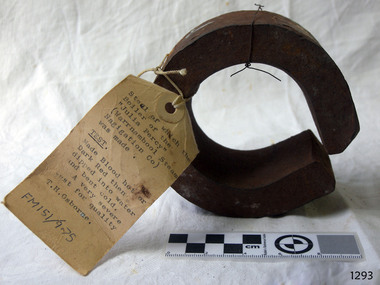
... construction. The steel needs to be manufactured in such a way that it is strong enough yet still flexible enough not to crack when bent or rolled. The boiler on the Julia Percy could have been a Scotch Boiler, a design introduced in the 1870’s and still being used today. This design was more robust that previous boilers, generating higher working steam pressures. The design incorporate greater ability to roll iron plates, leading to greater strength...construction. The steel needs to be manufactured in such a way that it is strong enough yet still flexible enough not to crack when bent or rolled. The boiler on the Julia Percy could have been a Scotch Boiler, a design introduced in the 1870’s and still being used today. This design was more robust that previous boilers, generating higher working steam pressures. The design incorporate greater ability to roll iron plates, leading to greater strength ...The sample of steel from the S.S. Julia Percy’s boiler was made has been tested, according to the attached label. The test involved heating the steel to blood red temperature (or dark red colour) then dipping it into water and bending it when it was cold. A “very severe test for quality” was written on the ticket by T.H. Osborne. (Mr Thomas Hamilton Osborne was the secretary for the Western Steam Navigation Co, established in Warrnambool in 1886. The company’s office was on the corner of Timor and Liebig Streets in Warrnambool and its north-western wall is now part of the current Warrnambool Regional Art Gallery. ) Cold bending of steel in a press or through rollers is the typical method of curving steel for construction. The steel needs to be manufactured in such a way that it is strong enough yet still flexible enough not to crack when bent or rolled. The boiler on the Julia Percy could have been a Scotch Boiler, a design introduced in the 1870’s and still being used today. This design was more robust that previous boilers, generating higher working steam pressures. The design incorporate greater ability to roll iron plates, leading to greater strength, thicker plating and fewer riveted joints. They were originally made of iron then later incorporated steel sections until they were entirely constructed of steel. Many examples of this type of boiler can be found on wreck sites. Shipping was the cheapest and most practical means of carrying produce and goods during the period 1840-1890. Regular domestic steamer services commenced in the Warrnambool district in the late 1850’s and by 1870 the passenger trade was booming. Produce was loaded from the jetty into ‘lighters’ (small boats), which took it to the ships at anchorage in the bay. Passengers were taken to the ship’s side then climbed aboard up ladders or gangways. The coming of the railway in October 1889 meant the gradual decline and end of the steam shipping era. Originally the ship was known as the SS Julia Percy and was later renamed as the Leeuwin. She was an iron passenger-cargo steam ship built in Glasgow by Thomas Wingate for the Warrnambool Steam Packet Company, which commissioned the ship for the steamship trade in Victoria’s western district. She was first registered in Warrnambool, Victoria in 1876. At one point in time the Julia Percy would sail from Warrnambool to Melbourne every Friday and return from Melbourne to Warrnambool every Tuesday. The cost of a return ticket for a Saloon Fare was £1.0.0. She would sail “if practical and weather permitting”. The Julia Percy changed hands several times. Her next owner was the Western Steam Navigaiton Co of Melbourne (1887). It was the manager of this company, Mr. T.H. Osborne, who tagged ths steel sample above. Melbourne Steamship Co became the next owners (1890), followed by William Howard Smith and Sons (1901) for use in Queensland coastal trades, then she was bought by George Turnbull in 1903 and used for local mail contract in Western Australia. She was sold to the Melbourne Steamship Company Ltd. (1906) and re-named the Leeuwi but continued in her Western Australian coastal run. She was converted into a coal hulk in Melbourne in 1910 as a result of damaged caused when she was driven against the jetty at Dongara during a gale. The ship was eventually dismantled and scuttled in Bass Strait on 28 December 1934. The steel sample is significant for its association with the wreck of the Leeuwin (Julia Percy), which is on the Victorian Heritage Register. It is historically significant for being a rare artefact that has potential to interpret aspects of western Victoria’s 19th century steamship trade and Victorian cultural history, including the testing and manufacturing process associated with steam power. Leeuwin is listed on the Victorian heritage Register as being historically significant ‘as one of only four wrecks of steamships in Victorian waters associated with the western district of Victoria’s coastal steamship trade. Her registered number is VHR S413. A sample of the steel from which the boiler of the "SS Julia Percy" (later named Leeuwin) was made. The piece of steel is a ‘C’ shape with the ends almost meeting. A luggage ticket is tied onto the steel and has an inscription on it. The steel is rusty.Ticket with typed information “Steel of which the Boiler of the “Julia Percy” (Warrnambool Steam Navigation Co) was made. TEST: Made Blood hot or Dark Red then dipped into water and bent cold. A very severe test for quality T.H. Osborne. Below these words is the hand written inscription in black “FM 151 / 9.75” julia percy, leeuwin, steel, boiler, steam ship, metal testing, western steam navigation co., flagstaff hill, warrnambool, shipwrecked-coast, flagstaff-hill, flagstaff-hill-maritime-museum, maritime-museum, shipwreck-coast, flagstaff-hill-maritime-village, t.h. osborne -
Marysville & District Historical Society
THE TRIANGLE NEWS-VOL 36 NO 27-JULY 24 2009
... construction positions vacant...church notices...community grants...buxton strength...marysville victoria australia funding for sports community marysville cricket club victorian sports commissioner james merlino member for seymour ben hardman bushfire relief for community sports clubs recovery fund grant what's on when community meetings triangle arts group meeting buxton community hall marysville & district lions club matdg report mobile vet service advertisements triangle material & warehouse murrindindi bushfire reconstruction & recovery committee mbrrc groundwater management murrindindi council goulburn-murray water relevant authority murrindindi construction positions vacant church notices community grants buxton strength training marysville medical clinic marysville marathon thank you mayor's chair dhs health & wellbeing marysville triangle community recovery committee mtcrc councillor comment christmas in july marysville central hoarding fire hazard murrindindi construction bushfire case manager information sessions taxation assistance australian taxation office bushfire recovery positions vacant dse & parks victoria leadbeater's possum lions triangle tools library art exhibition australian landscapes louise foletta marysville real estate THE TRIANGLE NEWS-VOL 36 NO 27-JULY 24 2009 ...marysville, victoria, australia, funding for sports community, marysville cricket club, victorian sports commissioner, james merlino, member for seymour, ben hardman, bushfire relief for community sports clubs, recovery fund grant, what's on when, community meetings, triangle arts group meeting, buxton community hall, marysville & district lions club, matdg report, mobile vet service, advertisements, triangle material & warehouse, murrindindi bushfire reconstruction & recovery committee, mbrrc, groundwater management, murrindindi council, goulburn-murray water relevant authority, murrindindi construction positions vacant, church notices, community grants, buxton strength training, marysville medical clinic, marysville marathon, thank you, mayor's chair, dhs, health & wellbeing, marysville triangle community recovery committee, mtcrc, councillor comment, christmas in july, marysville central, hoarding fire hazard, murrindindi construction, bushfire case manager information sessions, taxation assistance, australian taxation office, bushfire recovery positions vacant, dse & parks victoria, leadbeater's possum, lions triangle tools library, art exhibition australian landscapes, louise foletta, marysville real estate -
Federation University Historical Collection
Booklet, Longman's, Green, and Co, A Select List of Books suitable for use in Science and Technical Schools, September 1904, 1904
... Building and Construction, 12. Magnetism and Electricity, 13. Engineering, Strength of Materials, 14. ...Building and Construction, 12. Magnetism and Electricity, 13. Engineering, Strength of Materials, 14. ...Used at Ballarat School of Mines and Industries. The book was produced by Longmans, Green and Co. in 1904. The books are divided into sections: 1. Practical Elementary Science Series, 2. Elementary Science Manuals, 3. Advanced Science Manuals, 4. Text-books of Science, 5. Chemistry, 6. Physics, 7. Mechanics, Theoretical and Applied, 8. Optics and Photography, 9, Sound, Light and Heat, 10. Steam, 11. Building and Construction, 12. Magnetism and Electricity, 13. Engineering, Strength of Materials, 14. Machine Construction and Drawing, 15. Navigation, 16. Mineralogy, 17. Metallurgy, Astronomy, 18. Naval Architecture, 19. Principles of Mining, 20. Manufactures, Technology, 21. Geology, Physiography, 22.Hygiene, 23. Zoology, 24. Human Physiology, 25. General Biology, 26. Botany, 27. Principles of Agriculture, 28. Mathematics, 29. Geometry, 30. Trigonometry, Beige coloured soft covered book with 30 pages. Lists books suitable for use in technical and science schools.list of books, science and technical school, longmans, green and co., subject sections of books available -
 Kiewa Valley Historical Society
Drill Auger, Circa early 1900s
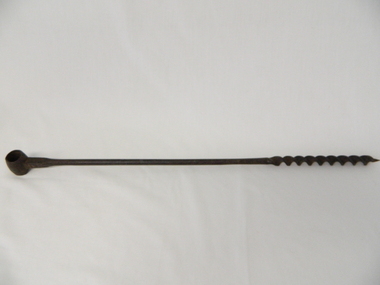
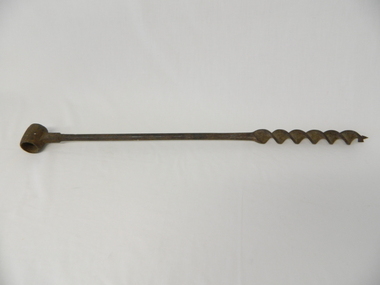
... strength. This item personifies the rugged environment of the rural workplace. The Kiewa Valley with its main emphasis on farming and grazing provided ample opportunity to use this construction implement. ...This item wasused before diesel, electric and battery drilling apparatus were used by farmers, and other trades requiring a portable yet reliable method of drilling holes. As this item is a 3/4 inch hole drill it would be suitable for fencing and providing holes for structural studs. As with all outdoor farm equipment, man power was required (be it the farmer or farm hands). Fitness of the operator was at a high standard but protective gloves were not highly thought of as it was before occupational, health and safety regulations became mandatory over all manual handling activities, be they on rural properties or town/city factories. This period was one where the male ego was at its pinnacle i.e. the harder the tasks the more of a man was required. Hard manual work was not only the "way to go" but also a necessity. Evolution of cheap portable electric/battery powered tools opened up a more efficient method available, especially to those with less muscle strength. This item personifies the rugged environment of the rural workplace. The Kiewa Valley with its main emphasis on farming and grazing provided ample opportunity to use this construction implement. The manufacturer being a Scottish tool company is very significant in the era when this hole maker was in high demand. British steel products were of high grade and had a good record of reliability. The reliability of any tool was a solid factor for farmers and tradesmen in this semi-isolated region (Circa early 1900s) within the Kiewa Valley and its regional area. This factor,although not as crucial, post 1960s, when Asian manufacturers entered the market place and produced cheaper tools and transportation and supplies was more frequent and reliable, the need for the more expensive British made tools diminished considerably. After the influx of tradesmen from war torn Europe (post 1945) and the increased availability of tradesmen in the Kiewa Valley and its region the price of tools was and still is not as crucial and the cost of all required tools has become a minimal part of the equation. It is only with the emerging younger trades person, farmer and grazier, who have more, "one eye on production costs" and no "old ties to the motherland" inert mind set that quality tools such as this auger and other hand tools "must be made to last a life time" is no longer part of the modern work environment.This cast iron, hand operated Auger has a short barrel shaped cylinder at one end (known as the "Eye") and at the other end a Helical screw blade (screws the cutting edge into wooden material, thereby creating a hole 3/4 inch diameter in the wood) . The barrel section at the top permits a metal or wooden leverage plank to be inserted. The main rod has a 180mm long cutting/screw blade running from the bottom up towards the "eye" end. From the end of the screw blade to the handle is 380mm and cylindrical, but this changes at 550mm from the "eye" end to a 14mm x 10mm rectangular shape shaft.This shaft end is welded to the "Eye".On the shaft below the "eye" is stamped " MATHESON GLASGOW" on the front side and a spade (cards) symbol on the back.auger, hand drill, fencing, tool, rural trades, brace & bit -
 Kiewa Valley Historical Society
Drill Auger, Circa early 1900's
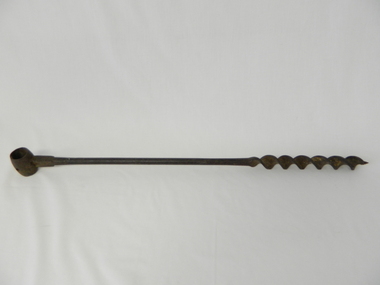
... strength. This item personifies the rugged environment of the rural workplace. The Kiewa Valley with its main emphasis on farming and grazing provided ample opportunity to use this construction implement. ...This item was before diesel, electric and battery drilling apparatus were used by farmers, and other trades requiring a portable yet reliable method of drilling holes. As this item is a 3/4 inch hole drill it would be suitable for fencing and providing holes for structural studs. As with all outdoor farm equipment, man power was required (be it the farmer or farm hands). Fitness of the operator was at a high standard but protective gloves were not highly thought of as it was before occupational, health and safety regulations became mandatory over all manual handling activities, be they on rural properties or town/city factories. This period was one where the male ego was at its pinnacle i.e. the harder the tasks the more of a man was required. Hard manual work was not only the "way to go" but also a necessity. Evolution of cheap portable electric/battery powered tools opened up a more efficient method available, especially to those with less muscle strength.This item personifies the rugged environment of the rural workplace. The Kiewa Valley with its main emphasis on farming and grazing provided ample opportunity to use this construction implement. The manufacturer being a Scottish tool company is very significant in the era when this hole maker was in high demand. British steel products were of high grade and had a good record of reliability. The reliability of any tool was a solid factor for farmers and tradesmen in this semi-isolated region (Circa early 1900s) of the Kiewa Valley and its regional area. This factor,although not as crucial, post 1960s, when Asian manufacturers entered the market place and produced cheaper tools and transportation and supplies was more frequent and reliable, the need for the more expensive British made tools diminished considerably. After the influx of tradesmen from war torn Europe (post 1945) and the increased availability of tradesmen in the Kiewa Valley and its region the price of tools is not as crucial and the cost of all required tools has become a minimal part of the equation. It is only with the emerging younger trades person, farmer and grazier, who have more, "one eye on production costs" and no "old ties to the motherland" inert mind set that quality tools such as this auger and other hand tools "must be made to last a life time" is no longer part of the modern work environment.This cast iron hand operated drill, has a short barrel-shaped cylinder, known as "the eye" welded across the main rod and is 30mm in circumference. It also has a hole drilled to allow a screw to be fastened onto the hand stock ( not available).The main rod is solid for 400mm and then has been flattened and coiled (Helical screw blade) for another 200mm. At the end of the larger screw blade there is a smaller gauged starter blade with a pointer thread 15mm long. This Auger produces a 1/8th inch hole (metric measurement not used at time of manufacture) See KVHS 0469 for 3/4 inch hole and KVHS 0471 for another 1/8th inch hole.A number 5 stamped on the flat sideauger, hand drill, fencing, tool, rural trades, brace & bit -
 Kiewa Valley Historical Society
Drill Auger, Circa early 1900's
... strength. This item personifies the rugged environment of the rural workplace. The Kiewa Valley with its main emphasis on farming and grazing provided ample opportunity to use this construction implement. ...This item was before diesel, electric and battery drilling apparatus were used by farmers, and other trades requiring a portable yet reliable method of drilling holes. As this item is a 3/4 inch hole drill it would be suitable for fencing and providing holes for structural studs. As with all outdoor farm equipment, man power was required (be it the farmer or farm hands). Fitness of the operator was at a high standard but protective gloves were not highly thought of as it was before occupational, health and safety regulations became mandatory over all manual handling activities, be they on rural properties or town/city factories. This period was one where the male ego was at its pinnacle i.e. the harder the tasks the more of a man was required. Hard manual work was not only the "way to go" but also a necessity. Evolution of cheap portable electric/battery powered tools opened up a more efficient method available, especially to those with less muscle strength.This item personifies the rugged environment of the rural workplace. The Kiewa Valley with its main emphasis on farming and grazing provided ample opportunity to use this construction implement. The manufacturer being a Scottish tool company is very significant in the era when this hole maker was in high demand. British steel products were of high grade and had a good record of reliability. The reliability of any tool was a solid factor for farmers and tradesmen in this semi-isolated region (Circa early 1900s) of the Kiewa Valley and its regional area. This factor,although not as crucial, post 1960s, when Asian manufacturers entered the market place and produced cheaper tools and transportation and supplies was more frequent and reliable, the need for the more expensive British made tools diminished considerably. After the influx of tradesmen from war torn Europe (post 1945) and the increased availability of tradesmen in the Kiewa Valley and its region the price of tools is not as crucial and the cost of all required tools has become a minimal part of the equation. It is only with the emerging younger trades person, farmer and grazier, who have more, "one eye on production costs" and no "old ties to the motherland" inert mind set that quality tools such as this auger and other hand tools "must be made to last a life time" is no longer part of the modern work environment.This cast iron hand operated drill, has a short barrel-shaped cylinder, known as "the eye" welded across the main rod and is 30mm in circumference. It also has a hole drilled to allow a screw to be fastened onto the hand stock ( not available).The main rod is solid for 400mm and then has been flattened and coiled (Helical screw blade) for another 200mm. At the end of the larger screw blade there is a smaller gauged starter blade with a pointer thread 15mm long. This Auger produces a 1/8th inch hole (metric measurement not used at time of manufacture) See KVHS 0469 for 3/4 inch hole and KVHS 0470 for another 1/8th inch hole.auger, hand drill, fencing, tool, rural trades, brace & bit -
 Kiewa Valley Historical Society
Jar Brylcream- Personal Item, Circa mid 1900s
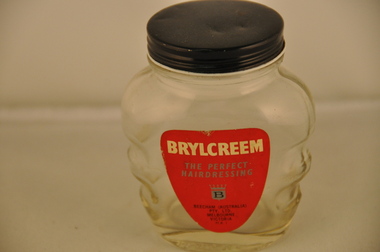
... The long held "men are men" and "women are women" distinction between the sexes lingered on more in rural areas because of the perceived physical differences, mainly "strength" and perceived tasks such as "men only" activities (heavy farm/mining/construction). ...This product was introduced in an era where the "silky smooth" look was in vogue. From the 1920s on, American and British film stars set the tone of how clean cut (hero type) masculine look attracts the opposite sex faster and in greater quantities than the "unkempt" or natural maintained look. This look was bold and "polished" and had the intended projection that the hair matched the character of "I look after myself and have a high opinion of physical appearances". As fashion goes this slick and well maintained look has circled many times, in and out of history and in Australia in the 1950s this was a prime example. The liberation of the stereo type of both sexes occurred in the 1960s when the freedom loving "hippie culture" had a marked affect upon the city inhabitants but not so strong among rural males. Sexism was still rife in that time frame.This jar of Brylcreem was a part of the (masculine) rural scene for a longer period than that found in the larger towns and cities. The long held "men are men" and "women are women" distinction between the sexes lingered on more in rural areas because of the perceived physical differences, mainly "strength" and perceived tasks such as "men only" activities (heavy farm/mining/construction). The jar of Brylcreem maintained the respectable male look for those special occasions when males "dressed" up and looked clean physically and well behaved (to show respect to the women folk)This glass jar with a glued on,red background, label detailing the product Brylcreem (a men's) hairdressing ointment is empty of its original product. It has been contoured on each side to allow for a man's fingers to comfortably and firmly grip the jar. This form would allow even "greased up" hands to maintain control. The glass thickness is far greater than needed and also added the extra stability to the standing jar. The shape of the jar is a latent attempt to emulate the physique of a fit young man (small waist, expanded and muscled mid rift and large shoulders). The jar does not distract from viewing its contents (clear glass). It has a black gloss screw (on/off) lid made from mild grade steel. The jar holds approximately 200 grams of a thick molasses textured product. On the front red Label; in large white letters "BRYLCREEM" underneath this is in smaller silver print "THE PERFECT HAIRDRESSING" underneath this is a banner type motif with a crown at the top and a black letter "B"in the centre. Below this and in much smaller print are printed in black script "BEECHAM (AUSTRALIA) PTY. LTD. MELBOURNE VICTORIA M A Imen's deportment, toiletries, men's hair styles, physical appearances -
 Kiewa Valley Historical Society
Tuyere Pipe, circa mid to late 1900's
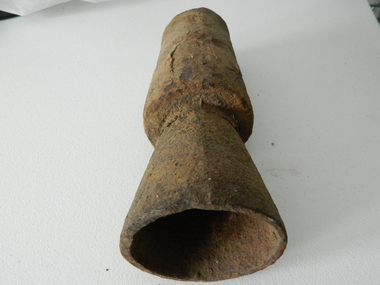
... The "inventiveness" of cattlemen and construction workers to produce metal objects not available "off the shelf" is one of the inherent traits not only of rural self sufficiency but in the "pioneer" days of rural isolation one of survival. This tuyere is of great significance to the Kiewa Valley and its regions because it highlights one of the greatest strengths of the rural (especially isolated) life and its folk living there, and that is the great human factor of adaptability and survival techniques in sometimes harsh and demanding environmental circumstances. ...This tuyere (word from French origin) was used by professional blacksmiths and or cattlemen before and during the Kiewa Hydro Electricity Scheme was being constructed. The need to use a furnace or forge in the shaping of metal rods, horse shoes and pipes is both a rural necessity and a construction, on site requirement. The "inventiveness" of cattlemen and construction workers to produce metal objects not available "off the shelf" is one of the inherent traits not only of rural self sufficiency but in the "pioneer" days of rural isolation one of survival.This tuyere is of great significance to the Kiewa Valley and its regions because it highlights one of the greatest strengths of the rural (especially isolated) life and its folk living there, and that is the great human factor of adaptability and survival techniques in sometimes harsh and demanding environmental circumstances. The inventiveness and the attitude, "she'll be right mate", demonstrates life on the land where specialised blacksmith activities can be found in non "professionals" because of the fact that "someone" has to do the job. This is one of the differences between country "rural" life and that found in cities and larger towns.This iron cone shaped tuyere has a small hole (diamenter 25mm) starting within an ever enlarging cone (amplification of the air pressure going through) delivering varying hot or extremely hot air into a furnace or hearth which intensifies the heat to allow the "shaping" of metal objects. The larger "flared" cone extension allows for the directed air to be spread and not concentrated.blacksmith tool, tue, bellows, fashioning metal, forge manufacturing process -
 Eltham District Historical Society Inc
Photograph, Shire of Eltham, Eltham Shire Council display at the 1987 Eltham Community Festival, 7 Nov. 1987
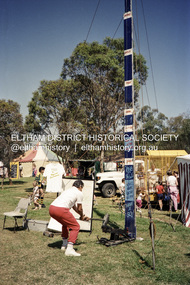
... Test your strength - Eltham Leisure Centre activity beside then Eltham Shire Council display at the 1987 Eltham Community Festival, 7 November 1987. The Shire of Eltham Engineering Department display promoted: Providing the resources to undertake • Survey, design, consultation • Road construction and maintenance • Bridge construction and maintenance • Street sweeping • Drain and pit cleaning • Traffic engineering installation and maintenance • Garbage collection • Tip management, land reclamation and beautification • Maintenance of community buildings • Provision of community and recreation facilities...Test your strength - Eltham Leisure Centre activity beside then Eltham Shire Council display at the 1987 Eltham Community Festival, 7 November 1987. The Shire of Eltham Engineering Department display promoted: Providing the resources to undertake • Survey, design, consultation • Road construction and maintenance • Bridge construction and maintenance • Street sweeping • Drain and pit cleaning • Traffic engineering installation and maintenance • Garbage collection • Tip management, land reclamation and beautification • Maintenance of community buildings • Provision of community and recreation facilities 1987 Display panel Eltham Festival Eltham Shire Council shire of eltham Eltham Leisure Centre Fuji 100 Roll of 35mm colour negative film, 7 strips Eltham Shire Council display at the 1987 Eltham Community Festival Photograph Shire of Eltham ...Test your strength - Eltham Leisure Centre activity beside then Eltham Shire Council display at the 1987 Eltham Community Festival, 7 November 1987. The Shire of Eltham Engineering Department display promoted: Providing the resources to undertake • Survey, design, consultation • Road construction and maintenance • Bridge construction and maintenance • Street sweeping • Drain and pit cleaning • Traffic engineering installation and maintenance • Garbage collection • Tip management, land reclamation and beautification • Maintenance of community buildings • Provision of community and recreation facilitiesRoll of 35mm colour negative film, 7 stripsFuji 1001987, display panel, eltham festival, eltham shire council, shire of eltham, eltham leisure centre -
 Bendigo Military Museum
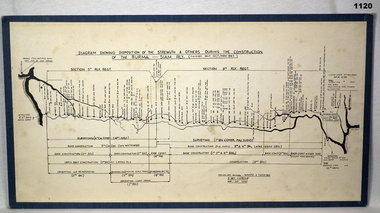
Map - DIAGRAM, MOUNTED
... Top centre: Diagram showing disposition of strength and others during construction of Burma - Siam Rly (Finished about Oct / Nov 1943)...Refer 2485 for his service history. documents - maps military history - pows Top centre: Diagram showing disposition of strength and others during construction of Burma - Siam Rly (Finished about Oct / Nov 1943) Diagram showing construction of Burma-Siam railway. ...Item donated by Alf Maskell POW. Refer 2485 for his service history.Diagram showing construction of Burma-Siam railway. White background with black writing & markings. Mounted on blue board.Top centre: Diagram showing disposition of strength and others during construction of Burma - Siam Rly (Finished about Oct / Nov 1943)documents - maps, military history - pows -
 Warrnambool and District Historical Society Inc.
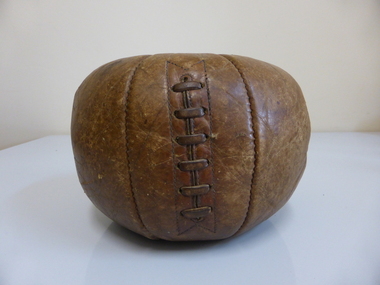
Functional object - Sporting goods, Medicine Ball
... strength. Their use is recorded as early as 1000BC when skins were sewn and stuffed with sand. They are still used to the present time and come in various sizes and weights. This example probably belongs to the turn of the 20th century. An item which was in common use by people interested in fitness. Items of similar design and construction ...Medicine balls are a weighted ball used to improve fitness and strength. Their use is recorded as early as 1000BC when skins were sewn and stuffed with sand. They are still used to the present time and come in various sizes and weights. This example probably belongs to the turn of the 20th century.An item which was in common use by people interested in fitness. Items of similar design and construction have been used by many different cultures and peoples.Brown leather with eight segments, laced on side. It has two small leather circles either end, each with two holes. medicine ball, physical culture, warrnambool -
 Australian Gliding Museum
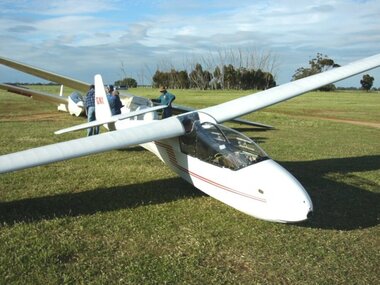
Machine - Glider – Sailplane, March 1964
... The swept-forward cantilever wing is of wood and fabric construction with a single spar and a plywood covered leading edge “D” box for strength. ...The swept-forward cantilever wing is of wood and fabric construction with a single spar and a plywood covered leading edge “D” box for strength. ...The Schleicher K7 is a high wing tandem two-seat sailplane designed in the late 1950s by Rudolf Kaiser for the Alexander Schleicher company in Germany. The fuselage is built using steel tube framing covered with fabric. The swept-forward cantilever wing is of wood and fabric construction with a single spar and a plywood covered leading edge “D” box for strength. The wing is equipped with Schempp-Hirth airbrakes. The K7 first flew in 1959. It is a versatile design that can be used for both basic and more advanced training of pilots. Over 500 were built. VH-GNX was manufactured in Germany and imported into Australia by Edmund Schneider Limited. It was test flown by them at Parafield Aerodrome, Adelaide, South Australia in March 1964. The original owner of VH-GNX was the Adelaide Soaring Club and it was maintained by Edmund Schneider Limited until May 1971. It appears that about this time it was transferred to the Gold Coast Soaring Club. In July 1974, after it had flown for an aggregate 3075 hours from 13919 flights, it was purchased by the Bundaberg Soaring Club. About 10 years later, it was acquired by the Bendigo Gliding Club. At that stage it had recorded over 4600 hours flying time from 21546 launches. When it was retired from service by the Bendigo Gliding Club in June 2006 due to age related defects the hours flown had reached 7259 from 31820 flights. It appears that the airframe has had a relatively trouble free life with only minor damage from storage / ground handling incidents, a heavy landing (January 1987) and a bird strike (January 2002). It was donated to the Museum in April 2007.This exhibit is an example of the Schleicher K7 two seat sailplane type.Two seat high wing glider sailplane finished in white with red detailing.Serial Number 7134, registered as VH-GNX. The registration appears on each side of the Fin / Rudder in red letteringaustralian gliding, glider, sailplane, schleicher, k7, schneider, adelaide soaring club, gold coast soaring club, bundaberg soaring club, bendigo gliding club -
 Robin Boyd Foundation
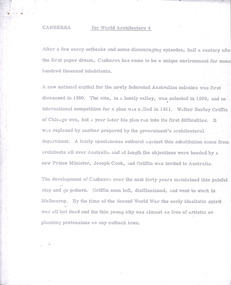
Document - Manuscript, Robin Boyd, Canberra, 1967
... Boyd outlines the history of Canberra's design and construction. He argues that Canberra's strength is its planning and axially-based landscaping, but that it lacks the buildings which make the Le Corbusier's Chandigarh interesting. ...Boyd outlines the history of Canberra's design and construction. He argues that Canberra's strength is its planning and axially-based landscaping, but that it lacks the buildings which make the Le Corbusier's Chandigarh interesting. ...Boyd outlines the history of Canberra's design and construction. He argues that Canberra's strength is its planning and axially-based landscaping, but that it lacks the buildings which make the Le Corbusier's Chandigarh interesting. Boyd is highly critical of Chandigarh as an urban environment and concludes that for non-architects, planning and connection to nature is more important than buildings.Original manuscript published as 'Canberra Master Plan: Walter Burley Griffin' in World Architecture 4, John Donat (ed.), Viking Press 1967, pp 202-205.Typewritten (p/copy), quarto, 6 pageswalter burley griffin, canberra, john overall, lake burley griffin, oscar niemeyer, le corbusier, chandigarh, city beautiful, garden city, urban planning, robin boyd, manuscript -
Moorabbin Air Museum
Book - Aircraft structures, Practical Aircraft Stress Analysis
... Aircraft construction Loads Fittings & joint strengths Overview of aircraft stress analysis circa1942 Practical Aircraft Stress Analysis Book Aircraft structures ...Overview of aircraft stress analysis circa1942non-fictionOverview of aircraft stress analysis circa1942loads, fittings & joint strengths -
Moorabbin Air Museum
Book - Aircraft design, Airplane Design
... strength of materials...Materials of airplane construction...Aircraft design Elements of applied mechanics & strength of materials Advanced methods in strength of materials Materials of airplane construction General design procedure The prediction of performance External loads on an aircraft Fundamental principles of methods of computation to be used in aircraft design, circa 1926 Airplane Design Book Aircraft design ...Fundamental principles of methods of computation to be used in aircraft design, circa 1926non-fictionFundamental principles of methods of computation to be used in aircraft design, circa 1926elements of applied mechanics & strength of materials, advanced methods in strength of materials, materials of airplane construction, general design procedure, the prediction of performance, external loads on an aircraft -
 Surrey Hills Historical Society Collection
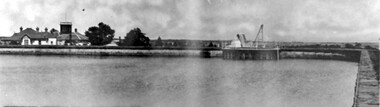
Photograph, Surrey Hills Reservoir No 1
... The excavated material was banked against the sides and pine trees were planted in it to add strength to the embankment. They were paid £2,000 for their work. Construction of Surrey Hills Number 2 Reservoir was completed in 1913 and the accompanying tower was built in 1929. ...The excavated material was banked against the sides and pine trees were planted in it to add strength to the embankment. They were paid £2,000 for their work. Construction of Surrey Hills Number 2 Reservoir was completed in 1913 and the accompanying tower was built in 1929. ...Copied by Ken Hall from an early postcard. This is Surrey Hills Reservoir No 1 on the corner of Tower Street built in c1892 at a cost of £12,000 to supply higher sections of the area. The builders were Jack and Bob Laudehr, partners in a wood yard in St. Kilda (Vic). They began by delivering firewood but extended to contract work involving timber. Another of their projects was to lay cable tram tracks commencing in Acland Street St. Kilda and running along The Esplanade. The reservoir in Canterbury Road was a large concrete structure built before the introduction of reinforcements. The excavated material was banked against the sides and pine trees were planted in it to add strength to the embankment. They were paid £2,000 for their work. Construction of Surrey Hills Number 2 Reservoir was completed in 1913 and the accompanying tower was built in 1929. It is assumed that the Miss Hill as the source of the donation (via Bill Dempsey) was Ivy Annie Hill (1902-1984). She was the only female child of William Valentine Dempsey to not marry. Bill Dempsey's mother was Laura Constance 'Birdie' Hill (1900-1968) who married Albert Dempsey.A sepia photograph within a post card of a reservoir on Canterbury Road, Surrey Hills. In the background to the left you can see the top halves of two houses and the tops of some trees. The photo takes up only the central section of the postcard.Below the photo on the front of the postcard on blue biro "Reservor [sic] Canterbury Rd / Surrey Hills." On the rear in grey lead pencil in Jocelyn Hall's handwriting: "Donor W Dempsey ------------- Keep / (nephew) / [arrow pointing down] / From Miss Hill / 10 Pembroke St SH / This house can be / seen in front of / No 12 which has / tower"1890, water supply, mmbw, edward d dyer (mr), 10 pembroke street, 12 pembroke street, surrey hills, ivy annie hill (miss), william valentine hill (mr), canterbury road, tower street, water supply structures and establishments, dams and reservoirs, jack laudehr (mr), bob laudehr (mr) -
 Melbourne Legacy
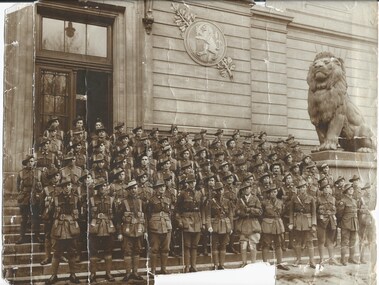
Photograph - Photo, 2nd Pioneer Battalion, 1919
... construction and engineering experience in addition to basic soldiering skills. After the Armistice personnel were repatriated to Australia in drafts as part of the gradual demobilisation of the AIF, the battalion's strength dwindled until finally it was disbanded on 18 May 1919 while in the Charleroi area of Belgium. ...construction and engineering experience in addition to basic soldiering skills. After the Armistice personnel were repatriated to Australia in drafts as part of the gradual demobilisation of the AIF, the battalion's strength dwindled until finally it was disbanded on 18 May 1919 while in the Charleroi area of Belgium. ...A large photo of soldiers from the first World War. It is almost identical to one in the AWM. From the AWM record it is the 2nd Pioneer Battalion before they returned to Australia. From Wikipedia the 2nd Pioneer Battalion was tasked with digging trenches, labouring, constructing strong points and light railways, and undertaking battlefield clearance, the troops assigned to the pioneers required construction and engineering experience in addition to basic soldiering skills. After the Armistice personnel were repatriated to Australia in drafts as part of the gradual demobilisation of the AIF, the battalion's strength dwindled until finally it was disbanded on 18 May 1919 while in the Charleroi area of Belgium. The men are standing on the steps of the Palais de Justice in Charleroi. The lion is one of a pair made by Antoine-Felix Boure a Belgium sculptor, who was renowned for his portrayal of lions. This pair is called Totor et Tutur. The Palais de Justice was replaced by a new building in the 1960s and the lions now stand in the garden of the Palais de Justice. The soldiers wear different uniforms depending on their rank. This photo is a good example of some of them. Legatee Philip E Potts who was president in 1927-28, was a Captain in the 2nd Pioneer Battalion and is likely to be in this photo. Or the photo belonged to him. Another photo of L/ Potts is labelled Charleroi 1919 and mentions a 2nd Division Concert Party and his war record at NAA says he was assigned to the Concert Party at that time.Legacy was founded by returned soldiers from World War 1, hence some founding legatees may be in this photo.Sepia photo of the 2nd Pioneer Battalion on the steps of a building.soldiers, world war one, lion, charleroi, 2nd pioneer battalion, uniforms, philip e potts -
Moorabbin Air Museum
Book - Advisory Committee for Aeronautics technical reports, Technical Report of the Advisory Committee for Aeronautics for the Year 1913 - 1914
... ...Strength of construction...Advisory Committee for Aeronautics technical reports Committee report for 1913-1914 Wind channels Experiments on airship models Tests on aircraft bodies Stability Propellers Strength of construction Hydro-aircraft Fabrics Meteoroloy Collection of aeronautical studies for 1913 - 1914 Technical Report of the Advisory Committee for Aeronautics for the Year 1913 - 1914 Book Advisory Committee for Aeronautics technical reports ...Collection of aeronautical studies for 1913 - 1914non-fictionCollection of aeronautical studies for 1913 - 1914committee report for 1913-1914, wind channels, experiments on airship models, tests on aircraft bodies, stability, propellers, strength of construction, hydro-aircraft, fabrics, meteoroloy
