
Showing 93 items matching "cooking stoves"
-
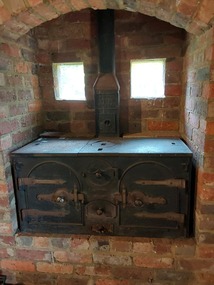 Mont De Lancey
Domestic object - Kitchen Stove, C. Andrews, c1900's
... ...Cooking stoves...The cast iron combustion stove is significant as part of the evolution of domestic cooking. Cast iron stoves burn solid fuel such as wood or coal, and are used for cooking and warmth. ...The cast iron combustion stove is significant as part of the evolution of domestic cooking. Cast iron stoves burn solid fuel such as wood or coal, and are used for cooking and warmth. ...The cast iron combustion stove is significant as part of the evolution of domestic cooking. Previously, cooking was mostly carried out in the outdoors on open fires, and later in fireplaces indoors. The cast iron combustion stove is significant as part of the evolution of domestic cooking. Cast iron stoves burn solid fuel such as wood or coal, and are used for cooking and warmth. The stoves have a firebox with a grate where the fuel is burned. The hot air flows through flues and baffles that heat the stove top and the oven. By the 1920s gas cookers were being introduced for domestic use, and by the 1930s electric home cookers were being offered to householders. A vintage cast iron kitchen stove set in the back wall of the Mont De Lancey Slab Kitchen. It has two steel decorative hinged doors with a handle to open and close. There is one pull out metal shelf in each compartment. Between the two doors is a round door which opens to reveal the wood box with a slatted base. This allows the ash and small coals from the fire to fall though to a pull-out tray below to be emptied outside when cooled. There is another lift-out kid to clean the ash and coals underneath.On the chimney plate 'Andrews, Patent Non Pariel' On the front of the stove below the round wood box 'C Andrews Geelong'cooking equipment, cooking stoves, fuel cooking stoves, domestic ovens -
 Hand Tool Preservation Association of Australia Inc
Pamphlet
... Pamphlet, perfection oil cooking stove...Pamphlet, perfection oil cooking stove Pamphlet ...This item is part of the Thomas Caine Tool Collection, owned by The National Trust of Australia (Victoria) and curated by the Hand Tools Preservation Association of Australia.Pamphlet, perfection oil cooking stove -
Hand Tool Preservation Association of Australia Inc
Pamphlet
... Pamphlet, lorain veritas cooking stove...Pamphlet, lorain veritas cooking stove Pamphlet ...This item is part of the Thomas Caine Tool Collection, owned by The National Trust of Australia (Victoria) and curated by the Hand Tools Preservation Association of Australia.Pamphlet, lorain veritas cooking stove -
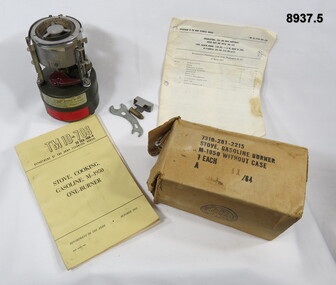 Bendigo Military Museum
Equipment - PETROL STOVE, Department of Army, 1950
... Stove...Cooking...The one-burner M1950 gasoline cooking stove is a cooking and heating unit. The stove is small and light and operates on gasoline. 2. ...“Stove, Cooking Gasoline M-1950 - ne-Burner - Department of Army”...The one-burner M1950 gasoline cooking stove is a cooking and heating unit. The stove is small and light and operates on gasoline. 2. ...1. The one-burner M1950 gasoline cooking stove is a cooking and heating unit. The stove is small and light and operates on gasoline. 2. Maitenance spanner and spare gas jet. 3. TM10-708 Department of Army Technical Manual 1951. 4. TM10-708 Repair parts and tool lists. 5. Packaging (cardboard box) Stove Gasoline burner. “Stove, Cooking Gasoline M-1950 - ne-Burner - Department of Army”passchendaele barracks trust, pbt263, equipment, stove, cooking -
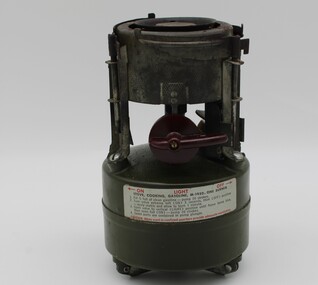 National Vietnam Veterans Museum (NVVM)
Equipment - Stove, camp
... M-1950, one burner gasoline cooking stove. ...M-1950, one burner gasoline cooking stove. Equipment Stove, camp ...Standard issue item as used by Australian servicemen during the conflict in Vietnam. M-1950, one burner gasoline cooking stove. Refer to media image. -
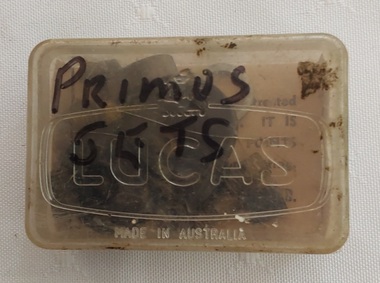 Mont De Lancey
Domestic object - Primus Jet Parts, Primus Trading Company, c. 1950's
... ...Cooking stoves...Camping equipment Recreational equipment Cooking stoves Cooking equipment Kerosene cooking stoves The plastic box lid has a "King of the Road" lion emblem at the top and 'Made in Australia' stamped at the bottom. ...The original Primus stove was designed to be "soot-free" by vaporizing kerosene before ignition, a process requiring a precisely drilled, small-aperture jet nipple. Early jet parts were made of brass, designed for longevity and maintenance by the user. In 1962 Optimus bought the Primus brand name for liquid fueled stoves. Together with the brand name they also got spare parts and partly finished stoves. Bahco retained the Primus brand name for liquid gas products.A small lidded plastic container with Primus Jet parts, 9 washers, 11 jet nipples, 2 tiny open cylinders and 1 tiny screw. The lidded plastic box has a cardboard insert with details about an automotive Joseph Lucas Contact Set of points which are not contained in this box. The plastic box lid has a "King of the Road" lion emblem at the top and 'Made in Australia' stamped at the bottom. Handwritten on the lid and base of the box in black texta is 'Primus Jets'. The cardboard in the bottom of the plastic box says 'This Contact Set is treated with a preservative. IT IS ESSENTIAL that the POINTS are wiped clean before fitting. JOSEPH LUCAS (AUST.) PTY. LTD.'camping equipment, recreational equipment, cooking stoves, cooking equipment, kerosene cooking stoves -
 Mont De Lancey
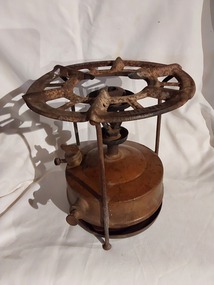
Functional object - Primus stove, Companion Brand, mid 1900's
... ...Cooking stoves...Decades later, in 2008, Companion was acquired by Primus Australia. Stoves Cooking equipment Cooking stoves Kerosene cooking stoves 'Companion Brand' A vintage brass Primus Stove with operating knobs on both sides to turn the gas into vapour. ...The Primus stove was the first pressurized-burner kerosene (paraffin) stove, developed in 1892 by Frans Wilhelm Lindqvist, a factory mechanic in Stockholm. The efficient Primus stove quickly earned a reputation as a reliable and durable stove in everyday use, and it performed especially well under adverse conditions. The Companion brand originated in Australia during World War II (1941) when wartime shipping shortages cut off imports of Swedish Sievert/Svea kerosene stoves and blowlamps. Decades later, in 2008, Companion was acquired by Primus Australia.A vintage brass Primus Stove with operating knobs on both sides to turn the gas into vapour. The bottom fuel tank has a pump on the side, above which is a "rising tube" and the burner assembly. A steel top ring on which to set a pot is held above the burner by three support legs. Underneath the stove is a drip tray. 'Companion Brand' stoves, cooking equipment, cooking stoves, kerosene cooking stoves -
 Mont De Lancey
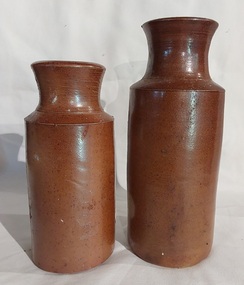
Container - Pottery Bottles, Unknown
... ...Cooking stoves...This was a source of pride amongst house-proud women, and also ensured a more efficient distribution of heat on their stove-tops for cooking. It was however one of the dirtiest jobs in the kitchen, requiring a lot of elbow-grease as well as a good polish paste or blacking ink....Blacking bottles Bottles Cooking equipment Cooking stoves Fuel cooking stoves Domestic ovens Two brown pottery blacking bottles, one with a light brown glaze and other is dark brown. ...One of the jobs of the housewife was to keep her stove-top looking clean and new, and a rich black colour. This was a source of pride amongst house-proud women, and also ensured a more efficient distribution of heat on their stove-tops for cooking. It was however one of the dirtiest jobs in the kitchen, requiring a lot of elbow-grease as well as a good polish paste or blacking ink.Two brown pottery blacking bottles, one with a light brown glaze and other is dark brown. Both have shaped wide necks with a lip at the edge for pouring. The contents were used to blacken a stove. blacking bottles, bottles, cooking equipment, cooking stoves, fuel cooking stoves, domestic ovens -
 Mont De Lancey
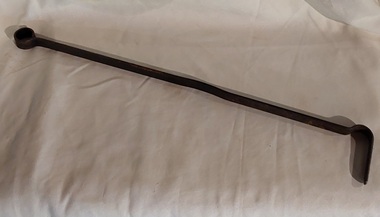
Domestic object - Fire Poker, Unknown
... ...Fuel cooking stoves...This iron poker is a piece of equipment essential for use in open fireplaces or in wood stoves which was used for 19th and early 20th century domestic heating or cooking....Fireplace accessories Fireplaces Fire Irons Pokers Fuel cooking stoves A long steel vintage fire poker with a small finger loop at the end of the handle and a bent hook shape at the end. ...This iron poker is a piece of equipment essential for use in open fireplaces or in wood stoves which was used for 19th and early 20th century domestic heating or cooking.A long steel vintage fire poker with a small finger loop at the end of the handle and a bent hook shape at the end. It was used to move wood and logs in an open fire.fireplace accessories, fireplaces, fire irons, pokers, fuel cooking stoves -
 Mont De Lancey
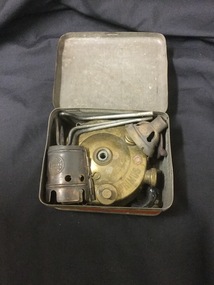
Functional object - Primus Stove - Parts, c1935
... ...cooking stoves...It was Pre-heated by methylated Sprits, with three legs and a pump. stoves cooking stoves Primus stove - complete in tin with picture of oven on lid. ...The Primus stove, the first pressurized-burner kerosene (paraffin) stove, was developed in 1892 by Frans Wilhelm Lindqvist, a factory mechanic in Stockholm. The stove was based on the design of the hand-held blowtorch. It was Pre-heated by methylated Sprits, with three legs and a pump.Primus stove - complete in tin with picture of oven on lid.stoves, cooking stoves -
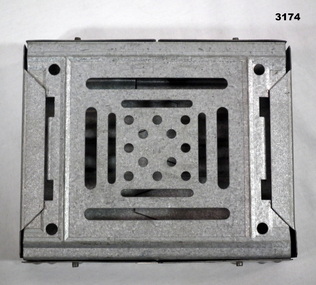 Bendigo Military Museum
Equipment - HEXAMINE STOVE, Possibly post Korea
... cooking...Hexamine...stoves...military equipment - army domestic items - cooking Hexamine stoves Galvanised metal folding stove with numerous ventilation holes. ...Galvanised metal folding stove with numerous ventilation holes. One side folds outwards 90 degrees to form the stove. Hexamine tablets used to fuel.military equipment - army, domestic items - cooking, hexamine, stoves -
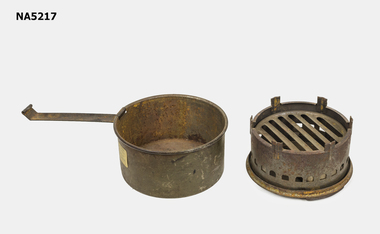 Whitehorse Historical Society Inc.
Functional object - Field cooker stove
... German World War One soldiers' cooking stove. From the Charles Honybun Collection...German World War One soldiers' cooking stove. From the Charles Honybun Collection WW1 Charles Henry Honybun German Metal saucepan with matching heating container. ...German World War One soldiers' cooking stove. From the Charles Honybun CollectionMetal saucepan with matching heating container.ww1, charles henry honybun, german -
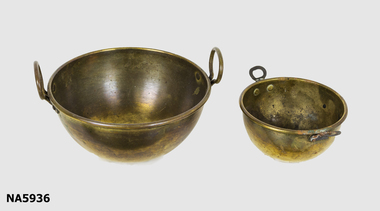 Whitehorse Historical Society Inc.
Leisure object - Copper bowl pans X 2, 'Kinder Kochherde" German Toy, C 1909
... - Child's toy component if cooking stove - Manufactured c - 1909 (See stove info NA5931)...- Child's toy component if cooking stove - Manufactured c - 1909 (See stove info NA5931) Child's toy Kitchen Stove Stove component Nil 2 copper bowls with handles Leisure object Copper bowl pans X 2 'Kinder Kochherde" German Toy ...- Child's toy component if cooking stove - Manufactured c - 1909 (See stove info NA5931)2 copper bowls with handlesNilchild's toy, kitchen stove, stove component -
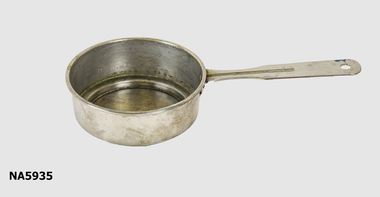 Whitehorse Historical Society Inc.
Leisure object - Saucepan, "Kinder - Kochherde" German Toy, 1909
... - Child's toy component of cooking stove - Manufactured circa 1909 (See info on Kitchen Stove NA5931)...- Child's toy component of cooking stove - Manufactured circa 1909 (See info on Kitchen Stove NA5931) Child's toy Kitchen stove Flat saucepan with interchangeable lid with stockpot lid Leisure object Saucepan "Kinder - Kochherde" German Toy ...- Child's toy component of cooking stove - Manufactured circa 1909 (See info on Kitchen Stove NA5931)Flat saucepan with interchangeable lid with stockpot lidchild's toy, kitchen stove -
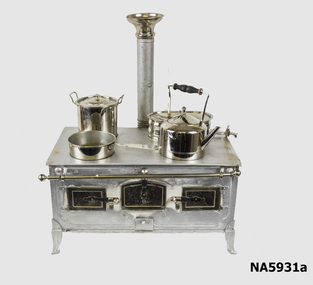 Whitehorse Historical Society Inc.
Leisure object - Child's stove, "Kinder - Kochherde" German Toy, 1909
... Child's toy cooking stove Manufactured circa 1909 by Maerklin/Gerbruder Maerklin. ...Child's toy cooking stove Manufactured circa 1909 by Maerklin/Gerbruder Maerklin. ...Child's toy cooking stove Manufactured circa 1909 by Maerklin/Gerbruder Maerklin. Original toy belonged to Pauline Bacher Used by Marion Ralph. Brought to Australia in 1977Pressed steel. 4 burners stove. 4 burner holes- fueled from inside. Central oven fueled from below Stands on 4 metal feet Front rail for holding towels/cloths Chimney inserted from back.Trademark on the basechild's toy - kitchen stove, kitchen stove -
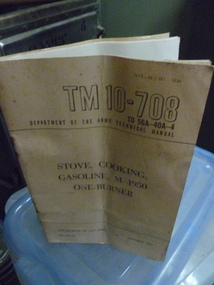 National Vietnam Veterans Museum (NVVM)
Pamphlet, Stove, Cooking, Gasoline, M-1950 One Burner, 1/10/1951 12:00:00 AM
... Stove, Cooking, Gasoline, M-1950 One Burner...Stove, Cooking, Gasoline, M-1950. One Burner. Dept Of the Army 1951/ TM 10-708...Stove Phamphlet Stove, Cooking, Gasoline, M-1950. One Burner. Dept Of the Army 1951/ TM 10-708 Small buff coloured instruction manual for operation of M-1950 Stove Stove, Cooking, Gasoline, M-1950 One Burner Pamphlet Pamphlet Department Of supply ...Small buff coloured instruction manual for operation of M-1950 StoveStove, Cooking, Gasoline, M-1950. One Burner. Dept Of the Army 1951/ TM 10-708stove, phamphlet -
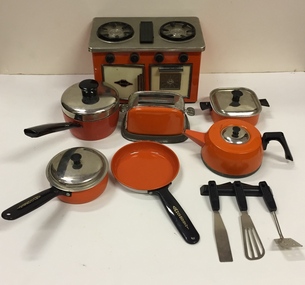 Kew Historical Society Inc
Leisure object - Toys, Miniature Kitchen Equipment, 1970s
... Miniature kitchen stove, cooking utensils and implements. Made of metal and enamel. ...The examples of toys in the collection include examples of alphabet toys, arcade toys, baby toys, construction toys, dolls, doll accessories, educational toys, soft toys, tin toys, toy animals, toy blocks, toy machines, toy typewriters, etc. miniature toys toy kitchen equipment functional toys Miniature kitchen stove, cooking utensils and implements. Made of metal and enamel. ...The Kew Historical Society’s collection includes a wide range of leisure objects. Many of the items are European-made, generally of British origin, however there are a number that were made for the Australian market by Australian manufacturers. There were clearly a huge range of toys produced for the Australian and International children’s market in the Nineteenth and Twentieth centuries. The examples of toys in the collection include examples of alphabet toys, arcade toys, baby toys, construction toys, dolls, doll accessories, educational toys, soft toys, tin toys, toy animals, toy blocks, toy machines, toy typewriters, etc. Miniature kitchen stove, cooking utensils and implements. Made of metal and enamel. Orange and black. Eight pieces.miniature toys, toy kitchen equipment, functional toys -
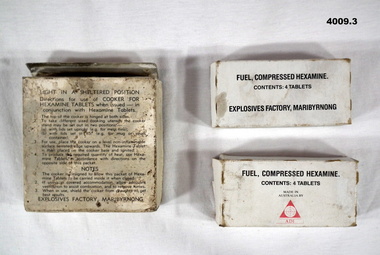 Bendigo Military Museum
Equipment - HEXAMINE TABLETS, Explosives Factory
... .1) Large size packet of fuel compressed heat tablets (4 only in box) for use in Hexamine stove for cooking. Each tablet has an effective burning time of 15 minutes. .2) Small packet of 4 Hexamine heat tablets .3) Small packet of (3 only) Hexamine heat tablets...Large size packet of full compressed heat tablets (4 only in box) for use in hexamine stove for cooking. Each tablet has an effective burning time of 15 minutes. 2, Small packet of 4 hexamine heat tablets. 3. ....1) Large size packet of fuel compressed heat tablets (4 only in box) for use in Hexamine stove for cooking. Each tablet has an effective burning time of 15 minutes. .2) Small packet of 4 Hexamine heat tablets .3) Small packet of (3 only) Hexamine heat tablets Cooking Hexamine tablets 1. ....1) Large size packet of fuel compressed heat tablets (4 only in box) for use in Hexamine stove for cooking. Each tablet has an effective burning time of 15 minutes. .2) Small packet of 4 Hexamine heat tablets .3) Small packet of (3 only) Hexamine heat tablets1. Large size packet of full compressed heat tablets (4 only in box) for use in hexamine stove for cooking. Each tablet has an effective burning time of 15 minutes. 2, Small packet of 4 hexamine heat tablets. 3. Small packet of 3 hexamine heat tablets.cooking, hexamine tablets -
Tatura Irrigation & Wartime Camps Museum
Photograph, 1942
... Colour photograph of dolls house furniture consisting of bath, wardrobe, stove with cooking utensils are main pieces. ...Handcrafts of Camp 3 internees camp 3 templer society Colour photograph of dolls house furniture consisting of bath, wardrobe, stove with cooking utensils are main pieces. Photograph ...Handcrafts of Camp 3 interneesColour photograph of dolls house furniture consisting of bath, wardrobe, stove with cooking utensils are main pieces. camp 3, templer society -
 Bendigo Military Museum
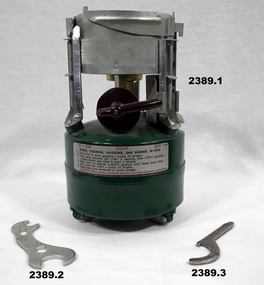
Equipment - PETROL STOVE, Rogers Tool and Die Co Inc, 1951
... .1) Stove, cooking Gasoline, one burner, Model M-1950. .2) Spanner for above stove. .3) Tool for above stove. .4) Cardboard carton for above stove....domestic items-cooking military equipment - army .1) Stove, cooking Gasoline, one burner, Model M-1950. .2) Spanner for above stove. .3) Tool for above stove. .4) Cardboard carton for above stove. ....1) Stove, cooking Gasoline, one burner, Model M-1950. .2) Spanner for above stove. .3) Tool for above stove. .4) Cardboard carton for above stove.domestic items-cooking, military equipment - army -
 Mont De Lancey
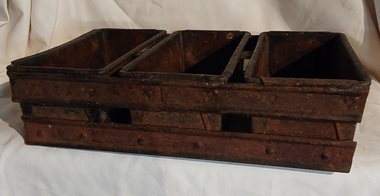
Domestic object - Bread Tins, Unknown
... During the 19th century people used open flames for cooking or stoves. Stoves were gaining popularity in the 1800s, but they were not electric or gas like ours are now. ...During the 19th century people used open flames for cooking or stoves. Stoves were gaining popularity in the 1800s, but they were not electric or gas like ours are now. ...This is an antique, bread baking tray. During the 19th century people used open flames for cooking or stoves. Stoves were gaining popularity in the 1800s, but they were not electric or gas like ours are now. Instead, they had either a wood fire or a coal fire inside. The stove allowed the heat to more uniformly cook and bake food than an open flame.This is an antique, bread baking tray. There are three tins joined by rivets to a heavy metal frame, so they cannot be separated. It shows considerable surface rust, but no holes and it can be used. It is very heavy, weighing close to 3 kgs. bread tins, baking tins, containers for baking bread -
 City of Moorabbin Historical Society (Operating the Box Cottage Museum)
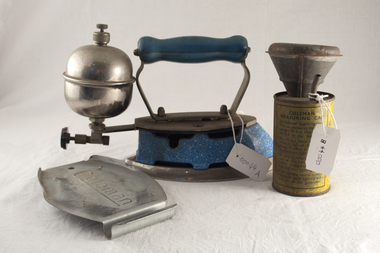
Domestic object - Kitchen equipment, spirit-fuelled sad iron, c1920
... The company also produced a range of cooking stoves and domestic irons. This spirit- fuelled flat iron was very popular in 1920s - 30s ...The company also produced a range of cooking stoves and domestic irons. This spirit- fuelled flat iron was very popular in 1920s - 30s These sad irons remind us of the difficult circumstances experienced in their daily routines by the pioneers and early settlers of Moorabbin Shire The family of Miss M Curtis were early settlers in Moorabbin Shire sad iron kitchen equipment coleman william kansas oklahoma pioneers early settlers market gardeners sewing craftwork clothing moorabbin brighton bentleigh fireplaces stoves petrol fuelled irons spirit flat irons coleman lamp stove co. ltd. ...Sad-irons or "solid" irons were made by blacksmiths and used to smooth out material by pressing the hot iron over it. A piece of sheet -iron was placed over the kitchen fire and the irons placed on it could be heated whilst remaining clean of ash.. The women used 2 irons - one heating while the other was used. Thick cloth or gloves protected their hands from the hot irons. The handle was removed from the cool iron and re- attached to remove the hot iron from the fire. The cool iron was replaced on the fire or stove to heat again. These irons were cleaned with steel wool to prevent them marking the material. If the iron was too hot the material would scorch. Most homes set aside one day for ironing and some large households had an ironing room with a special stove designed to heat irons. However, most women had to work with a heavy, hot iron close to the fireplace even in summer. Late in the 19thC designers experimented with heat retaining fillings for these irons. William Coleman began selling Kerosene lanterns in 1900 in Kingfisher, Oklahoma, USA. He moved to Wichita, Kansas in 1902 and the company became world wide. The company also produced a range of cooking stoves and domestic irons. This spirit- fuelled flat iron was very popular in 1920s - 30s These sad irons remind us of the difficult circumstances experienced in their daily routines by the pioneers and early settlers of Moorabbin Shire The family of Miss M Curtis were early settlers in Moorabbin ShireA) spirit- fuelled, sad iron with chrome plated sole c1920, and metal trivet The iron is blue enamel with a white speckled body, with a hemispherical tank for the Coleman 'Lighting Petrol' that provided the heat for smoothing the material B) Coleman Fuel measuring can and funnellMetal Trivet/stand " COLEMAN" ; Petrol can " COLEMAN" / MEASURING CAN / for INSTANT LIGHTING IRON/ with printed instructionssad iron, kitchen equipment, coleman william, kansas, oklahoma, pioneers, early settlers, market gardeners, sewing, craftwork, clothing, moorabbin, brighton, bentleigh, fireplaces, stoves, petrol fuelled irons, spirit flat irons, coleman lamp stove co. ltd. -
 Broadmeadows Historical Society & Museum
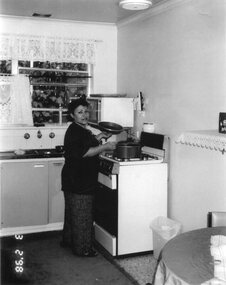
Photograph, Gulcan Cooks Up a Treat, 3 February 1998
... Titled "Gulcan Cooks Up a Treat Public Housing" / "Broadmeadows 1998," the photograph features a woman standing at a stove, cooking in a house within the Banksia Gardens estate. ...Titled "Gulcan Cooks Up a Treat Public Housing" / "Broadmeadows 1998," the photograph features a woman standing at a stove, cooking in a house within the Banksia Gardens estate. ...This item is part of a series of images regarding social housing in Broadmeadows. Titled "Gulcan Cooks Up a Treat Public Housing" / "Broadmeadows 1998," the photograph features a woman standing at a stove, cooking in a house within the Banksia Gardens estate. This image captures a moment of daily life and highlights the personal and communal aspects of living in public housing. It provides a glimpse into the domestic environment and the social fabric of the community during that period, emphasizing the importance of home and family within the context of social housing.The photograph titled "Gulcan Cooks Up a Treat Public Housing" / "Broadmeadows 1998" holds significant historical and cultural value. It features a woman, Gulcan, standing at a stove and cooking in a house within the Banksia Gardens estate. This image is part of a series documenting social housing in Broadmeadows and provides a poignant glimpse into the everyday lives of residents. It highlights the personal and communal aspects of living in public housing, emphasising the importance of home, family, and community. The photograph captures the essence of domestic life and the social fabric of the community during that period, offering valuable insights into the lived experiences of those in social housing.A black and white photograph on glossy photographic paper of a woman in a kitchen."Gulcan Cooks Up a Treat Public Housing"/"Broadmeadows 1998"broadmeadows, social housing, cooking, banksia gardens, 1998 -
 Kiewa Valley Historical Society
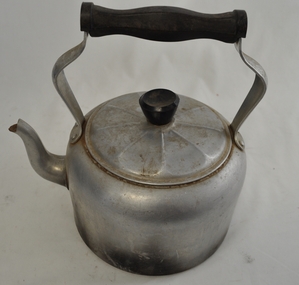
Kettle Aluminium, mid to late 1900's
... This 99% aluminium hot plate kettle with lid (bakelite handle) is Australian made for flat stoves (cooking or room heating). It has a "tea style" spout and a bakelite hand grip(knob) on the top of the lid. ...The C.W.A. motto "Honour our God, Loyalty to the throne, Service to the country, Through country women, For country women, By country women." cwa homeware aluminium kitchen utensils made in australia cook ware On both sides of the aluminium handle "HOT PLATE WARE" and covering an oblique shaped triangle "99% PURE ALUMINIUM" and below that "MADE IN AUSTRALIA".Within the triangle "DURALIFE" This 99% aluminium hot plate kettle with lid (bakelite handle) is Australian made for flat stoves (cooking or room heating). It has a "tea style" spout and a bakelite hand grip(knob) on the top of the lid. ...This aluminium kettle was manufactured between 1940 to 1960's and replaced the heavier caste iron "open fire" stove ones (in doors or in the bush). A cast iron flat base between the open fires and the kettle was required. This kettle was used extensively with indoor open fire places. It was part of the evolution in "tea" making kettles. These were the only method of making hot beverages before introduction of electric kettles. For the Kiewa Valley the connection to the major electricity grid was post 1950's.This kettle is significant demonstrating the type of kitchen utensils required before electrical home connections became a reality. The aluminium structure of the kettle was an advancement over the heavier caste iron kettles. This type of kettle is still in use for bush and mountain hikers/climbers due to the light weight. This kettle was used by the Tawonga C.W.A. Branch. The C.W.A. motto "Honour our God, Loyalty to the throne, Service to the country, Through country women, For country women, By country women."This 99% aluminium hot plate kettle with lid (bakelite handle) is Australian made for flat stoves (cooking or room heating). It has a "tea style" spout and a bakelite hand grip(knob) on the top of the lid. The lid has nine ridges (for strength) radiating from the central hand grip. The two handle prongs are bop riveted onto the the body of the kettle. The bakelite hand grip has been fashioned to fit the natural contours of a clutching hand.On both sides of the aluminium handle "HOT PLATE WARE" and covering an oblique shaped triangle "99% PURE ALUMINIUM" and below that "MADE IN AUSTRALIA".Within the triangle "DURALIFE"cwa, homeware aluminium kitchen utensils, made in australia cook ware -
 St Kilda Historical Society
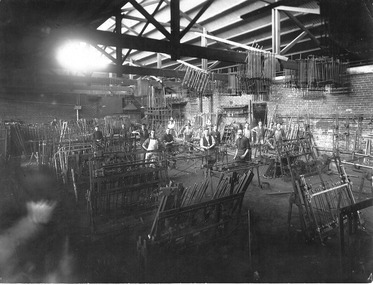
Photograph - Industrial, Galliers & Klaerr Iron and Brass Foundry
... Galliers & Klaerr was an iron foundry and plumbing business in St Kilda, known for producing gas, cooking, and heating stoves from 1883. Located on Inkerman Street, the firm was a major industrial employer in the area, specializing in cast iron stoves and appliances until the company was sold in the 1960s. ...Galliers & Klaerr was an iron foundry and plumbing business in St Kilda, known for producing gas, cooking, and heating stoves from 1883. Located on Inkerman Street, the firm was a major industrial employer in the area, specializing in cast iron stoves and appliances until the company was sold in the 1960s. ...Galliers & Klaerr was an iron foundry and plumbing business in St Kilda, known for producing gas, cooking, and heating stoves from 1883. Located on Inkerman Street, the firm was a major industrial employer in the area, specializing in cast iron stoves and appliances until the company was sold in the 1960s. Henry Albert Galliers (1845-1907), born in England and a plumber and gasfitter by trade, moved to Australia in 1872 and set up business in rented premises in High Street, and later Inkerman Street. In 1882-1883 he established Galliers & Klaerr with Frederick Klaerr (1856 - 1934) also a plumber. Galliers returned to England in 1980 and the partnership was dissolved, with Klaerr undertaking to continue the business on his own account and to continue to use the business name Galliers & Klaerr. After the company was sold in 1960 the site became the St Kilda 10-pin Bowl, then a data processing centre, and then a Commonwealth Employment Service. These days it is the Aldi Supermarket.black and white photographst kilda businesses, galliers & klaerr -
 St Kilda Historical Society
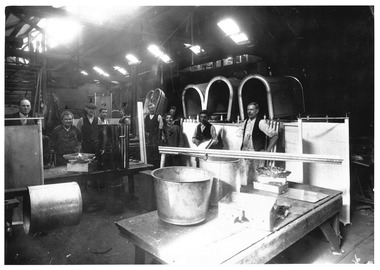
Photograph - Industrial, Barge, Galliers & Klaerr Iron and Brass Foundry, c.1925
... Galliers & Klaerr was an iron foundry and plumbing business in St Kilda, known for producing gas, cooking, and heating stoves from 1883. Located on Inkerman Street, the firm was a major industrial employer in the area, specializing in cast iron stoves and appliances until the company was sold in the 1960s. ...Galliers & Klaerr was an iron foundry and plumbing business in St Kilda, known for producing gas, cooking, and heating stoves from 1883. Located on Inkerman Street, the firm was a major industrial employer in the area, specializing in cast iron stoves and appliances until the company was sold in the 1960s. ...Interior view of tinsmiths shop. Galliers & Klaerr was an iron foundry and plumbing business in St Kilda, known for producing gas, cooking, and heating stoves from 1883. Located on Inkerman Street, the firm was a major industrial employer in the area, specializing in cast iron stoves and appliances until the company was sold in the 1960s. Henry Albert Galliers (1845-1907), born in England and a plumber and gasfitter by trade, moved to Australia in 1872 and set up business in rented premises in High Street, and later Inkerman Street. In 1882-1883 he established Galliers & Klaerr with Frederick Klaerr (1856 - 1934), also a plumber. Galliers returned to England in 1980 and the partnership was dissolved, with Klaerr undertaking to continue the business on his own account and to continue to use the business name Galliers & Klaerr. After the company was sold in 1960 the site became the St Kilda 10-pin Bowl, then a data processing centre, and then a Commonwealth Employment Service. These days it is the Aldi Supermarket.black and white photograph original good conditionTin Smiths Shop Circa 1925,Galiers and Klaergalliers & klaerr, st kilda businesses -
 St Kilda Historical Society
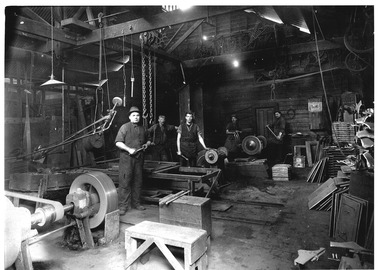
Photograph - Industrial, Barge, Galliers & Klaerr Iron and Brass Foundry, 1925
... Galliers & Klaerr was an iron foundry and plumbing business in St Kilda, known for producing gas, cooking, and heating stoves from 1883. Located on Inkerman Street, the firm was a major industrial employer in the area, specializing in cast iron stoves and appliances until the company was sold in the 1960s. ...Galliers & Klaerr was an iron foundry and plumbing business in St Kilda, known for producing gas, cooking, and heating stoves from 1883. Located on Inkerman Street, the firm was a major industrial employer in the area, specializing in cast iron stoves and appliances until the company was sold in the 1960s. ...Interior view of grinding shop. Galliers & Klaerr was an iron foundry and plumbing business in St Kilda, known for producing gas, cooking, and heating stoves from 1883. Located on Inkerman Street, the firm was a major industrial employer in the area, specializing in cast iron stoves and appliances until the company was sold in the 1960s. Henry Albert Galliers (1845-1907), born in England and a plumber and gasfitter by trade, moved to Australia in 1872 and set up business in rented premises in High Street, and later Inkerman Street. In 1882-1883 he established Galliers & Klaerr with Frederick Klaerr (1856 - 1934), also a plumber. Galliers returned to England in 1980 and the partnership was dissolved, with Klaerr undertaking to continue the business on his own account and to continue to use the business name Galliers & Klaerr. After the company was sold in 1960 the site became the St Kilda 10-pin Bowl, then a data processing centre, and then a Commonwealth Employment Service. These days it is the Aldi Supermarket.black and white photographgalliers & klaerr, st kilda businesses -
 St Kilda Historical Society
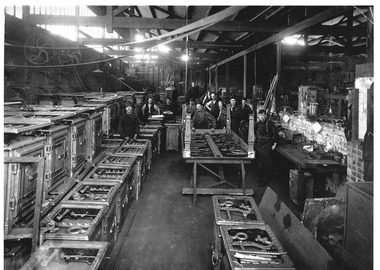
Photograph - Industrial, Barge, Galliers & Klaerr Iron and Brass Foundry, 1925
... Galliers & Klaerr was an iron foundry and plumbing business in St Kilda, known for producing gas, cooking, and heating stoves from 1883. Located on Inkerman Street, the firm was a major industrial employer in the area, specializing in cast iron stoves and appliances until the company was sold in the 1960s. ...Galliers & Klaerr was an iron foundry and plumbing business in St Kilda, known for producing gas, cooking, and heating stoves from 1883. Located on Inkerman Street, the firm was a major industrial employer in the area, specializing in cast iron stoves and appliances until the company was sold in the 1960s. ...Galliers & Klaerr was an iron foundry and plumbing business in St Kilda, known for producing gas, cooking, and heating stoves from 1883. Located on Inkerman Street, the firm was a major industrial employer in the area, specializing in cast iron stoves and appliances until the company was sold in the 1960s. Henry Albert Galliers (1845-1907), born in England and a plumber and gasfitter by trade, moved to Australia in 1872 and set up business in rented premises in High Street, and later Inkerman Street. In 1882-1883 he established Galliers & Klaerr with Frederick Klaerr (1856 - 1934), also a plumber. Galliers returned to England in 1980 and the partnership was dissolved, with Klaerr undertaking to continue the business on his own account and to continue to use the business name Galliers & Klaerr. After the company was sold in 1960 the site became the St Kilda 10-pin Bowl, then a data processing centre, and then a Commonwealth Employment Service. These days it is the Aldi Supermarket.black and white photograph original good conditionst kilda businesses, galliers & klaerr -
 St Kilda Historical Society
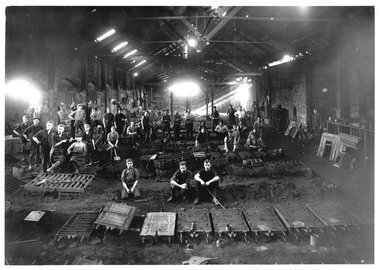
Photograph - Industrial, Barge, Galliers & Klaerr Iron and Brass Foundry, 1925
... stove shop. Galliers & Klaerr was an iron foundry and plumbing business in St Kilda, known for producing gas, cooking, and heating stoves from 1883. ...stove shop. Galliers & Klaerr was an iron foundry and plumbing business in St Kilda, known for producing gas, cooking, and heating stoves from 1883. ...Interior view of stove shop. Galliers & Klaerr was an iron foundry and plumbing business in St Kilda, known for producing gas, cooking, and heating stoves from 1883. Located on Inkerman Street, the firm was a major industrial employer in the area, specializing in cast iron stoves and appliances until the company was sold in the 1960s. Henry Albert Galliers (1845-1907), born in England and a plumber and gasfitter by trade, moved to Australia in 1872 and set up business in rented premises in High Street, and later Inkerman Street. In 1882-1883 he established Galliers & Klaerr with Frederick Klaerr (1856 - 1934), also a plumber. Galliers returned to England in 1980 and the partnership was dissolved, with Klaerr undertaking to continue the business on his own account and to continue to use the business name Galliers & Klaerr. After the company was sold in 1960 the site became the St Kilda 10-pin Bowl, then a data processing centre, and then a Commonwealth Employment Service. These days it is the Aldi Supermarket.black and white photograph original good conditionst kilda businesses, galliers & klaerr -
 St Kilda Historical Society
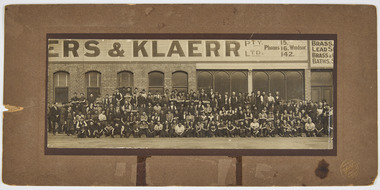
Photograph - Group portrait, Galliers & Klaerr staff, c1924
... Galliers & Klaerr was an iron foundry and plumbing business in St Kilda, known for producing gas, cooking, and heating stoves from 1883. Located on Inkerman Street, the firm was a major industrial employer in the area, specializing in cast iron stoves and appliances until the company was sold in the 1960s. ...Galliers & Klaerr was an iron foundry and plumbing business in St Kilda, known for producing gas, cooking, and heating stoves from 1883. Located on Inkerman Street, the firm was a major industrial employer in the area, specializing in cast iron stoves and appliances until the company was sold in the 1960s. ...Galliers & Klaerr staff photo. Galliers & Klaerr was an iron foundry and plumbing business in St Kilda, known for producing gas, cooking, and heating stoves from 1883. Located on Inkerman Street, the firm was a major industrial employer in the area, specializing in cast iron stoves and appliances until the company was sold in the 1960s. Henry Albert Galliers (1845-1907), born in England and a plumber and gasfitter by trade, moved to Australia in 1872 and set up business in rented premises in High Street, and later Inkerman Street. In 1882-1883 he established Galliers & Klaerr with Frederick Klaerr (1856-1934), also a plumber. Galliers returned to England in 1980 and the partnership was dissolved, with Klaerr undertaking to continue the business on his own account and to continue to use the business name Galliers & Klaerr. After the company was sold in 1960 the site became the location of, in turn, the St Kilda 10-pin Bowl, a data processing centre, an office of the Commonwealth Employment Service and an Aldi Supermarket.black and white photograph mounted on cardboard"Jack Klaerr in the middle. Ladies 1. Walsh, 2. Barret, 3.,4.,5. Heatherington. This photo taken approx 1924. M.E. Mahony"st kilda businesses, galliers & klaerr
