
Showing 33 items matching "crib point"
-
 Port Melbourne Historical & Preservation Society
Letter - T L Winchombe at Crib Point Naval station to his daughter Lily Winchcombe, 3 Dec 1915
... T L Winchombe at Crib Point Naval station to his daughter Lily Winchcombe...One of two handwritten letters dated 3.12.1915, written by T.L. Winchcombe at Crib Point Naval station to daughter Lily Winchcombe. ...Crib Point, Victoria, Australia...Letter T L Winchombe at Crib Point Naval station to his daughter Lily Winchcombe ...One of two handwritten letters dated 3.12.1915, written by T.L. Winchcombe at Crib Point Naval station to daughter Lily Winchcombe. Copy of letter typed by donor is also included.On the other side of last page 'from dear Dad on my 15th Birthday'war - world war i, leslie g pont, lily winchcombe pont, t l winchcombe. -
Port Melbourne Historical & Preservation Society
Letter - T L Winchombe at Crib Point Naval station to his daughter Lily Winchcombe, 5 Dec 1916
... T L Winchombe at Crib Point Naval station to his daughter Lily Winchcombe...One of two handwritten letters; dated 5.12.1916, written by T.L. Winchcombe at Crib Point Naval station to daughter Lily Winchcombe. ...Crib Point, Victoria, Australia...Letter T L Winchombe at Crib Point Naval station to his daughter Lily Winchcombe ...One of two handwritten letters; dated 5.12.1916, written by T.L. Winchcombe at Crib Point Naval station to daughter Lily Winchcombe. Copy of letter typed by donor is also included.war - world war i, leslie g pont, lily winchcombe pont, t l winchcombe. -
 Phillip Island and District Historical Society Inc.
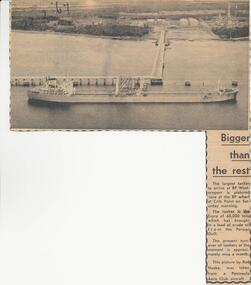
Newspaper clippings, 22/02/1967
... ...Crib Point...Aerial photo of the tanker at Crib Point Jetty....Crib Point, Mornington Peninsula, Victoria, Australia...Collection of newspaper clippers in scrap book dated 1960 - 1973 local history newspapers westernport oil installation arrival of tanker "esyra" Crib Point Jean Jamieson Article re the tanker, "Esyra" arriving at Crib Point refinery with Persian Gulf oil. ...Collection of newspaper clippers in scrap book dated 1960 - 1973Article re the tanker, "Esyra" arriving at Crib Point refinery with Persian Gulf oil. The largest tanker to arrive at that time. Aerial photo of the tanker at Crib Point Jetty.local history, newspapers, westernport oil installation, arrival of tanker "esyra", crib point, jean jamieson -
 Phillip Island and District Historical Society Inc.
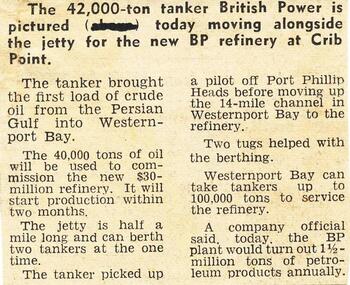
Newspaper clippings, 29/07/1966
... ...Crib Point...Projected arrival production of petroleum products from Crib Point....Crib Point, Mornington Peninsula, Victoria, Australia...Collection of newspaper clippers in scrap book dated 1960 - 1973 local history newspapers westernport oil installation crude oil from persian gulf Crib Point Jean Jamieson "Oil in Westernport" Article with photo of Crib Point Oil Refinery and arrival of the tanker, "British Power", with crude oil from Persian Gulf. ...Collection of newspaper clippers in scrap book dated 1960 - 1973Article with photo of Crib Point Oil Refinery and arrival of the tanker, "British Power", with crude oil from Persian Gulf. Projected arrival production of petroleum products from Crib Point."Oil in Westernport"local history, newspapers, westernport oil installation, crude oil from persian gulf, crib point, jean jamieson -
 Flagstaff Hill Maritime Museum and Village
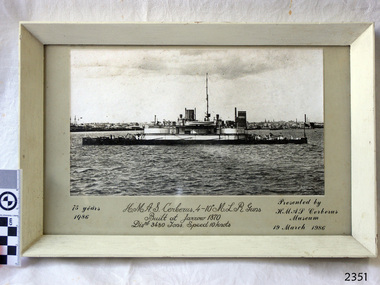
Photograph - Commemorative, Royal Australian Navy (RAN), H.M.A.S. Cerberus. 4-10" M.L.R. Guns, 1986
... ...Point Crib...The photograph was mounted by members of HMAS Cerberus at Crib Point, Western Port Bay, Victoria in 1986. ...HMAS Cerberus, Crib Point, Western Port Bay, Victoria, Australia...The photograph was mounted by members of HMAS Cerberus at Crib Point, Western Port Bay, Victoria in 1986. ...The ship HMAS Cerberus was Built at Jarrow, Newcastle upon Tyne, England, in 1870, specifically for the colony of Victoria (Australia) and originally named HMVS Cerberus. It had a displacement of 3480 tons and could travel at the speed of 10 knots. The ship carried 4x 10 inch M.L.R. guns. The ship was renamed HMAS Cerberus in 1911 when the navy became the Royal Australian Navy. The photograph was mounted by members of HMAS Cerberus at Crib Point, Western Port Bay, Victoria in 1986. It was presented to Flagstaff Hill Maritime Village by the HMAS Cerberus Museum in 1986 to commemorate the ship's 75 years of service for the Royal Australian Navy. The photograph is significant for its connection with the colony of Victoria before Federation. It is also significant for its connection with the Royal Australian Navy and its service and training of Australian defence forces. Photograph behind glass, in timber frame. Black and white photograph of vessel HMAS Cerberus anchored , with city in the background. Frame is painted white. Photograph was taken to commemorate 75 years of the ship's service in the Royal Australian Navy. It was framed and presented to Flagstaff Hill by the HMAS Cerberus Museum on 19 March 1986. Details are hand written below the photograph.Original script writing in centre "H.M.A.S. Cerberus. 4-10 M.L.R. Guns / Built at Jarrow 1870 / Displ 3480 tons. Speed 10 knots. More recent text "75 years / 1986" "Presented by / HMAS Cerberus / Museum/ 19 March 1986"flagstaff hill, warrnambool, shipwrecked-coast, flagstaff-hill, flagstaff-hill-maritime-museum, maritime-museum, shipwreck-coast, flagstaff-hill-maritime-village, photograph, hmas cerberus, 75 year commemoration, 1876, 1911, royal australian navy, navy training base, point crib, ran, cerberus, commemorative photograph, western port bay, hmvs cerberus -
 Queenscliffe Maritime Museum
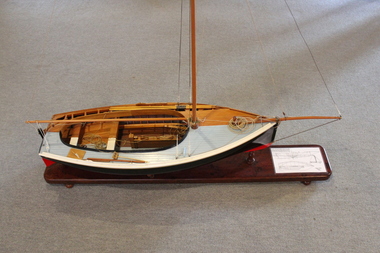
Leisure object - Model Boat, Scale model of Couta Boat "Joyce", 2001-2002
... Built by Arthur Woodley Crib Point, April 2001- June 2002. Although later fitted with a motor, Ariel was one of the last couta boats designed principally for sailing, and still sails at Portland. ...Crib Point, Australia...Built by Arthur Woodley Crib Point, April 2001- June 2002. Although later fitted with a motor, Ariel was one of the last couta boats designed principally for sailing, and still sails at Portland. ...1/10 size scale model of couta Boat Ariel. Built by Arthur Woodley Crib Point, April 2001- June 2002. Although later fitted with a motor, Ariel was one of the last couta boats designed principally for sailing, and still sails at Portland. The original "Ariel" was built in 1927 by J A Jones of Melbourne for Keiller Brothers of Portland, Victoria.Scale Model of the Couta Boat Arielcouta boats, ariel, boat models, arthur woodley -
 Phillip Island and District Historical Society Inc.
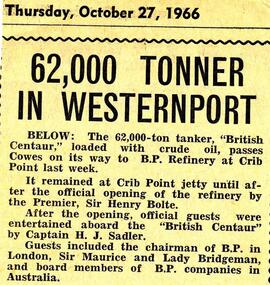
Newspaper Clipping, Tanker "British Centaur", 27/10/1966
... ...Crib Point...Newspaper item about the tanker "British Centaur" passing Cowes on its way to BP Refinery at Crib Point in October 1966. Photo of "British Centaur"...Tanker "British Centaur" Crib Point cowes phillip island Jean Jamieson Newspaper item about the tanker "British Centaur" passing Cowes on its way to BP Refinery at Crib Point in October 1966. ...Collection of newspaper clippings from a Scrap Book from 1960 - 1973.Newspaper item about the tanker "British Centaur" passing Cowes on its way to BP Refinery at Crib Point in October 1966. Photo of "British Centaur"tanker "british centaur", crib point, cowes phillip island, jean jamieson -
 Ballarat Tramway Museum
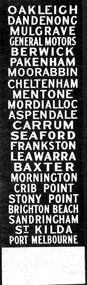
Sign - Sign - Destination Blinds, Trains, Victorian Rail Suburban Train Destination Blind in Miniature: South Eastern Region
... ...crib point...Frankston to Leawarra, Baxter, Mornington, Crib Point, Stony Point, Brighton Beach, Sandringham, St Kilda and Port Melbourne...Frankston to Leawarra, Baxter, Mornington, Crib Point, Stony Point, Brighton Beach, Sandringham, St Kilda and Port Melbourne train destination blinds miniature railway stations ron bridger collection suburban train oakleigh dandenong berwick pakenham moorabbin cheltenham mentone mordiallic aspendale seaford baxter mornington crib point brighton beach port melbourne Place names - stations List of names on black paper with white print. ...Ron Bridger was an avid collector of items related to transport, predominately Trams. These items include newspaper cuttings, pamphlets, reports, timetables, fares prices plus special items relating to events. Items from Melbourne and regional Victoria, interstate - Adelaide and Sydney, plus overseas, make up this collection. A suburban train destination blind in miniature. Place names indicate the eastern and southern suburbs that the train travels to. Place names listed are from Oakleigh to Dandenong, Mulgrave, General Motors, Berwick and Pakenham. From Moorabbin, Cheltenham, Mentone, Mordiallic, Aspendale, Carrum and Seaford. Frankston to Leawarra, Baxter, Mornington, Crib Point, Stony Point, Brighton Beach, Sandringham, St Kilda and Port MelbourneList of names on black paper with white print.Place names - stationstrain destination blinds, miniature, railway stations, ron bridger collection, suburban train, oakleigh, dandenong, berwick, pakenham, moorabbin, cheltenham, mentone, mordiallic, aspendale, seaford, baxter, mornington, crib point, brighton beach, port melbourne -
 Flagstaff Hill Maritime Museum and Village
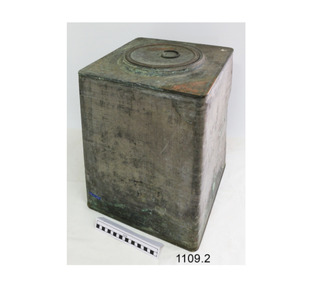
Container - Copper Drum, 1903
... ...crib point...The container once empty of explosives was used for many years as a flour bin on board the crayfish ketch "Lady Brassey" by Mr Charlie Washbourne, Crib Point, Australia (on the Mornington Peninsula in Victoria). ...The container once empty of explosives was used for many years as a flour bin on board the crayfish ketch "Lady Brassey" by Mr Charlie Washbourne, Crib Point, Australia (on the Mornington Peninsula in Victoria). ...This copper and tin container was used for the storage and transport of cordite that replaced black powder in 1889 as a military propellant. The stamped of a government broad arrow and date 1903 show the item was made for the war department and not for commercial use. The container once empty of explosives was used for many years as a flour bin on board the crayfish ketch "Lady Brassey" by Mr Charlie Washbourne, Crib Point, Australia (on the Mornington Peninsula in Victoria). The ketch Lady Brassey was probably named after Anna or "Annie" Brassey (née Allnutt), Baroness Brassey (7 October 1839 – 14 September 1887) who was an English traveller and writer. Her bestselling book A Voyage in the Sunbeam, Our Home on the Ocean for Eleven Months (1878) describes a voyage around the world including a visit to Australia.The explosives container is an example of how explosive compounds were stored and transported at the turn of the 20th century. It is significate as it is in very good condition and an artefact from Australia's colonial history around the Federation, just as the country was gaining independence from Britain.Metal box with tin sides, copper top and base and round, double layered lid that has a folding, D shaped handle. Referred to as a cordite container or copper drum. Inscriptions are stamped onto the drum and are on a sticker under the lid.Handle stamped "S & Co. 1900" on lid. Base is stamped "R.G.D. 1903" (meaning the container seals are resistant to Rapid Gas Decompression (RGD)") Logo: triangular "(vertical arrow) / A T " between letters and date. Base also has blue plastic label "N.T. 55" Sticker: "B55". flagstaff hill, warrnambool, flagstaff hill maritime museum, maritime museum, shipwreck coast, flagstaff hill maritime village, great ocean road, copper container, gunpowder container, government issue container, r.g.d. 1903, lady brassey, charlie washbourne, crib point, baroness brassey, cordite container, copper drum, gun powder container, gun powder, black powder, black powder container, explosives storage, crayfish ketch -
 Phillip Island and District Historical Society Inc.
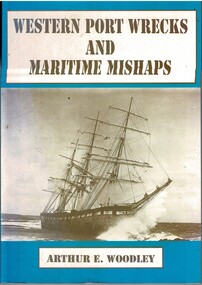
Book, Western Port Wrecks And Maritime Mishaps by Arthur E. Woodley, 1992
... Crib Point , Victoria ...Description of maritime accidents and shipwrecks in Western Port Bay. Historical Soft covered, blue white and black book with black and white photo of a sailing ship on the cover. First edition 1992, signed by Arthur E. Woodley. Western Port Wrecks And Maritime Mishaps Arthur E. Woodley. western port bay, wrecks, maritime mishaps, arthur e woodley, shipwrecks, the speke, maps -
Port Melbourne Historical & Preservation Society
Photograph - T L Winchcombe with penny-farthing bicycle, 1915
... Crib Point ?, Victoria, Australia ...Small photocard of Mr T.L. Winchcombe, standing alongside and holding up a penny-farthing bicycle, made by Stewart & Co, Melbourne c1915Stewart & Co Melbourne (on front); details of photographers on back. Also handwritten, 'My father'war - world war i, leslie g pont, lily winchcombe pont, t l winchcombe. -
Port Melbourne Historical & Preservation Society
Photograph - Group of people at a picnic, 1915
... Crib Point ?, Victoria, Australia ...Faded sepia photograph of group of 16 unidentified people at a picnic, with covered wagon in backgroundsocial activities, leslie g pont, lily winchcombe pont -
 Bendigo Historical Society Inc.
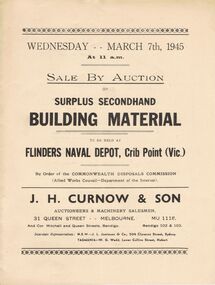
Document - IAN DYETT COLLECTION: AUCTION CATALOGUE - FLINDERS NAVAL DEPOT
... Auction catalogue for a sale of surplus second-hand Building Material held at Flinders Naval Depot, Crib Point, (Vic.) of 7th March, 1945. J. H. ...Special notice in front of catalogue mentions transport facilities from Flinders Street to Crib Point on day of sale. Document IAN DYETT COLLECTION: AUCTION CATALOGUE - FLINDERS NAVAL DEPOT ...Auction catalogue for a sale of surplus second-hand Building Material held at Flinders Naval Depot, Crib Point, (Vic.) of 7th March, 1945. J. H. Curnow & Son were the auctioneers. Special notice in front of catalogue mentions transport facilities from Flinders Street to Crib Point on day of sale.business, auctioneers, j h curnow & son pty ltd, ian dyett collection - auction catalogue - flinders naval depot, commonwealth disposals commission (allied works council-department of the interior), j h curnow & son, j l jamieson & co, w g wedd, the prahran telegraph printing co -
 Phillip Island and District Historical Society Inc.
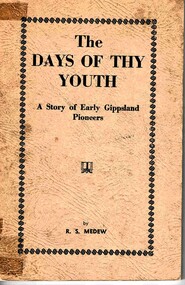
Book, MEDEW, R. S. (Robert Sutherland), The days of thy youth : A story of Early Gippsland Pioneers by R.S. Medew, 1960?
... Presented to Phillip Island Historical Society by Arthur E. Woodley, Crib Point 5/Oct/2005....Presented to Phillip Island Historical Society by Arthur E. Woodley, Crib Point 5/Oct/2005. Small, soft covered book,includes letter from Arthur Woodley and photo of Isabella Tyrrell. ...historicalSmall, soft covered book,includes letter from Arthur Woodley and photo of Isabella Tyrrell.Signed copy. Presented to Phillip Island Historical Society by Arthur E. Woodley, Crib Point 5/Oct/2005.pioneers, victoria, history, gippsland, arthur woodley, isabella tyrrell., r.s.medew -
 Queenscliffe Maritime Museum
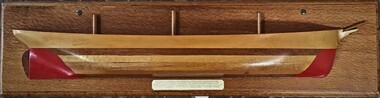
Leisure object - Half model of a 3 masted ship
... Repaired and completed by Arthur Woodley Crib Point September - October 2008....Repaired and completed by Arthur Woodley Crib Point September - October 2008. This nameless three-masted sailing ship half model is typical of a piece produced by a first year apprentice. ...This nameless three-masted sailing ship half model is typical of a piece produced by a first year apprentice. Nameless three-masted sailing ship half model, typical first year apprentice piece. Model acquired damaged and incomplete. Repaired and completed by Arthur Woodley Crib Point September - October 2008.boat building, boat half model -
 Phillip Island and District Historical Society Inc.
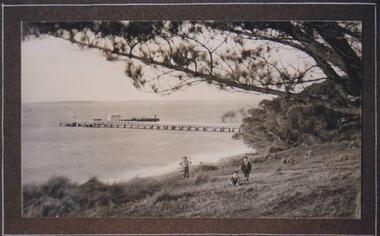
Photograph, Cowes Pier, Phillip Island, 1914
... The Jetty first built in 1870 connected Cowes to Crib Point. The service for mail, provisions and visitors from the mainland. ...The Jetty first built in 1870 connected Cowes to Crib Point. The service for mail, provisions and visitors from the mainland. ...The Jetty first built in 1870 connected Cowes to Crib Point. The service for mail, provisions and visitors from the mainland. A bridge to the Island was built in 1942 from San Remo.View of Jetty from Mussell Rocks, in the foreground a grassy slope. Three figures amongst mounds of grass and overhanging Pine tree branch. A very picturesque view.local history, photographs, jetties, cowes, phillip island, black & white photograph, betty kus collection, jetty cowes, cowes pier, bruce bennett -
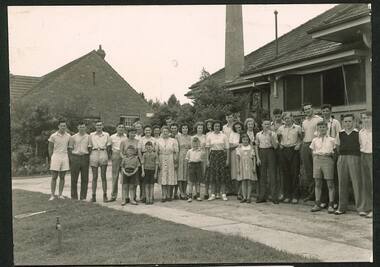 Melbourne Legacy
Photograph, Holmbush, 1947
... If interested in learning all the names in the group contact Arthur Woodley, 34 Park Road, Crib Point (059)839495"....If interested in learning all the names in the group contact Arthur Woodley, 34 Park Road, Crib Point (059)839495". Black and white photo in an album of the junior legatees at Holmbush. ...Black and white photo of the residents at Holmbush. It was one of the residences that was run by Melbourne Legacy for junior legatees. The residences were run by Melbourne Legacy to take care of children whose fathers had been servicemen, and who may have been left orphans, or whose mother may have been unable to care for them herself. The year is not known but it is approximately 1947, and was in an album which was a collection of photos taken in the 1940s and 1950s. The label with the photo says it was taken by Legatee Harry Rigby. Holmbush at 1267 Burke road, was one of the properties that Legacy used for Junior Legatees. It was purchased 1942. In 1957 Holmbush was renamed Blamey House until it was sold in 1977.It shows that Melbourne Legacy established residences to aid children of deceased servicemen complete their education, take further education and find employment.Black and white photo in an album of the junior legatees at Holmbush.The label is handwritten in blue pen and says "I was at Holmbush when this photo was taken by the late Legatee Harry Rigby c.1947. If interested in learning all the names in the group contact Arthur Woodley, 34 Park Road, Crib Point (059)839495".junior legatees, residences, holmbush -
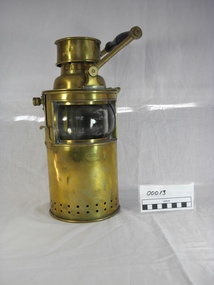 Frankston RSL Sub Branch
Lamp, c. World War 1
... It was given to Arthur E. Woodley of Crib Point during the 1960s by Captain Ivan E. ...It was given to Arthur E. Woodley of Crib Point during the 1960s by Captain Ivan E. ...Arthur E. Woodley donated the WW1 Military Carbide Signal and General Purpose Lamp to Frankston RSL. It was given to Arthur E. Woodley of Crib Point during the 1960s by Captain Ivan E. Layton MBE who was then the Executive Officer of Melbourne Legacy. During WW2 Ivan Layton was secretary to General Blamey. Ivan Layton died on 15th September, 1979. The carbide workings of the lamp were removed because of corrosion, otherwise it is almost complete.WW1 Military Carbide Signal and General Purpose Lamp which is round and made of brass. The lamp has a latched and hinged brass top. Brass and wood hinged handle with knurled access knob which is situated at the top of the lamp. In between the handle uprights is a round chimney flu which allows heat to escape. Approximately one third down from the top of the lamp there is a brass side handle. Immediately to the left of the handle is a rectangular curved view port with brass cover. Directly opposite the side handle is a convex glass window. Air vents are located at the bottom of the lamp. Inside the top half of the lamp is a chamber which contains the carbide lamp and perpendicular sleeves for the insertion of coloured glass panels. The bottom half of the lamp contains the carbide.Manufacturers Stamp, 'PLAYER & MITCHELL LTD', 'SENTINEL WORKS' 'BIRMINGHAM'ww1, military, brass, lamp, world war 1, round, great war, carbide, signal lamp, player mitchell, birmingham -
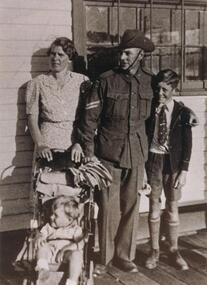 Phillip Island and District Historical Society Inc.
Photograph - Photograph, black + white, Corporal Frederick Edward Woodley and family at Cowes pier 1941, 01/1941
... With compliments, Arthur E Woodley, 34 Park Road, Crib Point. 6/8/1995" Arthur claims this is the only photo of the family together....With compliments, Arthur E Woodley, 34 Park Road, Crib Point. 6/8/1995" Arthur claims this is the only photo of the family together. ...As on back of photograph. "A Phillip Islander goes to War. Corporal Frederick Edward Woodley, No. VX24588 of 2nd/10th Field Company, Royal Australian Engineers, with his wife Ruby, eldest son Arthur and John, pictured beside the shed on Cowes Jetty prior to his departure for active service overseas. January 1941. Fred subsequently voyaged from Sydney to Singapore (via Western Australia) on the troop ship Queen Mary. He was taken prisoner-of-war by the Japanese at the fall of Singapore and imprisoned at the Changi P O W Camp. Later, after being on the missing list for some two years, it was learned that he was imprisoned at the most infamous Sandakan P O W camp in North Borneo from where he did not return. Fred was 37 years of age when this photo was taken. With compliments, Arthur E Woodley, 34 Park Road, Crib Point. 6/8/1995" Arthur claims this is the only photo of the family together.HistoricalBlack & White photograph of Corporal Frederick Edward Woodley (Royal Australian Engineer) with his wife Ruby, eldest son Arthur and John, standing beside the Cowes Jetty shed, Phillip Island.Detailed inscription on back - see Historical Information below.corporal frederick edward woodley, royal australian engineers, wwii, arthur e woodley, military -
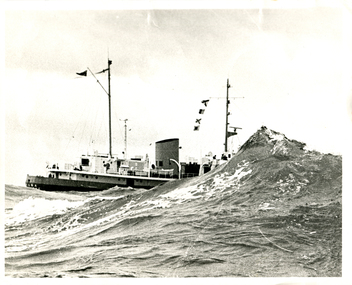 Queenscliffe Maritime Museum
Photograph - Monochrome, MV Wyuna
... In September 2013 she was donated to the Western Port Oberon Association for the Victorian Maritime Centre currently at Crib Point. For a time she was docked at Beauty Point, Tasmania, and after being refurbished for 18 months she was to be moved to Docklands in Melbourne, Victoria. ...In September 2013 she was donated to the Western Port Oberon Association for the Victorian Maritime Centre currently at Crib Point. For a time she was docked at Beauty Point, Tasmania, and after being refurbished for 18 months she was to be moved to Docklands in Melbourne, Victoria. ...The ship was built in 1953 by Ferguson Shipbuilders of Port Glasgow, Scotland for the Port Phillip Sea Pilots organisation as a pilot cutter. Her role as a pilot cutter was to sail with pilots on board to meet ships entering Port Phillip Bay. Pilots would be transferred by the Wyuna's workboat to the vessel requiring pilotage while it was stopped dead in the water, with shelter provided by the vessel itself. In the early 1970s the pilot service started using fast launches to allow pilots to board while ships were still underway, and in 1979 the Wyuna was sold to the Australian Maritime College in Launceston, Tasmania as a training vessel. She continued in that role until 2004 when sold to Mineralogy Pty Ltd as an accommodation vessel. In September 2013 she was donated to the Western Port Oberon Association for the Victorian Maritime Centre currently at Crib Point. For a time she was docked at Beauty Point, Tasmania, and after being refurbished for 18 months she was to be moved to Docklands in Melbourne, Victoria. After this berth became unavailable the vessel was docked at Inspection Head Wharf in Beauty Point. After a period there it was towed into Bell Bay where she lays at anchor as of January 2016. When funding becomes available the Western Port Oberon Association has plans to display the vessel in a wet berth alongside the former Royal Australian Navy Oberon-class submarine HMAS Otama.Mr Henry HudsonBlack and white photograph of the Pilot Tender MV Wyuna partially obscured by a large wave at the rip, entrance to Port Phillip Bay.mv wyuna, port phillip pilot service, the rip, the heads, queenscliff, point lonsdale -
Ringwood and District Historical Society
Legal record - Real Estate & Stock Institute of Victoria Contract of Sale of Property (C.E.Carter of Ringwood - Agent), Vendor: Hannah Spittle-house ROBERTS. Purchasers: Samuel Alfred BENNETT and Frederick SEALEY - 1944
... The vendors were Hannah Spittle house Roberts of Moore Street, Moonee Ponds, and Samuel Alfred Bennett of Crib Point, with Frederick Sealey of Sherbrooke Avenue, Ringwood, as purchaser. ...The vendors were Hannah Spittle house Roberts of Moore Street, Moonee Ponds, and Samuel Alfred Bennett of Crib Point, with Frederick Sealey of Sherbrooke Avenue, Ringwood, as purchaser. ...Copy of contract, correspondence and covering typewritten summary. Property: 1 acre 11 perches of land situated in Crown Portion 3, Parish of Ringwood, Certificate of Title Volume 5657 Folio 1131380.18698 Roberts – Bennett & Sealey AI Summary: The documentation records the 1944 sale of 1 acre 11 perches of land situated in Crown Portion 3, including part of a former government road in the Parish of Ringwood, County of Mornington, held under Certificate of Title Volume 5657 Folio 1131380. The vendors were Hannah Spittle house Roberts of Moore Street, Moonee Ponds, and Samuel Alfred Bennett of Crib Point, with Frederick Sealey of Sherbrooke Avenue, Ringwood, as purchaser. The agreed price was £145, with a £10 deposit and the balance payable within fourteen days of receiving Commonwealth consent under wartime National Security regulations. The contract followed the standard Real Estate & Stock Institute of Victoria form, with additional requirements for Treasurer’s consent, valuation, and statutory declarations under the Farmers’ Debts Adjustment Act. Supporting correspondence shows Bennett writing to agent C.E. Carter of Ringwood about the condition of the Whitehorse Road land, noting blackberries and “two cows grazing on the land,” and referencing a local occupier, “Mr Rowe.” Further letters involve Bennett’s son, a sworn valuer, and the solicitors Snowball & Kaufmann, who coordinated signatures and compliance steps. The final account sales confirm receipt of the deposit and commission relating to the Whitehorse Road property. -
 Port Melbourne Historical & Preservation Society
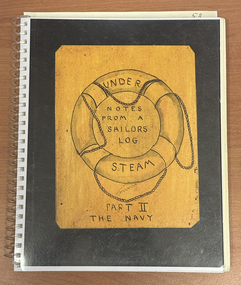
Document - James CONDER Journal, James Brycanne Conder, NOTES FROM A SAILORS LOG - UNDER STEAM - PART II THE NAVY
... He remained with the Naval College until 1937 through its moves to Jervis Bay, NSW and then to Crib Point, Victoria training midshipmen according to the practices of the Royal Navy. ...He remained with the Naval College until 1937 through its moves to Jervis Bay, NSW and then to Crib Point, Victoria training midshipmen according to the practices of the Royal Navy. ...James Bryance CONDER (aka James Brycanne CONDER) Artist, poet and four-navy veteran, 1872 - 1954. In 1889 he served in the Merchant Marine Service sailing on the ships ‘Ellora’ and ‘Avenger’. in 1891, aged 19, he joined the Royal Navy in Australia serving on the flagship of the Australian Station, ‘HMS Orlando’, when it escorted ships of the new Australasian Auxiliary Squadron in coastal voyages. After serving 6 months he returned to family in Melbourne rather than sign on for 12 years. Instead he joined the Victorian Colonial Navy and was posted, in succession, to the ‘HMVS Cerberus’, ‘HMVS Nelson’ and the gunboat ‘HMVS Albert’. In 1896 he left the navy, married Victoria Agnes NIHILL and joined the Victorian Police Force. In 1904 CONDOR returned to the sea as part of the Commonwealth Naval Forces, an amalgamation of the colonial navies formed after federation and later becoming the Royal Australian Navy. On his first ship, ‘HMS Katoomba’, as bosun yeoman, he helped train new recruits. He later served on ‘HMS Challenger’ and ‘HMS Psyche’ which included voyages to Fiji, the New Hebrides, Singapore and New Zealand as well as regular cruises to Australian ports. In 1909, CONDER left the Navy and undertook shored-based civilian work until 1913 when he joined the Royal Australian Naval College at Osborne House in Geelong. He remained with the Naval College until 1937 through its moves to Jervis Bay, NSW and then to Crib Point, Victoria training midshipmen according to the practices of the Royal Navy. In later life, CONDER produced two handwritten journals for his family illustrated with his own paintings and drawings. Two original sets were made. One remains in the family while the other is held by the Australian National Maritime Museum in Sydney. PMHPS hold several items relating to James CONDER including photocopies of his journals ‘Notes from a Sailors Log - Under Canvas - Part I The Merchant Service’ (Cat No 2700.01) and ‘Notes from a Sailors Log - Under Steam - Part II The Navy’ (Cat No 2700.02), a photocopy of his Certificate of Service (Cat No 2700.03), a booklet of his life story (Cat No 2700.04) and several digital items (Cat No 2476.01 - 2476.09).A spiral bound photocopy of a sailor's log; dark red marbled covers; front cover has tan inset with title in and around a sketch of a lifebuoy. Under Steam - Part II The Navy. See Under Canvas - Part I The Merchant Service (Cat No 2700.01)transport - shipping, hmvs cerberus, james bryance conder, armed services - navy, ran - royal australian navy -
 Port Melbourne Historical & Preservation Society
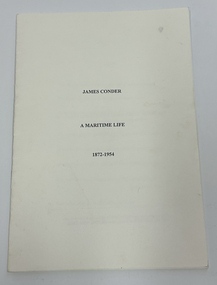
Booklet, Robert Murphy, James Conder - A Maritime Life - 1872-1954, c. 2000
... He remained with the Naval College until 1937 through its moves to Jervis Bay, NSW and then to Crib Point, Victoria training midshipmen according to the practices of the Royal Navy. ...He remained with the Naval College until 1937 through its moves to Jervis Bay, NSW and then to Crib Point, Victoria training midshipmen according to the practices of the Royal Navy. ...James Bryance CONDER (aka James Brycanne CONDER) Artist, poet and four-navy veteran, 1872 - 1954. In 1889 he served in the Merchant Marine Service sailing on the ships ‘Ellora’ and ‘Avenger’. in 1891, aged 19, he joined the Royal Navy in Australia serving on the flagship of the Australian Station, ‘HMS Orlando’, when it escorted ships of the new Australasian Auxiliary Squadron in coastal voyages. After serving 6 months he returned to family in Melbourne rather than sign on for 12 years. Instead he joined the Victorian Colonial Navy and was posted, in succession, to the ‘HMVS Cerberus’, ‘HMVS Nelson’ and the gunboat ‘HMVS Albert’. In 1896 he left the navy, married Victoria Agnes NIHILL and joined the Victorian Police Force. In 1904 CONDOR returned to the sea as part of the Commonwealth Naval Forces, an amalgamation of the colonial navies formed after federation and later becoming the Royal Australian Navy. On his first ship, ‘HMS Katoomba’, as bosun yeoman, he helped train new recruits. He later served on ‘HMS Challenger’ and ‘HMS Psyche’ which included voyages to Fiji, the New Hebrides, Singapore and New Zealand as well as regular cruises to Australian ports. In 1909, CONDER left the Navy and undertook shored-based civilian work until 1913 when he joined the Royal Australian Naval College at Osborne House in Geelong. He remained with the Naval College until 1937 through its moves to Jervis Bay, NSW and then to Crib Point, Victoria training midshipmen according to the practices of the Royal Navy. In later life, CONDER produced two handwritten journals for his family illustrated with his own paintings and drawings. Two original sets were made. One remains in the family while the other is held by the Australian National Maritime Museum in Sydney. PMHPS hold several items relating to James CONDER including photocopies of his journals ‘Notes from a Sailors Log - Under Canvas - Part I The Merchant Service’ (Cat No 2700.01) and ‘Notes from a Sailors Log - Under Steam - Part II The Navy’ (Cat No 2700.02), a photocopy of his Certificate of Service (Cat No 2700.03), a booklet of his life story (Cat No 2700.04) and several digital items (Cat No 2476.01 - 2476.09). 'James Conder - A Maritime Life - 1872-1954', A5 booklet 20 pp incl cover, 'developed by Robert Murphy for the many family members descended from James Conder'.armed services - navy, transport - shipping, police, arts and entertainment - visual arts, hmvs cerberus, james bryance conder, ran - royal australian navy, victorian colonial navy, victoria police, royal australian naval college, robert murphy, painting, royal naval squadron -
 Port Melbourne Historical & Preservation Society
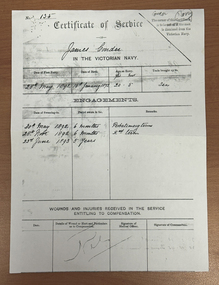
Certificate - Photocopy, Certificate of Service, James Condor, Navy, 1904 - 1959
... He remained with the Naval College until 1937 through its moves to Jervis Bay, NSW and then to Crib Point, Victoria training midshipmen according to the practices of the Royal Navy. ...He remained with the Naval College until 1937 through its moves to Jervis Bay, NSW and then to Crib Point, Victoria training midshipmen according to the practices of the Royal Navy. ...James Bryance CONDER (aka James Brycanne CONDER) Artist, poet and four-navy veteran, 1872 - 1954. In 1889 he served in the Merchant Marine Service sailing on the ships ‘Ellora’ and ‘Avenger’. in 1891, aged 19, he joined the Royal Navy in Australia serving on the flagship of the Australian Station, ‘HMS Orlando’, when it escorted ships of the new Australasian Auxiliary Squadron in coastal voyages. After serving 6 months he returned to family in Melbourne rather than sign on for 12 years. Instead he joined the Victorian Colonial Navy and was posted, in succession, to the ‘HMVS Cerberus’, ‘HMVS Nelson’ and the gunboat ‘HMVS Albert’. In 1896 he left the navy, married Victoria Agnes NIHILL and joined the Victorian Police Force. In 1904 CONDOR returned to the sea as part of the Commonwealth Naval Forces, an amalgamation of the colonial navies formed after federation and later becoming the Royal Australian Navy. On his first ship, ‘HMS Katoomba’, as bosun yeoman, he helped train new recruits. He later served on ‘HMS Challenger’ and ‘HMS Psyche’ which included voyages to Fiji, the New Hebrides, Singapore and New Zealand as well as regular cruises to Australian ports. In 1909, CONDER left the Navy and undertook shored-based civilian work until 1913 when he joined the Royal Australian Naval College at Osborne House in Geelong. He remained with the Naval College until 1937 through its moves to Jervis Bay, NSW and then to Crib Point, Victoria training midshipmen according to the practices of the Royal Navy. In later life, CONDER produced two handwritten journals for his family illustrated with his own paintings and drawings. Two original sets were made. One remains in the family while the other is held by the Australian National Maritime Museum in Sydney. PMHPS hold several items relating to James CONDER including photocopies of his journals ‘Notes from a Sailors Log - Under Canvas - Part I The Merchant Service’ (Cat No 2700.01) and ‘Notes from a Sailors Log - Under Steam - Part II The Navy’ (Cat No 2700.02), a photocopy of his Certificate of Service (Cat No 2700.03), a booklet of his life story (Cat No 2700.04) and several digital items (Cat No 2476.01 - 2476.09). Photocopy of James CONDER's Certificate of Servicearmed services - navy, transport - shipping, james bryance conder, ran - royal australian navy, royal naval squadron, victorian colonial navy, merchant navy, victoria police, police -
 Port Melbourne Historical & Preservation Society
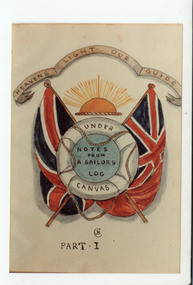
Photograph - Title page drawing from James Conder Journal Part I
... He remained with the Naval College until 1937 through its moves to Jervis Bay, NSW and then to Crib Point, Victoria training midshipmen according to the practices of the Royal Navy. ...He remained with the Naval College until 1937 through its moves to Jervis Bay, NSW and then to Crib Point, Victoria training midshipmen according to the practices of the Royal Navy. ...James Bryance CONDER (aka James Brycanne CONDER) Artist, poet and four-navy veteran, 1872 - 1954. In 1889 he served in the Merchant Marine Service sailing on the ships ‘Ellora’ and ‘Avenger’. in 1891, aged 19, he joined the Royal Navy in Australia serving on the flagship of the Australian Station, ‘HMS Orlando’, when it escorted ships of the new Australasian Auxiliary Squadron in coastal voyages. After serving 6 months he returned to family in Melbourne rather than sign on for 12 years. Instead he joined the Victorian Colonial Navy and was posted, in succession, to the ‘HMVS Cerberus’, ‘HMVS Nelson’ and the gunboat ‘HMVS Albert’. In 1896 he left the navy, married Victoria Agnes NIHILL and joined the Victorian Police Force. In 1904 CONDOR returned to the sea as part of the Commonwealth Naval Forces, an amalgamation of the colonial navies formed after federation and later becoming the Royal Australian Navy. On his first ship, ‘HMS Katoomba’, as bosun yeoman, he helped train new recruits. He later served on ‘HMS Challenger’ and ‘HMS Psyche’ which included voyages to Fiji, the New Hebrides, Singapore and New Zealand as well as regular cruises to Australian ports. In 1909, CONDER left the Navy and undertook shored-based civilian work until 1913 when he joined the Royal Australian Naval College at Osborne House in Geelong. He remained with the Naval College until 1937 through its moves to Jervis Bay, NSW and then to Crib Point, Victoria training midshipmen according to the practices of the Royal Navy. In later life, CONDER produced two handwritten journals for his family illustrated with his own paintings and drawings. Two original sets were made. One remains in the family while the other is held by the Australian National Maritime Museum in Sydney. PMHPS hold several items relating to James CONDER including photocopies of his journals ‘Notes from a Sailors Log - Under Canvas - Part I The Merchant Service’ (Cat No 2700.01) and ‘Notes from a Sailors Log - Under Steam - Part II The Navy’ (Cat No 2700.02), a photocopy of his Certificate of Service (Cat No 2700.03), a booklet of his life story (Cat No 2700.04) and several digital items (Cat No 2476.01 - 2476.09).Colour digital photograph of the title page handdrawn by James GONDER from ‘Notes from a Sailors Log - Under Canvas - Part I The Merchant Service’ (Cat No 2700.01).armed services - navy, transport - shipping, james bryance conder, ran - royal australian navy, victorian colonial navy, royal australian naval college, merchant navy, royal naval squadron -
 Port Melbourne Historical & Preservation Society
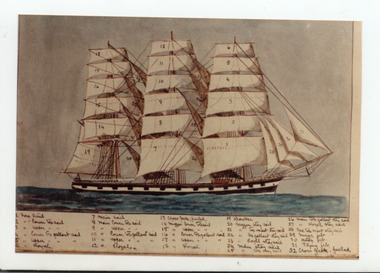
Photograph - Sailing ship showing sail configuration
... He remained with the Naval College until 1937 through its moves to Jervis Bay, NSW and then to Crib Point, Victoria training midshipmen according to the practices of the Royal Navy. ...He remained with the Naval College until 1937 through its moves to Jervis Bay, NSW and then to Crib Point, Victoria training midshipmen according to the practices of the Royal Navy. ...James Bryance CONDER (aka James Brycanne CONDER) Artist, poet and four-navy veteran, 1872 - 1954. In 1889 he served in the Merchant Marine Service sailing on the ships ‘Ellora’ and ‘Avenger’. in 1891, aged 19, he joined the Royal Navy in Australia serving on the flagship of the Australian Station, ‘HMS Orlando’, when it escorted ships of the new Australasian Auxiliary Squadron in coastal voyages. After serving 6 months he returned to family in Melbourne rather than sign on for 12 years. Instead he joined the Victorian Colonial Navy and was posted, in succession, to the ‘HMVS Cerberus’, ‘HMVS Nelson’ and the gunboat ‘HMVS Albert’. In 1896 he left the navy, married Victoria Agnes NIHILL and joined the Victorian Police Force. In 1904 CONDOR returned to the sea as part of the Commonwealth Naval Forces, an amalgamation of the colonial navies formed after federation and later becoming the Royal Australian Navy. On his first ship, ‘HMS Katoomba’, as bosun yeoman, he helped train new recruits. He later served on ‘HMS Challenger’ and ‘HMS Psyche’ which included voyages to Fiji, the New Hebrides, Singapore and New Zealand as well as regular cruises to Australian ports. In 1909, CONDER left the Navy and undertook shored-based civilian work until 1913 when he joined the Royal Australian Naval College at Osborne House in Geelong. He remained with the Naval College until 1937 through its moves to Jervis Bay, NSW and then to Crib Point, Victoria training midshipmen according to the practices of the Royal Navy. In later life, CONDER produced two handwritten journals for his family illustrated with his own paintings and drawings. Two original sets were made. One remains in the family while the other is held by the Australian National Maritime Museum in Sydney. PMHPS hold several items relating to James CONDER including photocopies of his journals ‘Notes from a Sailors Log - Under Canvas - Part I The Merchant Service’ (Cat No 2700.01) and ‘Notes from a Sailors Log - Under Steam - Part II The Navy’ (Cat No 2700.02), a photocopy of his Certificate of Service (Cat No 2700.03), a booklet of his life story (Cat No 2700.04) and several digital items (Cat No 2476.01 - 2476.09).Colour digital photograph of a drawing by James CONDER showing the sail configuration for a sailing ship.armed services - navy, transport - shipping, james bryance conder, ran - royal australian navy, victorian colonial navy, royal australian naval college, merchant navy, royal naval squadron -
 Port Melbourne Historical & Preservation Society
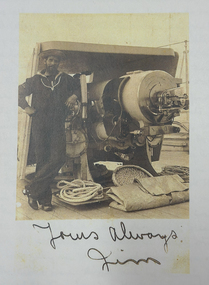
Photograph - James CONDER in uniform, c. 1905
... He remained with the Naval College until 1937 through its moves to Jervis Bay, NSW and then to Crib Point, Victoria training midshipmen according to the practices of the Royal Navy. ...He remained with the Naval College until 1937 through its moves to Jervis Bay, NSW and then to Crib Point, Victoria training midshipmen according to the practices of the Royal Navy. ...James Bryance CONDER (aka James Brycanne CONDER) Artist, poet and four-navy veteran, 1872 - 1954. In 1889 he served in the Merchant Marine Service sailing on the ships ‘Ellora’ and ‘Avenger’. in 1891, aged 19, he joined the Royal Navy in Australia serving on the flagship of the Australian Station, ‘HMS Orlando’, when it escorted ships of the new Australasian Auxiliary Squadron in coastal voyages. After serving 6 months he returned to family in Melbourne rather than sign on for 12 years. Instead he joined the Victorian Colonial Navy and was posted, in succession, to the ‘HMVS Cerberus’, ‘HMVS Nelson’ and the gunboat ‘HMVS Albert’. In 1896 he left the navy, married Victoria Agnes NIHILL and joined the Victorian Police Force. In 1904 CONDOR returned to the sea as part of the Commonwealth Naval Forces, an amalgamation of the colonial navies formed after federation and later becoming the Royal Australian Navy. On his first ship, ‘HMS Katoomba’, as bosun yeoman, he helped train new recruits. He later served on ‘HMS Challenger’ and ‘HMS Psyche’ which included voyages to Fiji, the New Hebrides, Singapore and New Zealand as well as regular cruises to Australian ports. In 1909, CONDER left the Navy and undertook shored-based civilian work until 1913 when he joined the Royal Australian Naval College at Osborne House in Geelong. He remained with the Naval College until 1937 through its moves to Jervis Bay, NSW and then to Crib Point, Victoria training midshipmen according to the practices of the Royal Navy. In later life, CONDER produced two handwritten journals for his family illustrated with his own paintings and drawings. Two original sets were made. One remains in the family while the other is held by the Australian National Maritime Museum in Sydney. PMHPS hold several items relating to James CONDER including photocopies of his journals ‘Notes from a Sailors Log - Under Canvas - Part I The Merchant Service’ (Cat No 2700.01) and ‘Notes from a Sailors Log - Under Steam - Part II The Navy’ (Cat No 2700.02), a photocopy of his Certificate of Service (Cat No 2700.03), a booklet of his life story (Cat No 2700.04) and several digital items (Cat No 2476.01 - 2476.09).Sepia digital photograph of James CONDER in uniform, sent to family with greeting 'Yours Always, Jim'. This photo is included in the early pages of CONDER's journal ‘Notes from a Sailors Log - Under Steam - Part II The Navy’ (Cat No 2700.02)."Yours always / Jim"armed services - navy, transport - shipping, james bryance conder, ran - royal australian navy, victorian colonial navy -
 Port Melbourne Historical & Preservation Society
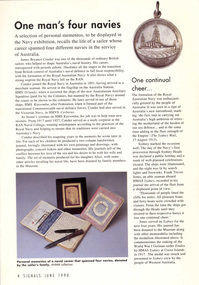
Magazine - Article, One Man's Four Navies
... He remained with the Naval College until 1937 through its moves to Jervis Bay, NSW and then to Crib Point, Victoria training midshipmen according to the practices of the Royal Navy. ...He remained with the Naval College until 1937 through its moves to Jervis Bay, NSW and then to Crib Point, Victoria training midshipmen according to the practices of the Royal Navy. ...James Bryance CONDER (aka James Brycanne CONDER) Artist, poet and four-navy veteran, 1872 - 1954. In 1889 he served in the Merchant Marine Service sailing on the ships ‘Ellora’ and ‘Avenger’. in 1891, aged 19, he joined the Royal Navy in Australia serving on the flagship of the Australian Station, ‘HMS Orlando’, when it escorted ships of the new Australasian Auxiliary Squadron in coastal voyages. After serving 6 months he returned to family in Melbourne rather than sign on for 12 years. Instead he joined the Victorian Colonial Navy and was posted, in succession, to the ‘HMVS Cerberus’, ‘HMVS Nelson’ and the gunboat ‘HMVS Albert’. In 1896 he left the navy, married Victoria Agnes NIHILL and joined the Victorian Police Force. In 1904 CONDOR returned to the sea as part of the Commonwealth Naval Forces, an amalgamation of the colonial navies formed after federation and later becoming the Royal Australian Navy. On his first ship, ‘HMS Katoomba’, as bosun yeoman, he helped train new recruits. He later served on ‘HMS Challenger’ and ‘HMS Psyche’ which included voyages to Fiji, the New Hebrides, Singapore and New Zealand as well as regular cruises to Australian ports. In 1909, CONDER left the Navy and undertook shored-based civilian work until 1913 when he joined the Royal Australian Naval College at Osborne House in Geelong. He remained with the Naval College until 1937 through its moves to Jervis Bay, NSW and then to Crib Point, Victoria training midshipmen according to the practices of the Royal Navy. In later life, CONDER produced two handwritten journals for his family illustrated with his own paintings and drawings. Two original sets were made. One remains in the family while the other is held by the Australian National Maritime Museum in Sydney. PMHPS hold several items relating to James CONDER including photocopies of his journals ‘Notes from a Sailors Log - Under Canvas - Part I The Merchant Service’ (Cat No 2700.01) and ‘Notes from a Sailors Log - Under Steam - Part II The Navy’ (Cat No 2700.02), a photocopy of his Certificate of Service (Cat No 2700.03), a booklet of his life story (Cat No 2700.04) and several digital items (Cat No 2476.01 - 2476.09).Article, 'One Man's Four Navies', about James CONDER from National Maritime Museum's 'Signals' magazine, Issue 12, 1 June 1990. armed services - navy, transport - shipping, james bryance conder, ran - royal australian navy, royal naval squadron, victorian colonial navy -
 Port Melbourne Historical & Preservation Society
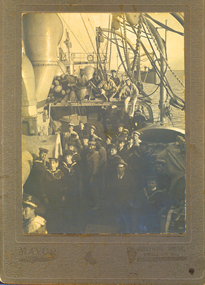
Photograph - Crew of the Katoomba, 1904
... He remained with the Naval College until 1937 through its moves to Jervis Bay, NSW and then to Crib Point, Victoria training midshipmen according to the practices of the Royal Navy. ...He remained with the Naval College until 1937 through its moves to Jervis Bay, NSW and then to Crib Point, Victoria training midshipmen according to the practices of the Royal Navy. ...James Bryance CONDER (aka James Brycanne CONDER) Artist, poet and four-navy veteran, 1872 - 1954. In 1889 he served in the Merchant Marine Service sailing on the ships ‘Ellora’ and ‘Avenger’. in 1891, aged 19, he joined the Royal Navy in Australia serving on the flagship of the Australian Station, ‘HMS Orlando’, when it escorted ships of the new Australasian Auxiliary Squadron in coastal voyages. After serving 6 months he returned to family in Melbourne rather than sign on for 12 years. Instead he joined the Victorian Colonial Navy and was posted, in succession, to the ‘HMVS Cerberus’, ‘HMVS Nelson’ and the gunboat ‘HMVS Albert’. In 1896 he left the navy, married Victoria Agnes NIHILL and joined the Victorian Police Force. In 1904 CONDOR returned to the sea as part of the Commonwealth Naval Forces, an amalgamation of the colonial navies formed after federation and later becoming the Royal Australian Navy. On his first ship, ‘HMS Katoomba’, as bosun yeoman, he helped train new recruits. He later served on ‘HMS Challenger’ and ‘HMS Psyche’ which included voyages to Fiji, the New Hebrides, Singapore and New Zealand as well as regular cruises to Australian ports. In 1909, CONDER left the Navy and undertook shored-based civilian work until 1913 when he joined the Royal Australian Naval College at Osborne House in Geelong. He remained with the Naval College until 1937 through its moves to Jervis Bay, NSW and then to Crib Point, Victoria training midshipmen according to the practices of the Royal Navy. In later life, CONDER produced two handwritten journals for his family illustrated with his own paintings and drawings. Two original sets were made. One remains in the family while the other is held by the Australian National Maritime Museum in Sydney. PMHPS hold several items relating to James CONDER including photocopies of his journals ‘Notes from a Sailors Log - Under Canvas - Part I The Merchant Service’ (Cat No 2700.01) and ‘Notes from a Sailors Log - Under Steam - Part II The Navy’ (Cat No 2700.02), a photocopy of his Certificate of Service (Cat No 2700.03), a booklet of his life story (Cat No 2700.04) and several digital items (Cat No 2476.01 - 2476.09). Digital copy of b&w photograph of the crew of the 'Katoomba'armed services - navy, hms katoomba, james bryance conder, ran - royal australian navy -
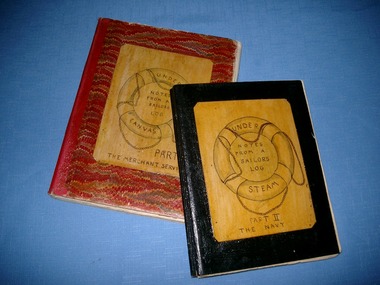 Port Melbourne Historical & Preservation Society
Photograph - James CONDER's journals, Glen Stuart, Aug 2008
... He remained with the Naval College until 1937 through its moves to Jervis Bay, NSW and then to Crib Point, Victoria training midshipmen according to the practices of the Royal Navy. ...He remained with the Naval College until 1937 through its moves to Jervis Bay, NSW and then to Crib Point, Victoria training midshipmen according to the practices of the Royal Navy. ...James Bryance CONDER (aka James Brycanne CONDER) Artist, poet and four-navy veteran, 1872 - 1954. In 1889 he served in the Merchant Marine Service sailing on the ships ‘Ellora’ and ‘Avenger’. in 1891, aged 19, he joined the Royal Navy in Australia serving on the flagship of the Australian Station, ‘HMS Orlando’, when it escorted ships of the new Australasian Auxiliary Squadron in coastal voyages. After serving 6 months he returned to family in Melbourne rather than sign on for 12 years. Instead he joined the Victorian Colonial Navy and was posted, in succession, to the ‘HMVS Cerberus’, ‘HMVS Nelson’ and the gunboat ‘HMVS Albert’. In 1896 he left the navy, married Victoria Agnes NIHILL and joined the Victorian Police Force. In 1904 CONDOR returned to the sea as part of the Commonwealth Naval Forces, an amalgamation of the colonial navies formed after federation and later becoming the Royal Australian Navy. On his first ship, ‘HMS Katoomba’, as bosun yeoman, he helped train new recruits. He later served on ‘HMS Challenger’ and ‘HMS Psyche’ which included voyages to Fiji, the New Hebrides, Singapore and New Zealand as well as regular cruises to Australian ports. In 1909, CONDER left the Navy and undertook shored-based civilian work until 1913 when he joined the Royal Australian Naval College at Osborne House in Geelong. He remained with the Naval College until 1937 through its moves to Jervis Bay, NSW and then to Crib Point, Victoria training midshipmen according to the practices of the Royal Navy. In later life, CONDER produced two handwritten journals for his family illustrated with his own paintings and drawings. Two original sets were made. One remains in the family while the other is held by the Australian National Maritime Museum in Sydney. PMHPS hold several items relating to James CONDER including photocopies of his journals ‘Notes from a Sailors Log - Under Canvas - Part I The Merchant Service’ (Cat No 2700.01) and ‘Notes from a Sailors Log - Under Steam - Part II The Navy’ (Cat No 2700.02), a photocopy of his Certificate of Service (Cat No 2700.03), a booklet of his life story (Cat No 2700.04) and several digital items (Cat No 2476.01 - 2476.09).Colour digital photograph of of of the original two sets of James CONDER's handwritten and illustrated journals made for his family, '‘Notes from a Sailors Log - Under Canvas - Part I The Merchant Service’ (Cat No 2700.01) and ‘Notes from a Sailors Log - Under Steam - Part II The Navy’ (Cat No 2700.02). Displayed in 'Navy in Port' exhibition Aug/Sept 2008armed services - navy, transport - shipping, james bryance conder, merchant navy, royal naval squadron, victorian colonial navy, ran - royal australian navy
