
Showing 11 items matching "crofts stores"
-
 Bendigo Historical Society Inc.
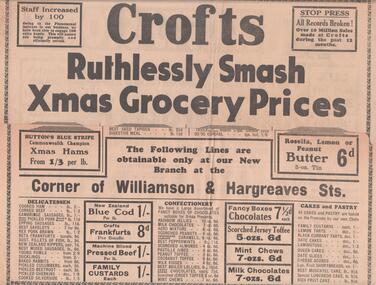
Document - BENDIGO BUSINESSES COLLECTION: CROFTS STORES
... BENDIGO BUSINESSES COLLECTION: CROFTS STORES......crofts stores...Advertising pages for Crofts Stores Bendigo cr. Williamson and Hargreaves Streets and 224 Mitchell Street....BENDIGO Business crofts stores Advertising pages for Crofts Stores Bendigo cr. ...Advertising pages for Crofts Stores Bendigo cr. Williamson and Hargreaves Streets and 224 Mitchell Street.bendigo, business, crofts stores -
 Bendigo Historical Society Inc.
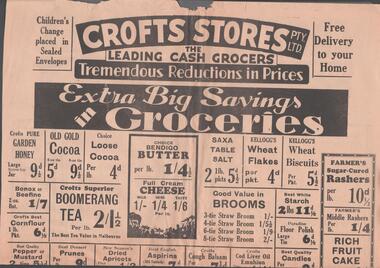
Document - BENDIGO BUSINESSES COLLECTION: CROFTS STORES
... BENDIGO BUSINESSES COLLECTION: CROFTS STORES......crofts stores...One page, printed on both side advertising Crofts Stores Pty. Ltd. The leading cash grocers, tremendous reduction in prices, extra big savings in groceries....BENDIGO Business crofts stores One page, printed on both side advertising Crofts Stores Pty. ...One page, printed on both side advertising Crofts Stores Pty. Ltd. The leading cash grocers, tremendous reduction in prices, extra big savings in groceries.bendigo, business, crofts stores -
 City of Kingston
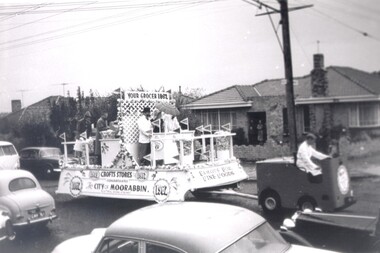
Photograph - Black and white, 1962
... Crofts had several stores in the City of Moorabbin...Signage along the long edge of the float reads 'Crofts Stores congratulates the City of Moorabbin 1962'. ...Crofts had several stores in the City of Moorabbin Crofts Stores was established by Archibald Crofts with a single grocers store in South Melbourne. ...Crofts Stores (a chain of grocery stores) entered this float in the City of Moorabbin centenary procession held in 1962. Crofts had several stores in the City of MoorabbinCrofts Stores was established by Archibald Crofts with a single grocers store in South Melbourne. It eventually expanded to include 137 branches throughout Victoria, trading as Crofts Stores. Several Crofts stores existed in the City of Moorabbin and the chain pioneered self-service food stores in Australia. In 1962 the City of Moorabbin celebrated its centenary, which was marked with a procession through the streetsBlack and white photograph of a float being driven down a busy street. There are five people aboard the float, three behind a counter, and two at the rear. There are small flags reading Crofts (the business name) all around the float. Signage along the long edge of the float reads 'Crofts Stores congratulates the City of Moorabbin 1962'. Signage along the front shorter side reads 'Famous for fine foods', and signage above the counter reads 'Your grocer 1962'. There are people visible on the front porch of a house in the background, watching the float pass. Cars are parked along either side of the road and are also travelling in the opposite direction to the float.Handwritten in red ink: 60%grocery, centenary, city of moorabbin -
 Box Hill Historical Society
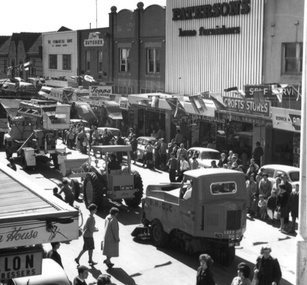
Photograph - Street Parade, c.1950s
... ...Crofts' Stores Pty. Ltd....Butchers Patersons Home Furnishers Crofts' Stores Pty. Ltd. The Commercial Bank Advertising Festivals and celebrations Clothing and dress Station Street Motor Vehicles B&w photo Photograph Street Parade ...Street Parade of floats travelling north along Station Street, Box Hill. In view are some of the Box Hill City Council's vehicles. Some of the businesses in view on the east side of Station Street, include Crofts' Store, Patersons, Lloyd's butcher, The Commercial Bank, the funeral parlor and the corner of Station Street and Whitehorse Road, the milk bar with advertising for Four'n'Twenty pies and Toppa Ice Cream on its roof.B&w photolloyd> e., butchers, patersons home furnishers, crofts' stores pty. ltd., the commercial bank, advertising, festivals and celebrations, clothing and dress, station street, motor vehicles -
 Bendigo Historical Society Inc.
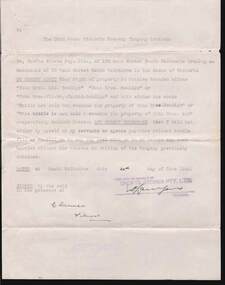
Document - COHN BROTHERS COLLECTION: VARIOUS LETTERS
... [a] Ouyen Cordials Co, 10th June 1940. [b] Croft's Stores Pty Ltd of 176 Bank St South Melbourne, 20th June 1940....[a] Ouyen Cordials Co, 10th June 1940. [b] Croft's Stores Pty Ltd of 176 Bank St South Melbourne, 20th June 1940. ...Two folded typed documents relating to improper use of Cohn's company bottles, both captioned as such and numbered No 8. [a] Ouyen Cordials Co, 10th June 1940. [b] Croft's Stores Pty Ltd of 176 Bank St South Melbourne, 20th June 1940.bendigo, industry, cohn bros brewery -
 Ballarat Tramway Museum
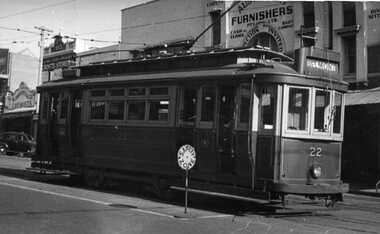
Photograph - Black & White Photograph/s, John Webster, 6/06/1950 12:00:00 AM
... Tram has the destination of Belmont. Chemist, Crofts Stores and Austral Art Furnishers store building in the background. ...Tram has the destination of Belmont. Chemist, Crofts Stores and Austral Art Furnishers store building in the background. ...Yields information about the appearance of one Geelong's single truck trams and its city streets.Black and white photograph of Geelong No. 22 photographed in Moorabool St at a Safety Zone stop. Safety Zone stop sign in photograph. Tram has the destination of Belmont. Chemist, Crofts Stores and Austral Art Furnishers store building in the background. Photographed by John Webster, 6/6/1950. Copy 1 - On rear in ink "Tram 22 Geelong Vic" and on right hand edge "BB31 F2 / T20 / F16 / 6/6/50 1/100 at 12, VV HP3".tramways, trams, geelong, moorabool st, safety zone, tram 22 -
 City of Moorabbin Historical Society (Operating the Box Cottage Museum)
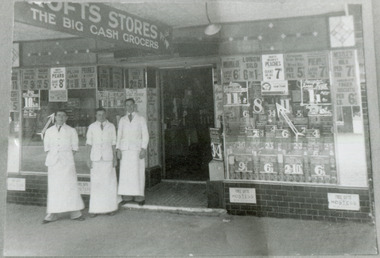
Photograph - Black & White, Crofts Grocery 395 Centre Rd Bentleigh c1937, c1937
... Crofts Stores was established by Archibald Crofts (1875-1942) as a single grocery store in South Melbourne. ...Crofts Stores was established by Archibald Crofts (1875-1942) as a single grocery store in South Melbourne. ...After the extension of the Railway line from Caulfield to Mordialloc 1880's the shopping centre moved from the Tucker Rd end to around the East Brighton (Bentleigh) Station area of Centre Road. A variety of shops, forges, estate agents, Coles' and Fossey's variety stores, a Hoyts picture theatre, butchers, traded in Centre Rd. Crofts was one many grocery stores along the strip. Crofts Stores was established by Archibald Crofts (1875-1942) as a single grocery store in South Melbourne. It eventually expanded to include 137 branches throughout Victoria, trading as Crofts Stores. The Lees family had established a Seedling Nursery in Thomas St that has continued until the land sold 2018 for housing development.Crofts Grocery Store was one of the shops in the Centre Road Bentleigh shopping strip that were established after the arrival of the train line 1881Black & White photograph of 3 men outside Crofts Grocery Store 395 Centre Rd Bentleigh c 1937 Mr Jack Lees is centre.Handwritten informationcrofts grocery store bentleigh, lees jack, mordialloc railway line, centre road bentleigh, smith j l, smith mary ann, stanley helen, smith vic, smith harry redvers, chaff cutter, horse drawn carts, toll gates brighton, motor cars 1900, steam engines, early settlers, bentleigh, parish of moorabbin, city of moorabbin, county of bourke, moorabbin roads board, shire of moorabbin, henry dendy's special survey 1841, were j.b., bent thomas, o'shannassy john, king richard, charman stephen, highett william, ormond francis, maynard dennis, market gardeners, vineyards -
 Sunshine and District Historical Society Incorporated
Archive - Receipts and other documents belonging to Mrs Butler for purchases in Sunshine, c. 1950s
... Receipt Arthur Smith Fuel Merchant|Receipt Richards Dairies Pty Ltd|Receipt Crofts Stores Pty Ltd|Miss H Dickson Ladies Lingerie and Corsetry|Certificate of Posting|State Electricity Commission of Victoria|Broadcast Listeners Licence|The Colonial Gas AssociationLimited|State Electricity Commission of Victoria...Mrs Butler Receipt Arthur Smith Fuel Merchant|Receipt Richards Dairies Pty Ltd|Receipt Crofts Stores Pty Ltd|Miss H Dickson Ladies Lingerie and Corsetry|Certificate of Posting|State Electricity Commission of Victoria|Broadcast Listeners Licence|The Colonial Gas AssociationLimited|State Electricity Commission of Victoria Receipts and other documents belonging to Mrs Butler for purchases in Sunshine Archive Receipts and other documents belonging to Mrs Butler for purchases in Sunshine ...Receipt Arthur Smith Fuel Merchant|Receipt Richards Dairies Pty Ltd|Receipt Crofts Stores Pty Ltd|Miss H Dickson Ladies Lingerie and Corsetry|Certificate of Posting|State Electricity Commission of Victoria|Broadcast Listeners Licence|The Colonial Gas AssociationLimited|State Electricity Commission of Victoriamrs butler -
 Bendigo Historical Society Inc.
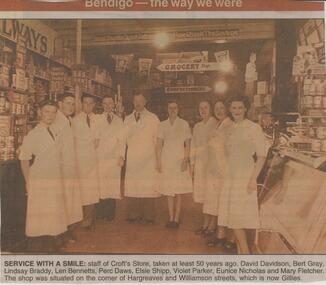
Newspaper - JENNY FOLEY COLLECTION: SERVICE WITH A SMILE
... Eventually there were 137 Crofts stores including one in Bendigo. In many cases these were the first self-serve grocery stores. ...Eventually there were 137 Crofts stores including one in Bendigo. In many cases these were the first self-serve grocery stores. ...Archibald Crofts (1875-1942) was born in India and came to Australia in the mid 1890's. He married Mary Keene i 1899 and in 1905 opened his first grocery store in Sth Melbourne. Eventually there were 137 Crofts stores including one in Bendigo. In many cases these were the first self-serve grocery stores. Crofts was also heavily involved in the South Melbourne Football Club and was its president 1933-37. He was a councillor for South Melbourne in 1931 before entering state politics in 1935 until his death.Bendigo Advertiser ''The way we were'' from 2002. Service with a smile: staff of Croft's Store, taken at least 50 years ago. David Davidson, Bert Gray, Lindsay Braddy, Len Bennetts, Perc Daws, Elsie Shipp, Violet Parker, Eunice Nicholas and Mary Fletcher. The shop was situated on the corner of Hargreaves and Williamson streets, which is now Gillies. The clip is in a folder.newspaper, bendigo advertiser, the way we were -
 City of Moorabbin Historical Society (Operating the Box Cottage Museum)
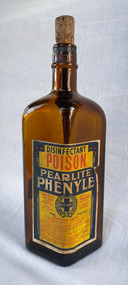
Container - Pearlite Phenyle Bottle
... Lime water and olive oil or castor oil (Perlite for Preference) EMBOSED ON BOTTLE: Phenyle with XX’s – poisonous – this bottle is the property of – 2140 STICKER: Sold by Crofts Stores Pty Ltd Branch Store: Hawthorn Road Caulfield. ...Lime water and olive oil or castor oil (Perlite for Preference) EMBOSED ON BOTTLE: Phenyle with XX’s – poisonous – this bottle is the property of – 2140 STICKER: Sold by Crofts Stores Pty Ltd Branch Store: Hawthorn Road Caulfield. 4 sided, diamond-shaped amber glass Phenyle bottle with cork stopper and paper label printed in blue, red, and yellow. ...Pearlite Phenyle was manufactured by Renown Pearlite Company Pty Ltd, which was formerly known as Pearlite Manufacturing Company. The factory was in 171-177 Stawell Street, Richmond and they manufactured kitchen products essence, Sunflakes - breakfast cereal.4 sided, diamond-shaped amber glass Phenyle bottle with cork stopper and paper label printed in blue, red, and yellow.Disinfectant – Poison – Pearlite Phenyle Poisonous not to be taken Contents 20 Fluid ozs Renown & Pearlite Pty Ltd DIRECTIONS FOR USE 2 teaspoonfuls to 1 pint of water 1 pint to 6 Gallons of water Does not contain more than 3 per cent or less than 2 pre cent or Carbolic or its homologue. Guaranteed to destroy Typhoid Fever Bacillus, 1 part fluid 30 parts water, in 10 minutes. NOTE – Placing the disinfectant in copper vessels or in contact with Alkaline Substances renders it imperative. ANTIDOTE: Epsom or Glauber salts in water. Lime water and olive oil or castor oil (Perlite for Preference) EMBOSED ON BOTTLE: Phenyle with XX’s – poisonous – this bottle is the property of – 2140 STICKER: Sold by Crofts Stores Pty Ltd Branch Store: Hawthorn Road Caulfield. phenyle, bottle, cleaning, disenfectant -
 Flagstaff Hill Maritime Museum and Village
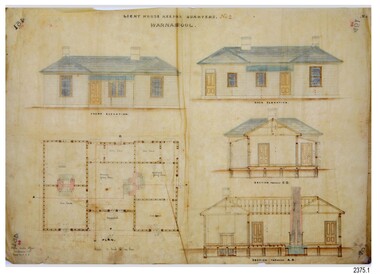
Document - Plans, Lighthouse Keeper's Quarters Warrnambool, 1858-1909
... Stores No. 2 Warrnambool. Office of Public Works. Nov. 1858 - Details Lighthouse Keepers Quarters No. 2 Warrnambool. Public Works Office Melbourne. Nov. 1858 - No.4 ‘Lighthouse No. 2 – Warrnambool. Public Works Melbourne. Nov. 1858 - No. 1, Lighthouse - Warrnambool. Office of Public Works Melbourne. 4/3/9 [1909] - Additions and Repairs, Lighthouse Quarters, Warrnambool, General Plan. Department of Public Works Melbourne. SIGNED "Croft...Stores No. 2 Warrnambool. Office of Public Works. Nov. 1858 - Details Lighthouse Keepers Quarters No. 2 Warrnambool. Public Works Office Melbourne. Nov. 1858 - No.4 ‘Lighthouse No. 2 – Warrnambool. Public Works Melbourne. Nov. 1858 - No. 1, Lighthouse - Warrnambool. Office of Public Works Melbourne. 4/3/9 [1909] - Additions and Repairs, Lighthouse Quarters, Warrnambool, General Plan. Department of Public Works Melbourne. SIGNED "Croft ...The set of seven 1858 plans shows proposed plans for the original Lighthouse Complex that was built on Middle Island in 1858-1859. The whole complex was then transferred to Flagstaff Hill in 1871. The plan, dated 1909, is for proposed additions and repairs to the Quarters at Flagstaff Hill. The plan 'Alterations and Additions' shows alternate plans for changes to the quarters at the Flagstaff Hill location. This plan has no date. The Complex comprised the Lighthouse, the Lighthouse Keepers’ Quarters, the Store (now called the Chart Room) and a Privy, which was not included in these plans. The Keeper’s bluestone Quarters was a cottage divided into two compartments, one for each keeper and his family. The bluestone Store was divided into three; a store, a workshop an oil store (or office). The Privy comprised of a small building also divided into two separate, back-to-back toilets, one for each Keeper and his family. The Flagstaff Hill Keeper's Quarters have had extensions and additions at various times, and these have also been removed at various other times. THE PLANS - *Dec. 1858 (12/58) ‘Lighthouse Keepers Quarters No.2 Warrnambool’ (2375.01)* Public Works Office Melbourne – Front and Back elevations, sections, and floor plan. The drawing shows timber walls. [The floor plan is the closest plan to the current building, however, the walls are timber in this plan.] *Nov. 1858 – No.3 ‘Lighthouse Keepers Quarters Warrnambool’ (2375.02)* Office of Public Works, Melbourne – Back and End elevations and section through. The drawing shows stone walls. One side; Senior Keeper’s bedroom, living room and kitchen with storeroom. Another side; is the Assistant’s bedroom, living room and storeroom. *Nov. 1858 - No.4 ‘Lighthouse Stores Warrnambool’ (2375.03)* Office of Public Works – Front, Side and end elevations, centre section. The drawing shows stone walls. *Nov. 1858 – No.4, ‘Lighthouse Stores No. 2 Warrnambool’ (2375.04)* Office of Public Works – Front, side and end elevations, centre section. The drawing shows timber walls. *Nov. 1858 – ‘Details Lighthouse Keepers Quarters No. 2 Warrnambool’ (2375.05)* Public Works Office Melbourne. The plan shows the foundations, joists and eaves. The drawing shows timber walls. (Nov. 1858 – ‘No.4 ‘Lighthouse No. 2 – Warrnambool’ (2375.06)* Public Works Melbourne (Part of the paper is missing). This plan shows an octagonal tower, internal stairs, a balcony landing, and a weather vane on top. *November 1858 – No. 1, ‘Lighthouse – Warrnambool’ (2375.07)* Office of Public Works Melbourne. This plan shows a round tower, including the stairs, windows on the tower and the weather vane on the top. *4/3/9 [1909] – ‘Additions and Repairs, Lighthouse Quarters, Warrnambool, General Plan’ (2375.8)* Department of Public Works Melbourne’s official stamp is signed by Croft. It shows the floor plans of the Store, Upper Lighthouse and the Quarters. The Store building has three sections; a Store, Work-Shop and Office, with an internal wall between them and separate entries. The Quarters are divided into two dwellings. The Senior Keeper’s side on the left has fireplaces in two of the three bedrooms and there is a pantry and wash house. The Assistant’s side has no fireplaces in the bedrooms and there’s no pantry or washhouse. These plans include proposed changes to the buildings. The Senior Keeper’s Quarters would have a partition on bedroom 2, a bath with plumbing and drainage, a wall moved and a built-in side porch. The Store would also have a built-in porch. The undated plan 'Additions and Alterations' (2375.9) shows alternative arrangements for water tanks, plumbing and such. WARRNAMBOOL'S LADY BAY LIGHTHOUSES- In the 1800s ships sailing from England to Australia began to use Bass Strait as a faster route to Melbourne. Small navigation errors led to many tragic shipwrecks. From 1848 lighthouses were operating along Victoria’s southern coast as a guide for sailors. Coastal towns such as Warrnambool grew and the exchange of trade and passengers were of great benefit. However, the uncertain weather changes, relatively shallow waters and treacherous, hidden rocky reefs were not suitable for a Harbour and in the 1840s and 1850s there were many shipwrecks in the area, with some even stranded in its Lady Bay harbour. A jetty was built in 1850 and a flagstaff to guide seafarers was placed up high on what became known now as Flagstaff Hill. In November 1857 the Victorian Government recommended that Warrnambool Harbour had beacons and two lighthouses to guide vessels into and out of the Harbour safely. The white light of the Middle Island lighthouse was to be used for the first time on September 1, 1859. The red light of the Beach Lighthouse, a wooden obelisk structure, was first operated on March 25, 1860, but in 1868 this light was ‘discontinued’ due to it being too low. Melbourne’s Department of Public Works decided to relocate the Middle Island Lighthouse Complex - Lighthouse, Keeper’s Quarters, Privy, Store Room and even water tanks - to Flagstaff Hill. The lower obelisk was shortened, and a protruding gallery, railing, and external ladder were added, as well as the light from the Beach Lighthouse. A green guiding light was erected on the end of the jetty. The transfer of the Complex began in March 1871. Each shaped stone of the lighthouse was carefully numbered, removed then reassembled on Flagstaff Hill. In 1872 the well was sunk behind the Lighthouse Keeper’s Cottage. The Keepers and families had left Middle Island in April and moved to Flagstaff Hill in October 1871. Vessels entering Lady Bay align the Upper and Lower Lighthouse towers during the day and the lights at night. The Upper Lighthouse is a round tower, the Lower Light is square. The Lighthouses were categorised as harbour lights rather than coastal lights, so they remain under the control of the Victorian Government’s Ports and Harbours section. The lights were originally powered by oil, then acetylene gas, later by electricity, and then converted to solar power in 1988. In 1993 the solar panel was replaced by a battery charger. A decision was made in 1936 to replace the lighthouses’ lights with unattended lights that no longer required Keepers and Assistants. At least 29 Keepers had attended to the lighthouse from its opening in 1859 to when the last official Lightkeepers left In April 1916. The Warrnambool Harbour Board rented out the Quarters from 1916 to 1936. The Board closed down but the rentals continued with other unknown landlords. In the 1970s the Flagstaff Hill Planning Board was set up under the chairmanship of John Lindsay. The Board was to make recommendations to the Warrnambool City Council regarding the use of the buildings and the rest of the Crown Land on the site. The Flagstaff Hill Maritime Village opened in 1975 and began renovating the Cottage in stages, during which time evidence of a 1920s fire was found in the eastern section of the cottage. Additions of a porch on the west and a washroom on the east were made in the 1980s. The western part of the building is now a Shipwreck Museum and the east has returned to a late 19th-century Lighthouse Keeper’s cottage and includes the screen made by Assistant Lighthouse Keeper Thomas Hope during one of his two periods of service there. THE LIGHTHOUSE KEEPERS Lighthouse Keepers were responsible for keeping their Lighthouse’s lights shining at night. They kept a lookout for passing vessels and changes in weather. They were expected to clean, polish and maintain the equipment and buildings. They kept regular and detailed records of who was on watch, and the time the light was lit, trimmed and extinguished. They kept a journal about other events that occurred. They keep regular, accurate Meteorological Logs. It was expected that they were competent in Morse code signalling. They would be called to help in times of disasters and shipwrecks, and to give official statements about these events. Many Lighthouse Keepers also volunteered as members of the lifeboat crew. The Lady Bay lighthouses were officially classified as small, so the Keepers had the official titles of Senior Assistant Lighthouse Keeper and Assistant Lighthouse Keeper. They were employed by the Public Service and paid rent to live in the Lighthouse Quarters. They were compulsorily retired at the age of 60, with most receiving a superannuation payment. Despite their time-consuming duties, there was time to follow hobbies and crafts such as growing vegetables, playing musical instruments, making models of buildings including lighthouses, and crafting furniture pieces. An example of a keeper’s skills is the carved fire screen made by /assistant Keeper Thomas Hope in the early 20th century and displayed in the Lighthouse Keeper’s cottage at Flagstaff Hill. The last occupants of the Middle Island Complex were Senior Keeper Robert Deverell, his Assistant Keeper, Andrew Farncombe, and their families. They all became the first occupants at the Lady Bay Lighthouse Keepers’ Quarters on Merri Street. The Warrnambool Lighthouse Complex plans are the origin of what is now the Lady Bay Lighthouse Complex. They are a record of the people, process and departments involved in bringing the complex into fruition. The plans are significant to the Complex, which is now listed on the Victorian Heritage Register, H1520, for being of historical, scientific (technological) and architectural significance to the State of Victoria. The Complex is significant as an example of early colonial development. The plan are significant for their connection with the important navigational function of the Lighthouses, a function still being performed to this day. The plans are also significant as an example of a product from the Public Works Department in Victoria in the mid-to-late 19th century. The structures built to these plans still stand strong. Plans for the Lighthouse Complex in Warrnambool, including Lighthouses, Keeper's Quarters and Stores. Seven of the plans are on thin fragile paper, one is on thicker, stronger paper. The drawings have been made in pens coloured red and black. They originate from Public Works in Melbourne. Seven were drawn in 1858, one in 1904, the other is not dated.Dec. 1858 - Lighthouse Keepers Quarters No.2 Warrnambool. Public Works Office Melbourne. Nov. 1858 - No.3 ‘Lighthouse Keepers Quarters Warrnambool. Public Works Office Melbourne. Nov. 1858 - No.4 ‘Lighthouse Stores Warrnambool. Office of Public Works. Nov. 1858 - No.4, ‘Lighthouse Stores No. 2 Warrnambool. Office of Public Works. Nov. 1858 - Details Lighthouse Keepers Quarters No. 2 Warrnambool. Public Works Office Melbourne. Nov. 1858 - No.4 ‘Lighthouse No. 2 – Warrnambool. Public Works Melbourne. Nov. 1858 - No. 1, Lighthouse - Warrnambool. Office of Public Works Melbourne. 4/3/9 [1909] - Additions and Repairs, Lighthouse Quarters, Warrnambool, General Plan. Department of Public Works Melbourne. SIGNED "Croft" "15A" on reverse [no date] - Lighthouse Quarters Warrnambool, Additions and Alterations. "9A" on reverseflagstaff hill, warrnambool, lighthouse keeper's cottage, lighthouse residence, lighthouse, plans, public works, melbourne, flagstaff hill maritime museum, maritime museum, shipwreck coast, flagstaff hill maritime village, chart room, quarters, privy, middle island, beach lighthouse, obelisk, lighthouse keeper, assistant keeper, lighthouse complex, lady bay, lady bay complex, keepers, upper lighthouse, lower lighthouse, ports and harbours, cottage, harbour board, flagstaff hill planning board, meteorological record, robert deverell, andrew farncombe, warrnambool port, warrnambool harbour, residence, alterations, repairs, department of works, light keeper
