
Showing 45 items matching "crouch and wilson"
-
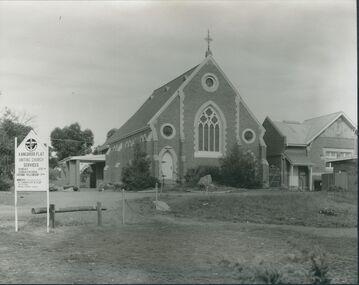 Uniting Church Archives - Synod of Victoria
Photograph, undated
... The church was designed by architects Crouch & Wilson, and constructed by Mr W. Gibbons of Castlemaine....The church was designed by architects Crouch & Wilson, and constructed by Mr W. Gibbons of Castlemaine. ...The Wesleyan Methodist Church at Kangaroo Flat was opened on 2nd July 1871, and replaced an earlier church. The church was designed by architects Crouch & Wilson, and constructed by Mr W. Gibbons of Castlemaine.B & W exterior view of the Kangaroo Flat Uniting (formerly Wesleyan Methodist) Church and adjoining hall.wesleyan methodist, kangaroo flat, crouch & wilson, w. gibbons, castlemaine -
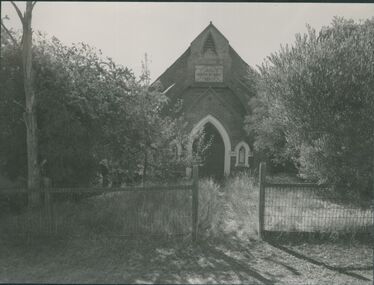 Uniting Church Archives - Synod of Victoria
Photograph, 3.3.1991
... A brick church of 1860 designed by Crouch and Wilson and an unusually early use of the Gothic style by the Primitive Methodists. ...A brick church of 1860 designed by Crouch and Wilson and an unusually early use of the Gothic style by the Primitive Methodists. ...Jubilee Primitive Methodist Church. A brick church of 1860 designed by Crouch and Wilson and an unusually early use of the Gothic style by the Primitive Methodists. The most distinctive element of the design is the pair of flying buttresses projecting at angles from the facade.B & W photograph of the exterior of the Chewton Primitive Methodist Church.ex Primitive Methodistchewton, jubileel primitive methodist, crouch and wilson, gothic -
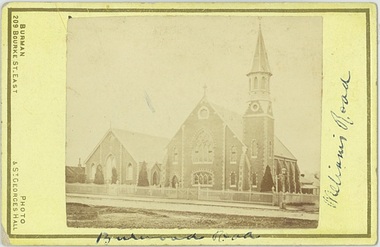 Uniting Church Archives - Synod of Victoria
Photograph, Undated c.1880
... It was designed by Messrs. Crouch and Wilson. The foundation stone was laid by the Hon. ...It was designed by Messrs. Crouch and Wilson. The foundation stone was laid by the Hon. ...The Wesleyan Church was located at the corner of Burwood Road and William St. Hawthorn. It was designed by Messrs. Crouch and Wilson. The foundation stone was laid by the Hon. Alexander Fraser MLC on 14 August 1867. The Sunday School next to the church was built in 1878.Sepia carte de visite photograph of the Wesleyan Methodist Church located at the corner of Burwood Road and Williams Street Hawthorn.Burwood Road, Williams Roadwesleyan church, hawthorn, crouch and wilson, hon. alexander fraser -
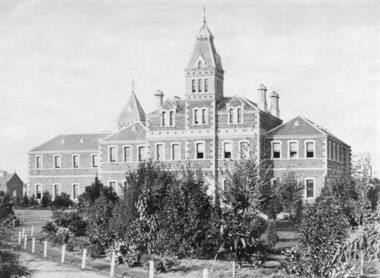 Vision Australia
Photograph - Image, RVIB building in St Kilda Road
... The Asylum and School for the Blind, designed by Crouch & Wilson, was built on St Kilda Road in 1868, and later became the Royal Victorian Institute for the Blind. ...The Asylum and School for the Blind, designed by Crouch & Wilson, was built on St Kilda Road in 1868, and later became the Royal Victorian Institute for the Blind. ...The Asylum and School for the Blind, designed by Crouch & Wilson, was built on St Kilda Road in 1868, and later became the Royal Victorian Institute for the Blind. This photograph was most likely taken in the late 19th century, with white posts and wire fencing sectioning the driveway from the garden..B/W photograph of RVIB St Kilda Road buildingroyal victorian institute for the blind, crouch & wilso -
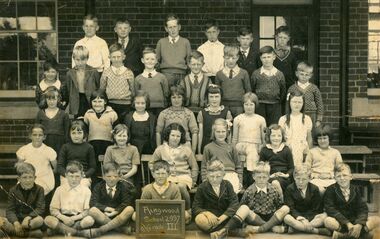 Ringwood and District Historical Society
Photograph, Ringwood State School - Class photograph- Grade 3, 1937
... 3rd Row - L to R: Kath Crouch, ?, ?, Dulcie Long, Lillian Wilson, Mollie Long, Dawn Sanders. 4th Row - L to R: Linda Washusen, ?...3rd Row - L to R: Kath Crouch, ?, ?, Dulcie Long, Lillian Wilson, Mollie Long, Dawn Sanders. 4th Row - L to R: Linda Washusen, ? ...Black and white photograph - Grade 3, 1937"Attached to photograph" Back Row - L to R: Des Trewitt, Milton Gray, Gordon Storey, (?) Richards, Wally Vincent, John Jewkes. 2nd Row -- L to R: ?, ?, Bill Dellar, Ernie Goodall, Leon Brown, ?, ?, ?. 3rd Row - L to R: Kath Crouch, ?, ?, Dulcie Long, Lillian Wilson, Mollie Long, Dawn Sanders. 4th Row - L to R: Linda Washusen, ?, ?, Dorothy hancy ?, ?, ?. Front Row- L to R: Don Parker, ?, Len Leviston, ?, Jeff Roberts, ?, Graeme Clifton, Jack McKay. Teacher: -
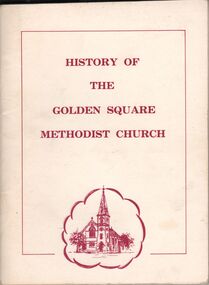 Bendigo Historical Society Inc.
Booklet - BARBARA MAMOUNEY COLLECTION: BOOKLET OF HISTORY OF THE GOLDEN SQUARE METHODIST CHURCH
... Images include the building, Church from street level then of inside and outside the church; Augustonian workers; Other members; a 64th Anniversary flyer; architects sketch (by Messrs. Crouch, and Wilson,) of the church circa 1902; reproduction of leaders weekly accounts from July,, August and September 1901; image of the Sunday School at street level reproduction of Junior member's quarterly ticket 1902; list of Property Board members names 21st June 1977 & Communion Stewards names; EXTRACTS FROM RULES OF METHODIST SOCIETIES OF THE AUSTRALASIAN WESLEYAN METHODST CHURCH 1901...Images include the building, Church from street level then of inside and outside the church; Augustonian workers; Other members; a 64th Anniversary flyer; architects sketch (by Messrs. Crouch, and Wilson,) of the church circa 1902; reproduction of leaders weekly accounts from July,, August and September 1901; image of the Sunday School at street level reproduction of Junior member's quarterly ticket 1902; list of Property Board members names 21st June 1977 & Communion Stewards names; EXTRACTS FROM RULES OF METHODIST SOCIETIES OF THE AUSTRALASIAN WESLEYAN METHODST CHURCH 1901 Booklet BARBARA MAMOUNEY COLLECTION: BOOKLET OF HISTORY OF THE GOLDEN SQUARE METHODIST CHURCH ...Foundation stone was laid in 1872 and the church closed in 2016.Cream coloured booklet by Geo Doenau from 1977 with 6 chapters but no index. Chapters include The Building; The Ministers; Choir & Organ; The Sunday School; Society Class & Local Preachers; Prominent Laymen. Images include the building, Church from street level then of inside and outside the church; Augustonian workers; Other members; a 64th Anniversary flyer; architects sketch (by Messrs. Crouch, and Wilson,) of the church circa 1902; reproduction of leaders weekly accounts from July,, August and September 1901; image of the Sunday School at street level reproduction of Junior member's quarterly ticket 1902; list of Property Board members names 21st June 1977 & Communion Stewards names; EXTRACTS FROM RULES OF METHODIST SOCIETIES OF THE AUSTRALASIAN WESLEYAN METHODST CHURCH 1901barbara mamouney, golden square methodist church -
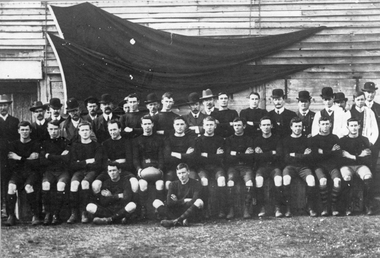 Stawell Historical Society Inc
Photograph, Stawell Football Club -- Premiers Wimmera League 1909
... BACK ROW (L to R) Alf Clearson, Bill Wilson, (Secretary S.F. C.), Fritz Thomson, Tom Mullins, Geo. ...SECOND ROW, George (Piggy) Arnott, Herb Chester, Hughie Sparks, Paddy Doyle, Arthur Parsons (Captain) Bill Earle, Gordon Scriviner, Bert Crouch, Edgar Heal, Bert Errington, Fred Crouch, jack Thompson. ...Stawell Football Club Team Premiers Wimmera League 1909. Photograph taken when a match played at Dunolly - between Dunolly and Stawell Premiers of Wimmera League, and Dunolly Premiers of Maryborough District League. Stawell winning by 5 points in 1909.Black and white photograph of a group of sports people. Three rows of people in sporting uniforms others in civilian dress with bowler hats. Taken against a background of a wooden building which has two large pennants hanging on it.BACK ROW (L to R) Alf Clearson, Bill Wilson, (Secretary S.F. C.), Fritz Thomson, Tom Mullins, Geo. Oliver (President 1910), Mat. Newton, Harry Peck, Ned. Walton, Tom Hunter, Gus. Mahnke, Bill McCullough, Bob Claringbold (President S.F.C. 1909), Frank Derry, Jim Wyatt, Roy Nettle, Jack Allison, Eddy Thomas, Hughie Dalziel, Dr. Fox, Archie Gilchrist, C. Murrells, Bill Tiddy. SECOND ROW, George (Piggy) Arnott, Herb Chester, Hughie Sparks, Paddy Doyle, Arthur Parsons (Captain) Bill Earle, Gordon Scriviner, Bert Crouch, Edgar Heal, Bert Errington, Fred Crouch, jack Thompson. FRONT ROW Ark Williams, Jackie Jackson or George Baylie. Match played at Dunolly between Dunolly and Stawell. Stawell Premiers of Wimmera League and Dunolly Premiers of Maryborough District League. Stawell winning by 5 points 1909.stawell sport -
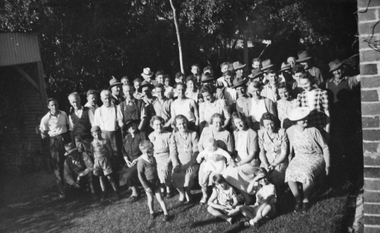 Stawell Historical Society Inc
Photograph, North Park Volunteers instrumental in making North Park at the home of Mr G LaGerche 1948, 1948
... Men L to R Roy Hurst, Alan Willoughby, Fred Crouch, Arthur Parsons, Cyril Cashin, Glynn Cashin. ...Men L to R Roy Hurst, Alan Willoughby, Fred Crouch, Arthur Parsons, Cyril Cashin, Glynn Cashin. ...Group of North Park Volunteers 1948 instrumental in making North Park. Taken in backyard of Mr G LaGerche's home Cnr Houston and Lamont Streets. This snapshot was donated by miss Glenda Hurst - Stawell - to the Society - Black and White Photograph of a large group of persons - Background of trees.On rear: North Park Volunteers 1948. Taken in the back garden of Mr G LaGerche (morning Tea). Men L to R Roy Hurst, Alan Willoughby, Fred Crouch, Arthur Parsons, Cyril Cashin, Glynn Cashin. Ladies Second Row L to R: Mrs Edna(Geoff) LaGerche, Mrs Pretty, ?, Mrs Darling, Ladies in front Row: ?, ?, Mrs Ted Mills, Mrs Harold Dunn, Miss Dorothy Kingston, Mrs Bess (bill) Wilson, ?, . Farmers brought in their Not Horse drawn graders, etc to form the two (2) ovals at "The Pug" Photo property R.W. Hurst. 29 Houston Street Stawellstawell, north park -
 Vision Australia
Photograph - Image, 1868 Time Capsule at St Kilda Road, 1985
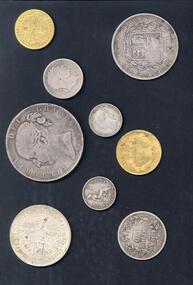
... An undated note also describes a piece of parchment in the time capsule, which contained a list of names of committee members and relevant people involved in the construction of the building, such as Crouch & Wilson; however no image of this has been located. ...An undated note also describes a piece of parchment in the time capsule, which contained a list of names of committee members and relevant people involved in the construction of the building, such as Crouch & Wilson; however no image of this has been located. ...In 1868, with the laying of the foundation stone, a time capsule was placed containing four newspapers of the day (Saturday 25 January, 1868 - The Age, The Argus, The Sun and The Telegraph: St Kilda, Prahran and South Yarra Guardian), the first Annual report of the Victorian Asylum and School for the Blind (1867), 11 coins from the Victorian regency and an illustration of the proposed building at St Kilda Road. An undated note also describes a piece of parchment in the time capsule, which contained a list of names of committee members and relevant people involved in the construction of the building, such as Crouch & Wilson; however no image of this has been located. In 1991, this time capsule was opened as part of 125 year celebrations and the contents were put on display. The capsule was the size of a house brick and buried underneath the foundation stone. It was made of metal and had to be sawn open to reveal the contents. These images are of the items found inside the time capsule. Additionally there are low res images of these items plus some photographs taken on the day: Brian Howe, Minister for Health, holds the time capsule whilst Trent Willard and Janice Johns, current RVIB students, stand by during the raising ceremony; Miss Molly Miller, the oldest surviving student, and Mr Percy Raufer, great grand nephew of Mary-Ann Raufer who was pupil number 6 and enrolled in the school in January 29th, 1866 look at the items found in the time capsule. In 2005 a new time capsule was buried, including an electronic copy of the 1867 report and drawing of St Kilda Road from the 1868 time capsule.Photographs and scans of items found inside the time capsuleroyal victorian institute for the blind, brian howe, trent willard, janice johns, molly miller, percy raufer, time capsule -
 Ballarat Heritage Services
Photograph - Church, Clare Gervasoni, Daylesford Uniting Church, 2023, 04/03/2023
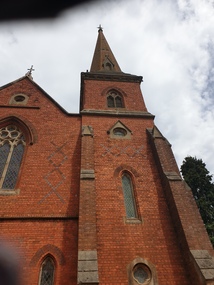
... The foundaton stone for the newer, current church was laid on 12 June 1865, designed by Architects Crouch and Wilson the structure was built in early English Gothic style. ...The foundaton stone for the newer, current church was laid on 12 June 1865, designed by Architects Crouch and Wilson the structure was built in early English Gothic style. ...The Daylesford Uniting Church (formerly Wesleyan /Methodist Church) was built in 1865, replacing an earlier Wesleyan Chapel built in 1861 which is still on site and known as the Sunday School (2024). The foundaton stone for the newer, current church was laid on 12 June 1865, designed by Architects Crouch and Wilson the structure was built in early English Gothic style. The first service was held in the new church on 10 December 1865. It is of interest for its brick broach spire, diapered brick façade and spacious interior with aisles separated from the nave by slender columns. The church organ was installed and built in 1888 by William Anderson and boasts an impressive 724 pipes, many of which are decorated with Christian symbols. This organ is a rare example of Anderson’s work and is his only instrument in Western Victoria. It is classified by the National Trust of Australia (Victoria) as being of state significance. The organ was renpvated in 1979-80 by Leighton Turner. It has 2 manuals, 14 speaking stops, 3 couplers, tracker action, Gt: 8.8 divided.8.4.4.2-2/3.2. Sw: 8.8.4.2.8. Ped: 16. In the 1880s the decline in mining led to the congregation considering ways to reduce debt. Rent was received from pew hire as well as organ concerts and annual fairs. By the end of the 19th century the church had settled into a pattern of steady parish life. The 1950s and 1960s were really the glory days of the church with an active Sunday School, tennis clubs and vibrant social activity as well as many worshippers at Sunday services. The final service was held at the church on 21 April 2024.A redbrick church on stone foundation in Daylesforddaylesford uniting church, daylesford methodist church, daylesford, john mitchell uniting church, daylesford wesleyan church, crouch and wilson, daylesford uniting sunday school -
 Ballarat Heritage Services
Photograph - Church, Clare Gervasoni, Former Daylesford Wesleyan Chapel, 2023, 04/03/2023
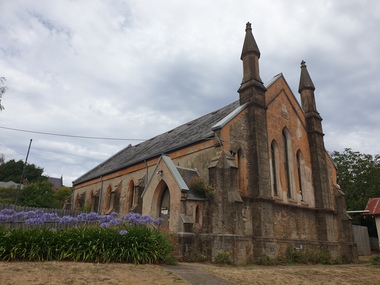
... The foundaton stone for the newer, current church was laid on 12 June 1865, designed by Architects Crouch and Wilson the structure was built in early English Gothic style. ...The foundaton stone for the newer, current church was laid on 12 June 1865, designed by Architects Crouch and Wilson the structure was built in early English Gothic style. ...The Daylesford Uniting Church (formerly Wesleyan /Methodist Church) was built in 1865, replacing an earlier Wesleyan Chapel built in 1861 which is still on site and known as the Sunday School (2024). The foundaton stone for the newer, current church was laid on 12 June 1865, designed by Architects Crouch and Wilson the structure was built in early English Gothic style. The first service was held in the new church on 10 December 1865. It is of interest for its brick broach spire, diapered brick façade and spacious interior with aisles separated from the nave by slender columns. The church organ was installed and built in 1888 by William Anderson and boasts an impressive 724 pipes, many of which are decorated with Christian symbols. This organ is a rare example of Anderson’s work and is his only instrument in Western Victoria. It is classified by the National Trust of Australia (Victoria) as being of state significance. The organ was renpvated in 1979-80 by Leighton Turner. It has 2 manuals, 14 speaking stops, 3 couplers, tracker action, Gt: 8.8 divided.8.4.4.2-2/3.2. Sw: 8.8.4.2.8. Ped: 16. In the 1880s the decline in mining led to the congregation considering ways to reduce debt. Rent was received from pew hire as well as organ concerts and annual fairs. By the end of the 19th century the church had settled into a pattern of steady parish life. The 1950s and 1960s were really the glory days of the church with an active Sunday School, tennis clubs and vibrant social activity as well as many worshippers at Sunday services. The final service was held at the church on 21 April 2024.A stone church in Daylesford. Originally built at the Daylesford Wesleyan Chapel, it was later used as the Daylesford Uniting Church Sunday School. daylesford uniting church, daylesford methodist church, daylesford, john mitchell uniting church, daylesford wesleyan church, daylesford uniting sunday school -
 Ballarat Heritage Services
Photograph - Church, Clare Gervasoni, Daylesford Uniting Church Interior, 2023, 04/03/2023
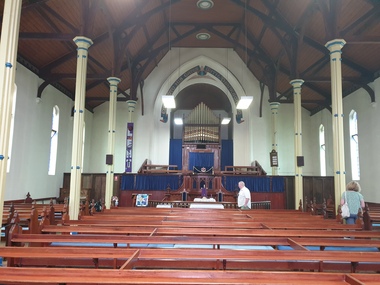
... The foundaton stone for the newer, current church was laid on 12 June 1865, designed by Architects Crouch and Wilson the structure was built in early English Gothic style. ...The foundaton stone for the newer, current church was laid on 12 June 1865, designed by Architects Crouch and Wilson the structure was built in early English Gothic style. ...The Daylesford Uniting Church (formerly Wesleyan /Methodist Church) was built in 1865, replacing an earlier Wesleyan Chapel built in 1861 which is still on site and known as the Sunday School (2024). The foundaton stone for the newer, current church was laid on 12 June 1865, designed by Architects Crouch and Wilson the structure was built in early English Gothic style. The first service was held in the new church on 10 December 1865. It is of interest for its brick broach spire, diapered brick façade and spacious interior with aisles separated from the nave by slender columns. The church organ was installed and built in 1888 by William Anderson and boasts an impressive 724 pipes, many of which are decorated with Christian symbols. This organ is a rare example of Anderson’s work and is his only instrument in Western Victoria. It is classified by the National Trust of Australia (Victoria) as being of state significance. The organ was renpvated in 1979-80 by Leighton Turner. It has 2 manuals, 14 speaking stops, 3 couplers, tracker action, Gt: 8.8 divided.8.4.4.2-2/3.2. Sw: 8.8.4.2.8. Ped: 16. In the 1880s the decline in mining led to the congregation considering ways to reduce debt. Rent was received from pew hire as well as organ concerts and annual fairs. By the end of the 19th century the church had settled into a pattern of steady parish life. The 1950s and 1960s were really the glory days of the church with an active Sunday School, tennis clubs and vibrant social activity as well as many worshippers at Sunday services. The final service was held at the church on 21 April 2024.A redbrick church on stone foundation in Daylesforddaylesford uniting church, daylesford methodist church, daylesford, john mitchell uniting church, daylesford wesleyan church, crouch and wilson, daylesford uniting sunday school -
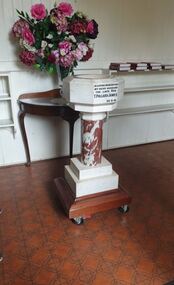 Ballarat Heritage Services
Photograph - Church, Clare Gervasoni, Daylesford Uniting Church Baptisimal Font, 2023, 04/03/2023
... The foundaton stone for the newer, current church was laid on 12 June 1865, designed by Architects Crouch and Wilson the structure was built in early English Gothic style. ...The foundaton stone for the newer, current church was laid on 12 June 1865, designed by Architects Crouch and Wilson the structure was built in early English Gothic style. ...The Daylesford Uniting Church (formerly Wesleyan /Methodist Church) was built in 1865, replacing an earlier Wesleyan Chapel built in 1861 which is still on site and known as the Sunday School (2024). The foundaton stone for the newer, current church was laid on 12 June 1865, designed by Architects Crouch and Wilson the structure was built in early English Gothic style. The first service was held in the new church on 10 December 1865. It is of interest for its brick broach spire, diapered brick façade and spacious interior with aisles separated from the nave by slender columns. The church organ was installed and built in 1888 by William Anderson and boasts an impressive 724 pipes, many of which are decorated with Christian symbols. This organ is a rare example of Anderson’s work and is his only instrument in Western Victoria. It is classified by the National Trust of Australia (Victoria) as being of state significance. The organ was renpvated in 1979-80 by Leighton Turner. It has 2 manuals, 14 speaking stops, 3 couplers, tracker action, Gt: 8.8 divided.8.4.4.2-2/3.2. Sw: 8.8.4.2.8. Ped: 16. In the 1880s the decline in mining led to the congregation considering ways to reduce debt. Rent was received from pew hire as well as organ concerts and annual fairs. By the end of the 19th century the church had settled into a pattern of steady parish life. The 1950s and 1960s were really the glory days of the church with an active Sunday School, tennis clubs and vibrant social activity as well as many worshippers at Sunday services. The final service was held at the church on 21 April 2024.A marble baptisimal font in Daylesford Uniting Church.In loving memory of my dear husband The late Rev. T. Pollard James 28.9.41daylesford uniting church, daylesford methodist church, daylesford, john mitchell uniting church, daylesford wesleyan church, daylesford uniting sunday school, baptisimal font, t. pollard james -
 Ballarat Heritage Services
Photograph - Church, Clare Gervasoni, Daylesford Uniting Church John Mitchell Memorial Hall, 2023, 04/03/2023
... The foundaton stone for the newer, current church was laid on 12 June 1865, designed by Architects Crouch and Wilson the structure was built in early English Gothic style. ...The foundaton stone for the newer, current church was laid on 12 June 1865, designed by Architects Crouch and Wilson the structure was built in early English Gothic style. ...The Daylesford Uniting Church (formerly Wesleyan /Methodist Church) was built in 1865, replacing an earlier Wesleyan Chapel built in 1861 which is still on site and known as the Sunday School (2024). The foundaton stone for the newer, current church was laid on 12 June 1865, designed by Architects Crouch and Wilson the structure was built in early English Gothic style. The first service was held in the new church on 10 December 1865. It is of interest for its brick broach spire, diapered brick façade and spacious interior with aisles separated from the nave by slender columns. The church organ was installed and built in 1888 by William Anderson and boasts an impressive 724 pipes, many of which are decorated with Christian symbols. This organ is a rare example of Anderson’s work and is his only instrument in Western Victoria. It is classified by the National Trust of Australia (Victoria) as being of state significance. The organ was renpvated in 1979-80 by Leighton Turner. It has 2 manuals, 14 speaking stops, 3 couplers, tracker action, Gt: 8.8 divided.8.4.4.2-2/3.2. Sw: 8.8.4.2.8. Ped: 16. In the 1880s the decline in mining led to the congregation considering ways to reduce debt. Rent was received from pew hire as well as organ concerts and annual fairs. By the end of the 19th century the church had settled into a pattern of steady parish life. The 1950s and 1960s were really the glory days of the church with an active Sunday School, tennis clubs and vibrant social activity as well as many worshippers at Sunday services. The final service was held at the church on 21 April 2024.A small hall in the grounds of Daylesford Uniting Church. John Mitchell was a teacher and superintendent from September 1861 to 1921. The hall was still in existence in August 2024.John Mitchell Memorial Hall 1931daylesford uniting church, daylesford methodist church, daylesford, john mitchell uniting church, daylesford wesleyan church, daylesford uniting sunday school, john mitchell -
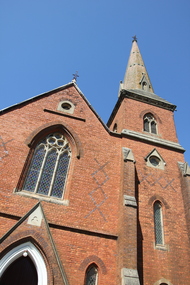 Ballarat Heritage Services
Photograph - Church, Clare Gervasoni, Daylesford Uniting Church, 18/10/2015
... The foundaton stone for the newer, current church was laid on 12 June 1865, designed by Architects Crouch and Wilson the structure was built in early English Gothic style. ...The foundaton stone for the newer, current church was laid on 12 June 1865, designed by Architects Crouch and Wilson the structure was built in early English Gothic style. ...The Daylesford Uniting Church (formerly Wesleyan /Methodist Church) was built in 1865, replacing an earlier Wesleyan Chapel built in 1861 which is still on site and known as the Sunday School (2024). The foundaton stone for the newer, current church was laid on 12 June 1865, designed by Architects Crouch and Wilson the structure was built in early English Gothic style. The first service was held in the new church on 10 December 1865. It is of interest for its brick broach spire, diapered brick façade and spacious interior with aisles separated from the nave by slender columns. The church organ was installed and built in 1888 by William Anderson and boasts an impressive 724 pipes, many of which are decorated with Christian symbols. This organ is a rare example of Anderson’s work and is his only instrument in Western Victoria. It is classified by the National Trust of Australia (Victoria) as being of state significance. The organ was renpvated in 1979-80 by Leighton Turner. It has 2 manuals, 14 speaking stops, 3 couplers, tracker action, Gt: 8.8 divided.8.4.4.2-2/3.2. Sw: 8.8.4.2.8. Ped: 16. In the 1880s the decline in mining led to the congregation considering ways to reduce debt. Rent was received from pew hire as well as organ concerts and annual fairs. By the end of the 19th century the church had settled into a pattern of steady parish life. The 1950s and 1960s were really the glory days of the church with an active Sunday School, tennis clubs and vibrant social activity as well as many worshippers at Sunday services. The final service was held at the church on 21 April 2024.A redbrick church on stone foundation in Daylesforddaylesford uniting church, daylesford methodist church, daylesford, john mitchell uniting church, daylesford wesleyan church, crouch and wilson, daylesford uniting sunday school -
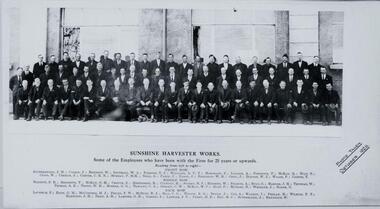 Sunshine and District Historical Society Incorporated
Photograph - Sunshine Harvester Works 25 Years of Service 1928, Oct 1928
... . : Bennetts T. : McKay G. H. : Crouch J. : Henderson R. : Clemson H. : Storey R. .... : Bennetts T. : McKay G. H. : Crouch J. : Henderson R. : Clemson H. : Storey R. ...Sunshine Harvester Works Some of the employees who have been with the firm for 25 years or upwards October 1928|Front Row Southerwood J. H. : Cairns J. : Bennett W. : Southall W. A. : Parsons T. J. : Williams A. E. T. : Marchant J. : Lawson A. : Porteous T. : McKay R. : Bult F. : Craig W. : Crehan J. : Carter C. K. R. : Murray P. McKe : Neal A. : Parle J. : Eason J. : Rogerson W. H. : Grey J. : Dalton W. J. Walsh P. : Cooper T.|Middle Row Bennett P. R. : Bennetts T. : McKay G. H. : Crouch J. : Henderson R. : Clemson H. : Storey R. J. : Herring W. : Francis A. : Bult G. : Marder J. H. : Trueman W. : Thomas A. E. : Troon W. H. : Bosher G. G. : Barclay C. A. : Osborn C. W. : McKay W. C. : Bult P. : Michael R. : Wheeler J. : Baker G.|Back Row Laverick F. : Eddy G. M. : McConnell H. J. : Fields F. W. : Hill C. G. : Wilson S. G. : Doyle J. : Cox A. : Walker I. : Phelan M. : Wilkins F. T. : Hardwood J. H. : Dean A. H. : Lampier G. H. : Garson J. : Lampier J. T. : Perry H. E. Day H. C. : Sutherland J. : Reynolds W.h.v. mckays, sunshine harvester works, employee -
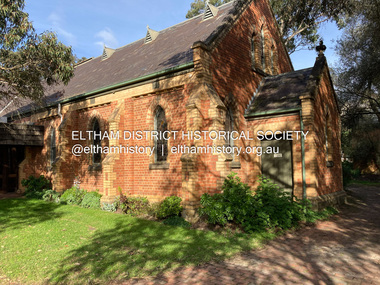 Eltham District Historical Society Inc
Photograph, Jim Connor, Eltham - Montmorency Uniting Church, 810 Main Rd, Eltham, 10 July 2023
... The present church on John Street was designed by architects Crouch and Wilson in the Early English Gothic style with biochrome brick window frames, buttress heads and pinnacle. ...The present church on John Street was designed by architects Crouch and Wilson in the Early English Gothic style with biochrome brick window frames, buttress heads and pinnacle. ...Located on the corner of Main Road and John Street, the church first served the community as the Eltham Wesleyan Church since 1881. It became the Eltham Methodist Church in 1902, the year it united with the Primitive Methodists. Eltham Wesleyans first worshipped together in the home of William and Mary Crozier, on 24 acres bounded by Mount Pleasant Road and Pitt Street. From there they moved to a slab and bark hut in 1855 (this later served as the first school run by David Clark prior to the building of a new school in Dalton Street) and the members then built a chapel in 1858 on Lot 20, Henry Street (later to become the Rechabite Hall and Eltham Public Hall). The present church on John Street was designed by architects Crouch and Wilson in the Early English Gothic style with biochrome brick window frames, buttress heads and pinnacle. Church member George Stebbing built the church, the foundations were constructed with stone from the walls of the first Eltham State Primary School (No. 209) building which collapsed in 1874 and were purchased by Robert David Taylor. Stebbing was also responsible for building St Margaret’s Church and Shillinglaw Cottage. The Roll of Honour, which presently hangs in the church hall (which also doubles as the Opportunity Shop) lists 27 members of the congregation who served in the First World War, 11 of whom never returned. The red-brick Church Hall was opened in 1931 and in 1971 further additions linked the hall and church, including a foyer, vestry, meeting room and toilets reflecting the Eltham style of that time with its simplicity, extensive clear glass, reused baked clay-bricks from the 1881 church, heavy ceiling beams and compressed straw ceiling. On June 26, 1977, the church became part of the new Uniting Church in Australia consisting of the former Methodist and Congregational and most of the Presbyterian Churches. Following of declining numbers of worshippers, the church merged with the Montmorency Uniting Church on June 23, 1996. In 2023 the Uniting church approved a plan to renovate the church. It is understood that the historic church and the hall will be retained, and the building added in 1971 is to be demolished, to make way for a new purpose-built Opportunity shop. The proposed areas to be demolished include the current foyer, toilets, crèche, etc, including the area between the hall and the former RSL. Works are expected to commence mid to late July 2023. The Society was invited by a church member to take photographs of these areas to document them prior to demolition works commencing. Ref: “Nillumbik Now and Then” by Marguerite Marshall (2008)jim connor collection, 2023-07-10, eltham-montmorency uniting church, john street, methodist church, opportunity shop, uniting church, uniting church hall -
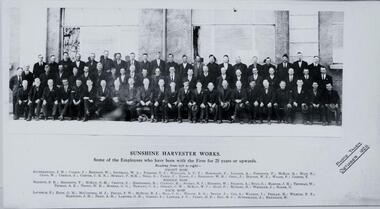 Sunshine and District Historical Society Incorporated
Photograph - Sunshine Harvester Works Some of the Employees who have been with the Firm for 25 years or upwards, 1928
... Photograph of Sunshine Harvester Works Some of the empolyees who have been with the Firm for 25 years or upwards Front Row Souteerwood JH Cairns J Bennett W Southall WA Parson TJ Williams AFT Marchant J Lawson A Porteous T McKay R Bult F Craig W Crehan J Carter CKR Murray P McK Neal A Parle J Eason J Rogerson WH Grey J Dalton WJ Walsh P Cooper T Middle Row Bennett PR Benetts T McKay GH Crouch J Henderson R Clemson H Storey RJ Herring W Francis A Bult G Marder JH Trueman W Thomas AE Troon WH Bosher GG Barclay CA Osborn CW McKay WC Bult P Michael R Wheeler J Baker G Back Row Laycrock F Eddy GM McConnell HJ Fields FW McDuff RJ Hill CG Wilson SG Doyle J Cox A Walker I Phelan M Wilkins FT Harwood JH Dean AH Lampier JT Perry HE Day HC Sutherland J Reynolds W Sepia portrait of employees of the Sunshine Harverster Works who had been with the firm for 25 years or upwards in 1928 on beige colour mounting board The names of the individuals in the portrait are printed at the bottom. ...McKay Massis Harris Massey Ferguson Employee Photograph of Sunshine Harvester Works Some of the empolyees who have been with the Firm for 25 years or upwards Front Row Souteerwood JH Cairns J Bennett W Southall WA Parson TJ Williams AFT Marchant J Lawson A Porteous T McKay R Bult F Craig W Crehan J Carter CKR Murray P McK Neal A Parle J Eason J Rogerson WH Grey J Dalton WJ Walsh P Cooper T Middle Row Bennett PR Benetts T McKay GH Crouch J Henderson R Clemson H Storey RJ Herring W Francis A Bult G Marder JH Trueman W Thomas AE Troon WH Bosher GG Barclay CA Osborn CW McKay WC Bult P Michael R Wheeler J Baker G Back Row Laycrock F Eddy GM McConnell HJ Fields FW McDuff RJ Hill CG Wilson SG Doyle J Cox A Walker I Phelan M Wilkins FT Harwood JH Dean AH Lampier JT Perry HE Day HC Sutherland J Reynolds W Sepia portrait of employees of the Sunshine Harverster Works who had been with the firm for 25 years or upwards in 1928 on beige colour mounting board The names of the individuals in the portrait are printed at the bottom. ...Photograph of Sunshine Harvester Works Some of the empolyees who have been with the Firm for 25 years or upwards Front Row Souteerwood JH Cairns J Bennett W Southall WA Parson TJ Williams AFT Marchant J Lawson A Porteous T McKay R Bult F Craig W Crehan J Carter CKR Murray P McK Neal A Parle J Eason J Rogerson WH Grey J Dalton WJ Walsh P Cooper T Middle Row Bennett PR Benetts T McKay GH Crouch J Henderson R Clemson H Storey RJ Herring W Francis A Bult G Marder JH Trueman W Thomas AE Troon WH Bosher GG Barclay CA Osborn CW McKay WC Bult P Michael R Wheeler J Baker G Back Row Laycrock F Eddy GM McConnell HJ Fields FW McDuff RJ Hill CG Wilson SG Doyle J Cox A Walker I Phelan M Wilkins FT Harwood JH Dean AH Lampier JT Perry HE Day HC Sutherland J Reynolds W Sepia portrait of employees of the Sunshine Harverster Works who had been with the firm for 25 years or upwards in 1928 on beige colour mounting board The names of the individuals in the portrait are printed at the bottom. All of the employees in the portrait would have worked with the Sunshine Harvester Works of Ballarat before the firm moved to Braybrook Junction Presumably held by the family of HC Day one of the individuals included in the portrait Photo presumably commissioned by firm. Mounted by A Frith 17 Paisley St Footscray Photo taken October 1928 is handwritten in black ink on an angle, in the lower right hand side of the mountsunshine harvester works, h.v. mckay, h.v. mckay massis harris, massey ferguson, employee -
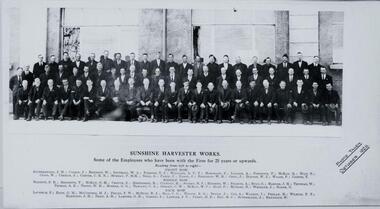 Sunshine and District Historical Society Incorporated
Photograph - Sunshine Harvester Works Some of the Employees who have been with the Firm for 25 years or upwards, 1928
... Photograph of Sunshine Harvester Works Some of the empolyees who have been with the Firm for 25 years or upwards Front Row Souteerwood JH Cairns J Bennett W Southall WA Parson TJ Williams AFT Marchant J Lawson A Porteous T McKay R Bult F Craig W Crehan J Carter CKR Murray P McK Neal A Parle J Eason J Rogerson WH Grey J Dalton WJ Walsh P Cooper T Middle Row Bennett PR Benetts T McKay GH Crouch J Henderson R Clemson H Storey RJ Herring W Francis A Bult G Marder JH Trueman W Thomas AE Troon WH Bosher GG Barclay CA Osborn CW McKay WC Bult P Michael R Wheeler J Baker G Back Row Laycrock F Eddy GM McConnell HJ Fields FW McDuff RJ Hill CG Wilson SG Doyle J Cox A Walker I Phelan M Wilkins FT Harwood JH Dean AH Lampier JT Perry HE Day HC Sutherland J Reynolds W Sepia portrait of employees of the Sunshine Harverster Works who had been with the firm for 25 years or upwards in 1928 on beige colour mounting board The names of the individuals in the portrait are printed at the bottom. ...McKays Sunshine Harvester Works Sunshine Employees Photograph of Sunshine Harvester Works Some of the empolyees who have been with the Firm for 25 years or upwards Front Row Souteerwood JH Cairns J Bennett W Southall WA Parson TJ Williams AFT Marchant J Lawson A Porteous T McKay R Bult F Craig W Crehan J Carter CKR Murray P McK Neal A Parle J Eason J Rogerson WH Grey J Dalton WJ Walsh P Cooper T Middle Row Bennett PR Benetts T McKay GH Crouch J Henderson R Clemson H Storey RJ Herring W Francis A Bult G Marder JH Trueman W Thomas AE Troon WH Bosher GG Barclay CA Osborn CW McKay WC Bult P Michael R Wheeler J Baker G Back Row Laycrock F Eddy GM McConnell HJ Fields FW McDuff RJ Hill CG Wilson SG Doyle J Cox A Walker I Phelan M Wilkins FT Harwood JH Dean AH Lampier JT Perry HE Day HC Sutherland J Reynolds W Sepia portrait of employees of the Sunshine Harverster Works who had been with the firm for 25 years or upwards in 1928 on beige colour mounting board The names of the individuals in the portrait are printed at the bottom. ...Photograph of Sunshine Harvester Works Some of the empolyees who have been with the Firm for 25 years or upwards Front Row Souteerwood JH Cairns J Bennett W Southall WA Parson TJ Williams AFT Marchant J Lawson A Porteous T McKay R Bult F Craig W Crehan J Carter CKR Murray P McK Neal A Parle J Eason J Rogerson WH Grey J Dalton WJ Walsh P Cooper T Middle Row Bennett PR Benetts T McKay GH Crouch J Henderson R Clemson H Storey RJ Herring W Francis A Bult G Marder JH Trueman W Thomas AE Troon WH Bosher GG Barclay CA Osborn CW McKay WC Bult P Michael R Wheeler J Baker G Back Row Laycrock F Eddy GM McConnell HJ Fields FW McDuff RJ Hill CG Wilson SG Doyle J Cox A Walker I Phelan M Wilkins FT Harwood JH Dean AH Lampier JT Perry HE Day HC Sutherland J Reynolds W Sepia portrait of employees of the Sunshine Harverster Works who had been with the firm for 25 years or upwards in 1928 on beige colour mounting board The names of the individuals in the portrait are printed at the bottom. All of the employees in the portrait would have worked with the Sunshine Harvester Works of Ballarat before the firm moved to Braybrook Junction Presumably held by the family of HC Day one of the individuals included in the portrait Photo presumably commissioned by firm. Mounted by A Frith 17 Paisley St Footscray Photo taken October 1928 is handwritten in black ink on an angle, in the lower right hand side of the mount. Les Day is handwritten in black ink on the back side of the mounting board in several placesh.v. mckays, sunshine harvester works, sunshine, employees -
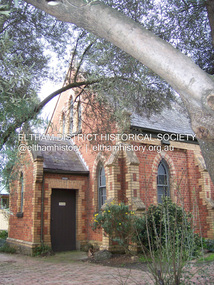 Eltham District Historical Society Inc
Photograph - Digital Photograph, Marguerite Marshall, Uniting Church, Main Road, Eltham, 19 August 2008
... The John Street building – in the Early English Gothic style with biochrome brick window frames, buttress heads and pinnacle – was designed by architects Crouch and Wilson. Church member George Stebbing built the church as he did Eltham’s St Margaret’s Anglican Church and Shillinglaw Cottage. ...The John Street building – in the Early English Gothic style with biochrome brick window frames, buttress heads and pinnacle – was designed by architects Crouch and Wilson. Church member George Stebbing built the church as he did Eltham’s St Margaret’s Anglican Church and Shillinglaw Cottage. ...Eltham's original Wesleyan Methodist Church Covered under Heritage Overlay, Nillumbik Planning Scheme. Published: Nillumbik Now and Then / Marguerite Marshall 2008; photographs Alan King with Marguerite Marshall.; p97 The pretty Uniting Church building at the corner of John and Main Roads Eltham has served the community since 1881.1 Originally called the Eltham Wesleyan Church, the church became the Eltham Methodist Church in 1902, the year it united with the Primitive Methodists.2 As the church community developed, influencing and being influenced by the wider community, its buildings changed accordingly. Eltham Wesleyans first worshiped together in 1850 at the home of William and Mary Crozier on 24 acres (9.7ha) bounded by Mount Pleasant Road and Pitt Street. From 1855 the Wesleyans worshipped in a slab-and-bark hut; then in 1858 in a chapel on Henry Street close to Maria Street (now Main Road). Meanwhile, in 1860, the Primitive Methodists opened a brick chapel at the corner of Susan and Bridge Streets. The John Street building – in the Early English Gothic style with biochrome brick window frames, buttress heads and pinnacle – was designed by architects Crouch and Wilson. Church member George Stebbing built the church as he did Eltham’s St Margaret’s Anglican Church and Shillinglaw Cottage. The Church Honour Roll is a poignant reminder of how church members have served the wider community: 27 members enlisted and 11 died in World War One. Despite the Great Depression, 1931 was a time of expansion for the church. Its red-brick hall was opened by prominent Methodist and philanthropist F J Cato of the Moran and Cato Grocery chain. The hall enabled the church to attract people from outside through activities like its gymnasium – with 40 boys and youth participating – and the girls’ callisthenics club, which competed at the Ballarat South Street Competitions. The church also held concerts, bazaars, picnics and sports, with badminton and tennis played on the church court at 23 John Street. Two stained-glass windows commemorate tragic events. A dove representing the Holy Spirit and Comforter marked the death in 1936 of member Effie Lowerson from scarlet fever at 14 years. The other depicting the Biblical story A sower went forth to sow, commemorates Ross Gangell, who died in 1961 at 23 years of a rare blood condition. Eltham’s population expanson resulted in the growth of the church and an extension in 1971, designed by member and architect Colin Jones. The church was linked to the hall and additions included a foyer, vestry, meeting room and toilets. The design reflected the Eltham style of the time, with its simplicity, extensive clear glass, reused baked clay-bricks from the 1881 church, heavy ceiling beams and solomite (compressed straw) ceiling. On June 26, 1977 the church became part of the new Uniting Church in Australia consisting of the former Methodist and Congregational and most of the Presbyterian Churches. In 1981 membership peaked at 159 – about 20 years after most Protestant churches – and continued to reach out to the wider community.3 In 1987, 147 children attended Selihoo, the weekly after-school program organised with St Margaret’s Anglican Church. From 1993, the church with other local churches, participated in LINC (Love in the Name of Christ), helping the wider community in various ways including babysitting, transport, gardening and visiting. Despite such initiatives, church numbers declined, and on June 23, 1996, the church merged with the Montmorency Uniting Church.4 However, the church continued to proclaim its message of love in community service and strong social justice action, such as in Jubilee 2000, supporting debt relief to the world’s 45 poorest countries. Some of the many church members who have had an outstanding impact on the wider community include Philip Shillinglaw, farmer and poet, and Arthur Bird (after whom the Arthur Bird Reserve is named), a pioneer orchardist and the Sunday School Superintendent for 33 years. Others were: the Rev Dr Cliff Wright, who established the Methodist Youth Fellowship and was prominent in the World Council of Churches, the Rev Brian Howe, who became Deputy Prime Minister and Tim Marshall, awarded the Order of Australia in 2000 for his work on salinity.This collection of almost 130 photos about places and people within the Shire of Nillumbik, an urban and rural municipality in Melbourne's north, contributes to an understanding of the history of the Shire. Published in 2008 immediately prior to the Black Saturday bushfires of February 7, 2009, it documents sites that were impacted, and in some cases destroyed by the fires. It includes photographs taken especially for the publication, creating a unique time capsule representing the Shire in the early 21st century. It remains the most recent comprehenesive publication devoted to the Shire's history connecting local residents to the past. nillumbik now and then (marshall-king) collection, eltham uniting church, eltham methodist church -
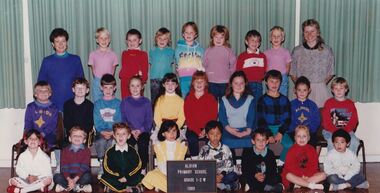 Sunshine and District Historical Society Incorporated
Photograph - Albion State School 1989 Class Photographs
... 5142.01 - Albion State School 1989 Grade 1 2W 5142.01 - Albion State School 1989 Grade 1 2W Names Back Row L2R Mrs Vicki Morris Jeremy Bond Drew Giblin Jason Witcombe Justin Tevelein Kelly Barham Timothy Meilak Luke Bond Kelly Woolley Second Row L2R Damien Meilak Trevor Gray Matthew Davis Kellie White Dimitra Kolokotsas Natasha Loft Dragana Milic Steve Taleski Chelsea Hall Kenneth Smith Front Row L2R Renee Farrugia Christopher Saunders Simon Taskov Tugba Yuksel Jerson Corcuera Mark Rogers Casey Shuliga Dominic Choi Teachers Kelly Ann Woolley Vicki Morris Principal Mr Alan Jones 5142.02 - Albion State School 1989 Grade 2 3V 5142.02 - Albion State School 1989 Grade 2 3V Names Back Row L2R Miss Verzak Ana Marek Belinda Giblin Dragan Milic Petar Joksimovic Bradley Rego Joanne Billsborrow Second Row L2R Rebecca Parker Jakup Jakupi Tony Tevelein William Wilson DeWayne Brizzi Wesley Allender Matthew Calvitto Front Row L2R Ian Dos Santos Okan Beyit Liliana Neacsu Roxanne Kelly Sherrie Skew Suzanna Zvizdalo Imelda Bongcaron Ozan Beyit Lance Harland Absent Michelle Delceppo Teacher Anne Verzak Principal Mr Alan Jones 5142.03 - Albion State School 1989 Grade 3 4M 5142.03 - Albion State School 1989 Grade 3 4M Names Back Row L2R Rebecca Wilson Nicholas Formosa Zoran Majkic Serdar Yuksei Damien McKenzie Second Row L2R Christopher Huynh Stuart Hicks Anthony Kitchen Steve Wrochna Kemal Mustaffa Zawat Souki Front Row L2R Sonia Gauci Ricky Every Tanya Smith April Keane Orienn White Philip Huynh Mark Thomas Brendan Franksen Teacher Miss Sue Maslen Principal Mr Alan Jones 5142.04 - Albion State School 1989 Grade 5 6S 5142.04 - Albion State School 1989 Grade 5 6S Names Back Row L2R Kristal Hjorth Jenny Huynh Julie Duncan Bernadette Hauk Brennan Eder Helen Passolunghi Second Row L2R Kylie Laver Adrian Downing Nathan Reid Ulku Yuksei Corey Freeman Nancy Gonzalez Paul Delceppo Robert Ayala Front Row L2R Natalie Adams Tiep Tran Boni McComb Tina Tasovac Linda Souki Rohan Franksen Chris Rogers Kristy Harty Christina Neacsu Absent Jacob Schuliga Nadia Wilson Teacher Mrs Joanne Sullivan Miss Lyn Stirling Principal Mr Alan Jones 5142.05 - Albion State School 1989 Grade Prep 1T 5142.05 - Albion State School 1989 Grade Prep 1T Names Back Row L2R Adam Souter Jillian Allender Douna Souki Mitchell Rogers Alwin Laysico Sarah Alderton Matthew Croucher Luke McComb Second Row L2R David Loft Tracey Kelly Sibel Muradoglu Shelley Duggan Haifa Majdali Jarema Bogdanowicz Vladomir Filip Daniel Simic Andrew Formosa Front Row L2R Jennifer Keane Michelle Baker Kayle Whitlow Kylie Skew Matthew Campbell Lauren Steers Helen Zingiridis Teacher Mrs B Telford Principal Mr Alan Jones 5142.06 - Albion State School 1989 Grade Prep F 5142.06 - State School 1989 Grade Prep F Names Back Row L2R Christos Zingiridis Paul Vella Kristy Hall Ben Decis Sezen Adem Steven White Jason Stafford Second Row L2R Kenny Hipworth Alicia Mahu Amanda Chiswell Luke Jones Florina Maruster Ebony Batty Kate Burrows Fatoum Souki Third Row L2R Jessica Brennan Kristine Coulson Rachel Dingli Andrea Gonzalez Jayvan McKenzie Hayley Every Tom Joksimovic Clinton Duggan Teacher Angela Ferrazzola Principal Mr Alan Jones Front Row L2R 5142.07 - Albion State School 1989 Staff 5142.07 - Albion State School 1989 Staff Names Back Row L2R Andrea Murray Tony Hilton Joanne Sullivan Second Row L2R Joy Farrell Lorna Stainer Debbie Nicholson Ana Verzak Sue Maslen Front Row L2R Kelly Quinlan Lesley Chugg Adrienne Bird Patricia Brideson Angela Ferrazzola Vicki Morris Bernadette Telford Absent Mr Alan Jones Elaine James ...Albion State School Albion Primary School Adelaide Street Albion 5142.01 - Albion State School 1989 Grade 1 2W 5142.01 - Albion State School 1989 Grade 1 2W Names Back Row L2R Mrs Vicki Morris Jeremy Bond Drew Giblin Jason Witcombe Justin Tevelein Kelly Barham Timothy Meilak Luke Bond Kelly Woolley Second Row L2R Damien Meilak Trevor Gray Matthew Davis Kellie White Dimitra Kolokotsas Natasha Loft Dragana Milic Steve Taleski Chelsea Hall Kenneth Smith Front Row L2R Renee Farrugia Christopher Saunders Simon Taskov Tugba Yuksel Jerson Corcuera Mark Rogers Casey Shuliga Dominic Choi Teachers Kelly Ann Woolley Vicki Morris Principal Mr Alan Jones 5142.02 - Albion State School 1989 Grade 2 3V 5142.02 - Albion State School 1989 Grade 2 3V Names Back Row L2R Miss Verzak Ana Marek Belinda Giblin Dragan Milic Petar Joksimovic Bradley Rego Joanne Billsborrow Second Row L2R Rebecca Parker Jakup Jakupi Tony Tevelein William Wilson DeWayne Brizzi Wesley Allender Matthew Calvitto Front Row L2R Ian Dos Santos Okan Beyit Liliana Neacsu Roxanne Kelly Sherrie Skew Suzanna Zvizdalo Imelda Bongcaron Ozan Beyit Lance Harland Absent Michelle Delceppo Teacher Anne Verzak Principal Mr Alan Jones 5142.03 - Albion State School 1989 Grade 3 4M 5142.03 - Albion State School 1989 Grade 3 4M Names Back Row L2R Rebecca Wilson Nicholas Formosa Zoran Majkic Serdar Yuksei Damien McKenzie Second Row L2R Christopher Huynh Stuart Hicks Anthony Kitchen Steve Wrochna Kemal Mustaffa Zawat Souki Front Row L2R Sonia Gauci Ricky Every Tanya Smith April Keane Orienn White Philip Huynh Mark Thomas Brendan Franksen Teacher Miss Sue Maslen Principal Mr Alan Jones 5142.04 - Albion State School 1989 Grade 5 6S 5142.04 - Albion State School 1989 Grade 5 6S Names Back Row L2R Kristal Hjorth Jenny Huynh Julie Duncan Bernadette Hauk Brennan Eder Helen Passolunghi Second Row L2R Kylie Laver Adrian Downing Nathan Reid Ulku Yuksei Corey Freeman Nancy Gonzalez Paul Delceppo Robert Ayala Front Row L2R Natalie Adams Tiep Tran Boni McComb Tina Tasovac Linda Souki Rohan Franksen Chris Rogers Kristy Harty Christina Neacsu Absent Jacob Schuliga Nadia Wilson Teacher Mrs Joanne Sullivan Miss Lyn Stirling Principal Mr Alan Jones 5142.05 - Albion State School 1989 Grade Prep 1T 5142.05 - Albion State School 1989 Grade Prep 1T Names Back Row L2R Adam Souter Jillian Allender Douna Souki Mitchell Rogers Alwin Laysico Sarah Alderton Matthew Croucher Luke McComb Second Row L2R David Loft Tracey Kelly Sibel Muradoglu Shelley Duggan Haifa Majdali Jarema Bogdanowicz Vladomir Filip Daniel Simic Andrew Formosa Front Row L2R Jennifer Keane Michelle Baker Kayle Whitlow Kylie Skew Matthew Campbell Lauren Steers Helen Zingiridis Teacher Mrs B Telford Principal Mr Alan Jones 5142.06 - Albion State School 1989 Grade Prep F 5142.06 - State School 1989 Grade Prep F Names Back Row L2R Christos Zingiridis Paul Vella Kristy Hall Ben Decis Sezen Adem Steven White Jason Stafford Second Row L2R Kenny Hipworth Alicia Mahu Amanda Chiswell Luke Jones Florina Maruster Ebony Batty Kate Burrows Fatoum Souki Third Row L2R Jessica Brennan Kristine Coulson Rachel Dingli Andrea Gonzalez Jayvan McKenzie Hayley Every Tom Joksimovic Clinton Duggan Teacher Angela Ferrazzola Principal Mr Alan Jones Front Row L2R 5142.07 - Albion State School 1989 Staff 5142.07 - Albion State School 1989 Staff Names Back Row L2R Andrea Murray Tony Hilton Joanne Sullivan Second Row L2R Joy Farrell Lorna Stainer Debbie Nicholson Ana Verzak Sue Maslen Front Row L2R Kelly Quinlan Lesley Chugg Adrienne Bird Patricia Brideson Angela Ferrazzola Vicki Morris Bernadette Telford Absent Mr Alan Jones Elaine James Collection of Digital Photographs Photograph Albion State School 1989 Class Photographs ...The current school, Albion Primary School, No 4265 opened in 1926. It was built on a site once owned by John Fitzgerald (1850s). The land was later acquired by H. V. McKay who had transferred his Sunshine Harvester Works to the area in 1905 - 7. In 1920, the Albion railway station was moved nearer Ballarat Road at the request of Mr McKay. More people came to live in the area including soldier settlers.Albion Primary School's mission is to 'Aim High' in all we do so that our students grow to be socially capable, reach their full academic potential and become caring, respectful community minded people. Albion Primary School is located in a residential area in Albion, a small pocket of the local government area of Brimbank, approximately 10 kilometres west of Melbourne and was established in 1926. Our current enrolment is 199 students. We have a rich cultural diversity amongst our school community. The school is set around a courtyard with spacious playing areas including a grassed oval, running track, games courts, an adventure playground, sand pit, jumping pits, shady courtyard and garden areas, a vegetable garden and fruit tree orchard. As well as classroom groups, we have our learning teams, student house groups (siblings are allocated to the same house) and a Junior School Council. The school has four main buildings. All classrooms have air conditioning and interactive screens. Block A houses classrooms, staff areas and the administration offices. Our newest building has classrooms and some small group/office spaces. Block B includes our library, canteen and a multi-purpose room used for indoor physical education, Perceptual Motor Program, drama, visiting performers, and community activities. Block C houses classrooms and specialist rooms. We expect and receive the best from our students in terms of their learning and behaviour. The school’s dedicated and effective staff is strongly committed to helping students achieve personal, behavioural, social and academic success. In terms of learning, the highest priority is placed on the work in English and Mathematics. We also have a range of specialist and extra-curricular programs that we provide. Our specialist teacher-librarian is involved in reading extension programs that support development in literacy. All children are able to develop their artistic abilities through visual arts and music program. Our music program is supported by the Australian Children's Music Foundation. A specialist Physical Education teacher provides lessons for all children as well as the opportunity for students to participate in organised lunch time sporting competitions between the house groups. Auslan is the additional language all students learn at Albion. All children participate in a student wellbeing program that focuses on developing strong connections and a sense of belonging within the school. Our school student leaders participate in programs that help develop their leadership skills. 5142.01 - Albion State School 1989 Grade 1 2W 5142.01 - Albion State School 1989 Grade 1 2W Names Back Row L2R Mrs Vicki Morris Jeremy Bond Drew Giblin Jason Witcombe Justin Tevelein Kelly Barham Timothy Meilak Luke Bond Kelly Woolley Second Row L2R Damien Meilak Trevor Gray Matthew Davis Kellie White Dimitra Kolokotsas Natasha Loft Dragana Milic Steve Taleski Chelsea Hall Kenneth Smith Front Row L2R Renee Farrugia Christopher Saunders Simon Taskov Tugba Yuksel Jerson Corcuera Mark Rogers Casey Shuliga Dominic Choi Teachers Kelly Ann Woolley Vicki Morris Principal Mr Alan Jones 5142.02 - Albion State School 1989 Grade 2 3V 5142.02 - Albion State School 1989 Grade 2 3V Names Back Row L2R Miss Verzak Ana Marek Belinda Giblin Dragan Milic Petar Joksimovic Bradley Rego Joanne Billsborrow Second Row L2R Rebecca Parker Jakup Jakupi Tony Tevelein William Wilson DeWayne Brizzi Wesley Allender Matthew Calvitto Front Row L2R Ian Dos Santos Okan Beyit Liliana Neacsu Roxanne Kelly Sherrie Skew Suzanna Zvizdalo Imelda Bongcaron Ozan Beyit Lance Harland Absent Michelle Delceppo Teacher Anne Verzak Principal Mr Alan Jones 5142.03 - Albion State School 1989 Grade 3 4M 5142.03 - Albion State School 1989 Grade 3 4M Names Back Row L2R Rebecca Wilson Nicholas Formosa Zoran Majkic Serdar Yuksei Damien McKenzie Second Row L2R Christopher Huynh Stuart Hicks Anthony Kitchen Steve Wrochna Kemal Mustaffa Zawat Souki Front Row L2R Sonia Gauci Ricky Every Tanya Smith April Keane Orienn White Philip Huynh Mark Thomas Brendan Franksen Teacher Miss Sue Maslen Principal Mr Alan Jones 5142.04 - Albion State School 1989 Grade 5 6S 5142.04 - Albion State School 1989 Grade 5 6S Names Back Row L2R Kristal Hjorth Jenny Huynh Julie Duncan Bernadette Hauk Brennan Eder Helen Passolunghi Second Row L2R Kylie Laver Adrian Downing Nathan Reid Ulku Yuksei Corey Freeman Nancy Gonzalez Paul Delceppo Robert Ayala Front Row L2R Natalie Adams Tiep Tran Boni McComb Tina Tasovac Linda Souki Rohan Franksen Chris Rogers Kristy Harty Christina Neacsu Absent Jacob Schuliga Nadia Wilson Teacher Mrs Joanne Sullivan Miss Lyn Stirling Principal Mr Alan Jones 5142.05 - Albion State School 1989 Grade Prep 1T 5142.05 - Albion State School 1989 Grade Prep 1T Names Back Row L2R Adam Souter Jillian Allender Douna Souki Mitchell Rogers Alwin Laysico Sarah Alderton Matthew Croucher Luke McComb Second Row L2R David Loft Tracey Kelly Sibel Muradoglu Shelley Duggan Haifa Majdali Jarema Bogdanowicz Vladomir Filip Daniel Simic Andrew Formosa Front Row L2R Jennifer Keane Michelle Baker Kayle Whitlow Kylie Skew Matthew Campbell Lauren Steers Helen Zingiridis Teacher Mrs B Telford Principal Mr Alan Jones 5142.06 - Albion State School 1989 Grade Prep F 5142.06 - State School 1989 Grade Prep F Names Back Row L2R Christos Zingiridis Paul Vella Kristy Hall Ben Decis Sezen Adem Steven White Jason Stafford Second Row L2R Kenny Hipworth Alicia Mahu Amanda Chiswell Luke Jones Florina Maruster Ebony Batty Kate Burrows Fatoum Souki Third Row L2R Jessica Brennan Kristine Coulson Rachel Dingli Andrea Gonzalez Jayvan McKenzie Hayley Every Tom Joksimovic Clinton Duggan Teacher Angela Ferrazzola Principal Mr Alan Jones Front Row L2R 5142.07 - Albion State School 1989 Staff 5142.07 - Albion State School 1989 Staff Names Back Row L2R Andrea Murray Tony Hilton Joanne Sullivan Second Row L2R Joy Farrell Lorna Stainer Debbie Nicholson Ana Verzak Sue Maslen Front Row L2R Kelly Quinlan Lesley Chugg Adrienne Bird Patricia Brideson Angela Ferrazzola Vicki Morris Bernadette Telford Absent Mr Alan Jones Elaine James albion state school, albion primary school, adelaide street, albion -
 Glen Eira Historical Society
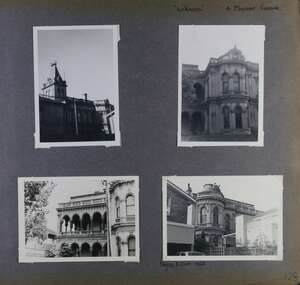
Album - Album page, Labassa, 4 Manor Grove, Circa 1972
... His first eight-roomed house was extended significantly in 1873 into a twenty-roomed house by architects Crouch and Wilson, who were possibly also responsible for the first house. ...His first eight-roomed house was extended significantly in 1873 into a twenty-roomed house by architects Crouch and Wilson, who were possibly also responsible for the first house. ...This photograph is part of the Caulfield Historical Album 1972. This album was created in approximately 1972 as part of a project by the Caulfield Historical Society to assist in identifying buildings worthy of preservation. The album is related to a Survey the Caulfield Historical Society developed in collaboration with the National Trust of Australia (Victoria) and Caulfield City Council to identify historic buildings within the City of Caulfield that warranted the protection of a National Trust Classification. Principal photographer thought to be Trevor Hart, member of Caulfield Historical Society. Most photographs were taken between 1966-1972 with a small number of photographs being older and from unknown sources. All photographs are black and white except where stated, with 386 photographs over 198 pages. HISTORY:-- From Victorian Heritage Database citation for Labassa https://vhd.heritagecouncil.vic.gov.au/places/278 as at (26/10/2020) Labassa, Caulfield is one of Melbourne's most lavishly decorated nineteenth century mansions. It resulted from the extensive remodelling in 1890, of an earlier house, known as Sylliott Hill, which was begun in 1862-3 for lawyer, Richard A. Billing. The land at the corner of Balaclava and Orrong Roads was first acquired in 1854 by William Lyall, transferred to his partner, John Mickle, in 1859, who also acquired the adjoining allotment in Balaclava Road, and the three allotments were conveyed to Billing. His first eight-roomed house was extended significantly in 1873 into a twenty-roomed house by architects Crouch and Wilson, who were possibly also responsible for the first house. This reflected Billing's success as a barrister, and he resided at this property until his death in 1882. In 1883 prominent Melbourne businessman, Alexander William Robertson, leased the Sylliott Hill property from Billing's widow, and in 1885 he purchased the adjoining allotment in Balaclava Road. He purchased the Billing's property in 1887 and renamed the 6.31 hectare property, Ontario. In 1889-90, Robertson commissioned the German born architect, John A. B. Koch, to extensively remodel the house into a thirty-five roomed mansion. The existing house was extended and altered, largely resulting in the nineteenth century mansion as it now appears. After Robertson's death in 1896, the house was tenanted until it was eventually sold to the mining millionaire, John Boyd Watson, in 1904. He renamed the property Labassa and carried out repair and re-decoration work to the house. In the early twentieth century, many large estates were subdivided into smaller allotments as the demand for land grew and it became difficult to maintain such large estates. After Watson's death in 1911, portions of the Labassa estate were offered for sale, with Mrs Watson retaining a 1.73 hectare portion containing the house. In 1913 forty-six allotments were auctioned at Labassa Estate, with the formation of Labassa Grove and Ontario Street to the east of the property. Labassa was first recorded as containing flats in 1923 and in the late 1920s, the owner, Robert Hannon, built a red brick block of flats adjacent to the house. Subdivision continued, until the National Trust of Australia (Victoria) purchased the house in 1980 and subsequently purchased adjoining sites, one to the south-east in 1984 (house demolished in 1988) and to the west in 1988. Labassa as it now stands is substantially as it appeared when Koch completed the work in 1890. The original two storey house was transformed into a French Renaissance style mansion, with the addition of a two level L-shaped arcaded verandah and two prominent terminating bays to the south and the east. The building is of unpainted cement render with dressed bluestone plinths, balustraded parapet and steep, slate covered, flat topped mansard roofs behind. A truncated conical roof is a feature of the south bay and a helmeted head is incorporated in the parapet over the east bay. The main south and east facades incorporate many cast cement details, including sculptures, elaborate cornices, swagged Corinthian columns and caryatid consoles flanking the entrance porch, as well as pink marble panels and imitation marble, or scagliola, on curved surfaces. At the rear of the building is a two storey wing and a single storey cottage, the former being connected to the main house by a tower. This section of the house was constructed in 1873. The estate at its peak included stables (1873), conservatory (probably 1890) and a tennis pavilion (probably 1890). All of these outbuildings survive, with the stables and conservatory being converted for residential use after 1922. Internally a range of decorative treatments remain from the late nineteenth century and the early twentieth century, both from the Robertson and Watson periods of occupancy. These include wallpapers, ceiling decoration, chimney pieces, mouldings, joinery and decorative glass. From Victorian Heritage Database citation for H0135 Labassa 2/2A Manor Grove Caulfield North https://vhd.heritagecouncil.vic.gov.au/places/278 as at (26/10/2020) HOW IS IT SIGNIFICANT? Labassa, Caulfield is of architectural, aesthetic and historical significance to the State of Victoria. WHY IS IT SIGNIFICANT? Labassa, Caulfield is of architectural significance as the most prominent example of a small number of houses built in Australia in the French Renaissance style. It is of further note due to the German interpretation of the style and the use of Hellenistic sources, via Germany. It is exceptional for its lavish treatment externally, including marble, scagliola, caryatids, swagged columns, mansard roofs and ornamental cresting. Labassa is of architectural significance as the most important surviving example of German architect, John Koch's domestic work. He undertook a large variety of work in Melbourne, including a number of houses, however Labassa is the most lavish example of his work. Labassa is of aesthetic significance for its outstanding assemblage of late nineteenth and early twentieth century European style interior decoration, which remain remarkably intact. These include a trompe l'oeil ceiling, painted ceilings, embossed imitation leather and other papers, chimney pieces, ceramic tilework, oak parquetry and stained glass, including a tripartite window by Ferguson and Urie, probably dating from the 1873 period. Labassa is of historical significance as an illustrative example of the wealth acquired by a number of prominent Victorian families in the second half of the 19th century. The early development of the property, Sylliott Hill, was due to the wealth acquired by Richard Billing, barrister and fifth Victorian to be appointed Queen's Counsel in 1878. The significant development in 1890 of Ontario, is illustrative of the wealth of Alexander Robertson, a partner in Cobb and Co., a director of Goldsborough Mort & Co., and a pastoral speculator. John B. Watson, whose father had acquired great wealth from the goldfields of Bendigo and subsequently invested in city and country properties, was the third resident to impact on the house, particularly the interiors. The Labassa estate is of historical significance as an illustrative example of the development that occurred in such suburbs as Caulfield in the 1880s due to the land boom, its proximity to Melbourne and the establishment of the Melbourne to Gippsland railway in 1879. It is also illustrative of an estate which succumbed to the pressures of subdividing in the early twentieth century, as properties became difficult to maintain and demand for land close to the city grew. It was typically divided into flats in the 1920s and was used as such for about sixty years. It is of historical significance for its associations with the remnants of the earlier estate which remain extant. These include the stables, conservatory (H2005) and tennis pavilion which all remain on separate sites. Also significant are the remains of early electrical wiring and fittings. Labassa was one of the first houses in Caulfield to be electrified and some of the original wires remain. [Online Data Upgrade Project 2004]Page 128 of Photograph Album with four photographs (two portrait and two landscape) of Labassa.Handwritten: "Labassa" 4 Manor Grove [top right] / Neg 232 8 Oct 1966 [under bottom right photo] / 128 [bottom right]trevor hart, bracketed eaves, slate roof, bay windows, decorative brackets, caulfield north, labassa, richard a. billing, balaclava road, orrong road, sylliott hill, william lyall, crouch and wilson, alexander william robertson, ontario, 1880's, john a. b. koch, mansion, john boyd watson, labassa grove, french renaissance style, l-shaped arcaded verandah, bluestone plinths, balustraded parapet, flat topped mansard roofs, conical roof, elaborate cornices, corinthian columns, caryatid consoles, marble panels, imitation marble, scagliola, tower, conservatory, stables, tennis pavilion, mouldings, decorative glass, caryatids, swagged columns, ornamental cresting, trompe l'oeil ceiling, embossed imitation leather, oak parquetry, stained glass, tripartite window, triple window, ferguson and urie, 1870's, flats, 1920's, electric wiring, 1860's, verandahs, curved windows, arched windows, italianate, terraces, gargoyles, ornamentation, ornate entrance, la bassa, manor grove, st kilda east, victorian, cast iron work, john koch, richard billing, architects, electrification, john mickle, land subdivision, mrs watson, labassa estate, robert hannon, national trust of australia (victoria), sculpture -
 Glen Eira Historical Society
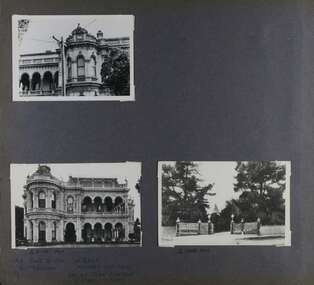
Album - Album page, Labassa, 4 Manor Grove, Circa 1972
... His first eight-roomed house was extended significantly in 1873 into a twenty-roomed house by architects Crouch and Wilson, who were possibly also responsible for the first house. ...His first eight-roomed house was extended significantly in 1873 into a twenty-roomed house by architects Crouch and Wilson, who were possibly also responsible for the first house. ...This photograph is part of the Caulfield Historical Album 1972. This album was created in approximately 1972 as part of a project by the Caulfield Historical Society to assist in identifying buildings worthy of preservation. The album is related to a Survey the Caulfield Historical Society developed in collaboration with the National Trust of Australia (Victoria) and Caulfield City Council to identify historic buildings within the City of Caulfield that warranted the protection of a National Trust Classification. Principal photographer thought to be Trevor Hart, member of Caulfield Historical Society. Most photographs were taken between 1966-1972 with a small number of photographs being older and from unknown sources. All photographs are black and white except where stated, with 386 photographs over 198 pages. HISTORY:-- From Victorian Heritage Database citation for Labassa https://vhd.heritagecouncil.vic.gov.au/places/278 as at (26/10/2020) Labassa, Caulfield is one of Melbourne's most lavishly decorated nineteenth century mansions. It resulted from the extensive remodelling in 1890, of an earlier house, known as Sylliott Hill, which was begun in 1862-3 for lawyer, Richard A. Billing. The land at the corner of Balaclava and Orrong Roads was first acquired in 1854 by William Lyall, transferred to his partner, John Mickle, in 1859, who also acquired the adjoining allotment in Balaclava Road, and the three allotments were conveyed to Billing. His first eight-roomed house was extended significantly in 1873 into a twenty-roomed house by architects Crouch and Wilson, who were possibly also responsible for the first house. This reflected Billing's success as a barrister, and he resided at this property until his death in 1882. In 1883 prominent Melbourne businessman, Alexander William Robertson, leased the Sylliott Hill property from Billing's widow, and in 1885 he purchased the adjoining allotment in Balaclava Road. He purchased the Billing's property in 1887 and renamed the 6.31 hectare property, Ontario. In 1889-90, Robertson commissioned the German born architect, John A. B. Koch, to extensively remodel the house into a thirty-five roomed mansion. The existing house was extended and altered, largely resulting in the nineteenth century mansion as it now appears. After Robertson's death in 1896, the house was tenanted until it was eventually sold to the mining millionaire, John Boyd Watson, in 1904. He renamed the property Labassa and carried out repair and re-decoration work to the house. In the early twentieth century, many large estates were subdivided into smaller allotments as the demand for land grew and it became difficult to maintain such large estates. After Watson's death in 1911, portions of the Labassa estate were offered for sale, with Mrs Watson retaining a 1.73 hectare portion containing the house. In 1913 forty-six allotments were auctioned at Labassa Estate, with the formation of Labassa Grove and Ontario Street to the east of the property. Labassa was first recorded as containing flats in 1923 and in the late 1920s, the owner, Robert Hannon, built a red brick block of flats adjacent to the house. Subdivision continued, until the National Trust of Australia (Victoria) purchased the house in 1980 and subsequently purchased adjoining sites, one to the south-east in 1984 (house demolished in 1988) and to the west in 1988. Labassa as it now stands is substantially as it appeared when Koch completed the work in 1890. The original two storey house was transformed into a French Renaissance style mansion, with the addition of a two level L-shaped arcaded verandah and two prominent terminating bays to the south and the east. The building is of unpainted cement render with dressed bluestone plinths, balustraded parapet and steep, slate covered, flat topped mansard roofs behind. A truncated conical roof is a feature of the south bay and a helmeted head is incorporated in the parapet over the east bay. The main south and east facades incorporate many cast cement details, including sculptures, elaborate cornices, swagged Corinthian columns and caryatid consoles flanking the entrance porch, as well as pink marble panels and imitation marble, or scagliola, on curved surfaces. At the rear of the building is a two storey wing and a single storey cottage, the former being connected to the main house by a tower. This section of the house was constructed in 1873. The estate at its peak included stables (1873), conservatory (probably 1890) and a tennis pavilion (probably 1890). All of these outbuildings survive, with the stables and conservatory being converted for residential use after 1922. Internally a range of decorative treatments remain from the late nineteenth century and the early twentieth century, both from the Robertson and Watson periods of occupancy. These include wallpapers, ceiling decoration, chimney pieces, mouldings, joinery and decorative glass.From Victorian Heritage Database citation for H0135 Labassa 2/2A Manor Grove Caulfield North https://vhd.heritagecouncil.vic.gov.au/places/278 as at (26/10/2020) HOW IS IT SIGNIFICANT? Labassa, Caulfield is of architectural, aesthetic and historical significance to the State of Victoria. WHY IS IT SIGNIFICANT? Labassa, Caulfield is of architectural significance as the most prominent example of a small number of houses built in Australia in the French Renaissance style. It is of further note due to the German interpretation of the style and the use of Hellenistic sources, via Germany. It is exceptional for its lavish treatment externally, including marble, scagliola, caryatids, swagged columns, mansard roofs and ornamental cresting. Labassa is of architectural significance as the most important surviving example of German architect, John Koch's domestic work. He undertook a large variety of work in Melbourne, including a number of houses, however Labassa is the most lavish example of his work. Labassa is of aesthetic significance for its outstanding assemblage of late nineteenth and early twentieth century European style interior decoration, which remain remarkably intact. These include a trompe l'oeil ceiling, painted ceilings, embossed imitation leather and other papers, chimney pieces, ceramic tilework, oak parquetry and stained glass, including a tripartite window by Ferguson and Urie, probably dating from the 1873 period. Labassa is of historical significance as an illustrative example of the wealth acquired by a number of prominent Victorian families in the second half of the 19th century. The early development of the property, Sylliott Hill, was due to the wealth acquired by Richard Billing, barrister and fifth Victorian to be appointed Queen's Counsel in 1878. The significant development in 1890 of Ontario, is illustrative of the wealth of Alexander Robertson, a partner in Cobb and Co., a director of Goldsborough Mort & Co., and a pastoral speculator. John B. Watson, whose father had acquired great wealth from the goldfields of Bendigo and subsequently invested in city and country properties, was the third resident to impact on the house, particularly the interiors. The Labassa estate is of historical significance as an illustrative example of the development that occurred in such suburbs as Caulfield in the 1880s due to the land boom, its proximity to Melbourne and the establishment of the Melbourne to Gippsland railway in 1879. It is also illustrative of an estate which succumbed to the pressures of subdividing in the early twentieth century, as properties became difficult to maintain and demand for land close to the city grew. It was typically divided into flats in the 1920s and was used as such for about sixty years. It is of historical significance for its associations with the remnants of the earlier estate which remain extant. These include the stables, conservatory (H2005) and tennis pavilion which all remain on separate sites. Also significant are the remains of early electrical wiring and fittings. Labassa was one of the first houses in Caulfield to be electrified and some of the original wires remain. [Online Data Upgrade Project 2004]Page 129 of Photograph Album with three landscape photographs of Labassa. One of the photographs is of Labassa's drive and gates.Handwritten: 4 JUNE 1910 / SALE JUNE 28 1910 "LA BASSA' / "AUSTRALASIAN" FORMERLY "ONTARIO"/ RES OF JOHN B WATSON / 15 ACRES 3 ROADS [under bottom left photo] / 4 JUNE 1910 [under bottom right photo] / 129 [bottom left]trevor hart, bracketed eaves, intricate lacework, slate roof, bay windows, decorative brackets, caulfield north, labassa, richard a. billing, balaclava road, orrong road, sylliott hill, william lyall, crouch and wilson, alexander william robertson, ontario, 1880's, john a. b. koch, mansion, john boyd watson, labassa grove, french renaissance style, l-shaped arcaded verandah, bluestone plinths, balustraded parapet, flat topped mansard roofs, conical roof, elaborate cornices, corinthian columns, caryatid consoles, marble panels, imitation marble, scagliola, tower, conservatory, stables, tennis pavilion, mouldings, decorative glass, caryatids, swagged columns, ornamental cresting, trompe l'oeil ceiling, embossed imitation leather, oak parquetry, stained glass, tripartite window, triple window, ferguson and urie, 1870's, flats, 1920's, electric wiring, 1860's, verandahs, curved windows, arched windows, italianate, terraces, gargoyles, ornamentation, ornate entrance, la bassa, manor grove, st kilda east, gates, cast iron work, richard billing, architects, john koch, electrification, victorian style, drives, john mickle, land subdivision, mrs watson, labassa estate, robert hannon, national trust of australia (victoria), sculpture -
 Kew Historical Society Inc
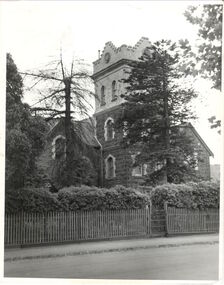
Photograph, J E & B L Rogers, 'Ivy Grange', Malmsbury Street, c. 1965
... He added, probably the tower wing, to the house in 1877 when architects Crouch and Wilson called tenders in that year 'for the erection of bluestone additions to (a) villa at Kew, for Davis Beath Esq.' ...He added, probably the tower wing, to the house in 1877 when architects Crouch and Wilson called tenders in that year 'for the erection of bluestone additions to (a) villa at Kew, for Davis Beath Esq.' ...Rate Book evidence records that by 1870 Charles Vickers, architect, was the occupier of this house, having an NA.V. at that date o f£1105, although it is apparent that the house was in fact built by 1864, from the dat; set in the brickwork above the main door. In 1873 the property was purchased by David Beath, a merchant, and it was in the following year that the house was first recorded as 'Ivy Grange'. Beath was a deeply religious man and was a foundation member of both the Congregational and the Presbyterian (the Church of Scotland) Churches of Kew . He added, probably the tower wing, to the house in 1877 when architects Crouch and Wilson called tenders in that year 'for the erection of bluestone additions to (a) villa at Kew, for Davis Beath Esq.' The house was again added to in 1885 by the leading firm Reed, Henderson and Smart. For a number of years in the 1920s 'Ivy Grange' was used as a private mental hospital and is currently a guest house. In 1921 a fete was held at Ivy Grange in aid of building a new church (Sacred Heart, Kew): "Garden Fete in Aid of New Church, Kew. A SUCCESSFUL FUNCTION. Beautiful weather favoured the opening of a garden fete at "Ivy Grange," the residence of Mr. and Mrs. J. Lawlor, Malmsbury and Princess streets, Kew, on last Saturday afternoon, in aid of the fine new Church of the Sacred Heart, Kew, which is now receiving its finishing touches. Not content to wait for the official opening, the lady stallholders did a good business on the previous evening. The ceremony was performed" by the Very Rev. Dean Hegarty, P.P., V.F. (Carlton), with whom were associated the Rev. J. Manly, P.P. (Kew), and the Rev. R. S. Benson, P.P. (South Yarra), Mr. and Mrs. J. Lawlor, and others. Fr. Manly, who was cordially received, said he desired to thank Mr. and Mrs. Lawlor for lending their charming grounds, and for the trouble, time and expense they had given to preparing for the fete. He wished to thank Dean Hegarty for coming to open the fete. The Dean had been a dear and lifelong friend of the late Fr. O'Donoghoe, the beloved pastor of the Kew parish. Next June the Dean would celebrate the golden jubilee of his priesthood, so they could see that he was not a young man. (Laughter.) He hoped that the fete would be a great success, and that when his Grace the Archbishop —: (applause) — should open the new church, he (the speaker) would be able to present a satisfactory financial statement. (Applause.) Dean Hegarty, who was very cordially received, said it was a source of great pleasure to him to come to Kew, of which he entertained many pleasant recollections. The new church would have delighted the heart of their late beloved pastor, but it had pleased God to take him to a holler temple. His mantle had fallen on worthy shoulders, in the person of Fr. Manly—(applause)—who was carrying on the work of the parish well and vigorously. (Applause.) Some wondered how these great works were successfully accomplished. The prime factor in the wonderful progress of the Church— the work of the people, priests and nuns—was their deep, abiding Catholic faith. (Applause.) Kew was not by any means a large parish, yet look at the magnificent church that Fr. Manly was building on the hill! He said to his people, "Come, follow me, and we shall win through." (Applause.) It gave him great pleasure to declare the fete open, and he wished it the highest measure of success. (Prolonged applause.) Mr. J. Lawlor, who was greeted with applause, in moving a hearty vote of thanks to Dean Hegarty for his presence and support, said he knew of the great work done by the Dean in Gippsland, where he (the speaker) lived when a young man. The Dean ministered to a parish at that time as large as was the diocese of Sale to-day. The Dean and Fr. Manly reflected credit on the pioneer priests, who had laid well and solidly the foundations, of religion in Victoria. (Applause.) He was glad that reference had been~made to the work of their late beloved pastor, Fr. O'Donoghoe. : Mr. Pierce Cody seconded the motion, which, was carried by acclamation. The Dean,* in acknowledging the compliment, paid a tribute to Mr. and Mrs. Lawlor for their great generosity in connection with the fete, and complimented them on their successful efforts. (Applause.). A cafe chantant, organised by Mr. John. Sullivan, was contributed to by Misses G. Hornal, M. O'Donnell, Ella Burke, Eileen Burke, Alice Marsh, and M. Carrucan, and Messrs. T. Hammond, J. Donovan, J. Sullivan, and Fr. Lanigan. Mrs. J. Donovan was at the piano. St. Vincent de Paul Boys' Orphanage Band (South Melbourne) rendered selections. The stalls ware as follow:—Cake and Sweets Stall: Mesdames Needham, Treacey, Lynch and Cody. Fancy Stall: Mesdames Lawlor, J. P. Martin, M. Treacey, Simpson, Giddons and A. Molton, and Miss, Shirley. Refrestiment Stall: Mesdames Shiels, Hunter, Kealy, Duane and the Misses Turner and Delahunty; Produce Stall: Mesdames O'Sullivan, Mareli, Carrucan, and Kennedy. Mr. P. J. Kennedy acted as hon. general secretary. The fete was continued in the evening, the grounds being brilliantly illuminated. (Advocate (Melbourne, Vic. : 1868 - 1954), Thursday 7 April 1921, page 13) In 1930 it was acquired by the Carmelite Fathers for use as a novitiate: "IVY GRANGE," KEW." Acquired for Carmelite Novitiate. The valuable property, "Ivy Grange," Kew. which" belonged to the McGuiness family has been acquired by the Carmelite Fathers for a novitiate." (Advocate (Melbourne, Vic. : 1868 - 1954), Thursday 18 September 1930, page 18This work forms part of the collection assembled by the historian Dorothy Rogers, that was donated to the Kew Historical Society by her son John Rogers in 2015. The manuscripts, photographs, maps, and documents were sourced by her from both family and local collections or produced as references for her print publications. Many were directly used by Rogers in writing ‘Lovely Old Homes of Kew’ (1961) and 'A History of Kew' (1973), or the numerous articles on local history that she produced for suburban newspapers. Most of the photographs in the collection include detailed annotations in her hand. The Rogers Collection provides a comprehensive insight into the working habits of a historian in the 1960s and 1970s. Together it forms the largest privately-donated collection within the archives of the Kew Historical Society.Ivy Grange, cnr Malmsbury and Princess Streets, Kew. Ivy Grange. Home of David Beath. Commenced 1864, Tower Wing added 1877. Chap 38.ivy grange, malmsbury street, dorothy rogers, david beath, charles vickers, crouch and wilson, kew houses -
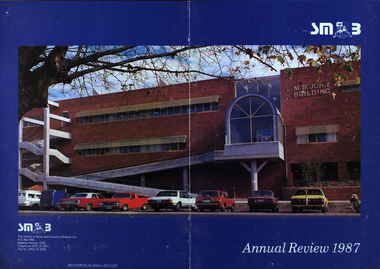 Federation University Historical Collection
Booklet - Annual Review, Ballarat School of Mines Annual Review, 1986 -1991
... Founders Day (Hadden Storey), Gwyn Hanssen-Pigott, Ken Latta, Neville Bunning Outstanding Achievement Award, Valerie Wilson, Jack Barker, John Sharpham, Jack Barker Resignation. ...The Ballarat School of Mines was established in 1870 through the initiatives of the Ballarat Mining Board making it the oldest site of technical education in Australia. The Board was concerned with the shortage of mine managers for the goldfields. Classes began in surveying, mathematics, and chemistry and a decade later they included metallurgy , assaying and geology. With the decline in goldmining the direction of the college changed and broadened, the art School was established and the Ballarat Junior Technical School developed. In 1976, the tertiary sector seperated from the School of Mines and Industries Ballarat to form the Ballarat College of Advanced Education. In the 1980s SMB was a Community College of Technical Education and Further Education (TAFE) offering a wide range of vocational, enrichment and preparatory programs. It is continuing the tradition of providing for the educaiton needs of people within the Central Highlands. During the 1970s and 80s it acquired and refurbished old buildings and developed new facilities to keep up with the needs of an expanding curriculum and student population. The era of these annual reports is just before the merger with the University of Ballarat.A number of soft card covered annual report for the Ballarat School of Mines. .1) 12 page black covered report featuring an image of the E.J. Tippett Library. Includes information on death of E.J. Tippett, disability policy, Peter Quinn, Patti McNulty, Bob Feary, Shane Everand, Integration, Fiona Watson, retirement of Robert Morgan, Opening of the carpentry and Joinery Facility in Davey Street, formation of the School of Business and Information Technology, Melissa Bone, opening of the E.J. T. Tippett Learning Resource Centre (Library), Refurbishment of the Administration Building, Food Service Building (Prospects), Court House Theatre, Enrolment centre, Museum, Creche, Women's Trade technical Program, Rural Education Program, Ararat Prison Program, Community Studies Section, Ararat Adult Literacy Group. Literacy Assistance for Undergraduates, Fire training, fitness, open Learning, Training & Employment Group, Awards, Filipino Visitors, oil Seed Research, Brunei, Barometer (gift) for Horticulture, Special Equipment (guillotine and brake press; programmable logic Controller; theodolite: laser lever; Universal testing Machine; Atomic Absorption Spectrophotometer)., organisational Structure. Photos include Ken Flecknoe, Peter Quinn, Patti McNulty, Bob Feary, Shane Everard, Fiona Watson,Linda Bland, Robert Morgan, David McCaughey, E.J. Tippett, Frank Sheehan, Julie Baulch, Jo Reeves, Col McCurry, Jenny Garnham .3) Blue covered book with a photograph of the M.B. John Building taken from Albert Street on the cover. Topics include: Ken Flecknoe, Peter Shiells, Ararat Campus, David Haddow, Kevin Martin, Rendle Hannah, Gary Eason, Geoff Pope, Albert Peart, M.B. John building opened, Hairdressing Salon, Community Centre, Creche, closure of Lydiard Street, Museum, Jenny Levison, Inskill, Small Business Training, Ballarat Eat free Library, Barkly Street, Wormalds Valve Group, Aboriginal Programs, Horticulture Center, Awards, Country fire Authority, tractor Donation, Women's Policy. Special purchases included surveying equipment with data recorder, test rig , CDT MIG welder, compact gas chromatograph with FID and single pen recorder, Olivetti stand-alone word processing unit. Images include Ken Flecknoe. Peter Shiells, John Crowe, Trevor Slater, Brian McLennan, Kerrie Cross, Albert Peart, John Cain, M.B. John, Enrollment Centre, Museum, Jo Watson, Wormalds, Brian Webber, Dianna Nikelson, Ian Aitken, Brendan B, Chez Dichiera, Heather Dixon, Julie Broadbent .4) 1993 - Brown and white soft covered annual review featuring students of the Ballarat School of Mines at work. Bill Gribble, Brian McLennan, Peter Shiells Retirement, Robert C. Lovett, Steven Mendelson, Max Palmer, Jenny Gough, Mary Molloy, Barrie Firth, Colin McCurry, Dora Hormann, Organisation Structure, Brewery Acquisition, Humffray Street Primary School, Grant Street Retaining Wall, Neville Bunning Plaque, VCE Plus, Ballarat Small Business centre, Ararat Prison, Ballarat Showgrounds Rotunda, .6) Green covered annual review with an aerial photograph over Albert Street, Ballarat. Content include Kerrie Cross, Peter Shiells. Kenneth Flecknoe Obituary, Ian Pimblett, Keith Boast, David Nicholson, Max Palmer, Brian Webber, Bob Lovett, Linda Bland, Prospects, Training restaurant, 3BBB, Malcolm Vallance, Aboriginal Programs, Ian Cathie, Koorie Support Unit, Caroline Hogg, 'Trained Men Make Their Own Terms' exhibition at the Gold Museum, Ricky Hains, Stephen Hughes, Jeff White, Dennis Bolster .8) Blue covered review for 1989. The contents include: Kerrie Cross, Peter Shiells, Ann McCaffrey, Kevin Alsop, Mary Molloy, Ross Furness, Robert Lovett, Victoria Street Student Hostel, Hugh Beggs, Ballarat Small Business Centre, Inskill, Ararat Campus, Hospitality and Tourism, Koorie Support Unit, Fiona Warsn, Bruce Staley, Terry Moran, Anthony Wonish, Ivan Deveson, Leo Shannon Memorial Award, Bryan Crebbin, Geoff Howard, R.C.W. Burdett, Jeff White, Ian Harris, Tom Wiseman, Bill Gribble, Allison Kay, Steven Mendelson, Keith Boast. .9) Grey covered book with a coloured photo of the Victoria Street Student Residence. Contents include: Kerry Cross, Peter Shiells, Morgan Bevan John Illuminated address. Jean Phillips, Koorie Support Unit, Andrew Sullivan, Victoria Street Student Residence, Horticulture, Inskill, Tertiary Awareness Project, Adult Education, Ivan Deveson, Brian Howe, Barry Jones, Joan Kirner, Andrew Trigg, Warren Perry, Murrell Rock Collections, Gwyn Hanssen-Piggott, Disability Awareness Day, Sebastopol Borough Logo, Phoebe Rimmer, Russell Jackson, R.J. Young Scholarship, Peter Muir, Founders Day Cake, Morgan John. .11) Black card covered booklet with five images of exteriors of the Ballarat School of Mines. the contents include: Jack Barker, Peter Shiells, Peter Ellyard, Ian Stoney, Terry Moran, Wayne Strong, David Ince, Simone Titheridge, Ian Aitken,Kevin Alsop, Bill Bridges, Clive Carmichael, Bob Feary, Rendle hannah, Roly Parfenovics, Graham Snibson, Kevin Stockdale, Len Wilson, Child Care Centre opening, Student accommodation, Victoria Street, Brewery site. naming buildings, E.J. barker. A.W. Steane K.J. Flecknow, Carpentry and joinery, Inskill, Hospitality, Pottery, ceramics, Founders' Day, Warren Perry, Agreement between Ballarat School of Mines and Ballarat university College, merger, Peter Baldwin, Awards, obituary Lindsay Hillman. Images include: Wayne Strong, David Ince, Simone Titheridge, kerrie Cross, Joan Kirner, Frank Sheehan, Bill Gribble Ros Wilkie, Judi O'Loughlin, Tony Leonard, Gemma Hearnes, Brendan Hill, Joanne Bell, Karl Moon, Stella Savy, Shirley Falkinder, Peter Baldwin, Jack Barker, Michael Ronaldson, David Kemp, Peter Shiells, Margot Healey, Sharon McLennan, Kerrie Firns, Petrena Brookers, Deb Goudappel, Claire Bond, Administration Building Lindsay Hillman. .13 ) Brown covered report with photographic images. Content includes: Pam Merrett. , Peter Shiells, Robert Lovett, Steven Mendelson, Max Palmer, Jenny Gough, Barrie Firth .14) Brown covered report with photographic images. Content includes: .15) Green covered report with photographic images. The blond woman standing on the right looking at a computer screen is Pam Merrett. Content includes: Bill Gribble, Ron Wild, Doug Sarah, Martin Hill, John Kemp, David Manterfield, Leslie Comy, Linette Penhall, Glen Martland. Virginia Fenelon. Michael Bracher, Brewery Building. Child care centre, Prospects Cafe Opening, Horticulture Training Centre, Retaining Wall, The Gordon, University of Ballarat and Ballarat School of Mines affiliation, Geoffrey Blainey, Ararat Community College Memo of understanding, Brian McLennan. Founders Day (Hadden Storey), Gwyn Hanssen-Pigott, Ken Latta, Neville Bunning Outstanding Achievement Award, Valerie Wilson, Jack Barker, John Sharpham, Jack Barker Resignation.ballarat school of mines, university of ballarat, integration, shane everard, robery morgan, linda bland, ballarat junior technical school, former court house, ken flecknoe, bruce muir, lindsay hillman, neil crouch, jack barker, keith boast, rex hollioake, m.b. john, bob lovett, brian mclennan, peter shiells, bruce tanner, jeff white, bryan crebbin, kerrie cross, ric dunlop, tom wiseman, barbara hughes, chris matheson, morgan b. john, albert street, steven mendelson, john crowe, ann mccaffrey, kevin alsop, mary molloy, ross furness, robert lovett, victoria street student hostel, student residences, hugh beggs, ballarat small business centre, inskill, ararat campus, hospitality and tourism, koorie support unit, fiona watson, bruce staley, terry moran, anthony wonish, ivan deveson, leo shannon memorial award, geoff howard, r.c.w. burdett, ian harris, bill gribble, allison kay, liz eddy, pam merrett, doug sarah, martin hill, john kemp, david manterfield, leslie comy, linette penhall, glen martland, virginia fenelon, michael bracher, brewery building, child care centre, prospects cafe, horticulture training centre, retaining wall, the gordon, university of ballarat and ballarat school of mines affiliation, geoffrey blainey, ararat community college memo of understanding, founders day, hadden storey, gwyn hanssen-pigott, ken latta, neville bunning outstanding achievement award, valerie wilson, john sharpham, kerry cross, morgan bevan john illuminated address, jean phillips, andrew sullivan, victoria street student residence, horticulture, inskill, tertiary awareness project, adult education, brian howe, barry jones, joan kirner, andrew trigg, warren perry, murrell rock collections, gwyn hanssen-piggott, disability awareness day, sebastopol borough logo, phoebe rimmer, russell jackson, r.j. young scholarship, peter muir, kenneth flecknoe obituary, ian pimblett, david nicholson, brian webber, prospects, training restaurant, 3bbb, malcolm vallance, aboriginal programs, ian cathie, caroline hogg, 'trained men make their own terms' exhibition at the gold museum, ricky hains, stephen hughes, dennis bolster, aboriginal education, e.j. tippett obituary, patti mcnulty, bob feary, equal opportunity officer, robert c. morgan, school of business and information technology, e.j. tippett library, e.j. tippett library opening, carpentry and joinery, women's trade and technical program, rural education program, ararat prison program, barometer, oil seed research, . bill gribble, peter shiells retirement, robert c. lovett, max palmer, jenny gough, barrie firth, colin mccurry, dora hormann, organisation structure, brewery acquisition, humffray street primary school, grant street retaining wall, neville bunning plaque, vce plus, ararat prison, ballarat showgrounds rotunda -
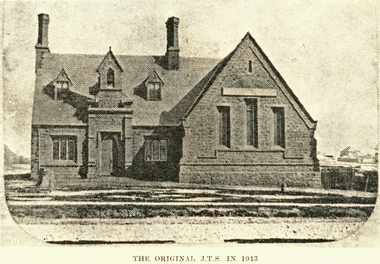 Federation University Historical Collection
Magazine - Booklet, F.W. Niven, Ballarat School of Mines Students' Magazine, 1957, 1957
... McLennan A. Clarke G. Wilson T. Coad J. Caldwell D. Chung R. Champneys J. ...The Ballarat School of Mines produced an annual students' magazine from 1899 - 1966. Contents include, School Council, Members of Staff, 1st Corbould Scholarship, Australian Speech, Art Lending Library, Literary Society, football, Boys' Junior Technical School, Bullarto Camp Reunion, John Leckie, Stan Hillman, Girls' Junior Technical School, Parliament House, Ballarat North Junior Technical School Images include: Craig's Royal Hotel, Peter Robinson, John Thomas Huyton Clelland, John Wolfe, Bernie Gallagher, Nelson Hails, John Gowan, Beverley Selkirk, Pat Collier, Barry Singleton Mara Jekabsons, Bill Widdop, Neil Brogden, frank Pomeroy, Laurence Trevan, Neville Bunning, Jim McKay, Malcolm Hausler, Josephine Young, George Lewis, Alan Clarke, Norman Leckie, Andrew Atkins, Lorette Davey, Noel Flood, Denis Bryan, SMB Football Team, SMB Athletics Team, SMB Baseball Team, SMB Basketball Team, SMB Tennis Team, Athletic Champions, R. Ross, I. Beaumont, R. Parker, G. Waller, John Rash, J. Sarah, J. Walters, P. Rowe, L. Drummond, R. Whitcher, ATC Flight No 24, BJTS Football Team, BJTS Swimming Team, BJTS Tennis Team, BJTS Athletics Squad, BJTS Cricket Team, BJTS Softball team and coach, W. Sawall, L. McDonald, K. Penna, J. Clarke, K. Rogers, Mr Wilson, F. Holmes, graham Manning, Andrew Brumby, Kevin Rogers, Graham Walters, Yellow soft covered students' magazine of 92 pages. keith alexander, brian bellingham, neil brogden, bernie gallagher, john gowan, francis hunting, teng hor khoo, teng seong khoo, norman leckie, boon thiam lu, brian mclennan, peter russell, chookiate sirivingse, laurie trean, john wolfe, ballarat school of mines, peter robinson, john thomas huyton clelland, d. w. brown, n. bunning, jim mckay, barry singleton, malcolm hausler, josephine young, george lewis, alan clarke, andrew atkins, lorette davey, noel flood, denis bryans, john mckenzie, robert skewes, ian fraser, walter reimann, pat collier, ralph hepburn, peter m. robinson, a. bethune, j. lane, d. colbourn, w. etty, b. bellingham, n. hails, t. white, p. agrums, w. widdop, f. pomeroy, b. singleton, j. mckay, j. pollock, r. cutter, d. vendy, j. wolfe, p. collier, w. bowtell, r. hepburn, w. wynd, p. menz, b. dunstan, j. gowan, l. groat, g. westwood, j. erdmanis, a. rock, k. alexander, p. walker, w. reimann, n. delosa, b. mclennan, a. clarke, g. wilson, t. coad, j. caldwell, d. chung, r. champneys, j. mckenzie, b. paterson, j. cowan, somnam nandhabiwat, w. spencer, p. schoutens, d. treller, gayle peterson, denise lockett, carmel dobbyn, margaret ayars, raymond jenkin, l. nester, w. eyers, r. ross, g. dreever, r. ross, i. beaumont, r. parker, g. waller, j. rash, j. sarah, j. walters, p. rowe, l. drummond, r. whitcher, r. ingle, i. pollock, p. bilney, i. collier, l. thomas, g. leslie, p. schoutens, a. morris, g. wells, b. mcgregor, j. bedggood, k. spencer, j. vincent, j. elliott, j. whitten, g. higgins, g. le couteur, h. mcdougall, g. wise, m. allen, d. pattie, i. collinson, c. kearns, g. severino, g. smith, n. smith, f. tolliday, r. williams, d. coldicott, m. hewitt, g. higgins, c. ludbrook, j. simpson, glenys spielvogel, norma davies, dawn ridgeway, carmel dobbyn, beverley davis, j. crouch, kathleen harris, j. walters, jan hunter, j. carroll, c. jenkins, lesley cutts, h. vagg, irene horgan, graham manning, andrew brumby, kevin rogers, graham walters, k. howell, n. malthouse, l. deppler, g. manning, n. nugent, b. antonio, r. mccarthy, mr morrison, r. mckenzie, w. wakeling, j. clarke, l. mayne, n. bromley, a. brumby, a. abrams, k. penna, r. button, p. linane, f. holmes, n. yean, mr love, miss atkins, p. cochrane, i. quick, mr mitchell, b. flynn, r. brown, k. penna, j. mcmahon, g. turnbull, n. skewes, d. vowles, d. blake, mr nuttall, g. borchers, i. greenbank, d. evans, j. whelan, j. milne, w. sawall, d. ward, r. rundell, mr ellerton, m. foy, l. reed, c. tilgals, peter agrums -
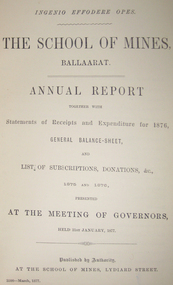 Federation University Historical Collection
Book - Register, Ballarat School of Mines Donation Book, 1878 - 1895
... Nature of Donation: Copy of the Victorian Review No 74 December 1 1885, Copy Wide Awake Vol 1 No 6 May 21st 1887 ballarat school of mines ballarat school of mines museum benjamin hepburn ce clarke j noble wilson m hamburger d christy edwin jewell ellery john gray go preshaw cf crouch henry brind james darby rm serjeant george day jf watson stoddart j hicks hicks james hector sleep jj sleep james pearce henry obree newman william tarrant beilby william bradford george lansell watson edward gazzard e morey john lynch j hector rivett bland bland costin whittle crowther mitchell ferdinand krause krause joseph mitchell john walker bailey duncan mica smith alfred mica smith james buchanan buchanan whitehouse dr bunce bunce james bklack james bickett js north joseph flude alfred lester wagemann fw niven edwards william evett john addis al elphinstone henry sutton ol olden bh cross robert hamilton hancock ferdinand von mueller von meuller berchevaise j whitehouse serjeant henty james shugg john ross james oddie ralph tate henry watts wh wooster wooster luplau rosenblum heddington albert furmedge buley robert wilson e. rowlands ne hall henry pearce lee young nicholls dusontory daniel brohpy brophy klug james donaldson john cherry ce jones john feilds thomas williams enscoe e price shoppee jacob drew george wyatt dimmock james orr john hardy george wyatte thomas rogers james lamb doepel margaret guerin bella guerin guerin george binns william laplau captain baker baker crisp barnard haffie bateman chalmers richard parker adam adamson jn wilson john noble wilson papenhagen towl government astronomer royal society minister of mines thoams blackett burbury denny thys p gay james law woolnough Large rough calf covered book recording museum, laboratory and library donations to the Ballarat School of Mines. 4835 donations are recorded.Marbled end papers. ...The Ballarat School of Mines was the first School of Mines in the southern hemisphere. Its Museum was established in 1872. Donation 600, 4 July 1882, H. Sutton, Ballarat. Nature of Donation: 13th Annual report of the Aeronautical Society of Great Britain 2 papers 'from the proceedings of the Royal Society', Nos 217 & 218 - 1882 communicated by the President :on a new electrical Storage battery" by Henry Sutton, Ballarat, Victoria Donation 976, 8 May 1884, H. Sutton, Ballarat. Nature of Donation: * 1 volume "Pluttner on the Blowpipe: (Pluttner's manual of qualitative & quantitative analysis of the blowpipe. Donation 1682, 28 Feb 1887, James Lamb, Ballarat. Nature of Donation: Copy of "The Ballarat Times" newspaper of 3 December 1854, framed, and protected on both sides with glass. Donation 1712, 28 April 1887, Marg. Guerin, Ballaarat. Nature of Donation: Specimens nos (797-806) 797-801 from the New Reform Mine Luchnow, NSW (797) Serpentine with vein of quartz and calcite (798) Surpentine passing into silicous ferruginoous gossan; with drives of rock crystal (&99) Diorite with vein of calcite (800) Auriferous vein stuff (801) Auriferous arrenopyrite with calcite (802) noble opal filling cavities in decomposed traclyte (803-805) from Mr McDonald, NSW (806) arutute (carbonate of lead) in long schombie purni (?) Donation 1730, 23 May 1887, Miss Guerin, Ballaarat. Nature of Donation: Copy of the Victorian Review No 74 December 1 1885, Copy Wide Awake Vol 1 No 6 May 21st 1887Large rough calf covered book recording museum, laboratory and library donations to the Ballarat School of Mines. 4835 donations are recorded.Marbled end papers. Labels on spine and front cover.ballarat school of mines, ballarat school of mines museum, benjamin hepburn, ce clarke, j noble wilson, m hamburger, d christy, edwin jewell, ellery, john gray, go preshaw, cf crouch, henry brind, james darby, rm serjeant, george day, jf watson, stoddart, j hicks, hicks, james hector, sleep, jj sleep, james pearce, henry obree, newman, william tarrant, beilby, william bradford, george lansell, watson, edward gazzard, e morey, john lynch, j hector, rivett bland, bland, costin, whittle, crowther, mitchell, ferdinand krause, krause, joseph mitchell, john walker, bailey, duncan, mica smith, alfred mica smith, james buchanan, buchanan, whitehouse, dr bunce, bunce, james bklack, james bickett, js north, joseph flude, alfred lester, wagemann, fw niven, edwards, william evett, john addis, al elphinstone, henry sutton, ol olden, bh cross, robert hamilton, hancock, ferdinand von mueller, von meuller, berchevaise, j whitehouse, serjeant, henty, james shugg, john ross, james oddie, ralph tate, henry watts, wh wooster, wooster, luplau, rosenblum, heddington, albert furmedge, buley, robert wilson, e. rowlands, ne hall, henry pearce, lee young, nicholls, dusontory, daniel brohpy, brophy, klug, james donaldson, john cherry, ce jones, john feilds, thomas williams, enscoe, e price, shoppee, jacob drew, george wyatt, dimmock, james orr, john hardy, george wyatte, thomas rogers, james lamb, doepel, margaret guerin, bella guerin, guerin, george binns, william laplau, captain baker, baker, crisp, barnard, haffie, bateman, chalmers, richard parker, adam adamson, jn wilson, john noble wilson, papenhagen, towl, government astronomer, royal society, minister of mines, thoams blackett, burbury, denny, thys, p gay, james law, woolnough -
 Federation University Historical Collection
Book, Ballarat School of Mines Minute Book , 1876-1881, 1876-1881
... The first president of the Ballarat School of Mines was Redmond Barry. ballarat school of mines henry richards caselli w.h. barnard flude usher august hoelscher warrington rogers james oddie robert m. sergeant ferdinand krause curator w.p. bechervaise james flude school of mines exhibition committee james bickett hugh grey & son ballarat juvenile industrial exhibition charles shoppee g.o. preshaw alfred mica smith rivet henry bland r.w. newman noble wilson william burbidge marie barbour george hall susan cahir mary troy pharmacy botany f.f. bailliere richard viccars mary usher f. pinkerton pyrites works james campbell telegraphy william bailey judge rogers ballarat school of mines certificates william f. west j. bryant henry obree w.h. odgers edward debois james darby redmond barry pharmacy board w.h. keast george perry f.w. niven fedinand von mueller benjamin trewhella d. miliken charles strachan william wilson r.a.f. murray e.p. figgis charles flude laboratory john richards eyres brothers john armstrong h.b. de la poer wall c.f. crouch William H. ...The Ballarat School of Mines was established in 1870 and was a predecessor institution of Federation University. The first president of the Ballarat School of Mines was Redmond Barry.Half leather bound ledger containing handwritten minutes of the Ballarat School of Mines. Includes: * Foundation Class in Pharmacy and Botany (17/04/1979) * Female Telegraphy Students (12/06/1917)ballarat school of mines, henry richards caselli, w.h. barnard, flude, usher, august hoelscher, warrington rogers, james oddie, robert m. sergeant, ferdinand krause, curator, w.p. bechervaise, james flude, school of mines exhibition committee, james bickett, hugh grey & son, ballarat juvenile industrial exhibition, charles shoppee, g.o. preshaw, alfred mica smith, rivet henry bland, r.w. newman, noble wilson, william burbidge, marie barbour, george hall, susan cahir, mary troy, pharmacy, botany, f.f. bailliere, richard viccars, mary usher, f. pinkerton, pyrites works, james campbell, telegraphy, william bailey, judge rogers, ballarat school of mines certificates, william f. west, j. bryant, henry obree, w.h. odgers, edward debois, james darby, redmond barry, pharmacy board, w.h. keast, george perry, f.w. niven, fedinand von mueller, benjamin trewhella, d. miliken, charles strachan, william wilson, r.a.f. murray, e.p. figgis, charles flude, laboratory, john richards, eyres brothers, john armstrong, h.b. de la poer wall, c.f. crouch, william h. keast, frank pintkerton, hugh grey -
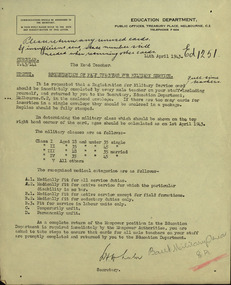 Federation University Historical Collection
Letter - Correspondence, Numerous letters of different sizes relating to the Ballarat School of Mines, 1943, 1943
... education department defence training branch world war two a.j. murdoch fred l. gray william baragwanath t.a.l. farr h.b. george b.a. john a.w. lynch f. middleton a.w. nicholson g.k. sutton m.g. beanland v.c. jones m.b. john d. maxwell n. mchutchison j. smail l.j. wilson technical education ballarat school of mines george m. downing geoffrey w. crouch douglas e. hale amel r. gordon alan h. gilpin jack w. sandall harold j. hassell andrew j.e. campbell dressmaking ballarat junior technical school art courses edward james quick maxwell donald gilbert john alexander mcbride young patriotic guild f.w. ferguson ruby h. lonie annie a. jones william j. meinhardt alan j. murdoch d. metcalfe cromwell george bray stanley robert marshall young workers patriotic guild certificate j.m. sutherland nursing douglas philip campbell raymond george colbourne g.w. cornell geoffrey biddington bill carroll douglas george dean robert james egginton percival david fisher norman ludbrook maxwell pescott ernest j. poppins lindsay wallis joy martin heseltine allsop yates pound lambert richards cornell sutherland goldsmith mein hillman gordon mullins wilkinson ferguson jeffrey paterson mayo whitla cotton warson bergin gilpin johnston trengrove proctor brew rowlands gardiner airforce ballarat school of mines F.G. ...Numerous letters of different sizes relating to the Ballarat School of Mines in 1943. .16) Education Department Correspondence requesting registration of all male teachers for military service. List of those registered are Heseltine, Allsop, Yates, Pound, Lambert, Richards, Cornell, Sutherland, Goldsmith, Mein, Hillman, Gordon, Mullins, Wilkinson, Ferguson, Jeffrey, Paterson, Mayo, Whitla, Cotton, Warson, Bergin, Gilpin, Johnston, Trengrove, Proctor, Brew, Rowlands, Gardiner .31) Special Leave arrangements for defence Training instructors and staff on Education Training Branch letterhead. The leave relates to the Ballarat SChool of Mines' A. J. Murdock .32) Ballarat School of Mines COuncil Members, statistics, student numbers, Staff Members and salary, etc .33) R.H. Parsons of Footscray nominated as the representative of Technical School Councils .34) Edward James Quick, Maxwell Donald Gilbert and John Alexander McBride qualify for the Young Patriotic Guild .35) Ballarat School of Mines recommending increase in rates of pay for female Clerical Workers (Ruby H. Lonie, Annie A. Jones) .37) Ballarat School of Mines requesting authority for part-time appointments (William J. Meinhardt, Alan J. Murdoch, D. Metcalfe) .38) Cromwell George Bray is recommended for the Young Workers Patriotic Guild Certificate. He raised 1 pound, 2 shillings, 4 pence by selling oilcloth scraps, catching mice and doing odd jobs, cleaning drains and taps. .39) Stanley Robert Marshall is recommended for the Young Workers Patriotic Guild Certificate. He raised 1 pound by running messages and doing odd jobs. .40) Extension of J.M. Sutherland's appointment at the Ballarat School of Mines .41) Pre-Nursing Education Course for Girls' School .42) Douglas Philip Campbell and Raymond George Colbourne are recommended for the Young Workers Patriotic Guild Certificate. .43) Report on holders of Senior Technical Scholarships attending the Ballarat School of Mines (Geoffrey Biddington, Bill Carroll, Douglas George Dean, Robert James Egginton, Percival David Fisher, Norman Ludbrook, Maxwell Pescott, Ernest J. Poppins, Lindsay Wallis, Joy Martin) .44) Visit to the Ballarat School of Mines concerning proposed new workshop units .45) Promotion of G.W. Cornelleducation department defence training branch, world war two, a.j. murdoch, fred l. gray, william baragwanath, t.a.l. farr, h.b. george, b.a. john, a.w. lynch, f. middleton, a.w. nicholson, g.k. sutton, m.g. beanland, v.c. jones, m.b. john, d. maxwell, n. mchutchison, j. smail, l.j. wilson, technical education, ballarat school of mines, george m. downing, geoffrey w. crouch, douglas e. hale, amel r. gordon, alan h. gilpin, jack w. sandall, harold j. hassell, andrew j.e. campbell, dressmaking, ballarat junior technical school, art courses, edward james quick, maxwell donald gilbert, john alexander mcbride, young patriotic guild, f.w. ferguson, ruby h. lonie, annie a. jones, william j. meinhardt, alan j. murdoch, d. metcalfe, cromwell george bray, stanley robert marshall, young workers patriotic guild certificate, j.m. sutherland, nursing, douglas philip campbell, raymond george colbourne, g.w. cornell, geoffrey biddington, bill carroll, douglas george dean, robert james egginton, percival david fisher, norman ludbrook, maxwell pescott, ernest j. poppins, lindsay wallis, joy martin, heseltine, allsop, yates, pound, lambert, richards, cornell, sutherland, goldsmith, mein, hillman, gordon, mullins, wilkinson, ferguson, jeffrey, paterson, mayo, whitla, cotton, warson, bergin, gilpin, johnston, trengrove, proctor, brew, rowlands, gardiner, airforce, ballarat school of mines, f.g. procter, gladstone procter, military service, annie jones -
 Federation University Historical Collection
Book - Scrap Book, Ballarat School of Mines Scrap Book, 1924 - 1929, c1931
... The scrap books were kept by the librarians and related to topics of interest to the Ballarat School of Mines, its students and its staff. ballarat school of mines martha pinkerton scrap book a.w. nicholson john lynch (junior) mount lyell leslie evans leslie blake evans herald shield for athletics ballarat school of mines museum motor mechanics' classes for ladies farm engineering villers bretonneux carvings trengrove museum port pirrie j.i. simpson reuben s. russelll ballarat technical art school charles harvey elliott gower la gerche c. curnow applied art macroberston scholarship ballarat school of mines procession rag vale park tree planting smb ball pottery classes delineascope mica smith scholarship james peart burma mnies smb excursion to western australia kalgoorlie elsie mckissock war trophies warwick smith spencer street bridge war museum richard j. young alfred mica smith obituary reginald callister john rowell sewerage installation h.h. smith w.h. middleton olive scott dolly whitehead vale park ballarat war museum opening repatriation classes sewerage at the ballarat school of mines australian coals j.p. ellsworth yallourn w.g. walker reunion norfolk island pine mica smith memorial jessice smith harry fern t. henderson bhp john adam ols students' association l.b. curnow laura crouch signwriting excursion port pirrie excursion albert potter pearl fricke technica school sports percy trompf ballarat school of mines battery albert mclean a.d.r. galloway alan douglas richard galloway r.j. young alan ludbrook r. timpe ballarat ironworkers and polytechnic association h. jolly carpentry harold jolly millinery classes phoenix model locomotive s.j. morgan r.d. bannister juvenile industrial exhibition w.h. shaw j.c. winds f.h. davis h.r. worland w.t. magee l. george l. balhausen white flat oval resue from yarrowee creek e. berriman ballarat teachers' college reg mcconnell mount lyell co munro reaper munro reaper model weaving classes mervyn trimmings briquette dust edna findlay jean rogers n. mccallum jessie glass classroom ventilation art metal charles fenner levi molyneux olice scott poster competition kerr grant w.h. steane h. caddy colvin smith claude creelman robert colins stan hillman n.c. heathcote egg collection john alexander nornie gude charles deane graham hopwood roswald john dart max wilson new battery jess hopwood william middleton a.e.c. kerr hand weaving classes m. martin a.h. leeson mona rogerson lorna bailey prospectors classes edwin robinson Kalgoorlie vist railway locomotive 17 December 1954 - Ballarat Junior Technical School Headmaster's Report 05 February 1925 - Ballarat School of Mines Museum closure 25 February 1925 - War Trophies Museum 06 May 1925 - Ballarat's Museum. ...The Ballarat School of Mines was a predecessor institution of Federatin University Australia. The scrap books were kept by the librarians and related to topics of interest to the Ballarat School of Mines, its students and its staff. 17 December 1954 - Ballarat Junior Technical School Headmaster's Report 05 February 1925 - Ballarat School of Mines Museum closure 25 February 1925 - War Trophies Museum 06 May 1925 - Ballarat's Museum. Where is it? Some Interesting Facts 14 May 1925 - White Flat Reserve 21 June 1928 - Ballarat School of Mines Procession 14 March 1929 - Mr A.D.R. Galloway - An Australian Abroad - Tragic end. 1929 - Technical Education 17 October 1929 - Agricultural Engineering 15 February 1930 - Ballarat School of Mines Student Association 20 February 1930 - 61s Annual Meeting of the Ballarat School of Mines 02 June 1930 - R. Young in Belgium and visits battlefields including Hill 60. 19 February 1931 - School Hostel Suggested 14 April 1931 - Frank Pinkerton Obituary 15 October 1921 - Life at Mt Isa (E. Loveland) 18 February 1932 - Discussion on Teachers College (Ballarat Teachers' College) 11 July 1931 - Phoenix Model Locomotive donation to the Ballarat School of Mines 06 May 1932 - The Mt Isa Country 11 Oct 1932 - Death of F.W. Alsopp (former SMB student) 21 January 1933 - Education In Victoria: Will a New Era Open 28 September 1933 - New Teaching System Explained by the Minister 17 February 1934 - Trip to New Guinea (A.F. Heseltine) 19 April 1934 - Early Ballarat - Address by Nathan Spielvogel 30 August 1934 - Ballarat Junior Technical School Tennis Court 23 August 1934 - Welding plant and Battery 17 June 1935 - Men about Town - A.F. Heseltine 21 June 1935 - Vocational Guidance 16 July 1935 - Ballarat School of Mines (history) 03 August 1935 - Men About Town - William H. Middleton 10 August 1935 - A.E.C. Kerrballarat school of mines, martha pinkerton, scrap book, a.w. nicholson, john lynch (junior), mount lyell, leslie evans, leslie blake evans, herald shield for athletics, ballarat school of mines museum, motor mechanics' classes for ladies, farm engineering, villers bretonneux carvings, trengrove, museum, port pirrie, j.i. simpson, reuben s. russelll, ballarat technical art school, charles harvey, elliott gower, la gerche, c. curnow, applied art, macroberston scholarship, ballarat school of mines procession, rag, vale park tree planting, smb ball, pottery classes, delineascope, mica smith scholarship, james peart, burma mnies, smb excursion to western australia, kalgoorlie, elsie mckissock, war trophies, warwick smith, spencer street bridge, war museum, richard j. young, alfred mica smith obituary, reginald callister, john rowell, sewerage installation, h.h. smith, w.h. middleton, olive scott, dolly whitehead, vale park, ballarat war museum opening, repatriation classes, sewerage at the ballarat school of mines, australian coals, j.p. ellsworth, yallourn, w.g. walker, reunion, norfolk island pine, mica smith memorial, jessice smith, harry fern, t. henderson, bhp, john adam, ols students' association, l.b. curnow, laura crouch, signwriting, excursion, port pirrie excursion, albert potter, pearl fricke, technica school sports, percy trompf, ballarat school of mines battery, albert mclean, a.d.r. galloway, alan douglas richard galloway, r.j. young, alan ludbrook, r. timpe, ballarat ironworkers and polytechnic association, h. jolly, carpentry, harold jolly, millinery classes, phoenix model locomotive, s.j. morgan, r.d. bannister, juvenile industrial exhibition, w.h. shaw, j.c. winds, f.h. davis, h.r. worland, w.t. magee, l. george, l. balhausen, white flat oval, resue from yarrowee creek, e. berriman, ballarat teachers' college, reg mcconnell, mount lyell co, munro reaper, munro reaper model, weaving classes, mervyn trimmings, briquette dust, edna findlay, jean rogers, n. mccallum, jessie glass, classroom ventilation, art metal, charles fenner, levi molyneux, olice scott, poster competition, kerr grant, w.h. steane, h. caddy, colvin smith, claude creelman, robert colins, stan hillman, n.c. heathcote, egg collection, john alexander, nornie gude, charles deane, graham hopwood, roswald john dart, max wilson, new battery, jess hopwood, william middleton, a.e.c. kerr, hand weaving classes, m. martin, a.h. leeson, mona rogerson, lorna bailey, prospectors classes, edwin robinson, kalgoorlie vist, railway locomotive
