
Showing 23 items matching "current situation"
-
 Northern District School of Nursing. Managed by Bendigo Historical Society Inc.
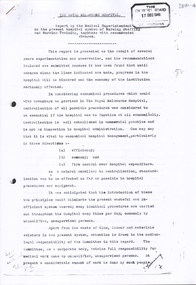
Document - 1946 Report by the Medical Superintendent of the current nursing situation at the Royal Melbourne Hospital
... 1946 Report by the Medical Superintendent of the current nursing situation at the Royal Melbourne Hospital...Document 1946 Report by the Medical Superintendent of the current nursing situation at the Royal Melbourne Hospital ...The Northern District School of Nursing opened in 1950 in to address the issues around nurse recruitment, training and education that had previously been hospital based. The residential school was to provide theoretical and in-house education and practical training over three years. The students would also receive practical hands-on training in the wards of associated hospitals. The Northern District School of Nursing operated from Lister House, Rowan Street, Bendigo. It was the first independent school of nursing in Victoria and continued until it closed in 1989. The book "The First of its Kind" was published in 2015. Printed in Bendigo by "Bendigo Modern Press". Memories compiled by Peter Rosewall; who attended the last NDSN school PTS 108 between 1986 - 89.A typed 13-page document entitled 'The Royal Melbourne Hospital: Report by the Medical Superintendent on the present hospital system of Nursing Staffing and Nursing Training, together with recommended changes'. This document was published by The Charities Board on 17th December 1946 and authored by J.H.Lindell. nursing, nurse training, royal melbourne hospital, post-war nursing, j.h.lindell -
 Moorabbin Air Museum
Book - DOUGLAS DC-3 DAKOTA, THE DOUGLAS DC-3 and its predecessors Update 1
... ...Current situation...Douglas DC-3 Corrections & additions Development history Preserved DC-2s & DC-3s Military users Commercial DC-2 /DC-3 operations Production list Current situation Full list of Douglas DC3 aircraft in use in the world, circa 1987 THE DOUGLAS DC-3 and its predecessors Update 1 Book DOUGLAS DC-3 DAKOTA ...Full list of Douglas DC3 aircraft in use in the world, circa 1987non-fictionFull list of Douglas DC3 aircraft in use in the world, circa 1987corrections & additions, development history, preserved dc-2s & dc-3s, military users, commercial dc-2 /dc-3 operations, production list, current situation -
Moorabbin Air Museum
Book - DOUGLAS DC-3 DAKOTA, THE DOUGLAS DC-3 and its predecessors Update 2 & World Survey
... ...Current situation...Survey of commercial DC-3 operators Production list changes & corrections Preserved DC- 2s & DC-3s DC-3 casualties since update 1 NTSB accident reports 1964 to 1989 Current situation Registration index Survey of surviving DC-3 aircraft in the world, circa 1993 THE DOUGLAS DC-3 and its predecessors Update 2 & World Survey Book DOUGLAS DC-3 DAKOTA ...Survey of surviving DC-3 aircraft in the world, circa 1993non-fictionSurvey of surviving DC-3 aircraft in the world, circa 1993turboprop power, survey of military users of dc- 3 / c-47 / li-2 ., survey of commercial dc-3 operators, production list changes & corrections, preserved dc- 2s & dc-3s, dc-3 casualties since update 1, ntsb accident reports 1964 to 1989, current situation, registration index -
 Sunshine and District Historical Society Incorporated
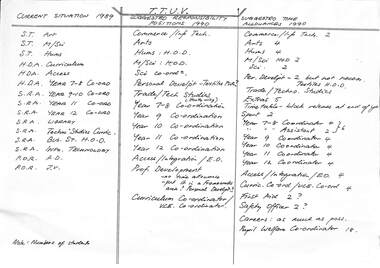
Document - Sunshine Technical School - Technical Teachers Union of Victoria Suggested Responsibility Positions 1990, Sunshine Technical School, 1989
... Current Situation 1989 T.T.U.V. Suggested Responsibility Positions 1990 Suggested Time Allowances 1990...Sunshine Technical School Derby Road Sunshine Current Situation 1989 T.T.U.V. Suggested Responsibility Positions 1990 Suggested Time Allowances 1990 A4 Document Document Sunshine Technical School - Technical Teachers Union of Victoria Suggested Responsibility Positions 1990 Sunshine Technical School. ...Current Situation 1989 T.T.U.V. Suggested Responsibility Positions 1990 Suggested Time Allowances 1990sunshine technical school, derby road, sunshine -
 Vision Australia
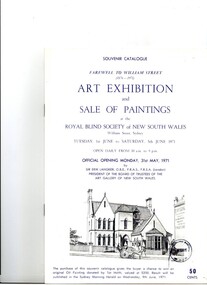
Booklet - Text, Souvenir catalogue Farewell to William Street (1876-1971) Art exhibition and sale of painting at the Royal Blind Society of New South Wales, 1971
... 6 page booklet providing a brief history and overview of current situation, including a list of auction items...Royal Blind Society of NSW Fundraising 6 page booklet providing a brief history and overview of current situation, including a list of auction items Souvenir catalogue Farewell to William Street (1876-1971) Art exhibition and sale of painting at the Royal Blind Society of New South Wales Booklet Text ...As a way of raising funds, an art exhibition and sale of paintings was held at the William Street offices of the Royal Blind Society before they moved to their new offices in Enfield. This was one of a series of events held to say goodbye to the former building and to pay for the creation of purpose built offices outside of the CBD. 6 page booklet providing a brief history and overview of current situation, including a list of auction itemsroyal blind society of nsw, fundraising -
University of Melbourne, Burnley Campus Archives
Administrative record - Meeting Minutes, Environmental Horticulture Group Meeting, 09.09.1992
... Problems of current financial situation....Problems of current financial situation. Environmental Horticulture Group Meeting Administrative record Meeting Minutes ...garden maintenance, garden management, financial -
 Sunshine and District Historical Society Incorporated
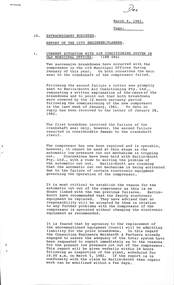
Administrative record - City of Sunshine - Commissioner Mr Alexander Alex George Gillon Collection 1976 - 1982 - Extraordinary Business Report Old Municipal Offices Air Conditioning 9th March 1982, City of Sunshine, 9th March 1982
... Report of the City Engineer / Planner Current situation with air conditioning system in old municipal offices Stradbroke Reserve Rotary Club BMX Track report Devonshire Road (Both sides) west of Hampshire Road restricted parking report...City of Sunshine Alexander "Alex" George Gillon McIntyre Road Sunshine North Stradbroke Reserve Sunshine Rotary Club BMX Track Sunshine Municipal Offices City of Sunshine Municipal Offices Alexandra Avenue Sunshine Report of the City Engineer / Planner Current situation with air conditioning system in old municipal offices Stradbroke Reserve Rotary Club BMX Track report Devonshire Road (Both sides) west of Hampshire Road restricted parking report Foolscap sized document. ...Report of the City Engineer / Planner Current situation with air conditioning system in old municipal offices Stradbroke Reserve Rotary Club BMX Track report Devonshire Road (Both sides) west of Hampshire Road restricted parking report city of sunshine, alexander "alex" george gillon, mcintyre road, sunshine north, stradbroke reserve, sunshine rotary club, bmx track, sunshine municipal offices, city of sunshine municipal offices, alexandra avenue, sunshine -
Clunes Museum
Letter, 1971
... Correspondence from the Shire to the Committee on the current situation with the proposed caravan park for Clunes....Correspondence from the Shire to the Committee on the current situation with the proposed caravan park for Clunes. local history document letter caravan park CARBON COPY CORRESPONDENCE FROM SHIRE OF TALBOT & CLUNES, (TYPED) TO SECRETARY OF CARAVAN PARK AND SCENIC ROAD COMMITTEE OF CLUNES. ...Correspondence from the Shire to the Committee on the current situation with the proposed caravan park for Clunes.CARBON COPY CORRESPONDENCE FROM SHIRE OF TALBOT & CLUNES, (TYPED) TO SECRETARY OF CARAVAN PARK AND SCENIC ROAD COMMITTEE OF CLUNES. DATED 6TH APRIL, 1971local history, document, letter, caravan park -
 Melbourne Tram Museum
Document - Notice, The Met, "MTA Business Planning Report No. 1 - Analysis of the Existing situation", 24/03/1987 12:00:00 AM
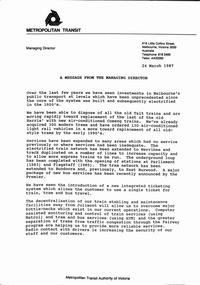
... Set of two A4 documents about the future and current situation or status of the Metropolitan Transit Authority of Victoria (The Met). .1 - A3 folded sheet, titled "A message from the Managing Director" signed by Kevin Shea, dated 24/3/1987 setting out the current situation, changes, services, Jolimont, new tram lines, ticketing, vehicles and future planning. ...Trams tramways The Met Planning Reports Finances Railways New Trams New Track Set of two A4 documents about the future and current situation or status of the Metropolitan Transit Authority of Victoria (The Met). .1 - A3 folded sheet, titled "A message from the Managing Director" signed by Kevin Shea, dated 24/3/1987 setting out the current situation, changes, services, Jolimont, new tram lines, ticketing, vehicles and future planning. ...Set of two A4 documents about the future and current situation or status of the Metropolitan Transit Authority of Victoria (The Met). .1 - A3 folded sheet, titled "A message from the Managing Director" signed by Kevin Shea, dated 24/3/1987 setting out the current situation, changes, services, Jolimont, new tram lines, ticketing, vehicles and future planning. Business Plan released the same day by the Minister Tom Roper. .2 - 12 A4 pages - centre stapled printed on orange paper, titled "MTA Business Planning Report No. 1 - Analysis of the Existing situation" - setting out the policy context, goals and objectives, international perspective, patronage and service levels, fares system, human resources, capital investment, financial performance, changing environment, key issues and next stepstrams, tramways, the met, planning, reports, finances, railways, new trams, new track -
Bendigo Historical Society Inc.
Document - National Trust Collection: Cranleigh Barn Marong, 14/09/1970
... Adams of the Central Victorian Branch to follow up and determine the current situation regarding the barn....Adams of the Central Victorian Branch to follow up and determine the current situation regarding the barn. Document National Trust Collection: Cranleigh Barn Marong ...This item contain the following document: 3084.38a This memorandum from the National Trust of Australia (Victoria), dated September 14, 1970, addresses the following. The Bluestone Barn at "Cranleigh", Marong (Reference No. 2631). Background: The barn was first brought to the Trust's attention in April of that year. Multiple written attempts and data forms have been sent to the owner, Mr. I. H. K. Nixon, but there has been no response. The Administrator is asking Mrs. R. R. Adams of the Central Victorian Branch to follow up and determine the current situation regarding the barn.history, national trust bendigo collection, cranleigh marong -
 Bendigo Historical Society Inc.
Document - HANDWRITTEN PAPER ''THE WESLEYANS'': AUTHOR: BEV O'SHEA
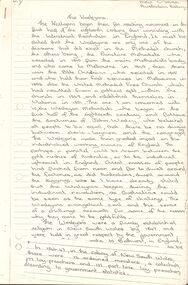
... With specific reference to the Bendigo area including ref to - James Jeffrey; Sir John Quick; Laurel Street church history; schooling and education; School No 279 Golden Square; Wesleyan Chapel Reserve; School No 1189 Golden Square; Table of various church denominations with their number of churches, buildings, accommodation and number usually attending (no date provided); post-1873 Education Act; 'rules' of living for Methodists; current situation. Bibliography....With specific reference to the Bendigo area including ref to - James Jeffrey; Sir John Quick; Laurel Street church history; schooling and education; School No 279 Golden Square; Wesleyan Chapel Reserve; School No 1189 Golden Square; Table of various church denominations with their number of churches, buildings, accommodation and number usually attending (no date provided); post-1873 Education Act; 'rules' of living for Methodists; current situation. Bibliography. Document HANDWRITTEN PAPER ''THE WESLEYANS'': AUTHOR: BEV O'SHEA ...Handwritten 11 paged Paper on ''The Wesleyans'' - author: Bev O'Shea submitted for 'Australian History' (where??); date? With specific reference to the Bendigo area including ref to - James Jeffrey; Sir John Quick; Laurel Street church history; schooling and education; School No 279 Golden Square; Wesleyan Chapel Reserve; School No 1189 Golden Square; Table of various church denominations with their number of churches, buildings, accommodation and number usually attending (no date provided); post-1873 Education Act; 'rules' of living for Methodists; current situation. Bibliography.Bev O'Sheachurch, history, golden square wesleyan, methodist. laurel street. sir john quick. james jeffrey. bev o'shea. golden square wesleyan church. -
 Glen Eira Historical Society
Article - St. Andrew’s Presbyterian Church, North Road, Gardenvale East
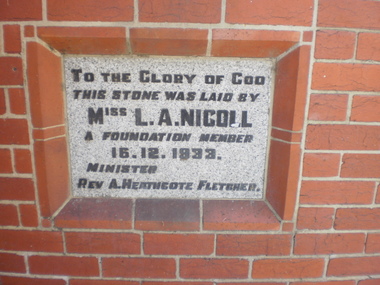
... It includes history as well as current situation at 1957. Photocopied notes and photo of the Army Hut used by Gardenvale Primary School in 1921 only as donated by church for and year then Reverted back to church use. ...It includes history as well as current situation at 1957. Photocopied notes and photo of the Army Hut used by Gardenvale Primary School in 1921 only as donated by church for and year then Reverted back to church use. ...Handwritten document giving brief details on wording on foundation stone of St. Andrew’s church, undated and author unknown. Photocopy of pamphlet produced for the stewardship campaign 1957 for St. Andrew’s Presbyterian Church Gardenvale East, with several photos. It includes history as well as current situation at 1957. Photocopied notes and photo of the Army Hut used by Gardenvale Primary School in 1921 only as donated by church for and year then Reverted back to church use. Photocopy of letter to Glen Eira News and City Council re-proposed subdivision of church land from Robert W. Sinclair.st. andrew’s presbyterian church, foundation stones, nicoll l.a., heathcote-fletcher a. rev., north road, seach street, smith a. f.h. rev., mcneilage alex rev., gardenvale east, caulfield south, younger street, gardenvale east church, nicholls rev., rowlands w. rev., lang walter, sunday schools, yeaman f.e. rev., brown f.e., brick, towers, manse, choirs, groups, smith mrs., curtis e.e., morse roger, marryatt harry, pegler adrian, savill t., south caulfield, gardenvale primary school, sinclair robert w., dakin ms., campbell felicity -
 Melbourne Tram Museum
Document - Report, Melbourne Tramway & Omnibus Co. Limited, "Forty-Fourth Report and Balance Sheet - 30 June 1917 - "Forty-Fourth Report and Balance Sheet - 30 June 1917 - Melbourne Tramway & Omnibus Co. Limited"", Aug. 1917
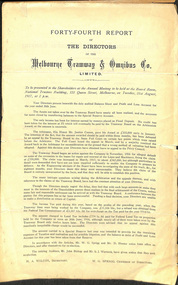
... Limited", detailing the current financial situation following the hand over of the cable tram system, disputes with the Tramway Board and taxes. ...Limited", detailing the current financial situation following the hand over of the cable tram system, disputes with the Tramway Board and taxes. ...Report - four pages, one double folio sheet (double foolscap), titled "Forty-Fourth Report and Balance Sheet - 30 June 1917 - Melbourne Tramway & Omnibus Co. Limited", detailing the current financial situation following the hand over of the cable tram system, disputes with the Tramway Board and taxes. Details the financial situation of the company. Signed by H. A. Wilcox Secretary and W. G. Sprigg, Chairman.trams, tramways, annual reports, mto co, tramway board, financial statements, cable trams -
 Heytesbury District Historical Society Inc.
Administrative record - Minute Book, Waarre Telephone Subscribers, 1960
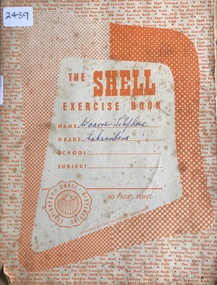
... current operator. The minutes note the majority of people who lived on Eastern Creek Rd. and Waarre Rd. at this time. Families included. Bottrel, Bramley, Lloyd, Fitzpatrick, McKenzie, Clarke, Welton, Younis, Meek, Wills, Shiells, Jeffery, Wilson, Giblett, Webb, Tranter, Stevens, Meek. The book contains a letter written to the PMG and a response. The situation...current operator. The minutes note the majority of people who lived on Eastern Creek Rd. and Waarre Rd. at this time. Families included. Bottrel, Bramley, Lloyd, Fitzpatrick, McKenzie, Clarke, Welton, Younis, Meek, Wills, Shiells, Jeffery, Wilson, Giblett, Webb, Tranter, Stevens, Meek. The book contains a letter written to the PMG and a response. The situation ...Excercise book with minutes taken at two meetings held in the Waarre hall in Decemberr 1960 to resolve the problem of the local telephone exchange losing its current operator. The minutes note the majority of people who lived on Eastern Creek Rd. and Waarre Rd. at this time. Families included. Bottrel, Bramley, Lloyd, Fitzpatrick, McKenzie, Clarke, Welton, Younis, Meek, Wills, Shiells, Jeffery, Wilson, Giblett, Webb, Tranter, Stevens, Meek. The book contains a letter written to the PMG and a response. The situation was resolved when Sylvia Fitzpatrick agreed to become the telephonist and for the exchange to be relocated from the home of Roy and Minnie Ford to the Home of Jim and Sylvia Fitzpatrick. School Exercise bookWaarre Telephone Subscriberscommunication, telephone, community action -
 Eltham District Historical Society Inc
Book, Shire of Eltham, The Shire of Eltham - A Perspective, July 1981
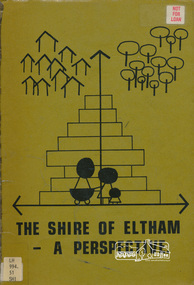
... situation - introduction, the Shire of Eltham, physical characteristics, historical development, population growth. Characteristics of the population - size and distribution, age / sex, natural increase, migration. Socio-Economic Factors: socio-economic status, employment/workforce, education, other social factors. Housing/ building statistics: characteristics of Housing stock, current...situation - introduction, the Shire of Eltham, physical characteristics, historical development, population growth. Characteristics of the population - size and distribution, age / sex, natural increase, migration. Socio-Economic Factors: socio-economic status, employment/workforce, education, other social factors. Housing/ building statistics: characteristics of Housing stock, current ...This report was produced by the Shire of Eltham (Planning Department) following a population study of the Shire. It also includes other areas of general interest. The Document contents includes Present and Future - Population - Housing - Residential Lands - Social Characteristics - Development and History. Includes maps, tables and diagrams. Part 1: The Existing situation - introduction, the Shire of Eltham, physical characteristics, historical development, population growth. Characteristics of the population - size and distribution, age / sex, natural increase, migration. Socio-Economic Factors: socio-economic status, employment/workforce, education, other social factors. Housing/ building statistics: characteristics of Housing stock, current residential trends, other types of building activity. Residential Land: existing vacant lots, estimated additional lots. Part 2: The Future. Land availability, the future population.The Shire of Eltham Council resolved on publication of this report "to commend it to the ratepayers as a most valuable resource document". It provides a comprehensive statistical review of the Shire of Eltham, Victoria in 1981 with some population and development predictions for the future.Spiral bound, soft cover, includes indexBarcode and identification markings including stamped "WITHDRAWN" from Heidelberg Regional Library Serviceshire of eltham, planning, population -
 Kiewa Valley Historical Society
Safe Coolgardie, circa early 1900s
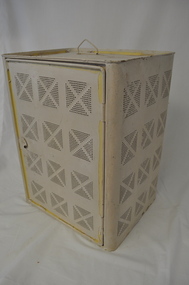
... This however could not be carried out in all situations eg. fast flowing currents and locations away from streams. domestic refrigeration cabinets coolgardie "safe" insect and vermin proof food containers electric and gas free cold storage containers This "Coolgardie safe" is made from a medium grade steel enclosure and its appearance is of a perforated box with a wire handle and one side (long side) being a hinged "door" with a clasp securing "lock". ...The harsh summer temperatures and the isolated rural environment(of the 1890's) provided the inventor of the "Coolgardie safe" (Arthur Patrick McCormick) with an idea to cool perishable foods by using water soaked "hessian" cloth to provide the "coolant" for the evaporation process to cool the inside temperature of the "safe". Items such as meat,cream/milk/butter and cool "drinks" are a few perishables that need cool environments , especially in isolated "ice free" locations. Cities during this time period had large "ice works" which delivered block ice to all areas that required a form of refrigeration. These ice blocks where held in early refrigerators to keep perishables cool to cold. This "Coolardie" safe was the next best thing for isolated rural households and travellers/campers/stockmen to provide a cooler environment for foodstuff affected by heat. Ice filled "esky" coolers and ice boxes are a modern day off shoot to the original Coogardie safe however they still rely on ice or frozen coolant bricks for cooling.This "Coogardie" safe is very significant to the Kiewa Valley and the Bogong High Plains because it represents not only the initiative thinking of the early settlers and communities but also the "primitive" solution to an everyday (1800s to 1930s) problem (before gas and electric run refrigerators) of keeping "perishables" at a low temperature and thereby prolonging their "shelf" life. This was before electricity and gas was available to the inhabitants of the Kiewa Valley and Bogong High Plains. Another cooling method for food was to have "water tight" containers dipped into the very cold streams running from the "cooler" alpine mountains and the Bogong High Plains. This however could not be carried out in all situations eg. fast flowing currents and locations away from streams. This "Coolgardie safe" is made from a medium grade steel enclosure and its appearance is of a perforated box with a wire handle and one side (long side) being a hinged "door" with a clasp securing "lock". There are air holes grouped into a small "boxed" pattern. Each "box" is divided by a crossed pattern, dividing the "holed" sections(4) into a diamond configuration of 49 small holes each. There are four sides (long) which have the perforations except for the base which does not. The base has an indentation with a loose "catch" tray to catch water spills. When in use the "box" is covered with a water "soaked" cloth. The wet cloth is used as "coolant" ie. fibers in the cloth hold the water droplets seep out evaporating the area and thereby (in mass) cooling the air inside the container.domestic refrigeration cabinets, coolgardie "safe", insect and vermin proof food containers, electric and gas free cold storage containers -
 Warrnambool and District Historical Society Inc.
Book, Flotsam and Jetsam, 2014
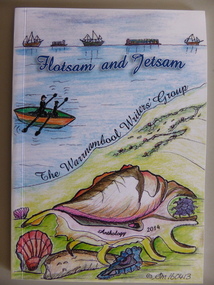
... The book is of some significance as the contents are by local people and refer not only to their personal thoughts and ideas but also to aspects of Warrnambool’s past and current situation. It has, therefore, social and cultural significance. warrnambool poetry and short stories Front Cover: ‘Flotsam and Jetsam’, The Warrnambool Writers’ Group, Anthology 2014, © SM 160413’ This is a paper-back book of 85 pages. ...This is an anthology of writings by members of the Warrnambool Writers’ Group. The group was formed nearly 30 years ago and has published several other anthologies. The book contains writings from current members of the group and many contributions contain reference to Warrnambool’s maritime and township history and present day affairs. The book is of some significance as the contents are by local people and refer not only to their personal thoughts and ideas but also to aspects of Warrnambool’s past and current situation. It has, therefore, social and cultural significance. This is a paper-back book of 85 pages. The cover is multi-coloured with a seascape design on the front cover and printed material on the back cover. The inside pages contain printed material only with a sketch of a boat on the frontispiece. The pages have been bound with glue. Front Cover: ‘Flotsam and Jetsam’, The Warrnambool Writers’ Group, Anthology 2014, © SM 160413’warrnambool, poetry and short stories -
 Warrnambool and District Historical Society Inc.
Ledger, Swintons Records, 1909
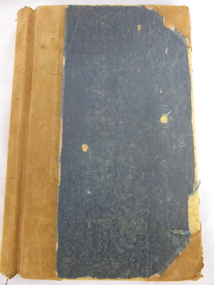
... This ledger is of great interest as it gives details of the sales and financial situation of the Warrnambool business of Swintons Pty Ltd for most of the 20th century. The information in the ledger will be of great help to researchers. The current ...This ledger comes from the Warrnambool business of Swintons Pty Ltd and records the wages of employees and stock supplies and sales from 1909 to 1982. William and Ann Swinton migrated to Australia in 1854 and for a decade William Swinton worked as a builder and carpenter in the Warrnambool district, erecting many buildings, including the Wangoom Presbyterian Church. In 1865 he opened a store in Timor Street Warrnambool selling groceries, china and glassware and hardware. By 1888 the business was known as William Swinton and Sons. Branch stores were opened in Cudgee, Nullawarre, Wangoom, West Warrnambool and South Warrnambool. After William Swinton died his son Robert became the first managing director of Swintons Pty Ltd. In 1934 the business split with George Swinton and Sons selling furnishings, clothing and glassware and Swintons Pty Ltd selling seed, produce and hardware. Today the Swinton family still operates a furniture and bedding shop in Timor Street. This ledger is of great interest as it gives details of the sales and financial situation of the Warrnambool business of Swintons Pty Ltd for most of the 20th century. The information in the ledger will be of great help to researchers. The current Swinton business in Timor Street Warrnambool is the oldest family business in Warrnambool and, with the Swinton name associated with businesses in Timor Street for 152 years, it is amongst the oldest family businesses in Australia. This ledger of 152 pages has a dark blue cover with leather binding on the spine and cover corners. The cover material is worn away in parts. The ledger has reinforced binding stitched with white cotton. The insides of the cover have red and blue mottled patterning. The pages are white with printed ruled red lines. The entries are handwritten in black ink. swinton family, warrnambool, history of warrnambool -
 Victorian Aboriginal Corporation for Languages
Periodical, Australian Institute of Aboriginal and Torres Strait Islander Studies, Australian Aboriginal studies : journal of the Australian Institute of Aboriginal and Torres Strait Islander Studies, 2010
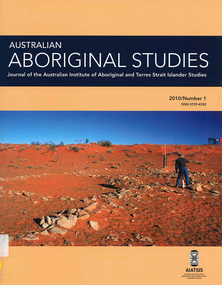
... This unique ecosystem is currently teetering on the verge of collapse, a situation arguably brought about by prolonged drought after decades of unsustainable management practices. ...This unique ecosystem is currently teetering on the verge of collapse, a situation arguably brought about by prolonged drought after decades of unsustainable management practices. ...Mediating conflict in the age of Native Title Peter Sutton (The University of Adelaide and South Australian Museum) Mediators have played roles in managing conflict in Aboriginal societies for a long time. This paper discusses some of the similarities and differences between older customary mediator roles and those of the modern Native Title process. Determinants of tribunal outcomes for Indigenous footballers Neil Brewer, Carla Welsh and Jenny Williams (School of Psychology, Flinders University) This paper reports on a study that examined whether football tribunal members? judgments concerning players? alleged misdemeanours on the sporting field are likely to be shaped by extra-evidential factors that disadvantage players from Indigenous backgrounds. Indigenous and non-Indigenous Australian Football League (AFL) players, matched in terms of their typical levels of confidence and demeanour in public situations, were interrogated in a mock tribunal hearing about a hypothetical incident on the football field. The specific aim was to determine if the pressures of such questioning elicited behavioural differences likely to be interpreted as indicative of testimonial unreliability. Mock tribunal members (number = 103) then made judgments about the degree to which a number of behavioural characteristics were evident in the players? testimonies. Under intense interrogation, Indigenous players were judged as presenting less confidently and displaying a greater degree of gaze aversion than non-Indigenous players. These behavioural characteristics are commonly ? and inappropriately ? used as cues or heuristics to infer testimonial accuracy. The paper discusses the implications for Indigenous players appearing at tribunal hearings ? and for the justice system more broadly. Timothy Korkanoon: A child artist at the Merri Creek Baptist Aboriginal School, Melbourne, Victoria, 1846?47 ? a new interpretation of his life and work Ian D Clark (School of Business, University of Ballarat) This paper is concerned with the Coranderrk Aboriginal artist Timothy Korkanoon. Research has uncovered more about his life before he settled at the Coranderrk station in 1863. Evidence is provided that five sketches acquired by George Augustus Robinson, the former Chief Protector of Aborigines, in November 1851 in Melbourne, and found in his papers in the State Library of New South Wales, may also be attributed to the work of the young Korkanoon when he was a student at the Merri Creek Baptist Aboriginal School from 1846 to 1847. Developing a database for Australian Indigenous kinship terminology: The AustKin project Laurent Dousset (CREDO, and CNRS, Ecole des Hautes Etudes en Sciences Sociales), Rachel Hendery (The Australian National University), Claire Bowern (Yale University), Harold Koch (The Australian National University) and Patrick McConvell (The Australian National University) In order to make Australian Indigenous kinship vocabulary from hundreds of sources comparable, searchable and accessible for research and community purposes, we have developed a database that collates these resources. The creation of such a database brings with it technical, theoretical and practical challenges, some of which also apply to other research projects that collect and compare large amounts of Australian language data, and some of which apply to any database project in the humanities or social sciences. Our project has sought to overcome these challenges by adopting a modular, object-oriented, incremental programming approach, by keeping metadata, data and analysis sharply distinguished, and through ongoing consultation between programmers, linguists and communities. In this paper we report on the challenges and solutions we have come across and the lessons that can be drawn from our experience for other social science database projects, particularly in Australia. A time for change? Indigenous heritage values and management practice in the Coorong and Lower Murray Lakes region, South Australia Lynley A Wallis (Aboriginal Environments Research Centre, The University of Queensland) and Alice C Gorman (Department of Archaeology, Flinders University) The Coorong and Lower Murray Lakes in South Australia have long been recognised under the Ramsar Convention for their natural heritage values. Less well known is the fact that this area also has high social and cultural values, encompassing the traditional lands and waters (ruwe) of the Ngarrindjeri Nation. This unique ecosystem is currently teetering on the verge of collapse, a situation arguably brought about by prolonged drought after decades of unsustainable management practices. While at the federal level there have been moves to better integrate typically disparate ?cultural? and ?natural? heritage management regimes ? thereby supporting Indigenous groups in their attempts to gain a greater voice in how their traditional country is managed ? the distance has not yet been bridged in the Coorong. Here, current management planning continues to emphasise natural heritage values, with limited practical integration of cultural values or Ngarrindjeri viewpoints. As the future of the Coorong and Lower Murray Lakes is being debated, we suggest decision makers would do well to look to the Ngarrindjeri for guidance on the integration of natural and cultural values in management regimes as a vital step towards securing the long-term ecological viability of this iconic part of Australia. Hearts and minds: Evolving understandings of chronic cardiovascular disease in Aboriginal and Torres Strait Islander populations Ernest Hunter (Queensland Health and James Cook University) Using the experience and reflections of a non-Indigenous clinician and researcher, Randolph Spargo, who has worked in remote Aboriginal Australia for more than 40 years, this paper tracks how those at the clinical coal-face thought and responded as cardiovascular and other chronic diseases emerged as new health concerns in the 1970s to become major contributors to the burden of excess ill health across Indigenous Australia. The paper cites research evidence that informed prevailing paradigms drawing primarily on work in which the clinician participated, which was undertaken in the remote Kimberley region in the north of Western Australia. Two reports, one relating to the Narcoonie quarry in the Strzelecki Desert and the other concerning problematic alcohol use in urban settings.maps, b&w photographs, colour photographs, tablesstrzelecki desert, native title, timothy korkanoon, merri creek baptist aboriginal school, austkin project, coorong, lower murray lakes district, south australia, indigenous health -
Koorie Heritage Trust
Book, Roberts, Janine, From Massacres to mining. The colonization of Aboriginal Australia, 1978
... . - To 1900 | Race relations - Racial discrimination - Legislative White colonisation of Australia; violent conflict; establishment of reserves; current situation legal oppression in Queensland; racism and discrimination; poverty, malnutrition and disease; government policy; land rights; mining on Aboriginal land; Aboriginal struggle for rights. 212 P.; appendices; maps; plates; ill.; footnotes; bib.; refs.; figs.; 21 cm. ...White colonisation of Australia; violent conflict; establishment of reserves; current situation legal oppression in Queensland; racism and discrimination; poverty, malnutrition and disease; government policy; land rights; mining on Aboriginal land; Aboriginal struggle for rights.212 P.; appendices; maps; plates; ill.; footnotes; bib.; refs.; figs.; 21 cm.White colonisation of Australia; violent conflict; establishment of reserves; current situation legal oppression in Queensland; racism and discrimination; poverty, malnutrition and disease; government policy; land rights; mining on Aboriginal land; Aboriginal struggle for rights.aboriginal australians -- social conditions. | aboriginal australians -- government relations. | aboriginal australians -- land tenure. | colonisation | economics - income - poverty and low income | government policy | health - nutrition disorders | land rights - mining industry | land rights - excisions and leases - mining leases | race relations - violent - massacres, murders, poisonings etc. - to 1900 | race relations - racial discrimination - legislative -
 Royal District Nursing Service (now known as Bolton Clarke)
Photograph - Photograph, black and white, Barry Sutton, 01.05.1974
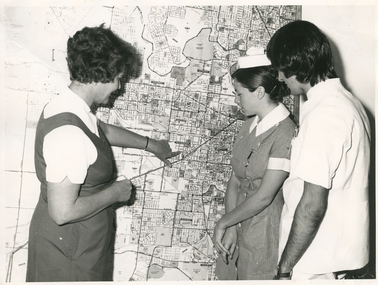
... currently receiving nursing care from RDNS Sisters working in these areas (districts). During their training, Student nurses from several hospitals either attended the Royal District Nursing Service (RDNS), Education Department, or, a RDNS Nurse Educator travelled to the appropriate hospital’s Education Department to educate the Trainees on District nursing through the RDNS Community Nursing Program. Following the lectures Students went to a RDNS Centre and each Student accompanied a Trained nurse (Sister) for a week observing and gaining knowledge of all facets of nursing care in the home. This gave them an insight into the home conditions and situations ...Sister Ellen Anderson is the Supervisor of the Royal District Nursing Service, (RDNS) Footscray Centre. She is wearing her RDNS uniform of a short sleeve white blouse under a royal blue V neck tunic style dress. Sr. Anderson is showing two Student nurses from Western General Hospital the map with the areas covered by Footscray Centre. The map had different colour pins to identify streets where patients lived who were currently receiving nursing care from RDNS Sisters working in these areas (districts).During their training, Student nurses from several hospitals either attended the Royal District Nursing Service (RDNS), Education Department, or, a RDNS Nurse Educator travelled to the appropriate hospital’s Education Department to educate the Trainees on District nursing through the RDNS Community Nursing Program. Following the lectures Students went to a RDNS Centre and each Student accompanied a Trained nurse (Sister) for a week observing and gaining knowledge of all facets of nursing care in the home. This gave them an insight into the home conditions and situations patients faced after discharge from hospital. During 1971 there were 584 Student nurses who received field experience with RDNS. From its inception as Melbourne District Nursing Society (MDNS), in 1885, their Trained nurses (Nurses) worked in specific areas, 'districts'. The first Nurse worked east and west, between Victoria Parade and Flinders Street and, north and south, between Spencer Street and Spring Street. When a second Nurse was employed they divided this area at Elizabeth Street so each Nurse could attend to patients in the same area giving continuity of care. As the Society expanded, becoming Melbourne District Nursing Service, then, with Royal patronage, Royal District Nursing Service (RDNS) many Centres were opened throughout the Melbourne Metropolitan area and outer suburbs. The District nurse's areas (districts) grew and were divided within Shire boundaries for e.g. Knox 1, Knox 2, Knox 3, Knox 4, within the area of the Shire of Knox. A map covering the Centre’s Districts was attached to a wall, and its different colour pins identified streets where patients lived who were currently receiving nursing care from the RDNS Trained nurses (Sisters) working in these areas (districts).On the left of this black and white photograph is Royal District Nursing Service (RDNS), Sister Ellen Anderson, who has short dark curly hair and is wearing her RDNS uniform of a short sleeve white blouse under a dark V neck tunic style frock. She is standing side-on, towards the right of the photograph, and with her left hand is pointing to an area on a large map attached to the wall in the background. To her right, is a Student nurse who is facing Sr. Anderson, and looking at the area on the map. Under her white nurses cap, she has her long dark hair drawn back, and is wearing her hospital uniform of a short sleeve checked dress with white collar and cuffs; a nursing watch is attached to its upper left; her hands are clasped in front of her. To her right, is a male Student nurse who has collar length straight dark hair, and is wearing white trousers and a short sleeve white top with pens in the left upper pocket. He is looking at the areas on the map.. Barry Sutton MA 77 informationroyal district nursing service, rdns, rdns education, rdns centre, rdns district map, sister ellen anderson -
Kew Historical Society Inc
Archive (Sub-series) - Subject File, Fernhurst (Kew), 1973
... The situation was complicated as the Church also bought the neighbouring Neama (q.v.) and Mandalay. Villa Maria and St Paul’s School currently occupy the site. ...The situation was complicated as the Church also bought the neighbouring Neama (q.v.) and Mandalay. Villa Maria and St Paul’s School currently occupy the site. ...Various partiesReference, Research, InformationSecondary Values (KHS Imposed Order)Subject file containing research related to George Wharton and his house Fernhurst, originally situated on the corner of Princess Street and Studley Park Road, but later subdivided. The house was in the 20th century converted into flats and later bought by the Catholic Church, who established St Paul’s School for the Blind on the site. The situation was complicated as the Church also bought the neighbouring Neama and Mandalay. Villa Maria and St Paul’s School currently occupy the site. Part of the site was later subdivided to create Elphinstone Court. The file contains photocopied extracts from histories and detailed research and correspondence between the School, the Kew Historical Society, the National Trust of Victoria, and the Historic Buildings Preservation Council relating to both Neama and Fernhurst. There is a reference in a letter from St Paul’s inviting the Society to collect artefacts from the site. There are no known current items in the collection relating to the collection of these. kew (vic) - history, victorian architects - george wharton, fernhurst (kew), st paul’s school for the blindkew (vic) - history, victorian architects - george wharton, fernhurst (kew), st paul’s school for the blind -
 Kew Historical Society Inc
Newspaper, Kew Festival Gazette, No.1, October 5th 1895, 1895
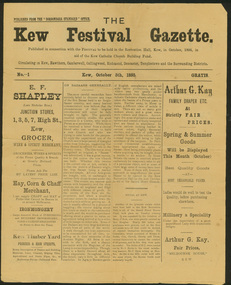
... The Festival was not associated with the current Kew Festival, which was founded in 1974, but was principally a bazaar held in the Kew Recreation Hall to raise money for the Kew Catholic Church Building Fund which was associated with the Jesuit Mission. Perhaps because of the recent economic depression, the Mission was in financial difficulties and it was hoped that the bazaar would raise enough money to ease the situation. ...The Festival was not associated with the current Kew Festival, which was founded in 1974, but was principally a bazaar held in the Kew Recreation Hall to raise money for the Kew Catholic Church Building Fund which was associated with the Jesuit Mission. Perhaps because of the recent economic depression, the Mission was in financial difficulties and it was hoped that the bazaar would raise enough money to ease the situation. ...The first known use of the term 'Kew Festival'.The Kew Festival Gazette, 5 October 1895 is a four-page mock-up newspaper, published from the Boroondara Standard office to advertise and publicise a Kew Festival. The Festival was not associated with the current Kew Festival, which was founded in 1974, but was principally a bazaar held in the Kew Recreation Hall to raise money for the Kew Catholic Church Building Fund which was associated with the Jesuit Mission. Perhaps because of the recent economic depression, the Mission was in financial difficulties and it was hoped that the bazaar would raise enough money to ease the situation. According to the Gazette, ‘All Kew has been in a gentle simmer of excitement for some time past over the coming Sacred Heart Bazaar in aid of the Jesuit Mission funds. Wherever one goes the talk is of the bazaar, and whoever one meets is either a stallholder, an assistant or an intending purchaser.’ There are a few items in the Gazette about other local events, including a cake fair and sale of works, and a history of bazaars that traces them from the Middle East via Britain to Kew. One article contains some examples of nineteenth century humour, including ‘the lady stallholders will not have to pay income tax on their takings’. The advertisements reflect the goods and services available to Kew residents in 1895 – groceries, wine & spirits, hay, corn, chaff, ironmongery, timber, drapery, millinery, gas cookers, and an undertaker and embalmer. kew festival gazette, kew catholic church, boroondara standard
