
Showing 342 items matching "defence forces"
-
 National Vietnam Veterans Museum (NVVM)
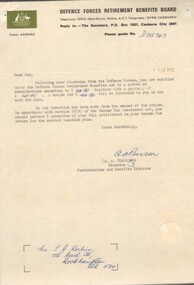
Letter - A Letter from Defence forces Retirement Benefits Board to Mr T.J, Kerlin, 1968
... A Letter from Defence forces Retirement Benefits Board to Mr T.J, Kerlin......Defence Forces Retirement Benefits Board...A Letter from Defence forces Retirement Benefits Board to Mr T.J, Kerlin dated 4 Nov 1968 advising him of money being forwarded to him. ...Defence Forces Retirement Benefits Board...Letter A Letter from Defence forces Retirement Benefits Board to Mr T.J, Kerlin Defence Forces Retirement Benefits Board ...this item was donated by Cpl Terrence John Kerlin (1731133) who was a National Serviceman with the Royal Australian Infantry Corps and he served in Vietnam with the 3rd Battalion, The Royal Australian Regiment from December 1967 to August 1968.A Letter from Defence forces Retirement Benefits Board to Mr T.J, Kerlin dated 4 Nov 1968 advising him of money being forwarded to him. The letter has been laminated.cpl terrence john kerlin, 1731133, australian national serviceman, royal australian infantry corps, 3rd battalion, the royal australian regiment, defence forces retirement benefits board -
 Waverley RSL Sub Branch
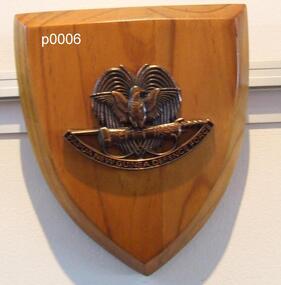
Plaque Papua New Guinae Defence Forces, Papua New Guinae Defence Forces
... Plaque Papua New Guinae Defence Forces ...Papua New Guinae Defence Forces ...Papua New Guinae Defence Forces ...Waverley RSL Sub Branch 161 Coleman Parade Glen Waverley melbourne Papua New Guinae Defence Forces Wooden plaque 15cm x 13cm Papua New Guinae Defence Forces Plaque Papua New Guinae Defence Forces ...Wooden plaque 15cm x 13cmPapua New Guinae Defence Forces -
 National Vietnam Veterans Museum (NVVM)
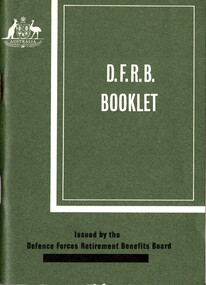
Booklet, Australian Defence Forces, D.F.R.B. Booklet: Issued by the Defence Forces Retirement Benefits Board, 1970
... Booklet: Issued by the Defence Forces Retirement Benefits Board...Australia - Armed Forces - Service manuals...Defence...Athe bottom of the booklet in black in reads Issued by the Defence Forces Retirement Benefits Board. There is a black thick line under this. ...Australian Defence Forces...Booklet: Issued by the Defence Forces Retirement Benefits Board Booklet Australian Defence Forces ...A green coloured cover with the Australian Coat of Arms insignia in white at the top left hand side of the booklet. Ina a white oxed rectangular reads D.F.R.B. Booklet. Athe bottom of the booklet in black in reads Issued by the Defence Forces Retirement Benefits Board. There is a black thick line under this. There are two rusty staples holding the booklet togetheraustralia - armed forces - service manuals, defence force retirement benefits -
 Lara RSL Sub Branch
Newspaper Article, Defence Forces Bicentennial Celebrations
... Defence Forces Bicentennial Celebrations...News clipping - Defence Forces Bicentennial Celebrations...Lara RSL Sub Branch McClelland Ave Lara News clipping - Defence Forces Bicentennial Celebrations Defence Forces Bicentennial Celebrations Newspaper Article ...News clipping - Defence Forces Bicentennial Celebrations -
 Sunbury Family History and Heritage Society Inc.
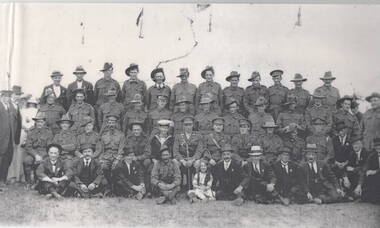
Photograph, World War 1 defence forces
... World War 1 defence forces.......Defence Forces...Many men from Sunbury enlisted in the defence forces during World War 1. Sadly some did not return while others did come home. ...The photograph was taken to welcome home the Sunbury men who had fought in overseas battles during World War 1.Those who were not wearing their uniforms had been discharged as a result of injuries but they were eligible to be included in the Welcome Home functions that took place after 1918.Many men from Sunbury enlisted in the defence forces during World War 1. Sadly some did not return while others did come home.A non- digital black and white photograph of a group of men with one little girl seated and standing in four rows in front of a large screen. Most of the men are wearing army uniforms, one is in a sailor's uniform and others are in civilian dress. world war 1, defence forces, sunbury -
 Sunbury Family History and Heritage Society Inc.
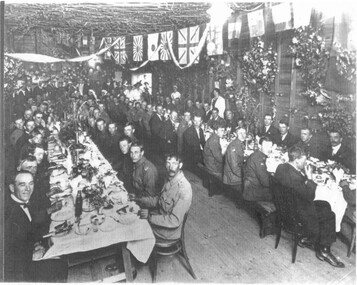
Photograph, World War 1 defence forces, 1918
... World War 1 defence forces.......Defence Forces...There are flags from a number of countries festooned across the room. World War 1 defence forces. Photograph ...The photograph was taken some time after the end of World War 1. It was a Welcome Home reception for those men who had enlisted to fight in World War 1 and were lucky to return home. The reception took place in the Sunbury Fire Station which was located in Evans Street. At the end of World War 1, the local Sunbury community held a number of Welcome Home receptions to acknowledge the part played by many local men and women in World War 1.A non-digital black and white copy of a photograph of a lot of men at a reception seated at long tables in a large hall. There are flags from a number of countries festooned across the room. welcome home receptions, world war 1, sunbury, defence forces -
 Ithacan Historical Society
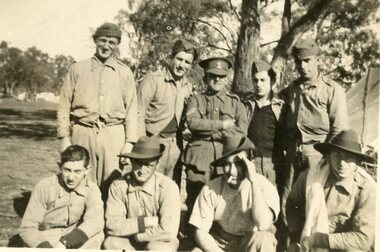
Photograph, WW2 Australian Defence Forces - Allied Aliens, c1940s
... WW2 Australian Defence Forces - Allied Aliens...Young Greek born men who had migrated to Australia were recruited to the defence forces during World War 2. Pictured is a group belonging to Civilian Military Forces. ...WW2 Australian Defence Forces - Allied Aliens Photograph ...Young Greek born men who had migrated to Australia were recruited to the defence forces during World War 2. Pictured is a group belonging to Civilian Military Forces. Standing, second from the right, is Nakis (Nick) Raftopoulos.During the period of the second world war, Ithacans who were unnaturalised were recruited into the Civilian Military Forces as 'Allied Aliens' and served the war effort on the home front. Naturalised Ithacans saw active service.A black and white photograph of nine men in army uniform at a camp. Five men are standing behind the other four who are sitting in front. -
 Ithacan Historical Society
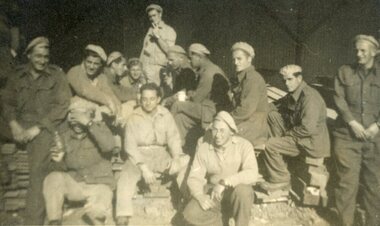
Photograph, WW2 Australian Defence Forces - Allied Aliens, 1940s
... WW2 Australian Defence Forces - Allied Aliens...Many young men, both Ithacan born and Australian born of Ithacan descent joined the Australian Defence Forces in various capacities during World War 2. ...WW2 Australian Defence Forces - Allied Aliens Photograph ...Many young men, both Ithacan born and Australian born of Ithacan descent joined the Australian Defence Forces in various capacities during World War 2. Pictured is a group of army recruits to the Civilian Military Forces with a young Stathi Raftopoulos seated in the centre - he is the only one not wearing a cap.Ithacans who were not naturalised were recruited to the Civilian Military Forces as 'Allied Aliens'.A black and white photograph of thirteen men inn army uniform sitting and relaxing in a shed. -
 Bendigo Military Museum
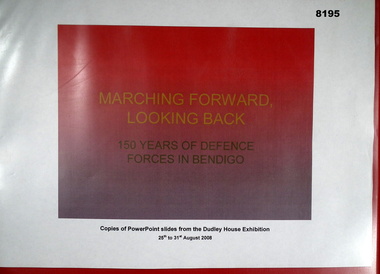
Album - FOLDERS, 150 YEARS
... The Exhibition led up to the 150 years Anniversary Dinner of Defence Forces in Bendigo held re Cat No’s 8193 & 8194.5P The source of the images came from Multiple places including; The Bendigo Advertiser, Bendigo Military Museum, Passchendaele Barracks Military Historical Society, Victorian State Library, Victorian Govt Gazette, City of Greater Bendigo, Victorian Colonial Infantry Association, 15 Transport Sqd and multiple personal files. ....1)Folder A4 4 ring Binder with plastic inserts each holding two A4 white paper sheets with images, 79 inserts making total 158 images. .2) Folder same as .1) has 80 insert sheets with articles, old photos newspapers relating to units, Wars during 150 years of Defence Forces in Bendigo.....1)On front cover, “Marching Forward, Looking Back - 150 years of Defence Forces in Bendigo”. .2) At top, “The Organising Committee - 150 Years of Defence Forces in Bendigo”...These were part of the research by Murray Poustie for the 150 year event. brsl Smirsl 150 .1)On front cover, “Marching Forward, Looking Back - 150 years of Defence Forces in Bendigo”. .2) At top, “The Organising Committee - 150 Years of Defence Forces in Bendigo” .1)Folder A4 4 ring Binder with plastic inserts each holding two A4 white paper sheets with images, 79 inserts making total 158 images. .2) Folder same as .1) has 80 insert sheets with articles, old photos newspapers relating to units, Wars during 150 years of Defence Forces in Bendigo. ...The images are ones that were used in a Power Point exhibition at Dudley House Bendigo from August 25th - 31st August 2008. The Exhibition led up to the 150 years Anniversary Dinner of Defence Forces in Bendigo held re Cat No’s 8193 & 8194.5P The source of the images came from Multiple places including; The Bendigo Advertiser, Bendigo Military Museum, Passchendaele Barracks Military Historical Society, Victorian State Library, Victorian Govt Gazette, City of Greater Bendigo, Victorian Colonial Infantry Association, 15 Transport Sqd and multiple personal files. These were part of the research by Murray Poustie for the 150 year event..1)Folder A4 4 ring Binder with plastic inserts each holding two A4 white paper sheets with images, 79 inserts making total 158 images. .2) Folder same as .1) has 80 insert sheets with articles, old photos newspapers relating to units, Wars during 150 years of Defence Forces in Bendigo..1)On front cover, “Marching Forward, Looking Back - 150 years of Defence Forces in Bendigo”. .2) At top, “The Organising Committee - 150 Years of Defence Forces in Bendigo”brsl, smirsl, 150 -
4th/19th Prince of Wales's Light Horse Regiment Unit History Room
Book, Bob Nicholls, The Colonial Volunteers, 1988
... The defence forces of the Australian colonies 1836-1901...Hard covered book. The defence forces of the Australian colonies 1836-1901...The defence forces of the Australian colonies 1836-1901 The Colonial Volunteers Book Book Bob Nicholls ...Hard covered book. The defence forces of the Australian colonies 1836-1901ISBN 0 04 302003 8the defence forces of the australian colonies 1836-1901, the colonial volunteers -
 Ballarat RSL Sub-Branch Inc.
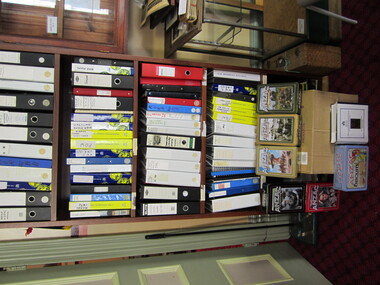
Folder - Buttons of the Defence Forces in Australia
... Folder - Buttons of the Defence Forces in Australia...Ballarat RSL Sub-Branch Inc. 330 Heinz Lane Invermay Park goldfields Literature Ballarat RSL Ballarat Folder - Buttons of the Defence Forces in Australia ...literature, ballarat rsl, ballarat -
 Federation University Historical Collection
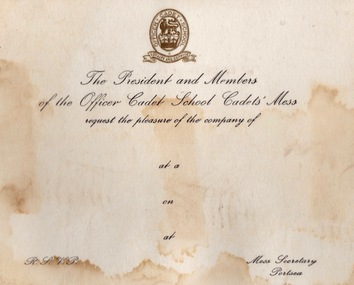
Document - Document - Correspondence, ZILLES COLLECTION: Letter paper and cards - Defence Forces, Portsea and Queenscliff
... ZILLES COLLECTION: Letter paper and cards - Defence Forces, Portsea and Queenscliff....Blue print ZILLES COLLECTION: Letter paper and cards - Defence Forces, Portsea and Queenscliff. Document Document - Correspondence ...Zilles Printers was begun by Lewis Zilles in the early 1930s. It was in McKenzie Street Ballarat. His son Jeffrey also became a printer - letterpress, offset and screen printer. The business became Zilles Printers/Graphics and was in Armstrong Street and later Bell Street Ballarat. Items are work done for the Australian Defence Force bases at Portsea and Queenscliff. They were training bases - Officer Cadet School and Australian Staff College. Originally the base at Portsea was the Quarantine Station established in the late 1800s. International protocols required captains of arriving ships to provide a clean bill of health from the last port of call. If this was not possible all on board would be transferred to the Quarantine Station by boat for observations. This was to stop the spread of diseases such as cholera, small pox, typhoid fever, influenza and the plague. In 1952 it became a military training base - Officer Cadet School. The quarantine station still operated and the Army had to be prepared to evacuated in an emergency. This occurred in 1954 when 113 passengers on board the Strathaird were quarantined with smallpox. Cadets and staff came with their families and was a small township. Training for the Vietnam War was here, Now gone the remnants of the quarantine station and army activites can be seen. Under Point Nepean Community Trust. Fort Queenscliff dates from 1860 when it was an open battery known as Shortlands Bluff. The Garrison included volunteer artillery, engineers and infantry. It was a Coastal Defence Installation from 1883-1946. The base on Swan Island was part of this and soldiers from the Fort would go on detail to the Island each day. A permanent group with their families were housed there. The children would attend the local school in Queenscliff. It eventually became and still is a restricted area. In 1946 the Fort became home of the Army Command and Staff College. Officers came from overseas to train. Families would come with them and be accommodated in the main officers residence "Maytone" or private housing rented by the Army. Their children would attend local schools. Staff Colleges were all moved to Canberra. The Fort is now the Army Soldiers Career Management Agency and houses all historical documents related to the Army. .1 Off-white card with gold badge and black writing. .2 White card with separate page held together with blue and red ribbon. Badge in gold on front. Two Officer Cadet School flags - crossed and Christmas Greeting in blue inside card. .3 Off-white paper with Australian Staff College emblem. Blue print.2 Officer Cadet School emblem - lion and crown in centre. Flags - British and Australian .3 Emblem - crossed swords, owl and crownzilles printers, australian defence force, quarantine station portsea, officer cadet school, fort queenscliff, open battery, swan island, staff college, army command, zilles collection -
 Lara RSL Sub Branch
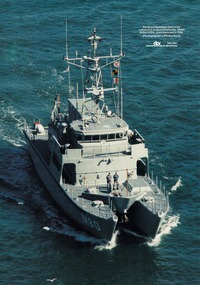
FOLDER, Folder of Defence Forces Photographs
... Folder of Defence Forces Photographs....Lara RSL Sub Branch McClelland Ave Lara Rectangular shaped red coloured folder. Folder of Defence Forces Photographs. FOLDER ...Rectangular shaped red coloured folder. -
 Warrnambool RSL Sub Branch
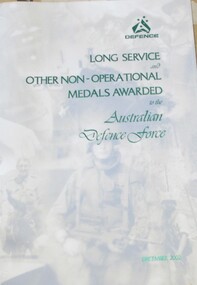
Booklet, BOOKLET: Long Service and Other Non-operational Medals Awarded to Australian Defence Forces
... BOOKLET: Long Service and Other Non-operational Medals Awarded to Australian Defence Forces...Horton Publisher: Department of Defence 2002 BOOKLET: Long Service and Other Non-operational Medals Awarded to Australian Defence Forces Booklet ... -
 Greensborough Historical Society
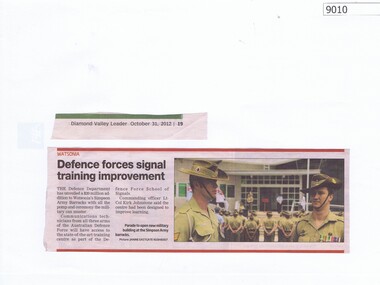
Newspaper - Newspaper Clipping, Diamond Valley Leader, Defence forces signal training improvement, 31/10/2012
... Defence forces signal training improvement...Greensborough Historical Society 34A Glenauburn Road Lower Plenty Lower Plenty melbourne A new Defence Force School of Signals was opened at Simpson Army Barracks in 2012. simpson army barracks Defence Force School of Signals Newspaper clipping with text and colour photo Defence forces signal training improvement Newspaper Newspaper Clipping Diamond Valley Leader ...A new Defence Force School of Signals was opened at Simpson Army Barracks in 2012.Newspaper clipping with text and colour photosimpson army barracks, defence force school of signals -
 Ithacan Historical Society
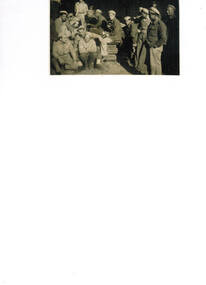
Photograph, WW2 Australian Defence Forces - Allied Aliens, c1940s
... WW2 Australian Defence Forces - Allied Aliens...WW2 Australian Defence Forces - Allied Aliens Photograph ...The photograph was taken when Stathi Raftopoulos was seserved with the Civilian Military Forces during World War 2. Young Greek and Australian-Greek men joined the Australian Defence Forces during World War 2 and served in various capacities. Ithacans who were unnaturalised were recruited into the Civilian Military Forces as 'Allied Aliens' and served the war effort on the home front. Naturalised Ithacans saw active service.A black and white photograph of fifteen men wearing army style clothing and light coloured berets sitting around and relaxing.wwii, army -
 Ithacan Historical Society
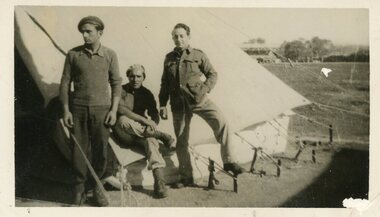
Photograph, WW2 Australian Defence Forces - Allied Aliens, c 1943
... WW2 Australian Defence Forces - Allied Aliens...Forces as 'Allied Aliens'. The photograph was taken at an army base in Albury in 1944. Albury was one of the regional towns where troops were stationed before being sent to other areas of battle or defence. ...WW2 Australian Defence Forces - Allied Aliens Photograph ...The men photographed are from L-R: Gerry Dellaportas (Dellas), Bill Antypas and Stathi Raftopoulos who served in the Civilian Military Forces as 'Allied Aliens'. The photograph was taken at an army base in Albury in 1944. Albury was one of the regional towns where troops were stationed before being sent to other areas of battle or defence. Young Greek and Australian-Greek men joined the Australian Defence Forces during World War 2 and served in various capacities. Ithacans who were unnaturalised were recruited into the Civilian Military Forces as 'Allied Aliens' and served the war effort on the home front. Naturalised Ithacans saw active service.A black and whit photograph of three men in army uniform standing next to a tent erected in an open paddock.army, wwii -
 Ithacan Historical Society
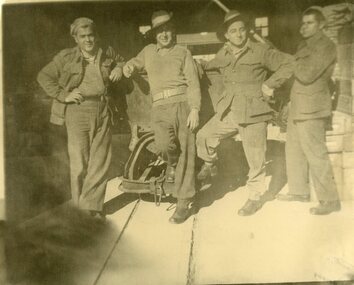
Photograph, WW2 Australian Defence Forces - Allied Aliens, c 1939 - 1945
... WW2 Australian Defence Forces - Allied Aliens...WW2 Australian Defence Forces - Allied Aliens Photograph ...Stathi Raftopoulos, pictured third from the left , served in the Civilian Military Forces during WW2.Young Greek and Australian-Greek men joined the Australian Defence Forces during World War 2 and served in various capacities. Ithacans who were unnaturalised were recruited into the Civilian Military Forces as 'Allied Aliens' and served the war effort on the home front. Naturalised Ithacans saw active service.A black and white photograph of four men in army uniform standing against a large piece of machinery.wwii -
 Ithacan Historical Society
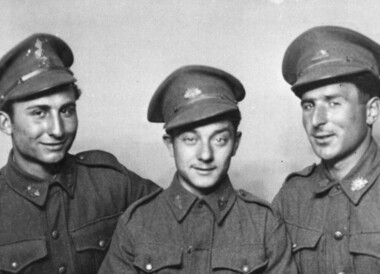
Photograph, WW2 Australian Defence Forces - Allied Aliens, c 1942
... WW2 Australian Defence Forces - Allied Aliens...WW2 Australian Defence Forces - Allied Aliens Photograph ...Ithacan Naki Raftopoulos (centre) served in the Civilian Military Forces during WW 2 and is pictured with Arthur Pantatzis (left) and Theo Spirakos (Spirason). A number of Ithacan Greek men and Australian born men of Ithacan descent served in the Australian defence forces during World War 2. Some saw active service whilst those who had not become naturalised were recruited into the Civilian Military Forces as 'Allied Aliens' and served the war effort on the home front.A black and white head and shoulders photograph of three men in Australian army uniform, wearing peaked caps. army -
 Ithacan Historical Society
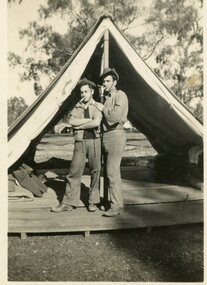
Photograph, WW2 Australian Defence Forces - Allied Aliens, c1940s
... WW2 Australian Defence Forces - Allied Aliens...WW2 Australian Defence Forces - Allied Aliens Photograph ...The soldiers are pictured at Camp Pell, Royal Park Melbourne where a large military camp was located during World War 2. On the left is Stathi Raftopoulos, one of a number Ithacans who served in the Civilian Military Forces during World War 2.A number of Ithacan Greek men and Australian born men of Ithacan descent served in the Australian defence forces during World War 2. Those who had not become naturalised were recruited into the Civilian Military Forces as 'Allied Aliens' and served the war effort on the home front.A black and white photograph of two soldiers standing in from of a tent at an army camp. -
 Ithacan Historical Society
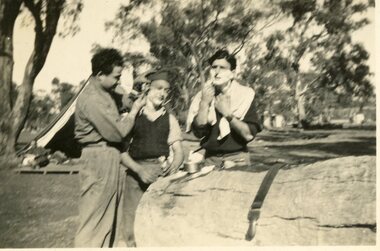
Photograph, WW2 Australian Defence Forces - Allied Aliens, c1942
... WW2 Australian Defence Forces - Allied Aliens...WW2 Australian Defence Forces - Allied Aliens Photograph ...The three soldiers, all from Ithaca, served with the Australian Civilian Military Forces during World War 2. They are pictured at Camp Pell, Royal Park Melbourne where a large military camp was located during World War 2. Naki Raftopoulos is the man being shaved. He migrated as a young boy in the early 1930. Initially the family settled in the Mildura area where other members of the Raftopoulos family were established. Eventually they moved to Melbourne.During the period of the second world war, Ithacans who were unnaturalised were recruited into the Civilian Military Forces as 'Allied Aliens' and served the war effort on the home front. Naturalised Ithacans saw active service. A black and white photograph of three soldiers standing around a fallen tree trunk in a camp. One man is shaving himself while the man in the middle is being shaved. A tent is visible in thew background.army -
 Ithacan Historical Society
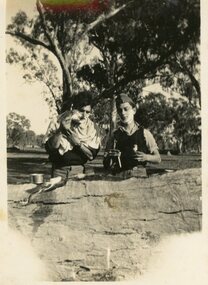
Photograph, WW2 Australian Defence Forces - Allied Aliens, c 1942
... WW2 Australian Defence Forces - Allied Aliens...WW2 Australian Defence Forces - Allied Aliens Photograph ...The soldiers are pictured at Camp Pell, Royal Park Melbourne where a large military camp was located during World War 2. On the right is Naki Raftopoulos who served with the Australian Civilian Military Forces during World War 2. During the period of the second world war, Ithacans who were unnaturalised were recruited into the Civilian Military Forces as 'Allied Aliens' and served the war effort on the home front. Naturalised Ithacans saw active service. Royal Park was used as a temporary army camp during both world wars. Following the Japanese bombing of Pearl Harbour and the entry of the United States into World War II, the camp was used to house some of the 250,000 Americans stationed in Australia. A black and white photograph of two soldiers standing behind a fallen tree trunk at a camp and shaving.army -
 Ithacan Historical Society
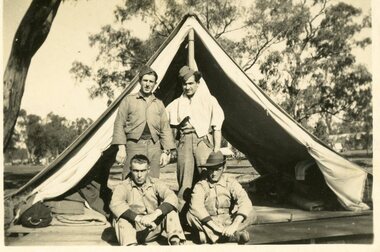
Photograph, WW2 Australian Defence Forces - Allied Aliens, c1942
... WW2 Australian Defence Forces - Allied Aliens...WW2 Australian Defence Forces - Allied Aliens Photograph ...The four soldiers are members of the Civilian Military Forces recruited as 'Allied Aliens' and are pictured at Camp Pell, Royal Park Melbourne where a large military camp was located during World War 2.A number of Ithacan Greek men and Australian born men of Ithacan descent served in the Australian defence forces during World War 2 and saw active service. Those who had not become naturalised were recruited into the Civilian Military Forces as 'Allied Aliens' and served the war effort on the home front.A black and white photograph of four soldiers standing in front of an open tent at a camp.army -
 National Vietnam Veterans Museum (NVVM)
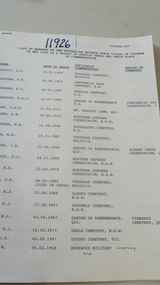
Document, Defence Forces Killed In Vietnam
... Defence Forces Killed In Vietnam...National Vietnam Veterans Museum (NVVM) 25 Veterans Drive Newhaven phillip-island-and-the-bass-coast Deaths In Vietnam Australian Defence Force 520 names and details 27 page typed document (copy) of listed member of the Australian Defence Force killed in Vietnam or who died as a result of service there and place of commemoration. Defence Forces Killed In Vietnam Document Document ...27 page typed document (copy) of listed member of the Australian Defence Force killed in Vietnam or who died as a result of service there and place of commemoration.520 names and detailsdeaths in vietnam, australian defence force -
 Flagstaff Hill Maritime Museum and Village
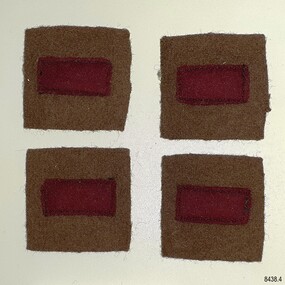
Badge - Australian Military cloth patch, Army Medical Corps, 108 Australian General Hospital, 1939-1945
... ...Australian Defence Forces...During World War II He served as a Military Doctor in the Australian Defence Forces. Dr Angus and his family moved to Warrnambool in 1939, where Dr Angus operated his own medical practice. ...Insignia of the Australian Defence Forces, Army Medical Corps, 108 Australian General Hospital, WWII era. ...Insignia of the Australian Defence Forces, Army Medical Corps, 108 Australian General Hospital, WWII era. ...The four cloth patches belonged to Dr William Roy Angus and are now part of Flagstaff Hill’s comprehensive W.R. Angus Collection, donated by the family of Dr W R Angus (1901-1970), surgeon and oculist. The badges date to the Second World War era, when Dr Angus was a Surgeon Captain for the Australian Defence Forces in the Army Medical Corps, 108 Australian General Hospital and 106 Australian General Hospital, stationed in Ballarat, Victoria, and in Bonegilla, N.S.W. He completed his service just before the end of the war due to suffering from a heart attack. In World War I the troops of the Australian Military Forces staked coloured flags of various shapes and colours in the ground where they camped to identify their units. These flag codes were quickly recognised. The system worked so well that miniature flags were called colour patches. They became part of the uniform, to be worn on both sleeves just below the shoulder. The system was slightly modified for use in the Second World War. The W.R. Angus Collection: - The W.R. Angus Collection includes historical medical equipment, surgical instruments and material belonging to Dr Edward Ryan and Dr Thomas Francis Ryan, (both of Nhill, Victoria) and Dr Angus’ own belongings. The Collection’s history spans the medical practices of the two Doctors Ryan, from 1885-1926 plus that of Dr Angus, up until 1969. It includes historical medical and surgical equipment and instruments from the doctors Edward and Thomas Ryan of Nhill, Victoria. Dr Angus married Gladys in 1927 at Ballarat, the nearest big city to Nhill where he began as a Medical Assistant. He was also Acting House surgeon at the Nhill hospital where their two daughters were born. During World War II He served as a Military Doctor in the Australian Defence Forces. Dr Angus and his family moved to Warrnambool in 1939, where Dr Angus operated his own medical practice. He later added the part-time Port Medical Officer responsibility and was the last person appointed to that position. Both Dr Angus and his wife were very involved in the local community, including the planning stages of the new Flagstaff Hill and the layout of the gardens there. Dr Angus passed away in March 1970.Dr W R Angus (1901-1970), surgeon and oculist, collected a range of military objects including those he personally used during his time as Surgeon Captain in the Australian Defence Forces in World War II. The objects allow insight into military life in the early-to-mid 20th century. The W.R. Angus Collection is significant for still being located at the site it is connected with, Doctor Angus being the last Port Medical Officer in Warrnambool. The Collection includes historical medical objects that date back to the late 1800s.Badges; set of four cloth patches, red rectangles on brown squares. Insignia of the Australian Defence Forces, Army Medical Corps, 108 Australian General Hospital, WWII era. Dr W R Angus owned the cloth patches that are now part of the W. R. Angus Collection.flagstaff hill, warrnambool, maritime village, maritime museum, shipwreck coast, great ocean road, flagstaff hill maritime museum and village, dr w r angus, w.r. angus collection, australian army, surgeon captain, ballarat, bonegilla, badge, insignia, badge collection, world war 2, second world war, australian defence forces, army medical corps, 108 australian general hospital, great war, military uniform, 106 australian general hospital, 1939-1945 -
 Flagstaff Hill Maritime Museum and Village
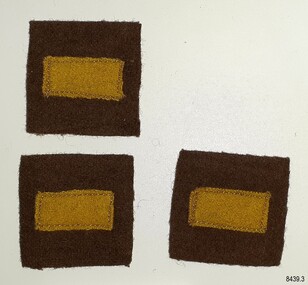
Badge - Australian Military cloth patch, Army Medical Corps, 106 Australian General Hospital, 1939-1945
... ...Australian Defence Forces...During World War II He served as a Military Doctor in the Australian Defence Forces. Dr Angus and his family moved to Warrnambool in 1939, where Dr Angus operated his own medical practice. ...Insignia of the Australian Defence Forces, Army Medical Corps, 106 Australian General Hospital, WII era. ...Insignia of the Australian Defence Forces, Army Medical Corps, 106 Australian General Hospital, WII era. ...The three cloth patches belonged to Dr William Roy Angus and are now part of Flagstaff Hill’s comprehensive W.R. Angus Collection, donated by the family of Dr W R Angus (1901-1970), surgeon and oculist. The badges date to the Second World War era, when Dr Angus was a Surgeon Captain for the Australian Defence Forces in the Army Medical Corps, 108 Australian General Hospital and 106 Australian General Hospital, stationed in Ballarat, Victoria, and in Bonegilla, N.S.W. He completed his service just before the end of the war due to suffering from a heart attack. In World War I the troops of the Australian Military Forces staked coloured flags of various shapes and colours in the ground where they camped to identify their units. These flag codes were quickly recognised. The system worked so well that miniature flags were called colour patches. They became part of the uniform, to be worn on both sleeves just below the shoulder. The system was slightly modified for use in the Second World War. The W.R. Angus Collection: - The W.R. Angus Collection includes historical medical equipment, surgical instruments and material belonging to Dr Edward Ryan and Dr Thomas Francis Ryan, (both of Nhill, Victoria) and Dr Angus’ own belongings. The Collection’s history spans the medical practices of the two Doctors Ryan, from 1885-1926 plus that of Dr Angus, up until 1969. It includes historical medical and surgical equipment and instruments from the doctors Edward and Thomas Ryan of Nhill, Victoria. Dr Angus married Gladys in 1927 at Ballarat, the nearest big city to Nhill where he began as a Medical Assistant. He was also Acting House surgeon at the Nhill hospital where their two daughters were born. During World War II He served as a Military Doctor in the Australian Defence Forces. Dr Angus and his family moved to Warrnambool in 1939, where Dr Angus operated his own medical practice. He later added the part-time Port Medical Officer responsibility and was the last person appointed to that position. Both Dr Angus and his wife were very involved in the local community, including the planning stages of the new Flagstaff Hill and the layout of the gardens there. Dr Angus passed away in March 1970.Dr W R Angus (1901-1970), surgeon and oculist, collected a range of military objects including those he personally used during his time as Surgeon Captain in the Australian Defence Forces in World War II. The objects allow insight into military life in the early-to-mid 20th century. The W.R. Angus Collection is significant for still being located at the site it is connected with, Doctor Angus being the last Port Medical Officer in Warrnambool. The Collection includes historical medical objects that date back to the late 1800s.Badges; set of three cloth patches, yellow rectangles on brown squares. Insignia of the Australian Defence Forces, Army Medical Corps, 106 Australian General Hospital, WII era. Dr W R Angus owned the cloth patches that are now part of the W. R. Angus Collection.flagstaff hill, warrnambool, maritime village, maritime museum, shipwreck coast, great ocean road, flagstaff hill maritime museum and village, dr w r angus, w.r. angus collection, australian army, surgeon captain, ballarat, bonegilla, badge, insignia, world war 1, 1914-1918, badge collection, world war 2, second world war, australian defence forces, army medical corps, 108 australian general hospital, great war, military uniform, 106 australian general hospital -
 Uniting Church Archives - Synod of Victoria
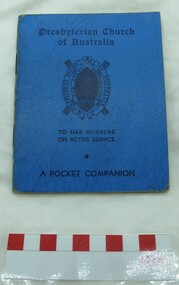
Book, Keating-Wood Pty Ltd, Presbyterian Church of Australia to her members on active service : A Pocket Companion of prayer, praise and helpful thoughts
... ...Defence Forces Chaplaincy Committee of the Presbyterian Church...Issued by the Defence Forces Chaplaincy Committee of the Presbyterian Church for free distribution to members of the Services....Issued by the Defence Forces Chaplaincy Committee of the Presbyterian Church for free distribution to members of the Services. ...Small blue covered book with black text on the cover. The book is held together by two staples along its spine. 55 p. presbyterian church of australia, field chaplain world war 1939-1945, defence forces chaplaincy committee of the presbyterian church -
 Melbourne Legacy
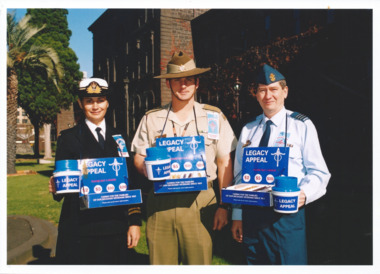
Photograph - Photo, Legacy Appeal 2005, Selling Badges, 2005
... A badge seller from each of the defence forces outside Victoria Barracks on St Kilda Road for Badge Week in 2005....Colour photo x 4 of three badge sellers (one from each of the defence forces) in Badge week....A badge seller from each of the defence forces outside Victoria Barracks on St Kilda Road for Badge Week in 2005. ...Photos during Badge Week in September 2005. A badge seller from each of the defence forces outside Victoria Barracks on St Kilda Road for Badge Week in 2005.A record of defence forces participating in fundraising for the Legacy Appeal, believed to be 2005. Colour photo x 4 of three badge sellers (one from each of the defence forces) in Badge week.Printed on the back "legacy appeal, fundraising, badge week, army, navy, adf personnel, raaf -
 Montmorency–Eltham RSL Sub Branch
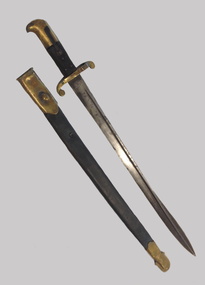
Weapon - 1855 Pattern Sappers and Miners Lancaster Sword Bayonet, Carl Reinhard KIRSCHBAUM, 1855 Pattern Sapper and Miners Lancaster Sword Bayonet, 1855
... ...victorian defence forces...Pattern 1855 bayonets were issued to some volunteer units of the Victorian defence forces in the late 1850s, ...Pattern 1855 bayonets were issued to some volunteer units of the Victorian defence forces in the late 1850s, bayonet victorian defence forces lancaster carbine Knight's Head stamping of the German Solingen-based firm Carl Reinhard KIRSCHBAUM Stylised beaked-brass pommel with T- shaped attachment slot. ...This bayonet and scabbard was made for the Charles Lancaster .577 calibre Oval Bore Carbine and was known as the Pattern 1855 'Sappers and Miners' bayonet because they were designed for use by the Corps of British Royal Sappers & Miners. The first model Sappers and Miners bayonet appeared in 1841 and differs significantly from this type. Pattern 1855 bayonets were issued to some volunteer units of the Victorian defence forces in the late 1850s, Stylised beaked-brass pommel with T- shaped attachment slot. A steel press stud operates the locking catch via a steel leaf spring on right side of hilt. Two-piece black chequered leather grips. Left grip has four small steel rivets, right grip three rivets and the leaf spring securing screw. Brass cross-guard with formed muzzle ring. Long single-edged, pipe backed, quill pointed 24 inch (615mm) steel blade. Original leather scabbard with brass locket and chape.Knight's Head stamping of the German Solingen-based firm Carl Reinhard KIRSCHBAUM bayonet, victorian defence forces, lancaster carbine -
Ringwood and District Historical Society
Pamphlet, Australian Militia Forces (Home Defence) Conditions of Service c1939, c.1939
... Australian Militia Forces (Home Defence) Conditions of Service c1939...Conditions of Service in the Australian Militia Forces. Home defence only. Cream bifold leaflet with blue printing and with rising sun crest above printing....Conditions of Service in the Australian Militia Forces. Home defence only....Conditions of Service in the Australian Militia Forces. Home defence only. Conditions of Service in the Australian Militia Forces. ...Given to potential applicants wanting to join any arm of service. Enquiry at any drill hall for conditions of service.Conditions of Service in the Australian Militia Forces. Home defence only. Cream bifold leaflet with blue printing and with rising sun crest above printing.Conditions of Service in the Australian Militia Forces. Home defence only.
