
Showing 299 items matching "demolished shops"
-
 Ringwood and District Historical Society
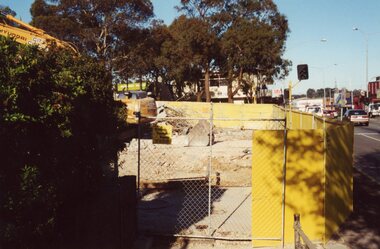
Photograph, Ringwood Railway Precinct circa 2009, Maroondah Highway looking west over demolished shops
... Ringwood Railway Precinct circa 2009, Maroondah Highway looking west over demolished shops...Ringwood Railway Precinct circa 2009, Maroondah Highway looking west over demolished shops Photograph ... -
 Ringwood and District Historical Society
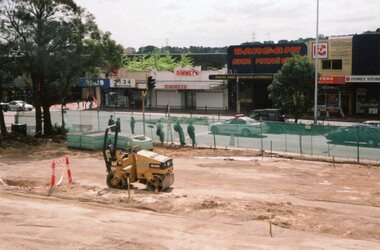
Photograph, Ringwood Railway Precinct with southside shops demolished and northside shops intact in 2009
... Ringwood Railway Precinct with southside shops demolished and northside shops intact in 2009...Ringwood Railway Precinct with southside shops demolished and northside shops intact in 2009 Photograph ... -
 Ringwood and District Historical Society
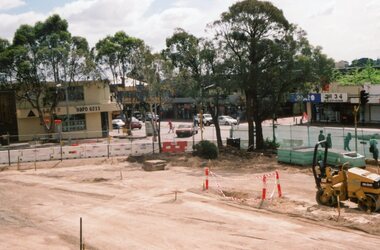
Photograph, Ringwood Railway Precinct in 2009, facing west towards former CE Carter premises and Melbourne Street, showing demolished corner shops
... Ringwood Railway Precinct in 2009, facing west towards former CE Carter premises and Melbourne Street, showing demolished corner shops...Ringwood Railway Precinct in 2009, facing west towards former CE Carter premises and Melbourne Street, showing demolished corner shops Photograph ... -
 Williamstown Historical Society Inc
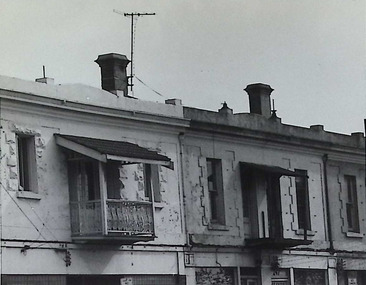
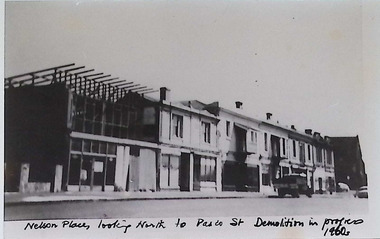
Photograph - Nelson Place, shops, 1965
... ...demolished shops...These old shops located near the corner of Nelson Place and Pascoe Street were demolished in 1965, to allow for the construction of the Nelson Heights Commission Flats. ...Nelson Place Nelson Heights demolished shops 1965 These old shops located near the corner of Nelson Place and Pascoe Street were demolished in 1965, to allow for the construction of the Nelson Heights Commission Flats. ...These old shops located near the corner of Nelson Place and Pascoe Street were demolished in 1965, to allow for the construction of the Nelson Heights Commission Flats. nelson place, nelson heights, demolished shops, 1965 -
 Williamstown Historical Society Inc
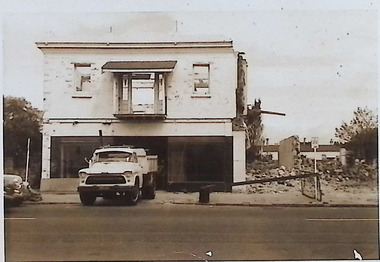
Photograph - Nelson Place, shops, 1960's
... ...demolished shops...Streetscape view of old shops which were demolished in 1965, to allow for the construction of the Nelson Heights Commission Flats. ...Nelson Place Nelson Heights demolished shops 1960's Streetscape view of old shops which were demolished in 1965, to allow for the construction of the Nelson Heights Commission Flats. ...Streetscape view of old shops which were demolished in 1965, to allow for the construction of the Nelson Heights Commission Flats. nelson place, nelson heights, demolished shops, 1960's -
 Williamstown Historical Society Inc
Photograph - Nelson Place, shops, 1965
... ...demolished shops...Streetscape view of old shops which were demolished in 1965, to allow for the construction of the Nelson Heights Commission Flats. ...Nelson Place Nelson Heights demolished shops 1965 Streetscape view of old shops which were demolished in 1965, to allow for the construction of the Nelson Heights Commission Flats. ...Streetscape view of old shops which were demolished in 1965, to allow for the construction of the Nelson Heights Commission Flats. nelson place, nelson heights, demolished shops, 1965 -
 Charlton Golden Grains Museum Inc
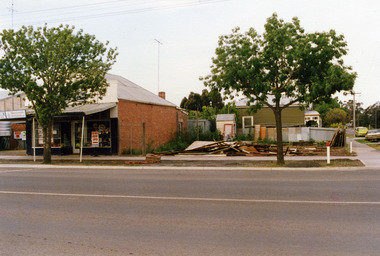
Photograph, Charlton Shire, c.1987
... Corner High Street and Learmonth Street. 2 shops demolished by Greg Fatheres. Shop on left Paterson's fruit and veg c.1935. ...Corner High Street and Learmonth Street, 2 Shops demolished by Greg Fathers...Corner High Street and Learmonth Street. 2 shops demolished by Greg Fatheres. Shop on left Paterson's fruit and veg c.1935. ...Corner High Street and Learmonth Street. 2 shops demolished by Greg Fatheres. Shop on left Paterson's fruit and veg c.1935. Butchers shop. rebuilt by Graeme Turner, Marini's take away cafe. Dalgety's, Building at back home of Sheisa Volch facing Learnmouth Street.Corner High Street and Learmonth Street, 2 Shops demolished by Greg Fathersdemolition, charlton, high street, shops, butcher, business, dalgety's, paterson -
 Kew Historical Society Inc
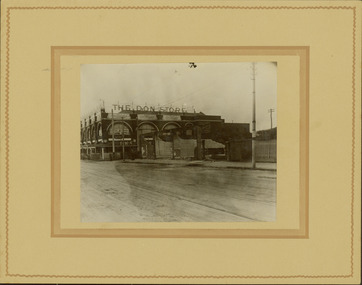
Photograph - Railway level crossing in Glenferrie Road, Glenferrie, E.J. Dower, 1912-13
... Annotated verso: "1912 / Demolishing shops near Glenferrie Railway Station, just prior to the regrading of line to camberwell / Taken by E.J. ...Railways -- Hawthorn Annotated verso: "1912 / Demolishing shops near Glenferrie Railway Station, just prior to the regrading of line to camberwell / Taken by E.J. ...One of a series of photographs, taken by Edgar James Dower in the second decade of the twentieth century. Born and raised in Olinda, his family later moved to Surrey Hills. He worked as an adult as a clerk in the city office of the Metropolitan Gas Company, and in his role as a 'collector', he was able to photograph scenes including the construction of tramlines and associated buildings in Kew, Hawthorn, Camberwell and Surrey Hills. Later he established a real estate agency with his brother - the E.J. Dower Real Estate Agency, Dandenong Office.The image is an historically significant record of the development of transport infrastructure which was used to connect Victorians in the first two decades of the twentieth century. This development resulted from increases in population and the consequent extension of Melbourne's suburbs. The photographs, both individually and collectively, richly detail the labour of workers and the tools and machinery used to create and extend Melbourne's public transport network in the years preceding and during World War 1.Digital copy of an original mounted photograph showing the old railway crossing in Glenferrie Road, Hawthorn. The removal of the train level crossing and the elevation of the rail line above the road was designed to enable the laying of tram tracks along Glenferrie Road. The buildings to the right of the photo were being demolished to allow for this. "The Don Store" is immediately behind the crossing.Annotated verso: "1912 / Demolishing shops near Glenferrie Railway Station, just prior to the regrading of line to camberwell / Taken by E.J. Dower 1912"theme --- travelling by tram, theme -- connecting victorians by transport and communications, glenferrie railway station, glenferrie road -- hawthorn (vic.), railways -- hawthorn -
 Tatura Irrigation & Wartime Camps Museum
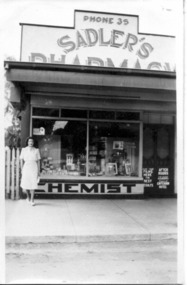
Photograph, Sadler's Pharmacy 1940
... Later Colliver's Shop, demolished in 1989. Storefront with female standing in front. ...Later Colliver's Shop, demolished in 1989. Storefront with female standing in front. ...Black & white photograph of Dorothy Sadler's Pharmacy, opposite the post office 1940. Later Colliver's Shop, demolished in 1989. Storefront with female standing in front. tatura -
 Ringwood and District Historical Society
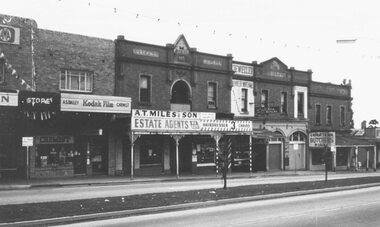
Photograph, Maroondah Highway Central, Ringwood. Coffee Palace and shops towards Adelaide Street. c1966
... . & Adelaide St. c1966. Demolished 1966 for shopping centre"..... & Adelaide St. c1966. Demolished 1966 for shopping centre". Black and white photograph (2 copies). ...Black and white photograph (2 copies).Written on back of photograph: "Coffee Palace and Block Buildings Cr. Main St. & Adelaide St. c1966. Demolished 1966 for shopping centre". -
 Ringwood and District Historical Society
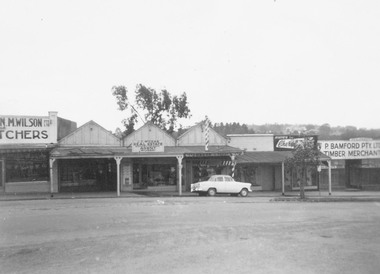
Photograph, Shops adjoining Bamfords. Ringwood. Probably 1958
... Shop of trio has a front that was taken from a shop demolished in Burke St. City. 1912. Boot shop run by Goodwin, formerly Clarke & Goodwin."...Shop of trio has a front that was taken from a shop demolished in Burke St. City. 1912. Boot shop run by Goodwin, formerly Clarke & Goodwin." ...Undated but probably 1958 as per #2373 (SS0187a)Written next to photograph, "Shops adjoining Bamfords. L.H. Shop of trio has a front that was taken from a shop demolished in Burke St. City. 1912. Boot shop run by Goodwin, formerly Clarke & Goodwin." -
 Linton and District Historical Society Inc
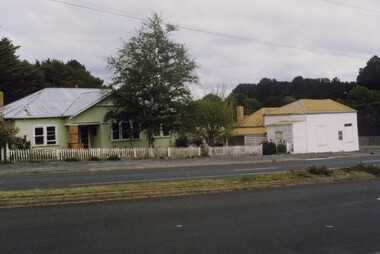
Photograph, Preston House and Shop, Sussex Street, Linton, 1988
... The shop closed in the 1970s and this photo taken in 1988 shows it without its original verandah. Dean Hart afterwards purchased the weatherboard house as a residence and demolished the shop building on the corner....The shop closed in the 1970s and this photo taken in 1988 shows it without its original verandah. Dean Hart afterwards purchased the weatherboard house as a residence and demolished the shop building on the corner. ...The white corner building was formerly a fruit and vegetable shop which was run by various generations of the Preston family, the last of whom was George Preston. The shop closed in the 1970s and this photo taken in 1988 shows it without its original verandah. Dean Hart afterwards purchased the weatherboard house as a residence and demolished the shop building on the corner.Colour photograph showing a green double-fronted weatherboard house in Sussex Street, Linton. The house has a chimney, pitched roof and a small porch, and a picket fence across the front. A smaller, white-painted building fronts the footpath on the corner of Sussex and Gillespie Streets.buildings, houses, shops, preston's shop, george preston, dean hart -
 Ringwood and District Historical Society
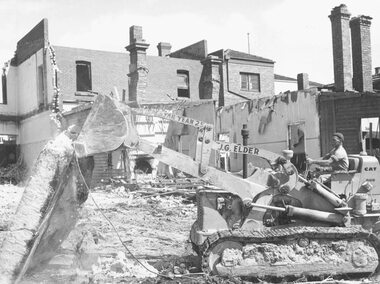
Photograph, Maroondah Highway Central, Ringwood. Demolition of Coffee Palace, Main St. 1966
... Written on back of smaller duplicate photograph: "Demolishing Coffee Palace & shops cnr. Maroondah Hwy. & Adelaide St. ...Written on back of smaller duplicate photograph: "Demolishing Coffee Palace & shops cnr. Maroondah Hwy. & Adelaide St. ...Black and white photograph (2 copies- 1 large, 1 small)Typed below large photograph: "Demolition of Coffee Palace - Main St. 1966". Written on back of smaller duplicate photograph: "Demolishing Coffee Palace & shops cnr. Maroondah Hwy. & Adelaide St. (west cnr.) 1966. Portion of house on right - This was home of T. Grant, Blacksmith, 1883". -
 Box Hill Historical Society
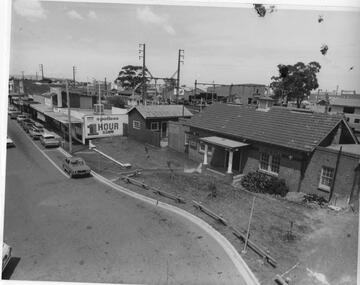
Photograph - Scout Hall and shops in Main Street, 1/10/1975
... The Scout Hall and shops in Main Street in October, 1975.All the shops were demolished and the railway lowered when Box Hill Centro was built - now referred to as Centro South....The Scout Hall and shops in Main Street in October, 1975.All the shops were demolished and the railway lowered when Box Hill Centro was built - now referred to as Centro South. ...The Scout Hall and shops in Main Street in October, 1975.All the shops were demolished and the railway lowered when Box Hill Centro was built - now referred to as Centro South.Black and white photoscout halls, shops, main street -
 Melbourne Tram Museum
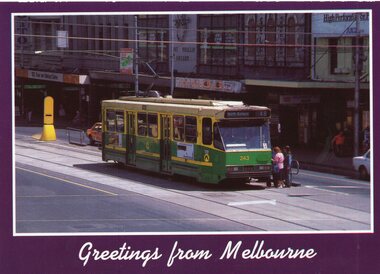
Postcard, Biscay Greeting Pty Ltd, A class 243 (Route 48, North Balwyn) in Flinders St at Swanston St, mid 1980's
... In the background is the Port Phillip Arcade, ANZ bank and other shops demolished during 2018/9 for the Metro Tunnel works. ...In the background is the Port Phillip Arcade, ANZ bank and other shops demolished during 2018/9 for the Metro Tunnel works. ...Colour postcard divided back, four photo panels - Biscay Greetings, of A class 243 (Route 48, North Balwyn) in Flinders St at Swanston St. In the background is the Port Phillip Arcade, ANZ bank and other shops demolished during 2018/9 for the Metro Tunnel works. Back has space for name and address, stamp and a message and details of the postcard. Produced by Biscay Greetings, possibly mid 1980's. Card No. BG307trams, tramways, a class, flinders st, route 48, tram 243 -
 Rutherglen Historical Society
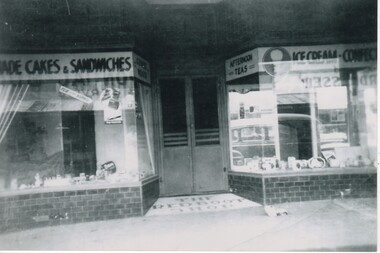
Image, c April 1958
... Booklet - Rutherglen heritage walk : a self-guided tour of Rutherglen's Historic Streetscapes / by Rutherglen Wine Experience. 2009, p. 5 - states that the Red Boot Shop was "demolished sometime after WWII, and no trace remained until a wild storm uncovered the tiled entrance in the mid 2000's."...Booklet - Rutherglen heritage walk : a self-guided tour of Rutherglen's Historic Streetscapes / by Rutherglen Wine Experience. 2009, p. 5 - states that the Red Boot Shop was "demolished sometime after WWII, and no trace remained until a wild storm uncovered the tiled entrance in the mid 2000's." main street rutherglen red boot shop ozone cafe harold hall alan zotti mccarthy On back of photo: "Ozone Café Main St Rutherglen | approx. ...Booklet - Rutherglen heritage walk : a self-guided tour of Rutherglen's Historic Streetscapes / by Rutherglen Wine Experience. 2009, p. 5 - states that the Red Boot Shop was "demolished sometime after WWII, and no trace remained until a wild storm uncovered the tiled entrance in the mid 2000's."Black and white photograph of the front of a café, with a central door flanked by two display windows. In tile, in front of the door, is the sign "The Red Boot Shop".On back of photo: "Ozone Café Main St Rutherglen | approx. April 1958 | purchased by Harold Hall March 1958 from McKinlays. | owners after H. Hall | McCarthy | Alan Zotti"main street rutherglen, red boot shop, ozone cafe, harold hall, alan zotti, mccarthy -
 Kew Historical Society Inc
Archive (Sub-series) - Subject File, Copy Shop (Walpole Street, Kew), 1958-present
... Archive file containing information about The Copy Shop at 3 Walpole Street, Kew, which was located in the Council-owned Masonic Hall (demolished c.1983). ...Archive file containing information about The Copy Shop at 3 Walpole Street, Kew, which was located in the Council-owned Masonic Hall (demolished c.1983). ...Various partiesReference, Research, InformationSecondary Values (KHS Imposed Order)Subject file containing information about The Copy Shop at 3 Walpole Street, Kew, which was located in the Council-owned Masonic Hall (demolished c.1983). The Shop acted as a community Centre as well as being a self-help duplicating centre. At one stage, the Society had an Information Centre at the Shop. The file holds correspondence and printed materials. -
 Charlton Golden Grains Museum Inc
Photograph, Charlton Shire, West end Charlton High St c. 1987, c.1987
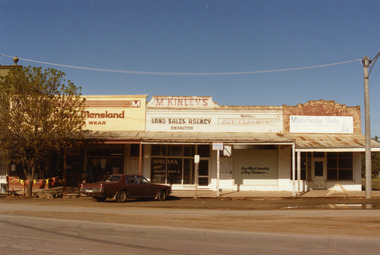
... Built c. 1890s. The tree shops were demolished in early 1990s. The photo was taken by Shire Engineer c. 1987. ...Built c. 1890s. The tree shops were demolished in early 1990s. The photo was taken by Shire Engineer c. 1987. ...Shops at the western end, on the south side of High St Charlton showing Eddie Harris Mensland, McKinleys Land Sales Agency, Hillier's Dry Cleaners and Manchester Unity Agency. Built c. 1890s. The tree shops were demolished in early 1990s. The photo was taken by Shire Engineer c. 1987. Part of a series of photos taken by the Shire.Colour photograph of shops at the western end, on the south side of High St Charlton showing Eddie Harris Mensland, McKinleys Land Sales Agency, Hillier's Dry Cleaners and Manchester Unity Agency. Dark cloured car parked in front of McKinleys. Safety flags around tree to the left of the car. Signage in McKinley's window says 'Special Any Garments Only $'. Signage on Hillier's window says Nor-West Laundry & Dry Cleaners.business, industry, eddie harris mensland, charlton, high street -
 Linton and District Historical Society Inc
Photograph, Shops in Sussex Street, Linton, circa 1922
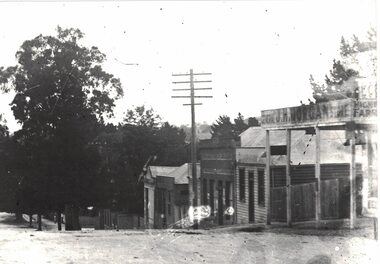
... What appears to be a laneway between the Morgan shop and the Ching dwelling was once occupied by the Surface Hill Hotel (demolished c.1911). ...What appears to be a laneway between the Morgan shop and the Ching dwelling was once occupied by the Surface Hill Hotel (demolished c.1911). ...Black and white copy of original photograph which shows the shop in Sussex Street owned by J. H. Morgan, the shop and dwelling owned by Richard Ching (telegraph pole in front), and the shop and dwelling owned by Annie Brown (née Nicholls). A small building between Ching's and Brown's shops may be the workshop of Dan McMillan, bootmaker. What appears to be a laneway between the Morgan shop and the Ching dwelling was once occupied by the Surface Hill Hotel (demolished c.1911). Shops in Sussex Street, Linton, c.1922: Morgan's, Ching's, Brown's. The original Bank of New South Wales building (by 1922 a private residence owned by the Lewers family) can just be seen further along the street, screened by a large tree.On reverse:"J. H. Morgans store Sussex St Linton c.1922".annie brown (née nicholls), j.h. morgan, richard ching, dan mcmillan -
 Wodonga & District Historical Society Inc
Photograph - Wodonga Business - Wodonga Home Furnishers
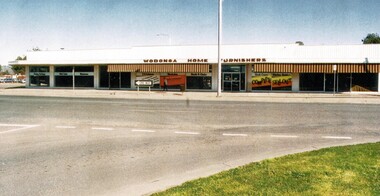
... demolished to make way for the Wodonga Home Furnishers. Mr Cheesley was a well-respected member of the community and served 13 years as a local councillor. He was often referred to as the council’s watchdog. His contribution is commemorated in the naming of the Les Cheesley Oval, Wodonga in his honour. Mr Cheesley died in Wodonga on 29th September 1994. The business continued to operate for a few more years but the shop...demolished to make way for the Wodonga Home Furnishers. Mr Cheesley was a well-respected member of the community and served 13 years as a local councillor. He was often referred to as the council’s watchdog. His contribution is commemorated in the naming of the Les Cheesley Oval, Wodonga in his honour. Mr Cheesley died in Wodonga on 29th September 1994. The business continued to operate for a few more years but the shop ...This popular furniture business was owned and operated by Mr Les Cheesley. In about 1963 the premises of Birrell's Bakery, Miss Hamilton's Corsetry, Gouge's Dry Cleaners, and the Dalgety NZ Loan Stock & Station Agents were demolished to make way for the Wodonga Home Furnishers. Mr Cheesley was a well-respected member of the community and served 13 years as a local councillor. He was often referred to as the council’s watchdog. His contribution is commemorated in the naming of the Les Cheesley Oval, Wodonga in his honour. Mr Cheesley died in Wodonga on 29th September 1994. The business continued to operate for a few more years but the shop was demolished in 1999 to make way for the realignment of Elgin Street in central Wodonga.A colour photo of the premises of Wodonga Home Furnishers in High Steet, Wodongawodonga businesses, high street wodonga, wodonga home furnishers, les cheesley -
 Ringwood and District Historical Society
Book, Bryce Raworth, Heritage Impact Assessment - 1 Bedford Road, Ringwood, Victoria. Application for permit - Proposed Redevelopment - July 2021, 2021
... It relates to a proposal to demolish the existing shop on the site and construct a multi-storey car park incorporating a commercial tenancy at the lower levels. ...It relates to a proposal to demolish the existing shop on the site and construct a multi-storey car park incorporating a commercial tenancy at the lower levels. ...A4 size wire-bound book compiled by Bryce RaworthINTRODUCTION: This heritage impact assessment (HIS) was prepared at the request of the City of Maroondah, the owner of the subject property at 1 Bedford Street (sic), Ringwood. It relates to a proposal to demolish the existing shop on the site and construct a multi-storey car park incorporating a commercial tenancy at the lower levels. It reviews the significance of the existing building on the site and the contribution it makes to the surrounding streetscapes, then comments on the heritage impacts of the proposed demolition in the context of the significance of the place and broader considerations. This office has previously provided an Historical Overview of the subject site (June 2020) and this assessment draws upon that previous research and analysis. The report has been prepared by Guy Murphy and Bryce Raworth. CONCLUSION: The proposed demolition of the former Blood Brothers Store at 1 Bedford Street (sic), Ringwood and the construction of a multi-storey car park on the enlarged site will result in the loss of some significance to the Heritage Overlay. The degree of loss is moderated by the partial intactness of the store, its modest character and the loss of its original setting, as well the proposal to implement a heritage interpretation strategy for the site. When considered in the context of the broader range of urban planning considerations and broader net community benefit, the proposed development is supported with respect to heritage impacts. -
 Federation University Historical Collection
Plan - Plans, Ballarat School of Mines New Workshops, 1944, 17/11/1944
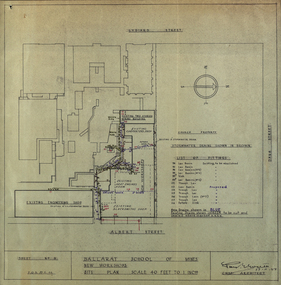
... demolished to make way for new buildings along Albert Street. According to E.J. Barker this was Metal Fabrication. ballarat school of mines metal fabrication albert street buildings plan heat engines room model mine blacksmiths shop blacksmithing carpenters shop engineering shope percy everett Sheet No 3 F.G.B. ...This building has been demolished to make way for new buildings along Albert Street. According to E.J. Barker this was Metal Fabrication.Plans (dyeline) for new building along the Ballarat School of Mines Albert Street frontage .1) Ballarat School of Mines New Workshops .2) as above Scale 1:480 WGS 84 37 degrees 33 feet 54 inches south 143 degrees 50 feet 30 inches eastSheet No 3 F.G.B.ballarat school of mines, metal fabrication, albert street, buildings, plan, heat engines room, model mine, blacksmiths shop, blacksmithing, carpenters shop, engineering shope, percy everett -
 Federation University Historical Collection
Plan, Sulieman Pasha Co Plan Transverse Section
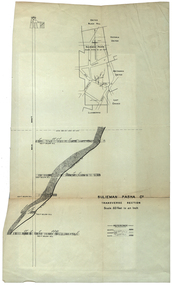
... demolished. The area had since those days become heavily occupied with a number of shops, houses, a post office, church and two schools in the immediate area. ...demolished. The area had since those days become heavily occupied with a number of shops, houses, a post office, church and two schools in the immediate area. ...The Sulieman Pasha is possibly named after the most important Sultan of the Ottoman Empire, Suleiman One, or Suleiman the Magnificent, when the Ottoman Empire was at its peak. Or potentially a number of Ottoman governors, statesmen and military commanders with the same name after, however the spelling is slightly different to the mine name. No Turkish connection was found relating to the formation of the company, and remains unconfirmed. The mine operated from two shafts; No. 1 near the corner of Humffray and Mair streets, and also near where the Welcome Nugget (2217 ounces) was found years earlier; and the controversial No. 2 shaft several blocks south bordering the northern side of the main highway through Ballarat. The company produced 62 666 ounces of gold, the twelfth highest quartz reef gold production for any mine on the Ballarat goldfield. Some crushing figure examples are January-June 1881: 3674 tonnes 1085 ounces; January-June 1885: 2949 tonnes 1281 ounces; July-December 1885: 4459 tonnes 1119 ounces; January-June 1887: 1869 tonnes 730 ounces; July-December 1892: 1450 tonnes 771 ounces; July-December 1896: 4365 tonnes 1372 ounces. Like many mines in the area, gold grades were low. John Watson was noted as mine manager in the 1880s, and John Williams 1890s. The company was re-organised twice increasing the number of shares from 4000 to 24 000, and increasing the capital available. The Sulieman Pasha Company was formed in 1878. David Fitzpatrick was given the honour of turning the first sod of both the No.1 and later No. 2 shafts. The first dividend was given to shareholders in July 1881. The company obtained a prospecting vote (government grant) to start, and was very proud to be the first Victorian gold mining company to pay the funds back to the government. The event was marked by a lavish banquet laid out for ministers and government officials by the company. Leases were purchased to the south in 1885 to the Llanberris Mine boundary, after poor results began accumulating from the small No. 1 shaft. To take advantage of this new land the company planned to sink a second shaft. Initially this was to take place on government land, but the uproar from nearby residents caused the company to purchase land along the Main Road (now Western Highway), and the old Yarrowee Hotel which had occupied the site since the alluvial digger days of the 1850's was demolished. The area had since those days become heavily occupied with a number of shops, houses, a post office, church and two schools in the immediate area. The thought of an underground mine next door drew considerable opposition. The company (before the days of public relations departments) wrote 'most people would have thought that progress as vital as mining would be supported by tradesmen whose business rely on the mining industry. It seems when it comes to mining they are bereft of their senses, and considering the low ebb of mining in Ballarat East, the action of our opponents are unaccountable. (Sarcastically) There are certain engineering difficulties in moving the quartz reefs to a new location, but if we could to appease our opponents we would'. The company also wanted to take over 4 acres of the St Paul's school oval for machinery, but accused the St Paul's Church of wanting extortionate amounts of money upfront, and on a yearly basis for the privilege. It stated the church could not be opposed to mining when several years earlier it had formed its own company to mine the land, only for shareholders to lose their money. In 1886, the company approached the Minister for Mines, and attended heated public meetings on the matter. The local residents, shop owners, and church submitted a 60 person petition to the local council and government authorities. They stated the shaft contravened the mining statutes, which stating no mining could take place within 150 yards of a public building or church. A speech by a resident stated 'mining always comes with glorious pictures of the great benefits which would accrue all parties concerned if their request is granted, but if property is destroyed or depreciated in value, no-one then comes forward and compensates them'. The No. 2 shaft was approved including taking over part of the school oval. In 1888, workers at the company's No. 2 shaft went on strike to try and bring their wages in line with other mines in the district (the No. 1 shaft was operated by tributers). William Madden (26) was killed from a fall of earth underground the same year, while a year later his father John Madden (70) was similarly killed in the Madame Berry Mine elsewhere in the district. In 1897 as the amount of gold being found fell away, it came to light part of the deal to purchase the Yarrowee Hotel site was a 5% royalty on gold found. Shareholders could not understand why they were paying a royalty to the former owners of the property. The mine closed in 1898 due to a lack of gold. In 1902 a boy (age unknown) called Charles Lee was killed from a fractured skull while working to dismantle the Sulieman Pasha plant. The fuss over the No. 2 shaft had a sequel. On the company winding up, the land was purchased by J.S. Trethowan who built a house next to the shaft. In 1907, the shaft caved-in creating a sinkhole immediately at the back of the house. A Mr Chamberlain heard a deep rumbling sound at 5am, and looked out the window to see his fowl house and thirteen chickens disappear down an expanding hole. He then went back to bed, and called the police later in the day. The shaft was 1050 feet deep, and the hole at the surface that developed was 20 feet by 17 feet across, and 20 feet depth. In 1930 it is reported a syndicate had been formed to clean out the old shaft, and re-open the mine. It is assumed this was the No. 1 shaft but no more was found. (https://www.mindat.org/loc-304239.html, accessed 07/08/2019) A transverse section plan of the Sulieman Pasha Mine.sulieman pasha company, plan, mining, united black hill mine, victoria united mine, victoria street, britannia united mine, last chance mine, llanberris mine, ottoman empire, john watson, john williams, david fitzpatrick -
 Flagstaff Hill Maritime Museum and Village
Sign - Hudson's Soap Enamel Advertising Sign, Patent Enamel Co Ltd, c. late 19th century- early 20th century
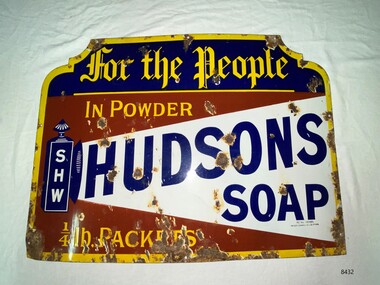
... shops carried his advertisements. This sign was manufactured by Patent Enamel Co Ltd was a company built in 1889 at Selly Oak, Borough of Birmingham, West Midlands, England, United Kingdom. The business was the first factory specifically devoted to enameled iron sign making. It had twelve furnaces for fusing the enamel, two scaling furnaces, and a large printing room, plus a huge area for steampipe drying. The company also smelted its own enamels and colour oxides. It is believed that the factory was decommissioned and demolished...shops carried his advertisements. This sign was manufactured by Patent Enamel Co Ltd was a company built in 1889 at Selly Oak, Borough of Birmingham, West Midlands, England, United Kingdom. The business was the first factory specifically devoted to enameled iron sign making. It had twelve furnaces for fusing the enamel, two scaling furnaces, and a large printing room, plus a huge area for steampipe drying. The company also smelted its own enamels and colour oxides. It is believed that the factory was decommissioned and demolished ...Hudson's Soap Powder, was the first satisfactory and commercially successful soap powder and was made in Liverpool by Robert Spear Hudson. He was also an innovator in using advertising, commissioning striking images from professional artists and paid for publicity , something which few other businesses did, and as such Hudson's soap became a household name. Horse, steam and electric tramcars, print periodicals and chemist shops carried his advertisements. This sign was manufactured by Patent Enamel Co Ltd was a company built in 1889 at Selly Oak, Borough of Birmingham, West Midlands, England, United Kingdom. The business was the first factory specifically devoted to enameled iron sign making. It had twelve furnaces for fusing the enamel, two scaling furnaces, and a large printing room, plus a huge area for steampipe drying. The company also smelted its own enamels and colour oxides. It is believed that the factory was decommissioned and demolished in the 1960's.the first factory specifically devoted to enameled iron sign making. It had twelve furnaces for fusing the enamel, two scaling furnaces, and a large printing room, plus a huge area for steampipe drying. The company also smelted its own enamels and colour oxides.The factory was decommissioned and demolished in the 1960s.The signage demonstrates the increasing demand for domestic soap products and new forms of advertising. The soap business was apart of the flourishing export trade between Australia and Britain during the height of the British Empire.Enamel advertising sign for Hudson's soapflagstaff hill, warrnambool, maritime museum, hudson's soap, advertising signage, patent enamel co ltd, selly oak, borough of birmingham, robert spear hudson -
 City of Moorabbin Historical Society (Operating the Box Cottage Museum)
Photograph - Photograph, 4 Vickery Street Bentleigh c 1950, 1950
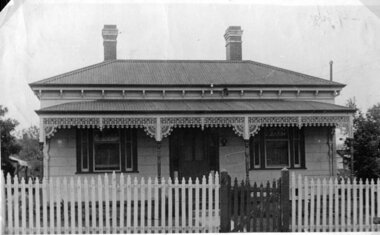
... Mr Herron lived there until 1989 and the house was demolished and turned into a carpark for the busy Shopping precinct of Centre Road, Bentleigh. ...Mr Herron lived there until 1989 and the house was demolished and turned into a carpark for the busy Shopping precinct of Centre Road, Bentleigh. ...Mr John Herron and his wife Isa Mary Herron purchased the house at 4 Vickery Street Bentleigh in 1950 from Miss M Marriott. Isa May (nee Kennedy) was the granddaughter of James Jones a very early settler in Moorabbin Shire and Miss M Marriott was a descendant of the early settler market gardeners Marriott family. Mr Herron lived there until 1989 and the house was demolished and turned into a carpark for the busy Shopping precinct of Centre Road, Bentleigh. The Marriott family were early settler market gardeners from 1878 in the area of Dendy’s 1841 Special Survey. Isa May Jones, the grand daughter of James Jones married John Herron in 1940. James was the son of Philip Jones , a chair-maker, who settled in the area of East Brighton, now Bentleigh, in 1852. John Herron immigrated to Australia in 1926.A black and white photograph of the house at 4 Vickery Street, Bentleigh purchased by Mr John Herron and his wife Isa May (nee Jones) in 1950 from Miss M. Marriott. * pioneers, early settlers, brighton, moorabbin, bentleigh, market gardeners, dairyman, dairy farmer, jones james, jones mary ann, jones martha, jones elizabeth ann, dendy henry, dendys special survey 1841, elster creek, melbourne, jones ethel may, herron isa mary, herron john, tram conductor, marriott m -
 City of Moorabbin Historical Society (Operating the Box Cottage Museum)
Document - Document, Receipt 1950, c1950
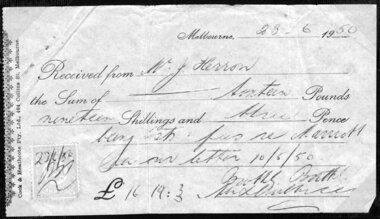
... Mr Herron lived there until 1989 and the house was then demolished and turned into a carpark for the busy Shopping precinct of Centre Road, Bentleigh....Mr Herron lived there until 1989 and the house was then demolished and turned into a carpark for the busy Shopping precinct of Centre Road, Bentleigh. ...Mr John Herron and his wife Isa Mary Herron purchased the house at 4 Vickery Street Bentleigh in 1950 from Miss M Marriott. He was a descendant of John James an early settler dairyman in Moorabbin Shire and Miss M Marriott was a descendant of the early settler market gardeners Marriott family. Mr Herron lived there until 1989 and the house was then demolished and turned into a carpark for the busy Shopping precinct of Centre Road, Bentleigh.The Marriott family were early settler market gardeners from 1878 in the area of Dendy’s 1841 Special Survey and John Herron was a descendant of Philip Jones , a chair-maker, who settled in the area of East Brighton, now Bentleigh, in 1852 An original paper receipt, dated 25/6/1950, for solicitors fees regarding the purchase of the house a 4 Vickery Street Bentleigh by Mr John Herron from Miss M Marriott. Melbourne 23-6- 1950/ Received from Mr. J. Herron / the Sum of – Sixteen Pounds / nineteen Shillings and three Pence / being costs & fees re Marriott / per letter 10/5/50 / £16.19.3 signed N Boothby Boothby / stamp in left corner dated 23/6/50 / along left side Cook & Heathcote Pty. Ltd., 404 Collins St., Melbournepioneers, early settlers, brighton, moorabbin, bentleigh, market gardeners, dairyman, dairy farmer, jones james, jones mary ann, jones martha, jones elizabeth ann, dendy henry, dendys special survey 1841, elster creek, melbourne, jones ethel may, herron isa mary, herron john, tram conductor, marriott m, cook and heathcote pty ltd -
 City of Moorabbin Historical Society (Operating the Box Cottage Museum)
Document - Document, letter of costs 1950, c1950
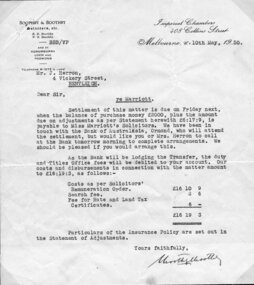
... Mr Herron lived there until 1989 and the house was then demolished and turned into a carpark for the busy Shopping precinct of Centre Road, Bentleigh....Mr Herron lived there until 1989 and the house was then demolished and turned into a carpark for the busy Shopping precinct of Centre Road, Bentleigh. ...Mr John Herron and his wife Isa Mary Herron purchased the house at 4 Vickery Street Bentleigh in 1950 from Miss M Marriott. He was a descendant of John James an early settler dairyman in Moorabbin Shire and Miss M Marriott was a descendant of the early settler market gardeners Marriott family. Mr Herron lived there until 1989 and the house was then demolished and turned into a carpark for the busy Shopping precinct of Centre Road, Bentleigh.The Marriott family were early settler market gardeners from 1878 in the area of Dendy’s 1841 Special Survey and John Herron was a descendant of Philip Jones , a chair-maker, who settled in the area of East Brighton, now Bentleigh, in 1852 An original letter, dated 10th May 1950, from solicitors Boothby and Boothby requesting settlement of costs involved with purchase of house at 4 Vickery Street Bentleigh by Mr John Herron from Miss M Marriott Attached is a Statement of Adjustments cat 00053.4 * Boothby & Boothby Imperial Chambers / Solicitors etc. 408 Collins Street/ B>B Boothby / N.B Boothby / - BBB/VP Melbourne C 10th May, 1950/ and at / Korumburra / Loch and / Poowong/ Telephone M 1275 ( 2 Lines )/ Mr. J. Herron, / 4 Vickery Street, / Bentleigh / re Marriott signed N Boothby solicitors, pioneers, early settlers, brighton, moorabbin, bentleigh, market gardeners, dairyman, dairy farmer, jones james, jones mary ann, jones martha, jones elizabeth ann, dendy henry, dendys special survey 1841, elster creek, melbourne, jones ethel may, herron isa mary, herron john, tram conductor, marriott m, boothby and boothby -
 City of Moorabbin Historical Society (Operating the Box Cottage Museum)
Document - Document, statement of fees 1950, c1950
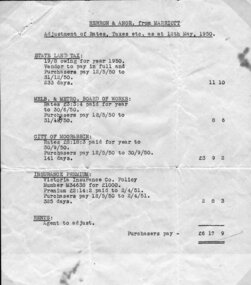
... Mr Herron lived there until 1989 and the house was then demolished and turned into a carpark for the busy Shopping precinct of Centre Road, Bentleigh....Mr Herron lived there until 1989 and the house was then demolished and turned into a carpark for the busy Shopping precinct of Centre Road, Bentleigh. ...Mr John Herron and his wife Isa Mary Herron purchased the house at 4 Vickery Street Bentleigh in 1950 from Miss M Marriott. He was a descendant of John James an early settler dairyman in Moorabbin Shire and Miss M Marriott was a descendant of the early settler market gardeners Marriott family. Mr Herron lived there until 1989 and the house was then demolished and turned into a carpark for the busy Shopping precinct of Centre Road, Bentleigh.The Marriott family were early settler market gardeners from 1878 in the area of Dendy’s 1841 Special Survey and John Herron was a descendant of Philip Jones , a chair-maker, who settled in the area of East Brighton, now Bentleigh, in 1852 An original, paper, Statement of Adjustments attached to previous item 00053.3 for purchase of the house at 4 Vickery Street, Bentleigh by Mr John Herron from Miss M Marriott in 1950 Heading - HERRON & ANOR. From MARRIOTT / Adjustment of Rates, Taxes, etc., as at 12th May 1950 / list of costs/ typed in left hand bottom corner – E. & O.E, / Melbourne, / 10th May 1950 pioneers, early settlers, brighton, moorabbin, bentleigh, market gardeners, dairyman, dairy farmer, jones james, jones mary ann, jones martha, jones elizabeth ann, dendy henry, dendys special survey 1841, elster creek, melbourne, jones ethel may, herron isa mary, herron john, tram conductor, marriott m, boothby b b, boothby n b, solicitors, land sales, house sales 1950, real estate -
 City of Moorabbin Historical Society (Operating the Box Cottage Museum)
Document - Document, deposit receipt 1950, c1950
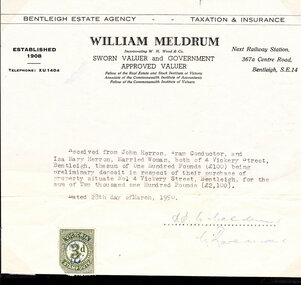
... Mr Herron lived there until 1989 and the house was then demolished and turned into a carpark for the busy Shopping precinct of Centre Road, Bentleigh....Mr Herron lived there until 1989 and the house was then demolished and turned into a carpark for the busy Shopping precinct of Centre Road, Bentleigh. ...Mr John Herron and his wife Isa Mary Herron purchased the house at 4 Vickery Street Bentleigh in 1950 from Miss M Marriott. He was a descendant of John James an early settler dairyman in Moorabbin Shire and Miss M Marriott was a descendant of the early settler market gardeners Marriott family. Mr Herron lived there until 1989 and the house was then demolished and turned into a carpark for the busy Shopping precinct of Centre Road, Bentleigh.The Marriott family were early settler market gardeners from 1878 in the area of Dendy’s 1841 Special Survey and John Herron was a descendant of Philip Jones , a chair-maker, who settled in the area of East Brighton, now Bentleigh, in 1852An original paper statement of receipt issued by William Meldrum for £100 deposit paid on March 28th 1950 by Mr John Herron for purchase of the house at 4 Vickery Street BentleighBENTLEIGH ESTATE AGENCY TAXATION & INSURANCE / WILLIAM MELDRUM / ESTABLISHED / 1908 Incorporating W.H.Wood & Co., Next Railway Station,/ SWORN VALUER and GOVERNMENT / APPROVED VALUER 367 a Centre Road / Bentleigh / Telephone XU 1404 / Fellow of the Real Estate and Stock Institute of Victoria / Associate of the Commonwealth Institute of Accountants/ Fellow of the Commonwealth Institute of Valuers Stamp in left bottom VICTORIA STAMP DUTY 3d with signature initials / Letter dated 28th day of March 1950 and signed SP W Meldrum / C Raveand pioneers, early settlers, brighton, moorabbin, bentleigh, market gardeners, dairyman, dairy farmer, jones james, jones mary ann, jones martha, jones elizabeth ann, dendy henry, dendys special survey 1841, elster creek, melbourne, jones ethel may, herron isa mary, herron john, tram conductor, marriott m, solicitors, valuers, taxation, meldrum w, real estate -
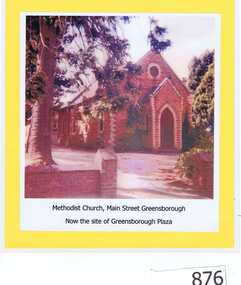 Greensborough Historical Society
Photograph, Unknown, Methodist Church Main Street Greensborough, 1940c
... shopping complex. The Church moved to the new building in Grimshaw Street circa 1970s. This photograph shows the red brick church, now demolished. methodist church greensborough Caption: 'Methodist Church, Main Street Greensborough. ...The Greensborough Methodist Church stood in Main Street Greensborough and was central to the social life of the suburb in the early 20th century. This original site is now part of the Greensborough Plaza shopping complex. The Church moved to the new building in Grimshaw Street circa 1970s. This photograph shows the red brick church, now demolished.Copy of colour photograph of red brick church, mounted on yellow card and laminated.Caption: 'Methodist Church, Main Street Greensborough. Now the site of Greensborough Plaza'methodist church greensborough
