
Showing 20 items matching "depleted"
-
 Melbourne Tram Museum
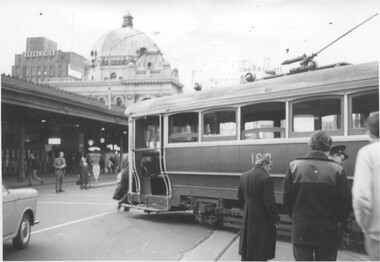
Photograph - T class 180 derailed at Princes Bridge - set of 2, 1967
... ...depleted...T180 was turning from Batman Avenue into Swanston Street and may have been in service as the tram fleet was depleted in these years and some older cars were pressed into service. ...T180 was turning from Batman Avenue into Swanston Street and may have been in service as the tram fleet was depleted in these years and some older cars were pressed into service. ...These two photographs from different angles show T class 180 derailed across both Princes Bridge tracks with trolley pole still raised. T180 was turning from Batman Avenue into Swanston Street and may have been in service as the tram fleet was depleted in these years and some older cars were pressed into service. Also depicted are the tram crew, a policeman, pedestrians and motor vehicles.Yields information about the intersection of Batman Avenue and Swanston Street, T class 180 and trams in the 1960s. Set of two Black and white photographs with no notes. t class, 180, derailed, princes bridge, trolley pole, batman avenue, depleted, tram crew, policeman, swanston st, tramways, trams -
 Whitehorse Historical Society Inc.
Article, Recession strips opportunity shop, 1991
... Mrs Joan Sparkes says the Victorian Animal Aid Trust Shop at Blackburn South has had its shelves depleted.....Mrs Joan Sparkes says the Victorian Animal Aid Trust Shop at Blackburn South has had its shelves depleted.. Recession strips opportunity shop Article Article ...Opportunity shops have been hit by the recession.Opportunity shops have been hit by the recession. They have more customers but people are selling their goods at garage sales instead of donating to the opportunity shops. Mrs Joan Sparkes says the Victorian Animal Aid Trust Shop at Blackburn South has had its shelves depleted..Opportunity shops have been hit by the recession. clubs and associations, victorian animal aid trust, opportunity shops, sparkes, joan -
 Northern District School of Nursing. Managed by Bendigo Historical Society Inc.
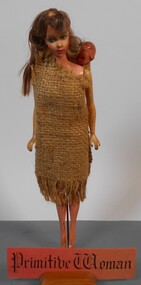
Education kit - Primitive Women - Miniature Dolls, Nursing Through the Ages
... Infectious diseases depleted numbers and the sick were regarded as occurring through witchcraft. ...Infectious diseases depleted numbers and the sick were regarded as occurring through witchcraft. ...Primitive Woman - First nurse was the mother - probably a "matriarchal" head of the family. Men were the hunters and absent for long periods. Women grew seeds for food and likely first medicines. Infectious diseases depleted numbers and the sick were regarded as occurring through witchcraft. This resulted in the medicine man or witch doctor.Miniature Doll dressed in brown cloth sack dress carrying child on her back. Doll is 30cm tallName tag - Primitive Womennursing history, northern district school of nursing, first nurses -
 The Beechworth Burke Museum
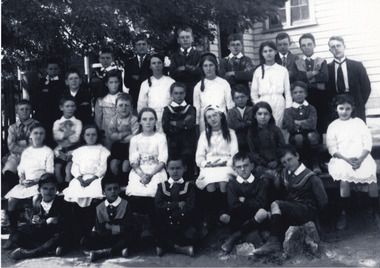
Photograph, 1900
... The school closed in 1922 following the decline of residents due to the depletion of gold ore, leading miners to seek residence elsewhere. ...The school closed in 1922 following the decline of residents due to the depletion of gold ore, leading miners to seek residence elsewhere. ...Woolshed School was based in the former mining region in the North-East of Victoria. The school closed in 1922 following the decline of residents due to the depletion of gold ore, leading miners to seek residence elsewhere. Woolshed was initially built to house the miners and their families, ultimately containing 29 storekeepers and 14 hotels at its peak in 1857. This photograph allows us to identify the families and individuals living in Woolshed in the 1900s. Since many of the families left the town following the decrease in mining opportunity, this photograph represents a percentage of the population associated with the gold rush who settled in Woolshed to find their fortune. We can derive from this photograph and its associated history the quality of life of the families and children of the miners while also being able to study the impacts of the gold rush in the area.Rectangular black and white photograph printed on matte photographic paper.Reverse: 3308/ Woolshed School 190burke street museum, woolshed, woolshed school, beechworth, 1900s beechworth -
 National Vietnam Veterans Museum (NVVM)
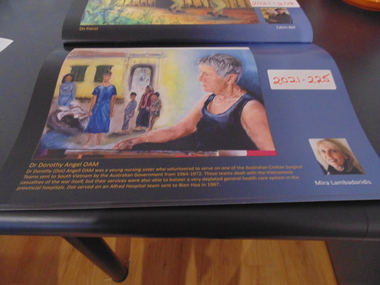
Painting, Dr Dorothy Angel OAM
... These teams dealt with the Vietnamese casualities of the war itself, but their services were also albe to bolster a very depleted general health care system in the provincial hospitals. ...These teams dealt with the Vietnamese casualities of the war itself, but their services were also albe to bolster a very depleted general health care system in the provincial hospitals. ...An Original painting of Dorothy Angel in the foreground of the painting. In the background there is a patient lying on a bed with five people nearby.Dr Dorothy (Dot) Angel OAM (Order Of Australian Medal) was a young nursing sister who volunteered to serve on one of the Australian Civilian Surgical Teams sent to South Vietnam by the Australian Government from 1964 - 1972. These teams dealt with the Vietnamese casualities of the war itself, but their services were also albe to bolster a very depleted general health care system in the provincial hospitals. Dot served on an Alfrred Hospital team sent to Bien Hoa in 1967painting, vietnam lest we forget, order of australia, nurses - vietnam, bien hoa -
 Flagstaff Hill Maritime Museum and Village
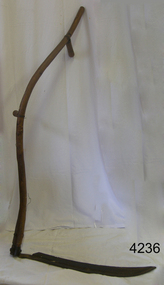
Tool - Scythe, 1930-1960
... ( producing food, by using ways that do not deplete the earth's natural resources) to cut grass in a more eco-friendly way as opposed to using a machine.... ( producing food, by using ways that do not deplete the earth's natural resources) to cut grass in a more eco-friendly way as opposed to using a machine. ...A Scythe was one of the most important of all agricultural hand tools, consisting of a curved blade fitted at an angle to a long, curved handle and used for cutting grain. In modern scythes the handle has a projecting peg that is grasped by one hand, facilitating control of the swinging motion by which grass and grain are cut. The exact origin of the scythe is unknown, but it was little used in the ancient world. It came into wide use only with agricultural developments of the Carolingian era (8th century AD) in Europe, when the harvesting and storing of hay became important to support livestock through winters. Scythes can still be found in use today by hobby farmers and permaculturists. ( producing food, by using ways that do not deplete the earth's natural resources) to cut grass in a more eco-friendly way as opposed to using a machine.A hand tool used for the cutting of crops and grain, modern versions are still being produced today in Europe. The subject item gives us a snapshot into agricultural practices in times past.Scythe with long wood Snath (curved handle) with 1 hand holding piece & curved blade. Noneflagstaff hill, warrnambool, shipwrecked-coast, flagstaff-hill, flagstaff-hill-maritime-museum, maritime-museum, shipwreck-coast, flagstaff-hill-maritime-village -
 The Beechworth Burke Museum
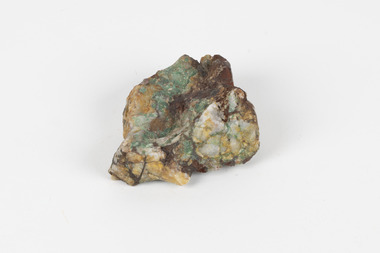
Geological specimen - Malachite in Conglomerate, Unknown
... Malachite is considered a rare gemstone in that the original deposits for the stones have been depleted leaving behind very few sources. In addition, the use of Malachite as gemstones and sculptural materials remains just as popular today as they were throughout history. ...Malachite is considered a rare gemstone in that the original deposits for the stones have been depleted leaving behind very few sources. In addition, the use of Malachite as gemstones and sculptural materials remains just as popular today as they were throughout history. ...Malachite is a green copper carbonate hydroxide mineral and was one of the first ores used to make copper metal. Malachite has been utilised as a gemstone and sculptural material in the past as its distinctive green color does not fade when exposed to light or after long periods of time. Malachite is formed at shallow depths in the ground, in the oxidizing zone above copper deposits. The material has also been used as a pigment for painting throughout history. Malachite is considered a rare gemstone in that the original deposits for the stones have been depleted leaving behind very few sources. In addition, the use of Malachite as gemstones and sculptural materials remains just as popular today as they were throughout history. It is quite common to cut the stone into beads for jewellery. The fact that Malachite has such a rich colour and one that does not fade with time or when exposed to light makes it particularly rare. Although there is no indication available of the locality from which the specimen was sourced, it is likely that the specimen was collected either in South Australia in the vicinity of the Burra Burra mines or in Victoria as part of programs of geological surveying undertaken in the Nineteenth and Twentieth centuries. This specimen is part of a larger collection of geological and mineral specimens collected from around Australia (and some parts of the world) and donated to the Burke Museum between 1868-1880. A large percentage of these specimens were collected in Victoria as part of the Geological Survey of Victoria that begun in 1852 (in response to the Gold Rush) to study and map the geology of Victoria. Collecting geological specimens was an important part of mapping and understanding the scientific makeup of the earth. Many of these specimens were sent to research and collecting organisations across Australia, including the Burke Museum, to educate and encourage further study.A solid hand-sized copper carbonate hydroxide mineral with quartz pebbles in red conglomorate matrix presenting shades of cream, brown and green.Existing label: Malachite / (green) in / conglomerate / (white quartz / pebbles / in red matrix /geological specimen, geology, geology collection, burke museum, beechworth, geological, indigo shire, malachite, malachite specimen, australian mines, mines, geological survey, conglomorate, matrix -
 Bendigo Military Museum
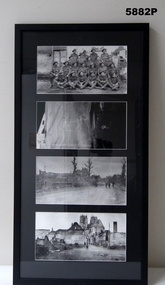
Photograph - THE GRINTON COLLECTION, FRAMED, 2008 - 2009
... In Oct 1918 the 37th and 38th Batt's were so depleted that both were combined. A and B Coy 38th became C Coy and C and D Coy 38th became D Coy. ...In Oct 1918 the 37th and 38th Batt's were so depleted that both were combined. A and B Coy 38th became C Coy and C and D Coy 38th became D Coy. ...Frame 3. Photo 1. Group Photo, mostly Sergeants. There are 3 medal winners in the group which appear to be military medals. There were 76 Military medal winners in the 38th plus 2 bars making 78. Jack Grinton is first on left in the top row. we are reasonably confident that we have identified several others. They are: Top row, 1st on the right No 262 CSM W.J. Durward (Bendigo). 2nd row, 2nd on left No 1612 Sgt J.E. Adams (Boinika) 3rd row, 1st on left No 446 CSM A. Clark (Abbotsford) 3rd row, 3rd from right No 1192 Sgt J. Coffey (Fitzroy) 3rd row, 2nd from right No 1194 Sgt J. Lockett (Mildura) Bottom row, 1st on left No 1048 Sgt F. Lehman MM (Horsham) Bottom row, 3rd on left No 1645 Sgt W. Hogan MID (Newport) These men would be a mixture of C and D Coy, 38th Batt. In Oct 1918 the 37th and 38th Batt's were so depleted that both were combined. A and B Coy 38th became C Coy and C and D Coy 38th became D Coy. The 37th Batt became A and B Coy, 38th Batt. Photo 2. Cartoon "Huttons the Best" with sign post either way. The Military Medal winner is unknown. Photo 3. War damaged town, the streets have bee cleared to allow traffic through. Photo 4. The war damaged town of Corbie. Corbie Cathedral is in the background. Refer Cat No. 5880P for exhibition details. Refer Cat No. 1280 for Jack GRINTON Service Records. Photographs - black and white on paper. 4 photographs Top to Bottom. 1. Group photograph. 2. Cartoon drawing on canvas. 3. War damaged street.. 4. War damaged town. Frame - timber, black colour paint with glass front. Mount black colour cardboard. Backing cardboard with handwritten notation.Backing cardboard - handwritten black felt tip pen "3."photographs - framed, grinton collection, ww1, 38th -
Federation University Historical Collection
Booklet - Booklet - Media Clippings, University of Ballarat: Community Service Activities, 1994
... Computer and IT programmes; Uni helps kids learn about safe, active, healthy life; Uni eager to foster partnership with local community; Professor David James (Vice Chancellor) to be chair of regional consultation group reforming State's planning system; Ballarat's Martin Hughes of BU Geology Department and Queensland's Neil Phillips to present paper at Geological Society of America in Seattle; Uni to build aquatic centre to attract top swimmers; Open Days planned by Ballarat Universities; Sue Hadden, Ballarat Uni, received $75,000 grant to carry out research on Victoria's disappearing native grasses; Ballarat Uni to host major student sculpture show; Moves to develop high-tech park plan; New Research Plans assisted by Professor Tom O'Donnell; Indian experts look for answers to get more from their depleted desert forests; Uni conducts nursing survey re courses to be offered; Rabbit numbers rise - survey from farmers; Ted Lovett, VFL footballer (Fitzroy) talk on racism in sport at Ballarat Uni.; Australian beer awards at Ballarat Uni.; Study on Unhealthy Fitness - Heart Foundation suggests regular exercise at level suited to individual needs; Survey tracks path of yellow spotting; Tertiary push for hospital - Ararat; University considered for athletics facility; Top-level study on fitness for the elderly to be monitored by Human Movement and Sports Science students, University of Ballarat; Institute of Chartered Accountants will hold its annual accounting information day at the University of Ballarat's Foundation Hall. ...Computer and IT programmes; Uni helps kids learn about safe, active, healthy life; Uni eager to foster partnership with local community; Professor David James (Vice Chancellor) to be chair of regional consultation group reforming State's planning system; Ballarat's Martin Hughes of BU Geology Department and Queensland's Neil Phillips to present paper at Geological Society of America in Seattle; Uni to build aquatic centre to attract top swimmers; Open Days planned by Ballarat Universities; Sue Hadden, Ballarat Uni, received $75,000 grant to carry out research on Victoria's disappearing native grasses; Ballarat Uni to host major student sculpture show; Moves to develop high-tech park plan; New Research Plans assisted by Professor Tom O'Donnell; Indian experts look for answers to get more from their depleted desert forests; Uni conducts nursing survey re courses to be offered; Rabbit numbers rise - survey from farmers; Ted Lovett, VFL footballer (Fitzroy) talk on racism in sport at Ballarat Uni.; Australian beer awards at Ballarat Uni.; Study on Unhealthy Fitness - Heart Foundation suggests regular exercise at level suited to individual needs; Survey tracks path of yellow spotting; Tertiary push for hospital - Ararat; University considered for athletics facility; Top-level study on fitness for the elderly to be monitored by Human Movement and Sports Science students, University of Ballarat; Institute of Chartered Accountants will hold its annual accounting information day at the University of Ballarat's Foundation Hall. ...Booklet of article that appeared in the newspaper outlining events, programmes, etc. that are of community involvement. Computer and IT programmes; Uni helps kids learn about safe, active, healthy life; Uni eager to foster partnership with local community; Professor David James (Vice Chancellor) to be chair of regional consultation group reforming State's planning system; Ballarat's Martin Hughes of BU Geology Department and Queensland's Neil Phillips to present paper at Geological Society of America in Seattle; Uni to build aquatic centre to attract top swimmers; Open Days planned by Ballarat Universities; Sue Hadden, Ballarat Uni, received $75,000 grant to carry out research on Victoria's disappearing native grasses; Ballarat Uni to host major student sculpture show; Moves to develop high-tech park plan; New Research Plans assisted by Professor Tom O'Donnell; Indian experts look for answers to get more from their depleted desert forests; Uni conducts nursing survey re courses to be offered; Rabbit numbers rise - survey from farmers; Ted Lovett, VFL footballer (Fitzroy) talk on racism in sport at Ballarat Uni.; Australian beer awards at Ballarat Uni.; Study on Unhealthy Fitness - Heart Foundation suggests regular exercise at level suited to individual needs; Survey tracks path of yellow spotting; Tertiary push for hospital - Ararat; University considered for athletics facility; Top-level study on fitness for the elderly to be monitored by Human Movement and Sports Science students, University of Ballarat; Institute of Chartered Accountants will hold its annual accounting information day at the University of Ballarat's Foundation Hall. Students from other universities to attend; Prince Edward's visit - challenge of "Great Rubber Tube Raft Regatta" at Lake Wendouree; Uni, company in joint training initiative - installation on Novell's networking software in the degree course; Uni begins study into tree threat; Eureka leadership conference in Ballarat; Leadership conference an outstanding success.Buff coloured cover, black print. Pages glued and bound - black tape. Newspaper articles - photographs and print - on separate sheets in reverse order of appearance in paper; December to February.Symbol of University of Ballarat - cover.computer and it, newspaper items, health, local community involvement, david james, vice chancellor, state's planning system, martin hughes, geology department, neil phillips, queensland university, geological society of america, seattle, aquatic centre, sue hadden, research grant, $75000, native grasses, sculpture exhibitiontom o'donnell, indian experts, nursing survey, rabbit survey, ted lovett, footballer, racism in sport, australian beer awards, unhealthy fitness, heart foundation, athletics facility, fitness for the elderly, human movement and sports science, intitute of chartered accountants, networking system in degree course, eureka leadership conference -
 Eltham District Historical Society Inc
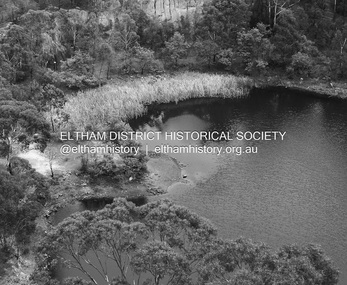
Photograph - Digital Photograph, Alan King, Blue Lake, Plenty Gorge Park, 2008
... The Plenty Valley was among the first in the Port Phillip District to be settled - mainly in the less heavily timbered west - and was proclaimed a settled district in 1841.But by the late 1880s, the settlers’ extensive land clearing for animal grazing, then agriculture, depleted the Wurundjeri’s traditional food sources, which helped to drive them away. ...The Plenty Valley was among the first in the Port Phillip District to be settled - mainly in the less heavily timbered west - and was proclaimed a settled district in 1841.But by the late 1880s, the settlers’ extensive land clearing for animal grazing, then agriculture, depleted the Wurundjeri’s traditional food sources, which helped to drive them away. ...A quarry was transformed into the Blue Lake. Published: Nillumbik Now and Then / Marguerite Marshall 2008; photographs Alan King with Marguerite Marshall.; p179 The dramatic steep-sided Plenty Gorge lies along the divide of two geological areas, and separates the Nillumbik Shire and the City of Whittlesea. On the Nillumbik side are undulating hills and sedimentary rock, and in Whittlesea, lies a basalt plain formed by volcanic action up to two million years ago. This provides the Plenty Gorge Park with diverse vegetation and habitats, making it one of Greater Melbourne’s most important refuges for threatened and significant species. The park, established in 1986, consists of around 1350 hectares, and extends 11 kilometres along the Plenty River, from Greensborough to Mernda. It provides a wildlife corridor for around 500 native plant and 280 animal species. The area’s plentiful food and water attracted the Wurundjeri Aboriginal people and then European settlers. By 1837 squatters had claimed large runs of land for their sheep and cattle. The Plenty Valley was among the first in the Port Phillip District to be settled - mainly in the less heavily timbered west - and was proclaimed a settled district in 1841.But by the late 1880s, the settlers’ extensive land clearing for animal grazing, then agriculture, depleted the Wurundjeri’s traditional food sources, which helped to drive them away. Many Wurundjeri artefacts remain (now government protected), and so far 57 sites have been identified in the park, including scarred trees, burial areas and stone artefacts. Pioneer life could be very hard because of isolation, flooding, bushfires and bushrangers. Following the Black Thursday bushfires of 1851, basalt was quarried to build more fire-resistant homes. Gold discoveries in the early 1850s swelled the population, particularly around Smugglers Gully; but food production made more of an impact. In the late 1850s wheat production supplanted grazing. In the 1860s the government made small holdings available to poorer settlers. These had the greatest effect on the district, particularly in Doreen and Yarrambat, where orchards were established from the 1880s to 1914. Links with a prominent early family are the remains of Stuchbery Farm, by the river’s edge bounded by Smugglers Gully to the north and La Trobe Road, Yarrambat, to the east. The Stuchberys moved to the valley in 1890, and the family still lives in the area. In 1890, Alfred and Ada first lived in a tent where four children were born, then Alfred built the house and outbuildings around 1896. They planted an orchard, then a market garden, and developed a dairy. The family belonged to the local Methodist and tennis communities. Their grandson Walter, opened the Flying Scotsman Model Railway Museum in Yarrambat, which his widow, Vi, continues to run. Wal was also the Yarrambat CFA Captain for 22 years until 1987. Walter sold 24 hectares in 1976 for development - now Vista Court - and in 1990, the remaining 22.6 hectares for the park. Remaining are an early stone dairy and remnants of a stone barn, a pig sty and a well. Until it was destroyed by fire in 2003, a slab hut stood on the Happy Hollow Farm site, at the southern end of the park. The hut is thought to have been built in the Depression around 1893. This was a rare and late example of a slab hut with a domestic orchard close to Melbourne. Emmet Watmough and his family first occupied the hut, followed by a succession of families, until the Bell family bought it around 1948. There they led a subsistence lifestyle for 50 years, despite encroaching Melbourne suburbia. The Yellow Gum Recreation Area includes the Blue Lake, coloured turquoise at certain times of the year. Following the 1957 bushfires, this area was quarried by Reid Quarries Pty Ltd for Melbourne’s first skyscrapers, then by Boral Australia. However in the early 1970s water began seeping into the quarry forming the Blue Lake and the quarry was closed. The State Government bought the site in 1997 and opened it as a park in 1999.This collection of almost 130 photos about places and people within the Shire of Nillumbik, an urban and rural municipality in Melbourne's north, contributes to an understanding of the history of the Shire. Published in 2008 immediately prior to the Black Saturday bushfires of February 7, 2009, it documents sites that were impacted, and in some cases destroyed by the fires. It includes photographs taken especially for the publication, creating a unique time capsule representing the Shire in the early 21st century. It remains the most recent comprehenesive publication devoted to the Shire's history connecting local residents to the past. nillumbik now and then (marshall-king) collection, blue lake, plenty gorge park -
 Eltham District Historical Society Inc
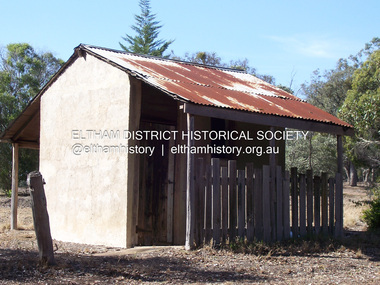
Photograph - Digital Photograph, Marguerite Marshall, Stuchbery Farm dairy, 14 March 2008
... But by the late 1880s, the settlers’ extensive land clearing for animal grazing, then agriculture, depleted the Wurundjeri’s traditional food sources, which helped to drive them away. ...But by the late 1880s, the settlers’ extensive land clearing for animal grazing, then agriculture, depleted the Wurundjeri’s traditional food sources, which helped to drive them away. ...Stuchbery Farm was situated on the Plenty River bounded by Smugglers Gully to the north and La trobe Road, Yarrambat, to the east. Alan and Ada Stutchbery moved to the valley in 1890, first living in a tent where four children were born. Alfred built a home and outbuildings around 1896. They planted an orchard, then a market garden and developed a dairy. Published: Nillumbik Now and Then / Marguerite Marshall 2008; photographs Alan King with Marguerite Marshall.; p179 The dramatic steep-sided Plenty Gorge lies along the divide of two geological areas, and separates the Nillumbik Shire and the City of Whittlesea. On the Nillumbik side are undulating hills and sedimentary rock, and in Whittlesea, lies a basalt plain formed by volcanic action up to two million years ago. This provides the Plenty Gorge Park with diverse vegetation and habitats, making it one of Greater Melbourne’s most important refuges for threatened and significant species. The park, established in 1986, consists of around 1350 hectares, and extends 11 kilometres along the Plenty River, from Greensborough to Mernda. It provides a wildlife corridor for around 500 native plant and 280 animal species. The area’s plentiful food and water attracted the Wurundjeri Aboriginal people and then European settlers. By 1837 squatters had claimed large runs of land for their sheep and cattle. The Plenty Valley was among the first in the Port Phillip District to be settled - mainly in the less heavily timbered west - and was proclaimed a settled district in 1841. But by the late 1880s, the settlers’ extensive land clearing for animal grazing, then agriculture, depleted the Wurundjeri’s traditional food sources, which helped to drive them away. Many Wurundjeri artefacts remain (now government protected), and so far 57 sites have been identified in the park, including scarred trees, burial areas and stone artefacts. Pioneer life could be very hard because of isolation, flooding, bushfires and bushrangers. Following the Black Thursday bushfires of 1851, basalt was quarried to build more fire-resistant homes. Gold discoveries in the early 1850s swelled the population, particularly around Smugglers Gully; but food production made more of an impact. In the late 1850s wheat production supplanted grazing. In the 1860s the government made small holdings available to poorer settlers. These had the greatest effect on the district, particularly in Doreen and Yarrambat, where orchards were established from the 1880s to 1914. Links with a prominent early family are the remains of Stuchbery Farm, by the river’s edge bounded by Smugglers Gully to the north and La Trobe Road, Yarrambat, to the east. The Stuchberys moved to the valley in 1890, and the family still lives in the area. In 1890, Alfred and Ada first lived in a tent where four children were born, then Alfred built the house and outbuildings around 1896. They planted an orchard, then a market garden, and developed a dairy. The family belonged to the local Methodist and tennis communities. Their grandson Walter, opened the Flying Scotsman Model Railway Museum in Yarrambat, which his widow, Vi, continues to run. Wal was also the Yarrambat CFA Captain for 22 years until 1987. Walter sold 24 hectares in 1976 for development - now Vista Court - and in 1990, the remaining 22.6 hectares for the park. Remaining are an early stone dairy and remnants of a stone barn, a pig sty and a well. Until it was destroyed by fire in 2003, a slab hut stood on the Happy Hollow Farm site, at the southern end of the park. The hut is thought to have been built in the Depression around 1893. This was a rare and late example of a slab hut with a domestic orchard close to Melbourne. Emmet Watmough and his family first occupied the hut, followed by a succession of families, until the Bell family bought it around 1948. There they led a subsistence lifestyle for 50 years, despite encroaching Melbourne suburbia. The Yellow Gum Recreation Area includes the Blue Lake, coloured turquoise at certain times of the year. Following the 1957 bushfires, this area was quarried by Reid Quarries Pty Ltd for Melbourne’s first skyscrapers, then by Boral Australia. However in the early 1970s water began seeping into the quarry forming the Blue Lake and the quarry was closed. The State Government bought the site in 1997 and opened it as a park in 1999.This collection of almost 130 photos about places and people within the Shire of Nillumbik, an urban and rural municipality in Melbourne's north, contributes to an understanding of the history of the Shire. Published in 2008 immediately prior to the Black Saturday bushfires of February 7, 2009, it documents sites that were impacted, and in some cases destroyed by the fires. It includes photographs taken especially for the publication, creating a unique time capsule representing the Shire in the early 21st century. It remains the most recent comprehenesive publication devoted to the Shire's history connecting local residents to the past. nillumbik now and then (marshall-king) collection, ada stuchbery, alan stuchbery, dairy, stuchbery farm, farm buildings, yarrambat, plenty gorge park -
 The Beechworth Burke Museum
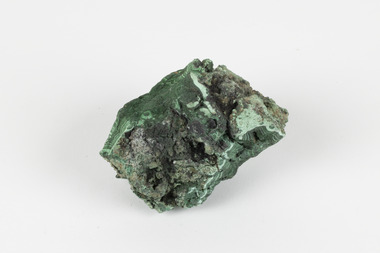
Geological specimen - Malachite, Unknown
... This specimen is significant as it is considered to be a rare gemstone, as many of the original deposits for the stones are significantly depleted, leaving behind very few sources. ...Malachite is a copper carbonate hydroxide mineral. It has a chemical composition of Cu2(CO3)(OH)2. It often forms within limestone where a subsurface chemical environment favourable for the formation of carbonate minerals can occur. It is a substance that can be found in many different parts of the world including: Australia, USA, Russia and the Democratic Republic of Congo. Malachite has historically been used to produce copper, with mining of the mineral dating back over a period of four thousand years. Due to its beautiful green colourations, it is also commonly used for aesthetic purposes such as in the production of sculptures and jewellery. This particular specimen was collected from the town of Burra, South Australia as part of a geological survey undertaken during the nineteenth century. The locality (located on Ngadjuri Country) has a long history of mining, particularly in copper mining, as the area is rich in copper deposits. The first significant discovery of this was made in Burra (Burra Burra Mine) in 1845 and, at the time, the mine was the largest and richest of its kind in the world, producing nearly five percent of the total world copper output. This specimen is significant as it is considered to be a rare gemstone, as many of the original deposits for the stones are significantly depleted, leaving behind very few sources. This specimen is part of a larger collection of geological and mineral specimens collected from around Australia (and some parts of the world) and donated to the Burke Museum between 1868-1880. A large percentage of these specimens were collected in Victoria as part of the Geological Survey of Victoria that begun in 1852 (in response to the Gold Rush) to study and map the geology of Victoria. Collecting geological specimens was an important part of mapping and understanding the scientific makeup of the earth. Many of these specimens were sent to research and collecting organisations across Australia, including the Burke Museum, to educate and encourage further study.A solid palm-sized copper carbonate hydroxide mineral with patterns of green colourations Existing Label: MALACHITE / Locality: Burra / S. Aust. Other Label: Confirmed / as Malachite / C. Willman / 15/4/1 / + Bill Birch burke museum, beechworth, geological, geological specimen, malachite, gemstone, green gemstone, burra, burra burra mine, burra south australia, carbonate mineral, copper, copper mining, copper mining burra, carbonate hydroxide mineral, copper carbonate, malachite mining, malachite burra, monster mine -
 Flagstaff Hill Maritime Museum and Village
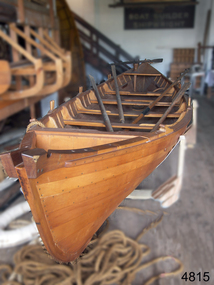
Vehicle - Vessel, Whaleboat, Flagstaff Hill Boat Builders, 1989
... A time during which the population of whales was greatly depleted. Flagstaff Hill Maritime Museum and Village Maritime Museum Maritime Village Great Ocean Road Shipwreck Coast whaleboat vessel clinker built huon pine whaleboat whaling Whaleling Industry Australian whaleboat; a long narrow vessel constructed of clinker-planked Huon Pine timber. ...The Huon Pine whaleboat was made on site by the boat builders at Flagstaff Hill in1989, of the clinker-planked construction method. Whaling was carried out in the 1790s up until the 1970s in the Southern Ocean off the coast of Australia, including southwest Victoria. The whales were hunted for their oil, baleen, meat and other products. It was a lucrative but very dangerous occupation. The small whaleboats with their five crew members were easy to maneuver but also easily overturned by a writhing whale. The Southern Right whales had desirable attributes; they came close to shore, they were slow swimmers and they floated when dead - hence the name 'Right' describing the right whale to hunt. The whale population was greatly reduced until 1979 when the Australian government prohibited whaling. These whales still visit the area annually to breed in the shallow bays along what is now called the Shipwreck Coast of Victoria. The whaleboat represents a significant time in Australia between the 1790s and 1979, when the whaling trade was carried in this area, and around Australia, providing employment and meeting the demand for whale oil, meat and other products. A time during which the population of whales was greatly depleted. Australian whaleboat; a long narrow vessel constructed of clinker-planked Huon Pine timber. It has provision for a crew of 5five oarsmen and a sweep or helmsman. Made in 1989.flagstaff hill maritime museum and village, maritime museum, maritime village, great ocean road, shipwreck coast, whaleboat, vessel, clinker built, huon pine whaleboat, whaling, whaleling industry -
 The Beechworth Burke Museum
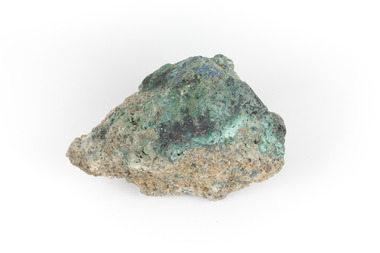
Geological specimen - Malachite, Unknown
... Malachite is considered a rare gemstone in that the original deposits for the stones have been depleted leaving behind very few sources. In addition, the use of Malachite as gemstones and sculptural materials remains just as popular today as they were throughout history. ...Malachite is typically found as crystalline aggregates or crusts, often banded in appearance, like agates. It is also often found as botryoidal clusters of radiating crystals, and as mammillary aggregates as well. Single crystals and clusters of distinguishable crystals are uncommon, but when found they are typically acicular to prismatic. It is also frequently found as a pseudomorph after Azurite crystals, which are generally more tabular in shape. This particular specimen was recovered from the Burra Burra Copper Mine in Burra, South Australia. Otherwise known as the 'Monster Mine', the Burra Burra Copper Mine was first established in 1848 upon the discovery of copper deposits in 1845. Within a few short years, people from around the world migrated to Burra to lay their claim in the copper economy. By April 1848 the mine was employing over 567 people and supporting a population of 1,500 in the local township. Up until 1860, the mine was the largest metals mine in Australia, producing approximately 50,000 tonnes of copper between 1845 to its closure in 1877. The Burra Burra Mine was also famous for a number of other specimens, including; crystalline azurite, cuprite, and botryoidal and malachite. Malachite is considered a rare gemstone in that the original deposits for the stones have been depleted leaving behind very few sources. In addition, the use of Malachite as gemstones and sculptural materials remains just as popular today as they were throughout history. It is quite common to cut the stone into beads for jewellery. The fact that Malachite has such a rich colour and one that does not fade with time or when exposed to light makes it particularly rare. This specimen is part of a larger collection of geological and mineral specimens collected from around Australia (and some parts of the world) and donated to the Burke Museum between 1868-1880. A large percentage of these specimens were collected in Victoria as part of the Geological Survey of Victoria that begun in 1852 (in response to the Gold Rush) to study and map the geology of Victoria. Collecting geological specimens was an important part of mapping and understanding the scientific makeup of the earth. Many of these specimens were sent to research and collecting organisations across Australia, including the Burke Museum, to educate and encourage further study. A solid hand-sized copper carbonate hydroxide mineral with shades of blue and light green throughout. burke museum, beechworth, indigo shire, beechworth museum, geological, geological specimen, mineralogy, burra, burra burra mine, south australia, malachite, malachite specimen -
 The Beechworth Burke Museum
Geological specimen - Malachite, Unknown
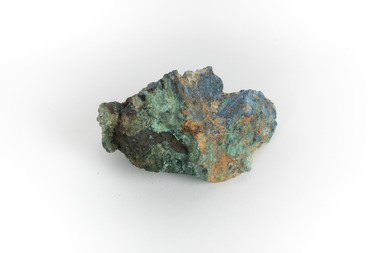
... Malachite is considered a rare gemstone in that the original deposits for the stones have been depleted leaving behind very few sources. In addition, the use of Malachite as gemstones and sculptural materials remains just as popular today as they were throughout history. ...Malachite is a green copper carbonate hydroxide mineral and was one of the first ores used to make copper metal. Malachite has been utilised as a gemstone and sculptural material in the past as its distinctive green color does not fade when exposed to light or after long periods of time. Malachite is formed at shallow depths in the ground, in the oxidizing zone above copper deposits. The material has also been used as a pigment for painting throughout history. This particular specimen was recovered from the Burra Burra Copper Mine in Burra, South Australia. Otherwise known as the 'Monster Mine', the Burra Burra Copper Mine was first established in 1848 upon the discovery of copper deposits in 1845. Within a few short years, people from around the world migrated to Burra to lay their claim in the copper economy. By April 1848 the mine was employing over 567 people and supporting a population of 1,500 in the local township. Up until 1860, the mine was the largest metals mine in Australia, producing approximately 50,000 tonnes of copper between 1845 to its closure in 1877. The Burra Burra Mine was also famous for a number of other specimens, including; crystalline azurite, cuprite, and botryoidal and malachite.Malachite is considered a rare gemstone in that the original deposits for the stones have been depleted leaving behind very few sources. In addition, the use of Malachite as gemstones and sculptural materials remains just as popular today as they were throughout history. It is quite common to cut the stone into beads for jewellery. The fact that Malachite has such a rich colour and one that does not fade with time or when exposed to light makes it particularly rare. This specimen is part of a larger collection of geological and mineral specimens collected from around Australia (and some parts of the world) and donated to the Burke Museum between 1868-1880. A large percentage of these specimens were collected in Victoria as part of the Geological Survey of Victoria that begun in 1852 (in response to the Gold Rush) to study and map the geology of Victoria. Collecting geological specimens was an important part of mapping and understanding the scientific makeup of the earth. Many of these specimens were sent to research and collecting organisations across Australia, including the Burke Museum, to educate and encourage further study. A solid hand-sized copper carbonate hydroxide mineral with shades of yellow, blue, and light green throughout.geological, geological specimen, burke museum, indigo shire, malachite, malachite specimen, burra burra mine, burra, south australia, australian mines, mines, monster mine -
 Kiewa Valley Historical Society
Lighter Lift Arm, Circa 1930's to 1940's
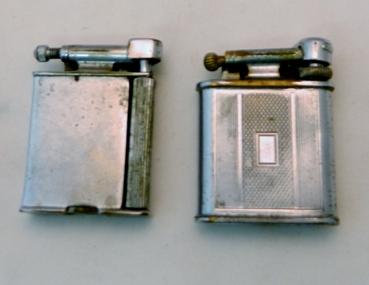
... The socio-economics of the Australian work place changed after the emancipation of women in the "workforce" after the World War II depleted the male workforce for the duration of the War and changed the Australian ethics of women in all aspects of both city and rural working "so called" male only occupations. early hand lighters smoking in the 1930's cigarette lighter tobacco cigerettes lighter At the bottom of the lift arm station "POLO". ...This cigarette or pipe lighter was in use in the mid 1900's when the majority of users were men. Ladies did smoke but mainly not in "public" The activity was still regarded as a male activity. Middle to Upper "Class" of women nearly always had a gentleman "at hand" that would "light up" her cigarette. This was seen as a "social" activity only but later in the mid 1900's onward it was quite acceptable for both sexes to "smoke" at anytime.This type of lighter was male orientated due to the degree of lighting the flint with the horizontal movement required a strong thumb action across the lighting wheel. It is significant to rural areas such as the Kiewa Valley as the majority of men (especially during and after World War II) regarded smoking as a way to ease off the "tension" of hard work. The socio-economics of the Australian work place changed after the emancipation of women in the "workforce" after the World War II depleted the male workforce for the duration of the War and changed the Australian ethics of women in all aspects of both city and rural working "so called" male only occupations.This Polo Swift lift arm cigarette/pipe lighter has a chrome plated shell and is fueled by petrol. To operate this lighter you lift the "snuffer" arm exposing the wick, then scrape the flint wheel to create a spark from the adjacent flint(resting on the brass ignition wheel).At the bottom of the lift arm station "POLO". Each side of the lighter are "Art Deco line running from the top of the lighter to the bottom. Between these is a rectangular box with "diamond crossed lines"early hand lighters, smoking in the 1930's, cigarette lighter, tobacco, cigerettes, lighter -
 Kiewa Valley Historical Society
Lighter Lift Arm, circa early 1900s
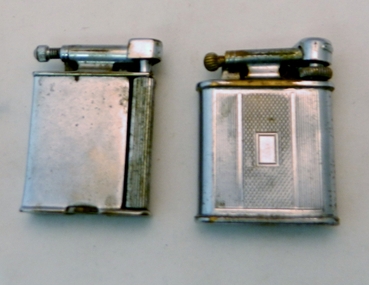
... The socio-economics of the Australian work place changed after the emancipation of women in the "workforce" after the World War II depleted the male workforce for the duration of the War and changed the Australian ethics of women in all aspects of both city and rural working "so called" male only occupations. early hand lighters smoking in the 1930's cigarette lighter cigarette tobacco At the base to the left of the "filler" screw "PATENT No. 485037, 818155" underneath "REG. ...This cigarette or pipe lighter was in use in the mid 1900's when the majority of users were men. Ladies did smoke but mainly not in "public" The activity was still regarded as a male activity. Middle to Upper "Class" of women nearly always had a gentleman "at hand" that would "light up" her cigarette. This was seen as a "social" activity only but later in the mid 1900's onward it was quite acceptable for both sexes to "smoke" at anytime.This type of lighter was male orientated due to the degree of lighting the flint with the horizontal movement required a strong thumb action across the lighting wheel. It is significant to rural areas such as the Kiewa Valley as the majority of men (especially during and after World War II) regarded smoking as a way to ease off the "tension" of hard work. The socio-economics of the Australian work place changed after the emancipation of women in the "workforce" after the World War II depleted the male workforce for the duration of the War and changed the Australian ethics of women in all aspects of both city and rural working "so called" male only occupations.This Roller Beacon lift arm cigarette/pipe lighter has a chrome plated brass shell and is fueled by petrol. To operate this lighter you lift the "snuffer" arm(long roller lift arm) exposing the horizontal external flint tube, then scrape the flint wheel to create a spark (to light the wick) from the adjacent flint(resting on the brass ignition wheel).At the base to the left of the "filler" screw "PATENT No. 485037, 818155" underneath "REG. DES. N" on the filler screw "ROLLER REG" underneath "TRADE MARK". To the right of the "filler", "THE ROLLER BEACON MADE IN ENGLAND"early hand lighters, smoking in the 1930's, cigarette lighter, cigarette, tobacco -
Koorie Heritage Trust
Book, Butlin, Noel George, Our original aggression : Aboriginal populations of southeastern Australia, 1788-1850, 1983
... Demographic Modelling - Assumptions and procedures - Basis of modelling; Depopulating disturbances - Diseases and population recovery - Smallpox; the potential for population recovery; Other diseases; Summary diseases effects - Resource competition - Resource depletion and depopulation; Black and white options. ...Contents: Introduction and Disease Background - Black fellow fall down, jump up white man; Death at a long distance. Demographic Modelling - Assumptions and procedures - Basis of modelling; Depopulating disturbances - Diseases and population recovery - Smallpox; the potential for population recovery; Other diseases; Summary diseases effects - Resource competition - Resource depletion and depopulation; Black and white options. Appraisal of estimates - '1788' population possibilities; Possible extrapolations; Summary results. Towards an Ecological Model - Economy and ecology; Some general inferences.xii, 186 p. : ill. ; 22 cm.Contents: Introduction and Disease Background - Black fellow fall down, jump up white man; Death at a long distance. Demographic Modelling - Assumptions and procedures - Basis of modelling; Depopulating disturbances - Diseases and population recovery - Smallpox; the potential for population recovery; Other diseases; Summary diseases effects - Resource competition - Resource depletion and depopulation; Black and white options. Appraisal of estimates - '1788' population possibilities; Possible extrapolations; Summary results. Towards an Ecological Model - Economy and ecology; Some general inferences.aborigines, australian -- population. | aborigines, australian -- statistics, vital. | aborigines, australian -- treatment. | europeans -- australia. | australia -- history -- 1788-1851. | fire-stick farming -
 Mrs Aeneas Gunn Memorial Library
Book, George Routledge and Sons, The crown of wild olive : three lectures on industry & war
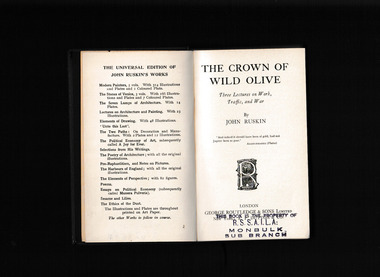
... John Ruskin 1819-1900 Ethics This 1866 collection of essays on "Work," "Traffic," and "War," begins with a preface condemning the human depletion of nature for what Ruskin saw as valueless gains. ...This 1866 collection of essays on "Work," "Traffic," and "War," begins with a preface condemning the human depletion of nature for what Ruskin saw as valueless gains. In this way, mining the ground for metals, water, and other resources parallels the work of the three lecture topics--all is done for the money. But what Ruskin wants to know is what the ultimate effect and product of their work is?Index, notes, p.132.non-fictionThis 1866 collection of essays on "Work," "Traffic," and "War," begins with a preface condemning the human depletion of nature for what Ruskin saw as valueless gains. In this way, mining the ground for metals, water, and other resources parallels the work of the three lecture topics--all is done for the money. But what Ruskin wants to know is what the ultimate effect and product of their work is? john ruskin 1819-1900, ethics -
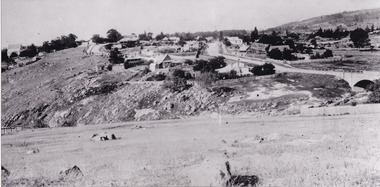 The Beechworth Burke Museum
Photograph - Photograph - Reproduction, ca. 1900
... By the 1870s, alluvial gold deposits were depleted and increasingly complex engineering was required so deeper shafts could reach bedrock. ...This image shows the approach to Beechworth from the south-west via the Newtown Bridge. Numerous early buildings line the road as it bifurcates to become Ford and High Streets on the ridge above Spring Creek and Newtown Falls. The sloping, rocky terrain and water course along the gorge show evidence of the intense mining activity that occurred at the site. The Ovens Gold Rush at Beechworth started when gold was found at Spring Creek in February 1852, prompting an influx of miners from around the world. The population grew over 20,000 by 1857. While the earliest mining at Beechworth was similar to that in other Victorian goldfields like Ballarat and Bendigo, Beechworth is notable for its use of hydraulic sluicing as a major method of removing wash-dirt. Hydraulic sluicing employs high pressure jets of water to blast away large areas of earth and wash it down to be run through a sluice box. Gold gets caught in the sluice and the remaining slurry is washed away. This method of mining is extremely effective but causes significant environmental impacts and damage to waterways. Large water quantities were required for large-scale sluicing, and the long water races and deep tailraces that were constructed in the Beechworth area in the nineteenth century are nonetheless considered feats of engineering. The site in the photograph is associated with the Rocky Mountain Mining Company who constructed an eight hundred meter tunnel under the township between 1876-1880 to reduce water levels at Spring Creek, which had been subject to diversions since the earliest days of alluvial mining. Over four million ounces of gold (115 tones) were found at Beechworth between 1852 and 1868, and the wealth from the gold rushes built Beechworth and the nationally significant buildings that remain standing today.This image shows the early development of the Beechworth township above Spring Creek, where gold was discovered in 1852. Evidence of hydraulic sluicing, a uniquely predominant method at Beechworth, and water-works engineering are present in the landscape. By the 1870s, alluvial gold deposits were depleted and increasingly complex engineering was required so deeper shafts could reach bedrock. This image is significant for understanding changes to the landscape and the evolution of mining methods and engineering practices related to the extensive construction, manipulation and management of water networks. The shift from smaller scale alluvial mining to larger company dominance in the mining industry has implications for understanding wider social, economic, political and industrial changes in the region of Beechworth and within the context of the Victorian Gold Rush more broadly. A black and white rectangular reproduction photograph printed on photographic paper. burke museum, beechworth museum, beechworth, gold fields, gold rush, victorian gold rush, hydraulic sluicing, rocky mountain mining company, spring creek, netwown falls, mining tunnels, water races, tailraces, colonial australia, australian gold rushes, mining technology, beechworth historic district, indigo gold trail, migration, indigo shire, gold mining, gold mining history
