
Showing 37 items matching "design evolution"
-
 Moorabbin Air Museum
Book - DE HAVILLAND Mosquito, De Havilland Mosquito Super Profile
... Design evolution...De Havilland Mosquito Design evolution The prototype The first sorties The bomber debut 4000lb & highball bombs Day & night fighters Intruders & bomber escorts Fighter bombers Civil Mosquitoss High altitude Mosquitos Post war History & overview of De Havilland Mosquito, circa 1984 De Havilland Mosquito Super Profile Book DE HAVILLAND Mosquito ...History & overview of De Havilland Mosquito, circa 1984non-fictionHistory & overview of De Havilland Mosquito, circa 1984design evolution, the prototype, the first sorties, the bomber debut, 4000lb & highball bombs, day & night fighters, intruders & bomber escorts, fighter bombers, civil mosquitoss, high altitude mosquitos, post war -
 Australian Gliding Museum
Machine - Glider - Sailplane
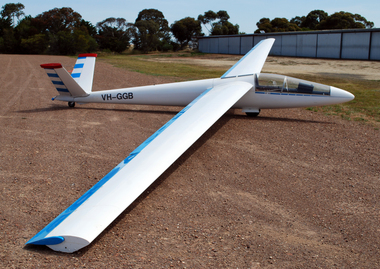
... The Schreder HP 14V is an all metal single seat sailplane designed by Richard Schreder in America. The design is an evolution of Schreder’s metal sailplane designs that date from the late 1950s. ...The Schreder HP 14V is an all metal single seat sailplane designed by Richard Schreder in America. The design is an evolution of Schreder’s metal sailplane designs that date from the late 1950s. ...The Schreder HP 14V is an all metal single seat sailplane designed by Richard Schreder in America. The design is an evolution of Schreder’s metal sailplane designs that date from the late 1950s. Schreder won the United States National Soaring Championship in 1966 in the prototype HP 14. He marketed the glider in kit form in the 1960s and 1970s and allowed Slingsby in the UK to further develop the design for production. Schreder HP14 V, registered as VH-GGB, was built in South Australia by Harry Bache of the Waikerie Gliding Club in the 1970s. Martin Simons, an authority on vintage sailplanes (including Slingsby types), refers to this airframe as “built entirely from scratch”. After Bache, this Schreder HP14V passed on to E.G. Moore and N.L. Lovell at Ararat in Western Victoria, then Graeme Rickert of the Canberra Gliding Club and finally, to Greg O’Sullivan of the Geelong Gliding Club. The glider was first flown on 20 December 1975. It appears to have been flown regularly over its life to 2015 and the cumulative use being 1386 hours flown from 702 launches. The log book does not disclose details of flights except as aggregates of flights and times. Details of notable flights by Bache and Moore et al are not available. However, reports from Rickert and O’Sullivan indicate that a good number of cross-country flights of 300km or longer were achieved in this aircraft. A well-engineered metal sailplane from the 1970s with good soaring performance which was designed for amateur construction. All metal single seat glider sailplane with a distinctive V-tail, finished in a white and blue colour schemeRegistration letters 'GGB' on sides of fuselageaustralian gliding, glider, sailplane, schreder, slingsby, bache, waikerie gliding club, moore, lovell, rickert, o’sullivan, canberra gliding club, geelong gliding club. -
 Flagstaff Hill Maritime Museum and Village
Book - Reference Book/History, Henry Smith Williams, The Historians History of the World Vol 9 set 1 - Edited by Henry Smith Williams L.L.D. Published by “The Times” 1908, 1908
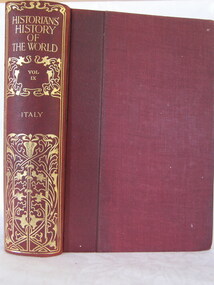
... designed to tell the story of humanity using the actual words of over 2,000 "master historians" (such as Herodotus, Gibbon, and Mommsen), woven together by modern editorial transitions. This specific 1908 set of volumes was published by "The Times" (London). In the early 20th century, The Times entered the book trade to boost its prestige and revenue, notably marketing this set and the “Encyclopedia Britannica”. While previous volumes dealt with the Roman Empire, Volume 9 picks up the story after the "Fall of Rome" and tracks the peninsula’s evolution...evolution through the dawn of the 20th century. Flyleaf has the title with Edited by Henry Smith Williams L.L.D. In twenty five volumes-Vol. IX and London “The Times” 1908 in Gothic script The Book is part of a 25 volume set with red cloth bindings and gold filigree design to rib The Historians History of the World Vol 9 set 1 - Edited by Henry Smith Williams L.L.D. ...The 1908 edition of The Historians' History of the World is a monumental work of Edwardian scholarship, representing a specific era of "universal history" where the goal was to synthesise all human knowledge into a single narrative. While previous volumes dealt with the Roman Empire, Volume 9 picks up the story after the "Fall of Rome" and tracks the peninsula’s evolution through the dawn of the 20th century.The Book is part of a 25 volume set with red cloth bindings and gold filigree design to ribnon-fictionThe 1908 edition of The Historians' History of the World is a monumental work of Edwardian scholarship, representing a specific era of "universal history" where the goal was to synthesise all human knowledge into a single narrative. While previous volumes dealt with the Roman Empire, Volume 9 picks up the story after the "Fall of Rome" and tracks the peninsula’s evolution through the dawn of the 20th century. warrnambool, shipwrecked-coast, flagstaff-hill, flagstaff-hill-maritime-museum, maritime-museum, book, the historians history of the world vol 9 set 1, henry smith williams -
 Flagstaff Hill Maritime Museum and Village
Book - Reference Book/History, Henry Smith Williams, The Historians History of the World Vol 15 set 1 - Edited by Henry Smith Williams L.L.D. Published by “The Times” 1908, 1908
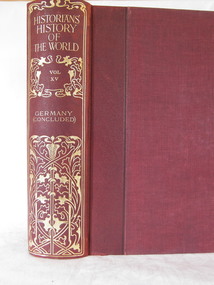
... evolution of the Austrian Empire. Flyleaf has the title with Edited by Henry Smith Williams L.L.D. In twenty five volumes-Vol. XV and London “The Times” 1908 in Gothic script The Book is part of a 25 volume set with red cloth bindings and gold filigree design to rib. ...Henry Smith Williams’ “The Historians' History of the World” is a chronological and geographical "tapestry" of human events, these twenty five volumes occupy a very specific and prestigious place in historical research. Volume 15 of “The Historians' History of the World” moves into the heart of modern European power dynamics. Published by The Times in 1908, this volume focuses on the rise of the modern German state and the evolution of the Austrian Empire.The Book is part of a 25 volume set with red cloth bindings and gold filigree design to rib.non-fictionHenry Smith Williams’ “The Historians' History of the World” is a chronological and geographical "tapestry" of human events, these twenty five volumes occupy a very specific and prestigious place in historical research. Volume 15 of “The Historians' History of the World” moves into the heart of modern European power dynamics. Published by The Times in 1908, this volume focuses on the rise of the modern German state and the evolution of the Austrian Empire.flagstaff hill, warrnambool, shipwrecked-coast, flagstaff-hill-maritime-museum, maritime-museum, shipwreck-coast, flagstaff-hill-maritime-village, book, the historians history of the world vol 15 set 1, henry smith williams -
 Flagstaff Hill Maritime Museum and Village
Book - Reference Book/History, The Times Newspaper, The Historians History of the World Vol 17 set 1 - Edited by Henry Smith Williams L.L.D. Published by “The Times” 1908, 1908
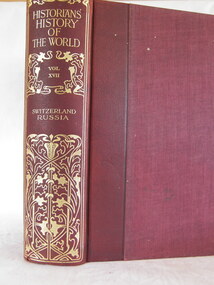
... designed to tell the story of humanity using the actual words of over 2,000 "master historians" (such as Herodotus, Gibbon, and Mommsen), woven together by modern editorial transitions. This specific 1908 set of volumes was published by "The Times" (London). In the early 20th century, The Times entered the book trade to boost its prestige and revenue, notably marketing this set and the “Encyclopedia Britannica”. Volume 17 focuses primarily on the history of Switzerland with concluding sections on Russia, and Poland. The volume concludes the Swiss narrative began in volume 16, focusing on its complex political evolution...designed to tell the story of humanity using the actual words of over 2,000 "master historians" (such as Herodotus, Gibbon, and Mommsen), woven together by modern editorial transitions. This specific 1908 set of volumes was published by "The Times" (London). In the early 20th century, The Times entered the book trade to boost its prestige and revenue, notably marketing this set and the “Encyclopedia Britannica”. Volume 17 focuses primarily on the history of Switzerland with concluding sections on Russia, and Poland. The volume concludes the Swiss narrative began in volume 16, focusing on its complex political evolution ...Henry Smith Williams’ “The Historians' History of the World” is a chronological and geographical "tapestry" of human events, these twenty five volumes occupy a very specific and prestigious place in historical research. Volume 17 focuses primarily on the history of Switzerland with concluding sections on Russia, and Poland. The volume concludes the Swiss narrative began in volume 16.The Book is part of a 25 volume set with red cloth bindings and gold filigree design to rib.non-fictionHenry Smith Williams’ “The Historians' History of the World” is a chronological and geographical "tapestry" of human events, these twenty five volumes occupy a very specific and prestigious place in historical research. Volume 17 focuses primarily on the history of Switzerland with concluding sections on Russia, and Poland. The volume concludes the Swiss narrative began in volume 16.flagstaff hill, warrnambool, shipwrecked-coast, flagstaff-hill, flagstaff-hill-maritime-museum, maritime-museum, shipwreck-coast, flagstaff-hill-maritime-village, book, the historians history of the world vol 17 set 1 -
 Flagstaff Hill Maritime Museum and Village
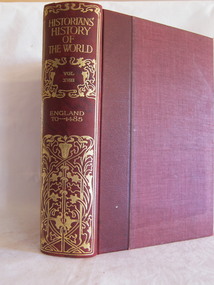
Book - Reference Book/History, Henry Smith Williams, The Historians History of the World Vol 18 set 1 - Edited by Henry Smith Williams L.L.D. Published by “The Times” 1908, 1908
... designed to tell the story of humanity using the actual words of over 2,000 "master historians" (such as Herodotus, Gibbon, and Mommsen), woven together by modern editorial transitions. This specific 1908 set of volumes was published by "The Times" (London). In the early 20th century, The Times entered the book trade to boost its prestige and revenue, notably marketing this set and the “Encyclopedia Britannica”. Volume 18 specifically focuses on the history of England to 1485, it serves as the foundational text for British history within the series. It chronicles the evolution...evolution of the English nation from its earliest recorded beginnings through the end of the Middle Ages. Flyleaf has the title with Edited by Henry Smith Williams L.L.D. In twenty five volumes-Vol. XVIII and London “The Times” 1908 in Gothic script The Book is part of a 25 volume set with red cloth bindings and gold filigree design to rib. ...Henry Smith Williams’ “The Historians' History of the World” is a chronological and geographical "tapestry" of human events, these twenty five volumes occupy a very specific and prestigious place in historical research. Volume 18 specifically focuses on the history of England to 1485, it serves as the foundational text for British history within the series. It chronicles the evolution of the English nation from its earliest recorded beginnings through the end of the Middle Ages.The Book is part of a 25 volume set with red cloth bindings and gold filigree design to rib.non-fictionHenry Smith Williams’ “The Historians' History of the World” is a chronological and geographical "tapestry" of human events, these twenty five volumes occupy a very specific and prestigious place in historical research. Volume 18 specifically focuses on the history of England to 1485, it serves as the foundational text for British history within the series. It chronicles the evolution of the English nation from its earliest recorded beginnings through the end of the Middle Ages.flagstaff hill, warrnambool, shipwrecked-coast, flagstaff-hill, flagstaff-hill-maritime-museum, maritime-museum, shipwreck-coast, flagstaff-hill-maritime-village, book, the historians history of the world vol 18 set 1 -
 Flagstaff Hill Maritime Museum and Village
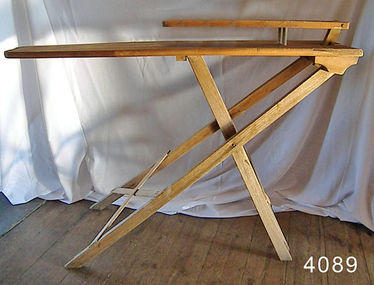
Furniture - Ironing board, 1910-1930
... A domestic item with an interesting history of development, significant as it shows the progress and the evolution of a domestic item designed to make housework more efficient. flagstaff hill warrnambool shipwrecked-coast flagstaff-hill-maritime-museum flagstaff-hill-maritime-village Domestic Item Ironing Board Ironing Clothes Wrinkles in Clothes Henry W. ...Ironing is the use of a machine, usually a heated tool (an iron), to remove wrinkles from fabric. The heating is around 180–220 °Celsius, depending on the fabric type. Ironing works by loosening the bonds between the long-chain polymer molecules in the fibres of the material. While the molecules are hot, the fibres are straightened by the weight of the iron, and they hold their new shape as they cool. Some fabrics, such as cotton, require the addition of water to loosen the intermolecular bonds. Many modern fabrics developed in or after the mid-twentieth century require little or no ironing. Permanent press clothing was developed to reduce the ironing necessary by combining Wrinkle resistant polymers with cotton. The first known use of the iron for removing wrinkles in clothes is known to have occurred in China, and the electric iron was invented in 1882, by Henry W. Seeley. Seeley patented his "electric flat iron" on June 6, 1882 (U.S. Patent no. 259,054). On 15 February 1858 W. Vandenburg and J. Harvey patented an ironing table that facilitated pressing sleeves and pants legs. A truly portable folding ironing board was first patented in Canada in 1875 by John B. Porter. The invention also included a removable press board used for sleeves. In 1892 Sarah Boone obtained a patent in the United States for improvements to the ironing board, allowing for better quality ironing of shirt sleeves.A domestic item with an interesting history of development, significant as it shows the progress and the evolution of a domestic item designed to make housework more efficient.Wooden Ironing board with press board for sleeves, board is folding.Noneflagstaff hill, warrnambool, shipwrecked-coast, flagstaff-hill-maritime-museum, flagstaff-hill-maritime-village, domestic item, ironing board, ironing, clothes, wrinkles in clothes, henry w. seeley, w. vandenburg and j. harvey -
 Federation University Historical Collection
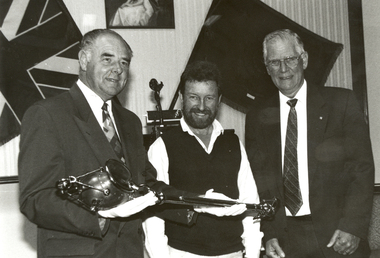
Photograph - Black and White, The University of Ballarat Mace, 1996, 1996
... evolution from the Ballarat School of Mines. An opening egg at the top stands for the nurturing of development and learning. The mace's straight shaft is depicted as the tree of knowledge and, incorporating a bark canoe scar, Ballarat's Aboriginal heritage. At the end of the shaft is a surveying device, which represents precision and accuracy ads embodied in the university's academic pursuits.' Bob Morrell of the University organised the national competition to design...evolution from the Ballarat School of Mines. An opening egg at the top stands for the nurturing of development and learning. The mace's straight shaft is depicted as the tree of knowledge and, incorporating a bark canoe scar, Ballarat's Aboriginal heritage. At the end of the shaft is a surveying device, which represents precision and accuracy ads embodied in the university's academic pursuits.' Bob Morrell of the University organised the national competition to design ...The University's mace was carried in procession for the first time during the Graduation ceremonies in May 1996. The mace was presented to the University by former Chief Commissioner of the Ballarat City Council, Vern Robson, at a ceremony on 02 February, following a national competition for its design, sponsored by the Council. (The Flag, Issue 2, July 1996) Nineteen artists responded to the competition which called for a design that would embody a distinctive Australian image reflecting the heritage of the city and in relationship with gold, an Aboriginal element and the history of the University. The winning entry, dominated by a poppet head, was submitted by Central Victorian artist/sculptor Trefor Prest, a sessional lecturer in sculpture at the University.(The Flag, Issue 2, July 1996) The Herald Sun of 03 February 1996 reported 'the new mace shows importance elements of Ballarat's heritage as well as the university's focus on the future. The artist emphasises the egalitarian nature of Australia as embodied in Ballarat's famous slice of history - the Eureka uprising. ... The mace has a poppet head at the top of the shaft - an unusual element for a mace - but it represents Ballarat's mining history and the University's evolution from the Ballarat School of Mines. An opening egg at the top stands for the nurturing of development and learning. The mace's straight shaft is depicted as the tree of knowledge and, incorporating a bark canoe scar, Ballarat's Aboriginal heritage. At the end of the shaft is a surveying device, which represents precision and accuracy ads embodied in the university's academic pursuits.' Bob Morrell of the University organised the national competition to design the mace and said 'It is in keeping with the university's logo, 'proudly flying the flag', which incorporates the Southern Cross.' Trefor Prest lectured in Sculpture at the University of Ballarat from 1995-1996.Black and white photograph showing three men holding the new University of Ballarat (now Federation University) mace. From left to right they are Vern Robson (Chief Executive Officer City of Ballarat), Trefor Prest (Sculptor) and Professor David James (Vice Chancellor).university of ballarat, mace, trefor prest, vern robson -
 Flagstaff Hill Maritime Museum and Village
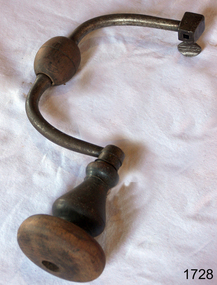
Tool - Drill Brace, 1800s
... designed to accept tapered square shank bits, early designs have a thumb screw to help secure the bit. Later designs had a catch to secure drilling bits. This type of brace was used in wagon making for boring & drilling holes into the wood for a variety of purposes, including driving screws. The subject item is unmarked but could have been made in Glasgow Scotland by John Fray in the 1800s A significant early example of a drill brace made in the UK during the 1800s demonstrates the evolution ...The subject item is an early Victorian Scotch Brace with a 10-inch sweep. They were also known as a six penny or "gentleman's" brace and were designed to accept tapered square shank bits, early designs have a thumb screw to help secure the bit. Later designs had a catch to secure drilling bits. This type of brace was used in wagon making for boring & drilling holes into the wood for a variety of purposes, including driving screws. The subject item is unmarked but could have been made in Glasgow Scotland by John Fray in the 1800s A significant early example of a drill brace made in the UK during the 1800s demonstrates the evolution of this type of tool from this time that today is a rare and collectable example of woodworking tools.Drill Brace metal with socket and thumbscrew, varnished wooden head and handleNoneflagstaff hill, warrnambool, flagstaff-hill, flagstaff-hill-maritime-museum, maritime-museum, shipwreck-coast, flagstaff-hill-maritime-village, brace, carpenders wheel brace, cabinet makers tools, drilling tool, wagon makers drill -
 Flagstaff Hill Maritime Museum and Village
Functional object - Hand Trolley, Melbourne Steamship Company (MSS Co), Late 19th to mid-20th century
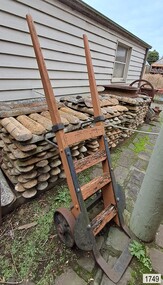
... The design represents an early step in the evolution of the simple hand trolley. ...This hand trolley was originally marked M.S.S. Co., and likely to have once belonged to the Melbourne Steamship Company, often referred to by those initials. Flagstaff Hill’s collection has several other objects connected to the M.S.S. Co. The firm was established in 1873 under the name Hugh R. Reid and Company, renamed Melbourne Steamship Company Ltd in 1895, and became Melbourne’s foremost interstate shipping line. Warrnambool was one of the ports of call at least between 1922 and 1956; for example, on September 27 1934, the ship Coolana left Warrnambool on its way to Stanley, Burnie and Devonport, then on to Sydney and Newcastle, while other of its vessels were visiting Fremantle, Port Lincoln, Whyalla, Adelaide, and Melbourne. The firm remained in business until around 1960. A hand trolley can be loaded with heavy and bulky objects such as luggage, and stacks of boxes such as produce, cargo and equipment. It uses the principles of wheels and leverage, like a wheelbarrow, and can easily be wheeled from one place to another. Hand trolleys are still used by farmers, railway workers, shipping companies, porters, airports, hospitals, warehouses, logistical firms, furniture removalists, factory labourers and even in private homes when heavy loads need to be moved. Hand trolleys were first used in the 18th century in industries where children were used to move heavy loads. By using a hand trolley, the young labourers could move the piles of objects with the same efficiency as the adult workers. This hand trolley is significant for its likely connection to the Melbourne Steamship Company, or MSSCo, Melbourne’s foremost shipping line for interstate trade in the late nineteenth and early-to- mid twentieth century, representing many aspects of early trade within maritime Australia; Warrnambool was one of the ports visited by the company’s ships. The design of the hand trolley is an example of equipment used since the 18th century to move heavy loads at docks and shipyards. It is associated with the maritime industries of shipping, transportation, travel, and trade, as well as the colonial primary production sectors of farming, markets, and produce. The design represents an early step in the evolution of the simple hand trolley. More recently, as well as the continued use of this simple style of trolley, the design has been improved to include specialised trolleys that fold, climb stairs, move pianos and even easily turn corners on their spinning, pivoting wheels. Hand trolley: an L-shaped handcart with handles and supporting legs at one end, wheels at the other, and a ledge or platform to hold the load. This hand trolley has orange wooden slats and handles, two metal wheels, and a black metal frame with semi-circular side flanges. An inscription is stamped on one side.Stamped: "M.S.S.CO."warrnambool, flagstaff-hill, flagstaff-hill-maritime-museum, maritime-museum, shipwreck-coast, flagstaff-hill-maritime-village, hand trolley, sack truck, trolley, luggage trolley, hand truck, trundler, sack barrow, bag barrow, leverage, marine technology, cargo handling, docks, wharft, shipping, trade, vintage, antique, hand card, rolling cart, station trolley, dolly, stack truck, box cart, two-wheeler, material handling equipment, shipping trade, mss co, mssc, melbourne steamship company, interstate shipping, hugh r. reid and company -
 Flagstaff Hill Maritime Museum and Village
Equipment - Hand Trolley
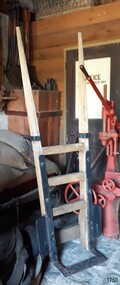
... The design represents an early step in the evolution of the simple hand trolley. ...A hand trolley can be loaded with heavy and bulky objects such as luggage, and stacks of boxes such as produce, cargo and equipment. It uses the principles of wheels and leverage, like a wheelbarrow, and can easily be wheeled from one place to another. Hand trolleys are still used by farmers, railway workers, shipping companies, porters, airports, hospitals, warehouses, logistical firms, furniture removalists, factory labourers and even in private homes when heavy loads need to be moved. Hand trolleys were first used in the 18th century in industries where children were used to move heavy loads. By using a hand trolley, the young labourers could move the piles of objects with the same efficiency as the adult workers. The design of the hand trolley is an example of equipment used since the 18th century to move heavy loads at the docks and shipyards. It is associated with the maritime industries of shipping, transportation, travel and trade as well as the colonial primary production sectors of farming, markets and produce. The design represents an early step in the evolution of the simple hand trolley. More recently, as well as the continued use of this simple style of trolley, the design has been improved to include specialised trolleys that fold, climb stairs, move pianos and even easily turn corners on their spinning, pivoting wheels. Hand trolley: an L-shaped hand-operated trolley with handles and supporting legs at one end, wheels at the other, and a ledge or platform to hold the load. This hand trolley has orange wooden slats and handles, two metal wheels, and a black metal frame with curved corners on its rectangular side flanges.flagstaff hill, warrnambool, shipwreck coast, maritime museum, flagstaff hill maritime museum and village, vintage, antique, hand trolley, hand card, hand truck, rolling cart, luggage trolley, station trolley, dolly, stack truck, sack truck, trundler, box cart, sack barrow, bag barrow, two-wheeler, leverage, material handling equipment, marine technology, cargo handling, docks, shipping trade -
 Flagstaff Hill Maritime Museum and Village
Domestic object - Washboard, 1900-1920s
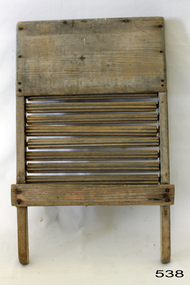
... The washboard is also significant in the evolution of household laundry equipment designed to reduce labour. ...This washboard with horizontal fulted rollers appears to be a variation on the patented Hubbard Roller Washboard system, which had rollers with vertical flutes. The rollers appear to be maple wood, which indicates an American manufacturer. The Mother Hubbard Roller Washboard was very popular in America in the early 1900s. The patented design, sold door-to-door, featured threaded maple rollers that rolled in opposite directions. It required only a light touch from the launderer, as the rollers did the work. It was awarded the Good Housekeeping Seal of Approval. The first roller washboard was made by the Hubbard brothers in Dover, Illinois, where they were born. As sales increased, they moved their large sawmill to Lamoille in 1904 for better shipping facilities. In 1916, they moved their sawmill to Mendota, Illinois. In addition to the washboards, the plant specialised in sawing walnut logs and forming them into roughs for gun stocks. Throughout the 1920s, the Mother Hubbard Washboard factory was busy, but production ceased after 1935, once the electric washing machine became popular. An unusual washboard with horizontal fluted rollers, different to the patented Hubbard Brothers washboards with vertical fluted rollers. It makes the item rare and possibly made in Australia in the early 1900s. The washboard gives insight into how various companies tried to improve or get around other manufacturers' patented designs. The washboard is also significant in the evolution of household laundry equipment designed to reduce labour. Washboard: a rectangular wooden frame with two legs enclosing horizontal, rotating rollers with flutes. flagstaff hill, flagstaff hill maritime museum and village, warrnambool, maritime museum, maritime village, great ocean road, shipwreck coast, washboard, laundry, clothes washing, clothes cleaning, washing, household item, washing equipment, laundering equipment, laundering, roller washboard, hubbard brothers, domestic laundry, mother hubbard washboard, rollers with horizontal flutes -
 Flagstaff Hill Maritime Museum and Village
Uniform - Sailor's Collar, Early to mid-20th century
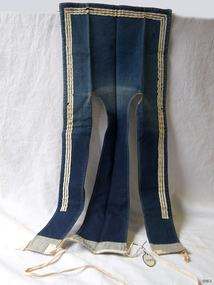
... design from the early 20th century. The rating personnel of the Royal Canadian Navy were issued with a very similar collar from 1910 to the 1950s. The blue denim collars were buttoned or died inside their tops with the back and the striped portion of the front flaps showing. The square sailor's collar represents the uniform of a rating sailor in the Royal Australian Navy in the early to mid-20th century, connecting it to the maritime history of Australia and the evolution of the uniform of the navy. ...This sailor's collar is part of a naval uniform. It once belonged to R S Wallace, who served in the RAN (Royal Australian Navy) and on the HMAS Warrnambool for three years. After the war he made several ship models including the sailing ship Cutty Sark. From January 1857 the Australian Navy uniform was formally established. The uniform, referred to as a 'sailor's suit', includes a blue flap collar such as this one. Sailors in the Royal Australian Navy wore collars of this design from the early 20th century. The rating personnel of the Royal Canadian Navy were issued with a very similar collar from 1910 to the 1950s. The blue denim collars were buttoned or died inside their tops with the back and the striped portion of the front flaps showing.The square sailor's collar represents the uniform of a rating sailor in the Royal Australian Navy in the early to mid-20th century, connecting it to the maritime history of Australia and the evolution of the uniform of the navy. The collar is the only one in this museum's collection and is connected to a sailor who service in the RAN on the HMAS Warrnambool for three years.Sailor's collar. A square collar of blue cotton fabric with three flaps or strips. Three white stripes make a border on the outside edges and two flaps; the centre flap that has no stripes. There is an inscription. The underside is lined with white cotton fabric that has thin blue stripes. Tapes are attached for fastening the collar. The Royal Australian Navy collar once belonged to R S Wallace."R.S. Wallace"flagstaff hill, flagstaff hill maritime museum and village, warrnambool, maritime museum, maritime village, great ocean road, shipwreck coast, sailor’s collar, sailor’s uniform, uniform, military, navy, ran, royal australian navy, r s wallace, seamen's collar, australian defence forces, naval force, sailor's rig, flap collar, naval collar, robert s wallace, collar, sailor's uniform, world war, hmas warrnambool, sailor's suit -
Federation University Historical Collection
Book - Book - ledger, Ernest Pickering, Architectural Design by Ernest Pickering, 1941, 1941
... Contents include architectural influences, climate, topography, materials, social conditions, economic conditions, evolution of form, plan and volume, visible structure, materials, structure, creative principles, composition, design....design ernest pickering Ballarat SCbool of Mines Library Brown hard covered book. Contents include architectural influences, climate, topography, materials, social conditions, economic conditions, evolution of form, plan and volume, visible structure, materials, structure, creative principles, composition, design. ...Ernest Pickering was author of Architecture at the University of Cincinnati.Brown hard covered book. Contents include architectural influences, climate, topography, materials, social conditions, economic conditions, evolution of form, plan and volume, visible structure, materials, structure, creative principles, composition, design.architecture, decorative elements, principles of design, ernest pickering, ballarat scbool of mines library -
 Flagstaff Hill Maritime Museum and Village
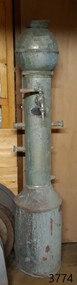
Functional object - Water Boiler, Jackson Boilers Ltd, 1920s
... The boiler is significant as a patented design, illustrating the evolution of maritime, commercial and domestic water boilers that have led to many innervations and improvements in today's boilers that are used in heating and in producing hot water for domestic and catering use. ...Jackson Boilers Ltd., brass founders, electro platers and sheet metal works made this tube water boiler. It was a fitting in the vessel Reginald M, a small cargo ship built at Port Adelaide in 1922 and named after her builder and first owner, John Murch. The Reginald M was launched at Largs Bay, South Australia, in 1922 to carry cargo around South Australia that included guano, barley, wool, horses, cattle, timber, explosives, potatoes, shell grit, and gypsum. It passed through numerous owners over the years and primarily maintained its purpose as a cargo vessel. In 1975, the decommissioned Reginald M was purchased by Flagstaff Hill Maritime Museum as an attraction. Although restoration efforts were undertaken and maintained for the craft above the water line, deterioration occurred below the surface and resulted in the ship being unsafe for visitors to board. It was broken up and removed from Flagstaff Hill in 2018, but items such as the historical boiler remain in Flagstaff Hill’s Collection. JACKSON BOILERS LTD.: - In 1911, Henry Jackson was the Managing Director at Jackson Boilers Ltd. He had gained around 30 years’ experience as a tin plate worker, plumber and gas fitter at Ilkey in 1881, then at Leeds by 1901. By 1921, he had changed employment from Jackson Boilers to Managing Director of Patent Water Boilers. During World War I, Jackson Boilers Ltd of Leeds performed war work like many other manufacturers at that time. The firm made cases for the explosive picric acid and electroplated fuse hole plugs. In 1918, the firm employed 15 males and 19 females. Jacksons Boilers became very successful throughout the first half of the twentieth century with showrooms and sales offices in Scotland, the Midlands and Southern England. It also had an office in Dublin, Ireland. In the post-war 1920s, the firm’s production included instantaneous water boilers and coffee machines for cafes, restaurants and canteens. Jackson Boilers also began to supply shipping lines with catering water boilers for their ships. The firm applied for a USA patent for the tube boiler in 1930, for the design which appears to have been invented in 1926. A 1971 advertisement adds the credentials, Members of the Catering Equipment Manufacturers’ Association. The tube water boiler was designed specifically for use in a ship's restaurant or dining area and patented by Jackson Boilers Ltd. of Leeds. The boiler is significant as a patented design, illustrating the evolution of maritime, commercial and domestic water boilers that have led to many innervations and improvements in today's boilers that are used in heating and in producing hot water for domestic and catering use. It is also significant as it is one of the earlier boilers the Jackson company made in the early 1920s before they applied for a US patent on their revised design in 1926.Water boiler, free standing Jackson's Tube boiler. A tall metal cylindrical stand with a metal sphere on top and several pipe fittings on the sides. A brass tap with a lever handle is connected to the front. A plaque with maker's details is attached under the tap. Details are also impressed into the cylinder above the tap.Jackson Boilers Leeds Ltd. "JACKSON'S PATENT" . Other details indecipherable. flagstaff hill maritime museum and village, flagstaff hill maritime museum, flagstaff hill, maritime museum, maritime village, warrnambool, great ocean road, leeds, jackson boilers ltd, jackson boilers, henry jackson, brass founders, electro platers, sheet metal works, patent water boilers, leeds manufacturer, tube water boiler, domestic boiler, tube domestic boiler, tube boiler, water heaters, water boilers, self-feeding water boilers, sheet metal work instantaneous water heaters, engineering, allied trades, metal workers, metal trade, food machinery, hospitality equipment, ship equipment, ship water boiler, ship heater, catering boilers, café boiler, restaurant boiler, canteen boiler, catering equipment manufacturers’ association, cema, kitchen equipment, kitchen appliance, war work, world war i, wwi, picric acid, picric acid cases, fuse hole plugs, electro plated fuse hole plugs, reginald m, cargo ship, port adelaide, 1922, john murch -
 Flagstaff Hill Maritime Museum and Village
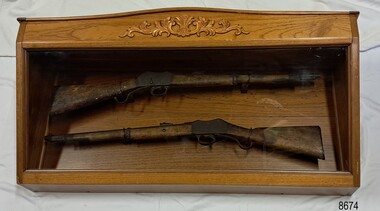
Weapon - Historic Rifles, Royal Small Arms Factory, 1877-1900
... design. The pair of Martini-Henry Carbine firearms represents policing in the early pre-1900 days of colonial settlement; Woodford was one of the first townships settled in Victoria, and it had a police presence from 1854 until 1917. The rifles and display provide a historic connection between the location of Woodford and relatives and associates. The carbine rifles show a stage in the evolution ...Martini-Henry Artillery Carbin rifles were made by the Royal Small Arms Factory at Enfield, Britain, from 1877 until 1900. Many were distributed to the British Colonies, including this pair, which was allocated to the Woodford Police, Victoria Police District of Warrnambool, Southwest Victoria. The Carbine model rifles were shorter than the standard rifles and more suited to mounted police and troopers. It is likely that in the early 20th century, Victoria Police replaced the two carbines with more modern firearms, and the outdated guns were stored in the stables. The rifles were left there and likely forgotten about due to changes in police staff. In 1915, police authorities announced that they would be replacing patrol horses with bicycles and would also close some smaller police stations. This affected Woodford Police Station, which closed in 1917. The forgotten firearms remained in the stables and were noticed by schoolboy Robert Jellie in 1940 and seen again in 1946. In 1995, the property was sold by the Education Department to a private owner. The Woodford Community donated the pair of Martini-Henry Carbines to the Victoria Police Museum in the late 1990s for mounting and display, which was funded by the Victoria Police Historical Society Inc. The decorative wood and glass display case and frame were designed to preserve the significant history of the guns. On November 1st 1999, the display was presented to Warrnambool Police and the local community due to the historical significance of the Woodford Police Station. In 2025, these items were formally deaccessioned by the Victoria Police Museum, and ownership was transferred to the Warrnambool Police Station. On March 10th, 2025, the display was transferred to Flagstaff Hill Maritime Museum and Village, where the historical story of the Martini-Henry Carbines could continue to be preserved and accessed by local families, the community, visitors to the area, and online visitors. WOODFORD POLICE: - The small settlement at Woodford was established in the 1840s around the Merri River where there was a ford across the water and a bridge from 1848 to 1851. The area was settled very early in Victoria’s history, and the river crossing provided travellers with access to the early route between Port Fairy (named Belfast at that time), Warrnambool and Melbourne. Occasionally, a Warrnambool police trooper would ride through Woodford and the district. In December 1854, Woodford Police barracks and stables were built on the hill by the Merri River on Bridge Road east, where Jubilee Park now stands. A local mounted trooper kept law and order in the area. In 1856, a lock-up was installed, and the first Woodford Police Station was in action in 1857. By 1871, the police station had been moved from the hill to land across the Merri River bridge, on the southern side of Bridge Road west, near Mill Street. In 1890, the police residence there was replaced by a stone Edwardian-style building with the stables and lock-up behind it and the old police station at the rear. The police continued to have a presence in Woodford until it was closed by the Police Commissioner in July 1917 for economic reasons. The residence was used for government housing until 1923, when it was taken over by the Education Department for the school teacher’s home. In 1995, it became privately owned. THE MARTINI-HENRY ARTILLERY CARBINE: - The Martini-Henry rifles were made in Britain from 1871 at the Royal Small Arms factory at Enfield and were stamped with the symbol of the Royal Cipher (Crown over VR) over ENFIELD to identify their origin. They were named after two of several people who helped design this method: Swiss Friederich von Martini and Scotsman Alexander Henry. The design was breech-loaded, and the inner barrel was rifled. A thumb rest was incorporated into the top right of the bullet receiver’s chamber. The small teardrop lever on the right side of the rifle showed whether the rifle was ready to be shot. In 1877, the shorter, lighter-weight Carbine version of the firearm was produced for mounted troops and artillery. Its official name was “Carbine, B.L., Rifled, Martini-Henry.” The bullets were slightly lighter in weight than those used for the longer rifle. The sight position was adjusted for the shorter gun, and wings were added to the sight on the tip, making it easier to slide the rifle back into a saddle bag. Some of the later Carbines also had leather sight covers screwed to the stock to prevent them from catching on the saddle bags. The Carbines had accessories available, such as barrel extensions with bayonets and swivels for adding slings. The Martini-Henry Carbine designs were later modified to fire the British .303 ammunition. Eventually, by 1900, the Martini-Henry Carbines were replaced by the Lee Enfield gun design. The pair of Martini-Henry Carbine firearms represents policing in the early pre-1900 days of colonial settlement; Woodford was one of the first townships settled in Victoria, and it had a police presence from 1854 until 1917. The rifles and display provide a historic connection between the location of Woodford and relatives and associates. The carbine rifles show a stage in the evolution of weapon design, adapted to suit mounted troops, and adding features to streamline use and storage. The ammunition was also improved during this progression. The carbines are important for their connection to policing law and order in a remote area. They are significant for their association with the township of Woodford, which was important to travel in the southwest Victoria district, providing access across a river for a road between Port Fairy and Melbourne, and later Warrnambool, and supplying food, goods and accommodation for the travellers. A pair of mounted rifles is mounted behind glass in a timer case, accompanied by a framed display of two photographs and an account of the rifles’ history. The case and display each have a horizontal board with a gently curved edge and carved decorations added. The identical firearms are British-made Martini Henry Carbine breach-loaded rifled guns, supplied by Britain to its Colonial troops from around 1877. The rifles are lever-action, single-shot .500 calibre weapons. They have a teardrop lever on their right side. They were used by Victoria Police mounted troops at the Woodford Police Station, Victoria. The black and white photographs were taken in 1946. The left photograph has a circled area; the right photograph is an enlarged view of the circled area, showing the Woodford Police Station in detail. The printed text is on textured paper with the Victoria Police watermark. It gives a summary of the rifle’s history. There is an inscription on the left photograph. Left photograph, handwritten in white pen: “WOODFORD” Document’s print: “During the late 1840s the small town of Woodford grew around the crossing of the Merri River on the Melbourne/Port Fairy Rad. Woodford was proclaimed a township in 1854 and a police quarters was established there in 1857. The police station remained until 1917 when it was closed and police service from then on was provided from Warrnambool. The building was then used as a school residence and is now privately owned. In !940 Robert JELLIE, then a schoolboy, observed two rifles mounted on the wall of the disused stable at the rear of the old police building. Following the devastating flood of 1946 (see photograph above) the rifles were again seen in the room next to the stable but were not seen again until the building was sold by the Education Department many years later. It was a recognition of the historical value of the rifles which led to their donation to the Warrnambool Police Complex. The rifles have been authenticated by the Victoria Police Armoury as being Victoria Police issue some time before 1900. The rifles are an identical pair of the famous British-made Martini Henry, a .500 inch calibre military weapon widely used by British Colonial troops. Victoria Police and the wider community of Warrnambool are indebted to the members of the Woodford community for their fine gesture in donating the rifles for mounting so that their historical importance can be preserved and they can be displayed for generations to come. This display was funded by the Victoria Police Historical Society Incorporated, and presented on the first day of November, 1999.”flagstaff hill maritime museum and village, great ocean road, shipwreck coast, martini henry, victoria police, woodford police station, rifle, carbine, display case, british, martini henry carbine, breech-loaded, rifled, colonial, single-shot, .500 calibre, weapon, gun, 1877, troops, mounted troops, merri river, victoria police woodford, victoria police warrnambool, victoria police melbourne, police quarters, robert jellie, school residence, stable, 1946 flood, victoria police armoury, identical pair, british colonial troops, victoria police historical society incorporated, woodford, bicycles, found by a schoolboy, edwardian-style building, victoria police museum, warrnambool police station -
 Flagstaff Hill Maritime Museum and Village
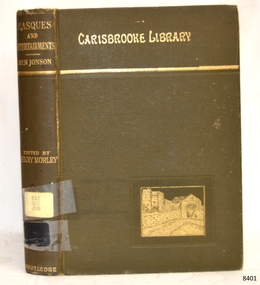
Book - Compilation of Dramatic Artistic Performances, George Routledge, Masques and Entertainments, 1890
... designed to flatter the ruling monarch while delivering deep mythological and intellectual allegories. This 1890 book operates on two historical levels. The first is its 17th-century significance: Jonson revolutionized the masque format. He introduced the "antimasque"—a chaotic, grotesque, or comedic prelude featuring actors playing witches, satyrs, or fools, which served as a foil before the main masque restored divine order and harmony. These texts are crucial for understanding Stuart politics, royal propaganda, and the evolution...designed to flatter the ruling monarch while delivering deep mythological and intellectual allegories. This 1890 book operates on two historical levels. The first is its 17th-century significance: Jonson revolutionized the masque format. He introduced the "antimasque"—a chaotic, grotesque, or comedic prelude featuring actors playing witches, satyrs, or fools, which served as a foil before the main masque restored divine order and harmony. These texts are crucial for understanding Stuart politics, royal propaganda, and the evolution ...Masques and Entertainments by Ben Jonson (edited by Henry Morley and published by George Routledge & Sons in 1890) is a compilation of the dramatic courtly performances written by the legendary Renaissance playwright and poet Ben Jonson. Issued as Volume IX of the popular "Carisbrooke Library" series, this specific late-Victorian edition gathered works that Jonson originally wrote in the early 17th century (between 1603 and 1630) for the courts of King James I and King Charles I.Masques and Entertainments Author: Ben Jonson Publisher: George Routledge & Sons Date: 1890fictionMasques and Entertainments by Ben Jonson (edited by Henry Morley and published by George Routledge & Sons in 1890) is a compilation of the dramatic courtly performances written by the legendary Renaissance playwright and poet Ben Jonson. Issued as Volume IX of the popular "Carisbrooke Library" series, this specific late-Victorian edition gathered works that Jonson originally wrote in the early 17th century (between 1603 and 1630) for the courts of King James I and King Charles I.flagstaff hil, warrnambool, flagstaff hill maritime museum, maritime museum, shipwreck coast, flagstaff hill maritime village, great ocean road, book, pattison collection, warrnambool library, warrnambool mechanics’ institute, ralph eric pattison, corangamite regional library service, warrnambool city librarian, mechanics’ institute library, victorian library board, warrnambool books and records, warrnambool children’s library, masques and entertainments, ben jonson -
 Flagstaff Hill Maritime Museum and Village
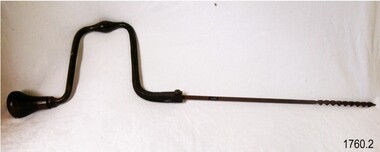
Tool - Drill Brace, 1800s
... designed to accept tapered square shank bits, early designs have a thumb screw to help secure the bit. Later designs had a catch to secure drilling bits. This type of brace was used in wagon making for boring & drilling holes into the wood for a variety of purposes, including driving screws. The subject item is unmarked but could have been made in Glasgow Scotland by John Fray in the 1800s, early drill braces of this type were often unmarked by their makers. A significant early example of a drill brace made in the UK during the 1800s demonstrates the evolution ...The subject item is an early Victorian Scotch Brace with a 10-inch sweep. They were also known as a six penny or "gentleman's" brace and were designed to accept tapered square shank bits, early designs have a thumb screw to help secure the bit. Later designs had a catch to secure drilling bits. This type of brace was used in wagon making for boring & drilling holes into the wood for a variety of purposes, including driving screws. The subject item is unmarked but could have been made in Glasgow Scotland by John Fray in the 1800s, early drill braces of this type were often unmarked by their makers. A significant early example of a drill brace made in the UK during the 1800s demonstrates the evolution of this type of tool from this time that today is a rare and collectable example of woodworking tools.Brace metal with wooden handle. Has a screw in the holding socket item also has an auger bit. Noneflagstaff hill, warrnambool, flagstaff-hill, flagstaff-hill-maritime-museum, maritime-museum, shipwreck-coast, flagstaff-hill-maritime-village, brace, carpenders wheel brace, cabinet makers tools, drilling tool, wagon makers drill -
 Flagstaff Hill Maritime Museum and Village
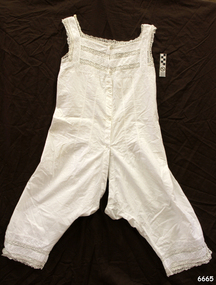
Clothing - Combination Undergarment, Late 1800s
... design had far fewer gathers and bulk, making the other clothing look much smoother. The collection of women’s late-19th-century undergarments is an example of clothing that women would include in their wardrobes. The garments add to the study of the evolution ...This handmade women’s combination undergarment features hand-worked lace panels and trim, and fine pintucks. It is one of seven handmade items of white cotton underwear, all made with beautiful needlework and embroidery skill. The lingerie once belonged to the donor’s great-grandmother’s family, the Paton family of ‘Trefnant’, Yangery, in southwest Victoria. The design of this combination undergarment, or ‘combination’, includes a chemise attached to a pair of drawers or bloomers. The combination is divided, or bifurcated, from the waist to the crutch for easier urinating. This one-piece type of underwear was worn by females from the 1860s and into the early 1900s. The 19th Century garments had front button closures like this one, and those made in the 1900s more often had back closures. Combination underwear was popular because the all-in-one design had far fewer gathers and bulk, making the other clothing look much smoother. The collection of women’s late-19th-century undergarments is an example of clothing that women would include in their wardrobes. The garments add to the study of the evolution of women's fashions and practicality for the early Australian settlers. The fine linen fabric and the careful needlework in these handmade garments and hand-worked lace trims reflect the maker’s dedication to making even serviceable garments beautiful to look at and wear. Women’s white cotton and lace all-In-one combination undergarment. The handmade underwear is a combined chemise and bloomers. It has a front button closure and is trimmed with hand-worked lace panels on the bodice and lace edging around armholes, the neck, and the bottom of the legs. The left and right sides are divided from the waist to the crutch.flagstaff hill maritime museum and village, maritime museum, maritime village, warrnambool, great ocean road, southwest victoria, victorian era, combination undergarment, all-in-one underwear, combination, ‘combinations’, one-piece underwear, one-piece undergarment, chemise and bloomers, combination chemise and bloomers, divided, bifurcated, split, chemise and drawers, women’s underwear, ladies’ underwear, undergarment, women’s clothing, women’s fashion, lingerie, under-structure, 1900s undergarments, 19th-century undergarment, 20th century, handmade clothing, handmade lace, hand-worked lace, paton family, trefnant, yangery, lady's combinations, ladies combinations -
 Flagstaff Hill Maritime Museum and Village
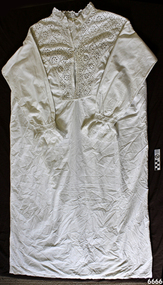
Clothing - Nightgown, Late 19th century
... design of nightgown was worn by females in the 19th century and is still worn today. The collection of women’s late-19th-century undergarments is an example of clothing that women would include in their wardrobes. The garments add to the study of the evolution ...This handmade women’s nightgown features hand-worked Broderie Anglaise yoke and trim. It is one of seven handmade items of white cotton underwear, all made with beautiful needlework and embroidery skill. The lingerie once belonged to the donor’s great-grandmother’s family, the Paton family of ‘Trefnant’, Yangery, in southwest Victoria. This design of nightgown was worn by females in the 19th century and is still worn today.The collection of women’s late-19th-century undergarments is an example of clothing that women would include in their wardrobes. The garments add to the study of the evolution of women's fashions and practicality for the early Australian settlers. The fine linen fabric and the careful needlework in these handmade garments and hand-worked lace trims reflect the maker’s dedication to making even serviceable garments beautiful to look at and wear. Women's long straight nightgown, white cotton, with long sleeves gathered at the cuff, stand-up lace collar, and a small catch closure on the bodice's centre opening. Hand-worked Broderie Anglaise yoke and sleeve tips.flagstaff hill maritime museum and village, maritime museum, maritime village, warrnambool, great ocean road, southwest victoria, victorian era, nightie, nightgown, women’s nightwear, sleepwear, night dress, women’s clothing, women’s fashion, lingerie, 19th century, handmade clothing, broderie anglaise, hand-made broderie anglaise, paton family, trefnant, yangery, nightdress -
 Mission to Seafarers Victoria
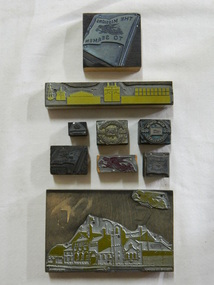
Functional object - Printers Blocks in box, c. 1950 - c. 1990
... The various designs show the evolution of the Mission iconography and in particular the earlier designs of the Flying Angel logos featuring the angel of the Revelation. One block uses graphic design ...These 11 printers blocks were used as formal identifiers on documentation for administrative, correspondence and publication, used especially mid 20th Century around the time of the Centenary in 1956/57. Some have inscriptions at the back (Coffey) or some pasted paper (one in Chinese). They come in a metal box.These printers blocks were used as formal identifiers on documentation. The various designs show the evolution of the Mission iconography and in particular the earlier designs of the Flying Angel logos featuring the angel of the Revelation. One block uses graphic design representing symbolic evolution of shipping from sail to container.Set of nine printers blocks of various sizes with Mission logo, centenary commemorative logo and flying angel logo.centenary, ink, stamps, printers-blocks, mission-to-seamen, flying-angel, logos, administration, reverend hubert william coffey (1915-2002) -
 Flagstaff Hill Maritime Museum and Village
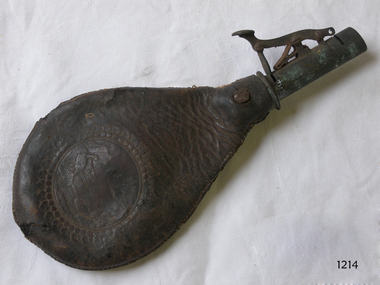
Weapon - Gunpowder Pouch, Early-to-mid 19th Century
... design featuring birds, which may indicate that it was made for hunting rather than for military use. The shot pouch is an example of weaponry accessories in the early-to-mid 19th century for hunting and military purposes. It is a step in the evolution ...This type of gunpowder pouch was used in the first half of the 19th century. It stores gunpowder or gunshot for loading or charging firearms such as rifles and muskets. This one has a decorative design featuring birds, which may indicate that it was made for hunting rather than for military use.The shot pouch is an example of weaponry accessories in the early-to-mid 19th century for hunting and military purposes. It is a step in the evolution of firearms and weaponry.Gunpowder pouch or shot pouch, the two sides of the rounded leather body are hand-stitched together apart from a small opening for the fitted brass spout, which has a spring-operated mechanism. Both sides have a decorative centre medallion with a finely tooled design depicting a landscape behind two birds. The adjustable charger mechanism releases a measured amount of gunpowder or shot for rifles or muskets. flagstaff hill, flagstaff hill maritime museum and village, warrnambool, maritime museum, maritime village, great ocean road, shipwreck coast, firearms, musket, gunpowder flask, gunpowder pouch, flask pouch, arms, militaria, leather flask, gunpowder bag, ammunition accessory, weaponry, shot pouch, hunting, military, gunpowder, gun powder, hinting, shot flask -
 Queenscliffe Maritime Museum
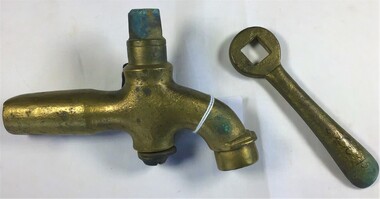
Equipment - Tap, brass
... Along with the wrecks of the Light of the Age (1868 - American-built wooden clipper ship) and Sussex (1871 - Blackwall frigate) nearby these vessels represent the three major design classes, and span the evolution of commercial and immigrant sailing ships used by the British in the colonial Australian trade in the last half of the nineteenth century. ...Along with the wrecks of the Light of the Age (1868 - American-built wooden clipper ship) and Sussex (1871 - Blackwall frigate) nearby these vessels represent the three major design classes, and span the evolution of commercial and immigrant sailing ships used by the British in the colonial Australian trade in the last half of the nineteenth century. ...Along with the wrecks of the Light of the Age (1868 - American-built wooden clipper ship) and Sussex (1871 - Blackwall frigate) nearby these vessels represent the three major design classes, and span the evolution of commercial and immigrant sailing ships used by the British in the colonial Australian trade in the last half of the nineteenth century. Taken as a group, it can be seen that the Great Ocean Road area wrecks constitute an extremely rich resource of historical and archaeological information.The Victoria Tower is archaeologically significant as the wreck of an international inward-bound passenger and cargo vessel. It is educationally and recreationally significant as a coherently intact example of a British built iron clipper Brass tap with key (handle)shipwrecks, victoria tower, tap with key -
 Queenscliffe Maritime Museum
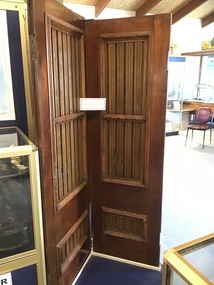
Functional object - Doors
... Along with the wrecks of the Light of the Age (1868 - American-built wooden clipper ship) and Sussex (1871 - Blackwall frigate) nearby these vessels represent the three major design classes, and span the evolution of commercial and immigrant sailing ships used by the British in the colonial Australian trade in the last half of the nineteenth century. ...There are only seven shipwrecks in Victoria that have had more than 100 objects recovered from them reported as a result of the Commonwealth Amnesty held in 1993-94. These are the Loch Ard (1878), Schomberg (1855) and Fiji (1891) - all situated along the western district 'Shipwreck Coast' - and the George Roper (1883), Light of the Age (1868), Joseph H. Scammell (1891) and Victoria Tower - all situated along the short section of the 'Surf Coast' between Point Lonsdale and Torquay.The Victoria Tower is archaeologically significant as the wreck of an international inward-bound passenger and cargo vessel. It is educationally and recreationally significant as a coherently intact example of a British built iron clipper ie: representative of a class or type. Along with the wrecks of the Light of the Age (1868 - American-built wooden clipper ship) and Sussex (1871 - Blackwall frigate) nearby these vessels represent the three major design classes, and span the evolution of commercial and immigrant sailing ships used by the British in the colonial Australian trade in the last half of the nineteenth century.2 Doors from the 'Victoria Tower' made from teak and mahoganydoors, salvage, shipwreck, torquay, victoria tower -
 Kiewa Valley Historical Society
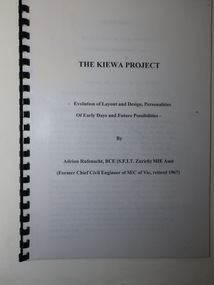
Booklet - The Kiewa Project, The Kiewa Project by Adrian Rufenacht
... Title on the front followed by 'Evolution of Layout and Design, Personalities / Of Early Days and Future Possibilities' followed by the author...Title on the front followed by 'Evolution of Layout and Design, Personalities / Of Early Days and Future Possibilities' followed by the author The Kiewa Project by Adrian Rufenacht, Booklet - The Kiewa Project ...The Kiewa Hydro Electric Scheme was constructed by the SECVBooklet of 40 pages typed on both sides and including 4 maps at the back. It has a black plastic spiral spine and black back cover. Title on the front followed by 'Evolution of Layout and Design, Personalities / Of Early Days and Future Possibilities' followed by the authorkiewa hydro electric scheme, adrian rufenacht -
 Kiewa Valley Historical Society
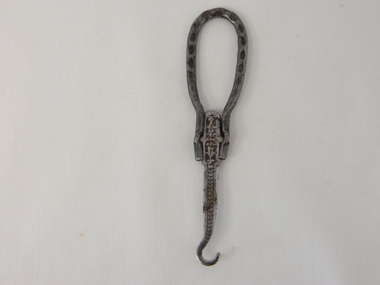
Hook Button, late 1800's to mid 1900's
... This item and its use and design spans the 1800's to early 1900's both in its fashion and application requirements. The genteel factor must be made when applying it to the Kiewa Valley. The evolution...This item and its use and design spans the 1800's to early 1900's both in its fashion and application requirements. The genteel factor must be made when applying it to the Kiewa Valley. The evolution ...This item and its use and design spans the 1800's to early 1900's both in its fashion and application requirements. The genteel factor must be made when applying it to the Kiewa Valley. The evolution of general clothing and apparel has moved from solid(long lasting) and sometimes expensive material and fasteners to a cheaper and more "throw away" fashion of sometimes monthly change in the later 1900's to 2000's.The significance of this item to a rural setting such as the Kiewa Valley not only points to an integration of "modern" fashion in semi remote rural Australian environments but also the limited connections to "high" fashion through magazines and audible (radio) and visual (cinema) advertising. It also "spotlights" the differences between the European and British social networking and lack of interaction between towns and counties to the "Australian" levels of interactions between rural and city environments. Although physical distances in Australia, during this period (1800's to early 1900's) was a retarding factor in the diffusion of the latest fashion apparel it was not as noticeable as when the global communication and the physical travel abilities were "exploded" in the latter 1900's. This shift towards "the smaller" globe scenario has overcome the physical distances that were so apparent in the previous century.This silver button/glove hook was based on late 1800's designs when buttons became more integrated and fashionable than "tie up" laces. This was more so in genteel fashion. The main hook extension from the "pronged" hand piece has been constructed in a way that allows for easy replacement by either longer or shorter hooks.costume accessories, footwear, shoes and boots with buttons, gloves, costume -
 Monbulk RSL Sub Branch
Book, Stackpole Books, Russian tanks, 1900-1970 : the complete illustrated history of Soviet armoured theory and design, 1970
... evolution of Russian armoured vehicles. Index, bib, ill, maps, p.192. Russian tanks, 1900-1970 : the complete illustrated history of Soviet armoured theory and design Book Stackpole Books John Milsom ...A detailed pictorial and textual description of the evolution of Russian armoured vehicles.Index, bib, ill, maps, p.192.non-fictionA detailed pictorial and textual description of the evolution of Russian armoured vehicles.russia - armoured fehicles, tanks - military science - russia -
 Geoffrey Kaye Museum of Anaesthetic History
Functional object - Bite Block, c. 1930s–1950s
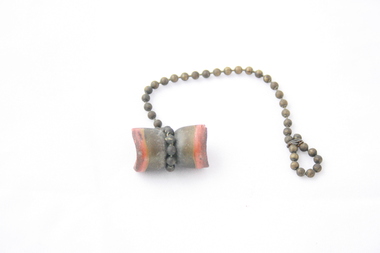
... designed to prevent it from slipping too far into the throat — a simple yet essential feature in an era before digital monitoring. Allen & Hanburys Ltd., a prominent British pharmaceutical company, was known for producing surgical and dental instruments throughout the 20th century. Their bite blocks were part of a broader evolution...designed to prevent it from slipping too far into the throat — a simple yet essential feature in an era before digital monitoring. Allen & Hanburys Ltd., a prominent British pharmaceutical company, was known for producing surgical and dental instruments throughout the 20th century. Their bite blocks were part of a broader evolution ...This bite block was used to prevent patients under anaesthesia or sedation from involuntarily biting down. This protected the patient’s teeth and tongue, while also shielding vital instruments like endotracheal tubes from damage during procedures. The device narrows in the centre to rest securely between the molars, with a beaded metal chain and loop designed to prevent it from slipping too far into the throat — a simple yet essential feature in an era before digital monitoring. Allen & Hanburys Ltd., a prominent British pharmaceutical company, was known for producing surgical and dental instruments throughout the 20th century. Their bite blocks were part of a broader evolution of airway management tools that prioritised safety, hygiene, and patient comfort. Black hard rubber tubular bite block with red rubber ends. Block narrows in the centre where there is attached a metal beaded chain ending in a circular loop for securing and preventing from losing down the patient's throat. medical device, anaesthesia, bite block -
 Geoffrey Kaye Museum of Anaesthetic History
Functional object - Bite Block, c. 1930s–1950s
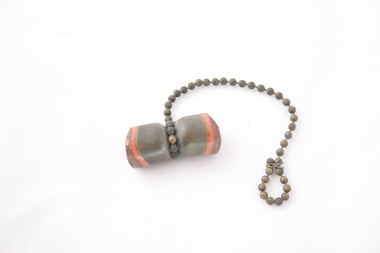
... designed to prevent it from slipping too far into the throat — a simple yet essential feature in an era before digital monitoring. Allen & Hanburys Ltd., a prominent British pharmaceutical company, was known for producing surgical and dental instruments throughout the 20th century. Their bite blocks were part of a broader evolution...designed to prevent it from slipping too far into the throat — a simple yet essential feature in an era before digital monitoring. Allen & Hanburys Ltd., a prominent British pharmaceutical company, was known for producing surgical and dental instruments throughout the 20th century. Their bite blocks were part of a broader evolution ...This bite block was used to prevent patients under anaesthesia or sedation from involuntarily biting down. This protected the patient’s teeth and tongue, while also shielding vital instruments like endotracheal tubes from damage during procedures. The device narrows in the centre to rest securely between the molars, with a beaded metal chain and loop designed to prevent it from slipping too far into the throat — a simple yet essential feature in an era before digital monitoring. Allen & Hanburys Ltd., a prominent British pharmaceutical company, was known for producing surgical and dental instruments throughout the 20th century. Their bite blocks were part of a broader evolution of airway management tools that prioritised safety, hygiene, and patient comfort.Black hard rubber tubular bite block with red rubber ends. Block narrows in the centre where there is attached a metal beaded chain ending in a circular loop for securing and preventing from losing down the patient's throat.medical device, anaesthesia, bite block -
Victorian Aboriginal Corporation for Languages
Book, Helen Gardner et al, Southern Anthropology : a History of Fison and Howitt's Kamilaroi and Kurnai, 2015
... evolution of humans. This narrative is interspersed with an introduction to the kinship and social organisation of Aboriginal and Pacific Island people that highlight the enduring value of Fison and Howitt's methods and the resurgence of their questions in contemporary anthropology. Southern Anthropology is designed...evolution of humans. This narrative is interspersed with an introduction to the kinship and social organisation of Aboriginal and Pacific Island people that highlight the enduring value of Fison and Howitt's methods and the resurgence of their questions in contemporary anthropology. Southern Anthropology is designed ...From far-flung sites in Australia and the Pacific Islands, Lorimer Fison and A. W. Howitt produced the landmark study, 'Kamilaroi and Kurnai' (1880). Their book revealed the complexity of Aboriginal and Pacific Island societies and changed the course of anthropology in the early years of the discipline. Using archival sources and an innovative approach, Southern Anthropology explores the research, writing and reception of 'Kamilaroi and Kurnai'. Historical chapters track Fison and Howitt's collection and analysis of anthropological material in the context of raging debates about the evolution of humans. This narrative is interspersed with an introduction to the kinship and social organisation of Aboriginal and Pacific Island people that highlight the enduring value of Fison and Howitt's methods and the resurgence of their questions in contemporary anthropology. Southern Anthropology is designed to be read across disciplinary boundaries. b&w illustrations, b&w photographs, tables, document reproductionshistories, anthropology, howitt, fisson, kamilaroi, kurnai, evolution, archives, australia
