
Showing 19 items matching "design objectives"
-
 Moorabbin Air Museum
Manual - GE turbofan engines, CF6 High Bypass Turbofan General Electric
... Design objectives...GE turbofan engines Design objectives Engine performance CF6 growth Noise & smoke technology Power management General description Fan Compressor Combustor High & low pressure turbine Support structures Accessory drive Thrust reverser system. ...Overview of design, performance & systems of GE CF6 turbofan engine, circa 1972Large single clip foldernon-fictionOverview of design, performance & systems of GE CF6 turbofan engine, circa 1972design objectives, engine performance, cf6 growth, noise & smoke technology, power management, general description, fan, compressor, combustor, high & low pressure turbine, support structures, accessory drive, thrust reverser system., fuel system, lubrication system, maintenance & maintainability, reliability, materials -
Glen Eira Historical Society
Document - Beauville Estate
... The Guidelines set out design parameters, principles and techniques for achieving appropriate heritage conservation objectives for the defined Beauville Estate Heritage Area, to be used by the Council, property owners, residents and designers. ...The Guidelines set out design parameters, principles and techniques for achieving appropriate heritage conservation objectives for the defined Beauville Estate Heritage Area, to be used by the Council, property owners, residents and designers. ...Beauville Estate Draft Heritage Guidelines, July 2000, produced by the Glen Eira City Council, author unknown, 25 pages. The Guidelines set out design parameters, principles and techniques for achieving appropriate heritage conservation objectives for the defined Beauville Estate Heritage Area, to be used by the Council, property owners, residents and designers. A number of photographs of houses and design features are included in the document as well as a brief history of the Estate and a Key Design Checklist.a v jennings construction co, gurney edward, jennings albert v sir, beauville estate, beauville estate heritage area, beauville avenue 1-39 (odd), beauville avenue 2-36 (even), dalny road 3-25 (odd), gloucester court 1-3 (odd), gloucester court 2-6 (even), lindsay avenue 40-44 (even), murrumbeena road 227-233 (odd), murrumbeena road 222-232 (even), murrumbeena, glen eira city council, architectural features, architectural styles, plans, brick houses, shops, residential development, tennis courts, housing estates, builders, building regulations, local government, commercial development, history, maps, photographs -
 Bendigo Military Museum
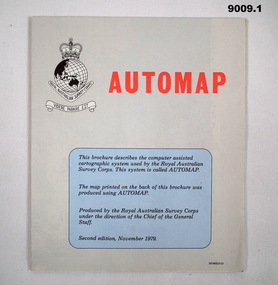
Map - Army Survey Regiment - Automap, Army Survey Regiment, Bendigo, 1 Nov 1979, .2 and .3 Aug 1980 and .4 December 1982
... designed to provide a general description of the second phase of the AUTOMAP system (Automap 2) installed at the Army Survey Regiment, Bendigo. It contains information that managers and supervisors need to know and serves as a preliminary introduction for anyone interested in learning about AUTOMAP 2. In addition, a number of annexes are included to provide more detailed descriptions of significant features and components of the system. System Objectives...designed to provide a general description of the second phase of the AUTOMAP system (Automap 2) installed at the Army Survey Regiment, Bendigo. It contains information that managers and supervisors need to know and serves as a preliminary introduction for anyone interested in learning about AUTOMAP 2. In addition, a number of annexes are included to provide more detailed descriptions of significant features and components of the system. System Objectives ...These flow diagrams and in particular the Introduction to Automap 2 booklet is designed to provide a general description of the second phase of the AUTOMAP system (Automap 2) installed at the Army Survey Regiment, Bendigo. It contains information that managers and supervisors need to know and serves as a preliminary introduction for anyone interested in learning about AUTOMAP 2. In addition, a number of annexes are included to provide more detailed descriptions of significant features and components of the system. System Objectives. In order that RASVY can carry out its mapping programme effectively, an efficient production system is required that can acquire and edit digital data from a topographic data base and thence automatically produce high quality maps using that digital data. The existing system, AUTOMAP 1, provides a small part of such a system. AUTOMAP 2 expands the capabilities of AUTOMAP 1 in data capture, computing power and data handling for cartographic purposes. AUTOMAP 2 includes state-of-the-art technology, introduces interactive graphics as a production tool and shifts procedures from a current mix of analogue and digital technologies to an almost totally digital system. AUTOMAP 2 increases map production by at least 20 percent at the Army Survey Regiment. Project References. A wide range of user manuals and associated documentation is available for both the hardware and software components of the AUTOMAP system. Other related departmental references are listed at the rear of the booklet..1 A folded Automap produced Map, Derby 1:100 000, Series 1611, Sheet 3663, Printed on one side and Automap flow diagram second Edition DEF/MISC/5157 on the other side. .2 and .3 Two copies of a folded Automap produced Map, Yampi 1:250 000, Series 1501 (Joint Operations Graphic), Sheet SE51-3, Edition 1, Printed on one side and Automap flow diagram third Edition DEF/MISC/5157C on the other side. .4 An Introduction to the Automap 2 System, A4 Booklet 16 x pages and a folded Automap2 flow diagram fifth Edition DEF/MISC/5157E Annex in the rear of the booklet..1 DEF/MISC/5157 .2 AND .3 DEF/MISC/5157C .4 DEF/MISC/5157Eroyal australian survey corps, rasvy, fortuna, army survey regiment, army svy regt, asr -
 Eltham District Historical Society Inc
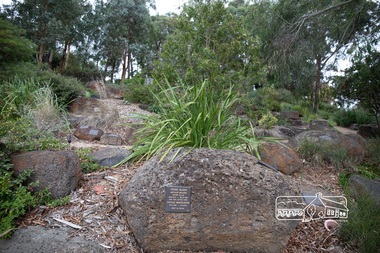
Photograph, Peter Pidgeon, Memorial to Peter Glass and Cecile Glass, Eltham Cemetery, Victoria, 5 April 2021
... objective of building a mud-brick house. War intervened, but then in 1948 he began working for Alistair Knox as a carpenter and mud-brick builder. By then, Peter had married, necessitating a larger house, which he built with help from Alistair Knox. As a trained architectural draftsman, Peter later progressed to working for Alistair in that role, eventually running the drafting office during the 1960s. He was deeply involved in the foundation of the Australian Institute of Landscape Architects, and went on to design...objective of building a mud-brick house. War intervened, but then in 1948 he began working for Alistair Knox as a carpenter and mud-brick builder. By then, Peter had married, necessitating a larger house, which he built with help from Alistair Knox. As a trained architectural draftsman, Peter later progressed to working for Alistair in that role, eventually running the drafting office during the 1960s. He was deeply involved in the foundation of the Australian Institute of Landscape Architects, and went on to design ...In 1938, Arthur William Glass (known as Peter Glass) was studying painting under Max Meldrum. Much of their inspiration came from the Eltham bush and the nearby Yarra River. With his friends jazz musicians Graeme and Roger Bell, Peter bought land at the top of John Street: enchanted by Montsalvat, he had the objective of building a mud-brick house. War intervened, but then in 1948 he began working for Alistair Knox as a carpenter and mud-brick builder. By then, Peter had married, necessitating a larger house, which he built with help from Alistair Knox. As a trained architectural draftsman, Peter later progressed to working for Alistair in that role, eventually running the drafting office during the 1960s. He was deeply involved in the foundation of the Australian Institute of Landscape Architects, and went on to design many gardens, some in partnership with Alistair Knox and Gordon Ford. He died in 1997 and is buried in Eltham Cemetery with his wife Cecile. Peter Glass (Arthur William) Artist A.I.L.A. 28.8.1917 - 28.12.1997 and his loving wife Cecile Madeleine 23.2.1927 - 6.2.2006 Rest In PeaceBorn Digitaleltham cemetery, gravestones, heritage excursion, cecile madeleine glass, peter glass -
 Yarra City Council
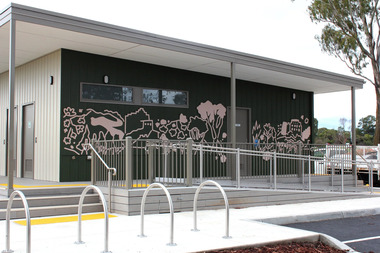
Artwork, other - Integrated artwork, Angharad Neal-Williams, View Point, 2026
... Its conceptual and artistic delivery is strongly aligned with the commission objectives outlined in the Yambla Concept Design Brief. ‘View Point’ (2026) was commissioned by Yarra City Council (Council) as part of the Yambla Pavilion redevelopment project, in accordance with Council’s Public Art Policy 2015-2020 Percent for Art scheme. ...Its conceptual and artistic delivery is strongly aligned with the commission objectives outlined in the Yambla Concept Design Brief. ‘View Point’ (2026) was commissioned by Yarra City Council (Council) as part of the Yambla Pavilion redevelopment project, in accordance with Council’s Public Art Policy 2015-2020 Percent for Art scheme. ...Beginning as sketchbook drawings at the park, this artwork is based upon a series of site drawings that map the landscape around Yambla Pavilion. Views from around the walking tracks and ovals are sketched from a range of perspectives. The drawings capture a mix of viewpoints across the site, coming together to form a shared landscape. It celebrates the ways the community collectively uses the park, the pavilion, the oval, the seating and shared facilities, highlighting how these spaces foster connection and bring people together. The fabrication process involved taking elements away from sheets of aluminium, revealing the drawing as the metal was removed. This process is a nod to the previous use of the site as a quarry, where materials were taken away to then create something new. Small off-cuts from the fabrication process are installed around the pavilion, adding to the space and extending the interplay of positive and negative form. The colours in the artwork are two-toned: the background a deep forest green to tie the artwork into the surrounding environment, with a dusty pink powder coating, a soft welcoming colour that aims to promote inclusion and create a public artwork that feels inviting to all.‘View Point’ is an integrated artwork that meaningfully engages with the Yambla Pavilion site and reflects the diverse communities that utilise its facilities. Its conceptual and artistic delivery is strongly aligned with the commission objectives outlined in the Yambla Concept Design Brief. ‘View Point’ (2026) was commissioned by Yarra City Council (Council) as part of the Yambla Pavilion redevelopment project, in accordance with Council’s Public Art Policy 2015-2020 Percent for Art scheme. The artwork consists of 1000mm high laser-cut aluminium panels that depict sightlines observed and sketched by the artist on site at Quarries Park, March 2026. It features floral, landscape and architectural motifs in a dusty pink hue against a forest green background. N/Aanimals, flora, cities, park -
The Ed Muirhead Physics Museum
Photograph, Optical Munitions
... Designed by J.J. McNeill and G.G. Schaefer of Munitions School Laboratory, forerunner of Materials Research Laboratories. Built by MSL. Specifications: 2 objectives...Designed by J.J. McNeill and G.G. Schaefer of Munitions School Laboratory, forerunner of Materials Research Laboratories. Built by MSL. Specifications: 2 objectives ...“Optical microscope made in Australia ater 1939-45 War. Designed by J.J. McNeill and G.G. Schaefer of Munitions School Laboratory, forerunner of Materials Research Laboratories. Built by MSL. Specifications: 2 objectives of 16mm and 4mm and 2 eyepieces 5x, 10x and a substage condenser. (Script of HC Bolton) Full discussion in Bolton, HC, “JJ MCNEILL AND THE DEVELOPMENT OF OPTICAL RESEARCH IN AUSTRALIA. Historical Records of Australian Science 5 (1983) pp 55-70.Black and white photograph of optical microscope. Information in ink on back - see History of Object for transcript. -
Villa Alba Museum
Document, Villa Alba: Interior Design Resource Centre
... The major objectives of this proposal were to preserve and restore the heritage listed Villa Alba, and adapt the house for use as Australia's first resource centre of historic interior design. ...design, decorative materials and techniques of the 19th and 20th centuries. The completed report was a submission by the Villa Alba Preservation Committee, in conjunction with Dulux Australia, to ICI. The submission includes original photographs of the period. The major objectives ...'Villa Alba: Interior Design Resource Centre', was the outcome of a funded project designed to underpin the restoration, adaptation and use of Villa Alba, 44 Walmer Street Kew, as a repository, resource centre, training institution, and display centre for interior design, decorative materials and techniques of the 19th and 20th centuries. The completed report was a submission by the Villa Alba Preservation Committee, in conjunction with Dulux Australia, to ICI. The submission includes original photographs of the period.The major objectives of this proposal were to preserve and restore the heritage listed Villa Alba, and adapt the house for use as Australia's first resource centre of historic interior design. The 34-page report outlines the case for the house's preservation, its projected use and the costs involved. The sections of the report are: Summary, The Villa Alba, Extract from Melbourne "Argus", Objectives of project, Administration, Preliminary estimates, Proposed sources of funding, Project details, Architect's Report, Members of Villa Alba Preservation Committee, and Photographs.non-fiction'Villa Alba: Interior Design Resource Centre', was the outcome of a funded project designed to underpin the restoration, adaptation and use of Villa Alba, 44 Walmer Street Kew, as a repository, resource centre, training institution, and display centre for interior design, decorative materials and techniques of the 19th and 20th centuries. The completed report was a submission by the Villa Alba Preservation Committee, in conjunction with Dulux Australia, to ICI. The submission includes original photographs of the period. villa alba museum, vila alba preservation committee, interior design -- australia, decorative arts, vision statements, heritage proposals -
 Robin Boyd Foundation
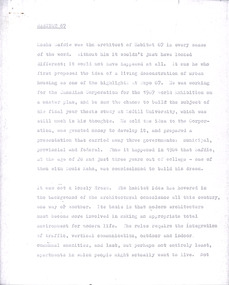
Document - Manuscript, Robin Boyd, Habitat 67, 1967
... Boyd discusses the achievement of Moshe Safdie in the design and dream of Habitat 67. He outlines the history, philosophy and sociological objective of cluster housing....Boyd discusses the achievement of Moshe Safdie in the design and dream of Habitat 67. He outlines the history, philosophy and sociological objective of cluster housing. ...Boyd discusses the achievement of Moshe Safdie in the design and dream of Habitat 67. He outlines the history, philosophy and sociological objective of cluster housing.Original manuscript published as 'Experimenting with boxes: Habitat's cluster' in Architectural Forum Vol.126, No.4, May 1967 pp. 35-41.Typewritten (p/copy), quarto, 9 pageshabitat 67, moshe safdie, expo 67, le corbusier, urbanism, unite d'habitation, reyner banham, alison and peter smithson, kenzo tange, clusters, russian apartments, cluster housing, robin boyd, manuscript -
 Sunshine and District Historical Society Incorporated
Document - Brimbank Early Years Review Final Report March 2022, Brimbank City Council, March 2022
... The revised objectives of the Early Years Facilities Review are to: 1. Review early years’ service facility models and develop guiding principles for the planning, design, governance and operation of the children’s and community centres. 2. ...The revised objectives of the Early Years Facilities Review are to: 1. Review early years’ service facility models and develop guiding principles for the planning, design, governance and operation of the children’s and community centres. 2. ...The purpose of the Brimbank Early Years Facilities Review is to ensure the provision of quality early years infrastructure that meets demand across the municipality. The Brimbank Early Years Facilities Review seeks to achieve the original objectives of the Review as set out in the CSIP while also responding to the impact of the three-year-old kindergarten reform. The revised objectives of the Early Years Facilities Review are to: 1. Review early years’ service facility models and develop guiding principles for the planning, design, governance and operation of the children’s and community centres. 2. Make recommendations on the priority order and components of the five proposed Children’s and Community Centres in the CSIP, in light of the three-year-old kindergarten reform. 3. Identify sites that can be expanded to accommodate additional kindergarten infrastructure. 4. Assess 24 underperforming kindergarten, playgroup and long day care facilities and make recommendations on the future need for and purpose of those facilities.Brimbank Early Years Review Final Report March 2022deer park west children's and community centre, albanvale children's and community centre, sunshine west children's and community centre, furlong road children's and community centre, dempster park children's and community centre -
Moorabbin Air Museum
Booklet (Item) - Design Of Japanese Structures
... British Intelligence Objectives Sb-Committee Originating Agency: U.S Naval Technical Mission To Japan Design Of Japanese Structures Booklet Design Of Japanese Structures ...British Intelligence Objectives Sb-Committee Originating Agency: U.S Naval Technical Mission To Japan -
Moorabbin Air Museum
Manual - Boeing aircraft repair manuals, Increasing Self - Reliance to Develop Repairs. The Boeing Company Customer Services
... Boeing repair manuals Workshop goals & objectives Summary of Applicable FARs Classes of structural components Typical structural component loading & materials for fuselage & wings/empennage Elements of a repair Examples of repairs Summary of Boeing workshop designed to make airlines more self reliant, circa 2000 Increasing Self - Reliance to Develop Repairs. ...Summary of Boeing workshop designed to make airlines more self reliant, circa 2000non-fictionSummary of Boeing workshop designed to make airlines more self reliant, circa 2000workshop goals & objectives, summary of applicable fars, classes of structural components, typical structural component loading & materials for fuselage & wings/empennage, elements of a repair, examples of repairs -
Moorabbin Air Museum
Book - AGARD reports, Report of the Working Group oh Aerodynamics of Aircraft Afterbody
... AGARD reports Objectives & scope of work Computational methods Experimental aspects Overview of issues around design of the back part of an aircraft, circa 1986 Report of the Working Group oh Aerodynamics of Aircraft Afterbody Book AGARD reports ...Overview of issues around design of the back part of an aircraft, circa 1986non-fictionOverview of issues around design of the back part of an aircraft, circa 1986objectives & scope of work, computational methods, experimental aspects -
University of Melbourne, Burnley Campus Archives
Map, Kororoit Creek Proposed ..... [words obscured], 1998
... Design DWC No KC 13 Sheet 13 of 14 dated March 1998. Scale 1:200. Legend includes: Vegetation, Drainage and Flood Management Issues and Action, Water Quality, Stream System V? Issues, Primary Objectives...Design DWC No KC 13 Sheet 13 of 14 dated March 1998. Scale 1:200. Legend includes: Vegetation, Drainage and Flood Management Issues and Action, Water Quality, Stream System V? Issues, Primary Objectives ...Composite photocopy so title partly obscured, by Thompson Berrill Landscape Design DWC No KC 13 Sheet 13 of 14 dated March 1998. Scale 1:200. Legend includes: Vegetation, Drainage and Flood Management Issues and Action, Water Quality, Stream System V? Issues, Primary Objectives (partially obscured).thompson berrill, landscape design, kororoit creek, water quality, vegetation -
 Melbourne Legacy
Document, History & purposes of residences
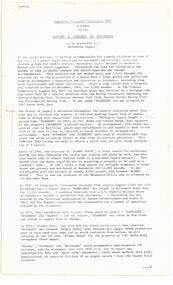
... designed to be as homely as possible, and each one was largely autonomous. Children, many of whom came from country Victoria, would go to their own homes during school holidays and the Christmas season. The stated objectives...designed to be as homely as possible, and each one was largely autonomous. Children, many of whom came from country Victoria, would go to their own homes during school holidays and the Christmas season. The stated objectives ...A paper which was delivered to the Legacy in Victoria Conference in 1980, detailing Melbourne Legacy's involvement in housing the children of Legacy widows since 1942. By 1950 Melbourne Legacy administered four houses - Holmbush, Stanhope, Blamey House and Harelands - and cared for approximately 100 children. The houses were designed to be as homely as possible, and each one was largely autonomous. Children, many of whom came from country Victoria, would go to their own homes during school holidays and the Christmas season. The stated objectives were to 'pass out into the world young men and women with high ideals of citizenship, who are self-reliant and self-supporting.' Also 'to provide affection, security and a future goal and essential discipline.' The country Clubs and Groups would send provisions such as preserved fruit, cheese, eggs, honey, citrus fruit, butter, and potatoes throughout the year to support the residences. Numbers of residents declined during the 70s, and in 1975 a Residences Committee recommended that Blamey House and Harelands should be closed, leaving only Stanhope in operation, the first Blamey House having closed in 1955 with Holmbush being renamed the second Blamey House. By 1980 the only remaining house was Stanhope with an average occupancy of 20. See Cat. No. 00785 for a first hand account of being a resident at Stanhope.Melbourne Legacy established residences to aid children of deceased servicemen complete their education, take further education and find employment. The document reveals details of the residences through the years. It shows the effort the Legatees invested in looking after Junior Legatees and how seriously they took this responsibility.White foolscap paper x 3 pages, with black type.Some pencilled ticks and bracketing, W.T. Lewis handwritten in blue biro on last page.residences, conference -
 Wodonga & District Historical Society Inc
Booklet - Under the Umbrella - The Story of Age Concern Albury Wodonga Inc, Audrey McDonald, 1996
... The objective of Age Concern is to lessen the mental and physical stress of growing older by advocating preparation and education of people approaching retirement as well as encouraging the provision of services within the community designed to improve the physical, mental and social well being of the aged. ...This book outlines the history and development of "Age Concern Albury Wodonga Inc." a not for profit organisation that operates in the Albury Wodonga area with some services provided operating across The Riverina Murray region. It provides services and social activities for frail aged people or people with disabilities and their carers. The objective of Age Concern is to lessen the mental and physical stress of growing older by advocating preparation and education of people approaching retirement as well as encouraging the provision of services within the community designed to improve the physical, mental and social well being of the aged.A small booklet of 70 pages including photos, interviews and text outlining the history of "Age Concern Albury Wodonga.non-fictionThis book outlines the history and development of "Age Concern Albury Wodonga Inc." a not for profit organisation that operates in the Albury Wodonga area with some services provided operating across The Riverina Murray region. It provides services and social activities for frail aged people or people with disabilities and their carers. The objective of Age Concern is to lessen the mental and physical stress of growing older by advocating preparation and education of people approaching retirement as well as encouraging the provision of services within the community designed to improve the physical, mental and social well being of the aged.aged concern albury wodonga, aged care, aged care services albury wodonga -
 Melbourne Tram Museum
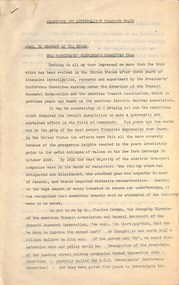
Document - Report, Melbourne & Metropolitan Tramways Board (MMTB), "Memo to Members of the Board - The Presidents' Conference Committee Tram", 13 Oct. 1938
... Report looks at the background to the development of the tram, the project objectives, development history, the story, noise, design features, the trucks, use of rubber, weight, speed. ...Report looks at the background to the development of the tram, the project objectives, development history, the story, noise, design features, the trucks, use of rubber, weight, speed. ...Report - 9 foolscap duplicated sheets, titled , dated 13 Oct. 1938. Report looks at the background to the development of the tram, the project objectives, development history, the story, noise, design features, the trucks, use of rubber, weight, speed. Notes on his visit to Brooklyn, revenue results, safety, accidents, his visit to the Canadian Car and Foundry Co of Montreal, securing the rights for Australia, licences, royalties, terms of any agreement and finally a recommendation to enter into an agreement for the tram.trams, tramways, pcc, new trams, manufacturing, licence fees, agreements, canada -
 Department of Energy, Environment and Climate Action
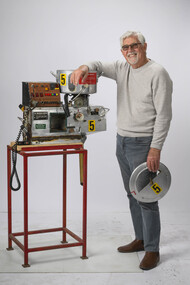
Incendiary machine
... The original design of the machine was not suitable to meet the burning objectives and a number of modification were necessary. ...The original design of the machine was not suitable to meet the burning objectives and a number of modification were necessary. ...The Canadians developed a machine that used "ping pong balls" instead of cylindrical incendiary capsules and, in 1977, the FCV purchased a Premo machine for evaluation. The 32mm-diameter balls were made from high impact polystyrene and contained 3.5g of potassium permanganate. They were injected with 1ml of glycol which would ignite after a short delay The first Premo machine used four slipper blocks, which were loaded via a hand-operated hopper which, when rotated forward, the balls would be fed into four feed chutes to individual slipper blocks. Each slipper block has an opening allowing individual balls to enter and exit once injected. The original design of the machine was not suitable to meet the burning objectives and a number of modification were necessary. Following close inspection and field testing it was clear that utilising four slipper blocks was excessive and would generate too much fire. It was acknowledged that satisfactory spacing could be achieved by using just one slipper block. Selective spacing could be achieved by the speeding up or slowing down of the slipper block transferring the capsules during the injection process. Regulating the speed that the injected capsules were being dropped controlled the amount of fire created on the ground. This machine was the result of many years of experimentation at AltonaSignificant development of aerial incendiary machines enabled expansion of the fuel reduction burning program across Victoria.Aerial Incendiary machine for use in helicopters Modification at the Altona workshops over many years by Barry Marsden forests commission victoria (fcv), planned burning, bushfire, bushfire aviation -
 Federation University Historical Collection
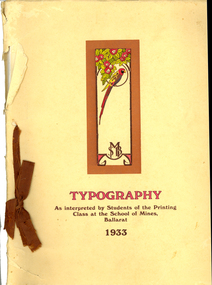
Book, Typography: As interpreted by students of the Printing Class at the School of Mines, Ballarat, 1933, 1933
... The objectives of Typographical Instruction at the Ballarat Technical Art School was to develop an appreciation of art in printing; to create and foster a wholesome respect for books; to develop a justifiable pride in persona achievement; to broaden the educational and social outlook; to broaden the field of vocational choice; to prepare for effective entrance into the printing trade; to give mastery of many of the principles of design; to help in forming habits of accuracy, thoroughness, neatness and industry; to give opportunity to turn out a product of use, beauty and value; to cultivate appreciation of the value of co-operation and service; to aid in mastery of other school subjects,particularly English; to provide an appropriate instructional medium for pupils whose constructive instincts desire this method of expression; to provide experience which will show the practical application and value of academic subjects....The objectives of Typographical Instruction at the Ballarat Technical Art School was to develop an appreciation of art in printing; to create and foster a wholesome respect for books; to develop a justifiable pride in persona achievement; to broaden the educational and social outlook; to broaden the field of vocational choice; to prepare for effective entrance into the printing trade; to give mastery of many of the principles of design; to help in forming habits of accuracy, thoroughness, neatness and industry; to give opportunity to turn out a product of use, beauty and value; to cultivate appreciation of the value of co-operation and service; to aid in mastery of other school subjects,particularly English; to provide an appropriate instructional medium for pupils whose constructive instincts desire this method of expression; to provide experience which will show the practical application and value of academic subjects. typography, printing, ballarat school of mines, ballarat technical art school, bickart's diamond shop, lydiard street methodist choir, south street competitions, allambee guest house, buninyong lodge, ballarat journalists' association, thornton studios, harry davies, harry brown & co., nautilus corsets, toti dal monte, symmons flower shop, ritz club, ballarat symphony orchestra, ladies' art association typography ballarat school of mines ballarat technical art school printing albert dorling Coloured soft covered book bound with a brown ribbon. ...Albert E. Dorling was the Instructor in Printing at the Ballarat Technical Art School in 1933. The art school was a division of the Ballarat School of Mines. The objectives of Typographical Instruction at the Ballarat Technical Art School was to develop an appreciation of art in printing; to create and foster a wholesome respect for books; to develop a justifiable pride in persona achievement; to broaden the educational and social outlook; to broaden the field of vocational choice; to prepare for effective entrance into the printing trade; to give mastery of many of the principles of design; to help in forming habits of accuracy, thoroughness, neatness and industry; to give opportunity to turn out a product of use, beauty and value; to cultivate appreciation of the value of co-operation and service; to aid in mastery of other school subjects,particularly English; to provide an appropriate instructional medium for pupils whose constructive instincts desire this method of expression; to provide experience which will show the practical application and value of academic subjects.Coloured soft covered book bound with a brown ribbon. It is a book of specimens of work by the students attending the Typography Classes at the Ballarat Technical Art School under the instruction of Albert Dorling. Illustrations include: Ariel [sic] View from Art School by Fred Longhurst, 1932 Other work includes Bickart's Diamond Shop, Lydiard Street Methodist Choir, South Street Competitions, Allambee Guest House, Buninyong Lodge, Ballarat Journalists' Association, Thornton Studios, Harry Davies, Harry Brown & Co., Nautilus Corsets, Toti dal Monte, Symmons Flower Shop, Ritz Club, Ballarat Symphony Orchestra, Ladies' Art Associationtypography, printing, ballarat school of mines, ballarat technical art school, bickart's diamond shop, lydiard street methodist choir, south street competitions, allambee guest house, buninyong lodge, ballarat journalists' association, thornton studios, harry davies, harry brown & co., nautilus corsets, toti dal monte, symmons flower shop, ritz club, ballarat symphony orchestra, ladies' art association, typography, ballarat school of mines, ballarat technical art school, printing, albert dorling -
 Sunshine and District Historical Society Incorporated
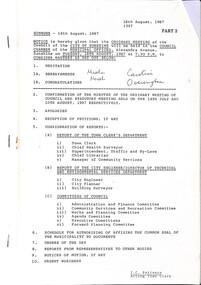
Administrative record - City of Sunshine Council Meetings 1986 - 1994 - Notice of Ordinary Meeting 18th August 1987 Part 2, City of Sunshine, 14th August 1987
... Albans Plan of Consolidation Lots 1 - 4 Fourth Avenue North West Corner Market Road Sunshine Two Plans of Transfer and One Plan of Consolidation Western Avenue Sunshine Connor Shea Plan of Subdivision Sunshine Road Tottenham Plan of Transfer & Consolidation, Plan of Creation of Easement, Plan of Subdivision Ashley Street, Hampden Street, Crothers Street & South Road Braybrook Draft Proposal for New Subdivision Legislation Report of the Building Surveyor Dangerous Building 252A & 252B Hampshire Road Sunshine (Fire Damaged) Dangerous Building 6 Kynoch Street Deer Park Dangerous Building 112 Billingham Road Deer Park Dangerous Building 2 Devonshire Road Sunshine (Fire Damaged) Location of Building 34 Links Street Sunshine West Dangerous Building Factories 4 & 5 18 Second Avenue Sunshine Dangerous Building 19 Duffy Street Maribyrnong Certification of Architectural Design Maribyrnong Medical Centre Proposed Additions to the Sunshine Hospital Furlong Road Certification of Architectural Design Smorgan Consolidated Industries Proposed New Corporate Headuaters and Ancillary Administration Facilities Somerville Road Brooklyn Statistical Information Building Permits Schedule for Authorising of Affixing the Common Seal of the Municipality to Documents Orders of the Day Appointment of Council Representatives to Other Bodies Council Meeting dates Standing Committees of Council Appointment of Standing & Advisory Committees Membership of Standing & Advisory Committees Deputy Mayor Community Services Objectives Planning Permit Application Hotel McIntyre Road Sunshine North Planning Permit Application Motor Repair Station Omar Street Maidstone Show Cause Notice 19 Second Avenue Sunshine Australian Institute of Health Surveyors and the New Zealand Insititute of Health Inspectors Joint Conference Melbourne / Christchurch Australian Association of Social Workers ltd Notice of Motion Corporate Management Structure Maribyrnong River Flood Mitigation North Sunshine Soccer Club Larisa Reserve...Albans Plan of Consolidation Lots 1 - 4 Fourth Avenue North West Corner Market Road Sunshine Two Plans of Transfer and One Plan of Consolidation Western Avenue Sunshine Connor Shea Plan of Subdivision Sunshine Road Tottenham Plan of Transfer & Consolidation, Plan of Creation of Easement, Plan of Subdivision Ashley Street, Hampden Street, Crothers Street & South Road Braybrook Draft Proposal for New Subdivision Legislation Report of the Building Surveyor Dangerous Building 252A & 252B Hampshire Road Sunshine (Fire Damaged) Dangerous Building 6 Kynoch Street Deer Park Dangerous Building 112 Billingham Road Deer Park Dangerous Building 2 Devonshire Road Sunshine (Fire Damaged) Location of Building 34 Links Street Sunshine West Dangerous Building Factories 4 & 5 18 Second Avenue Sunshine Dangerous Building 19 Duffy Street Maribyrnong Certification of Architectural Design Maribyrnong Medical Centre Proposed Additions to the Sunshine Hospital Furlong Road Certification of Architectural Design Smorgan Consolidated Industries Proposed New Corporate Headuaters and Ancillary Administration Facilities Somerville Road Brooklyn Statistical Information Building Permits Schedule for Authorising of Affixing the Common Seal of the Municipality to Documents Orders of the Day Appointment of Council Representatives to Other Bodies Council Meeting dates Standing Committees of Council Appointment of Standing & Advisory Committees Membership of Standing & Advisory Committees Deputy Mayor Community Services Objectives Planning Permit Application Hotel McIntyre Road Sunshine North Planning Permit Application Motor Repair Station Omar Street Maidstone Show Cause Notice 19 Second Avenue Sunshine Australian Institute of Health Surveyors and the New Zealand Insititute of Health Inspectors Joint Conference Melbourne / Christchurch Australian Association of Social Workers ltd Notice of Motion Corporate Management Structure Maribyrnong River Flood Mitigation North Sunshine Soccer Club Larisa Reserve A4 Stapled Document Administrative record City of Sunshine Council Meetings 1986 - 1994 - Notice of Ordinary Meeting 18th August 1987 Part 2 City of Sunshine ...Notice of Ordinary Meeting 18th August 1987 Part 2 Report of the City Planner Planning Permit Application Warehouse Lot 16 Central Avenue South East Corner First Avenue Sunshine Planning Permit Application Motor Vehicle Wreaking Motor Repairs and Care Sales 149 Anderson Road Sunshine Planning Permit Application Dual Occupancy 3 Middle Road Maribyrnong Planning Permit Application Factory Warehouse Lot 33 Keith Street Southern Corner Richards Street Maidstone Planning Permit Application Ten Flats 16 Wiltshire Street Sunshine North Planning Permit Application Four Flats 4 Rose Street Braybrook Planning Permit Application Building and Works 21 Wright Street Sunshine Planning Permit Application Convenience Shop 720 Geelong Road Brooklyn Planning Permit Application Dog Breeding 15 Maroonda Court St. Albans Sunshine Shopping Centre Road Works Notice of Motion Planning Permit Application Four Flats Lots 492 - 493 Fairbairn Road Sunshine West The Planning Scheme How it Works Councillors Training Course 5th September 1987 Rezoning Application Land Bounded by Kent Street, Stewart Street, Hotham Street & Pritchard Avenue Braybrook Planning Permit Application Buildings & Works Dalgety Farmers Ltd Lot 2 & 5 Frederick Street Tottenham Planning Permit Application Illuminated Advertising Signs St. Albans Hotel McKechnie Street St. Albans Planning Permit Application Manufacturing Sales and Buildings and Works 55 Wright Street Sunshine Hazardous Material Handling Depot Douglas Parade Newport Planning Permit Application Take Away Food Premises 75 Dumfries Street Corner Salmond Street Deer Park Planning Permit Application LP gas Tank & Dispenser Victoria Produces Co-Operative Company Ltd 413 Francis Street Brooklyn Planning Permit Application Transport Depot 1 Carrington Drive Albion Planning Permit Application Three Single Storey Flats 102 Morris Street Sunshine Planning Permit Application Factory Warehouse Units Tottenham Parade Tottenham Planning Permit Application Special Accommodation Building (Nursing Home) 4 - 8 Killara Street Sunshine West Planning Permit Application Dwelling Units and Recreation Centre Building lots 1 - 7 Warrs Road and lots 21 & 22 Fabian Court Maribyrnong Melbourne Metropolitan Planning Scheme Amendment No 388 Planning Permit Application Take Away Food Premises Lot 122 Whitehill Avenue Sunshine North Proposed Amendments to Liquor Control Commission Act 1966 Sunshine Planning for the 21st Century Report Medical Practices & Home-Based Offices in Residential Zones Planning Permit Application Panel Beating, Spray Painting, Mechanical Repairs 168 McIntyre Road Sunshine North Rezoning No 133 Robinsons Road Deer Park Planning Permit Application Works Within 15m of Stony Creek 219 - 243 Sunshine Road Tottenham Planning Permit Application Subdivision Lot 2 Fourth Avenue Sunshine Amendment No 432 McGraths Quarry Duke Street Sunshine Amendment No 432 Canterbury Street Deer Park Local Government into the 1990's Economic Development Delegated Matters Plan of Strata Subdivision 2 Percy Street St. Albans Plan of Strata Subdivision 4 Kynoch Street Deer Park Plan of Consolidation 20 - 22 Cooper Street Sunshine Plan of Strata Subdivision Factory Units Lot 40 Reid Street Ardeer Plan of Consolidation 32 Studley Street Maidstone Plan of Strata Subdivision Fabian Court Maribyrnong Plan of Subdivision Grantham Parade Bounded by Belfort Street, Carlow Road and Rosslare Parade St. Albans Plan of Consolidation Lots 1 - 4 Fourth Avenue North West Corner Market Road Sunshine Two Plans of Transfer and One Plan of Consolidation Western Avenue Sunshine Connor Shea Plan of Subdivision Sunshine Road Tottenham Plan of Transfer & Consolidation, Plan of Creation of Easement, Plan of Subdivision Ashley Street, Hampden Street, Crothers Street & South Road Braybrook Draft Proposal for New Subdivision Legislation Report of the Building Surveyor Dangerous Building 252A & 252B Hampshire Road Sunshine (Fire Damaged) Dangerous Building 6 Kynoch Street Deer Park Dangerous Building 112 Billingham Road Deer Park Dangerous Building 2 Devonshire Road Sunshine (Fire Damaged) Location of Building 34 Links Street Sunshine West Dangerous Building Factories 4 & 5 18 Second Avenue Sunshine Dangerous Building 19 Duffy Street Maribyrnong Certification of Architectural Design Maribyrnong Medical Centre Proposed Additions to the Sunshine Hospital Furlong Road Certification of Architectural Design Smorgan Consolidated Industries Proposed New Corporate Headuaters and Ancillary Administration Facilities Somerville Road Brooklyn Statistical Information Building Permits Schedule for Authorising of Affixing the Common Seal of the Municipality to Documents Orders of the Day Appointment of Council Representatives to Other Bodies Council Meeting dates Standing Committees of Council Appointment of Standing & Advisory Committees Membership of Standing & Advisory Committees Deputy Mayor Community Services Objectives Planning Permit Application Hotel McIntyre Road Sunshine North Planning Permit Application Motor Repair Station Omar Street Maidstone Show Cause Notice 19 Second Avenue Sunshine Australian Institute of Health Surveyors and the New Zealand Insititute of Health Inspectors Joint Conference Melbourne / Christchurch Australian Association of Social Workers ltd Notice of Motion Corporate Management Structure Maribyrnong River Flood Mitigation North Sunshine Soccer Club Larisa Reservecentral avenue, first avenue, sunshine, anderson road, middle road, maribyrnong, keith street, richards street, maidstone, wiltshire street, sunshine north, rose street, braybrook, wright street, geelong road, brooklyn, maroonda court, st. albans, fairbairn road, sunshine west, kent street, stewart street, hotham street, pritchard avenue, dalgety farmers, frederick street, tottenham, st. albans hotel, mckechnie street, douglas parade, newport, dumfries street, salmond street, deer park, victoria produces co-operative, francis street, carrington drive, albion, morris street, tottenham parade, killara street, warrs road, fabian court, whitehill avenue, mcintyre road, robinsons road, sunshine road, fourth avenue, mcgraths quarry, duke street, canterbury street, percy street, kynoch street, cooper street, reid street, studley street, grantham parade, belfort street, carlow road, rosslare parade, market road, western avenue, connor shea, ashley street, hampden street, crothers street, south road, hampshire road, billingham road, devonshire road, links street, second avenue, duffy street, sunshine hospital, furlong road, smorgan consolidated industries, somerville road, omar street, maribyrnong river, north sunshine soccer club, larisa reserve, larisa road
