
Showing 30 items matching "designer's view"
-
 Moorabbin Air Museum
Book - Air crashes - pilot error, Pilot Error. A Professional Study of Contributory Factors
... ...Designer's view...Air crashes - pilot error Pilot's view Human factors Designer's view Air traffic control factors Airline management - pilot relations Legal implications Technical/pilot overview of factors contributing to air crashes, circa 1976 Pilot Error. ...Technical/pilot overview of factors contributing to air crashes, circa 1976non-fictionTechnical/pilot overview of factors contributing to air crashes, circa 1976pilot's view, human factors, designer's view, air traffic control factors, airline management - pilot relations, legal implications -
 National Wool Museum
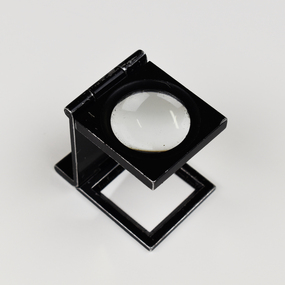
Tool - Lens, c.1960
... Although Nino has now retired from his honorary position and has hung up his Australian Tartan vest, these items will continue to serve the community in sharing the stories of Australian Textile design. Textile designers used viewing lenses such as this to see how many threads are within a textile sample. ...Although Nino has now retired from his honorary position and has hung up his Australian Tartan vest, these items will continue to serve the community in sharing the stories of Australian Textile design. Textile designers used viewing lenses such as this to see how many threads are within a textile sample. ...Nino Corda was a Geelong based textile designer who worked at various textile mills between 1957 & 2003. He travelled the world in search of the latest fashions and techniques and developed timeless designs that were much loved by Australians. These items are on rotational display at the National Wool Museum’s ‘In the Factory’ exhibition. For many years, Nino also worked as part of the Honorary Staff of the National Wool Museum. His passion for the world of textiles provided energy and knowledge to the visitors and staff of the museum. Although Nino has now retired from his honorary position and has hung up his Australian Tartan vest, these items will continue to serve the community in sharing the stories of Australian Textile design. Textile designers used viewing lenses such as this to see how many threads are within a textile sample. It was important to count correctly, otherwise the enlarged final pattern would be out of alignment. Before compact lenses such as this, specialised glasses were used such as 8039.The viewing lens has a 3 fold design in order to fold up to be compact and easily transportable in a pocket while also working to provide its own stand when unfolded. The lens is black and contains one circular piece of magnifying glass on the top panel.Top panel. Words, scratched. NINOtextile calculations, textile design -
 Mission to Seafarers Victoria
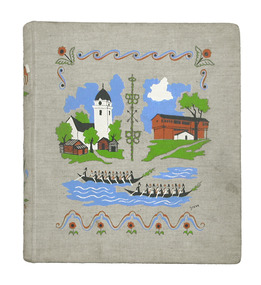
Album - Photographic album, Ports of call with the M/S Mongabarra from December 1st 1949 to July 23rd 1950, 1949
... The Collection is especially useful when viewed along with contemporary Quinn family correspondence. album photograph ms mongbarra san francisco dunkirk voyages allan quinn barbara quinn seafaring life ww2 seafarer melbourne sydney brisbane san pedro newcastle adelaide port pirie port lincoln cape town las palmas australia south africa canary islands usa United states france antwerp belgium hull england hamburg germany copenhagen denmark gothenburg norway sweden halden malmö On front cover possible designer printed signature in black: "Grane"; On inside front cover on adhered sheet of paper in aqua ink lists intinerary/ index of 20 Ports visited: Title (see above) / "Signed on in San Francisco December 1st 1949 / " then a header line for 4 columns: " PORT COUNTRY ARRIVED DEPARTED / 1. ...The album tells the story of ports visited by Allan Charles Quinn during his service on board the M/S "Mongabarra". He signed on in San Francisco on December 1, 1949. Note this trip overlapped with the Album (00278) which documents the next trip Quinn made to Africa out of Gothenburg. The album preserves a 1950s perspective of a Merchant Seaman and his experience of the respective Ports at that time. The Collection is especially useful when viewed along with contemporary Quinn family correspondence.Album with metal Metal binder rings at spine and beige fabric cover with gouache printed colour design featuring scandinavian buildings. The album contains 25 pages of b/w mounted photographs. Some are missing. The cover is illustrated with colour screenprinted pictures of a white tower on the left and a brown Barn-like building on the right. There are stylised canoe boats containing rowers in the foreground.. On the inside front cover is a handwritten itinerary of the places visited.On front cover possible designer printed signature in black: "Grane"; On inside front cover on adhered sheet of paper in aqua ink lists intinerary/ index of 20 Ports visited: Title (see above) / "Signed on in San Francisco December 1st 1949 / " then a header line for 4 columns: " PORT COUNTRY ARRIVED DEPARTED / 1. San Francisco U.S.A 10-10-49 4-12-49 / ... / 10. ADELAIDE ... 11-4-50 19-4-50 / .../ 20. HALDEN NORWAY 23-7 - 50 25-7-50" ; Most of the photographs in the Album also annotated and dated ; inside back cover has an embossed letter R.album, photograph, ms mongbarra, san francisco, dunkirk, voyages, allan quinn, barbara quinn, seafaring life, ww2, seafarer, melbourne, sydney, brisbane, san pedro, newcastle, adelaide, port pirie, port lincoln, cape town, las palmas, australia, south africa, canary islands, usa, united states, france, antwerp, belgium, hull, england, hamburg, germany, copenhagen, denmark, gothenburg, norway, sweden, halden, malmö -
 Flagstaff Hill Maritime Museum and Village
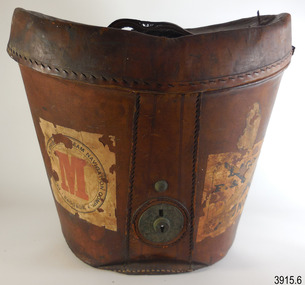
Functional object - Hat Box, John Brush, Son & Co, 1920s
... designer and maker, John Brush, Sons & Co. Brush began his saddlery trade in Roma, Queensland, His designing process included consulting with the men who rode and worked the horses. He was described in the Sydney Morning Herald of December 15, 1897, as a leading Sydney saddler, well known and reliable, with every kind of English and Australian saddle on view. ...designer and maker, John Brush, Sons & Co. Brush began his saddlery trade in Roma, Queensland, His designing process included consulting with the men who rode and worked the horses. He was described in the Sydney Morning Herald of December 15, 1897, as a leading Sydney saddler, well known and reliable, with every kind of English and Australian saddle on view. ...This sturdy, deep hat box has been carefully constructed to give the contents utmost protection in the roughest of travel conditions. At the same time, attention to detail and quality of materials makes the box an attractive, desirable and useful piece of luggage. The supports inside the hat box show that the hat’s brim dipped at the front and back in the popular 1920s Homburg or Derby style. The hat box was likely to have been purchased, complete with its fashionable hat and personalised with the initials ‘G.M.’. The five shipping labels on the hat box tell that the owner traveller overseas with it on more than one occasion. The owner had first travelled with the shipping line Peninsular & Orient Steam Navigation Company, and may have been one the first Australian passengers in 1932, as the remnant of label on the base reads Sydney. The owner later voyaged under the company’s new name of P & O. and travelled from at least one of the voyages from Melbourne to London The square label, with “P & O” and red printed “M” in centre of circle, refers to alphabetical organisation of baggage by surname, connecting the owner ‘G.M.’ to the owner’s voyage with P & O. The P & O shipping line’s early beginnings started with the partnership of London ship broker Brodie McGhie Willcox and Scottish sailor Arthur Anderson in 1822. The partnership was joined by Irish shipowner Captain Richard Bourne in 1835 and they began operation as the Peninsular & Orient Steam Navigation Company with a service between London- Spain - Portugal. In 1932 the company expanded to include Australia with its passenger services departing from Sydney; in 1840 the company was incorporated. After various take-overs of other shipping lines and businesses, it operated under the name P & O. JOHN BRUSH The hat box was made by Australian saddle designer and maker, John Brush, Sons & Co. Brush began his saddlery trade in Roma, Queensland, His designing process included consulting with the men who rode and worked the horses. He was described in the Sydney Morning Herald of December 15, 1897, as a leading Sydney saddler, well known and reliable, with every kind of English and Australian saddle on view. John Brush established his business in 1840, operating from 371 George Street Sydney. A catalogue from that era jointly advertises John Brush (371 George Sty Sydney) and Butlers & Brush (432-4 Queen Street Sydney), both under the name of Edward Butler & Co. Pty. Ltd. The catalogue included saddlery, harness equipment, riding wear and travel goods, and strongly promoted the Wienkek made saddles, which he distributed Australia wide. John Brush, So & co. advertised its ‘new’ address in 1887, as 403 George Street Sydney. In 1898 Brush made a side-saddle for a customer, a design popular with gentlewomen of the era. The business was still operating over 100 years later, producing a catalogue in the 1950s.This early 20th century hat box is significant for being one of a kind in our Collection. Its fitted design shows the shape of the hat, dating it from the 1920s men’s fashions. The hat box is significant for being a high quality hat box made in Sydney, Australia by prominent and successful early colonial saddler and leather goods business, John Brush, Son & Co. The labels on the outside of the hat box are also significant, representing the prosperous lifestyle of an Australian traveller who purchased quality goods and cared for them. The traveller was able to depart from firstly the Port of Sydney and later the Port of Melbourne. Hatbox, oval shape, brown leather, strong, sturdy construction, six pieces, and metal lock on base. Wide lid, then tapers to a narrower base that has a red leather trim. Brown velvet fabric lining inside and covers some accessories. Other internal accessories are trimmed with plain red paper and blue and white striped paper. The lid has two attached leather tabs and a leather handle and underneath it has a drawstring liner and oval, gold-lettered maker’s label. The internal oval box has a leather retention strap and brim support. Separate moulded brim support is included. A detached leather strap with catch is inside the base. Inscriptions are stamped on the lid, printed on the maker’s label, attached as printed paper labels to the lid, sides, and under the base. Maker is John Brush, Son & Co. of Sydney. The owner’s initials “G.M” are embossed on the lid.Stamped on lid “G. M.” Label, oval, inside lid “JOHN BRUSH, SON & CO. / MANUFACTURERS & IMPORTERS / of / SADDLERY AND HARNESS / 403, GEORGE ST. / SYDNEY” Label, paper: “BAGGAGE, MELBOURNE TO LONDON’, part of word ‘CABIN’ and “P & O” Label, square, white background, black print, circular emblem: ‘PE - - - - - & ORIEN-’, ‘STEAM NAVIATION COMPY.’ BAGGAGE’ and a red printed “M” in centre of circle. Label, rectangular, white background, black print; narrow line border, text in rows and an ‘X’ overprinted, from corner to corner of the border: “BAGGAGE / P. & O. S. N. Co. / MELBOURNE / To / LONDON” Label, paper, rectangular, white background, black print, an “X” across the label: “CABIN / P & O / “ Label, paper, on base, “– aid” [Paid], “SYDNEY” flagstaff hil, warrnambool, flagstaff hill maritime museum, maritime museum, shipwreck coast, flagstaff hill maritime village, great ocean road, hat box, leather hat box, vintage hat box, top hat, homburg hat, derby hat, travel ware, luggage, leather goods, travel goods, clothing accessory, men’s clothing, john brush, son & co, saddler, sydney firm, peninsular & orient steam navigation company, p & o, g.m., melbourne to london, sydney port, melbourne port, hat case -
 Greensborough Historical Society
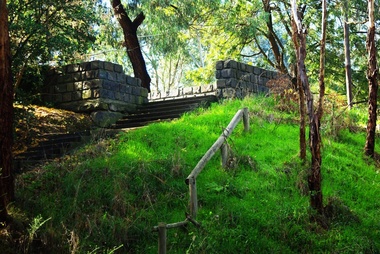
Photograph - Digital Image, Pioneer Reserve 2014 -1, 21/05/2014
... The shelter, viewing platform, retaining wall and entrance are built from the bridge's massive bluestone arched abutments dismantled between 1974 and 1983. Pioneer Reserve is historically significant for its formative association with noted local landscape designer Gordon Ford in 1968, and it is likely that remnant large field stones at the entrance drive to the Reserve remain from his design. ...The shelter, viewing platform, retaining wall and entrance are built from the bridge's massive bluestone arched abutments dismantled between 1974 and 1983. Pioneer Reserve is historically significant for its formative association with noted local landscape designer Gordon Ford in 1968, and it is likely that remnant large field stones at the entrance drive to the Reserve remain from his design. ...Pioneer Reserve, Greensborough is a small park on the corner of St Helena and Diamond Creek Roads. It is adjacent to the site of Greensborough's first bridge across the Plenty River, c. 1864 - 1960s. The shelter, viewing platform, retaining wall and entrance are built from the bridge's massive bluestone arched abutments dismantled between 1974 and 1983. Pioneer Reserve is historically significant for its formative association with noted local landscape designer Gordon Ford in 1968, and it is likely that remnant large field stones at the entrance drive to the Reserve remain from his design. Photograph by Marilyn Smith 2014.Digital copy of colour photograph. -
 Flagstaff Hill Maritime Museum and Village
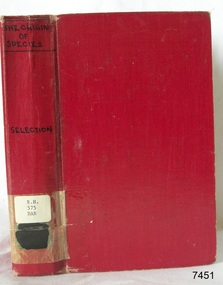
Book - Reference Book/Biology/Scientific, Charles Darwin, The Origin of Species or The Preservation of Favoured Races in the Struggle for Life, 1859
... designer. He lived quietly at Down House, continuing experiments until his death in 1882. Darwin's book on “The Origin of Species” is significant as it unified the theory of biology in providing a single, coherent explanation for the diversity of life on Earth, replacing the prevailing view of fixed, separately created species. ...The Origin of Species is Charles Darwin’s landmark 1859 book, and it introduced the idea that species change over time through natural selection. Darwin drew on observations from his voyage on the HMS Beagle, especially evidence from the Galapagos Islands, to argue that living things share common ancestry and adapt through inherited variation. Darwin’s central claim argues that individuals with traits better suited to their environment are more likely to survive and reproduce, so those traits become more common over generations. The book challenged the idea of special creation and became the foundation of modern evolutionary biology. The book is considered one of the most influential scientific works ever written because it provided a unifying explanation for the diversity of life. It also sparked major scientific and religious debate that continues to this day.The Origin of Species Author: Charles Darwin Publisher: John Murray Date: 1860non-fiction The Origin of Species is Charles Darwin’s landmark 1859 book, and it introduced the idea that species change over time through natural selection. Darwin drew on observations from his voyage on the HMS Beagle, especially evidence from the Galapagos Islands, to argue that living things share common ancestry and adapt through inherited variation. Darwin’s central claim argues that individuals with traits better suited to their environment are more likely to survive and reproduce, so those traits become more common over generations. The book challenged the idea of special creation and became the foundation of modern evolutionary biology. The book is considered one of the most influential scientific works ever written because it provided a unifying explanation for the diversity of life. It also sparked major scientific and religious debate that continues to this day. warrnambool, shipwrecked-coast, flagstaff-hill, flagstaff-hill-maritime-museum, maritime-museum, shipwreck-coast, shipwrecked-artefact, book, warrnambool mechanics’ institute, the origin of species, charles darwin, pattison collection -
![Article, Bridget Whitelaw, Australian landscape drawing 1830-1880, in the National Gallery of Victoria [Exerpts], 1976](/media/collectors/4f729f5697f83e03086015b8/items/60965c6d3c71fad916b399b7/item-media/60965d623c71fad916b39be8/item-fit-380x285.jpg?cb=6) Greensborough Historical Society
Greensborough Historical SocietyArticle, Bridget Whitelaw, Australian landscape drawing 1830-1880, in the National Gallery of Victoria [Exerpts], 1976
... Illustrations selected from book showing views of "The Station Plenty" (Yallambie), the Bakewell family home, illustrated by Edward La Trobe Bateman, an artist and garden designer....Illustrations selected from book showing views of "The Station Plenty" (Yallambie), the Bakewell family home, illustrated by Edward La Trobe Bateman, an artist and garden designer. yallambie bakewell family plenty station edward la trobe bateman Photocopy of illustrations from book, 6 pages. 2 copies. ...Illustrations selected from book showing views of "The Station Plenty" (Yallambie), the Bakewell family home, illustrated by Edward La Trobe Bateman, an artist and garden designer.Photocopy of illustrations from book, 6 pages. 2 copies.yallambie, bakewell family, plenty station, edward la trobe bateman -
 Eltham District Historical Society Inc
Audio - Audio Compact Cassette Tape, Audio Recording; 2003-09-10 Speaker Panel: Builders of the Eltham Tradition, 2003
... John will speak on the work of Alistair Knox designer and builder in mud brick and the person who has most contributed to the environmental building traditions of Eltham. • Peter Jarvis who will talk about his own work as a builder in mud brick and his views on traditional and modern construction methods. • Leigh Wykes, a present day builder of stone houses, will talk about his own work in the district and its relevance to Eltham traditions. • Diana Bassett-Smith will talk about her experience with owner-builders constructing their earth houses in Eltham in the 1950's. ...John will speak on the work of Alistair Knox designer and builder in mud brick and the person who has most contributed to the environmental building traditions of Eltham. • Peter Jarvis who will talk about his own work as a builder in mud brick and his views on traditional and modern construction methods. • Leigh Wykes, a present day builder of stone houses, will talk about his own work in the district and its relevance to Eltham traditions. • Diana Bassett-Smith will talk about her experience with owner-builders constructing their earth houses in Eltham in the 1950's. ...September Meeting (Newsletter No. 152, Sep. 2003) This meeting is one in an occasional series where we get together a panel of speakers to talk about a particular aspect of Eltham's history, its character or its people. As has been the case for past speaker panels, we have organised a buff et dinner to precede the meeting and details of this are given below. Eltham has a well-known tradition of building with mud brick, second hand materials and other innovative or uncommon materials. Although this trend dates mainly from the 1930 's there are examples from the pioneer days of Eltham. Part of the Brocksopp house at Eltham South is an 1850' s mud brick construction by George Souter. But the alternative building tradition in Eltham really began at Montsalvat in the 1930's. Justus Jorgensen's building complex of earth construction, stone and items from wreckers' yards inspired a number of builders and owner builders, particularly in adopting mud brick or adobe as their building medium. The tradition continues today with our area remaining home to a relatively high proportion of builders using these alternative materials. The panel we have selected to talk on this subject are either builders in the Eltham tradition or have had close contact with builders of the past. The panel will be introduced by Russell Yeoman who will talk briefly about George Stebbing, an early Eltham builder responsible for many of our remaining historic buildings, but known for traditional buildings of his time rather than the later buildings which give Eltham its particular character. The panel members are as follows:- • John Pizzey, architect. John will speak on the work of Alistair Knox designer and builder in mud brick and the person who has most contributed to the environmental building traditions of Eltham. • Peter Jarvis who will talk about his own work as a builder in mud brick and his views on traditional and modern construction methods. • Leigh Wykes, a present day builder of stone houses, will talk about his own work in the district and its relevance to Eltham traditions. • Diana Bassett-Smith will talk about her experience with owner-builders constructing their earth houses in Eltham in the 1950's. Pise and mud brick presented a cheap building material provided that you could do it yourself or persuade your friends to help. Prior to the meeting there will be a buffet dinner of casseroles and other courses prepared by some of our members. We will be starting at 6.00pm with dinner scheduled for 6.30. Harry Gilham will be providing drinks, including wines from his personally made collection. Cost of the dinner will be $10 which can be paid on the night. However, for catering purposes we need to know numbersCompact audio cassette Sony EF 90 Type I / IEC I Cassette labelled "Eltham Builders Historical" Converted to MP3 file; 100MB, 1:18:57 alistair knox, audio cassette, audio recording, building construction, diana bassett-smith, eltham, john pizzey, leigh wykes, peter jarvis, society meeting -
 Geoffrey Kaye Museum of Anaesthetic History
Equipment - Inhaler, Bruck, 1908
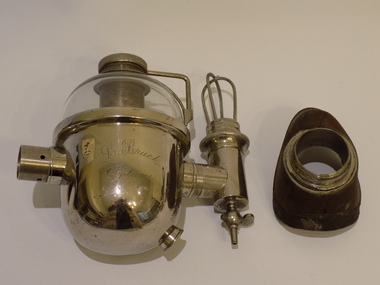
... viewing window was possibly inspired by Wilson-Smith Inhaler. The Bruck Inhaler is historically significant as it is the first inhaler to be made with a completely clear lower glass section. This improved the usability for the ether administrator, and eliminated much of the guesswork associated with dosage and ether levels, which in turn improved the patient experience. This piece provides a strong local link to both anaesthetic and general medical practice at the turn of the century. The design is credited to Ludwig Bruck of Sydney, and was presumably manufactured in the same area. Bruck, as the attributed designer ...The Bruck Inhaler is a modification of the Clover Inhaler, designed by Lambert Bruck. Bruck added a glass dome which enabled the level of ether to be monitored during administration. This was a revolutionary change as it removed guess work from the process.The Bruck Inhaler is a historically, aesthetically and scientifically significant piece. The basic design is based on the Clover Inhaler, but with a rounded bottom. The idea of a glass viewing window was possibly inspired by Wilson-Smith Inhaler. The Bruck Inhaler is historically significant as it is the first inhaler to be made with a completely clear lower glass section. This improved the usability for the ether administrator, and eliminated much of the guesswork associated with dosage and ether levels, which in turn improved the patient experience. This piece provides a strong local link to both anaesthetic and general medical practice at the turn of the century. The design is credited to Ludwig Bruck of Sydney, and was presumably manufactured in the same area. Bruck, as the attributed designer, holds much relevance to the significance of the object, as connected with him is much historical information about the social context of medical practice. Ludwig Bruck was a prominent figure in the medical industry. He started his medical career in Sydney as a Medical Transfer Agent, and later owned a shop at 16 Castlereagh Street, Sydney. This business is listed in the 1903 Register of Firms as a Medical Agent and Importer of Medical Instruments and Books. Bruck was vocal as a journalist and published analyses of medical statistics, as well as the well known Australasian Medical Dictionary and Handbook, which included the “List of Unregistered Medical Practitioners”. Ludwig Bruck was an immigrant. He was of German descent, which placed him in a precarious position within Sydney society during the turn of century. Bruck conducted several public conversations with prominent members of the Australian Natives Association through the Sunday News in regards to his disagreement of the employment of medical practitioners by the ANA specifically to corroborate their health insurance policies. He was also a stalwart supporter of the Australian arm of the British Medical Association, being the publisher of the first and subsequent editions of The Australian Medical Gazette. Bruck chose to end his life with a combination of poison and chloroform on 14 August 1915, after being accused of trading with the enemy during World War One. His suicide note stated his horror at leaving his business partner to deal with the tarring of his reputation as the reason for his decision. The Bruck Inhaler has aesthetic significance as it is a beautiful example of turn of the century surgical design and craftsmanship. Aseptic methods of surgery were well known by 1909, and the aesthetic design of the Bruck Inhaler conformed to these principles. The ability for the surgeon to unscrew, clean and sterilize each part of the Inhaler contributes to the streamlined design of the piece. The Buck Inhaler holds scientific significance. There is the capacity for further research to be undertaken on the object. Geoffrey Kaye often collected multiple examples of equipment, usually one for reverse engineering and another for teaching. There are currently two examples of the Bruck Inhaler in the collection, presenting an opportunity for further technical research on the object. The inhaler is oval shaped with one half made of glass to allow observation of the ether level. A vertical cross tube, 22mm in diameter passes between the face-piece and the bag [missing]. There is a stopcock for admission of oxygen or nitrous oxide opposite the bag attachment. There is a central tube, 28mm in diameter, with controllable ports on either side. There is also a tear-drop shaped fask mask.Hand engraved on side of base: L. Bruck / Sydneyclover, joseph, bruck, lambert, inhaler, rebreather, nitrous oxide, oxygen, williams, probyn -
 Bendigo Historical Society Inc.
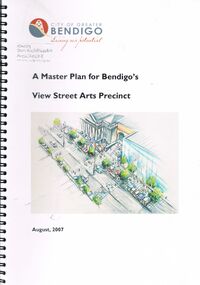
Book - CITY OF GREATER BENDIGO: MASTER PLAN FOR BENDIGO'S VIEW STREET ARTS PRECINCT AUGUST 2007, August 2007
... City of Greater Bendigo Document ''A Master Plan for Bendigo's View Street Arts Precinct. August 2007. Don Goldsworthy - Architect and Urban Designer, Positive Solutions Arts Facilities and Business Planning, Cardno Grogan Richards Engineering and Traffic Management. ...BENDIGO Planning view street arts precinct http://www.bendigotourism.com/things-to-do/bendigo-arts-culture/view-street-arts-precinct City of Greater Bendigo City of Greater Bendigo Document ''A Master Plan for Bendigo's View Street Arts Precinct. August 2007. Don Goldsworthy - Architect and Urban Designer, Positive Solutions Arts Facilities and Business Planning, Cardno Grogan Richards Engineering and Traffic Management. ...City of Greater Bendigo Document ''A Master Plan for Bendigo's View Street Arts Precinct. August 2007. Don Goldsworthy - Architect and Urban Designer, Positive Solutions Arts Facilities and Business Planning, Cardno Grogan Richards Engineering and Traffic Management. Booklet 47 Pages.City of Greater Bendigobendigo, planning, view street arts precinct, http://www.bendigotourism.com/things-to-do/bendigo-arts-culture/view-street-arts-precinct -
 Bendigo Historical Society Inc.
Document - ROYAL PRINCESS THEATRE COLLECTION:PHOTOCOPIES OF EXTERIOR AND INTERIOR
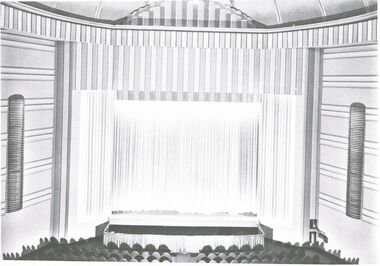
... Royal Princess Bendigo View Street closed Saturday 4th May 1963 last Movie 'Guns of Navarone' became amaco service station designers Cowper and Murphy State Library of Victoria, 6. ...Royal Princess Bendigo View Street closed Saturday 4th May 1963 last Movie 'Guns of Navarone' became amaco service station designers Cowper and Murphy State Library of Victoria, 6. ...Eighteen photocopy photographic images of Princess Theatre exterior and interior. 1. Royal Princess Bendigo main auditorium, 2. Royal Princess Bendigo Auditorium dome and chandelier, 3. Royal Princess Bendigo main auditorium views from upstairs circle, 4. Royal Princess Bendigo. Downstairs front stalls, 5. Royal Princess Bendigo View Street closed Saturday 4th May 1963 last Movie 'Guns of Navarone' became amaco service station designers Cowper and Murphy State Library of Victoria, 6. Royal Princess Bendigo Downstairs foyer, 7. Princess main entrance, 8. Princess circle entrance, 9. Princess Theatre was built behind the Albion Chambers, 10. Royal Princess Bendigo 1875 2000 seats 1800seats later, 11. Royal Princess front stalls and stage, 12.. Advertisement Bendigo Advertiser Tuesday December 22 1908 top right hand corner, 13. Advertisement Bendigo Advertiser Thursday march 10 1910, 14 Advertisement Bendigo Advertiser Tuesday July 26 1910, 15 Advertisement Bendigo Advertiser Thursday July 28 1910.bendigo, buildings, princess theatre -
 National Wool Museum
Book - Fabric Sample Book, Ernest Waddington, c.1930
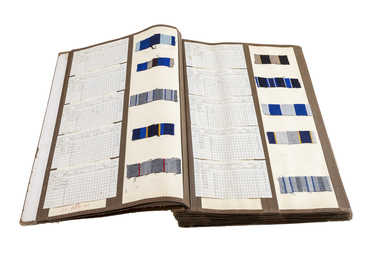
... designers to take inspiration from in future designs and for re-releases of iconic designs. This sample book is also notable because of its period of creation. It was created in the Great Depression. Despite societies psyche at this time, there is a surprising amount of colour and what may be viewed...designers to take inspiration from in future designs and for re-releases of iconic designs. This sample book is also notable because of its period of creation. It was created in the Great Depression. Despite societies psyche at this time, there is a surprising amount of colour and what may be viewed ...Fabric sample book produced by Ernest Waddington with specifications circa 1930. Such a book would work as a catalogue of a designer’s previous Mastercards. Mastercards are specification sheets that are sent to mills in order to produce commercial amounts of fabrics for tailoring into final products, such as suits. Keeping a catalogue of previous designs is useful for designers to take inspiration from in future designs and for re-releases of iconic designs. This sample book is also notable because of its period of creation. It was created in the Great Depression. Despite societies psyche at this time, there is a surprising amount of colour and what may be viewed as daring designs. Large, light brown book bound with string containing fabric samples and notes. Pages stitched at borders. Large cream paper label with "Patterns" written diagonally across, pasted on cover.E. Waddingtonweaving textile design textile mills textile mills, waddington, mr ernest, weaving, textile design, textile mills -
 Robin Boyd Foundation
Document - Script, Robin Boyd, University of the Air. Design in Australia 8. Conclusions, 1964
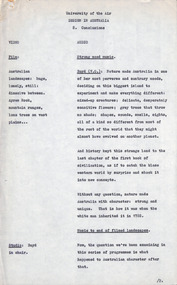
... In Boyd's view, Australia now produces world-class designers, but lacks a world-class design culture, leading the best professionals to leave for the US or UK. ...In Boyd's view, Australia now produces world-class designers, but lacks a world-class design culture, leading the best professionals to leave for the US or UK. ...Robin Boyd was involved in creating several TV series for the ABC University of the Air. 'Design in Australia' was an eight part series. (Items D184-D193 contain all the manuscripts except part six titled 'Communications'.) In part 8, Boyd concludes his lecture with an overview of the state of Australian design. Boyd points to the uniqueness of Australia's natural landscapes and asks a series of pointed questions, implying that Australian design does not reflect or match up to its context. In Boyd's view, Australia now produces world-class designers, but lacks a world-class design culture, leading the best professionals to leave for the US or UK. Boyd concludes by arguing that Australian design culture can be developed into something both connected to the rest of the world and still uniquely Australian.This is a draft script for the ABC television program 'University of the Air', subtitled 'Design in Australia', broadcast in 1965.Typewritten (c copy), foolscap, 12 pagesInscription in pencil on p.8 - "good ideas (Kings + fountain)"university of the air, design in australia, robin boyd, henry lawson, d.h. lawrence, kangaroo novel, canberra, manuscript -
 National Wool Museum
Film - Transfiguration, Max Bell, Streamline Media and Communications Group Pty Ltd, 2025
... designer Max Bell and his work 'Transfiguration'. Artist Statement: This collection, ‘Transfiguration’, originally stems from the way Brutalist architecture spaces, commonly cold and geometric, have been transformed with plants and organic matter to create an interesting dichotomy. Max translates this to his collection through viewing...designer Max Bell and his work 'Transfiguration'. Artist Statement: This collection, ‘Transfiguration’, originally stems from the way Brutalist architecture spaces, commonly cold and geometric, have been transformed with plants and organic matter to create an interesting dichotomy. Max translates this to his collection through viewing ...One of three We The Makers videos commissioned by the Programs and Education department at the National Wool Museum to assist in learning and engagement alongside the We The Makers Sustainable Fashion Prize 2025 exhibition at the National Wool Museum. The films feature artist interviews from three finalists from We the Makers, providing insights into their personal influences, the motivations behind their material choices and the impact of culture on artistic practice. This film features designer Max Bell and his work 'Transfiguration'. Artist Statement: This collection, ‘Transfiguration’, originally stems from the way Brutalist architecture spaces, commonly cold and geometric, have been transformed with plants and organic matter to create an interesting dichotomy. Max translates this to his collection through viewing it as a growing canvas with the collection beginning as geometric and technological based looks to then morphing into an ethereal and organic look with the garments being taken over by moss slowly growing on the collection. Max has depicted this moss through the rug making process of tufting, highlighting the differing greens and levels throughout through a mastery of these skills. These processes are then depicted onto silhouettes commonly within the gorpcore aesthetic further promoting the outdoor element of the collection. Max utilises a series of ripstop fabrics and technical style nylons commonly associated with the outdoors which is juxtaposed by the wool yarn of the tufting promoting themes of renewability and nature. This works represents his design aesthetic through common use of functional fabrics, a fascination with textures and use of uncommon fabrics to try and create an innovative design or to explore an untapped idea. Through this collection the sustainable practice arises from the use of dead stock fabrics and primary use of wool yarn a notoriously renewable material that leaves a positive impact.Three minute and eleven second digital video with audio. fashion, design, max bell, we the makers, sustainability, textiles -
 National Wool Museum
Film - Brinton's Carpets and Wooltara, Brintons Carpets, Geelong et al, c.2000
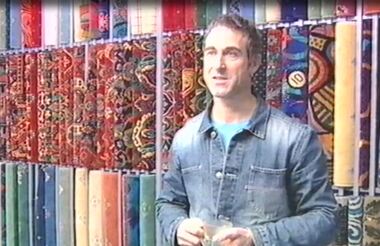
... Film includes colour footage and audio. 00:01 - titles 00:05 - Eric Steverink, Brinton's Design Manager, speaking with carpet rolls in background 00:17 - detail of carpet 01:06 - view of man working at a computer (designer) 01:15 - woman working at a comput (designer) 05:19 - titles 05:26 - Tim Gresham, Tapestry Artist, speaking 05:41 - Gresham working at loom weaving 05:53 - artwork detail 09:51 - titles 09:57 - Samantha Hall, Wooltara Director, speaking about Wooltara 10:37 - detail of quilts 11:53 - interior of factory scenes showing process of making wool quilts and bedding 14:24 - end...Film includes colour footage and audio. 00:01 - titles 00:05 - Eric Steverink, Brinton's Design Manager, speaking with carpet rolls in background 00:17 - detail of carpet 01:06 - view of man working at a computer (designer) 01:15 - woman working at a comput (designer) 05:19 - titles 05:26 - Tim Gresham, Tapestry Artist, speaking 05:41 - Gresham working at loom weaving 05:53 - artwork detail 09:51 - titles 09:57 - Samantha Hall, Wooltara Director, speaking about Wooltara 10:37 - detail of quilts 11:53 - interior of factory scenes showing process of making wool quilts and bedding 14:24 - end Film Brinton's Carpets and Wooltara Brintons Carpets, Geelong Wooltara Eric Steverink Tim Gresham Samantha Hall Hotshot Media ...Film depicts design process at Brinton's Carpets with artists and staff. Film also features Wooltara Director Samantha Hall and the process of making woollen quilts and bedding.Black VHS tape with white stickers and printed text. Tape is housed in a clear plastic case. Film includes colour footage and audio. 00:01 - titles 00:05 - Eric Steverink, Brinton's Design Manager, speaking with carpet rolls in background 00:17 - detail of carpet 01:06 - view of man working at a computer (designer) 01:15 - woman working at a comput (designer) 05:19 - titles 05:26 - Tim Gresham, Tapestry Artist, speaking 05:41 - Gresham working at loom weaving 05:53 - artwork detail 09:51 - titles 09:57 - Samantha Hall, Wooltara Director, speaking about Wooltara 10:37 - detail of quilts 11:53 - interior of factory scenes showing process of making wool quilts and bedding 14:24 - endLabel on tape: Wool Museum / Brinton's Carpet, Tim / Gresham & Wooltara / Hotshot Mediavictoria, film, carpet, brinton's, wooltara, eric steverink, design, artist, working life, factory, textile industry, tim gresham, samantha hall, quilts, bedding -
 National Wool Museum
Tool - Glasses, c.1950
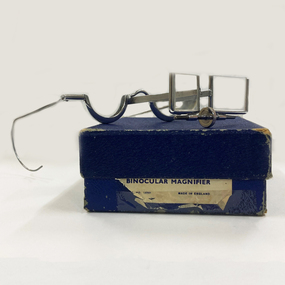
... designers used glasses such as these to see how many threads are within a textile sample. It was important to count correctly, otherwise the enlarged final pattern would be out of alignment. These glasses were popular in the 1950s but were replaced by viewing...designers used glasses such as these to see how many threads are within a textile sample. It was important to count correctly, otherwise the enlarged final pattern would be out of alignment. These glasses were popular in the 1950s but were replaced by viewing ...Nino Corda was a Geelong based textile designer who worked at various textile mills between 1957 & 2003. He travelled the world in search of the latest fashions and techniques and developed timeless designs that were much loved by Australians. These items are on rotational display at the National Wool Museum’s ‘In the Factory’ exhibition. For many years, Nino also worked as part of the Honorary Staff of the National Wool Museum. His passion for the world of textiles provided energy and knowledge to the visitors and staff of the museum. Although Nino has now retired from his honorary position and has hung up his Australian Tartan vest, these items will continue to serve the community in sharing the stories of Australian Textile design. Textile designers used glasses such as these to see how many threads are within a textile sample. It was important to count correctly, otherwise the enlarged final pattern would be out of alignment. These glasses were popular in the 1950s but were replaced by viewing lens, such as item 8040 (in the National Wool Museum's Collection) in the 1960s because of their compact nature.Thin metal wire makes up the frame of the glasses. The metal is a standard metallic silver. The piece to sit on-top of the ear is excessively curved to hook around the ear. This is done to ensure the glasses do not fall off the face while looking down to view thread counts in a textile sample. The glasses are lacking lenses in their usual place. This has been replaced by another thin wire frame which protrudes an extra inch in front of the frame, almost like an additional layer of the glasses. Where this layer / frame ends, two lenses can be found which are square and much smaller than typical glasses lenses. This has been done to allow for powerful magnifying glass which would be ill-suited if it sat too close to the face / eyes. The glasses are also accompanied by their original box. The box is blue and has a large rectangle running through its centre. This rectangle works as a cushion for the glasses and is required as a result of their unusual shape.textile design, textile calculations -
 National Wool Museum
Clothing - 1984 Los Angeles Olympics Men's Opening Ceremony Shirt, c. 1984
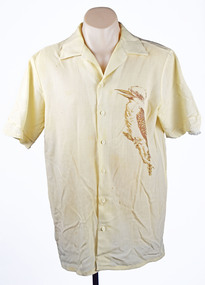
... designer who had been overlooked. However, with the contenders receiving an exacting brief the numbers of serious contenders greatly reduced. The Los Angeles Olympic Uniforms. A further reason for the AWC bid failure to design the LA uniform was that the AOC had already chosen Prue Acton to design it. This was based on her proven performance during previous games as she had a talent for creating good taste Australiana. Her design concepts also considered the effect when they were viewed...designer who had been overlooked. However, with the contenders receiving an exacting brief the numbers of serious contenders greatly reduced. The Los Angeles Olympic Uniforms. A further reason for the AWC bid failure to design the LA uniform was that the AOC had already chosen Prue Acton to design it. This was based on her proven performance during previous games as she had a talent for creating good taste Australiana. Her design concepts also considered the effect when they were viewed ...On the 1984 Los Angeles Olympic Uniforms donator Doug wrote- During the 1980s the Australian wool industry was at its most prosperous times with record numbers of sheep producing wool receiving ever increasing values due to the success of the Reserve Price Scheme, and the overall guidance of the Australian Wool Corporation (AWC). As a humble technician, my role was a low profile newly created position of “Controller, Technical Marketing” where wool was to be marketed on its technical properties, as distinct from the “Product Marketing Group” which exploited trhe traditional high profile approach of marketing wool;s superior fashion attributes. The Woolmark was the tool central to this approach. When the forthcoming Los Angeles Olympic Games was announced, the Product Marketing Group seized upon the chance to show the world that we could make top fashion garments and display them on our elite athletes on the world stage. A concept was launched using a contemporary top designer, Adel Weiss, with the most exclusive fabrics and knits available, and all with a lot of hype. This launch failed dismally for the following reasons- - The designer did a wonderful job presenting an excellent fashion range on perfect skinny models. The AOC however wanted a uniform which had an obvious Australian appearance when fitted to elite, and frequently muscular, athletes. - The fabrics chosen did not reflect the performance required by travelling athletes, there was no recognition of the need for ‘easy care.’ - There was no recognition given to the problem of measuring, manufacturing and distribution of a range of articles when the selected athlete could be domiciled anywhere in Australia. - There was no appreciation of such historical facts as Fletcher Jones, who had been unofficial suppliers dating back to the 1954 Olympics in Melbourne, and the Fletcher Jones board member, who was also an AWC board member, and was not in favour of the change. The project passed from Product Marketing to Public Relations, a big spending off-shoot of the AWC Chairman David Asimus, and due to the day to day operations of the project was passed to me and PR took care of the financial matters. The first task was to meet with the AOC and find out exactly their requirements. This lead to the production of a design and manufacturing brief, cointaining exact time lines for each event required to ensure an appropriate uniform on every athlete chosen to represent his/her country on the date given for the Opening Ceremony in Los Angeles. Working backwards the timeline becomes- 1. Noted the exact date of the Opening Ceremony. 2. Estimated the date for distributing completed garments to each athlete. 3. Estimated the time span available for measuring each athlete and commence making each component of the ensemble to the individual measurements of each athlete. 4. Decided the date for making the final choice of uniform design concept. 5. Decided the date for distribution of the design brief to selected designers. These five steps were spread out over a two year period. The Commonwealth Games occur midway between each Olympic Games, work on the Olympic uniform commences the week after the Commonwealth Games closing ceremony and MUST be ready by the prescribed day two years hence. The project also had to remain cognisant of trade politics existing within the span of the task, as well as the temperament of designers in general. It is no overstatement to say that in the past every designer in Australia believed they could, and should, be chosen to design the Australian Uniform. The final choice of designer almost always faced criticism from the fashion press and any designer who had been overlooked. However, with the contenders receiving an exacting brief the numbers of serious contenders greatly reduced. The Los Angeles Olympic Uniforms. A further reason for the AWC bid failure to design the LA uniform was that the AOC had already chosen Prue Acton to design it. This was based on her proven performance during previous games as she had a talent for creating good taste Australiana. Her design concepts also considered the effect when they were viewed on a single athlete as well as the impact when viewed on a 400 strong team coming on to the arena. A blazer trouser/skirt uniform in bright gold was chosen for the formal uniform. It was my task to select a pure wool faille fabric from Foster Valley weaving mill and have sufficient woven and ready within the prescribed timeline. The trouser/skirt fabric selected was a 60/40 wool polyester plain weave fabric from Macquarie Worsted. This fabric had a small effect thread of linen that was most attractive when dyed to match some eucalyptus bark Prue had brought back from central Australia. For the Opening Ceremony uniform, Prue designed a series of native fauna, a kookaburra for the men’s shirt and a pleated skirt with a rural scene of kangaroos, hills and plants. This presented an insurmountable printing challenge to the local printing industry as it had an unacceptably large repeat size and the number required (50) was also commercially unacceptable. The solution was a DIY mock up at RMIT and the employment of four student designers. The fabric selected for this garment was a light weight 19 micron, pure wool with a very high twist yarn in alternating S and Z twist, warp and weft. This fabric proved to be the solution to a very difficult problem, finding a wool product which is universally acceptable when worn next to the sin by young athletes competing in the heat of a Los Angeles summer. Modifications to this fabric were developed to exploit its success when facing the same problem in future games. Garment Making- The most exacting garment in the ensemble is the tailored blazer, plus the related trouser/skirt. Unfortunately tailoring athletes that come in various shapes and sizes such as; - Weight lifters develop an enormous chest, arms and neck size. A shirt made to a neck size of 52 would produce a shirt with cuffs extending well beyond the wearer’s hands. - Basketball players are up to 7 feet tall and garments relying ona chest measurement grading would produce a shirt with cuffs extending only to elbow length. - Swimmers develop enormous shoulders and slim hips, cyclists by contrast develop thighs I liken to tree trunks and a uniform featuring tight trousers must be avoided at all cost. Suffice to say many ensembles require specialist ‘one off’ treatment for many athletes. Meanwhile there is a comfortable in between group who can accept regular sizes so you can cater for these by having back up stock with plenty of built in contingencies. Athletes may be domiciled anywhere in Australia, this creates a fundamental problem of taking their measurements. The Fletcher Jones organisation was key to answering this problem due to their presence in every capital city, as well as many provincial towns around Australia. Each athlete on being selected for the Olympic Team was simultaneously requested to visit their nearest Fletcher Jones shop. The standardised measurement data collected was shared with the other manufacturers, e.g. Pelaco Shirts, Holeproof Socks and Knitwear, Maddison Belts, and even Hush Puppy Shoes. As the time for the Games approached the AOC made arrangements for combining meeting of all. Selected available athletes at the Australian Institute of Sport, Canberra, where, among other things, they were fitted and supplied with their uniform. The method evolved as follows.Men’s cream coloured button up, collared shirt. Images of a kookaburra have been printed onto the shirt, a single kookaburra on the left breast and a pair of kookaburras on the reverse of the shirt. The kookaburras are printed in a brown tone to complement the cream colour of the fabric.On tag - FMaustralian wool corporation, 1984 los angeles olympics, olympic uniforms, men's uniforms, sport, athletes -
 St Kilda Historical Society
Photograph - St Kilda foreshore, Brookes Beach, St Kilda, c1980s
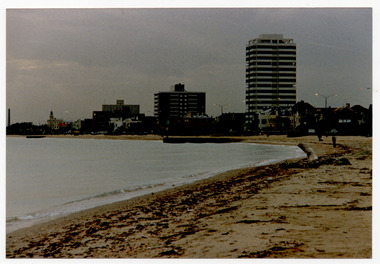
... viewed from the south and looking towards St Kilda. The tall white building is Edgewater Towers, 12 Marine Parade. Built in 1961, it was Melbourne's first high-rise residential apartment block and introduced a new concept of luxury 'own your own' apartment living that encouraged the building of similar apartment blocks. It is said to have secured the reputation of architect Mordechai Benshemesh as a leading designer...viewed from the south and looking towards St Kilda. The tall white building is Edgewater Towers, 12 Marine Parade. Built in 1961, it was Melbourne's first high-rise residential apartment block and introduced a new concept of luxury 'own your own' apartment living that encouraged the building of similar apartment blocks. It is said to have secured the reputation of architect Mordechai Benshemesh as a leading designer ...Photograph of Brookes Beach, St Kilda, viewed from the south and looking towards St Kilda. The tall white building is Edgewater Towers, 12 Marine Parade. Built in 1961, it was Melbourne's first high-rise residential apartment block and introduced a new concept of luxury 'own your own' apartment living that encouraged the building of similar apartment blocks. It is said to have secured the reputation of architect Mordechai Benshemesh as a leading designer of high-density residential developments in Melbourne. Colour photograph, unmounteddavid rae collection, st kilda, edgewater towers -
 Brighton Historical Society
Dress, Evening dress, early 1960s
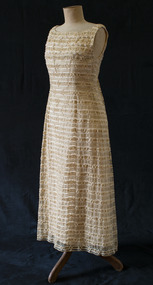
... The collection, which includes clothing, hats, handbags and shoes from local and international designers, is representative of Di's wide-ranging interests, colourful personality, creativity, humour and love of fashion and travel. Di purchased this dress as a vintage item. Brian Samuel, son of Hartnell owner Ralph Samuel, viewed...The collection, which includes clothing, hats, handbags and shoes from local and international designers, is representative of Di's wide-ranging interests, colourful personality, creativity, humour and love of fashion and travel. Di purchased this dress as a vintage item. Brian Samuel, son of Hartnell owner Ralph Samuel, viewed ...This item is part of the Di Reidie collection. Diane Reidie was a much loved volunteer and President of Brighton Historical Society from 1999 until 2016. Originally from New Zealand, Di and her family lived in Male Street, Brighton for many years. A vibrant and energetic person with a zest for life and a gift for bringing people together, Di was a friend to many in the Bayside community and active in local community organisations. Her tireless work as President of BHS saw her named Bayside Citizen of the Year in 2008. As a seller and collector of vintage clothing, she was passionate about fashion history; one of her many enduring contributions to BHS was her extensive work in preserving, developing and promoting the Society's costume collection. In 2018-19, Di donated more than one hundred items from her personal vintage clothing collection to the Society. The collection, which includes clothing, hats, handbags and shoes from local and international designers, is representative of Di's wide-ranging interests, colourful personality, creativity, humour and love of fashion and travel. Di purchased this dress as a vintage item. Brian Samuel, son of Hartnell owner Ralph Samuel, viewed this dress at BHS in 2019 and suggested that it may potentially have originally belonged to his mother Shirley Samuel (nee Slonim, 1922-2006).Sleeveless gold lurex evening dress. Zip at back, partially covered by three small cream bows.Label, pale blue on cream "Exclusively Yours / Hartnell / REGD / MELBOURNE"di reidie, vintage clothing, melbourne designers, hartnell of melbourne, ralph samuel, shirley samuel -
Moorabbin Air Museum
Book - ARCHITECT OF WINGS A Biography of Roy Chadwick - Designer of the Lancaster Bomber, Harald Penrose, 1985
... ARCHITECT OF WINGS A Biography of Roy Chadwick - Designer of the Lancaster Bomber ARCHITECT OF WINGS A Biography of Roy Chadwick - Designer of the Lancaster Bomber Cover jacket showing b&w photo of two Lancaster Bombers inflight, photo superimposed on light purple cover with section view of bi=plane, with red lettered book title at top ARCHITECT OF WINGS A Biography of Roy Chadwick - Designer of the Lancaster Bomber Book ARCHITECT OF WINGS A Biography of Roy Chadwick - Designer of the Lancaster Bomber Harald Penrose ...ARCHITECT OF WINGS A Biography of Roy Chadwick - Designer of the Lancaster BomberCover jacket showing b&w photo of two Lancaster Bombers inflight, photo superimposed on light purple cover with section view of bi=plane, with red lettered book title at topnon-fictionARCHITECT OF WINGS A Biography of Roy Chadwick - Designer of the Lancaster Bomber -
 Kew Historical Society Inc
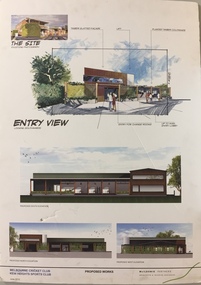
Plan - Architectural Sketch, MCC Kew Sports Club Proposed Works Entry View, 2012
... The collection illuminates two of the Victorian historic themes - 'Building community life' through forming community organisations and 'Shaping cultural and creative life' by participating in sport and recreation. mcc kew sports club - barkers road - kew (vic) mcildowie partners -- architects architectural sketches Architectural sketches on corflute of proposed designs for the new MCC Kew Sports Club by McIldowie Partners (Architects & Interior Designers), 2012. MCC Kew Sports Club Proposed Works Entry View Plan Architectural Sketch McIldowie Partners ...Sports Clubs in Kew in the final decades of the 19th century and in the early 20th century were often umbrella organisations with facilities for a number of sports. Typically in Kew, this included teams in lawn bowls, tennis and croquet. The Kew Bowling Club was formed in 1880 while the privately owned Auburn Heights Recreation Club was opened in 1904. By 1998, the two Clubs decided to amalgamate at the Auburn Heights site in Barkers Road, forming the Kew Heights Sports Club. The combined club was itself taken over by the Melbourne Cricket Club in 2012 becoming MCC Kew Sports Club. In 2017 MCC Kew closed and its landholding was subsequently sold to Carey Baptist Grammar School. Both the Kew and Auburn Heights Clubs assembled important collections. These historically significant and large collections were donated to the Society in 2020. The collections include manuscripts, pictures, trophies, plans, honour boards etc. The combined collections of the four sporting clubs making up the collection number hundreds of items that are historically significant locally. They are also significant to the sporting history of the greater Melbourne area and to the sports of lawn bowls and tennis in Australia in the 19th and 20th centuries. The collection illuminates two of the Victorian historic themes - 'Building community life' through forming community organisations and 'Shaping cultural and creative life' by participating in sport and recreation.Architectural sketches on corflute of proposed designs for the new MCC Kew Sports Club by McIldowie Partners (Architects & Interior Designers), 2012. mcc kew sports club - barkers road - kew (vic), mcildowie partners -- architects, architectural sketches -
 Kew Historical Society Inc
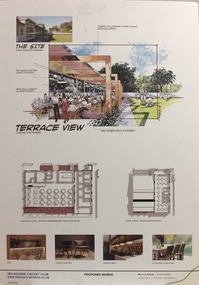
Plan - Architectural Sketch, MCC Kew Sports Club Proposed Works Terrace View, 2012
... The collection illuminates two of the Victorian historic themes - 'Building community life' through forming community organisations and 'Shaping cultural and creative life' by participating in sport and recreation. mcc kew sports club - barkers road - kew (vic) mcildowie partners -- architects architectural sketches Architectural sketches on corflute of proposed designs for the new MCC Kew Sports Club by McIldowie Partners (Architects & Interior Designers), 2012. MCC Kew Sports Club Proposed Works Terrace View Plan Architectural Sketch McIldowie Partners ...Sports Clubs in Kew in the final decades of the 19th century and in the early 20th century were often umbrella organisations with facilities for a number of sports. Typically in Kew, this included teams in lawn bowls, tennis and croquet. The Kew Bowling Club was formed in 1880 while the privately owned Auburn Heights Recreation Club was opened in 1904. By 1998, the two Clubs decided to amalgamate at the Auburn Heights site in Barkers Road, forming the Kew Heights Sports Club. The combined club was itself taken over by the Melbourne Cricket Club in 2012 becoming MCC Kew Sports Club. In 2017 MCC Kew closed and its landholding was subsequently sold to Carey Baptist Grammar School. Both the Kew and Auburn Heights Clubs assembled important collections. These historically significant and large collections were donated to the Society in 2020. The collections include manuscripts, pictures, trophies, plans, honour boards etc. The combined collections of the four sporting clubs making up the collection number hundreds of items that are historically significant locally. They are also significant to the sporting history of the greater Melbourne area and to the sports of lawn bowls and tennis in Australia in the 19th and 20th centuries. The collection illuminates two of the Victorian historic themes - 'Building community life' through forming community organisations and 'Shaping cultural and creative life' by participating in sport and recreation.Architectural sketches on corflute of proposed designs for the new MCC Kew Sports Club by McIldowie Partners (Architects & Interior Designers), 2012.mcc kew sports club - barkers road - kew (vic), mcildowie partners -- architects, architectural sketches -
 Kew Historical Society Inc
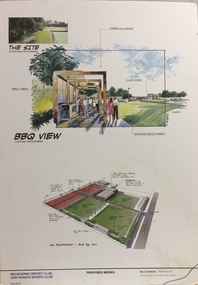
Plan - Architectural Sketch, MCC Kew Sports Club Proposed Works BBQ View, 2012
... The collection illuminates two of the Victorian historic themes - 'Building community life' through forming community organisations and 'Shaping cultural and creative life' by participating in sport and recreation. mcc kew sports club - barkers road - kew (vic) mcildowie partners -- architects architectural sketches Architectural sketches on corflute of proposed designs for the new MCC Kew Sports Club by McIldowie Partners (Architects & Interior Designers), 2012. MCC Kew Sports Club Proposed Works BBQ View Plan Architectural Sketch McIldowie Partners ...Sports Clubs in Kew in the final decades of the 19th century and in the early 20th century were often umbrella organisations with facilities for a number of sports. Typically in Kew, this included teams in lawn bowls, tennis and croquet. The Kew Bowling Club was formed in 1880 while the privately owned Auburn Heights Recreation Club was opened in 1904. By 1998, the two Clubs decided to amalgamate at the Auburn Heights site in Barkers Road, forming the Kew Heights Sports Club. The combined club was itself taken over by the Melbourne Cricket Club in 2012 becoming MCC Kew Sports Club. In 2017 MCC Kew closed and its landholding was subsequently sold to Carey Baptist Grammar School. Both the Kew and Auburn Heights Clubs assembled important collections. These historically significant and large collections were donated to the Society in 2020. The collections include manuscripts, pictures, trophies, plans, honour boards etc. The combined collections of the four sporting clubs making up the collection number hundreds of items that are historically significant locally. They are also significant to the sporting history of the greater Melbourne area and to the sports of lawn bowls and tennis in Australia in the 19th and 20th centuries. The collection illuminates two of the Victorian historic themes - 'Building community life' through forming community organisations and 'Shaping cultural and creative life' by participating in sport and recreation.Architectural sketches on corflute of proposed designs for the new MCC Kew Sports Club by McIldowie Partners (Architects & Interior Designers), 2012.mcc kew sports club - barkers road - kew (vic), mcildowie partners -- architects, architectural sketches -
 Kew Historical Society Inc
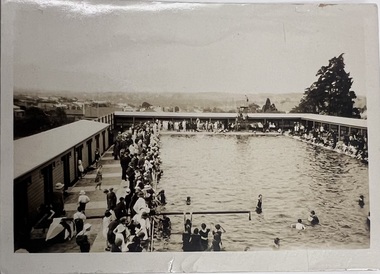
Photograph - Opening of the Kew Baths, 1925
... designer of the Kew Baths (later Kew Swimming Pool). The photograph, one of five (three of which were taken at the opening ceremony) was donated to the collection by John Maughan's daughter in 2026. The Kew Baths was a major infrastructure project during the 1920s by a suburban council. The photographs of the opening are the earliest documentary evidence of the original format of the Baths in the Collection. Kew Baths Kew Swimming Pool City Engineer -- Kew (Vic) Official openings - Kew (Vic) John Maughan Nil Bird's eye view ...Small sepia photograph, originally belonging to John Maughan, City of Kew Engineer from c.1934-1965, and in this role the designer of the Kew Baths (later Kew Swimming Pool). The photograph, one of five (three of which were taken at the opening ceremony) was donated to the collection by John Maughan's daughter in 2026.The Kew Baths was a major infrastructure project during the 1920s by a suburban council. The photographs of the opening are the earliest documentary evidence of the original format of the Baths in the Collection.Bird's eye view of the opening of the Kew Baths in 1925. The small sepia photograph shows the original buildings on the east, north and west of the Baths. The Baths were entered from High Street. The original diving board is in the foreground of the photograph. Children can be seen swimming in the pool for the first time. Previously public bathing took place in locations on the Yarra.Nilkew baths, kew swimming pool, city engineer -- kew (vic), official openings - kew (vic), john maughan -
 Kew Historical Society Inc
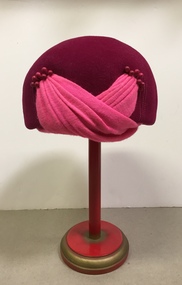
Headwear - Wool Felt & Jersey Hat, Ann Austin of Melbourne, 1960s
... designer/milliner. Very little information about the millinery house and the milliner are available online but there is an interesting article, published in the Brisbane Courier Mail on 8 October 1949 which describes the influence of French style on fashion and design in Australia. The article by Lucy Gough recounts the views...designer/milliner. Very little information about the millinery house and the milliner are available online but there is an interesting article, published in the Brisbane Courier Mail on 8 October 1949 which describes the influence of French style on fashion and design in Australia. The article by Lucy Gough recounts the views ...Ann Austin of Melbourne was the name of a Melbourne millinery house. Thelma Prentice was one of the partners in the house, and the chief designer/milliner. Very little information about the millinery house and the milliner are available online but there is an interesting article, published in the Brisbane Courier Mail on 8 October 1949 which describes the influence of French style on fashion and design in Australia. The article by Lucy Gough recounts the views of Thelma Prentice who had just returned from the Paris fashion shows. "Australian millinery toes line with Paris From LUCY GOUGH LONDON, October 7 (Special) Australian hats can compare very favourably with those designed in Paris, and are considerably cheaper, says Miss Thelma Prentice, partner in a well-known Melbourne millinery firm, who has just completed six months' visit to England and the Continent. An ordinary hat, Miss Prentice said, would cost at least £15 from any of the top Paris houses. Australia could achieve the same effect for a lot less money. Miss Prentice went to all the Important dress shows as well as the millinery houses in Paris, because she believes that millinery is an accessory to fashion and to obtain the best idea of new trends hats must be shown with frocks to get a complete follow-through and tie-up between the two. At their packed shows, with standing room only, Path and Dior were selling hats they designed, faster than many well known Paris millinery houses, Fath's favourite line was the becoming 'wing treatment,' which he achieved by a profile flattering side swing of material jutting out almost 10 inches from the face. This was completely different to the side drape already seen in Australia. Dior, as a direct contrast, was specialising in skull hats, which almost followed the hair line, to show very little hair at the back of the head. His cocktail hats were heavily sequinned and beaded. Every model was designed exclusively for short hair, and Miss Prentice, whose own hair is beautifully short cut by a Paris hairdresser, said that French mannequins' hair was so abbreviated at the back it was almost a semi-shingle. Hats generally she found were plain, with sharply angled self trimming, and black one of the most popular colours." The hat was donated by Kathleen Gervasoni, a resident of Kew, and during the 1970s a Mayoress of the former City of Kew. The Kew Historical Society’s fashion and design collection is comprised of costumes, hats, shoes and personal accessories. Many of these items were purchased or handmade in Victoria; some locally in Kew. The extensive hat collection comprises items dating from the 1860s to the 1970s. While most of the hats in the collection were created by milliners for women, there are a number of early and important men’s hats in the collection. The headwear collection is particularly significant in that it includes the work of notable Australian and international milliners.High crowned hat made of burgundy felt with decorative pink jersey turban folds attached to the side by clusters of pink beads. The hat was designed by Thelma Prentice of the ' Austin of Melbourne' millinery house. Label, inside centre crown, woven in black on white polyester: *ann austin / OF MELBOURNEmilliners, hats, ann austin of melbourne, thelma prentice, australian fashion - 1960s, kathleen gervasoni -
 Kew Historical Society Inc
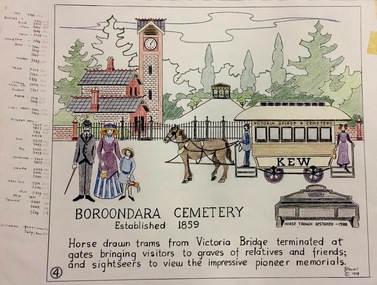
Work on paper, Joy Stewart, 4. Boroondara Cemetery, established 1859, 1988
... designer/painter, gallery assistant, and art teacher. Joy relocated to Cairns in 1981. Solo exhibitions in Melbourne and Cairns, including 'Done By Me' at Cairns Regional Gallery in 1999. Group exhibitions at Cairns Regional Gallery, 'The Fish John West Regrets, 1993' and 'Facets of Life' 1994. Joy Stewart died in Cairns in 2018. bicentennial project (kew) boroondara general (kew) cemetery Inscription: "BOROONDARA CEMETERY, Established 1859. Horse drawn trams from Victoria Bridge terminated at gates bringing visitors to graves of relatives and friends; and sightseers to view ...Kew Tapestry The eight panels depict the history of Kew. This was a 1988 Australian Bi-Centennial Project carried out under the auspices of City of Kew Council and the Kew Historical Society Incorporated. Nearly 600 citizens including many children participated in the production by adding a few or more stitches. A book records their names and the panels upon which they worked. Artist: Joy Stewart Co-ordinator: Dorothy BenyeiSydney Joy (Joy) Stewart was born in Melbourne 1925. She studied at Swinburne Technical College Art School from 1941-1945, then the National Gallery Art School 1946-1948. Her career included employment positions as a display artist, designer/painter, gallery assistant, and art teacher. Joy relocated to Cairns in 1981. Solo exhibitions in Melbourne and Cairns, including 'Done By Me' at Cairns Regional Gallery in 1999. Group exhibitions at Cairns Regional Gallery, 'The Fish John West Regrets, 1993' and 'Facets of Life' 1994. Joy Stewart died in Cairns in 2018.4. Boroondara Cemetery, established 1859. A Handcoloured cartoon created by the artist Joy Stewart as a template for the fourth of a series of embroidered panels depicting the history of Kew. Wool colour codes at left. Inscription: "BOROONDARA CEMETERY, Established 1859. Horse drawn trams from Victoria Bridge terminated at gates bringing visitors to graves of relatives and friends; and sightseers to view the impressive pioneer memorials". Signed by the artist "(c) JStewart, 1988". bicentennial project (kew), boroondara general (kew) cemetery -
 Kew Historical Society Inc
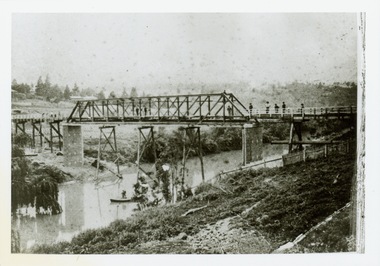
Print - Walmer Street Foot Bridge, 1901
... Won for designer Martin Aylard a New Zealand award presented by the timber Research & Development Assoc / Site of Simpsons Road passenger foot ferry". Photographic print of the Walmer Street Bridge. The view ...Photographic print of the Walmer Street Bridge. The view of the Bridge is from the Abbotsford side of the Yarra. A section of pipe on the near side of the bridge is a remnant of the irrigation pipes that carried water from above Dight's falls to the Melbourne Botanic Gardens. The former bridge, constructed in 1896 was swept away in the 1901 Flood. It has two major brick piers while the remainder of the trestle supports are metal. The original photograph from which this copy was made was taken after 1901 as it shows the second bridge under construction. Houses in Young Street, Kew, can be seen on the far side of the river.Reverse: " Walmer St footbridge 1901 being repaired after flood / Constructed 1892 substantially renewed in 1901 and in 1928 / Rebuilt in 1977 by Kew Council aided by State funding. Won for designer Martin Aylard a New Zealand award presented by the timber Research & Development Assoc / Site of Simpsons Road passenger foot ferry". bridges - yarra river -- kew (vic.), walmer street bridge -- kew (vic.) -
Kew Historical Society Inc
Journal, The Kewriosity Sheet Vol.4 No.12 : August 1983
... Unique cards: feature views of Kew (Gregary Chase designer) / p3. Look out for funding! ...R.A.A.V. Action Program 1983 (Rheumatism and Arthritis Association of Victoria) / p1. Kew Library / p1. Council Immunisations (Rubella) / p1. Save the Children Fund / p1. Scrabble / p1. Can you spare some time for your neighbours? (Volunteering; Meals on Wheels) / p1. Meet the editor of "Gardening News" / p1. Correction (Recycling) / p2. Community Centre??? (Kew Swimming Pool; Kew Depot; North Ward Action Group) / p2. Kew Rotaract / p2. Uniting Church East Kew (calendar of events) / p2. S.C.F. fundraising morning (Save the Children Fund) / p2. Kew Recreation Program: Term III - 1983 [short courses] / p2. Kew in that other Depression (Great Depression; 1930s) / Barbara Giles p3. Kew Philharmonic Society / p3. Kew Historical Society / p3. Unique cards: feature views of Kew (Gregary Chase designer) / p3. Look out for funding! (Family and Community Services Program; F.A.C.S.) / p4. "An Asian experience" (The Asian Evangelical Fellowship) / p4. Parkinson's Disease Association / p4. Hyde Park Fellowship (Hyde Park Uniting Church) / p4. Kew drop-In Centre - holiday program (Sacred Heart Church) / p4. Back by popular demand (Kew Garden Club) / p4. Native planet Group / p4. Daytime Garden Club / p4. Camberwell Film Society / p4. Women's Discussion Group / p4.The Kewriosity Sheet (1979-83) was first published in the City of Kew (Victoria) in June 1979 as a two-sided 'community newssheet'. It aimed to: 'share news about Kew happenings and Kew people, and to exchange ideas about living in Kew'. Later issues gradually evolved into a 4-page, quarto sized publication. The Kewriosity Sheet was superseded by the Kew Council publication 'Kewriosity' (1983-1994).non-fiction R.A.A.V. Action Program 1983 (Rheumatism and Arthritis Association of Victoria) / p1. Kew Library / p1. Council Immunisations (Rubella) / p1. Save the Children Fund / p1. Scrabble / p1. Can you spare some time for your neighbours? (Volunteering; Meals on Wheels) / p1. Meet the editor of "Gardening News" / p1. Correction (Recycling) / p2. Community Centre??? (Kew Swimming Pool; Kew Depot; North Ward Action Group) / p2. Kew Rotaract / p2. Uniting Church East Kew (calendar of events) / p2. S.C.F. fundraising morning (Save the Children Fund) / p2. Kew Recreation Program: Term III - 1983 [short courses] / p2. Kew in that other Depression (Great Depression; 1930s) / Barbara Giles p3. Kew Philharmonic Society / p3. Kew Historical Society / p3. Unique cards: feature views of Kew (Gregary Chase designer) / p3. Look out for funding! (Family and Community Services Program; F.A.C.S.) / p4. "An Asian experience" (The Asian Evangelical Fellowship) / p4. Parkinson's Disease Association / p4. Hyde Park Fellowship (Hyde Park Uniting Church) / p4. Kew drop-In Centre - holiday program (Sacred Heart Church) / p4. Back by popular demand (Kew Garden Club) / p4. Native planet Group / p4. Daytime Garden Club / p4. Camberwell Film Society / p4. Women's Discussion Group / p4. community publications --- kew (vic.), the kewriosity sheet, newsletters - kew (vic.) -
 Returned Nurses RSL Sub-branch
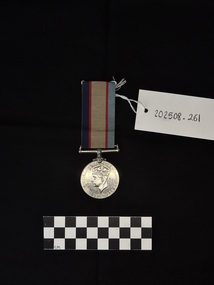
Medal - The Australia Service Medal 1939-1945
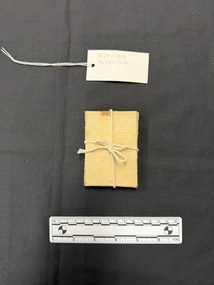
... views of the Australia Service Medal, made from cool-to-the-touch nickel-silver. The obverse features a central, textured design of the Australian coat of arms, with the inscription 'THE AUSTRALIA SERVICE MEDAL/1939-1945' and engravings along the rim reading 'VFX53656/J.G. GIBSON.' The reverse displays a central, textured design of the crowned effigy of King George VI, facing left, with the initials 'PM' [for designer...views of the Australia Service Medal, made from cool-to-the-touch nickel-silver. The obverse features a central, textured design of the Australian coat of arms, with the inscription 'THE AUSTRALIA SERVICE MEDAL/1939-1945' and engravings along the rim reading 'VFX53656/J.G. GIBSON.' The reverse displays a central, textured design of the crowned effigy of King George VI, facing left, with the initials 'PM' [for designer ...Medal belonged to Joan Grace Gibson (Mitchell) Service numbers: VFX53656 VX53656 VX38752. The Australia Service Medal 1939-1945 was instituted in 1949 to recognise the service of members of the Australian Armed Forces and the Australian Mercantile Marine during World War II.The medal is of high significance and should be kept in the collection.Medal belonged to Joan Grace Gibson (Mitchell) Service numbers: VFX53656 VX53656 VX38752. Both the obverse and reverse views of the Australia Service Medal, made from cool-to-the-touch nickel-silver. The obverse features a central, textured design of the Australian coat of arms, with the inscription 'THE AUSTRALIA SERVICE MEDAL/1939-1945' and engravings along the rim reading 'VFX53656/J.G. GIBSON.' The reverse displays a central, textured design of the crowned effigy of King George VI, facing left, with the initials 'PM' [for designer Percy Metcalfe] beneath the truncated neck of the effigy. Surrounding the perimeter is the legend 'GEORGIVS VI D:G:BR:OMN:REX ET INDIAE IMP:', [Latin meaning: 'George VI, by the Grace of God, King of all the Britains and Emperor of India.] The ribbon- Dark blue (representing the Royal Australian Navy), khaki (representing the Army), light blue (representing the R.A.A.F) and red (representing the Mercantile Marine). 'VFX53656 / J.G. GIBSON' [Engraved on the rim]world war 2, world war ii, world war two, wwii, ww2, joan grace gibson -
 Returned Nurses RSL Sub-branch
Medal - The Australia Service Medal 1939-1945
... views of the Australia Service Medal, made from cool-to-the-touch nickel-silver. The obverse features a central, textured design of the Australian coat of arms, with the inscription 'THE AUSTRALIA SERVICE MEDAL/1939-1945' and engravings along the rim reading 'QF140158 M. L. JACKSON'. The reverse displays a central, textured design of the crowned effigy of King George VI, facing left, with the initials 'PM' [for designer...views of the Australia Service Medal, made from cool-to-the-touch nickel-silver. The obverse features a central, textured design of the Australian coat of arms, with the inscription 'THE AUSTRALIA SERVICE MEDAL/1939-1945' and engravings along the rim reading 'QF140158 M. L. JACKSON'. The reverse displays a central, textured design of the crowned effigy of King George VI, facing left, with the initials 'PM' [for designer ...Medal belonged to Margaret Lawrence Jackson Service numbers: QF140158 Q140158. The Australia Service Medal 1939-1945 was instituted in 1949 to recognise the service of members of the Australian Armed Forces and the Australian Mercantile Marine during World War II.The medal is of high significance and should be kept in the collection.Medal belonged to Margaret Lawrence Jackson Service numbers: Q140158 QF140158. Both the obverse and reverse views of the Australia Service Medal, made from cool-to-the-touch nickel-silver. The obverse features a central, textured design of the Australian coat of arms, with the inscription 'THE AUSTRALIA SERVICE MEDAL/1939-1945' and engravings along the rim reading 'QF140158 M. L. JACKSON'. The reverse displays a central, textured design of the crowned effigy of King George VI, facing left, with the initials 'PM' [for designer Percy Metcalfe] beneath the truncated neck of the effigy. Surrounding the perimeter is the legend 'GEORGIVS VI D:G:BR:OMN:REX ET INDIAE IMP:', [Latin meaning: 'George VI, by the Grace of God, King of all the Britains and Emperor of India.] The ribbon- Dark blue (representing the Royal Australian Navy), khaki (representing the Army), light blue (representing the R.A.A.F) and red (representing the Mercantile Marine). Ribbon is not sewn closed and has khaki threads hanging from each end of the ribbon.'QF140158 M. L. JACKSON' [Engraved on the rim]world war 2, world war ii, world war two, wwii, ww2, margaret lawrence jackson
