
Showing 40 items matching "different environments"
-
 Moorabbin Air Museum
Book - Pilot training - general aviation, Progressive Flying
... ...Different environments...Pilot training - general aviation Taking care of passengers New horizons Weather factora Different environments Cash & carry Breaking new ground Pilot's playthings Guide to new flying skills to progress to higher certification grades, circa 1997 Progressive Flying Book Pilot training - general aviation ...Guide to new flying skills to progress to higher certification grades, circa 1997non-fictionGuide to new flying skills to progress to higher certification grades, circa 1997taking care of passengers, new horizons, weather factora, different environments, cash & carry, breaking new ground, pilot's playthings -
 The Beechworth Burke Museum
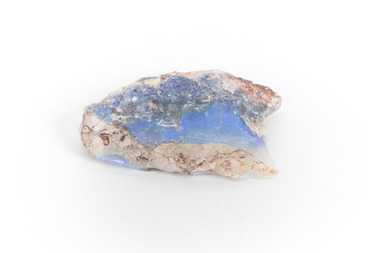
Geological specimen - Precious Opal
... Common opal is found in many localities and different geological environments throughout Australia and the world. ...Common opal is found in many localities and different geological environments throughout Australia and the world. ...In Australia, precious opal is found in Cretaceous age sandstones and mudstones. These sedimentary rocks were deeply weathered and this weathering released silica into the groundwater.Australia is the only part of the world where opalised animal and plant fossils have been found. Opal artefacts several thousands of years old have been discovered in East Africa. As early as 250 BC the Romans prized opals, thought to have come from mines in Eastern Europe, the ancient world's main source of opals. There are many aboriginal dreamtime stories that feature opal. Australian opals discovered during the late 1800's found little favour with European markets but their commercial value increased in the 1900's and in 1932 Australia took over as the major producer of opals in the world and remains the largest producer to this day. Opal is found around the world (Brazil, Mexico, Honduras and the western US) however Australia produces 95% of the world's precious opal and it is our official national gemstone. Opal was first mined commercially at Listowel Downs in Queensland in 1875 and later at White Cliffs in NSW. Today, Coober Pedy (SA) is the main producer of white opal, though in recent years this field has expanded and all types of opals are found. Other centres in SA include Andamooka and Mintabe. Lightning Ridge (NSW) is renowned for black opal and formerly White Cliffs was a large producer of high quality opal. Boulder opals (opals in concretionary ironstone) are mined in Queensland from numerous localities in a zone extending from the Eulo and Cunnamulla district in the south and northwest for a distance of over 700 km to Kynuna in the north. The towns of Quilpie, Yowah and Winton are the main opal mining and wholesale centres. Opals are considered gemstones and have been used in jewellery for thousands of years.Throughout much of history, opals were actually believed to be good luck. The Romans thought that opals were one of the luckiest gemstones and a symbol of hope. In the Middle Ages, opals were believed to be bestowed with all the positive properties of coloured gemstones due to its rainbow-like play of colour. Finally, there is a superstition that you should not wear an opal unless it is your birthstone otherwise misfortune will befall you. This, of course, is far-fetched, but the notion could have been promoted in the late 19th and early 20th Centuries by diamond traders who were trying to increase sales of diamonds and deter people from buying opals. Possibly related to this is the thought that you should set opal jewellery with diamonds as their powers of good fortune will override any negativity held by the opal. The great majority of opal does not show play of colour and is called common opal or potch however this is not the case with a precious opal. Opal is a precious gemstone, like rubies, emeralds or diamonds. Opal is rare, and it is expensive to prospect and mine for.Silica is one of the most common minerals on the planet, but precious opal is very rare – far more rare than diamonds. Precious opal is rare because the natural processes that create it rarely occur.Most (at least 95%) of the opal found by miners is common opal without gem colour. In Australia we call it potch. It can be white, grey, black or amber coloured. Even when a miner finds gem-coloured opal, most of it can’t be cut into gemstones because it’s too thin, or sandy. This specimen is part of a larger collection of geological and mineral specimens collected from around Australia (and some parts of the world) and donated to the Burke Museum between 1868-1880. A large percentage of these specimens were collected in Victoria as part of the Geological Survey of Victoria that begun in 1852 (in response to the Gold Rush) to study and map the geology of Victoria. Collecting geological specimens was an important part of mapping and understanding the scientific makeup of the earth. Many of these specimens were sent to research and collecting organisations across Australia, including the Burke Museum, to educate and encourage further study.It is not known where this opal originated, except that it is probably from Victoria, as it has been recorded from many localities in the State. Common Opal is formed from silica-rich water circulating through rocks near the Earth’s surface. It consists of minute spheres of silica arranged in different ways. In common opal, the spheres are of different sizes and randomly arranged, unlike in precious opal where the spheres are of similar size and uniformly arranged in three dimensions. These differences account for common opal generally being translucent to opaque and without the play of colours, or opalescence, displayed by precious opal. Common opal is found in many localities and different geological environments throughout Australia and the world. Precious opal requires special conditions to form and is much less common. Australia produces most to the world’s precious opal. burke museum, beechworth, indigo shire, beechworth museum, geological, geological specimen, precious opal, opal, brazil, mexico, honduras, queensland, coober pedy, gemstones, jewellery, play-of-colour, light blue -
 Flagstaff Hill Maritime Museum and Village
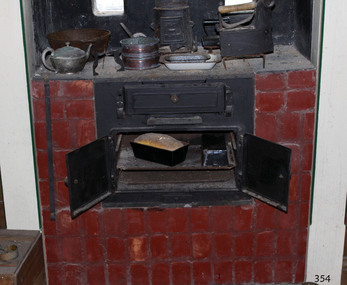
Domestic object - Stove, Cox and Rizzetti Stove Works, ca. 1918-1930s
... After the mid-19th century cast iron stoves were produced with burners in different positions, giving varied temperatures, so a wide variety of foods could be cooked at the same time at the most suitable heat, from slow cooking to baking scones. In contemporary times people the new wood-burning stoves had to meet the anti-pollution standards now in place to protect our environment. ...After the mid-19th century cast iron stoves were produced with burners in different positions, giving varied temperatures, so a wide variety of foods could be cooked at the same time at the most suitable heat, from slow cooking to baking scones. In contemporary times people the new wood-burning stoves had to meet the anti-pollution standards now in place to protect our environment. ...Cast iron stoves burn solid fuel such as wood or coal, and are used for cooking and warmth. The stoves have a firebox with a grate where the fuel is burned. The hot air flows through flues and baffles that heat the stove top and the oven. Before cast iron stoves were invented, cooking and heating were carried out in outdoor open fires, and later, in fireplaces inside the home. In 1642 the first cast iron stove was manufactured in Lynn, Massachusetts, where molten cast iron was poured into a sand mould to make rectangular plates that were then joined together to make a box. Benjamin Franklin invented the more efficient Pennsylvania stove in 1744, and this efficient design is still used today. After the mid-19th century cast iron stoves were produced with burners in different positions, giving varied temperatures, so a wide variety of foods could be cooked at the same time at the most suitable heat, from slow cooking to baking scones. In contemporary times people the new wood-burning stoves had to meet the anti-pollution standards now in place to protect our environment. By the 1920s gas cookers were being introduced for domestic use, and by the 1930s electric home cookers were being offered to householders. PLANET STOVES In August 1925 the firm Cox and Rizzetti, Stove Works, and also Sydney Road, South Melbourne, advertised in the Brunswick and Coburg Leader of November 11, 1925 as "formerly with Harnwell and Sons" and as "specialists in solid cast iron Planet stoves ... which merit an inspection from builders and householders". The firm continued in business and was mentioned as sponsors in the King Island News in 1971. Harnwell and Sons was listed in the Victorian Government Gazette of 1894. It is curious that the firm was mentioned in an article in the Sunrasia Daily of June 14, 1934 titled 'Planet Stoves' as a manufacturer of Planet Stoves. This Planet No 3 stove is an uncommon example of cooking equipment used in kitchens in the early 20th century, as the firebox is above the oven rather than beside it. The cast iron combustion stove is significant as part of the evolution of domestic cooking. Previously cooking was mostly carried out in outdoors in open fires, and later in fireplaces indoors. Cast iron stoves are still used today and have additional features such as thermostats to monitor and maintain temperature, water heating pipes connected, and environmentally approved anti-pollution fittings. Stove; a compact, blackened cast iron combustion cooker, installed within a fireplace and enclosed by bricks on both sides. The upright rectangular stove has a flat top with three round, removable cook plates and a flue connected at the back. The front has three doors with round knob handles; a swing-down firebox door above a sliding ashtray, and two side-hinged oven doors above a sliding opening. Inside on the side walls are two pairs of runners. Behind the pair of doors is an oven with two pairs of rails and two removable metal shelves. The stove has cast inscriptions on the chimney flue and on the front of the right hand side stove door. The model of the stove is The Planet No 3, made in Melbourne.Chimney flue, "[within rectangle] THE / PLANET" Stove door, "(within oval) PLANET / No 3"flagstaff hill, flagstaff hill maritime museum and village, warrnambool, maritime museum, maritime village, great ocean road, shipwreck coast, stove, cast iron stove, combustion stove, wood-burning stove, wood stove, wood oven, solid fuel stove, cooker, the planet, planet, planet no. 3, kitchen equipment, baking, domestic cooking, cooking equipment, food preparation, planet stove, planet cooker, cooking range, slow combustion stove, antique, range cooker, cox and rizzetti, harnwell and sons, melbourne manufacturer -
 Flagstaff Hill Maritime Museum and Village
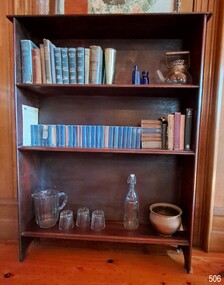
Furniture - Bookcase, 1900-1920
... environment. Its portable size makes it easy to rearrange for different furnishing configurations. ...environment. Its portable size makes it easy to rearrange for different furnishing configurations. ...This bookcase is typical of the homemade domestic furniture of the early 20th century. Its simple design encloses books on three sides, giving some protection from the environment. Its portable size makes it easy to rearrange for different furnishing configurations. The timber material allows for re-painting or staining to suit the decor of the time.The basic design of this bookcase is an example of domestic and office furniture used from the early to mid-20th century. Its classic shape makes it suitable for the home-carpenter to build for domestic use.Bookcase: a wooden bookcase with three shelf levels enclosed by a back panel, top and sides. Its size can accommodate large books. The legs are an extension of the side panels. Finished in a rosewood coloured varnish. flagstaff hill maritime museum and village, flagstaff hill, warrnambool, maritime museum, maritime village, shipwreck coast, great ocean road, bookcase, book storage, domestic furniture, library storage, book display, bookshelf, office furniture -
 The Beechworth Burke Museum
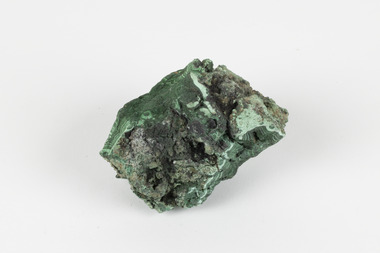
Geological specimen - Malachite, Unknown
... It often forms within limestone where a subsurface chemical environment favourable for the formation of carbonate minerals can occur. It is a substance that can be found in many different parts of the world including: Australia, USA, Russia and the Democratic Republic of Congo. ...It often forms within limestone where a subsurface chemical environment favourable for the formation of carbonate minerals can occur. It is a substance that can be found in many different parts of the world including: Australia, USA, Russia and the Democratic Republic of Congo. ...Malachite is a copper carbonate hydroxide mineral. It has a chemical composition of Cu2(CO3)(OH)2. It often forms within limestone where a subsurface chemical environment favourable for the formation of carbonate minerals can occur. It is a substance that can be found in many different parts of the world including: Australia, USA, Russia and the Democratic Republic of Congo. Malachite has historically been used to produce copper, with mining of the mineral dating back over a period of four thousand years. Due to its beautiful green colourations, it is also commonly used for aesthetic purposes such as in the production of sculptures and jewellery. This particular specimen was collected from the town of Burra, South Australia as part of a geological survey undertaken during the nineteenth century. The locality (located on Ngadjuri Country) has a long history of mining, particularly in copper mining, as the area is rich in copper deposits. The first significant discovery of this was made in Burra (Burra Burra Mine) in 1845 and, at the time, the mine was the largest and richest of its kind in the world, producing nearly five percent of the total world copper output. This specimen is significant as it is considered to be a rare gemstone, as many of the original deposits for the stones are significantly depleted, leaving behind very few sources. This specimen is part of a larger collection of geological and mineral specimens collected from around Australia (and some parts of the world) and donated to the Burke Museum between 1868-1880. A large percentage of these specimens were collected in Victoria as part of the Geological Survey of Victoria that begun in 1852 (in response to the Gold Rush) to study and map the geology of Victoria. Collecting geological specimens was an important part of mapping and understanding the scientific makeup of the earth. Many of these specimens were sent to research and collecting organisations across Australia, including the Burke Museum, to educate and encourage further study.A solid palm-sized copper carbonate hydroxide mineral with patterns of green colourations Existing Label: MALACHITE / Locality: Burra / S. Aust. Other Label: Confirmed / as Malachite / C. Willman / 15/4/1 / + Bill Birch burke museum, beechworth, geological, geological specimen, malachite, gemstone, green gemstone, burra, burra burra mine, burra south australia, carbonate mineral, copper, copper mining, copper mining burra, carbonate hydroxide mineral, copper carbonate, malachite mining, malachite burra, monster mine -
 Flagstaff Hill Maritime Museum and Village
Currency - Guinea Coin, The Royal Mint, 1793 George III Spade Guinea, 1793
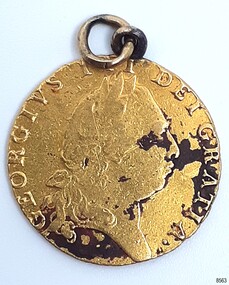
... environment. The GEORGE III GOLD SPADE GUINEA: - The British Guinea was introduced in 1663 and was circulated until 1814. It was made of 22 carat gold, was 25 to 26 cm in diameter and weighed 8.35 grams. It had a value of 21 British shillings. The guinea coin ceased circulation after 1816 and was replaced by the one-pound note. However, the term ‘guinea’ continued to represent 21 shillings. King George (1738-1820) had six gold guinea designs minted during his reign from 1760 and 1820. Each of the six had different...environment. The GEORGE III GOLD SPADE GUINEA: - The British Guinea was introduced in 1663 and was circulated until 1814. It was made of 22 carat gold, was 25 to 26 cm in diameter and weighed 8.35 grams. It had a value of 21 British shillings. The guinea coin ceased circulation after 1816 and was replaced by the one-pound note. However, the term ‘guinea’ continued to represent 21 shillings. King George (1738-1820) had six gold guinea designs minted during his reign from 1760 and 1820. Each of the six had different ...The coin was discovered by Julie Wilkins, a Victorian scuba diver who had already experienced more than 500 dives in Australia and overseas. She was holidaying in Peterborough, Victoria, and looking forward to discovering more about the famous Loch Ard ship, wrecked in June 1878 at Mutton Bird Island. The fast Glasgow-built clipper ship was only five years old when the tragedy occurred. There were 54 people on board the vessel and only two survived Julie's holiday photograph of Boat Bay reminds her of her most memorable dive. Submerged in the calm, flat sea, she was carefully scanning around the remains of the old wreck when, to her amazement, a gold coin and a small gold cross suddenly came up towards her. She excitedly cupped them in her hands, then stowed the treasures safely in her wetsuit and continued her dive. She soon discovered a group of brass carriage clock parts and some bottles of champagne. It was a day full of surprises. The items were easily recognisable, without any build-up of encrustations or concretion. Julie secretly enjoyed her treasures for twenty-four years then packed them up for the early morning train trip to Warrnambool. After a short walk to Flagstaff Hill Maritime Museum and Village, her photograph was taken as she handed over her precious find. She told her story to a local newspaper reporter, lunched a café in town then took the late afternoon train home. Her generous donation is now part of a vast collection of Loch Ard shipwreck artefacts, including the gold watch and the Minton Majolica model peacock. The coin is a British 1793 George III Gold Spade Guinea. It was already 83 years old when the Loch Ard had set sail. The loop and ring have been added, perhaps as a pendant, pocket watch accessory or similar purpose. It may have been worn for ‘good luck’ on the long journey to Australia, where ships had to carefully navigate the treacherous Bass’s Strait before arriving at their destination of Melbourne. Sadly, many met their fate on that short stretch of ocean aptly named the Shipwreck Coast. The coin is very recognisable even though it was exposed to the wrecking of the ship, its consequent movement, and the sea's turbulence. Its bent, scratched, buckled, split, dinted and worn condition is part of its story. The red-brown-black discolouration is similar to that found on other gold coins, sometimes called the ‘corrosion phenomena’. Studies suggest the possible cause is contaminants in the minting process reacting to the coins’ environment. The GEORGE III GOLD SPADE GUINEA: - The British Guinea was introduced in 1663 and was circulated until 1814. It was made of 22 carat gold, was 25 to 26 cm in diameter and weighed 8.35 grams. It had a value of 21 British shillings. The guinea coin ceased circulation after 1816 and was replaced by the one-pound note. However, the term ‘guinea’ continued to represent 21 shillings. King George (1738-1820) had six gold guinea designs minted during his reign from 1760 and 1820. Each of the six had different obverse portraits, all facing the right. There were three different reverse sides. The Spade Guinea was the fifth issue of the coin, introduced in 1787 and produced until 1799. The reverse shows a royal crown over a flat-topped shield with the Royal Arms of Great Britain, used in Scotland between 1714 and 1800. The shield images are, from left to right, top to bottom, the Arms of England and Scotland, the Arms of France, the Arms of Ireland, and the Arms of the House of Hanover. The Gold Guinea is also part of Australia’s history. It was the first coin mentioned in the announcement of Governor King of New South Wales his Australian Proclamation of a limited variety and denomination of coins accepted for use in the Australian Colony. The historic and decorative George III Spade Guinea has been reproduced for special collections of coins. However, replicas and imitations have also been made as souvenirs for tourists, as gaming tokens and chips for gamblers, and as ‘fake’ coins for profit. These coins differ in many ways; they may be only half the weight of the genuine coin. Often have a small stamp on the obverse with “COPY” or the manufacturer’s name or initials. Some have scalloped edges, some have dates that are different to the original dates of issue, and some even have text in Latin that translates as something very different to the original coin.The King George III Guinea was only produced from 1663 to 1814 and was the first English coin to be mechanically minted. The coin is the fifth edition of the King George III Guinea, the Spade Guinea, was only produced between 1787 and 1799. It is the only edition with this portrait of King George and the only one with the Royal Coat of Arms of Great Britain in Scotland on the reverse side. This edition was also the last guinea in circulation, because the sixth edition was reserved as the Military guinea. This edition of the Guinea is unique; This coin is the only guinea in our collection. It was minted in 1793, so it is now over 230 years old. The Gold Guinea is part of Australia’s history; it was the first coin in the list of coins for use in the Australian Colonies, mentioned by Governor King of New South Wales in his Australian Proclamation speech of 1800. The George III Spade Guinea was included in the Limited Edition Sherwood 12 Coin Collection of Notable Coinage of Australia. This coin is the only known guinea coin recovered from the wreck of the Loch Ard. It was already 85 years old when the ship was wrecked.Gold coin; British. 1793, King George III of the United Kingdom of Great Britain and Ireland (1760-1820), Spade Guinea. Yellow gold coin with gold metal loop mount and a gold ring through the loop. The design is the fifth issue of the George III Gold Guinea. The obverse relief is a portrait of George III facing right. Reverse relief is a crown above the Coats of Arms (1801-1816) of flat top spade-shaped shield divided into four quadrants that depict crowned lions, fleur de lies, a harp. These images are identified as, from left to right, top to bottom, England and Scotland, France, Ireland and Hanover. Inscriptions are minted around the rims of each side. The coin is dated 1793. Its surface has dark areas on both sides and the reed edge and surfaces are well worn. The loop mount is bent and the ring is buckled. The coin was recovered from the wreck of the ship Loch Ard.Obverse text; 'GEORGIVS III DEI GRATIA' (translates to George the Third, by the Grace of God) Obverse relief; (King George III bust, facing right, laurel wreath on head) Reverse text; 'M.B.E.ET.H.REX.F. D.B.ET.L.D. S.R.I.A.T.ET.E' '1793' (translates to: King of Great Britain, France and Ireland, Defender of the Faith, Duke of Brunswick and Lüneburg, Arch-Treasurer and Elector of the Holy Roman Empire) Reverse relief; a spade-shaped image i.e. (Crown with fleer de lies, above Shield with crowned lions in different postures, a harp, and other details)flagstaff hill maritime museum and village, warrnambool, great ocean road, shipwreck coast, royal mint, british coin, currency, guinea, military guinea, australian currency, british guinea, gold coin, spade guinea, king george iii, george iii, fifth portrait, arms of england and scotland, arms of france, arms of ireland, arms of the house of hanover, coins, gold coins, gold medallion, georgian era, 1793, numismatics, contamination phenomena, gold corrosion, good luck, lucky charm, pendant, lucky coin, trade, loch ard, wreck of the loch ard, 1878, mutton bird island, peterborough, scuba diver, 1980s, guinea coin, gold guinea, shipwreck artefact, relic, julie wilkins -
 Flagstaff Hill Maritime Museum and Village
Postcard - Postcard Folder, scenes, Valentine & Sons Co. Publishing Ltd, Warrnambool Photographic Souvenir, Early-to-mod 20th century
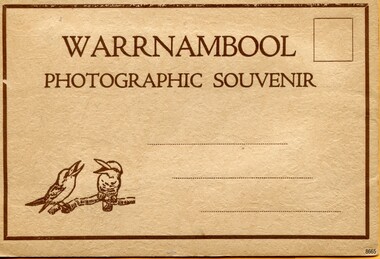
... different periods in time. Each postcard records a moment in history and is significant as a way to compare and show the changes in the local environment and community, building a story of the local history. ...This postcard folder is one of three in a set of postcards that were published in Victoria, Australia, and collected together. The Valentine Publishing Co. Pty. Ltd. produced this folder. Valentine and Sons was a printing and photography business based in Dundee, Scotland, and in Canada. In the early 1900s, at the height of the postcard craze, the firm published large numbers of postcards in the U.K., Canada, U.S., Australia and South Africa. From around 1900 or earlier, the firm bought many lithographic images for its postcards from local and national photographers who sold publishing rights to Valentines, and the business was famous for publishing photographs of popular sites worldwide. Postcard titles in this folder include many of those in the Rose postcard folders plus the following titles that are not duplicated. . Municipal Buildings and Post Office . Soldiers’ Memorial . Hopkins River . The Cliffs at Shelly Beach . The Road to Sandy Beach . The Breakwater and Pier This Valentine postcard folder was produced in Australia. It includes pictures from the early-to-mid 20th century. It is one of three in a set, with images of the same locations as other images in our collection but at different periods in time. Each postcard records a moment in history and is significant as a way to compare and show the changes in the local environment and community, building a story of the local history. The images record changes in the coastline, land, bay, buildings and other structures, roads, transportation and even the fashions of the times.Postcard folder, Valentine Publishing, cream cover. One of a set of three displaying images of Warrnambool and district around the mid-20th century. Print on the front and back covers is in brown ink. The front has an image of two laughing kookaburras on a branch, three address lines and an outline for a postage stamp. The back cover has the publisher’s details and a line for a return address. The cover opens like a book, and then the double-sided, Z-folded page of photographs drops downward. Titles are printed below each of the fifteen black and white photographs inside. The folder is secured on the back cover by placing a tab into a slot. The folder was produced by The Valentine Publishing Co. Pty. Ltd. Melbourne“WARRNAMBOOL / PHOTOGRAPHIC SOUVENIR” Symbol: [Two facing kookaburras standing on a branch with beaks open] “Published by The Valentine Publishing Co. Pty. Ltd. Melbourne” flagstaff hill maritime museum and village, great ocean road, shipwreck coast, warrnambool, flagstaff hill, flagstaff hill maritime museum, flagstaff hill maritime village, warramble, postcard, postcard folder, warrnambool scenes, picturesque views of warrnambool, picturesque views of warramble, lady bay, port of warrnambool, breakwater, warrnambool breakwater, viaduct, merri river footbridge, merri river suspension bridge, suspension footbridge, merri river mouth, hopkins river mouth, proudfoot's, fanny nelson, nelson's boatsheds, nelson's boathouse, boathouse, hopkins river boathouses, flett's boathouse, flett, george rose, image of a rose, rose series, rose stereograph co, rose stereographic company, lighograph, armadale victoria, lady bay beach, beach scene, lower light, concrete footbridge, 1922 footbridge, viaduct road, rose postcard, new concrete bridge, 1945, 1890, 1922, small footbridge, 1872 footbridge, 1872, merri river estuary, stingray bay, postcards, concertina fold, z fold, shipwrecked coast, maritime museum, souvenir, warrnambool local scenes, photography, local history, tourism, photographs, visitors, travel, scenes, mid-20th century, 1940s, 1950s, z-fold, 1880s, collection, correspondence, valentine publishing co. pty. ltd melbourne, valentine publishing co. pty. ltd sydney, municipal buildings and post office, soldiers’ memorial, hopkins river, the cliffs at shelly beach, the road to sandy beach, the breakwater and pier -
 Flagstaff Hill Maritime Museum and Village
Postcard - Postcard Folder, scenes, George Rose, Rose Stereographic Company, Rose Series, Picturesque Views of Warrnambool Australia, 1880-1942
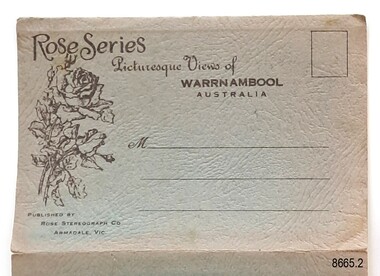
... different periods in time. Each postcard records a moment in history and is significant as a way to compare and show the changes in the local environment and community, building a story of the local history. ...GEORGE ROSE 1861-1942: - George Rose was a well-known Victorian photographer, famous for his late 19th and early 20th century photography. He was born in Clunes, Victoria, and was in his 20th year when he founded Rose Stereograph Company in 1880. He took the opportunity of a popular trend of the times to produce stereographs, pairs of almost duplicate photographs that appeared in 3D when viewed in a handheld stereo viewer. By the 1920s, these lost their popularity, so he used his photographic skills to produce cards and postcards of scenes and people. The twelve photographs in the Rose postcard folders include locations connected to other items in our Collection, including the Valentine postcard folder in this set. The photographs are titled: - . The Avenue and War Memorial. Warrnambool. Vic. . The Blow-hole. Thunder Point. Warrnambool. Vic. . Botanical Gardens. Warrnambool. Vic. . Eagle Rock. Warrnambool. Vic. . The New Concrete Bridge and Breakwater. Warrnambool. Vic. . Liebig Street. Warrnambool. Vic. . Looking to Thunder Point. Warrnambool. Vic. . The Beach. Warrnambool. Vic. . Hopkins Falls. Warrnambool. Vic. . Shelly Beach. Warrnambool. Vic. . The Mouth of the Hopkins River. Warrnambool. Vic. . Panorama of Warrnambool, Vic. [Kepler Street towards Presbyterian Church on Spence St] This postcard folder shows scenes and places of interest in and around Warrnambool. The George Rose postcard folders in this set were produced in Victoria and include pictures taken by the renowned photographer between 1880 and 1942. Other postcards in our collection have photographs of the same or similar locations at different periods in time. Each postcard records a moment in history and is significant as a way to compare and show the changes in the local environment and community, building a story of the local history. The images record changes in the coastline, land, bay, buildings and other structures, roads, transportation and even the fashions of the times. This copy folder is one of a set of three. This folder has a green-grey textured rectangular card cover with a sketch of a rose on the front. The cover also contains the name of the postcard series, the location of the series' focus, the producer's details, and lines for adding an address. The folded cover contains a long, concertinaed page with six titled photographs on each side, totalling twelve. The folder contains scenes from Warrnambool and nearby popular areas, including Lady Bay, the Port of Warrnambool, the Warrnambool Breakwater, the Viaduct, the Merri River Footbridge, the Hopkins River Mouth, and Proudfoot’s and the Fanny Nelson/Flett boathouses. The cover has a sketch of a rose and inscriptions. The lithograph photographs were taken between 1880 and 1942 by well-known Victorian photographer George Rose, Rose Stereograph Company of Armadale, Victoria.Image: [Rose with rosebud and leaves] Printed: "Rose Series / Picturesque Views of / WARRNAMBOOL / AUSTRALIA" "PUBLISHED BY / ROSE STEREOGRAPH CO / ARMADALE. VIC."flagstaff hill maritime museum and village, great ocean road, shipwreck coast, warrnambool, flagstaff hill, flagstaff hill maritime museum, flagstaff hill maritime village, warramble, postcard, postcard folder, warrnambool scenes, picturesque views of warrnambool, lady bay, port of warrnambool, breakwater, warrnambool breakwater, viaduct, merri river footbridge, merri river suspension bridge, suspension footbridge, merri river mouth, hopkins river mouth, proudfoot's, fanny nelson, nelson's boatsheds, nelson's boathouse, boathouse, hopkins river boathouses, flett's boathouse, flett, george rose, image of a rose, rose series, rose stereograph co, rose stereographic company, lighograph, armadale victoria, lady bay beach, beach scene, lower light, concrete footbridge, 1922 footbridge, viaduct road, rose postcard, new concrete bridge, 1945, 1890, 1922, small footbridge, 1872 footbridge, 1872, merri river estuary, stingray bay, postcards, green-grey postcard folder, shipwrecked coast, maritime museum, souvenir, warrnambool local scenes, photography, local history, tourism, photographs, visitors, travel, scenes, mid-20th century, 1940s, 1950s, concertina fold, z-fold, 1880s, collection, correspondence, rose stereograph co armadale, victorian photographer, soldiers’ memorial, hopkins river, the cliffs at shelly beach, the road to sandy beach, pier, botanic gardens, post office, municipal buildings, merri river, proudfoot’s -
Glenelg Shire Council Cultural Collection
Photograph - Photograph - Portland Library, Portland Victoria, 05/06/1998
... Portland Library, World Environment Day display - similar to 9472, slightly different angle...Portland Library, World Environment Day display - similar to 9472, slightly different angle Photograph Photograph - Portland Library, Portland Victoria ...Coloured photo. Portland Library, World Environment Day display - similar to 9472, slightly different angleFront: '98 6 5' -
 Bendigo Military Museum
Album - PHOTOGRAPHIC ALBUM WW2, AIF Training in Palestine : Middle East Tactical School and MEWTS officer training
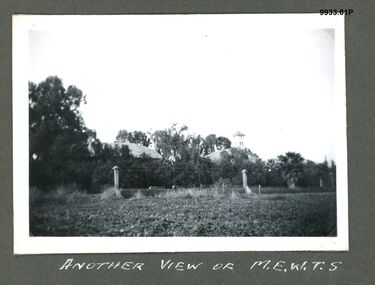
... different units. Refer to record number 9928P and 10106P for details on physical albums. Contains unique images of AIF life in Palestine and Syria. Syria Palestine Egypt Thomason collection METS Middle East Tactical School Photographs of participants and environment of the METS and MEWTS training schools for officers. ...These images feature various personnel attending courses and the Middle East Tactical School. This school honed the leadership and command skills of officers. The images are part of the collection of Bill Thomason, a Bendigo collector of militaria. The collection includes two albums put together by a Lieutenant Brown in 1940-41, possibly attached to the 19th Training Battalion at Biet Jirja in Palestine. The albums record events and personalities from units passing through the camp, including many friends of the author in a range of units. The images include those taken by Brown, along with images seemingly supplied by friends from different units. Refer to record number 9928P and 10106P for details on physical albums.Contains unique images of AIF life in Palestine and Syria.Photographs of participants and environment of the METS and MEWTS training schools for officers. These schools were credited with providing an extra degree of professionalism to Australian and Commonwealth officerssyria, palestine, egypt, thomason collection, mets middle east tactical school -
 Warrnambool and District Historical Society Inc.
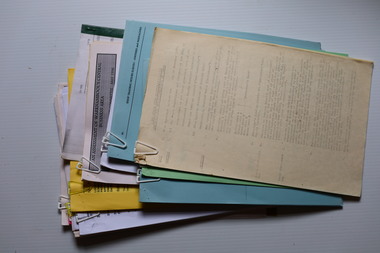
Administrative record (Collection) - Warrnambool City Council Administrative Records, Warrnambool City Council Officers, 1990s
... environment, business and street scape (City Plans, Street Life, Coastal Wetlands, Landcare, Foreshore, Shop Trading etc). Warrnambool, founded in 1847, became a Municipality in 1856, a Borough in 1863, a town in 1883 and a City in 1918. The Warrnambool City Council offices are in Liebig Street, Warrnambool. This collection is of interest as a record of some of the work of the Warrnambool City Council in the 1990s Warrnambool City Council Warrnambool City Council Strategies and Plans This collection contains a variety of different ...Warrnambool City Council Records collected by a member of a Council Advisory Committee.Collection of Warrnambool City Council records of the 1990sIn folders and archival envelopes in an A3 archival boxTwo A3 archival envelopes containing information on Foreshore etc., five booklets containing reports on City Plans, Council Strategies etc and 15 Reports (Shop Trading, Coastal Wetlands, Foreshore, Landcare etc)warrnambool city council, warrnambool city council strategies and planswarrnambool city council, warrnambool city council strategies and plans -
 Kiewa Valley Historical Society
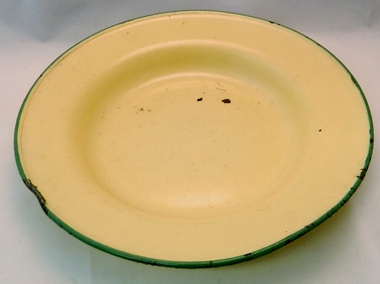
Plate Enamel, mid 1900's
... The Kiewa Valley has small township centres and to survive in the Australian bush high country environment camp-side fires and meals required sturdy utensils and plates. enamel outdoor plates and mugs camping kitchen utensils Stamped on the bottom base " made in Hong Kong 24 cm E MELLING CO LTD" This yellow enameled tin soup/salad/dinner plate has a green boarded rim and can hold a variety of different meals. ...This "outdoor" dinner plate was made in Hong Kong and is therefore dated well after World War II. It was imported from Hong Kong at the beginning of the start of the great Asian influx of cheap household/camping kitchen and dinner plates(1960's onward). It is also during the time before stronger and more resilient plastic "camper" goods. It was at the start of the city based outdoor campers Australian bush adventure holidays.This plate is very significant to the High Plains cattlemen of the Victorian Alpine Region. Because of its unbreakable and easy to clean qualities this type of plate and associate mugs where a necessity for overnight workers and campers in the upper Kiewa Valley and its high plains regions. The Kiewa Valley has small township centres and to survive in the Australian bush high country environment camp-side fires and meals required sturdy utensils and plates.This yellow enameled tin soup/salad/dinner plate has a green boarded rim and can hold a variety of different meals. This plate is sturdy enough for any outdoor activity and was used by campers and cattlemen.Stamped on the bottom base " made in Hong Kong 24 cm E MELLING CO LTD"enamel outdoor plates and mugs, camping kitchen utensils -
 Kiewa Valley Historical Society
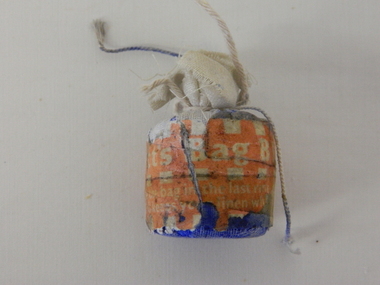
Bag Whitening Agent Reckitts, circa early 1900s
... environment. As appearances, of clothing, was on the whole not significant it was a different scenario at social and religious scenes. ...This little bag of "whitener" additive for the washing of white clothes was manufactured in Hull in the United Kingdom mid and later 1900's. The Manufacturer, Ricketts, was one of the first manufacturers to employ women in equal proportions with males (a rarity before 1914). This product was used to improve the appearance of white fabrics. This ability to use a product that would "whiten" clothes chemically rather than the "hard boiling" of clothes was a time saver and a lot easier on the fabrics. This is a boon to rural families where time was of the essence (boiling took time). The blue coloring was introduced because the white colour perception is enhanced by the blue (fadeable and not permanent). The "washing machine industry" of the late 1900's emphasised "whitening" agents that were not so haphazard in producing blue stains, and allowed a "gentle" washing action. This item is very significant in detailing the early 1900's rural household domestic "chore" of washing white clothes to a "social" standard of cleanliness. White shirts were the mark cleanliness that those outside of the family judged the family unit by. The best clothes were worn to church on Sundays. Hard and mostly rural activities/work in the Kiewa Valley encompassing farming, crop cultivation, cattle/sheep and "field work" to do with the SEC Vic Hydro Scheme involved provided a stain prone environment. As appearances, of clothing, was on the whole not significant it was a different scenario at social and religious scenes. The ability to attain "brilliant" white shirts, dresses and bonnets by a less drastic method to that of "boiling" of clothes in vats, was a boon of that "era". The anti establishment revolt came later in the 1950's onward took longer to migrate from the cities and larger rural townships to eventually sneak into the Kiewa valley.This "blue bag" is a whitening agent wrapped in flannel or muslin, or sold ready bagged (1 ounce).It was used in the final rinse to "whiten white coloured clothes" The string was used to facilitate finger grip onto the "bag" after the wash had finished for easy removal to stop the hand and other surfaces from being stained by the blue colour residue drips.domestic and commercial laundries, starch and whitening additive, washing brightener -
 Bendigo Historical Society Inc.
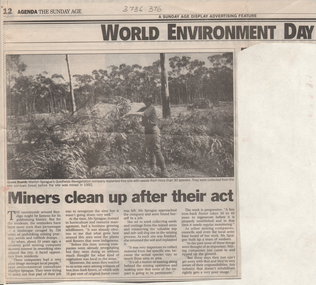
Newspaper - Kangaroo Flat Gold Mine Collection: mine revegetation
... Sunday Age article, 26th May, 1996, in 'Agenda' titled 'World Environment Day and subtitled 'Miners clean up after their act'. Marilyn Sprague collected seeds from 36 different species of plants to revegetate land disturbed by mining. ...Gold mining Bendigo box-ironbark forest Marilyn Sprague Goldfields Revegetation Company revegetation Bendigo Mining Sunday Age article, 26th May, 1996, in 'Agenda' titled 'World Environment Day and subtitled 'Miners clean up after their act'. Marilyn Sprague collected seeds from 36 different species of plants to revegetate land disturbed by mining. ...Sunday Age article, 26th May, 1996, in 'Agenda' titled 'World Environment Day and subtitled 'Miners clean up after their act'. Marilyn Sprague collected seeds from 36 different species of plants to revegetate land disturbed by mining. She stated ' it is very important to collect material from the specific site, because the actual species vary so much from area to area.' Black and white photo shows Marily Sprague collecting seeds from felled trees in the Box-Ironbark forest. gold mining, bendigo, box-ironbark forest, marilyn sprague, goldfields revegetation company, revegetation, bendigo mining -
 Bendigo Historical Society Inc.
Document - PETER ELLIS COLLECTION: PETER ELLIS OBITUARY, 23rd May, 2015
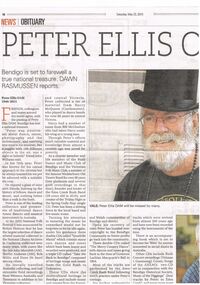
... 'Peter was passionate about dance, music, photography and the environment, and watching him tend to his interests, like a juggler with 100 different objects in the air, was a sight to behold,' friend John Williams said. ...'Peter was passionate about dance, music, photography and the environment, and watching him tend to his interests, like a juggler with 100 different objects in the air, was a sight to behold,' friend John Williams said. ...Colour photocopy of newspaper article Obituary. Dated Saturday, May 23, 2015. Article is not complete. Titled Peter Ellis O. Reads: Bendigo is set to farewell a true national treasure. Dawn Rasmussen reports. Peter Ellis OAM 1946-2015. Friends, colleagues and mates around the world agree, with the passing of Peter Ellis OAM, Bendigo has lost a national treasure. 'Peter was passionate about dance, music, photography and the environment, and watching him tend to his interests, like a juggler with 100 different objects in the air, was a sight to behold,' friend John Williams said. In his 70th year, Peter was known for his casual approach to the niceties but he always insisted his teapot be adorned with a suitable tea cosy. He enjoyed a glass of wine with friends, hunting up the history of folklore, dance and music, and nothing better than a walk in the bush. Peter is one of the leading collectors and presenters of traditional dance tunes, dances and musical instruments in Australia. At the 2005 National Folk Festival it was announced by Robyn Holmes that he has the largest selection of dance related material collected in the National Library Archives in Canberra, collected over many years, with mates like the late John Meredith (AM), Shirley Andrews (AM), Rob Willis and Dave Di Santi among others. He literally travelled Australia collecting, and had extensive field recordings from Western Australia and Tasmania in addition to his Victorian collection. .. .. .. And central Victoria. Peter collected a lot of material from Harry McQueen (Castlemaine), who played in dance bands for over 60 years in central Victoria. Harry had a number of tunes from Bill McGlashan who had taken Harry under his wing as a young man. Through Peter's efforts much valuable material and knowledge from almost a century ago was saved for posterity. As a charter member and life member of the Bush Dance and Music Club of Bendigo and the Victorian Folk Music Club, a member of the famous Wedderburn Old Timers Band for over 28 years (two platinum and several gold recordings in that time), founder and leader of the Emu Creek Bush Band (29 years old in 2010) and creator of the 'Friday Night at the Spring Gully Hop' single CD, Peter has been a driving force in the local band and live music scene. Turning his attention to ensuring the music he unearthed would not be forgotten or let lay idle again, under his guidance three double CD's called Quadrille Mania' which contain many rare dances and tunes which have been learnt and recorded were produced, and a triple CD called 'Take Me back To Bendigo', composed of heritage songs and music from the Gold Rush to Federation. These Cd's show the multicultural heritage in Bendigo and include music and songs from the Koorie.. .. … and Welsh communities of Bendigo and district. Upon his recovery of costs Peter has handed over copyright to the Bendigo Community so future profits go back into the community. Three double CDs called 'The Merry Country Dance' with dances and tunes going back to the time of Governor Lachlan Macquarie's Ball in 1804. Most of the tracks are performed by the Emu Creek bush Band following much practice under Peter's tutelage. For further authenticity .. .. .. Tracks which were revived from almost 200 years ago and have now been recorded using the instruments of the time. There is an accompanying book which is set to become the 'Bible' for anyone interested in social dance in Australia. Other CDs include Bush Concert recordings (Volume 1 Goornong), Cooee, Songs of the ANZACs two- CD set in conjunction with the Bendigo Historial Society, 'Music of the Diggings' (four tracks by Peter or Emu Creek) and many more guest… ARTICLE CUT OFFperson, individual, peter ellis oam -
Port Melbourne Historical & Preservation Society
Photograph - Aerial view of Port Melbourne, 23 Dec 1945
... Piers and Wharves - Station Pier Piers and Wharves - Town Pier War - World War II Built Environment Transport - Railways Missions to Seamen Swallow & Ariell Ltd One of three prints of aerial photographs of Port Melbourne 23.12.1945, showing different areas and to different scales: this one vertical, takes in Station and Town Piers, railyards, Missions to Seamen, Engine Works, temporary US wartime structures, edge of COR buildings, Swallow & Ariell, portion of Wiilliamstown Road. ...One of three prints of aerial photographs of Port Melbourne 23.12.1945, showing different areas and to different scales: this one vertical, takes in Station and Town Piers, railyards, Missions to Seamen, Engine Works, temporary US wartime structures, edge of COR buildings, Swallow & Ariell, portion of Wiilliamstown Road. (Smaller copies located in A.06.04.B4)piers and wharves - station pier, piers and wharves - town pier, war - world war ii, built environment, transport - railways, missions to seamen, swallow & ariell ltd -
 Alfred Hospital Nurses League - Nursing History Collection
Booklet - Illustraed booklet, Valerie Asche 1927-2019, Walking my baby back home: my journey with TB before antibiotics, 2011
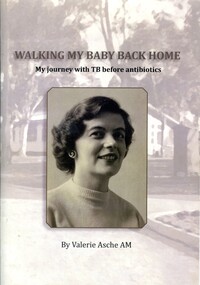
... The author describes the different phases of her illness, her life at Greenvale Sanatorium, her friendships with other patients, her family and the subsequent treatment in the 1940's for people suffering with TB. Greenvale was a close knit environment ...This story is about the author starting off her studies at University only to become ill with pleurisy, which did not improve, the result was a break in University studies, bed rest and a referral to the part-time Director of Tuberculosis in Victoria. The author describes the different phases of her illness, her life at Greenvale Sanatorium, her friendships with other patients, her family and the subsequent treatment in the 1940's for people suffering with TB. Greenvale was a close knit environment, everyone was fighting to stay alive, but some didn't.Stapled illustrated booklet, Black and white photograph of the author as a young woman on front cover. Title and author's name in black print above and below sketch of building and trees in backgroundnon-fictionThis story is about the author starting off her studies at University only to become ill with pleurisy, which did not improve, the result was a break in University studies, bed rest and a referral to the part-time Director of Tuberculosis in Victoria. The author describes the different phases of her illness, her life at Greenvale Sanatorium, her friendships with other patients, her family and the subsequent treatment in the 1940's for people suffering with TB. Greenvale was a close knit environment, everyone was fighting to stay alive, but some didn't.tuberculosis, tuberculosis-medical treatment -
 Kiewa Valley Historical Society
Report - Land Conservation Council x2, Land Conservation Council, Victoria Melbourne, April 1978, October 1974
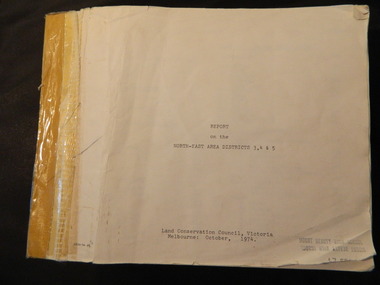
... environment public land kiewa valley planning Stamped on Front Cover: "Mount Beauty High School" Has a library borrowing slip at the back of the last page. Thick heavy book with 312 pages with black and white photos. Back half has a folder with heavy cardboard attached to thick cardboard back cover. Inside folder are 9 maps with color each with a different ...Land Conservation Act 1970 established the Land Conservation Council to investigate and recommend to the Minister use of public land in Victoria. It describes and assesses the natural resources:-Physiography, Geology, Topography, Land Systems, Outdoor Recreation, Public land and blocks. Primary Production. Vegetation.North East Victoria includes the Kiewa Valley. This report gives an understanding of the development of the area.Thick heavy book with 312 pages with black and white photos. Back half has a folder with heavy cardboard attached to thick cardboard back cover. Inside folder are 9 maps with color each with a different title.Stamped on Front Cover: "Mount Beauty High School" Has a library borrowing slip at the back of the last page.land conservation council, environment, public land, kiewa valley, planning -
 Victorian Aboriginal Corporation for Languages
Periodical, Australian Institute of Aboriginal and Torres Strait Islander Studies, Australian Aboriginal studies : journal of the Australian Institute of Aboriginal and Torres Strait Islander Studies, 2007
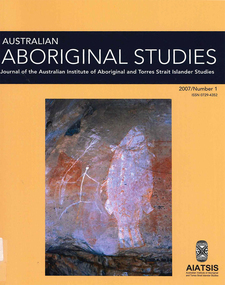
... environment that exists today. This geomorphological framework provides a background for the interpretation of the archaeology, which spans some 4000 years. 7. A different...environment that exists today. This geomorphological framework provides a background for the interpretation of the archaeology, which spans some 4000 years. 7. A different ...1. The moral lexicon of the Warlpiri people of central Australia LR Hiatt This paper discusses words that match ?Good? and ?Bad?; examples of ?Good? and ?Bad? behaviour; morality and law; and egalitarianism and dominance. It also presents a comparison with Gidjingarli (Burarra). 2. Mobs and bosses: Structures of Aboriginal sociality Patrick Mullins (Mount Druitt, NSW) A commonality of Aboriginal social organisation exists across the continent in communities as different as those from the Western Desert across to Cape York, from the towns of New South Wales and Western Australia to cities like Adelaide. This is found in the colloquial expressions ?mob? and ?boss?, which are used in widely differing contexts. Mobbing is the activity where relatedness, in the sense of social alliances, is established and affirmed by virtue of a common affiliation with place, common experience and common descent, as well as by the exchange of cash and commodities. Bossing is the activity of commanding respect by virtue of one?s capacity to bestow items of value such as ritual knowledge, nurturance, care, cash and commodities. Mobbing and bossing are best understood as structures in Giddens? sense of sets of rules and resources involved in the production of social systems, in this case social alliances. Mobbing and bossing imply a concept of a person as a being in a relationship. Attention needs to be given to the way these structures interact with institutions in the wider Australian society. 3. Recognising victims without blaming them: A moral contest? About Peter Sutton?s ?The Politics of Suffering: Indigenous Policy in Australia since the 1970s? and Gillian Cowlishaw?s replies Ma�a Ponsonnet (Universit� Paris- 8-Saint-Denis) Peter Sutton?s texts on Aboriginal violence, health and their politicisation are replied to using his methodology, and acknowledging his convincing points. Sutton rightly denounces a lack of lucidity and scientific objectivity in anthropological debates. These inadequacies impede identification of what Aboriginal groups can do to improve their situations for fear that this identification would lead to blame the victims. At the other end of the ethical spectrum, those who advocate a broader use of what I will call a ?resistance interpretation? of violence fail to recognise victims as such, on the implicit grounds that seeing victims as victims would deprive them of any agency, on the one hand, and entail blame, on the other hand. I aim to define a middle road between those views: the idea that victims should be acknowledged as such without being denied their agency and without being blamed for their own condition. This middle road allows identification of the colonisers? responsibilities in the contemporary situation of Indigenous communities in Australia, and to determine who can do what. Secondly, I show that Sutton?s texts convey, through subtle but recurrent remarks, an ideology of blame rather than a mere will to identify practical solutions. As a consequence, some of his proposals do not stand on a solid and objective causal analysis. 4. 'You would have loved her for her lore?: The letters of Daisy Bates Bob Reece (Murdoch University) Daisy Bates was once an iconic figure in Australia but her popular and academic reputation became tarnished by her retrograde views. Her credibility was also put in doubt through the exposure of her fictionalised Irish background. In more recent times, however, her ethnographic data on the Aborigines of Western Australia has been an invaluable source for Native Title claims, while her views on Aboriginal extinction, cannibalism and ?castes? are being seen as typical of her time. This article briefly reviews what has been the orthodox academic opinion of her scientific achievement before summarising what is reliably known of her early history and indicating what kind of person is revealed in the 3000 or more letters that she left behind. 5. What potential might Narrative Therapy have to assist Indigenous Australians reduce substance misuse? Violet Bacon (Curtin University of Technology) Substance misuse is associated with adverse consequences for many Australians including Aboriginal and Torres Strait Islander peoples. Extensive research has been conducted into various intervention, treatment and prevention programs to ascertain their potential in reducing substance misuse within Aboriginal and non-Aboriginal communities. I explore the potential of Narrative Therapy as a counselling intervention for assisting Indigenous Australians reduce the harm associated with substance misuse. 6. Bone points from the Adelaide River, Northern Territory Sally Brockwell (University of Canberra) and Kim Akerman (Moonah) Large earth mounds located next to the vast floodplains of the lower Adelaide River, one of the major tropical rivers draining the flat coastal plains of northern Australia, contain cultural material, including bone points. The floodplains of the north underwent dynamic environmental change from extensive mangrove swamps in the mid-Holocene, through a transition phase of variable estuarine and freshwater mosaic environments, to the freshwater environment that exists today. This geomorphological framework provides a background for the interpretation of the archaeology, which spans some 4000 years. 7. A different look: Comparative rock-art recording from the Torres Strait using computer enhancement techniques Liam M Brady (Monash University) In 1888 and 1898, Cambridge University?s Alfred C Haddon made the first recording of rock-art from the Torres Strait islands using photography and sketches. Systematic recording of these same paintings and sites was carried out from 2000 to 2004 by archaeologists and Indigenous Torres Strait Islander and Aboriginal communities as part of community-based rock-art recording projects. Computer enhancement techniques were used to identify differences between both sets of recordings, to reveal design elements that Haddon missed in his recordings, and to recover images recorded by Haddon that are today no longer visible to the naked eye. Using this data, preliminary observations into the antiquity of Torres Strait rock-art are noted along with recommendations for future Torres Strait region rock-art research and baseline monitoring projects. 8. Sources of bias in the Murray Black Collection: Implications for palaeopathological analysis Sarah Robertson (National Museum of Australia) The Murray Black collection of Aboriginal skeletal remains has been a mainstay of bio-anthropological research in Australia, but relatively little thought has been given to how and why this collection may differ from archaeologically obtained collections. The context in which remains were located and recovered has created bias within the sample, which was further skewed within the component of the collection sent to the Australian Institute of Anatomy, resulting in limitations for the research potential of the collection. This does not render all research on the collection unviable, but it demonstrates the importance of understanding the context of a skeletal collection when assessing its suitability for addressing specific research questions.maps, b&w photographs, colour photographs, illustrations, graphs, chartswarlpiri, sociology, daisy bates, substance abuse, narrative therapy, rock art, technology and art, murray black collection, pleistocene sites, watarrka plateau -
 Robin Boyd Foundation
Document - Manuscript, Robin Boyd, Going, Going, Gone: Introduction, 1962
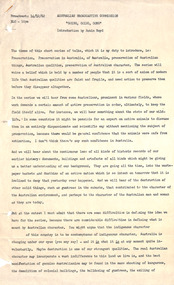
... Different prominent people from various fields talk about aspects of preservation - from native animals and the environment, to historic records of Australia's early history etc. ...Different prominent people from various fields talk about aspects of preservation - from native animals and the environment, to historic records of Australia's early history etc. ...Boyd introduces a short series of talks on ABC 3LO, on the theme of preservation. Different prominent people from various fields talk about aspects of preservation - from native animals and the environment, to historic records of Australia's early history etc. Boyd poses questions about the typical Australian and international influences on the Australian character and lifestyle. This is talk number one.Typewritten, foolscap, 5 pagespreservation, robin boyd, manuscript, radio -
 National Wool Museum
Archive - About Wool, International Wool Secretariat, 1995
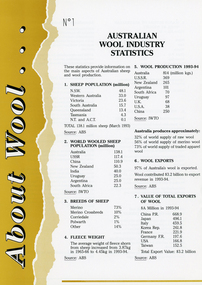
... All have different colours and titles, including 'Australian Wool Industry Statistics', 'History of the Australian Wool Industry', 'Guide to Wool Textiles', 'Wool the Fibre', 'Trademarks of Wool', 'Wool and the Environment', 'The Australian Sheep Flock', 'Care of Wool', 'The Natural Properties of Wool' and 'The Processing of Raw Wool into Yarn'. ...Stuart Ascough International Wool Secretariat Victoria Wool Processors Port Phillip Mills Pty Ltd Topmaking career wool industry mills leaflet 8394.1: No.1 / AUSTRALIAN / WOOL INDUSTRY / STATISTICS 8394.2: No. 2 / HISTORY OF THE / AUSTRALIAN WOOL / INDUSTRY 8394.3: No. 3 / GUIDE TO WOOL TEXTILES 8394.4: No. 4 / WOOL THE FIBRE 8394.5: No. 5 / TRADEMARKS OF WOOL 8394.6: No. 6 / WOOL AND THE ENVIRONMENT 8394.7: No. 7 / THE / AUSTRALIAN SHEEP / FLOCK 8394.8: No. 8: / CARE OF WOOL 8394.9: No. 9 / THE NATURAL / PROPERTIES OF WOOL 8394.10: No. 10 / THE PROCESSING OF / RAW WOOL INTO YARN A series of ten A4 information leaflets with various titles on the theme of 'About Wool...'. Some leaflets are single sheets double sided, some are folded four sided leaflets. All have different ...Part of a collection of books, manuals, photographs, letters and clothing relating to the working life of Stuart Ascough. Stuart's career in the wool industry spanned over 43 years from 1960 to 2003 in various roles including Topmaking Plant Manager at Courtaulds Ltd. in Spennymore, U.K., Operations Manager at Port Phillip Mills in Williamstown Victoria, Marketing Executive, Early Stage Wool Processing at the International Wool Secretariat Melbourne, Australia and General Manager of Victoria Wool Processors Pty. Ltd. in Laverton North, Victoria. Throughout his career Stuart travelled extensively, and in the 1990s worked at many topmaking mills in China on quality improvement projects. He also provided technical advice and training at mills in India, Ukraine, Lithuania, Kyrgyzstan, Russia, Latvia, Byelorussia and other parts of Europe and Asia.A series of ten A4 information leaflets with various titles on the theme of 'About Wool...'. Some leaflets are single sheets double sided, some are folded four sided leaflets. All have different colours and titles, including 'Australian Wool Industry Statistics', 'History of the Australian Wool Industry', 'Guide to Wool Textiles', 'Wool the Fibre', 'Trademarks of Wool', 'Wool and the Environment', 'The Australian Sheep Flock', 'Care of Wool', 'The Natural Properties of Wool' and 'The Processing of Raw Wool into Yarn'. Leaflets show illustrations, logos, images and text.8394.1: No.1 / AUSTRALIAN / WOOL INDUSTRY / STATISTICS 8394.2: No. 2 / HISTORY OF THE / AUSTRALIAN WOOL / INDUSTRY 8394.3: No. 3 / GUIDE TO WOOL TEXTILES 8394.4: No. 4 / WOOL THE FIBRE 8394.5: No. 5 / TRADEMARKS OF WOOL 8394.6: No. 6 / WOOL AND THE ENVIRONMENT 8394.7: No. 7 / THE / AUSTRALIAN SHEEP / FLOCK 8394.8: No. 8: / CARE OF WOOL 8394.9: No. 9 / THE NATURAL / PROPERTIES OF WOOL 8394.10: No. 10 / THE PROCESSING OF / RAW WOOL INTO YARNstuart ascough, international wool secretariat, victoria wool processors, port phillip mills pty ltd, topmaking, career, wool industry, mills, leaflet -
 Nillumbik Shire Council
Public Art: Edward GINGER (b.1951 Kegalle, Sri Lanka - arrived 1975 Aus), Edward Ginger, The Breeze, Location: Main Road, Research - opposite Eltham Little Theatre, 1990
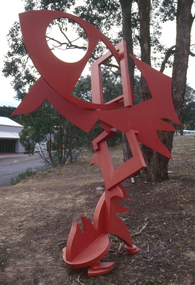
... It comprises a series of flat, cut-out shapes, interlocking at different angles, giving the impression of being hinged together rather than fixed. The work references nature and the built environment. ...environment. This work is the most appropriate for the site and expressive of the dynamics of an evolving community in which artistic discourse and debate has always thrived." The work has acquired the status of a major landmark from the National Trust. public art ginger red sienna elements steel abstract breeze fire sculpture N/A The Breeze is an abstract work made out of welded steel and painted in enamel in bush fire red / sienna. It comprises a series of flat, cut-out shapes, interlocking at different ...The first sculpture awarded the Shire of Eltham 'Art in Public Places' Award/Commission. The Judges were Inge King, Jenny Zimmer and Daryl Jackson. The work deals with the juxtaposition of suburban and rural surroundings. This scupture is a typical example of the artist's oevre of the period. This sculptre is site specific and refers to the nature of the environment. The colour - bushfire red / sienna - alludes to the history of fire in the urban/rural fringe and the title, as well as the sculpture's shapes, forms and material refer to the natural and local elements. Judges report noted: "The most vital and expressive work for the site...with a great sense of dynamic movement and vibrant colour. Its' abstract forms will enliven the surroundings and the urban and natural environment. This work is the most appropriate for the site and expressive of the dynamics of an evolving community in which artistic discourse and debate has always thrived." The work has acquired the status of a major landmark from the National Trust. The Breeze is an abstract work made out of welded steel and painted in enamel in bush fire red / sienna. It comprises a series of flat, cut-out shapes, interlocking at different angles, giving the impression of being hinged together rather than fixed. The work references nature and the built environment. Its geometric shapes suggest man-made structures within industry and suburban life, while rural areas can be identified by the organic flame-like shapes fanned by the wind. The circular cut-out in the eye mimics the sun, symbolising the intense heat of the Australian climate, while the colour red alludes to the history of bushfire within the urban and rural fringe. N/Apublic art, ginger, red, sienna, elements, steel, abstract, breeze, fire, sculpture -
 Nillumbik Shire Council
Deborah Halpern (b.1957 Melb) with Malcolm Laurence (b.1974 Melb), Malcolm Laurence, The Spirit of Nillumbik (balustrade panels x11); Location: Eltham Town Square - Main St, Eltham, 2001
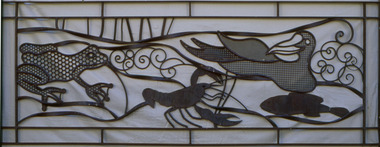
... environment. There is also a relevant aboriginal presence amongst each of the panels. Each panel represents the different areas that make up the Shire. ...environment. There is also a relevant aboriginal presence amongst each of the panels. Each panel represents the different areas that make up the Shire. ...In October 2000, Council invited three artists from the region (Deborah Halpern, Matcham Skipper, Tony Trembath) to submit designs for a sculpture / public art work for the Eltham Town Square. The commission was paid for by supermarket giant Safeway (Woolies) as part of its supermarket permit, which required them to contribute to beautification work in the Town Square.This is the first of three parts. The 'Spirit of Nillumbik' is a celebration of the artistic spirit of Eltham and surrounding communities. Each area is identified through the flora and fauna represented in the panels. The work honours the many creative artists and architects, past and present, who have built homes and shaped lives and livelihoods with their unique creative spirit. Halpern describes her work as a public expression of their individual and collective visions. Halpern acknowledges these contributions to our hand-made history and the influence they have on the character and identity of Eltham and Nillumbik. Five picture and six woven balustrades each made out of welded steel / organic wrought iron and coated with wax. Imagery (flora - plants, landscapes and fauna - animals, birds, reptiles, insects) are all based on the local environment. There is also a relevant aboriginal presence amongst each of the panels. Each panel represents the different areas that make up the Shire. 'Water' for Warrandyte, 'Kangaroos' for Christmas Hills, 'Cockatoos and 'Valley Creek Flats' for Hurstbridge, 'Wombats', 'Bluetongues' and 'Possums' for St. Andrews/Kinglake, 'Orchids' for Panton Hill, 'Cows' and 'Grapevines' for the Kangaroo Gound Hill landmark. N/Apublic art, nillumbik, fauna, flora, wrought iron, balustrade, halpern, laurence, kangaroo, eltham town square, spirit, warrandyte, christmas hills, kangaroo ground, hurstbridge, kinglake, panton hill, water, valley creek flats, cockatoos -
Koorie Heritage Trust
Book, Bourke, Colin, Before the invasion, Aboriginal life to 1788, 1980
... environment offered. It also covers families, clans, roles of men and women, attitudes to children and the old; and the religious world-view which determined the rhythm of their life and underlay all their laws art and music. The authors bring out the broad patterns Australia-wide, but they are careful to note the differences between groups in different ...Blurb: Before the Invasion gives a vivid overview of traditional Aboriginal life. It describes what Aborigines wore, their houses, weapons, tools, canoes, and shows their practical ingenuity and resourcefulness in making the most of what their environment offered. It also covers families, clans, roles of men and women, attitudes to children and the old; and the religious world-view which determined the rhythm of their life and underlay all their laws art and music. The authors bring out the broad patterns Australia-wide, but they are careful to note the differences between groups in different areas and to give specific documented examples...112 p. : ill. ; 21 x 23 cm.Blurb: Before the Invasion gives a vivid overview of traditional Aboriginal life. It describes what Aborigines wore, their houses, weapons, tools, canoes, and shows their practical ingenuity and resourcefulness in making the most of what their environment offered. It also covers families, clans, roles of men and women, attitudes to children and the old; and the religious world-view which determined the rhythm of their life and underlay all their laws art and music. The authors bring out the broad patterns Australia-wide, but they are careful to note the differences between groups in different areas and to give specific documented examples...1. aborigines, australian -- social life and customs. schools - project referencers. i. johnson, colin, joint author. ii. white, isobel m., joint author. iii. title -
 Ararat Gallery TAMA
Nanette Bourke, Grasstrees, a different perspective, 1992
... In contrast to the often joyous depictions of Australian native flora, Bourke’s imagery also presents a poignant reminder of humankind’s negative impact on the environment. Grasstrees, a different perspective Nanette Bourke ...Settling in Moyston in 1984, Nanette Bourke is a prominent figure in the Ararat and Grampians arts community, perhaps best known as a member of the ‘Grampians Four’ group of artists. Bourke has been a printmaker since the late 1960s, having studied at the Julian Ashton Art School in Sydney, and at art societies and the CAE in Melbourne before relocating to Western Victoria. Inspired by the woodcuts and linocuts by Melbourne artists of the 1920s and 1930s - Napier Waller, Murray Griffin, and especially Eric Thake - Bourke embraces the sophisticated results that can be achieved in this medium. Bourke holds a deep affinity with the natural environment, which is integral in her artistic life. Many of the works in this exhibition are inspired by the natural environment of the Grampians. In contrast to the often joyous depictions of Australian native flora, Bourke’s imagery also presents a poignant reminder of humankind’s negative impact on the environment. -
 Ararat Gallery TAMA
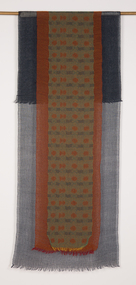
Jennifer Robertson, Forest near Norseman, 2005
... environment, human experience, and the expressive possibilities of textile materiality. At the time this work was made, Robertson was working with Australian fine merino wool, often with contrasting spun qualities, to develop a form of weaving in three layers simultaneously, creating different woven patterns on both sides of the cloth. ...environment, human experience, and the expressive possibilities of textile materiality. At the time this work was made, Robertson was working with Australian fine merino wool, often with contrasting spun qualities, to develop a form of weaving in three layers simultaneously, creating different woven patterns on both sides of the cloth. ...Jennifer Robertson obtained a BA Hons degree in Woven Textiles at West Surrey College and Art and Design. After migrating to Australia in 1986, she began researching the plant life in her new home to develop a language to present her experience of the Australian landscape. In the 1990s, Robertson received Australia Council funding to design and build a unique 32-shaft handloom. This complex loom has since become central to her internationally recognised practice, enabling her to explore the relationships between the natural environment, human experience, and the expressive possibilities of textile materiality. At the time this work was made, Robertson was working with Australian fine merino wool, often with contrasting spun qualities, to develop a form of weaving in three layers simultaneously, creating different woven patterns on both sides of the cloth. The artist said of this triple-layered cloth: “Metaphorically the three layers are the landscape, fine wool and the body.” -
 Ararat Gallery TAMA
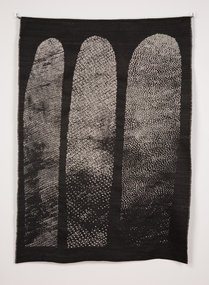
Jennifer Robertson, The Three Cones, 2004
... environment, human experience, and the expressive possibilities of textile materiality. At the time this work was made, Robertson was working with Australian fine merino wool, often with contrasting spun qualities, to develop a form of weaving in three layers simultaneously, creating different woven patterns on both sides of the cloth. ...environment, human experience, and the expressive possibilities of textile materiality. At the time this work was made, Robertson was working with Australian fine merino wool, often with contrasting spun qualities, to develop a form of weaving in three layers simultaneously, creating different woven patterns on both sides of the cloth. ...Jennifer Robertson obtained a BA Hons degree in Woven Textiles at West Surrey College and Art and Design. After migrating to Australia in 1986, she began researching the plant life in her new home to develop a language to present her experience of the Australian landscape. In the 1990s, Robertson received Australia Council funding to design and build a unique 32-shaft handloom. This complex loom has since become central to her internationally recognised practice, enabling her to explore the relationships between the natural environment, human experience, and the expressive possibilities of textile materiality. At the time this work was made, Robertson was working with Australian fine merino wool, often with contrasting spun qualities, to develop a form of weaving in three layers simultaneously, creating different woven patterns on both sides of the cloth. The artist said of this triple-layered cloth: “Metaphorically the three layers are the landscape, fine wool and the body.” -
 Ararat Gallery TAMA
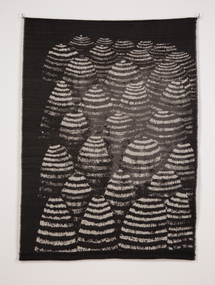
Jennifer Robertson, Landforms, Kimberley, 2004
... environment, human experience, and the expressive possibilities of textile materiality. At the time this work was made, Robertson was working with Australian fine merino wool, often with contrasting spun qualities, to develop a form of weaving in three layers simultaneously, creating different woven patterns on both sides of the cloth. ...environment, human experience, and the expressive possibilities of textile materiality. At the time this work was made, Robertson was working with Australian fine merino wool, often with contrasting spun qualities, to develop a form of weaving in three layers simultaneously, creating different woven patterns on both sides of the cloth. ...Jennifer Robertson obtained a BA Hons degree in Woven Textiles at West Surrey College and Art and Design. After migrating to Australia in 1986, she began researching the plant life in her new home to develop a language to present her experience of the Australian landscape. In the 1990s, Robertson received Australia Council funding to design and build a unique 32-shaft handloom. This complex loom has since become central to her internationally recognised practice, enabling her to explore the relationships between the natural environment, human experience, and the expressive possibilities of textile materiality. At the time this work was made, Robertson was working with Australian fine merino wool, often with contrasting spun qualities, to develop a form of weaving in three layers simultaneously, creating different woven patterns on both sides of the cloth. The artist said of this triple-layered cloth: “Metaphorically the three layers are the landscape, fine wool and the body.” -
 Surrey Hills Historical Society Collection
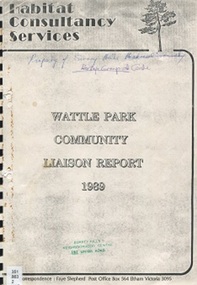
Book, Habitat Consulting Services, Wattle Park Community Liaison Report 1989, Sept 1989
... This is a report on the outcome of feedback re: the various areas of Wattle Park, including the natural environment, the constructed environment and the restoration projects of different areas of the park.Five major issues were identified: disability and elderly access to the park; staffing; dogs; security of parkland and personal safety; green issues....This is a report on the outcome of feedback re: the various areas of Wattle Park, including the natural environment, the constructed environment and the restoration projects of different areas of the park.Five major issues were identified: disability and elderly access to the park; staffing; dogs; security of parkland and personal safety; green issues. ...The role of the community consultation officer was to act as an interface between Board of Works and the community. This is a report on the outcome of feedback re: the various areas of Wattle Park, including the natural environment, the constructed environment and the restoration projects of different areas of the park.Five major issues were identified: disability and elderly access to the park; staffing; dogs; security of parkland and personal safety; green issues.A spiral bound photocopy of a report."Property of Surrey Hills Historical Society (Historical Society crossed out) / Heritage Group" (in Jocelyn Hall's handwriting)wattle park, jeanette norman, m m board of works, parks and recreation, wattle park advisory committee, bird observers club of victoria, wattle park golf club, 4 seasons tennis club, golf, wattle park chalet, doberman club of victoria, melbourne and metropolitan tramways band, surrey hills neighbourhood centre, residents action group of box hill south, (ms) faye shepherd -
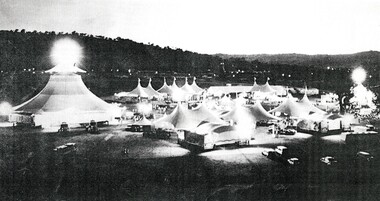 Wodonga & District Historical Society Inc
Photograph - Bicentennial Travelling Exhibition Wodonga, 1988
... The Exhibition focused on the concept "Living Together" through different modules based on themes of Journeys, Environment, Together, Identity, Today and Futures. ...The Exhibition focused on the concept "Living Together" through different modules based on themes of Journeys, Environment, Together, Identity, Today and Futures. ...The Bicentennial Travelling Exhibition was launched on 1st January 1988 at Wodonga Racecourse before touring Australia as part of the Australia-wide Bicentennial celebrations. In attendance were Prime Minister Bob Hawke, his wife Hazel, the Mayors of Albury and Wodonga, John Roach and John Macaulay as well as the Director of the Exhibition Mr Desmond Kennard. The Exhibition focused on the concept "Living Together" through different modules based on themes of Journeys, Environment, Together, Identity, Today and Futures. The Travelling Exhibition was hauled by 29 pantechnicons specially designed for the task by Daryl Jackson Pty Ltd of Melbourne. These vehicles also acted as large tent pegs, holding the large display tents in position. The Exhibition in Wodonga ran for five days and was forecast to attract a crowd of 18,000 per day. Two days were required to set the Exhibition up and another two days were needed to dismantle it. The dominating feature of the Exhibition was a 600-seat Bicentennial Theatre. Other displays were set up in each area to reflect the local community. From Wodonga the Exhibition travelled to 34 Australian cities and towns across all States and Territories. It featured a range of displays which travelled the entire journey of more than 30,000 kilometres on land as well as sea travel to Tasmania. These items are significant because they document the Bicentennial Touring Exhibition which began in Wodonga in January 1988.A collection of photos and memorabilia reflecting activities at the celebration of the Bicentennial in Wodonga in January 1988.australian bicentennial, bicentennial wodonga, bicentennial travelling exhibition
