
Showing 76 items matching "disease management"
-
 Beechworth Honey Archive
Publication, The Australian apiary industry: pest and disease management. (Hooper, Ben). Moana, 2011, 2011
... The Australian apiary industry: pest and disease management. (Hooper, Ben). Moana, 2011....The Australian apiary industry: pest and disease management. (Hooper, Ben). Moana, 2011. Publication ...31 pages, illustrated. -
 University of Melbourne, Burnley Campus Archives
Book - Scrapbook, Special Articles, 1927-1940
... ...Disease management...In Book 1 most articles are concerned with general articles about plants, disease management in the districts, growing media and horticultural techniques. ...In Book 1 most articles are concerned with general articles about plants, disease management in the districts, growing media and horticultural techniques. ...2 Cloth bound books with leather spine and corners on front and back cover - 399 pages each. The books each have hand inked alphabetical indexes. They are scrapbooks used to catelogue a variety of articles from newspapers and magazines 1927-1940 - glued or pinned in place. In Book 1 most articles are concerned with general articles about plants, disease management in the districts, growing media and horticultural techniques. There are also cuttings about Botanical Gardens and significant horticulturalists of the day. Book two is thematically Garden and kitchen garden cuttings. It includes one about a Burnley Flower Competition (P58) and an article by Edna Walling "To Save the Elms". These may have been used to inform teaching at Burnley. Subsequently each scrap book has been stored with a detailed 7 page handwritten list of contents in page order by the cataloguer (Elizabeth Hill, 1994). Not all pages are used. 2 inserts in plastic sleeves are in the rear of the first book B92.0584 a and b.Special Articlesnewspaper and magazine articles, plants, growing media, horticultural techniques, botanical gardens, significant horticulturalists, burnley flower show, edna walling, kitchen gardens, disease management -
 Musculoskeletal Health Australia (now held by the Glen Eira Historical Society)
Photograph - Group photo, Circa late 1990s to early 2000s
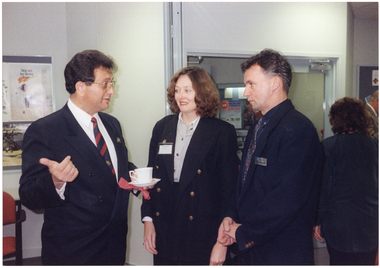
... disease... self management...The Chronic Disease Self Management (CDSM) program was launched by the Minister for Veteran Affairs at the Arthritis Foundation of Victoria's headquarters in Elsternwick. ...The Chronic Disease Self Management (CDSM) program was launched by the Minister for Veteran Affairs at the Arthritis Foundation of Victoria's headquarters in Elsternwick. ...The Chronic Disease Self Management (CDSM) program was launched by the Minister for Veteran Affairs at the Arthritis Foundation of Victoria's headquarters in Elsternwick. In this photo, the Minister is chatting to two people after the formalities have concluded.COL photo of three people standing close to one another, chatting. One of them is holding a white cup and saucer in one hand while gesticulating with the other. In the background, there are a few people standing to the right of the frame.arthritis foundation of victoria, afv, osteoporosis victoria, ov, information displays, chronic disease, self management, pain management, program, launch, minister for veteran affairs, c1990s, c2000s -
 Musculoskeletal Health Australia (now held by the Glen Eira Historical Society)
Photograph - Group photo, Circa late 1990s to early 2000s
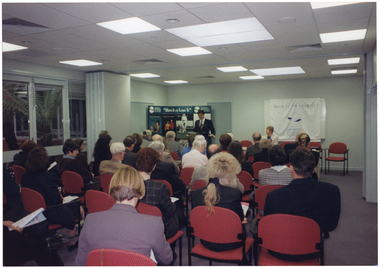
... disease... self management...The Chronic Disease Self Management (CDSM) program was launched by the Minister for Veteran Affairs at the Arthritis Foundation of Victoria's headquarters in Elsternwick. ...The Chronic Disease Self Management (CDSM) program was launched by the Minister for Veteran Affairs at the Arthritis Foundation of Victoria's headquarters in Elsternwick. ...The Chronic Disease Self Management (CDSM) program was launched by the Minister for Veteran Affairs at the Arthritis Foundation of Victoria's headquarters in Elsternwick. In this photo, the Mininster for Veterans Affairs (standing) addresses attendees at the launch. Seated at a table beside him is the Foundation's CEO, Shirley Caulfield.COL photo of a man, standing at a lectern, speaking to a large group of people (seated) in a large room. Beside him, there is a woman seated at a table, facing the group. Behind them is a large freestanding Arthritis Foundation of Victoria display board and a large white and blue banner draped across a whiteboard fixed to the wall. Both the display board and the banner contain the text "Move It or Lose It" as a heading. The room contains bi-fold doors, which have been folded back to connect two rooms into one. On the left of the frame, there are some large windows through which a small palm tree is visible.arthritis foundation of victoria, afv, osteoporosis victoria, ov, shirley caulfield, ceo, information displays, chronic disease, self management, pain management, program, launch, minister for veteran affairs, c1990s, c2000s -
 Musculoskeletal Health Australia (now held by the Glen Eira Historical Society)
Photograph - Group photo, Circa late 1990s to early 2000s
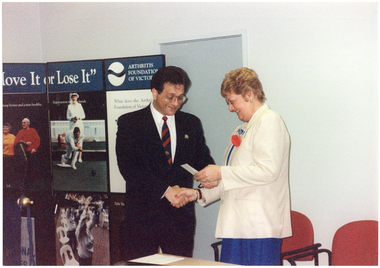
... disease... self management...The Chronic Disease Self Management (CDSM) program was launched by the Minister for Veteran Affairs at the Arthritis Foundation of Victoria's headquarters in Elsternwick. ...The Chronic Disease Self Management (CDSM) program was launched by the Minister for Veteran Affairs at the Arthritis Foundation of Victoria's headquarters in Elsternwick. ...The Chronic Disease Self Management (CDSM) program was launched by the Minister for Veteran Affairs at the Arthritis Foundation of Victoria's headquarters in Elsternwick. In this photo, the Mininster shakes hands with the CEO of Arthritis Victoria, Shirley Caulfield, after presenting her with a cheque to assist in funding the program.COL photo of a man and a woman, (both standing), shaking hands. The woman is holding a small piece of paper and they are both smiling. Behind them is an Arthritis Foundation of Victoria "Move It Or Lose It" display board with information and posters.arthritis foundation of victoria, afv, osteoporosis victoria, ov, shirley caulfield, ceo, information displays, chronic disease, self management, pain management, program, launch, minister for veteran affairs, c1990s, c2000s -
 Musculoskeletal Health Australia (now held by the Glen Eira Historical Society)
Photograph - Group photo, Circa late 1990s to early 2000s
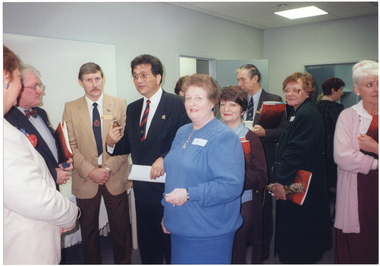
... disease... self management...The Chronic Disease Self Management (CDSM) program was launched by the Minister for Veteran Affairs at the Arthritis Foundation of Victoria's headquarters in Elsternwick. ...The Chronic Disease Self Management (CDSM) program was launched by the Minister for Veteran Affairs at the Arthritis Foundation of Victoria's headquarters in Elsternwick. ...The Chronic Disease Self Management (CDSM) program was launched by the Minister for Veteran Affairs at the Arthritis Foundation of Victoria's headquarters in Elsternwick. In this photo, a group of people gather around the Minister and the Foundation's CEO, Shirley Caulfield (partially obscured), after the formalities have concluded.COL photo of a group of people standing in a room. Many of them are holding one or more large printed programs with a red cover.arthritis foundation of victoria, afv, osteoporosis victoria, ov, shirley caulfield, ceo, chronic disease, self management, pain management, program, launch, minister for veteran affairs, c1990s, c2000s -
 Musculoskeletal Health Australia (now held by the Glen Eira Historical Society)
Photograph - Group photo, Circa late 1990s to early 2000s
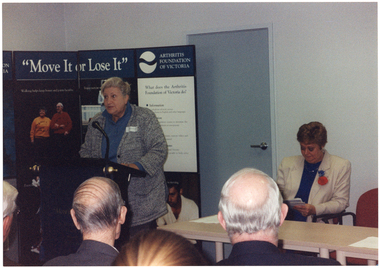
... disease... self management...The Chronic Disease Self Management (CDSM) program was launched by the Minister for Veteran Affairs at the Arthritis Foundation of Victoria's headquarters in Elsternwick. ...The Chronic Disease Self Management (CDSM) program was launched by the Minister for Veteran Affairs at the Arthritis Foundation of Victoria's headquarters in Elsternwick. ...The Chronic Disease Self Management (CDSM) program was launched by the Minister for Veteran Affairs at the Arthritis Foundation of Victoria's headquarters in Elsternwick. In this photo, CDSM Leader, Thelma Kendall, addresses attendees at the CDSM launch. Seated at a table beside her is the Foundation's CEO, Shirley Caulfield.COL photo of a woman standing at a black lectern, speaking into a microphone. Beside her, there is another woman sitting at a long rectangular table. Behind her, there is a freestanding display board with the heading, "Move It or Lose It", the Arthritis Foundation of Victoria text and logo, and various posters and information. In the foreground, there are a few people sitting in the audience (partially obscured), facing them.[On a yellow sticky note printed with the text "URGENT, To: From: Date: Beautone #11421", and handwritten in blue ink] Thelma Kendall CDSM Leader at the Launch of the Project by the Min for Veteran Affairsarthritis foundation of victoria, afv, osteoporosis victoria, ov, shirley caulfield, ceo, information displays, chronic disease, self management, pain management, program, launch, minister for veteran affairs, thelma kendall, leader, c1990s, c2000s -
Northern District School of Nursing. Managed by Bendigo Historical Society Inc.
Administrative record - Northern District School of Nursing Graduates Association - Examinations and Instruction Guides, Dec 1976
... It covers a range of medical and surgical nursing topics, focusing on patient care, disease management, and clinical reasoning. 3794.11d This document serves as a guide for examiners assessing general nursing examinations, outlining the essential knowledge and skills expected from candidates. 3794.11e This document is a surgical nursing examination paper covering essential topics in post-operative care, complications, and related medical concepts. ...It covers a range of medical and surgical nursing topics, focusing on patient care, disease management, and clinical reasoning. 3794.11d This document serves as a guide for examiners assessing general nursing examinations, outlining the essential knowledge and skills expected from candidates. 3794.11e This document is a surgical nursing examination paper covering essential topics in post-operative care, complications, and related medical concepts. ...The Northern District School of Nursing in Victoria, Australia Graduates Association: History of the School Managed by a committee including hospital administrators, medical professionals, and nursing leaders from several regional hospitals. Associated with major hospitals in the Northern District, including Bendigo Base, Mildura Base, Castlemaine, Echuca, Swan Hill, St. Arnaud, and Kyneton District Hospitals. Provide high-quality theoretical and practical nursing training. Raise the standard of nursing education in the region. Maintain the highest principles of nursing practice. Applicants must be at least 17 years old and hold a Proficiency Certificate or higher educational qualification. Application involves submitting forms, certificates, an interview, an aptitude test, and a medical examination. A three-month probationary period follows initial acceptance. Preliminary Training School: Four-week introductory course covering basic nursing, anatomy, hygiene, and practical skills. Practical experience in various hospital departments, guided by senior staff. Study Block Plan: Includes several blocks of theoretical and practical instruction throughout the three-year program. Regular school exams and two state exams (First Professional and Final State) are required for progression and graduation. Nurses work a 40-hour week with at least one or two days off per week and three weeks of annual leave. Accommodation is provided in comfortable hostels with good facilities. Uniforms are supplied free; nurses provide their own shoes and stockings. Salaries and allowances are regulated, with deductions for board and free medical care. Additional Information Post-Graduate Opportunities. Senior positions require further experience and additional certificates (e.g., Midwifery, Infant Welfare).Diploma courses available in administration, teaching, and specialized nursing fields. Bursaries are available for advanced study.Career Prospects: Graduates can pursue roles in administration, teaching, ward and departmental leadership, district and visiting nursing, industrial and school nursing, and more. Opportunities existed both within hospitals and in community or specialized settings.FAQs and Practical Details. Minimal training costs (mainly exam fees and personal items).Living out allowances and travel expenses are covered. Four training intakes per year; waiting periods are short if qualifications are met.Northern District School of Nursing Graduates Association - Examinations and Instruction Guides Dec 1976 This item contains the following documents: 3794.11a This document is a nursing examination paper focused on medical and nursing care for a range of acute and chronic conditions. 3794.11b This document is an examiners' guide for a general nurse training medical nursing paper, outlining essential knowledge and expected answers for key medical and nursing topics. 3794.11c This document is a nursing examination paper from the Victorian Nursing Council, dated December 2, 1976, for general nurse training. It covers a range of medical and surgical nursing topics, focusing on patient care, disease management, and clinical reasoning. 3794.11d This document serves as a guide for examiners assessing general nursing examinations, outlining the essential knowledge and skills expected from candidates. 3794.11e This document is a surgical nursing examination paper covering essential topics in post-operative care, complications, and related medical concepts. nurse training, lister house, examinations -
Northern District School of Nursing. Managed by Bendigo Historical Society Inc.
Administrative record - Northern District School of Nursing Graduates Association - Examinations and Guides, 1987
... Northern District School of Nursing Graduates Association - Examinations and Guides 1987 This item contains the following documents: 3795.12a This document is a set of compulsory examination questions for nursing students, focusing on surgical nursing. 3795.12b This document is a Victorian Nursing Council examination paper for general nurses, focusing on surgical nursing scenarios and patient management. 3795.12c This document is a Victorian Nursing Council examination paper for general nurses, focusing on surgical nursing scenarios and clinical management. 3795.12d This document is a general and medical nursing examination paper covering key areas of patient management, disease processes, and nursing care procedures....Nurse Training Lister House examinations Northern District School of Nursing Graduates Association - Examinations and Guides 1987 This item contains the following documents: 3795.12a This document is a set of compulsory examination questions for nursing students, focusing on surgical nursing. 3795.12b This document is a Victorian Nursing Council examination paper for general nurses, focusing on surgical nursing scenarios and patient management. 3795.12c This document is a Victorian Nursing Council examination paper for general nurses, focusing on surgical nursing scenarios and clinical management. 3795.12d This document is a general and medical nursing examination paper covering key areas of patient management, disease processes, and nursing care procedures. ...The Northern District School of Nursing in Victoria, Australia Graduates Association: History of the School Managed by a committee including hospital administrators, medical professionals, and nursing leaders from several regional hospitals. Associated with major hospitals in the Northern District, including Bendigo Base, Mildura Base, Castlemaine, Echuca, Swan Hill, St. Arnaud, and Kyneton District Hospitals. Provide high-quality theoretical and practical nursing training. Raise the standard of nursing education in the region. Maintain the highest principles of nursing practice. Applicants must be at least 17 years old and hold a Proficiency Certificate or higher educational qualification. Application involves submitting forms, certificates, an interview, an aptitude test, and a medical examination. A three-month probationary period follows initial acceptance. Preliminary Training School: Four-week introductory course covering basic nursing, anatomy, hygiene, and practical skills. Practical experience in various hospital departments, guided by senior staff. Study Block Plan: Includes several blocks of theoretical and practical instruction throughout the three-year program. Regular school exams and two state exams (First Professional and Final State) are required for progression and graduation. Nurses work a 40-hour week with at least one or two days off per week and three weeks of annual leave. Accommodation is provided in comfortable hostels with good facilities. Uniforms are supplied free; nurses provide their own shoes and stockings. Salaries and allowances are regulated, with deductions for board and free medical care. Additional Information Post-Graduate Opportunities. Senior positions require further experience and additional certificates (e.g., Midwifery, Infant Welfare).Diploma courses available in administration, teaching, and specialized nursing fields. Bursaries are available for advanced study.Career Prospects: Graduates can pursue roles in administration, teaching, ward and departmental leadership, district and visiting nursing, industrial and school nursing, and more. Opportunities existed both within hospitals and in community or specialized settings.FAQs and Practical Details. Minimal training costs (mainly exam fees and personal items).Living out allowances and travel expenses are covered. Four training intakes per year; waiting periods are short if qualifications are met.Northern District School of Nursing Graduates Association - Examinations and Guides 1987 This item contains the following documents: 3795.12a This document is a set of compulsory examination questions for nursing students, focusing on surgical nursing. 3795.12b This document is a Victorian Nursing Council examination paper for general nurses, focusing on surgical nursing scenarios and patient management. 3795.12c This document is a Victorian Nursing Council examination paper for general nurses, focusing on surgical nursing scenarios and clinical management. 3795.12d This document is a general and medical nursing examination paper covering key areas of patient management, disease processes, and nursing care procedures.nurse training, lister house, examinations -
 Mont De Lancey
Book, The Editor et al, The Practical Home Physician and Encyclopedia of Medicine, 1800's
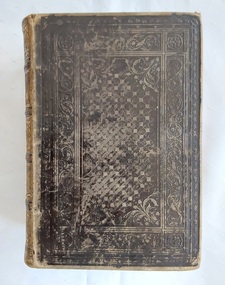
... A thick, brown leather hardcover vintage book, The Practical Home Physician and Encyclopedia of Medicine: A Guide for the Household Management of Disease; The Care of the Sick. Directions for treating Wounds Injuries and Poisons - Illustrated. ...'Francis Robert born 31st March 1896' ending with ' Ada Lousia born 19th November (crossed out and replaced with) August 1916' A thick, brown leather hardcover vintage book, The Practical Home Physician and Encyclopedia of Medicine: A Guide for the Household Management of Disease; The Care of the Sick. Directions for treating Wounds Injuries and Poisons - Illustrated. ...This Australasian edition specially revised and adapted to the colonies of Australia, Tasmania and New Zealand. The Practical Home Physician and Encyclopedia of Medicine, a late 19th-century medical guide, provided household management advice for the common diseases of men, women, and children. It was widely available in the 1880s, often in an Australasian edition revised for the colonies, by the World Publishing Co. Edited by prominent physicians such as Henry M. Lyman, it was a popular and illustrated resource for home use, containing information on prevention, symptoms, and treatment methods, along with sections on care for the sick.A thick, brown leather hardcover vintage book, The Practical Home Physician and Encyclopedia of Medicine: A Guide for the Household Management of Disease; The Care of the Sick. Directions for treating Wounds Injuries and Poisons - Illustrated. It has a blind tooled decoration on the front cover and a gilt title and the word, Illustrated, with five gilt raised bands on the highly decorative spine and faded marbled edges to the pages. A coloured illustration of the male anatomy is opposite the title page, covered by tissue paper which has foxed markings. The book is embellished and illustrated by numerous Plates of superb character, coloured after nature and other fine engravings. Some of these engravings are multi layered and open out to show muscles, organs and skeleton.There is a Publisher and Author's, Index to General Division and a Table of Contents. At the back is a Medical Dictionary or Glossary, a Prescription Register and an Index. Pp.1142.non-fictionThis Australasian edition specially revised and adapted to the colonies of Australia, Tasmania and New Zealand. The Practical Home Physician and Encyclopedia of Medicine, a late 19th-century medical guide, provided household management advice for the common diseases of men, women, and children. It was widely available in the 1880s, often in an Australasian edition revised for the colonies, by the World Publishing Co. Edited by prominent physicians such as Henry M. Lyman, it was a popular and illustrated resource for home use, containing information on prevention, symptoms, and treatment methods, along with sections on care for the sick. health, human body, biology, medical reference -
![Poster - Infantile Paralysis Notice, Shire of Mortlake, infantile Paralysis registration of cases, [14/8/1937]](/media/collectors/4f729f5b97f83e0308601618/items/4f72acc197f83e030860399a/item-media/4f72acc197f83e030860399c/item-fit-380x285.jpg?cb=6) Mortlake and District Historical Society
Mortlake and District Historical SocietyPoster - Infantile Paralysis Notice, Shire of Mortlake, infantile Paralysis registration of cases, [14/8/1937]
... management was difficult - paralysis in varying degrees was the usual outcome. Public concern was high especially concerning children. One of the most significant Australians to suffer from this disease, was Alan Marshall (1902 -1984) who was born in Noorat, 15 kilometres from Mortlake. ...Polio, EpidemicOutbreaks of poliomyelitis were common up until the 1950's when vaccine became available. The cause was not known and management was difficult - paralysis in varying degrees was the usual outcome. Public concern was high especially concerning children. One of the most significant Australians to suffer from this disease, was Alan Marshall (1902 -1984) who was born in Noorat, 15 kilometres from Mortlake. He wrote an account of his boyhood after he was struck down by the disease, in the internationally acclaimed 'I can jump puddles' (1955).Rectangular piece of calico, poster.'Shire of Mortlake. INFANTILE PARALYSIS. 1. Parents or Guardians of all children aged eighteen and under coming into the Shire of Mortlake from the Metropolitan or any other area affected with Infantile Paralysis, MUST REGISTER such children immediately either personally or by post at the Shire Hall, Mortlake. 2. Parents or Guardians of such "registered" children are requested to keep them away from all public gatherings and from all contact with other children for a period of Twenty-one days, and in the event of any illness to consult a Doctor immediately. 3. Residents of the Shire with children living in the house are requested in their own interests, not to take into their homes, or allow their children to have contact with, any "registered" child. 4. The following particulars are required upon registration:- Name, Age, Sex, Local Address, Metropolitan School, Grade, Metropolitan Address, Date of Leaving Metropolitan or affected area. Registration forms may be obtained at the Shire Hall, Mortlake, and at all Post Offices within the Shire. By Order, N.TURNBULL, Shire Secretary. MORTLAKE, 14/81937. ' -
 Eltham District Historical Society Inc
Book, Michael Jones, Nature's plenty : a history of the City of Whittlesea, 1992
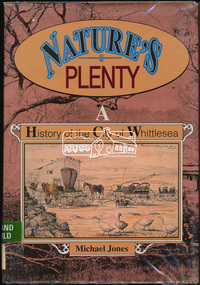
... management system' now buried under Yan Yean reservoir. Smallpox epidemics among Aboriginal people prior to settlement - probably from the activity of nearby European sealers. Estimations of Aboriginal populations. Scattered references throughout. Subjects Health - Infectious diseases...management system' now buried under Yan Yean reservoir. Smallpox epidemics among Aboriginal people prior to settlement - probably from the activity of nearby European sealers. Estimations of Aboriginal populations. Scattered references throughout. Subjects Health - Infectious diseases ...This book explores Whittlesea's history from early 1830's to 1991. Environment of the Aboriginal people about the the time of European settlement. Possible use of a 'swamp management system' now buried under Yan Yean reservoir. Smallpox epidemics among Aboriginal people prior to settlement - probably from the activity of nearby European sealers. Estimations of Aboriginal populations. Scattered references throughout. Subjects Health - Infectious diseases - Smallpox. Settlement and contacts - Colonisation - 1788-1850. Settlement and contacts - Colonisation - 1851- Environment - Land management. Demography. Woiwurrung / Wurundjeri / Woiwurung people (S36) (Vic SJ55-05) Yan Yean (Vic SJ55-05) Eden Park (Vic SJ55-05) Whittlesea (Vic SJ55-05) Diamond Creek (Vic SJ55-05) Kingslake (Vic SJ55-05) Whittlesea (Vic.) -- History.xvi, 319 p., [16] p. of plates : ill. (some col.), maps (some col.), ports. ; 28 cm. the plenty, farming, settlement, gold rush, plenty river, donnybrook, germantown, separation, thomastown, whittlesea, epping, woodstock, city of whittlesea, railway, yan yean, roll of honour -
 Bendigo Historical Society Inc.
Administrative record - Annual Report Bendigo Hospital
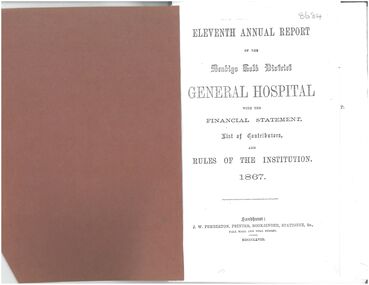
... Management...Annual Report...1860s...Finance...Health...Illness and Disease...Bendigo Hospital Bendigo Hospital Committee of Management Annual Report 1860s Finance Health Illness and Disease Photocopy booklet of two annual reports for the Bendigo Gold District General Hospital with the Financial Statement, List of Contributors and the Rules of the Institution. ...Photocopy booklet of two annual reports for the Bendigo Gold District General Hospital with the Financial Statement, List of Contributors and the Rules of the Institution. The Eleventh Annual Report for 1867 (23 pages) and the Twelfth Annual Report for 1868 (27 pages) are included. Information includes officers for the upcoming year, dates and times of annual meeting, report to Board of Management, details of meetings held during the year, table of cases treated as in-patients, list of annual contributors, life contributors, surgeons report. The printers of the original document were J. W. Pemberton, Printer, Bookbinder, Stationer, Pall Mall and Bull Street, Sandhurst.bendigo hospital, bendigo hospital committee of management, annual report, 1860s, finance, health, illness and disease -
 Bendigo Historical Society Inc.
Administrative record - Annual Report
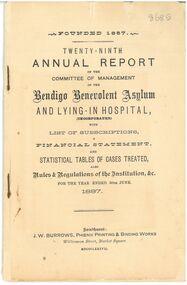
... Bendigo Hospital Annual Report 1860s Finance Health Illness and Disease Bendigo Benevolent Asylum Original booklet of the twenty ninth annual report for the Bendigo Benevolent Asylum with the Financial Statement, List of Subscriptions, Statistical Table of Cases Treated and the Rules of the Institution, for the year 1887. Information includes officers for the upcoming year, dates and times of annual meeting, report from the Committee of Management ...Original booklet of the twenty ninth annual report for the Bendigo Benevolent Asylum with the Financial Statement, List of Subscriptions, Statistical Table of Cases Treated and the Rules of the Institution, for the year 1887. Information includes officers for the upcoming year, dates and times of annual meeting, report from the Committee of Management, table of cases treated as in-patients, list of annual contributors, life governors, medical officers report. The printers of the original document were J. W. Pemberton, Printer, Bookbinder, Stationer, Pall Mall and Bull Street, Sandhurst.bendigo hospital, annual report, 1860s, finance, health, illness and disease, bendigo benevolent asylum -
Bendigo Historical Society Inc.
Administrative record - Commercial Egg Producers' Association of Victoria (CEPA) Central Council Correspondence, 1979
... Foster's persistent efforts to maintain demand and supply management legislation for poultry in the state. 8504.35d This document is a formal letter to the Poultry Research Advisory Council, dated January 6, 1980, expressing support for ongoing efforts and making key recommendations 8504.35e Letter to the Department of Agriculture, Division of Animal Healy re a possible outbreak of an exotic disease. 8504.35f The document is a letter addressed to the Minister of Agriculture, summarizing The importance of Random Sample Laying Tests 8504.35g The document is a letter from the Secretary of an agricultural association expressing concerns about the upcoming inquiry into the Egg Board. ...Foster's persistent efforts to maintain demand and supply management legislation for poultry in the state. 8504.35d This document is a formal letter to the Poultry Research Advisory Council, dated January 6, 1980, expressing support for ongoing efforts and making key recommendations 8504.35e Letter to the Department of Agriculture, Division of Animal Healy re a possible outbreak of an exotic disease. 8504.35f The document is a letter addressed to the Minister of Agriculture, summarizing The importance of Random Sample Laying Tests 8504.35g The document is a letter from the Secretary of an agricultural association expressing concerns about the upcoming inquiry into the Egg Board. ...The Commercial Egg Producers' Association of Victoria was active by the 1930s, engaging in industry management and lobbying.The Commercial Egg Producer's Association (CEPA) had branches in Bendigo, South Bendigo, Eaglehawk, Wedderburn, Murrabit and Euroa.CEPA Commercial Egg Producer's Association (Bendigo Region) correspondence, for the year 1979. This item includes the following documents: 8504.35a Minutes of Branch half yearly conference 1979 8504.35b The document is a letter from K. Fitzgibbon, Secretary of the Central Council, addressed to Mr. C. L. Jefferson, Secretary of the Victorian Egg Marketing Board. Congratulation on Meeting Reduction:The Central Council commends the A.E.B. and C.E.M.A.A. for reducing their meetings to two per year. 8504.35c This document is a letter from K. Fitzgibbon, Secretary of the association, addressed to Mr. D. J. Foster, Chairman of the Federal Council of Poultry Farmers' Association of Australia. Gratitude for Legislative SupportThe letter expresses appreciation for Mr. Foster's persistent efforts to maintain demand and supply management legislation for poultry in the state. 8504.35d This document is a formal letter to the Poultry Research Advisory Council, dated January 6, 1980, expressing support for ongoing efforts and making key recommendations 8504.35e Letter to the Department of Agriculture, Division of Animal Healy re a possible outbreak of an exotic disease. 8504.35f The document is a letter addressed to the Minister of Agriculture, summarizing The importance of Random Sample Laying Tests 8504.35g The document is a letter from the Secretary of an agricultural association expressing concerns about the upcoming inquiry into the Egg Board. The association acknowledges the government's decision to extend the Egg Industry Stabilization Act Legislation for another 12 months. 8504.35h This document is a thank-you letter from the secretary of an association addressed to Hon. John Radford, M.L.C. The association expresses gratitude to John Radford for his support and efforts regarding the Egg Industry Stabilization Act. 8504.35i The document is a formal letter from the association to the Victorian Egg Marketing Board, proposing that with regards to the Producer Price Increase that the they suggest that the advance price paid to egg producers should be increased.The recommended increase should be in line with the Consumer Price Index (CPI), not just based on cost of production. 8504.35j Notice of half yearly conference 8504.35k The document is a letter from the Commercial Egg & Producers Association of Victoria expressing urgent concern about the government's reported intention to discontinue the Egg Industry Stabilization Act as of March 1980. The association requests that John Radford raise this issue with the Minister of Agriculture and, if the statement is accurate, arrange an immediate meeting with the Liberal Party Parliamentary Agriculture Committee to present their case. 8504.35l This document is a formal letter addressed to Mr. Cecil Burgin, Convenor of the Agricultural Committee of the Parliamentary Liberal Party. The letter is signed by K. Fitzgibbon, Secretary, and highlights the urgency and significance of resolving disagreements over the egg industry legislation. 8504.35m This document is a formal letter to the Secretary of the Liberal Party in Victoria. CPA requests the names and contact details of the Agricultural Committee of the Parliamentary Liberal Party. 8504.35n The Commercial Egg Producers' Association of Victoria expresses disappointment with the Minister of Agriculture's stance on the indefinite continuation of the Egg Industry Stabilisation Legislation. 8504.35o The document is a protest letter from the Commercial Egg Producers' Association of Victoria, addressed to Mrs. Jeanette Patrick, Secretary of the Liberal Party. The Association is protesting the selection of members for the New Victorian Egg Board. 8504.35p Notable recipients include Mr. B. Reid, Mr. D. McClure, Mr. W. Ebery, Mr. J. Radford, Mr. E. Hann (M.L.A., Echuca), Mr. P. Ross-Edwards (Leader National Party), and Mr. N. McKenzie (Executive Officer, Poultry Section V.F.U., Melbourne) 8504.35q This document outlines the formal hierarchy and key officials in the government. 8504.35r Newspaper article: "Stability and Efficiency in the Australian Egg IndustryDemand and supply management has made the Australian egg industry the most stable among major producers globally." 8504.35s The document is a letter from the Commercial Egg Producers' Association of Victoria expressing concerns about recent changes to the Victorian Egg Board. Concerns Over Appointment Process. The Association is troubled by how the new appointments were made, feeling the process lacked transparency and justification. 8504.35t The document highlights concerns about the political influence and governance of the Victorian Egg Producers Board:Board Member Changes: The Minister has replaced three Board members and the Chairman, which is the maximum allowed in a year. 8504.35u CEPA Annual Conference business Paper June 1979 8504.35v Notice of annual meeting 8504.35w This document is a formal letter from K. Fitzgibbon, Secretary of the association, addressed to the Minister of Agriculture. It responds to a previous request for nominations to fill a vacancy on the Victorian Egg Marketing Board. Three candidates are nominated for the vacancy: L. F. Bessy: Recognized for previous contributions to the Board and known qualifications.Ronald Robins (Harcourt): Has 30 years of experience in the poultry industry, currently operates 12,000 layers, is a director and past Chairman of the Commercial Egg Producers Co-operative, and is a member of the local fire brigade.John Scott (Maiden Gully): Has 21 years of experience in the poultry industry, currently operates 3,000 laying hens, involved in all aspects of poultry production, is President of the South Bendigo Branch E.P.A., and a member of the local fire brigade. 8504.35x The document is a formal letter addressed to the Minister of Agriculture, highlighting concerns about uncertainty regarding the future of the Stabilization Act in Victoria. There is widespread panic selling of hen quotas in rural areas due to rumors about possible changes, such as quotas being tied to farms, surrendered to the Licensing Committee, or prices being pegged. 8504.35y This document is a letter addressed to the Premier of Victoria, expressing concerns about uncertainty regarding the continuation of the Stabilization Act for poultry farmers. There is widespread panic selling of hen quotas among poultry farmers in rural areas due to rumors about potential changes to quota regulations, such as quotas being tied to farms, surrendered to the Licensing Committee, or prices being pegged. 8504.35z The document is a formal request addressed to the Secretary of the Federal Council of Poultry Farmers' Associations of Australia. Inclusion Request: The sender, K. Fitzgibbon (Secretary), asks for a specific item to be added to the agenda for the upcoming Annual and General Meeting.Investigation of Surplus Egg Sales:The agenda item proposes an investigation into the sale of surplus eggs from fertile egg farms. 8504.35aa This document is a formal letter from CEPA to the Victorian Egg Marketing Board. The Association is submitting research project suggestions for consideration by the Board. 8504.35ab The document is a protest letter addressed to the State Director of the Liberal Party of Australia. Objection to Ministerial Appointments:Members at a recent conference unanimously objected to V.E.B. (Victorian Egg Board) members being appointed by the Minister of Agriculture.The method is described as undemocratic. 8504.35ac The document is a formal protest letter expressing concerns about the appointment process for V.E.B. (Victorian Egg Board) members. Objection to Ministerial Appointments:The letter strongly opposes the practice of the Minister of Agriculture appointing V.E.B. members, describing it as undemocratic. 8504.35ad The document is a formal protest letter expressing concerns about the appointment process for V.E.B. (Victorian Egg Board) members. Objection to Ministerial Appointments:The letter strongly opposes the practice of the Minister of Agriculture appointing V.E.B. members, describing it as undemocratic. 8504.35ae The document is a formal protest letter expressing concerns about the appointment process for V.E.B. (Victorian Egg Board) members. Objection to Ministerial Appointments:The letter strongly opposes the practice of the Minister of Agriculture appointing V.E.B. members, describing it as undemocratic. 8504.35af The document is a letter from the Secretary of CEPA addressed to the State Director of the Liberal Party of Australia. The poultry industry in Victoria is approaching the final year of its current licensing legislation.The association is seeking political support for the continuation of Licensing and Demand Supply Management policies in Victoria. 8504.35ag The document is a letter from the Secretary of CEPA addressed to the State Director of the Liberal Party of Australia. The poultry industry in Victoria is approaching the final year of its current licensing legislation.The association is seeking political support for the continuation of Licensing and Demand Supply Management policies in Victoria. 8504.35ah The document is a letter from the Secretary of CEPA addressed to the State Director of the Liberal Party of Australia. The poultry industry in Victoria is approaching the final year of its current licensing legislation.The association is seeking political support for the continuation of Licensing and Demand Supply Management policies in Victoria. 8504.35ai The document is a letter from the Secretary of CEPA addressed to the State Director of the Liberal Party of Australia. The poultry industry in Victoria is approaching the final year of its current licensing legislation.The association is seeking political support for the continuation of Licensing and Demand Supply Management policies in Victoria. 8504.35aj The document is a letter from the Secretary of CEPA addressed to the State Director of the Liberal Party of Australia. The poultry industry in Victoria is approaching the final year of its current licensing legislation.The association is seeking political support for the continuation of Licensing and Demand Supply Management policies in Victoria. 8504.35ak The document is a letter from the Commercial Egg Producers' Association, written by Secretary K. Fitzgibbon, addressing Mr. S. McDonald regarding compensation payments for fire damage 8504.35al 8504.35ak The document is a letter from the Commercial Egg Producers' Association, written by Secretary K. Fitzgibbon, addressing Mr. B. Reid regarding compensation payments for fire damage 8504.35am The document is a letter from the Commercial Egg Producers' Association, written by Secretary K. Fitzgibbon, addressing Mr. W. Ebery regarding compensation payments for fire damage 8504.35an 8504.35am The document is a letter from the Commercial Egg Producers' Association, written by Secretary K. Fitzgibbon, addressing Mr. D. McClure regarding compensation payments for fire damage 8504.35ao This document is a formal letter from the Central Council of the Commercial Egg Producers Association of Victoria, dated January 10, 1979. The letter recommends that all non-government delegate members attending Poultry Research Advisory Council meetings should be reimbursed for out-of-pocket and travel expenses 8504.35ap The document is a letter from the Secretary of CEPA to the Director General of Agriculture, highlighting two main concerns: Retention of Genetic Laying Stock in Victoria:The Association urges efforts to retain genetic laying stock, especially in light of suggestions to sell the flock at Dookie.There is awareness of remaining pure-bred stock in Victoria, and a question is raised about their availability for sale to new breeders.Concerns About Cage-Kept Birds:The Association addresses ongoing public discussion about keeping birds in cages.They express concern that the Department of Agriculture's actions, such as inviting Dr. Linda Murphy to a Field Day, may increase publicity on this issue. 8504.35aq The document is a formal letter from the Secretary of the Commercial Egg Producers Association Co-operative Ltd. to Mr. W Cramer. The Association wishes to maintain a close relationship with the Heat Board. They express willingness to act as an agent for the Wheat Board if possible. 8504.35ar Minutes of the CEPA General Council Annual conference June 1979 8504.35as Minutes of a branch meeting of CEPA 8504.35at Government of Victoria Agnote Jan 1979 39/79 Disposal of Pesticide containers and surplus pesticide 8504.35au Government of Victoria Agnote Mar 1979 637/79 Safety with agricultural chemicals 8504.35av This document is a formal letter from the National Bank of Australasia Limited addressed to the Commercial Egg Producers Association of Victoria. Confirmation of Good Standing. The bank confirms that Bruce Noel Moresi and Robyn Elizabeth Moresi are customers considered to be in good standing for their business engagements. 8504.35aw Letter of reference from Fitzpatrick's View point Eaglehawk 8504.35ax CEPA half yearly conference Dec 1979 Agenda and Resolutions 8504.35ay Reference from the Bendigo College of Advanced Education Dec 1979 8504.35az Part minutes, report and General Business of a meeting. 8504.35aaa CEPA Notice of half yearly conference Dec 1979egg producer's information, correspondence, cepa, commercial egg producers' association -
 Bendigo Historical Society Inc.
Book - HARRIS COLLECTION: FARMER'S GUIDE; A TREATISE ON THE DISEASES OF HORSES AND BLACK CATTLE
... 'The Farmer's Guide; a treatise on the diseased of horses and black cattle. With a selection of proved prescriptions and instruction for the management of breeding mares and cows' Published by Blackie & Son, Queen Street, Glasgow, MDCCCXXXIX (1839) Written inside front cover handwritten in pen ' Alex MacDonald, Alex Macdonald, Grieve Culbo' On next page handwritten in pen 'Alex MacDonald, Grieve Coulmony, Pariah of a Ardcheck (?) ...'The Farmer's Guide; a treatise on the diseased of horses and black cattle. With a selection of proved prescriptions and instruction for the management of breeding mares and cows' Published by Blackie & Son, Queen Street, Glasgow, MDCCCXXXIX (1839) Written inside front cover handwritten in pen ' Alex MacDonald, Alex Macdonald, Grieve Culbo' On next page handwritten in pen 'Alex MacDonald, Grieve Coulmony, Pariah of a Ardcheck (?) ...Book, dark blue faded cover, black tape on spine ( could be later addition to secure book.) 'The Farmer's Guide; a treatise on the diseased of horses and black cattle. With a selection of proved prescriptions and instruction for the management of breeding mares and cows' Published by Blackie & Son, Queen Street, Glasgow, MDCCCXXXIX (1839) Written inside front cover handwritten in pen ' Alex MacDonald, Alex Macdonald, Grieve Culbo' On next page handwritten in pen 'Alex MacDonald, Grieve Coulmony, Pariah of a Ardcheck (?) 1837' Medicine for horses, fenugreek seeds, medicine for horses' Book found in material with Harris Collection, Axedale, although no indication of Harris ownership of book.James Webb, veterinary surgeon.axedale, history, harris family farming -
 Bendigo Historical Society Inc.
Document - PAUL HOWARD MACGILLIVRAY CERTIFICATE, 1873
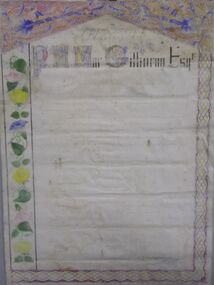
... diseases, and injuries were prevalent. His role involved overseeing surgical operations and general medical services for a burgeoning community, contributing to the hospital's development as a key institution in regional healthcare. MacGillivray's surgical expertise was particularly evident in his focus on hydatid cysts, a common affliction in colonial Australia due to environmental factors. He authored three papers on the subject between 1865 and 1872, published in medical journals, which detailed innovative management...diseases, and injuries were prevalent. His role involved overseeing surgical operations and general medical services for a burgeoning community, contributing to the hospital's development as a key institution in regional healthcare. MacGillivray's surgical expertise was particularly evident in his focus on hydatid cysts, a common affliction in colonial Australia due to environmental factors. He authored three papers on the subject between 1865 and 1872, published in medical journals, which detailed innovative management ...Paul Howard McGillivray (1834 - 1895) : In 1862, Paul Howard MacGillivray was appointed resident surgeon at Bendigo Hospital, succeeding Dr. Atkinson, a position he held until 1873.[ During this tenure, he managed patient care amid the rapid population growth and health challenges of the Victorian goldfields, where mining accidents, infectious diseases, and injuries were prevalent. His role involved overseeing surgical operations and general medical services for a burgeoning community, contributing to the hospital's development as a key institution in regional healthcare. MacGillivray's surgical expertise was particularly evident in his focus on hydatid cysts, a common affliction in colonial Australia due to environmental factors. He authored three papers on the subject between 1865 and 1872, published in medical journals, which detailed innovative management techniques including excision methods and post-operative outcomes. These works emphasized conservative approaches alongside surgical intervention, drawing from cases encountered at Bendigo Hospital, and helped advance local understanding of the disease's treatment. In 1873, following the end of his hospital appointment, MacGillivray transitioned to independent private practice in Bendigo, establishing a solo operation that catered to the mining community's medical needs. This shift allowed him greater flexibility in serving patients affected by occupational hazards and chronic conditions, building on his foundational experience in Williamstown. His practice quickly gained prominence for reliable surgical care in the region. Paul Howard McGillivray died in Bendigo on 9th. July, 1895, at his residence on the corner of Forest and Rowan Streets. https://grokipedia.com/page/paul_macgillivrayHand written certificate of appreciation presented to P. H. MacGillivray, Resident Surgeon, Bendigo Gold District General Hospital from the patients upon his resignation. On stiff paper with a hand painted border of leaves, flowers and patterns in blue, green, yellow and pink. Markings - Sandhurst October 1873.paul howard macgillivray, sandhurst, bendigo hospital, mcgillivray museum, bendigo school of mines -
St Vincent's Hospital Melbourne Archives
Journal - Notebook of lecture notes of St Vincent's Melbourne nurse, circa 1903
... The subjects range from Operation of Lithotomy instrument requirements to Infection Control including nursing management of Diptheria and Smallpox, diseases now controlled with vaccines. ...The subjects range from Operation of Lithotomy instrument requirements to Infection Control including nursing management of Diptheria and Smallpox, diseases now controlled with vaccines. ...kathleen o'brien, margaret scudds, nurse training, st vincent's hospital melbourne -
St Vincent's Hospital Melbourne Archives
Work on paper - Clinical notes from nurse training lectures at St Vincent's Hospital Melbourne in 1925, 1925
... Interesting insight into the extensive nursing knowledge required of diseases, their signs and symptoms and nursing management. For example, how to perform a gutter (bed) bath, managing typhoid fever or making up a soap solution for an enemata....Interesting insight into the extensive nursing knowledge required of diseases, their signs and symptoms and nursing management. For example, how to perform a gutter (bed) bath, managing typhoid fever or making up a soap solution for an enemata. ...Interesting insight into the extensive nursing knowledge required of diseases, their signs and symptoms and nursing management. For example, how to perform a gutter (bed) bath, managing typhoid fever or making up a soap solution for an enemata.st vincent's hospital melbourne, nurse training, lecture notes, nellie brophy, dr prendergast -
 Alfred Hospital Nurses League - Nursing History Collection
Book - Illustrated textbook, Ronald Lowe 1913-1988 et al, Lectures in diseases of the eye, 1981
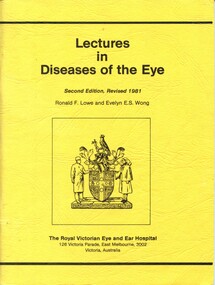
... First edition published in 1958, second edition first published 1979 ,designed as a teaching resource for the Royal Victorian Eye and Ear Hospital's clinical program Insight into management of eye disease nursing study and teaching opthamology eye diseases opthalmic nursing eye anatomy Book provides an overview of the anatomy of the eyeball, ocular disorders, diagnostic techniques, eye diseases, trauma and pharmacology At bottom right of inside front cover is a coloured donation sticker: the AHNL badge, under which are printed the words 'This book was donated to /AHNL Inc-Nursing Archives by' Cherie Neilson/ (nee Titcombe) /Grad 1976. 28/11/18. ...Book provides an overview of the anatomy of the eyeball, ocular disorders, diagnostic techniques, eye diseases, trauma and pharmacologyIllustrated textbook with yellow binding. Black print on front cover details title, authors, and publisher, and the coat of arms of The Royal Victorian Eye and Ear Hospitalnon-fictionBook provides an overview of the anatomy of the eyeball, ocular disorders, diagnostic techniques, eye diseases, trauma and pharmacologynursing study and teaching, opthamology, eye diseases, opthalmic nursing, eye anatomy -
 Alfred Hospital Nurses League - Nursing History Collection
Book - Textbook, Vera Scantlebury Brown 1889-1946 et al, A guide to the care of the young child, 1963
... First published under this title in 1947, it evolved from an earlier manual titled 'The guide to infant feeding' Authors were pioneers in Austalian paediatrics infant welfare infant nutrition paediatrics infectious diseases vitamin deficency Historic textbook covering topics ranging from infant nutrition and hygeine to the management of pre school children Inside front cover there is a printed black and white donation sticker: black Maltese cross in circle, 'This book was donated to Alfred Archival Association Nursing Division by'. ...Historic textbook covering topics ranging from infant nutrition and hygeine to the management of pre school childrenIllustrated textbook with pale olivegreen cloth binding. Title, authors and publisher stamped in gilt on front cover and spinenon-fictionHistoric textbook covering topics ranging from infant nutrition and hygeine to the management of pre school childreninfant welfare, infant nutrition, paediatrics, infectious diseases, vitamin deficency -
 Alfred Hospital Nurses League - Nursing History Collection
Pamphlet - Reference pamphlet, R E Street et al, Advice to patients suffering from pulmonary tuberculosis, 1945
... Vintage pamplet that served as a guide for paatients during a time when tuberculosiswas a public health focus in Australia, often used in facilities like the Nacleod Repatriation Hospital Gives insight into the management of tuberculosis in the 1940's Tuberculosis Infectious diseases sanatorium public health education Previous catalogue number handwritten at top right [black ink] of front cover. ...Vintage pamplet that served as a guide for paatients during a time when tuberculosiswas a public health focus in Australia, often used in facilities like the Nacleod Repatriation HospitalGives insight into the management of tuberculosis in the 1940'sStapled booklet with blue cover.Black print detailing publisher, title and printer within a decorative border on front cover. Previous catalogue number handwritten at top right [black ink] of front cover. 'Patricia Johnson/1948, handwritten [blue ink] at top right of first pagetuberculosis, infectious diseases, sanatorium, public health education -
 Alfred Hospital Nurses League - Nursing History Collection
Book - Illustrated textbook, The Royal Victorian Eye and Ear Hospital et al, Lectures in diseases of the eye, 1975
... First edition published in 1958, second edition first published 1979 ,designed as a teaching resource for the Royal Victorian Eye and Ear Hospital's clinical program Insight into management of eye disease nursing study and teaching opthamology eye diseases opthalmic nursing eye anatomy Book provides an overview of the anatomy of the eyeball, ocular disorders, diagnostic techniques, eye diseases, trauma and pharmacology Handwritten on front cover $1.20 NETT [pencil]. ...Book provides an overview of the anatomy of the eyeball, ocular disorders, diagnostic techniques, eye diseases, trauma and pharmacologyStapled illustrated textbook with orange binding. Black print on front cover details title, publisher, and the coat of arms of The Royal Victorian Eye and Ear Hospital. Book has been covered with a cclear plastic filmnon-fictionBook provides an overview of the anatomy of the eyeball, ocular disorders, diagnostic techniques, eye diseases, trauma and pharmacologynursing study and teaching, opthamology, eye diseases, opthalmic nursing, eye anatomy -
 Alfred Hospital Nurses League - Nursing History Collection
Booklet - Text booklet, Wilhelmine G Wright, Muscle training in the treatment of infantile paralysis, 1916
... Before modern vaccinations, treatment for polio focused on alleviating symptoms and managing symptoms through methods such as therapeutic exercise and physiotherapy Insight into treatment and management of poliomylitis which was a significant disease prior to vaccination becoming available Infantile papalysis poliomyltis Historic textbook (1916) detailing systemic therapeutic exercises to treat "infantile paralysis" (poliomyltis) Previous owner has handwritten [black ink] her name (both maiden and married) at top right of front cover. previous catalogue number handwritten [black ink] above this. ...Historic textbook (1916) detailing systemic therapeutic exercises to treat "infantile paralysis" (poliomyltis)Booklet with light brown cover, staples have been removed. Black print on front cover details title, author and publishernon-fictionHistoric textbook (1916) detailing systemic therapeutic exercises to treat "infantile paralysis" (poliomyltis)infantile papalysis, poliomyltis -
 Bendigo Historical Society Inc.
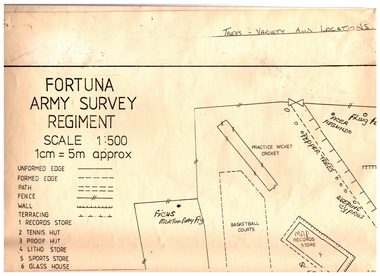
Administrative record - Ex-Fortuna Survey Association Collection: Conservation Management Plans, 1994-96
... Part of the conservation policy and management plan for the Fortuna estate: 11231.4j A six page document is a conservation management plan and tree health report for Fortuna Villa in Bendigo, focusing on diagnosing tree diseases, assessing tree conditions, and recommending removal or treatment actions. ...Part of the conservation policy and management plan for the Fortuna estate: 11231.4j A six page document is a conservation management plan and tree health report for Fortuna Villa in Bendigo, focusing on diagnosing tree diseases, assessing tree conditions, and recommending removal or treatment actions. ...'Fortuna' was developed by George Lansell, the 'Quartz King', from the 1870s to 1906. The estate features a mansion, a notable Italian water garden with imported elements, and a large lake originally used for mining. The property covers 6.7 hectares and contains many mature trees, including palms, poplars, pepper trees, Norfolk Island pines, and various specimen trees. Since 1942 to the 1980s, the Department of Defence has owned and maintained the property. General Considerations are to: 1 Preserve and restore the heritage value and history of the gardens to complement historic buildings. Maintain plant health and species diversity to enhance the area's character. 2 Address financial constraints, human use, military requirements, and stakeholder engagement. 3 Employ qualified experts to prepare the plan. 4 Address historical significance, plant health, heritage value, remedial works, and visual character (including maintaining views and screening modern structures). 5 Restore garden design to its original character where possible. 6 Recommend measures for future works to protect garden health and significant trees. 7 Identify and map significant plants and recommend suitable species for replanting. Consultant to start in September 1994 and complete by December 1994 with Regular meetings with a steering committee and encourage public involvement. The plan aims to ensure the long-term preservation, enhancement, and appropriate use of the heritage gardens, balancing historical, ecological, recreational, and military needs. In 1996 Fancine Gilfedder and Associates produced the Garden Conservation Management Plan for the Department of Defence: This Conservation Management Plan for the historic Fortuna Bendigo Garden outlines its historical development, significance, and strategies for preservation and management. 1. The plan was commissioned by the Department of Defence and prepared by Francine Gilfedder & Associates in 1996. It covers the Fortuna Garden site, its heritage status, and the methodology used for assessment. 2. Historical OverviewProvides a detailed chronology of the garden's development and its phases. Identifies significant materials, features, and architectural elements. 3. Site AssessmentSurveys existing site conditions, including plant and tree inventories.Documents architectural features and general landscape conditions. 4. Assesses the garden's heritage value using established criteria (e.g., Burra Charter, AHC criteria). Identifies elements of significance and provides comparative analysis with similar sites. 5. Summarizes the heritage value and unique aspects of the Fortuna Garden. 6. Outlines statutory and non-statutory requirements, user needs, and physical constraints affecting management. 7. Recommends general and component-specific policies for conservation. 8. Implementation Provides guidelines and specific recommendations for development and ongoing management. 9. Details best practices for tree, shrub, rose, and lawn care, as well as maintenance of paths and structures.Fortuna Villa Conservation Management Plans This Document Contains the following Items: 11231.4a This document is a draft brief by the army, 1994. It outlines the brief for a conservation management plan for the heritage gardens and surrounds of Fortuna Villa in Bendigo. It's three pages outlines Purpose, Background History and General Considerations, requirements and a summary. Seven first pages reproduced here. 11231.4b This Conservation Management Plan for the historic Fortuna Bendigo Garden outlines its historical development, significance, and strategies for preservation and management. Black Fabric Binding of approximately 110 pages (printed on both sides), photocopy with photos and plans. The first four pages showing the cover and index are shown here. 11231.4c Undated. This document is a horticultural report providing suggestions for improving the grounds and gardens at 'Fortuna', a historic estate now used by the Army Survey Regiment in Bendigo. The black and white report of approx 100 pages is "Spiralex" bound. It contains - it is compiled for the army by Karl Liffman (TAFE horticulture department) and Ian Huxley (experienced horticulturist and garden designer), with input from gardening apprentices. It contains many photos with new suggestions overlyared on top of them. The report addresses only the grounds and gardens visible to visitors: main drive, car parks, front garden, and areas around the lake. Recommendations are from a horticultural perspective, emphasizing plant variety and practical maintenance over formal landscape architecture.PurposeAims to guide the Army in developing and maintaining Fortuna’s gardens, recognizing the property's heritage and its value for public relations. 11231.4d An unbound copy of the above 11231.4e A letter to Range Control, Department of Defence, Puckapunyal, from Francine Gilfedder and Associates, Landscape Architect and Horticulturist, 15 Dover St Richmond; and a 18 page management plan. The plan aims to guide the conservation and management of the Fortuna Villa gardens, focusing on heritage values and preservation needs. May 1995. 11231.4f March 1996 five page document which outlines a conservation and restoration proposal for the Pompeii Fountain and adjacent heritage structures at Fortuna, Golden Square, Victoria. The fountain's steel column was severely rusted; rendered surfaces and marble font were deteriorating; adjacent garden walls and staircases were failing. 11231.4g Copy of above 11231.4h A five page document which contains key points from the conservation and restoration plan for Fortuna Villa. 1990s. 11231.4i A 30 page document. Part of the conservation policy and management plan for the Fortuna estate: 11231.4j A six page document is a conservation management plan and tree health report for Fortuna Villa in Bendigo, focusing on diagnosing tree diseases, assessing tree conditions, and recommending removal or treatment actions. Prepared by Francine Gilfedder and Associates, Landscape Architect and Horticulturist, 15 Dover St Richmond for the army. 11231.4k The one page document is a tree inspection report for a Sierra Redwood at Fortuna Villa, Bendigo, prepared in response to concerns about the tree's stability after the removal of a nearby specimen. Prepared by Trevor Lawrence Tree Surgeon, 830 Barkley St Ballarat. July 1995 11231.4l A 15 page document which provides an interpretive plan and historical overview for Fortuna Villa, a heritage site in Bendigo, focusing on its history, significance, and strategies for visitor engagement. 1995 prepared by Dianne Bish, Eaglehawk 11231.4m A large army plan of the Fortuna Grounds with prominent trees marked.bendigo, fortuna villa, history, army survey regiment, gardens, conservation management -
National Wool Museum
Report, The pathogenesis of blowfly strike and its effects on productivity DAQ-14P. Report on terminated project
... Report on terminated project" - Queensland Government Dept of Primary Industry Sheep - diseases Animal Health Sheep stations - management Sheep - diseases Animal Health Sheep stations - management TERM DATE JUNE '87 The pathogenesis of blowfly strike and its effects on productivity DAQ-14P. ..."The pathogenesis of blowfly strike and its effects on productivity DAQ-14P. Report on terminated project" - Queensland Government Dept of Primary IndustryTERM DATE JUNE '87sheep - diseases animal health sheep stations - management, sheep - diseases, animal health, sheep stations - management -
National Wool Museum
Book, Handbook for woolgrowers, 1950
... Animal Health Sheep - diseases Sheep - parasites Sheep stations - management Agriculture - education Sheep - nutrition Australian Wool Board Wool Clip Preparation Animal Health Sheep - diseases Sheep - parasites Sheep stations - management Agriculture - education Sheep - nutrition Handbook for woolgrowers, 1950 Book ..."Handbook for woolgrowers, 1950", J.A. Baker, Australian Wool Board.animal health sheep - diseases sheep - parasites sheep stations - management agriculture - education sheep - nutrition, australian wool board, wool clip preparation, animal health, sheep - diseases, sheep - parasites, sheep stations - management, agriculture - education, sheep - nutrition -
National Wool Museum
Book, Handbook for woolgrowers, 4th ed, 1961
... "Handbook for woolgrowers, 4th ed, 1961" G R Moule, Australian Wool Bureau Animal Health Sheep - diseases Sheep - parasites Sheep stations - management Agriculture - education Sheep - nutrition Australian Wool Bureau Wool Clip Preparation Animal Health Sheep - diseases Sheep - parasites Sheep stations - management Agriculture - education Sheep - nutrition Handbook for woolgrowers, 4th ed, 1961 Book ..."Handbook for woolgrowers, 4th ed, 1961" G R Moule, Australian Wool Bureauanimal health sheep - diseases sheep - parasites sheep stations - management agriculture - education sheep - nutrition, australian wool bureau, wool clip preparation, animal health, sheep - diseases, sheep - parasites, sheep stations - management, agriculture - education, sheep - nutrition -
National Wool Museum
Book, Sheep Management and Wool Technology
... Management and Wool Technology" - J.B. D'Arcy, 1986. Originally published in 1972; this is a reprinted and revised edition. Wool Growing Wool Processing Woolclassing Wool Marketing Shearing Sheep breeding Sheep - diseases Wool Growing Wool Processing Woolclassing Wool Marketing Shearing Sheep breeding Sheep - diseases Sheep Management and Wool Technology Book ..."Sheep Management and Wool Technology" - J.B. D'Arcy, 1986. Originally published in 1972; this is a reprinted and revised edition.wool growing wool processing woolclassing wool marketing shearing sheep breeding sheep - diseases, wool growing, wool processing, woolclassing, wool marketing, shearing, sheep breeding, sheep - diseases -
National Wool Museum
Book, Sheep, Farm and Station Management
... Management" - compiled by E.H. Pearse, 1920. Wool Growing Sheep breeding Merino sheep Sheep - British Sheep - diseases Shearing Woolclassing Sheep stations - establisment Sheep stations - management Pastoral Review Pty Ltd Wool Growing Sheep breeding Merino sheep Sheep - British Sheep - diseases Shearing Woolclassing Sheep stations - establisment Sheep stations - management Sheep, Farm and Station Management Book ..."Sheep, Farm and Station Management" - compiled by E.H. Pearse, 1920.wool growing sheep breeding merino sheep sheep - british sheep - diseases shearing woolclassing sheep stations - establisment sheep stations - management, pastoral review pty ltd, wool growing, sheep breeding, merino sheep, sheep - british, sheep - diseases, shearing, woolclassing, sheep stations - establisment, sheep stations - management
