
Showing 45 items matching "diseases of plants"
-
 University of Melbourne, Burnley Campus Archives
Photograph - 35mm Colour slides, Ektachrome, Diseases, 1950's-1970's
... ...diseases of plants...diseases diseases of plants Set of 161 colour slides formerly in plastic pockets designed to be held in a filing cabinet - removed and placed in archival standard plastic pockets Diseases Photograph 35mm Colour slides Ektachrome Kodachrome Agfacolor Kodacolor Kodachrome Transparency ...diseases, diseases of plants -
University of Melbourne, Burnley Campus Archives
Certificate - Award Certificate, Victorian College of Agriculture and Horticulture, Horticulture Studies, c. 1983-1996
... VCAH VICTORIAN COLLEGE OF AGRICULTURE and HORTICULTURE Horticultural Studies Certificate This is to certify that JANE DOUGLAS HERRING has successfully completed eight units each of thirty hours part-time study at the levels shown below PLANT FORM AND FUNCTION D SOILS AND GROWING MEDIA HP INTRODUCTION TO HORTICULTURE D WEEDS AND DISEASES HP PLANT REPRODUCTION D ORNAMENTAL HORTICULTURE D PLANT PROPAGATION HP PESTS AND PESTICIDES D Director.... ...Certificate for Jane Douglas Herring stating she had successfully completed part-time study in 8 units, but not dated or signed. jane douglas herring students VCAH Horticultural Studies Certificate VCAH Burnley VCAH VICTORIAN COLLEGE OF AGRICULTURE and HORTICULTURE Horticultural Studies Certificate This is to certify that JANE DOUGLAS HERRING has successfully completed eight units each of thirty hours part-time study at the levels shown below PLANT FORM AND FUNCTION D SOILS AND GROWING MEDIA HP INTRODUCTION TO HORTICULTURE D WEEDS AND DISEASES HP PLANT REPRODUCTION D ORNAMENTAL HORTICULTURE D PLANT PROPAGATION HP PESTS AND PESTICIDES D Director.... ...Certificate for Jane Douglas Herring stating she had successfully completed part-time study in 8 units, but not dated or signed.Original certificate awarded to Jane Douglas Herring - not signed by Principal.VCAH VICTORIAN COLLEGE OF AGRICULTURE and HORTICULTURE Horticultural Studies Certificate This is to certify that JANE DOUGLAS HERRING has successfully completed eight units each of thirty hours part-time study at the levels shown below PLANT FORM AND FUNCTION D SOILS AND GROWING MEDIA HP INTRODUCTION TO HORTICULTURE D WEEDS AND DISEASES HP PLANT REPRODUCTION D ORNAMENTAL HORTICULTURE D PLANT PROPAGATION HP PESTS AND PESTICIDES D Director.... Principal.... dated thisjane douglas herring, students, vcah, horticultural studies, certificate, vcah burnley -
 Ringwood and District Historical Society
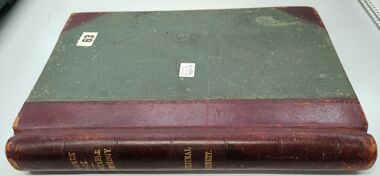
Administrative record, Agricultural Department, Large ledger, dark green cover, red leather spine with inscription. Bitter Pit investigation. Tracking fruit sent to coolstores 3-Jul-1911 to 30-Aug-1916. From Agricultural Department, fruit from all over the state - not just Ringwood. Some is from N.S.W, 1911 - 1916
... In 1890 Daniel McAlpine was appointed to the Victorian Department of Agriculture as vegetable pathologist 'to attend to all diseases of plants that might form the subject of inquiry'. ...In 1890 Daniel McAlpine was appointed to the Victorian Department of Agriculture as vegetable pathologist 'to attend to all diseases of plants that might form the subject of inquiry'. ...From https://researchworks.oclc.org/archivegrid/archiveComponent/1013459255: Australia's first plant pathologist. Lecturer in Biology at Melbourne University from 1884. In 1890 Daniel McAlpine was appointed to the Victorian Department of Agriculture as vegetable pathologist 'to attend to all diseases of plants that might form the subject of inquiry'. In 1911 McAlpine was assigned to the Commonwealth and State governments for four years to undertake researches into bitter pit of apples, a disease he had reported in 1900. Realising the difficulties such an investigation posed, he was reluctant to accept the post but did so 'for the credit of Australia'. He made detailed observations of the disease and published five reports but, unable to discover the cause, found himself arrayed against the Victorian government botanist Professor A. J. Ewart, who mistakenly attributed bitter pit to traces of poison in the soilLarge ledger, dark green cover, red leather spine with inscription. Bitter Pit investigation. Tracking fruit sent to coolstores 3-Jul-1911 to 30-Aug-1916. From Agricultural Department, fruit from all over the state - not just Ringwood. Some is from N.S.W. Only pages 1 & 2 scanned as examples. Specimen Book; Vegetable Pathology; Agricultural Department; Coolstore -
University of Melbourne, Burnley Campus Archives
Newspaper - Newspaper Cutting, The Weekly Times, Burnley Gardens To Be Utilised For Scientific Research and Experiments, 1928
... The article describes the need for scientific research by the Agricultural Department into plant diseases and the advantages of performing research at Burnley in the new laboratories. ...The article describes the need for scientific research by the Agricultural Department into plant diseases and the advantages of performing research at Burnley in the new laboratories. ...The article describes the need for scientific research by the Agricultural Department into plant diseases and the advantages of performing research at Burnley in the new laboratories. The research is directed by the Superintendant of Agriculture, Mr HA Mullett.Newspaper cutting from "The Weekly Times", September 8, 1928. the weekly times, laboratories, superintendant of agriculture, h.a. mullett, burnley horticultural college, plant research institute, plant research laboratory, plant diseases -
Croydon Conservation Society Inc.
Archive, Eastfield Road Park Croydon - Archive Collection - Parent
... Severe canopy decline across much of the site threatens understorey diversity, as does the presence of a soil-borne plant disease. Nevertheless, the site still supports several locally rare plant species as well as a range of animals and contributes significantly to conservation value of the Taralla Creek habitat corridor....Severe canopy decline across much of the site threatens understorey diversity, as does the presence of a soil-borne plant disease. Nevertheless, the site still supports several locally rare plant species as well as a range of animals and contributes significantly to conservation value of the Taralla Creek habitat corridor. ...Eastfield Park supports 5.5 hectares of remnant vegetation from two vegetation types which are Endangered in the bioregion – Valley Heathy Forest and Swampy Woodland. Severe canopy decline across much of the site threatens understorey diversity, as does the presence of a soil-borne plant disease. Nevertheless, the site still supports several locally rare plant species as well as a range of animals and contributes significantly to conservation value of the Taralla Creek habitat corridor.Archival Collection of Eastfield Road Croydon park photographs, documents, planning etc -
University of Melbourne, Burnley Campus Archives
Book - Scrapbook, Special Articles, 1927-1940
... In Book 1 most articles are concerned with general articles about plants, disease management in the districts, growing media and horticultural techniques. ...In Book 1 most articles are concerned with general articles about plants, disease management in the districts, growing media and horticultural techniques. ...2 Cloth bound books with leather spine and corners on front and back cover - 399 pages each. The books each have hand inked alphabetical indexes. They are scrapbooks used to catelogue a variety of articles from newspapers and magazines 1927-1940 - glued or pinned in place. In Book 1 most articles are concerned with general articles about plants, disease management in the districts, growing media and horticultural techniques. There are also cuttings about Botanical Gardens and significant horticulturalists of the day. Book two is thematically Garden and kitchen garden cuttings. It includes one about a Burnley Flower Competition (P58) and an article by Edna Walling "To Save the Elms". These may have been used to inform teaching at Burnley. Subsequently each scrap book has been stored with a detailed 7 page handwritten list of contents in page order by the cataloguer (Elizabeth Hill, 1994). Not all pages are used. 2 inserts in plastic sleeves are in the rear of the first book B92.0584 a and b.Special Articlesnewspaper and magazine articles, plants, growing media, horticultural techniques, botanical gardens, significant horticulturalists, burnley flower show, edna walling, kitchen gardens, disease management -
Bendigo Historical Society Inc.
Administrative record - Commercial Egg Producers' Association of Victoria (CEPA) Central Council Correspondence, 1978
... The key points are:The Central Council is requesting information about arrangements for holding wheat for egg producers within 40 km of Bendigo. 8504.34f A recommendation letter made to submit information to the Senate Standing Committee on National Resources regarding the adequacy of quarantine and control measures for protecting Australia's pastoral industries from exotic livestock and plant diseases. 8504.34g The document is a letter from the Commercial Egg Producers' Association of Victoria to the Victorian Egg Marketing Board, expressing concerns about rumored changes to payment schedules for egg producers. 8504.34h The document is a protest letter from an association representing small poultry producers regards Rising Government Charges and License Fees 8504.34i This document to the Department of agriculture highlights concerns from a conference regarding the insufficient penalties for non-compliance with the Hen Quota regulations in Victoria. 8504.34j This document is a formal correspondence dated July 17, 1978, from K. ...The key points are:The Central Council is requesting information about arrangements for holding wheat for egg producers within 40 km of Bendigo. 8504.34f A recommendation letter made to submit information to the Senate Standing Committee on National Resources regarding the adequacy of quarantine and control measures for protecting Australia's pastoral industries from exotic livestock and plant diseases. 8504.34g The document is a letter from the Commercial Egg Producers' Association of Victoria to the Victorian Egg Marketing Board, expressing concerns about rumored changes to payment schedules for egg producers. 8504.34h The document is a protest letter from an association representing small poultry producers regards Rising Government Charges and License Fees 8504.34i This document to the Department of agriculture highlights concerns from a conference regarding the insufficient penalties for non-compliance with the Hen Quota regulations in Victoria. 8504.34j This document is a formal correspondence dated July 17, 1978, from K. ...The Commercial Egg Producers' Association of Victoria was active by the 1930s, engaging in industry management and lobbying.The Commercial Egg Producer's Association (CEPA) had branches in Bendigo, South Bendigo, Eaglehawk, Wedderburn, Murrabit and Euroa.CEPA Commercial Egg Producer's Association (Bendigo Region) correspondence, for the year 1978. This item includes the following documents: 8504.34a The Commercial Egg Producers' Association of Victoria conference agenda December 1978 8504.34b Notice of half yearly Conference Dec 1978 8504.34c A letter congratulating Mr. Tom Austin on his appointment to the Cabinet. 8504.34d A formal letter from the Secretary of an association, K. Fitzgibbon, addressed to the Chairman of the Beef and Meat Enquiry. The key points are:Purpose: The association is inquiring about the possibility of submitting evidence to the Beef and Meat Enquiry. 8504.34e This document is a formal inquiry from the Central Council of the C.E.P.A. to the Australian Wheatgrowers Federation regarding wheat storage for egg producers near Bendigo. The key points are:The Central Council is requesting information about arrangements for holding wheat for egg producers within 40 km of Bendigo. 8504.34f A recommendation letter made to submit information to the Senate Standing Committee on National Resources regarding the adequacy of quarantine and control measures for protecting Australia's pastoral industries from exotic livestock and plant diseases. 8504.34g The document is a letter from the Commercial Egg Producers' Association of Victoria to the Victorian Egg Marketing Board, expressing concerns about rumored changes to payment schedules for egg producers. 8504.34h The document is a protest letter from an association representing small poultry producers regards Rising Government Charges and License Fees 8504.34i This document to the Department of agriculture highlights concerns from a conference regarding the insufficient penalties for non-compliance with the Hen Quota regulations in Victoria. 8504.34j This document is a formal correspondence dated July 17, 1978, from K. Fitzgibbon (Secretary) to Mr. J. Bourchier at Hills Bazaar, Bendigo. 8504.34k This document is a formal letter from K. Fitzgibbon (Secretary) to Mr. D. McClure, M.L.A., enclosing copies of two letters previously sent to Mr. Wishart, Director General of the Department of Agriculture. The correspondence follows a recent conference and is intended to keep Mr. McClure informed of communications with the Department of Agriculture. 8504.34l This document is a formal letter dated July 17, 1978, from K. Fitzgibbon (Secretary) to Mr. F. Grimwade, M.L.A. 8504.34m This document is a formal letter from K. Fitzgibbon (Secretary) to Mr. W. Ebery, M.L.A., dated July 17, 1978. The main points are:The letter transmits copies of two letters that were sent to Mr. Wishart, Director General of the Department of Agriculture. 8504.34n This document is a formal correspondence dated July 17, 1978, from K. Fitzgibbon (Secretary) to Mr. B. Reid, M.L.C. The key points are:The letter encloses copies of two letters previously sent to Mr. Wishart, Director General of the Department of Agriculture. 8504.34o This document is a formal letter from K. Fitzgibbon (Secretary) to Mr. S. McDonald, dated July 17, 1978. The key points are:The letter serves as a cover note, enclosing copies of two letters sent to Mr. Wishart, Director General of the Department of Agriculture. 8504.34p This document is a formal inquiry from the Poultry Industry Association to the Diagnostic Centre regarding the establishment of a Liaison Committee. A panel of representatives from the Poultry Industry Association is provided for the committee, including Broadbent, J. Scott, R. Stephens, and Fitzgibbon. 8504.34q The document is a letter from the Commercial Egg Producers Association of Victoria, advocating for the introduction of a standardized Stock Feed Wheat Price across Australia 8504.34r The document provides a contact and organizational listing for the Commercial Egg Producers' Association of Victoria. 8504.34s The document is a formal letter from the Commercial Egg Producers' Association of Victoria to the Grains Division of the Victorian Farmers' Union 8504.34t This document is a formal letter from the Commercial Egg Producers' Association of Victoria, addressed to the Minister of Agriculture, nominating candidates for vacancies on the Victorian Egg Marketing Board. 8504.34u Meeting Announcement of the annual Central Council meeting 8504.34v The document outlines the agenda for a commercial egg producers' conference, highlighting several industry concerns and proposals 8504.34w This document is a letter from the Secretary of the Commercial Egg Producers Association of Victoria to the N.S.W. Egg Marketing Board. Concern about N.S.W. egg quotas - The Association believes N.S.W. has not reduced its egg quotas to the appropriate level 8504.34x The letter is a protest regarding the Victorian Egg Marketing Board's decision to transfer the Sympag License at Kangaroo Flat to Crystal Egg Co. in Bendigo. 8504.34y The document is a formal letter from an association to the Victorian Egg Marketing Board, requesting a review and potential increase in the prices for 2nd grade eggs. 8504.34z The Commercial Egg Producers Association requests that Agricultural Officers receive periodic refresher training, specifically for procedures like blood sampling. 8504.34aa This document is a formal complaint from an association addressed to the manager of Crystal Egg Co. The association is concerned that farmers are not receiving their own fillers back after grading. Fillers from one farm may be returned to another farm, rather than to their original owner.The association highlights a potential disease risk if fillers are mixed between farms. 8504.34ab The letter is a formal complaint addressed to the Secretary of the Victorian Egg Marketing Board. The association is concerned that farmers are not receiving their own fillers back after grading. Fillers from one farm may be returned to another farm, rather than to their original owner.The association highlights a potential disease risk if fillers are mixed between farms. 8504.34ac The document is a formal letter from the Commercial Egg Producers Association to the Victorian Egg Marketing Board. The key points are:The Association recommends that all fertile eggs be classified as second quality. This grading is suggested as a precautionary measure to protect market standards. 8504.34ad The document is a formal letter from the Secretary of the Commercial Egg Producers Association of Victoria to the Minister of Agriculture. Farmers are frustrated by the excessive amount of statistical forms they are required to complete. 8504.34ae The document is a formal letter proposing the establishment of a Liaison Committee at the Diagnostic Centre. 8504.34af The document is a formal letter addressing the need for improved egg unloading facilities at grading floors in Bendigo. The Central Council of the Commercial & Producers Association of Victoria discussed concerns about unloading facilities at two grading floors in Bendigo. 8504.34ag Minutes from the the association's half yearly Conference Dec 1978 8504.34ah Minutes from the the association's annual Conference June 1978 8504.34ai Minutes from the the association's Executive Meeting May 1978 8504.34aj Minutes from the the association's half yearly Conference Dec 1977 8504.34ak Minutes from the the association's annual Conference June 1977egg producer's information, correspondence, cepa, commercial egg producers' association -
 Federation University Historical Collection
Document - Document - Proposal, VIOSH: Proposal for a Post Graduate Course in Safety and Loss Control - Ballarat College of Advanced Education
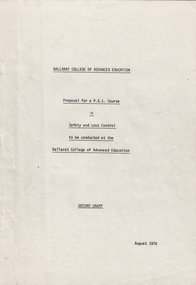
... plant damage...fire...security breaches...property and storm damage...pollution...transportation...product liability...occupational disease...The aim of the course is to assist the administrator in identifying such accidental loss producing areas as - injury. plant damage, fire, breaches of security, property and storm damage, pollution, transportation, product liability and occupational disease. ...The aim of the course is to assist the administrator in identifying such accidental loss producing areas as - injury. plant damage, fire, breaches of security, property and storm damage, pollution, transportation, product liability and occupational disease. viosh victorian institute of occupational safety and health ballarat college of advanced education post graduate institute pgi safety and loss control external advisory panel second draft accidental loss injury plant damage fire security breaches property and storm damage pollution transportation product liability occupational disease Sixteen A4 sheets - typed. ...Victorian Institute of Occupational Safety and Health (VIOSH) Australia is the Asia-Pacific centre for teaching and research in occupational health and safety (OHS) and is known as one of Australia's leaders on the field. VIOSH has a global reputation for its innovative approach within the field of OHS management. VIOSH had its first intake of students in 1979. At that time the Institution was known as the Ballarat College of Advanced Education. In 1990 it became known as Ballarat University College, then in 1994 as University of Ballarat. It was 2014 that it became Federation University. VIOSH Australia students are safety managers, senior advisors and experienced OHS professionals. They come from all over Australia and industry. Students are taught active research and enquiry; rather than textbook learning and a one-size fits all approach. VIOSH accepts people into the Graduate Diploma of Occupational Hazard Management who have no undergraduate degree - on the basis of extensive work experience and knowledge. Ballarat College of Advanced Education made a preliminary submission for a Post Graduate Institute Course in Safety and Loss Control in 1975. This was forwarded to the External Advisory Panel and other experts for comment, etc. Comments were constructive and some modifications were made. These have been incorporated in this Second Draft dated August 1976. The aim of the course is to assist the administrator in identifying such accidental loss producing areas as - injury. plant damage, fire, breaches of security, property and storm damage, pollution, transportation, product liability and occupational disease. Sixteen A4 sheets - typed. Front sheet - Title page. Some pages have hand written notations in pencil. Last page has section hand written in ink.viosh, victorian institute of occupational safety and health, ballarat college of advanced education, post graduate institute, pgi, safety and loss control, external advisory panel, second draft, accidental loss, injury, plant damage, fire, security breaches, property and storm damage, pollution, transportation, product liability, occupational disease -
 Federation University Historical Collection
Letter, Letters from Richard Squire to his son Tom 1936
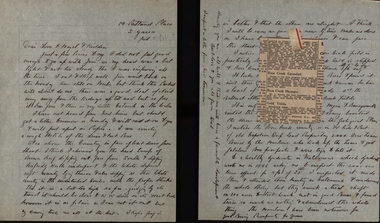
... Plant...Skids...Pump...C. Hayes...Illness...Poppet...Carburetor...Shaft...Balance Weight...Pearson...Pulleys...Syndicate...Goon...Suction...Lease...Reports...Estimates...Flat Fields...Reef...Trucks...Pipeclay...Sandstone...Suction Pipe...Valves...Honeycomb Rock...Mr Kermode...Yarrowee...Ballarat...Reef Combs...Cheques...Yellow Slate...Leigh River...Dyke...Quartz...Ballarat Deep Leads...Ballarat Deep Leads Extension...Bore...Reads...Bedrock...Cemented Sand...G M of A...Gold Mines of Australia...Liz the Car...Geoff Squire...Lode...Cameron and Sutherland...Lancaster...Harman...Hayes Timber...T. Hood...Alan Squire...Catarrh...Kidney Disease...Plant Skids Pump C. Hayes Illness Poppet Carburetor Shaft Balance Weight Pearson Pulleys Syndicate Goon Suction Lease Reports Estimates Flat Fields Reef Trucks Pipeclay Sandstone Suction Pipe Valves Honeycomb Rock Mr Kermode Yarrowee Ballarat Reef Combs Cheques Yellow Slate Leigh River Dyke Quartz Ballarat Deep Leads Ballarat Deep Leads Extension Bore Reads Bedrock Cemented Sand G M of A Gold Mines of Australia Liz the Car Geoff Squire Lode Cameron and Sutherland Lancaster Harman Hayes Timber T. Hood Alan Squire Catarrh Kidney Disease ...In 1905 Richard Squire was manager of the West Berry Consuls at Allendale, and developed an improved system of mine ventilation, which was supported in "The Age." He was successful in combating and remedying the gas and ventilation troubles of the Deep Mines of Creswick and Allendale Districts after all had failed. MINE MANAGERS’ ASSOCIATION. Ballarat Branch. ... Mr. R. B. Squire, manager of the West Berry Consuls, at Allendale, submitted a paper detailing what he had done tor the betterment of ventilation in the alluvial mines of Smeaton and Mary borough districts- Members gave Mr. Squire every credit for the results that he claimed to have affected; the adoption of his ideas had testified to their value to mine-owners. It was painted out, however, that for want of a thorough debate of the subject with experienced men the author had unwittingly included some general statements that required modifying in some points and extending in others, in justice to other workers among the earlier and the present-day managers of mines. It was decided to invite the author to meet a sub-committee on this subject!Various letters written by Richard Squire to his son Tom on the topic of their Mine in 1936 richard squire, tom squire, hazel squire, jack squire, jim squire, ned, mt mercer, basil, plant, skids, pump, c. hayes, illness, poppet, carburetor, shaft, balance weight, pearson, pulleys, syndicate, goon, suction, lease, reports, estimates, flat fields, reef, trucks, pipeclay, sandstone, suction pipe, valves, honeycomb rock, mr kermode, yarrowee, ballarat, reef combs, cheques, yellow slate, leigh river, dyke, quartz, ballarat deep leads, ballarat deep leads extension, bore, reads, bedrock, cemented sand, g m of a, gold mines of australia, liz the car, geoff squire, lode, cameron and sutherland, lancaster, harman, hayes timber, t. hood, alan squire, catarrh, kidney disease, stomach issues, ethel, measles, scarlet fever, ross creek field, j. bourke, j. cock, ross creek gold mining co., frank herman, hogan & banagwanath, hogan, banagwanath, napolean deap lead, hanlons, lillas, martin, jack hayes, diptheria, anticline, mr mcnichol, ronaldson, bob allan, jenkins, hunter, wilkinson, eyres brothers, g.gay & co, buninyong, llewellen, glenfine, the star mine of avoca fields, talbot alluvials, g.e. dickenson, guildford plateau, a.b.c. special supply store, jelbart, geological branch, shell coy, mr horsefields, lawaluk, almanac, trenery, barry, mining -
 City of Moorabbin Historical Society (Operating the Box Cottage Museum)
Manufactured Glass, brown bottle 'Iodine', 20thC
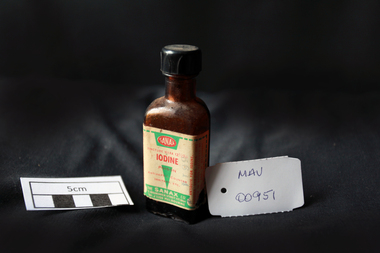
... plants grown on iodine-rich soil. Iodized salt is fortified with iodine. Elemental iodine is used as a disinfectant in various forms. It is a wound cleaner and Iodine also acts as an expectorant of mucous from the common cold and other respiratory ailments. Iodine is a common aid for skin conditions, such as acne, .. pharmacy medicines iodine athritis glassware bottles moorabbin bentleigh cheltenham thyroxin goitre iodised salt gravves' disease Front Label : SANA / TINCTURE WEAK (2 1/2 % ) / IODINE / POISON / ANTISEPTIC COUNTER / IRRITANT ETC. / THE SANAX CO. / 5 BRUNSWICK STREET FITZROY / TEL. ...Iodine is an essential trace element for life, the heaviest element commonly needed by living organisms. In medicine, potassium iodide is usually used to treat acute thyrotoxicosis. Hyperthyroidism, an overactive thyroid, is a condition in which the thyroid gland produces and secretes excessive amounts of the free (not protein bound, and circulating in the blood) thyroid hormones, This is the opposite of hypothyroidism ('sluggish thyroid'), which is their reduced production and secretion. Graves' disease is the most common cause of hyperthyroidism. Iodine's main role in animal biology is as a constituent of the thyroid hormones thyroxine If there is a deficiency of dietary iodine, the thyroid will not be able to make thyroid hormone. The lack of thyroid hormone will lead to decreased negative feedback on the pituitary, leading to increased production of thyroid-stimulating hormone, which causes the thyroid to enlarge (the resulting medical condition is called endemic colloid goitre This has the effect of increasing the thyroid's ability to trap more iodide, compensating for the iodine deficiency and allowing it to produce adequate amounts of thyroid hormone. The thyroid hormones are essential to proper development and differentiation of all cells of the human body. These hormones also regulate protein, fat, and carbohydrate metabolism, affecting how human cells use energetic compounds. They also stimulate vitamin metabolism. Natural sources of iodine include sea life, such as kelp and certain seafood, as well as plants grown on iodine-rich soil. Iodized salt is fortified with iodine. Elemental iodine is used as a disinfectant in various forms. It is a wound cleaner and Iodine also acts as an expectorant of mucous from the common cold and other respiratory ailments. Iodine is a common aid for skin conditions, such as acne, ..A brown glass triangular shaped bottle with a plastic screw top lid that contained IodineFront Label : SANA / TINCTURE WEAK (2 1/2 % ) / IODINE / POISON / ANTISEPTIC COUNTER / IRRITANT ETC. / THE SANAX CO. / 5 BRUNSWICK STREET FITZROY / TEL. J 3208 MELBOURNE. on side : ANTIDOTE FOR IODINE / DIRECTIONS.........pharmacy, medicines, iodine, athritis, glassware, bottles, moorabbin, bentleigh, cheltenham, thyroxin, goitre, iodised salt, gravves' disease -
 Greensborough Historical Society
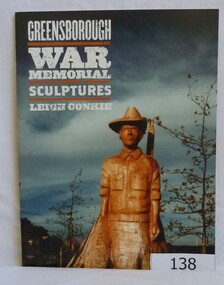
Book, Banyule City Council, Greensborough War Memorial Sculptures, Leigh Conkie, 2004_
... These chainsaw sculptures were carved from the stumps of trees originally planted around the park. The carver was Leigh Conkie. The trees had become diseased and were in danger of falling....These chainsaw sculptures were carved from the stumps of trees originally planted around the park. The carver was Leigh Conkie. The trees had become diseased and were in danger of falling. ...These chainsaw sculptures were carved from the stumps of trees originally planted around the park. The carver was Leigh Conkie. The trees had become diseased and were in danger of falling.Memorial to local people who fought in the various wars of the 20th century. 21 pages, colour illustrationsgreensborough war memorial park, sculptures, ester street, leigh conkie, chainsaw sculptures -
 Ringwood and District Historical Society
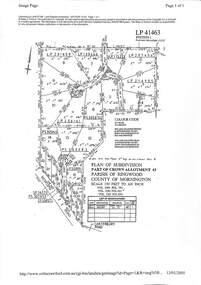
Document, Property Research Notes - Reaghill, Ringwood East, Victoria. Appendix 4 - Plan of Subdivision No. 41463 and history notes by Ian and Margaret McKellar - 1996
... While there he earned the gratitude of his fellows by his innovative use of available plants to treat tropical diseases. After this war Geoffrey returned to Melbourne and worked as a pathologist at the. ...While there he earned the gratitude of his fellows by his innovative use of available plants to treat tropical diseases. After this war Geoffrey returned to Melbourne and worked as a pathologist at the. ...Plan of Subdivision LP41463 - Part of Crown Allotment 43, Parish of Ringwood, County of Mornington. Map includes Bedford Road, Homebush Court, Vista Avenue and Vista Court, Heathmont. Allotments include LP201659, LP139446, LP115253, LP207494, LP216905, PS335874, LP206161, PS305345, PS300083, LP92899."Reaghill”; a 30 acre property in Bedford Road, Heathmont was bought from the Blood family about 1910 by Mr Seymour Davies as a weekend retreat from his busy life as a manager with the Glenferrie (or Hawthorn) branch of the English, Scottish and Australian (ES&A) Bank. He and his family came by train to Ringwood and then drove a pony cart up Bedford Road to a gateway at about number 139 and then a long drive, which wound up to the top of the hill. There was a wonderful view of Mount Dandenong which later became obliterated by tall eucalyptus trees. The land which became “Reaghill” was part of an 80 acre crown land sale to Mr Robert Blood on 12 March 1872. More information on the Blood family involvement with the area is given on pages 13-17 of the original 1974 edition of Hugh Anderson, Ringwood, Place of Many Eagles. Another section of this land was bought by Mr Frank L Walker and subsequently became "Wombalano Park". There is a quarry on the property from which stone was used for the long driveway. The garden was mainly left natural although we have two large Liquidamber trees which were planted by his wife Dora Davies (nee Hall). Surely these were some of the first to be planted in Melbourne gardens. A small weatherboard, galvanised iron roofed cottage was built on the top of the hill. At the time the house was built there was a strike of plasterers - as a result it was lined with timber, an unusual combination at that time. The Davies had a daughter and two sons - Dora (born 1897), Geoffrey (1900), John (1902). All studied medicine at Melbourne and practised, Geoffrey in Sydney, John in general practice Melbourne while Dora went to England in the 1930s and never returned. John and Dora married in 1933 and 1938 respectively and had families. Soon after the beginning of the 1939-45 war Geoffrey enlisted in the AIF as a Medical Officer and was in Singapore when it fell to the Japanese. He spent the remaining war years in various POW camps, including Changi and others in Malaya and Thailand. While there he earned the gratitude of his fellows by his innovative use of available plants to treat tropical diseases. After this war Geoffrey returned to Melbourne and worked as a pathologist at the. Heidelberg Repatriation Hospital while living for part of the time at "Reaghill". Seymour Davies died in October 19-35 and his wife, Dora, in February 1945. Of their children, John died in 1976, Dora in 1985 and Geoffrey in 1986. In July 1968 Geoffrey moved to East Ringwood and the two acre house block* and an adjacent one were sold to Dr James Hamilton Kelly, then of New York State, USA (Title Vol 8740 folio 991). As far as is known he never lived there. The house was let to a Mr and Mrs Ingamels for some years. The relatively fertile lower slopes on the south side of the land were cleared and farmed by descendants of the Blood family. At the time of the 1957 subdivision there were clear signs of the ploughed area. It was said that they used to grow strawberries in those paddocks. In about 1955 Dr Geoff Davies decided to sub-divide the property, he was unmarried and found it too large to maintain. Initially five of the seven normal house sized blocks fronting Bedford Road were sold and in about 1957 the remainder, was divided into 15 blocks (averaging nearly two acres) and put on the market. These were sold for £1000 ($2000) per acre. Homebush Court and Vista Court were formed to give access to- these blocks. The Homebush Court blocks have close access to Heathmont and the others to East Ringwood although all are lumped into East Ringwood by the municipal and postal authorities. The name "Reaghill" possibly comes from the Davies family's Irish origins. Homebush Court was named by Geoff Davies from the Sydney suburb of that name where he had lived in the 1930s. It was originally the name of a property owned by one of the early NSW Governors. Vista was a reminder to Geoff Davies of the once-grand views he remembered seeing from the hilltop. The earlier history in this article was recounted by my mother, a niece of Mr Seymour Davies, who remembered coming on a great outing to "Reaghill" as a child. Other recollections are from our own conversations with Geoff Davies. Ian and Margaret McKellar. 16 January, 1996 -
 Bendigo Military Museum
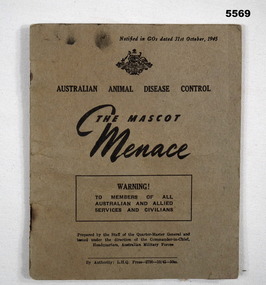
Booklet, "The Mascot Menace"
... plants and animals by Returning Forces in WW2. Was common for Service people to bring back mascots as souvenirs from overseas in breach of Australian Regulations. Mascots Disease ...Booklet issued by Military Forces, outlining rules in relation to the import of plants and animals by Returning Forces in WW2. Was common for Service people to bring back mascots as souvenirs from overseas in breach of Australian Regulations. Small brown booklet issued by Australian Military Forces. 22 pages of content in black and white. In relation to import of animals on plants back into Australia by Military or Civilians.Front header "Australian Animal Disease Control" and titled "The Mascot Menace"/mascots, disease control, ww2 -
 Kiewa Valley Historical Society
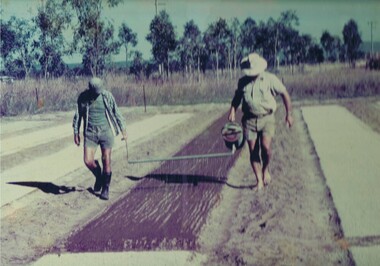
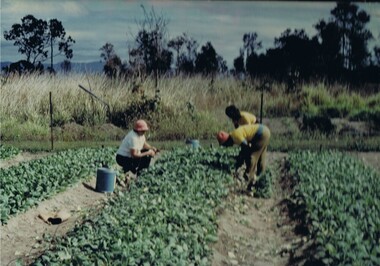
Photograph Tobacco planting, Planting Tobacco seeding, Circa mid to late 1900's
... History has produced the following results. (1) adequate tariff protection was never achieved,(2) control of disease through benzol vapour (CSIRO) breakthrough, was later identified as carcinogenic, (3) orderly marketing was achieved through (4) the establishment of the Tobacco Growers Association(1984). In October 2006, by way of Government buy back of tobacco leases from growers, resulted in the end of Tobacco farming in Australia (after 136 years of planting the first crop). ...History has produced the following results. (1) adequate tariff protection was never achieved,(2) control of disease through benzol vapour (CSIRO) breakthrough, was later identified as carcinogenic, (3) orderly marketing was achieved through (4) the establishment of the Tobacco Growers Association(1984). In October 2006, by way of Government buy back of tobacco leases from growers, resulted in the end of Tobacco farming in Australia (after 136 years of planting the first crop). ...This promotional photograph by the Tobacco Growers Association was in response to a 1935 meeting of tobacco growers from Victoria, South Australia and Queensland which produced four major resolutions for the industry covering the remainder of the 1900s. These four resolutions were: (1) Adequate tariff protection (2) Control of pests and diseases (3) Orderly marketing (4) The formation of an advisory council of growers. History has produced the following results. (1) adequate tariff protection was never achieved,(2) control of disease through benzol vapour (CSIRO) breakthrough, was later identified as carcinogenic, (3) orderly marketing was achieved through (4) the establishment of the Tobacco Growers Association(1984). In October 2006, by way of Government buy back of tobacco leases from growers, resulted in the end of Tobacco farming in Australia (after 136 years of planting the first crop). It was also significant that the major tobacco companies such as Philip Morris and The British American Tobacco Australasia advised the industry that it would source its tobacco requirements overseas by 2009.The remnants of the Tobacco Industry can still be viewed throughout the Kiewa Valley and adjacent regions on the former tobacco farms which still have the tobacco drying sheds and now converted into hay sheds. The problems from the large quantities of carcinogenic infused soil of farmlands in the region, still remains a problem now and for future generations. This particular photograph shows the lack of understanding by farmers and the contracted labour, at that time, and is demonstrated by the bare footed farmer walking next to the seed canister. Some workers did use protective "gum" boots but the majority of farm owners were skeptical of city scientists and their carcinogenic concerns, and it was only after the younger generation of farmers , who had attended Agricultural colleges, encompassed the scientific approach to farm management and began working closely with agricultural scientists. The "she'll be right mate" attitude of the earlier farming/rural community has since mid 1970s, been slowly dissipating. Stricter controls of herbicides and pesticides used in agriculture are now in force. The death of the tobacco industry(2006) resulted in the expansion of the dairy , sheep, beef cattle, venison and lama wool producers in the Kiewa Valley and surrounding regions.Coloured photograph pasted onto a thick wood chip backing. Two galvanised eyelets at the top of the frame, 50mm from each end, with a twine cord stretch from each, for hanging purposes. See also KVHS 0054(B) to KVHS 0054(F)A sign, which has been removed from the picture at some previous point in time is "The Tobacco seed, being so fine, is suspended in water and sown onto the seed base using a watering can [as in the photo] or similar device - August - Sept."tobacco, farming, rural industry, licences, ollie mould, blue mould, benzol vapour -
 Kiewa Valley Historical Society
Photograph Tobacco seedlings, Pulling tobacco seedlings for Planting, Circa mid to late 1900s
... History has produced the following results. (1) adequate tariff protection was never achieved,(2) control of disease through benzol vapour (CSIRO) breakthrough, was later identified as carcinogenic, (3) orderly marketing was achieved through (4) the establishment of the Tobacco Growers Association(19840. In October 2006, by way of Government buy back of tobacco leases from growers, resulted in the end of Tobacco farming in Australia (after 136 years of planting the first crop). ...History has produced the following results. (1) adequate tariff protection was never achieved,(2) control of disease through benzol vapour (CSIRO) breakthrough, was later identified as carcinogenic, (3) orderly marketing was achieved through (4) the establishment of the Tobacco Growers Association(19840. In October 2006, by way of Government buy back of tobacco leases from growers, resulted in the end of Tobacco farming in Australia (after 136 years of planting the first crop). ...This promotional photograph by the Tobacco Growers Association was in response to a 1935 meeting of tobacco growers from Victoria, South Australia and Queensland which produced four major resolutions for the industry covering the remainder of the 1900s. These four resolutions were: (1) Adequate tariff protection (2) Control of pests and diseases (3) Orderly marketing (4) The formation of an advisory council of growers. History has produced the following results. (1) adequate tariff protection was never achieved,(2) control of disease through benzol vapour (CSIRO) breakthrough, was later identified as carcinogenic, (3) orderly marketing was achieved through (4) the establishment of the Tobacco Growers Association(19840. In October 2006, by way of Government buy back of tobacco leases from growers, resulted in the end of Tobacco farming in Australia (after 136 years of planting the first crop). It was also significant that the major tobacco companies such as Philip Morris and The British American Tobacco Australasia advised the industry that it would source its tobacco requirements overseas by 2009.The death of the tobacco industry(2006) resulted in the expansion of the dairy , sheep, beef cattle, venison and lama wool producers in the Kiewa Valley and surrounding regions. The remnants of the Tobacco Industry can still be viewed throughout the Kiewa Valley and adjacent regions on the former tobacco farms which still have the tobacco drying sheds and now converted into hay sheds. The problems from the large quantities of carcinogenic infused soil of farmlands in the region, still remains a problem now and for future generations. This particular photograph shows the lack of understanding by farmers and the contracted labour, at that time, and is demonstrated by the lack of protection of hands when handling seedlings and attached soil. Hand and foot protection was rarely used, even when later warnings were issued of the carcinogenic toxicity of the soil. The majority of farm owners, up until Health authorities stepped in the later stages of 1900s, were skeptical of city scientists' "carcinogenic" health warnings and it was only after the younger generation of farmers, who had graduated from Agricultural colleges, encompassed the scientific approach to farm management. The "she'll be right mate" attitude of the farming/rural community has since the 1970s been slowly dissipating. Stricter controls of herbicides and pesticides used in agriculture are now in force.Coloured photograph pasted onto a thick wood chip backing. Two galvanised eyelets at the top of the frame, 50mm from each end, with a twine cord stretch from each, for hanging purposes. See also KVHS 0054A, KVHS0054C to KVHS 0054FA sign, which has been removed from the picture at some previous point in time is "Pulling seedlings for planting"tobacco, farming, rural industry, licences, ollie mould, blue mould, benzol vapour, photograph -
 Kiewa Valley Historical Society
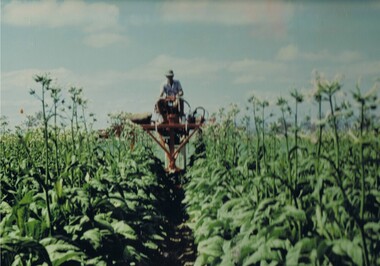
Photograph Topping Tobacco, Tobacco being topped (removal of flower), Circa mid to late 1900's
... History has produced the following results. (1) adequate tariff protection was never achieved,(2) control of disease through benzol vapour (CSIRO) breakthrough, was later identified as carcinogenic, (3) orderly marketing was achieved through (4) the establishment of the Tobacco Growers Association(1984). In October 2006, by way of Government buy back of tobacco leases from growers, resulted in the end of Tobacco farming in Australia (after 136 years of planting the first crop). ...History has produced the following results. (1) adequate tariff protection was never achieved,(2) control of disease through benzol vapour (CSIRO) breakthrough, was later identified as carcinogenic, (3) orderly marketing was achieved through (4) the establishment of the Tobacco Growers Association(1984). In October 2006, by way of Government buy back of tobacco leases from growers, resulted in the end of Tobacco farming in Australia (after 136 years of planting the first crop). ...This promotional photograph by the Tobacco Growers Association was in response to a 1935 meeting of tobacco growers from Victoria, South Australia and Queensland which produced four major resolutions for the industry covering the remainder of the 1900s. These four resolutions were: (1) Adequate tariff protection (2) Control of pests and diseases (3) Orderly marketing (4) The formation of an advisory council of growers. History has produced the following results. (1) adequate tariff protection was never achieved,(2) control of disease through benzol vapour (CSIRO) breakthrough, was later identified as carcinogenic, (3) orderly marketing was achieved through (4) the establishment of the Tobacco Growers Association(1984). In October 2006, by way of Government buy back of tobacco leases from growers, resulted in the end of Tobacco farming in Australia (after 136 years of planting the first crop). It was also significant that the major tobacco companies such as Philip Morris and The British American Tobacco Australasia advised the industry that it would source its tobacco requirements overseas by 2009.The remnants of the Tobacco Industry can still be viewed throughout the Kiewa Valley and adjacent regions on the former tobacco farms which still have the tobacco drying sheds and now converted into hay sheds. The problems from the large quantities of carcinogenic infused soil of farmlands in the region, still remains a problem now and for future generations. This particular photograph shows the lack of understanding by farmers and the contracted labour, at that time, and is demonstrated by the lack of protection of hands when handling seedlings and attached soil. Hand and foot protection was rarely used, even when later warnings were issued of the carcinogenic toxicity of the soil. The majority of farm owners, up until Health authorities stepped in the latter stages of 1900s, were skeptical of city scientists' "carcinogenic" health warnings and it was only after the younger generation of farmers, who had graduated from Agricultural colleges, encompassed the scientific approach to farm management. The "she'll be right mate" attitude of the farming/rural community has since the 1970s been slowly dissipating. Stricter controls of herbicides and pesticides used in agriculture are now in force. The death of the tobacco industry(2006) resulted in the expansion of the dairy , sheep, beef cattle, venison and lama wool producers in the Kiewa Valley and surrounding regions.Coloured photograph pasted onto a thick wood chip backing. Two galvanised eyelets at the top of the frame, 50mm from each end, with a twine cord stretch from each, for hanging purposes. See also KVHS 0054A ,KVHS 0054B and KVHC 0054D to KVHS 0054F A sign, which has been removed from the picture at some previous point in time is "The Tobacco crop being topped (flower removed)". tobacco, farming, rural industry, licences, ollie mould, blue mould, benzol vapour -
 Kiewa Valley Historical Society
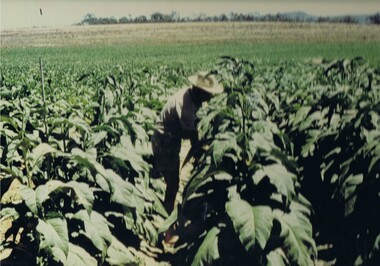
Photograph Tobacco plants, Tobacco fully grown prior to start picking, Circa mid to late 1900's
... History has produced the following results. (1) adequate tariff protection was never achieved,(2) control of disease through benzol vapour (CSIRO) breakthrough, was later identified as carcinogenic, (3) orderly marketing was achieved through (4) the establishment of the Tobacco Growers Association(1984). In October 2006, by way of Government buy back of tobacco leases from growers, resulted in the end of Tobacco farming in Australia (after 136 years of planting the first crop). ...History has produced the following results. (1) adequate tariff protection was never achieved,(2) control of disease through benzol vapour (CSIRO) breakthrough, was later identified as carcinogenic, (3) orderly marketing was achieved through (4) the establishment of the Tobacco Growers Association(1984). In October 2006, by way of Government buy back of tobacco leases from growers, resulted in the end of Tobacco farming in Australia (after 136 years of planting the first crop). ...This promotional photograph by the Tobacco Growers Association was in response to a 1935 meeting of tobacco growers from Victoria, South Australia and Queensland which produced four major resolutions for the industry covering the remainder of the 1900s. These four resolutions were: (1) Adequate tariff protection (2) Control of pests and diseases (3) Orderly marketing (4) The formation of an advisory council of growers. History has produced the following results. (1) adequate tariff protection was never achieved,(2) control of disease through benzol vapour (CSIRO) breakthrough, was later identified as carcinogenic, (3) orderly marketing was achieved through (4) the establishment of the Tobacco Growers Association(1984). In October 2006, by way of Government buy back of tobacco leases from growers, resulted in the end of Tobacco farming in Australia (after 136 years of planting the first crop). It was also significant that the major tobacco companies such as Philip Morris and The British American Tobacco Australasia advised the industry that it would source its tobacco requirements overseas by 2009.The remnants of the Tobacco Industry can still be viewed throughout the Kiewa Valley and adjacent regions on the former tobacco farms which still have the tobacco drying sheds and now converted into hay sheds. The problems from the large quantities of carcinogenic infused soil of farmlands in the region, still remains a problem now and for future generations. This particular photograph shows the lack of understanding by farmers, at that time, and is demonstrated by the lack of protection of hands and no masks over their noses, when handling plants. Hand, nose and foot protection was rarely used, even when later warnings were issued of the carcinogenic toxicity of the soil. The majority of farm owners, up until Health authorities stepped in the latter stages of 1900s, were skeptical of city scientists' "carcinogenic" health warnings and it was only after the younger generation of farmers, who had graduated from Agricultural colleges, encompassed the scientific approach to farm management. The "she'll be right mate" attitude of the farming/rural community has since the 1970s been slowly dissipating. Stricter controls of herbicides and pesticides used in agriculture are now in force. The death of the tobacco industry(2006) resulted in the expansion of the dairy , sheep, beef cattle, venison and lama wool producers in the Kiewa Valley and surrounding regions.Coloured photograph pasted onto a thick wood chip backing. Two galvanised eyelets at the top of the frame, 50mm from each end, with a twine cord stretch from each, for hanging purposes. See also KVHS 0054A to KVHS 0054C and 0054E to KVHS 0054FA sign, which has been removed from the picture at some previous point in time is "The Tobacco fully grown prior to start picking"tobacco, farming, rural industry, licences, ollie mould, blue mould, benzol vapour -
 Kiewa Valley Historical Society
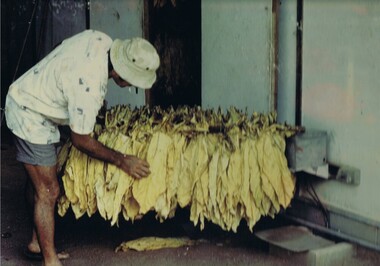
Photograph Tobacco drying leaves, Inspecting Drying tobacco leaves, 1950's to 1999
... History has produced the following results. (1) adequate tariff protection was never achieved,(2) control of disease through benzol vapour (CSIRO) breakthrough, was later identified as carcinogenic, (3) orderly marketing was achieved through (4) the establishment of the Tobacco Growers Association(19840. In October 2006, by way of Government buy back of tobacco leases from growers, resulted in the end of Tobacco farming in Australia (after 136 years of planting the first crop). ...History has produced the following results. (1) adequate tariff protection was never achieved,(2) control of disease through benzol vapour (CSIRO) breakthrough, was later identified as carcinogenic, (3) orderly marketing was achieved through (4) the establishment of the Tobacco Growers Association(19840. In October 2006, by way of Government buy back of tobacco leases from growers, resulted in the end of Tobacco farming in Australia (after 136 years of planting the first crop). ...This promotional photograph by the Tobacco Growers Association was in response to a 1935 meeting of tobacco growers from Victoria, South Australia and Queensland which produced four major resolutions for the industry covering the remainder of the 1900s. These four resolutions were: (1) Adequate tariff protection (2) Control of pests and diseases (3) Orderly marketing (4) The formation of an advisory council of growers. History has produced the following results. (1) adequate tariff protection was never achieved,(2) control of disease through benzol vapour (CSIRO) breakthrough, was later identified as carcinogenic, (3) orderly marketing was achieved through (4) the establishment of the Tobacco Growers Association(19840. In October 2006, by way of Government buy back of tobacco leases from growers, resulted in the end of Tobacco farming in Australia (after 136 years of planting the first crop). It was also significant that the major tobacco companies such as Philip Morris and The British American Tobacco Australasia advised the industry that it would source its tobacco requirements overseas by 2009.The remnants of the Tobacco Industry can still be viewed throughout the Kiewa Valley and adjacent regions on the former tobacco farms which still have the tobacco drying sheds and now converted into hay sheds. The problems from the large quantities of carcinogenic infused soil of farmlands in the region, still remains a problem now and for future generations. This particular photograph shows the lack of understanding by farmers and the contracted labour, at that time, and is demonstrated by the lack of protection of hands when handling the tobacco leaves and nose from tobacco dust. Hand and foot protection was rarely used, even when later warnings were issued of the carcinogenic toxicity of the soil. The majority of farm owners, up until Health authorities stepped in the later stages of 1900s, were skeptical of city scientists' "carcinogenic" health warnings and it was only after the younger generation of farmers, who had graduated from Agricultural colleges, encompassed the scientific approach to farm management. The "she'll be right mate" attitude of the farming/rural community has since the 1970s been slowly dissipating. Stricter controls of herbicides and pesticides used in agriculture are now in force. The death of the tobacco industry(2006) resulted in the expansion of the dairy , sheep, beef cattle, venison and lama wool producers in the Kiewa Valley and surrounding regions.Coloured photograph pasted onto a thick wood chip backing. Two galvanised eyelets at the top of the frame, 50mm from each end, with a twine cord stretch from each, for hanging purposes. See also KVHS 0054A to KVHS 0054D and KVHS 0054Ftobacco, farming, rural industry, licences, ollie mould, blue mould, benzol vapour, photograph -
 Kiewa Valley Historical Society
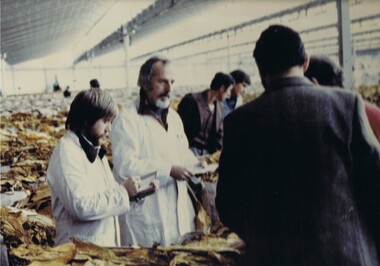
Photograph Tobacco selling, Tobacco sale floor, 1950 to 199
... History has produced the following results. (1) adequate tariff protection was never achieved,(2) control of disease through benzol vapour (CSIRO) breakthrough, was later identified as carcinogenic, (3) orderly marketing was achieved through (4) the establishment of the Tobacco Growers Association(19840. In October 2006, by way of Government buy back of tobacco leases from growers, resulted in the end of Tobacco farming in Australia (after 136 years of planting the first crop). ...History has produced the following results. (1) adequate tariff protection was never achieved,(2) control of disease through benzol vapour (CSIRO) breakthrough, was later identified as carcinogenic, (3) orderly marketing was achieved through (4) the establishment of the Tobacco Growers Association(19840. In October 2006, by way of Government buy back of tobacco leases from growers, resulted in the end of Tobacco farming in Australia (after 136 years of planting the first crop). ...This promotional photograph by the Tobacco Growers Association was in response to a 1935 meeting of tobacco growers from Victoria, South Australia and Queensland which produced four major resolutions for the industry covering the remainder of the 1900s. These four resolutions were: (1) Adequate tariff protection (2) Control of pests and diseases (3) Orderly marketing (4) The formation of an advisory council of growers. History has produced the following results. (1) adequate tariff protection was never achieved,(2) control of disease through benzol vapour (CSIRO) breakthrough, was later identified as carcinogenic, (3) orderly marketing was achieved through (4) the establishment of the Tobacco Growers Association(19840. In October 2006, by way of Government buy back of tobacco leases from growers, resulted in the end of Tobacco farming in Australia (after 136 years of planting the first crop). It was also significant that the major tobacco companies such as Philip Morris and The British American Tobacco Australasia advised the industry that it would source its tobacco requirements overseas by 2009.This particular photograph shows prospective buyers (from the major processing firms of Philip Morris and British American Tobacco Australasia) inspecting the dried tobacco leaves at the Melbourne sales, before 2009, when they moved to overseas growers.The remnants of the Tobacco Industry can still be viewed throughout the Kiewa Valley and adjacent regions on the former tobacco farms, which still have the former tobacco drying sheds but now converted into hay sheds. The death of the tobacco industry(2006) resulted in the expansion of the dairy , sheep, beef cattle, venison and lama wool producers in the Kiewa Valley and surrounding regions. The problems from the large quantities of carcinogenic infused soil of farmlands in the region, still remains a problem now and for future generations. The tighter restrictions of where the final product can be smoked and the higher tax levied (no tariff protection) was the main contributor to this one time lucrative industry's demise.Coloured photograph pasted onto a thick wood chip backing. Two galvanised eyelets at the top of the frame, 50mm from each end, with a twine cord stretch from each, for hanging purposes. See also KVHS 0054A to KVHS 0054EA sign, which has been removed from the picture at some previous point in time is "Tobacco sale floor"tobacco, farming, rural industry, licences, ollie mould, blue mould, benzol vapour, photograph -
 Bendigo Military Museum
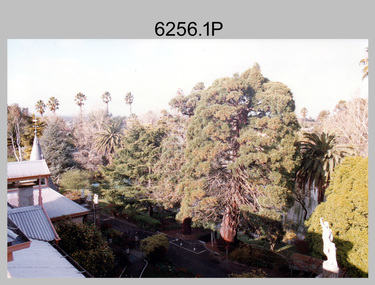
Photograph - Removal of Sequoia Californian Redwood Tree - Army Survey Regiment, Fortuna, Bendigo, 1994
... A sequoia sapling was eventually planted as a replacement to the diseased tree. It was decided to mill and store the timber of the felled tree on-site due to its historical significance. ...A sequoia sapling was eventually planted as a replacement to the diseased tree. It was decided to mill and store the timber of the felled tree on-site due to its historical significance. ...These nine photographs of contractors felling a sequoia Californian redwood tree was taken at the Army Survey Regiment, Fortuna, Bendigo on the 16th of September 1994. Although 23 photos were taken at the time, 14 were not scanned due to their similarity to the nine featured photos. Two sequoia Californian redwood trees were planted at the front entrance of Fortuna Villa in the early days of gold mining magnate George Lansell’s occupation in the 1870’s. They were of immense proportion and much admired during the Lansell era and RA Svy’s occupation from 1942 to 1996. In these early days of Army occupation, the trees were lopped due to concerns of their size and proximity to the Villa. The felling of the tree in 1994 was considered unsafe due to perceptions of disease. These perceptions were upsetting to staff, as some believed that although there were a few dead branches, the tree was OK. As the tree had a noticeable lean, measurements were taken indicating the tree was stable. A sequoia sapling was eventually planted as a replacement to the diseased tree. It was decided to mill and store the timber of the felled tree on-site due to its historical significance. Although future uses were not determined at the time, the timber was eventually used to construct display cabinets and souvenir pens. When Defence decided to relocate geospatial production to a new facility in Junortoun an outer suburb of Bendigo in 2008, the sequoia timber was used as a beautiful feature in the front foyer as well as several feature walls within the building, providing a historical connection Fortuna Villa.This is a set of nine photographs of contractors felling a Sequoia (Californian redwood) tree at the Army Survey Regiment, Fortuna, Bendigo on the 16th of September 1994. The colour photographs were printed on photographic paper and are part of the Army Survey Regiment’s Collection. The photographs were scanned at 300 dpi. .1) - Photo, colour, 1994, Felling of sequoia Californian redwood tree. .2) - Photo, colour, 1994, Felling of sequoia Californian redwood tree. Neil Morgan (ground maintenance) is hugging the tree. .3) - Photo, colour, 1994, Felling of sequoia Californian redwood tree. .4) to .8) - Photo, colour, 1994, Felling of sequoia Californian redwood tree. .9) - Photo, colour, 1994, background on left - WO2 Bob Garritty, foreground L to R: Geoff (ground maintenance), unidentified, Neil Morgan (ground maintenance)..1P to .9P – No personnel are identified.royal australian survey corps, rasvy, army survey regiment, army svy regt, fortuna, asr -
 Bendigo Historical Society Inc.
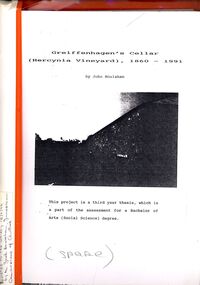
Book - STRAUCH COLLECTION: GREIFFENHAGENS CELLAR (HERCYNIA VINEYARD)
... planted a vineyard. They also grew fruit and crops to feed the working horses. In 1870 August sold his interest in the vineyard and set up his own smaller vineyard at Sheepwash Gully. He had several business interests before he took up the caretaker position at the newly dug Weeroona lake, a position he held until his death. Carl Heine sold his interest in the vineyard in 1873 and returned to Germany. WIlliam Grieffenhagen (1834-1916) continued his very successful vineyard until the region was hit with a highly infectious vine disease...planted a vineyard. They also grew fruit and crops to feed the working horses. In 1870 August sold his interest in the vineyard and set up his own smaller vineyard at Sheepwash Gully. He had several business interests before he took up the caretaker position at the newly dug Weeroona lake, a position he held until his death. Carl Heine sold his interest in the vineyard in 1873 and returned to Germany. WIlliam Grieffenhagen (1834-1916) continued his very successful vineyard until the region was hit with a highly infectious vine disease ..."Hercynia" was the largest vineyyard in the Bendigo District. It was started by Carl Wilhelm Greiffenhagen (William) and his cousins, twins, Carl and August Heine. The first vine cuttings were planted in 1860. The partners owned 300 acres at Axe Creek and in 1862 had 24 acres under vines and an orchard of 4 acres. By 1884 they had expanded to 30 acres of vines. They produced many award winning wines. August Heine ( 1832 - 1898) was born in Germany and came to Australia in 1854 with his twin brother Carl and their cousin William Greiffenhagen. Initially the three took up mining successfully but then the partnership bought 300 acres at Axe Creek and planted a vineyard. They also grew fruit and crops to feed the working horses. In 1870 August sold his interest in the vineyard and set up his own smaller vineyard at Sheepwash Gully. He had several business interests before he took up the caretaker position at the newly dug Weeroona lake, a position he held until his death. Carl Heine sold his interest in the vineyard in 1873 and returned to Germany. WIlliam Grieffenhagen (1834-1916) continued his very successful vineyard until the region was hit with a highly infectious vine disease in 1893. Although his own vines escaped infection, he was within the 2 mile quarantine area and was forced to dig out all his vines. He never replanted but depended on his orchard instead. He was a founding member of the Bendigo Agricultural Society and a local Shire councillor for several years. In 1870 he married Margaret Boyd.Binder containing information relating to Greiffenhagen's cellar (Hercynia Vineyard) 1860 - 1991 including black and white photographs & maps, compiled by John Houlahan as a third year thesis whichnis pat of the assessment for a Bachelor of Arts (Social Science) degree. Donated to the German Society 15/2/96 by the Grandfather of author Jack Houlahan.John Houlahanbook, bendigo, wineries, bendigo-history-axe creek- wineries- german -
 Otway Districts Historical Society
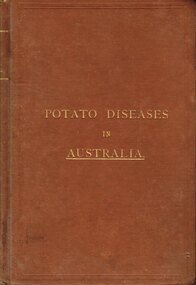
Book, Government Printer, Potato diseases in Australia, 1911
... Potatoes are known for their great liability to disease, suffering more from the ravages of fungi than any other crop, and this is largely owing to the fact that they are propagated from tubers which are just swollen portions of underground branches of the stem. Portions of the parent plant...Potatoes are known for their great liability to disease, suffering more from the ravages of fungi than any other crop, and this is largely owing to the fact that they are propagated from tubers which are just swollen portions of underground branches of the stem. Portions of the parent plant ...Potatoes are known for their great liability to disease, suffering more from the ravages of fungi than any other crop, and this is largely owing to the fact that they are propagated from tubers which are just swollen portions of underground branches of the stem. Portions of the parent plant in the form of tubers or cuttings are planted year after year, so that any inherent weakness in the original is transmitted to the offspring, and therefore, without a process of selection, deterioration is sure to occur sooner or later. When the tubers are raised from seed and a good selection made from them, they are less liable to disease at least for a number of years. Handbook of fungus diseases of the potato in Australia and their treatment. D. McAlpine. 1st ed. Department of Agriculture, Victoria; Melbourne (Vic); 1911. x, 314 p.; illus., map. Hard cover.potatoes; disease; fungus; agriculture; -
 Glen Eira Historical Society
Article - GLEN HUNTLY (HISTORY OF)
... ‘Glen Huntly’ Buchanan Captain fever ship emigrants Cummins Ann St Kilda Cemetery Bowman Mrs Caulfield Craig John Cameron Miss McGonagle Mrs Elsternwick Armstrong George Mathers James The Glen Huntly Pioneers Memorial Jones Alfred Ramsey St David’s Uniting Church (Grange Road) Glen Huntly Glen Huntly Road Lake Street Glen Huntly State School Glen Huntly Presbyterian Church South Caulfield Mernda Avenue Garden Avenue Grange Road Jenkin (Boss) William Wattle Avenue Chinese joss-house Smith A.W Glen Huntly Post Office foundation stones King F.L Methodist Church Trinity Congregational Church Greek Orthodox Church Salvation Army Temple Wanalta Road St Anthony’s Roman Catholic Church St Agnes’ Anglican Church Booran Road St David’s Uniting Church El Nido Grove Manses Royal Avenue Munster Avenue James Street Rothschild Street Neerim Road organs Peace Memorial Organ railways Marara Road Curraweena Road Booran Road Bambra Road Rosstown railway Murray-Ross William Leila Road Murray-Ross Leila ‘The Grange’ North Road Wild Cherry Road ‘Rosstown’ picture theatres Manchester Grove aerodrome Lord Reserve Neville Street Lyons Street Morgan Street Rosedale Avenue rifle clubs Glen Huntly Infant Welfare Centre Watson Grove Rowlands Drapery drapers Bones Plant Nursery nurseries Elsternwick railway station railway stations Kooyong Road Glen Eira Road Truganini Road Rosstown Sugar Works Ross Murray street names typhoid diseases death and dying Article GLEN HUNTLY (HISTORY OF) ...This file contains 10 items about the history of Glen Huntly: 1/6 photocopied pages from ‘The History of St Kilda’ which relates to the place name Glen Huntly, and the Quarantine graves, date unknown. 2/2 photocopied pages from the ‘Sun Pictorial’ dated 13/4/1928 and 12/4/1928; relating to the state of the graves at Point Ormond and their re-internment to St Kilda Cemetery. 3/1 pen and ink sketch of graves at Point Ormond from the State Library Victoria. 4/3 pages taken from a website on the re-internment of graves and some social history as to the reason that the new emigrants were coming to Australia. The Article also has 7 photographs. 5/2 newspaper articles on the ‘Glen Huntly’ descendants forthcoming reunion being held on 21&22/4/1990. 6/1 article reprinted from newsletter no. 22 October 1983 on the barque ‘Glen Huntly’. Also details of passengers who died and the burial of 3 at Point Ormond. 7/1 handwritten document (unattributed) taken from ‘Migrant ships for South Australia 1836-1850’ by Ronald Parsons. 8/1 pamphlet commemorating the 150th anniversary of the ‘Glen Huntly’ arriving in Melbourne. It gives information about the ship, passengers, memorial in St Kilda Cemetery and upcoming descendants’ reunion. 9/1 program of commemoration events 21&22/4/1990. 10/1 piece of art work for a ‘Welcome to Glen Huntly’ sign, featuring a ship. Undated, unattributed and source unknown.‘glen huntly’, buchanan captain, fever ship, emigrants, cummins ann, st kilda cemetery, bowman mrs, caulfield, craig john, cameron miss, mcgonagle mrs, elsternwick, armstrong george, mathers james, the glen huntly pioneers memorial, jones alfred ramsey, st david’s uniting church (grange road), glen huntly, glen huntly road, lake street, glen huntly state school, glen huntly presbyterian church, south caulfield, mernda avenue, garden avenue, grange road, jenkin (boss) william, wattle avenue, chinese joss-house, smith a.w, glen huntly post office, foundation stones, king f.l, methodist church, trinity congregational church, greek orthodox church, salvation army temple, wanalta road, st anthony’s roman catholic church, st agnes’ anglican church, booran road, st david’s uniting church, el nido grove, manses, royal avenue, munster avenue, james street, rothschild street, neerim road, organs, peace memorial organ, railways, marara road, curraweena road, booran road, bambra road, rosstown railway, murray-ross william, leila road, murray-ross leila, ‘the grange’, north road, wild cherry road, ‘rosstown’, picture theatres, manchester grove, aerodrome, lord reserve, neville street, lyons street, morgan street, rosedale avenue, rifle clubs, glen huntly infant welfare centre, watson grove, rowlands drapery, drapers, bones plant nursery, nurseries, elsternwick railway station, railway stations, kooyong road, glen eira road, truganini road, rosstown sugar works, ross murray, street names, typhoid, diseases, death and dying -
National Wool Museum
Report, Final report: Interactions of plant hepatotoxins and copper in sheep (UMU 08P)
... "Final report: Interactions of plant hepatotoxins and copper in sheep (UMU 08P)" Possibly a Melbourne University, 1988 research project. Sheep - diseases ..."Final report: Interactions of plant hepatotoxins and copper in sheep (UMU 08P)" Possibly a Melbourne University, 1988 research project.TERM DATE 06/88sheep - diseases sheep - nutrition animal health, sheep - diseases, sheep - nutrition, animal health -
 Great Stupa of Universal Compassion
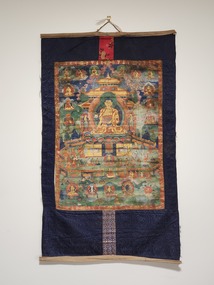
Artwork, other - Medicine Buddha thangka
... His iconic imagery, including the medicine bowl and healing plant, represents the union of wisdom and compassion as forces of healing. His teachings, rooted in the "Four Medicine Tantras," emphasize that the root of all diseases lies in negative emotions of greed, hatred, and ignorance. ...Thangkas are cloth scrolls unique to Tibetan Buddhism, depicting deities, venerated spiritual figures, or common religious symbols. Intended for personal meditation or instruction of monastic students, they are invested with the spirit of a deity to whom they are consecrated. A thangka is a composite art form consisting of a picture panel which is painted or embroidered; a brocade mounting; and one or more of the following: a silk cover, leather corners, wooden dowels at the top and bottom and metal or wooden decorative knobs on the bottom dowel. This allows a thangka to be rolled up for portability, reflecting its origins in the nomadic lifestyle of Tibetan monks.The Medicine Buddha (also known as Bhaisajyaguru or Sangyé Menla) is revered as the embodiment of healing and associated with practices helping with mental and physical ailments, as well as purifying negative karma. His iconic imagery, including the medicine bowl and healing plant, represents the union of wisdom and compassion as forces of healing. His teachings, rooted in the "Four Medicine Tantras," emphasize that the root of all diseases lies in negative emotions of greed, hatred, and ignorance.The central figure in this old thangka is Medicine Buddha, seated on a lotus throne and surrounded by other deities and figures. He has a bowl in his left hand, and a flower in his right hand. An interesting feature is that his body is not painted blue, as is customary for the image Medicine Buddha. The paint colours were derived from natural ingredients – grinded coral, turquoise and other gemstones. The 'Om Ah Hum' mantra is printed in Tibetan in red ink on the verso of the thangka.buddhist art, tibetan buddhism, holy objects -
 Stawell Historical Society Inc
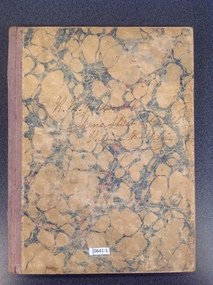
Book, Richard Morcom, Exercise Book, Wages, Loads of Materials for Crushing Plants Firewood etc, 1895-1899
... Other book contains working hours - Not at Stawell- Notes taken from Food in Health and Disease by Burney J. 1890 stawell education Richard Morcom Goldsworthy School of Mines Skene Street Stawell 641-1 Conatins Miscellaneous material. Re Wages - Loads of material for crushing Plants ...These books belonged to Goldsworthy R.W. Stawell when a Student at School of Mines - 1 Book contains information re chemistry assaying ect. Other book contains working hours - Not at Stawell- Notes taken from Food in Health and Disease by Burney J. 1890641-1 Conatins Miscellaneous material. Re Wages - Loads of material for crushing Plants, firewood, etcRichard Morcom Goldsworthy School of Mines Skene Street Stawellstawell education -
 Harcourt Valley Heritage & Tourist Centre
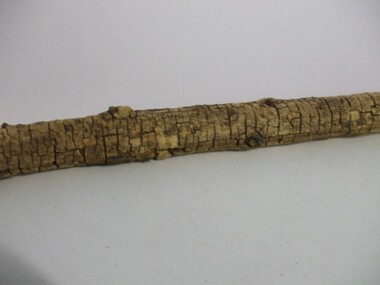
Mulberry Tree Branch, 1874
... Heavy frost damage to mulberry plants. (3). Disease of silkworms. (4). Lack of quantity of leaves. (5) drought and rabbits. ...Heavy frost damage to mulberry plants. (3). Disease of silkworms. (4). Lack of quantity of leaves. (5) drought and rabbits. ...An unsuccessful attempt was made to set up a silkworm industry at Mt Alexander, to be an occupation for ladies of the district as well as to introduce the silk industry to Victoria. An attempt by women to enter the business world was beaten by difficulties: (1). Road access to the property (2). Heavy frost damage to mulberry plants. (3). Disease of silkworms. (4). Lack of quantity of leaves. (5) drought and rabbits. Experiments proved silk harvested and woven was superior to overseas products, but the venture was defeated by the climate and the surviving trees were relocated to Corowa NSWA relic of the far-sighted venture by the Victorian Ladies Sericulture Co, promoted by the charismatic Mrs Bladen Neill , who was anxious to generate employment opportunities for women..A dead branch from a mulberry tree grown at Sericulture Farm, Mt Alexander, in the early 1870s. This long limb's bark has cracked with age, forming a pattern of brown cracks. Remnants of smaller branch axilla are clearly visible. An inscription on paper is pasted around the branch L 74 x W 14 x D 3.5Typed: "Part of a limb of a mulberry tree from the Sericulture Farm on Mt Alexander which was started by Mrs Bladen-Neill in early 1870s, finally closing in 1878. Mrs Bladen-Neill died in September 1884 at the residence of Dr Barker, Melbourne" "Courtesy of Keith Henderson, Harcourt" -
 Glen Eira City Council History and Heritage Collection
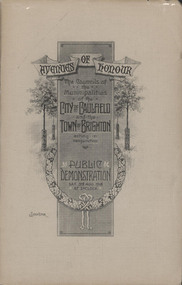
Booklet, "AVENUES OF HONOUR The Councils of the Municipalities of the CITY OF CAULFIELD TOWN OF BRIGHTON acting in conjunction PUBLIC DEMONSTRATION SAT 3rd AUG. 1918 AT 3oCLOCK"
... planted. Intensely personal, the Avenue also acted as a focus of grief and remembrance for the wider community. For many years, the annual civic Anzac Day service was held at the Avenue on Point Nepean Road, near Glen Huntly Road, Elsternwick. The service was moved to Caulfield Park upon the completion of the Cenotaph in 1930. Due to road widening and disease...planted. Intensely personal, the Avenue also acted as a focus of grief and remembrance for the wider community. For many years, the annual civic Anzac Day service was held at the Avenue on Point Nepean Road, near Glen Huntly Road, Elsternwick. The service was moved to Caulfield Park upon the completion of the Cenotaph in 1930. Due to road widening and disease ...Souvenir Programme from the Councils of the Municipalities of the City of Caulfield and the Town of Brighton for a Public Demonstration to be held on Sat 3rd August 1918 at 3 o'clock for the proposed Avenues of Honour to be planted in memory of fallen WWI soldiers. From Honour Roll Display 2019 interpretation panel - Brighton-Caulfield Avenue of Honour It is hard to imagine but a grand arboreal Avenue of Honour once lined parts of North Road, McMillan Street and Point Nepean Road (now Nepean Highway). The Avenue of Honour was a distinctly Australian phenomenon with hundreds being constructed throughout Australia during and following World War One, most of these in Victoria. Consisting of tree lined streets with each tree representing a solider, the Avenue of Honour signalled a more egalitarian approach to commemoration where rank was not a consideration. Arguably the most famous Avenue of Honour in Victoria still exists at Ballarat. Stretching for nearly 22 kilometres, the entrance to the Avenue is marked by the imposing Arch of Victory. Smaller in scale, the Brighton-Caulfield Avenue of Honour was dedicated to the ‘memory of (Brighton and Caulfield’s) kith and kin who came from (the) district and who died in the Great War’. A joint project between the neighbouring Councils, the idea was first reported in The Argus on 1 July 1918. Plans moved along quickly and on 3 August 1918 the Governor of Victoria Arthur Stanley planted the first Australian flowering gum. The next of kin were then invited to plant trees for lost sons, brothers, uncles, nephews and husbands. In all, over 400 trees were planted. Intensely personal, the Avenue also acted as a focus of grief and remembrance for the wider community. For many years, the annual civic Anzac Day service was held at the Avenue on Point Nepean Road, near Glen Huntly Road, Elsternwick. The service was moved to Caulfield Park upon the completion of the Cenotaph in 1930. Due to road widening and disease the last original tree was replaced in the 1980s, however a plaque in Caulfield Park records the Avenue’s plantation. Commemorative booklet, grey cover with text printed on the grey textured paper cover and an image of four trees and a wreath. Image of a kookaburra on the back. Inside, 28 numbered pages with b/w text and photographic images including a transparent paper representation of the proposed Avenues of Honour on Brighton Road and Point Nepean Road. Souvenir programme for a Public Demonstration for the Avenues of Honour as detailed on the front.city of caufield, world war one, first world war, anzac, remembrance, town of brighton, brighton, caulfield, avenue of honour -
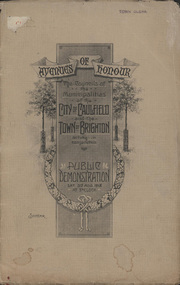 Glen Eira City Council History and Heritage Collection
Booklet, D. W. Paterson Co. Pty. Ltd, "AVENUES OF HONOUR The Councils of the Municipalities of the CITY OF CAULFIELD TOWN OF BRIGHTON acting in conjunction PUBLIC DEMONSTRATION SAT 3rd AUG. 1918 AT 3oCLOCK SOUVENIR"
... planted. Intensely personal, the Avenue also acted as a focus of grief and remembrance for the wider community. For many years, the annual civic Anzac Day service was held at the Avenue on Point Nepean Road, near Glen Huntly Road, Elsternwick. The service was moved to Caulfield Park upon the completion of the Cenotaph in 1930. Due to road widening and disease...planted. Intensely personal, the Avenue also acted as a focus of grief and remembrance for the wider community. For many years, the annual civic Anzac Day service was held at the Avenue on Point Nepean Road, near Glen Huntly Road, Elsternwick. The service was moved to Caulfield Park upon the completion of the Cenotaph in 1930. Due to road widening and disease ...Souvenir Programme from the Councils of the Municipalities of the City of Caulfield and the Town of Brighton for a Public Demonstration to be held on Sat 3rd August 1918 at 3 o'clock for the proposed Avenues of Honour to be planted in memory of fallen WWI soldiers. One of two known copies, this copy has "Town Clerk" stamped in the upper corner, rhs.Commemorative booklet, grey cover with text printed on the grey textured paper and an image of four trees and a wreath. Image of a kookaburra on the back. Inside, 28 numbered pages with b/w text and photographic images including a transparent paper representation of the proposed Avenues of Honour on Brighton Road and Point Nepean Road. Souvenir programme for a Public Demonstration for the Avenues of Honour as detailed on the front. From Honour Roll Display 2019 interpretation panel - Brighton-Caulfield Avenue of Honour It is hard to imagine but a grand arboreal Avenue of Honour once lined parts of North Road, McMillan Street and Point Nepean Road (now Nepean Highway). The Avenue of Honour was a distinctly Australian phenomenon with hundreds being constructed throughout Australia during and following World War One, most of these in Victoria. Consisting of tree lined streets with each tree representing a solider, the Avenue of Honour signalled a more egalitarian approach to commemoration where rank was not a consideration. Arguably the most famous Avenue of Honour in Victoria still exists at Ballarat. Stretching for nearly 22 kilometres, the entrance to the Avenue is marked by the imposing Arch of Victory. Smaller in scale, the Brighton-Caulfield Avenue of Honour was dedicated to the ‘memory of (Brighton and Caulfield’s) kith and kin who came from (the) district and who died in the Great War’. A joint project between the neighbouring Councils, the idea was first reported in The Argus on 1 July 1918. Plans moved along quickly and on 3 August 1918 the Governor of Victoria Arthur Stanley planted the first Australian flowering gum. The next of kin were then invited to plant trees for lost sons, brothers, uncles, nephews and husbands. In all, over 400 trees were planted. Intensely personal, the Avenue also acted as a focus of grief and remembrance for the wider community. For many years, the annual civic Anzac Day service was held at the Avenue on Point Nepean Road, near Glen Huntly Road, Elsternwick. The service was moved to Caulfield Park upon the completion of the Cenotaph in 1930. Due to road widening and disease the last original tree was replaced in the 1980s, however a plaque in Caulfield Park records the Avenue’s plantation. Inkstamp upper corner rhs: "TOWN CLERK" -
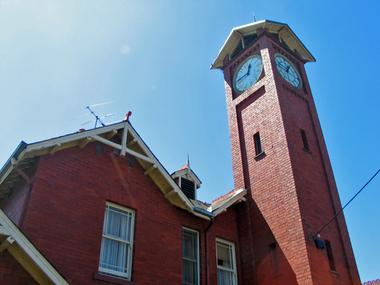 Ballarat Heritage Services
Photograph - Digital photographs, L.J. Gervasoni, Boroondara General Cemetery Gatehouse, c2005-2015
... plantings. In the 1850s cemeteries were located on the periphery of populated areas because of concerns about diseases like cholera. ...The Boroondara General Cemetery is registerd by Heritage VictoriaBoroondara Cemetery in kew was established in 1858. It has an unusual triangular reserve bounded by High Street, Park Hill Road and Victoria Park, Kew. The caretaker's lodge and administrative office (1860 designed by Charles Vickers, additions, 1866-1899 by Albert Purchas) form a picturesque two-storey brick structure with a slate roof and clock tower. A rotunda or shelter (1890, Albert Purchas) is located in the centre of the cemetery: this has an octagonal hipped roof with fish scale slates and a decorative brick base with a tessellated floor and timber seating. The cemetery is surrounded by a 2.7 metre high ornamental red brick wall (1895-96, Albert Purchas) with some sections of vertical iron palisades between brick pillars. Albert Purchas was a prominent Melbourne architect who was the Secretary of the Melbourne General Cemetery from 1852 to 1907 and Chairman of the Boroondara Cemetery Board of Trustees from 1867 to 1909. He made a significant contribution to the design of the Boroondara Cemetery Boroondara Cemetery is an outstanding example of the Victorian Garden Cemetery movement in Victoria, retaining key elements of the style, despite overdevelopment which has obscured some of the paths and driveways. Elements of the style represented at Boroondara include an ornamental boundary fence, a system of curving paths which are kerbed and follow the site's natural contours, defined views, recreational facilities such as the rotunda, a landscaped park like setting, sectarian divisions for burials, impressive monuments, wrought and cast iron grave surrounds and exotic symbolic plantings. In the 1850s cemeteries were located on the periphery of populated areas because of concerns about diseases like cholera. They were designed to be attractive places for mourners and visitors to walk and contemplate. Typically cemeteries were arranged to keep religions separated and this tended to maintain links to places of origin, reflecting a migrant society. Other developments included cast iron entrance gates, built in 1889 to a design by Albert Purchas; a cemetery shelter or rotunda, built in 1890, which is a replica of one constructed in the Melbourne General Cemetery in the same year; an ornamental brick fence erected in 1896-99(?); the construction and operation of a terminus for a horse tram at the cemetery gates during 1887-1915; and the Springthorpe Memorial built between 1897 and 1907. A brick cremation wall and a memorial rose garden were constructed near the entrance in the mid- twentieth century(c.1955-57) and a mausoleum completed in 2001.The maintenance shed/depot close to High Street was constructed in 1987. The original entrance was altered in 2000 and the original cast iron gates moved to the eastern entrance of the Mausoleum. Some notable memorials include The Springthorpe Memorial (VHR 522), The Syme Memorial (1908), The Cussen Memorial (VHR 2036). Burials within the cemetery include the Henty family, artists Louis Buvelot and Charles Nuttall, businessmen John Halfey and publisher David Syme, artist and diarist Georgiana McCrae, actress Nellie Stewart and architect and designer of the Boroondara and Melbourne General Cemeteries, Albert Purchas. The Boroondara Cemetery features many plants, mostly conifers and shrubs of funerary symbolism, which line the boundaries, road and pathways, and frame the cemetery monuments or are planted on graves. The major plantings include an impressive row of Bhutan Cypress (Cupressus torulosa), interplanted with Sweet Pittosporum (Pittosporum undulatum), and a few Pittosporum crassifolium, along the High Street and Parkhill Street, where the planting is dominated by Sweet Pittosporum. Planting within the cemetery includes rows and specimen trees of Bhutan Cypress and Italian Cypress (Cupressus sempervirens), including a row with alternate plantings of both species. The planting includes an unusual "squat" form of an Italian Cypress. More of these trees probably lined the cemetery roads and paths. Also dominating the cemetery landscape near the Rotunda is a stand of 3 Canary Island Pines (Pinus canariensis), a Bunya Bunya Pine (Araucaria bidwillii) and a Weeping Elm (Ulmus glabra 'Camperdownii'). Amongst the planting are the following notable conifers: a towering Bunya Bunya Pine (Araucaria bidwillii), a Coast Redwood (Sequoia sempervirens), a rare Golden Funeral Cypress (Chamaecyparis funebris 'Aurea'), two large Funeral Cypress (Chamaecyparis funebris), and the only known Queensland Kauri (Agathis robusta) in a cemetery in Victoria. The Cemetery records, including historical plans of the cemetery from 1859, are held by the administration and their retention enhances the historical significance of the Cemetery. Digital images of a red brick gatehouse at Boroondara General Cemetery in Kew.cemetery, boroondara, kew, gatehouse, clock, tower, clocktower, heritage, memorial
