
Showing 111 items matching "door plates"
-
 Warrnambool and District Historical Society Inc.
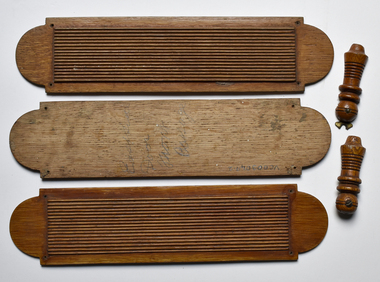
Functional object - Door plates and key hole covers
... Door plates and key hole covers......Door plates....1,.2,.3 These are three wooden door plates with a fine ridged front and a curved top and base. ...Functional object Door plates and key hole covers ...These items come from the house "BIRCHWOOD" in Koroit Street, Warrnambool belonging to Dr. Angus and family. Dr. William Roy Angus (1901-1970) practised in Warrnambool from 1939 to 1970. In his later years Dr. Angus was an important ophthalmologist. He was prominent in Warrnambool in both medical and community affairs. The Angus home "BIRCHWOOD" at 214 Koroit Street (the site of the Warrnambool Police station today) was noted for its beautiful garden, lawns and croquet court and used as a meeting place and entertainment centre for vice-regal personnel and community organisations.These items are of considerable interest as they are connected to a well known doctor in Warrnambool and a notable house..1,.2,.3 These are three wooden door plates with a fine ridged front and a curved top and base. They have four holes to be used with nails to attach to the door. .4, .5 These are two wooden key hole covers with half spherical shapes at the top, ridging and carving towards a tapered base. .4 has a brass circular plate at the back with two small decorations protruding at the top. The screw attaching it to the front is broken..5 As for .4 but the brass section is missing and the screw is intact..2 East side door, front passage. .3 West side door dr. angus warrnambool, birchwood warrnambool, door plates, key hole covers, warrnambool, warrnambool history -
 Lakes Entrance Historical Society
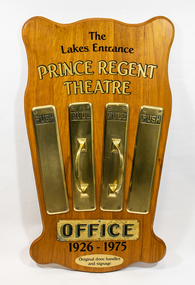
Functional Object - Door handle, Brass door handles and finger plates fron Prince Regent Theatre Lakes Entrance, 1975
... Brass door handles and finger plates fron Prince Regent Theatre Lakes Entrance...Display of door handles and finger plates on plaque...Used at Prince Regent Theatre in Lakes Entrance from 1926 to 1975 Historical PERFORMING ARTS Cinema Display of door handles and finger plates on plaque Brass door handles and finger plates fron Prince Regent Theatre Lakes Entrance Functional Object Door handle ...Used at Prince Regent Theatre in Lakes Entrance from 1926 to 1975HistoricalDisplay of door handles and finger plates on plaqueperforming arts, cinema -
 Working Heritage Crown Land Collection
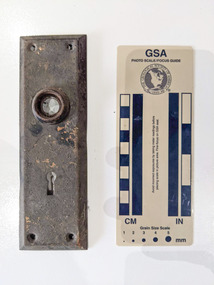
Functional object - Door plate
... Door plate...Historic door plate with a key hole...Historic Building former Royal Mint Historic door plate with a key hole Functional object Door plate ...Historic door plate with a key holehistoric building, former royal mint -
 Working Heritage Crown Land Collection
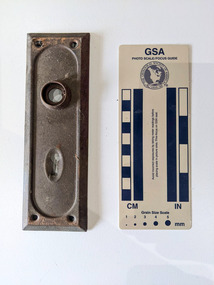
Functional object - Door plate
... Door plate...Historic door plate with a key hole....Historic Building former Royal Mint Historic door plate with a key hole. Functional object Door plate ...Historic door plate with a key hole.historic building, former royal mint -
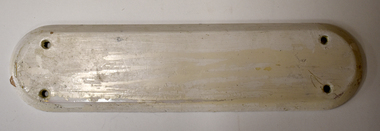 Warrnambool and District Historical Society Inc.
Archive - Door plate with Inscription, Leslie O'Callaghan, 1942
... Door plate with Inscription...This door plate was found at 28 Spence Street, Warrnambool by the builder Ray Hollingsworth, when he was renovating the building for the Warrnambool Presbyterian Church in June 2019. ...This is a cream-coloured ceramic door plate. It is rectangular-shaped with curved edges at the top and bottom. ...He never mentioned the interesting memento of his time there that he left on the back of a door plate. The Warrnambool and District Historical Society Archives Centre is called 'Les O'Callaghan History House' This door plate with its inscription was found 77 years after the inscription was written. ...This door plate was found at 28 Spence Street, Warrnambool by the builder Ray Hollingsworth, when he was renovating the building for the Warrnambool Presbyterian Church in June 2019. He realized that the inscription had been placed there by Leslie O'Callaghan, probably when he left the premises in 1942 after boarding there for some years. Leslie O'Callaghan (1918-2014) was born in Balmoral and left there at the age of 13 with a scholarship to study at Warrnambool Technical School. He became an industrial chemist, working at the Kraft Walker Cheese Factory in Allansford (Warrnambool Cheese and Butter Factory). His experimental work in cheese cultures over a 45 year period was regarded as cutting edge work in the Victorian dairying industry. Known as 'Mr History', Leslie O'Callaghan was also an important Warrnambool historian, serving as president of the Warrnambool and District Historical Society for 35 years. In later life Les wrote about his time in 28 Spence Street, noting the lay-out of the early building and other boarders at the time. He never mentioned the interesting memento of his time there that he left on the back of a door plate. The Warrnambool and District Historical Society Archives Centre is called 'Les O'Callaghan History House'This door plate with its inscription was found 77 years after the inscription was written. It is of considerable interest because the writer of the inscription was well-known in Warrnambool as a bacteriologist and an historian. He left his own personal historical message and by sheer chance it was found years later. (All the old door plates at the time of the renovation were thrown out and it was fortunate that the builder happened to see the writing on one of them and to recognize who the writer was.)This is a cream-coloured ceramic door plate. It is rectangular-shaped with curved edges at the top and bottom. It has been painted white and has two holes at the top and bottom for the insertion of screws for a5taching the plate to the door. The inside of the plate has handwriting in black pencilLeslie Alexander O'Callaghan lived here for some years 1939-1942 AD. His occupation was as assistant bacteriologist for Kraft-Walker Cheese Coy. at Allansford. Born at Balmoral, 40 miles NORTH of Hamilton, Victorialeslie o'callaghan warrnambool, kraft walker cheese company allansford, 28 spence street warrnambool -
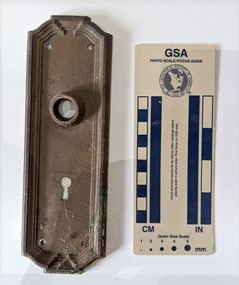 Working Heritage Crown Land Collection
Functional object - Door plate
... Door plate...Historic door plate with a key hole with embossed boarder....Functional object Door plate ...Historic door plate with a key hole with embossed boarder.historic building, former royal mint -
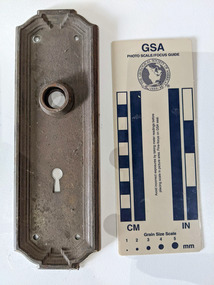 Working Heritage Crown Land Collection
Functional object - Door plate
... Door plate...Historic door plate with an embossed boarder and key hole....Functional object Door plate ...Historic door plate with an embossed boarder and key hole.historic building, former royal mint -
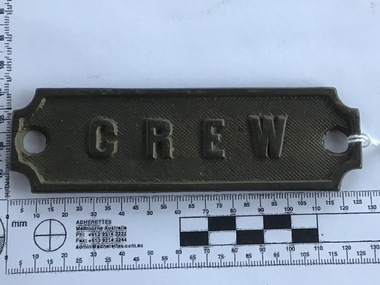 Queenscliffe Maritime Museum
Plaque - Brass Plate
... ...door plate...Brass door plate from SS Time with "Crew" inscribed on front...Recovered from wreck of SS Time ss time door plate CREW Brass door plate from SS Time with "Crew" inscribed on front Plaque Brass Plate ...Recovered from wreck of SS TimeBrass door plate from SS Time with "Crew" inscribed on frontCREWss time, door plate -
 Working Heritage Crown Land Collection
Functional object - Door Bolt
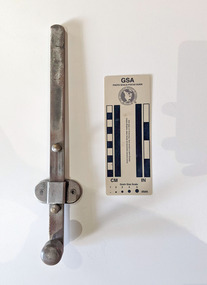
... Iron door bolt with wall plate...Historic Building former Royal Mint Iron door bolt with wall plate Functional object Door Bolt ...Iron door bolt with wall platehistoric building, former royal mint -
 Wodonga & District Historical Society Inc
Functional object - Door lock and floor nails, railway home, 2 Ethel Lane, Wodonga
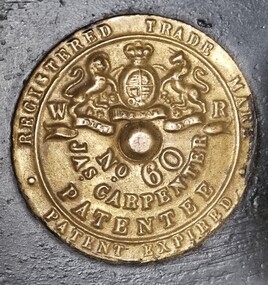
... Flooring nails - one diamond headed timber nail and four other nails from railways cottage at 2 Ethel Lane, Wodonga. Door lock and striker plate from a railway cottage at Ethel Lane....Railway Houses Wodonga Jas Carpenter Locksmith On Lock - Trademark disc Around edge - REGISTERED TRADEMARK PATENT EXPIRED In centre: Royal Warrant Symbol of Rampant Lion and Unicorn above words NO. 60 JAS CARPENTER PATENTEE On striker plate: VR Flooring nails - one diamond headed timber nail and four other nails from railways cottage at 2 Ethel Lane, Wodonga. Door ...These flooring nails and lock came from a railway cottage at 2 Ethel Lane, Wodonga. One is a diamond-headed timber nail and the others are simple round headed nails. They were designed so the head of the flooring nail when driven into the Baltic pine flooring was covered over by the timber so was not visible. The cottage was built about 1890. It featured many items labelled with the emblem of Victorian Railways. The house was demolished in November 2006. This lock is significant because it came from an early railway home in Wodonga.Flooring nails - one diamond headed timber nail and four other nails from railways cottage at 2 Ethel Lane, Wodonga. Door lock and striker plate from a railway cottage at Ethel Lane.On Lock - Trademark disc Around edge - REGISTERED TRADEMARK PATENT EXPIRED In centre: Royal Warrant Symbol of Rampant Lion and Unicorn above words NO. 60 JAS CARPENTER PATENTEE On striker plate: VRrailway houses wodonga, jas carpenter locksmith -
 Flagstaff Hill Maritime Museum and Village
Domestic object - Saucepan
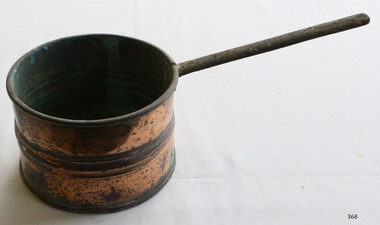
... This has led to it often being used for frequently touched surfaces such as door knobs, push plates and taps. A seemingly perfect material for cooking, it is therefore no surprise that it has been used in kitchens for millennia. ...This has led to it often being used for frequently touched surfaces such as door knobs, push plates and taps. A seemingly perfect material for cooking, it is therefore no surprise that it has been used in kitchens for millennia. ...It is no secret that copper is currently experiencing a huge upsurge in popularity. This is mainly thanks to its beautiful colour featuring heavily in the ranges of countless homeware retailers. There is, however, far more to this lustrous metal than just its appearance. For example, it has a greater level of thermal conductivity than any other metal (except silver); roughly 60% higher than aluminium and 3000% higher than stainless steel. This means copper is capable of heating up very quickly when compared to other metals. Perhaps a less commonly known property of copper is it being inherently antimicrobial. A wide range of harmful microbes are unable to survive for more than a couple of hours when in contact with a surface made of copper or one of its alloys (brass and bronze). This has led to it often being used for frequently touched surfaces such as door knobs, push plates and taps. A seemingly perfect material for cooking, it is therefore no surprise that it has been used in kitchens for millennia. But exactly when did we learn to utilise copper and its valuable assets? Origins It is hard to pin down an exact date when copper cookware was first introduced. Pieces discovered in regions of the middle east were dated as far back as 9000BC, suggesting cooking with copper began during the Neolithic period (≈10000-2000BC). As civilisations became increasingly capable in metallurgical techniques, metals such as copper became more widely used. It would have been around this time that copper replaced stone as the material used for making tools and cooking vessels. The use of copper is also well documented in Ancient Egypt. Not only was it used to produce water and oil containers, but it was also used to in medical practices. The antimicrobial nature of copper was exploited long before the concept of microorganisms was fully understood. The Smith Papyrus, a medical text written between 2600 and 2200BC records the use of copper in sterilising wounds and drinking water. Tin Lining Although copper is essential to many processes within the human body, it can become toxic if consumed in excess. It was this knowledge that gave rise to lining cookware with tin, a technique used for hundreds of years to prevent copper leaching in to food. These tin linings would eventually wear out and during the 18th and 19th century, it was common for people to send pans away to be re-tinned. This practice is becoming increasingly rare, as are the craftsmen who perform it. Despite this, there are still manufactures producing tin-lined copper cookware who also offer a re-lining service. Perhaps the best known of these is Mauviel, a French manufacturer who have been making this type of cookware since 1830. Tin has now largely been replaced by stainless steel as an interior cooking surface. Not only is it more cost effective, but the high grade of stainless steel used in premium cookware (typically 18/10) is highly resistant to corrosion and more durable than tin.Copper saucepans are still used in many kitchens.Small copper saucepan with long handle and three ridges around the circumference. Extensive corrosion.None.flagstaff hill, warrnambool, shipwrecked-coast, flagstaff-hill, flagstaff-hill-maritime-museum, maritime-museum, shipwreck-coast, flagstaff-hill-maritime-village, copper, saucepans, kitchen equipment -
 Flagstaff Hill Maritime Museum and Village
Domestic object - Stove, 1850-1890
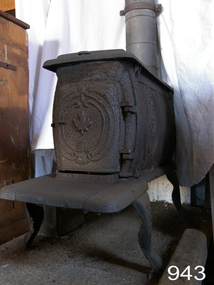
... Cast iron stove with four-legs, 2 plates on top and a hinged front door. ...The stove gives us a social snapshot into what life must have been like for our early colonialists using this device for heating and cooking in their meagre homes. flagstaff hill warrnambool shipwrecked-coast flagstaff-hill flagstaff-hill-maritime-museum maritime-museum shipwreck-coast flagstaff-hill-maritime-village stove domestic heating domestic cooking heater cooking unit pot belly stove wood fired stove wood stove The door has been cast with a maple leaf design and the sides have a pattern cast into them. Cast iron stove with four-legs, 2 plates on top and a hinged front door. ...In the industrialized world, as stoves replaced open fires and braziers as a source of more efficient and reliable heating, models were developed that could also be used for cooking, and these came to be known as kitchen stoves. The first manufactured cast-iron stove was produced at Lynn, Mass., in 1642. This stove had no grates and was little more than a cast-iron box. About 1740 Benjamin Franklin invented the “Pennsylvania fireplace,” which incorporated the basic principles of the heating stove. The Franklin stove burned wood on a grate and had sliding doors that could be used to control the draft (flow of air) through it. Because the stove was relatively small, it could be installed in a large fireplace or used free-standing in the middle of a room by connecting it to a flue. The Franklin stove warmed farmhouses, city dwellings, and frontier cabins throughout North America. Its design influenced the development of the pot-bellied stove, which was a familiar feature in some homes well into the 20th century. The first round cast-iron stoves with grates for cooking food on them were manufactured by Isaac Orr at Philadelphia, Pa., in 1800. The base-burning stove for burning anthracite coal was invented in 1833 by Jordan A. Mott. The subject item is a mid to late 19th century settlers stove probably of Canadian manufacture imported into Australia around this time. The stove gives us a social snapshot into what life must have been like for our early colonialists using this device for heating and cooking in their meagre homes. Cast iron stove with four-legs, 2 plates on top and a hinged front door. The door has been cast with a maple leaf design and the sides have a pattern cast into them.flagstaff hill, warrnambool, shipwrecked-coast, flagstaff-hill, flagstaff-hill-maritime-museum, maritime-museum, shipwreck-coast, flagstaff-hill-maritime-village, stove, domestic heating, domestic cooking, heater, cooking unit, pot belly stove, wood fired stove, wood stove -
 Flagstaff Hill Maritime Museum and Village
Lock
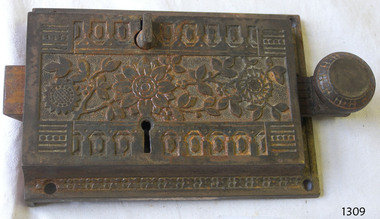
... Lock for door with pull action door knob, locking pin and keyhole. Cover plate has ornate floral design. ...Flagstaff Hill Warrnambool Shipwrecked-coast Flagstaff-Hill Flagstaff-Hill-Maritime-Museum Maritime-Museum Shipwreck-coast Flagstaff-Hill-Maritime-Village Lock for door with pull action door knob, locking pin and keyhole. Cover plate has ornate floral design. ...Lock for door with pull action door knob, locking pin and keyhole. Cover plate has ornate floral design. Made by Pye USAflagstaff hill, warrnambool, shipwrecked-coast, flagstaff-hill, flagstaff-hill-maritime-museum, maritime-museum, shipwreck-coast, flagstaff-hill-maritime-village -
 Flagstaff Hill Maritime Museum and Village
Domestic object - Stove, Cox and Rizzetti Stove Works, ca. 1918-1930s
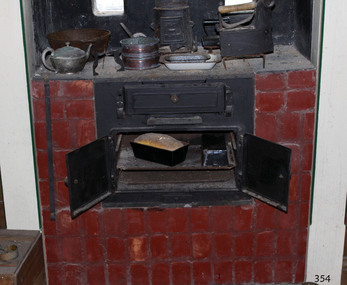
... The upright rectangular stove has a flat top with three round, removable cook plates and a flue connected at the back. The front has three doors with round knob handles; a swing-down firebox door above a sliding ashtray, and two side-hinged oven doors above a sliding opening. ...Flagstaff Hill Flagstaff Hill Maritime Museum and Village Warrnambool Maritime Museum Maritime Village Great Ocean Road Shipwreck Coast Stove cast iron stove combustion stove wood-burning stove wood stove wood oven solid fuel stove cooker The Planet Planet Planet No. 3 kitchen equipment baking domestic cooking cooking equipment food preparation Planet stove Planet cooker cooking range slow combustion stove antique range cooker Cox and Rizzetti Harnwell and Sons Melbourne manufacturer Chimney flue, "[within rectangle] THE / PLANET" Stove door, "(within oval) PLANET / No 3" Stove; a compact, blackened cast iron combustion cooker, installed within a fireplace and enclosed by bricks on both sides. The upright rectangular stove has a flat top with three round, removable cook plates and a flue connected at the back. ...Cast iron stoves burn solid fuel such as wood or coal, and are used for cooking and warmth. The stoves have a firebox with a grate where the fuel is burned. The hot air flows through flues and baffles that heat the stove top and the oven. Before cast iron stoves were invented, cooking and heating were carried out in outdoor open fires, and later, in fireplaces inside the home. In 1642 the first cast iron stove was manufactured in Lynn, Massachusetts, where molten cast iron was poured into a sand mould to make rectangular plates that were then joined together to make a box. Benjamin Franklin invented the more efficient Pennsylvania stove in 1744, and this efficient design is still used today. After the mid-19th century cast iron stoves were produced with burners in different positions, giving varied temperatures, so a wide variety of foods could be cooked at the same time at the most suitable heat, from slow cooking to baking scones. In contemporary times people the new wood-burning stoves had to meet the anti-pollution standards now in place to protect our environment. By the 1920s gas cookers were being introduced for domestic use, and by the 1930s electric home cookers were being offered to householders. PLANET STOVES In August 1925 the firm Cox and Rizzetti, Stove Works, and also Sydney Road, South Melbourne, advertised in the Brunswick and Coburg Leader of November 11, 1925 as "formerly with Harnwell and Sons" and as "specialists in solid cast iron Planet stoves ... which merit an inspection from builders and householders". The firm continued in business and was mentioned as sponsors in the King Island News in 1971. Harnwell and Sons was listed in the Victorian Government Gazette of 1894. It is curious that the firm was mentioned in an article in the Sunrasia Daily of June 14, 1934 titled 'Planet Stoves' as a manufacturer of Planet Stoves. This Planet No 3 stove is an uncommon example of cooking equipment used in kitchens in the early 20th century, as the firebox is above the oven rather than beside it. The cast iron combustion stove is significant as part of the evolution of domestic cooking. Previously cooking was mostly carried out in outdoors in open fires, and later in fireplaces indoors. Cast iron stoves are still used today and have additional features such as thermostats to monitor and maintain temperature, water heating pipes connected, and environmentally approved anti-pollution fittings. Stove; a compact, blackened cast iron combustion cooker, installed within a fireplace and enclosed by bricks on both sides. The upright rectangular stove has a flat top with three round, removable cook plates and a flue connected at the back. The front has three doors with round knob handles; a swing-down firebox door above a sliding ashtray, and two side-hinged oven doors above a sliding opening. Inside on the side walls are two pairs of runners. Behind the pair of doors is an oven with two pairs of rails and two removable metal shelves. The stove has cast inscriptions on the chimney flue and on the front of the right hand side stove door. The model of the stove is The Planet No 3, made in Melbourne.Chimney flue, "[within rectangle] THE / PLANET" Stove door, "(within oval) PLANET / No 3"flagstaff hill, flagstaff hill maritime museum and village, warrnambool, maritime museum, maritime village, great ocean road, shipwreck coast, stove, cast iron stove, combustion stove, wood-burning stove, wood stove, wood oven, solid fuel stove, cooker, the planet, planet, planet no. 3, kitchen equipment, baking, domestic cooking, cooking equipment, food preparation, planet stove, planet cooker, cooking range, slow combustion stove, antique, range cooker, cox and rizzetti, harnwell and sons, melbourne manufacturer -
 Flagstaff Hill Maritime Museum and Village
Functional object - Lamp, ca. 1886
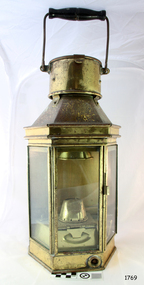
... Lamp, brass plated copper, with three flat glass panes, one side panel hinged for access, wooden grip on handle. The chimney lid flips upwards. The right-side door...Warrnambool Shipwreck Coast Flagstaff Hill Flagstaff Hill Maritime Museum Flagstaff Hill Maritime Village ship lighting maritime equipment lamp wall lamp lantern Lamp, brass plated copper, with three flat glass panes, one side panel hinged for access, wooden grip on handle. The chimney lid flips upwards. The right-side door ...This late 19th century maritime lamp is an example of lighting on ships, wharfs and other outside areas around docks and shipyards as well as on vessels.Lamp, brass plated copper, with three flat glass panes, one side panel hinged for access, wooden grip on handle. The chimney lid flips upwards. The right-side door frame has a sliding latch, and the edge behind has a sliding panel to allow air flow. Ca. 1886.warrnambool, shipwreck coast, flagstaff hill, flagstaff hill maritime museum, flagstaff hill maritime village, ship lighting, maritime equipment, lamp, wall lamp, lantern -
 Mission to Seafarers Victoria
Journal (item) - Periodicals-Annual, Shiplovers' Society of Victoria, The Annual Dog Watch, 1943
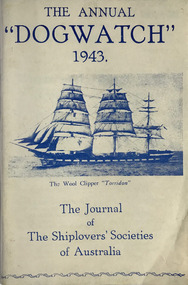
... Doorly - 26 The Sailing Ship Apprentice. - “Tandanya” - 30 Friends of the S. S. V. - - 51 A Shiplovers’ Award. - “Barnicle William” - 33 The Founding of the Shiplovers’ Society of Tasmania. - - 34 A Sunrise in the Tropics. - A. T. Wreford - 36 In Peril in the Rip. - H. R. Watson - 37 Who First Discovered Australia? - From the notes of H. O’May - 40 Our Cover Plate...Doorly - 26 The Sailing Ship Apprentice. - “Tandanya” - 30 Friends of the S. S. V. - - 51 A Shiplovers’ Award. - “Barnicle William” - 33 The Founding of the Shiplovers’ Society of Tasmania. - - 34 A Sunrise in the Tropics. - A. T. Wreford - 36 In Peril in the Rip. - H. R. Watson - 37 Who First Discovered Australia? - From the notes of H. O’May - 40 Our Cover Plate ...This journal provides the reader with glimpses of the adventures and hardships of a seaman's life. Many of the stories are of sailing ships.First issue of the magazine published during the war Contributes to our knowledge of the importance of shipping and places on record those stories of the sea which would otherwise be lost.sailing ships, steamships, shipping, seafaring life, shiplovers' society of victoria, dog watch, ww2, hms jervis bay -
 Flagstaff Hill Maritime Museum and Village
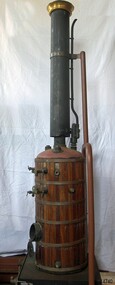
Equipment - Boiler, ca 1880
... A round opening near the base is covered by an adjustable metal plate that controls the boiler's temperature. The front door of the firebox has two hinges at the base and when the side clips are opened. ...A round opening near the base is covered by an adjustable metal plate that controls the boiler's temperature. The front door of the firebox has two hinges at the base and when the side clips are opened. ...This little steam boiler has been beautifully built. It could have been used to drive an engine in a small workshop, a boat or launch, or even farming equipment. It is an example of the steam technology and mechanisation of the 19th century. William Cook introduced steam heating in England in the 18th century. Steam combined with pressure was used for powering transport, such as steam engines for trains, and manufacturing, such as steam engines driving manufacturing machines. Steam boilers are still used today as an energy-efficient means of power.This steam boiler would have been suitable to drive a small engine, possibly that of a small boat. Coal was added to the firebox for fuel to heat water in the boiler. It is an example of the power used to drive machinery and equipment in the mid-to-late 19th century. Steam boilers like this one have played a part in the evolution of steam power. Steam engine boiler; vertical cylindrical coal-fired boiler with a black firebox at its base and a dome top. The cylinder's sides and top have brass fittings, inlet and outlet taps. A round opening near the base is covered by an adjustable metal plate that controls the boiler's temperature. The front door of the firebox has two hinges at the base and when the side clips are opened. A shiny brass collar tops the tall chimney. Oak wood planks around the sides of the boiler, and held in place by brass bands with nut and screw fixtures. The boiler stands on a metal and wood frame with a looped handle at the back. An inscription has been noted. Circa 1880. "1948 D/430" flagstaff hill, warrnambool, maritime museum, maritime village, great ocean road, boiler, steam engine, steam boiler, coal fired boiler, vertical boiler, boat boiler, power source, steam driven, engine boiler, steam machine, firebox, steam engine boiler -
 Federation University Historical Collection
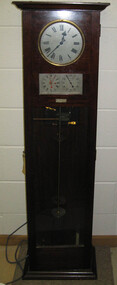
Object, Synchronome Co. Ltd, Synchronome Frequency Checking Master Clock No. 2191, c1930
... Front below main clock face on front of case: "Patented Sychronome Brisbane" Lower left-hand clock face: "Frequency time" Lower right-hand clock face: "Standard Seconds" Synchronous electric clock mechanism on door (Frequency time clock): >200/250 V. 50~ >"Synchronomains" Made in England >Direction indicator for clock starting switch >"To start move lever in direction of arrow and release" >"Patent applied for" Mechanism for "standard seconds" clock: >"English Made" >"Patented" >Serial number "321" >0 above right-hand pillar on front-plate Mechanism for "standard seconds" clock: >"English Made" >"Patented" >Serial number "321" >0 above right-hand pillar on front-plate Mechanism for main clock face: >"English Made" >"Patented" >Serial number "8751" >0 above right-hand pillar on front-plate Inside case, back panel, top enamel plate: >Seconds Battery + Pos...A rectifier is a device that is used to convert AC power to more stable DC current. synchronome frequency checking master clock electricity state electricity commission wendouree parade power station secv clock time pendulum electric supply company of victoria norman f. dalton ballarat power station rectifier slave clock Front below main clock face on front of case: "Patented Sychronome Brisbane" Lower left-hand clock face: "Frequency time" Lower right-hand clock face: "Standard Seconds" Synchronous electric clock mechanism on door (Frequency time clock): >200/250 V. 50~ >"Synchronomains" Made in England >Direction indicator for clock starting switch >"To start move lever in direction of arrow and release" >"Patent applied for" Mechanism for "standard seconds" clock: >"English Made" >"Patented" >Serial number "321" >0 above right-hand pillar on front-plate Mechanism for "standard seconds" clock: >"English Made" >"Patented" >Serial number "321" >0 above right-hand pillar on front-plate Mechanism for main clock face: >"English Made" >"Patented" >Serial number "8751" >0 above right-hand pillar on front-plate Inside case, back panel, top enamel plate: >Seconds Battery + Pos ...Information from Norman F. Dalton: Ballarat had a reticulated DC supply in the early part of last century and in 1905 had sufficient generating capacity to enable the trams to be changed from horse drawn to DC electricity. The use of electricity increased with the main power station located on Wendouree Parade, near Webster Street, under the ownership of The Electric Supply Company of Victoria. AC generating plant was installed in 1925 and conversion to AC proceeded. In 1934 the company was taken over by the State Electricity Commission Victoria (SECV) and more AC generation was installed and the changeover of customers was accelerated. This is around the time that the Synchronome Frequency Checking Mast Clock was installed at the Wendouree Parade Power Station. The SECV Annual Report of 1921 states: ::Section 11 of the act directed the COmmission to enquire into the question of securing the adoption of such standards of plant and equipment of a system, frequency and pressure for the generation and distribution of electricity as will admit of the efficient interconnection of undertakings throughout the State. In 1934 when the SECV took over the Ballarat operations the question of linking with the State grid had been a planned operation for some years but due to financial considerations had hindered it and in fact would continue to do so for a further 10 years. So while the need for close frequency control for interconnection was hardly an issue, the need to keep electric clocks correct was important, particularly as this item was a frequent sales point to cover the inconvenience and sometimes expense of converting from DC to AC. The clock is a very accurate pendulum clock with provision for varying effective length during operation for precise time regulation. There are two normal time dials and one is controlled by the pendulum and the other is operated by the system frequency. When the clock was in use it was installed by the MEter and Tests Laboratory and the time was checked daily by radio time signals. The two dials were repeated in the operators control panel in the Power Station. A maximum deviation between the two dials was set in the operating instructions (eg 5 seconds) and the operator would correct this when necessary by remote manual alteration of the turbine governor set point. The clock was used to drive and regulate a system of "slave" clocks which were used to display the time in various locations around the power station. A slave clock is a simple clock which is driven by a small electric motor, its accuracy is regulated by the master clock every 30 seconds to ensure that it and all the other slave clocks in the station are on exactly the right time; slave clocks were placed in various locations, from common rooms to workshops. A master clock could potentially run thousands of slave clocks at one plant. The clock also contains a rectifier. A rectifier is a device that is used to convert AC power to more stable DC current.Two clocks in a timber case. Both are electric, one is powered by the main pendulum mechanism, the other is a self contained electric clock. The main mechanism is of the gravity arm and roller type, which sends an impulse to the slave clocks every 30 seconds. The This Synchronome Frequency Checking Master Clock was used at the Ballarat Power Station. Below the main section of the case is a smaller cabinet containing a rectifier to provide consistent DC power for the clock. The rectifier was made by the Victorian company Hilco, which was located in Burwood. There is a high chance this is not the original rectifier from this clock as there appears to be brackets to hold a larger device in the space the rectifier occupies.Front below main clock face on front of case: "Patented Sychronome Brisbane" Lower left-hand clock face: "Frequency time" Lower right-hand clock face: "Standard Seconds" Synchronous electric clock mechanism on door (Frequency time clock): >200/250 V. 50~ >"Synchronomains" Made in England >Direction indicator for clock starting switch >"To start move lever in direction of arrow and release" >"Patent applied for" Mechanism for "standard seconds" clock: >"English Made" >"Patented" >Serial number "321" >0 above right-hand pillar on front-plate Mechanism for "standard seconds" clock: >"English Made" >"Patented" >Serial number "321" >0 above right-hand pillar on front-plate Mechanism for main clock face: >"English Made" >"Patented" >Serial number "8751" >0 above right-hand pillar on front-plate Inside case, back panel, top enamel plate: >Seconds Battery + Pos. > Battery Common or - Neg. >1/2 min dials Inside case, back panel, bottom enamel plate: external seconds dial Inside case, right hand side, electrical knobs: two switches, both "A.C. mains" Pendulum rod, below suspension spring: Serial number (?) 0000005 Rectifier in bottom cabinet: >"Hilco Rectifier" >"A.C. Volts 230/240" >"Model 1060/S" >"A.C. Amperes" >"Serial No. 1060/S >"Phases 1" >"D.C. Volts 6" >"C.P.S. 50" >"D.C. Amperes 1" >"Made in Australia by Hilco Transformers McIntyre St., Burwood, Victoria." Bakelite electrical plug: makers mark Lower cabinet, RH side panel, pressed tin plate: "AC" (upside down) Brass speed adjustment, outer right RH side: "S" and "F" Ivory and wood pendulum beat ruler: >Ruler, with 0 in centre and numbers 1-5 in ascending order from centre on left and right. > "Synchronome Patent." Steel plate, back panel, inside case, right hand side: >N R A" (descending) >"2191" serial number/part number Face of main clock: "Synchronome Electric" synchronome frequency checking master clock, electricity, state electricity commission, wendouree parade power station, secv, clock, time, pendulum, electric supply company of victoria, norman f. dalton, ballarat power station, rectifier, slave clock -
 Upper Yarra Museum
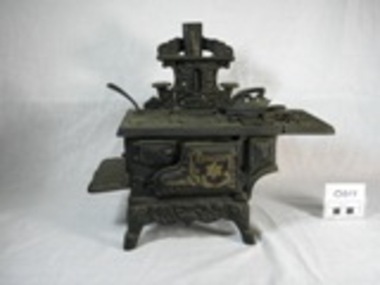
Stove, Miniature
... The stove is on legs with left hand extension for pots, right hand extension with holes, removeable hot plates [4 round 1 rectangle] tin chimney with folded join and seperate decorative cover with pot stands x2 , front door opens on hinges with internal gold pan with gold crescent logo. ...The stove is on legs with left hand extension for pots, right hand extension with holes, removeable hot plates [4 round 1 rectangle] tin chimney with folded join and seperate decorative cover with pot stands x2 , front door opens on hinges with internal gold pan with gold crescent logo. ...Story to be placed here - Available to publicMinature cast iron, Black Solid Wood Stove with miniature utensils. The stove is on legs with left hand extension for pots, right hand extension with holes, removeable hot plates [4 round 1 rectangle] tin chimney with folded join and seperate decorative cover with pot stands x2 , front door opens on hinges with internal gold pan with gold crescent logo. Frying pan, hot plate handle and "swan flat iron on stand. Solid fuel space with tin base. 2 screws and bolts used to assemble stove. 14 removeable parts.crescent, star, scrolls, wood, iron, tin, cast, stove, black, cast iron, star, solid, fuel, chimney, flat iron stand, flat, stand, hot plates, frying, pan, bolt, screws, legs, toy, miniature, crescent, made in taiwan, taiwan, wood box -
 Federation University Historical Collection
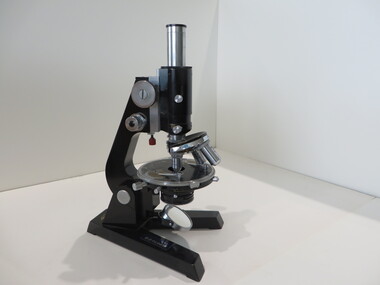
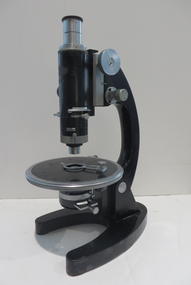
Instrument - Scientific Instrument, Petrographic Microscope
... door "S BOSHMA" in red Dymotype. Optical microscope, petrographic type, with a 4-lens objective turret. Black enamel frame, chrome plated accessories. ...This microscope was used in the Ballarat Institute of Advanced Education Petrology Laboratory.Optical microscope, petrographic type, with a 4-lens objective turret. Black enamel frame, chrome plated accessories. Liftable frame. Housed in a blonde polished wood case.Reichert Serial Number 275062 Inside storage box "2" in red marker pen. On microscope frame a self-adhesive sticker "Ballarat CAE Geology". Also riveted to base frame a label "Supplied by H.B. Selby & Co Pty Ltd, Australia". Inside carry case door a card giving visual magnifications. On box door "S BOSHMA" in red Dymotype.petrographic microscope, ballarat college of advanced education, petrology laboratory, reichert, selby, microscope -
 Federation University Historical Collection
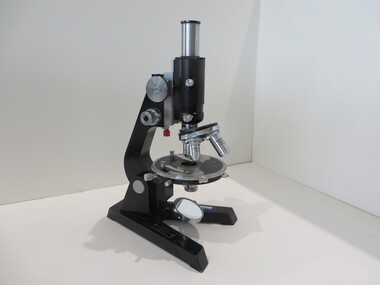
Instrument - Scientific Instrument, Boxed Petrographic Polarizing Microscope
... POS marking on steel plate Olympus Tokyo 202108 engraved on barrel On Box door "P6" engraved label...Used at BIAE in petrology laboratory microscope polarizing microscope olympus optical co. ltd ballarat institute of advanced education petrology laboratory scientific instrument POS marking on steel plate Olympus Tokyo 202108 engraved on barrel On Box door "P6" engraved label An optical, petrographic, polarizing microscope with a single objective lens in a blonde timber case with key. ...Used at BIAE in petrology laboratoryAn optical, petrographic, polarizing microscope with a single objective lens in a blonde timber case with key. Black enamel frame, chrome accessories.POS marking on steel plate Olympus Tokyo 202108 engraved on barrel On Box door "P6" engraved labelmicroscope, polarizing microscope, olympus optical co. ltd, ballarat institute of advanced education, petrology laboratory, scientific instrument -
 Federation University Historical Collection
Instrument - Scientific Instrument, Petrographic Microscope
... door a card giving visual magnifications. Optical Microscope, petrographic type, with 4-lens objective turret. Black enamel frame, chrome-plated accessories. ...This microscope used in SMB/BIAE/BCAE geology laboratoriesOptical Microscope, petrographic type, with 4-lens objective turret. Black enamel frame, chrome-plated accessories. Cream, plastic container with clear plastic speciman jars. Small, brown Reichert case containing objective and glass plate. Housed in a polished wood case. REICHERT, ser. No. 273065 Inside storage box "3" in red marker pen. On microscope frame a self-adhesive sticker "Ballarat CAE Geology". Also riveted to base frame a label "Supplied by H.B. Selby & Co Pty Ltd, Australia". Inside carry case door a card giving visual magnifications.microscope, reichert, selby, laboratory -
 Federation University Historical Collection
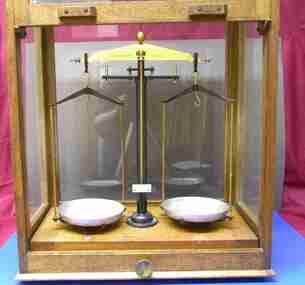
Instrument, Oertling Beam Balance
... 33439 on back of beam support. Small plate on top of door: Townen and Mercer, Sydeny...This balance was used at the Ballarat School of Mines. balance scientific instrument oertling 33439 on back of beam support. Small plate on top of door: Townen and Mercer, Sydeny A two-pan beam balance, mounted on a wood base board. ...This balance was used at the Ballarat School of Mines. A two-pan beam balance, mounted on a wood base board. Housed in a timber-framed glass-sided cabinet. Aluminium pans. No balance weights. 25.5 beam length.33439 on back of beam support. Small plate on top of door: Townen and Mercer, Sydenybalance, scientific instrument, oertling -
 Federation University Historical Collection
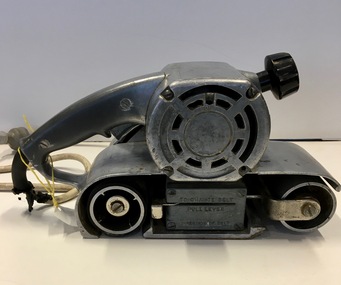
Tool - Electrical Instrument, Electric Belt Sander, c1960s
... door, reduce the thickness of timber, dress up a poor saw cut. Also used for back cutting miter cuts for neater joints and for polishing and cutting. ballarat school of mines building studies david flintoff timber smooth miter cuts polishing buffing thinning Maker's Plate: MILLER FALL TOOLS CATALOG 830 3 INCH BELT SANDER MODEM "C" USE 3" X 21" BELT 230/250 VOLTS 3 AMPS 25-60 CYCLES MADE IN USA PATENT 2,991,595 MILLER FALLS COMPANY, GREEFIELDS, MASS. ...Used in Building Studies at Ballarat School of Mines. The sander used to sand rough timber smooth, remove old finish from wood, put a bevel on a door, reduce the thickness of timber, dress up a poor saw cut. Also used for back cutting miter cuts for neater joints and for polishing and cutting.Stainless steel with rollers and sanding plate. Hand held. Continuous loop of sandpaper would be mounted.Maker's Plate: MILLER FALL TOOLS CATALOG 830 3 INCH BELT SANDER MODEM "C" USE 3" X 21" BELT 230/250 VOLTS 3 AMPS 25-60 CYCLES MADE IN USA PATENT 2,991,595 MILLER FALLS COMPANY, GREEFIELDS, MASS. TO CHANGE BELT PULL LEVER DIRECTION OF BELT ballarat school of mines, building studies, david flintoff, timber, smooth, miter cuts, polishing, buffing, thinning -
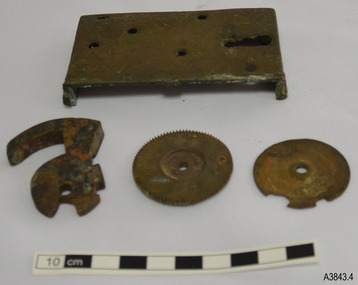 Flagstaff Hill Maritime Museum and Village
Functional object - Lock, 1800s to early 1900s
... Items that come from several wrecks have since been donated to the Flagstaff Hill Maritime Village’s museum collection by his family, illustrating this item’s level of historical value. flagstaff hill warrnambool flagstaff hill maritime museum maritime museum shipwreck coast flagstaff hill maritime village great ocean road john chance hardware door fitting ship’s fitting furniture fitting security 19th century lock cabinetry brass lock Lock, brass, with separated moving parts. Rectangular plate ...This lock was recovered from an unknown shipwreck in the coastal waters of Victoria in the late 1960s to early 1970s. It is part of the John Chance Collection. The small size of the lock indicates that it was possibly used for cabinetry such as a cupboard, desk or wardrobe. It may have been part of the ship’s fittings or perhaps luggage or cargo. The blue-green patina on the metal is caused by a reaction from its exposure to external elements such as the sea water. The lock is likely to have been in the water for over 100 years, as the more widely known shipwrecks along Victoria’s Shipwreck Coast date from 1837 to 1940. Although the lock is not linked to a particular shipwreck, it is recognised as being historically significant as an example of hardware either as part of the ship’s fittings or imported for use in Colonial Victoria in the 19th to early 20th century. The lock is also significant as it was recovered by John Chance, a diver in Victoria’s coastal waters in the late 1960s to early 1970s. Items that come from several wrecks have since been donated to the Flagstaff Hill Maritime Village’s museum collection by his family, illustrating this item’s level of historical value. Lock, brass, with separated moving parts. Rectangular plate with keyhole, plus two cogs and a latch.flagstaff hill, warrnambool, flagstaff hill maritime museum, maritime museum, shipwreck coast, flagstaff hill maritime village, great ocean road, john chance, hardware, door fitting, ship’s fitting, furniture fitting, security, 19th century lock, cabinetry, brass lock -
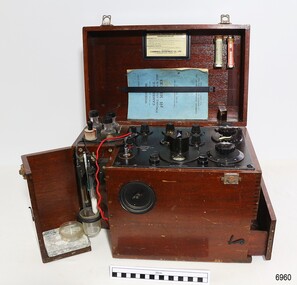 Flagstaff Hill Maritime Museum and Village
Instrument - Cambridge pH Meter, Cambridge Scientific Instrument Co. Ltd, 9-6-1946
... doors, and leather carry handle. Includes blue covered Instruction manual with a 'Certificate of Test' inside, and chemicals. Electrodes mounted in compartment. The lid is separate from the base, attached by pins and hinges. A plate...plate: "Cambridge Instrument Co. Ltd, 13 Grosvenor Place, London, S.W.1' Certificate dated: "6-3- 46" (1946) Scientific instrument, electric Cambridge Portable pH Meter in a polished wooden box with compartments, fold-out doors, and leather carry handle. ...This pH meter was made in 1946 by Cambridge Scientific Instrument Co. Ltd. in London. The company was founded in 1881 and the owner eventually became Horace Darwin, the youngest son of the famous scientist Charles Darwin. It is a portable version that can be used on-site in many different situations. A similar instrument was used by the Chemistry Department of what is now the University of Cambridge. The science of pH measurement began in the 1910s and was further developed in 1926. The pH meter is an electronic scientific instrument used to determine the pH measurements of a solution accurately; the amount of acid and alkaline in it This measurement can have many other applications helping to maintain the appropriate balance for a particular result. For example, it can measure the pH of pharmaceutical medications, soil, swimming pool water and hair shampoos. This Cambridge portable electronic pH instrument was made in 1946 by a company specialising in scientific instruments. It is an early example of much smaller devices used today in many different fields including medicine, and the preservation and conservation of shipwreck artefacts. Flagstaff Hill Maritime Museum and Village's Curator uses a pH meter today in the conservation process of a historic cannon that was recovered from the 1839 wreck of the vessel 'Children'.Scientific instrument, electric Cambridge Portable pH Meter in a polished wooden box with compartments, fold-out doors, and leather carry handle. Includes blue covered Instruction manual with a 'Certificate of Test' inside, and chemicals. Electrodes mounted in compartment. The lid is separate from the base, attached by pins and hinges. A plate inside the lid gives instructions for 'Preparation for Use'. Made by the Cambridge Instrument Company, London, in 1946.Printed on plate: "Cambridge Instrument Co. Ltd, 13 Grosvenor Place, London, S.W.1' Certificate dated: "6-3- 46" (1946)flagstaff hill, warrnambool, maritime museum, maritime village, great ocean road, shipwreck coast, ph meter, cambridge scientific instrument co. ltd, horace darwin, cambridge university, ph balance, scientific instrument, ph measurement -
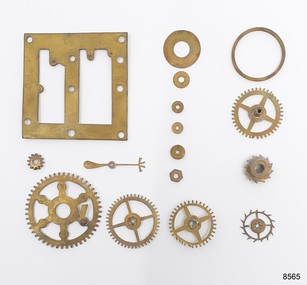 Flagstaff Hill Maritime Museum and Village
Instrument - Clock Parts, Bef. 01-06-1878
... plate. They would have been mounted inside a protective case with a small door to easily access the clock face for setting the time and accessing the key's winding hole. ...plate. They would have been mounted inside a protective case with a small door to easily access the clock face for setting the time and accessing the key's winding hole. ...The clock parts were discovered in 1980 by Julie Wilkins, a Victorian scuba diver who had already experienced more than 500 dives in Australia and overseas. She was holidaying in Peterborough, Victoria, and looking forward to discovering more about the famous Loch Ard ship, wrecked in June 1878 at Mutton Bird Island. The fast Glasgow-built clipper ship was only five years old when the tragedy occurred. There were 54 people on board the vessel and only two survived Julie's holiday photograph of Boat Bay reminds her of her most memorable dive. Submerged in the calm, flat sea, she was carefully scanning around the remains of the old wreck when, to her amazement, a gold coin and a small gold cross suddenly came up towards her. She excitedly cupped them in her hands and then stowed the treasures safely in her wetsuit and continued her dive. She soon discovered a group of brass carriage clock parts and some bottles of champagne. It was a day full of surprises. The items were easily recognisable, without any build-up of encrustations or concretion. Julie secretly enjoyed her treasures for twenty-four years then packed them up for the early morning train trip to Warrnambool. After a short walk to Flagstaff Hill Maritime Museum and Village, her photograph was taken as she handed over her precious find. She told her story to a local newspaper reporter, lunched a café in town then took the late afternoon train home. Her generous donation is now part of a vast collection of Loch Ard shipwreck artefacts, including the gold watch and the Minton Majolica model peacock. This group of brass clockwork parts is incomplete. The pieces were in the ocean for over 100 years before Julie recovered them from the Loch Ard wreck. Their size would suit the works of a carriage clock, with a mainspring and weight to power the clock movement, a pendulum to measure the clock's speed, arbours, posts, pillars and at least one other plate. They would have been mounted inside a protective case with a small door to easily access the clock face for setting the time and accessing the key's winding hole. The clock cases were usually made from decorative gilt brass with a glass front and a carrying handle. The parts include a weighted second hand with a decorative four-pronged finish at one end, a rounded weight at the other, and a hole for attaching it to the clock face. The gear teeth profiles are ‘cycloidal’, an arch shape with vertical sides, which is common for antique clocks. Modern clockworks have ‘involute’ teeth with sloping sides and a squared-off top. The brass carriage clock parts are an example of a mechanical clock produced in the 1870s. The clock's design is a part of the chain of technological improvements in methods for timekeeping. Its cycloidal gear teeth were the forerunner of the more modern involute gears. The group of clock parts includes a weighted hand or arm for signifying the seconds. This feature was uncommon in portable Victorian-era clocks. The clock parts are also significant for their association with the ill-fated sailing ship Loch Ard, wrecked in 1878. The travelling clock or officer’s clock may have been part of the cargo destined for the 1880 Melbourne Exhibition, or the personal possession of one of the people on board the vessel. Brass clockwork parts from a mechanical clock, sixteen pieces. Parts comprise a plate, large gears or wheels, small pinions or wheels with fine teeth, wheels with cogs, and a weighted second hand. The parts were from a carriage clock ca. 1878. They were recovered from the wreck of the sailing ship Loch Ard.flagstaff hill maritime museum and village, warrnambool, great ocean road, shipwreck coast, loch ard, wreck of the loch ard, 1878, mutton bird island, peterborough, scuba diver, 1980s, shipwreck artefact, relic, clock, mechanical, clock parts, time, timekeeper, horology, chronometry, cogs, time keeping device, scientific instrument, chronometer, john harrison, longitude, carriage clock, coach clock, portable clock, travelling clock, travel clock, traveller’s clock, officer’s clock, weighted second hand, victorian era, cycloidal gear teeth, brass clock, julie wilkins -
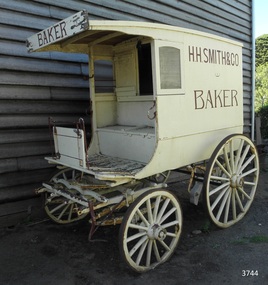 Flagstaff Hill Maritime Museum and Village
Vehicle - Wagon, H.H. Smith & Co. Baker, Circa 1930s - 1940s
... plates. The wagon has suspension leaves on back and sides and double suspension leaves on the front. Driver’s area at front has a roof, glass side windows and wooden box seat with hinged compartment accessing wagon storage area. Door...plates. The wagon has suspension leaves on back and sides and double suspension leaves on the front. Driver’s area at front has a roof, glass side windows and wooden box seat with hinged compartment accessing wagon storage area. Door ...This baker’s wagon or cart transported and delivered bread and other baked goods in the Warrnambool area. It currently has advertising for H.H. Smith & Co. Henry Huntington Smith (1857-1941) owned and operated his Warrnambool bakery in the late 19th and early 20th century. However, the design of the wagon is similar to those used by local bakers in the 1930s and 1940s and probably originated from Stephenson’s Bakery in Warrnambool, which operated around that time. The wagon’s original internal shelves were removed in the early days of Flagstaff Hill so that children could have rides around the village in a horse-driven cart. BAKERS’ HISTORY There were many bakeries in Warrnambool in the 19th to mid-20th century. Each bread bakery made horse and cart deliveries in its allocated zone. SMITH’S BAKERY; – as shown on the wagon’s signage. Henry Huntington Smith (1857-1941) was born and educated in Warrnambool. He worked at Davis’ steam biscuit factory in Timor Street before he began his own bakery business in 1885 near the corner of Fairy and Koroit Streets. A few years later Smith built a new bakery on the corner of Fairy and Lava Street where it still stands today (2025) as Monaghan’s Pharmacy. The building was designed by James McLeod in 1892 as a bakehouse, shop and residence for Smith The address was known locally as Smith’s Corner. Next door to the bakery, at 136 Fairy Street, were stables built by Jobbins and McLeod in 1886 for William Cust. A photograph in the archives of the Warrnambool and District Historical Society shows the 1892 building with four fancy horse-drawn wagons on the street with white-clad drivers and a promotional stand erected with 5 bakers in uniform and the signage “H H Smith & Co, Pastry Cooks and Confectioners”. One of the wagons appears to have “H H Smith” painted on the side. H.H. Smith & Co. placed an Advertisement in the Weekly Times in December 1896 promoting its business as bakers, confectioners and pastry cooks, praising their shop as an ‘ornament to the town’ with ‘neat appointments’ and ‘dainty decorations’. It also boasted of supplying a large number of customers within a twelve-mile radius of Warrnambool. In November 1919 The Warrnambool Standard announced the marriage of Henry H Smith, Mayor of Warrnambool, to Jeannie Samson-Goodman in East Adelaide. In the same newspaper was a notice that Frank Crossley was to open as baker and pastry cook in H.H. Smith’s premises. As well as being the proprietor of the H.H. Smith Bakery, Henry Huntington Smith was a Councillor for the Warrnambool Municipality from 1913 to 1937 and Mayer for two terms. In December 1919 during his first term as Mayor, he was honoured for the work he had done with returning soldiers after World War I, receiving a document in recognition of this work, presented by the Mothers, Wives and Sisters of returned soldiers. Smith was very interested and involved in the community in many roles, including being the Vice President of the first Warrnambool and District Historical Society. STEPHENSON’S BAKERY: – believed to be the past owner of the wagon. The last owner of the bakery was Harold Stephenson. Stephenson was enlisted in the A.I.F. and was invalided home in 1943 before the end of the Second World War. He also served as a Councillor from 1958 to 1976, during which time he served six terms as Mayor for the City of Warrnambool (1966-1973) while he had the bakery. He was very involved in many local organisations including the Warrnambool Surf Life Saving Club and the Road Race Committee. He died in 1985, lauded as being one of Warrnambool’s “most distinguished civic leaders”. It has been said that the baker injured in World War II invented a special contraption to enable him to get up into the wagon and that he alerted his customers that he was in their vicinity by blowing a whistle. The customers would come out and choose their bread from the back of his wagon then pay him for it. However, another account is given by a man who once earned pocket money by helping the baker on his rounds. He says that it was Stephenson, the owner and manager of the bakery, and not the delivery baker who received a significant injury during the war, making him unable to climb the stairs of his upstairs accommodation at the bakery, therefore causing him to sleep downstairs. At this time in the early to late 1940 Stephenson’s bakery had three wagons, one for each of the delivery rounds. The wagons were painted black and yellow. Two of the drivers were Stan Lake and Ali (Alec) Dean who both had wagons with the covered cabin design. The third driver was Bill Lake who had a flat wagon. Stan Lake delivered in the area around Lava and Koroit Streets, Ali Dean had another round and Bill Lake had the Dennington area. Bread continued to be delivered into the 1960s but by this time the delivery vehicles were motorised. The goods produced at Stephenson’s bakery included bread baked in different shaped tins such as High Tin, Sandwich and Vienna. Some shapes were easily divided into half by breaking them apart, therefore the baker could make two-quarter loaves from a half loaf, satisfying different needs. There was the option of white or brown bread, sweet buns, fruit buns and Boston buns. The baker’s assistant was known to take great delight in ‘trimming’ the broken halves of excess bread and crust, enjoying his treat. THE BAKERY PREMISES: – Southeast corner of Fairy and Lava Streets, Warrnambool. The building retains the original cast iron veranda. Above the veranda, a motif of a wheat sheaf in ornamental plaster can be seen. Inside the building, there are still some of the original fittings. The building was classified by the National Trust in August 1979. After the Second World War, an official system of zoning was introduced as a fair way for the baking industry to operate. In 1949 different pricing was introduced by the Government for either delivered or retail purchased bread. Many of the small local bakeries went out of business after the Government banned zoning. The way was made open for the larger bread manufacturers to enter the local market with cheaper prices. Some of those companies were Mc Queens, Tip Top, Twisties, and Sunicrust, (Mc Queens ‘new’ bakery building was where the current Toyworld shop now stands, is, in the Ozone carpark.) O’Grady’s Bakery, later changing hands and known as Burkes Bakery, was on Fairy Street near the Timor Street intersection, on the North West side. There was also a bakery named Almay. The baker’s wagon is significant because of its association with H.H. Smith’s Bakery in Warrnambool.. The H.H. Smith’s Bakery building on the corner of Fairy and Lava Streets, built in 1892, is classified by the National Trust, August 1979. Smith Street Warrnambool was named after Henry Huntington Smith, who was a Warrnambool Councillor 1913 – 1937 and Mayor 1919 – 1921. Baker’s wagon, often referred to as a baker’s cart. Four wheeled horse-drawn delivery wagon, front wheels smaller than rear wheels. Wagon is clad with metal sheets and lined with varnished timber panels. Wheels have metal rims, wooden spokes and rear wheels have wooden brake pads. Horse shaft is timber with metal fittings. Front has a metal lamp holder, brake lever, metal hand grips and decorative metal foot plates. The wagon has suspension leaves on back and sides and double suspension leaves on the front. Driver’s area at front has a roof, glass side windows and wooden box seat with hinged compartment accessing wagon storage area. Door above back of seat has buckled leather handgrip strap attached, door slides open for access to wagon area. Back of wagon has a wooden step and a split door; top door has ventilation louvers, both doors have metal latches. Wagon is painted cream with brown trim and signage and green step. Remnants of red and green paint are visible; underside of seat panel is painted grey. Wagon advertises H.H. Smith & Co. Baker, a Warrnambool business established in 1885, but is of a more modern design seen around 1930’s and 1940’s and most likely belonging to Stephenson's bakery. Brown signwriting on sides of wagon “H.R. SMITH & CO. / BAKER” Brown signwriting across front of wagon “BAKER” warrnambool, shipwrecked-coast, flagstaff-hill, flagstaff-hill-maritime-museum, maritime-museum, shipwreck-coast, flagstaff-hill-maritime-village, shipwrecked-artefact, great ocean road, baker’s wagon, h.h. smith baker, warrnambool, henry h smith, jeannie samson-goodman, frank crossley, mayor of city of warrnambool, vice president of warrnambool and district historical society, stephenson’s bakery warrnambool, harold stephenson, warrnambool surf life saving club, road race committee, national trust building, stan lake, bill lake, ali dean, 19th and 20th century bakers, davies steam biscuit factory warrnambool, james mcleod building designer, jobbins and mcleod, william cust, h h smith & co, pastry cooks and confectioners, bakery trade, bread delivery wagon -
 City of Moorabbin Historical Society (Operating the Box Cottage Museum)
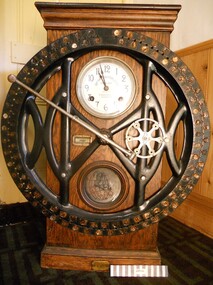
Functional object - Punch Clock, manual, circa 1880
... "/ On Brass plate at base are Patent registrations The large manual, ‘Punch-Clock’, (also known as a Time Clock), used by the Shire of Moorabbin employees to “clock-on and off” each working day circa late 1800s early 1900s. The clock face is exposed and the internal mechanism is encased in a wooden cupboard with two glass framed side panels. Right side panel is a door ...The large, early, manual, ‘Punch-Clock’, (also known as a Time Clock), used by the Shire of Moorabbin employees to “clock-on and off” each working day circa late 1800s early 1900s.This 'Punch-Clock' was used by employees of the Shire of Moorabbin circa 1880 - 1900 and was donated to the City of Moorabbin Historical Society by the now defunct Moorabbin City Council in 1984.The large manual, ‘Punch-Clock’, (also known as a Time Clock), used by the Shire of Moorabbin employees to “clock-on and off” each working day circa late 1800s early 1900s. The clock face is exposed and the internal mechanism is encased in a wooden cupboard with two glass framed side panels. Right side panel is a door that accesses the clock mechanism.Around Centre of Clock face " DEY TIME REGISTERS LTD"/ "HOWARD BROS./ made in USA/ 75 Queen Victoria St./ LONDON E.C."/ On Brass plate at base are Patent registrations moorabbin, clocks, wages, punch clock -
 City of Moorabbin Historical Society (Operating the Box Cottage Museum)
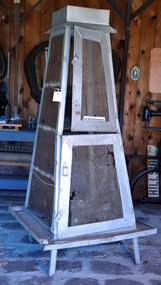
Functional object - Kitchen Equipment, Coolgardie Safe, c1900
... doors on one side, a metal tray at base of food safe and a metal cover over top. Ridges on which to rest trays carrying food are inside safe. The Safe is enclosed by fly-wire mesh. Functional object Kitchen Equipment, Coolgardie Safe Illegible on plate ...The invention of the Coolgardie Safe is credited to Arthur Patrick McCormick, a contractor in Coolgardie, and later the Mayor of Narrogin. Coolgardie is in the Eastern Goldfields region of Western Australia. Gold was first discovered there in 1892; the townsite became a municipality in 1894, and by 1898 its population of 15,000 made it the third largest town in Western Australia after Perth and Fremantle. In the last decade of the 19th century, Coolgardie was the capital of the West Australian goldfields. Being 180 kilometres from the nearest civilisation, food supplies were initially scarce and expensive. As fresh food was a valuable commodity there was incentive to preserve it, and keep it out of reach of scavengers such as birds, dingos, dogs, ants, and flies. It was in an effort to do this, in the extreme heat of the Australian Interior, that McCormick came up with his design for the Coolgardie Safe. McCormick noticed that a wet bag placed over a bottle cooled its contents. He further noted that if this bottle was placed in a breeze, the bag would dry out more quickly, but the bottle would get colder. What McCormick had discovered was the principle of evaporation: ‘to change any liquid into a gaseous state requires energy. This energy is taken in the form of heat from its surroundings.’ Employing this principle, McCormick made a box for his provisions which he covered with a wet hessian bag. He then placed a tray on top, into which he poured water twice daily. He hung strips of flannel from the tray so that water would drip down onto the hessian bag, keeping it damp. As the water evaporated, the heat dissipated, keeping the food stored inside cool and fresh. The success of McCormick’s invention would not have worked without a steady supply of water. Fresh water was scarce in the eastern goldfields at this time but the demand for water from a steadily growing population encouraged innovation. The solution was to condense salt water. Heating salt water in tanks produced steam that was condensed in tall cylinders, cooled and then collected in catchment trays. By 1898 there were six companies supplying condensed water to the goldfields, the largest company producing 100,000 gallons of water a day. In the early 20th century, Coolgardie Safes were also manufactured commercially. These safes incorporated shelving and a door, had metal or wooden frames and hessian bodies. The feet of the safe were usually placed in a tray of water to keep ants away. (MAV website) The early settlers of Moorabbin Shire depended on this type of Food Safe to protect their food from flies and vermin as they established market gardens in the fertile area around the notorious Elster Creek A metal framed, 4 sided structure standing on 4 legs with 2 hinged doors on one side, a metal tray at base of food safe and a metal cover over top. Ridges on which to rest trays carrying food are inside safe. The Safe is enclosed by fly-wire mesh.'...IN.....GEELONG' A manufacturer's oval metal plate is embossed on one side of Safe but it is illegible.elster creek, moorabbin, brighton, dendy's special survey 1841, market gardens, infant mortality, disease, cemeteries, fruit, vegetables, pioneers, coolgardie safe, mccormick arthur patrick, dendy henry, vaccination, jones martha, jones ethel may
