
Showing 1079 items matching "early background"
-
 Ringwood and District Historical Society
Document, Early Historical Background of the Area Adjancent to Marrondah High School (1855 - 1974), by Eva Buchanan (Handwritten Photocopy Plus Transcription, undated)
... Early Historical Background of the Area Adjancent to Marrondah High School (1855 - 1974), by Eva Buchanan (Handwritten Photocopy Plus Transcription, undated)...(Billy) WIlliams, de Pelsenaire family, Cheevers family, Brentnall Road naming, Muldowney Family, Alfred Brentnall, Ainslee Park. Early Historical Background of the Area Adjancent to Marrondah High School (1855 - 1974), by Eva Buchanan (Handwritten Photocopy Plus Transcription, undated) Document ...6 page photocopy of handwritten History of the Area adjacent to Marrondah High School, by Eva Buchanan. Also a Word Trasncription of same. Date unknown. Includes references to Nelson's Hill, Burnt Bridge, Cutts Avenue naming, Samuel Cutts, W. S. (Billy) WIlliams, de Pelsenaire family, Cheevers family, Brentnall Road naming, Muldowney Family, Alfred Brentnall, Ainslee Park. -
Moorabbin Air Museum
Book - History of the merlin engine, ROLLS-ROYCE HERITAGE TRUST THE MERLIN IN PERSPECTIVE-the combat years HISTORICAL SERIES No.2
... Early background...History of the merlin engine Early background Expansion Developments Experience in service Operational flying The drive for improvements Main service problems The perspective Technical history of the Merlin engine during World War 2, circa 1987 ROLLS-ROYCE HERITAGE TRUST THE MERLIN IN PERSPECTIVE-the combat years HISTORICAL SERIES No.2 Book History of the merlin engine ...Technical history of the Merlin engine during World War 2, circa 1987non-fictionTechnical history of the Merlin engine during World War 2, circa 1987early background, expansion, developments, experience in service, operational flying, the drive for improvements, main service problems, the perspective -
 Ringwood and District Historical Society
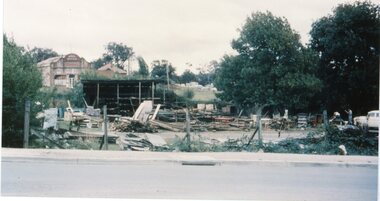
4 Coloured photographs numbered 10043 to 10046, Demolition of buildings in Adelaide Street -Ringwood. Circa 1960
... "Written on back of photograph" Demolition of buildings East side of Adelaide Street- Ringwood Mail Office and Pines Hospital in background. Early 1960's..."Written on back of photograph" Demolition of buildings East side of Adelaide Street- Ringwood Mail Office and Pines Hospital in background. Early 1960's Postcard size coloured photograph Demolition of buildings in Adelaide Street -Ringwood. ...Postcard size coloured photograph"Written on back of photograph" Demolition of buildings East side of Adelaide Street- Ringwood Mail Office and Pines Hospital in background. Early 1960's -
 Tatura Irrigation & Wartime Camps Museum
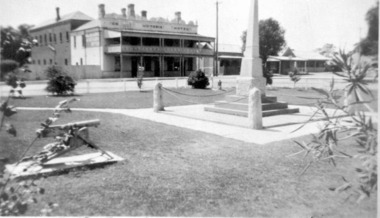
Photograph, War Memorial c.1940
... |Victoria Hotel in background.|Early Bazeley's Victoria Hotel....|Victoria Hotel in background.|Early Bazeley's Victoria Hotel. photograph people War Memorial c.1940 Photograph ...War Memorial c.1940.|Victoria Hotel in background.|Early Bazeley's Victoria Hotel.photograph, people -
 Port Melbourne Historical & Preservation Society
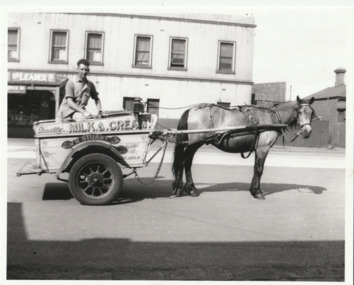
Photograph - William Raeburn STUART on milk float with horse, 'Goatie', Bridge Street, near Ross Street, Port Melbourne, 1930s
... Photo of William Raeburn STUART on his two wheeled milk float with horse 'Goatie' standing in Bridge Street near Ross Street, late 1930s-early 40s. In background is the newsagent/milk bar...The Photo was printed from a 620 box Brownie-size negative which was found in a box of negatives taken by the late Mrs M F Stuart Business and Traders - Dairies Transport - Horse William Raeburn STUART Gladysdale Dairy Business and Traders - Milkbars Bridge Street Ross Street Mrs M F STUART Photo of William Raeburn STUART on his two wheeled milk float with horse 'Goatie' standing in Bridge Street near Ross Street, late 1930s-early 40s. In background is the newsagent/milk bar Photograph William Raeburn STUART on milk float with horse, 'Goatie', Bridge Street, near Ross Street, Port Melbourne Glen Stuart ...'Goatie' was William STUART first horse. William's parents owned the Gladysdale Diary on the corner of Bridge street and Williamstown Road. The newsagent and Milk Bar on the corner of Ross & Bridge Street is still in operation (2024). The Photo was printed from a 620 box Brownie-size negative which was found in a box of negatives taken by the late Mrs M F StuartPhoto of William Raeburn STUART on his two wheeled milk float with horse 'Goatie' standing in Bridge Street near Ross Street, late 1930s-early 40s. In background is the newsagent/milk barbusiness and traders - dairies, transport - horse, william raeburn stuart, gladysdale dairy, business and traders - milkbars, bridge street, ross street, mrs m f stuart -
 Ballarat Tramway Museum
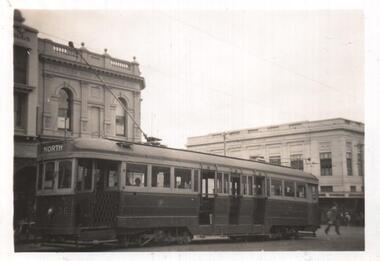
Photograph - Black & White Photograph/s, Lee A Ratten, early to mid 1950's
... Black and white photograph of Geelong 36, destination North and the intersection of Ryrie and Moorabool Streets with the Union Bank of Australia building in the background. Early to mid 1950's. Photo possibly Lee A Ratten - see related document and Reg Item 7185....Trams tramways Geelong North Ryrie St Moorabool St tram 36 Black and white photograph of Geelong 36, destination North and the intersection of Ryrie and Moorabool Streets with the Union Bank of Australia building in the background. Early to mid 1950's. Photo possibly Lee A Ratten - see related document and Reg Item 7185. ...Black and white photograph of Geelong 36, destination North and the intersection of Ryrie and Moorabool Streets with the Union Bank of Australia building in the background. Early to mid 1950's. Photo possibly Lee A Ratten - see related document and Reg Item 7185.trams, tramways, geelong, north, ryrie st, moorabool st, tram 36 -
 Mt Dandenong & District Historical Society Inc.
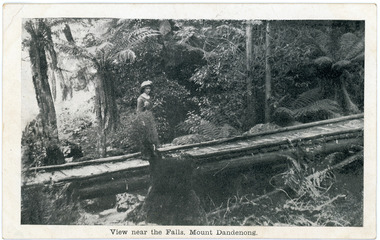
Photograph, View near the Falls, Mount Dandenong, early 1900s
... Tree ferns and bushes are in the background. Taken early 1900s....Tree ferns and bushes are in the background. Taken early 1900s. View near the Falls, Mount Dandenong. ...Postcard showing a woman wearing a long dress and wide brimmed hat standing on a footbridge that crosses the Olinda Creek. Tree ferns and bushes are in the background. Taken early 1900s.On front of postcard: View near the Falls, Mount Dandenong. On back of post card: Mason, Firth & McCutcheon, Printers, Melbourne.mason, firth & mccutcheon, olinda falls, footbridge, bridge, mt dandenong, olinda creek -
Stawell Historical Society Inc
Photograph, Group of Stawell Miners
... Cocker spaniels in front row, trees in background. Early 1900's Fourth from right is owner Thomas Kinsella. ...Cocker spaniels in front row, trees in background. Early 1900's Fourth from right is owner Thomas Kinsella. ...Magdala Mine with three rows of miners standing kneeling and sitting in front of timber building. Cocker spaniels in front row, trees in background. Early 1900's Fourth from right is owner Thomas Kinsella. Origional Photo No 1386-10 -
 Bendigo Historical Society Inc.
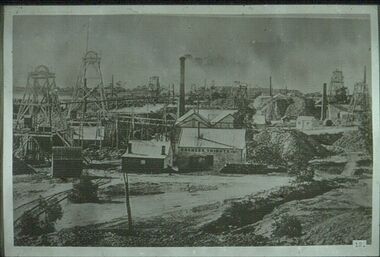
Slide - ALBERT RICHARDSON COLLECTION: DEVONSHIRE GROUP OF MINES 1870'S
... 'Mungo mines in the background, early 1870's' (Albert Richardson)....'Mungo mines in the background, early 1870's' (Albert Richardson). Slide ALBERT RICHARDSON COLLECTION: DEVONSHIRE GROUP OF MINES 1870'S ...Slide. Devonshire Group of mines with Duchess Tribute Gold Mine in foreground. Mine shed with 'Ducches Tribute' printed on side. Poppet heads, chimney stacks, mullock heaps, and mine buildings in the background. 'Mungo mines in the background, early 1870's' (Albert Richardson).No. 12 on bottom of slidemine, gold, devonshire group., bendigo mines-jack hattam collection -
Dandenong & District Historical Society
Booklet - St James' Dandenong 1864-1989
... 1835 Background suggests early settlement around mid/late 1840's. ...1835 Background suggests early settlement around mid/late 1840's. ...History of St James Church - Dandenong 125 years4pp Cover Printed 4 Colour Process Outer Cover, Black Ink on Inner Cover. Text & Pictures Black on White paper.non-fictionHistory of St James Church - Dandenong 125 yearsbuilding of church -
 Falls Creek Historical Society
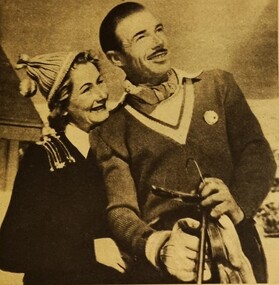
Newspaper - Australia's Playground of the Future
... He outlined Toni's earlier background with the SEC and noted that Toni had recently named a peak in the area Mt.. ...He outlined Toni's earlier background with the SEC and noted that Toni had recently named a peak in the area Mt.. ...Australian Magazine (A.M.) published a special three page article about Falls Creek and the Bogong High Plains on 24th August 1954. The article was titled "Australia's playground of the future". Written by Muir Maclaren, it referred to the Bogong High Plains as a comparatively new and unexploited winter playground which could be one of the best snow resorts in the world. There were 13 huts which were at Falls Creek which were there due to "hard work, the grace of God, and the permission of the Victorian State Electricity Commission". A brief history of the Albury Ski Club Lodge was included. In 1954 the Lodge was run byLes Meikle and had the Club had a membership of 200 people. Lodges with accommodation established at this time, with the ability to house a total of 280 people, included Albury, Skyline, Bogong, Myrtleford, Hymans, Dawn, Galleon, Kiewa Valley, Snowden, Nelse, Moroma, Trowalla, St, Trinian's, Bowna and Nissen. The reporter also interviewed Skippy and Toni St. Elmo and gave a description of the tow and its fees. He outlined Toni's earlier background with the SEC and noted that Toni had recently named a peak in the area Mt.. Hillary in honour of the success of Edmund Hillary in conquering Mt. EverestThis article and accompanying images are significant because they capture early information about the Bogong High Plains, Falls Creek and its pioneers.A centre spread from a monthly publication featuring text and colour imagesBeneath photo Toni St. Elmo and his wife, Skippy, who run the ski tow and a ski school. Skippy won the Albury Club Club Championship against men.bogong high plains, skippy st. elmo, toni st. elmo -
Port Melbourne Historical & Preservation Society
Financial record, Pat Grainger, Port Melbourne Historical & Preservation Society Annual Report 2000, Aug 2000
... Annual Report of the PMH&PS, 2000 A5 8 pp plus cover - light brown with handwriting from early document as background texture. Contains financial reports, list of members, Phillip Williams illustration of Gellibrand lighthouse and photos from two festivals - Lee-ar-day Days and Back to Port....These were compiled, designed, printed on photocopier and bound by the Secretary, except for the Tenth anniversary edition. societies clubs unions and other organisations port melbourne historical & preservation society pmhps Ann GIBSON Phillip WILLIAMS Annual Report Lois DALEY Ted KOBELT Glen STUART Glen COSHAM Maralyn KOBELT Annual Report of the PMH&PS, 2000 A5 8 pp plus cover - light brown with handwriting from early document as background texture. Contains financial reports, list of members, Phillip Williams illustration of Gellibrand lighthouse and photos from two festivals - Lee-ar-day Days and Back to Port. ...PMH&PS was incorporated in 1994, and from 1995 was required to hold an AGM and present an Annual Report. These were compiled, designed, printed on photocopier and bound by the Secretary, except for the Tenth anniversary edition.Annual Report of the PMH&PS, 2000 A5 8 pp plus cover - light brown with handwriting from early document as background texture. Contains financial reports, list of members, Phillip Williams illustration of Gellibrand lighthouse and photos from two festivals - Lee-ar-day Days and Back to Port.societies clubs unions and other organisations, port melbourne historical & preservation society, pmhps, ann gibson, phillip williams, annual report, lois daley, ted kobelt, glen stuart, glen cosham, maralyn kobelt -
 Bendigo Historical Society Inc.
Book - NORMA YOUNG: A LIFE OF DEVOTION
... It is the life story of Norma Young comprising of: Family Background, Early Days, War and Work, Guides And Guiding, The Business and Professional Women's Club, Community Involvement, The Joys of Travel, Career Woman, Family and Friends, Declining Years, Photographs & Newspaper Cuttings.Plastic spine and cover...It is the life story of Norma Young comprising of: Family Background, Early Days, War and Work, Guides And Guiding, The Business and Professional Women's Club, Community Involvement, The Joys of Travel, Career Woman, Family and Friends, Declining Years, Photographs & Newspaper Cuttings.Plastic spine and cover Book NORMA YOUNG: A LIFE OF DEVOTION. ...Book, Norma Young, A Life Of Devotion, Written by Lorraine Griffiths. It is the life story of Norma Young comprising of: Family Background, Early Days, War and Work, Guides And Guiding, The Business and Professional Women's Club, Community Involvement, The Joys of Travel, Career Woman, Family and Friends, Declining Years, Photographs & Newspaper Cuttings.Plastic spine and coverLorraine Griffithsbook, bendigo, norma dorothy young a.m. -
 Eltham District Historical Society Inc
Photograph, Collection of wood
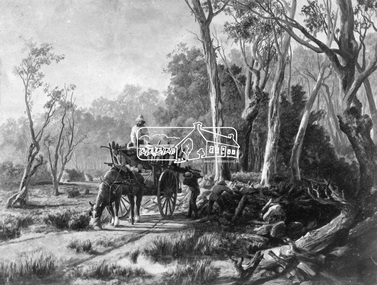
... Two huts are in the background. Early settlers often had to make use of what was available in their local environment to build their shelters. ...Two huts are in the background. Early settlers often had to make use of what was available in their local environment to build their shelters. ...Etching of country scene, a horse pulling a rudimentary cart with three men collecting wood and possibly stones from underneath trees on a rough track. Two huts are in the background. Early settlers often had to make use of what was available in their local environment to build their shelters. Today roadside collection of firewood is regulated by the State government. Unknown location, unknown artist and unknown date.This photo forms part of a collection of photographs gathered by the Shire of Eltham for their centenary project book," Pioneers and Painters: 100 years of the Shire of Eltham" by Alan Marshall (1971). The collection of over 500 images is held in partnership between Eltham District Historical Society and Yarra Plenty Regional Library (Eltham Library) and is now formally known as 'The Shire of Eltham Pioneers Photograph Collection.' It is significant in being the first community sourced collection representing the places and people of the Shire's first one hundred years.Digital imagesepp, shire of eltham pioneers photograph collection, other areas, pioneer life, country scene, country roads -
 Ballarat Tramway Museum
Negative - Geelong 23 in Moorabool St for Belmont, early 1950s
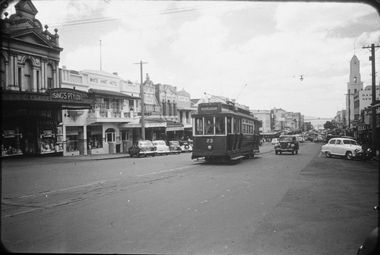
... The T&G building and the Bank of NSW are in the background. Photo early 1950s. Photographer unknown....The T&G building and the Bank of NSW are in the background. Photo early 1950s. Photographer unknown. ...Photograph shows Geelong tram No. 23, south bound to Belmont in Moorabool St at Little Ryrie St. Has Ising's store, the White Hart Hotel, Alexander frocks and coats in the view. The T&G building and the Bank of NSW are in the background. Photo early 1950s. Photographer unknown.Yields information about tram 23 and Moorabool St in the early 1950s, prior to the closure of the Geelong tram system in 1956.120 size black and white negative.moorabool st, geelong, tramways, tramcars, tram 23 -
 Melbourne Tram Museum
Negative - VR Tram 51 at Black Rock, Hugh Ballment, early 1950s
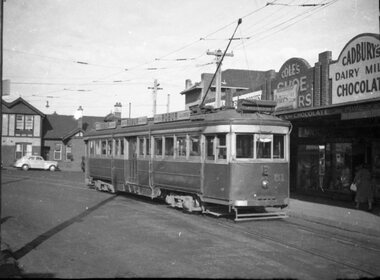
... Photo early 1950s. In the background are Coles Shoe Repairs and a Milk bar advertising Peters Ice cream, and Cadbury's Dairy Milk Chocolate....Photo early 1950s. In the background are Coles Shoe Repairs and a Milk bar advertising Peters Ice cream, and Cadbury's Dairy Milk Chocolate. ...The photograph shows Victorian Railways tram No. 51 at the Black Rock terminus, with the destination set for the return trip to Sandringham. Tram has Robur tea adverts. Photo early 1950s. In the background are Coles Shoe Repairs and a Milk bar advertising Peters Ice cream, and Cadbury's Dairy Milk Chocolate.Yields information about VR Tramcars at the Black Rock terminus.Negative - 127 film black and white.tramways, vr, victorian railways, tram 51, black rock, sandringham to black rock -
 Lakes Entrance Historical Society
Photograph, George Price Grant Metung, 1900 c
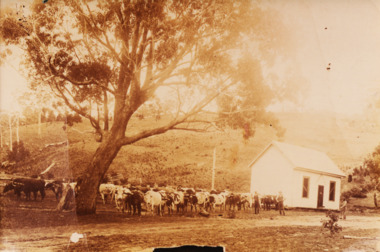
... Bare hill and a few dead trees in background showing early land improvement for agriculture Metung Victoria...Bare hill and a few dead trees in background showing early land improvement for agriculture Metung Victoria George Price Grant Metung Photograph ...Myrtle Fish collection daughter of George Price GrantSepia toned photograph showing large Bullock team of George Price Grant of Metung moving a small building in Metung district four men visible one on right with an axe other with whips. Bare hill and a few dead trees in background showing early land improvement for agriculture Metung Victoria genealogy, settlers -
 Villa Alba Museum
Wallpaper sample - Landscape frieze, c.1910
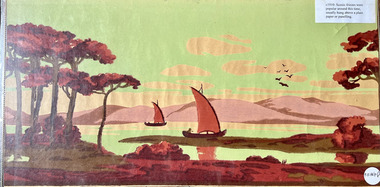
... Scenic landscape featuring stylized boats with deep red sails gliding past stone pine trees, silhouetted against a serene pink and mint background. Classic early 20th century Arts and Crafts movement style. ...Heritage interiors Wallpapers 20th century design decorative arts & design classical friezes Scenic landscape featuring stylized boats with deep red sails gliding past stone pine trees, silhouetted against a serene pink and mint background. Classic early 20th century Arts and Crafts movement style. ...Part of a collection of historic wallpapers collected by Phyllis Murphy, most of whose wallpapers were donated to the collection of Historic Houses Sydney. This wallpaper sample, annotated and encased in mylar was used by Phyllis for educational purposes, and donated by her son to Villa Alba Museum's collection in 2025.Scenic landscape featuring stylized boats with deep red sails gliding past stone pine trees, silhouetted against a serene pink and mint background. Classic early 20th century Arts and Crafts movement style. Friezes were popular around this time, usually hung above a plain paper or panelling. heritage interiors, wallpapers, 20th century design, decorative arts & design, classical friezes -
 Ballarat Tramway Museum
Photograph - Ballarat 15 in Victoria Street, Bob Lilburn, early 1950s
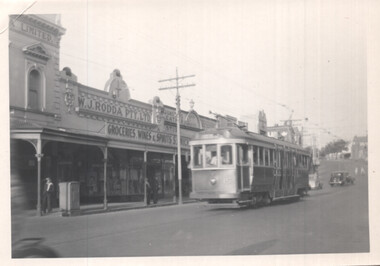
... Photo early 1950s. In the background is W J Rodda Pty Ltd Grocery, wines and spirits store and Dunstan's leather store. ...Photo early 1950s. In the background is W J Rodda Pty Ltd Grocery, wines and spirits store and Dunstan's leather store. ...Photo shows Ballarat bogie tram 15 in Bridge Street Ballarat, near Stones Corner. The tram arrived in Ballarat in Oct. 1945 and was renumbered to No. 36 in Sept 1953. Photo early 1950s. In the background is W J Rodda Pty Ltd Grocery, wines and spirits store and Dunstan's leather store. Note the metal box on the footpath - could be an Electric Supply Co. cable power terminal box.Yields information about bogie tram 15, early 1950s.Black and White photograph of Ballarat 15 in Bridge StreetHas in ink on rear " R Lilburn"ballarat, tramways, trams, stones corner, bridge st, tram 15, esco, w j rodda -
Tatura Irrigation & Wartime Camps Museum
Document - Memoir, Hermine Wedel, Memories of Tatura, July 2014
... An account of the author's family background & early life, more particularly those events leading to their internment in Tatura, Victoria, Australia during World War 2. ...An account of the author's family background & early life, more particularly those events leading to their internment in Tatura, Victoria, Australia during World War 2. ...An account of the author's family background & early life, more particularly those events leading to their internment in Tatura, Victoria, Australia during World War 2. The author's parents (author Hermine Wedel, nee Strauss) were of German nationality & practicing as missionaries in New Guinea. Upon the outbreak of WW2, those German nationals were ordered to the coast by the Australian authorities and the men were transported to internment camps in Australia. The women remained behind, reporting regularly to the authorities, until they too were brought to camps in Australia at the end of 1941. They were eventually reunited in a family camp for internees, Camp 3 at Tatura, in 1943. They were released from the camp to work in Australia in 1947 and the family returned to New Guinea in 1949, and eventually went back to Germany. The author also briefly recounts her marriage & married life in Brazil & Germany. 13 page document, A4 paper. 7 pages of English translation, 6 pages German original. world war ii, internee camps, civilian internees, german internees, camp 3, tatura, new guinea, strauss, stuerzenhofecker -
 Ballarat Tramway Museum
Photograph - Black & White Photograph/s, State Electricity Commission of Victoria (SECV), late 1950's or early 1960
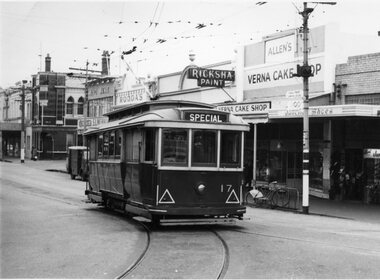
... Photo late 1950's or early 1960. In the background a Ricksha Paints (pronounced Rickshaw), Allen's Verna Cake Shop, Junction Shoes. ...Photo late 1950's or early 1960. In the background a Ricksha Paints (pronounced Rickshaw), Allen's Verna Cake Shop, Junction Shoes. ...Yields information Bridge Street and the buildings at the junction with Main and Victoria St / Stones corner. Tram parked for some particular reason - see 3807.1 to .3 for a similar set of photographs. Shows shops and cars.Black and White photograph, No. 17 at Stone Corner, intersection of Bridge and Main Streets Ballarat. Parked just past the junction points - reason unknown, see also Reg Item 3802, 3807.1 to 3807.3 - for other photographs of the tram at the same location. Photo late 1950's or early 1960. In the background a Ricksha Paints (pronounced Rickshaw), Allen's Verna Cake Shop, Junction Shoes. Roddas, ANZ and the English Scottish Bank of Australia buildings in the view. Also the signal for incoming trams from Main St, on the post with the tram stop. tramways, trams, bridge st, signals, stones corner, tram 17 -
 Warrnambool and District Historical Society Inc.
Booklet, Australia's second Air Mail. The aviation Career of Basil Watson 1893-1917, 2017
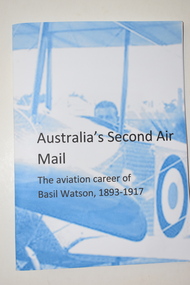
... It tells in detail his early life, background, his home built aeroplane, his display flights and his tragic death and the story since. ...It tells in detail his early life, background, his home built aeroplane, his display flights and his tragic death and the story since. ...This booklet relates the life of Basil Watson. It tells in detail his early life, background, his home built aeroplane, his display flights and his tragic death and the story since. This year marks 100 years since one of Australia’s pioneering aviators, Basil Watson arrived in Warrnambool and delivered the first airmail to the town. Basil Watson was born in Bendigo in 1894. His interest in aviation which began at a young age, took him to England at the commencement of WW1 where he worked at Brookland in aviation workshops and as a test pilot. Despite crashing and suffering injuries he was not deterred. He returned to Australia and by 1916 Basil had built his own plane. He soon took to the air performing tricks and barnstorming to the delight of onlookers. His connection to Warrnambool lies with his delivery of the first airmail to the town, an event which was filled with much excitement. Basil Watson, pioneer aviator landed his 50hp home built aeroplane on the racecourse on Saturday January 27th 1917, after a flight from Point Cook. The trip of 166 miles took just under two hours, and set a record non-stop cross country flight for Australia. Watson was heartily welcomed by the Mayor, to whom he delivered three letters, the first aerial post to Warrnambool. One of the letters, from the Mayor of Melbourne Sir David Hennessy to the Mayor of Warrnambool is now in the W&DHS collection: I have much pleasure in sending you greetings by aeroplane piloted by my friend, Mr Basil Watson. I hope when the cruel war is over and victory crowns our efforts, we, over the Commonwealth, will be able to fly from one State to the other. With best wishes for the New Year. Yours truly, DV Hennessy. Basil Watson was unfortunately killed two months after his historic visit to Warrnambool. While participating in an air show at Point Cook, the plane he was flying that day crashed into the sea. This booklet tells the story of an interesting part of Warrnambool and Australia's aviation history. It has special significance as it enlightens two significant items in our local collection, namely the letter which he delivered and the seat from his aircraft.A small 29 page booklet with blue and white photograph of Basil Watson in his aeroplane. It contains a number of black and white and some colour photographs. Introduction from the author, "This small booklet recognises the short career of Basil Watson. He came to my attention when researching the French aviator Maurice Guillaux who carried the first official air mail in Australia, Melbourne to Sydney in two and a half days 16/18 July 1914..... Tom Lockley 1 June 2017. Handwritten inside front cover,"These items may be of interest to add to your material about Basil Watson. Its a pity that the 100 year anniversary of his flight was not more widely recognised but thank you for mounting some of his records. Tom Hockley."warrnambool, basil watson, first airmail flight, aviation career of basil watson -
 Royal Brighton Yacht Club
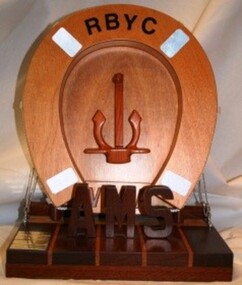
Life Ring, Vega Trophy (Mounted Wooden Life Ring)
... Bedlington 2005/06 Vega – Further historical background Early in the Second World War Jersey was declared “unarmed” and the German military took over, taking quite a few lives in the process, through strafing the main harbour and a few other places which they needlessly considered threatening. ...Bedlington 2005/06 Vega – Further historical background Early in the Second World War Jersey was declared “unarmed” and the German military took over, taking quite a few lives in the process, through strafing the main harbour and a few other places which they needlessly considered threatening. ...Vega Trophy (Mounted Wooden Life Ring) Donor: Graham Noel During World War II when the Germans occupied the Channel Islands the local people went through very severe food rationing and were on the verge of starvation. Near the end of the war, the Swedish ship Vega was allowed by the Germans to deliver several shipments of food to the civilian population, easing the critical shortages of food on the islands. Further background detail can be found below. Graham Noel was born on the Islands and lived there during this harsh period. The trophy is awarded to the winner of the Combined Division AMS Aggregate Series. First Winner: Under Capricorn, P. Bedlington 2005/06 Vega – Further historical background Early in the Second World War Jersey was declared “unarmed” and the German military took over, taking quite a few lives in the process, through strafing the main harbour and a few other places which they needlessly considered threatening. A considerable number of locals evacuated to England before the Germans arrived, but more than 60% of the population remained and endured 5 years of very strict and difficult conditions. Not only was the population unable to contact relatives in the UK or elsewhere, but very quickly they found themselves subject to harsh curfews, strictly rationed foodstuffs, no fuel for vehicles, radios confiscated, and homes and hotels commandeered by the military. The military demanded first pick of all foodstuffs and kept meticulous records of all livestock forcing farmers even to show newborn calves and piglets to them, then claiming the new arrivals for their dinner tables. However there are many stories of farmers outwitting their masters when twin calves or suchlike arrived! Lawbreakers were quickly dealt with, mostly with lengthy prison terms in Jersey, but the more serious crimes were punished by being sent to some horrible French prisons, or even some of the notorious German concentration camps. All local Jews were dispatched to concentration camps, and even English born families were similarly shipped through France and on to Germany. Sadly, a considerable number of those deported did not make it back safely to Jersey. In June 1944 the locals were delighted to hear that the Allies had invaded Normandy and very soon they could hear the battles as the Allies worked their way along the French coast. Little did they know they would still have to wait another 11 months for freedom, having to put up with a very demanding German occupation force which was still determined to obey Hitler’s order to “Defend the Channel Islands to the death”. Now that France was in Allied Hands the local military commanders were unable to supplement their food supplies from France and even harsher demands were made on the local population to ensure that all branches of their still very substantial military force were reasonably well fed. As well as the military, Jersey farmers had to provide food for the Allied POWs and the many “forced labourers”, mainly of Russian, Polish and Italian backgrounds who had been directed to the island to build all the concrete bunkers. This included an underground hospital, all this complying with Hitler’s orders to ensure that the Channel Islands would never again be part of Britain. Many requests by the Jersey authorities for Red Cross assistance were rejected, but finally in December 1944 they agreed and on 30th December the Red Cross vessel “Vega” (Swedish Registry) arrived and delivered parcels to the civilian population. These parcels contained a variety of foodstuffs supplied mainly by Canadian authorities, desperately needed medical supplies, flour, oils and soaps, as well as tobacco from New Zealand. Vega made a further 3 or 4 trips and most certainly eased the desperate situation being faced by the locals. In fact, it resulted in the locals having slightly better food supplies than the military and many local farmers tell stories of having to protect their stock from marauding soldiers. Understandably Churchill was reluctant to send in an invading force to retake the Channel Islands, but by May 1945 it was clear that the Third Reich was finished and on May 9th the German Military surrendered, without a fight, to a large British landing force. On a slightly lighter note … in January 1945 Jersey stonemasons were seen in the main town square repairing flagstones … the Germans had never noticed that the name “Vega” had been formed in those flagstones! As a side note Vega is the name of the brightest star in the universe. Furthermore, throughout the occupation, despite German law that demanded confiscation of all radio sets, punishable by long prison terms or deportation to Germany, there were still many sets being listened to. The locals had a well refined news system for the dissemination of news of what was happening in the outside world. vega, graham noel, ams, combined division, aggregate -
 Ballarat Tramway Museum
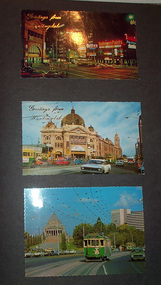
Album - Photo Album, Newstar, 1960s to 1970's
... (mid 1970's) W2 515 outbound, Collins St., late 1960's, with Town Hall in background. (early 1970's, prior to lights) Collins St. looking west at Russell St with W2 637outbound route 42, early 1960's. ...(mid 1970's) W2 515 outbound, Collins St., late 1960's, with Town Hall in background. (early 1970's, prior to lights) Collins St. looking west at Russell St with W2 637outbound route 42, early 1960's. ...Photographic album containing 39 Colour postcards of Melbourne trams. The album consists of 30 leaves of dark grey heavy paper with three creases on left hand side of sheet, bound into a heavy bluey grey folder, embossed in gold 'Scrap Book" and bound with bluey grey string with two holes. The cover has been embossed with a the blue grey in swirls. Inside of back cover is a white label, "A New Star Product", with a please ask for No. with "425" stamped on. Postcards have been glued into the album. Entries have been kept to a single line - cards are able to be dated from buildings, whether the trams have marker lights, types of motor cars and general Melbourne history. Image files in page number order. Image 15 is of book. All taken with a electronic camera. Page 1 - Night photo - Flinders and Swanston St. - with "Greetings from Huntingdale" embossed in gold. Flinders St. station, with "Greetings from Huntingdale" embossed in gold. (post 1972 ) St. Kilda road with the Shrine of Remembrance in the background and W2 453 inbound on route 6. (post 1974) Page 2 - Bourke St, looking from Parliament House westwards, with Z8 inbound - after 13/8/1975 on route 89. Bourke St, looking east from Queen St., night photo, early 1970's. Princes Bridge looking towards Flinders St. Station Page 3 - Flinders St. Station, from Princes Gate buildings, - Photo E. Ludwig, John Hinde Studios. Bourke St. from Queen St, looking east, late 1960's - all W's. - W7 1026 east bound on route 88. Flinders St and Swanston St. corner, from Princes Bridge - night photo - W5 756 northbound route 15. Page 4 - W2 584 inbound route 64, St. Kilda Road and Nolan St., late 1960s - photograph. Princes Bridge, looking over Yarra River to the east. (pre Concert Hall) St. Kilda Road, with Shine of Remembrance in background, W2 303 inbound route 4D, mid 1960's. Page 5 - Flinders and Swanston St, W2 530 outbound route 8, early 1970's. Swanston and Collins St., W2 596 westbound in Collins St. City Square built - 1st version. (post 1972) St Kilda Road, with Shine in background, W2 298 and others, route 8 and 72. (post 1972) Page 6 - Flinders and Swanston St., W2, inbound route 5 on a wet evening. (mid 1970's) W2 515 outbound, Collins St., late 1960's, with Town Hall in background. (early 1970's, prior to lights) Collins St. looking west at Russell St with W2 637outbound route 42, early 1960's. Page 7 - Swanston St looking south at Little Bourke, W2's 373 route 67 and 374?(route 5), southbound, early 1970's Flinders St. Station, looking west in Flinders St., early 1970's, at dusk. Melbourne Town Hall with City Square from the North West (early 1970's) Page 8 - Bourke St looking east from Queen St. with W7 1005 inbound on route 96 - early 1970's. Bourke St. looking west from Exhibition St. with W6 976 outbound on route 95 - early 1970's. Swanston St. looking south from Lonsdale, with W2 484 on route 64, W2 228 and W2 364 in photo - early 1970's. Page 9 - Swanston looking south from north of Lonsdale St with many tramcars in photo - mid 1970's. St Kilda Road, with Shrine in background, W2 345 outbound route 4, SW6 913 inbound route 4 - prior to 1970. St Kilda Road, with Shrine in background, with trams in photo - early 1970's. (Photo loose in album - National View postcard by Murfett Ltd. Aust.) Page 10 - Postcard - TMSV? of 1041 and cable car set at Preston Workshops. 1041 in Bourke St., looking east from Queen St. - early 1970's - 1974? Collins St. looking east from Elizabeth St. with W2 253 inbound route 11, and W2 224 outbound - rout 47, early 1970's Page 11 - TMSV Postcard, X217 in Dandenong Road with L class in background. Shrine of Remberance from BP building, looking towards the city with St. Kilda Road on the left. Princes Gate and Flinders St. from the SEC buildings in Flinders St. looking south east - mid 1960's. Page 12 - Swanston St. at Flinders St. looking north at dusk. Flinders St. station at Swanston St with trams crossing at intersection - late 1960's Flinders St. station with W2 327 outbound. Page 13 - Temporary City Square at Collins and Swanston St. with tramcars at intersection. Wellington Parade (Mugs Alley), looking towards the City, with W2 546 inbound on route 38 - mid to late 1960's. Page 14 - Swanston St. looking south, at Lonsdale St, W2 432 inbound route 7 - late 1960's or early 1970's. Partly loose in album - National View postcard by Murfett Ltd. Aust. trams, tramways, photo album, melbourne, postcards -
 Federation University Historical Collection
Photograph, N.l. Harvey & Son, Mount Helen Campus, 1968, 1969
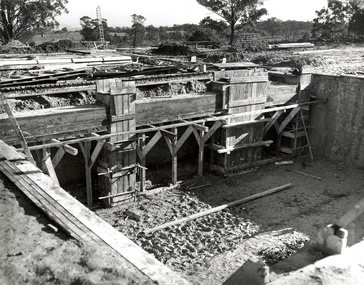
... The Federation University campus at Mount Helen was first used by students in 1970. federation university federation university australia feduni university of ballarat ballarat college of advanced education ballarat institute of advanced education building earthworks foundation early development soil testing laboratory Seven photographs of the Mt Helen Campus Stage one development. .1) Aerial view of foundation work, from west, towards Green Hill .2) Aerial View from South. Earthworks and foundations .3) Aerial View from south west. Earthworks, general view .4) Aerial View from above the South West corner of E building. .5) Aerial View from North East. Gear Avenue in background ...The Federation University campus at Mount Helen was first used by students in 1970.Seven photographs of the Mt Helen Campus Stage one development. .1) Aerial view of foundation work, from west, towards Green Hill .2) Aerial View from South. Earthworks and foundations .3) Aerial View from south west. Earthworks, general view .4) Aerial View from above the South West corner of E building. .5) Aerial View from North East. Gear Avenue in background .6) Aerial View from North West. Earthworks extend from Gear Avenue .7) Ground level view. First columns of E building. .13) Mt Helen development Stage One, Engineering Diploma Buildings. This image shows the wall beam and pier construction to the East Wall of the Fluid Mechanics Laboratory adjacent to the pump chamber, 17 June 1968. .18) Flume Pit and Pump Chamber, 15 July 1968. .28) East Wing Pit Looking North, 26 August 1968 .40) Construction as of 04 November 1968federation university, federation university australia, feduni, university of ballarat, ballarat college of advanced education, ballarat institute of advanced education, building, earthworks, foundation, early development, soil testing laboratory -
 Federation University Historical Collection
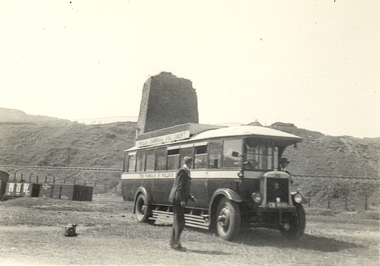
Photograph - Black and White, Frank Wright, St Hilda's Band bus at Llanelly, Wales, 29/5/1934
... Black and white photograph of an early 1930's bus parked on the grass in the foreground, with a man standing on the hidden steps of the bus and another man walking in front. In the middle distance rail lines can be seen on an embankment rising behind a post and wire fence and in the background a tower rises on the closest hill. ...The Frank Wright Medal at the Royal South Street competition is awarded to an individual recognized as making an outstanding contribution to brass music in Australia. frank wright 1930's bus welsh tower st hilda's band sthilda's band bus Written in pencil on back - Llanelly, Wales, 29/5/34 Black and white photograph of an early 1930's bus parked on the grass in the foreground, with a man standing on the hidden steps of the bus and another man walking in front. In the middle distance rail lines can be seen on an embankment rising behind a post and wire fence and in the background a tower rises on the closest hill. ...Frank Wright was a renown resident of Smeaton, where he was born on 2 August 1901. He lived at Laura Villa, and attended Smeaton State School. His father William was a gold miner and his mother's name was Sarah. Their family won many singing and instrumental awards. Frank was tutored by Percy Code and was awarded a gold medal for the highest marks in the ALCM examinations in the British Colonies at the age of seventeen years. He became the Australian Open Cornet Champion by the age of eighteen. A year later, Frank conducted the City of Ballarat Band, and later the Ballarat Soldiers’ Memorial Band. He formed the Frank Wright Frisco Band and Frank Wright and his Coliseum Orchestra. These bands won many South Street awards, and Frank as conductor won many awards in the Australian Band Championship contest. In 1933 Frank Wright sailed to England to conduct the famous St Hilda’s Band and was later appointed Musical Director of the London County Council, where he organized many amazing concerts in parks, in and around the London district. He was made Professor of Brass and Military Band Scoring and conducted at the Guildhall of Music and Drama. Frank was often invited to adjudicate Brass Band Championships around Europe, in Australia, including South Street and in New Zealand. The Frank Wright Medal at the Royal South Street competition is awarded to an individual recognized as making an outstanding contribution to brass music in Australia.Black and white photograph of an early 1930's bus parked on the grass in the foreground, with a man standing on the hidden steps of the bus and another man walking in front. In the middle distance rail lines can be seen on an embankment rising behind a post and wire fence and in the background a tower rises on the closest hill. The bus is the St Hilda's Band bus and the place is Llanelly in Wales.Written in pencil on back - Llanelly, Wales, 29/5/34frank wright, 1930's bus, welsh tower, st hilda's band, sthilda's band bus -
 Federation University Historical Collection
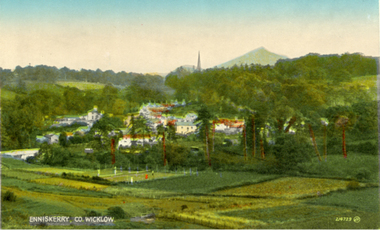
Postcard - colour, Enniskerry, County Wicklow, Ireland
... early 1950s. [Jane Dyer 2024] Chatham-Holmes Family Collection Enniskerry Wicklow Ireland postcard A town is surrounded by green fields and trees. A mountain is evident in the background ...Possibly acquired because of a connection to rural life and the Irish immigrants settled in the Ballarat District. Harry and Edith Holmes visited this area with my mother, their daughter M. Elizabeth in the early 1950s. [Jane Dyer 2024]A town is surrounded by green fields and trees. A mountain is evident in the backgroundchatham-holmes family collection, enniskerry, wicklow, ireland, postcard -
 Flagstaff Hill Maritime Museum and Village
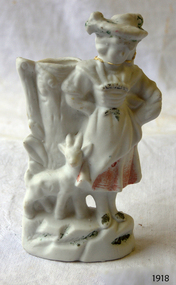
Decorative object - Ornament, ca. 19th century
... The set of six bisque figurines is representative of popular table decorations during the 19th and early 20th centuries. warrnambool shipwrecked-coast flagstaff-hill-maritime-museum maritime-museum shipwreck-coast ornament Flagstaff Hill Flagstaff Hill Maritime Museum and Village Maritime Museum Maritime Village Great Ocean Road Shipwreck Coast Bisque China ornament white china ornament German Germany porcelain unglazed porcelain 19th century 18th century European ornament pottery unglazed pottery domestic ornament decoration table decoration girl and goat vase "3943: Fine unglazed white porcelain ornament, hollow inside. It is carved to represent a peasant girl and goat with a vase shaped like a tree stump in the background ...This fine white unglazed porcelain figurine is one of six donated together. The bisque material was easy to carve and allowed fine detail. Figurine ornaments were popular for table decorations between the mid-18th to early 19th centuries. This ornament was likely made in Germany, and German manufacturers began to use bisque material to make realistic faces for dolls in the 1850s.The set of six bisque figurines is representative of popular table decorations during the 19th and early 20th centuries.Fine unglazed white porcelain ornament, hollow inside. It is carved to represent a peasant girl and goat with a vase shaped like a tree stump in the background. The ornament has remnants of gold, red, brown and green paint. There is an inscription on the base."3943:warrnambool, shipwrecked-coast, flagstaff-hill-maritime-museum, maritime-museum, shipwreck-coast, ornament, flagstaff hill, flagstaff hill maritime museum and village, maritime museum, maritime village, great ocean road, shipwreck coast, bisque, china ornament, white china ornament, german, germany, porcelain, unglazed porcelain, 19th century, 18th century, european ornament, pottery, unglazed pottery, domestic ornament, decoration, table decoration, girl and goat, vase -
 Ringwood and District Historical Society
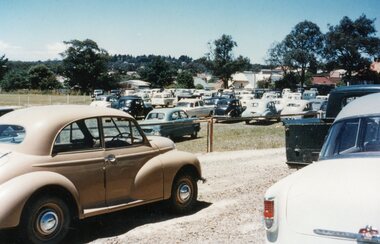
Photograph, Ringwood Oval car parking, off Ringwood Street circa early 1960s
... Adelaide Street and Presbyterian Church in background Ringwood Oval car parking, off Ringwood Street circa early 1960s Photograph ...Adelaide Street and Presbyterian Church in background -
 Mission to Seafarers Victoria
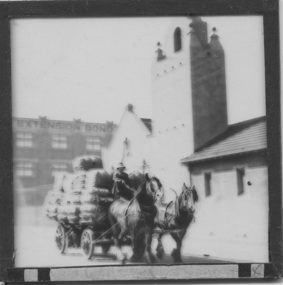
Slide - Glass slide, Black and white, Mission to seamen building, Flinders St and loaded horse-drawn wagon, circa 1920s
... "The Extension Bond and Free stores" building which can be seen in the background can be identified on an aerial photograph of the area dated 1927. This image besides showing an early view of the current Mission to Seafarers building also features a glimpse of the early 20th C (Flinders St) Extension Bond ( Store ?) ...This Spanish Mission style building first opened in 1917 and has been in continual use since as the Mission to seamen and later Mission to Seafarers at a location initially known as the extension to Flinders St near the Australian Wharf and later address known as 717 Flinders St. "The Extension Bond and Free stores" building which can be seen in the background can be identified on an aerial photograph of the area dated 1927.This image besides showing an early view of the current Mission to Seafarers building also features a glimpse of the early 20th C (Flinders St) Extension Bond ( Store ?) building positioned to make use of the Yarra-side docks known as the Australian Wharf.Positive photograph on medium format glass slide ; b & w image of the chapel and bell tower of 1917 Mission Building, extension to Flinders St. with a loaded horse-drawn dray or wagon being driven in the foreground. . In the background of image can be seen a section of a large warehouse or Bond store building, visible signage reads: "Extension Bond"in upper case letters. The foreground details appear to have been hand touched up with linear ink highlights. Image is slightly blurry. The slide is edged with adhesive tape.pencil cross at lower right corner on adhesive tape edgingmissions to seamen institute, mission building, extension bond store, warehouse
