
Showing 29 items matching "early post offices"
-
 Whitehorse Historical Society Inc.
Newsletter - Whitehorse Historical Society Newsletters 1978, 1978
... ...Early Post Offices...Produced by Nunawading Historical Society in 1978 Yarran Dheran Early Mitcham William Witt Australian Navy World War 1 World War 2 1902 drought Our Special City Box Hill Reporter History of Box Hill East Burwood Vermont Primary School Early Post Offices Nunawading Shire Council letters The Australian Natives Association Newsletters 68-75, published in 1978. ...Newsletters 68-75, published in 1978. Features articles on: Report on opening of the Museum Path to Yarran Dheran opened Early Mitcham, memories by Mrs Boxshall, train trips, shop fires 1920s, school headmaster Mr. Webster, school had 2 rooms and slate roof William Witt, first Shire President (1833-1910) Australian Navy by Mr Ricketts, joined 1910, World War 1 & 2 Travelling sheep feeding and trespassing in Nunawading, 1902 drought, Mr L Norman, Councillor Collier Our Special City, 1925 establishment Box Hill Reporter articles, Pte Walter Foote welcomed home. Colonel Tom Price, W Pope, Privates Foote and Rich. 21/12/1900 Blackburn fire, lack of water, Councillor Morton's Paddock, Messrs Jennings, Horkings, Loftus and Hone Properties. 28/12/1900 It was a stick-up, Herald 11/03/1867, hold up, William Parsons, first Constable in Nunawading, Constable Purcell History of Box Hill book by Andrew Lemon, extract. Early Days in East Burwood Vermont Primary School, David Boyle Early Post Offices: Forest Hill, Blackburn Creek, Mitcham, Tunstall From Nunawading Shire Council letters about condition of Canterbury Road The Australian Natives Association, R H Hart, George MendallTyped newslettersnon-fictionNewsletters 68-75, published in 1978. Features articles on: Report on opening of the Museum Path to Yarran Dheran opened Early Mitcham, memories by Mrs Boxshall, train trips, shop fires 1920s, school headmaster Mr. Webster, school had 2 rooms and slate roof William Witt, first Shire President (1833-1910) Australian Navy by Mr Ricketts, joined 1910, World War 1 & 2 Travelling sheep feeding and trespassing in Nunawading, 1902 drought, Mr L Norman, Councillor Collier Our Special City, 1925 establishment Box Hill Reporter articles, Pte Walter Foote welcomed home. Colonel Tom Price, W Pope, Privates Foote and Rich. 21/12/1900 Blackburn fire, lack of water, Councillor Morton's Paddock, Messrs Jennings, Horkings, Loftus and Hone Properties. 28/12/1900 It was a stick-up, Herald 11/03/1867, hold up, William Parsons, first Constable in Nunawading, Constable Purcell History of Box Hill book by Andrew Lemon, extract. Early Days in East Burwood Vermont Primary School, David Boyle Early Post Offices: Forest Hill, Blackburn Creek, Mitcham, Tunstall From Nunawading Shire Council letters about condition of Canterbury Road The Australian Natives Association, R H Hart, George Mendallyarran dheran, early mitcham, william witt, australian navy, world war 1, world war 2, 1902 drought, our special city, box hill reporter, history of box hill, east burwood, vermont primary school, early post offices, nunawading shire council letters, the australian natives association -
 Bendigo Historical Society Inc.
Document - HARRY BIGGS COLLECTION: HISTORICAL GUIDE TO BENDIGO, C. 1970's
... The chapters are :- Derivation of the name of Bendigo, Historical facts, Mining Guide, Post Offices, Early Bendigo Hotels, Bendigo tramways, Eaglehawk, The Lonely Grave'...The chapters are :- Derivation of the name of Bendigo, Historical facts, Mining Guide, Post Offices, Early Bendigo Hotels, Bendigo tramways, Eaglehawk, The Lonely Grave' Document HARRY BIGGS COLLECTION: HISTORICAL GUIDE TO BENDIGO ...Photocopy of the Booklet 'Historical Guide to Bendigo' , includes one loose photo of a tram, which has been included in the book. The chapters are :- Derivation of the name of Bendigo, Historical facts, Mining Guide, Post Offices, Early Bendigo Hotels, Bendigo tramways, Eaglehawk, The Lonely Grave'Variousplace, bendigo, historical items, historical guide to bendigo -
 Ballarat Tramway Museum
Book, Royal Historical Society of Vic - Bendigo Branch, "Historical Guide to Bendigo", 1968
... Contents: Derivation of the name of Bendigo, historical facts. mining guide, post offices, early Bendigo Hotels, Bendigo Tramways, Eaglehawk, the Lonely Grave. ...Contents: Derivation of the name of Bendigo, historical facts. mining guide, post offices, early Bendigo Hotels, Bendigo Tramways, Eaglehawk, the Lonely Grave. ...Yields information about the appearance of SEC single truck trams during 1938. Has a strong association with Wal Jack.Book - 200gsm card cover - two colours, 36 pages off white paper printed with text and 8 pages of black and white photos printed onto gloss paper, centre stapled titled "Historical Guide to Bendigo". Published by the Royal Historical Society of Victoria Bendigo Branch, 1968. Contents: Derivation of the name of Bendigo, historical facts. mining guide, post offices, early Bendigo Hotels, Bendigo Tramways, Eaglehawk, the Lonely Grave. Has photos on the Battery Tram, Steam Tram and ESCo No. 2, Pall Mall, various mines, Golden Square and the Lonely Grave. Bendigo Tram item written by H. Biggs.On page 3 in black ink "Ballarat Tramway Preservation Society, Catalogue No. 119"trams, tramways, bendigo, eaglehawk, mining, post office -
 Flagstaff Hill Maritime Museum and Village
Bottle, Late 19th century
... Businesses such as banks and post offices provided ink and dip pens for their customers' use, along with blotting paper to dry their writing. This bottle is significant for being both and example of handmade bottles and for its association with earlier methods of writing. flagstaff hill warrnambool shipwrecked-coast flagstaff-hill flagstaff-hill-maritime-museum maritime-museum shipwreck-coast flagstaff-hill-maritime-village ink and pen writing ink pouring bottle bank stationery equipment writing with pen and ink "82 PRICE" (illegible) Label provided with donation is marked "SLATER AND PALMER works: MARSHGATE MILLS, STRATFORD ESSEX" Bottle, cream coloured, glazed ceramic bottle, cylindrical shape, with spout and flared lip moulded into mouth of bottle. ...This handmade ceramic bottle was made and used for pouring ink to fill ink wells. Businesses such as banks and post offices provided ink and dip pens for their customers' use, along with blotting paper to dry their writing.This bottle is significant for being both and example of handmade bottles and for its association with earlier methods of writing.Bottle, cream coloured, glazed ceramic bottle, cylindrical shape, with spout and flared lip moulded into mouth of bottle. Hand made. Bottle was used for pouring ink. Inscription stamped into base. "82 PRICE" (illegible) Label provided with donation is marked "SLATER AND PALMER works: MARSHGATE MILLS, STRATFORD ESSEX"flagstaff hill, warrnambool, shipwrecked-coast, flagstaff-hill, flagstaff-hill-maritime-museum, maritime-museum, shipwreck-coast, flagstaff-hill-maritime-village, ink and pen writing, ink pouring bottle, bank stationery equipment, writing with pen and ink -
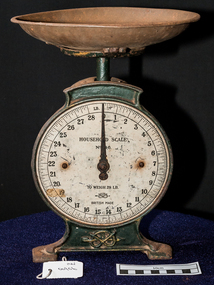 City of Moorabbin Historical Society (Operating the Box Cottage Museum)
Scales, Imperial, Spring, 'Salter Household Scale’ 28lb, c1920
... post offices to outfit their clerks with spring postal scales. One of the most common types of spring scales was the kitchen scale—also known as a family or dial scale. Designed for horizontal surfaces, these scales used the weight of goods in a pan at the top of the scale to force the spring down. Such scales were common in early...post offices to outfit their clerks with spring postal scales. One of the most common types of spring scales was the kitchen scale—also known as a family or dial scale. Designed for horizontal surfaces, these scales used the weight of goods in a pan at the top of the scale to force the spring down. Such scales were common in early ...In the 18th century, spring scales appeared. To produce these scales, a manufacturer would use the resistance of a spring to calculate weights, which could be read automatically on the scale’s face. The ease of use of spring scales over balance scales is what led most post offices to outfit their clerks with spring postal scales. One of the most common types of spring scales was the kitchen scale—also known as a family or dial scale. Designed for horizontal surfaces, these scales used the weight of goods in a pan at the top of the scale to force the spring down. Such scales were common in early-20th-century households and were sold by Sears and Montgomery Ward. Many had flat weighing surfaces but some were topped by shallow pans. Companies such as Salters, Chatillon, and Fairbanks made both. SALTER HOUSEWARES began in the late 1760 in the village of Bilston, England. At this time Richard Salter, a spring maker, began making 'pocket steelyards', a scale similar to the fisherman's scale of today. By 1825 his nephew George had taken over the company, which became known as George Salter & Co. and later established a large, well equipped manufacturing site in the town of West Bromwich. The business thrived throughout the 1900s, and in 1972 the company was purchased by Staveley Industries Plc. In 2002, the management team at Salter Housewares Ltd, backed by Barclays Private Equity, bought the company out from the group, to concentrate on its consumer businesses. In 2004 was sold to the US-based HoMedics company, and in 2006, Salter Housewares USA and Taylor Precision Products Inc (also owned by HoMedics) merged.Salter Brand No. 46 Household Spring Balance Kitchen Scales made of green painted metal with a white large clock face dial marked in 1oz graduations and with a shallow metal bowl placed on the flat top connected to the mechanism. An adjustable screw tightened or loosened the spring to bring the pointer to zero, prior to adding the material to be weighed.. A common piece of kitchen equipment as most families used this type of scale when measuring goods for cooking or storing. HOUSEHOLD SCALE / NO. 46 / SALTER / TO WEIGH 28 LB / ( rope & arrow TM) BRITISH MADE Base rope & anchor S (trade mark) weights, measures, shops, scales. balances, grocery stores, early settlers, moorabbin, bentleigh, cheltenham, salter housewares pty ltd, west bromwich, england, salter george, salter richard, bilston england -
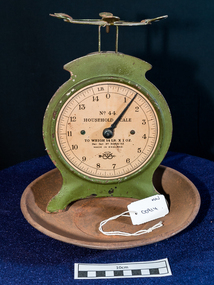 City of Moorabbin Historical Society (Operating the Box Cottage Museum)
Scales,Spring Balnce Imperial ‘Household’ Salter, 20thC
... post offices to outfit their clerks with spring postal scales. One of the most common types of spring scales was the kitchen scale—also known as a family or dial scale. Designed for horizontal surfaces, these scales used the weight of goods in a pan at the top of the scale to force the spring down. Such scales were common in early...post offices to outfit their clerks with spring postal scales. One of the most common types of spring scales was the kitchen scale—also known as a family or dial scale. Designed for horizontal surfaces, these scales used the weight of goods in a pan at the top of the scale to force the spring down. Such scales were common in early ...In the 18th century, spring scales appeared. To produce these scales, a manufacturer would use the resistance of a spring to calculate weights, which could be read automatically on the scale’s face. The ease of use of spring scales over balance scales is what led most post offices to outfit their clerks with spring postal scales. One of the most common types of spring scales was the kitchen scale—also known as a family or dial scale. Designed for horizontal surfaces, these scales used the weight of goods in a pan at the top of the scale to force the spring down. Such scales were common in early-20th-century households and were sold by Sears and Montgomery Ward. Many had flat weighing surfaces but some were topped by shallow pans. Companies such as Salters, Chatillon, and Fairbanks made both. SALTER HOUSEWARES began in the late 1760 in the village of Bilston, England. At this time Richard Salter, a spring maker, began making 'pocket steelyards', a scale similar to the fisherman's scale of today. By 1825 his nephew George had taken over the company, which became known as George Salter & Co. and later established a large, well equipped manufacturing site in the town of West Bromwich. The business thrived throughout the 1900s, and in 1972 the company was purchased by Staveley Industries Plc. In 2002, the management team at Salter Housewares Ltd, backed by Barclays Private Equity, bought the company out from the group, to concentrate on its consumer businesses. In 2004 was sold to the US-based HoMedics company, and in 2006, Salter Housewares USA and Taylor Precision Products Inc (also owned by HoMedics) merged. Salter Brand No. 44 Household Spring Balance Kitchen Scales made of green painted metal with a large clock face dial marked in 1oz graduations and with a shallow metal bowl placed on the flat top connected to the mechanism. An adjustable screw tightened or loosened the spring to bring the pointer to zero, prior to adding the material to be weighed.. A common piece of kitchen equipment as most families used this type of scale when measuring goods for cooking or storing.On Clock face ; NO. 44 / HOUSEHOLD SCALE / TO WEIGH 14LB X 1OZ / Pro. Pat. No. 30819 / 32 / MADE IN ENGLAND / SALTER / S in trademark rope with arrow market gardeners, early settlers, fruit, vegetables, farmers, cooking, recipes, scales, weights, measures, brass, balance beam, moorabbin, cheltenham, bentleigh, kitchen scales, dairy products, cereals, wheat flour, salter housewares pty ltd, west bromwich england -
 City of Moorabbin Historical Society (Operating the Box Cottage Museum)
Functional object - Australia Post Bag x 2, Australia Post, mid 20th Century
... post offices...mail...bentleigh...moorabbin...mckinnon...ormond...cheltenham...highett...early...Small bag has Australia Post Stamped on it and the large bag has no markings but has white rope threaded through the brass eyelets Australia Post Canvas Bags donated by Judy Clark the daughter of George Reed who lived and worked in the City of Moorabbin in 20th century australia post post offices mail bentleigh moorabbin mckinnon ormond cheltenham highett early settlers reed george a) AUSTRALIA POST OFFICE 869 No 5 b) no marking ; white rope 2 Blue canvas bags with brass eyelets Functional object Australia Post Bag x 2 Australia Post ...2 blue canvas Australia Post bags with brass eyelets used mid 20th Century to deliver mail to householders in the City of Moorabbin . Small bag has Australia Post Stamped on it and the large bag has no markings but has white rope threaded through the brass eyeletsAustralia Post Canvas Bags donated by Judy Clark the daughter of George Reed who lived and worked in the City of Moorabbin in 20th century 2 Blue canvas bags with brass eyeletsa) AUSTRALIA POST OFFICE 869 No 5 b) no marking ; white rope australia post, post offices, mail, bentleigh, moorabbin, mckinnon, ormond, cheltenham, highett, early settlers, reed george -
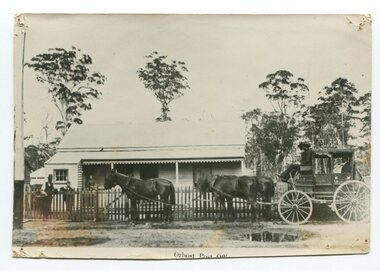 Orbost & District Historical Society
black and white photograph, 1896 / 1896
... Post Mistress was Miss Farrell, who was a trained telegraphist. This was the first time the telegraph line had reached Orbost, and was about the year 1895 or 1896. (more info. from Newsletter Npovember 2008) This is a pictorial record of the an early Orbost Post Office. Post Offices ...This is a photograph of the Orbost Post Office on the site of the Commonwealth Hotel. The horse -drawn vehicle is a Cunninghame (Lakes Entrance) Coacht. The Post Mistress was Miss Farrell, who was a trained telegraphist. This was the first time the telegraph line had reached Orbost, and was about the year 1895 or 1896. (more info. from Newsletter Npovember 2008) This is a pictorial record of the an early Orbost Post Office. Post Offices are a vital necessity in any town or community playing a very important part in the progress and development of the town and district. A black / white photograph of a one - storey wooden building with a passenger coach drawn by a team of four horses outside the wooden picket fence. There are a man holding a flat basket, a young boy and a woman (on the verandah) standing nearby.on front - "Orbost Post office"farrell-post-office-orbost -
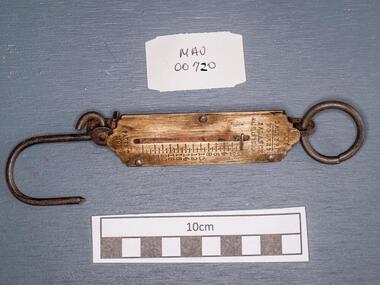 City of Moorabbin Historical Society (Operating the Box Cottage Museum)
Tool - Brass balance 'Salters', c1900
... post offices to outfit their clerks with spring postal scales. One of the most common types of spring scales was the kitchen scale—also known as a family or dial scale. Designed for horizontal surfaces, these scales used the weight of goods in a pan at the top of the scale to force the spring down. Such scales were common in early...post offices to outfit their clerks with spring postal scales. One of the most common types of spring scales was the kitchen scale—also known as a family or dial scale. Designed for horizontal surfaces, these scales used the weight of goods in a pan at the top of the scale to force the spring down. Such scales were common in early ...In the 18th century, spring scales appeared. To produce these scales, a manufacturer would use the resistance of a spring to calculate weights, which could be read automatically on the scale’s face. The ease of use of spring scales over balance scales is what led most post offices to outfit their clerks with spring postal scales. One of the most common types of spring scales was the kitchen scale—also known as a family or dial scale. Designed for horizontal surfaces, these scales used the weight of goods in a pan at the top of the scale to force the spring down. Such scales were common in early-20th-century households and were sold by Sears and Montgomery Ward. Many had flat weighing surfaces but some were topped by shallow pans. Companies such as Salters, Chatillon, and Fairbanks made both. SALTER HOUSEWARES began in the late 1760 in the village of Bilston, England. At this time Richard Salter, a spring maker, began making 'pocket steelyards', a scale similar to the fisherman's scale of today. By 1825 his nephew George had taken over the company, which became known as George Salter & Co. and later established a large, well equipped manufacturing site in the town of West Bromwich. The business thrived throughout the 1900s, and in 1972 the company was purchased by Staveley Industries Plc. In 2002, the management team at Salter Housewares Ltd, backed by Barclays Private Equity, bought the company out from the group, to concentrate on its consumer businesses. In 2004 was sold to the US-based HoMedics company, and in 2006, Salter Housewares USA and Taylor Precision Products Inc (also owned by HoMedics) merged. A portable, brass balance scale , 'Salters' for weighing items. A steel ring holds a brass plate marked with graduations 0 – 26 to which is attached a steel hook. ( rope & arrow TM ) / SALTER / POCKET / BALANCE / MADE IN ENGLAND Graduated 0 – 26 / PATENT / No. 8 Base rope & anchor S (trade mark) pioneers, early settlers, market gardeners, moorabbin, brighton, cheltenham, tools, craftsman, balance, scales, weights, imperial measure,, salter housewares pty ltd, west bromwich, england, salter george, salter richard, bilston england, -
 Flagstaff Hill Maritime Museum and Village
Equipment - First Aid Case, Thomas Urquhart & Son Pty Ltd (Thos. Urquhart), 1930-1939
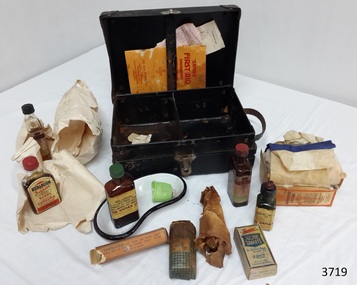
... Post Master General’s section of the Commonwealth of Australia Gazette, Issue No. 73, Thursday 27th September 1951 http://trove.nla.gov.au/newspaper/article/232185299?searchTerm=%22sanax%22%20and%20%22fitzroy%22&searchLimits= Sanax First Aid Emergency Instructions, by S.A. Burrows, publisher Sanax Ltd. Fitzroy, Victoria, 1930-1939 English, book, Illustrated edition, Trove http://trove.nla.gov.au/version/40948895 Access to emergency medical help in early settlement days of Victoria could take quite some time, especially in remote areas. From 1888 First Aid Kits and instructions became available for work sites, offices ...This small, portable 1930s Sanax First Aid Case has been strongly constructed, with corners reinforced with metal to take knocks and bumps, so it could be quickly transported to the site of an emergency. Having these supplies organised into a kit made them easily accessible and reduces time to take them to the site of the accident. It was possibly designed for use in factories because the booklet in the case states that the kit complies with “Part 1, Victorian Factories Regulations”. The text of the printed brand “Sanax First Aid Case” is right-way up when the case stands vertically on its hinged side. In modern times people are well aware of the importance of quick treatment when accident and injury occur. However, before the first commercial First Aid Kit was made by Johnson & Johnson in 1888, people had little knowledge about treating injuries and lacked information about suitable supplies to keep on hand for emergencies. They were often unaware of how to help in that critical time before the doctor or other assistance arrived, a particularly important time for the many people living in remote areas. A quote from Johnson’s & Johnson’s 1888 price list explains “It is a fact, which is everywhere being recognized, that many lives are lost and much suffering entailed in such accidents on account of the lack of the simple but necessary articles required to afford prompt assistance to the wounded.” One example of the value of First Aid assistance to community groups is shown in an article from the Weekly Times, 29th November 1930. It records a report from the Annuello Branch of the Younger Set (a Country Women’s Organisation), telling that on Armistice Day their president Mrs Jamieson, presented the Annuello School with the gift of a Sanax Red Cross First Aid outfit, which was accepted as being “of great practical use to the scholars.” (Annuello is a remote wheat growing area in the Mallee region of North Western Victoria, which became a soldier settlement area after World War I. There is a strain of wheat named ‘Annuello’ due to its suitability for that area. ) The Sanax Case in our Collection contains instructions, equipment and medical items suitable for use in emergency situations. The Case was one of 42 patterns available from Sanax that conformed to ‘Part 1, Victorian Factories Regulations’. It includes items made by Sanax Company and by Burroughs Wellcome & Co. (Australia) Ltd., Sydney, NSW. A quote at the back of the First Aid Emergency Instructions booklet says: “Sanax products are made in Australia by or under the supervision of qualified chemists, from the highest quality materials. They are dependable for the purposes written on labels.” BOOKLET included in First Aid Case: “SANAX” First-Aid Emergency Instructions has orange cover and white pages, joined in the centre by two staples. Booklet contains First Aid Instructions for general events listed in alphabetical order. It also contains an indexed sections headed “Poisoning, and what to do” written by S.A. Burrows, Ph.C., Vuc and N.Z. There are instructions and diagrams on how to perform Artificial Respiration. There are advertisement for Sanax products throughout the booklet that include; - Sanax Ambulance Stretcher for timber mills, mines, ships and quarries - Saw dust masks (porous rubber) for workers in dust, paint or duco sprayers Inside cover lists Sanax’s Australian made products including - tablets and powders for headaches, neuralgia, influenza, colds - snuff for Catarrh that is “quite harmless” - First Aid Cases that come in a range of 42 patterns - sunburn preventatives and treatments - healing salve for carbuncles, pock, pimples, boils, varicose ulcers etc. - snake bite outfits and kits LEAFLETS included in First Aid Case: (1) Tannafax Tannic Acid Jelly. Tannafax should be kept at hand in every home. It should be applied direct from the tube and used with neither oil nor grease. Where a large area has to be covered the clamped end may be torn or cut off to give a wider mouth to the tube. Collapsible tubes of different sizes. Made in Australia. Burroughs Wellcome & Co. (Australia) Ltd. (Incorporated in England). Sydney, NSW. Assorted Houses, London, New York, Montreal, Cape Town, Milan, Bombay, Shanghai, Buenos Aires. Copyright A. 1817, J. 9463 (2) Tabloid. The strong thing is the just - - . Tabloid marks the wor - - Burroughs Wellcome & Comp. The use of the word is to enab – the prescriber, dispenser and patient to get the right thing with one short word, instead of the firm’s long name. If another maker apply the word to his product, the act is unlawful. Tabloid is our trade mark and brand. If a vendor disregard it in dispensing or selling, the act is unlawful for the same reason. We prosecute both offenders rigorously, in the interest of prescribers, dispensers, patients and the owners of the trade mark. Please inform us of any instance of either offence. Burroughs Wellcome & Co. (Australia) Ltd. (Incorporated in England). Telephone Number - M 4184 (4 lines) All communications to G.P.O. Box No. 1185 DD. Copyright Sy. 20. & J 9894. Medicines and Equipment included in First Aid Case: - Absorbent Cotton, Sanax, for absorbing blood or drying a wound. As a swab for washing wounds; to place above a compress to keep the heat in: or as a pad to protect wounds or fractures. The Sanax Co. Manuf. Chemists, Melbourne. Regd. Office: 5 Brunswick St, Fitzroy. N.6. - ACHE tablets, Sanax, for all aches, pains, fevers etc. Dose: 2 to 3 tablets with a draught of water, every 3 hours. Children in proportion. For influenza or colds, take the bedtime dose with a hot lemon drink or toddy. Recommended for Headaches, Colds, Influenza, Fevers, Neuralgia, Rheumatism, Nerve Pains, Sleeplessness, and Seasickness. Three Sanax Ache tablets equals one Sanax Ache powder. Each tablet contains 1.75grs. each Phenacotinum and Acety acSzilcyl, and .75grs Ammon Brom. Etc.. Sanax brand specialties are prepared by highly qualified pharmaceutical chemists and may be accepted as safe and effective for the purpose indicated on the label. The Sanax Co. Melbourne - Eye lotion, Sanax, “in eye bath full strength or diluted with equal parts of water. Sanax Co. Brunswich St, Fitzroy, Melbourne. - Iodine, Sanax, POISON, with instructions for what to do if swallowed. - Kuraburn, Sanax, Applied to the burn and allowed to dry, the pain and heat instantly disappear, and blistering is prevented. If necessary, apply again in an hours. To safeguard against burning when sunbathing, apply before exposure to the sun. If already sunburnet, use Kuraburn as directions above. Safe and harmless. Sole makers, The Sanax Co. Brunswick St. - - Vic. - Sal Volatile, Sanax, - - stimulant for - - nervous aches - - or as smelling salts Dose - - - - Solution of A- - - 5%, . The Sanax Co. Brunswick St, Melbourne. - Tannafax, Burroughs Wellcome & Co. Australia Ltd. Sydney, N.S.W., 20gm. Approx., Tannic Acid Jelly, (Tannic Acid with 0.5% Phenol in a water-soluble base) for burns and scalds. A.N. 15050, p188, logo of a unicorn. Apply lightly, allow to dry, and bandage loosely. Do not apply oil or grease. - bottle wrapped in brown paper, unknown contents, paper adhered to bottle. - dish, kidney shaped, metal, white enamel with black rim - eye bath, green, plastic or Bakelite SANAX COMPANY The Sanax Company was at the address of 5 Brunswick Street, Fitzroy [Melbourne] at least as early as November 1924, as shown by its advertisement of Ache Powder in the Weekly Times, 8th November 1924. It was still at this address in September 1951, when it advertised First Aid outfits and components in the Post Master General’s section of the Commonwealth of Australia Gazette. REFERENCES: Annuello, Victoria; Wikipedia, https://en.wikipedia.org/wiki/Annuello,_Victoria Annuello Younger Set, Branch Activities and Local Reports, Country Women’s Organisations, Weekly Times, 29 November 1930, Trove http://trove.nla.gov.au/newspaper/article/224921009?searchTerm=%22sanax%22%20and%20%22melbourne%22&searchLimits=# Commonwealth of Australia Gazette, Issue 32, 24th April 1915, https://www.legislation.gov.au/file/1915GN32 [Johnson & Johnson Price List, September 1, 1888, p. 20. From our archives], Celebrating the 125th Birthday of the First Aid Kit , The Story of Johnson & Johnson, , http://www.kilmerhouse.com/2013/06/from-1888-to-2013-celebrating-the-125th-birthday-of-the-first-aid-kit/ Post Master General’s section of the Commonwealth of Australia Gazette, Issue No. 73, Thursday 27th September 1951 http://trove.nla.gov.au/newspaper/article/232185299?searchTerm=%22sanax%22%20and%20%22fitzroy%22&searchLimits= Sanax First Aid Emergency Instructions, by S.A. Burrows, publisher Sanax Ltd. Fitzroy, Victoria, 1930-1939 English, book, Illustrated edition, Trove http://trove.nla.gov.au/version/40948895 Access to emergency medical help in early settlement days of Victoria could take quite some time, especially in remote areas. From 1888 First Aid Kits and instructions became available for work sites, offices, community groups and individuals, helping to bridge the gap between the accident and the arrival of medical assistance. This portable Sanax First Aid Case is an example of portable medical equipment made in Melbourne, Australia, in the 1930’s and available to the public. It contains a range of items plus information to be used in a variety of injuries and emergencies in in factories, households, businesses and local communities, and instructions on their use. First Aid Case, portable, Sanax First Aid Case. First Aid kit in strong black cardboard carry case with metal reinforced corners, metal hinges on lid, metal catch and leather carry handle. Inside lid is a vertical strap with narrow gap behind it. Base is divided into two compartments. Manufactured by Sanax, Fitzroy, Melbourne, C. 1930-1939 Contents include "Sanax" First Aid instructions booklet, 2 leaflets, metal kidney dish enamelled in white with black trim on edge, green plastic or Bakelite eye bath, eye lotion, Tannafax tannic acid jelly, Sal Volitile, Kuraburn, Iodine, Argyrol, ACHE tablets, absorbent cotton in cardboard box, gauze bandage, and UNKNOWN wrapped bottle. Printed in gold on lid of case “SANAX” FIRST AID CASE. Most of the contents, as well as the case, show the “SANAX” brand. Some contents are inscribed Burroughs Wellcome & Co. (Australia) Ltd., flagstaff hill, warrnambool, shipwrecked coast, flagstaff hill maritime museum, maritime museum, shipwreck coast, flagstaff hill maritime village, great ocean road, first aid items, first aid kit, emergency first aid, medical emergency kit, home emergency kit, industrial emergency kit, sanax company fitzroy melbourne, burroughs wellcome & co. (australia) ltd, thos. urquhart & son pty. ltd. melbourne, sanax first aid case, sanax first-aid emergency instructions, part 1 victorian factories regulations, tabloid medical supplies -
 Eltham District Historical Society Inc
Folder, Eltham Shire Office Fire, 1934
... Advertiser article 9/2/1934, Eltham Shire Office gutted by fire, 2p Advertiser article 16/2/1934, Eltham Shire Office post fire and early history as Evelyn Observer office, 2p Advertiser article 23/2/1934, Praise for Eltham Fire Brigade by Shire Secretary P.J.McMahon, 1p Extracts from "The Grass is Green" by Alan Marshall referencing Tiny Carroll, pp28-67 Recollections of Jocelyn McMahon (nee Shallard) on Office staff and conditions, 1928 to 1935,1p. Folder no 62 Photocopies of various newspaper articles from "The Advertiser", 1934 included in attached list. Typed transcription from "Diamond Valley News", 10 October, 1961 Includes copy of hand drawn map: "Kangaroo Ground, Parish of Nillumbik, Country of Evelyn, land holdings 1860s-1900s" with site of Eltham Shire Offices...Advertiser article 9/2/1934, Eltham Shire Office gutted by fire, 2p Advertiser article 16/2/1934, Eltham Shire Office post fire and early history as Evelyn Observer office, 2p Advertiser article 23/2/1934, Praise for Eltham Fire Brigade by Shire Secretary P.J.McMahon, 1p Extracts from "The Grass is Green" by Alan Marshall referencing Tiny Carroll, pp28-67 Recollections of Jocelyn McMahon (nee Shallard) on Office staff and conditions, 1928 to 1935,1p. Folder no 62 Photocopies of various newspaper articles from "The Advertiser", 1934 included in attached list. Typed transcription from "Diamond Valley News", 10 October, 1961 Includes copy of hand drawn map: "Kangaroo Ground, Parish of Nillumbik, Country of Evelyn, land holdings 1860s-1900s" with site of Eltham Shire Offices ...Anecdotes about caretaker, Mr W. Carroll (Tiny), an old identity by H. Gillam, 1p History of records in office Fire, 1934 by Frank McMahon, 4p. Advertiser article 9/2/1934, Eltham Shire Office gutted by fire, 2p Advertiser article 16/2/1934, Eltham Shire Office post fire and early history as Evelyn Observer office, 2p Advertiser article 23/2/1934, Praise for Eltham Fire Brigade by Shire Secretary P.J.McMahon, 1p Extracts from "The Grass is Green" by Alan Marshall referencing Tiny Carroll, pp28-67 Recollections of Jocelyn McMahon (nee Shallard) on Office staff and conditions, 1928 to 1935,1p. Folder no 62 Photocopies of various newspaper articles from "The Advertiser", 1934 included in attached list. Typed transcription from "Diamond Valley News", 10 October, 1961 Includes copy of hand drawn map: "Kangaroo Ground, Parish of Nillumbik, Country of Evelyn, land holdings 1860s-1900s" with site of Eltham Shire Offices marked.Folder of photocopies, a transciption and typed up memoriesHG Booklets 8 and 62fire, reminiscences, tiny carroll, jocelyn mcmahon (nee shallard), harry gilham collection, eltham shire office, frank mcmahon, kangaroo ground, map, bill o'laughlin, cr jim ryan, evelyn observer, p.j. mcmahon, pelling, woodlands homestead -
 Kiewa Valley Historical Society
Telephone Handset Field, early 1900s
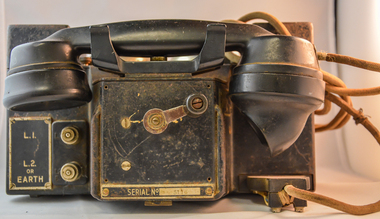
... This handset was used to connect offices and workshops, which due to their functions could not be co-located with their prime office(external workshops).The evolution from the early 1900s to the mid 1980s when mobile communication technology progressed in leaps and bounds from hard wire telephone communication to mobile digital receivers. This handset was manufactured by a subcontracted Australian company under the Australian Post...This handset was used to connect offices and workshops, which due to their functions could not be co-located with their prime office(external workshops).The evolution from the early 1900s to the mid 1980s when mobile communication technology progressed in leaps and bounds from hard wire telephone communication to mobile digital receivers. This handset was manufactured by a subcontracted Australian company under the Australian Post ...This field telephone was developed primary for military purposes (World War I) and other wars/military interventions there after. It was the first "mobile" telephone which had a prime objective of providing isolated or "hard" to connect with locations instant communication links. Like a lot of "new" technologies it evolved from a war environment. This handset was used to connect offices and workshops, which due to their functions could not be co-located with their prime office(external workshops).The evolution from the early 1900s to the mid 1980s when mobile communication technology progressed in leaps and bounds from hard wire telephone communication to mobile digital receivers. This handset was manufactured by a subcontracted Australian company under the Australian Post Office mandate.This handset is significant in that it was donated by the Mount Beauty Timber yards and formed an integrated part of its communication system with its out lying work yards and buildings, before the mobile handset evolution. This handset was located in an environment which required a rugged and reliable day to day communications linkage as a vital part of its logistical (business) survival. As progress demands it, the faster that customers are satisfied with the service they obtain from suppliers the longer those services will be asked for and the longer and more profitable the supplier will be. This edict is as true for rural companies as it is for small or large city businesses. The customer is "always" right.This sturdy field telephone has a shell housing made in black bakelite material with a "U" form housing the major components (wiring, magneto and batteries). The main housing has two metal bells, with a central ringer between both, on the top part (to notify incoming calls). In front of the main structure is a box with the telephone hand piece (ear and mouth receptacles) nestled on two cradles. An on/off switch is activated when handset is removed from its cradle. On the front of the control box is a winder handle(to ring off) and in a field situation to activate/deactivate the magneto. To the left of the winder but on the the main body are two wind up connection buttons for the connection of operational wires (power)On the main right hand front body and next to two chrome switches is a plate with "L (next to the top switch) and below this "L2" and underneath this are "or" "EARTH". There is a plate fastened to the front of the handset and behind the winder with "REPLACE HANDSET WHEN FINISHED" and below the winder 'SERIAL NUMBER 5116"field telephone, world war ii field telephone f mk i -
 Eltham District Historical Society Inc
Photograph, Inside the garden of the War memorial with paths and entrance gates along Main Road, Eltham, February 1968, Feb 1968
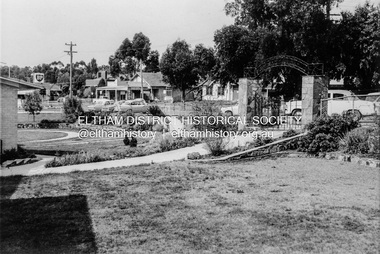
... Offices. View is from the entrance of the Baby Health Centre. The roadway outside the gates was not made and was used for parking. The shops and an early fire station (near to left gate post) show the area before the Woolworths rebuilding of the area to Eltham....Offices. View is from the entrance of the Baby Health Centre. The roadway outside the gates was not made and was used for parking. The shops and an early fire station (near to left gate post) show the area before the Woolworths rebuilding of the area to Eltham. ...Shows the east side shops between Arthur Street and Dudley Street and former Eltham Shire Offices. View is from the entrance of the Baby Health Centre. The roadway outside the gates was not made and was used for parking. The shops and an early fire station (near to left gate post) show the area before the Woolworths rebuilding of the area to Eltham.In February 1968 an unknown person took a series of photos from the Eltham Hotel at Pitt Street heading north along Main Road through the shopping centre to just north of Elsa Court covering the length of the section of Main Road which was duplicated shortly thereafter. Shows the condition and environment of the streesscape of Main Road, Eltham immediately prior to the duplication between Pitt Street and Elsa Court through the shopping centre. Also shows a number of shops and businesses that operated at that time.Black and white photographduplication, eltham, main road, dudley street, shire of eltham war memorial, arthur street, shopping centre, eltham shire office -
 Bendigo Historical Society Inc.
Photograph - Pall Mall shops
... early buildings in Bendigo late 1800s A4 copy of original photograph. Pall Mall shops viewed from Government Camp, prior to 1870 (when Post Office and Court House were erected). View shows the Shamrock Hotel and the Royal Exchange Hotel with linked verandahs, the bell tower of St Paul's Anglican Church; and band stand (on the site of Post Office) beyond the creek. In the foreground part of the Government Offices ...BHS CollectionA4 copy of original photograph. Pall Mall shops viewed from Government Camp, prior to 1870 (when Post Office and Court House were erected). View shows the Shamrock Hotel and the Royal Exchange Hotel with linked verandahs, the bell tower of St Paul's Anglican Church; and band stand (on the site of Post Office) beyond the creek. In the foreground part of the Government Offices with eight men shown on fence line.bendigo buildings, early buildings in bendigo late 1800s -
 Kiewa Valley Historical Society
Photographs – Set of 10 black and white photographs and photocopies of original photographs documenting early residents of Bogong Village
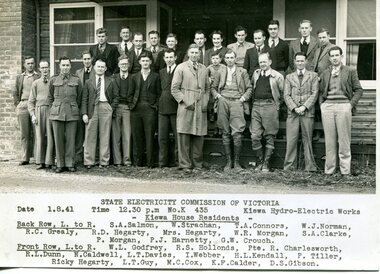
... The early forties saw rapid growth of the village, with single and married men’s quarters, workshops, mess huts and administrative offices. The facilities necessary for communal living were quickly in place- a post office, police station, co-op store, medical centre, community hall/theatre, tennis courts and school. ...The early forties saw rapid growth of the village, with single and married men’s quarters, workshops, mess huts and administrative offices. The facilities necessary for communal living were quickly in place- a post office, police station, co-op store, medical centre, community hall/theatre, tennis courts and school. ...Bogong Village, which was known as “The Junction”, is well recorded. The first tent camp was at the junction of Pretty Valley and Rocky Valley streams in the early 40’s. Further downstream were the sawmill, stables and blacksmith’s forge. Horses were the main mode of transport in the early days. The road to Bogong had reached the lookout spur just beyond Roper’s Spur track just before the 1939 fires. The early forties saw rapid growth of the village, with single and married men’s quarters, workshops, mess huts and administrative offices. The facilities necessary for communal living were quickly in place- a post office, police station, co-op store, medical centre, community hall/theatre, tennis courts and school. Much of the temporary accommodation that housed groups such as the Albion Quarrying Company were in the area now under water.This group of photographs are a pictorial record of the early history of the Kiewa Hydro Scheme, the people who worked in the background supplying administrative support and the workers and their families. It also shows a glimpse into how a large group of people from very diverse backgrounds came together to enjoy social activities and share each others companyGroup of 10 black and white photographs and photocopies of original photographs of varying sizes (some official SECV photos) Some Photos are labelled with the date and the names of SECV staff members. Depicting early life at Bogong Village 1. Group photo – Kiewa House Residents 1.8.41 (SECV official photo) 2. Female staff residents 3. Female office staff 4. Kitchen staff – Junction Mess (SECV official photo) 5. Male administration staff Bogong 6. Bogong Social Club fancy dress ball, 1940 7. Wives and children of SECV workers 8. Children in fancy dress 9. Opening of Volunteer Air Observers post 1943 10. Flag raising at opening of Volunteer Air Observers post 1. Printed under photo: STATE ELECTRICITY COMMISSION OF VICTORIA Date: 1.8.41 Time: 12.30pm No:K 435 Kiewa Hydro-Electric Works. Kiewa House Residents Back Row L to R: S.A. Salmon, W. Strachn, T.A Connors, W.J Norman, R.C Grealey, R.D Hegarty, Mrs Hegarty, W.R Morgan, S.A Clarke, P. Morgan, P.J. Harnetty, G.W Crouch. Front Row L to R: W.L Godfrey, R.S Hollands, Pte. R Charlesworth, R.L Dunn, N Caldwell, L.T Davies, I Webber, H.L Kendall, P Tiller, Ricky Hegarty, L.T Guy, M.C Cox, K.F Calder, D.S Gibson 2. Printed on bottom: Staff who lived at Kiewa House and worked in the Administration Office c 1943 Handwritten at bottom Priscilla Johnson (nee Reid) At top of page A GOOD LIFE: WOMEN’S RECOLLECTIONS OF LIFE IN THE UPPER KIEWA VALLEY 3. Printed under photo- Office Staff – Bogong 4. Printed under photo: STATE ELECTRICITY COMMISSION OF VICTORIA Date: 18.5.40 Time: 11.05am No:K 103. Kiewa Hydro-Electric Works. Kitchen Staff- Junction Mess. Opening night of the new staff mess Bogong. 5. Printed under photo -Administration staff Bogong 6. Printed under photo- The social club raised money for patriotic fund from fancy dress nights. (1st Fancy Dress Ball, Bogong 1940) 7. Printed above photo: ---- and family life begins (1942 Bogong) 8. Printed under photo: A favourite photograph 9. Printed under photo: STATE ELECTRICITY COMMISSION OF VICTORIA Date: 24.5.43 Time: 2.8pm No:K 1151 Kiewa Hydro-Electric Works. Bogong- Squadron Leader Leggett speaking at opening of Air Observer’s Post 10. Printed under photo: Raising the flag at the opening of the Volunteer Air Observer’s Post at Bogong - 1943 bogong village; kiewa hydro electric scheme; social activities; community clubs -
 Kiewa Valley Historical Society
Photographs – Set of 9 black and white photographs and photocopies of original photographs depicting the early days of Bogong Village during the 1940’s, circa 1940's
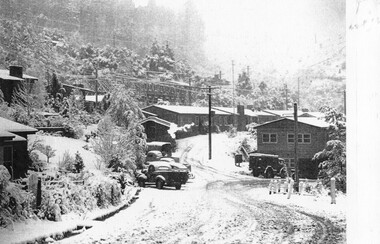
... The early forties saw rapid growth of the village, with single and married men’s quarters, workshops, mess huts and administrative offices. The facilities necessary for communal living were quickly in place- a post office, police station, co-op store, medical centre, community hall/theatre, tennis courts and school. ...The early forties saw rapid growth of the village, with single and married men’s quarters, workshops, mess huts and administrative offices. The facilities necessary for communal living were quickly in place- a post office, police station, co-op store, medical centre, community hall/theatre, tennis courts and school. ...Bogong Village, which was known as “The Junction”, is well recorded. The first tent camp was at the junction of Pretty Valley and Rocky Valley streams in the early 40’s. Further downstream were the sawmill, stables and blacksmith’s forge. Horses were the main mode of transport in the early days. The road to Bogong had reached the lookout spur just beyond Roper’s Spur track just before the 1939 fires. The early forties saw rapid growth of the village, with single and married men’s quarters, workshops, mess huts and administrative offices. The facilities necessary for communal living were quickly in place- a post office, police station, co-op store, medical centre, community hall/theatre, tennis courts and school. Much of the temporary accommodation that housed groups such as the Albion Quarrying Company were in the area now under water.Pictorial history of the early years of Bogong Village including one photo taken following the devastating fires of 1939. Photos show the terrain in which Bogong Village was built, the early construction used for the temporary buildings and the housing and the amount of infrastructure required to accommodate the needs of the residents of the area including workers, their families and other support staff. Set of 9 black and white photographs and photocopies of photographs depicting early buildings at Bogong Village . Photos show very early construction buildings as well as the village in various weather conditions, including snowing and after bush fires. (some official SECV photographs) 1. Bogong Village in heavy snow 2. Bogong Township during heavy snow (SECV Official Photo) 3. VIP Lodge at Bogong in the snow 4. Bogong Village - circa 1940’s 5. Bogong Village under street lights 6. Lewis Construction Camp (SECV Official Photo) 7. Albion Quarrying Co. Camp (SECV Official Photo) 8. Tent camp and early buildings following 1939 fires 9. Typical house – Bogong Village 1. Handwritten under photo – August 1948 2. Printed under photo: STATE ELECTRICITY COMMISSION OF VICTORIA Date: 25.8.48 Time: 9am No:K 4680 Kiewa Hydro-Electric Works. Bogong Township 3. Handwritten on back of photo- V.I.P. Lodge, Bogong 4 – 5. No markings 6. Printed under photo: STATE ELECTRICITY COMMISSION OF VICTORIA Date: 28.11.40 Time: 1.40pm No:K284 Kiewa Hydro-Electric Works. Lewis Construction Camp 7. Printed under photo: STATE ELECTRICITY COMMISSION OF VICTORIA Date: 11.1.41 Time: 10.40am No:K294 Kiewa Hydro-Electric Works. Albion Quarrying Co. Camp – Bogong. Handwritten on back of photo: On the floor of the present dam 8. No markings 9. Printed under photo: STATE ELECTRICITY COMMISSION OF VICTORIA Date: 11.1.46 Time: 1.23pm No:K2181 Kiewa Hydro-Electric Works. Bogong – Typical House bogong village; 1939 fires; kiewa hydro electric scheme; -
 Kiewa Valley Historical Society
Photograph – black and white photograph of children playing in the school yard at Bogong Village Primary School, Circa late 1960s to early 1970’s
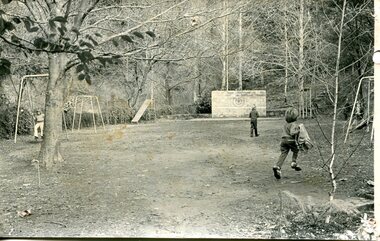
... The early forties saw rapid growth of Bogong Village, with single and married men’s quarters, workshops, mess huts and administrative offices. The facilities necessary for communal living were quickly in place- a post office, police station, co-op store, medical centre, community hall/theatre, tennis courts and school. ...The early forties saw rapid growth of Bogong Village, with single and married men’s quarters, workshops, mess huts and administrative offices. The facilities necessary for communal living were quickly in place- a post office, police station, co-op store, medical centre, community hall/theatre, tennis courts and school. ...The early forties saw rapid growth of Bogong Village, with single and married men’s quarters, workshops, mess huts and administrative offices. The facilities necessary for communal living were quickly in place- a post office, police station, co-op store, medical centre, community hall/theatre, tennis courts and school. Bogong Primary School opened in 1941 to provide an education for the families of employees of the State Electricity Commission of Victoria. The school had up to date equipment and received glowing reports from school inspectors. It closed circa 1970.The Bogong State School was opened for the children of S.E.C.V. workers who lived in Bogong in a remote part of north east Victoria. The nearest school would have been 14 miles away and over mountain roads subject to heavy construction traffic and extremes of climatic conditionsBlack and white photograph of a group of 6 children playing on play equipment in the schoolyard at Bogong Primary School. The area is enclosed by tall trees in a bush-like settingbogong state school; secv; kiewa hydro electric scheme; -
 Warrnambool and District Historical Society Inc.
Scales, W. & T. Avery Ltd. Mill Lane Works, Nullawarre PO & tray + 2 weights, Early 20th century
... These scales are of interest as a memento of the type of weighing scales used in Post Offices in Victoria in the early to mid 20th century. ...These scales come from the Nullawarre Post Office and would have been used there for most of the 20th century. Nullawarre is a small settlement 25 kilometres south east of Warrnambool. It was first settled in the late 1860s and 70s and the main agricultural pursuit for the area today is dairying. The first Nullawarre school was opened in 1878 and the Nullawarre Post Office operates today in the Nullawarre General Store. These scales are of interest as a memento of the type of weighing scales used in Post Offices in Victoria in the early to mid 20th century. They are also of local interest as they come from the Nullawarre Post Office.This is a metal set of scales with a balance mechanism on a metal stand. The balance has a circular tray at one end to hold weights An oval dish to hold items to be weighed is a separate item that sits at the other end of the balance. The scales were once painted green and some traces of the green paint are visible. Two weights are with this item. The scales are much rusted. ‘W & T Avery Ltd Birm.’nullawarre, victoria, history of warrnambool -
 Stawell Historical Society Inc
Photograph, Green Grocers Shop at 150 Main Street Stawell with Restored Verandah & Posts
... posts. Earlier owned by F. Allah who conducted a Green Grocers there. stawell Black & white restored building at 150 Main Street Stawell. Now and accountant's offices ...Business Premises 150 Main Street restored with verandah posts. Earlier owned by F. Allah who conducted a Green Grocers there.Black & white restored building at 150 Main Street Stawell. Now and accountant's offices. Previous owner F. Allan conducted a greengrocer business. The two story building restored with veranda posts.stawell -
 Surrey Hills Historical Society Collection
Book, Marc Fiddian, Six stamps please: a tableau of Australian post offices, 1989
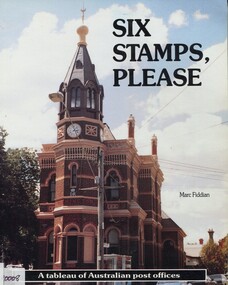
... post office building was from the mid-1860s to the early 1890s. Invariably a post office was built in a prime location, frequently on a street corner. surrey hills post office post offices official buildings architectural styles (mr) marc fiddian This book provides a cross section of the various styles of post offices built in city, suburb and country town, and who the post offices serve around Australia. ...Once a community's size and importance could be gauged from its post office. The post office, especially in the 19th century, reflected the growth and prosperity of its locality. The boom in post office building was from the mid-1860s to the early 1890s. Invariably a post office was built in a prime location, frequently on a street corner.This book provides a cross section of the various styles of post offices built in city, suburb and country town, and who the post offices serve around Australia. Softback book of 83 pages, with numerous black and white photos; post offices are described alphabetically by town.surrey hills post office, post offices, official buildings, architectural styles, (mr) marc fiddian -
 Surrey Hills Historical Society Collection
Photograph, Surrey Hills Post Office
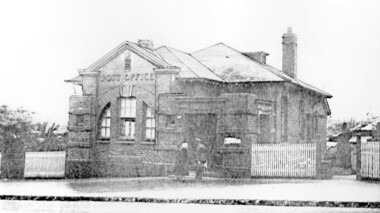
... early image of a demolished building which should have been protected. In 1991, when the City of Camberwell conducted a heritage study, (which still informs the basis of the City of Boroondara’s heritage guidelines for this part of the municipality,) the post office was owned by the Commonwealth Government. As such, it could not be considered for heritage listing by the local authorities. Some years later, the Commonwealth and Australia Post rather belatedly recognized not only that post offices ...The post office opened at this location in 1912. It was demolished in 2000. Post office history in the area: Until 1883 when the railway came through to Surrey Hills, this was essentially a rural community of scattered farms. Land subdivisions soon occurred along the railway line and limited postal services followed soon after, although a ‘permanent’ home for the post office was two decades away. George Sim Junior is acknowledged as our first postmaster; he opened a post office on 1 October 1884 in his father’s general store at 619-621 Canterbury Road, a few doors down from the Surrey Hills Hotel on the corner of Union Road. Over the next 20 years, the Surrey Hills Post Office moved several times into temporary, shared accommodation – in 1889 into Woodhead’s Corner Store at 364 Canterbury Road; then in 1895 to No 376, Hansen’s Exchange Building, part of Hansen’s Terrace (demolished) and in 1901 to 109 Union Road, on the corner of Windsor Crescent. Following Federation in 1901, the new Commonwealth Government established the Postmaster-General's Department to provide postal services to the nation. Many of the post offices constructed in the following years reflected a growing sense of Australian pride and nationalism. It was 1914 when building commenced on the ‘purpose-built’ post office at 609 Canterbury Road, Surrey Hills. Described as “a polychromatic Federation Freestyle building”, it served as the local post office for nearly 85 years until sold by the Commonwealth Government in c1999, after which the post office moved to the current, less prominent site at 100 Union Road. For nearly 10 years under private ownership, the building was successfully adapted for use as the base for two businesses, Gargoyles and Dragons and later the Surrey Sculpture Studio, and fortuitously the historic integrity of the building was maintained. However although renovated in the 1990's, structurally sound and of historic significance, it was not protected under local or commonwealth heritage legislation and was demolished soon after sale. This is an early image of a demolished building which should have been protected. In 1991, when the City of Camberwell conducted a heritage study, (which still informs the basis of the City of Boroondara’s heritage guidelines for this part of the municipality,) the post office was owned by the Commonwealth Government. As such, it could not be considered for heritage listing by the local authorities. Some years later, the Commonwealth and Australia Post rather belatedly recognized not only that post offices have heritage and social value, but also that the architecture of post offices as community buildings is important. A heritage management scheme was developed for the buildings they own or control under the Environment Protection and Biodiversity Act 1999. Unfortunately, the Surrey Hills Post Office had been sold and demolished before this was finally enacted in 2004. Black and white image, perhaps from a post card, of Surrey Hills post office at 609 Canterbury Road. The building is flanked by a picket fence. There is a woman, a dog and a man in front of the entrance. The man is in uniform - possibly a postal employee.post offices, canterbury road, businesses, surrey hills post office, surrey sculture studio, gargoyles and dragons -
 Kew Historical Society Inc
Drawing, AK Lines, Macfarlane & Marshall, Kew Civic Centre, c.1970
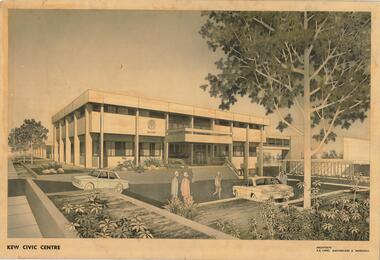
... Lines' office, for example had designed the Eltham Shire Offices in 1941, while Leith's firm had been responsible for the celebrated Heidelberg Town Hall in 1937). Both practices parleyed this early experience into a lucrative post-war career, designing numerous municipals offices well into the 1970s." ...The Kew Civic Centre (A K Lines, MacFarlane & Marshall, 1972) was built next to the Kew Civic Hall (A C Leith & Bartlett, 1960) on the site of the former mansion Ordsall (later renamed South Esk). Whereas the entrance to the Civic Hall was positioned off Civic Drive, the main entrance to the Civic Centre faced Cotham Road, as shown in the undated perspective drawing of the proposed building. The Civic Hall was used for public functions and performances, while the Civic Centre was used for civic offices. It also contained the Council Chamber. The building opened in 1972, following the relocation of the councillors and council officers from the former Town Hall in Walpole Street (now a Woolworth's supermarket). Following the amalgamation of the former City of Kew into the City of Boroondara in 1994, the Civic Centre was sold to Trinity Grammar School. The exterior of the Centre has been modified by Trinity Grammar.A report for Heritage Victoria (date) describes how two architectural firms dominated the designs for new civic buildings in Victoria during the post war period. The report claims that: "An interesting sub-theme in the erection of post-war municipal offices in Victoria is that a considerable proportion were designed by the same three or four Melbourne-based architectural firms, who established themselves as the leading specialists in this type of work. The two most prolific firms in this regard were A K Lines, MacFarlane & Marshall, and A C Leith & Bartlett; both, in fact, had made names for themselves as designers of local government offices prior to the Second World War. Lines' office, for example had designed the Eltham Shire Offices in 1941, while Leith's firm had been responsible for the celebrated Heidelberg Town Hall in 1937). Both practices parleyed this early experience into a lucrative post-war career, designing numerous municipals offices well into the 1970s." (Survey of Post-War Built Heritage in Victoria, Built Heritage Pty Ltd, 2010.) The perspective drawing importantly captures the original design and function of the exterior of the building and its public entrance.Hand-coloured perspective sketch of the new Kew Civic Centre, completed in 1972 to designs by A K Lines, MacFarlane & Marshall; and located on the corner of Charles Street and Cotham Road, Kew. The sketch represents the front elevation of the building and its relation to the preexisting Kew Civic Hall at right. The three storey building features strong vertical concrete buttresses that extend across the three levels. KEW CIVIC CENTRE / A K LINES, MACFARLANE & MARSHALLkew civic centre, a.k. lines, macfarlane & marshall, architectural drawings, civic buildings -- kew (vic.), town hall -- kew (vic) -
Tarnagulla History Archive
Box of Murray Comrie's Research Notes (Set 1), Murray Comrie's Research Notes (Set 1), circa 1960s-80s
... Within this set are multiple archival folders with the following subject matter: Banks Lodge Gold & mining War/Military Local people Buildings Businesses Local government Post Offices Policing Recreation Reserve Railway Clubs & Societies Band/Music Hotels Churches Schools Fire Brigade Laanecoorie Early white history General (including many captions that accompanied photographs - which were separated from the photos for preservation storage reasons). ...post offices policing recreation reserve railway clubs & societies band/music hotels churches schools fire brigade laanecoorie names Blue-grey archive box containing research notes of Murray Comrie. Within this set are multiple archival folders with the following subject matter: Banks Lodge Gold & mining War/Military Local people Buildings Businesses Local government Post Offices Policing Recreation Reserve Railway Clubs & Societies Band/Music Hotels Churches Schools Fire Brigade Laanecoorie Early white history General (including many captions that accompanied photographs - which were separated from the photos for preservation storage reasons). ...Murray Comrie Collection. Murray Comrie, born in Tarnagulla in 1912 also became a policeman and later a Chief Superintendent, retiring in 1972 and passing away in 1983 after a long illness. Murray Comrie's son Murray Jnr., to avoid confusion became known by his middle name, Neil. Neil Comrie also joined Victoria Police and rose through the ranks to become Chief Commissioner of Victoria Police from 1993 to 2001. Blue-grey archive box containing research notes of Murray Comrie. Within this set are multiple archival folders with the following subject matter: Banks Lodge Gold & mining War/Military Local people Buildings Businesses Local government Post Offices Policing Recreation Reserve Railway Clubs & Societies Band/Music Hotels Churches Schools Fire Brigade Laanecoorie Early white history General (including many captions that accompanied photographs - which were separated from the photos for preservation storage reasons). The contents of these files were research notes compiled by Murray Comrie during his research for a book about Tarnagulla. tarnagulla, comrie, research, banks, lodge, gold & mining, war/military, local people, buildings, businesses, local government, post offices, policing, recreation reserve, railway, clubs & societies, band/music, hotels, churches, schools, fire brigade, laanecoorie, names -
Tarnagulla History Archive
Box of Donald Clark's Research Notes, Donald Clark's Research Notes, circa 1960s-2000s
... Within this set are multiple archival folders with the following subject matter: Hotels Gold, prospecting & mining Peace Picnic Street lighting Churches Cemetery Poems Shire of Bet Bet Chinese Clubs Police Transport Local businesses/premises Local people Post Offices Previous history work / previous history enquiries Back To Tarnagulla events Victoria Theatre / Entertainment Schools Water and waterways Early town Mapping and geography Photocopies of photos Miscellaneous Rail Link Centenary Newbridge Eddington Waanyarra Bet bet (town) Llanelly Murphy's Creek / Irishtown Laanecoorie Military Service Fire Brigade Tarnagulla Landmarks / Places of Interest Family Histories Births, Deaths, Marriage info Transcript of St. ...Within this set are multiple archival folders with the following subject matter: Hotels Gold, prospecting & mining Peace Picnic Street lighting Churches Cemetery Poems Shire of Bet Bet Chinese Clubs Police Transport Local businesses/premises Local people Post Offices Previous history work / previous history enquiries Back To Tarnagulla events Victoria Theatre / Entertainment Schools Water and waterways Early town Mapping and geography Photocopies of photos Miscellaneous Rail Link Centenary Newbridge Eddington Waanyarra Bet bet (town) Llanelly Murphy's Creek / Irishtown Laanecoorie Military Service Fire Brigade Tarnagulla Landmarks / Places of Interest Family Histories Births, Deaths, Marriage info Transcript of St. ...Donald Clark Collection. Blue-grey archive box containing research notes of Donald Clark. Within this set are multiple archival folders with the following subject matter: Hotels Gold, prospecting & mining Peace Picnic Street lighting Churches Cemetery Poems Shire of Bet Bet Chinese Clubs Police Transport Local businesses/premises Local people Post Offices Previous history work / previous history enquiries Back To Tarnagulla events Victoria Theatre / Entertainment Schools Water and waterways Early town Mapping and geography Photocopies of photos Miscellaneous Rail Link Centenary Newbridge Eddington Waanyarra Bet bet (town) Llanelly Murphy's Creek / Irishtown Laanecoorie Military Service Fire Brigade Tarnagulla Landmarks / Places of Interest Family Histories Births, Deaths, Marriage info Transcript of St. Saviour's Records A plastic pocket containing duplicate copies of local history images held elsewhere in the collection. The contents of these files were research notes compiled by Donald Clark from his local history research about Tarnagulla and district. tarnagulla & district, donald clark, research -
 Linton and District Historical Society Inc
Photograph, Centenary Celebrations Procession, Linton, 1939
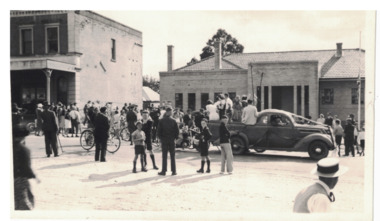
... The upper level of this building was at one time (post WWI-early 1920s) used as a hospital. The building on the right is the Grenville Shire Offices, built 1938/39 and only recently opened....The upper level of this building was at one time (post WWI-early 1920s) used as a hospital. The building on the right is the Grenville Shire Offices, built 1938/39 and only recently opened. ...This photograph was taken during Linton's centenary celebrations at the end of 1939. The double storey building on the left is Criterion House, originally a draper's store. The upper level of this building was at one time (post WWI-early 1920s) used as a hospital. The building on the right is the Grenville Shire Offices, built 1938/39 and only recently opened.Black and white image of a crowd of men, women and children plus a motor vehicle, motorcycle and bicycle outside buildings in Sussex Street, Linton. The car has been decorated with streamers. centenaries, centenary celebrations, hospitals, motorcycles, cars, bicycles, grenville shire offices, criterion house -
 Linton and District Historical Society Inc
Photograph, John O'Meara on his Wedding Day
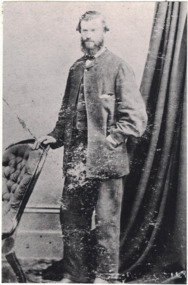
... O'Meara is shown as owner of lot 13 in Sussex Street, Linton, which is part of the block now occupied by the Shire Offices. In an early Post Office Directory (1868), J.J. ...O'Meara is shown as owner of lot 13 in Sussex Street, Linton, which is part of the block now occupied by the Shire Offices. In an early Post Office Directory (1868), J.J. ...John O'Meara on his Wedding Day, August 1865. Born 1833, Tipperary, Ireland. Son of Patrick O'Meara and Ann O'Brien. Married Maria O'Brien. Died 11 Nov 1910. J.J. O'Meara. According to the first Lands Dept. plan of the area, a J.J. O'Meara is shown as owner of lot 13 in Sussex Street, Linton, which is part of the block now occupied by the Shire Offices. In an early Post Office Directory (1868), J.J. O'Meara is listed as "Timber Merchant", Sussex Street, Linton.Black and white copy of original portrait showing a man, standing with his right hand resting on the back of a chair. He is wearing a light coloured suit, white shirt and dark bow tie. His left hand is in the pocket of his jacket, which is done up with a single button on the top of the jacket. A wall and curtain in the background. His hair sticks out at the sides and he has a beard and mustache."John O'Meara".john o'meara, j.j. o'meara, weddings -
 Linton and District Historical Society Inc
Photograph, Criterion House, Sussex Street, Linton
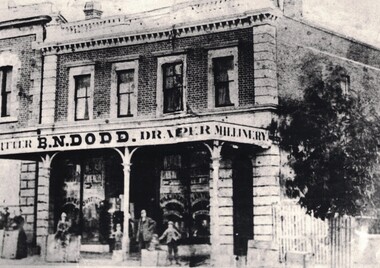
... early 1920s. The building was demolished around 1938/39, in connection with the rebuilding of new offices for the Shire of Grenville. Criterion House Samuel Steele B.N. (Benjamin Nunnington) Dodd Drapers Shops Sussex Street Linton Digital copy of original photograph, which shows a two-storey brick building with a verandah. There are four windows across the second storey. A sign across the front of the verandah reads "...TFITTER. B. N. DODD. DRAPER. MILLINERY". A man is leaning on a verandah post ...Date of the photograph is not known. Criterion House was built by Samuel Steele in 1862/1863. Samuel Steele left Linton in the late 1860s, but it is not known if B. N. Dodd was the next owner of the building. B. N. Dodd was mentioned in advertising as a Linton draper in 1878. He sold the shop and moved to Ballarat in 1887. The upper floor of the building was used as a hospital from around the end of WWI to the early 1920s. The building was demolished around 1938/39, in connection with the rebuilding of new offices for the Shire of Grenville.Digital copy of original photograph, which shows a two-storey brick building with a verandah. There are four windows across the second storey. A sign across the front of the verandah reads "...TFITTER. B. N. DODD. DRAPER. MILLINERY". A man is leaning on a verandah post at the front of the shop near the entrance, and a woman is standing on the left of the picture, behind a box or counter. Several children are sitting on boxes or bales outside the shop. Ground floor windows have signs reading "DRAPER", "OUTFITTER", "MILLINERY". (A fourth sign is illegible.)criterion house, samuel steele, b.n. (benjamin nunnington) dodd, drapers, shops, sussex street linton -
 Bacchus Marsh & District Historical Society
Photograph, Taubman's Store and Post Office circa 1863-1876
... Post Offices are an essential service in any community particularly in the nineteenth century when mail services were the main means for personal and commercial communication over distances. This image is one of the earliest images of a post office in Bacchus Marsh and is therefore an important documentary record of early postal services in the Bacchus Marsh area. ...The Old Post Office Store was established in 1850 at 191-193 Main Street Bacchus Marsh. In 1863 Thomas Taubman was the house and store owner and storekeeper. In 1866 he opened a branch of the Savings Bank at these premises. In 1876, he left the district. He died in 1901 as the result of a train accident at Moreland.Post Offices are an essential service in any community particularly in the nineteenth century when mail services were the main means for personal and commercial communication over distances. This image is one of the earliest images of a post office in Bacchus Marsh and is therefore an important documentary record of early postal services in the Bacchus Marsh area.This image is of a photographic copy of an original photo. Shown is a double-fronted store and Post Office in two sections , with a group of six men standing at the front. The building appears to be of weatherboard, with shingled roofs. Built in different styles, the two buildings may date from different periods. The buildings are unified by a single verandah supported by seven pillars along the front of the store. A sign erected between two of the pillars reads T. Taubman. On the brickwork a sign reads POST OFFICE above a number of noticeboards. Various items can be seen at the front of the store. On the front: A hand-written note: "Bacchus Marsh Post Office Store 1850-1860 (?) from yellowed original by "P Robertson. B'Marsh" prior to restoration of original. businesses main street bacchus marsh, post offices, shops bacchus marsh, post offices bacchus marsh, thomas taubman bacchus marsh -
Surrey Hills Historical Society Collection
Work on paper - Vertical File, Surrey Hills Post Office
... POST OFFICES 1. Early postal facilities in Surrey Hills, (undated), (2 pages). 2. ...Surrey Hills Post Offices POST OFFICES 1. Early postal facilities in Surrey Hills, (undated), (2 pages). 2. ...POST OFFICES 1. Early postal facilities in Surrey Hills, (undated), (2 pages). 2. Postal facilities, various newspaper references, and notes by Mrs. E. Finlay (undated) (5 pages). 3. Surrey Hills Post Office (history), (1 page). 4. Post Office, various notes, (2 pages). 5. George and Elizabeth Sim family notes (1 page). 6. Photocopy of photo of Surrey Hills North Post Office (undated), (1 page). 7. Photocopy of photo of Surrey Hills South Post Office (undated), (1 page). 8. Photocopy of photo of Surrey Hills Post Office (undated), (1 page). 9. Photocopy of photo of Surrey Hills Post Office 1901, (1 page). 10. Photocopy of photo of Surrey Hills Post Office 1944, rear view (1 page). 11. Photocopy of photo of Surrey Hills Post Office 1944, (1 page). 12. Unknown newspaper cutting of Ken Tate, Surrey Hills Post Office postmaster, May, 1983 (1 page). 13. ‘’Telegrams’’, author unknown, possibly Norman Kerr, date unknown, (4 pages). 14. ‘’History in rubbles’’, letter in Progress Leader, 15.12.2008 (1 page). 15. 2 letters in Progress Leader, 12.1.2010 (1 page). 16. Surrey Hills Post Office, prepared by Sue Barnett for SHNN (2 pages). 17. Vale: Surrey Hills Post Office by Sue Barnett. Demolition of building. 18. Australia Post of the Move. Historical Moves at the Post Office. SHNN c. 2010 19. The memories of a popular postie. Norman Kerr. Written c. 1986 20. Surrey Hills Post Office File at NAA (National Archives Australia list of postmaster/postmistress from 1887 – 1899 a. Age news item 20 November 1964 surrey hills post offices
