
Showing 16 items matching "elegant clothing"
-
 Melbourne Tram Museum
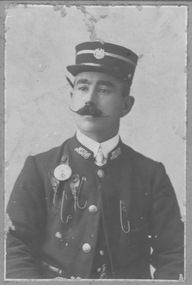
Photograph - Cable tram conductor Fred Guildford, c1900
... ...elegant clothing...In a time when the average person could afford very little elegant clothing, a stylish uniform impressed many. ...In a time when the average person could afford very little elegant clothing, a stylish uniform impressed many. ...The MTOC only provided full uniforms to its traffic staff from around 1900. Numerous professional photographs then appeared of uniformed staff individually or in groups. In a time when the average person could afford very little elegant clothing, a stylish uniform impressed many. It raised the profile of the well dressed staff member and of the tramway company. As well as the brass buttons on the conductor's tunic and vest, MTOC insignia can be seen on his cap and collar. He also wears an employee badge with his number (4) and depot (P = Prahran) and several large pins to hold his trip slips. These long strips of coloured card were clipped using a bell punch to record the fares collected. Yields information about MTOC staff uniformBlack and white photograph glued to cardboard with company name on front and note on rearPrinted name on front: 'Yeoman & Co, Prahran'; Pencil note on rear: 'Fred Guildford, Melbourne Tramway and Omnibus Co, c1900, The Tramway Museum Society of Victoria Limited'mtoc, uniforms, professional photographs, elegant clothing, stylish uniform, profile, conductor's tunic, vest, brass button, insignia, employee badge, prahran, trip slips, large pins, bell punch -
 Federation University Historical Collection
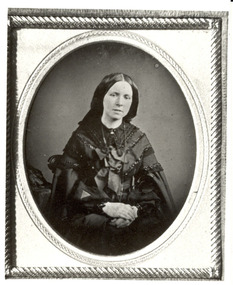
Photograph, Catherine Coghill, 1860s
... elegant steamship, ‘Ly-ee-Moon’ to visit her sister Adelaide Reid and purchase a property in the Darling Downs, Qld. Tragically all three, and the gold sovereigns they were carrying to purchase same, were lost when the steamship struck rocks and was wrecked off the rugged Green Cape Coast, just south of Bega, New South Wales [Jane Dyer, 15 June 2024] catherine coghill catherine holmes william coghill william coghill junior holmes family collection chatham-holmes family collection ly-ee-moon mourning shipwreck women pioneer women family history Black and white photograph of a seated woman wearing black clothing, a cap with centrally parted hair. ...Catherine Holmes married William Coghill Junior. William died in 1884. This is possibly a photo of Catherine in her mourning clothes. They had no children. His estate passed to Catherine. In 1886 Catherine accompanied by her brother, Edward Carter Holmes, Mr. Holmes a farmer at Ascot and her companion Mrs. Mark Gardiner [Gardner], wife of the contractor for laying down the wood pavement in Elizabeth- street, sailed for Queensland aboard the elegant steamship, ‘Ly-ee-Moon’ to visit her sister Adelaide Reid and purchase a property in the Darling Downs, Qld. Tragically all three, and the gold sovereigns they were carrying to purchase same, were lost when the steamship struck rocks and was wrecked off the rugged Green Cape Coast, just south of Bega, New South Wales [Jane Dyer, 15 June 2024]Black and white photograph of a seated woman wearing black clothing, a cap with centrally parted hair. The woman is Catherine Coghill (formerly Holmes), who married William Coghill Jnr. catherine coghill, catherine holmes, william coghill, william coghill junior, holmes family collection, chatham-holmes family collection, ly-ee-moon, mourning, shipwreck, women, pioneer women, family history -
 Flagstaff Hill Maritime Museum and Village
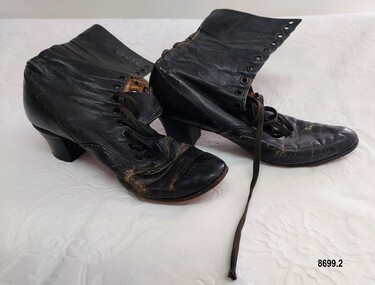
Footwear - Leather boots, Adler Boots and Shoes, circa 1920
... elegant materials like patent leather or dyed suede. Edwardian boots were lace up or button up. The most remarkable thing about women's shoes in the 1920's was that they were visible! This led to an increase in demand for new styles every season which made ordering custom fit shoes a thing of the past. New shoes were made in standard sizes, ready to buy from local clothing...elegant materials like patent leather or dyed suede. Edwardian boots were lace up or button up. The most remarkable thing about women's shoes in the 1920's was that they were visible! This led to an increase in demand for new styles every season which made ordering custom fit shoes a thing of the past. New shoes were made in standard sizes, ready to buy from local clothing ...This item is one of a collection of clothing items that belonged to the Stephenson family who lived at 22 McCracken Street, Kensington, Melbourne. Matthew Stephenson (1861 – 1943) who had grown up on the Bendigo goldfields and shifted to Melbourne in the early 1900’s was a train driver and later, a fireman with the railways. His wife Elizabeth Jane (Betsy) Wigley (1865 – 1953) also grew up on the goldfields around Majorca and Bendigo. They married in 1885 in Bendigo. They had two daughters – Ethel Evelyn Stephenson (1886 – 1956) and Lillian or Lila (1891 – 1977) who were milliners and dressmakers and who continued to live in the family home after the death of their parents. The family are recorded as living at 22 McCracken Street, Kensington, as early as 1914. It is not known who made or owned the clothing that makes up this collection but as it appears to be from the late Victorian and early Edwardian era, the different pieces were probably made and worn by any of the three ladies of the house – Betsy, Ethel and/or Lila. During W.W.2, a local Warrnambool couple (Meryl and Tony Everard) boarded with them – Tony was in the airforce training paratroopers to jump into (and survive) enemy territory and his wife Meryl worked in the Methodist baby Home. The Everards developed a close friendship with the Stephensons and were responsible for clearing out the house (and finding this clothing collection) after Lila died in 1977. Starting in around 1850, women began wearing boots that resembled the ones already worn by men in high society. Victorian women's boots were slightly more feminine in nature, however, than those worn by their male counterparts. The boots first worn by women extended to the middle of the calf so that her ankle would stay properly covered underneath her many skirts. These boots often featured laces or a row of buttons to keep them secure to the foot and ankle. Although usually made from durable materials like rubber and leather, boots that were worn purely for fashion were sometimes made of more elegant materials like patent leather or dyed suede. Edwardian boots were lace up or button up. The most remarkable thing about women's shoes in the 1920's was that they were visible! This led to an increase in demand for new styles every season which made ordering custom fit shoes a thing of the past. New shoes were made in standard sizes, ready to buy from local clothing stores or mail order catalogues. Working women, however, tended to wear sensible, lace up shoes and boots. These boots appear to be of a practical nature, designed for comfort, warmth, and proof against the rain and mud, rather than high fashion. They feature the brand name "adler" printed on the inner sole and have stamped letters and numbers suggesting ready-made sizes.This pair of boots are a significant example of a working woman's footwear dating around the early 20th century.Pair of lady's black leather, lace up boots featuring 3.75 cm heels, 14 pairs of lacing eyelets, a black leather tongue and black shoelaces. The leather soles have tacks on the heels and near the instep. The boots have a black leather inner sole and the inner shaft and upper part of the boots are lined with a durable cotton type fabric. Both boots have ink markings (handwritten and stamped) at the top of the shaft lining and the inner sole of the left hand boot is labelled "adler".Both boots - "0/128 /X" (handwritten) and "6MC200" (stamped). Left boot inner sole - "adler" left boot upper shaft lining - "X/8FH?" (handwritten)flagstaff hill maritime museum and village, great ocean road, shipwreck coast, warrnambool, boots, lady's boots, footwear, leather boots, lace up boots, adler, stephenson family -
 National Vietnam Veterans Museum (NVVM)
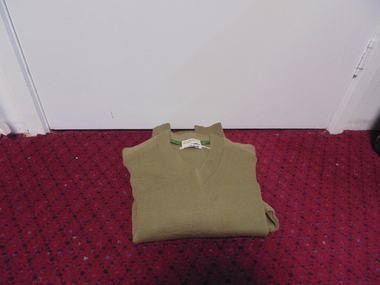
Uniform - Uniform, Army, Jumper
... Clothing McPhail Collection A khaki woolen jumper with a V neck and long sleeves. Name of a soldier called Stone Service No 43164 is shown on a label inside the jumper Jumper Uniform Uniform, Army Elegant Knitting Co ...A khaki woolen jumper with a V neck and long sleeves. Name of a soldier called Stone Service No 43164 is shown on a label inside the jumperjumper, clothing, mcphail collection -
 National Wool Museum
Clothing - Overcoat, Dominex, 1950s
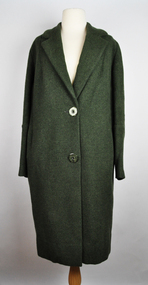
... elegant at social events and work. Kim donated the overcoat to the National Wool Museum in 2021. Dominex Fashion Women's corporate wear Godfrey Hirst Overcoat Wool Clothing Wording, gold. ...This overcoat was designed and tailored by Dominex, a company that sold clothing in high end department stores such as Myer and David Jones in the 1940s through to the 2000s. As pictured in the accompanying advertising, Dominex looked to produce clothes for women to “casually, confidently wear … the exquisite styling and superb tailoring of… Dominex Coats”. This sentiment was carried by the company for more than 60 years. Amanda Morgan, a director of the Dominex fashion label in an interview from 2003 said “Not everybody wants sass, or sex, or high fashion for that matter. Au contraire. Our customers will be stylish, sophisticated and womanly, but we don’t do shoestring straps or asymmetrical lines." Dominex was a label specialising in exceptional quality "traditional" dressing for corporate wear. Their clothes looked to provide women with a return to the tried and true values of elegant, unpretentious, classic dressing. "Our look is European-influenced," Morgan explained further. "Inspired by Armani, Valentino, Chanel and Escada. Suits have been specially dyed in France to ensure the perfect shade of ice blue, lemon, grey, or slate. Fabrics are natural, silk and linen. Shapes are stylish, with an almost 1930s feel; classic pants, silk shirts, structured overcoats with elegant-length” Returning to this overcoat, it has a label on the inside which reads “Pure Wool Material by Godfrey Hirst of Geelong”. Nowadays Godfrey Hirst produce flooring products and are the largest manufacturer and exporter of residential and commercial carpets in Australasia. They have expanded into hard flooring and left their fashion days behind. This overcoat serves as a useful example of a different time for the company; before they made the change to concentrating exclusively on flooring, when they produced fabrics to be tailored for the height of Australian fashion. This overcoat was purchased and worn by Joan Waller, aunty of the donor, Kim Rosenow. Kim said her aunty was from Ballarat but frequently shopped in Melbourne to keep up with the latest trends. Her aunty Joan fitted the target demographic of Dominex well, as she needed to look sophisticated and elegant at social events and work. Kim donated the overcoat to the National Wool Museum in 2021. Green singled breasted overcoat with a narrow overlap and one column of buttons for fastening. The overcoat features notched lapels of a medium width and two large buttons of a green & dark green marble. The overcoat has two semi-visible jetted pockets at the hips. Internally, the overcoat features a black silk lining for comfort. It also features a stitched patch on the left side of the opening which reads “Pure Wool Material by Godfrey Hirst of Geelong”. At the collar, another patch reads “Dominex REGD”. At the cuffs, the overcoat finishes in a type of gauntlet cuff which stretches back over 200mm. The decorative finish utilises no buttons and has thick piping to accentuate this design feature. The overcoat finishes with a simple invisible hem at the bottom.Wording, gold. Patch stitched at collar: “DomineX / REGD.” Wording, black. Patch stitched at left off opening: “PURE WOOL MATERIAL BY / Godfrey Hirst / OF GEELONG”dominex, fashion, women's corporate wear, godfrey hirst, overcoat, wool clothing -
 National Wool Museum
Clothing - 35 Life, Canwen Zhao, 2022
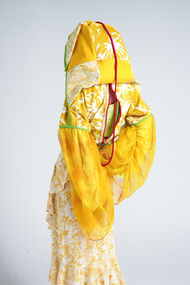
... The project includes various types of clothing, each with unique storage methods. This yellow look, named "elegant beach sunscreen monarch," draws its fashion inspiration from traditional Han Chinese attire and its storage concept from the Chinese cultural concept of "jiu jiu gui yi." the design employs flat pattern cutting, utilizing materials from the second-hand market such as beach towels, children's waterproof clothing, and women's dresses. ...The project includes various types of clothing, each with unique storage methods. This yellow look, named "elegant beach sunscreen monarch," draws its fashion inspiration from traditional Han Chinese attire and its storage concept from the Chinese cultural concept of "jiu jiu gui yi." the design employs flat pattern cutting, utilizing materials from the second-hand market such as beach towels, children's waterproof clothing, and women's dresses. ...Canwen Zhao was awarded the $10,000 We The Makers Acquisitive Prize for '35 Life' in 2023. Artist Statement: "35life" is a sustainable fashion project that transforms second-hand clothing materials into urban street outdoor-style products. Highlighting prominent Chinese classic red and green colours not only conveys eastern aesthetics but also adds a sense of unity to the clothing collection. The high-saturation and high-brightness full-colour palette keeps the clothing consistently "fresh," allowing any trendy colours to seamlessly integrate into the project's designs, thus extending the lifespan of the garments. Additionally, all clothing items can quickly transform into a stylish bag for convenient daily carrying and home storage. These bags are made from leftover fabric generated during the production process and serve as original packaging for sale. This approach not only reduces excessive packaging but also enhances the chances of resale in the second-hand market. The project draws inspiration from the traditional Chinese cultural concept of "huo feng ding," meaning "exchange the old for the new." it's also influenced by the designer's personal experience with health issues, making the designs suitable for individuals who can't be exposed to sunlight for extended periods, adapting to the changing urban lifestyle. 35life aims to provide visually pleasing and comfortable dressing experiences for urban dwellers who are busy with work and experience high levels of stress. Unlike traditional design patterns, this project adopts a unique design approach. It selects 3-5 pieces of raw materials based on their colours, and then disassembles them through structural lines. While retaining most of their functionality, these materials are rearranged and assembled on a flat surface before being shaped on a dress form. Subsequently, various ways of creating storage bags are derived from the initial clothing prototypes. After refining the designs, the final products are developed, and similar materials are used to create samples. Therefore, under this design methodology, even for the same garment, it is impossible to produce two identical pieces of clothing. Each garment is truly one-of-a-kind, which enhances its rarity and contributes to the longevity of the fashion pieces. The project includes various types of clothing, each with unique storage methods. This yellow look, named "elegant beach sunscreen monarch," draws its fashion inspiration from traditional Han Chinese attire and its storage concept from the Chinese cultural concept of "jiu jiu gui yi." the design employs flat pattern cutting, utilizing materials from the second-hand market such as beach towels, children's waterproof clothing, and women's dresses. Similar colours and patterns are reassembled through cutting and combining. For the sleeves, quick-drying, sun-protective sport fabric forms the base, overlaid with discarded silk fabric dyed with turmeric and plant dyes. This not only ensures functionality but also adds a sense of elegance. The length can be adjusted using drawstrings. Artist Bio: Zhao Canwen is a multidisciplinary fashion designer with a strong passion for integrating art, history, culture, and sustainable design. With over 15 years of experience in painting, she draws inspiration from ancient Chinese philosophy and aesthetics, which gives her a unique sense of beauty. After 8 years of fashion and art training, she possesses a keen insight into current trends and tends to combine art with commercial needs. Zhao's design style is diverse, characterized by a multidimensional approach, a focus on colour application, and storytelling through details.Outfit consisting of six pieces: - Orange plastic eye wear with green paint - Pair of red and green metal clip on earrings - Red beaded phone case with attached beads on string - Pair of red and green painted running shoes - Yellow and green hooded garment with red piping and zips - Brown bag with green beaded handlessustainable, fashion, we the makers, art, culture, design, chinese philosophy, prize -
 Nhill and District Historical Society Inc.
Clothing - c 1860 Wedding dress of Erstine Schlisweg
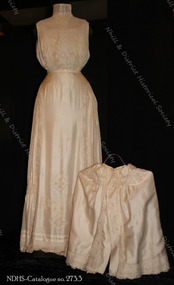
... Erstine Schlisweg married William Bosse in Germany in 1860, later settled in Nhill district Settlers in Nhill wedding dress william bosse erstine schlisweg nhill German - textiles - handmade Lace & ribbon trims c 1860 Three piece silk & lace wedding ensemble handmade in Germany, consisting of a silk full length skirt with lace & ribbon trim which hugs the waist, flows into a small train at the back; the high round neck, sleeveless bodice/top tucks into the skirt, is silk with pleats down either side of a lace panel in front; cape is silk, slightly gathered so it elegantly flows over the shoulders, finishing below the hips, is trimmed with lace around the neck and bottom. Clothing ...Erstine Schlisweg married William Bosse in Germany in 1860, later settled in Nhill districtSettlers in Nhillc 1860 Three piece silk & lace wedding ensemble handmade in Germany, consisting of a silk full length skirt with lace & ribbon trim which hugs the waist, flows into a small train at the back; the high round neck, sleeveless bodice/top tucks into the skirt, is silk with pleats down either side of a lace panel in front; cape is silk, slightly gathered so it elegantly flows over the shoulders, finishing below the hips, is trimmed with lace around the neck and bottom. Lace & ribbon trims wedding dress, william bosse, erstine schlisweg, nhill, german - textiles - handmade -
 Nhill and District Historical Society Inc.
Clothing - 1980 of Wedding dress, Cassandra Gowns, worn by Debbie Jarred, 8 March 1980
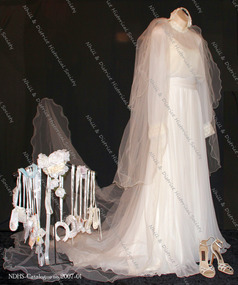
... Nhill family wedding; representing style of wedding dresses in 1980 wedding dress 1980 broughton debra jarred debbie jarred john barber uniting church rex & joan jarred basil & val barber] nhill daisy lace trim on cuffs and neckline Wedding dress made by Cassandra Gowns; shoe string strap daisy lace bodice, with stand up collar of daisy lace and pleated skirt, elegantly covered with a cuffed long sleeve blouse, over skirt & belt of chiffon, flowing graceful soft train, finishing with a head-dress decorated in daisies attached to a long fine silk net veil.(2007.01.1) - Bouquet of white silk roses & ribbon(2007.01.2); white high heal lattice toe shoes with delicate ankle strap (2007.01.3), Blue lace garter & assorted crocheted bells, horse-shoe, and slippers, of satin ribbon (2007.01.4) worn by Debbie Jarred Clothing 1980 of Wedding dress Cassandra Gowns ...Debra Jarred only daughter of Rex and Joan Jarred, of Broughton, married John Barber second son of Basil and Val Barber of Nhill, on 8 March 1980, at the Uniting Church, Broughton.Nhill family wedding; representing style of wedding dresses in 1980Wedding dress made by Cassandra Gowns; shoe string strap daisy lace bodice, with stand up collar of daisy lace and pleated skirt, elegantly covered with a cuffed long sleeve blouse, over skirt & belt of chiffon, flowing graceful soft train, finishing with a head-dress decorated in daisies attached to a long fine silk net veil.(2007.01.1) - Bouquet of white silk roses & ribbon(2007.01.2); white high heal lattice toe shoes with delicate ankle strap (2007.01.3), Blue lace garter & assorted crocheted bells, horse-shoe, and slippers, of satin ribbon (2007.01.4)daisy lace trim on cuffs and necklinewedding dress, 1980, broughton, debra jarred, debbie jarred, john barber, uniting church, rex & joan jarred, basil & val barber], nhill -
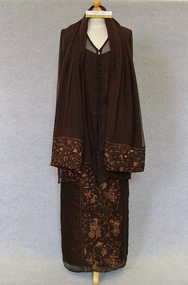 Brighton Historical Society
Evening outfit, Four piece outfit of blouse, camisole, skirt and wrap, c.1997
... When she bought it around 1997-98, it was the first time she had spent a large amount of money on clothing, and she thought it only fitting to throw a suitably elegant party at which to wear it. ...When she bought it around 1997-98, it was the first time she had spent a large amount of money on clothing, and she thought it only fitting to throw a suitably elegant party at which to wear it. ...This item is part of the Di Reidie collection. Diane Reidie was a much loved volunteer and President of Brighton Historical Society from 1999 until 2016. Originally from New Zealand, Di and her family lived in Male Street, Brighton for many years. A vibrant and energetic person with a zest for life and a gift for bringing people together, Di was a friend to many in the Bayside community and active in local community organisations. Her tireless work as President of BHS saw her named Bayside Citizen of the Year in 2008. As a seller and collector of vintage clothing, she was passionate about fashion history; one of her many enduring contributions to BHS was her extensive work in preserving, developing and promoting the Society's costume collection. In 2018-19, Di donated more than one hundred items from her personal vintage clothing collection to the Society. The collection, which includes clothing, hats, handbags and shoes from local and international designers, is representative of Di's wide-ranging interests, colourful personality, creativity, humour and love of fashion and travel. Of all the items Di donated to the Society, this four-piece Easton Pearson outfit was her favourite. When she bought it around 1997-98, it was the first time she had spent a large amount of money on clothing, and she thought it only fitting to throw a suitably elegant party at which to wear it. James Cameron's hit movie 'Titanic' had just been released, and upon discovering the recipe book 'Last Dinner On the Titanic: Menus and Recipes from the Great Liner', Di was inspired to host a Titanic-themed party for her friends. Held at her home in Brighton in 1998, the event included a string quartet, an eleven-course meal prepared entirely by Di, and a life boat in the backyard swimming pool.A four piece outfit consisting of a blouse/cardigan, camisole, skirt and wrap. Double-layered silk wrap with an outer layer of silk chiffon. Both ends feature and embroidered band of brown and black cotton, copper wire, and copper glass beads. Camisole of black and copper shot polyester rayon with wide shoulder straps and small shoulder pads. Blouse of brown silk chiffon, with a v-neck and eleven silk-covered buttons and loops at centre front. Patch pockets over front hip and full length sleeves. The neckline and sleeve edges are trimmed with copper-coloured glass beads. Full-length double-layered straight skirt with black and copper shot polyester rayon lining and silk chiffon overskirt. The skirt secures centre back with a nylon zip and botton closure. The skirt features a centre front embroidered panel of brown and black cotton leaf and flower motifs, with copper wire and copper glass beads. manufacturer's label: "Oh! Easton Pearson", "Pure Silk", "Polyester Rayon", Care label, "M"costume party, titanic, easton pearson, pamela easton, lydia pearson, australian fashion, di reidie, 1990s -
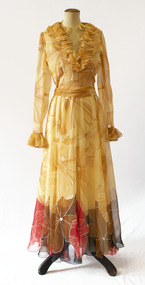 Brighton Historical Society
Dress, Evening dress, 1970s
... The collection, which includes clothing, hats, handbags and shoes from local and international designers, is representative of Di's wide-ranging interests, colourful personality, creativity, humour and love of fashion and travel. Di purchased this dress as a vintage item. Elvie Hill (1917-2018) was a Melbourne fashion designer and a longtime Brighton resident. She established her eponymous label and became well-known for her elegant...The collection, which includes clothing, hats, handbags and shoes from local and international designers, is representative of Di's wide-ranging interests, colourful personality, creativity, humour and love of fashion and travel. Di purchased this dress as a vintage item. Elvie Hill (1917-2018) was a Melbourne fashion designer and a longtime Brighton resident. She established her eponymous label and became well-known for her elegant ...This item is part of the Di Reidie collection. Diane Reidie was a much loved volunteer and President of Brighton Historical Society from 1999 until 2016. Originally from New Zealand, Di and her family lived in Male Street, Brighton for many years. A vibrant and energetic person with a zest for life and a gift for bringing people together, Di was a friend to many in the Bayside community and active in local community organisations. Her tireless work as President of BHS saw her named Bayside Citizen of the Year in 2008. As a seller and collector of vintage clothing, she was passionate about fashion history; one of her many enduring contributions to BHS was her extensive work in preserving, developing and promoting the Society's costume collection. In 2018-19, Di donated more than one hundred items from her personal vintage clothing collection to the Society. The collection, which includes clothing, hats, handbags and shoes from local and international designers, is representative of Di's wide-ranging interests, colourful personality, creativity, humour and love of fashion and travel. Di purchased this dress as a vintage item. Elvie Hill (1917-2018) was a Melbourne fashion designer and a longtime Brighton resident. She established her eponymous label and became well-known for her elegant and feminine designs. She dressed some of Australia's best known women, including Lady Sonia McMahon and Dame Pattie Menzies, and was also known for her boutiques in Melbourne (the last store closed in 1991). She retired in 1999, aged 80.Long-sleeved silk chiffon evening dress with yellow/gold floral print and brown, red and black border at hem. Ruffled neckline and cuffs. Snap fastenings at cuffs and zip at back. Matching silk chiffon sash.Label, inside collar, black on white: "ELVIE HILL / OF MELBOURNE" Label inside seam: "SIZE 10 / TO FIT / Bust 80cm"di reidie, vintage clothing, melbourne designers, elvie hill, 1970s -
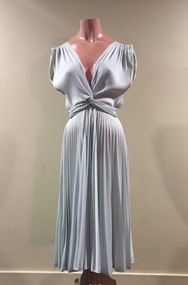 Kew Historical Society Inc
Clothing - Ice-Green Sun-Ray Pleated Dress, Prue Acton, 1963-1965
... The collection is also significant in that it includes the work of a large number of Melbourne designers from the 1960s to the 1990s. australian fashion - 1960s women's clothing day wear mcintyre collection Label: Prue Acton Elegant ice green coloured sunray pleated sleeveless dress. ...The Fashion & Design collection of the Kew Historical Society includes examples of women’s, men’s, children’s and infants’ clothing from the 18th, 19th and 20th centuries. Items in the collection were largely produced for, or purchased by women in Melbourne, and includes examples of outerwear, protective wear, nightwear, underwear and costume accessories.The outfit was owned, worn and donated to the collection by Dione McIntyre.The McIntyre Collection of clothing and clothing accessories forms one of the largest single donations to our Fashion & Design collection. It includes clothing and clothing accessories worn by four women in the Cohen and McIntyre families across three generations. The items worn by Melbourne architect, and Kew resident, Dione McIntyre date from the 1960s and 1970s, and include evening wear, day wear, hats and shoes. As Dione McIntyre often accompanied her husband, fellow architect Peter McIntyre, to formal events, there are a number of pieces of evening wear among the items. The McIntyre Collection also includes items worn by women of an earlier generation: by Lilian Cohen, Dione McIntyre's mother, and by her mother-in-law, the wife of the architect Robert McIntyre. At the other end of the chronological spectrum are a number of outfits belonging to, worn and donated by Annie McIntyre. These include outfits created by notable late 20th century Australian and/or international fashion designers. The McIntyre Collection is significant historically and artistically as it includes examples of design that demonstrate changing tastes in fashion over an 80-year period. The collection is also significant in that it includes the work of a large number of Melbourne designers from the 1960s to the 1990s. Elegant ice green coloured sunray pleated sleeveless dress. The dress comes from the earliest period of Prue Acton's design career [1963-91].Label: Prue Actonaustralian fashion - 1960s, women's clothing, day wear, mcintyre collection -
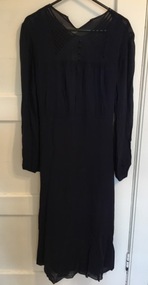 Kew Historical Society Inc
Clothing - Black Crepe de Chine Day Dress, 1922-24
... The garments in the Weir Collection were donated to the Kew Historical Society by a granddaughter of Edith Weir in 2017. edith mary weir (nee betteridge), 84 princess street - kew, australian fashion, women's clothing, costumes, dresses Elegant knee-length black crepe dress with long sleeves with black silk georgette over-layer. ...An item forming part of a collection of costumes, photographs and documents relating to the Weir family who lived in the mansion originally named Illapa, 84 Princess Street, Kew, from c.1917 to 1950. This historically significant collection includes items relating to both George Weir (1866-1937) and his wife Edith Mary Weir (1867-1948). George Weir attained national prominence in the mining industry, becoming General Manager of the North Broken Hill Silver Mining Company in 1903 (later renamed North Broken Hill Mining Company 1905-12, and North Broken Hill Ltd 1912-1988), and subsequently President of the Mine Owners Association. He was to remain General Manager of North Broken Hill Ltd until his retirement in 1926.This garment is part of a collection of women’s clothing, owned and worn by Edith Mary Weir (nee Betteridge) - born in Clare, South Australia 1867, died Kew 1948 - and also by her daughter. The garments date from the 1880s to the 1930s. The collection includes day dresses, evening dresses, evening coats, capes, and undergarments. As the wife and daughter of a mine manager, the collection includes representative examples of clothing worn by upper middle class Australian women in domestic circumstances, and at social and civic events. A number of the costumes from the 1920s to the 1930s are of a particularly fine quality, being both rare, representative and intact examples of Australian fashion of the period. The garments in the Weir Collection were donated to the Kew Historical Society by a granddaughter of Edith Weir in 2017.Elegant knee-length black crepe dress with long sleeves with black silk georgette over-layer.edith mary weir (nee betteridge), 84 princess street - kew, australian fashion, women's clothing, costumes, dresses -
 Kew Historical Society Inc
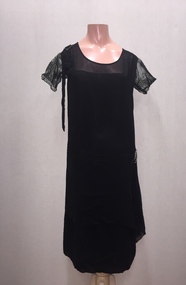
Clothing - Black Crepe de Chine Day Dress, c. 1920-25
... The garments in the Weir Collection were donated to the Kew Historical Society by a granddaughter of Edith Weir in 2017. edith mary weir (nee betteridge) illapa - 84 princess street -- kew (vic.) women's clothing australian fashion -- 1920s Elegant knee-length black silk dress with short sleeves with black silk crepe de chine over-layer. ...An item forming part of a collection of costumes, photographs and documents relating to the Weir family who lived in a mansion, originally named Illapa, at 84 Princess Street, Kew, from c.1917 to 1950. This historically significant collection includes items relating to both George Weir (1866-1937), his wife Edith Mary Weir (1867-1948) and their children. George Weir attained national prominence in the mining industry, becoming General Manager of the North Broken Hill Silver Mining Company in 1903 (later renamed North Broken Hill Mining Company 1905-12, and North Broken Hill Ltd 1912-1988), and subsequently President of the Mine Owners Association. He was to remain General Manager of North Broken Hill Ltd until his retirement in 1926.This garment is part of a collection of women’s clothing, owned and worn by Edith Mary Weir (nee Betteridge) - born in Clare, South Australia 1867, died Kew 1948 - and also by her daughter. The garments date from the 1880s to the 1930s. The collection includes day dresses, evening dresses, evening coats, capes, and undergarments. As the wife and daughter of a mine manager, the collection includes representative examples of clothing worn by upper middle class Australian women in domestic circumstances, and at social and civic events. A number of the costumes from the 1920s to the 1930s are of a particularly fine quality, being both rare, representative and intact examples of Australian fashion of the period. The garments in the Weir Collection were donated to the Kew Historical Society by a granddaughter of Edith Weir in 2017.Elegant knee-length black silk dress with short sleeves with black silk crepe de chine over-layer. Abstract double fern pattern in diamentes on skirt edith mary weir (nee betteridge), illapa - 84 princess street -- kew (vic.), women's clothing, australian fashion -- 1920s -
 Whitehorse Historical Society Inc.
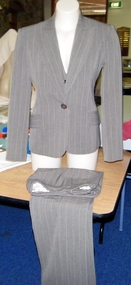
Clothing - Womens Suit, 1980's
... elegant evening wear, suiting and separates. Joining with his twin sister Kathy, the three began with a small Adelaide store and expanded to include more than 500 retailers worldwide at the height of their business.|Inspired by real women, Gross showcases his love of colour, cut and quality with each collection. His aim is to create sensuous clothing ...Attached George Gross Biography. Vogue Australia|With more than 40 years in the industry,- George Gross is one of Australia's best known fashion designers. Designing his own. label for the last 35 years, Gross is renowned for his glamorous evening wear, corporate and race wear ranges. Embodying style and sophistication, Gross has dressed celebrities the world over in his eponymous label.|With his first creation - a sequined shift, at the tender age of 16 George still believes 'every collection starts with the fabric and is all about the cut and proper finishing. The looks and silhouettes change every season but not dramatically, it is more that they evolve from season to season.'|The George Gross label was first conceived in Adelaide by Gross and his business partner Harry Watt. As designer, both were working for other fashion houses and saw a gap In the market for elegant evening wear, suiting and separates. Joining with his twin sister Kathy, the three began with a small Adelaide store and expanded to include more than 500 retailers worldwide at the height of their business.|Inspired by real women, Gross showcases his love of colour, cut and quality with each collection. His aim is to create sensuous clothing that women of any age, shape or taste look fabulous wearing. Attributing his longevity to a desire for experimentation while also listening to his customers' needs, Gross designs the fabric prints and only uses the best quality natural fibres from Europe.|Gross and Watt have won 13 Australian fashion design awards between them and both work closely with charities throughout Australia. Working primarily with Breast and Prostate Cancer Research, George organises parades around Australia, especially in their home town of Adelaide.|Gross now has seven stand alone stores, nine concession areas in David Jones department stores and numerous wholesale clients Australia wide. Having finished summer 2009, George is now working on winter 2010, his 73rd collection with many more to come.Three piece Grey - brown pin stripe pants suit. Fully lined pants, shaped waist band. Zip front & turned up cuffs. Jacket fully lined, wide reveres, single breasted, one button. Two pockets. Tailored waistcoat, 5 buttons. Two imitation pockets. Stretched lace backGeorge Grosscostume, female -
 Port Melbourne Historical & Preservation Society
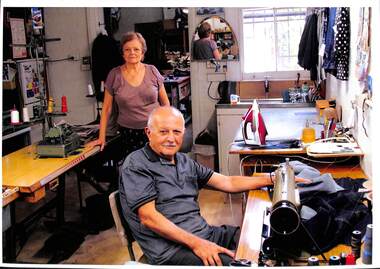
Photograph - Tailoring workroom at Elegant Slax, c.2010
... Elegant Slax...Built Environment -Commercial...Business and Traders - Tailors and Clothing...Elegant Slax, in Bay Street where he employed his wife Desi and later also his son George. In this photo of the workroom, Nick is seated at his tailor's bench with Desi standing behind him. The tailoring of men's 'made to measure' clothing...Elegant Slax, in Bay Street where he employed his wife Desi and later also his son George. In this photo of the workroom, Nick is seated at his tailor's bench with Desi standing behind him. The tailoring of men's 'made to measure' clothing ...Until late in the 20th century, retail shops were most often family affairs in which most, if not all, the employees were family members. Nick TSINGOS founded the tailoring business, Elegant Slax, in Bay Street where he employed his wife Desi and later also his son George. In this photo of the workroom, Nick is seated at his tailor's bench with Desi standing behind him. The tailoring of men's 'made to measure' clothing took place in the workroom behind the retail shop. The original photograph was taken as part of the "Postcards from Port' project. This copy was used in a display at Emerald Hill Centre in May 2026.Copy of a coloured photograph of Nick TSINGOS & his wife Desi in the tailoring workroom at their shop, Elegant Slax, in Bay Street, Port Melbourne.nick tsingos, desi tsingos, elegant slax, built environment -commercial, business and traders - tailors and clothing -
 Moorabbin Air Museum
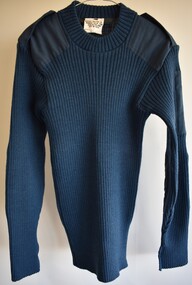
Clothing (item) - Royal Australian Air Force (RAAF) Rib Knit Crew Neck Jumper
... Elegant Knitting Co. Penrith NSW. Dated :1985 8405-66-703-3388 Name: Boydell Royal Australian Air Force (RAAF) Rib Knit Crew Neck Jumper. Clothing ...
