
Showing 13 items matching "elizabeth mccracken"
-
 Federation University Historical Collection
Magazine - Emagazine, Fedpress Magazine, 2016-2019
... ...elizabeth mccracken...Brayne, Dakota Powell, Elizabeth McCracken, Dan Schweinzer, Jordyn Presley, Sarah McLean, Bianca Bedford, Bronwyn Nel, Beck Small, Tara Parada) Issue No. 23, July 2019 (Beck Small, Jasmyne Tziziras, Jodie Flower-Russell, Maxwell Waterhouse, Dhogaluxmi Chemen, Alisha Hendrick, Elizabeth McCraken, Trent Bowes, Will La Grue, Laura Benney, Sir Troy Anthony Platt, Harrod Boadie, Kathryn Drum, Jordyn Presley, Bianca Bedford, Bronwyn Nel, Olly Brayne, Cherise Oosthuizen, Chloe Waddell, Nyalat Pel Kun, Autism Issue No 25 (April 2021) (Jesse Noonan-Wade, Laura Wilson, Chloe Hopkins, Jordyn Presley, Ruby Sait, Lauren Johnson, Kymberley Loats, Darren Rout, Maddison Gill, Baklava, Covid-19 pandemic, exercise...FedPress Magazine prints four issues a year and is distributed across FedUni's Ballarat, Wimmera and Gippsland campuses. fedpress brad paisley selin kasif dakota richards emma gamble damian brown clare hartigan tanya bird freya fogliani scarlett baum amanda mill jess powell feduni quidditch rebecca fletcher bridget o'brien lisa tops jordyn presley jack barnes emma-lee winters brook forrest bianca bedford jessica rae laura wilson laura benney monique stephens kelsey knight sarah mclean liam carter bronwynn nel olly brayne cherise oosthuizen chloe waddell nyalet pel kun trent bowes elizabeth mccracken beck small jasmine tzaitziras jodi flower-russell will la grue laura benny maxwell waterhouse sir troy anthony platt dhogaluxmi chemen jarrod boadle alisha hendrick autism PDFs of the Federation University Magazine 'fedpress'. ...Formerly known as Hotch Potch, FedPress is the student publication of Federation University Australia. FedPress is a space for students to showcase their written and visual talents. The editorial team aim to inform, inspire, and entertain. We are looking for a range of different creative individuals — journalists, reviewers, poets, designers, artists, and photographers — to submit content. FedPress Magazine prints four issues a year and is distributed across FedUni's Ballarat, Wimmera and Gippsland campuses. PDFs of the Federation University Magazine 'fedpress'. Hardcopy of the following years: Issue No 3, October 2014 (Rianh Silvertree, Mathew Lambrou, India McGee, Kayla Elizabeth Stone, Amber Dance, Australian University Games,Amphipipolis Tomb) Issue 4, February 2015 (Kayla Elizabeth Stone. Clubs and Societies, Monash University Gippsland Student Union, Federation University Football Club, Student Senate, Student Connect, Kaitlyn Ashmore, Issue 5, April 2015 (Ellen Sabo, Sexual Education, Gippsland Campus, Monash Campus, Sammy Desai, Zach Mullane, Feduni Living Kakoda Trek) Issue 6, 2015 (Southern University Games, Student Senate, Memories of War Project, Survivors of Suicide, Gippsland Campus, Lucinda Horrocks, Exam Information For Students, Tania McMullenNational Student Leadership Workshop, Mining Games, AUSIMM, The History of MMO, FEdUnied Soccer) Issue 7, July 2015 (PASS - Peer Assisted Study Sessions, Mad Swan Productions, Student Senate, Adam Bignold, Rainh Silvertree, Rebecca Fletcher, Pietro Angeli) Issue 9, October 2015 (Student Senate, Jeannie King, Australian Space Agency, S. Hooley, Rebecca Fletcher, Animal Rights, Breanna Alexander, Pietro Angeli, Jody Dontje, Amanda Mill, Frank Gartlan. Joel King) Issue No 10, 2016 (Unibar, Stone Cutters, Australian Hospitality, Jogy Dontje, Jess Kelly, Pietro Angeli, Getting Through Semester One, Online Student understanding, Liana Skewes, Brianna MacDonald, Student Services, Student Senate, S. Hooley, HECS Help, Ashleigh Dyer, Six things that can cost you easy marks, Laura McLachlan, Surviving grief, Theahna CoburnTenneill Pearl, Rochelle Jardine, Zach Mullane, Dakota Richards, Survival Guide, Scarlette Baum) Issue No 11, May 2016 (Rebecca Fletcher, Joshua Paddon, Hooliganism, Catherine Elliott, Fedpress School of Rock, Dakota Richards, Zach Mullane, Scalette Baum, Clubs, Societies, Sport, FedUni Ultimate Frisbie Club, Geolgoy, Dean DiQuinzio, FedUni Geology Society, Sebastian Wolfe) Issue No 12, 2016 (Crows, Joshua Paddon, Sarah McLean, Fandom, Learn Another Language, Laura McLachlan, Planes, Pietro Angel, Cover Co, mpetition, Megan Corder, Jess Kelly, The Secret Life of Post-Grad Students, Cale Hellyer, What I hate about Facebook, Damian Brown, National Student Vounteer Week, Premnath Chakarvarty, Selin Kasif, Brendan Caffrey, Senate Six, Fed United, Awards, Ultimate Frisbee, Ashleigh Dyer, Cassandra Lovett, Rochelle Jardine, Dakota Richards, Freya Fogliani) Issue No 13, 2016 Issue No. 14, February 2017 Issue No. 15, May 2017 (James Charlton, Rebecca Fletcher, Timothy Kirkham, Mohammad Sami Baardarani, Lajan Maharjan, Jennifer Pont, Kate Williams, Damian Brown, Matthew James, Zoe Ormiston, Freya Fogliani, Myles Hema, Jess Powell) Issue No. 17, October 2017 (Jack Barnes, Damian, Syed Zain Ali, Molly Irvine, Rebecca Fletcher) Issue No. 18, February 2018 (Submission Dates, Guidance for the Shell-Shocked Graduates, Pills, Shark, How to be a Writer, Climate Summit) Issue No. 21, October 2018 (Bianca Bedford, Kelsey Knight, Laura Benney, Rainbow Collective, Smartphone, Sarah McLean, Monique Stephens, Clare Hartigan, Liam Carter) Issue No. 22, March (2018) 2019 (Elizabeth McCracken, Troy Anthony Platt, Liam Carter, O.R. Brayne, Dakota Powell, Elizabeth McCracken, Dan Schweinzer, Jordyn Presley, Sarah McLean, Bianca Bedford, Bronwyn Nel, Beck Small, Tara Parada) Issue No. 23, July 2019 (Beck Small, Jasmyne Tziziras, Jodie Flower-Russell, Maxwell Waterhouse, Dhogaluxmi Chemen, Alisha Hendrick, Elizabeth McCraken, Trent Bowes, Will La Grue, Laura Benney, Sir Troy Anthony Platt, Harrod Boadie, Kathryn Drum, Jordyn Presley, Bianca Bedford, Bronwyn Nel, Olly Brayne, Cherise Oosthuizen, Chloe Waddell, Nyalat Pel Kun, Autism Issue No 25 (April 2021) (Jesse Noonan-Wade, Laura Wilson, Chloe Hopkins, Jordyn Presley, Ruby Sait, Lauren Johnson, Kymberley Loats, Darren Rout, Maddison Gill, Baklava, Covid-19 pandemic, exercisefedpress, brad paisley, selin kasif, dakota richards, emma gamble, damian brown, clare hartigan, tanya bird, freya fogliani, scarlett baum, amanda mill, jess powell, feduni quidditch, rebecca fletcher, bridget o'brien, lisa tops, jordyn presley, jack barnes, emma-lee winters, brook forrest, bianca bedford, jessica rae, laura wilson, laura benney, monique stephens, kelsey knight, sarah mclean, liam carter, bronwynn nel, olly brayne, cherise oosthuizen, chloe waddell, nyalet pel kun, trent bowes, elizabeth mccracken, beck small, jasmine tzaitziras, jodi flower-russell, will la grue, laura benny, maxwell waterhouse, sir troy anthony platt, dhogaluxmi chemen, jarrod boadle, alisha hendrick, autism -
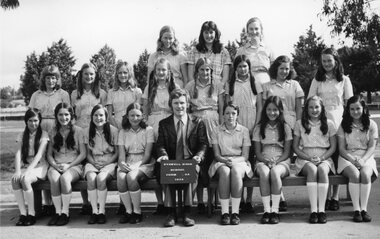 Stawell Historical Society Inc
Photograph, Stawell High School 1973, 1973
... 6975-32 Stawell High School Form 3A, 1973 Form Teacher Mr Kruger Back Row, Julie Start, Robyn Murphy, Kerryn Slater Middle Row, Christine Slorach, Julie Martin, Pam Robson, Pamela Guy, Judy Jeffery, Ruth West, Elizabeth McCracken, Helen McAllister, Front Row, Karen Vendee, Poppy Mangana. ...6975-32 Stawell High School Form 3A, 1973 Form Teacher Mr Kruger Back Row, Julie Start, Robyn Murphy, Kerryn Slater Middle Row, Christine Slorach, Julie Martin, Pam Robson, Pamela Guy, Judy Jeffery, Ruth West, Elizabeth McCracken, Helen McAllister, Front Row, Karen Vendee, Poppy Mangana. ...6975-32 Stawell High School Form 3A, 1973 Form Teacher Mr Kruger Back Row, Julie Start, Robyn Murphy, Kerryn Slater Middle Row, Christine Slorach, Julie Martin, Pam Robson, Pamela Guy, Judy Jeffery, Ruth West, Elizabeth McCracken, Helen McAllister, Front Row, Karen Vendee, Poppy Mangana. Margaret van Leeuwan, Wendy Mason, Mr Kruger, Julie Roe, Zanda Seng-Hpa, Geraldine Rathgeber, Angela Hayes. Students and Teacher Class Photo in front of OvalStawell High School Form 3A 1973education -
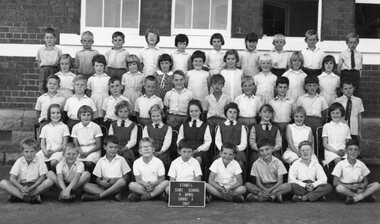 Stawell Historical Society Inc
Photograph, Stawell State School 1967, 1967
... Second Row, Pamela Guy, Lyn Watson, Lynne Bonney, Karla Eldridge, Jilleen Jenkins, Elizabeth McCracken, Debra Bell, Kim Pickering, Robin Whelan, Third Row, Stuart McClure, Russell Jennings, Andrew Allam, Graham Deans, David Allam, Gordon Green, John Scott, Clinton Cathro, Paul Landon, Raymond Scott, Fourth Row, Jean Peters, Judith Jeffrey, Wendy Mason. ...Second Row, Pamela Guy, Lyn Watson, Lynne Bonney, Karla Eldridge, Jilleen Jenkins, Elizabeth McCracken, Debra Bell, Kim Pickering, Robin Whelan, Third Row, Stuart McClure, Russell Jennings, Andrew Allam, Graham Deans, David Allam, Gordon Green, John Scott, Clinton Cathro, Paul Landon, Raymond Scott, Fourth Row, Jean Peters, Judith Jeffrey, Wendy Mason. ...6975-27 Stawell State School Grade 3, 11 April 1967 Teacher Mr Neumann Top Row, left to right, Ian McKellar, Reg Bach, Greg Yanner, Meredith Tangey, Karen Vendy, Joy Oliver, Jenny O'Neill, James Delley, Stephen Quarrell, Michelle Pyke. Second Row, Pamela Guy, Lyn Watson, Lynne Bonney, Karla Eldridge, Jilleen Jenkins, Elizabeth McCracken, Debra Bell, Kim Pickering, Robin Whelan, Third Row, Stuart McClure, Russell Jennings, Andrew Allam, Graham Deans, David Allam, Gordon Green, John Scott, Clinton Cathro, Paul Landon, Raymond Scott, Fourth Row, Jean Peters, Judith Jeffrey, Wendy Mason. Kristine Slorach, Suzanne Overall, Susan Prior, Deborah Giles, Julie Ross, Gayle Redford, Fifth Row, Rodney Young, Ian Longmore, Ronald Fry, Alan Marshall, Andrew Adamson, Jeffrey Clowes, David Hooper, Peter Delley, Stephen Taylor, teacher, Mr Neumann. Students and Teacher Grade 3 1967Stawell State School Grade 3 1967education -
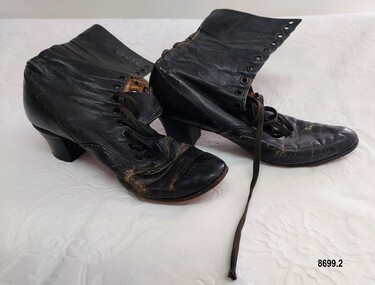 Flagstaff Hill Maritime Museum and Village
Footwear - Leather boots, Adler Boots and Shoes, circa 1920
... McCracken Street, Kensington, Melbourne. Matthew Stephenson (1861 – 1943) who had grown up on the Bendigo goldfields and shifted to Melbourne in the early 1900’s was a train driver and later, a fireman with the railways. His wife Elizabeth...McCracken Street, Kensington, Melbourne. Matthew Stephenson (1861 – 1943) who had grown up on the Bendigo goldfields and shifted to Melbourne in the early 1900’s was a train driver and later, a fireman with the railways. His wife Elizabeth ...This item is one of a collection of clothing items that belonged to the Stephenson family who lived at 22 McCracken Street, Kensington, Melbourne. Matthew Stephenson (1861 – 1943) who had grown up on the Bendigo goldfields and shifted to Melbourne in the early 1900’s was a train driver and later, a fireman with the railways. His wife Elizabeth Jane (Betsy) Wigley (1865 – 1953) also grew up on the goldfields around Majorca and Bendigo. They married in 1885 in Bendigo. They had two daughters – Ethel Evelyn Stephenson (1886 – 1956) and Lillian or Lila (1891 – 1977) who were milliners and dressmakers and who continued to live in the family home after the death of their parents. The family are recorded as living at 22 McCracken Street, Kensington, as early as 1914. It is not known who made or owned the clothing that makes up this collection but as it appears to be from the late Victorian and early Edwardian era, the different pieces were probably made and worn by any of the three ladies of the house – Betsy, Ethel and/or Lila. During W.W.2, a local Warrnambool couple (Meryl and Tony Everard) boarded with them – Tony was in the airforce training paratroopers to jump into (and survive) enemy territory and his wife Meryl worked in the Methodist baby Home. The Everards developed a close friendship with the Stephensons and were responsible for clearing out the house (and finding this clothing collection) after Lila died in 1977. Starting in around 1850, women began wearing boots that resembled the ones already worn by men in high society. Victorian women's boots were slightly more feminine in nature, however, than those worn by their male counterparts. The boots first worn by women extended to the middle of the calf so that her ankle would stay properly covered underneath her many skirts. These boots often featured laces or a row of buttons to keep them secure to the foot and ankle. Although usually made from durable materials like rubber and leather, boots that were worn purely for fashion were sometimes made of more elegant materials like patent leather or dyed suede. Edwardian boots were lace up or button up. The most remarkable thing about women's shoes in the 1920's was that they were visible! This led to an increase in demand for new styles every season which made ordering custom fit shoes a thing of the past. New shoes were made in standard sizes, ready to buy from local clothing stores or mail order catalogues. Working women, however, tended to wear sensible, lace up shoes and boots. These boots appear to be of a practical nature, designed for comfort, warmth, and proof against the rain and mud, rather than high fashion. They feature the brand name "adler" printed on the inner sole and have stamped letters and numbers suggesting ready-made sizes.This pair of boots are a significant example of a working woman's footwear dating around the early 20th century.Pair of lady's black leather, lace up boots featuring 3.75 cm heels, 14 pairs of lacing eyelets, a black leather tongue and black shoelaces. The leather soles have tacks on the heels and near the instep. The boots have a black leather inner sole and the inner shaft and upper part of the boots are lined with a durable cotton type fabric. Both boots have ink markings (handwritten and stamped) at the top of the shaft lining and the inner sole of the left hand boot is labelled "adler".Both boots - "0/128 /X" (handwritten) and "6MC200" (stamped). Left boot inner sole - "adler" left boot upper shaft lining - "X/8FH?" (handwritten)flagstaff hill maritime museum and village, great ocean road, shipwreck coast, warrnambool, boots, lady's boots, footwear, leather boots, lace up boots, adler, stephenson family -
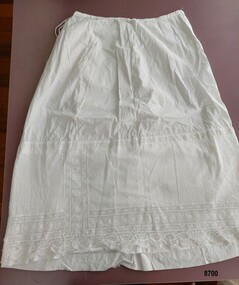 Flagstaff Hill Maritime Museum and Village
Textile - Petticoat, circa 1900
... McCracken Street, Kensington, Melbourne. Matthew Stephenson (1861 – 1943) who had grown up on the Bendigo goldfields and shifted to Melbourne in the early 1900’s was a train driver and later, a fireman with the railways. His wife Elizabeth...McCracken Street, Kensington, Melbourne. Matthew Stephenson (1861 – 1943) who had grown up on the Bendigo goldfields and shifted to Melbourne in the early 1900’s was a train driver and later, a fireman with the railways. His wife Elizabeth ...This item is one of a collection of clothing items that belonged to the Stephenson family who lived at 22 McCracken Street, Kensington, Melbourne. Matthew Stephenson (1861 – 1943) who had grown up on the Bendigo goldfields and shifted to Melbourne in the early 1900’s was a train driver and later, a fireman with the railways. His wife Elizabeth Jane (Betsy) Wigley (1865 – 1953) also grew up on the goldfields around Majorca and Bendigo. They married in 1885 in Bendigo. They had two daughters – Ethel Evelyn Stephenson (1886 – 1956) and Lillian or Lila (1891 – 1977) who were milliners and dressmakers and who continued to live in the family home after the death of their parents. The family are recorded as living at 22 McCracken Street, Kensington, as early as 1914. It is not known who made or owned the clothing that makes up this collection but as it appears to be from the late Victorian and early Edwardian era, the different pieces were probably made and worn by any of the three ladies of the house – Betsy, Ethel and/or Lila. During W.W.2, a local Warrnambool couple (Meryl and Tony Everard) boarded with them – Tony was in the airforce training paratroopers to jump into (and survive) enemy territory and his wife Meryl worked in the Methodist baby Home. The Everards developed a close friendship with the Stephensons and were responsible for clearing out the house (and finding this clothing collection) after Lila died in 1977. A petticoat is a lady's undergarment - worn under a skirt or dress. They provided warmth, modesty and shape to the dress. In the middle of the 19th century, petticoats were worn over hoops, bustles or in layers. Petticoats varied according to the style of the outside skirt or dress. Plain petticoats tended to be worn with everyday wear whilst better dresses (party dresses or silk gowns) were worn with petticoats that often had more trim and embellishments. Edwardian petticoats had less volume than Victorian era petticoats and they had a "dust ruffle" or lining under a lace flounce. The "dust ruffle" protected the lace flounce and gave the petticoat more flare at the bottom, greater freedom when walking as well as saving the flounce (which was often made of finer material) from everyday wear and tear. Tucks are another feature of Edwardian petticoats - when the lace at the bottom became worn, it could be cut off and the tucks released. This extended the life of the petticoat. This petticoat features an intricate trim of broderie anglaise. Although broderie anglaise was a lace that could be made by hand, it was very time consuming to make. St Gallen was a city in Switzerland that had become known for producing quality textiles. At the beginning of the 19th century, the first embroidery machines were developed in St Gallen. Factories used embroidery machines but people also had them in their homes. They were able to produce broderie anglaise for export. By the early 20th century, machine made lace, fabric, ribbons etc. were being sold in drapers shops all over England and Wales to women who were making clothes and furnishings for their families. It is highly likely that the lady who made this petticoat brought the lengths of broderie anglaise already made to embellish and personalise her petticoat.This item is an example of the needlework skills of women in the late 19th century - creating pintucks and adding lace to personalise and embellish a practical item of clothing. A lady's fine cotton and lace ankle length petticoat featuring a deep decorative hem made from sheer pinspot fabric and bands of eyelet lace. The top section of the petticoat is made from five sections of fine cotton sewn together with french seams and gathered with pleats and darts into the waistband. The waistband opening has two button holes and one button (the top button is missing) and a front section with a drawstring. The lace hem is lined with the same fine cotton as the top of the petticoat. There are three different lace bands - a narrow one featuring small flowers, a similar wider band with larger flowers and it is finished at the bottom with a broad band of lace with an intricate leaf design.flagstaff hill maritime museum and village, great ocean road, warrnambool, shipwreck coast, petticoat, lady's petticoat, broderie anglaise, decorative petticoat, draw string waist, machine sewn, dressmaker, stephenson family, pintucks, needlework -
 Flagstaff Hill Maritime Museum and Village
Textile - Overskirt, circa 1910
... McCracken Street, Kensington, Melbourne. Matthew Stephenson (1861 – 1943) who had grown up on the Bendigo goldfields and shifted to Melbourne in the early 1900’s was a train driver and later, a fireman with the railways. His wife Elizabeth...McCracken Street, Kensington, Melbourne. Matthew Stephenson (1861 – 1943) who had grown up on the Bendigo goldfields and shifted to Melbourne in the early 1900’s was a train driver and later, a fireman with the railways. His wife Elizabeth ...This item is one of a collection of clothing items that belonged to the Stephenson family who lived at 22 McCracken Street, Kensington, Melbourne. Matthew Stephenson (1861 – 1943) who had grown up on the Bendigo goldfields and shifted to Melbourne in the early 1900’s was a train driver and later, a fireman with the railways. His wife Elizabeth Jane (Betsy) Wigley (1865 – 1953) also grew up on the goldfields around Majorca and Bendigo. They married in 1885 in Bendigo. They had two daughters – Ethel Evelyn Stephenson (1886 – 1956) and Lillian or Lila (1891 – 1977) who were milliners and dressmakers and who continued to live in the family home after the death of their parents. The family are recorded as living at 22 McCracken Street, Kensington, as early as 1914. It is not known who made or owned the clothing that makes up this collection but as it appears to be from the late Victorian and early Edwardian era, the different pieces were probably made and worn by any of the three ladies of the house – Betsy, Ethel and/or Lila. During W.W.2, a local Warrnambool couple (Meryl and Tony Everard) boarded with them – Tony was in the airforce training paratroopers to jump into (and survive) enemy territory and his wife Meryl worked in the Methodist baby Home. The Everards developed a close friendship with the Stephensons and were responsible for clearing out the house (and finding this clothing collection) after Lila died in 1977. This overskirt is an outer protective garment made of durable cotton and was probably worn over a lady's skirt or dress to protect it whilst they were working. The pockets are large enough for the wearer to keep small items in and there is a loop at the back that would allow the wearer to hang it on a hook, when she finished her work. This item is an example of clothing worn by working women in the late 19th and early 20th centuryA heavy cotton ankle length overskirt made with two wide gored sections containing inset pockets joined to a middle T shaped front band. It has a waistband of grosgrain ribbon and a side opening with 3 pairs of metal snaps (one pair is missing) and a hook and eye at the top. The waistband also has a taped loop (for hanging) and an unusual double fabric overlay with unattached curved ends.flagstaff hill maritime museum and village, great ocean road, shipwreck coast, warrnambool, overskirt, needlework, sewing, protective garment, stephenson family -
 Flagstaff Hill Maritime Museum and Village
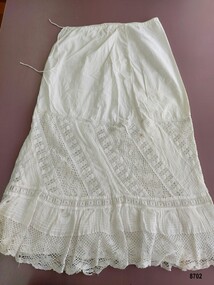
Textile - Petticoat, circa 1910
... McCracken Street, Kensington, Melbourne. Matthew Stephenson (1861 – 1943) who had grown up on the Bendigo goldfields and shifted to Melbourne in the early 1900’s was a train driver and later, a fireman with the railways. His wife Elizabeth...McCracken Street, Kensington, Melbourne. Matthew Stephenson (1861 – 1943) who had grown up on the Bendigo goldfields and shifted to Melbourne in the early 1900’s was a train driver and later, a fireman with the railways. His wife Elizabeth ...This item is one of a collection of clothing items that belonged to the Stephenson family who lived at 22 McCracken Street, Kensington, Melbourne. Matthew Stephenson (1861 – 1943) who had grown up on the Bendigo goldfields and shifted to Melbourne in the early 1900’s was a train driver and later, a fireman with the railways. His wife Elizabeth Jane (Betsy) Wigley (1865 – 1953) also grew up on the goldfields around Majorca and Bendigo. They married in 1885 in Bendigo. They had two daughters – Ethel Evelyn Stephenson (1886 – 1956) and Lillian or Lila (1891 – 1977) who were milliners and dressmakers and who continued to live in the family home after the death of their parents. The family are recorded as living at 22 McCracken Street, Kensington, as early as 1914. It is not known who made or owned the clothing that makes up this collection but as it appears to be from the late Victorian and early Edwardian era, the different pieces were probably made and worn by any of the three ladies of the house – Betsy, Ethel and/or Lila. During W.W.2, a local Warrnambool couple (Meryl and Tony Everard) boarded with them – Tony was in the airforce training paratroopers to jump into (and survive) enemy territory and his wife Meryl worked in the Methodist baby Home. The Everards developed a close friendship with the Stephensons and were responsible for clearing out the house (and finding this clothing collection) after Lila died in 1977. A petticoat is a lady's undergarment - worn under a skirt or dress. They provided warmth, modesty and shape to the dress. In the middle of the 19th century, petticoats were worn over hoops, bustles or in layers. Petticoats varied according to the style of the outside skirt or dress. Plain petticoats tended to be worn with everyday wear whilst better dresses (party dresses or silk gowns) were worn with petticoats that often had more trim and embellishments. Edwardian petticoats had less volume than Victorian era petticoats and they had a "dust ruffle" or lining under a lace flounce. The "dust ruffle" protected the lace flounce and gave the petticoat more flare at the bottom, greater freedom when walking as well as saving the flounce (which was often made of finer material) from everyday wear and tear. Tucks are another feature of Edwardian petticoats - when the lace at the bottom became worn, it could be cut off and the tucks released. This extended the life of the petticoat. This petticoat features an intricate trim of broderie anglaise. Although broderie anglaise was a lace that could be made by hand, it was very time consuming to make. St Gallen was a city in Switzerland that had become known for producing quality textiles. At the beginning of the 19th century, the first embroidery machines were developed in St Gallen. Factories used embroidery machines but people also had them in their homes. They were able to produce broderie anglaise for export. By the early 20th century, machine made lace, fabric, ribbons etc. were being sold in drapers shops all over England and Wales to women who were making clothes and furnishings for their families. It is highly likely that the lady who made this petticoat brought the lengths of broderie anglaise already made to embellish and personalise her petticoat.This item is an example of the needlework skills of women in the late 19th century - creating pintucks and adding lace to personalise and embellish a practical item of clothing.A lady's ankle length petticoat made in three sections. The top section is made from three rectangles of fine cotton (batiste) joined into a round with narrow french seams and inserted into a simple drawstring waistband with a small opening. The second section is made with rows of alternating strips of fine pin tucked lawn, white cotton cut work embroidery and a wider cotton lace design all joined in a diagonal pattern and lined with fine lawn. The bottom section of the petticoat has a horizontal strip of eyelet lace followed by a wider strip of fine pin tucked lawn and is finished with a deep hem of white cotton crocheted lace fabric and has the same lawn lining as the section above.flagstaff hill maritime museum and village, great ocean road, shipwreck coast, warrnambool, petticoat, lady's petticoat, needlework, sewing, broderie anglaise, stephenson family, drawstring waistband -
 Flagstaff Hill Maritime Museum and Village
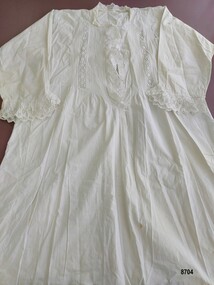
Textile - Nightgown, Circa 1900
... McCracken Street, Kensington, Melbourne. Matthew Stephenson (1861 – 1943) who had grown up on the Bendigo goldfields and shifted to Melbourne in the early 1900’s was a train driver and later, a fireman with the railways. His wife Elizabeth...McCracken Street, Kensington, Melbourne. Matthew Stephenson (1861 – 1943) who had grown up on the Bendigo goldfields and shifted to Melbourne in the early 1900’s was a train driver and later, a fireman with the railways. His wife Elizabeth ...This item is one of a collection of clothing items that belonged to the Stephenson family who lived at 22 McCracken Street, Kensington, Melbourne. Matthew Stephenson (1861 – 1943) who had grown up on the Bendigo goldfields and shifted to Melbourne in the early 1900’s was a train driver and later, a fireman with the railways. His wife Elizabeth Jane (Betsy) Wigley (1865 – 1953) also grew up on the goldfields around Majorca and Bendigo. They married in 1885 in Bendigo. They had two daughters – Ethel Evelyn Stephenson (1886 – 1956) and Lillian or Lila (1891 – 1977) who were milliners and dressmakers and who continued to live in the family home after the death of their parents. The family are recorded as living at 22 McCracken Street, Kensington, as early as 1914. It is not known who made or owned the clothing that makes up this collection but as it appears to be from the late Victorian and early Edwardian era, the different pieces were probably made and worn by any of the three ladies of the house – Betsy, Ethel and/or Lila. During W.W.2, a local Warrnambool couple (Meryl and Tony Everard) boarded with them – Tony was in the airforce training paratroopers to jump into (and survive) enemy territory and his wife Meryl worked in the Methodist baby Home. The Everards developed a close friendship with the Stephensons and were responsible for clearing out the house (and finding this clothing collection) after Lila died in 1977. This nightgown is machine sewn and has an added detailed design of pintucks and broderie anglaise lace to the front yoke and cuffs as a decorative element. The 1800's bought a shift in attitude towards modesty as the Victorian era progressed and by the mid to late 1800's it had become more acceptable ladies to wear simple, modest nightgowns. They tended to have a very loose fit and were usually made of linen, cotton or flannel, which had the advantage of providing warmth and also being easy to wash - a necessity for a garment worn next to the skin. Although the basic design of the nightgown was fairly simple, the wearer was free to add various types of trim e.g. lace, crochet, pintucks, embroidery etc.This item is an example of the needlework skills of women in the late 19th and early 20th century - combining machine stitching with hand embroidery to personalise and embellish a practical item of clothing. A full length lady's cotton nightgown with long sleeves finished with a diagonal pointed cuff of broderie anglaise. The bodice features a front opening placket with 3 buttons and buttonholes and a broderie anglaise cover. On either side of the placket, the bodice has been decorated with rows of vertical pintucks and a broderie anglaise panel insert. There is also a frill of broderie anglaise lace around the neck. The back of the nightgown is gathered onto a yoke.flagstaff hill maritime museum and village, great ocean road, shipwreck coast, warrnambool, nightgown, lady's nightgown, needlework, sewing, broderie anglaise, pintucks, stephenson family -
 Flagstaff Hill Maritime Museum and Village
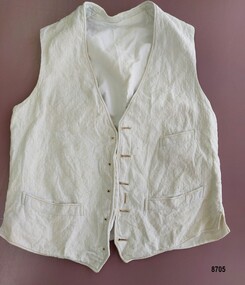
Textile - Waistcoat, circa 1910
... McCracken Street, Kensington, Melbourne. Matthew Stephenson (1861 – 1943) who had grown up on the Bendigo goldfields and shifted to Melbourne in the early 1900’s was a train driver and later, a fireman with the railways. His wife Elizabeth...McCracken Street, Kensington, Melbourne. Matthew Stephenson (1861 – 1943) who had grown up on the Bendigo goldfields and shifted to Melbourne in the early 1900’s was a train driver and later, a fireman with the railways. His wife Elizabeth ...This item is one of a collection of clothing items that belonged to the Stephenson family who lived at 22 McCracken Street, Kensington, Melbourne. Matthew Stephenson (1861 – 1943) who had grown up on the Bendigo goldfields and shifted to Melbourne in the early 1900’s was a train driver and later, a fireman with the railways. His wife Elizabeth Jane (Betsy) Wigley (1865 – 1953) also grew up on the goldfields around Majorca and Bendigo. They married in 1885 in Bendigo. They had two daughters – Ethel Evelyn Stephenson (1886 – 1956) and Lillian or Lila (1891 – 1977) who were milliners and dressmakers and who continued to live in the family home after the death of their parents. The family are recorded as living at 22 McCracken Street, Kensington, as early as 1914. It is not known who made or owned the clothing that makes up this collection but as it appears to be from the late Victorian and early Edwardian era however the vest was probably made by one of the three ladies of the house, for their husband and father, Matthew Stephenson. During W.W.2, a local Warrnambool couple (Meryl and Tony Everard) boarded with them – Tony was in the airforce training paratroopers to jump into (and survive) enemy territory and his wife Meryl worked in the Methodist baby Home. The Everards developed a close friendship with the Stephensons and were responsible for clearing out the house (and finding this clothing collection) after Lila died in 1977. Although by 1916, men's "ready to wear" clothing were widely available, this waistcoat was handmade (possibly by Matthew's wife or daughters). Men's suits in the early part of the twentieth century were predominantly three piece, consisting of a jacket, vest (or waistcoat) and trousers made from matching fabrics. Some men liked to wear a watch attached to their waistcoat with a fob chain. This item is an example of clothing worn by men on special occasions, in the late 19th and early 20th century.A man's waistcoat with cream cotton weave front pieces and cream cotton lining and back. The left front features five machine worked horizontal buttonholes and one vertical buttonhole (for a fob watch) and two inset pockets. The right hand side has five corresponding stud holes and one inset pocket. The studs or buttons are missing. The lining and back of the waistcoat are made from a plain cream cotton fabric. The back also features a cotton strap with a two pronged metal buckle.flagstaff hill maritime museum and village, great ocean road, shipwreck coast, warrnambool, vest, waistcoat, needlework, sewing, stephenson family, man's waistcoat -
 Flagstaff Hill Maritime Museum and Village
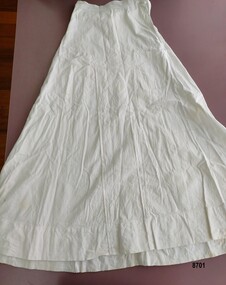
Textile - Skirt, circa 1910
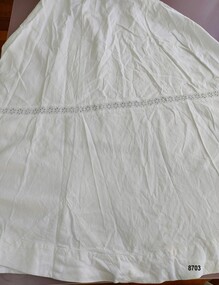
... McCracken Street, Kensington, Melbourne. Matthew Stephenson (1861 – 1943) who had grown up on the Bendigo goldfields and shifted to Melbourne in the early 1900’s was a train driver and later, a fireman with the railways. His wife Elizabeth...McCracken Street, Kensington, Melbourne. Matthew Stephenson (1861 – 1943) who had grown up on the Bendigo goldfields and shifted to Melbourne in the early 1900’s was a train driver and later, a fireman with the railways. His wife Elizabeth ...This item is one of a collection of clothing items that belonged to the Stephenson family who lived at 22 McCracken Street, Kensington, Melbourne. Matthew Stephenson (1861 – 1943) who had grown up on the Bendigo goldfields and shifted to Melbourne in the early 1900’s was a train driver and later, a fireman with the railways. His wife Elizabeth Jane (Betsy) Wigley (1865 – 1953) also grew up on the goldfields around Majorca and Bendigo. They married in 1885 in Bendigo. They had two daughters – Ethel Evelyn Stephenson (1886 – 1956) and Lillian or Lila (1891 – 1977) who were milliners and dressmakers and who continued to live in the family home after the death of their parents. The family are recorded as living at 22 McCracken Street, Kensington, as early as 1914. It is not known who made or owned the clothing that makes up this collection but as it appears to be from the late Victorian and early Edwardian era, the different pieces were probably made and worn by any of the three ladies of the house – Betsy, Ethel and/or Lila. During W.W.2, a local Warrnambool couple (Meryl and Tony Everard) boarded with them – Tony was in the airforce training paratroopers to jump into (and survive) enemy territory and his wife Meryl worked in the Methodist baby Home. The Everards developed a close friendship with the Stephensons and were responsible for clearing out the house (and finding this clothing collection) after Lila died in 1977. This skirt features broderie anglaise trim. Although broderie anglaise was a lace that could be made by hand, it was very time consuming to make. St Gallen was a city in Switzerland that had become known for producing quality textiles. At the beginning of the 19th century, the first embroidery machines were developed in St Gallen. Factories used embroidery machines but people also had them in their homes. They were able to produce broderie anglaise for export. By the early 20th century, machine made lace, fabric, ribbons etc. were being sold in drapers shops all over England and Wales to women who were making clothes and furnishings for their families. It is highly likely that the lady who made this skirt brought the lengths of broderie anglaise already made to embellish and personalise her skirt.This item is an example of the needlework skills of women in the late 19th century - creating pintucks and adding lace to personalise and embellish a practical item of clothing. A full length lady's skirt of heavy textured ribbed twill cotton. The top of the skirt is made from five pieces of fabric, sewn together and inserted into a simple waistband. It has an opening with room for 6 hook and eyes (but only the middle three remain). The top section of the skirt is separated from the bottom section by a strip of eyelet embroidery that has been inserted in a horizontal line at the back but becomes slightly diagonal at the front causing the two ends to cross in a decorative X fashion. The bottom of the skirt is the same heavy cotton as the top and one seam features a V shaped insert or patch.flagstaff hill maritime museum and village, great ocean road, shipwreck coast, warrnambool, broderie anglaise, needlework, sewing, stephenson family, skirt, lady's skirt -
 Mission to Seafarers Victoria
Flyer, Clare McCracken, The Place Between, 2018
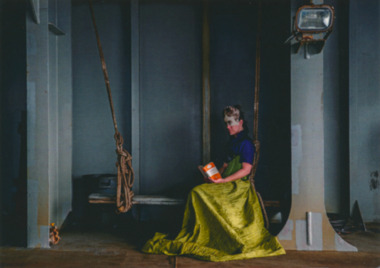
... On the 21st of July 2018, Clare McCracken boarded the ANL Wahroonga container ship to travel to China mirroring her great-great-grandmother's journey from Australia to Asia in 1874. Artist statement from the back of the flyer: "In 1874, my great-great-grandmother, Elizabeth Amy Cathcart Payne, sailed unaccompanied from Australia to Asia, writing a detailed journal of her experiences. ...On the 21st of July 2018, Clare McCracken boarded the ANL Wahroonga container ship to travel to China mirroring her great-great-grandmother's journey from Australia to Asia in 1874. Artist statement from the back of the flyer: "In 1874, my great-great-grandmother, Elizabeth Amy Cathcart Payne, sailed unaccompanied from Australia to Asia, writing a detailed journal of her experiences. ...On the 21st of July 2018, Clare McCracken boarded the ANL Wahroonga container ship to travel to China mirroring her great-great-grandmother's journey from Australia to Asia in 1874. Artist statement from the back of the flyer: "In 1874, my great-great-grandmother, Elizabeth Amy Cathcart Payne, sailed unaccompanied from Australia to Asia, writing a detailed journal of her experiences. This exhibition weaves together sections of her diary with my own voyage from Australia to the world's busiest port, Shanghai. In doing so, The Place Between, is a meditation upon the social and political nature of international trade, the mobility and the place between Australia and the rest of the world in the 19th and 21st century." The Mission has always been open to the community and has a tradition of hosting cultural events: shows, concerts, exhibitions, festivals.Postcard size flyer advertising for an exhibitionthe place between, clare mccracken, cultural events, sea voyage, andrew ferris, arun munoz, video installation -
 Bendigo Historical Society Inc.
Programme - BENDIGO OPERATIC SOCIETY ''BLESS THE BRIDE''
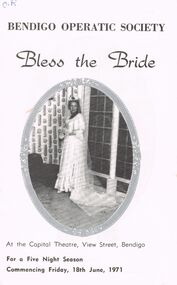
... Cast in Oreder of Appearance: Ruth Iredale as Alice Charity Willow - John Boquest as Cousin George - John Beaumont as Archdeacon Gurney - Carol McKenzie as Lucy Veracity Willow - Fred Trewarne as The Hon Thomas Trout - Coral Rivett as Ann Fidelity Willow - Christine Cavanaugh as Charlott Patience Willow - Jill Barker as Elizabeth Patience Willow - Pamela Duffy as Frances Fortitude Willow - Debra Lockett, Jocelyn Lyon as Millicent Punctuality Willow - Neil Roxburgh as Pierre Fontaine - Patricia McCracken as Suzanne Valois - Ferd Lorenz as Augustus Willow (Lucy's Father) - Bartina Daws as Mary Willow (Lucy's Mother) - Duncan McFarland as Albert Willow (Augustus's Father) - Dorothy Field as Harriet Willow (Grandmama) - Patricia Lyon as Nanny - Karl Steinberg, Shane Brennan as Buttons - Ray Edebone as Chief Gendarme - Fred Veitch as 2nd Gendarme - John Lourens as M. ...Cast in Oreder of Appearance: Ruth Iredale as Alice Charity Willow - John Boquest as Cousin George - John Beaumont as Archdeacon Gurney - Carol McKenzie as Lucy Veracity Willow - Fred Trewarne as The Hon Thomas Trout - Coral Rivett as Ann Fidelity Willow - Christine Cavanaugh as Charlott Patience Willow - Jill Barker as Elizabeth Patience Willow - Pamela Duffy as Frances Fortitude Willow - Debra Lockett, Jocelyn Lyon as Millicent Punctuality Willow - Neil Roxburgh as Pierre Fontaine - Patricia McCracken as Suzanne Valois - Ferd Lorenz as Augustus Willow (Lucy's Father) - Bartina Daws as Mary Willow (Lucy's Mother) - Duncan McFarland as Albert Willow (Augustus's Father) - Dorothy Field as Harriet Willow (Grandmama) - Patricia Lyon as Nanny - Karl Steinberg, Shane Brennan as Buttons - Ray Edebone as Chief Gendarme - Fred Veitch as 2nd Gendarme - John Lourens as M. ...Bendigo Operatic Society ''Bless the Bride'' At the Capital Theatre, View Street, Bendigo for a Five Night Season Commencing Friday 18th June 1971. Producer: Max Collis - Assistant producer, Ballet and Wardrobe: Madge Welch - Society Pianist: Ruth Gorman - Musical Director: Gwen Grose. Cast in Oreder of Appearance: Ruth Iredale as Alice Charity Willow - John Boquest as Cousin George - John Beaumont as Archdeacon Gurney - Carol McKenzie as Lucy Veracity Willow - Fred Trewarne as The Hon Thomas Trout - Coral Rivett as Ann Fidelity Willow - Christine Cavanaugh as Charlott Patience Willow - Jill Barker as Elizabeth Patience Willow - Pamela Duffy as Frances Fortitude Willow - Debra Lockett, Jocelyn Lyon as Millicent Punctuality Willow - Neil Roxburgh as Pierre Fontaine - Patricia McCracken as Suzanne Valois - Ferd Lorenz as Augustus Willow (Lucy's Father) - Bartina Daws as Mary Willow (Lucy's Mother) - Duncan McFarland as Albert Willow (Augustus's Father) - Dorothy Field as Harriet Willow (Grandmama) - Patricia Lyon as Nanny - Karl Steinberg, Shane Brennan as Buttons - Ray Edebone as Chief Gendarme - Fred Veitch as 2nd Gendarme - John Lourens as M. Robert - Michael Filippini as 1st Waiter - John Tonkin as 2nd Waiter - Douglas Sayle as M. Frontenac - John Beaumont as M. Martel. There are two copies of the booklet.program, theatre, bendigo operatic society -
Eltham District Historical Society Inc
Document - Folder, Morris family
... McCracken...Claude Morris...Levinia Morris...John Raymond Morris...Phillis Morris...Lillie Una Morris...Helen Metz...Francis Metz...Elizabeth...John Morris Jane Morris nee Elliott William Tayler Anna Maria Elliott Harriet Morris Jane Wilson nee Neily Samuel Wilson David Boyd Emmaline Wilson John Thomas Johnson Nathaniel Kinsman Ruby Emmeline Wilson Ida May Wilson Charles Alfred Wilson Laura Alma Wilson Sylvia Marguerite Wilson James Aubrey Leonard Wilson Hild Margaret Yeend Joyce Thelma Johnson James Osborne Payne Janet Margaret Payne David Frank Montgomery Andrew David James Montgomery Karen Margaret Montgomery Jane Atkinson nee Morris John Harold Gladstone Wilson Mary Ann Morrison John Anderson Atkinson Amy Morris Clarice Morris Ray Morris William Morris The Fountain of Friendship hotel Eltham Mt Evelyn Hotel Eltham Royal Mail Coaches Janet McColl Albert Morris Alfred George Morris Margaret Kate KcColl Francis Morris Samuel Morris Muriel Catherine Morris Effie Jane Morris Mary Ann McCracken Claude Morris Levinia Morris John Raymond Morris Phillis Morris Lillie Una Morris Helen Metz Francis Metz Elizabeth Morris Joseph Morris Thomas Alfred Morris George Hill Morris Margaret Ellen Morris Clara Lucy Matilda Morris Eltham Cemetery Joshua Ely Charlotte Ely Joseph Paling John R Grubb Harriet Rae nee Wilson Johnston Rae W J Everitt wheelwright and blacksmith E J Coutie butcher Kangaroo Ground P Ryan butcher Diamond Creek Sarah Jane Elliott nee Blunsden Hill Wilson Samuel Elliott Sarah Elliott nee Blunsden Jane Elliott St James Cathedral Melbourne Harriett Morris Rev David Boyd Hill Wilson Neily Samuel Neily Jane Neily Jane Morris Mary Ann Atkinson nee Morris Janet Morris nee McColl Margaret Kate Morris nee McColl Albert George Morris Francis Samuel Morris MaryAnn Morris nee McCraken Phyllis Morris Lily Una Morris Harriett Wilson nee Morris Emmeline Johnson Wilson Emmeline Johnson nee Wilson Ruby Emmeline Johnson Ida May Johnson Charles Alfred Johnson Laura Alma Johnson John Harold Gladstone Johnson Sylvia Marguerite Johnson James Aubrey Leonard Johnson Hilda Margaret Johnson nee Yeend Joyce Thelma Payne nee Johnson Janet Margaret Montgomery nee Payne Newspaper clippings, A4 photocopies, etc Morris family Document Folder ...John and Jane Morris moved to Eltham in 1842 on the site of the present sporting complex in Susan Street. Their daughter Harriet was the first white child born in the area. Contents Manuscript family tree of Morris family. Newspaper advertisement: The Evelyn Observer, 10 January 1902. Eltham Butcher, William Morris. Letter: Enid Delbridge to ElthamShire Council, 15 November 1966. Seeing information on Mary Ann Morris. Letter: Eltham Shire Secretary to Enid Delbridge. Unable to provide information. Text: Janet Montgomery, April 1989: The History of Morris Family of Eltham Victoria. Text: Notes taken from Janet Montgomery, April 1989. Summary of The History of Morris Family of Eltham Victoria. Text: Harry Gilham. "William Morris". Notes and photograph of the Evelyn Hotel and William Morris. Email: Owen Pitts to Eltham District Historical Society. Providing information on the Morris family and seeking more.Newspaper clippings, A4 photocopies, etcjohn morris, jane morris nee elliott, william tayler, anna maria elliott, harriet morris, jane wilson nee neily, samuel wilson, david boyd, emmaline wilson, john thomas johnson, nathaniel kinsman, ruby emmeline wilson, ida may wilson, charles alfred wilson, laura alma wilson, sylvia marguerite wilson, james aubrey leonard wilson, hild margaret yeend, joyce thelma johnson, james osborne payne, janet margaret payne, david frank montgomery, andrew david james montgomery, karen margaret montgomery, jane atkinson nee morris, john harold gladstone wilson, mary ann morrison, john anderson atkinson, amy morris, clarice morris, ray morris, william morris, the fountain of friendship hotel eltham, mt evelyn hotel eltham, royal mail coaches, janet mccoll, albert morris, alfred george morris, margaret kate kccoll, francis morris, samuel morris, muriel catherine morris, effie jane morris, mary ann mccracken, claude morris, levinia morris, john raymond morris, phillis morris, lillie una morris, helen metz, francis metz, elizabeth morris, joseph morris, thomas alfred morris, george hill morris, margaret ellen morris, clara lucy matilda morris, eltham cemetery, joshua ely, charlotte ely, joseph paling, john r grubb, harriet rae nee wilson, johnston rae, w j everitt wheelwright and blacksmith, e j coutie butcher kangaroo ground, p ryan butcher diamond creek, sarah jane elliott nee blunsden, hill wilson, samuel elliott, sarah elliott nee blunsden, jane elliott, st james cathedral melbourne, harriett morris, rev david boyd, hill wilson neily, samuel neily, jane neily, jane morris, mary ann atkinson nee morris, janet morris nee mccoll, margaret kate morris nee mccoll, albert george morris, francis samuel morris, maryann morris nee mccraken, phyllis morris, lily una morris, harriett wilson nee morris, emmeline johnson wilson, emmeline johnson nee wilson, ruby emmeline johnson, ida may johnson, charles alfred johnson, laura alma johnson, john harold gladstone johnson, sylvia marguerite johnson, james aubrey leonard johnson, hilda margaret johnson nee yeend, joyce thelma payne nee johnson, janet margaret montgomery nee payne
