
Showing 46 items matching "embossed leather paper"
-
 Flagstaff Hill Maritime Museum and Village
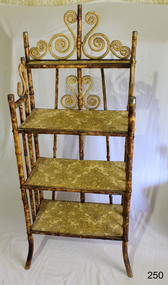
Furniture - Shelves, A. Englander & Searle, Late 19th Century (1898)
... ...embossed leather paper...Shelves were often covered with embossed leather paper designs, at first imported from Japan and then later produced in England. ...Shelves are covered with embossed leather paper. Frame is made from tortoise shell bamboo (brown lacquer applied to simulate tortoise shell appearance). ...Shelves were often covered with embossed leather paper designs, at first imported from Japan and then later produced in England. ...This music stand set of shelves is one of many 19th century items of furniture, linen and crockery donated to Flagstaff Hill Maritime Village by, Vera and Aurelin Giles. The items are associated with the Giles Family and are known as the “Giles Collection”. Many of the items of furniture, linen and crockery in the Lighthouse Keeper’s Cottage were donated by Vera and Aurelin Giles and mostly came from the simple home of Vera’s parents-in-law, Henry Giles and his wife Mary Jane (nee Freckleton) whose photos are in the parlour. They married in 1880. Henry, born at Tower Hill in 1858, was a labourer on the construction of the Breakwater before leaving in 1895 to build bridges in N.S.W. for about seven years. Mary Jane was born in 1860 at Cooramook. She attended Mailor’s Flat State School where she was also a student teacher before, as family legend has it, she became a governess at “Injemiara” where her grandfather, Francis Freckleton, once owned land. Henry and Mary’s family of six, some of whom were born at Mailor’s Flat and later children at Wangoom, lived with their parents at Wangoom and Purnim west, where Henry died in 1933 and Mary Jane in 1940. THE SHELVES During the years 1869-1935 there were well over 250 registered bamboo furniture producers in Britain. The earliest recorded firm was Hubert Bill of 14 Little Camden St, London N.W., who claimed to have been established in (1869 the first bamboo furniture maker), while Daniel Jacobs & Sons of Hackney Road, London, were still in business in 1915, after 45 years of production. Design, quality, price and methods of construction were fairly consistent throughout the whole period, but it was the imaginative and often eccentric choice of subject matter that marked the differentiation between the various firms. While most produced standard tables, stands and fire-screens, the more adventurous offered for sale items such as Corner shelve units, charcoal barbecue grills and musical tea tables. Shelves were often covered with embossed leather paper designs, at first imported from Japan and then later produced in England. Some firms incorporated the knobbly roots of the bamboo stems into their designs, generally to form feet. Occasionally handles to drawers and cupboards were made with these roots although they were more commonly carved as imitations. Handles were mostly of cheap metal or brass. The ends of the bamboo canes were capped with stamped metal or turned bone, ivory or wooden discs. Methods of construction fell into three categories. First and most common is that of pegging. Bamboo stems being hollow, thick dowels can easily be glued into the joints. Some firms farmed out this work of `plugging' the ends of the canes to part-time workers at home. The second method, that of pinning, was far less satisfactory as bamboo tends to split lengthwise and therefore the jointed pieces eventually disintegrated. The most efficient method was that patented in 1888 (patent No 2383) by the firm of W. F. Needham in Birmingham. It consisted of metal shoes and covers for all joints which were made by wrapping a metal strip around the stems and soldering the overlapping ends. Some joints were further strengthened by a small pin or screw. Needham was by far the largest and most successful manufacturer and their individual and superior method of construction undoubtedly gained them their reputation. A. Englander & Searle of 34 Gt Eastern St and 31 Mare St, Hackney, London, were a firm particularly concerned with methods of construction. Although they seem to have entered the bamboo furniture market at a comparatively late date, about 1898, they produced inexpensive bamboo, aimed particularly at the export trade. The company stated in their catalogue that bamboo furniture “can be exported in one piece or it can be exported in pieces and put together again. The fixing up is much facilitated by a system of marking and numbering. Further, no glue is required for putting together as the screw system only is applied”. This method of construction best fits the Etagere in the Flagstaff collection and it is believed to have been made by A Englander & Searle, exported in a knock down form to Australia, purchased in kit form from a dealer hear and put together by the owner. The Etagere is a significant item as it highlight furniture fashion of the late Victorian era. This item was highly sort after in its time and although mass produced, not many examples remain, so this example is a valuable addition to the Flagstaff collection. It is believed that the construction method used is by a notable and respected maker of bamboo furniture and that its production was aimed at the export market and probably came to Australia in kit form.Bamboo shelves: decorative free standing Etagere comprising three large shelves and one small shelf. Shelves are made of wood used to store either orange or bacon boxes (as there are no knots in the wood, imported from South America and cheap to recycle). Shelves are covered with embossed leather paper. Frame is made from tortoise shell bamboo (brown lacquer applied to simulate tortoise shell appearance). Ends of bamboo canes are covered with metal shoes and fixed with a pin. Other bamboo joints are fixed with round head steel screws. This item is part of the Giles Collection.Noneflagstaff hill, warrnambool, shipwrecked-coast, flagstaff-hill, flagstaff-hill-maritime-museum, maritime-museum, shipwreck-coast, flagstaff-hill-maritime-village, bamboo shelves, bamboo etagere, victorian furniture, furniture, bamboo furniture, embossed leather paper, simulated bamboo, tortise shell, a englander & searle, giles collection, henry giles, tower hill, cooramook, warrnambool breakwater, mailor’s flat, wangoom, 19th century furniture -
 Flagstaff Hill Maritime Museum and Village
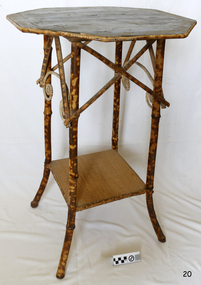
Furniture - Plant Stand, 1880
... Shelves were often covered with embossed leather paper designs, at first imported from Japan and then later produced in England. ...Shelves were often covered with embossed leather paper designs, at first imported from Japan and then later produced in England. ...During the years 1869-1935, there were well over 250 registered bamboo furniture producers in Britain. The earliest recorded firm was Hubert Bill of 14 Little Camden St, London N.W., who claimed to have been established in 1869, while Daniel Jacobs & Sons of Hackney Road, London, were still in business in 1915, after 45 years of production. Design, quality, price and methods of construction were fairly consistent throughout the whole period, but it was the imaginative and often eccentric choice of subject matter that marked differentiation between the various firms. While most produced standard tables, stands and fire-screens, the more adventurous offered for sale items such as corner shelve units, charcoal barbecue grills and musical tea tables. Shelves were often covered with embossed leather paper designs, at first imported from Japan and then later produced in England. Some firms incorporated the knobbly roots of the bamboo stems into their designs, generally to form feet. Occasionally, handles to drawers and cupboards were made with these roots, although they were more commonly carved as imitations. Handles were mostly of cheap metal or brass. The ends of the bamboo canes were capped with stamped metal or turned bone, ivory or wooden discs. Methods of construction fell into three categories. First and most common is that of pegging. Bamboo stems being hollow, thick dowels can easily be glued into the joints. Some firms farmed out this work of `plugging' the ends of the canes to part-time workers at home. The second method, that of pinning, was far less satisfactory as bamboo tends to split lengthwise and therefore the jointed pieces eventually disintegrated. The most efficient method was that patented in 1888 (patent No. 2383) by the firm of W. F. Needham in Birmingham. It consisted of metal shoes and covers for all joints, which were made by wrapping a metal strip around the stems and soldering the overlapping ends. Some joints were further strengthened by a small pin or screw. Needham was by far the largest and most successful manufacturer, and their individual and superior method of construction undoubtedly gained them their reputation. A. Englander & Searle of 34 Gt Eastern St and 31 Mare St, Hackney, London, were a firm particularly concerned with methods of construction. Although they seem to have entered the bamboo furniture market at a comparatively late date, about 1898, they produced inexpensive' bamboo, aimed particularly at the export trade. Stating in their catalogue that bamboo furniture “can be exported in one piece or it can be exported in pieces and put together again. The fixing up is much facilitated by a system of marking and numbering. Further, no glue is required for putting together as the screw system is applied”. This method of construction best fits the Etagere and this item in the Flagstaff collection, and it is believed to have been made by A Englander & Searle, exported in a knock-down form to Australia, purchased in kit form from a dealer here and put together by the purchaser. The bamboo plant stand is a significant item as it highlight furniture fashion of the late Victorian era. This item was highly sort after in its time and although mass produced, not many examples remain because the item is so fragile so this example is a valuable addition to the Flagstaff collection. It is believed,the construction method used is by a notable and respected maker in England of bamboo furniture that was aimed specifically at the export market and probably came to Australia in kit form to be assembled by the purchaser.Plant stand: a bamboo plant stand with a hexagonal pine timber top edged with tortoise shell bamboo. The top is supported on four tortoise shell bamboo legs joined at the base by a square cane-covered shelf. The tortoise shell appearance is brown lacquer. This stand is part of the Giles Collection. flagstaff hill, warrnambool, shipwrecked coast, flagstaff hill maritime museum, shipwreck coast, furniture, plant stand, bamboo furniture, etagere, victorian furniture, simulated bamboo, tortise shell, a englander & searle, domestic furniture, giles collection, henry giles, cooramook, mailor’s flat, wangoom, 19th century household goods -
 Warrnambool and District Historical Society Inc.
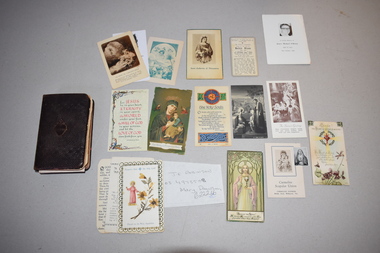
Book, Charles Eason, The Treasury of the Sacred Heart, C1920
... leather cover and gilt edging along the sides of the pages. The front and back cover and spine are embossed with two decorative patterns. The front cover has an embossed heart with flames and a cross and the spine has gold lettering. Some of the pages are loose and some have been re-attached to the binding using adhesive tape. Some of the pages are stained. The book contains black printing and there is one black and white illustration. In the pages of the book were 29 small cards, scraps of paper...leather cover and gilt edging along the sides of the pages. The front and back cover and spine are embossed with two decorative patterns. The front cover has an embossed heart with flames and a cross and the spine has gold lettering. Some of the pages are loose and some have been re-attached to the binding using adhesive tape. Some of the pages are stained. The book contains black printing and there is one black and white illustration. In the pages of the book were 29 small cards, scraps of paper ...This book of prayers was given by the Warrnambool Sisters of Mercy to Dorothy Ardlie on the occasion of her 12th birthday. The Sisters of Mercy came to Warrnambool in 1872 and established St. Mary’s Convent School, Wyton in North Warrnambool (re-named St. Ann’s in 1888). This school merged with the Christian Brothers College in 1990 to form the present-day Emmanuel College. The Sisters of Mercy ceased active involvement with the school in the 1990s. Dorothy Ardlie (1910-1993) and her sister Agnes Ardlie (1915-1993) were the daughters of Arthur and Ethel Ardlie of Warrnambool, the granddaughters of the prominent Warrnambool lawyer William Ardlie and his wife Mary and the great granddaughters of John and Mary Ardlie, pioneer settlers in Warrnambool. This book and the loose cards are interesting mementoes of Dorothy Ardlie, a member of a prominent Warrnambool family in the 20th century and of the Sisters of Mercy, an order of nuns that has been important in Warrnambool’s educational history. This is a book of 138 pages with a brown leather cover and gilt edging along the sides of the pages. The front and back cover and spine are embossed with two decorative patterns. The front cover has an embossed heart with flames and a cross and the spine has gold lettering. Some of the pages are loose and some have been re-attached to the binding using adhesive tape. Some of the pages are stained. The book contains black printing and there is one black and white illustration. In the pages of the book were 29 small cards, scraps of paper etc. These are now kept with the book but in a separate folder. Most of these are of a devotional nature – prayers, images of saints etc. Wishing dear Dorothy a very happy birthday with much love from the Sisters of Mercy 26th April 1922ardlie family, sisters of mercy, history of warrnambool -
 Warrnambool and District Historical Society Inc.
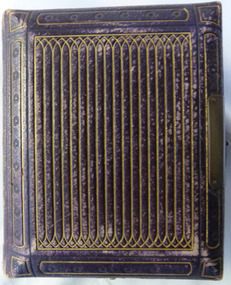
Album, Photograph, Circa mid 19th century
... Dark maroon leather cover with lined pattern embossed on front and back, with gold highlights on front cover. Brass metal clasp. Cream water-waved paper...Dark maroon leather cover with lined pattern embossed on front and back, with gold highlights on front cover. Brass metal clasp. Cream water-waved paper ...Many of the photographs in this album have photographers from areas near Nottingham, England. There are a couple of photographs by Daniel Clarke who was one of Warrnambool’s earliest and most prominent photographers.This album is typical of many of early settlers to Australia who brought a collection of photos from home or alternately were sent photos of family members.Dark maroon leather cover with lined pattern embossed on front and back, with gold highlights on front cover. Brass metal clasp. Cream water-waved paper inside front and back covers.Vickers in blue pen inside front cover.warrnambool, warrnambool photo album, daniel clarke, vickers, vickers photo album -
 Kiewa Valley Historical Society
Ledger - Tawonga Store 1915 to 1920s, c1915
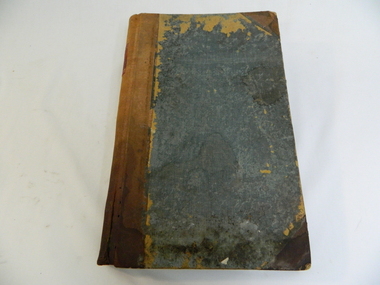
... It is well provenanced and very good interpretive capacity. tawonga general store book-keeping ledger george potter whit potter Ledger - printed on a red square embossed in gold on a brown thick paper spine Green linen covered cardboard cover. Brown (leather look) paper spine. ...The Tawonga Store was a general store in the Upper Kiewa Valley providing for a farming community. This store which had a variety of items was the main store for many of the farming families who would travel on horse and cart to make weekly trips to the store for supplies. This ledger was used by the owner of Tawonga Store to keep a record of items sold and to whom. George Potter owned the Tawonga Store before 1920. Whit Potter, George's son, worked with his father for many years. Attached to this ledger is a sheaf of letters which were sent to the Potter's, which are relevant to the day to day operation of a General Store. The ledger gives a comprehensive list of what type of items the residents of the Kiewa Valley purchased during this period, thus has great historical significance. It is well provenanced and very good interpretive capacity. Green linen covered cardboard cover. Brown (leather look) paper spine. Inside cover is red and green marbled paper. It has an alphabetic index at front. 262 ledger pages, the edges of which have been marbled.Ledger - printed on a red square embossed in gold on a brown thick paper spinetawonga, general store, book-keeping, ledger, george potter, whit potter -
 Invermay Local History Association
Bible, London: British and Foreign Bible Society
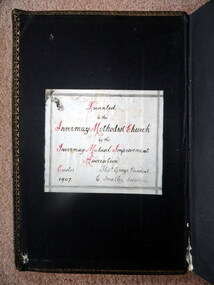
... Embossed leather bound volume featuring hand tooled decoration in inside edges front and back. Paper...Embossed leather bound volume featuring hand tooled decoration in inside edges front and back. Paper ...Embossed leather bound volume featuring hand tooled decoration in inside edges front and back. Paper featuring inscription glued to inside front cover.Inscribed inside front cover: Presented to the Invermay Methodist Church by the Invermay Mutual Improvement Association, Easter 1907. Thos. Crago, President and E. Smalley, Secretary. -
 Ballarat Clarendon College
Book, A voyage round the world
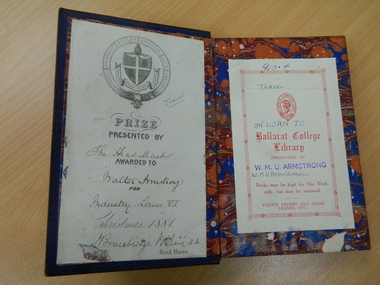
... It is an excellent example of the community spirit which carried the school through periods of financial hardship. walter-armstrong w-m-u-armstrong geelong-grammar Book plate inside front cover: Geelong Grammar crest / PRIZE / PRESENTED BY / The Headmaster / AWARDED TO / Walter Armstrong / FOR / Industry - Lower VI / Christmas 1881 / Bracebridge Wilson M A / Headmaster Book plate on right side of end paper: Ballarat College crest / Ballarat College / Library / PRESENTED BY / W M U Armstrong / W M Armstrong 1942 / Books may be kept for one week / only but may be renewed / PLEASE REPORT ANY LOOSE / LEAVES, ETC. Dark royal blue leather bound book with gold crest, borders and spine detail. Spine has 6 decorative compartments with raised bands and red leather and gold lettering in the title compartment; Geelong Grammar crest embossed ...This book was awarded by Geelong Grammar to Walter Armstrong in 1881. It was donated to the Ballarat College library by his grandson W Mick U Armstrong (1944). Mick attended Ballarat College 1937 - 1942. In 1936 the Weatherly Library was established at Ballarat College and a community book drive resulted in personal copies of books owned by members of the school community being donated to the library over the next 10-20 years. Mick Armstrong donated this book (amongst others) to the school library during his final year at the school. It is an excellent example of the community spirit which carried the school through periods of financial hardship. Dark royal blue leather bound book with gold crest, borders and spine detail. Spine has 6 decorative compartments with raised bands and red leather and gold lettering in the title compartment; Geelong Grammar crest embossed in gold on front cover and gold border to front and back cover; marbled endpapers and edges; black and white frontispiece and illustrations throughout book; book plates inside front cover.Book plate inside front cover: Geelong Grammar crest / PRIZE / PRESENTED BY / The Headmaster / AWARDED TO / Walter Armstrong / FOR / Industry - Lower VI / Christmas 1881 / Bracebridge Wilson M A / Headmaster Book plate on right side of end paper: Ballarat College crest / Ballarat College / Library / PRESENTED BY / W M U Armstrong / W M Armstrong 1942 / Books may be kept for one week / only but may be renewed / PLEASE REPORT ANY LOOSE / LEAVES, ETC.walter-armstrong, w-m-u-armstrong, geelong-grammar -
 Lara RSL Sub Branch
Wallet, Y.M.C.A. Wallet Mr Sid Ellis carried by hm during WW1
... leather with Y.M.C.A. Australian Armed Forces Logo embossed on the front and on the Back a motto "Talk Clean, Live Clean, Fight Clean, Play The Game." .02 White pocket notebook paper. .03 Small thin cardboard white with Blue and Red chevrons on each corner. ...leather with Y.M.C.A. Australian Armed Forces Logo embossed on the front and on the Back a motto "Talk Clean, Live Clean, Fight Clean, Play The Game." .02 White pocket notebook paper. .03 Small thin cardboard white with Blue and Red chevrons on each corner. ...WW1. Y.M.C.A. London, French scenesWW1 Wallet . YMCA LondonYMCA Wallet containing personal papers and letters - Sid Ellis- -472.01 Black leather Wallet - Y.M.C.A. Australian Logo on front. On the rear of the wallet is a Motto "Talk Clean, Live Clean, Fight Clean. Play the Game." .02 Paper slip containing details of acquaintances service numbers name and regiment details. .03 Paper Sovenior of France - written in French. .04 Paper folded to contain 10 photographic shots of French scenes countryside, sailing cutters. .05 Receipt from Returned Sailors & Soldiers Imperial League of Australia(Victoria). Issued to S. W. Ellis Brunswick Sub-branch dated 31/12/1936 Badge Number 48697. .06 Envelope Service of Campaign - printed on the front the envelope is written in Portuguese. "Servicio De Campanha" .07 Small brown paper representation of a boomerang with Cooee in gold lettering embossed on the front. .08 Small white business card for "Cafe - Debit" written in French "Albert Succr" Le Havre. .09 Cut-out from a magazine "View of the Seven Bridges" .10 Cut-out From a magazine "The New Louvre. .11 Cut-out from a magazine "Vendome Place" .12 Cut-out from a magazine "The Madeleine" .13 Cut-out from a magazine "The Arch De Triomphe - it is 150 feet high and cost 362,000 Pounds" .14 Cut-out from a magazine "The Grand Opera House - its cost was about 1,190,500 pounds and it seats over 2,000 people" .15 Cut-out from a magazine "The Cathedral of Notre Dame - A splendid example of the gothic architecture of the 13th century. .16 Cut-out from a magazine "The Trocadero Place erected from the Universal Exhibition of 1878 . with a Hall Capable of holding 5,000 people. .17 Envelope sent to Private S.W. Ellis from Lara took a well-traveled route to reach him. .18 Postcard of Park & Bandstand, Melton, Mowbray to Pte S.W Ellis. .19 Y.M.C.A. Newspaper "The Rising Sun" Vol 1, No. 14 Dated 28/1/1919 London, England. .20 Small note from Y.M.C.A. with pencil note on the rear "423 Pte. Schofield E.J." .21 Small Calander for 1918 from Y.M.C.A. London. .22 Cut out from a newspaper of a Funeral notice of Mrs. Thompson. .23 Paper note a pencil written recipe for an ointment measured amounts of the ingredients. .24 Two copies of Australian Imperial Force, Message to the "Officers, Non-Commissioned Officers, and Men of the Australian Imperial Force." From Commander in the field. .25 Memo "the Diggers" by Capt. William Denny - an order form for copies of the book.472.01 Black leather with Y.M.C.A. Australian Armed Forces Logo embossed on the front and on the Back a motto "Talk Clean, Live Clean, Fight Clean, Play The Game." .02 White pocket notebook paper. .03 Small thin cardboard white with Blue and Red chevrons on each corner. On the reverse side is a word "Souscrivez!" .04 Thin paper folder in a cascade that contains 10 small photos of French scenery. .05 Tissue paper receipt No. 31996 dated 15/01/1916 from Returned Sailors & Soldiers Imperial League of Australia (Victoria). .06 Brown Envelope with Green printing of the front. Army Form Number W 3078 (P) .07 Small Brown paper, shaped as a boomerang with a saying printed on the front "Cooee" .08 Cardboard white Business card for Cafe-Debit, Le Havre, .09 Paper cut out from a magazine with a view of the Seven Bridges. The reverse is printed with magazine writings. .10 Paper cut out from a magazine with a view of the New Louvre. The reverse is printed with magazine writings. .11 Paper cut out from a magazine with a view of Vendome Place. The reverse is printed with magazine writings. .12 Paper cut out from a magazine with a view of The Madeleine. The reverse is printed with magazine writings. .13 Paper cut out from a magazine with a view of The Arc De Triomphe. The reverse is printed with magazine writings. .14 Paper cut out from a magazine with a view of The Grand Opera House. The reverse is printed with magazine writings. .15 Paper cut out from a magazine with a view of The Cathedral Of Notre Dame. The reverse is printed with magazine writings. .16 Paper cut out from a magazine with a view of The Trocadero Palace. The reverse is printed with magazine writings. .17 Paper envelope Addressed to Pte. S. W. Ellis No. 640 sent from Lara and redirected to the recipient by Army Base Post Office. .18 Cardboard Postcard with a photographic picture of The Park & Bandstand, Melton Mowbray. Addressed to Pte. S. W. Ellis No. 640. .19 Y.M.C.A. Newspaper "The Rising Sun" Vol. 1 No. 14. .20 Thin paper from Y.M.C.A. addressed to 423 Pte. Schofield E.J. .21 Cardboard folded in two, a calendar for 1918, and small Map of Aldwych, reverse side is Y.M.C.A. in London details. Printed in red and black. .22 Cut out from a newspaper of a Funeral notice of Mrs. Thompson. .23 Thin Brown Paper with a note in pencil containing a written recipe for an ointment measured amounts of the ingredients. .24 Two copies of paper pamphlets. To the Officers & men of Australian Imperial Force dated 14th November 1918, .25 A paper pamphlet "The Diggers" by Capt. William Denny -
 Bright & District Historical Society operating the Bright Museum
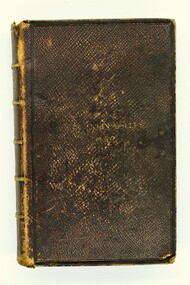
Book, Religion, Holy Bible & Common Prayer, 1849
... Brown embossed leather like cover. Gilt edged fine paper pages...C N Spaulding Growlers Crk Dec 1 1864 - in pencil Brown embossed leather like cover. Gilt edged fine paper pages Holy Bible & Common Prayer Book, Religion Oxford University Press ...The bible belonged to Francis Newton, who was born in Cornwall, England in 1831. Newton came to Wandiligong with his Irish wife, Mary (Molly) about 1860 by way of Sydney and BeechworthBrown embossed leather like cover. Gilt edged fine paper pagesCover spine : Hole Bible Common Prayer - in gold. Front Cover : Henry John Colles 1852 - in gold Fly page : Francis William Newton The gift of Mrs. C N Spaulding Growlers Crk Dec 1 1864 - in pencil -
 Blacksmith's Cottage and Forge
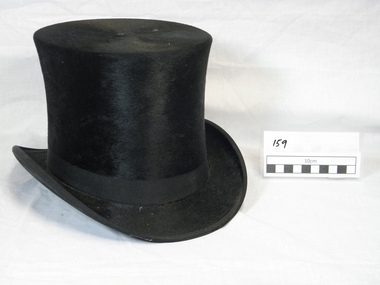
Top Hat, late 19th century
... leather sweat band, adjustable with silk ties. Inscription inside hat. Purple lining with gold embossing. Light canvas coated inside. Protective silver paper...leather sweat band, adjustable with silk ties. Inscription inside hat. Purple lining with gold embossing. Light canvas coated inside. Protective silver paper ...This hat belonged to Mr William Grant, Shire President of Bacchus Marsh. Mr Grant and his wife were invited to the opening of the first Federal Parliament held in the Royal Exhibition Building, Carlton, on the 9th May 1901. The opening was attended by the Duke and Duchess of Cornwall and York (later George V and Queen Mary) and 12,000 guests. Mr Grant's family were early settlers in Bacchus Marsh, and both he and his father were influential people in the town. They owned the property "Millbank". When William Grant died in 1924, his obituary in the 'Express' listed 17 public positions he held, including severaal terms as Shire President.This item has historical significance at a local, state and national level. It is representative of formal gentlemen's dress in the latter part of the 19th century/early 20th century.Gentleman's black shiny velour top hat with silk ribbon band, bound inside with leather sweat band, adjustable with silk ties. Inscription inside hat. Purple lining with gold embossing. Light canvas coated inside. Protective silver paper sweat band under leather sweat band.Inscription in gold inside hat reads "GREASE PROOF / Prize Medal" / Royal Insignia with motto "Honi soit qui mal y pense" / "VENTILATED / AND / FELT BANDED".1910, top hat, gentlemen s fashion, mr grant, velour, ninteenth century attire, skilled hatter, upper class attire, formal wear, monopoly token, president bacchus marsh shire, federation celebrations 1910, federation, owner millbank, mad hatter, opening parliament 1910, royal exhibition building, original box, greaseproof prize medal royal isignia, the sea breeze, no 5044, size 6, 7 8 -
 Eltham District Historical Society Inc
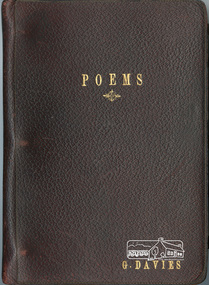
Book, Gwendoline G. W. Davies, Poems - G. Davies, 1933-1934
... During 1933-1934 in her early to mid-twenties, Gwenda wrote a series of poems which were captured in three books: one a leather bound three-ring binder with personalised gold embossing on the cover and two paper booklets held together by pink ribbon. ...Brown leather bound three-ring binder with personalised gold embossing on the cover 20.5 x 14.5 cm, Walkers Loose Leaf Book, pages typed with some pasted in colour illustrations, alphabeticised dividers (some tabs missing), 21 leafs (some blank) 2. Two paper...During 1933-1934 in her early to mid-twenties, Gwenda wrote a series of poems which were captured in three books: one a leather bound three-ring binder with personalised gold embossing on the cover and two paper booklets held together by pink ribbon. ...Gwendoline (Gwenda) Grace Watson Davies, only daughter of Mr. William Watson Davies and Mrs. Grace Davies (nee Hayes) of Arthur Street, Eltham was born in Newport, 18 February 1908. Gwenda grew up in Arthur Street and when she left school she was employed as an officer at the State Bank of Victoria, Chief Accountants Department, Head Office, Elizabeth Street, Melbourne. During 1933-1934 in her early to mid-twenties, Gwenda wrote a series of poems which were captured in three books: one a leather bound three-ring binder with personalised gold embossing on the cover and two paper booklets held together by pink ribbon. These poems are a reflection of her childhood days, home, her mother, her environment, pioneering days and other miscellaneous subjects including one example titled “EIGHTEEN YEARS TO-DAY”, an homage to the brave men of Gallipoli. On October 20, 1937 after ten years of service, Gwenda submitted her letter of resignation effective November 26th as she was to be married in the near future to Fred Jones. Frederick Geoffrey Jones, born 7 January 1911, third son of Mr. and Mrs. W. Jones of Napoleon Street, Eltham, married Gwenda at the Eltham Methodist Church on 27 November 1937. They made their home at ‘Llangollen’, Arthur Street, Eltham, a new house Fred had constructed earlier that year opposite the Shire Offices. Their residence was recorded in the Electoral Rolls from 1963-1980 as 6 Arthur Street, Eltham which was situated on the corner of Arthur Street and present-day Commercial Place. In the 1970s their home was sold and demolished to make way for the new shops. They built a new home at the top of the hill in Bible Street. In the Electoral Rolls for 1943-1980, Frederick’s occupation was recorded as a Plumber’s Assistant. Fred was also a long-standing member of the Eltham Cemetery Trust. He was first appointed 26 April 1944 and resigned 17 July 1957 to be appointed to the Warringal and Eltham Joint Trust where he served till February 1980. He then re-joined the Eltham Cemetery Trust and served a further 14 years till his resignation on 24 August 1994. In total, Fred represented the interests of Eltham Cemetery for 50 years (1944-1994). Gwenda and Fred were blessed with a son, Frederick William Jones in March 1942. Sadly, Frederick only lived two days and was buried at Eltham Cemetery on March 11. It is not known whether his grave is marked. A second son, Geoffrey Morris Jones arrived 25 November 1944 but he sadly contracted polio as a child. A fall down the front steps of Fred and Gwenda’s new home in Bible Street culminated in Geoff’s death from a heart attack whilst in transit to the Austin Hospital on February 6, 1979, at age 34. He was also interred in the Eltham Cemetery. Geoff was posthumously awarded the British Empire Medal for his services to fire safety at the CFA. A small man, handicapped from his childhood polio, he had figured prominently in the area as an active Apex member and as group officer for the 13 local brigades in the CFA Lower Yarra Group. His work for the CFA, all voluntary, included writing a fire-fighting manual and the innovation of aerial fire spotting and weekly fire reports. Gwendoline and Fred were presented with Geoff’s B.EM. award at Government House. Four years later on the anniversary of Geoff’s death, Gwenda could not sleep and collapsed in the hallway at home from a heart attack, 6 February 1983 at age 74. She was interred with her son Geoff, at Eltham Cemetery on February 9th. Fred died 31 July 1997 at age 86 and was also interred at Eltham Cemetery. A memorial plaque to Gwenda, Fred and Geoff lies within the lawn cemetery at Eltham Cemetery. In February 2022 Gwenda’s book of Poems along with a copy of her letter of resignation from the State Bank of Victoria and a news clipping about the Autumn Show held in the Public Hall at Eltham (opposite her home with Fred) in which Gwenda is listed as having entered Cream Puffs and a Swiss Roll into the Cooking section, were donated to the St Vincent’s de Paul Society in Bega, N.S.W.. A dedicated volunteer there researched their origins and desirous for these items to return ‘home’, posted them to the Eltham District Historical Society for which we are most appreciative. EIGHTEEN YEARS TO-DAY “Tell me why you’re dreaming, Daddy” Said my little son to me, So, I told him all about it, As he sat upon my knee. I told him of that Sunday morn, ‘Twas eighteen years to-day, When the men of Australasia, Joined the mighty fray. How they landed on that foreign shore, And fought the gallant fight, Of how they nobly won the day, And put the Turks to flight. We saw the cliffs before us, To be scaled ‘mid shot and shell, And our comrades fell around us - - - - I remember it - - - so well. There are some who’ll sleep forever, On a hill that’s called Lone Pine, And the twenty-fifth of April, Is famous for all time. And so to keep their memory green, We march each Anzac Day, To pay tribute to those Heroes, Who gave their lives that day. - Anzac Day 1933 And in reflections to Gwenda’s childhood home in Arthur Street: HOME Where do my thoughts ever wander? Where do my thoughts always roam? To a little old house, on the top of a hill, To the place, that I call “Home Sweet Home.” No matter where-ever I travel, On land, or away on the foam. My thoughts will return, and my heart ever yearn, To the place, that I call “Home Sweet Home”. - 2/7/1933 Sources: Book of Poems, G. Davies Letter of Resignation, 1937, Oct. 20, G.G.W. Davies Births Deaths and Marriages Victoria New House at Eltham (1937, September 10). Advertiser (Hurstbridge, Vic. : 1922 – 1939), p. 6. Retrieved May 12, 2022, from http://nla.gov.au/nla.news-article56845735 Family Notices (1937, December 17). Advertiser (Hurstbridge, Vic. : 1922 – 1939), p. 3. Retrieved May 12, 2022, from http://nla.gov.au/nla.news-article56846386 Geoff Jones, Proud Memory, unknown newspaper clipping, 1979 1979 Birthday Honours, Wikipedia, https://en.wikipedia.org/wiki/1979_Birthday_Honours Australian Electoral Rolls, Ancestry.com Family Trees, Ancestry.com Eltham Cemetery, Deceased Search findagrave.com Personal recollections, Joan Castledine The poetry by Gwendoline Davies provides an insight into life growing up in Eltham and the early 1930s. A long time resident, Gwendoline, her husband Fred Jones and son Geoff Jones were fully dedicated to the Eltham community for over 50 years.1. Brown leather bound three-ring binder with personalised gold embossing on the cover 20.5 x 14.5 cm, Walkers Loose Leaf Book, pages typed with some pasted in colour illustrations, alphabeticised dividers (some tabs missing), 21 leafs (some blank) 2. Two paper booklets held together by pink ribbon 15.5 x 12 cm, typed, some with colour illustrations, pages numbered (rh only) 12 pages and 25 pages and paper cover 3. Newspaper clipping 4. Letter sized hand written page in ink folded in three and damaged by foxing and insectsanzac day, arthur street, napoleon street, cfa, eltham cemetery, eltham cemetery trust, frederick geoffrey jones, geoffrey morris jones b.e.m., grace davies (nee hayes), gwendoline grace watson jones (nee davies), llangollen, lower yarra group, poems, william watson davies -
 Mission to Seafarers Victoria
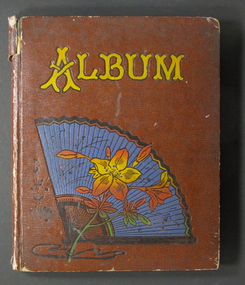
Album (item) - Photographic Album, 1928
... Brown leather album with embossed blue fan and flower design, small tear at the top of the spine with black paper pages. ...They sailed on the Osterley on the 22 January 1929. fan strikes police reverend john reginald weller (1880-1969) alexina weller (nee caley) freda oxley hmas australia hmas brisbane great depression unemployment port melbourne station pier sugar cane queensland dora simpson nee walker weddings cup day finhaven kew the ducketts mrs john buchan flinders street extension gasworks wharfs victoria dock motorboat southern cross success destroyers football sports rms maloja lhlg fan album anzac swordsman Freda Kathleen Oxley 1882-1969 Annie Alexandrina Caley (known as Alexina) 1885-1934 Embossed yellow font on cover reads: ALBUM Brown leather album with embossed blue fan and flower design, small tear at the top of the spine with black paper pages. ...This album containing 50 photographs depicts a year at the Mission in 1928: Wedding of the Dora Walker with Harry Simpson on 14 February. Picnic at Riversdale Hawthorn, 1 January 1928 Ships in Port Melbourne in November: HMAS Australia, HMAS Brisbane, and destroyers Anzac, Success, Swordsman Wharfs, Victoria Dock, Stevedores Picnic in Finhaven, Kew, the Buchan's Property for Cup Day (6 November) Views of Port Melbourne from 1888 building Monday 29 October: return of Archbishop of Melbourne (Dr. Harrington Lees), who had spent a 10-month holiday in England with his wife. Arrival on the RMS Maloja Two photographs are missing.Pre Great Depression, 1928 was a difficult year in Melbourne and also for the Mission. Ships were rare on the wharfs meaning seamen were also rare in the missions. However they started the fundraising for the extension of the 1888 Port Melbourne building which was becoming too small. At the end of the year, Reverend Weller announced he was appointed assistant in London. He and his wife Alexina left in January 1929 after five years. They sailed on the Osterley on the 22 January 1929.Embossed yellow font on cover reads: ALBUMfan, strikes, police, reverend john reginald weller (1880-1969), alexina weller (nee caley), freda oxley, hmas australia, hmas brisbane, great depression, unemployment, port melbourne, station pier, sugar cane, queensland, dora simpson nee walker, weddings, cup day, finhaven, kew, the ducketts, mrs john buchan, flinders street extension, gasworks, wharfs, victoria dock, motorboat, southern cross, success, destroyers, football, sports, rms maloja, lhlg, fan album, anzac, swordsman, freda kathleen oxley 1882-1969, annie alexandrina caley (known as alexina) 1885-1934 -
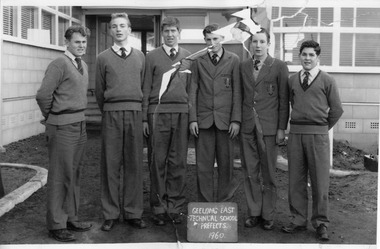 Newcomb Secondary College Archives
Photographic Album - Geelong East Technical School Prefects, Leathersmith, circa 1960
... Cover is black leather with a gold embossed trim around edges. Internal exposed leather has similar trim. Pages are paper with rounded corners and edge of paper is gold. ...Newcomb Secondary College Archives 81-85 Bellarine Hwy Newcomb geelong-and-the-bellarine-peninsula Cover is black leather with a gold embossed trim around edges. Internal exposed leather has similar trim. Pages are paper with rounded corners and edge of paper is gold. ...Photographic Album by Leathersmith, Made in England (AL4M Morocco)Cover is black leather with a gold embossed trim around edges. Internal exposed leather has similar trim. Pages are paper with rounded corners and edge of paper is gold. -
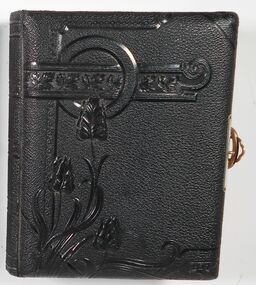 Bendigo Historical Society Inc.
Leisure object - Photo Album
... A dark brown leather-bound photograph album belonging to the family of Richard Hartley Smith Abbott. The covers have decorative embossed geometric and floral patterns. Inside the covers is a brown floral-patterned paper...Photo album R H S Abbott family A dark brown leather-bound photograph album belonging to the family of Richard Hartley Smith Abbott. The covers have decorative embossed geometric and floral patterns. Inside the covers is a brown floral-patterned paper ...Richard Hartley Smith Abbott and Mary Hannah Gibbs had eight children. This family album contained photos of them and two of their children - Harold Athelstane Abbott (Born 1889. Died 1979) and Kenneth Cyril Abbott (Born 1890). Photos catalogued individually.A dark brown leather-bound photograph album belonging to the family of Richard Hartley Smith Abbott. The covers have decorative embossed geometric and floral patterns. Inside the covers is a brown floral-patterned paper lining. Fourteen heavy card double sided pages have cut out sections with openings for insertion of photographs. Seven of the pages have decorative borders of painted flowers. The pages have gold covered edges. The album has a silver metal clasp to secure the album. photo album, r h s abbott family -
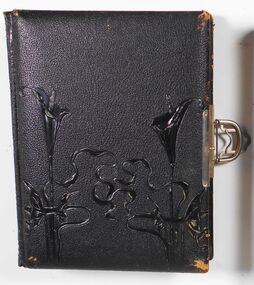 Bendigo Historical Society Inc.
Leisure object - Photo Album
... leather-bound photograph album belonging to the family of Richard Hartley Smith Abbott. The front cover has decorative embossed floral patterns, the back cover has an embossed geometric pattern. Inside the covers is a green and gold floral-patterned paper...leather-bound photograph album belonging to the family of Richard Hartley Smith Abbott. The front cover has decorative embossed floral patterns, the back cover has an embossed geometric pattern. Inside the covers is a green and gold floral-patterned paper ...Richard Hartley Smith Abbott and Mary Hannah Gibbs had eight children. This family albums contained photos of them and two of their children - Harold Athelstane Abbott (Born 1889. Died 1979) and Kenneth Cyril Abbott (Born 1890). Photos catalogued individually.A dark brown leather-bound photograph album belonging to the family of Richard Hartley Smith Abbott. The front cover has decorative embossed floral patterns, the back cover has an embossed geometric pattern. Inside the covers is a green and gold floral-patterned paper lining. Twelve heavy card double sided pages have cut out sections with openings for insertion of photographs. Six of the pages have decorative borders of painted flowers. The pages have gold covered edges. The album has a silver metal clasp to secure the album. photo album, r h s abbott family -
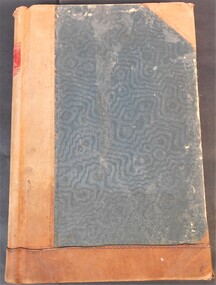 Bendigo Historical Society Inc.
Administrative record - Loan Ledger
... Larger loan ledger book, covered by a thick board cover and back, with a layer of possibly embossed silk, bound by thick material possibly leather. Paper inside, 402 pages are indicated, not all written in. ...History House 11 Mackenzie Street Bendigo goldfields loans ledger finance Larger loan ledger book, covered by a thick board cover and back, with a layer of possibly embossed silk, bound by thick material possibly leather. Paper inside, 402 pages are indicated, not all written in. ...Larger loan ledger book, covered by a thick board cover and back, with a layer of possibly embossed silk, bound by thick material possibly leather. Paper inside, 402 pages are indicated, not all written in. Ledger filled with first, alphabetical names and notes, then the rest (139 pages) are records for loans and payments for clients, including full names, dates and financial details of clients. Spine says: Loan Register. 6 loose pieces of paper of various financial notes, other loose papers attached by paper clip. Dates: 1900 - 1969loans, ledger, finance -
 Bendigo Historical Society Inc.
Book - BROWN PHOTO ALBUM
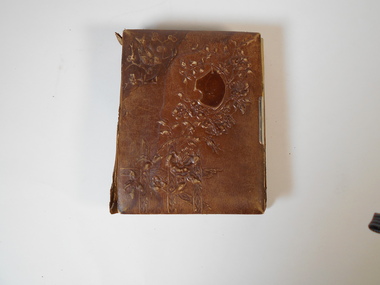
... Brown leather photo album with floral embossed front cover and a geometric embossed back cover. Inside back and front covers is blue and gold patterned paper. ...History House 11 Mackenzie Street Bendigo goldfields BOOK Brown Photo Album Brown leather photo album with floral embossed front cover and a geometric embossed back cover. Inside back and front covers is blue and gold patterned paper. ...Brown leather photo album with floral embossed front cover and a geometric embossed back cover. Inside back and front covers is blue and gold patterned paper. Album has broken silver catch. Album has Thirty one photographs. M/K 606 written in pencil on the first photo page. Photographs are not named and not dated. There is no record of the Donor.book, brown photo album -
 Bendigo Historical Society Inc.
Book - BLACK PHOTO ALBUM
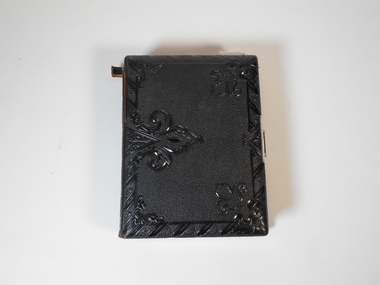
... embossed leather photo album with silver clasp and gold edging. Album is empty. It has places for one photograph on each page. Some of the pages have floral decoration, a small scene and butterflies around the opening for the photo. Patterned paper...embossed leather photo album with silver clasp and gold edging. Album is empty. It has places for one photograph on each page. Some of the pages have floral decoration, a small scene and butterflies around the opening for the photo. Patterned paper ...Black, embossed leather photo album with silver clasp and gold edging. Album is empty. It has places for one photograph on each page. Some of the pages have floral decoration, a small scene and butterflies around the opening for the photo. Patterned paper inside front and back covers. Undated. Donor unknown.book, black photo album -
 Bendigo Historical Society Inc.
Document - MEMORIAM - JOHN TREVEAN, 1918
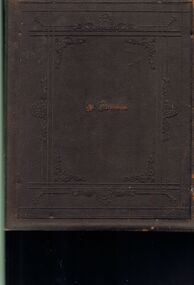
... Printed in gold on cream paper with red seal and framed in a folding black leather frame with embossed front marked 'A Memoriam'...Printed in gold on cream paper with red seal and framed in a folding black leather frame with embossed front marked 'A Memoriam' Document MEMORIAM - JOHN TREVEAN ...Memoriam presented to Mrs. H. Trevean from borough of Eaglehawk upon the passing of Councillor John Trevean. Printed in gold on cream paper with red seal and framed in a folding black leather frame with embossed front marked 'A Memoriam'person, individual, john trevean -
 Flagstaff Hill Maritime Museum and Village
Book - Welsh Theological Dictionary - 2 volume, William Jones, A THEOLOGICAL DICTIONARY, 1837 & 1839
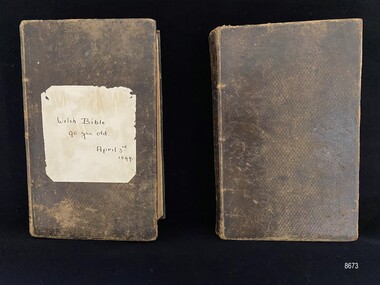
... leather with gold embossed patterns and words on the spine. The words 'GEIRIADUR DUWINYDDOL' (Theological dictionary) are on both spines towards the top and towards the bottom the number 1 or 2 dependent on the volume. The first volume, at around 900 pages, is slightly larger than the second volume, around 740 pages. The first volume has had a plain piece of paper...leather with gold embossed patterns and words on the spine. The words 'GEIRIADUR DUWINYDDOL' (Theological dictionary) are on both spines towards the top and towards the bottom the number 1 or 2 dependent on the volume. The first volume, at around 900 pages, is slightly larger than the second volume, around 740 pages. The first volume has had a plain piece of paper ...The Theological Dictionaries belonged to David and Alice Ellis, a young couple married in Dublin in 1855. They left for Australia on the Schomberg clipper ship on October 6 that same year, joining the other passengers for the luxury sailing ship’s first voyage, bound for Melbourne, Australia. The Schomberg was grounded on a sand spit near Peterborough. All passengers and crew were safely rescued. They had been allowed to take something small with them when leaving the sinking vessel, and as such, Alice took a small cane basket and coin purse. The Dictionaries were also amongst the couple’s possessions, along with a metal trunk, a Bible and a pair of candlesticks. These items were all later retrieved from the ship’s deck by the crew of a steamer sent from Melbourne. At that time, David was 23 years old (born in Wales, in 1832) and Alice was 26 (born in Ireland, 1829). The couple lived in Tasmania for a short period before settling in the Western Districts of Victoria. David worked as a gardener and, when land in the area was available to purchase, David and Alice claimed a selection on Noorat Road near Terang. They settled there for the remainder of their lives, expanding the property that they named, ‘Allambah’, and had six children. David died in 1911, aged 79, and Alice passed away the following year, aged 83. Two of David and Alice’s children, David jnr. and Grace adopted a daughter Nell Margaret Crick (nee Ellis). The Dictionaries were passed onto Nell with the misunderstanding (due to being written in the Welsh language) that they were Bibles. Nell pasted a piece of paper onto the front of the first volume recording ‘Welsh Bible 90 yrs old. April 3rd 1844’. The April date relates to the inscription inside both volumes and the 90 yrs old relates to the year Nell possibly received them, 1934. She has also added to the inscription page inside the first volume again recording ’Welsh Bible 90 yrs old. Miss. G Ellis “Allambah” Terang’. This implies that Grace Ellis had been the ‘keeper’ of the dictionaries. Grace and David Ellis were devout Christians which they passed on to their adopted daughter Nell, and were prominent members of the Noorat and Terang Presbyterian Churches. As David and Alice Ellis came out on the Schomberg in 1855, and the inscription inside both volumes of the Dictionary carries the date April 3rd 1844 and the name Thomas Ellis, it could be presumed that this was a family gift of significance to the couple as they began their new life in a country far away.The theological dictionaries are part of a group of donated possessions of David and Alice Ellis that have great significance as personal belongings, providing an insight into what emigrants considered important possessions to bring as they began a new life on the other side of the world. They are part of Flagstaff Hill’s collection of artefacts from the Schomberg shipwreck, which is listed on the Victorian Heritage Register (VHR S612). All items had been saved from the sinking luxury clipper ship, the Schomberg, in 1855. The ship has historical significance as a rare example of a large, fast clipper ship on the England to Australia run, built to carry emigrants at the time of the Victorian gold rush. The ship’s design included the technical advances needed to break sailing records between Europe and Australia. The relationship of the objects in Flagstaff Hill’s Schomberg collection allows potential interpretation of the story of the Schomberg. The collection of objects is archaeologically significant as the remains of an international passenger ship, as it represents aspects of Victoria’s shipping history, in addition to its association with the shipwreck and the ship.A two volume set Theological Dictionary in Welsh. Both books are covered in brown leather with gold embossed patterns and words on the spine. The words 'GEIRIADUR DUWINYDDOL' (Theological dictionary) are on both spines towards the top and towards the bottom the number 1 or 2 dependent on the volume. The first volume, at around 900 pages, is slightly larger than the second volume, around 740 pages. The first volume has had a plain piece of paper glued to the front with the words 'Welsh Bible, 90 yrs old, April 3rd 1844'. Each volume has an inscription to Thomas Ellis inside the front cover, the date April 3rd 1844 and other words in Welsh. The first volume has added writing (in different handwriting) on the inscription page. The books are laid out in dictionary format with the first volume going from ABE to HYP. The second volume begins at IAC and ends at YST, followed by an Appendix and Index. The first volume was published in 1837 and the second volume in 1839.Volume 1 - Thomas Ellis ... 6 words in Welsh ... Aprill 3/44 (Handwriting 1) - Welsh Bible 90 yrs old, Miss G. Ellis, "Allambah" Terang. (Handwriting 2) Volume 2 - Thomas Ellis ... 6 words in Welsh (same as volume 1) ... Aprill 3/44flagstaff hill maritime museum and village, great ocean road, shipwreck coast, theological dictionaries, welsh theological dictionaries, welsh bible, schomberg, sailing ship, schomberg passengers, schomberg ship, 1855, 1855 shipwreck, peterborough shipwreck, david and alice ellis, david ellis jnr, grace ellis, nell ellis, nell crick, allambah terang, terang presbyterian church -
 Flagstaff Hill Maritime Museum and Village
Functional object - Hat Box, John Brush, Son & Co, 1920s
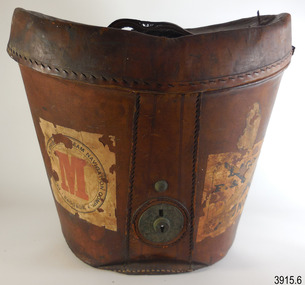
... paper. The lid has two attached leather tabs and a leather handle and underneath it has a drawstring liner and oval, gold-lettered maker’s label. The internal oval box has a leather retention strap and brim support. Separate moulded brim support is included. A detached leather strap with catch is inside the base. Inscriptions are stamped on the lid, printed on the maker’s label, attached as printed paper labels to the lid, sides, and under the base. Maker is John Brush, Son & Co. of Sydney. The owner’s initials “G.M” are embossed...paper. The lid has two attached leather tabs and a leather handle and underneath it has a drawstring liner and oval, gold-lettered maker’s label. The internal oval box has a leather retention strap and brim support. Separate moulded brim support is included. A detached leather strap with catch is inside the base. Inscriptions are stamped on the lid, printed on the maker’s label, attached as printed paper labels to the lid, sides, and under the base. Maker is John Brush, Son & Co. of Sydney. The owner’s initials “G.M” are embossed ...This sturdy, deep hat box has been carefully constructed to give the contents utmost protection in the roughest of travel conditions. At the same time, attention to detail and quality of materials makes the box an attractive, desirable and useful piece of luggage. The supports inside the hat box show that the hat’s brim dipped at the front and back in the popular 1920s Homburg or Derby style. The hat box was likely to have been purchased, complete with its fashionable hat and personalised with the initials ‘G.M.’. The five shipping labels on the hat box tell that the owner traveller overseas with it on more than one occasion. The owner had first travelled with the shipping line Peninsular & Orient Steam Navigation Company, and may have been one the first Australian passengers in 1932, as the remnant of label on the base reads Sydney. The owner later voyaged under the company’s new name of P & O. and travelled from at least one of the voyages from Melbourne to London The square label, with “P & O” and red printed “M” in centre of circle, refers to alphabetical organisation of baggage by surname, connecting the owner ‘G.M.’ to the owner’s voyage with P & O. The P & O shipping line’s early beginnings started with the partnership of London ship broker Brodie McGhie Willcox and Scottish sailor Arthur Anderson in 1822. The partnership was joined by Irish shipowner Captain Richard Bourne in 1835 and they began operation as the Peninsular & Orient Steam Navigation Company with a service between London- Spain - Portugal. In 1932 the company expanded to include Australia with its passenger services departing from Sydney; in 1840 the company was incorporated. After various take-overs of other shipping lines and businesses, it operated under the name P & O. JOHN BRUSH The hat box was made by Australian saddle designer and maker, John Brush, Sons & Co. Brush began his saddlery trade in Roma, Queensland, His designing process included consulting with the men who rode and worked the horses. He was described in the Sydney Morning Herald of December 15, 1897, as a leading Sydney saddler, well known and reliable, with every kind of English and Australian saddle on view. John Brush established his business in 1840, operating from 371 George Street Sydney. A catalogue from that era jointly advertises John Brush (371 George Sty Sydney) and Butlers & Brush (432-4 Queen Street Sydney), both under the name of Edward Butler & Co. Pty. Ltd. The catalogue included saddlery, harness equipment, riding wear and travel goods, and strongly promoted the Wienkek made saddles, which he distributed Australia wide. John Brush, So & co. advertised its ‘new’ address in 1887, as 403 George Street Sydney. In 1898 Brush made a side-saddle for a customer, a design popular with gentlewomen of the era. The business was still operating over 100 years later, producing a catalogue in the 1950s.This early 20th century hat box is significant for being one of a kind in our Collection. Its fitted design shows the shape of the hat, dating it from the 1920s men’s fashions. The hat box is significant for being a high quality hat box made in Sydney, Australia by prominent and successful early colonial saddler and leather goods business, John Brush, Son & Co. The labels on the outside of the hat box are also significant, representing the prosperous lifestyle of an Australian traveller who purchased quality goods and cared for them. The traveller was able to depart from firstly the Port of Sydney and later the Port of Melbourne. Hatbox, oval shape, brown leather, strong, sturdy construction, six pieces, and metal lock on base. Wide lid, then tapers to a narrower base that has a red leather trim. Brown velvet fabric lining inside and covers some accessories. Other internal accessories are trimmed with plain red paper and blue and white striped paper. The lid has two attached leather tabs and a leather handle and underneath it has a drawstring liner and oval, gold-lettered maker’s label. The internal oval box has a leather retention strap and brim support. Separate moulded brim support is included. A detached leather strap with catch is inside the base. Inscriptions are stamped on the lid, printed on the maker’s label, attached as printed paper labels to the lid, sides, and under the base. Maker is John Brush, Son & Co. of Sydney. The owner’s initials “G.M” are embossed on the lid.Stamped on lid “G. M.” Label, oval, inside lid “JOHN BRUSH, SON & CO. / MANUFACTURERS & IMPORTERS / of / SADDLERY AND HARNESS / 403, GEORGE ST. / SYDNEY” Label, paper: “BAGGAGE, MELBOURNE TO LONDON’, part of word ‘CABIN’ and “P & O” Label, square, white background, black print, circular emblem: ‘PE - - - - - & ORIEN-’, ‘STEAM NAVIATION COMPY.’ BAGGAGE’ and a red printed “M” in centre of circle. Label, rectangular, white background, black print; narrow line border, text in rows and an ‘X’ overprinted, from corner to corner of the border: “BAGGAGE / P. & O. S. N. Co. / MELBOURNE / To / LONDON” Label, paper, rectangular, white background, black print, an “X” across the label: “CABIN / P & O / “ Label, paper, on base, “– aid” [Paid], “SYDNEY” flagstaff hil, warrnambool, flagstaff hill maritime museum, maritime museum, shipwreck coast, flagstaff hill maritime village, great ocean road, hat box, leather hat box, vintage hat box, top hat, homburg hat, derby hat, travel ware, luggage, leather goods, travel goods, clothing accessory, men’s clothing, john brush, son & co, saddler, sydney firm, peninsular & orient steam navigation company, p & o, g.m., melbourne to london, sydney port, melbourne port, hat case -
 Flagstaff Hill Maritime Museum and Village
Book - Bound Newspapers, Edward Joseph Mansfield, Publisher, The Graphic Volume 23, January to June 1881, Jan. - June 1881
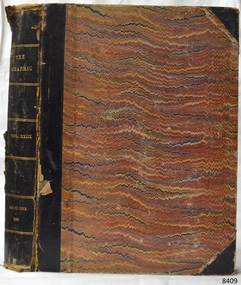
... The Graphic, an Illustrated Newspaper, Vol 23 Publisher: Edward Joseph Mansfield, at The Strand, London Date: January to June, 1881 The bound book of newspaper editions has a hardcover with a leather spine and brown/orange/blue pattern on the covers. The spine has gold embossed lettering. Inscriptions; sticker on the front end paper from Warrnambool Mechanics Institute and Free Library, and a purple, oval stamp on the fly from Warrnambool Mechanics Institute and Free Library....Embossed in gold on the spine; "THE GRAPHIC", "VOL. XXIII", "JAN. TO JUNE. / 1881" Sticker [identifies the Warrnambool Mechanics Institute and Free Library] Stamp; concentric ovals with "WARRNAMBOOL" "MECHANICS'" "INSTITUTE" The Graphic, an Illustrated Newspaper, Vol 23 Publisher: Edward Joseph Mansfield, at The Strand, London Date: January to June, 1881 The bound book of newspaper editions has a hardcover with a leather spine and brown/orange/blue pattern on the covers. The spine has gold embossed lettering. Inscriptions; sticker on the front end paper ...The book is a bound volume containing the weekly publications of The Graphic, an illustrated newspaper. The volume, No. 23, includes newspapers from January to June 1881. It was published and printed in London, England. WARRNAMBOOL MECHANICS’ INSTITUTE Warrnambool's Mechanics' Institute (or Institution as it was sometimes called) was one of the earliest in Victoria. On 17th October 1853, a meeting was held where it was resolved to request the Lieutenant Governor of the Colony to grant land for the erection of a Mechanics' Institutes building. A committee was formed at the meeting and Richard Osburne chaired the first meeting of this committee. The land on the North West corner of Banyan and Merri Streets was granted but there were no funds to erect the building. The Formal Rights of the Warrnambool Mechanics' Institute's encompassed its aims and these were officially adopted in1859; "This Institution has for its object the diffusion of literary, scientific, and other useful knowledge amongst its members, excluding all controversial subjects, religious or political. These objects are sought to be obtained by means of a circulating library, a reading room, the establishment of classes, debates, and the occasional delivery of lectures on natural and experimental philosophy, mechanics, astronomy, chemistry, natural history, literature, and the useful and ornamental arts, particularly those which have a more immediate reference to the colony." The Warrnambool Mechanics' Institute opened its first reading room in November 1884 in the National School building at the corner of Banyan and Timor Streets. The Institute was funded by member subscription, payable on a quarterly, half-yearly or yearly basis. Samuel Hannaford, the Manager of the Warrnambool Bank of Australasia, was the first Honorary Secretary of the Mechanics' Institutes, and an early President and Vice-President. He also gave several of the early lectures in the Reading Room. Another early Secretary, Librarian and lecturer was Marmaduke Fisher, the teacher at the National School. Lecture topics included The Poets and Poetry of Ireland', 'The Birth and Development of the Earth', 'The Vertebrae - with Remarks on the pleasures resulting from the study of Natural History' and 'Architecture'. In 1856 the Reading Room was moved to James Hider's shop in Timor Street, and by 1864 it was located in the bookshop of Davies and Read. In the 1860's the Mechanics' Institute struggled as membership waned but in 1866, after a series of fundraising efforts, the committee was able to purchase land in Liebig Street, on a site then called Market Square, between the weighbridge and the fire station. A Mechanics' Institute building was opened at this site in August 1871. The following year four more rooms were added to the main Reading Room and in 1873 the Artisan School of Design was incorporated into the Institute. The same year Joseph Archibald established a Museum; however, it deteriorated when he was transferred to Bendigo in 1877. In 1880, with Archibald's return to Warrnambool, the Museum was re-established, and in 1885 a new building was built at the back of the Institute to accommodate the re-created School of Design, the Art Gallery and the Museum. In 1887 the Museum section was moved to the former courthouse in Timor Street (for some time the walls of the building formed part of the TAFE cafeteria but all is now demolished)). In 1911 the Museum was transferred back to the original building and the management of the Mechanics' Institute was handed over to the Warrnambool City Council. The Museum and Art Gallery became one and housed many fine works of art, and the Library continued to grow. The building was well patronised, with records showing that at the beginning of the 20th century there were between 500 and 800 visitors. During World War One the monthly figures were in the thousands, with 3,400 people visiting in January 1915. The Museum was a much - loved Institution in Warrnambool until the contents of the Museum and Art Gallery were removed to make room for the Warrnambool City Council Engineers' Department. The contents were stored but many of the items were scattered or lost. When the original building was demolished the site became occupied by the Civic Centre, which included the new City Library. (The library was temporarily located in the old Palais building in Koroit Street.) In the process of reorganisation the Collection was distributed amongst the community groups: -The new City Library took some of the historical books and some important documents, historic photographs and newspapers. -The Art Gallery kept the 19th Century art collection and some of the artefacts from the museum. -The Historical Society has some items -The State Museum has some items -Some items were destroyed -Flagstaff Hill Maritime Village has old newspapers, Government Gazettes, most of the Mechanics' Institute Library, ledgers and documents connected to the Mechanics' Institute Library, some framed and unframed artworks and some photographs. The Warrnambool Mechanics' Institute Library book collection is deemed to be of great importance because it is one of the few collections in an almost intact state, and many of the books are now very rare and of great value. WARRNAMBOOL PUBLIC LIBRARY The Warrnambool Mechanics’ Institute (WMI) was formed by a voluntary community group in 1863, within six years of Warrnambool’s beginnings, and its Reading Room opened in 1854. The WMI operated until 1963, at which time it was one of the oldest Mechanics’ Institutes in Victoria. Mechanics’ Institutes offered important services to the public including libraries, reading rooms and places to display and store collections of all sorts such as curiosities and local historical relics. In 1886 a Museum and Fine Arts Gallery were added to the WMI and by the beginning of the 20th century, there was also a billiards room and a School of Art. By this time all Mechanics’ Institutes in country Victoria had museums attached. Over the years the Warrnambool Mechanics’ Institute Library was also known as the Warrnambool Public Library the Warrnambool Library and the Free Library. Early funding from the government was for the “Free Library”. The inscription in a book “Science of Man” was for the “Warrnambool Public Library”, donated by Joseph Archibald in 1899. Another inscription in the book “Catalogue of Plants Under Cultivation in the Melbourne Botanic Gardens 1 & 2, 1883” was presented to the “Warrnambool Library” and signed by the author W.R. Guilfoyle. In 1903 the Warrnambool Public Library decided to add a Juvenile Department to library and stock it with hundreds of books suitable for youth. In 1905 the Public Library committee decided to update the collection of books and added 100 new novels plus arrangements for the latest novels to be included as soon as they were available in Victoria. In July 1911 the Warrnambool Council took over the management of the Public Library, Art Gallery, Museum and Mechanics’ Institute and planned to double the size of the then-current building. In 1953, when Mr R. Pattison was Public Librarian, the Warrnambool Public Library’s senior section 10,000 of the 13,000 books were fiction. The children’s section offered an additional 3,400 books. The library had the equivalent of one book per head of population and served around 33 per cent of the reading population. The collection of books was made up of around 60 per cent reference and 40 per cent fiction. The library was lending 400 books per day. In 1963 the Warrnambool City Council allocated the site of the Mechanics’ Institute building, which included the Public Library, Museum and Art Gallery, for the new Municipal Offices and the Collections were dispersed until 1971. The Warrnambool Library took over the Mechanics’ Institute Library’s holdings on behalf of the Warrnambool City Council. Since the closure of the Warrnambool Mechanics’ Institute the exact location and composition of the original WMI books and items have become unclear. Other materials have been added to the collection, including items from Terang MI, Warrnambool Court House and Customs House. Many of the books have been identified as the Pattison Collection, named after the Librarian who catalogued and numbered the books during his time as Warrnambool Public Librarian in the time before the Mechanics’ Institute closed. It seems that when Warrnambool became part of the Corangamite Regional Library some of the books and materials went to its head office in Colac and then back to Warrnambool where they were stored at the Art Gallery for quite some time. Some then went to the Warrnambool Historical Society, some stayed at the Art Gallery and some were moved to Flagstaff Hill Maritime Village. The various stamps and labels on the books held at Flagstaff Hill show the variety of the collection’s distribution and origin. The books in the collection at Flagstaff Hill Maritime Village date from the 1850s to the late 1950s and include rare and valuable volumes. Many of the books are part of the “Pattison Collection” after the Warrnambool’s Public Librarian, Mr R. Pattison. The Pattison Collection, along with other items at Flagstaff Hill Maritime Village, was originally part of the Warrnambool Mechanics' Institute’s collection. The Warrnambool Mechanics’ Institute Collection is primarily significant in its totality, rather than for the individual objects it contains. Its contents are highly representative of the development of Mechanics' Institute libraries across Australia, particularly Victoria. A diversity of publications and themes has been amassed, and these provide clues to our understanding of the nature of and changes in the reading habits of Victorians from the 1850s to the middle of the 20th century. The collection also highlights the Warrnambool community’s commitment to the Mechanics’ Institute, reading, literacy and learning in the regions, and proves that access to knowledge was not impeded by distance. These items help to provide a more complete picture of our community’s ideals and aspirations. The Warrnambool Mechanics Institute book collection has historical and social significance for its strong association with the Mechanics Institute movement and the important role it played in the intellectual, cultural and social development of people throughout the latter part of the nineteenth century and the early twentieth century. The collection of books is a rare example of an early lending library and its significance is enhanced by the survival of an original collection of many volumes. The Warrnambool Mechanics' Institute’s publication collection is of both local and state significance. The Graphic, an Illustrated Newspaper, Vol 23 Publisher: Edward Joseph Mansfield, at The Strand, London Date: January to June, 1881 The bound book of newspaper editions has a hardcover with a leather spine and brown/orange/blue pattern on the covers. The spine has gold embossed lettering. Inscriptions; sticker on the front end paper from Warrnambool Mechanics Institute and Free Library, and a purple, oval stamp on the fly from Warrnambool Mechanics Institute and Free Library.Embossed in gold on the spine; "THE GRAPHIC", "VOL. XXIII", "JAN. TO JUNE. / 1881" Sticker [identifies the Warrnambool Mechanics Institute and Free Library] Stamp; concentric ovals with "WARRNAMBOOL" "MECHANICS'" "INSTITUTE" flagstaff hil, warrnambool, flagstaff hill maritime museum, maritime museum, shipwreck coast, flagstaff hill maritime village, great ocean road, book, pattison collection, warrnambool library, warrnambool mechanics’ institute, ralph eric pattison, corangamite regional library service, warrnambool city librarian, mechanics’ institute library, victorian library board, warrnambool books and records, warrnambool children’s library, the graphic illustrated newspaper vol 23, edward joseph mansfield, the graphic, illustrated newspaper, volume 23 -
 Glenelg Shire Council Cultural Collection
Book, British and Foreign Bible Society, New Testament and Psalms, 1880s
... paper]. Black leather bound bible with extended edges to entirely cover bible at sides. Gilt words on front cover. Embossed ...religion; the bible;Black leather bound bible with extended edges to entirely cover bible at sides. Gilt words on front cover. Embossed double-line borders on covers, and embossed line and flower design on spine. Gilt edged pages. Some passages highlighted in blue pencil throughout book.religion; the bible; -
 Federation University Historical Collection
Book, Mechanics' Magazine vol. 3, 1825 (exact)
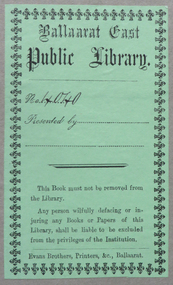
... The spine as the Legislative Council of Victoria embossed into the leather. Hardcovered book, half leather bound with marbled paper. ...Hardcovered book, half leather bound with marbled paper. Formerly book number 4040 from the Ballaarat East Public Library. Contents include: new pit-saw, self-moving carriage (car), Lord Worcestor's steam engine, extinction of fires, Cameron's Soda Water Apparatus, Newton's Lectures on Astronomy, coining at the Royal Mint, mechanical geometry, lifting ships by steam, voltaic-mechanic agent, steam navigation, portable hand-mill, Brown's pneumatic engine, Bell's invention for saving lives from shipwreck, triple pump, cycloidal chuck, potato-washer, sand clock, Galvanic electricity, perpetual motion, Hadley's Quadrent, Wollaston's Night-Bolt, rope bridges, boring machinery, locomotive steam-engines, new London Bridge, naval architecture, steam and water wheel, Spencer's Patent Forge, boat with wings, ivory profile portraits, Jenning's Gas burner, Ramage's Telescope, washing machine, tallow lamp, iron masts, self regulating pendulum, prismatic compass, simple blowpipe. Includes image of Henry Brougham, and many drawings of inventions.non-fictioncar, newton, fire, shipwreck, bell, naval architecture, locomotive, ballaarat east public library, ballarat east public library, ballarat east library, henry brougham, potassium, meridian lines, pit saw, self moving carriage, lord worcestor, steam engine, cameron s, soda water, astronomy, royal mint, mechanical geometry, lifting ships by steam, voltaic mechanic agent, steam navigation, hand mill, brown s pneumatic engine, triple pump, cycloidal chuck, potato washer, sand clock, galvanic electricity, perpetual motion, hadley s quadrent, wollaston s night bolt, rope bridges, boring machinery, steam engines, new london bridge, steam and water wheel, spencer s patent forge, boat with wings, ivory profile portraits, jenning s gas burner, ramage s telescope, washing machine, tallow lamp, iron masts, self regulating pendulum, prismatic compass, simple blowpipe, bookplate -
 Federation University Historical Collection
Painting - Artwork, Edith Alice Watson, Examples of General Design from folio of artwork undertaken at the Ballarat Technical Art School, 1931,1932
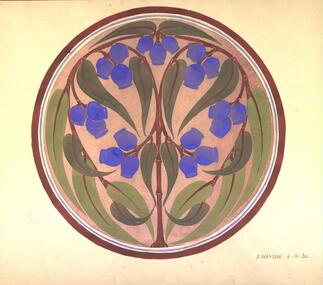
... Alice Watson died in Ballarat, aged 95, having conserved her beautiful student folio, which was generously gifted to the Federation University permanent Historical Collection by the Watson family. ballarat technical art school alice watson flora design artwork folio art nouveau alumni leather work design richelieu work applique doily holder doyley holder General Design Edith Alice Watson Most are signed A. Watson 1931 .2) Paper is embossed ...Edith (Alice) WATSON (1914–2010) Murtoa | Australia Alice Watson studied at the Ballarat Technical Art School (at the School of Mines, Ballarat) from 1930 until 1933. Watson sat several departmental exams, including drawing and painting plant forms from nature, lettering, Composition of Form and Colour and advanced General Design, as well as dressmaking and embossed leatherwork. General Design examinations required only designs on paper, and not the full execution of an object (which was the case for Applied Design exams). Watson's folio applies many Australian native floral elements to design. Upon graduating, Watson taught at the Murtoa High School, living with her parents until their deaths in 1972 and 1988 when she was 74 years old. Alice Watson died in Ballarat, aged 95, having conserved her beautiful student folio, which was generously gifted to the Federation University permanent Historical Collection by the Watson family. A folio of thirty three drawings and paintings undertaken by Alice Watson at the Ballarat Technical Art School. The works include including the application of Australian flora to designs, including for pottery, leather and applique. .2) is a design for a table runner to be executed in richelieu work .3) frieze including fish .4) "Design for a border to be executed in stencil". 1932 .12) "Design on the waratah for a bowl to be executed in clay". 1932 .14) "Time test" .12) .17) .15) .18) show the combination of Australian flora with Art Nouveau-inspired designs .9) is a design for a wallet to be executed in raffia showing elevation, side elevation and plan views .11) is a design for a prayer book carrier to be executed in leather work .10) is an example of pencil transfer method of design seen on .11) .18) Design for a fan, image of birds and berries on a blue ground. .25) landscape illustration .27) "development" design based on a correa .29) "Design for a tea cosy based on the Cobia-Scanden to be executed in applique. 1931 (see also .31) .30) "Design for a writing tablet to be executed in embossed leather work and based on the native fuschia" (correa). 1931 .31) a completed doily holder: applique workMost are signed A. Watson 1931 .2) Paper is embossed with stamp of 'Goodall's Bristol Boards' stamp. (Crown depicted in centre) .20 and .22) Paper is embossed with 'Windsor & Newtons Bristol Board' stamp.(Griffin depicted in centre)ballarat technical art school, alice watson, flora, design, artwork, folio, art nouveau, alumni, leather work design, richelieu work, applique, doily holder, doyley holder, general design, edith alice watson -
Ithacan Historical Society
Administrative record, IPS Minute Book, March 1928 to June 1944
... embossed label on the spine: MINUTE / BOOK. A foolscap sized bound minute book with tan leather binding on the spine and a green cloth cover on the front and back covers. The four corners are finished with brown leather. The inside covers are finished with purple marbled paper ...The minute book is a record of the activities of the Ithacan Philanthropic Society from March 1928 to June 1944. The minutes have been written in Greek which was the first language of the members.Through the records in this second minute book of the Ithacan Philanthropic Society it is possible to learn of the families who settled in Melbourne during the pre-World War years and throughout World War 2 , their occupations and lives and their concerns for families left behind in Greece during those difficult years. A foolscap sized bound minute book with tan leather binding on the spine and a green cloth cover on the front and back covers. The four corners are finished with brown leather. The inside covers are finished with purple marbled paper with cream cotton tape reinforcements. There are 578 lined pages but only 417 have been used. Three loose pages have been placed in order in the book. Two white labels ar stuck on the front cover. The figure '2' is written on the front.On a red embossed label on the spine: MINUTE / BOOK. -
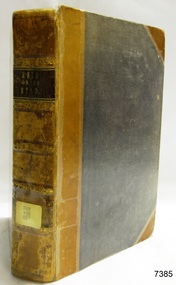 Flagstaff Hill Maritime Museum and Village
Book - Reference Book/Scholarly/Philosophy, Rev. George Newenham Wright et al, Essays on The Active Powers of the Human Mind (Annotated Version by REV. G N Wright), 1843
... paper has a sticker from Corangamite Regional Library Service Essays on The Active Powers of the Human Mind (Annotated Version by REV. G N Wright) Author: Original 1788 work by Thomas Reid ( subject work by REV. G N Wright ) Publisher: Thomas Tegg London Date: Subject work 1843 Black cloth cardboard covers with leather embossed ...Essays on The Active Powers of the Human Mind (Annotated Version by REV. G N Wright) Author: Original 1788 work by Thomas Reid ( subject work by REV. G N Wright ) Publisher: Thomas Tegg London Date: Subject work 1843 Black cloth cardboard covers with leather embossed ribbed spine (This is a first edition) non-fictionpattison collection, flagstaff hill maritime museum, george newenham, thomas reid, philosophy, book, warrnambool mechanics institute -
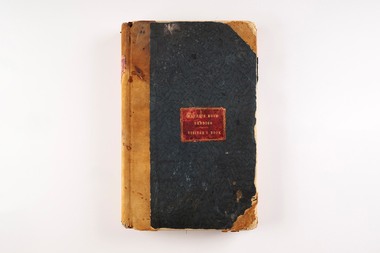 City of Greater Bendigo - Civic Collection
Book, J. B. Young Stationer, Mayor's Room Visitors Book, 1900
... Embossed leather piece with Visitors Book written on it. Cover; Embossed leather piece with Mayor's Room Bendigo Visitors Book Large tan leather and green cloth bound book. 390 lined pages each with three ruled vertical columns titled; Name, Address, Remarks. Marbled front and back end papers. Pages numbered top left or right of each page. Front end page has a small pink piece of paper ...The Mayor's room was traditionally a private space in which the Mayor met with visitors and official guests. The signatures in this Visitor's Book reflect the breadth of community members who were received by Mayor's throughout the 20th century. From local people to overseas dignitaries their signatures are recorded for prosperity as evidence of their visit to Bendigo. Signatures include the Duchess and Duke of York (Later the King and Queen of England) who visited on the 28th April 1927 as part of their national visit which coincided with the opening of Parliament House in Canberra. Royals Prince Charles and Lady Diana signed the book on the April 15th, 1983 and Prime Minister John Howard and Members of Cabinet in 1998. Large tan leather and green cloth bound book. 390 lined pages each with three ruled vertical columns titled; Name, Address, Remarks. Marbled front and back end papers. Pages numbered top left or right of each page. Front end page has a small pink piece of paper pasted in centre with makers name and address on it. The book began being used on the 23rd March1900, with the last two pages featuring signatures of federal politicians who attended a Cabinet Meeting at the Bendigo Town Hall on the 21st July 1998.Spine; Embossed leather piece with Visitors Book written on it. Cover; Embossed leather piece with Mayor's Room Bendigo Visitors Bookcity of greater bendigo events, city of greater bendigo town hall, city of greater bendigo royal visits -
Linton Mechanics Institute and Free Library Collection
Book - Novel, Ruck, Berta (Roberta Amy Ruck (Mrs Oliver Onions, Amy Oliver), A land-girl's love story, [n.d.] [1919?]
... paper pasted over it. 344 p. First pages, including title page, are missing. Plain brown cover with leather trim. Title and author's name embossed ...A novel set during World War I, which focuses on a young woman who joins the Women's Land Army in Britain. The story explores her journey as she transitions from city to rural life, and her developing romance with a soldier.344 p. First pages, including title page, are missing. Plain brown cover with leather trim. Title and author's name embossed on spine. Book shows signs of having been repaired and re-bound. "Ballaarat Mechanics' Institute" embossed on spine.fictionA novel set during World War I, which focuses on a young woman who joins the Women's Land Army in Britain. The story explores her journey as she transitions from city to rural life, and her developing romance with a soldier.berta ruck, fiction, romance, world war 1914-1918 -
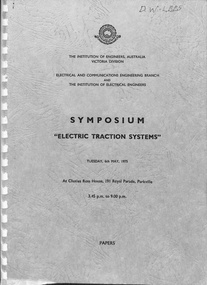 Melbourne Tram Museum
Document - Report, Engineers Australia, "Symposium 'Electric Traction Systems", May. 1975
... Report - approx. 55 A4 photocopied sheets - bound with white comb binding, with embossed leather imitation grey card covers, titled "Symposium 'Electric Traction Systems' ", presented by the Institution of Engineers Australia, Vic Div, Tues 6/5/1975. Contains three papers: 1 - "Electricity of Transportation" - R. G. Chapman, SEC 2 - "Electric vehicles for Street Transport:" - F. D. Snell - MMTB 3 - "Electric Railways" - A. Firth - VR Paper...Lees" Report - approx. 55 A4 photocopied sheets - bound with white comb binding, with embossed leather imitation grey card covers, titled "Symposium 'Electric Traction Systems' ", presented by the Institution of Engineers Australia, Vic Div, Tues 6/5/1975. Contains three papers: 1 - "Electricity of Transportation" - R. G. Chapman, SEC 2 - "Electric vehicles for Street Transport:" - F. D. Snell - MMTB 3 - "Electric Railways" - A. Firth - VR Paper ...Report - approx. 55 A4 photocopied sheets - bound with white comb binding, with embossed leather imitation grey card covers, titled "Symposium 'Electric Traction Systems' ", presented by the Institution of Engineers Australia, Vic Div, Tues 6/5/1975. Contains three papers: 1 - "Electricity of Transportation" - R. G. Chapman, SEC 2 - "Electric vehicles for Street Transport:" - F. D. Snell - MMTB 3 - "Electric Railways" - A. Firth - VR Paper 2 looks at the history of the MMTB system, the W class tram, control systems, lack of new trams in the 1960's, ordering of the Z class tram, its specification and manufacture, 980, 1041 and other forms of public transport on roads - trolley buses, gadgetbahns, and lots of possibilities of new systems including battery vehicles.On rear in ink in top right hand corner "D. W. Lees"trams, tramways, reports, mmtb, tramcars, pcc class, z class, melbourne, history, trolley buses, electrical engineering, controllers
