
Showing 39 items matching "emites"
-
 Whitehorse Historical Society Inc.
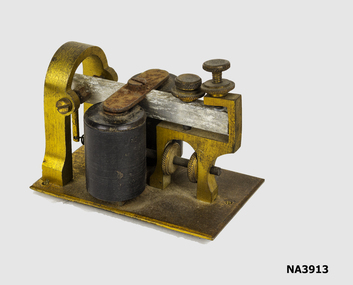
Equipment - Morse Code Repeater Limit
... The silver metal bar has two brass screws, one of which moves the bar to tap on the brass frame beneath it to emit the signal...The silver metal bar has two brass screws, one of which moves the bar to tap on the brass frame beneath it to emit the signal Equipment Morse Code Repeater Limit ...From the collection of Ken YoungWas a very important method of communication from approximately 1910 onwards. Morse Code was used by the Armed Forces up till 1960Brass base plate with two coils attached by a metal bar screwed down with a cross bar. The silver metal bar has two brass screws, one of which moves the bar to tap on the brass frame beneath it to emit the signalcommunication, telegraphic -
 Federation University Historical Collection
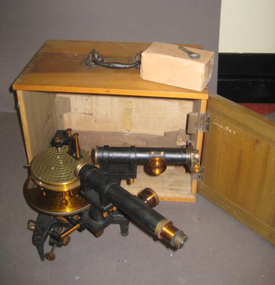
Instrument - Scientific Instruments, Spectroscope
... This item has applications in teaching Physics and Chemistry - obtaining information about the atomic structure of the light-emitting substance. ...This item has applications in teaching Physics and Chemistry - obtaining information about the atomic structure of the light-emitting substance. scientific instruments surveying microscope physics chemistry atomic structure spectroscope Manufacturers' and suppliers names stamped on the vernier disc: "Made by W. & J. ...This item has applications in teaching Physics and Chemistry - obtaining information about the atomic structure of the light-emitting substance. An optical instrument that employed a monochromatic light source, a prism (missing), and viewing lenses mounted in a tube that can be in any radial position with respect to the vertical axis of the prism. House in a polished timber carry box.Manufacturers' and suppliers names stamped on the vernier disc: "Made by W. & J. George Ltd, Birmingham, England" and "For H.B. SELBY & Co, SYDNEY & MELBOURNE. No 266"scientific instruments, surveying, microscope, physics, chemistry, atomic structure, spectroscope -
 Emerald Museum & Nobelius Heritage Park
Photograph - Emerald Football Club, 1977, Unknown maker, 1977
... ...Emites...The club has also been known variously as the 'Emites', the 'Redlegs' and the current 'Bombers.' ...The club has also been known variously as the 'Emites', the 'Redlegs' and the current 'Bombers.' ...Emerald Football Club was formed in 1905, one of the first teams in the Mountain District Football Association (renamed the Yarra Valley Mountain District Football League in 1967). The club has changed its official colours three times, playing firstly under blue and white colours, then green and gold before adopting the red and black colours shown in the photograph and still used today. The club has also been known variously as the 'Emites', the 'Redlegs' and the current 'Bombers.' A joint Australian Football League (AFL) and La Trobe University Centre for Sport and Social Impact study discusses the importance of local football teams for fostering community cohesion and relationships and distributing information and health and social issues to local people. Local football and other sporting teams are integral to the economic and social development of an area and are therefore significant far beyond the immediate players or families associated with the club.The photograph is significant for its insights into the history of sports and recreation in the Emerald region in the 1970s. It depicts a key moment between the Emerald Football Club (the 'Bombers') and South Belgrave Football Club (the 'Wolves'); both clubs are still active in the area. Australian Rules Football has a long history in the region and played a fundamental role in community life.Colour rectangular photograph printed on photographic paper. The photograph depicts seven men playing Australian Rules Football at a suburban football oval; fifteen spectators including a junior player in uniform are visible in the background of the photograph. Cars and sports field netting can also be seen. Notations on the reverse of the photograph indicate that the match shown is the second semi-final of the 1977 season, held in Marysville, between the Emerald Football Club (wearing red and black) and South Belgrave. Three names are written on the reverse in different hand-writing, these are Geoff 'Digger' Dolan, Tony Greenwell and Dave Sands.Reverse: 1977 / 7. / Second Semi Final / V SOUTH BELGRAVE / Marysville / GEOFF 'DIGGER' DOLAN / TONY GREENWELL / DAVE SANDS / VEMUP 417 /1970s, clubs, associations, societies, sports, australian rules football, emerald football club, bombers, south belgrave football club, geoff 'digger' dolan, tony greenwell, dave sands, marysville, wolves, redlegs, emites -
 Bendigo Historical Society Inc.
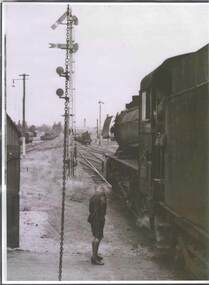
Photograph - RAILWAY COLLECTION: C22 AT CASTLEMAINE ON A DOWN BENDIGO GOODS, 1948
... Railway collection -photo 1948 C22 at Castlemaine on a Down Bendigo Goods -black and white photo of a boy looking at steam emitting from a steam train at Castlemaine station Goodsyard .Another steam train and goods and passenger carriages and a train signal are in the yard...PHOTOGRAPH Person C22 at Castlemaine Railway collection -photo 1948 C22 at Castlemaine on a Down Bendigo Goods -black and white photo of a boy looking at steam emitting from a steam train at Castlemaine station Goodsyard .Another steam train and goods and passenger carriages and a train signal are in the yard Photograph RAILWAY COLLECTION: C22 AT CASTLEMAINE ON A DOWN BENDIGO GOODS ...Railway collection -photo 1948 C22 at Castlemaine on a Down Bendigo Goods -black and white photo of a boy looking at steam emitting from a steam train at Castlemaine station Goodsyard .Another steam train and goods and passenger carriages and a train signal are in the yardphotograph, person, c22 at castlemaine -
 Federation University Historical Collection
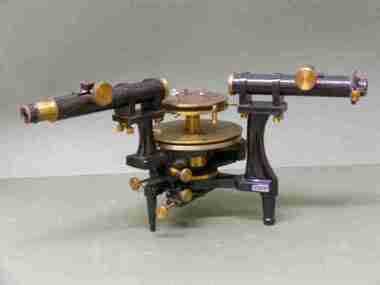
Scientific Instument, Spectrometer, Serial No.1667
... This item was used at the Ballarat School of Mines.It had applications in teaching physics and chemistry - obtaining information about the atomic structure of the light-emitting substance....This item was used at the Ballarat School of Mines.It had applications in teaching physics and chemistry - obtaining information about the atomic structure of the light-emitting substance. scientific instrument ballarat school of mines labororatory physics optical measurement chemistry structure of substance Serial number: 1667 Manufacturer's and Supplier's names Spectrometer in wooden case. ...This item was used at the Ballarat School of Mines.It had applications in teaching physics and chemistry - obtaining information about the atomic structure of the light-emitting substance.Spectrometer in wooden case. An optical instrument that employs a monochromatic light source, a prism (missing) and viewing lenses.Serial number: 1667 Manufacturer's and Supplier's namesscientific instrument, ballarat school of mines, labororatory, physics, optical measurement, chemistry, structure of substance -
 Flagstaff Hill Maritime Museum and Village
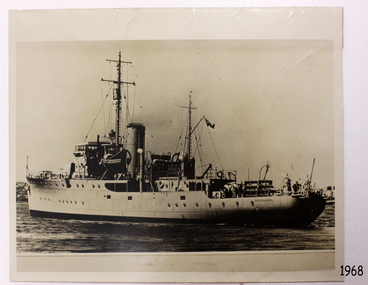
Photograph - Vessel, Steam Ship, HMAS Warrnambool J202, Between 1941-1947
... The light coloured funnel has emitted a small amount of smoke....The light coloured funnel has emitted a small amount of smoke. HMAS Warrnambool J202 Photograph Vessel, Steam Ship Royal Australian Navy (RAN) ...The photograph shows the vessel HMAS Warrnambool J202, which was commissioned by the Royal Australian Navy for use as a minesweeper during World War II. The Bathurst Class Corvette, fitted out with a range of armaments, was launched in Sydney 1941. The ship began service in Bass Strait in 1941. At the end of the year it called into its namesake city, Warrnambool, where the crew paraded for the public marching eastwards along Timor Street. A gift of books for the ship’s personnel and a plaque bearing the City of Warrnambool’s Coat of Arms were presented to the ship. The ship was involved in evacuating a family of nine from the Dutch East Indies that was later successful in its challenge of Australia’s Immigration Restriction Act (White Australia Polity). The ship had many other appointments around Australia. On 13th September 1947 HMAS Warrnambool was leading a flotilla of minesweepers in northern Queensland’s coastal waters, clearing mines previously laid to defend Australia. The ship hit a mine, which exploded and very quickly sunk the ship. Boats from the nearby ships rescued most of the seamen although one was killed at the time. The survivors were taken by the HMAS Swan II to Darwin, and they went from there to hospitals in Brisbane and Sydney. Three of these men later died from their injuries. A number of items were recovered by Navy divers in 1948 including the ship’s bell and a plaque with Warrnambool’s Coat of Arms. In 1972-75 the wreck was sold and other items were salvaged. In 1995 a memorial plaque was erected in Warrnambool near the RSL. NOTE: The RAN built a second HMAS Warrnambool FCPB204, launched in 1981 and decommissioned in 2005. There was also a steam ship SS Warrnambool built in London 1892 and broken up in 1926. [A more detailed history can be found in our Collection Record 3477.] This photograph of HMAS Warrnambool is significant for its association with Royal Australian Navy and its vessel, HMAS Warrnambool (J202). The HMAS Warrnambool played a nationally significant role in overturning Australia’s Immigration Restriction Act 1901 (colloquially known as the White Australia policy). The ship rescued, and brought to Australia, Samuel and Annie Jacob and their family after they evacuated Dutch East India. The family was threatened with deportation and made the first successful appeal to High Court regarding that Act. The HMAS Warrnambool has - Local significance for being the namesake of the City of Warrnambool - Local significance, having docked in Warrnambool Harbour - Local significance, the crew having paraded in Timor Street, Warrnambool - State significance for its first patrol being in Bass Strait. - National significance, being present in Timor at the Japanese surrender - National significance, shown by the significance of the ship’s bell being curated as Military Heritage and Technology at the Australian War Memorial. - National significance as part of Australia’s defence force history, being one of only four Bathurst class corvettes lost while in Australian service, the only Bathurst class corvette lost after World War II, the only RAN vessel to be sunk by a mine, and associated with the last four Navy deaths of WWIIPhotograph of HMAS Warrnambool near land. Black and white photograph shows a steam and sail vessel in calm water beside land. Figures are standing on board. A flag flies on a mast. The ship's name is on the stern. The light coloured funnel has emitted a small amount of smoke.On side of ship "WARRNAMBOOL"flagstaff hill, maritime village, maritime museum, warrnambool, shipwreck coast, mort's dock & engineering co ltd, h.m.a.s. warrnambool, hmas warrnambool, hmas warrnambool i, hmas warrnambool j202, hmas swan ii, j202, world war ii, bathurst class corvette, royal australian navy, ran, sydney built ship, bass strait patrol, sea mine patrol, mine sweeper, mine clearance, navy divers, great barrier reef, cockburn reef, southern cross diving and salvage, warrnambool city council, cr j r astbury, mayor j r astbury, warrnambool patriotic fund, seal, coat of arms, dedicatory plaque, hmas warrnambool 1941, shipwreck by sea mine 1947, sinking ship, sunk ship, minesweeper -
 Federation University Historical Collection
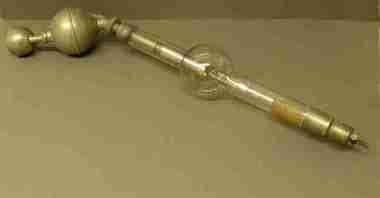
Scientific Instument, Media Hochleistung, Electron Valve, 11/11/1926
... ONe end connections for emitter filament heating current. Other end - attachmentes for electron target, with some provisin for air/gas flow. ...ONe end connections for emitter filament heating current. Other end - attachmentes for electron target, with some provisin for air/gas flow. ...A glass cylindar with a spherical enlargement in the middle part, with metal end attachments. ONe end connections for emitter filament heating current. Other end - attachmentes for electron target, with some provisin for air/gas flow. Paper label on one end, tabular voltages, currents, etc. Serial Number 243738scientific instrument, electron valve, x-ray -
 Bendigo Historical Society Inc.
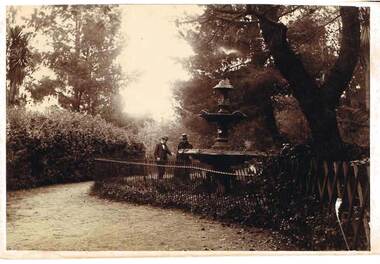
Photograph - FOUNTAIN IN ROSLIND PARK
... The photo shows a three tier fountain, water emitting from top, surrounded by a simple metal fence. ...The photo shows a three tier fountain, water emitting from top, surrounded by a simple metal fence. ...Photograph - black and white. Written on back of photo -' Fountain in Rosalind Park, old camp reserve. Violet and Mr Baker'. The photo shows a three tier fountain, water emitting from top, surrounded by a simple metal fence. Man and woman standing alongside fence looking at fountain, presumably Violet and Mr. Baker.place, public gardens, rosalind park, fountain in roslind park. bendigo. violet and mr baker. -
 Bendigo Historical Society Inc.
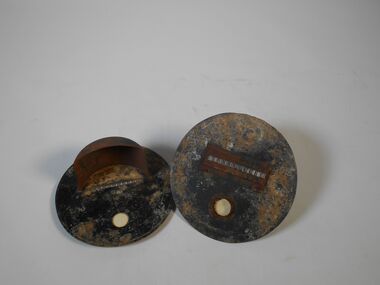
Accessory - Head light cover
... They were designed to restrict the amount of light emitted by cars and vans....They were designed to restrict the amount of light emitted by cars and vans. WW2 Blackout Cars Stamped Lucas Head light covers used during WW2. ...During WW2 headlight covers were used for night driving during brown out periods. They were compulsory from late 1941 to the end of 1943 when it was thought that the danger of invasion had passed. They were designed to restrict the amount of light emitted by cars and vans.Head light covers used during WW2. Small rectangular opening to allow a sliver of light to shine at night .Metal round piece with metal shade for headlights to point to the ground. Originally painted black.Stamped Lucasww2, blackout, cars -
Emerald Museum & Nobelius Heritage Park
Domestic object - Kerosene lantern, Unknown maker, Mid 19th to early 20th century
... Having two wicks instead of one meant that the lanterns emitted twice as much light. Electricity began to power Victorian towns in the 1890s, but its use did not become widespread until well into the 20th century. ...Having two wicks instead of one meant that the lanterns emitted twice as much light. Electricity began to power Victorian towns in the 1890s, but its use did not become widespread until well into the 20th century. ...The Duplex lantern was patented in 1864 or 1865 by James and Joseph Hinks. Having two wicks instead of one meant that the lanterns emitted twice as much light. Electricity began to power Victorian towns in the 1890s, but its use did not become widespread until well into the 20th century. Electricity reached Emerald in 1934.This item is historically significant as it is an example of a style of lantern that pre-dates the widespread use of electricity as a means of illumination. It is an example of the Duplex design of lantern which, in having two wicks instead of one, meant double the light and a more efficient combustion of fuel.Kerosene lantern with hand-painted green glass tank. Base of the lantern is ornately-decorated, metal square-based pyramid. The metal component of the lantern proper is gold-coloured.Wick winder buttons: DUPLEX / DUPLEX /lantern, kerosene lamp, lighting, kerosene lantern, domestic life, domestic appliance -
 Vision Australia
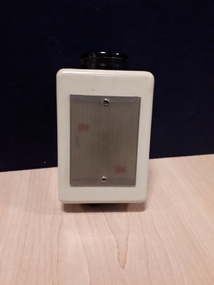
Equipment - Object, Data Acquisition Ltd, Rain warning device
... It was designed so that when placed outdoors would emit a noise at the first drop of rain, enabling vision impaired people to retrieve their washing from the line. ...It was designed so that when placed outdoors would emit a noise at the first drop of rain, enabling vision impaired people to retrieve their washing from the line. ...A battery operated device that is rectangular in shape with a sensor plate on top and an on/off switch on one end. At the other end is a round lid that screws off to allow a round 9 volt battery to be inserted. It was designed so that when placed outdoors would emit a noise at the first drop of rain, enabling vision impaired people to retrieve their washing from the line. 1 plastic box with metal plateRain warning device Made for the Royal National Institute for the Blind by Data Acquisition Ltd A price sticker reads: $49.assistive devices, royal national institute for the blind -
 Vision Australia
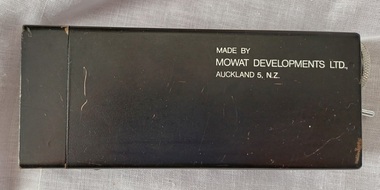
Equipment - Object, Mowat Developments Ltd, Mowat Sonic Sensor, 197
... Created prior to the Mowat-Wormald development, this prototype emits a beam of ultrasonic sound that detects reflection from objects and obstacles as well as vibrate when the object is within range. ...Created prior to the Mowat-Wormald development, this prototype emits a beam of ultrasonic sound that detects reflection from objects and obstacles as well as vibrate when the object is within range. ...Created prior to the Mowat-Wormald development, this prototype emits a beam of ultrasonic sound that detects reflection from objects and obstacles as well as vibrate when the object is within range. The rate of vibration increases the distance reduces and was designed to be used in conjunction with other mobility aids such as a cane or a dog. With a simple toggle switch, it could be operated easily or stored safely away due to it's compact size.A small black rectangular metal container with mesh on one aend and a switch and tuning dial on the other end.Model MS01assistive devices, orientation and mobility -
Emerald Museum & Nobelius Heritage Park
Photograph - Emerald Football Club, 1985, U17, Unknown photographer
... The club has also been known variously as the 'Emites', the 'Redlegs' and the current 'Bombers.'...The club has also been known variously as the 'Emites', the 'Redlegs' and the current 'Bombers.' ...Emerald Football Club was formed in 1905, one of the first teams in the Mountain District Football Association (renamed the Yarra Valley Mountain District Football League in 1967). The club has changed its official colours three times, playing firstly under blue and white colours, then green and gold before adopting the red and black colours shown in the photograph and still used today. The club has also been known variously as the 'Emites', the 'Redlegs' and the current 'Bombers.'The photograph is significant for its insights into the history of sports and recreation in the Emerald region. It shows the involvement of young men in a team sport and the style of uniforms they wore.Rectangular, coloured photograph printed on gloss paper. This photograph depicts a group of 26, mainly young men, dressed in black and red football uniforms. They are on a grass field. In the background are goal posts, bare trees and cars.football team colours, australian rules football -
Emerald Museum & Nobelius Heritage Park
Photograph - Emerald Football Club, 1986 Reserves, Unknown photographer, 1986
... The club has also been known variously as the 'Emites', the 'Redlegs' and the current 'Bombers.'...The club has also been known variously as the 'Emites', the 'Redlegs' and the current 'Bombers.' ...Emerald Football Club was formed in 1905, one of the first teams in the Mountain District Football Association (renamed the Yarra Valley Mountain District Football League in 1967). The club has changed its official colours three times, playing firstly under blue and white colours, then green and gold before adopting the red and black colours shown in the photograph and still used today. The club has also been known variously as the 'Emites', the 'Redlegs' and the current 'Bombers.'The photograph is significant for its insights into the history of sports and recreation in the Emerald region. Football was, and is a significant part of community sport in Emerald. The club was first formed in 1905. The club colours have changed, from originally blue and white, followed by green and gold, followed by black and red of the present day.Rectangular colour photograph printed on gloss photographic paper. The picture depicts a group of unnamed men. They are inside clubrooms. Some are seated, others standing. On the back wall are 2 premiership flags. The men are dressed in the Emerald Football Club colours of black and red.Obverse: M E F C E F C / D PREMIERS PREMIERS / F / A / MALE / EMERALD / FOOTBALL CLUB / 1986 / RESERVES / Reverse: RESERVES 1986 /1980s, australian rules football, emerald football club -
 Mission to Seafarers Victoria
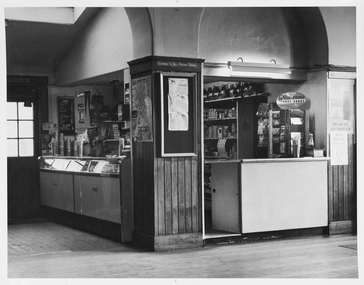
Photograph - Photograph, Black and white, Melbourne Harbour Trust, c. 1963
... From the left hand side of the photograph the image portrays an external doorway with six glass windows, emitting light from behind. This leads to the dipslay cabinet and bench of the canteen which is reflecting light from the windowed door. ...From the left hand side of the photograph the image portrays an external doorway with six glass windows, emitting light from behind. This leads to the dipslay cabinet and bench of the canteen which is reflecting light from the windowed door. ...The canteen is part of the Mission to Seafarers building that has catered to visiting seafarers since 1917. The canteen is operated by the Flying Angel Club, which offered services to seafarers including food, drink and souvenirs from the canteen and events held in the main hall which invloved the use of the canteen. The Ladies Harbor Lights Guild also used the canteen facilities for functions and fundraisers held at the Mission to Seafarers. One of the flyer in Chinese helps dating the photograph between 1963-66 when Padre Wong was chaplain at the Mission.Historical record of the Mission to Seafarers canteen post-1963. This is an example of the contemporaneous use of the canteen as primarily a supply shop and in a comparative fashion reveals some of the overall changes at the Mission.A white-bordered, black and white photograph of the Mission to Seafarers Canteen. From the left hand side of the photograph the image portrays an external doorway with six glass windows, emitting light from behind. This leads to the dipslay cabinet and bench of the canteen which is reflecting light from the windowed door. Central to the image is a pillar which is three-quarters wood paling starting from the floor, of which a map is displayed on one edge and a notice board on the remaining visible edge of the pillar. A bench is visible to the right side of the pillar and the far right side of the photograph, posters are hung on the wall. Purple stamp on central back of photograph. "Melbourne Harbor/Trust Photograph/Negative No......." photograph, canteen, tab, koalas, blackboard, archway, pennant, licensed-to-sell-postage-stamps, mission to seamen, mission to seafarers, melbourne, flying angel club, map, bar, milkshake machine, display case, fluorescent light, notice board, wains coting, postcards, milkshake, beverage, plastichrome, matches, razors, gillette, straw, melbourne harbour trust, melbourne harbor trust, donation tin, lighthouse -
 Orbost & District Historical Society
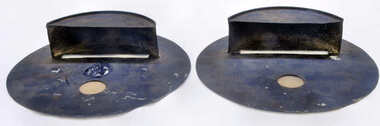
shields - blackout, Swan, Wally, WW11
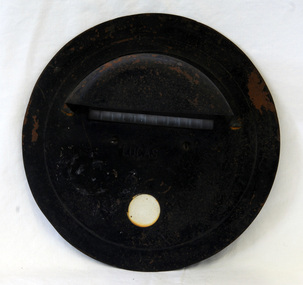
... These shields limited the amount of light emitted by a vehicle. To drive at night without them was an offence; however, the increase in road accidents led to the removal of headlight masks everywhere in Australia south of Rockhampton from 15 February 1943....These shields limited the amount of light emitted by a vehicle. To drive at night without them was an offence; however, the increase in road accidents led to the removal of headlight masks everywhere in Australia south of Rockhampton from 15 February 1943. ...By 1941, the threat of Japanese invasion caused restrictions to daily life. Blackouts became the norm. To prevent identification from enemy planes all lights had to be turned down, including car headlights that had to be covered to minimize light exposure. In Australia more relaxed regulations led to the Australian air raid precautions being dubbed the “brownout”. These shields limited the amount of light emitted by a vehicle. To drive at night without them was an offence; however, the increase in road accidents led to the removal of headlight masks everywhere in Australia south of Rockhampton from 15 February 1943.These shields, though not rare, evoke a period of restrictions, fear, rationing and confinement.Pair of handmade car light blackout shields. Black round metal with scoop at front as well as small glass partition.shields-blackout ww11 transport-motor-vehicles -
 Orbost & District Historical Society
blackout shield, Lucas Industries, WW 11
... These shields limited the amount of light emitted by a vehicle. To drive at night without them was an offence; however, the increase in road accidents led to the removal of headlight masks everywhere in Australia south of Rockhampton from 15 February 1943. ...These shields limited the amount of light emitted by a vehicle. To drive at night without them was an offence; however, the increase in road accidents led to the removal of headlight masks everywhere in Australia south of Rockhampton from 15 February 1943. ...By 1941, the threat of Japanese invasion caused restrictions to daily life. Blackouts became the norm. To prevent identification from enemy planes all lights had to be turned down, including car headlights that had to be covered to minimize light exposure. In Australia more relaxed regulations led to the Australian air raid precautions being dubbed the “brownout”. These shields limited the amount of light emitted by a vehicle. To drive at night without them was an offence; however, the increase in road accidents led to the removal of headlight masks everywhere in Australia south of Rockhampton from 15 February 1943. These shields, though not rare, evoke a period of restrictions, fear, rationing and confinement.A circular metal disc painted black - car light blackout shield. It has a small glass slot in front and a scooped out front to cover the light.ww11 blackout-shield -
 Coal Creek Community Park & Museum
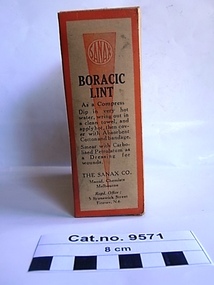
Medical dressing
... "SANAX" Fragrant Pastille; ignite easily and burn steadily, emitting delightful fumes of fragrant incense. ..."SANAX" Fragrant Pastille; ignite easily and burn steadily, emitting delightful fumes of fragrant incense. ...TROVE : Advocate (Melbourne, Vic. : 1868 - 1954), Saturday 29 March 1919, page 6. For Perfuming the Living or Sick Rooms, for Special Services, High, Mass, Requiem Service, and Benediction. "SANAX" Fragrant Pastille; ignite easily and burn steadily, emitting delightful fumes of fragrant incense. Every home should have them. All Chemists, or BURROWS PHARMACY, 5 Brunswick St., FITZROY. TROVE : Age (Melbourne, Vic. : 1854 - 1954), Saturday 16 August 1941, page 4 SITUATIONS VACANT. ADVERTISERS …………Girl Packer, about 18 yrs. The Sanax Co., 5 Brunswick-street, Fitzroy. City…….. Manila coloured cardboard box printed in dark brown and orange containing a pink coloured lint cloth.Box. Side 1. 'SANAX (logo) BORACIC LINT. As a compress. Dip in very hot water, wring out in a clean towel, and apply hot, then cover with Absorbent Cotton and bandage. Smear with Carbolised Petrolatum as a Dressing for wounds. THE SANAX CO. Manuf. Chemists Melbourne Reg'd Office : 5 Brunswick Street, Fitzroy, N.6.' Side 2. 'THERE'S A "SANAX" FIRST AID CASE for every purpose 27 Distinct Patterns to choose from. No. 1 "Sanax" First Aid For Factories, Home etc. No. 1a "Sanax" First Aid For the Home, Farm, School No. 2 "Sanax" First Aid For Factories, Mines, Quarries No. 4 "Sanax" First Aid (Portable) For Sports Clubs, Scouts, Guides No. 5 "Sanax" First Aid For Mines, Racing & Football Clubs No. 7 "Sanax" First Aid (Portable) For the Farm, Home or Sports Field No. 9 "Sanax" First Aid (Portable) For the Motor Car No. 11 "Sanax" First Aid (Pocket Size) For Boy Scouts, Girl Guides No. 20 & 25 "Sanax" First Aid (Portable) For the Motorist. Side 3. USE "SANAX" ACHE TABLETS for ALL PAINS ACHES and FEVERS - SAFE and EFFECTIVE. Side 4 Keep "Sanax" First Aid Dressing handy , for small wounds, cuts, cracked hands, and abrasions. It forms an antiseptic healing skin over the damaged part. Sole Makers The SANAX Co. Melbourne. Side 5. TRADE "SANAX" MARKwound dressing, lint cloth -
 Coal Creek Community Park & Museum
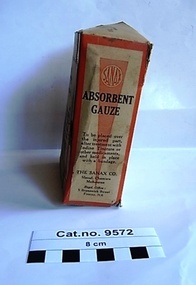
Box of Dressings, mid 20th Century
... "SANAX" Fragrant Pastille; ignite easily and burn steadily, emitting delightful fumes of fragrant incense. ..."SANAX" Fragrant Pastille; ignite easily and burn steadily, emitting delightful fumes of fragrant incense. ...TROVE : Advocate (Melbourne, Vic. : 1868 - 1954), Saturday 29 March 1919, page 6. For Perfuming the Living or Sick Rooms, for Special Services, High, Mass, Requiem Service, and Benediction. "SANAX" Fragrant Pastille; ignite easily and burn steadily, emitting delightful fumes of fragrant incense. Every home should have them. All Chemists, or BURROWS PHARMACY, 5 Brunswick St., FITZROY. TROVE : Age (Melbourne, Vic. : 1854 - 1954), Saturday 16 August 1941, page 4 SITUATIONS VACANT. ADVERTISERS …………Girl Packer, about 18 yrs. The Sanax Co., 5 Brunswick-street, Fitzroy. City…….. Manila coloured cardboard box printed in dark brown and orange containing cotton gauze.Box. Side 1. 'SANAX (logo) ABSRORBENT GAUZE. To be placed over the injured part, after treatment with Iodine Tincture or other medicaments, and held in place with a bandage. THE SANAX CO. Manuf. Chemists Melbourne Reg'd Office : 5 Brunswick Street, Fitzroy, N.6.' Side 2. 'THERE'S A "SANAX" FIRST AID CASE for every purpose 27 Distinct Patterns to choose from. No. 1 "Sanax" First Aid For Factories, Home etc. No. 1a "Sanax" First Aid For the Home, Farm, School No. 2 "Sanax" First Aid For Factories, Mines, Quarries No. 4 "Sanax" First Aid (Portable) For Sports Clubs, Scouts, Guides No. 5 "Sanax" First Aid For Mines, Racing & Football Clubs No. 7 "Sanax" First Aid (Portable) For the Farm, Home or Sports Field No. 9 "Sanax" First Aid (Portable) For the Motor Car No. 11 "Sanax" First Aid (Pocket Size) For Boy Scouts, Girl Guides No. 20 & 25 "Sanax" First Aid (Portable) For the Motorist. Side 3. ‘USE "SANAX" ACHE TABLETS for ALL PAINS ACHES and FEVERS - SAFE and EFFECTIVE’. Side 4 ‘Keep "Sanax" First Aid Dressing handy , for small wounds, cuts, cracked hands, and abrasions. It forms an antiseptic healing skin over the damaged part. Sole Makers The SANAX Co. Melbourne’. Side 5. ‘TRADE "SANAX" MARK’.wound dressing, cotton, gauze -
 Coal Creek Community Park & Museum
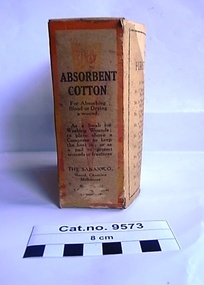
Box of Cottonwool, mid 20th century
... "SANAX" Fragrant Pastille; ignite easily and burn steadily, emitting delightful fumes of fragrant incense. ..."SANAX" Fragrant Pastille; ignite easily and burn steadily, emitting delightful fumes of fragrant incense. ...TROVE : Advocate (Melbourne, Vic. : 1868 - 1954), Saturday 29 March 1919, page 6. For Perfuming the Living or Sick Rooms, for Special Services, High, Mass, Requiem Service, and Benediction. "SANAX" Fragrant Pastille; ignite easily and burn steadily, emitting delightful fumes of fragrant incense. Every home should have them. All Chemists, or BURROWS PHARMACY, 5 Brunswick St., FITZROY. TROVE : Age (Melbourne, Vic. : 1854 - 1954), Saturday 16 August 1941, page 4 SITUATIONS VACANT. ADVERTISERS …………Girl Packer, about 18 yrs. The Sanax Co., 5 Brunswick-street, Fitzroy. City…….. Manila coloured cardboard box printed in dark brown and orange containing a wad of cotton wool wrapped in blue paper.Box. Side 1. 'SANAX (logo) ABSORBANT COTTON. For Absorbing Blood or Drying a wound. As a Swab for Washing Wounds; to place above a Compress to keep the heat in; or as a pad to protect wounds or fractures. THE SANAX CO. Manuf. Chemists Melbourne Reg'd Office : 5 Brunswick Street, Fitzroy, N.6.' Side 2. 'THERE'S A "SANAX" FIRST AID CASE for every purpose 27 Distinct Patterns to choose from. No. 1 "Sanax" First Aid For Factories, Home etc. No. 1a "Sanax" First Aid For the Home, Farm, School No. 2 "Sanax" First Aid For Factories, Mines, Quarries No. 4 "Sanax" First Aid (Portable) For Sports Clubs, Scouts, Guides No. 5 "Sanax" First Aid For Mines, Racing & Football Clubs No. 7 "Sanax" First Aid (Portable) For the Farm, Home or Sports Field No. 9 "Sanax" First Aid (Portable) For the Motor Car No. 11 "Sanax" First Aid (Pocket Size) For Boy Scouts, Girl Guides No. 20 & 25 "Sanax" First Aid (Portable) For the Motorist. Side 3. USE "SANAX" ACHE TABLETS for ALL PAINS ACHES and FEVERS - SAFE and EFFECTIVE. Side 4 Keep "Sanax" First Aid Dressing handy , for small wounds, cuts, cracked hands, and abrasions. It forms an antiseptic healing skin over the damaged part. Sole Makers The SANAX Co. Melbourne. Side 5. TRADE "SANAX" MARK cotton wool, wound dressing -
 Emerald Museum & Nobelius Heritage Park
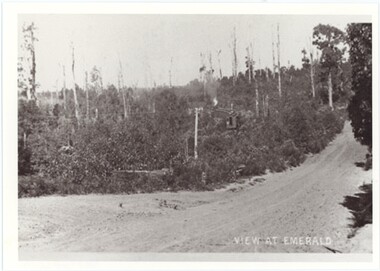
Photograph, View at Emerald, 1900-1954
... Past the road is a landscape mostly of shrubs, bushes, and sparse trees, interrupted by an unclear train with several carriages following the line left, steam emitting from its chimney.. Alongside the road runs what looks like a telegraph line, though depending when this was taken it could carry electricity....Past the road is a landscape mostly of shrubs, bushes, and sparse trees, interrupted by an unclear train with several carriages following the line left, steam emitting from its chimney.. Alongside the road runs what looks like a telegraph line, though depending when this was taken it could carry electricity. ...It's difficult to tell exactly when this photograph was taken, besides that it was when the line which is now Puffing Billy was in operation - that is, between 1900 and 1954. Location-wise, given the proximity to the railway it was likely taken from Belgrave-Gembrook Road to the west of Emerald, looking towards the town, though it is unclear exactly where this could have happened. This could also be taken from one of the curves in then railway to the east of Emerald, though the roads it could be taken from were historically limited.This photograph shows an earlier view of Emerald and its surroundings, mostly lacking the development that has effected the land over the past centuries.This item is a modern copy of an older black and white photograph. It is relatively blurry and pixelated, indicating it may have been expanded from a smaller photograph. It depicts an unpaved road; the photographer is standing to the right of the road, looking down it as it approaches from behind the photographer, appears in the bottom-left, ascends a hill and disappears into the top-right of the photograph. Past the road is a landscape mostly of shrubs, bushes, and sparse trees, interrupted by an unclear train with several carriages following the line left, steam emitting from its chimney.. Alongside the road runs what looks like a telegraph line, though depending when this was taken it could carry electricity.Obverse, Caption: "VIEW AT EMERALD"emerald -
 Emerald Museum & Nobelius Heritage Park
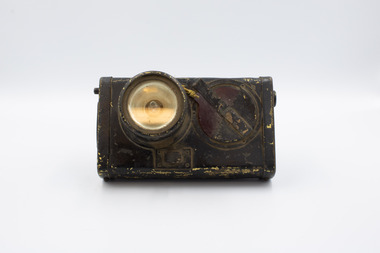
Functional object - Signalling Lamp, G.E.C. Mitton, c. 1923
... The panel of red plastic could be placed over the lense of the lamp, causing it to emit red light as the longer wavelength prevents it from being visible at longer distances as opposed to standard yellow light. ...The panel of red plastic could be placed over the lense of the lamp, causing it to emit red light as the longer wavelength prevents it from being visible at longer distances as opposed to standard yellow light. ...This electric torch, likely manufactured in 1923, was used in WWII trenches as a way to signal allies using morse code. A small button underneath a thin leather panel on the left face of the lamp would have been used to turn the bulb on and off in quick succession, allowing for messages to be transmitted. The panel of red plastic could be placed over the lense of the lamp, causing it to emit red light as the longer wavelength prevents it from being visible at longer distances as opposed to standard yellow light. The hook on the front face of the lamp allowed a bayonet to be attached by its handle, and the clip on the rear is likely to allow it to be worn on a belt. British manufacturing firm General Electric Company (G.E.C) Mitton was one of several producing similar models of signalling lamp at this time and they were heavily involved in supporting the war effort.This item demonstrates one of the many ways soldiers in Australia were able to communicate without the use of radio transmission and over distances without detection, a key aspect of wartime engineering and electronics development.This signalling lamp is of a rectangular shape with a cylindrical protrusion on its front, similar to that of a camera lense. Within the cylinder is a small light bulb and a panel of glass encloses it. To the right of the cylinder, a circular piece of translucent red plastic rests within a metal casing and is attached to the cylinder with a short piece of string. Below the cylinder is a small hook. On the lamp's rear is a large metal clip, and a small plate with an engraving upon it. The left side of the lamp includes a small, thin panel of leather under which rests a button.Rear, on metal plate: "TORCH ELECTRIC / SIGNAL MK.III / G.E.C. WITTON / NO 3462 / 1923"australia, 1920s, second world war, wwii, world war two -
Emerald Museum & Nobelius Heritage Park
Photograph - Emerald Football Club, 1980, 1980
... The club has also been known variously as the 'Emites', the 'Redlegs' and the current 'Bombers.' ...The club has also been known variously as the 'Emites', the 'Redlegs' and the current 'Bombers.' ...Emerald Football Club was formed in 1905, one of the first teams in the Mountain District Football Association (renamed the Yarra Valley Mountain District Football League in 1967). The club has changed its official colours three times, playing firstly under blue and white colours, then green and gold before adopting the red and black colours shown in the photograph and still used today. The club has also been known variously as the 'Emites', the 'Redlegs' and the current 'Bombers.' A joint Australian Football League (AFL) and La Trobe University Centre for Sport and Social Impact study discusses the importance of local football teams for fostering community cohesion and relationships and distributing information and health and social issues to local people. Local football and other sporting teams are integral to the economic and social development of an area and are therefore significant far beyond the immediate players or families associated with the club.The photograph is significant for its insights into the history of sports and recreation in the Emerald region. Australian Rules Football has a long history in the region and played a fundamental role in community life.Rectangular colour photograph printed on photographic paper. Depicted are a group of men with coaches comprising the 1980 Emerald Football Club Australian Rules Football team.Reserve: 19801980s, australian rules football, emerald football club -
Emerald Museum & Nobelius Heritage Park
Photograph - Rob Nash - Emerald Football Club, Unknown photographer, 1983
... The club has also been known variously as the 'Emites', the 'Redlegs' and the current 'Bombers.' ...The club has also been known variously as the 'Emites', the 'Redlegs' and the current 'Bombers.' ...Emerald Football Club was formed in 1905, one of the first teams in the Mountain District Football Association (renamed the Yarra Valley Mountain District Football League in 1967). The club has changed its official colours three times, playing firstly under blue and white colours, then green and gold before adopting the red and black colours shown in the photograph and still used today. The club has also been known variously as the 'Emites', the 'Redlegs' and the current 'Bombers.' A joint Australian Football League (AFL) and La Trobe University Centre for Sport and Social Impact study discusses the importance of local football teams for fostering community cohesion and relationships and distributing information and health and social issues to local people. Local football and other sporting teams are integral to the economic and social development of an area and are therefore significant far beyond the immediate players or families associated with the club.This record holds strong historic significance as it captures an insight into the history of sport and recreation within Emerald and surrounding suburbs. The image is also associated with many clubs within the Yarra Valley Mountain District Football League and holds historic significance within these clubs.Rectangular black and white photograph printed on photographic paper. Depicts Rob Nash, the fitness specialist for the Emerald Football Club.Obverse: 5/8 / 1.9 Reverse: 1983. / Rob Nash / Cockatoo / Fitness specialist for / Emerald Football Club / VEMUP40 /1980s -
Emerald Museum & Nobelius Heritage Park
Photograph - Emerald Football Club, 1983, Unknown photographer, 1983
... The club has also been known variously as the 'Emites', the 'Redlegs' and the current 'Bombers.' ...The club has also been known variously as the 'Emites', the 'Redlegs' and the current 'Bombers.' ...Emerald Football Club was formed in 1905, one of the first teams in the Mountain District Football Association (renamed the Yarra Valley Mountain District Football League in 1967). The club has changed its official colours three times, playing firstly under blue and white colours, then green and gold before adopting the red and black colours shown in the photograph and still used today. The club has also been known variously as the 'Emites', the 'Redlegs' and the current 'Bombers.' A joint Australian Football League (AFL) and La Trobe University Centre for Sport and Social Impact study discusses the importance of local football teams for fostering community cohesion and relationships and distributing information and health and social issues to local people. Local football and other sporting teams are integral to the economic and social development of an area and are therefore significant far beyond the immediate players or families associated with the club.The photograph is significant for its insights into the history of sports and recreation in the Emerald region in the 1980s. It depicts a key moment between the Emerald Football Club (the 'Bombers') and Powelltown Football Club. Australian Rules Football has a long history in the region and played a fundamental role in community life.Black and white rectangular photograph printed on photographic paper. 1983 Grand Final, in which the Emerald Football Club defeated Powelltown. The photograph depicts six men playing Australian Rules Football at a suburban football oval with approximately fifteen male spectators (including two policemen) visible in the background. Hoardings with advertisements for local businesses line the field, with the carpark visible behind the spectators. Notations on the reverse of the photograph indicate that the match shown is the 1983 Grand Final, in which the Emerald Football Club defeated Powelltown. A player on the front left of the image is named as Peter Rush.Obverse: GENERA, PLANT & TO / FOR THE BUILDER & HO / 64. 6245 % 64. 7130 7.4 / COMPLETE FU SERVICE. RINGWOOD / 8 / ONCASTER T / B Hours (03) 848.4132 % Owen / Reverse: Peter Rush - No. 18 front left / 1983 / Emerald Football Club / playing Powelltown / Grand Final - Emerald won / VEMUP 415 /emerald football club, powelltown football club, australian rules football, premiership, 1980s, 1983, bombers, redlegs, sports -
Emerald Museum & Nobelius Heritage Park
Photograph - Emerald Football Club, 1977, Unknown maker, 1977
... The club has also been known variously as the 'Emites', the 'Redlegs' and the current 'Bombers.' ...The club has also been known variously as the 'Emites', the 'Redlegs' and the current 'Bombers.' ...Emerald Football Club was formed in 1905, one of the first teams in the Mountain District Football Association (renamed the Yarra Valley Mountain District Football League in 1967). The club has changed its official colours three times, playing firstly under blue and white colours, then green and gold before adopting the red and black colours shown in the photograph and still used today. The club has also been known variously as the 'Emites', the 'Redlegs' and the current 'Bombers.' A joint Australian Football League (AFL) and La Trobe University Centre for Sport and Social Impact study discusses the importance of local football teams for fostering community cohesion and relationships and distributing information and health and social issues to local people. Local football and other sporting teams are integral to the economic and social development of an area and are therefore significant far beyond the immediate players or families associated with the club.The photograph is significant for its insights into the history of sports and recreation in the Emerald region in the 1970s. It depicts a key moment between the Emerald Football Club (the 'Bombers') and South Belgrave Football Club (the 'Wolves'); both clubs are still active in the area. Australian Rules Football has a long history in the region and played a fundamental role in community life.Colour rectangular photograph printed on photographic paper. The photograph depicts men playing Australian Rules Football at a suburban football oval; spectators with flags and banners are visible in the background of the photograph. Cars and buildings can also be seen. Notations on the reverse of the photograph indicate that the match shown is the second semi-final of the 1977 season, held in Marysville, between the Emerald Football Club (wearing red and black) and South Belgrave.Obverse:ERALD /Reverse:1977 /5. /Second semi final v SOUTH BELGRAVE /Marysville /IAN CRAIG WITH BALL /1970s, clubs, associations, societies, sports, australian rules football, emerald football club, bombers, south belgrave football club, ian craig -
Emerald Museum & Nobelius Heritage Park
Photograph - Emerald Football Club, 1977, Unknown maker, 1977
... The club has also been known variously as the 'Emites', the 'Redlegs' and the current 'Bombers.' ...The club has also been known variously as the 'Emites', the 'Redlegs' and the current 'Bombers.' ...Emerald Football Club was formed in 1905, one of the first teams in the Mountain District Football Association (renamed the Yarra Valley Mountain District Football League in 1967). The club has changed its official colours three times, playing firstly under blue and white colours, then green and gold before adopting the red and black colours shown in the photograph and still used today. The club has also been known variously as the 'Emites', the 'Redlegs' and the current 'Bombers.' A joint Australian Football League (AFL) and La Trobe University Centre for Sport and Social Impact study discusses the importance of local football teams for fostering community cohesion and relationships and distributing information and health and social issues to local people. Local football and other sporting teams are integral to the economic and social development of an area and are therefore significant far beyond the immediate players or families associated with the club.The photograph is significant for its insights into the history of sports and recreation in the Emerald region in the 1970s. It depicts a key moment between the Emerald Football Club (the 'Bombers') and Wandin Football Club (the 'Bulldogs'). The Emerald Football Club is still active in the area; the Wandin Football Club appears to have been active until at least 2019. Australian Rules Football has a long history in the region and played a fundamental role in community life.Colour rectangular photograph printed on photographic paper. The photograph depicts four men playing Australian Rules Football at a suburban football oval, watched by seven spectators including a junior player in uniform. Three umpires are also featured in the image as the moment of play pictured involves a high tackle. Cars, trees and facilities such as spectator stands and club buildings are visible in the background. Notes on the reverse of the image indicate this photograph depicts the 1977 Preliminary Grand Final between the Emerald and Wandin teams. The reverse of the image lists players Kevin Spence and Syd Jinnette and umpires Ted Meyer and Stan Morris.Reverse: in / 8 / 8 / 1977 Preliminary Final Yea / Emerald V Wandin / Kevin Spence / Syd Jinnette / Umpires / Ted Meyer / Stan Morris /1970s, clubs, associations, societies, sports, australian rules football, bombers, wandin football club, bulldogs, umpiring, kevin spence, syd jinnette, ted meyer, stan morris -
Emerald Museum & Nobelius Heritage Park
Photograph - Emerald Football Club, 1991, Unknown photographer, 1991
... The club has also been known variously as the 'Emites', the 'Redlegs' and the current 'Bombers.' ...The club has also been known variously as the 'Emites', the 'Redlegs' and the current 'Bombers.' ...Emerald Football Club was formed in 1905, one of the first teams in the Mountain District Football Association (renamed the Yarra Valley Mountain District Football League in 1967). The club has changed its official colours three times, playing firstly under blue and white colours, then green and gold before adopting the red and black colours shown in the photograph and still used today. The club has also been known variously as the 'Emites', the 'Redlegs' and the current 'Bombers.' A joint Australian Football League (AFL) and La Trobe University Centre for Sport and Social Impact study discusses the importance of local football teams for fostering community cohesion and relationships and distributing information and health and social issues to local people. Local football and other sporting teams are integral to the economic and social development of an area and are therefore significant far beyond the immediate players or families associated with the club.The photograph is significant for its insights into the history of sports and recreation in the Emerald region in the 1990s. It depicts and names individual players for the Emerald Football Club (the 'Bombers') during this time period. Australian Rules Football has a long history in the region and played a fundamental role in community life.Colour rectangular photograph printed on photographic paper with two adhesive paper labels. The photograph depicts twenty-four men standing or sitting in two rows facing the camera. Most of the men appear to be aged in their early twenties, but there is one older man standing at the far right of the group. Six of the men are wearing casual clothing, but the remainder are wearing black and red sports club jerseys and knee socks. Adhesive labels have been attached to the top and bottom of the photograph. The label at the top states that the photograph is the 'Emerald Football Club 1991 Reserve Eighteen' and the label at the bottom gives the names of the people depicted.Obverse: EMERALD FOOTBALL CLUB. / 1991 RESERVE EIGHTEEN. / BACK ROW. LEFT TO RIGHT: IVAN BATE, CRAIG BLYTHE, GARY SANTINI, PAUL DAVIES. / RUSSELL MORRISON, GEOFF LADNER, RORY CAHILL, PETER LEIGHTON, CORY DONALDSON. / COACH BOB RICHARDS, ROD SMITH, GREG KENDALL, RUNNER BYRON PORTER. / WAYNE KAAYANNIS, TRAINER NORM BANKS, / SEATED: PETER RUSH, STEVEN HARTNELL, DAVID ARCHER, WAYNE WRIGHT, MARK ANZIN, / ADAM BARRETT, CRAIG BRYANT, RUSSELL WILTSHIRE, ANDREW MEGARRELL. /emerald football club, australian rules football, 1990s, 1991, bombers, redlegs, sports -
Emerald Museum & Nobelius Heritage Park
Photograph - Emerald Footbal Club, 1987, U15s, Unknown photographer, 1987
... The club has also been known variously as the 'Emites', the 'Redlegs' and the current 'Bombers.' ...The club has also been known variously as the 'Emites', the 'Redlegs' and the current 'Bombers.' ...Emerald Football Club was formed in 1905, one of the first teams in the Mountain District Football Association (renamed the Yarra Valley Mountain District Football League in 1967). The club has changed its official colours three times, playing firstly under blue and white colours, then green and gold before adopting the red and black colours shown in the photograph and still used today. The club has also been known variously as the 'Emites', the 'Redlegs' and the current 'Bombers.' A joint Australian Football League (AFL) and La Trobe University Centre for Sport and Social Impact study discusses the importance of local football teams for fostering community cohesion and relationships and distributing information and health and social issues to local people. Local football and other sporting teams are integral to the economic and social development of an area and are therefore significant far beyond the immediate players or families associated with the club.The photograph is significant for its insights into the history of sports and recreation in the Emerald region in the 1980s. Australian Rules Football has a long history in the region and played a fundamental role in community life.Colour rectangular photograph printed on photographic paper. The photograph depicts twenty-five men standing in four main rows outside a building that may be a football clubhouse. There are nineteen younger men wearing red and black sports jerseys and six adults wearing casual clothes. An inscription on the reverse of the image indicates the group depicted is the Under Seventeen team, 1987.Obverse: EMER / Reverse: VEMU P 815 / U-17 - 1987 /australian rules football, sports, football, emerald football club, redlegs, 1987, 1980s, youth, junior, under seventeen, under 17 -
 Wodonga & District Historical Society Inc
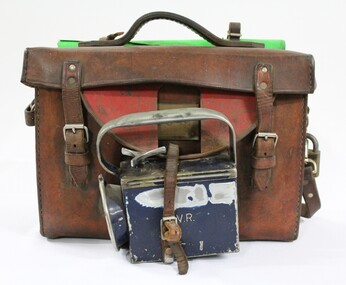
Functional object - Victorian Railways Guard's Satchel c. 1970s
... The lamp has a green filter in front of the bulb, so it would emit green light. The raised letters "V.R." are located on the front and top surfaces of the blue metal lamp, and the number "2749" is engraved on the back surface. ...The lamp has a green filter in front of the bulb, so it would emit green light. The raised letters "V.R." are located on the front and top surfaces of the blue metal lamp, and the number "2749" is engraved on the back surface. ...The leather satchel with printed information and equipment including instruction manuals, report sheets, rubber stamps and books was issued to Barry Ryan when he started working as a guard for Victorian Railways in Wodonga in 1972. It was in use until he became a locomotive train driver in 1987, when guards no longer worked on the trains.The leather satchel has local significance as it was used by a guard on the Victorian Railways in Wodonga and the railway was an important factor in the development of Wodonga. It also has state significance as part of the Victorian railways equipment for train guards, and is representative given that it's a complete kit with the green signal flag, lamp and the instruction manuals, report sheets, rubber stamps and books in the satchel.Brown leather Victorian Railways guard's satchel, with a leather handle and shoulder strap. There is a rolled up green signal flag attached behind the handle on the top and a dark blue metal lamp attached to the front of the satchel. The lamp has a green filter in front of the bulb, so it would emit green light. The raised letters "V.R." are located on the front and top surfaces of the blue metal lamp, and the number "2749" is engraved on the back surface. The name "B. RYAN" is engraved in the front surface of the lamp. The number "2544' is stamped into a brass plate on the front of the satchel. There is a semi-circular red painted iron disk hinged to the front of leather satchel with a cut out area in the centre to show the number on the brass plate. The lamp is attached to lower rim of the semi-circular red painted iron disk. Inside the leather satchel there are instruction manuals, report sheets, rubber stamps and books relating to the work as a guard on the Victorian railways, as the satchel was used by the donor Barry Ryan when he started working as a guard for Victorian Railways in Wodonga in 1972. "V.R." in raised letters on the front and top surfaces of the metal torch. "B. RYAN" engraved in the front surface of the torch. "2749" engraved into the back surface of the metal torch. "2544" stamped into the surface of the brass plate on the front of the leather satchel. victorian railways, v.r., victorian trains, trains, train guards, leather satchel, satchel, wodonga
