
Showing 11679 items matching "equipment."
-
 Geoffrey Kaye Museum of Anaesthetic History
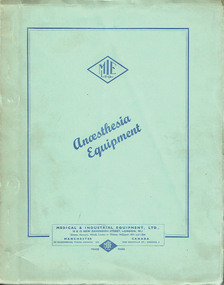
Booklet - Book, Catalogue, Medical and Industrial Equipment, Anaesthesia Equipment
... Anaesthesia Equipment......anaesthetic equipment...Undated catalogue outlining anaesthetic apparatus designed and supplied by MIE (Medical and Industrial Equipment), London....Medical and Industrial Equipment...Undated catalogue outlining anaesthetic apparatus designed and supplied by MIE (Medical and Industrial Equipment), London. catalogue anaesthetic anaesthetic apparatus anaesthetic device anaesthetic machine anaesthetic equipment anaesthesia surgical equipment surgery Blue cardboard covered book with low sheen white pages. ...Undated catalogue outlining anaesthetic apparatus designed and supplied by MIE (Medical and Industrial Equipment), London. Blue cardboard covered book with low sheen white pages. Bound using staples through the spine and star pins. catalogue, anaesthetic, anaesthetic apparatus, anaesthetic device, anaesthetic machine, anaesthetic equipment, anaesthesia, surgical equipment, surgery -
 Federation University Historical Collection
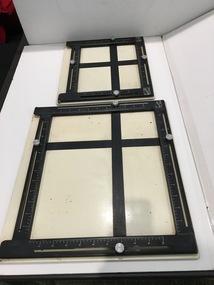
Equipment - Equipment - Photographic, ZILLES COLLECTION: Collection of Photographic Equipment
... Equipment - Photographic...ZILLES COLLECTION: Collection of Photographic Equipment......photographic equipment...Equipment...Collection of photographic equipment used by Zilles Printers. ...Collection of equipment - negative holders, developing trays - enamel and plastic, globes, thermometer, tongs - metal and plastic, metal frames, measuring cups, ...Collection of photographic equipment used by Zilles Printers. zilles printers photographic equipment developing trays image holders tongs thermometer wooden negative holder darkroom safe light globes negative holders darkroom Ilford on plastic developing tray Collection of equipment - negative holders, developing trays - enamel and plastic, globes, thermometer, tongs - metal and plastic, metal frames, measuring cups, ZILLES COLLECTION: Collection of Photographic Equipment Equipment Equipment - Photographic ...Collection of photographic equipment used by Zilles Printers. Collection of equipment - negative holders, developing trays - enamel and plastic, globes, thermometer, tongs - metal and plastic, metal frames, measuring cups, Ilford on plastic developing tray zilles printers, photographic equipment, developing trays, image holders, tongs, thermometer, wooden negative holder, darkroom safe light, globes, negative holders, darkroom -
 Bendigo Military Museum
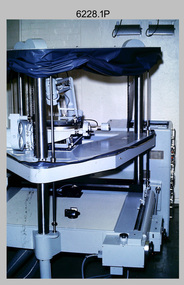
Photograph - Orthorectification Equipment - Army Survey Regiment, Fortuna, Bendigo, c1975, c1988
... Orthorectification Equipment - Army Survey Regiment, Fortuna, Bendigo. ...Orthorectification Equipment - Army Survey Regiment, Fortuna, Bendigo. ...These are four photographs of equipment used by the Army Survey Regiment to produce orthophotomaps. ...These four photographs of orthorectification equipment were taken at the Army Survey Regiment at Fortuna, Bendigo, c1975 and c1988. ....1P to .4P – Some of the equipment is annotated on the frame of the 35mm slides....These are four photographs of equipment used by the Army Survey Regiment to produce orthophotomaps. ...Orthophoto mapping provided the Survey Corps with the capability to produce map products quickly in the event of a crisis. These are four photographs of equipment used by the Army Survey Regiment to produce orthophotomaps. The Wild GZ1 orthophoto projector shown in photo.1P was introduced in 1973 and was the first equipment used to orthorectify colour and monochrome film aerial photography. Height profiles were originally produced on a PEB8 Stereo profiler and later were software generated. Photos of the PEB8 are available in Victorian Collections item 6222.17P, photos .5P and .6P. In the same era the IBM 1130 computer; OMI/Nistri AP/C-3 analytical plotter with coordinatograph, OP/C orthophoto projector and Zeiss Planimat D2 stereoplotters were introduced. Orthorectification is the process of removing geometric distortions and scale errors/variations from images. Images have tilt and relief distortions that make it difficult to compare accurately a map and an image of the same geographic area. Once an image is orthorectified, features on the image are shown in their planimetric locations. The WILD OR1 orthophoto projector and workstation shown in photos .2P to.4P was introduced in the mid-1980s. It was the second-generation equipment used to orthorectify colour and monochrome film aerial photography, replacing the system introduced in 1973. See items 6124.5P and 6133.4P for more photographs of orthorectification equipment. These four photographs of orthorectification equipment were taken at the Army Survey Regiment at Fortuna, Bendigo, c1975 and c1988. The photos are on 35mm colour slides and scanned at 96 dpi. They are part of the Army Survey Regiment’s Collection. .1) - Photo, colour, c1975, Wild GZ1 orthophoto projector. .2) - Photo, colour, c1988, WILD OR-1 unrectified colour photo in carrier, orthorectified and re-scaled colour image. .3) & .4) - Photo, colour, c1988, WILD OR-1 Orthorectification Workstation .1P to .4P – Some of the equipment is annotated on the frame of the 35mm slides. royal australian survey corps, rasvy, army survey regiment, asr, army svy regt, fortuna -
 Bendigo Military Museum
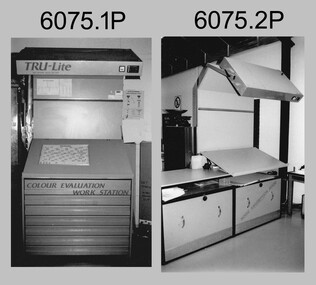
Photograph - Equipment used in Map Production at the Army Survey Regiment, 1991
... Equipment used in Map Production at the Army Survey Regiment...Equipment used in Map Production at the Army Survey Regiment...The equipment in Photo .3P is a daylight film processor. ...This is a set of photographs of Army Survey Regiment technical equipment taken in 1991. The photographs were printed on photographic paper and are part of the Army Survey Regiment’s Collection. ....1P, .2P, .4P to .10P – equipment description annotated on back .3P - no annotation....The equipment in Photo .3P is a daylight film processor. ...These nine photographs of technical equipment were provided to the Directorate of Survey as input to the 1990-1991 Annual Report. The equipment in Photos .1P and .2P were used to evaluate/validate colour values on printed maps. The equipment in Photo .3P is a daylight film processor. The Optronix 5040 Laser Scanner/Plotter was shown in Photos .4P to .6P. The Print Room’s Map Handling Station in photo .7P provided ergonomic benefits to the Printer Technician and improved despatching productivity. The Optical Disk Archive and Retrieval System (ODARS) equipment in .8P was optical "platter" disk technology for the secure and long term archive storage of large amounts of digital map data. Map data was transferred from large reels of magnetic tape. As most map type (letters and names) generation was done in Automap 2, The ITEK Typesetter shown in photo .9P was close to obsolete in 1991. At this time it was used to generate map type for other RASvy units, contractors and sections still performing manual map production at Army Svy Regt. This is a set of photographs of Army Survey Regiment technical equipment taken in 1991. The photographs were printed on photographic paper and are part of the Army Survey Regiment’s Collection. The photographs were scanned at 300 dpi. .1) - Photo, black & white, 1991, Colour Evaluation Workstation No 1, Lithographic Squadron .2) - Photo, black & white, 1991, Colour Evaluation Workstation No 2, Lithographic Squadron .3) - Photo, black & white, 1991, Daylight film processor, Lithographic Squadron, Daylight Working Contacting Frames in background. .4) - Photo, black & white, 1991, Optronix 5040 Laser Scanner/Plotter, Lithographic Squadron .5) - Photo, black & white, 1991, Optronix 5040 Laser Scanner/Plotter, Lithographic Squadron .6) - Photo, black & white, 1991, Optronix 5040 Laser Scanner/Plotter, Lithographic Squadron .7) - Photo, black & white, 1991, Map Handling Station, Lithographic Squadron .8) - Photo, black & white, 1991, Optical Disk Archive and Retrieval System (ODARS), Cartographic Squadron .10) - Photo, black & white, 1991, Optronix 5040 Laser Scanner/Plotter, Lithographic Squadron .9) - Photo, black & white, 1991, ITEK Typesetter, Cartographic Squadron .1P, .2P, .4P to .10P – equipment description annotated on back .3P - no annotation. royal australian survey corps, rasvy, army survey regiment, army svy regt, fortuna, asr, litho, automap -
 Bendigo Military Museum
Photograph - Photogrammetric Equipment – Army Survey Regiment, Bendigo and School of Military Survey Bonegilla, c1960s to c1980s
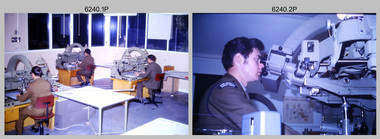
... Photogrammetric Equipment – Army Survey Regiment, Bendigo and School of Military Survey Bonegilla. ...Photogrammetric Equipment – Army Survey Regiment, Bendigo and School of Military Survey Bonegilla. ...This is a set of 14 photographs of RA Svy technicians operating photogrammetric equipment in Air Survey Squadron, Army Survey Regiment, Fortuna, Bendigo; and the School of Military Survey Bonegilla c1960s to c1980s. ...Photogrammetric Equipment – Army Survey Regiment, Fortuna, Bendigo. c1981. .9) – ASR’s CPL Dave Cook in AUTOMAP 1 operating a Wild B8 stereo plotter. ....1P to .14P - Some of the equipment is annotated on the frame of the 35mm slides....Photogrammetric Equipment – Army Survey Regiment, Bendigo and School of Military Survey Bonegilla. ...This is a set of 14 photographs of RA Svy technicians operating photogrammetric equipment in Air Survey Squadron, Army Survey Regiment, Fortuna, Bendigo; and the School of Military Survey Bonegilla c1960s to c1980s. The Wild B9 stereo plotter were introduced in 1962 and the Wild B8 stereo plotter was introduced in 1966. The Wild B9 and B8 stereo plotters were used for plotting topographic detail and contours. These analogue machines were manually controlled by adjusting the control knobs for the orientation of the 3D image. The B9s used a four and a half square, and the B8s used a nine-inch square photo image on a film or glass diapositive which allowed highly accurate extraction of map features. At first, plotting with B8 and B9 stereo plotters was undertaken at the aerial photography scale of 1:80,000 in pencil onto a controlled plotting sheet. Sheets were then inked up and reduced photographically to the 1: 100,000 publication scale for scribe impression production. In the early days topographic detail and contours were plotted with a pencil or ink pen mounted at the far end of the pantograph arm. The plotting procedure was upgraded to direct plotting in ink with photographic reduction to publication scale. In 1975 four B8s were upgraded with tri-axis locaters as part of the Input Sub-system to enable digital extraction to AUTOMAP 1’s topographic database. When AUTOMAP 2 was introduced in 1982 these B8s were upgraded, and additional machines added to expand the Army Survey Regiment’s digital capture capability. There are several more photos catalogued in the Victorian Collections database of RA Svy personnel operating Wild B9 and B8 stereo plotters. Photogrammetric Equipment – Army Survey Regiment, Fortuna, Bendigo c.1981. . .7) – Unidentified technician operating Wild B8 stereo plotter in AUTOMAP 1 at ASR. .8) - Wild B8 stereo plotter in AUTOMAP 1 at ASR. Photogrammetric Equipment – Army Survey Regiment, Fortuna, Bendigo. c1981. .9) – ASR’s CPL Dave Cook in AUTOMAP 1 operating a Wild B8 stereo plotter. This is a set of 14 photographs of RA Svy technicians operating photogrammetric equipment at the Army Survey Regiment (ASR), Bendigo and the School of Military Survey (SMS) Bonegilla. c1960s to c1980s. The photographs are on 35mm colour slides and were scanned at 96 dpi. .1) - Photo, colour, c1964. Unidentified ASR technicians operating analogue Wild B9 stereo plotters. .2) - Photo, colour, c1974. ASR’s SPR Mick Minchin operating an analogue Wild B8 stereo plotter. .3) to .6) - Photo, colour, c1980. Photogrammetry Instructor SGT Neil ‘Ned’ Kelly at the SMS operating an analogue Wild B8 stereo plotter. .7) - Photo, colour, c1981. Unidentified technician operating Wild B8 stereo plotter in AUTOMAP 1 at ASR. .8) - Photo, colour, c1981. Wild B8 stereo plotter in AUTOMAP 1 at ASR. .9) to .14) - Photo, colour, c1981. ASR’s CPL Dave Cook in AUTOMAP 1 operating a Wild B8 stereo plotter. .1P to .14P - Some of the equipment is annotated on the frame of the 35mm slides. royal australian survey corps, rasvy, army survey regiment, army svy regt, fortuna, asr, photogrammetry -
 Bendigo Military Museum
Manual - Lithographic Squadron Army Survey Regiment - Equipment Handbook 1991, Lithographic Squadron, Army Survey Regiment, Circa 1991
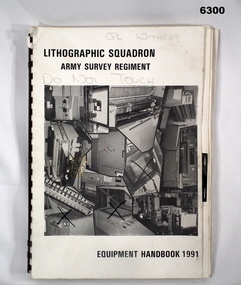
... Lithographic Squadron Army Survey Regiment - Equipment Handbook 1991...Lithographic Squadron Army Survey Regiment - Equipment Handbook 1991...The Equipment Handbook was produced by Lihographic Squadron Army Survey Regiment to record the characteristics and capabilities of the equipment used. ...A4 booklet, plastic ring binding, collage of Lithographic equipment on front cover, text, photographs and diagrams...The Equipment Handbook was produced by Lihographic Squadron Army Survey Regiment to record the characteristics and capabilities of the equipment used. ...The Equipment Handbook was produced by Lihographic Squadron Army Survey Regiment to record the characteristics and capabilities of the equipment used. It was also used to assist in the forecasting of equipment replacement. A4 booklet, plastic ring binding, collage of Lithographic equipment on front cover, text, photographs and diagrams "CPL WITHERS" annotated on front cover in pencil royal australian survey corps, rasvy, fortuna, army survey regiment, army svy regt, asr -
 Falls Creek Historical Society
Equipment - Race Club Timing equipment - TimeTech
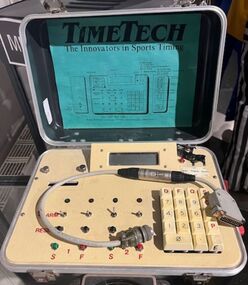
... Race Club Timing equipment - TimeTech...Race Club Timing equipment - TimeTech......Timing equipment Falls Creek...Equipment...A connecting electrical cord to attach the console to the TAGHEUER equipment is included....A connecting electrical cord to attach the console to the TAGHEUER equipment is included. Race Club Timing equipment - TimeTech Equipment Race Club Timing equipment - TimeTech ...The Falls Creek Race Club was started in the late 60's by Rodney Moss assisted by Bob Howe from Albury Ski Club and Geoff Henke from Moloney's. The club ran races on the summit every weekend and later started the training squad. Its aim is to promote all the skills of skiing and snowboarding and to improve the safety and enjoyment of the sport for all age groups. As an athlete's skills Improve so they can begin to train and race at Children's level races and move on to Junior and Senior levels, possibly aspiring to the Masters Circuit or State and National Teams. Hundreds of children have been involved over the past four decades and the program has produced a number of skiers who have been successful at national and international levels. Falls Creek has produced Olympians Ross and Malcolm Mine, Joanne Henke, Jenny Altermatt, Steven Lee in Alpine skiing. Dick Walpole and Chris Heberle in Cross Country, Britteny Cox, Paul and Adrian Costa in Freestyle Moguls. Many others have represented in National Teams at World Championship events. This timing system is significant because it was used by the Falls Creek Race Club to time skiers in events and training, some of whom progressed to become representatives in international sporting events. A timing console stored inside a black metal box. A connecting electrical cord to attach the console to the TAGHEUER equipment is included. falls creek race club, falls creek olympians, timing equipment falls creek, timetech -
 Bendigo Military Museum
Photograph - Photo Troop Equipment, Lithographic Squadron – Army Survey Regiment, Fortuna, Bendigo, c1970s
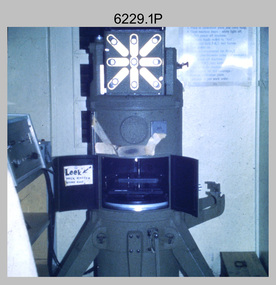
... Photo Troop Equipment, Lithographic Squadron – Army Survey Regiment, Fortuna, Bendigo. ...Photo Troop Equipment, Lithographic Squadron – Army Survey Regiment, Fortuna, Bendigo. ...This is a set of five photographs of Photo Troop equipment was taken in Lithographic Squadron, at the Army Survey Regiment, Fortuna, Bendigo, c1970s. ....1P to .5P – Some of the equipment is annotated on the frame of the 35mm slides....Photograph Photo Troop Equipment, Lithographic Squadron – Army Survey Regiment, Fortuna, Bendigo. ...This collection of five photos was most likely taken at Lithographic Squadron, Army Survey Regiment, Fortuna, Bendigo in c1970s. The main tasks undertaken by technicians in Photo Troop were most likely enlargements, reductions and duplication of map reproduction material, and processing of aerial photography. This is a set of five photographs of Photo Troop equipment was taken in Lithographic Squadron, at the Army Survey Regiment, Fortuna, Bendigo, c1970s. The photographs are on 35mm colour slides and were scanned at 96 dpi. They are part of the Army Survey Regiment’s Collection. .1) - Photo, colour, c1970s, WILD U4A Diapositive Camera. .2) - Photo, colour, c1970s, Hass-Labortechnik Film and Paper Roller Transport Processor. .3) - Photo, colour, c1970s, Hass-Labortechnik Film and Paper Roller Transport Processor, SGT Christopher Wardley. .4) - Photo, colour, c1970s, Hass-Labortechnik Film and Paper Roller Transport Processor, unidentified technician. .5) - Photo, colour, c1970s, Pako Film Processor. .1P to .5P – Some of the equipment is annotated on the frame of the 35mm slides. royal australian survey corps, rasvy, army survey regiment, army svy regt, asr, fortuna, litho -
 Bendigo Military Museum
Manual - Map Reproduction and Equipment Specification Handbook, Circa 1975
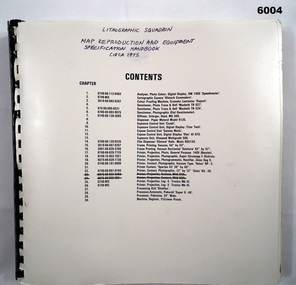
... Map Reproduction and Equipment Specification Handbook...Map Reproduction and Equipment Specification Handbook...Manual used by Lithographic Technicians as a register of Map reproduction equipment. Possible uses include to identify and quantify available equipment as part of the stocktaking process....Contents page and pages within the document have black and white stock descriptions followed by photos of equipment. The manual is printed on photographic paper and is bounded by a black plastic spiral spline....Manual used by Lithographic Technicians as a register of Map reproduction equipment. Possible uses include to identify and quantify available equipment as part of the stocktaking process. ...Manual used by Lithographic Technicians as a register of Map reproduction equipment. Possible uses include to identify and quantify available equipment as part of the stocktaking process. 90 page technical manual/ handbook. Does not have a front cover. Contents page and pages within the document have black and white stock descriptions followed by photos of equipment. The manual is printed on photographic paper and is bounded by a black plastic spiral spline. royal australian survey corps, rasvy, fortuna, army survey regiment, army svy regt, asr -
 Wodonga & District Historical Society Inc
Functional object - Haeusler Collection Photographic Equipment c. early 1900s
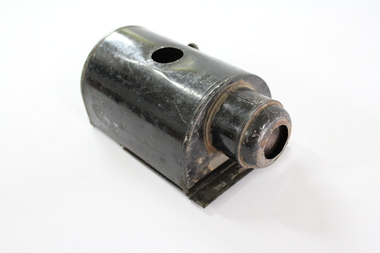
... Haeusler Collection Photographic Equipment c. early 1900s...Haeusler Collection Photographic Equipment c. early 1900s...This photographic equipment belonged to Louis Haeusler (b.1878) and is one of the many objects in the Haeusler Collection that represent home and social life in early twentieth century Wodonga....Film equipment made from alloy coated with black paint...It contributes to our understanding of domestic and family life in early twentieth century Wodonga, as well as providing interpretative capacity for themes including local history and social history. photography photos photographic photographs family photos family photography darkroom photography dark room photography wodonga haeusler haeusler collection Film equipment made from alloy coated with black paint Haeusler Collection Photographic Equipment c. early 1900s Functional object Haeusler Collection Photographic Equipment c. early 1900s ...The Wodonga Historical Society Haeusler Collection provides invaluable insight into life in late nineteenth and early twentieth century north east Victoria. The collection comprises manuscripts, personal artefacts used by the Haeusler family on their farm in Wodonga, and a set of glass negatives which offer a unique visual snapshot of the domestic and social lives of the Haeusler family and local Wodonga community. The Haeusler family migrated from Prussia (Germany) to South Australia in the 1840s and 1850s, before purchasing 100 acres of Crown Land made available under the Victorian Lands Act 1862 (also known as ‘Duffy’s Land Act’) in 1866 in what is now Wodonga West. The Haeusler family were one of several German families to migrate from South Australia to Wodonga in the 1860s. This photographic equipment belonged to Louis Haeusler (b.1878) and is one of the many objects in the Haeusler Collection that represent home and social life in early twentieth century Wodonga. This item has well documented provenance and a known owner. It forms part of a significant and representative historical collection which reflects the local history of Wodonga. It contributes to our understanding of domestic and family life in early twentieth century Wodonga, as well as providing interpretative capacity for themes including local history and social history. Film equipment made from alloy coated with black paint photography, photos, photographic, photographs, family photos, family photography, darkroom photography, dark room photography, wodonga, haeusler, haeusler collection -
 Bendigo Military Museum
Photograph - Royal Australian Survey Corps Electronic Distance Measuring Equipment Demonstration, c1960s
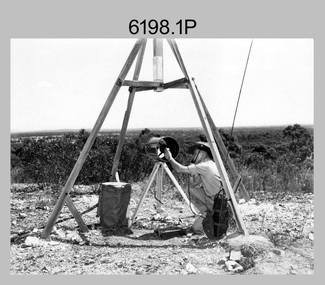
... Royal Australian Survey Corps Electronic Distance Measuring Equipment Demonstration. ...Royal Australian Survey Corps Electronic Distance Measuring Equipment Demonstration. ...This equipment was deployed in establishing mapping and geodetic control operations. ...This is a set of five photographs of a surveyor in the field demonstrating electric distance measurement (EDM) equipment. c1950s – 1960s. The photographs were printed on photographic paper and are part of the Army Survey Regiment’s Collection. ...This equipment was deployed in establishing mapping and geodetic control operations. ...This is a set of five photographs of CAPT James ‘Jim’ Leslie Stedman in the field demonstrating the setup of prisms used as electric distance measurement (EDM) receiver reflectors for tellurometer equipment and the sighting of a large surveyor’s light. This equipment was deployed in establishing mapping and geodetic control operations. The photos were most likely taken in the late 1950s or early 1960s. The tellurometers of this era were man-portable systems that improved geodetic survey efficiencies for rapid network extension and densification replacing triangulation with EDM and theodolite traverse sometimes using Bilby Towers to extend line lengths. Jim Stedman later reached the rank of Colonel, was Director of Military Survey from 1975 to 1978 and was appointed as Colonel Commandant (honorary appointment, Retd) of the Royal Australian Survey Corps from 1978 to 1983. Jim Stedman is demonstrating EDM equipment. See item 6180.16P, photos .14) to .16) for more information and photos of Jim Stedman’s EDM demonstration. This is a set of five photographs of a surveyor in the field demonstrating electric distance measurement (EDM) equipment. c1950s – 1960s. The photographs were printed on photographic paper and are part of the Army Survey Regiment’s Collection. The photographs were scanned at 300 dpi. .1) to .2) - Photo, black & white, c1960s, CAPT Jim Stedman demonstrating the sighting of a large surveyor’s light. .3) to .5) – Photo, black & white, c1960s, CAPT Jim Stedman demonstrating EDM prism equipment. .1P to .5P on back – CAPT Stedman EDM Eqpt. royal australian survey corps, rasvy, army survey regiment, army svy regt, fortuna, asr, surveying -
 Bendigo Military Museum
Photograph - Superseded AUTOMAP 1 Equipment, Army Survey Regiment, Fortuna, Bendigo, c1983
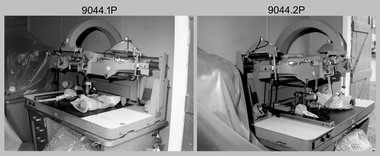
... Superseded AUTOMAP 1 Equipment, Army Survey Regiment, Fortuna, Bendigo...Superseded AUTOMAP 1 Equipment, Army Survey Regiment, Fortuna, Bendigo...This set of eight photographs of superseded AUTOMAP 1 equipment was taken at the Army Survey Regiment, Fortuna, Bendigo, circa 1983. ...This set of eight photographs of superseded AUTOMAP 1 Equipment was taken at the Army Survey Regiment, Fortuna, Bendigo, circa 1983. ...This set of eight photographs of superseded AUTOMAP 1 equipment was taken at the Army Survey Regiment, Fortuna, Bendigo, circa 1983. ...This set of eight photographs of superseded AUTOMAP 1 equipment was taken at the Army Survey Regiment, Fortuna, Bendigo, circa 1983. The photos were taken in one of the Q-store buildings. Introduced in 1975, the AUTOMAP 1 computer assisted cartography and mapping system was the first computer assisted cartography and mapping system utilised by the Survey Corps and the first system used by Australian mapping organisations. The replacement AUTOMAP 2 system achieved operational status in August 1983. The history of the AUTOMAP 1 system is covered in more detail with additional historic photographs, in pages 116-118 of Valerie Lovejoy’s book 'Mapmakers of Fortuna – A history of the Army Survey Regiment’ ISBN: 0-646-42120-4. See items 6122.20P, 6183.19P, and 6184.20P for additional photographs of AUTOMAP 1’s system and the B8 Stereoplotters in operation. This set of eight photographs of superseded AUTOMAP 1 Equipment was taken at the Army Survey Regiment, Fortuna, Bendigo, circa 1983. The photographs are on 35mm negative film and scanned at 96 dpi. They are part of the Army Survey Regiment’s Collection. .1) to .8) - Photo, black & white, c1983, superseded AUTOMAP 1 B8 Stereoplotters and equipment in storage awaiting disposal. .1P to .8P – There are no annotations royal australian survey corps, rasvy, fortuna, army survey regiment, automap 1 -
 Bendigo Military Museum
Photograph - Army Survey Regiment – Gym Equipment Delivery, Fortuna, Bendigo, 1990
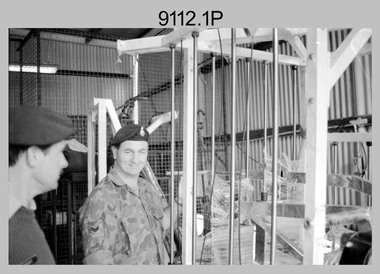
... Army Survey Regiment – Gym Equipment Delivery, Fortuna, Bendigo...Army Survey Regiment – Gym Equipment Delivery, Fortuna, Bendigo...This is a set of nine photographs of personnel delivering new gym equipment at the Army Survey Regiment, Fortuna, Bendigo in 1990. ...This is a set of nine photographs of personnel delivering new gym equipment at the Army Survey Regiment, Fortuna, Bendigo in 1990. ...This is a set of nine photographs of personnel delivering new gym equipment at the Army Survey Regiment, Fortuna, Bendigo in 1990. ...This is a set of nine photographs of personnel delivering new gym equipment at the Army Survey Regiment, Fortuna, Bendigo in 1990. The photos were taken inside the transport compound, outside Lithographic Squadron and behind the Pompeii Fountain before the gym equipment was installed inside the Stables. This is a set of nine photographs of personnel delivering new gym equipment at the Army Survey Regiment, Fortuna, Bendigo in 1990. The photographs are on 35mm negative film and were scanned at 2400 dpi. They are part of the Army Survey Regiment’s Collection. .1) - Photo, black & white, 1990. L to R: unidentified, CPL Peter Smyth. .2) & .3) - Photo, black & white, 1990. All unidentified. .4) - Photo, black & white, 1990. L to R: CPL Peter Smyth, remainder unidentified. .5) - Photo, black & white, 1990. All unidentified. .6) - Photo, black & white, 1990. L to R: unidentified, SGT Peter Tuddenham, unidentified, SPR Russ Brodie, SPR Trevor King. .7) - Photo, black & white, 1990. All unidentified. .8) - Photo, black & white, 1990. L to R: SPR Trevor King, unidentified. .9) - Photo, black & white, 1990. L to R: SSGT Bob Garritty, SPR Trevor King – behind equipment, CPL Peter Smyth. There are no personnel identified. royal australian survey corps, rasvy, army survey regiment, army svy regt, fortuna -
 Bendigo Military Museum
Photograph - Lithographic Squadron Personnel and Equipment, Army Survey Regiment, Fortuna, Bendigo, c1989
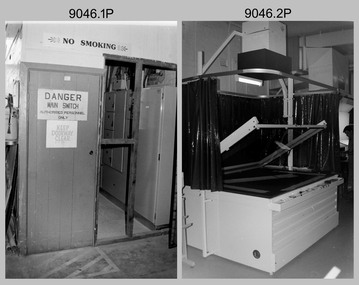
... Lithographic Squadron Personnel and Equipment, Army Survey Regiment, Fortuna, Bendigo...Lithographic Squadron Personnel and Equipment, Army Survey Regiment, Fortuna, Bendigo...These 14 photographs of Lithographic Squadron personnel and equipment was taken at Fortuna, Bendigo circa 1989. ...These 14 photographs of Lithographic Squadron Personnel and Equipment was taken at Fortuna, Bendigo circa 1989. ...These 14 photographs of Lithographic Squadron personnel and equipment was taken at Fortuna, Bendigo circa 1989. ...These 14 photographs of Lithographic Squadron personnel and equipment was taken at Fortuna, Bendigo circa 1989. Most of these photos were taken inside the Air Survey Support Section (BARCRO) work area. These 14 photographs of Lithographic Squadron Personnel and Equipment was taken at Fortuna, Bendigo circa 1989. The photographs are on 35mm negative film and scanned at 96 dpi. They are part of the Army Survey Regiment’s Collection. .1) - Photo, black & white, c1989. Power supply boards and switches. .2) - Photo, black & white, c1989. Large map format contact frame. .3) & .4) - Photo, black & white, c1989. AGFA- Gevaert Gevalux Separation & Gevarex Halftone Console. .5) - Photo, black & white, c1989. Lettercraft Kroy Labelling Printer. .6) - Photo, black & white, c1989. Air Survey Support Section (BARCRO), Pakotone film development processor, L to R: Tony Purton, unidentified. .7) - Photo, black & white, c1989. Miscellaneous equipment. .8) & .9) - Photo, black & white, c1989. Durst CLS 2000 Enlarger. .10) - Photo, black & white, c1989. Durst PCM 1001 Colour Photometer Console. .11) - Photo, black & white, c1989. Enlarger Controller. .12) - Photo, black & white, c1989. Durst PCM Photometer. .13) & .14) - Photo, black & white, c1989. Miscellaneous equipment. .1P to .14P – There are no annotations royal australian survey corps, rasvy, fortuna, army survey regiment, litho sqn, litho -
 Bendigo Military Museum
Photograph - Multiplex mechanical stereoplotting equipment, Army Survey Regiment, Fortuna Bendigo, c1950s
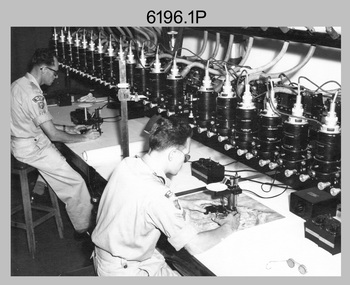
... Multiplex mechanical stereoplotting equipment, Army Survey Regiment, Fortuna Bendigo. ...Multiplex mechanical stereoplotting equipment, Army Survey Regiment, Fortuna Bendigo. ...This is a set of five photographs of Multiplex mechanical stereoplotting equipment at the Army Survey Regiment, Fortuna Bendigo. c1950s. ...This is a set of five photographs of Multiplex mechanical stereoplotting equipment at the Army Survey Regiment, Fortuna, Bendigo. c1950s. ...This is a set of five photographs of Multiplex mechanical stereoplotting equipment at the Army Survey Regiment, Fortuna Bendigo. c1950s. ...This is a set of five photographs of Multiplex mechanical stereoplotting equipment at the Army Survey Regiment, Fortuna Bendigo. c1950s. Multiplex equipment was imported from the UK in 1951 and introduced in the following year, to accelerate map production output covering CMF training areas at 1:25,000 map scale. Multiplex plotting was a productive advancement replacing the ‘Arundel’ method of graphical plotting planimetric detail that was expensive and slow, especially in timbered mountainous terrain. Air photos were made into small diapositives and mounted on racks in the exact position relative to when the aerial photos were taken. The technicians operated the Multiplex in a darkened room, with one photo projected with a green filter and the other through a red filter to form a 3D view of the overlapping photos. The 3D model projected onto a platen, which was a small platform that was raised up and down. The technician viewed the 3D image with special glasses fitted with red and green lenses. In the centre of the platen was a small pinhole that served as a floating mark, with a vertical pencil located exactly below the pinhole. This tracing table was moved to follow the topographic feature or contour line and draw it on the paper underneath. The technician raising or lowering the platform’s floating mark to match the height of the 3D terrain. It also replaced the slotted template method of mechanical adjustment of strips of aerial photography, however was restricted to each strip rather than between strips in the block. Although the Multiplex was phased out of production in 1968, it was used in the training of photogrammetry and aero-triangulation at the School of Military Survey located at Bonegilla, Victoria until the early 1990s. The history of the Multiplex is covered in more detail with additional historic photographs, in pages 50 to 51 of Valerie Lovejoy’s book 'Mapmakers of Fortuna – A history of the Army Survey Regiment’ ISBN: 0-646-42120-4. This is a set of five photographs of Multiplex mechanical stereoplotting equipment at the Army Survey Regiment, Fortuna, Bendigo. c1950s. The photographs were printed on photographic paper and are part of the Army Survey Regiment’s Collection. The photographs were scanned at 300 dpi. .1) - Photo, black & white, c1950s, unidentified personnel operating Multiplex equipment. .2) - Photo, black & white, c1950s, Multiplex equipment. .3) - Photo, black & white, c1950s, Multiplex components identified. .4) - Photo, black & white, c1950s, Multiplex optical components. .5) - Photo, black & white, c1950s. Unidentified technician laying down individual Multiplex plots. .1P to .2P, .4P – No annotations. .3P annotations identifying Multiplex components on front of photo. .5P annotated on front ‘Lay down of individual Multiplex plots at 1/14000 to framework of master grid to form Composite Compilation Sheet – Material Duralex.’ royal australian survey corps, rasvy, army survey regiment, army svy regt, fortuna, asr, photogrammetry -
 Wodonga & District Historical Society Inc
Negative - Haeusler Glass Negatives Collection - Man with horses and equipment in a paddock
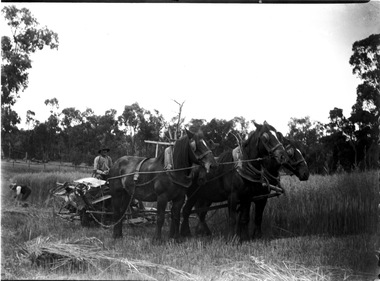
... Haeusler Glass Negatives Collection - Man with horses and equipment in a paddock...Haeusler Glass Negatives Collection - Man with horses and equipment in a paddock...This digital image was produced from one of the glass negatives that form part of the collection, probably taken by Louis Haeusler (b.1887) with the photographic equipment in the Wodonga Historical Society Haeusler Collection. ...A man with a team of four horses and equipment working in a paddock. A second man is working in the background. ...Haeusler Glass Negatives Collection - Man with horses and equipment in a paddock Negative Haeusler Glass Negatives Collection - Man with horses and equipment in a paddock ...The Wodonga Historical Society Haeusler Collection provides invaluable insight into life in late nineteenth and early twentieth century north east Victoria. The collection comprises manuscripts, personal artefacts used by the Haeusler family on their farm in Wodonga, and a set of glass negatives which offer a unique visual snapshot of the domestic and social lives of the Haeusler family and local Wodonga community. The Haeusler family migrated from Prussia (Germany) to South Australia in the 1840s and 1850s, before purchasing 100 acres of Crown Land made available under the Victorian Lands Act 1862 (also known as ‘Duffy’s Land Act’) in 1866 in what is now Wodonga West. The Haeusler family were one of several German families to migrate from South Australia to Wodonga in the 1860s. This digital image was produced from one of the glass negatives that form part of the collection, probably taken by Louis Haeusler (b.1887) with the photographic equipment in the Wodonga Historical Society Haeusler Collection. This item is unique and has well documented provenance and a known owner. It forms part of a significant and representative historical collection which reflects the local history of Wodonga. It contributes to our understanding of domestic and family life in early twentieth century Wodonga, as well as providing interpretative capacity for themes including local history and social history. Digital image created from the Haeusler Glass negative collection. A man with a team of four horses and equipment working in a paddock. A second man is working in the background. wodonga pioneers, haeusler family, glass negatives, dry plate photography, agricultural work -
 Moorabbin Air Museum
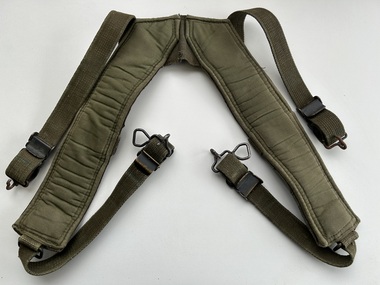
Uniform (Item) - H-Strap Combat Field Equipment Suspender Cotton Strap
... H-Strap Combat Field Equipment Suspender Cotton Strap....H-Strap Combat Field Equipment Suspender Cotton Strap....H-Strap Combat Field Equipment Suspender Cotton Strap .Possible Vietnam Era....H-Strap Combat Field Equipment Suspender Cotton Strap. Uniform H-Strap Combat Field Equipment Suspender Cotton Strap. ... -
 Bendigo Military Museum
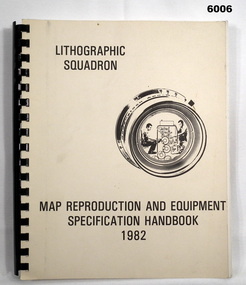
Manual - Map Reproduction and Equipment Specification Handbook, 1982
... Map Reproduction and Equipment Specification Handbook...Map Reproduction and Equipment Specification Handbook...Part 1 comprised technical descriptions and photos of lithographic equipment used in military map production. Part 2 provided various tables such as printing sizes conversion tables. ...The pages in the document are in black and white paper providing technical information and photograph identifying lithographic equipment and other information to lithographic technicians. ...Map Reproduction and Equipment Specification Handbook Manual Map Reproduction and Equipment Specification Handbook ...This handbook provided comprehensive technical information principally to the lithographic technician and to other Royal Australian Survey Corps technical trades. Part 1 comprised technical descriptions and photos of lithographic equipment used in military map production. Part 2 provided various tables such as printing sizes conversion tables. Part 3 provided technical guidance on the stipples and screens utilised in the map reproduction process. Part 4 detailed the Pantone Matching System printing colours for map and chart products. Part 5 was a Glossary of Lithographic Technical Terms. Army Survey Regiment Manual/handbook with a manilla cover comprising approximately 100 pages. The pages in the document are in black and white paper providing technical information and photograph identifying lithographic equipment and other information to lithographic technicians. Printed on standard paper bound by a by a black plastic spiral spline. royal australian survey corps, rasvy, fortuna, army svy regt, asr, army survey regiment -
 Bendigo Military Museum
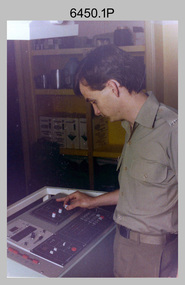
Photograph - KLIMSCH Large Format Camera and Wild OR1 Orthorectification Equipment - Army Survey Regiment, Fortuna, Bendigo, c1986
... KLIMSCH Large Format Camera and Wild OR1 Orthorectification Equipment - Army Survey Regiment, Fortuna, Bendigo...KLIMSCH Large Format Camera and Wild OR1 Orthorectification Equipment - Army Survey Regiment, Fortuna, Bendigo...See items 6124.5P and 6133.4P for more photographs of orthorectification equipment....These four photographs of KLIMSCH large format camera and Wild OR1 orthorectification equipment was taken at the Army Survey Regiment at Fortuna, Bendigo, c1986. ...These are four photographs of equipment used by the Army Survey Regiment to produce orthophotomaps. ...The main tasks undertaken by technicians operating the KLIMSCH Commodore large format camera were enlargements and reductions of map reproduction material. seen in photo .1P is at the operating console. See item 6189.4P for more information and photos of CPL Whaling operating the KLIMSCH camera. Orthophoto mapping provided the Survey Corps with the capability to produce map products quickly in the event of a crisis. These are four photographs of equipment used by the Army Survey Regiment to produce orthophotomaps. The WILD OR1 orthophoto projector and workstation shown in photos .3P and .4P was introduced in the mid-1980s. It was the second-generation equipment used to orthorectify colour and monochrome film aerial photography, replacing the system introduced in 1973. See items 6124.5P and 6133.4P for more photographs of orthorectification equipment. These four photographs of KLIMSCH large format camera and Wild OR1 orthorectification equipment was taken at the Army Survey Regiment at Fortuna, Bendigo, c1986. The colour photographs are on 35mm negative film and scanned at 96 dpi. They are part of the Army Survey Regiment’s Collection. .1) - Photo, colour, c1986, CPL John Whaling operating the KLIMSCH Camera. .2) - Photo, colour, c1986, large format film developer. .3) - Photo, colour, c1986, WILD OR-1 Orthorectification Workstation operated by CPL Dave Jobe. .4) - Photo, colour, c1986, WILD OR-1 Orthorectification Workstation. .1P to .4P – There are no annotations. royal australian survey corps, rasvy, army survey regiment, army svy regt, fortuna, asr -
 Bendigo Military Museum
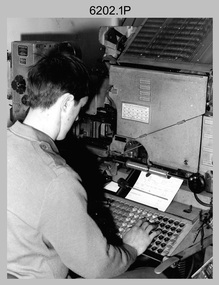
Photograph - Typesetting Equipment and Personnel, Army Survey Regiment, Fortuna, Bendigo, c1968 to 1979
... Typesetting Equipment and Personnel, Army Survey Regiment, Fortuna, Bendigo. ...Typesetting Equipment and Personnel, Army Survey Regiment, Fortuna, Bendigo. ...This is a set of nine photographs of cartographic typesetting equipment and personnel in Cartographic Squadron at the Army Survey Regiment, Fortuna, Bendigo circa 1968 to 1979. ...This is a set of nine photographs of cartographic typesetting equipment at the Army Survey Regiment, Fortuna, Bendigo, c1968 to c1979. ...Personnel and equipment are identified in photos .1P to .3P. on a card. ...This is a set of nine photographs of cartographic typesetting equipment and personnel in Cartographic Squadron at the Army Survey Regiment, Fortuna, Bendigo circa 1968 to 1979. ...This is a set of nine photographs of cartographic typesetting equipment and personnel in Cartographic Squadron at the Army Survey Regiment, Fortuna, Bendigo circa 1968 to 1979. The rooms on the top floor of Fortuna Villa where the photos were taken were formally the nursery and boys bedrooms during the Lansell family’s occupation of the building. The Fotosetter type setting machine replaced the letterpress method of type production in 1956. Its operator entered the text using a type order provided by cartographic draughtsmen/ draughtswomen. The type was output on a film positive, which was contacted onto strip film. The text was cut out by cartographic draughtsmen/ draughtswomen and affixed onto type sheets using bees wax. Cartographic Squadron’s CPL Arty Lane specialised in the operation of the Fotosetter type setting machine for many years, as shown in photos .3P and .4P. For more information on the Fotosetter, see page 71 of Valerie Lovejoy’s book 'Mapmakers of Fortuna – A history of the Army Survey Regiment’ ISBN: 0-646-42120-4. The computer based Editwriter Model 7500 typesetting system was introduced in 1975 as a replacement to the aging Fotosetter. It was operated by a specialised technician, who generated a large variety of map type styles and sizes quickly and reliably, as well as text panels. Output on Copy proof adhesive backed stripping type film replaced messy wax and spray adhesives in 1978. The Editwriter capability supported all RASvy units and its contractor type setting requirements. SGT Jim McDonald operated the Editwriter for a couple of years in the late 1970’s. He is seen in photos .7P and .8P. reading off a type order and entering text into the computer. See item 6181.23P, photo .1P for a reduced scale photo of SGT Jim McDonald undertaking this task. Also see item 6123.12P photos .1P and .2P featuring CPL Paul Richards, who was another technician that operated the Editwriter for several years in the 1980s. The Editwriter was also operated by SSGT Pat Lumsden, as featured in photo .9P taken in 1979. The Monotype Photolettering Machine seen in photos .5P and .6P is understood to be in service for a shorter period, as it was not as productive compared to the Fotosetter and Editwriter. This is a set of nine photographs of cartographic typesetting equipment at the Army Survey Regiment, Fortuna, Bendigo, c1968 to c1979. Black and white photos are on photographic paper and scanned at 300 dpi. .1) - Photo, black & white, c1960s, Fotosetter type setting machine, unidentified technician. .2) - Photo, black & white, c1960s, Fotosetter type setting machine. .3) to .4) - Photo, black & white, c1968, Fotosetter type setting machine, CPL Arty Lane. .5) to .6) - Photo, black & white, c1970s, Monotype Photolettering Machine, unidentified technician. .7) to .8) - Photo, black & white, c1979, Typesetting machine, ‘Editwriter’ Model 7500, SGT Jim McDonald. .9) - Photo, black & white, 1979, Typesetting machine, ‘Editwriter’ Model 7500, SSGT Pat Lumsden. Personnel and equipment are identified in photos .1P to .3P. on a card. A description is provided: ‘Fotosetter: This model was used from 1956 to 1974. Where photograph was taken: Army Survey Regiment. Person in Photograph: Arty Lane. Approx date photograph taken: 1968. Any Misc Information: All type on maps was set on this machine. The operator of the machine (Ex SGT Lane) joined the Army in 1956 and was discharged in 1977. Also with Survey from 1942 to 1946. Information given by: Arty Lane’. Photo .9P is dated 1979 on the back.’ royal australian survey corps, rasvy, army survey regiment, army svy regt, fortuna, asr, carto -
 Bendigo Military Museum
Photograph - Print Troop Equipment, Lithographic Squadron – Army Survey Regiment, Fortuna, Bendigo, c1990s
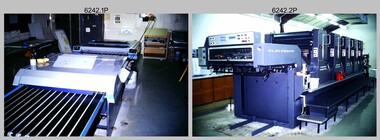
... Print Troop Equipment, Lithographic Squadron – Army Survey Regiment, Fortuna, Bendigo. ...Print Troop Equipment, Lithographic Squadron – Army Survey Regiment, Fortuna, Bendigo. ...This is a set of 25 photograph of Print Troop Equipment in Lithographic Squadron, Army Survey Regiment at Fortuna, Bendigo, 1990. ...This is a set of 25 photograph of Print Troop Equipment in Lithographic Squadron, Army Survey Regiment at Fortuna, Bendigo, 1990. ...This is a set of 25 photograph of Print Troop Equipment in Lithographic Squadron, Army Survey Regiment at Fortuna, Bendigo, 1990. ...This is a set of 25 photograph of Print Troop Equipment in Lithographic Squadron, Army Survey Regiment at Fortuna, Bendigo, 1990. Photo .1P features the new Howson Algraphy Autoneg printing plate processor. It improved quality control and efficiency and allowed the conversion of printing plates for positive or negative use. The Heidelberg Speedmaster 102 shown in photos .2P to .4P was a computer-controlled five colour lithographic offset printing press. It provided the Royal Australian Survey Corps a vastly improved printing capability, as the five colours for a standard topographic map was printed in a single pass. The print room housing the Speedmaster printing press was named Wayzgoose Hall after a medieval printing house festival. Wayzgoose Hall and the Speedmaster printing capability was commissioned by the Commander of the 3rd Military District BRIG P. Davies AM, ADC on Wednesday 27th June 1990. This occasion is covered in more detail in page 145 of Valerie Lovejoy’s book 'Mapmakers of Fortuna – A history of the Army Survey Regiment’ ISBN: 0-646-42120-4. For additional photos, refer to item 6062.4P for more photos of the Heidelberg Speedmaster printing press. The Print Room’s Map Assessment and Colour Evaluation Stations in photos .5P to .12P provided the Printer Technician suitable viewing environments to perform quality assessments of map samples. See item 6151.35P for more information and photos of technicians using the equipment. The Print Room’s Map Handling Station in photo .15P to .20P provided ergonomic benefits to the Printer Technician and improved despatching productivity. See Item 6070.9P for more information and photos. The Wohlenberg MCS-2 guillotine seen in photos .21P & .22P was a heavy-duty guillotine integrated component of the Map Handling Station, to trim bulk printed map stock. See item 6069.6P for more information and photos of earlier types of guillotine equipment. This is a set of 25 photograph of Print Troop Equipment in Lithographic Squadron, Army Survey Regiment at Fortuna, Bendigo, 1990. The photographs are on 35mm colour slides and were scanned at 96 dpi. They are part of the Army Survey Regiment’s Collection. .1) - Photo, colour, c1990s, Howson Algraphy Autoneg printing plate processor .2) to .4) - Photo, colour, 1990. Heidelberg Speedmaster 102 computer-controlled five colour lithographic offset printing press .3) to .10) - Photo, colour, c1990s, Heidelberg Speedmaster CPC 1-04 control unit. .11) to .12) - Photo, colour, c1990s, Map Colour Evaluation Work Station. .13) to .14) - Photo, colour, c1990s, Linear printing plate registration punch. .15) to .20) - Photo, colour, c1990s, Print Room’s Map Handling Station. .21) to .22) - Photo, colour, c1990s, Wohlenberg MCS-2 guillotine. .23) - Photo, colour, c1990s, Print Room Power supply equipment. .24) to .25P - Photo, colour, c1990s, Print Room Crown Fork Lift. .1P to .25P - There are no annotations stored with the 35mm slides. royal australian survey corps, rasvy, army survey regiment, army svy regt, fortuna, asr, printing, litho -
 Bendigo Military Museum
Photograph - Lithographic Squadron Personnel and Equipment, Army Survey Regiment, Fortuna, Bendigo, 1990
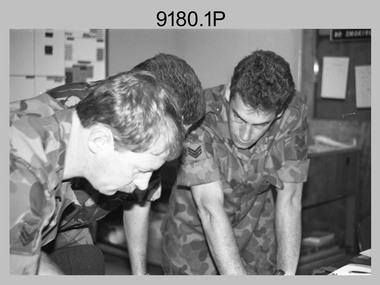
... Lithographic Squadron Personnel and Equipment, Army Survey Regiment, Fortuna, Bendigo...Lithographic Squadron Personnel and Equipment, Army Survey Regiment, Fortuna, Bendigo...This is a set of 10 photographs of Lithographic personnel and equipment taken at the Army Survey Regiment, Fortuna, Bendigo in 1990. ...This is a set of 10 photographs of Lithographic Squadron personnel and equipment taken at the Army Survey Regiment, Fortuna, Bendigo in 1990. ...This is a set of 10 photographs of Lithographic personnel and equipment taken at the Army Survey Regiment, Fortuna, Bendigo in 1990. ...This is a set of 10 photographs of Lithographic personnel and equipment taken at the Army Survey Regiment, Fortuna, Bendigo in 1990. Equipment shown includes the Carl Zeiss Rectifying Enlarger, the Beseler Model 4SAF Autofocus Enlarger, Pakotone film development processors, a film contact frame and the AGFA- Gevaert Gevalux Separation & Gevarex Halftone Console. This is a set of 10 photographs of Lithographic Squadron personnel and equipment taken at the Army Survey Regiment, Fortuna, Bendigo in 1990. The photographs are on 35mm negative film and were scanned at 2400 dpi. They are part of the Army Survey Regiment’s Collection. .1) - Photo, black & white, 1990. L to R: Photo Troop’s SGT Brian Fauth, SGT Frank Lenane. .2) - Photo, black & white, 1990. L to R: Photo Troop’s SSGT Di Chalmers, unidentified. .3) - Photo, black & white, 1990. SSM WO2 Rob Bogumil rearranges the contents of a clipboard. OC Bob Coote in the background is amused. .4) to .5) - Photo, colour, 1990. Air Survey Support Section (BARCRO), Carl Zeiss Rectifying Enlarger. .6) - Photo, black & white, 1990. L to R: unidentified camera, Beseler Model 4SAF Autofocus Enlarger. .7) - Photo, colour, c1990. Air Survey Support Section (BARCRO), Pakotone film development processors. .8) - Photo, black & white, 1991, Focus large format colour film/paper processor. .9) - Photo, colour, 1990. Air Survey Support Section (BARCRO), film contact frame. .10) - Photo, colour, 1990. AGFA- Gevaert Gevalux Separation & Gevarex Halftone Console. There are no personnel identified. royal australian survey corps, rasvy, army survey regiment, army svy regt, fortuna, litho, litho sqn -
 NMIT (Northern Melbourne Institute of TAFE)
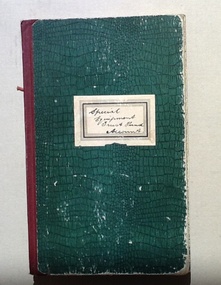
Account Book - CTS, Special equipment trust fund account, 1948-1966
... Special equipment trust fund account......special equipment trust fund...Includes all expenditure on 'special equipment' for various technical subjects such as carpentry or boot and shoe....Handwritten label on cover: "Special / equipment / trust / fund / account."...Collingwood Technical School CTS accounts special equipment trust fund account books NMIT Handwritten label on cover: "Special / equipment / trust / fund / account." ...A record of accounts from 1948 to 1966. Includes all expenditure on 'special equipment' for various technical subjects such as carpentry or boot and shoe. Original records of financial expenditure of Collingwood Technical School at this time. Green covered ledger book. Handwritten accounts throughout. Handwritten label on cover: "Special / equipment / trust / fund / account." collingwood technical school, cts, accounts, special equipment trust fund, account books, nmit, -
 Bendigo Military Museum
photograph - Orthorectification Equipment - Army Survey Regiment, Fortuna, Bendigo, c1975
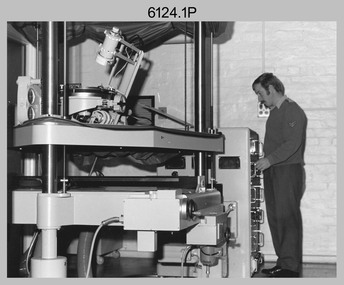
... Orthorectification Equipment - Army Survey Regiment, Fortuna, Bendigo...Orthorectification Equipment - Army Survey Regiment, Fortuna, Bendigo...These are four photographs of equipment used by the Army Survey Regiment to produce orthophotomaps. ...These four photographs of orthorectification equipment were taken at the Army Survey Regiment at Fortuna, Bendigo, c1975. ...These are four photographs of equipment used by the Army Survey Regiment to produce orthophotomaps. ...Orthophoto mapping provided the Survey Corps with the capability to produce map products quickly in the event of a crisis. These are four photographs of equipment used by the Army Survey Regiment to produce orthophotomaps. The Wild GZ1 orthophoto projector was introduced in 1973 and was the first equipment used to orthorectify colour and monochrome film aerial photography. Height profiles were originally produced on a PEB8 Stereo profiler and later were software generated. Photos of the PEB8 are available in Victorian Collections item 6222.17P, photos .5P and .6P. In the same era the IBM 1130 computer; OMI/Nistri AP/C-3 analytical plotter with coordinatograph, OP/C orthophoto projector and Zeiss Planimat D2 stereoplotters were introduced. Orthorectification is the process of removing geometric distortions and scale errors/variations from images. Images have tilt and relief distortions that make it difficult to compare accurately a map and an image of the same geographic area. Once an image is orthorectified, features on the image are shown in their planimetric locations. These four photographs of orthorectification equipment were taken at the Army Survey Regiment at Fortuna, Bendigo, c1975. Photo .1P and .3P were printed on photographic paper and scanned at 300 dpi. Photos .2P, .4P and .5P were on 35mm negative film and scanned at 96 dpi. They are part of the Army Survey Regiment’s Collection. .1) - Photo, black & white, c1975, Wild GZ1 orthophoto projector operated by CPL Phil Boyle. .2) - Photo, black & white, c1975, Wild GZ1 orthophoto projector. .3) - Photo, black & white, c1975, Wild GZ1 orthophoto projector. .4) - Photo, black & white, c1978, Zeiss D2 Planimat Stereoplotter. .5) - Photo, black & white, c1978, Zeiss D2 Planimat Stereoplotter. .1P to .5P No annotations. royal australian survey corps, rasvy, army survey regiment, army svy regt, fortuna, asr -
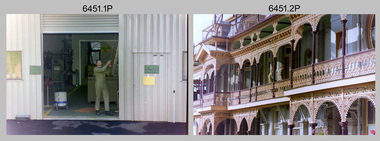 Bendigo Military Museum
Photograph - Lithographic Squadron Personnel and Equipment, Army Survey Regiment, Fortuna, Bendigo, c1990
... Lithographic Squadron Personnel and Equipment, Army Survey Regiment, Fortuna, Bendigo...Lithographic Squadron Personnel and Equipment, Army Survey Regiment, Fortuna, Bendigo...These 28 photographs of Lithographic Squadron personnel and equipment was taken at Fortuna, Bendigo circa 1990. ...These 28 photographs of Lithographic Squadron Personnel and Equipment was taken at Fortuna, Bendigo circa 1990. ...These 28 photographs of Lithographic Squadron personnel and equipment was taken at Fortuna, Bendigo circa 1990. ...These 28 photographs of Lithographic Squadron personnel and equipment was taken at Fortuna, Bendigo circa 1990. The photos were taken on the east side of Fortuna Villa, the Print Room’s map trimming and dispatch work area and the inside and outside Air Survey Support Section (BARCRO). These 28 photographs of Lithographic Squadron Personnel and Equipment was taken at Fortuna, Bendigo circa 1990. The 35mm colour photograph negatives were scanned at 96 dpi and are part of the Army Survey Regiment’s Collection. .1) - Photo, colour, c1990. RAEME and maintenance support, unidentified civilian. .2) - Photo, colour, c1990. Eastern side of Fortuna Villa, unidentified, CPL Le-Anne (Smallshaw) Shirley. .3) - Photo, colour, c1990. Eastern side of Fortuna Villa, SGT Gary Kerr. .4) - Photo, colour, c1990. Eastern side of Fortuna Villa, CPL Roy Hicks. .5) - Photo, colour, c1990. Eastern side of Fortuna Villa, unidentified. .6) - Photo, colour, c1990. Unidentified passing Q-Store & Transport Compound. .7) - Photo, colour, c1990. Data Management & Map Library. .8) - Photo, colour, c1990. Unidentified officer passing Q-Store heading up to Map Library. .9) - Photo, colour, c1990. Eastern side of Fortuna Villa, SPR Michelle Withers. .10) - Photo, colour, c1990. Unidentified RAEME soldier passing Q-Store heading up to Map Library. .11) & .12) - Photo, colour, c1990. Delivery of bulk map printing paper. WO2 Jeff Willey on forklift, unidentified. .13) & .14) - Photo, colour, c1990. Print Room, Wohlenberg MCS-2 guillotine. .15) to .18) - Photo, colour, c1990. Air Survey Support Section (BARCRO), Carl Zeiss Rectifying Enlarger. .19) - Photo, colour, c1990. Air Survey Support Section (BARCRO), film contact frame. .20) - Photo, colour, c1990. Air Survey Support Section (BARCRO), Pakotone film development processors. .21) & .22) - Photo, colour, c1990. Air Survey Support Section (BARCRO) entry/exit. .23) & .24) - Photo, colour, c1990. Air Survey Support Section (BARCRO) miscellaneous equipment. .25) & .26) - Photo, colour, c1990. Air Survey Support Section (BARCRO), CPL Warren ‘Waldo’ Shirley. .27) & .28) - Photo, colour, c1990. Outside Air Survey Support Section (BARCRO), L to R: WO1 Peter Coombes, CPL Warren ‘Waldo’ Shirley. .1P to .28P – There are no annotations. royal australian survey corps, rasvy, army survey regiment, army svy regt, fortuna, asr, litho sqn -
 Moorabbin Air Museum
Manual - Aircraft equipment, Index of Aeronautical Equipment Landing Gear
... Aircraft equipment...Index of Aeronautical Equipment Landing Gear...Aircraft Equipment...Aircraft Equipment Alphabetical & numerical index Brake assemblies Wheel assemblies Casings Tubes Parts list for landing gear , possibly circa 1940s Hard cardboard cover Index of Aeronautical Equipment Landing Gear Manual Aircraft equipment ...Parts list for landing gear , possibly circa 1940sHard cardboard cover non-fiction Parts list for landing gear , possibly circa 1940s alphabetical & numerical index, brake assemblies, wheel assemblies, casings, tubes -
Moorabbin Air Museum
Manual - Aircraft equipment, Index of Army and Navy Aeronautical Equipment , Supercharger Pumps and Accessories
... Aircraft equipment...Index of Army and Navy Aeronautical Equipment , Supercharger Pumps and Accessories ...Aircraft Equipment...Books 3434 & 3435 Index of Army and Navy Aeronautical Equipment , Supercharger Pumps and Accessories Manual Aircraft equipment ...Parts lists for superchargers, regulators, pumps & accessories, circa 1940sHard cardboard cover. Books 3434 & 3435 non-fiction Parts lists for superchargers, regulators, pumps & accessories, circa 1940s turbosuperchargers, regulators, fuel pumps, booster pumps & controls, motors, fuel transfer pumps, hydraulic oil pump, air pump assemblies, -
 National Vietnam Veterans Museum (NVVM)
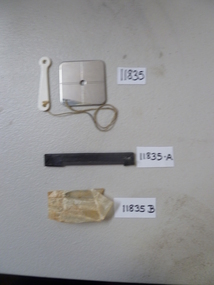
Equipment - Equipment, Army, Survival Equipment
... Equipment, Army...Survival Equipment...Survival Equipment...Equipment...(all found in flying vest 11386 pockets) Survival Equipment Equipment Equipment, Army ...11835 - Heliograph mirror with plastic sight. 11835. A - Small saw blade wrapped in black tape. 11835.B - One safetly pin wrapped in greaseproof paper. (all found in flying vest 11386 pockets) survival equipment -
 Falls Creek Historical Society
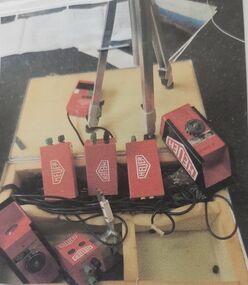
Equipment - Race Club Timing equipment - TAG HEUER
... Race Club Timing equipment - TAG HEUER...Race Club Timing equipment - TAG HEUER......Timing equipment Falls Creek...Equipment...Falls Creek Race Club Falls Creek Activities Falls Creek Olympians Timing equipment Falls Creek TAG HEUER timing On each component - TAG HEUER A steel box containing a variety components which make up the timing system used by the Falls Creek Race Club, Race Club Timing equipment - TAG HEUER Equipment Race Club Timing equipment - TAG HEUER ...The Falls Creek Race Club was started in the late 60's by Rodney Moss assisted by Bob Howe from Albury Ski Club and Geoff Henke from Moloney's. The club ran races on the summit every weekend and later started the training squad. Its aim is to promote all the skills of skiing and snowboarding and to improve the safety and enjoyment of the sport for all age groups. As an athlete's skills Improve so they can begin to train and race at Children's level races and move on to Junior and Senior levels, possibly aspiring to the Masters Circuit or State and National Teams. Hundreds of children have been involved over the past four decades and the program has produced a number of skiers who have been successful at national and international levels. Falls Creek has produced Olympians Ross and Malcolm Mine, Joanne Henke, Jenny Altermatt, Steven Lee in Alpine skiing. Dick Walpole and Chris Heberle in Cross Country, Britteny Cox, Paul and Adrian Costa in Freestyle Moguls. Many others have represented in National Teams at World Championship events. The TAGHEUER company was established by Edouard Heuer in 1860 n St-Imier, Switzerland. He patented his first chronograph or timepiece in 1882. The company has operated continuously from that time. In the early 1970s, Heuer’s Electronics Division developed the Centigraph, a timing system initially used by the Ferrari racing team. This system allowed times to be recorded to 1/1000 second. It was also capable of timing multiple cars or competitors, with the number of laps, the time of the last lap and total time, being printed out on the spot. This system has been adapted and used in a range of sports including numerous World Ski Championships and the Winter Olympic Games. The TAGHAEUR system has been certified by the FIS (Fédération Internationale de Ski). TAGHEUER ceased production of their sports timing systems at the end of 2020. This timing system is significant because it was used by the Falls Creek Race Club to time skiers in events and training, some of whom progressed to become representatives in international sporting events. A steel box containing a variety components which make up the timing system used by the Falls Creek Race Club, On each component - TAG HEUER falls creek race club, falls creek activities, falls creek olympians, timing equipment falls creek, tag heuer timing -
 Bendigo Military Museum
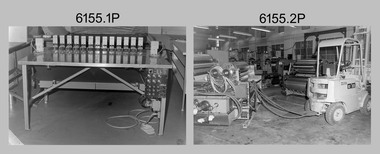
Photograph - Equipment and Personnel, Lithographic Squadron - Army Survey Regiment, Bendigo, c1975
... Equipment and Personnel, Lithographic Squadron - Army Survey Regiment, Bendigo. ...Equipment and Personnel, Lithographic Squadron - Army Survey Regiment, Bendigo. ...This is a set of 21 photographs of Lithographic Squadron equipment and personnel as well equipment operated by Cartographic Squadron, Army Survey Regiment, Fortuna, Bendigo circa 1975. ...This is a set of 21 photograph of Lithographic Squadron equipment and personnel, Army Survey Regiment at Fortuna, Bendigo, 1989. ...This is a set of 21 photographs of Lithographic Squadron equipment and personnel as well equipment operated by Cartographic Squadron, Army Survey Regiment, Fortuna, Bendigo circa 1975. ...This is a set of 21 photographs of Lithographic Squadron equipment and personnel as well equipment operated by Cartographic Squadron, Army Survey Regiment, Fortuna, Bendigo circa 1975. The photos were mainly taken in the Printing, Camera, proofing and external buildings. Cartographic Squadron’s CPL Arty Lane operated the Fotosetter type setting machine, as shown in photo .21P for many years in a room on the top floor of Fortuna Villa. There is more information on the Ultra-MAN-III Printing Presses, the KLIMSCH Commodore camera, Gavin Neilson and the Fotosetter type setting machine on pages 70-71, and the Newkoni Komori printing press on page 120 of Valerie Lovejoy’s book 'Mapmakers of Fortuna – A history of the Army Survey Regiment’ ISBN: 0-646-42120-4. This is a set of 21 photograph of Lithographic Squadron equipment and personnel, Army Survey Regiment at Fortuna, Bendigo, 1989. Black and white photographs .1P to .13P are on 35mm negative film and scanned at 96 dpi. Black and white photos .14P to .21P are on photographic paper and scanned at 300 dpi. .16P to .21P are on negative film and scanned at 600 dpi. .1) - Photo, black & white, c1975, tri-linear film punch. .2) to .5) - Photo, black & white, c1975, Newkoni Komori printing press components. .6) - Photo, black & white, c1975, Newkoni Komori printing press components, Alex Cook. .7) - Photo, black & white, c1975, Newkoni Komori printing press components. .8) to .12) - Photo, black & white, c1975, northern exterior of print buildings. .13) - Photo, black & white, c1975, L to R: unidentified (x2), Jim Mulqueen, Ian ‘Lofty’ Turner. .14) - Photo, black & white, c1975, Log Electonics film processor. .15) - Photo, black & white, c1975, contact frame. .16) - Photo, black & white, c1975, film tri-punch stud registration table. .17) - Photo, black & white, c1975, Ultra-MAN-III Printing Presses. .18) to .19) - Photo, black & white, c1975, KLIMSCH Commodore camera, Gavin Neilson. .20) - Photo, black & white, c1975, map proof whirler. .21) - Photo, black & white, c1975, Fotosetter type setting machine. No personnel are identified. .14P, .16P to .19P and .20P to .21P are annotated with 5-digit numbers on top right corner of photo. royal australian survey corps, rasvy, army survey regiment, army svy regt, fortuna, asr, litho, carto
