
Showing 10 items matching "evans of liverpool"
-
 Flagstaff Hill Maritime Museum and Village
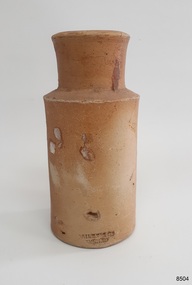
Container - Earthenware jar, Bailey & Co, circa 1869
... ...Evans of Liverpool...The object is now one of the shipwreck artefacts in Flagstaff Hill’s McCulloch Collection, which includes other items recovered from the Victoria Tower, built in Liverpool by Evans in 1969, and wrecked the same year near Torquay, Victoria, on its maiden voyage. ...England sailing ship Evans of Liverpool Evans Liverpool clipper ship iron hull migrant ship cargo ship 1869 shipwreck Inscription “Bailey [&] Co / ENGLAND” Container, round brown earthenware jar with a wide mouth, thick lip, a wide neck that tapers slightly inwards towards the shoulder, and a body that tapers slightly inward towards the base. ...The handmade earthenware jar, made by Bailey & Co. of England, was one of a group of artefacts in the McCulloch Collection that were recovered from the shipwreck Victoria Tower. The jar could have been from the ship's cargo or amongst the passengers' personal effects. The object is now one of the shipwreck artefacts in Flagstaff Hill’s McCulloch Collection, which includes other items recovered from the Victoria Tower, built in Liverpool by Evans in 1969, and wrecked the same year near Torquay, Victoria, on its maiden voyage. A diver salvaged the objects in the early 1970s while working along the southwest coast of Victoria. Advanced marine technology had enabled divers to explore the depths of the ocean and gather its treasures before the Government introduced protective legislation. The artefacts were donated to the Queensland Department of Environment and Heritage Protection (EHP) by a passionate shipwreck lover. Bruce McCulloch verified their locations. In 2017, the Department repatriated them to Flagstaff Hill, where they joined our vast collection of artefacts from Victoria’s Shipwreck Coast.The artefact is an example of cargo or personal items on board a ship in 1869. It provides a reference point for classifying and dating similar items. This artefact is significant for its association with the British-built, iron clipper ship Victoria Tower, a commercial and immigrant sailing ship constructed to carry cargo and passengers to colonial Australia. The vessel is recorded on the Victoria Heritage Database, VHR S698.Container, round brown earthenware jar with a wide mouth, thick lip, a wide neck that tapers slightly inwards towards the shoulder, and a body that tapers slightly inward towards the base. The glazed surface is rough. The variegated colours of the clay also have small dark speckles. There are several chips and dents on the jar. The inscription is stamped into the lower edge. Made by Bailey & Co., England. Recovered from the wreck of the Victoria Tower.Inscription “Bailey [&] Co / ENGLAND” flagstaff hill maritime museum and village, warrnambool, great ocean road, maritime museum, shipwreck artefact, southwest coast victoria, shipwreck coast, victoria tower, 1869, torquay, diver, bruce mcculloch, handmade, earthenware, jar, storage jar, stoneware, domestic container, kitchenware, bailey & co. england, sailing ship, evans of liverpool, evans, liverpool, clipper ship, iron hull, migrant ship, cargo ship, 1869 shipwreck -
 Mission to Seafarers Victoria
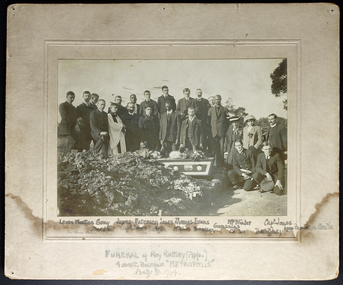
Photograph - Photograph mounted, The Swiss Studio, Funeral of Roy Rutley aka Rattley (Apprentice) of Barque Metropolis, 08/08/1914
... Barque Metropolis was possibly that of the 1887 4 masted barque built by R & J Evans, Liverpool. Officers of the Barque Metropolis are also joined by crew of the Penryhn Castle in port at the time. ...Barque Metropolis was possibly that of the 1887 4 masted barque built by R & J Evans, Liverpool. Officers of the Barque Metropolis are also joined by crew of the Penryhn Castle in port at the time. ...Barque Metropolis was possibly that of the 1887 4 masted barque built by R & J Evans, Liverpool. Officers of the Barque Metropolis are also joined by crew of the Penryhn Castle in port at the time. The ladies on the far right of the funeral party may be relatives but more likely to be representatives from the Mission to Seamen offering sympathy to fellow crew members and honouring the burial of the apprentice, Ray Rattley name also reported in the LHLG newsletter as Rutley. The Apprentice was ill after arriving from S. America in August 1914 and was taken to a local hospital but died the following day. The Mission chaplain attended him.The image of the burial is significant in the depiction of a multi-cultural crew and the presence of local women representing and symbolising the concern and sympathy felt for the apprentice's family and the plight of young seafarers far from home ports. The inscription with identifying names provides a valuable chronological link with seafarers and clergy attending the burial and funeral. Black and white photographic print adhered to mount board with handwritten inscription identifying some of the people depicted photographed while attending an internment and funeral service.Inscriptions in black ink along the lower edge of the mount beneath Photograph: Left to right names of crew and chaplain see image.at Lwr left printed in cursive : 'The Swiss Studios' and at right corner: "Melbourne" on reverse: in Pencil handwritten cursive " To Rev A G Goldsmith / from Capt P Jones / Barque Metropolis " roy rutley, barque metropolis, funeral, burial -
 Flagstaff Hill Maritime Museum and Village
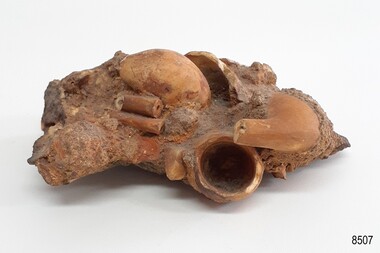
Leisure object - Tobacco Pipes, circa 1869
... Evans...Liverpool...Flagstaff Hill Warrnambool Maritime Village Maritime Museum Flagstaff Hill Maritime Museum and Village Shipwreck coast Great Ocean Road Shipwreck artefact wreck dive McCulloch Collection Bruce McCulloch White Star Line Victorian Heritage Register clipper ship Victoria Tower Captain Kerr shipwreck Victoria Tower migrant ship 1869 cargo ship 1869 iron clipper British clipper ship 1869 cargo imported to Australia pipe cluster concretion of pipes pipe ceramic pipes tobacco pipes smoker's pipes southwest coast Victoria Torquay diver Evans Liverpool sailing ship iron hull migrant ship cargo ship 1869 shipwreck Concretion of clay tobacco pipes. ...This concretion of tobacco pipes is one of a group of artefacts in the McCulloch Collection. It was recovered from the shipwreck of the Victoria Tower. The pipes may have been amongst the ship's cargo, but could have been included in a passenger’s personal effects. The object is now one of the shipwreck artefacts in Flagstaff Hill’s Mc Culloch Collection, which includes items recovered from the wrecks of the Victoria Tower (wrecked in 1869) and Loch Ard (wrecked in 1878). They were salvaged by a diver in the early 1970s from the southwest coast of Victoria. Advanced marine technology had enabled divers to explore the depths of the ocean and gather its treasures before the Government introduced protective legislation. The artefacts were donated to the Queensland Department of Environment and Heritage Protection (EHP) by a passionate shipwreck lover. Bruce McCulloch verified their locations. In 2017, the Department repatriated them to Flagstaff Hill, where they joined our vast collection of artefacts from Victoria’s Shipwreck Coast. The Victoria Tower: - The three-masted iron clipper ship was built in 1869 in Liverpool, England, as a passenger and cargo ship for the Australian trade. It was named after one of the two towers of the British Houses of Parliament and owned by the White Star line. The Victoria Tower sailed under the command of Captain Kerr from Liverpool towards Melbourne on its maiden voyage with 4 passengers and 16 crew plus a general cargo including bottled beer, slates, iron pipes and hardware. It was almost at her destination when, on 17th October, 1869, it was wrecked at Point Impossible, west of Thompsons Creek, Breamlea, near Torquay. The shipwreck is a very popular dive site.The artefact is an example of cargo or personal items on board a ship in 1869. It provides a reference point for classifying and dating similar items. This artefact is significant for its association with the British-built, iron clipper ship Victoria Tower, a commercial and immigrant sailing ship constructed to carry cargo and passengers to colonial Australia. The vessel is recorded on the Victoria Heritage Database, VHR S698.Concretion of clay tobacco pipes. Bowls and stems of several broken orange tobacco pipes are joined together in ac irregularly shaped clump of concretion from the sea. The concretion also contains stones, shells, sand and particles of seaweed. It was recovered wreck of the ship Victoria Tower.flagstaff hill, warrnambool, maritime village, maritime museum, flagstaff hill maritime museum and village, shipwreck coast, great ocean road, shipwreck artefact, wreck dive, mcculloch collection, bruce mcculloch, white star line, victorian heritage register, clipper ship, victoria tower, captain kerr, shipwreck victoria tower, migrant ship 1869, cargo ship 1869, iron clipper, british clipper ship, 1869, cargo imported to australia, pipe cluster, concretion of pipes, pipe, ceramic pipes, tobacco pipes, smoker's pipes, southwest coast victoria, torquay, diver, evans, liverpool, sailing ship, iron hull, migrant ship, cargo ship, 1869 shipwreck -
 Flagstaff Hill Maritime Museum and Village
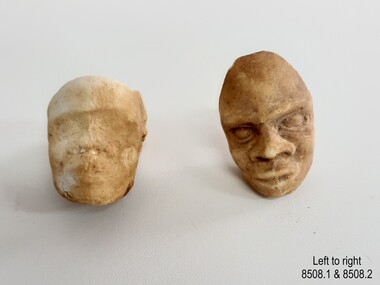
Leisure object - Tobacco Pipe Heads, circa 1869
... Evans...Liverpool...White Star Line Victorian Heritage Register clipper ship Victoria Tower Captain Kerr shipwreck Victoria Tower migrant ship 1869 cargo ship 1869 iron clipper British clipper ship 1869 cargo imported to Australia pipe heads clay pipe fragments pipe ceramic pipe clay pipe smoker’s pipe smoking accessory tobacco pipe smoker's pipe personal effects tobacco smoking pipe smoking tool smoking habit smoker tobacco smoker tobacco pipe heads Flagstaff Hill Maritime Museum and Village Warrnambool Great Ocean Road maritime museum shipwreck artefact southwest coast Victoria shipwreck coast Torquay diver Bruce McCulloch Evans Liverpool sailing ship iron hull migrant ship cargo ship 1869 shipwreck Tobacco pipe heads, two(2); bowls of white unglased clay tobacco pipes. ...These tobacco pipe heads are one of a group of artefacts in the McCulloch Collection that were recovered from the shipwreck Victoria Tower and were donated together. The pipe heads could have been from the ship's cargo or amongst a passenger’s personal belongings. The stems of the clay pipes would have been easily broken during the 100 or so years they were under the sea. Other tobacco pipes in our collection were recovered from the Victoria Tower and the Loch Ard. The object is now one of the shipwreck artefacts in Flagstaff Hill’s Mc Culloch Collection, which includes items recovered from the wrecks of the Victoria Tower (wrecked in 1869) and Loch Ard (wrecked in 1878). They were salvaged by a diver in the early 1970s from the southwest coast of Victoria. Advanced marine technology had enabled divers to explore the depths of the ocean and gather its treasures before the Government introduced protective legislation. The artefacts were donated to the Queensland Department of Environment and Heritage Protection (EHP) by a passionate shipwreck lover. Bruce McCulloch verified their locations. In 2017, the Department repatriated them to Flagstaff Hill, where they joined our vast collection of artefacts from Victoria’s Shipwreck Coast. The Victoria Tower: - The three-masted iron clipper ship was built in 1869 in Liverpool, England, as a passenger and cargo ship for the Australian trade. It was named after one of the two towers of the British Houses of Parliament and owned by the White Star line. The Victoria Tower sailed under the command of Captain Kerr from Liverpool towards Melbourne on its maiden voyage with 4 passengers and 16 crew plus a general cargo including bottled beer, slates, iron pipes and hardware. It was almost at her destination when, on 17th October 1869, it was wrecked at Point Impossible, west of Thompsons Creek, Breamlea, near Torquay. The shipwreck is a very popular dive site. The artefact is an example of cargo or personal items on board a ship in 1869. It provides a reference point for classifying and dating similar items. This artefact is significant for its association with the British-built, iron clipper ship Victoria Tower, a commercial and immigrant sailing ship constructed to carry cargo and passengers to colonial Australia. The vessel is recorded on the Victoria Heritage Database, VHR S698. Tobacco pipe heads, two(2); bowls of white unglased clay tobacco pipes. Pipe bowls are each decorated with the image of a Negro slave head moulded into it and facing away from the smoker. The pipe heads have no stems. Both have a vertical line down the centre of the face, broad nostrils, sunken eyes, and recessed hair. 8508.1 - features are worn, but the ear is distinct, forehead bare, eyes sunken. The bowl is complete. 8508.2 - features are distinct, eyes closed, thick, broad lips. The back section of the bowl is missing. The items were recovered from the wreck of the ship Victoria Tower.white star line, victorian heritage register, clipper ship, victoria tower, captain kerr, shipwreck victoria tower, migrant ship 1869, cargo ship 1869, iron clipper, british clipper ship, 1869, cargo imported to australia, pipe heads, clay pipe fragments, pipe, ceramic pipe, clay pipe, smoker’s pipe, smoking accessory, tobacco pipe, smoker's pipe, personal effects, tobacco, smoking pipe, smoking tool, smoking habit, smoker, tobacco smoker, tobacco pipe heads, flagstaff hill maritime museum and village, warrnambool, great ocean road, maritime museum, shipwreck artefact, southwest coast victoria, shipwreck coast, torquay, diver, bruce mcculloch, evans, liverpool, sailing ship, iron hull, migrant ship, cargo ship, 1869 shipwreck -
 Flagstaff Hill Maritime Museum and Village
Ceramic - Floor Tile, Maw & Co, 1862-1869
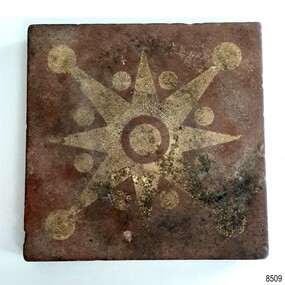
... The object is now one of the shipwreck artefacts in Flagstaff Hill’s McCulloch Collection, which includes other items recovered from the Victoria Tower, built in Liverpool by Evans in 1969, and wrecked the same year near Torquay, Victoria, on its maiden voyage. ...The object is now one of the shipwreck artefacts in Flagstaff Hill’s McCulloch Collection, which includes other items recovered from the Victoria Tower, built in Liverpool by Evans in 1969, and wrecked the same year near Torquay, Victoria, on its maiden voyage. ...The floor tile is one of a group of artefacts in the McCulloch Collection that were recovered from the shipwreck Victoria Tower and were donated together. The tile could have been from the ship's cargo or amongst the ship’s fittings. It was made by Maw & Co., of Broseley, England, makers of earthenware encaustic and geometric floor tiles. In 1850, George Maw and his brother Arthur began their first factory in Worcester, and in 1862, the company moved to Broseley, Shropshire. The object is now one of the shipwreck artefacts in Flagstaff Hill’s McCulloch Collection, which includes other items recovered from the Victoria Tower, built in Liverpool by Evans in 1969, and wrecked the same year near Torquay, Victoria, on its maiden voyage. A diver salvaged the objects in the early 1970s while working along the southwest coast of Victoria. Advanced marine technology had enabled divers to explore the depths of the ocean and gather its treasures before the Government introduced protective legislation. The artefacts were donated to the Queensland Department of Environment and Heritage Protection (EHP) by a passionate shipwreck lover. Bruce McCulloch verified their locations. In 2017, the Department repatriated them to Flagstaff Hill, where they joined our vast collection of artefacts from Victoria’s Shipwreck Coast. The Victoria Tower: - The three-masted iron clipper ship was built in 1869 in Liverpool, England, as a passenger and cargo ship for the Australian trade. It was named after one of the two towers of the British Houses of Parliament and owned by the White Star line. The Victoria Tower sailed under the command of Captain Kerr from Liverpool towards Melbourne on its maiden voyage with 4 passengers and 16 crew plus a general cargo including bottled beer, slates, iron pipes and hardware. It was almost at her destination when, on 17th October 1869, it was wrecked at Point Impossible, west of Thompsons Creek, Breamlea, near Torquay. The shipwreck is a very popular dive site. The artefact is an example of cargo or personal items on board a ship in 1869. It provides a reference point for classifying and dating similar items. This artefact is significant for its association with the British-built, iron clipper ship Victoria Tower, a commercial and immigrant sailing ship constructed to carry cargo and passengers to colonial Australia. The vessel is recorded on the Victoria Heritage Database, VHR S698. Ceramic tile, square, with star or compass design. The brown floor tile has a cream design of a pointed star with a circle in its centre and between, and on the end of, each point. The side profile of the tile shows the division between the top layer and the base, with a groove between the two. The back of the tile has parallel ridges and is embossed with an inscription. The tile was made by MAW & Co. of Broseley, England, and was recovered from the wrecked ship Victoria Tower. Inscribed "MAW & CO BROSELEY" flagstaff hill, warrnambool, maritime village, maritime museum, flagstaff hill maritime museum and village, shipwreck coast, great ocean road, shipwreck artefact, wreck dive, mcculloch collection, bruce mcculloch, white star line, victorian heritage register, clipper ship, victoria tower, captain kerr, shipwreck victoria tower, migrant ship 1869, cargo ship 1869, iron clipper, british clipper ship, 1869, cargo imported to australia, tile, floor tile, ceramic tile, compass pattern, star pattern, flooring, george maw, arthur maw, maw & co., beverley, worcester, made in england -
 Flagstaff Hill Maritime Museum and Village
Leisure object - Doll's Leg, circa 1869
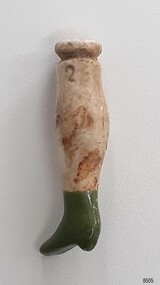
... Evans...Liverpool...The object is now one of the shipwreck artefacts in Flagstaff Hill’s McCulloch Collection, which includes other items recovered from the Victoria Tower, built in Liverpool by Evans in 1969, and wrecked the same year near Torquay, Victoria, on its maiden voyage. ...Flagstaff Hill Warrnambool Maritime Village Maritime Museum Flagstaff Hill Maritime Museum and Village Shipwreck coast Great Ocean Road Shipwreck artefact wreck dive McCulloch Collection Bruce McCulloch Victorian Heritage Register sailing ship doll's leg ceramic doll leg porcelain doll leg doll's limb ceramic limb from doll children's toy children's recreation doll's leg with green boot southwest coast Victoria Victoria Tower 1869 Torquay diver Evans Liverpool clipper ship iron hull migrant ship cargo ship 1869 shipwreck Inscribed "2" Doll's leg, cream-coloured ceramic leg with two seams, a flat solid top and a glazed green ankle-length heeled boot. ...The ceramic doll's leg was one of a group of artefacts in the McCulloch Collection that were recovered from the shipwreck Victoria Tower. The jar could have been from the ship's cargo or amongst the passengers' personal effects. The object is now one of the shipwreck artefacts in Flagstaff Hill’s McCulloch Collection, which includes other items recovered from the Victoria Tower, built in Liverpool by Evans in 1969, and wrecked the same year near Torquay, Victoria, on its maiden voyage. A diver salvaged the objects in the early 1970s while working along the southwest coast of Victoria. Advanced marine technology had enabled divers to explore the depths of the ocean and gather its treasures before the Government introduced protective legislation. The artefacts were donated to the Queensland Department of Environment and Heritage Protection (EHP) by a passionate shipwreck lover. Bruce McCulloch verified their locations. In 2017, the Department repatriated them to Flagstaff Hill, where they joined our vast collection of artefacts from Victoria’s Shipwreck Coast.The artefact is an example of cargo or personal items on board a ship in 1869. It provides a reference point for classifying and dating similar items. This artefact is significant for its association with the British-built, iron clipper ship Victoria Tower, a commercial and immigrant sailing ship constructed to carry cargo and passengers to colonial Australia. The vessel is recorded on the Victoria Heritage Database, VHR S698.Doll's leg, cream-coloured ceramic leg with two seams, a flat solid top and a glazed green ankle-length heeled boot. A shallow groove runs around the leg just below the top. An inscription is stamped into the leg below the groove. Recovered from the wreck of the Victoria Tower. Inscribed "2"flagstaff hill, warrnambool, maritime village, maritime museum, flagstaff hill maritime museum and village, shipwreck coast, great ocean road, shipwreck artefact, wreck dive, mcculloch collection, bruce mcculloch, victorian heritage register, sailing ship, doll's leg, ceramic doll leg, porcelain doll leg, doll's limb, ceramic limb from doll, children's toy, children's recreation, doll's leg with green boot, southwest coast victoria, victoria tower, 1869, torquay, diver, evans, liverpool, clipper ship, iron hull, migrant ship, cargo ship, 1869 shipwreck -
 Flagstaff Hill Maritime Museum and Village
Functional object - Lamp Fitting, circa 1869
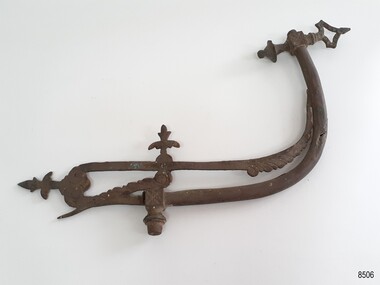
... Evans...Liverpool...The object is now one of the shipwreck artefacts in Flagstaff Hill’s McCulloch Collection, which includes other items recovered from the Victoria Tower, built in Liverpool by Evans in 1969, and wrecked the same year near Torquay, Victoria, on its maiden voyage. ...Flagstaff Hill Warrnambool Maritime Village Maritime Museum Flagstaff Hill Maritime Museum and Village Shipwreck coast Great Ocean Road Shipwreck artefact wreck dive McCulloch Collection Bruce McCulloch Victorian Heritage Register sailing ship lamp fitting gas lamp fitting ship’s fitting ship’s lamp brass lamp fitting lighting domestic lighting ship’s lighting southwest coast Victoria Victoria Tower 1869 Torquay diver Evans Liverpool clipper ship iron hull migrant ship cargo ship 1869 shipwreck Brass decorative gas lamp fitting. ...The brass lamp fitting was one of a group of artefacts in the McCulloch Collection that were recovered from the shipwreck Victoria Tower. The jar could have been from the ship's cargo or amongst the passengers' personal effects. The object is now one of the shipwreck artefacts in Flagstaff Hill’s McCulloch Collection, which includes other items recovered from the Victoria Tower, built in Liverpool by Evans in 1969, and wrecked the same year near Torquay, Victoria, on its maiden voyage. A diver salvaged the objects in the early 1970s while working along the southwest coast of Victoria. Advanced marine technology had enabled divers to explore the depths of the ocean and gather its treasures before the Government introduced protective legislation. The artefacts were donated to the Queensland Department of Environment and Heritage Protection (EHP) by a passionate shipwreck lover. Bruce McCulloch verified their locations. In 2017, the Department repatriated them to Flagstaff Hill, where they joined our vast collection of artefacts from Victoria’s Shipwreck Coast. The artefact is an example of cargo or personal items on board a ship in 1869. It provides a reference point for classifying and dating similar items. This artefact is significant for its association with the British-built, iron clipper ship Victoria Tower, a commercial and immigrant sailing ship constructed to carry cargo and passengers to colonial Australia. The vessel is recorded on the Victoria Heritage Database, VHR S698. Brass decorative gas lamp fitting. Two flat arms of different lengths are joined on either side of a fitting that has a fleur-de-lis-like design. The shorter arm has a J-shaped brass pipe fitted to it with a decorative threaded cube joint partway along, and ends with a triangular tap and knob. The longer arm is also J-shaped and ends with a feather design. There are remnants of green paint on the cube fittings and the knob. Recovered from the wreck of the Victoria Tower.flagstaff hill, warrnambool, maritime village, maritime museum, flagstaff hill maritime museum and village, shipwreck coast, great ocean road, shipwreck artefact, wreck dive, mcculloch collection, bruce mcculloch, victorian heritage register, sailing ship, lamp fitting, gas lamp fitting, ship’s fitting, ship’s lamp, brass lamp fitting, lighting, domestic lighting, ship’s lighting, southwest coast victoria, victoria tower, 1869, torquay, diver, evans, liverpool, clipper ship, iron hull, migrant ship, cargo ship, 1869 shipwreck -
 Flagstaff Hill Maritime Museum and Village
Painting - Oil painting, W. Langley-Taylor, Cape Schank [Schanck], Late 19th to early 20th century
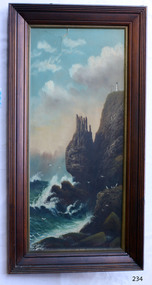
... A ship named “Irby”, built in Merseyside, Liverpool in 1881 by R & J Evans, Birkenhead. It was a four-masted iron ship built for the White Star Line. ...A ship named “Irby”, built in Merseyside, Liverpool in 1881 by R & J Evans, Birkenhead. It was a four-masted iron ship built for the White Star Line. ...This painting is one of a pair of large paintings by W. Langley-Taylor in our collection. Currently, no further information has been found about the artist but research is ongoing. The subjects of these paintings are seascapes of notable areas of the coast on each side of Port Phillip Bay, south of Melbourne, Victoria. The subject of this painting is Cape Schanck, Victoria, which is on the east side of Port Phillip Bay. It includes the Cape Schanck Lighthouse and its Flagstaff. The Cape Schanck Lighthouse was built in 1859 and is the second of Victoria’s coastal lights. It is 21 metres tall and made from limestone. Unusually, its stairway is made from stone rather than wrought iron. Gilded tours are available to explain its use and significance to visitors. The lighthouse keepers at Cape Schanck kept records of the ships that sailed past them along Bass Strait; ship’s names, direction, time and date and so on. The details would also be passed on to shipping agencies, Harbour Masters and newspapers, which published Arrivals and Departures into and out of shipping ports such as Port Phillip Bay and the Port of Melbourne. INSCRIPTIONS “Mrs M Irby” (and on the Eagle Rock, Warrnambool, painting “980/Regency”) The inscription “Mrs M Irby” is on the back of both paintings but the significance of the inscription has not yet been discovered. Perhaps she was connected with the ship or shipping company “Irby”. A ship named “Irby”, built in Merseyside, Liverpool in 1881 by R & J Evans, Birkenhead. It was a four-masted iron ship built for the White Star Line. Henry Wilson Hewitt bought her in 1882, then later she was owned by Chadwick & Pritchard. In 1888 she was registered under the Irby Ship Co. Ltd. (trading as J. Joyce) in Liverpool. In 1912 Galgate Co. Ltd owned her. She traded between London, England and Australia, and is recorded as being in Melbourne and Hobart. In 1919 the Irby was destroyed by a mine when on her way to England. Or perhaps her name and the inscription in pencil “980/Regency” on the Eagle Rock Warrnambool, painting could be a delivery address for the paintings, perhaps an apartment in a hotel. NOTE: The artist’s spelling of the title “Cape Schank, Vic.” is incorrect. The location in this painting is named Cape Schanck. This painting is geographically significant for its depiction of Victoria’s coastal scenery. It is also significant as one of a pair of seascapes depicting sites on either side of Port Phillip Bay. Historically, the painting is significant as an example of the late nineteenth- and early twentieth-century methods and materials used in frame construction.Oil on board, in a dark-stained wooden frame, portrait format. The composition depicts a seascape with cliffs, a lighthouse and a flagstaff, birds in flight, waves breaking against rocks, and a blue sky with clouds. The title is painted at the lower left. The work is signed at lower right by the Victorian artist W. Langley-Taylor. A handwritten inscription in red crayon or heavy red pencil appears on the reverse. The board is fixed within the timber frame by small dark metal tacks. Metal eyes secure the hanging wire to the frame. Small round nail heads are visible around the frame, and both the board and the wood exhibit colour change. The handwritten inscription runs vertically along the lower left edge of the board. The wire hangs in a shallow curve, and the mitred corners are reinforced with staples. The board shows some damage. The discolouration visible on both the board and frame may indicate the former presence of a backing paper, once attached to the reverse with tape and tacks.Painted on front “W.LANGLEY-TAYLOR.” and “CAPE SCHANK, VIC.” [NOTE: correct spelling is Schanck] Handwritten on back “Mrs. M. Irby” flagstaff hill, warrnambool, shipwrecked coast, flagstaff hill maritime museum, maritime museum, shipwreck coast, flagstaff hill maritime village, great ocean road, painting, oil painting, cape schanck painting, w. langley-taylor, wall decoration, seascape of victoria's coast, art, mrs m irby, victoria's coast, pair of paintings -
 Ballarat Heritage Services
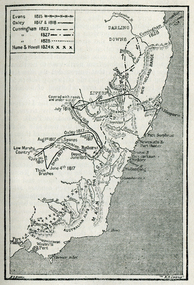
Map, Australian Inland Exploration, 1815-1928, 1815-1828
... evans...cunningham...darling downs...liverpool...map explorers exploration australian alps westernport port phillip hume and hovell oxley evans cunningham darling downs liverpool Copy of a map from 'A Short History of Australia' by Ernest Scott. ...Copy of a map from 'A Short History of Australia' by Ernest Scott.map, explorers, exploration, australian alps, westernport, port phillip, hume and hovell, oxley, evans, cunningham, darling downs, liverpool -
 Loreto Australia and South-East Asia
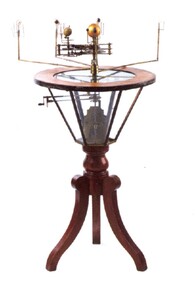
Orrery, mid 19th century
... Evans Baker, Superintendent of the Oddie Observatory, Mount Pleasant Ballarat, who subsequently made the students a telescope. Used in the curriculum for the study of astronomy. Connection with founder of Loreto in Australia and her family. Evidence of early curriculum. Rare artefact. orrery astronomy science Paterson & Son Maker Liverpool ...Donated by founder, Mother Gonzaga Barry's, brother, John Barry, to Loreto's Ballarat school, Mary's Mount, in 1887. Brought back by Mother Gonzaga on her return from Europe in 1887. Maintained by Captain Henry Evans Baker, Superintendent of the Oddie Observatory, Mount Pleasant Ballarat, who subsequently made the students a telescope. Used in the curriculum for the study of astronomy.Connection with founder of Loreto in Australia and her family. Evidence of early curriculum. Rare artefact.A clockwork scientific instrument modelling the solar system.Paterson & Son Maker Liverpoolorrery, astronomy, science
