
Showing 36 items matching "evening jackets"
-
 Kew Historical Society Inc
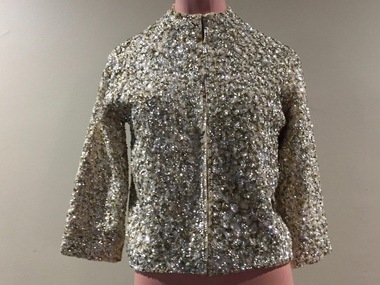
Clothing - Gold Satin & Sequin Evening Jacket, 1970s
... Gold Satin & Sequin Evening Jacket......evening jackets...Items in the collection were largely produced for, or purchased by women in Melbourne, and includes examples of outerwear, protective wear, nightwear, underwear and costume accessories.This sequinned evening jacket is one of a number of items donated to the collection by Rosemary Vaughan-Smith....Evening jacket heavily embroidered with gold sequins....Clothing Gold Satin & Sequin Evening Jacket ...The Fashion & Design collection of the Kew Historical Society includes examples of women’s, men’s, children’s and infants’ clothing from the 18th, 19th and 20th centuries. Items in the collection were largely produced for, or purchased by women in Melbourne, and includes examples of outerwear, protective wear, nightwear, underwear and costume accessories.This sequinned evening jacket is one of a number of items donated to the collection by Rosemary Vaughan-Smith.Evening jacket heavily embroidered with gold sequins.australian fashion -- 1970s, evening wear, evening jackets, rosemary vaughan-smith -
 Kew Historical Society Inc
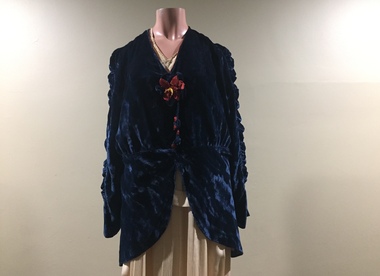
Clothing - Crushed Velvet Evening Jacket, 1930s
... Crushed Velvet Evening Jacket......evening jackets...Dark blue ruched crushed velvet evening jacket with a wine coloured trim. The waisted jacket has a scalloped hem at the front....Clothing Crushed Velvet Evening Jacket ...The Fashion & Design collection of the Kew Historical Society includes examples of women’s, men’s, children’s and infants’ clothing from the 18th, 19th and 20th centuries. Items in the collection were largely produced for, or purchased by women in Melbourne, and includes examples of outerwear, protective wear, nightwear, underwear and costume accessories.Dark blue ruched crushed velvet evening jacket with a wine coloured trim. The waisted jacket has a scalloped hem at the front.australian fashion -- 1930s, evening jackets, evening wear -
 Kew Historical Society Inc
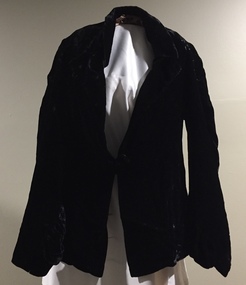
Clothing - Black Silk Velvet Evening Jacket, 1930s
... Black Silk Velvet Evening Jacket......evening jackets...Black silk velvet waist length evening jacket with beige silk lining. The jacket closed with a single large button at the front. ...Clothing Black Silk Velvet Evening Jacket ...The Fashion & Design collection of the Kew Historical Society includes examples of women’s, men’s, children’s and infants’ clothing from the 18th, 19th and 20th centuries. Items in the collection were largely produced for, or purchased by women in Melbourne, and includes examples of outerwear, protective wear, nightwear, underwear and costume accessories.Black silk velvet waist length evening jacket with beige silk lining. The jacket closed with a single large button at the front. It features narrow cuffs. The jacket (and or outfit) has been dated to the 1930s.women's clothing, evening wear, evening jackets, australian fashion - 1930s -
 Kew Historical Society Inc
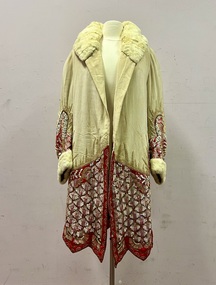
Clothing - Evening Coat, 1920–1930
... Evening jackets...The opulence of the sequinned and beaded embroidery have led to the supposition that it may be an opera coat inherited from an earlier generation. Evening jackets Opera coats Fashion -- 1920s Traditionally, pre acquisition, stored in brown suitcase embossed in gilt with the name R. ...The donor, whose parents owned an antique shop believed that the evening coat was owned by the family of Cr Morris Nathan and his wife Margaret Frances, nee MacKay. Maurice Nathan was born in Kew in 1914 and died in East Melbourne in 1982. He was a student of Trinity Grammar School, Kew. He was Lord Mayor, and his wife Lady Mayoress, of the City of Melbourne for two terms between 1961 and 1963. The age of the coat, created in a design typical of the 1920s would suggest that it is of an earlier vintage, almost certainly dating from the 1920s, but perhaps earlier. The opulence of the sequinned and beaded embroidery have led to the supposition that it may be an opera coat inherited from an earlier generation.Three quarter length, red and cream silk, padded evening coat highlighted on the cuffs and hem with iridescent sequins, beading and pearls of different shapes and sizes. These decorative features are arranged in a formal design, particularly at centre back. Above the beaded sections are sunbursts outlined in gold beads.Trimmed rabbit fur at collar and cuffs. The sleeves are shaped above the embroidered sections while the hem features a zig-zag profile. MEASUREMENTS - Neck to hem front 93cm; Neck to hem back 100cm; Circumference 126cm; Shoulder to cuff 72cm; Shoulder width 36cm.Traditionally, pre acquisition, stored in brown suitcase embossed in gilt with the name R. NATHANevening jackets, opera coats, fashion -- 1920s -
 Flagstaff Hill Maritime Museum and Village
Jacket
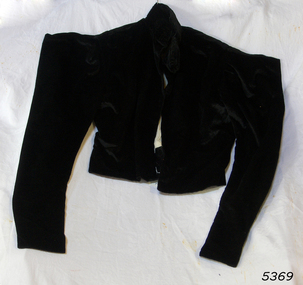
... Black velvet ladies evening jacket. Circa 1920...flagstaff hill warrnambool shipwrecked-coast flagstaff-hill flagstaff-hill-maritime-museum maritime-museum shipwreck-coast flagstaff-hill-maritime-village Black velvet ladies evening jacket. Circa 1920 Jacket ...Black velvet ladies evening jacket. Circa 1920flagstaff hill, warrnambool, shipwrecked-coast, flagstaff-hill, flagstaff-hill-maritime-museum, maritime-museum, shipwreck-coast, flagstaff-hill-maritime-village -
 Kew Historical Society Inc
Clothing - Black velvet jacket with diamanté clasp, 1930s
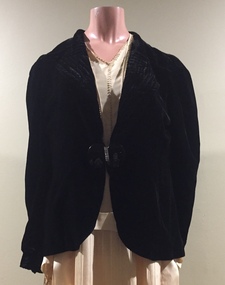
... Black silk velvet evening jacket with ornamental diamanté clip at front....This black velvet jacket with diamanté clasp was collected by Teresa Mayer, KHS member, and donated to our collection in 1988. women's clothing fashion -- melbourne -- 1930s capes Black silk velvet evening jacket with ornamental diamanté clip at front. ...The Fashion & Design collection of the Kew Historical Society includes examples of women’s, men’s, children’s and infants’ clothing from the 18th, 19th and 20th centuries. Items in the collection were largely produced for, or purchased by women in Melbourne, and includes examples of outerwear, protective wear, nightwear, underwear and costume accessories. This black velvet jacket with diamanté clasp was collected by Teresa Mayer, KHS member, and donated to our collection in 1988.Black silk velvet evening jacket with ornamental diamanté clip at front.women's clothing, fashion -- melbourne -- 1930s, capes -
 Kew Historical Society Inc
Clothing - Black Crepe Evening Jacket with Cream Silk Embroidery, 1930s
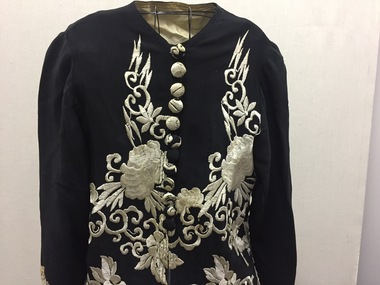
... Black Crepe Evening Jacket with Cream Silk Embroidery...evening wear...eveing jackets...The jacket is believed to have been purchased by an aunt of the donor in the 1930s on a trip to the ‘Orient’ Clothing Black Crepe Evening Jacket with Cream Silk Embroidery ...The Fashion & Design collection of the Kew Historical Society includes examples of women’s, men’s, children’s and infants’ clothing from the 18th, 19th and 20th centuries. Items in the collection were largely produced for, or purchased by women in Melbourne, and includes examples of outerwear, protective wear, nightwear, underwear and costume accessories.The McIntyre Collection of clothing and clothing accessories forms one of the largest single donations to our Fashion & Design collection. It includes clothing and clothing accessories worn by four women in the Cohen and McIntyre families across three generations. The items worn by Melbourne architect, and Kew resident, Dione McIntyre date from the 1960s and 1970s, and include evening wear, day wear, hats and shoes. As Dione McIntyre often accompanied her husband, fellow architect Peter McIntyre, to formal events, there are a number of pieces of evening wear among the items. The McIntyre Collection also includes items worn by women of an earlier generation: by Lilian Cohen, Dione McIntyre's mother, and by her mother-in-law, the wife of the architect Robert McIntyre. At the other end of the chronological spectrum are a number of outfits belonging to, worn and donated by Annie McIntyre. These include outfits created by notable late 20th century Australian and/or international fashion designers. The McIntyre Collection is significant historically and artistically as it includes examples of design that demonstrate changing tastes in fashion over an 80-year period. The collection is also significant in that it includes the work of a large number of Melbourne designers from the 1960s to the 1990s. Black crepe jacket with heavy cream embroidery. The jacket is believed to have been purchased by an aunt of the donor in the 1930s on a trip to the ‘Orient’mcintyre collection, women's clothing, international fashion - 1930s, evening wear, eveing jackets -
 Brighton Historical Society
Jacket, Evening jacket, 1920s-1930s
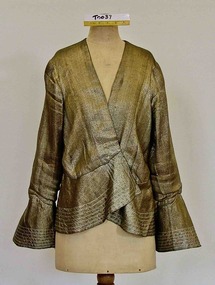
... Evening jacket...jacket...art deco...metallic fabric...evening...Evening jacket made of gold metallic fabric. Deep cross-over front with curved peplum and flared cuffs. ...Lined with pale blue silk. Evening jacket Jacket ...Evening jacket made of gold metallic fabric. Deep cross-over front with curved peplum and flared cuffs. Peplum and cuffs feature 7 rows of pale blue stiching. Lined with pale blue silk.jacket, art deco, metallic fabric, evening wear, 1920s, 1930s -
 Kew Historical Society Inc
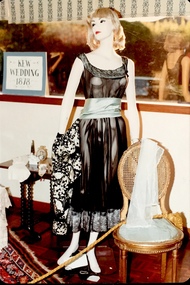
Photograph - Display at Festival of Kew, 1979
... Recognisable items include a Chinese black evening jacket embroidered with chrysanthemums in satin stitch belonging to Dione McIntyre....Recognisable items include a Chinese black evening jacket embroidered with chrysanthemums in satin stitch belonging to Dione McIntyre. ...From its beginnings in 1958, the Society has mounted exhibitions and/or displays, in early days in shop window and in community spaces located in the Kew City Hall (later Kew Library), and since 2010 at the Kew Court House. Exhibitions typically coincided with the annual Kew Community Festival in March, but after 2013 evolved into three new exhibitions yearly at the Kew Court House. Smaller displays continue to be mounted in the Kew Library.Display of objects and costumes owned by members of the Kew Historical Society or derived from the collection, exhibited during the Festival of Kew in 1979. Recognisable items include a Chinese black evening jacket embroidered with chrysanthemums in satin stitch belonging to Dione McIntyre.Inscribed verso: " Society's exhibition Festival of Kew / Donated by Janet McDermott 1979"kew historical society -- exhibitions, festival of kew -- 1979 -
 Kew Historical Society Inc
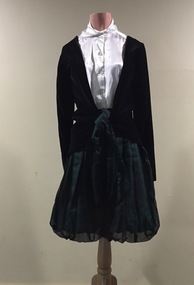
Clothing - Dark Green Silk Cullottes & Black Velvet Jacket, Martin Grant, 1985
... Dark green coloured taffeta and organza short evening culottes with separate black velvet evening jacket. The outfit, confidently dated to 1985, is from one of the earliest ready-to-wear collections by Martin Grant, who began his career in Melbourne at the age of 16....The outfit was worn by Annie McIntyre on her 21st birthday, 1985" Dark green coloured taffeta and organza short evening culottes with separate black velvet evening jacket. The outfit, confidently dated to 1985, is from one of the earliest ready-to-wear collections by Martin Grant, who began his career in Melbourne at the age of 16. ...The Fashion & Design collection of the Kew Historical Society includes examples of women’s, men’s, children’s and infants’ clothing from the nineteenth and twentieth centuries.These were produced for, or purchased by women in Melbourne, and includes examples of outerwear, protective wear, nightwear, underwear and costume accessories. The McIntyre Collection forms one of the largest single donations to our Fashion & Design collection. It includes clothing worn by women in the Cohen and McIntyre families. The collection is significant historically and aesthetically, demonstrating changing tastes in fashion over an 80-year period. It includes the work of a large number of Melbourne designers from the 1950s to the 1980s. Dark green coloured taffeta and organza short evening culottes with separate black velvet evening jacket. The outfit, confidently dated to 1985, is from one of the earliest ready-to-wear collections by Martin Grant, who began his career in Melbourne at the age of 16.A note by Dione McIntyre, describing the outfit, of which this item is a part reads: "Martin Grant outfit, including black satin and velvet shoes. Martin Grant was originally from Melbourne, now internationally and renowned and designing and living in Paris. The outfit was worn by Annie McIntyre on her 21st birthday, 1985"martin grant, women's clothing, australian fashion -- 1980s -
 Flagstaff Hill Maritime Museum and Village
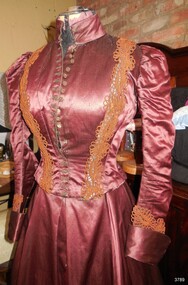
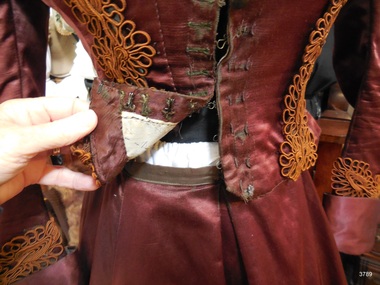
Clothing - Jacket, before April 1874
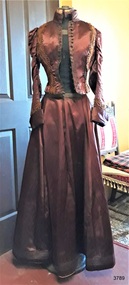
... ...colonial evening jacket...The buttons may have been used to replace missing buttons on the front of the jacket or perhaps to repair worn cuffs antique satin jacket colonial evening jacket ladies evening jacket 19th century ladies satin jacket evening outfit The amber coloured satin jacket is fully lined, has turned-back cuffs, a band collar, and looped, coffee-coloured braid trim. ...THE JACKET This jacket has been tailored to flatter the wearer’s figure. It also has elements that keep it in good shape and condition, preserve it from soiling and give it a longer life: - the hooks and eyes that join the jacket to the skirt allow the outfit to be made in two pieces but fit close to the body without exposing undergarments - the seams for the metal stays have been cut and stitched to allow maximum movement of the wearer and still keep a trim figure - the discreet breast pocket allows the wearer to keep a handkerchief, coins or other small items close at hand - the lining includes removable padded shields to absorb underarm perspiration - the lining has two cotton loops attached for hanging up to air and freshen it - new cuffs have been attached over the original sleeves that have buttonholes but no buttons. The buttons may have been used to replace missing buttons on the front of the jacket or perhaps to repair worn cuffs The amber coloured satin jacket is fully lined, has turned-back cuffs, a band collar, and looped, coffee-coloured braid trim. A row of closely spaced, round bronze buttons with a floral motif form a decorative closure most of the way down the front of the jacket, below which are metal hooks and eyes that finish at the waist. Underneath the cuffs there is a closely fitted cuff with a row of three button holes but no buttons. The jacket lining has vertical metal stays spaced around the midriff, sides and back. There is an absorbent, removable pad hand-stitched to the underarm section of each sleeve opening. A small satin pocket is stitched discreetly onto the lining above the chest on the right-hand side. There are also two cotton loops sewn onto the lining. Several small metal rings are sewn at intervals around the inside of the waist A satin bow from the same fabric is attached at the centre back of the jacket at waist level. antique satin jacket, colonial evening jacket, ladies evening jacket, 19th century ladies satin jacket, evening outfit -
 Flagstaff Hill Maritime Museum and Village
Clothing - Skirt, before April 1874
... The outfit is significant too for connecting the colonial families to the indigenous culture of the district and the contact between the native and European people. evening skirt ladies 1h century skirt satin skirt antique satin skirt The lined, floor-length, amber satin skirt has gentle folds that gather into a fitted waistband. One of the folds at the back conceals the opening of the skirt that fastens using metal hooks and eyes. The bow at the back of the jacket ...THE SKIRT The skirt has a gentle, soft, feminine design which keeps it in good shape and condition, preserving it from soiling and prolonging its life: - the satin fabric is softly pleated at the waist and falls gently to almost floor length - the opening is concealed at the back within one of the folds and closes with hooks and eyes underneath the bow at the back of the jacket - the horizontal stitching at the base of the skirt joins the lining to the skirt, and the firmness it creates allows it to gently flare out at the base without the need of hooped petticoats - a removable fabric lining at the hem protects the front and back of the skirt from friction and soiling from the wearer’s footwear THE SKIRT This evening outfit is significant for its connection with colonial Australia, Victoria and Warrnambool. It is a fine example of female fashion of the mid to late 1900s. The outfit is significant for its connection with a wedding uniting two colonial families from Northern Ireland who immigrated to Australia in the mid-1850s. The families had a significant role in the history of Warrnambool and district. The outfit is significant too for connecting the colonial families to the indigenous culture of the district and the contact between the native and European people. The lined, floor-length, amber satin skirt has gentle folds that gather into a fitted waistband. One of the folds at the back conceals the opening of the skirt that fastens using metal hooks and eyes. The bow at the back of the jacket covers the top of the closure. There are metal hooks distributed around the top of the waistband. The skirt is stitched horizontally around the hem in several rows. There is a removable fabric lining at the base of the skirt.evening skirt, ladies 1h century skirt, satin skirt, antique satin skirt -
 Flagstaff Hill Maritime Museum and Village
Clothing - Evening Outfit, before April 1874
... This amber satin evening outfit was worn by Mrs Isabella Mitchell (nee Russell, 1840 – 1929) at the wedding of her brother Alexander (c.1846–1938) and Eliza (nee Moore, c.1854–1939). The jacket...This lady’s evening outfit is made from amber coloured satin fabric. It comprises a short-waisted, long-sleeved jacket and a long skirt, and it has its own neck-to-floor wooden mannequin on a pedestal. ...This amber satin evening outfit was worn by Mrs Isabella Mitchell (nee Russell, 1840 – 1929) at the wedding of her brother Alexander (c.1846–1938) and Eliza (nee Moore, c.1854–1939). The jacket ...This amber satin evening outfit was worn by Mrs Isabella Mitchell (nee Russell, 1840 – 1929) at the wedding of her brother Alexander (c.1846–1938) and Eliza (nee Moore, c.1854–1939). The jacket and skirt attach at the waist by joining the metal rings around the base of the jacket, and the metal hooks on the waistband of the skirt. The outfit was donated with its own mannequin and fits it perfectly. In the colonial days, outer clothing was rarely, if ever, washed, due to the expense of fabrics and the difficulty in careful laundering. Clever methods were employed to reduce the occurrence of soiling. The mannequin included with the donation would also help keep the outfit in good shape and ensure a flattering fit. FAMILIES’ HISTORY The families connected with this wedding, where the outfit was worn, are from Warrnambool’s colonial days. Isabella and Alexander’s parents, Robert Russell and Elizabeth (nee Mitchell), were born in 1808 and married about 1830. They were from farming families in Northern Ireland, where they raised their seven children before migrating to Australia in the early colonial days, around 1857. Their graves are in the Tower Hill Cemetery. Alexander’s wife, Eliza (nee Moore, born in 1854), was also from Northern Ireland and migrated to Australia in 1858 with her parents, Thomas and Nancy Moore, in the last voyage of the sailing ship “Chance”. Isabella (Bella) talked with her granddaughter Ruby Akers about her memories of Alexander and Eliza’s wedding and other events in her life. Ruby recorded these memories in a letter. She says, “They were married in the Warrnambool Congregational Church by a pioneer minister, the Reverend Uriah Coombs. The bride wore a pale blue silk wedding gown, which she made herself. Bella was Matron of Honora, and Ian McCasker was best man. In those days, the transport to the church was usually a carriage – similar to a cab – and a pair of white ponies. They would have the reception at home, go for a drive afterwards, and at night there would be a dance. They did all the catering themselves … Eliza carried on farming in the Dennington, Yarpturk and Purnim districts until they moved to Camperdown around 1905…” Ruby’s letter later mentions “[Isabella] could recall seeing a blackfellows’ corroboree being performed near where the Dennington Bridge now stands. It was rather a terrifying experience; they seemed to be in a warlike mood, and one never knew what they would do next. One lubra came running to Granny, crying, Hide me, bad man kill me. She was bleeding from a wound in the head: probably the result of a blow from a waddy. My mother [Margaret Jane McLaughlan nee Mitchell], coming home from school in the 1800s, often met blackfellows walking ahead with spears and boomerang, the two lubras – they usually had two – following in the rear, carrying the children or any burdens they had.“ Margaret was probably in primary school at the time she saw these things. Alexander and Eliza had ten children. One of their daughters, Margaret Jane, was born in Warrnambool in 1879. She married William McCullagh, and they had eleven children. Margaret made headlines in the Warrnambool newspapers for celebrating her 100th birthday. She had lived in the district for 60 years before moving to Melbourne. Alexander passed away at the age of 92, and Eliza passed away six months later, aged 85. Their graves are in the Colac cemetery. Isabella married Ralph Mitchell, and their daughter Margaret Jane married John McLauchlan in 1891. Margaret and John’s daughter, Ruby Elizabeth Jane, married Fredrick Akers in 1938. Fredrick, born in England, was a Boer War veteran and served in the British Army. He migrated to Queensland, Australia, in 1913, and joined the Australian Army to fight in World War I. In 1935, he moved to Warrnambool, where he served in the Volunteer Defence Corps from 1938 to 1945. Both Ruby and Fredrick are buried in the Tower Hill Cemetery.The evening outfit and its accompanying mannequin serve as notable examples of female fashion from the mid to late 1900s. These items reflect the styles and trends that were prevalent during this period, offering insight into the clothing choices and cultural influences that shaped women's attire. Beyond their representation of period fashion, the outfit and mannequin are significant due to their association with colonial pioneer families from Australia, specifically Victoria and Warrnambool. These families played an important role in the development and history of the region, and the items are linked to their legacy. The evening outfit and mannequin are also notable for their connection to a wedding that united two colonial families originating from Northern Ireland. These families immigrated to Australia in the mid-1850s and became influential figures within the Warrnambool district. The wedding marked a significant event, symbolising the merging of two prominent family lineages. Furthermore, the significance of the evening outfit and mannequin extends to their connection with the colonial families’ contact with the indigenous culture of the district. These items represent a period of interaction between the native and European peoples, highlighting the cultural exchanges that occurred within the region. This lady’s evening outfit is made from amber coloured satin fabric. It comprises a short-waisted, long-sleeved jacket and a long skirt, and it has its own neck-to-floor wooden mannequin on a pedestal. The outfit was worn by Mrs Isabella Mitchell (nee Russell) as the Matron of Honour at the wedding of her brother Alexander Russell and his fiancée Eliza Moore in Warrnambool, 29th April 1874.flagstaff hill, warrnambool, shipwrecked coast, flagstaff hill maritime museum, maritime museum, shipwreck coast, flagstaff hill maritime village, great ocean road, evening outfit, wedding outfit, bridesmaid’ outfit, matron of honour outfit, clothing female, clothing late 19th century, clothing wedding late 19th century, clothing bridesmaid late 19th century, clothing antique, clothing ladies, women’s clothing, women’s fashion, alexander russell, eliza russell, eliza moore, isabella mitchell, bella mitchell, bella russell, isabella russell, ralph russell, ian mccusker, ruby akers, fredrick william akers, ruby mclauchlan, margaret jane mclaughlan nee mitchell, margaret jane mclaughlan centenarian, william mclaughlan, robert russell, elizabeth russell nee mitchell, irish immigrants, warrnambool volunteer defence corps 1938-1945, antique satin outfit, warrnambool wedding 1874, congregational church warrnambool, reverend uriah coombs, dennington farmer, yarpturk farmer, purnim district farmer, camperdown resident 1905, dennington bridge, indigenous corroboree in dennington, corroboree in warrnambool, 1880s corroboree in warrnambool, lubra and baby, indigenous corroboree in warrnambool, mccullagh family -
 City of Moorabbin Historical Society (Operating the Box Cottage Museum)
Manufactured Objects, x 6 buttons, white metal filigree, c1900
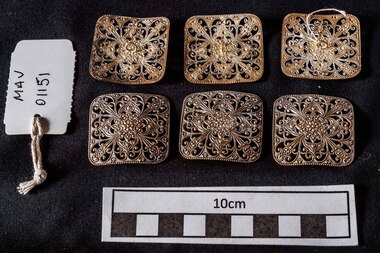
... c1900 These white metal buttons could be attached to a dress or jacket to possibly match or enhance decorative silver, pewter or brass buckles that were attached by ribbons or straps to plain shoes for evening and special occasions . ...c1900 These white metal buttons could be attached to a dress or jacket to possibly match or enhance decorative silver, pewter or brass buckles that were attached by ribbons or straps to plain shoes for evening and special occasions . ...c1900 These white metal buttons could be attached to a dress or jacket to possibly match or enhance decorative silver, pewter or brass buckles that were attached by ribbons or straps to plain shoes for evening and special occasions . These buttons were worn by a lady in the family of Ailsa Hunt in Moorabbin Shire These decorative white metal buttons were a common accessory for early settler women in Moorabbin Shire c19006x square white metal buttons with filigree design and attachment loop at backdetachable silver buttons, footwear, shoes, buckles, clothing, silver, pewter, brass, white metal, victorian fashion, edwardian fashion, market gardeners, early settlers, moorabbin shire, bentleigh, mckinnon, moorabbin, cheltenham, wedding dresses, evening wear, -
 Glenelg Shire Council Cultural Collection
Clothing - Evening Gown, n.d
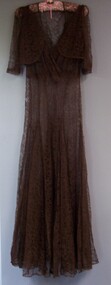
... evening gown (possibly belonging to Miss Crosbie). Sleeveless, buttoned opening at back. Long skirt with numerous darts for fullness. Matching bolero jacket...evening gown (possibly belonging to Miss Crosbie). Sleeveless, buttoned opening at back. Long skirt with numerous darts for fullness. Matching bolero jacket ...Part of Graham Collection, donated by the Family of Misses Mary and Edith Maude Graham, of 4 Blair Street, Portland.Brown lace evening gown (possibly belonging to Miss Crosbie). Sleeveless, buttoned opening at back. Long skirt with numerous darts for fullness. Matching bolero jacket (3794.2) and likely to have been worn with brown satin heels (3800.1 and 3800.2).clothing, womens clothing, costume, evening wear, graham collection -
 Bendigo Military Museum
Uniform - MESS DRESS, RAN, Australian Defence Industries, 1986
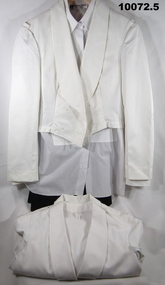
... Jacket, female, white cotton/polyester fabric. Collar with wide extended lapels, double breasted. Buttonholes - no buttons. Manufacturer's information - white cotton fabric label. 4. RAN evening...Jacket, female, white cotton/polyester fabric. Collar with wide extended lapels, double breasted. Buttonholes - no buttons. Manufacturer's information - white cotton fabric label. 4. RAN evening ...1. 2. 3. RAN Mess Dress Jacket, female, white cotton/polyester fabric. Collar with wide extended lapels, double breasted. Buttonholes - no buttons. Manufacturer's information - white cotton fabric label. 4. RAN evening shirt with white cotton/polyester fabric. Collar, panel front, long sleeves with cuffs with white and black plastic buttons. Manufacturer's information, white polyester fabric label, back below collar. 5. RAN skirt, long length, black wool/polyester fabric straight skirt, waistband, metal and nylon zipper and black plastic button closer, midline, back. Manufacturer's information, black polyester fabric label. Size label - white.Manufacturers details - black ink print. 1. "A.G.C.F./ VIC 1986/^/ JKT MESS WHITE/ SIZE 96S/ 8405--------/ R.A.N./MADE IN AUSTRALIA/ DO NOT BOIL OR /WRING DRIP DRY/ IRON LIGHTLY/ WTH WARM IRON. Handwritten - black ink "MIDN BOWMAN/ L149319" blue ink 8405-66-124-7060" 2. 1985 as above. 3. Illegible, 4. "Philippe Anton/ MADE IN ASUSTRALIA/ 105L" 5. Modern/TAILORING/ Canberra/ Size 14 to fir cm/ Bust 90/ Waist to / Hip 95".uniforms, ran, mess dress, rachel bowman -
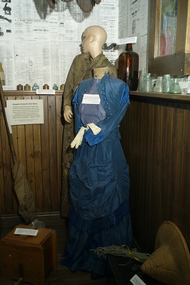 Andrew Ross Museum
Evening Gown, Circa 1870
... Believed to have belonged to Annie Maria Victoria Margareta Bisley, mother of Dorothy Wills, a post mistress/store keeper at Kangaroo Ground during the 1950's-60's Lady's blue taffeta skirt and jacket trimmed with fringe/tassels/sleeve inserts. Evening Gown ...Believed to have belonged to Annie Maria Victoria Margareta Bisley, mother of Dorothy Wills, a post mistress/store keeper at Kangaroo Ground during the 1950's-60'sLady's blue taffeta skirt and jacket trimmed with fringe/tassels/sleeve inserts. -
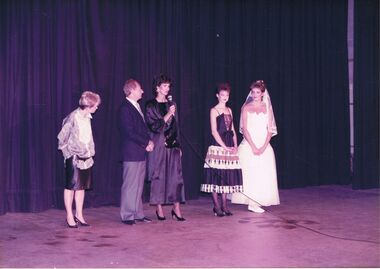 Bendigo Historical Society Inc.
Photograph - CASTLEMAINE GAS COMPANY COLLECTION: PHOTO PEOPLE
... Gas and Fuel Fashion,Food,Fitness. 5 people on a stage - From Left to Right: Female in black skirt and grey top, man in suit, female in long dark skirt dark top and jacket holding a microphone, female in evening dress, female in a wedding dress. ...EVENT Social gas & fuel fashion food fitness Gas and Fuel Fashion,Food,Fitness. 5 people on a stage - From Left to Right: Female in black skirt and grey top, man in suit, female in long dark skirt dark top and jacket holding a microphone, female in evening dress, female in a wedding dress. ...Gas and Fuel Fashion,Food,Fitness. 5 people on a stage - From Left to Right: Female in black skirt and grey top, man in suit, female in long dark skirt dark top and jacket holding a microphone, female in evening dress, female in a wedding dress. Date and location unknown.event, social, gas & fuel fashion, food, fitness -
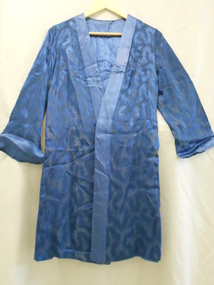 Bendigo Historical Society Inc.
Clothing - HELEN MUSK COLLECTION: BLUE SILK JACKET. PART OF A TWO PIECE ENSEMBLE, Blue Silk Jacket
... evening...Blue silk jacket...COSTUME Female evening Blue silk jacket Mid-thigh length jacket of royal blue silk fabric with a metallic thread forming a tinsel like pattern. ...Mid-thigh length jacket of royal blue silk fabric with a metallic thread forming a tinsel like pattern. Fully lined with blue satin. Front opening has a 5 cm border of blue satin. No fastenings. Three quarter length sleeves have 5cm borders of blue satin at the wrist. See 11400.507 .costume, female evening, blue silk jacket -
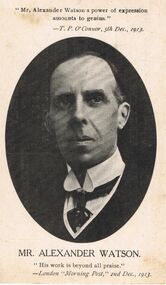 Bendigo Historical Society Inc.
Postcard - PETHARD COLLECTION: ALEXANDER WATSON POSTCARD
... jacket, tie and turn down collar. Written on top 'Mr. Alexander Watson's power of expression amounts to genius' - T.P. O'Connor, 5th. Dec. 1913' On bottom 'Mr. Alexander Watson, His work is beyond all praise' - London 'Morning Post 2nd. Dec. 1913' On rear of postcard Two nights only 18th & 19th. May. Masonic Hall, Monday evening...jacket, tie and turn down collar. Written on top 'Mr. Alexander Watson's power of expression amounts to genius' - T.P. O'Connor, 5th. Dec. 1913' On bottom 'Mr. Alexander Watson, His work is beyond all praise' - London 'Morning Post 2nd. Dec. 1913' On rear of postcard Two nights only 18th & 19th. May. Masonic Hall, Monday evening ...Black and white image: head and shoulders of Mr. Alexander Watson, dressed in dark jacket, tie and turn down collar. Written on top 'Mr. Alexander Watson's power of expression amounts to genius' - T.P. O'Connor, 5th. Dec. 1913' On bottom 'Mr. Alexander Watson, His work is beyond all praise' - London 'Morning Post 2nd. Dec. 1913' On rear of postcard Two nights only 18th & 19th. May. Masonic Hall, Monday evening, 18th. May. Mr. Alexander Watson, will present a special Kipling night: McAndrew's Hymn; Oonts, The glory of the Garden 'Boots' Fuzzy Wuzzy 'Gunga din'. The Bolivar 'The clampherdown' 'Shamus O'Brien' 'Punch Brothers'. Tuesday, May 19th Part 1, The Merchant of Venice, Part 11 Charles Dickens & J.M. Barrie.person, individual, alexander watson, bendigo, petherd, chancellor, alexander watson, masonic hall, sandhurst -
 Brighton Historical Society
Jacket, Bridge jacket, 1930
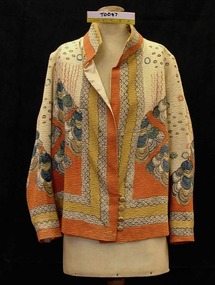
... jacket. Lin was born in Ballarat 1881, the eighth child of Scottish migrants James Nicol Law and Margaret Law (nee Bartholomew). BHS holds an evening...jacket. Lin was born in Ballarat 1881, the eighth child of Scottish migrants James Nicol Law and Margaret Law (nee Bartholomew). BHS holds an evening ...This jacket was bought in England for Elsie Law (nee Russell) by her husband James Lindsay Gordon "Lin" Law in 1930. Elsie used it as a bridge jacket. Lin was born in Ballarat 1881, the eighth child of Scottish migrants James Nicol Law and Margaret Law (nee Bartholomew). BHS holds an evening dress belonging to Margaret Law in its collection (see T0006.1). After leaving school at the age of 11, Lin began working as a salesman. In 1906, he and business partner James Kerr Pearson (also a Brighton local, who lived at 12 Moule Avenue) established the shirt manufacturing company Pelaco. In 1922 the company established its factory at 23 Goodwood Street on the top of Richmond Hill; the 4.3 metre high neon 'Pelaco' sign, erected in 1939, is today heritage listed. The company was known for its innovative approach to efficiency and labour relations, discontinuing Saturday morning work in 1908 and appointing an industrial relations officer in 1928. Lin married Elsie Russell on 12 January 1915 at St Mary's Catholic Cathedral in Sydney and they lived most of their life in Brighton. In 1920 they moved into 'Blairgowrie', 306 St Kilda Street, The eldest their four children, Pauline Margaret Law (born 15 December 1915) ultimately purchased the house with her husband Hugh McLean in 1956 and lived there until 1965 when the house was demolished.Cream silk jacket block-printed with art deco style pattern in red, blue, black and mustard colours. Lined with soft apricot-coloured satin. Wide stand collar. Front fastens low on hip with four silk covered buttons. Label, woven brown on cream silk, centre back: Eileen / Mulholland / Ltd. / 43, Wigmore St., / LONDON. W1.elsie russell, james lindsay gordon law, brighton, pelaco, bridge jacket, 1930s fashion, eileen mulholland, art deco -
 Brighton Historical Society
Evening outfit, 1970s
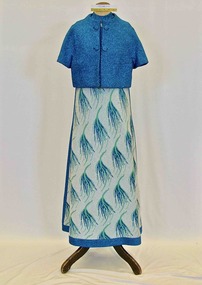
... Silver, blue and green knitted lurex evening outfit comprising maxi dress (.1) and short blue lurex jacket (.2) with short sleeves. ...evening outfit 1970s lurex Label, woven black on white acetate centre back jacket: Tricó / ROMA Silver, blue and green knitted lurex evening outfit comprising maxi dress (.1) and short blue lurex jacket (.2) with short sleeves. ...Silver, blue and green knitted lurex evening outfit comprising maxi dress (.1) and short blue lurex jacket (.2) with short sleeves. Sleeveless high-necked dress with bold seaweed design. Fastens centre back with long metal zip. Jacket and dress fully lined with dark blue lining.Label, woven black on white acetate centre back jacket: Tricó / ROMAevening outfit, 1970s, lurex -
 Brighton Historical Society
Outfit, Mandamatilda, Evening dress and jacket, c1975
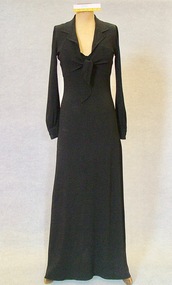
... Evening dress and jacket...A two piece ensemble consisting of long evening dress (.1) and matching jacket (.2), cropped jacket of black acetate. ...jacket features a tie front and long buttoned sleeve. The full length dress is slim fitting with centre back zip, shoestring straps and shaped bust with ruched centre front. Evening ...This item is part of the Di Reidie collection. Diane Reidie was a much loved volunteer and President of Brighton Historical Society from 1999 until 2016. Originally from New Zealand, Di and her family lived in Male Street, Brighton for many years. A vibrant and energetic person with a zest for life and a gift for bringing people together, Di was a friend to many in the Bayside community and active in local community organisations. Her tireless work as President of BHS saw her named Bayside Citizen of the Year in 2008. As a seller and collector of vintage clothing, she was passionate about fashion history; one of her many enduring contributions to BHS was her extensive work in preserving, developing and promoting the Society's costume collection. In 2018-19, Di donated more than one hundred items from her personal vintage clothing collection to the Society. The collection, which includes clothing, hats, handbags and shoes from local and international designers, is representative of Di's wide-ranging interests, colourful personality, creativity, humour and love of fashion and travel. Di purchased this two piece ensemble from the influential fashion boutique "The House of Merivale and Mr John" to wear to a performance of "The Sleeping Beauty" by London Festival Ballet, featuring Rudolph Nureyev at the Palais Theatre in St Kilda in May 1975.A two piece ensemble consisting of long evening dress (.1) and matching jacket (.2), cropped jacket of black acetate. The jacket features a tie front and long buttoned sleeve. The full length dress is slim fitting with centre back zip, shoestring straps and shaped bust with ruched centre front."Mandamatilda", "Dry Clean Only, SSWdi reidie, 1970s, house of merivale, manda matilda -
 Wangaratta RSL Sub Branch
Uniform - Army Mess Dress, 1967
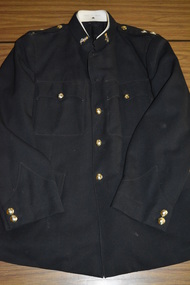
... Army mess dress is the formal military evening dress worn by Army officers and senior non-commissioned officers in their respective messes or at other formal occasions. Tailor made item belonging to Lieutenant Leonard V. GREAVES 310387. Badges attached to jacket...Army mess dress is the formal military evening dress worn by Army officers and senior non-commissioned officers in their respective messes or at other formal occasions. Tailor made item belonging to Lieutenant Leonard V. GREAVES 310387. Badges attached to jacket ...Army mess dress is the formal military evening dress worn by Army officers and senior non-commissioned officers in their respective messes or at other formal occasions. Tailor made item belonging to Lieutenant Leonard V. GREAVES 310387. Badges attached to jacket collar indicate GREAVES served with the Royal Australian Electrical and Mechanical Engineers (RAEME). This uniform serves as an example of the military dress worn by the Royal Australian Electrical and Mechanical Engineer during the late sixties.The Royal Corps of Australian Electrical and Mechanical Engineers (RAEME) is a corps of the Australian Army that has responsibility for the maintenance and recovery of all Army electrical and mechanical equipment. RAEME has members from both the Australian Regular Army and the Army Reserve. Prior to being given the title of 'Royal', the Australian Electrical and Mechanical Engineers (AEME) were raised on 1 December 1942. Some 64 years later, on 1 December 2006, the last independent RAEME Workshop was disbanded. RAEME soldiers continue in their role to provide support through attachment to other units in Tech Support Troops, Sections or Platoons.Two piece dark blue/black material suit consisting of long pants with red stripe and jacket with metal buttons and two badges attached to collaraustralian army mess dress, raeme -
 Stawell Historical Society Inc
Clothing, Satin Lace Jacket from Huttley Martin Collection
... Evening Wear. Balls Embroidered Lace Satin Jacket, with press studs to close front. ...Evening Wear. BallsEmbroidered Lace Satin Jacket, with press studs to close front. Scalloped bottom Edge. Circa 1920's -
 Kew Historical Society Inc
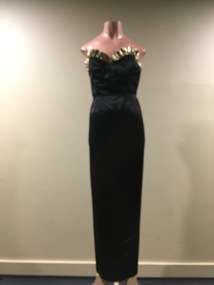
Clothing - Evening Dress & Jacket, Smaragd of Melbourne, 1965-75
... Evening Dress & Jacket...Black strapless satin evening dress with a ruched gold neckine. The outfit includes a fitted long sleeved black jacket....Clothing Evening Dress & Jacket Smaragd of Melbourne ...The Fashion & Design collection of the Kew Historical Society includes examples of women’s, men’s, children’s and infants’ clothing from the 18th, 19th and 20th centuries. Items in the collection were largely produced for, or purchased by women in Melbourne, and includes examples of outerwear, protective wear, nightwear, underwear and costume accessories.Black strapless satin evening dress with a ruched gold neckine. The outfit includes a fitted long sleeved black jacket.Label: SMARAGD EXCLUSIVE OF MELBOURNE. SIZE 12fashion - australia - melbourne, smaragd of melbourne, women's clothing, evening dresses, fashion design, clothing -- 1970s -
 Kew Historical Society Inc
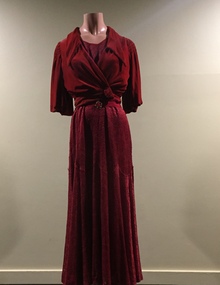
Clothing - Red Lace Evening Dress, & Matching Red Velvet Jacket, 1930s
... Red Lace Evening Dress, & Matching Red Velvet Jacket...Long burgundy machine-made lace evening dress with a separate red underslip. The dress is currently paired with a red velvet jacket and belt which it is believed was part of the original donation by Teresa Mayer....The dress is currently paired with a red velvet jacket and belt which it is believed was part of the original donation by Teresa Mayer. Clothing Red Lace Evening Dress, & Matching Red Velvet Jacket ...The Fashion & Design collection of the Kew Historical Society includes examples of women’s, men’s, children’s and infants’ clothing from the 18th, 19th and 20th centuries. Items in the collection were largely produced for, or purchased by women in Melbourne, and includes examples of outerwear, protective wear, nightwear, underwear and costume accessories.This 1930s dress and jacket is one of a number of items donated to the Fashion Collection by Teresa Mayer.Long burgundy machine-made lace evening dress with a separate red underslip. The dress is currently paired with a red velvet jacket and belt which it is believed was part of the original donation by Teresa Mayer.evening dresses, australian fashion - 1930s, women's clothing, evening wear, evening ensembles -
 Kew Historical Society Inc
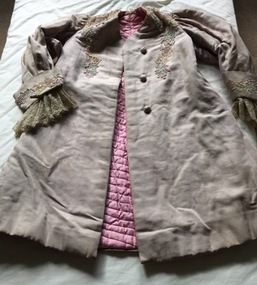
Clothing - Silk & Guipure Lace Evening Coat with Quilted Pink Silk Lining, 1920s
... jacket has a high neck. It is closed using three embroidered fabric buttons at the front Clothing Silk & Guipure Lace Evening Coat with Quilted Pink Silk Lining ...An item forming part of a collection of costumes, photographs and documents relating to the Weir family who lived in a mansion, originally named Illapa, at 84 Princess Street, Kew, from c.1917 to 1950. This historically significant collection includes items relating to both George Weir (1866-1937), his wife Edith Mary Weir (1867-1948) and their children. George Weir attained national prominence in the mining industry, becoming General Manager of the North Broken Hill Silver Mining Company in 1903 (later renamed North Broken Hill Mining Company 1905-12, and North Broken Hill Ltd 1912-1988), and subsequently President of the Mine Owners Association. He was to remain General Manager of North Broken Hill Ltd until his retirement in 1926.This garment is part of a collection of women’s clothing, owned and worn by Edith Mary Weir (nee Betteridge) - born in Clare, South Australia 1867, died Kew 1948 - and also by her daughter. The garments date from the 1880s to the 1930s. The collection includes day dresses, evening dresses, evening coats, capes, and undergarments. As the wife and daughter of a mine manager, the collection includes representative examples of clothing worn by upper middle class Australian women in domestic circumstances, and at social and civic events. A number of the costumes from the 1920s to the 1930s are of a particularly fine quality, being both rare, representative and intact examples of Australian fashion of the period. The garments in the Weir Collection were donated to the Kew Historical Society by a granddaughter of Edith Weir in 2017.Beige silk theatre or opera jacket with multi-coloured guipure lace at the neck, on the front bordering the opening, and on the cuffs. The long sleeves have extensive old lace extending beyond the wide cuffs. The inside is lined with quilted pink silk, which has darker silk panels at the front. The jacket has a high neck. It is closed using three embroidered fabric buttons at the frontedith mary weir (nee betteridge), 84 princess street - kew, australian fashion, women's clothing, costumes, coats -
 Whitehorse Historical Society Inc.
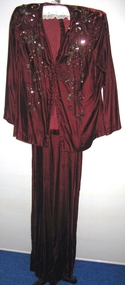
Clothing - Dress and Jacket
... Evening dress, burgundy velvet, 1950s. Shoulder straps, A-Line design, 30cm zip down back. Matching jacket, long sleeves, sixteen self covered buttons and loops down the front. ...costume female Evening dress, burgundy velvet, 1950s. Shoulder straps, A-Line design, 30cm zip down back. Matching jacket, long sleeves, sixteen self covered buttons and loops down the front. ...Evening dress, burgundy velvet, 1950s. Shoulder straps, A-Line design, 30cm zip down back. Matching jacket, long sleeves, sixteen self covered buttons and loops down the front. Sequin design pattern down the front of the jacket and over the shoulders.costume, female -
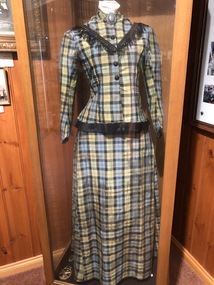 Mont De Lancey
Skirt and Jacket, Circa 1890
... Thomas Quayle in 1890 Evening dresses Silk tartan (green, blue, red and black) skirt and jacket, with black fringe yoke. ...Worn by Mrs. Thomas Quayle in 1890Silk tartan (green, blue, red and black) skirt and jacket, with black fringe yoke. Satin peplum and fully lined, with black buttons down the front. Oval silver metal brooch with filigree work, worn at the neckline. evening dresses
