
Showing 18 items matching "eye diseases"
-
 Alfred Hospital Nurses League - Nursing History Collection
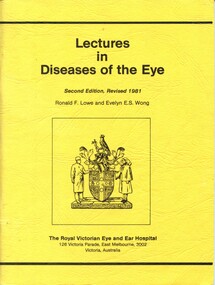
Book - Illustrated textbook, Ronald Lowe 1913-1988 et al, Lectures in diseases of the eye, 1981
... ...eye diseases...First edition published in 1958, second edition first published 1979 ,designed as a teaching resource for the Royal Victorian Eye and Ear Hospital's clinical program Insight into management of eye disease nursing study and teaching opthamology eye diseases opthalmic nursing eye anatomy Book provides an overview of the anatomy of the eyeball, ocular disorders, diagnostic techniques, eye diseases, trauma and pharmacology At bottom right of inside front cover is a coloured donation sticker: the AHNL badge, under which are printed the words 'This book was donated to /AHNL Inc-Nursing Archives by' Cherie Neilson/ (nee Titcombe) /Grad 1976. 28/11/18. ...Book provides an overview of the anatomy of the eyeball, ocular disorders, diagnostic techniques, eye diseases, trauma and pharmacologyIllustrated textbook with yellow binding. Black print on front cover details title, authors, and publisher, and the coat of arms of The Royal Victorian Eye and Ear Hospitalnon-fictionBook provides an overview of the anatomy of the eyeball, ocular disorders, diagnostic techniques, eye diseases, trauma and pharmacologynursing study and teaching, opthamology, eye diseases, opthalmic nursing, eye anatomy -
 Alfred Hospital Nurses League - Nursing History Collection
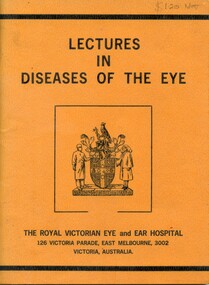
Book - Illustrated textbook, The Royal Victorian Eye and Ear Hospital et al, Lectures in diseases of the eye, 1975
... ...eye diseases...First edition published in 1958, second edition first published 1979 ,designed as a teaching resource for the Royal Victorian Eye and Ear Hospital's clinical program Insight into management of eye disease nursing study and teaching opthamology eye diseases opthalmic nursing eye anatomy Book provides an overview of the anatomy of the eyeball, ocular disorders, diagnostic techniques, eye diseases, trauma and pharmacology Handwritten on front cover $1.20 NETT [pencil]. ...Book provides an overview of the anatomy of the eyeball, ocular disorders, diagnostic techniques, eye diseases, trauma and pharmacologyStapled illustrated textbook with orange binding. Black print on front cover details title, publisher, and the coat of arms of The Royal Victorian Eye and Ear Hospital. Book has been covered with a cclear plastic filmnon-fictionBook provides an overview of the anatomy of the eyeball, ocular disorders, diagnostic techniques, eye diseases, trauma and pharmacologynursing study and teaching, opthamology, eye diseases, opthalmic nursing, eye anatomy -
 The Cyril Kett Optometry Museum
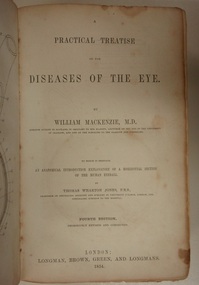
Book, A practical treatise on the diseases of the eye, 1854 (exact)
... eye...ocular anatomy...ocular disease...Eye Infirmary. This fourth edition appeared just after Helmholtz's invention of the ophthalmoscope, but Mackenzie did not at this stage have much understanding of the internal diseases of the eye. ...There are 27 chapters on eye disease. Chapter 24 is on refractive errors and presbyopia....There are 27 chapters on eye disease. Chapter 24 is on refractive errors and presbyopia. ...This is the 1854 fourth edition of a book on diseases of the eye by William MacKenzie (1791-1868) first published in 1830. William MacKenzie was surgeon oculist in Scotland to Her Majesty (Queen Victoria), lecturer in the University of Glasgow and a surgeon in the Glasgow Eye Infirmary. This fourth edition appeared just after Helmholtz's invention of the ophthalmoscope, but Mackenzie did not at this stage have much understanding of the internal diseases of the eye. Nor did he properly understand refractive errors which were soon to be elucidated by the work of Donders. MacKenzie did however recognise the hardness of the eye as being an essential sign of glaucoma.This book is significant historically as it shows contemporary understanding of eye disease in the early nineteenth century. It is not rare as copies still turn up at book markets and also are held in other Australian institutions.This book, bound in full calf leather (probably later 19th Century) with 1107 pages including an index and is followed by a publisher's catalogue. It is the 1854 fourth edition of William MacKenzie's 'A practical treatise on the diseases of the eye' first published in 1830. It has a long (32 pages) introductory section on the anatomy of the eye by Thomas Wharton Jones, FRS. There are 27 chapters on eye disease. Chapter 24 is on refractive errors and presbyopia.eye, ocular anatomy, ocular disease -
 Vision Australia
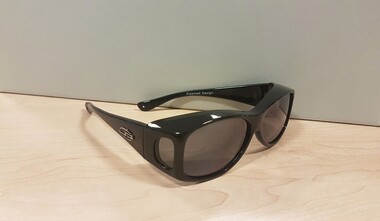
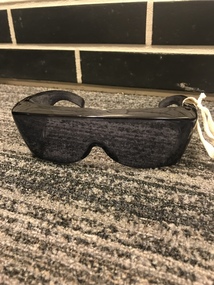
Functional object - Object, Jonathon Paul Fitovers, Fitover glasses, 199
... This wrap-around style blocks light from above and both sides which can benefit, alleviate and prevent many symptoms of common eye diseases by providing 100% UVA/UBA protection from harmful UV rays. ...This wrap-around style blocks light from above and both sides which can benefit, alleviate and prevent many symptoms of common eye diseases by providing 100% UVA/UBA protection from harmful UV rays. ...The Fitover sunglasses are designed to be worn directly over your prescription glasses. This wrap-around style blocks light from above and both sides which can benefit, alleviate and prevent many symptoms of common eye diseases by providing 100% UVA/UBA protection from harmful UV rays. 1 pair of black fitover glassesassistive devices, equipment -
 Vision Australia
Audio - Sound recording, Interview with Charlie Bradley
... Recorded as part of 'The Years Between: an oral history of the RVIB 1866-1991'. In 1918 an eye disease took Charlie Bradley's eyesight, ten years later he was part of the Royals club - the first RVIB cricket team - and went on to become one of the most well liked players of the game....Recorded as part of 'The Years Between: an oral history of the RVIB 1866-1991'. In 1918 an eye disease took Charlie Bradley's eyesight, ten years later he was part of the Royals club - the first RVIB cricket team - and went on to become one of the most well liked players of the game. ...Oral history interview of Charlie Bradley by Alan Nuske. Recorded as part of 'The Years Between: an oral history of the RVIB 1866-1991'. In 1918 an eye disease took Charlie Bradley's eyesight, ten years later he was part of the Royals club - the first RVIB cricket team - and went on to become one of the most well liked players of the game.1 audio recording of an interview with Charlie Bradleyroyal victorian institute for the blind, allan nuske, oral history, charlie bradley -
 Vision Australia
Functional object - Object, Fitover glasses with case, 199
... This wrap-around style blocks light from above and both sides which can benefit, alleviate and prevent many symptoms of common eye diseases by providing 100% UVA/UBA protection from harmful UV rays. ...This wrap-around style blocks light from above and both sides which can benefit, alleviate and prevent many symptoms of common eye diseases by providing 100% UVA/UBA protection from harmful UV rays. ...The Fitover sunglasses are designed to be worn directly over your prescription glasses. This wrap-around style blocks light from above and both sides which can benefit, alleviate and prevent many symptoms of common eye diseases by providing 100% UVA/UBA protection from harmful UV rays. This pair and case is labeled with the RSB logo and 'Royal Society for the Blind'.1 pair of black fitover glasses with soft caseOn both glasses and case: RSB The Royal Society for the Blind (with logo)assistive devices, royal society for the blind -
 Flagstaff Hill Maritime Museum and Village
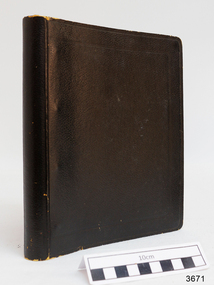
Journal - Notebook, W.R. Angus (Dr. William Roy Angus), 1931
... ...eye disease notes...Angus, 214 Koroit St, Warrnambool, 1931 (2) Typed notes stapled inside a thick, brown paper cover, containing 5 pages, titled “The Eye in General Diseases”. This notebook was donated to Flagstaff Hill Maritime Village by the family of Doctor William Roy Angus, Surgeon and Oculist. ...Angus, 214 Koroit St, Warrnambool, 1931 (2) Typed notes stapled inside a thick, brown paper cover, containing 5 pages, titled “The Eye in General Diseases”....Angus, 214 Koroit St, Warrnambool, 1931 (2) Typed notes stapled inside a thick, brown paper cover, containing 5 pages, titled “The Eye in General Diseases”. Journal Notebook W.R. Angus (Dr. ...This black vinyl binder contains 2 sets of teaching/lecture notes personally written by Dr. W.R. Angus. (1) hand written and typed notes, hole punched and clipped into the rings, titled “FIRST AID LECTURES FOR RED CROSS EMERGENCY SERVICES COURSES” and is signed by Dr. Angus, 214 Koroit St, Warrnambool, 1931 (2) Typed notes stapled inside a thick, brown paper cover, containing 5 pages, titled “The Eye in General Diseases”. This notebook was donated to Flagstaff Hill Maritime Village by the family of Doctor William Roy Angus, Surgeon and Oculist. It is part of the “W.R. Angus Collection” that includes historical medical equipment, surgical instruments and material once belonging to Dr Edward Ryan and Dr Thomas Francis Ryan, (both of Nhill, Victoria) as well as Dr Angus’ own belongings. The Collection’s history spans the medical practices of the two Doctors Ryan, from 1885-1926 plus that of Dr Angus, up until 1969. ABOUT THE “W.R.ANGUS COLLECTION” Doctor William Roy Angus M.B., B.S., Adel., 1923, F.R.C.S. Edin.,1928 (also known as Dr Roy Angus) was born in Murrumbeena, Victoria in 1901 and lived until 1970. He qualified as a doctor in 1923 at University of Adelaide, was Resident Medical Officer at the Royal Adelaide Hospital in 1924 and for a period was house surgeon to Sir (then Mr.) Henry Simpson Newland. Dr Angus was briefly an Assistant to Dr Riddell of Kapunda, then commenced private practice at Curramulka, Yorke Peninsula, SA, where he was physician, surgeon and chemist. In 1926, he was appointed as new Medical Assistant to Dr Thomas Francis Ryan (T.F. Ryan, or Tom), in Nhill, Victoria, where his experiences included radiology and pharmacy. In 1927 he was Acting House Surgeon in Dr Tom Ryan’s absence. Dr Angus had become engaged to Gladys Forsyth and they decided he would take time to further his studies overseas in the UK in 1927. He studied at London University College Hospital and at Edinburgh Royal Infirmary and in 1928, was awarded FRCS (Fellow from the Royal College of Surgeons), Edinburgh. He worked his passage back to Australia as a Ship’s Surgeon on the on the Australian Commonwealth Line’s T.S.S. Largs Bay. Dr Angus married Gladys in 1929, in Ballarat. (They went on to have one son (Graham 1932, born in SA) and two daughters (Helen (died 12/07/1996) and Berenice (Berry), both born at Mira, Nhill ) Dr Angus was a ‘flying doctor’ for the A.I.M. (Australian Inland Ministry) Aerial Medical Service in 1928 . The organisation began in South Australia through the Presbyterian Church in that year, with its first station being in the remote town of Oodnadatta, where Dr Angus was stationed. He was locum tenens there on North-South Railway at 21 Mile Camp. He took up this ‘flying doctor’ position in response to a call from Dr John Flynn; the organisation was later known as the Flying Doctor Service, then the Royal Flying Doctor Service. A lot of his work during this time involved dental surgery also. Between 1928-1932 he was surgeon at the Curramulka Hospital, Yorke Peninsula, South Australia. In 1933 Dr Angus returned to Nhill where he’d previously worked as Medical Assistant and purchased a share of the Nelson Street practice and Mira hospital from Dr Les Middleton one of the Middleton Brothers, the current owners of what was once Dr Tom Ryan’s practice. Dr L Middleton was House Surgeon to the Nhill Hospital 1926-1933, when he resigned. [Dr Tom Ryan’s practice had originally belonged to his older brother Dr Edward Ryan, who came to Nhill in 1885. Dr Edward saw patients at his rooms, firstly in Victoria Street and in 1886 in Nelson Street, until 1901. The Nelson Street practice also had a 2 bed ward, called Mira Private Hospital ). Dr Edward Ryan was House Surgeon at the Nhill Hospital 1884-1902 . He also had occasions where he successfully performed veterinary surgery for the local farmers too. Dr Tom Ryan then purchased the practice from his brother in 1901. Both Dr Edward and Dr Tom Ryan work as surgeons included eye surgery. Dr Tom Ryan performed many of his operations in the Mira private hospital on his premises. He too was House Surgeon at the Nhill Hospital 1902-1926. Dr Tom Ryan had one of the only two pieces of radiology equipment in Victoria during his practicing years – The Royal Melbourne Hospital had the other one. Over the years Dr Tom Ryan gradually set up what was effectively a training school for country general-practitioner-surgeons. Each patient was carefully examined, including using the X-ray machine, and any surgery was discussed and planned with Dr Ryan’s assistants several days in advance. Dr Angus gained experience in using the X-ray machine there during his time as assistant to Dr Ryan. Dr Tom Ryan moved from Nhill in 1926. He became a Fellow of the Royal Australasian College of Surgeons in 1927, soon after its formation, a rare accolade for a doctor outside any of the major cities. He remained a bachelor and died suddenly on 7th Dec 1955, aged 91, at his home in Ararat. Scholarships and prizes are still awarded to medical students in the honour of Dr T.F. Ryan and his father, Dr Michael Ryan, and brother, John Patrick Ryan. ] When Dr Angus bought into the Nelson Street premises in Nhill he was also appointed as the Nhill Hospital’s Honorary House Surgeon 1933-1938. His practitioner’s plate from his Nhill surgery states “HOURS Daily, except Tuesdays, Fridays and Saturday afternoons, 9-10am, 2-4pm, 7-8pm. Sundays by appointment”. This plate is now mounted on the doorway to the Port Medical Office at Flagstaff Hill Maritime Village, Warrnambool. Dr Edward Ryan and Dr Tom Ryan had an extensive collection of historical medical equipment and materials spanning 1884-1926 and when Dr Angus took up practice in their old premises he obtained this collection, a large part of which is now on display at the Port Medical Office at Flagstaff Hill Maritime Village in Warrnambool. During his time in Nhill Dr Angus was involved in the merging of the Mira Hospital and Nhill Public Hospital into one public hospital and the property titles passed on to Nhill Hospital in 1939. In 1939 Dr Angus and his family moved to Warrnambool where he purchased “Birchwood,” the 1852 home and medical practice of Dr John Hunter Henderson, at 214 Koroit Street. (This property was sold in1965 to the State Government and is now the site of the Warrnambool Police Station. ). The Angus family was able to afford gardeners, cooks and maids; their home was a popular place for visiting dignitaries to stay whilst visiting Warrnambool. Dr Angus had his own silk worm farm at home in a Mulberry tree. His young daughter used his centrifuge for spinning the silk. Dr Angus was appointed on a part-time basis as Port Medical Officer (Health Officer) in Warrnambool and held this position until the 1940’s when the government no longer required the service of a Port Medical Officer in Warrnambool; he was thus Warrnambool’s last serving Port Medical Officer. (The duties of a Port Medical Officer were outlined by the Colonial Secretary on 21st June, 1839 under the terms of the Quarantine Act. Masters of immigrant ships arriving in port reported incidents of diseases, illness and death and the Port Medical Officer made a decision on whether the ship required Quarantine and for how long, in this way preventing contagious illness from spreading from new immigrants to the residents already in the colony.) Dr Angus was a member of the Australian Medical Association, for 35 years and surgeon at the Warrnambool Base Hospital 1939-1942, He served as a Surgeon Captain during WWII 1941-45, in Ballarat, Victoria, and in Bonegilla, N.S.W., completing his service just before the end of the war due to suffering from a heart attack. During his convalescence he carved an intricate and ‘most artistic’ chess set from the material that dentures were made from. He then studied ophthalmology at the Royal Melbourne Eye and Ear Hospital and created cosmetically superior artificial eyes by pioneering using the intrascleral cartilage. Angus received accolades from the Ophthalmological Society of Australasia for this work. He returned to Warrnambool to commence practice as an ophthalmologist, pioneering in artificial eye improvements. He was Honorary Consultant Ophthalmologist to Warrnambool Base Hospital for 31 years. He made monthly visits to Portland as a visiting surgeon, to perform eye surgery. He represented the Victorian South-West subdivision of the Australian Medical Association as its secretary between 1949 and 1956 and as chairman from 1956 to 1958. In 1968 Dr Angus was elected member of Spain’s Barraquer Institute of Barcelona after his research work in Intrasclearal cartilage grafting, becoming one of the few Australian ophthalmologists to receive this honour, and in the following year presented his final paper on Living Intrasclearal Cartilage Implants at the Inaugural Meeting of the Australian College of Ophthalmologists in Melbourne In his personal life Dr Angus was a Presbyterian and treated Sunday as a Sabbath, a day of rest. He would visit 3 or 4 country patients on a Sunday, taking his children along ‘for the ride’ and to visit with him. Sunday evenings he would play the pianola and sing Scottish songs to his family. One of Dr Angus’ patients was Margaret MacKenzie, author of a book on local shipwrecks that she’d seen as an eye witness from the late 1880’s in Peterborough, Victoria. In the early 1950’s Dr Angus, painted a picture of a shipwreck for the cover jacket of Margaret’s book, Shipwrecks and More Shipwrecks. She was blind in later life and her daughter wrote the actual book for her. Dr Angus and his wife Gladys were very involved in Warrnambool’s society with a strong interest in civic affairs. Their interests included organisations such as Red Cross, Rostrum, Warrnambool and District Historical Society (founding members), Wine and Food Society, Steering Committee for Tertiary Education in Warrnambool, Local National Trust, Good Neighbour Council, Housing Commission Advisory Board, United Services Institute, Legion of Ex-Servicemen, Olympic Pool Committee, Food for Britain Organisation, Warrnambool Hospital, Anti-Cancer Council, Boys’ Club, Charitable Council, National Fitness Council and Air Raid Precautions Group. He was also a member of the Steam Preservation Society and derived much pleasure from a steam traction engine on his farm. He had an interest in people and the community He and his wife Gladys were both involved in the creation of Flagstaff Hill, including the layout of the gardens. After his death (28th March 1970) his family requested his practitioner’s plate, medical instruments and some personal belongings be displayed in the Port Medical Office surgery at Flagstaff Hill Maritime Village, and be called the “W. R. Angus Collection”. The W.R. Angus Collection is significant for still being located at the site it is connected with, Doctor Angus being the last Port Medical Officer in Warrnambool. The collection of medical instruments and other equipment is culturally significant, being an historical example of medicine from late 19th to mid-20th century. Dr Angus assisted Dr Tom Ryan, a pioneer in the use of X-rays and in ocular surgery. Notebook, black vinyl covered 4-ring binder, containing lecture notes composed by Dr. W.R. Angus. Binder contains 2 sets of notes. (1) hand written and typed notes, hole punched and clipped into the rings, titled “FIRST AID LECTURES FOR RED CROSS EMERGENCY SERVICES COURSES” and is signed by Dr. Angus, 214 Koroit St, Warrnambool, 1931 (2) Typed notes stapled inside a thick, brown paper cover, containing 5 pages, titled “The Eye in General Diseases”.flagstaff hill, warrnambool, shipwrecked coast, flagstaff hill maritime museum, maritime museum, shipwreck coast, flagstaff hill maritime village, great ocean road, dr w r angus, lecture notes, teaching notes, first aid notes, eye disease notes, medical history, medical education -
 Northern District School of Nursing. Managed by Bendigo Historical Society Inc.
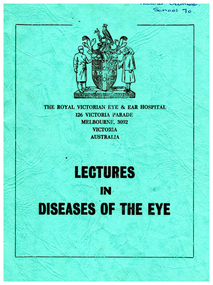
Book - Northern District School of Nursing Graduates Association - Lectures in Diseases of the Eye, Revised 1968
... lectures in disease of the eye...Northern District School of Nursing Graduates Association - Lectures in Diseases of the Eye Revised 1968 39 pages, owned by Heather Gamble School 70 This item contains the following documents: 3793.1a Lectures in Diseases of the Eye Revised 1968 3793.1b Front Cover and Contents Page This document is a comprehensive educational guide for nurses at The Royal Victorian Eye and Ear Hospital, focusing on eye anatomy, diseases, examination techniques, and ophthalmic nursing practices. ...Nurse Training Lister House lectures in disease of the eye Northern District School of Nursing Graduates Association - Lectures in Diseases of the Eye Revised 1968 39 pages, owned by Heather Gamble School 70 This item contains the following documents: 3793.1a Lectures in Diseases of the Eye Revised 1968 3793.1b Front Cover and Contents Page This document is a comprehensive educational guide for nurses at The Royal Victorian Eye and Ear Hospital, focusing on eye anatomy, diseases, examination techniques, and ophthalmic nursing practices. ...The Northern District School of Nursing in Victoria, Australia Graduates Association: History of the School Managed by a committee including hospital administrators, medical professionals, and nursing leaders from several regional hospitals. Associated with major hospitals in the Northern District, including Bendigo Base, Mildura Base, Castlemaine, Echuca, Swan Hill, St. Arnaud, and Kyneton District Hospitals. Provide high-quality theoretical and practical nursing training. Raise the standard of nursing education in the region. Maintain the highest principles of nursing practice. Applicants must be at least 17 years old and hold a Proficiency Certificate or higher educational qualification. Application involves submitting forms, certificates, an interview, an aptitude test, and a medical examination. A three-month probationary period follows initial acceptance. Preliminary Training School: Four-week introductory course covering basic nursing, anatomy, hygiene, and practical skills. Practical experience in various hospital departments, guided by senior staff. Study Block Plan: Includes several blocks of theoretical and practical instruction throughout the three-year program. Regular school exams and two state exams (First Professional and Final State) are required for progression and graduation. Nurses work a 40-hour week with at least one or two days off per week and three weeks of annual leave. Accommodation is provided in comfortable hostels with good facilities. Uniforms are supplied free; nurses provide their own shoes and stockings. Salaries and allowances are regulated, with deductions for board and free medical care. Additional Information Post-Graduate Opportunities. Senior positions require further experience and additional certificates (e.g., Midwifery, Infant Welfare).Diploma courses available in administration, teaching, and specialized nursing fields. Bursaries are available for advanced study.Career Prospects: Graduates can pursue roles in administration, teaching, ward and departmental leadership, district and visiting nursing, industrial and school nursing, and more. Opportunities existed both within hospitals and in community or specialized settings.FAQs and Practical Details. Minimal training costs (mainly exam fees and personal items).Living out allowances and travel expenses are covered. Four training intakes per year; waiting periods are short if qualifications are met.Northern District School of Nursing Graduates Association - Lectures in Diseases of the Eye Revised 1968 39 pages, owned by Heather Gamble School 70 This item contains the following documents: 3793.1a Lectures in Diseases of the Eye Revised 1968 3793.1b Front Cover and Contents Page This document is a comprehensive educational guide for nurses at The Royal Victorian Eye and Ear Hospital, focusing on eye anatomy, diseases, examination techniques, and ophthalmic nursing practices. Detailed coverage of the orbit, eyeball, fibrous coat, uvea, retina, lids, lacrimal apparatus, and conjunctiva. Explains the function of extra-ocular muscles and the mechanics of vision. Describes diseases affecting the orbit, cornea, sclera, uvea, retina, lids, lacrimal apparatus, and conjunctiva. Covers errors in the optical properties of the eye and their corrections.Includes information on glaucoma and diseases of the crystalline lens. Outlines examination techniques for various eye structures.Provides tests for retinal function and assessment of binocular vision.Injuries and Surgical CareDiscusses types of eye injuries, including contusions, penetrating wounds, and burns. Details pre-operative, operative, and post-operative care for intra-ocular operations. Offers guidance on ophthalmic nursing techniques.Lists pharmaceuticals, accessories, instruments, and equipment used in eye surgery.nurse training, lister house, lectures in disease of the eye -
 Federation University Historical Collection
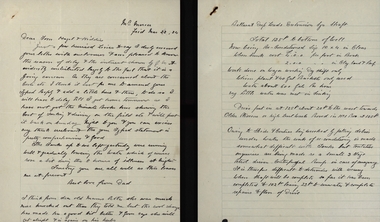
Letter, Letters from Richard Squire to his son Tom 1934
... Eye Specialist...Reid...Mullock Bank...Jack Squire...Herman...Peter's Legal Inc. Ballarat...Freddie Reid...J.R. Whipp...A.B. Reid...Grenville...Leigh River Plan...Johnstone's...Premier Petrol Coy...Chandler's...Ballarat Deep Leads Extension...Harwood & Pincott...A. Rice...Lillas...L. E. Walker...Secretary for Mines...Pipeclay...Sandstone...Mr Saville...Weymouth & Carroll...Suction Pipe...Valves...Financiers...Gold Mines of Australia...Mr Hanley Hunter...Sadowa Coy...Kerang Shareholder...Buninyong...Stanley Hunter...Len...Fran...Max...Dr Jones...Honeycomb Rock...Booth...Sandy McNab...Emily Shaw...John Cock...Ross Creek...Mitchell...Rowe...Neil Cameron...Walker...Kidney Disease...Eye Specialist Reid Mullock Bank Jack Squire Herman Peter's Legal Inc. Ballarat Freddie Reid J.R. Whipp A.B. Reid Grenville Leigh River Plan Johnstone's Premier Petrol Coy Chandler's Ballarat Deep Leads Extension Harwood & Pincott A. Rice Lillas L. E. Walker Secretary for Mines Pipeclay Sandstone Mr Saville Weymouth & Carroll Suction Pipe Valves Financiers Gold Mines of Australia Mr Hanley Hunter Sadowa Coy Kerang Shareholder Buninyong Stanley Hunter Len Fran Max Dr Jones Honeycomb Rock Booth Sandy McNab Emily Shaw John Cock Ross Creek Mitchell Rowe Neil Cameron Walker Kidney Disease Holst Nellie Ronaldson's Ronaldson & Tippett Brokers Investors Lockett Miller & Co Wellesly John Sharpe Elizabeht Ellen Old Lawaluk Mining Handwritten letters from Richard Squire to his son Tom and Family reporting happening at the mine Letters from Richard Squire to his son Tom 1934 Letter ...In 1905 Richard Squire was manager of the West Berry Consols at Allendale, and developed an improved system of mine ventilation, which was supported in "The Age."[4] He was successful in combating and remedying the gas and ventilation troubles of the Deep Mines of Creswick and Allendale Districts after all had failed.[5] MINE MANAGERS’ ASSOCIATION. Ballarat Branch. ... Mr R. B. Squire, manager of the West Berry Consols, at Allendale, submitted a paper detailing what he had done tor the betterment of ventilation in the alluvial mines of Smeaton and Mary borough districts- Members gave Mr Squire every credit for the results that he claimed to have effected; the adoption of his ideas had testified to their value to mine-owners. It was painted out, however, that for want of a thorough debate of the subject with experienced men the author had unwittingly included some general statements that required modifying in some points and extending in others, in justice to other workers among the earlier and the present day managers of mines. It was decided to invite the author to meet a sub-committee on this subject![6]Handwritten letters from Richard Squire to his son Tom and Family reporting happening at the mine richard squire, tom squire, engine trouble, basil, f.l. smythe broker, trembath, w. ryall, mt mercer, flu, plant, skids, pump, c. hayes, illness, poppet, carburetor, mum, ned, shaft, balance weight, hazel squire, pearson, pulleys, syndicate, goon, len hopkins, suction, dunstown, lease, jim squire, bannockburn, nina, albert, mrs trenery, connie, jay, judy squire, cohuna, bladder attack, reports, estimates, dunstan & coy, jelbarts, barrett, flat fields, brown, gold estates, berry leads, parsley roots, share book, meredith, reef, pay sheet, colin, mr gibbs, l.r.g plan, banagwanth, mcnaughton bores, glenfine, allan, william thomas, john lynch, crawford, shelford, liz the car, trucks, chandlers, ballarat trustees, cameron, elaine, mrs read, clark, j. hayes, dunlop, dr lawrence, eye specialist, reid, mullock bank, jack squire, herman, peter's legal inc. ballarat, freddie reid, j.r. whipp, a.b. reid, grenville, leigh river plan, johnstone's, premier petrol coy, chandler's, ballarat deep leads extension, harwood & pincott, a. rice, lillas, l. e. walker, secretary for mines, pipeclay, sandstone, mr saville, weymouth & carroll, suction pipe, valves, financiers, gold mines of australia, mr hanley hunter, sadowa coy, kerang shareholder, buninyong, stanley hunter, len, fran, max, dr jones, honeycomb rock, booth, sandy mcnab, emily shaw, john cock, ross creek, mitchell, rowe, neil cameron, walker, kidney disease, holst, nellie, ronaldson's, ronaldson & tippett, brokers, investors, lockett, miller & co, wellesly, john sharpe, elizabeht ellen, old lawaluk, mining -
 Flagstaff Hill Maritime Museum and Village
Work on paper - Photograph with envelope, Dr. W. R. Angus Warrnambool & District Base Hospital, c1951
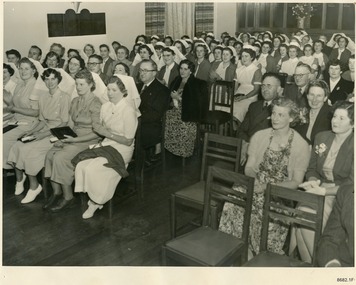
... Angus was Medical Officer to Diseases of the Eye, Ear, Nose and Throat. It is wondered if this building is the one used by the hospital and removed to 54 Banyan Street, Warrnambool for the use of Legacy? ...Angus was Medical Officer to Diseases of the Eye, Ear, Nose and Throat. It is wondered if this building is the one used by the hospital and removed to 54 Banyan Street, Warrnambool for the use of Legacy? ...This photograph is part of the “W.R. Angus Collection” that includes historical medical equipment, surgical instruments and material once belonging to Dr Edward Ryan and Dr Thomas Francis Ryan, (both of Nhill, Victoria) as well as Dr Angus’ own belongings. The Collection’s history spans the medical practices of the two Doctors Ryan, from 1885-1926 plus that of Dr Angus, up until 1969. This sepia photograph is from circa 1950s and came in an envelope with a postage mark commemorating the Australian Jubilee of 1901 and a 2-penny stamp with King George VI. The photo includes Dr. Angus in the second row wearing glasses, his wife Mrs. Angus seated behind in the third row. John Lindsay, Committee Member WDBH, is possibly in the third row on the right. It is probably Sister June H. Stewart, Matron, wearing glasses is seated behind Mrs. Angus. Mr. J. Taylor was Hon. Treasurer. All these names are inscribed on the back of the photograph. The envelope that the photo came is has a note “NURSES GRADUATION WARRNAMBOOL HOSPITAL ?1951/PHOTOGRAPH OF GRADS. The 1951 Report of the Warrnambool and District Base Hospital cites McMillian as a Committee Member, Mr. Taylor as Honorary Treasurer and Dr. Angus was Medical Officer to Diseases of the Eye, Ear, Nose and Throat. It is wondered if this building is the one used by the hospital and removed to 54 Banyan Street, Warrnambool for the use of Legacy? The W.R. Angus Collection is significant for still being located at the site it is connected with, Doctor Angus being the last Port Medical Officer in Warrnambool. The collection of medical instruments and other equipment is culturally significant, being an historical example of medicine from late 19th to mid-20th century. Dr Angus assisted Dr Tom Ryan, a pioneer in the use of X-rays and in ocular surgery.Sepia photograph of nurses and guests seated in rows at an official function. MR McMILLAN/MR J NED TAYLOR/MRS J TAYLOR/ SISTER STEWART/ DR W R ANGUS/MRS ANGUS/Ralph Illidge WARRNAMBOOL on the back of the photograph.flagstaff hill, warrnambool, maritime village, maritime museum, flagstaff hill maritime museum and village, shipwreck coast, great ocean road, dr. w.r. angus, dr. roy angus, warrnambool & district base hospital, nurses graduation, ralph illidge, 1951 warrnambool, jubilee year australia, 1901-1951, ophthalmology -
 The Cyril Kett Optometry Museum
Book, A treatise on the physiology and diseases of the eye containing a new mode of curing cataract, 1835 (exact)
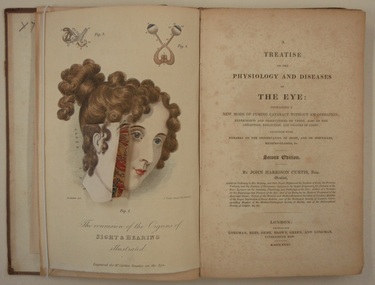
... This book is the 1835 second edition of John Harrison Curtis' 1833 'A Treatise on the Physiology and Diseases of the Eye, containing a new mode of curing cataract without an operation, experiments and observations on vision, also on the inflection, reflection and colours of light together with remarks on the preservation of sight, and on spectacles, reading glasses etc'. ...'A Treatise on the Physiology and the Diseases of the Eye' by J H Curtis is book of 1835 bound in its original boards, in very good condition, 230 x 140 mm, 242 pages, second edition. ... physiology cataract 'A Treatise on the Physiology and the Diseases of the Eye' by J H Curtis is book of 1835 bound in its original boards, in very good condition, 230 x 140 mm, 242 pages, second edition. ...This book is the 1835 second edition of John Harrison Curtis' 1833 'A Treatise on the Physiology and Diseases of the Eye, containing a new mode of curing cataract without an operation, experiments and observations on vision, also on the inflection, reflection and colours of light together with remarks on the preservation of sight, and on spectacles, reading glasses etc'. The title page describes J H Curtis (1778-1860) as an oculist and also as an expert on the ear. His knowledge of eye pathology and surgery was poor but this was typical of the medical profession until the middle of the 19th century. He was 'aurist in ordinary' to His Majesty and other members of the royal family and his hospital and teaching appointments had more to do with the ear rather than the eye. The last pages of the book list his other publications most of which concern the ear and the deaf. He was the first person, in 1803, to apply speaking tubes to assist the deaf. He established the Royal Ear Hospital in Soho, UK in 1816.This book is of historic significance as it shows contemporary understanding of ocular pathology in the early nineteenth century. It is quite rare as no other copies of the second edition are known in Australia.'A Treatise on the Physiology and the Diseases of the Eye' by J H Curtis is book of 1835 bound in its original boards, in very good condition, 230 x 140 mm, 242 pages, second edition. There is a coloured plate facing the title page with three figures featuring an ingenious lift up section of a woman's face to show the blood vessels and nerves underneath. There is a philosophical introduction, a chapter on ocular anatomy, two chapters on diseases and their treatment, one on the nature of light and one on the preservation of vision. Cataract is treated by withdrawal of blood from behind the ear and the application of an ointment to an induced blister on the neck, with potash applied to the cornea daily.optics, ocular anatomy, ocular disease, physiology, cataract -
 Royal Australian and New Zealand College of Obstetricians & Gynaecologists (RANZCOG)
Photograph - Reproduction photograph of Dr Lawson Tait, c.1891
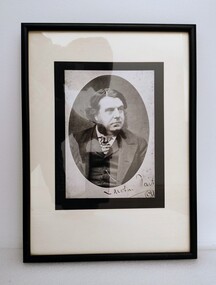
... diseases of the female reproductive system. Tait’s surgical techniques and advocacy not only aided in the development of hygiene in surgery, increasing patient survival, but also helped develop the field of gynecology, which contributed to a centralized focus on the health of the female reproductive system." (Arizona State University, Embryo Project Encyclopedia) Black and white reproduction of a portrait photograph. Photograph is of a man in a dark coloured three-piece suit, with a white shirt and striped tie. The man has mutton chop sideburns and long, dark hair, which is parted about his right eye ...Robert Lawson Tait (1845-1899) was a Scottish doctor and surgeon instrumental in the development of gynaecology as a field during the 19th century. Tait has been credited "with introducing a number of gynecologic surgeries, or surgeries related to women’s reproductive health. Those included procedures for treating abscesses, removing ovaries, and fallopian tubes, and treatment of the gallbladder." He also "argued for strict cleanliness during surgery as well as a more specific focus on performing surgeries to treat diseases of the female reproductive system. Tait’s surgical techniques and advocacy not only aided in the development of hygiene in surgery, increasing patient survival, but also helped develop the field of gynecology, which contributed to a centralized focus on the health of the female reproductive system." (Arizona State University, Embryo Project Encyclopedia)Black and white reproduction of a portrait photograph. Photograph is of a man in a dark coloured three-piece suit, with a white shirt and striped tie. The man has mutton chop sideburns and long, dark hair, which is parted about his right eye. The man is looking to camera right. The image is in an oval cutout on a white background. Handwritten reproduction of signature beneath the photograph reads 'Lawson Tait/1891'. The photograph is mounted in white card and housed in a black wooden frame. There is an old object label attached to the back of the object. A sticker noting the framer of the image (Jarman the Picture Framer) is attached to the back of the work at upper centre. A wire and two hooks have been attached to the back of the frame for hanging. -
 Alfred Hospital Nurses League - Nursing History Collection
Book - Illustrated book, Lyndsay Gardiner, The Eye and Ear: The Royal Victorian Eye and Ear Hospital centenary history, 1968
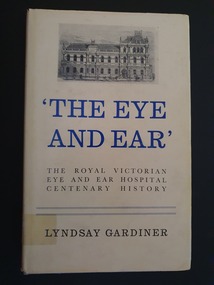
... Eye and Ear Hospital. In 1863 Dr Andrew Sexton Gray, started an institution for those suffering diseases of the eye and ear. ...History of the Royal Victorian Eye and Ear Hospital. In 1863 Dr Andrew Sexton Gray, started an institution for those suffering diseases of the eye and ear. Increased demand led to the formation of a charitable committee in 1866, and the establishment of Victoria's third public hospital. Several changes of location until the opening of the first building on the current site in 1871.Hardcover illustrated book pale blue binding, title and authors name in gold on spine. Cream dustjacket title and authors name on front cover and spine. Historical illustrations of the Eye and Ear Hospiital on front and back covernon-fictionHistory of the Royal Victorian Eye and Ear Hospital. In 1863 Dr Andrew Sexton Gray, started an institution for those suffering diseases of the eye and ear. Increased demand led to the formation of a charitable committee in 1866, and the establishment of Victoria's third public hospital. Several changes of location until the opening of the first building on the current site in 1871. royal victorian eye and ear hospital, ophthalmology-history, otolaryngology-history, hospitals-special history -
 Alfred Hospital Nurses League - Nursing History Collection
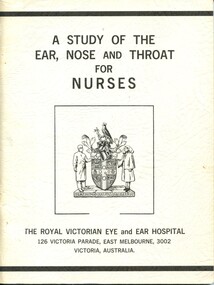
Book - Illustrated textbook, E Anne Miller et al, A study of the ear, nose and throat for nurses, 1981
... Contains guidelines specific to Royal Victorian Eye and Ear Hospital's medical and teaching practices during the late 20th century Insight into late 20th century nursing practice nursing study and teaching otolaryngology ENT nursing Historic manual covering topics such as ear, nasal and throat anatomy, related diseases, surgery and nursing practice At bottom right of inside front cover is a coloured donation sticker: the AHNL badge, under which are printed the words 'This book was donated to /AHNL Inc-Nursing Archives by' Cherie Neilson/ (nee Titcombe) /Grad 1976. 28/11/18. ...Historic manual covering topics such as ear, nasal and throat anatomy, related diseases, surgery and nursing practiceIllustrated stapled textbook with white binding. Front cover has black print detailing title and publisher, and the coat of arms of The Royal Victorian Eye and Ear Hospitalnon-fictionHistoric manual covering topics such as ear, nasal and throat anatomy, related diseases, surgery and nursing practicenursing study and teaching, otolaryngology, ent nursing -
 Alfred Hospital Nurses League - Nursing History Collection
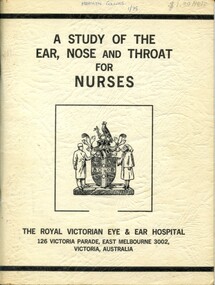
Book - Illustrated textbook, E Anne Miller et al, A study of the ear, nose and throat for nurses, 1973
... Contains guidelines specific to Royal Victorian Eye and Ear Hospital's medical and teaching practices during the late 20th century Insight into late 20th century nursing practice nursing study and teaching otolaryngology ENT nursing Historic manual covering topics such as ear, nasal and throat anatomy, related diseases, surgery and nursing practice Handwritten at top of front cover 'MERILYN COLLINS 1/75 [blue ink] $1.30 NETT [pencil] Illustrated textbook with white bonding. ...Historic manual covering topics such as ear, nasal and throat anatomy, related diseases, surgery and nursing practiceIllustrated textbook with white bonding. Front cover has black print detailing title and publisher, and the coat of arms of The Royal Victorian Eye and Ear Hospital. Book haas been covered with a ceal plastic filmnon-fictionHistoric manual covering topics such as ear, nasal and throat anatomy, related diseases, surgery and nursing practicenursing study and teaching, otolaryngology, ent nursing -
Koorie Heritage Trust
Book, Brady, Maggie, The Health of Young Aborigines: A report on the health of Aborigines aged 12 to 25, 1992
... Contents: Concepts of youth and adolescence - The Aboriginal youth population in Australia; Urban and rural residence.The health of young Aboriginal people: an overview - Mortality: an overview; Specific data on mortality; Morbidity: an overview; Specific data on morbidity; Presentations at local health centres.Social factors related to youth health - Sexually transmitted Diseases; AIDS: prevalence and education; Social issues and AIDS; Pelvic inflammatory disease; Childbirth among adolescent girls; Social and cultural issues in youthful childbirth; Young mothers; Maternal education; Ear disease: prevalence and social influences; Eye disease: prevalence and solutions.Psychosocial health issues among young Aborigines - Prevalence of drug and alcohol use; Social factors associated with drug use; Stress and mental health; Interpersonal violence, accidents and poisoning; Domestic violence and child abuse.Social factors in overall health - Priorities; Washing; Eating; School; Utilisation of health services; Hospitalisation; Aboriginal Medical Services; Drug and alcohol services.Issues related to urban or remote residence - Health issues and remoteness; 'Street kids'; Sport play and recreation; Some concluding ideas; Recommendations and key issues. viii, 51 p. ; 26 cm. ...Contents: Concepts of youth and adolescence - The Aboriginal youth population in Australia; Urban and rural residence. The health of young Aboriginal people: an overview - Mortality: an overview; Specific data on mortality; Morbidity: an overview; Specific data on morbidity; Presentations at local health centres. Social factors related to youth health - Sexually transmitted Diseases; AIDS: prevalence and education; Social issues and AIDS; Pelvic inflammatory disease; Childbirth among adolescent girls; Social and cultural issues in youthful childbirth; Young mothers; Maternal education; Ear disease: prevalence and social influences; Eye disease: prevalence and solutions. Psychosocial health issues among young Aborigines - Prevalence of drug and alcohol use; Social factors associated with drug use; Stress and mental health; Interpersonal violence, accidents and poisoning; Domestic violence and child abuse. Social factors in overall health - Priorities; Washing; Eating; School; Utilisation of health services; Hospitalisation; Aboriginal Medical Services; Drug and alcohol services. Issues related to urban or remote residence - Health issues and remoteness; 'Street kids'; Sport play and recreation; Some concluding ideas; Recommendations and key issues.viii, 51 p. ; 26 cm.Contents: Concepts of youth and adolescence - The Aboriginal youth population in Australia; Urban and rural residence. The health of young Aboriginal people: an overview - Mortality: an overview; Specific data on mortality; Morbidity: an overview; Specific data on morbidity; Presentations at local health centres. Social factors related to youth health - Sexually transmitted Diseases; AIDS: prevalence and education; Social issues and AIDS; Pelvic inflammatory disease; Childbirth among adolescent girls; Social and cultural issues in youthful childbirth; Young mothers; Maternal education; Ear disease: prevalence and social influences; Eye disease: prevalence and solutions. Psychosocial health issues among young Aborigines - Prevalence of drug and alcohol use; Social factors associated with drug use; Stress and mental health; Interpersonal violence, accidents and poisoning; Domestic violence and child abuse. Social factors in overall health - Priorities; Washing; Eating; School; Utilisation of health services; Hospitalisation; Aboriginal Medical Services; Drug and alcohol services. Issues related to urban or remote residence - Health issues and remoteness; 'Street kids'; Sport play and recreation; Some concluding ideas; Recommendations and key issues.aboriginal australians -- health and hygiene. | youth, aboriginal australian -- health and hygiene. -
 Vision Australia
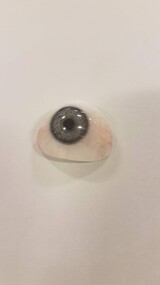
Model - Object, Kerri Wilson Ocular Prosthetics, Prosthetic eye
... This hand painted prosthetic eye would have been used for people who have had to have an eye removed due to damage or disease. The prosthesis fits over an orbital implant and under the eyelids. ...This hand painted prosthetic eye would have been used for people who have had to have an eye removed due to damage or disease. The prosthesis fits over an orbital implant and under the eyelids. ...This hand painted prosthetic eye would have been used for people who have had to have an eye removed due to damage or disease. The prosthesis fits over an orbital implant and under the eyelids. Often referred to as a glass eye, the ocular prosthesis roughly takes the shape of a convex shell. 1 prosthetic white glass eye with blue iriskerri wilson optical prosthetics, prosthetic eye -
 Mont De Lancey
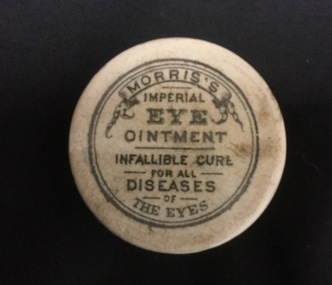
Ointment container
... Morris Imperial eye ointment container. White with black writing - Infallible cure of all diseases of th eye....ointments medicine containers Morris Imperial eye ointment container. White with black writing - Infallible cure of all diseases of th eye. ...Morris Imperial eye ointment container. White with black writing - Infallible cure of all diseases of th eye.ointments, medicine containers
