
Showing 84 items matching "f. c. (major)"
-
 Hume City Civic Collection
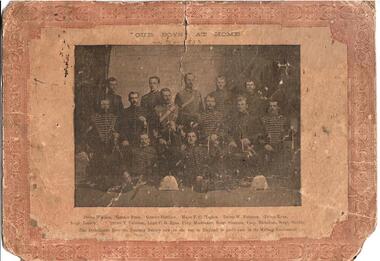
Photograph, c1893
... ...f. c. (major)...(written in ink) OUR BOYS AT HOME / in May 1893 Driver Wallace, Gunner Breen, Gunner Harrison, Major F. C. Hughes, Driver W. Paterson, Driver Ryan, / Sergt. ...This photo taken before a detachment from the Sunbury Battery left for England to participate in the Military Tournament in May 1893. rupertswood battery breen - (gunner) wallace - (driver) harrison hughes f. c. (major) paterson w. (driver) ryan looney - (sgt) t. ...This photo taken before a detachment from the Sunbury Battery left for England to participate in the Military Tournament in May 1893. B/W framed photo 13 men (in uniform) of the Sunbury Battery in May 1893. Photo unframed, mounted on cardboard with a paper-like frame pasted on surround. (written in ink) OUR BOYS AT HOME / in May 1893 Driver Wallace, Gunner Breen, Gunner Harrison, Major F. C. Hughes, Driver W. Paterson, Driver Ryan, / Sergt. Looney. Driver T. Paterson, Lieut. C. G. Ryan, Corp. MacKinnon, Sergt. Shannon. Corp. Nicholson, Sergt. Shields / The Detachment from Sunbury Battery now on the way to England to participate in the Military Tourament. rupertswood, battery, breen, - (gunner), wallace, - (driver), harrison, hughes, f. c. (major), paterson, w. (driver), ryan, looney, - (sgt), t. (driver), mackinnon, - (driver) (corp), c. g. (lieut), shannon, nicholson, - (corp), shields, military, england, armed forces, 1890s, uniforms, clothing and dress, george evans collection -
 8th/13th Victorian Mounted Rifles Regimental Collection
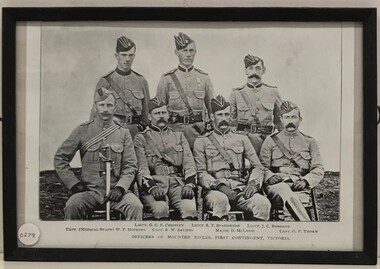
Print - VMR officers 1st contingent
... Officers are Lieutenants G C F Chomley, S T Staughton, J C Roberts, Captain (Medical Staff) W F Hopkins, Captain R W Salmon, Major D McLeish and Captain G F Thorn....Officers are Lieutenants G C F Chomley, S T Staughton, J C Roberts, Captain (Medical Staff) W F Hopkins, Captain R W Salmon, Major D McLeish and Captain G F Thorn. ...First Contingent Victorian Mounted Rifles sailed for South Africa 28 October 1899. Framed print showing seven officers of the First Contingent Victorian Mounted Rifles to the South African War 1899-1902. Officers are Lieutenants G C F Chomley, S T Staughton, J C Roberts, Captain (Medical Staff) W F Hopkins, Captain R W Salmon, Major D McLeish and Captain G F Thorn. military, vmr, south africa, boer war, victoria, uniform -
 Vision Australia
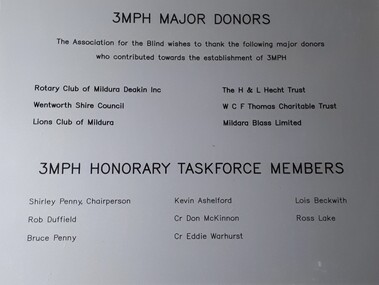
Photograph - Image, AFB Mildura plaques, 1996
... 3MPH Major Donors The Association for the Blind wishes to thank the following major donors who contributed towards the establishment of 3MPH Rotary Club of Mildura Deakin Inc Wentworth Shire Council Lions Club of Mildura The H & L Hecht Trust W C F Thomas Charitable Trust Mildara Blass Limited 3MPH Honorary Taskforce Members Shirley Penny, Chairperson, Kevin Ashelford, Lois Beckwith, Rob Duffield, Cr Don McKinnon, Ross Lake, Bruce Penny, Cr Eddie Warhurst This plaque commemorates the official opening of the Mildura Low Vision Clinic by the Chief Executive Officer of the Association for the Blind Mr John Cook, 5th August 1998. ...Additionally a low vision clinic was also officially opened in that same year. association for the blind 3MPH Mildura 3MPH Major Donors The Association for the Blind wishes to thank the following major donors who contributed towards the establishment of 3MPH Rotary Club of Mildura Deakin Inc Wentworth Shire Council Lions Club of Mildura The H & L Hecht Trust W C F Thomas Charitable Trust Mildara Blass Limited 3MPH Honorary Taskforce Members Shirley Penny, Chairperson, Kevin Ashelford, Lois Beckwith, Rob Duffield, Cr Don McKinnon, Ross Lake, Bruce Penny, Cr Eddie Warhurst This plaque commemorates the official opening of the Mildura Low Vision Clinic by the Chief Executive Officer of the Association for the Blind Mr John Cook, 5th August 1998. ...Radio was a key way of communicating with the blind and low vision community across Victoria, ensuring that news and information could be shared quickly and publicly. Some centres raised funds to develop their own studios, with local content programs, based in AFB offices. Mildura began 3MPH in 1998 as the result of major fundraising for equipment and support from AFB. Additionally a low vision clinic was also officially opened in that same year. 3 plastic plaques with black writing on silver background 3MPH Major Donors The Association for the Blind wishes to thank the following major donors who contributed towards the establishment of 3MPH Rotary Club of Mildura Deakin Inc Wentworth Shire Council Lions Club of Mildura The H & L Hecht Trust W C F Thomas Charitable Trust Mildara Blass Limited 3MPH Honorary Taskforce Members Shirley Penny, Chairperson, Kevin Ashelford, Lois Beckwith, Rob Duffield, Cr Don McKinnon, Ross Lake, Bruce Penny, Cr Eddie Warhurst This plaque commemorates the official opening of the Mildura Low Vision Clinic by the Chief Executive Officer of the Association for the Blind Mr John Cook, 5th August 1998. This plaque commemorates the official opening of Radio 3MPH 107.5FM by the Mayor of the Mildura Rural City Council, Cr Eddie Warhurst, 12th March 1998. association for the blind, 3mph, mildura -
 Sunshine and District Historical Society Incorporated
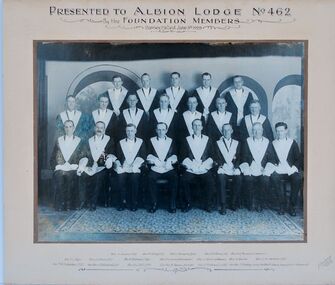
Photograph - Members of Albion Lodge No. 462, 1929
... Thompson|Centre Row E. J. Major, J. H. Mann, H. Robinson, H. L. Jones, L. ...Thompson|Centre Row E. J. Major, J. H. Mann, H. Robinson, H. L. Jones, L. ...Back Row J Hauser, W. V. Gray, J. J. Thompson, S.H. Davey, W.A. Thompson|Centre Row E. J. Major, J. H. Mann, H. Robinson, H. L. Jones, L. Spicer, G. Baxter, J. McKechnie|Front Row C. M. Dubbledan, J. B. Richards, W. D. Bell, H. Skewes, E. Pritchard, F. Findlay, W. C. Gibson, E. J. McKenzie|J. Ward Symons Hopkins St Footscray albion masonic lodge, lodge -
 Bacchus Marsh & District Historical Society
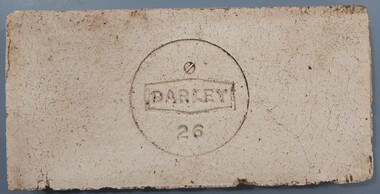
Ceramic, Tile manufactured by Darley Firebrick Company
... The tile (aka refractory) described in this record was possibly produced for use in very high temperatures (in excess of 1,000°F [538°C]) encountered in modern manufacturing. ...The tile (aka refractory) described in this record was possibly produced for use in very high temperatures (in excess of 1,000°F [538°C]) encountered in modern manufacturing. ...The manufacture of firebricks is believed to have begun in Bacchus Marsh in the 1880s when William Thomas Wittick in partnership with a Mr Ackers, and later a Mr Telford, quarried a rich deposit of fire clay at Darley. In 1902 financial assistance was provided by David Mitchell a significant businessman and contractor from Melbourne and the business then expanded and became a major supplier of refractories for gas works in Melbourne, with side lines in moulded fire bricks for foundries and smelting furnaces and complete kiln lines for potteries. The business traded under the name Darley Firebrick Company and later as Darley Refractories Ptd Ltd and was in business for over 100 years. The tile (aka refractory) described in this record was possibly produced for use in very high temperatures (in excess of 1,000°F [538°C]) encountered in modern manufacturing. More heat-resistant than metals, they are used to line the hot surfaces found inside many industrial processes. The date the tile was produced is unknown. Rectangle shaped ceramic tile 'Darley 26' inscribed within a circle darley firebrick company, refractory materials, wittick family bacchus marsh, william thomas wittick 1857-1939, darley refractories ptd ltd -
 8th/13th Victorian Mounted Rifles Regimental Collection
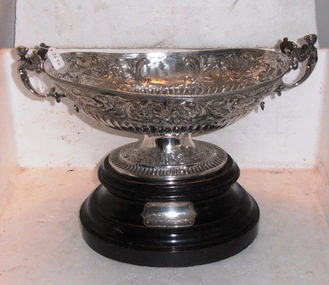
Rosebowl, Subalterns Challenge Cup, 1893 circa
... Davidson and the Officers 8th Hussara by major C G Poley on leaving the Regiment May 1893" and on base: "Won at Wetherby 1896 Lt O'Brien br:g "Baccarat" Owner Won at Wetherby 1897 Lt F J C Howard's b.m Moonshine aged Owner 12st 3lb Won at Fethard 1898 Lt E A O'Brien br.g Baccarat Owner 12st 3lb Won at Mullaboden 1899 Lt E M Jennings b.g May Boy Owner 12st 3lb Won at Aldershot 1904 Lt H F Partridge's b.g Loch Lomond aged Owner 12st.3lb"...Davidson and the Officers 8th Hussara by major C G Poley on leaving the Regiment May 1893" and on base: "Won at Wetherby 1896 Lt O'Brien br:g "Baccarat" Owner Won at Wetherby 1897 Lt F J C Howard's b.m Moonshine aged Owner 12st 3lb Won at Fethard 1898 Lt E A O'Brien br.g Baccarat Owner 12st 3lb Won at Mullaboden 1899 Lt E M Jennings b.g May Boy Owner 12st 3lb Won at Aldershot 1904 Lt H F Partridge's b.g Loch Lomond aged Owner 12st.3lb" Silver rose bowl mounted on black shellacked wooden base. ...Presented to the 8th/13th Victorian Mounted Rifles Regiment RAAC by its affiliated regiment the 8th Royal Irish Hussars as part of a gift of regimental property when a reorganisation of British cavalry regiments was being undertaken. Silver rose bowl mounted on black shellacked wooden base. Bowl is oval in plan view and boat-shaped in elevation with human figurines as handles. Designation of the bowl as the Subalterns Challenge Cup inscribed on side of bowl while winners are inscribed on wooden base. On side of bowl: "Subalterns Challenge Cup Presented to Lieut.Col. Davidson and the Officers 8th Hussara by major C G Poley on leaving the Regiment May 1893" and on base: "Won at Wetherby 1896 Lt O'Brien br:g "Baccarat" Owner Won at Wetherby 1897 Lt F J C Howard's b.m Moonshine aged Owner 12st 3lb Won at Fethard 1898 Lt E A O'Brien br.g Baccarat Owner 12st 3lb Won at Mullaboden 1899 Lt E M Jennings b.g May Boy Owner 12st 3lb Won at Aldershot 1904 Lt H F Partridge's b.g Loch Lomond aged Owner 12st.3lb" 8th hussars, rose bowl, regimental silver, horse racing, subalterns challenge cup -
 Royal Australian Air Force Band
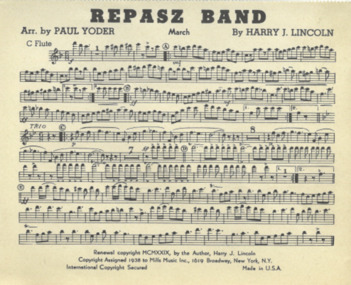
March Card, Lincoln, Harry J. (Composer) et al, Repasz Band, Composed: 1929
... 29 parts Concert Band Instrumentation Quick March Key Signature: F Major Instrumentation: C Flute Db Piccolo Eb Clarinet Oboe 1st Bb Clarinet 2nd Bb Clarinet 3rd Bb Clarinet Eb Alto Clarinet Bb Bass Clarinet 1st Eb Alto Saxophone 2nd Eb Alto Saxophone Bb Tenor Saxophone Bb Baritone Saxophone Bb Bass Saxophone (or Bb Bass) Bassoon 1st Horn in Eb (Alto) 2nd Horn in Eb (Alto) 3rd & 4th Horns in Bb (Alto) Solo and 1st Bb Cornet 2nd Bb Cornet 3rd Bb Cornet 1st and 2nd Bb Trumpets 1st Trombone (Bass Clef) 2nd Trombone (Bass Clef) 3rd Trombone (Bass Clef) Euphonium (Baritone) (Bass Clef) Baritone (Treble Clef) Basses Drums...Brass Band Australian Broadcasting Commission Marching Band Concert Band On envelope: QM169, Q315 Stamped on the reverse of some cards: Q315 29 parts Concert Band Instrumentation Quick March Key Signature: F Major Instrumentation: C Flute Db Piccolo Eb Clarinet Oboe 1st Bb Clarinet 2nd Bb Clarinet 3rd Bb Clarinet Eb Alto Clarinet Bb Bass Clarinet 1st Eb Alto Saxophone 2nd Eb Alto Saxophone Bb Tenor Saxophone Bb Baritone Saxophone Bb Bass Saxophone (or Bb Bass) Bassoon 1st Horn in Eb (Alto) 2nd Horn in Eb (Alto) 3rd & 4th Horns in Bb (Alto) Solo and 1st Bb Cornet 2nd Bb Cornet 3rd Bb Cornet 1st and 2nd Bb Trumpets 1st Trombone (Bass Clef) 2nd Trombone (Bass Clef) 3rd Trombone (Bass Clef) Euphonium (Baritone) (Bass Clef) Baritone (Treble Clef) Basses Drums Repasz Band March Card Lincoln, Harry J. ...In 1932 the call was put out to the ABC to start a military band. The band’s task was to record music to play on air four times a week, and to perform live concerts for the public. By November 1933 a band was put together with 40 musicians from around Australia. The band was initially conducted by Captain H. E. Adkins, Director of the Royal Military School of Music, Kneller Hall, London. After the tour, Adkins returned to his position at Kneller Hall, and Stephen Yorke, a retired bandmaster of the Gloucestershire Regiment, was brought out to Australia to become the permanent director and conductor of the band, which he did until the band closed in 1951. During the band’s 17 year history they presented a sizable program of music. Their final concert received a standing ovation from its audience of 1500, with a teary-eyed Yorke. 29 parts Concert Band Instrumentation Quick March Key Signature: F Major Instrumentation: C Flute Db Piccolo Eb Clarinet Oboe 1st Bb Clarinet 2nd Bb Clarinet 3rd Bb Clarinet Eb Alto Clarinet Bb Bass Clarinet 1st Eb Alto Saxophone 2nd Eb Alto Saxophone Bb Tenor Saxophone Bb Baritone Saxophone Bb Bass Saxophone (or Bb Bass) Bassoon 1st Horn in Eb (Alto) 2nd Horn in Eb (Alto) 3rd & 4th Horns in Bb (Alto) Solo and 1st Bb Cornet 2nd Bb Cornet 3rd Bb Cornet 1st and 2nd Bb Trumpets 1st Trombone (Bass Clef) 2nd Trombone (Bass Clef) 3rd Trombone (Bass Clef) Euphonium (Baritone) (Bass Clef) Baritone (Treble Clef) Basses Drums On envelope: QM169, Q315 Stamped on the reverse of some cards: Q315 brass band, australian broadcasting commission, marching band, concert band -
 Bendigo Historical Society Inc.
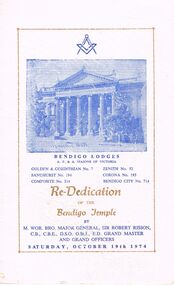
Document - RE-DEDICATION OF THE BENDIGO TEMPLE, VIEW STREET, BENDIGO, 19 October 1974
... Bendigo. By M. Wor. Bro. Major General...a/ Re-Dedication of the Bendigo Temple, View Street, Bendigo. By M. Wor. Bro. Major General, Sir Robert Risson, C.B.E., D.S.O. ...C. Phillips. Wor. Bro. D. L. Killian P.J.G.D. Bro. R. D. McPherson. b/ (letter) 3 Brodie St. Bendigo 3550. 1974. Bendigo Branch RHSV Bendigo. Miss Parry programme short history Board of Management of the Bendigo Masonic Hall. Alex M Stone. a/ Re-Dedication of the Bendigo Temple, View Street, Bendigo. By M. Wor. Bro. Major General, Sir Robert Risson, C.B.E., D.S.O. O.St.J., E.D. Grand Master and Grand Officers. Saturday, October 19th 1974. Bendigo Lodges A. F ...a/ Re-Dedication of the Bendigo Temple, View Street, Bendigo. By M. Wor. Bro. Major General, Sir Robert Risson, C.B.E., D.S.O. O.St.J., E.D. Grand Master and Grand Officers. Saturday, October 19th 1974. Bendigo Lodges A. F. & A. Masons of Victoria. Golden & Corinthian No. 7, Zenith No. 52, Sandhurst No. 194, Corona No. 195, Composite No. 314, Bendigo City No. 714. Re-Dedication Team Presiding Officer: M.W.Bro. Sir. Robert Risson, G.M. Deputy Grand Master R.W.Bro. C. R. B. James, D.G.M. Grand Master of Ceremonies V.W.Bro. L. Retchford, G.D.C. Senior Grand Warden R.W.Bro. L. G. Grant, S.G.W. Junior Grand Warden R.W.Bro. A. J. L. W. Greenwood, J.G.W.Grand Chaplain V.W.Bro. Rev. J.R. Lawton, G.Chap. Grand Supt. Of Works V.W.Bro. F. C. Galbraith, G I.Wkgs. Grand Secretary R.W.Bro. G. W. Jackson, P.D.G.M., G.Sec. Grand Deacons for Dedication Wor.Bro. B. A. McMillian, S.G.D. and Wor.Bro. D. E. Plaisted, J.G.D. Grand Sword Bearer Wor.Bro. J. R. Evans, G.Swd.B. Gand Organist Wor.Bro. J. N. Cowan, G.Org. Grand Pursuivant Wor.Bro. A. A. Eagle, A.G.Purs. Grand Herald Wor. Bro. P. J. Grenfell, P.G.Std.B., G.Her. Censer Stewards Wor. Bro. H. J. Blunden, G.Stwd. And Wor.Bro. B. D. Cross, G.Stwd. Historical, Brief History on Bendigo Masonic Temple, View Street, Bendigo, 1874-1974. Local historian, Bro. J. N. Macartney, in his book had this to say:- ''The Masonic Hall is by far the grandest building in Sandhurst (Bendigo), and a fitting and right noble home for such an Order to place their ark in. The building is one on the pure Corinthian order, lofty without, and spacious within; therein is the finest Assembly Hall out of Melbourne Town Hall. What an imposing façade, with its tapering columns rearing the graceful acanthus-leaf capitals 40 feet. . . . With the growth of Freemasonry in Bendigo, new Craft Lodges were established, as were lodges of higher degrees. At present the following lodges use the Temple and hall facilities:- Golden & Corinthian Lodge No. 7. Zenith Lodge, No. 52. Sanhurst Lodge, No. 194. Corona Lodge No. 195. The Lodge Composite, No. 314. Bendigo City Lodge, No. 714. The Bendigo Lodge of Mark Master Masons, No. 12. Royal Golden Chapter, No. 3. The Bendigo Royal Ark Mariner Lodge, No. 12. The Bendigo Conclave, No. 143. Bendigo Masonic Lodge of Instruction, No. 14. Bendigo Sovereign Council, No. 16. Bendigo Sovereign Chapter No. 32. The National Trust of Australia has done much to preserve our heritage for the succeeding generations. In 1972 the Masonic Temple and Hall Received their ''D'' Classification. . . Program. Toasts and Harmony. Bro. C. Phillips. Wor. Bro. D. L. Killian, P.J.G.D. Bro. R. D. McPherson. b/ (letter) 3 Brodie St. Bendigo 3550. 28.10.1974. The Secretary, Bendigo Branch, RHSV, Bendigo. Dear Miss Parry, Bendigo Masonic Hall, The enclosed programme contains a short history of the above, and comes to your Society with the compliments of the Board of Management of the Bendigo Masonic Hall. Yours sincerely, Alex M Stone. a/ re-dedication of the bendigo temple, view street, bendigo. by m. wor. bro. major general, sir robert risson, c.b.e., d.s.o. o.st.j., e.d. grand master and grand officers. saturday, october 19th 1974. bendigo lodges a. f. & a. masons of victoria. golden & corinthian no. 7, zenith no. 52, sandhurst no. 194, corona no. 195, composite no. 314, bendigo city no. 714. re-dedication team presiding officer: m.w.bro. sir. robert risson, g.m. deputy grand master r.w.bro. c. r. b. james, d.g.m. grand master of ceremonies v.w.bro. l. retchford, g.d.c. senior grand warden r.w.bro. l. g. grant, s.g.w. junior grand warden r.w.bro. a. j. l. w. greenwood, j.g.w.grand chaplain v.w.bro. rev. j.r. lawton, g.chap. grand supt. of works v.w.bro. f. c. galbraith, g i.wkgs. grand secretary r.w.bro. g. w. jackson, p.d.g.m., g.sec. grand deacons for dedication wor.bro. b. a. mcmillian, s.g.d. and wor.bro. d. e. plaisted, j.g.d. grand sword bearer wor.bro. j. r. evans, g.swd.b. gand organist wor.bro. j. n. cowan, g.org. grand pursuivant wor.bro. a. a. eagle, a.g.purs. grand herald wor. bro. p. j. grenfell, p.g.std.b., g.her. censer stewards wor. bro. h. j. blunden, g.stwd. and wor.bro. b. d. cross, g.stwd. historical, brief history on bendigo masonic temple, view street, bendigo, 1874-1974. local historian, bro. j. n. macartney, ''the masonic hall the grandest building in sandhurst (bendigo), corinthian order, finest assembly hall. golden & corinthian lodge no. 7. zenith lodge, no. 52. sanhurst lodge, no. 194. corona lodge no. 195. the lodge composite, no. 314. bendigo city lodge, no. 714. the bendigo lodge of mark master masons, no. 12. royal golden chapter, no. 3. the bendigo royal ark mariner lodge, no. 12. the bendigo conclave, no. 143. bendigo masonic lodge of instruction, no. 14. bendigo sovereign council, no. 16. bendigo sovereign chapter no. 32. national trust of australia preserve our heritage. in 1972 received their ''d'' classification. . . program. toasts and harmony. bro. c. phillips. wor. bro. d. l. killian, p.j.g.d. bro. r. d. mcpherson. b/ (letter) 3 brodie st. bendigo 3550. 1974. bendigo branch, rhsv, bendigo. miss parry, programme short history board of management of the bendigo masonic hall., alex m stone. -
 Bendigo Historical Society Inc.
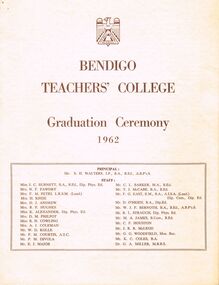
Document - LA TROBE UNIVERSITY BENDIGO COLLECTION: BENDIGO TEACHERS' COLLEGE GRADUATION CEREMONY 1962
... F. M. Courtis, Mr. P. M. Divola, Mr. E. J. Major, Mr. C. L. Barker, Mr. ...F. M. Courtis, Mr. P. M. Divola, Mr. E. J. Major, Mr. C. L. Barker, Mr. ...Two copies of the Bendigo Teachers' College Graduation Ceremony 1962 program. On the front page is a list of the staff working at the college - Mr. S. H. Walters (Principal), Miss J. C. Burnett, Mrs. N. F. Fawdry, Mrs. F. M. Petri, Mrs. H. Knox, Mrs. D. J. Andrew, Mrs. B. F. Hughes, Miss K. Alexander, Mrs. D. M. Philpot, Miss B. H. Cowling, Mrs. A. J. Coleman, Mr. W. D. Kolle, Mr. F. M. Courtis, Mr. P. M. Divola, Mr. E. J. Major, Mr. C. L. Barker, Mr. T. J. McCabe, Mr. F. G. East, Mr. D. O'Brien, Mr. W. J. F. Bernoth, Mr. R. L. Strauch, Mr. M. A. James, Mr. C. F. Houston, M. J. R. R. McLeod, Mr. G. G. Woodfield, Mr. K. C. Coles and Dr. G. A. Miller. On the inside cover is the "Significance of the Ceremony" and the "Order of the Ceremony". Mr. F. M. Courtis welcomed the visitors and the Principal read the College Charge. The 'Graduation Book' was presented to Mr. W. F. R. Budge by Miss J. C. Burnett. Mr. C. L. Barker presented the T.P.T.C. graduating students to the Principal and Mrs. N. F. Fawdry presented the T.I.T.C. graduating students to the Principal. Congratulations were offered by the Mayor of Bendigo Cr. R. A. Rae, J.P., the President of Strathfieldsaye Shire Cr. K. Houlahan, J. P. and Mr. E. P. Seymour, Head Teacher, Violet Street State School. The Occasional Address was given by Mr. L. J. Pryor Superintendent of Teacher Education. The following page contains a list of the "Students of 1960 - 1962 Trained Infant Teacher's Certificate". They are Glenys Faye Barrett, Marlene Isabella Bemrose, Beth Adora Bodinnar, Margaret Isobel Brown, Doris Lillian Chambers, Marie Ann Crawford, Margaret Carol Donne, Kaye Beverley Exell, Jannette Joyce Hughes, Margaret Christina Jenkins, Kathryn Margaret Lackmann, Susan Anne Lewer, Barbara June Lord, Jennifer Beris Matheson, Joy Lynette Messer, Geraldine Mary, Moylan, Patricia Joan O'Bree, Helen Jeanette Rodda, Lesley Scott, Heather Dawn Shenfield, Nola May Steele, Jennifer Margaret Weston and Alicia Yvonne Young. It also contains a paragraph describing "The Perfect Teacher". The back cover of the booklet has a list of "Students of 1961 - 1962 Trained Primary Teacher's Certificate". John Walter Angel, Elisabeth Ann Arkinstall, Mary Christina Backway, Helen Elizabeth Barclay, Bruce Maxwell Bouch, Pamela Mary Braden, Howard Francis Briggs, Clare Antoinette Brown, Alan John Bruce, Peter John Burns, Valerie Jean Caldwell, Marie Lynette Chambers, Margaret Jeannette Christie, Alison Ruth Clement, Marie Elaine Collins, Gladys Helena Cooke, Lindsay Charles Coster, David John Cowan, Peter John Cronin, Berenice Margaret Cronk, Edeline May Crouch, Theodore Robert Dare, Lynette Joan Davis, Ian David Dawson, Mary DeAraugo, Kenneth Ross Erbs, Francis Elaine Mary Fallon, Margaret Fawcett, Janet Frances Filbey, Francesco Gargiulo, Ian John Glenister, Barbara Faye Gotch, Lynette Ellen Graham, Colin Athol Hayes, Marlene Grace Hazen, Desmond Brian Hearn, Brentford Graeme Heath, Carmel Jean Heslop, Pamela Joy Higgie, Lynette Rosemary Cecelia Hoare, Erica Fay Holloway, Marie Jean Jardine, Kenneth Neil Johnson, Laurel Robyn Jones, Glenys Lorraine Judd, Diane Elizabeth Kear, Ann Elizabeth Keenan, Monica Cecelia Kelly, Margaret Elizabeth Landini, Patricia Joy Langdon, Dorothy Margaret Leitch, Donald Alan Leslie, Mary Carmel McCormack, Helen Mary McCutcheon, Birgitt Marx, Claire Agnes Mullins, Lucille Anne Newcombe, Glenice Vivienne Orr, Judith Joyce Ozanne, Wilma Beverley Pape, Virginia Elizabeth Parke, Robin Parker, Dorothy Joan Peterson, Robin Joan Phillips, Cherril Margaret Probyn, Norma Lesley Rantall, Nola Read, Margaret Elaine Ridley, Thomas Charles Rilen, Marie Therese Sharkey, Judith Margaret Spackman, Desmond Thomas Stephens, Nancy Rae Telfer, Bernard James Trevaskis, Marjorie Ellen Warden, Laurice Helen Warwick, Judith Maree Weir, Maxwell John White, Norman Leslie Williams, Pamela Williams and Lloyd Reginald Wishart. Within this document is a loose page showing the seating arrangements for the graduation. Staff seating arrangements are as follows - Walters, Barker, Seymour, Fawdry, McCabe, Woodfield, Alexander, Hughes, Divola, Major, Strauch, Pryor, Budge, Burnett, East, Houston, Petri, Andrew, Coles, McLeod, James, O'Brien. bendigo, education, bendigo teachers' college graduatio, la trobe university bendigo collection, collection, bendigo teachers' college, bendigo, education, teaching, teachers, students, staff, bendigo teachers' college students, bendigo teachers' college staff, history, graduation, graduation ceremony, book, tertiary education, graduands, graduates -
 Bendigo Historical Society Inc.
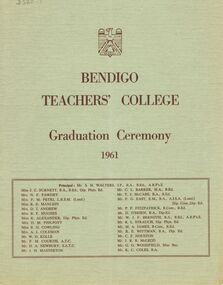
Document - LA TROBE UNIVERSITY BENDIGO COLLECTION: BENDIGO TEACHERS' COLLEGE GRADUATION CEREMONY 1961
... F. Bernoth, Mr. R. L. Strauch, Mr. M. A. James, Mr. R. E. Wittman, Mr. C. F. ...F. Bernoth, Mr. R. L. Strauch, Mr. M. A. James, Mr. R. E. Wittman, Mr. C. F. ...A light green document titled "Bendigo Teachers' College Graduation Ceremony 1961". The front page also contains a list of the staff working at the college. They are Mr. S. H. Walters (Principal), Miss J. C. Burnett, Mrs. N. F. Fawdry, Mrs. F. M. Petri, Miss R. E. Manlein, Mrs. D.J. Andrew, Mrs. B. F. Hughes, Miss K. Alexander, Mrs. D. M. Philpott, Miss B. H. Cowling, Mrs. A. J. Coleman, Mr. W. D. Kolle, Mr. F. M. Courtis, Mr. D. A. Newbury, Mr. J. H. Masterton, Mr. C. L. Barker, Mr. T. J. McCabe, Mr. F. G. East, Mr. P. F. Fitzpatrick, Mr. D. O'Brien, Mr. W. J. F. Bernoth, Mr. R. L. Strauch, Mr. M. A. James, Mr. R. E. Wittman, Mr. C. F. Houston, Mr. J. R. R. McLeod, Mr. G. G. Woodfield and Mr. K. C. Coles. The inside cover contains the "Significance of the Ceremony" and "Order of the Ceremony". Mr. F. M. Courtis welcomed the visitors and the Principal read the College Charge. The 'Graduation Book' was presented to Mr. A. L. Harris, Inspector of Schools, by Miss J. C. Burnett. Mr. C. L. Barker presented the 1960-1961 T.P.T.C. graduates to the Principal and Mrs. N. F. Fawdry presented the 1959-1961 T.I.T.C. graduates. Congratulations were offered by the Mayor of Bendigo Cr. F. W. Clayton, J.P. the President of Strathfieldsaye Shire, Cr. G.T. Gleeson and Mr. C. Campbell Head Teacher and Golden Square State School. The Occasional address was presented by Mr. E.C. Kreiger the Assistant Chief Inspector of Primary Schools. The following page contains a list of "Students of 1959-1961 Trained Infant Teacher's Certificate" - Bronwyn Mary Anthony, Helen Rose Argall, Betty Gay Ashby, Edna Rose Attewell, Barbara Christine Bailey, Barbara Isabelle Banfield, Cathleen Mary Banko, Kathleen Margaret Beard, Barbara Anne Beck, Mavis Lynette Brock, Cecily Joan Callister, Kathleen Mary Comer, Alison Jane Currie, Nola Curtis, Margaret Ellen Dowd, Jenifer Lorraine Every, Margaret Jane Ewing, Marie Therese Farrell, Linsey Jean Ferguson, Margaret Esther Fisher, Jean Margaret Fraser, Margaret Ruth Hallett, Elsie Frances Hamilton, Janice Ann Hutchinson, Judith Anne Knopp, Jennifer Mary Ruth Layton, Evelyn Jeanette McKean, Pamela Margaret McMahon, Astrid Norma Magnusson, Jennifer Ann Major, Elaine Joy Maple, Margaret Mary Morrow, Maureen Agnes O'Brien, Geraldine Anne O'Connor, Wendy Nanette O'Neill, Pamela Elsie Parker, Margaret Parslow, Lynette Margaret Pearce, Diane Olive Pell, Gladys Pope, Denise Helen Margaret Potter, Yvonne Joy Puckey, Georgina Mary Rodda, Margaret Agnes Schmidt, Barbara Marion Dorothy Stanton, Rosemary-ann Tipple, Penelope Ann Wallace and Nola Vivienne Williamson. A copy of "Goethe's Nine Essentials for Contented Living" followed this list of students. The back page has a list of the "Students of 1960-1961 Trained Primary Teacher's Certificate" - Ian Roy Aitken, Laurence James Aitken, Daryl Lewis Allemand, Raymond Thomas Arthur, Allan John Attwood, Peter Donald Bavinton, Graham John Bayles, Barry John Cameron, Margaret Suesan Chapman, Elizabeth Rae Clark, Kenneth Clarence Collins, Gavin Ernest Collinson, Terrance Richard Cook, Alan James Daniel, Peter Charles Derrick, Retford John Reuben Dettmann, John William Dicker, Judith Margaret Edwards, Donald Bertram Elshaug, David Forrester, Rodney Robert Foy, Clare Denise Frigerio, Colin David Gaylard, Barry Alexander Gemmell, Anne Isobel Godward, Peter Rodney Goode, John Jefferson Goold, John James Goonan, Ann Merilyn Hamilton, Thelma Grace Hartland, Jennifer Iris Hartvigsen, Bernice Joy Holland, Christopher John Hunt, Marjorie Catherine Iddles, Colin James Jenkins, Darryl Allan Jobling, Marcia Lillette Johnson, Albert Jordon, Janet Laurel Kennedy, John Joseph Kennedy, Malcolm James Kennedy, Frances Marjorie Leach, John Edward Lewis, Ivan James McCarrey, Kerry Francis McCartney, Graeme John McKean, Ian Hamilton McLean, David George Martin, John Russell Meers, Elizabeth Carolyn Miller, Ian Malcolm Morley, Campbell Frederick Muller, Noni Clare Murphy, Patricia Marie Murphy, Anne Mustey, Pauline Elizabeth Norman, Janice Anne North, Joan Margaret O'Callaghan, Margaret Mary O'Connor, William James Ovenden, Gordon Richard Patterson, Lawrence George Pattinson, Marcia Nancy Penrose, Judith Elaine Plant, Peter Alwyn Neville Aloysius Pritchard, Janice Yvonne Reid, David Barry Richards, William Clifford Richards, Geoffrey Roy Rodwell, Glenese Theresa Shanahan, Elizabeth Mary Shaw, Ian Russell Stapleton, Beverley Adeline Stevenson, Ronald John Stone, Nicholas Henry Sulinski, Daryl John Tatt, Brendan Joseph Tinkler, Roy Hamilton Trimble, Kenneth Graham Utber, Beverley June Vickers, Melva Elaine Vinnicombe, John Cornforth Waldron, Bruce Henry Walker, Frederick Robert Weight, Norman James West, Geoffrey Arthur Wigg, Lynette Patricia Wilkinson, Valiant Roy Wojtkiw, Janice Rae Woodcock, Peter Joseph Woods, Aleathea Nola Wootton and Susanne Katherine Yeaman bendigo, education, bendigo teachers' college graduatio, la trobe university bendigo collection, collection, bendigo teachers' college, bendigo, education, teaching, teachers, students, bendigo teachers' college students, bendigo teachers' college staff, tertiary education, history, graduates, graduands, book, teacher training, graduation ceremony -
 Federation University Historical Collection
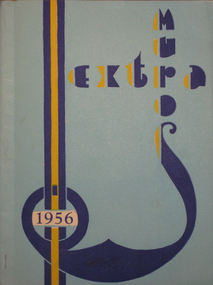
Book, Extra Muros 1956, Teachers' College Ballarat, 1956
... f. golding...a. hutchings...j. hammet...d. wyley...m. hutchinson...i. burt...y. davey...p. mcconville...m. ryan...h. miller...p. wiltshire...d. wright...m. hyndman...v. goodwin...k. reither...h. weeks...r. delbridge...n. freeman...b. pointer...w. taylor...g. mcrae...l. dugdale...b. robson...e. o. walpole...r. j. croft...e. constable...j. brown...j. dugdale...ian burt...heather sparkes...g. whitelaw...e. major...ruth ray...ron bunn...w. j. taylor...shirley a. mclay...d. henderson...a. gleeson...p. utber...a. rutter...i. erdmanis...e. phillips...i. mckinley...a. stalker...m. spencer...c...(BTC Handbook 1965) btc ballarat teachers college n. l. harvey t. w. h. turner john pianta d. stanley b. parker j. hutchings n. ruddick b. poole r. arthur e. w. doney f. golding a. hutchings j. hammet d. wyley m. hutchinson i. burt y. davey p. mcconville m. ryan h. miller p. wiltshire d. wright m. hyndman v. goodwin k. reither h. weeks r. delbridge n. freeman b. pointer w. taylor g. mcrae l. dugdale b. robson e. o. walpole r. j. croft e. constable j. brown j. dugdale ian burt heather sparkes g. whitelaw e. major ruth ray ron bunn w. j. taylor shirley a. mclay d. henderson a. gleeson p. utber a. rutter i. erdmanis e. phillips i. mckinley a. stalker m. spencer c. rodger r. ross l. jenkins j. m. blair j. kirk m. odd b. dahlenburg m. cattanach Light blue cover (cream inside cover) with dark blue and yellow titles. ...Editorial, Our Principal, Second Year Staff and Students', First Year Students', Main Events of '56, Hostel Highlights, Sporting World, Sports Awards. December 1955 Ballarat Teachers’ College held its first Graduation Ceremony. The words of the Graduation Hymn were written by Mavis Canty. (BTC Handbook 1965) July 1956 Tenders were called for the first section of the new Ballarat Teachers’ College to be built in Gillies St. (BTC Handbook 1965) Light blue cover (cream inside cover) with dark blue and yellow titles. Soft covered magazine of the Ballarat Teachers College. Title page states Vol. 2. No. 3. btc, ballarat teachers college, n. l. harvey, t. w. h. turner, john pianta, d. stanley, b. parker, j. hutchings, n. ruddick, b. poole, r. arthur, e. w. doney, f. golding, a. hutchings, j. hammet, d. wyley, m. hutchinson, i. burt, y. davey, p. mcconville, m. ryan, h. miller, p. wiltshire, d. wright, m. hyndman, v. goodwin, k. reither, h. weeks, r. delbridge, n. freeman, b. pointer, w. taylor, g. mcrae, l. dugdale, b. robson, e. o. walpole, r. j. croft, e. constable, j. brown, j. dugdale, ian burt, heather sparkes, g. whitelaw, e. major, ruth ray, ron bunn, w. j. taylor, shirley a. mclay, d. henderson, a. gleeson, p. utber, a. rutter, i. erdmanis, e. phillips, i. mckinley, a. stalker, m. spencer, c. rodger, r. ross, l. jenkins, j. m. blair, j. kirk, m. odd, b. dahlenburg, m. cattanach -
 Federation University Historical Collection
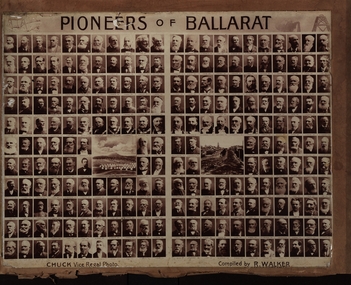
Photograph, Pioneers of Ballarat
... ...E. Major...Curtis; H. Crisp; E. Major; R. Pearce; J. Waller; G. Waller; G. ...Curtis; H. Crisp; E. Major; R. Pearce; J. Waller; G. Waller; G. ...The Pioneers of Ballarat may have been created to the Ballarat Old Colonists' Association and the reunions held by the early Ballarat pioneers. The dates given after the pioneers time is their date of arrival into the colony. Photograph showing numerous portraits of men who were considered Pioneers of Ballarat as complied by R. Walker and produced by Chuck Vice Regal Photo. The men depicted are: J. Smith; W. Gay; W. Downie; G. Goddard; B. Varcoe; A.F. Seidal; Loius Balhausen; J. McKenzie; William irwin; M. Box; Thomas Bath; James Oddie; William Tulloch; J.W. Graham; J. Ward; W. Curnow; R.J. Binder; F.J.L. Turner; W. Eyres; C.A. Welch; B. Welch; G. Welch; J. Lake; H. Smith; J. King; R.T. Wreford; Ernest Balhausen; J. Ward; T. Trengrove; J. Truswell; J. Taylor; W. Seeley; J.P. Murray; Hon. David Ham; Andrew Anderson; E. McCartney; J.H. Smith; Joseph Edward Cowley; A. Jones; W.H. Furness; F.N. Martin; James Anderson; G. Becher; James Meek; T. Hawkins; P. Drummond; C. Barker; J. Malcolm; R. Brown; G. Tupper; A. Rose; W. Pinkerton; A. Clinton; A. Sheppard, F.C. Downes; J.A. Blight; J. Blight; T. Blight; J. Richardson; C.W. Toy; W.C. Elder; E. Towl; S. Walker; W.P. Martin; J.T Langley; J.A. Abramowitch; R, Allan; S.W. Woodward; G. Hunt; J. Bishop; F.L. Graham; R. Graham; W. A.G. Fraser; J. Davies; J. Paterson; B.G. Tucker; E. McElroy; W.H. Burton, T.C. Coates; J. Williams; J.P. Roberts; J. Ritchie; T.W. White; J. F. Harvey; Natale D'Angri; D. McCallum; W. Chisholm; P. Kohl; J. Moncrief; J.P. Marshall; R.U. Nicholls; G.L. Holthouse; C. Gray; W. Gale; James Long; Theo Williams; J.R. Ellsworth; W. Scott; Henry Josephs; D. Cooke; William Little; T.H. Thompson; E. Morey; J.G. McDonald; C.C. Shoppee; G. Douglas; W. H. Ellis; W. Hicks; J. Cameron; W. B. Koppers; F. Marendez; G. Herrmann; J. Kelly; E. Jermyn; P. Murray; P. Gay; D. McNaught; T.D. Wanliss; G. Lord; H. Glenny; J. Trethowan; J. Blandford; J. Goujon; W. Coad; A. Colliver; J. Nunn; J. Munro; W.C. Burbidge; J. Jarvie; C. Ferguson; C. Morris; J. Russell; J. Phillips; J. Coghlan; R. Clark; Thomas Stoddart; M. Wasley; B. Retallack; John Reid; M.C. Carey; P. Maloney; E. Newman; J. Lamb; J,. Pryor; J. Gibson; James Mitchell; J. Rowe; James Vallins; A. Roxburgh; A. Cant; O. Thomas; J.Y. McDonald; W.M. Acheson; A. Jack; R. Gibbings; E.W. Chamberlain; J.H. Ellsworth; J. Falconer; G.G. Lorimer; James M. Bickett; T. Sayle; Andrew McIntyre; W. Hambley; K. Coutts; T. Muir; R. Scott; G. Leach; E. Richards; R. Hearn; J. Hughan; D. Miliani; E. Parr; J. T. Irving; W.G. Williams; J. Marks; J. Darby; T. Ray; D. McKenzie; James Robson; J. Robson; J. Moore; J. Murphy; Robert M. Serjeant; C. Ford; E.E. Campbell; P. Folland; P.J. Rickard; A. McVitty; B. Angwin; J.T. Sleep; M.P. Whiteside; W. Curtis; H. Crisp; E. Major; R. Pearce; J. Waller; G. Waller; G. Abrams; J. McIntyre; J. Johnston; W. Johnston; W. Taylor; J. Knoth; J. Davey; G. Smith; N. Kent; E.O. Witherden; J.B. Cathcart; W.H. Harrow; G. Evans; L. Ure; W.T. Glen; T. Dickinson; D. Hughes; J. Strickland; J. Hillman; E. Jackson; R.J. Walker; D. Gunn; R.J. Gullan; T. McManamy; A. Gray; James trembath; W. Porter; J. Showman; C. Walker; J. Bowman; W.B. McDonald; P. Jago; J. Stout pioneers, ballarat, chuck, chuck vice regal photo, r. walker, ballarat pioneers, pioneers of ballarat, j. smith, w. gay, w. downie, g. goddard, b. varcoe, a.f. seidal, loius balhausen, j. mckenzie, william irwin, m. box, thomas bath, james oddie, william tulloch, j.w. graham, j. ward, w. curnow, r.j. binder, f.j.l. turner, w. eyres, c.a. welch, b. welch, g. welch, j. lake, h. smith, j. king, r.t. wreford, ernest balhausen, t. trengrove, j. truswell, j. taylor, w. seeley, j.p. murray, hon. david ham, andrew anderson, e. mccartney, j.h. smith, joseph edward cowley, a. jones, w.h. furness, f.n. martin, james anderson, g. becher, james meek, t. hawkins, p. drummond, c. barker, j. malcolm, r. brown, g. tupper, a. rose, w. pinkerton, a. clinton, a. sheppard, f.c. downes, j.a. blight, j. blight, t. blight, j. richardson, c.w. toy, w.c. elder, e. towl, s. walker, w.p. martin, j.t langley, j.a. abramowitch, r, allan, s.w. woodward, g. hunt, j. bishop, f.l. graham, r. graham, w. a.g. fraser, j. davies, j. paterson, b.g. tucker, e. mcelroy, w.h. burton, t.c. coates, j. williams, j.p. roberts, j. ritchie, t.w. white, j. f. harvey, natale d'angri, d. mccallum, w. chisholm, p. kohl, j. moncrief, j.p. marshall, r.u. nicholls, g.l. holthouse, c. gray, w. gale, james long, theo williams, j.r. ellsworth, w. scott, henry josephs, d. cooke, william little, t.h. thompson, e. morey, j.g. mcdonald, c.c. shoppee, g. douglas, w. h. ellis, w. hicks, j. cameron, w. b. koppers, f. marendez, g. herrmann, j. kelly, e. jermyn, p. murray, p. gay, d. mcnaught, t.d. wanliss, g. lord, h. glenny, j. trethowan, j. blandford, j. goujon, w. coad, a. colliver, j. nunn, j. munro, w.c. burbidge, j. jarvie, c. ferguson, c. morris, j. russell, j. phillips, j. coghlan, r. clark, thomas stoddart, m. wasley, b. retallack, john reid, m.c. carey, p. maloney, e. newman, j. lamb, j, . pryor, j. gibson, james mitchell, j. rowe, james vallins, a. roxburgh, a. cant, o. thomas, j.y. mcdonald, w.m. acheson, a. jack, r. gibbings, e.w. chamberlain, j.h. ellsworth, j. falconer, g.g. lorimer, james m. bickett, t. sayle, andrew mcintyre, w. hambley, k. coutts, t. muir, r. scott, g. leach, e. richards, r. hearn, j. hughan, d. miliani, e. parr, j. t. irving, w.g. williams, j. marks, j. darby, t. ray, d. mckenzie, james robson, j. robson, j. moore, j. murphy, robert m. serjeant, c. ford, e.e. campbell, p. folland, p.j. rickard, a. mcvitty, b. angwin, j.t. sleep, m.p. whiteside, w. curtis, h. crisp, e. major, r. pearce, j. waller, g. waller, g. abrams, j. mcintyre, j. johnston, w. johnston, w. taylor, j. knoth, j. davey, g. smith, n. kent, e.o. witherden, j.b. cathcart, w.h. harrow, g. evans, l. ure, w.t. glen, t. dickinson, d. hughes, j. strickland, j. hillman, e. jackson, r.j. walker, d. gunn, r.j. gullan, t. mcmanamy, a. gray, james trembath, w. porter, j. showman, c. walker, j. bowman, w.b. mcdonald, p. jago, j. stout, john smith -
 Federation University Historical Collection
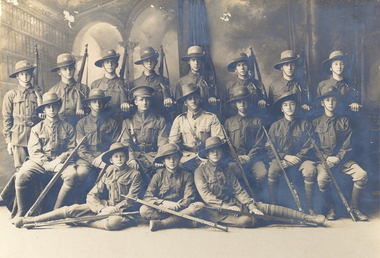
Photograph - Cadets, Richards & co, Ballarat Junior Technical School Cadets, c1917
... Brown, 2. John Dulfer, 3. Major Samuel Tucker, 4. E. Reeves (Staff Sergeant Major), 5. ....5) Item was in the collection of A E Williams from 1918 - 1988 The copies were prepared for the SMB history by Geoff Pope c1979. Mounted sepia prints, showing 18 males in cadet uniform, holding rifles. 6 copies in various condition. .5) and .4) are copies, and not mounted. On front - embossed printing - "Richards & co." .1) On back in pencil - "J.T.S. Cadet Team, 1917." .3) and .4) On back - "1918-20(?) S.M.B. Cadet Team. Standing - 1. A. W. Middleditch, 2. P. Hirt, 3. M. F. Larkin, 4. G. Chambers, 5. G. Renkin, 6. E. V. Rowsell, 7. A. G. Hannah, 8. Charles Howard Beanland. Seated - 1. F. H. Brown, 2. John Dulfer, 3. Major Samuel Tucker, 4. E. Reeves (Staff Sergeant Major), 5. H. Ashley, 6. L. Pearson, 7. G. Nicholls. In Front - 1. G. Beanland (205.3 has this item crossed out), 2. J.L. Lindsay, 3. G.E. Deeble (?)" .6) On back in pencil - "AEW / 1918/20?" ballarat junior technical school, a w middleditch, p hirt, m f larkin, g chambers, g renkin, e v rowsell, a g hannah, c h beanland, f h brown, j dulfer, harold gordon wakeling, e reeves, h ashley, l pearson, g nicholls, g beanland, j l lindsay, g e deeble, world war 1, world war i, world war one, school of mines ballarat, wakeling, a. w. middleditch, p. hirt, m.f. larkin, a.g. hannah, g. renkin, e.v. rowsell, charles beanland, c.b. beanland, h. ashley, e, reeves, g. nicholls, l. pearson, john dulfer, samuel tucker, f.h. brown, g. chambers -
 Mission to Seafarers Victoria
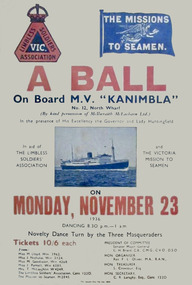
Poster - Digital poster, A ball on board M.V. "Kanimbla", 1936
... Robert-son, were present, and were received by the chairman of the ball committee (Major-General Brand) and Mrs. Brand, Admiral Sir Francis and Lady Hyde, Com- mander and Mrs. ...Robert-son, were present, and were received by the chairman of the ball committee (Major-General Brand) and Mrs. Brand, Admiral Sir Francis and Lady Hyde, Com- mander and Mrs. ...The motor vessel "Kanimbla" from Mcllwraith, McEacharn Ltd was brand new in 1936 and was used several times for charity balls. "Kanimbla Ball" (Australasian (Melbourne, Vic. : 1864 - 1946), Saturday 28 November 1936, page 12) Over 1,000 people were present at a very successful ball given on board the m.v. Kanimbla this week, to aid the funds of the Limbless Soldiers' Association and the Victorian Mission to Seamen. The ship was gaily decorated with balloons and international code flags, while vases of mixed flowers gave charm to the supper tables in dining saloon. His Excel- lency the Governor and Lady Huntingfield attended by Lieutenant A. W. P. Robert-son, were present, and were received by the chairman of the ball committee (Major-General Brand) and Mrs. Brand, Admiral Sir Francis and Lady Hyde, Com- mander and Mrs. Smith, the chaplain of the mission (the Rev. F. L. Oliver), Mr. and Mrs. James Kelso, the president of the Limbless Soldiers' Association (Mr. T. S. Gray) and Mrs. Gray, and the honorary secretary of the ball committee (Mr. C. R. Laragby) and Mrs. Laraghy. Lady Huntingfield wore a becoming gown of copper-red crepe, with a faint silver stripe. and was presented with a bouquet of deep red gladioli. Padre Oliver had a friendly relationship with the captain of the Kanimbla. Digital copy of a colour poster advertising for a ball on board the MV Kanimbla. m.v. kanimbla, ball, mission to seamen, 1936, mcilwraith mceacharn ltd, frank leslie oliver, lord huntingfield, limbless soldiers association -
 Mission to Seafarers Victoria
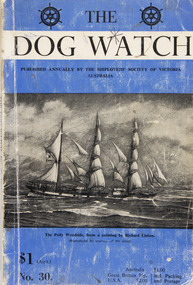
Journal (item) - Periodicals-Annual, Shiplovers' Society of Victoria, The Annual Dog Watch
... C. Ricketts - 112 Inverneill At Iquiqui 1912 - Major M. H. O. Forbes - 116 The "Bear" - S. A. E. Strom - 121 Book Reviews - - 125 Glossary - - 128 More After Thoughts - W. F...C. Ricketts - 112 Inverneill At Iquiqui 1912 - Major M. H. O. Forbes - 116 The "Bear" - S. A. E. Strom - 121 Book Reviews - - 125 Glossary - - 128 More After Thoughts - W. F ...This journal provides the reader with glimpses of the adventures and hardships of a seaman's life. Many of the stories are of sailing ships. Contributes to our knowledge of the importance of shipping and places on record those stories of the sea which would otherwise be lost. Contents Foreword - Commodore Dacre H. D. Smyth, R.A.N. - 7 Editorial - Pondering on Polly - 9 Progress Of The "Polly Woodside" - J. F. Yuncken - 13 Nearly Another "Birkenhead" - E. J. Batten - 21 Pawn Of The Storm - N. S. Smith - 27 The "Golden Plover" - I. L. Barton - 35 The "Brier Holme" - Ross Osmond - 43 The "Joseph H. Scammell" - A. D. Long - 47 A Western Port Boatman - Arthur Woodley - 51 Apology To A Freighter - C. E. Bonwick - 52 When Ships Burned Coal -- The 'Black Gang' - E. Carpenter - 53 From The Galley -- Fried Chicken - R.G.E. - 57 Just a Bit Outside The Law - Captain C. Meyer - 59 More Of Pearling Off The ARU Islands - Capt. W. J. Cowling - 63 A Medal Well Earned - L. A. Marchant - 70 The Tale Of The "Komet" - Harrow Morgan - 72 A Passage From England To Australia in the "Gauntlet" - Sven Tvermoes - 79 A Tug Of The Past - H. R. Watson - 94 Commodore Beal To The Rescue - Capt. F. K. Klebingat - 98 The Peacock From The Sea - J. M. MacKenzie - 106 The Man From Timbuctoo - L. de Neumann - 110 H.M.A.S. "Tingira" - D. C. Ricketts - 112 Inverneill At Iquiqui 1912 - Major M. H. O. Forbes - 116 The "Bear" - S. A. E. Strom - 121 Book Reviews - - 125 Glossary - - 128 More After Thoughts - W. F. Cook - 129 sailing ships, steamships, shipping, seafaring life, shiplovers' society of victoria, dog watch, polly woodside -
 Federation University Historical Collection
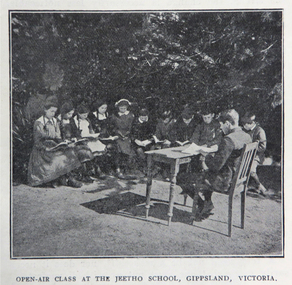
Book, Victoria Education Gazette and Teachers' Aid, 1911-1919, 1910-1919
... Christensen, Charles F. Sydes, H.G. Clements, Norman C. Fricker, J.M. Romeo. Eric N. ...Christensen, Charles F. Sydes, H.G. Clements, Norman C. Fricker, J.M. Romeo. Eric N. ...Black hard covered book with red spine, holding Victorian Education Gazettes for one calendar year. .1) 1910 .2) 1912 .3) 1911 .4) 1914 .5) 1918 Images: Open Air Classroom Black Rock; Open Air Classroom, Jeetho, Gippsland; Open Air Nurses bedroom, Mildura; Gym at Canterbury School ; Babies and Nurses at Melbourne Foundling Hospital; Camp at Portland; Alexander Peacock Opens a Melbourne School; Unveiling Major Mitchell Memorial at Mt Arapiles; Agricultural Plot; School Interior; Swimming Drill; Graham Dux Prize Board; Bathing Place; Classroom with blackboard and pictures; Major Mitchell's Map; Melbourne, Derbyshire; Market Place Melbourne; The Blackwood; World War One Send-off at The Athenaeum; Scarsdale Old Boy's logo; Sloyd articles for the Field Hospital; World War One; Gifts for Transport to the Wharf; soldiers; ANZAC Day; ANZAC Day Medalion .5) 1915: Education Department's War Relief Fund, William Park obituary, Closer Settlement Act 1912, Agriculture, needlework, Swimming and Life Saving, explorers, Gregory Blaxland, Matthew Flinders, Composition, Geography, potatoes, onions, gardens, Needlework for Infants, Iona and Staffa, Trained Primary Teacher's Course, Electricity, Electrical Technology, hygiene, Arbour Day, Horticulture, Wattle Day, Bird Day, Technical Schools, Landing at Gaba Tepe, Evils of Alcohol, Old Boys of Scarsdale, Belgium, Teachers' College Images: The British at War, The Sonnet, History and Patriotism, Male Swimming Teachers Summer School at Geelong, Women Swimming Teachers at Port Fairy, Buln Buln State School, Burwood East State School, needlework plans, methods of Rescue and Resucitation. plan of the journey of Gregory Blaxland, Macquarie House, teachers killed (William Ross Hoggart, Stanley Robert Close, William Roy Hodgson, Campbell McDiarmid Peter, William Henry Dawkins, William Hugh Hamilton, Frederick McRae Neal, Vernon Brookes, Frank J. Olle, Alfred J. Collins, Ernest R. Fairlie, William J. McLaren, A.E. Smith, Thomas Patton, Francis W. Kemp, Frederick G. Hall, Rupert O. Hepburn, Woolston J. Govan), Frederick Harold Tubb VC, Botanic Gardens Red Gum, Shelter Pavillions, Head of Wheat, Australian Commonwealth Flag, Iona Cathedral, Drawing exercises, ANZAC Madallion, School Rolls of Honor .6) 1916 - Nature Study, war relief, school gardening, horticulture, singing class, geography of the war, School Rolls of Honour, Ponsonby Carew-Smyth, Astronomy, ANZAC Day, Empire Day, Arbor Day, "Some Suul of Goodness in Things Evil" by Frank Tate, War Relief Gardeners' League, ANZAC Day medallion, Solar System, Abolition of German Schools in Victoria, ANZAC Avenues, avenues of honour, Geography of the War: The West, War relief and handwork, Victorian State Schools Horticultural Society, Patrick Maloney obituary, formalin lamps, Victoria League of Victoria, Wonwondah East Roll of Honor Images - Teachers killed (John Clarke, A.C.H. Jackson, Alexander Robertson, Noel Gambetta, Ralp E. Leyland, Laurance J. Woodruff, Walter E. Cass, Percy D. Moncur, Thomas M. Carmichael, Edward G. Brain, Reginald N.F. Woods, George E. James, William Colvin, David Dobson, Stanley L. Robinson, Charles Allen, G.E. James, H.F. Curnow, Franl L. Cousins, James R. Thompson, Henry H. Campbell, George E. Read, Ernest D. Morshead, Wilfred S. Merlin, Henry R. Wright, George B. Webb, Noel Nicholas, David H. Thomas, Charles A. Levens, Thomas R. Fenner, John M. Daniell, P.J. Larkin, Ralph Smith, Philip Ormsby), school rolls of honour, Swimming Instructors at Queenscliff, The Southern Sky, Map of the North Sea and its Littorals, Easter School of Horticulture at Oakleigh, Map of the Eastern Front, Map of Mesopotamia, Map of the War Area in the Egyptian Campaign, leeches for the Melbourne Hospital .7) 1917 - Swimming and Life-Saving, Childre's FLower Day, Education Department's War Relief Fund, State War Council, Horticulture, Bird Day, Swimming, Growing Chicory at Cowes Images - Teachers killed during World War One (G.M. Nicholas, William C.W. Spencer, J.W.C. Profitt, Ivon C. Bromilow, John Colwell, Robert W. Campbell, Arthur P. Bourchier, Francid G. Houston, Claude N. Harrison, Edgar Williams, Leslie A. Stevens, Charles E. W. Chester, Stanley R. Green, Walter Baker, Arthur G. Scott, Harry L. Swinburne, Horace W. Brown, Arnold Bretherton, Edward W. Jenkins Aubrey Liddelow, Ewen A. Cameron, Edmund R. Lyall, John H. Martin, Harry Bell, Frank L. Nicholls, Melville R. Hughes, Edwin W. Hauser, Walter S. Filmer, Walter G. Barlow, Henry A. Donaldson, Edward H. Jones, Walter W. Raw, Alfred W. Dean, Wiliam Lea, Frederick G. Drury, J.T. Richards, Norman G. Pelton, Lance-Corporal Doran, Kenneth F. McKenzie, William F. Robertson, Wiliam Jarrott, Norman Graham, George G. Paul, Victor Green, Arthur William Rennie, Alfred J. Glendinning, Robert B. Liston, Eward P. Toll, George Jones, Errol E. Rodda, Christian P. Christensen, Charles F. Sydes, H.G. Clements, Norman C. Fricker, J.M. Romeo. Eric N. Lear, Thomas J. Bartley, Norval Birrell, Frederick H. Tubb. J.T. Hamilton Aram, Arthur Wilcock, William M. Conroy, Alex. H. Miller, Patrick J. Cunningham, Charles S. Mitchell, John R. Maddern, James Roadknight, Harry Arundel, Jack C. McKellar, duncan M. McKellar, George S. Manfield, Edgar C. Holmes, George A. Young, Raymond A. Gardiner, William B. Bell, William Opie, George R. Scott, Richard V.B. Vine, Herbery S. Marshall, Hugh St Omer Dentry, George B. Fullerton, Harry Oulton, Iva F. Morieson), School Honor Books, Drawing, Presentation of 30,000 pounds to the British Red Cross at Melbourne Town Hall .8) 1918 .9) 1919 - Photographs of World War One soldiers from the Education Department, Margaret Montgomery Memorial, 1918 Act relating to State School Teachers, State Scolarships, Victorian State Schools' Horticultural Society, Pneumonic Influenza, Spanish Flu, epedemic, swimming and life savinfJunior cadet training, vacancies in Fiji, School Committees, Arbor Day, Arbour Day, Henry Harding of Yinnar, Planting Trees and Shrubs, Juvenile Crime, The use of 'Get', Soldier-Teachers from Overseas in Congress London, Australia's Effort in the War, Military, Working Bees, Tree Planting, fence building, Welcoming Home a Returned Soldier, Avenue of Honour planting, Discipline, Unveiling an Honor Board, School gymnasium, school tennis court, E. E. Crogger grave at Aldershot, The School Honor Book. War Relief Fund, Commonwealth War Record, Caulfield Military Hosptial, ANZAC Day Pilgrimage, Jimmie Panikin, Donald Fraser, Arthur Mee, Card Sun Dial, Balboa Day in Honolulu, William Hamilton, Alfred Jackson, The Backward Child, Flies, Language Teaching and Learning, Spelling, The Education of the Adolescent, victorian education gazette, education gazette and teachers' aid, sloyd, william a. cavanagh, james i froebel, school, education, world war one, memorials, alfred williams, exploration and settlement, cadets, australian naval college, bernard o;dowd, birds, swimming, drawingempire league, eucalypts, paper in history, forestry, arbor day, identification of trees, forestrey museums, fiji, gravel hill school band, horticulture, hygiene, gould league of bird lovers, life saving, la perouse, bandin, j. holland, w. hamilton, charles sturt, principles of archimedes, james holland, william hamilton, scarsdale old boys' reunion, foundling home melbourne, montessori education, open air schools, james hughes, marie corelli, flinders sydney harbour, major mitchell's map, tooth brushing, r.h.s. bailey -
 Federation University Historical Collection
Magazine - Booklet, Ballarat School of Mines Students' Magazine, 1952, 1952
... c. cartledege...cliff sealey...j. f...Flower, Literary Society, Prominent Personalities, Science School, News and Notes, Prize Presentation, The Apprentices, Boys Sport, Sun Youth Travel Memoirs, The Art School, His Majesty the Late King George VI, Commercial Notes, Gleanings Here and There, Junior School, Girls Sport, Sport, House Notes, Junior Technical School Students', Roll Call - Diploma Students 1952 ballarat school of mines magazine mr bryan c. sanos s. deans j. williams r. simpson c. g. fairbank d. treadwell e. aitkens g. birkett g. allen f. benjamin s. gillespie r. hullick h. mccallum h. harris j. walton e. walsh j. stevens b. clark rupert p. flower john bechervaise w. keith hindson a. james tinney walter c. tooth john d. bethune vilma sansom betty clark travers duncan joyce wilson lex lockhart jim w. beattie joyce stevens slim ingleton a. eddy john howard douglas george dean edgar bartrop colin mck. henry tom adams max kennedy jeff coward o. j. nilsen j. skuja s. rowe w. maddox a. kinnane d. fraser a. carpenter john james b. flavel j. murray d. schmidt g. habel t. duncan l. matthews n. spiers b. smith a. tonnisseu r. ingleton j. bethune j. mills j. mcneil b. schreenan w. carlyon d. stevens l. j. hillman k. hindson r. furlong j. beattie b. taylor g. heyes l. quilliam r. archer a. johnson m. gillin t. seabrook m. phillips j. sawyer c. restarick j. saggers g. ditchfield j. tinney don stewart j. faneco m. stevens w. tooth ron simpson bill maxwell graham searle jim tinney k. treloar j. barnes s. j. deans lynette j. blomeley georgina cox heather mcgregor janet saunders heather harris elizabeth mcarthur norma coffield pat lavery imelda lee gloria white valerie westbrook cynthia stone janice thompson clare mooney glenys perry faida lewis betty clarke marion volk isla veal valerie yates coralie mckenzie lorraine digby barbara henderson deidre wilson margaret henderson barbara ngip glenys sleeth anne duncan l. dwyer elaine leishman j. jenkin stirling gillespie w. bridges b. baldock b. braybrook e. mackie r. braybrook c. grose b. mackie c. garnham c. schmidtke t. lugg j. copeman b. tozer g. mathews n. sutherland r. lambert j. sanders m. quick j. collier g. pike r. digby r. quayle r. sharp n. brogden r. lyons p. stevens j. bastin b. kay k. duncan b. golding l. norman b. murnane k. hocking c. sealey b. langdon f. weightman m. birch r. stevenson r. stewart r. haintz k. mccoll k. jarvis l. hocking d. curtain r. lazarus e. boak j. fletcher b. orchard j. squires n. pike j. shrader l. reynolds m. ritchie g. smith d. parkes g. templeton m. wunhym v. vincent d. robertson d. lang l. horwood d. searle d. new v. jolly a. minotti b. beaumont m. marshall e. bowen j. rogers d. cody e. kinnane j. cunningham j. schrader r. horgan j. white n. flood j. matthews h. gale k. mitchell v. rowse j. mayne a. gilbert b. warrillow g. gilbert n. quick m. hall d. furlong n. lyons j. richards j. jones l. major d. baldock d. dow g. ruddick d. howell j. caddy b. singleton b. powell r. sharpe c. lockhart l. daff c. sharpe d. irish l. dow a. douglas n. twaites j. courtney l. beacham n. c. cartledege cliff sealey j. f. collier e. g. mackie m. g. quick b. l. collinson j. n. bastin g. e. timmins valerie mills j. a. jenkin w. cowan i. mitaxa n. c. leckie r. j. austin n. coffield d. quilliam r. courtney f. m. kilfoyle p. nunn King George VI Pale blue soft covered magazine with navy blue titles. ...School Council, Members of Staff, Editorial, Principal's Page, Magazine Committee, Obituary - Rupert P. Flower, Literary Society, Prominent Personalities, Science School, News and Notes, Prize Presentation, The Apprentices, Boys Sport, Sun Youth Travel Memoirs, The Art School, His Majesty the Late King George VI, Commercial Notes, Gleanings Here and There, Junior School, Girls Sport, Sport, House Notes, Junior Technical School Students', Roll Call - Diploma Students 1952 Pale blue soft covered magazine with navy blue titles. ballarat school of mines, magazine, mr bryan, c. sanos, s. deans, j. williams, r. simpson, c. g. fairbank, d. treadwell, e. aitkens, g. birkett, g. allen, f. benjamin, s. gillespie, r. hullick, h. mccallum, h. harris, j. walton, e. walsh, j. stevens, b. clark, rupert p. flower, john bechervaise, w. keith hindson, a. james tinney, walter c. tooth, john d. bethune, vilma sansom, betty clark, travers duncan, joyce wilson, lex lockhart, jim w. beattie, joyce stevens, slim ingleton, a. eddy, john howard, douglas george dean, edgar bartrop, colin mck. henry, tom adams, max kennedy, jeff coward, o. j. nilsen, j. skuja, s. rowe, w. maddox, a. kinnane, d. fraser, a. carpenter, john james, b. flavel, j. murray, d. schmidt, g. habel, t. duncan, l. matthews, n. spiers, b. smith, a. tonnisseu, r. ingleton, j. bethune, j. mills, j. mcneil, b. schreenan, w. carlyon, d. stevens, l. j. hillman, k. hindson, r. furlong, j. beattie, b. taylor, g. heyes, l. quilliam, r. archer, a. johnson, m. gillin, t. seabrook, m. phillips, j. sawyer, c. restarick, j. saggers, g. ditchfield, j. tinney, don stewart, j. faneco, m. stevens, w. tooth, ron simpson, bill maxwell, graham searle, jim tinney, k. treloar, j. barnes, s. j. deans, lynette j. blomeley, georgina cox, heather mcgregor, janet saunders, heather harris, elizabeth mcarthur, norma coffield, pat lavery, imelda lee, gloria white, valerie westbrook, cynthia stone, janice thompson, clare mooney, glenys perry, faida lewis, betty clarke, marion volk, isla veal, valerie yates, coralie mckenzie, lorraine digby, barbara henderson, deidre wilson, margaret henderson, barbara ngip, glenys sleeth, anne duncan, l. dwyer, elaine leishman, j. jenkin, stirling gillespie, w. bridges, b. baldock, b. braybrook, e. mackie, r. braybrook, c. grose, b. mackie, c. garnham, c. schmidtke, t. lugg, j. copeman, b. tozer, g. mathews, n. sutherland, r. lambert, j. sanders, m. quick, j. collier, g. pike, r. digby, r. quayle, r. sharp, n. brogden, r. lyons, p. stevens, j. bastin, b. kay, k. duncan, b. golding, l. norman, b. murnane, k. hocking, c. sealey, b. langdon, f. weightman, m. birch, r. stevenson, r. stewart, r. haintz, k. mccoll, k. jarvis, l. hocking, d. curtain, r. lazarus, e. boak, j. fletcher, b. orchard, j. squires, n. pike, j. shrader, l. reynolds, m. ritchie, g. smith, d. parkes, g. templeton, m. wunhym, v. vincent, d. robertson, d. lang, l. horwood, d. searle, d. new, v. jolly, a. minotti, b. beaumont, m. marshall, e. bowen, j. rogers, d. cody, e. kinnane, j. cunningham, j. schrader, r. horgan, j. white, n. flood, j. matthews, h. gale, k. mitchell, v. rowse, j. mayne, a. gilbert, b. warrillow, g. gilbert, n. quick, m. hall, d. furlong, n. lyons, j. richards, j. jones, l. major, d. baldock, d. dow, g. ruddick, d. howell, j. caddy, b. singleton, b. powell, r. sharpe, c. lockhart, l. daff, c. sharpe, d. irish, l. dow, a. douglas, n. twaites, j. courtney, l. beacham, n. c. cartledege, cliff sealey, j. f. collier, e. g. mackie, m. g. quick, b. l. collinson, j. n. bastin, g. e. timmins, valerie mills, j. a. jenkin, w. cowan, i. mitaxa, n. c. leckie, r. j. austin, n. coffield, d. quilliam, r. courtney, f. m. kilfoyle, p. nunn, king george vi -
 Federation University Historical Collection
Magazine, Ballarat School of Mines Students' Magazine, 1898-1901, 1898-1901
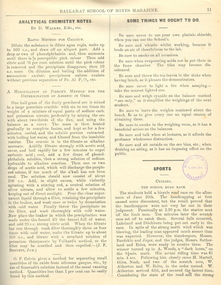
... F. and J. Mawl * On the Choice of Drawing Instruments * Summaries and Notes From the Technical Journals * Annual Examinations 1900 * New Students * Sporting Notes * The Vale of Coolgardie Mine, Bonnievale, W.A. by G. Stephen Hart * News and Notes (Kerr Grant, C.L. Nash, R. Gordon Todd, Vial) * Editorial Notices Vol 4., No 2, Second Term 1901 * The Metallurgical Treatment of Sulpho-Telluride Ores by L.W. Grayson * Some Metallurgical Difficulties of Aluminium * Diehl's Sulphide Process by A.E. C ...Bound copies of the Ballarat School of Mines Students' Magazine, 1898-1901 Vol 1, No. 1, September 1898 * News and Notes (Ballarat School of Mines Museum, J.F. Usher, New British Pharmacopoeia, excursion to Bendigo) * History of the Ballarat School of Mines * Current Topics (Federation, Gladstone, Anglo-American Alliance) * Of Custom * Discovery of Coolgardie * Mining Notes(Clunes, Pitfield, Birthday Mine, Western Australia, Transvaal, Mt Bischoff, Rand Drill Co.) * From the Journals * The Societies - (Student Association, Ballarat Field Club and Science Society, Ballarat Photographic Club) * Original Poetry * Sports * Students' Association Committee Meetings * On the Increase of Temperature of the Earth With Increased Depth Vol 1, No. 2, October 1898 * Notes about some of the Past Students (E.M. Weston, J.A. Porter, H.R. Sleeman, G.E. Sander, B.C.T. Solley, T. Rhys, C. Burbury, D. McDougal, J. Matsen) * Excursion to Daylesford, p.3 * History of the Ballarat School of Mines (continued) * The Soudan * Greater Melbourne * Image of J. Hopkinson, electrical engineer killed ascending the Alps * What is Science * Mining Notes (Pitfield Plains, Victoria United G.M.Co., Lithgow, Avoca, great Cobar, Mt Whycheproof) * Student's Association (women's franchise) * Sports Vol 2, No. 1, March 1899 * News and Notes * History of the Ballarat School of Mines (continued) * Notes of Victorian Geology, 1. Granites, by Thomas S. Hart * Sir William Crookes * Summaries and Notes from the Mining Journals * Students' Association * Sports * The Bush Assayer * Solubility of Gold-Silver Alloys in Potassium Cyanide * Correspondence Vol 2, No. 2, April 1899 * News and Notes (Smythesdale Excursion, New Buildings, A.S. Coyte, R.J. Allan) * History of the Ballarat School of Mines (Continued) * The New Students (J. Owen, A. Clayton Morrisby, A.S. Atkin, J. Alexander Reid, Alfred G. Johnston, L. Lowe, F.H. Dalton, W.M. Robertson, A. Hacke, H.L. Giles, W. Martin, E. Walshe, H.L. Krause, R. Sawyer) * Berringa by Oh'E Jay * Summaries and Notes from the Mining Journals * Mount Magnet to Victoria - A Long Bicycle Trip * 1898 Examination returns * Sports Vol 2, No. 3, May 1899 * Technical Education and the Proposed Affiliation of the Schools of Mines with the Melbourne University. * Laying of the Foundation Stone of the New Classrooms (now Administration Building). Alexander J. Peacock * News and Notes (Past Students - A.S. Lilburn, J.W. Sutherland, J. Richardson, E. Prendergast, J. Wallace, J. Kidd, J. Lake, Mathew Thompson), Coolgardie Exhibition. * Trip to Lal Lal * Students' Association * Summaries and Notes from the Mining Journals * Professor Henry Louis on Mining Education * Corrections Used in Chaining by C.W. Adams * The Black Horse Cyanide Plant * Sports * Completed List of 1898 Examinations Vol 2, No. 4, June 1899 * News and Notes * The Education Problem by D.N. McLean * A Few Hints on Histological Technique by Emil Gutheil * Summaries and Notes from the Mining Journals * Students' Association * A Visit to the Skipton Caves (Mount Widdern, Ormand Hill, volcano, Emu Creek, Mount Kinross, Mount Elephant, Mount Vite Vite, Mount Kinross, Mount Hamiston) * Mount Magnet To Victoria (cont) * The New Engines at the Ballarat Woollen Mills - includes image of the Compound 700 H.P. Engines constructed for the Ballarat Woollen Mills by Austral Otis Company and consulting engineers Monash and Anderson. * Sports * Original Poetry * Correspondence Vol 2, No. 5, July 1899 * News and Notes (E. Byron Moore, Visit to Britannia Gold Mine, J. Bryant, Visit to Last Chance Mine) * A Few Hints on Histological Technique (cont) by Emil Gutheil * Summaries and Notes from the Mining Journals * Professor Alfred Mica Smith (includes image) * Notes on Victorian Geology Part 2 The Trappean Rocks, by Thomas Hart * Origin of Diamonds * Hydraulic Mining by A.E.C. Kerr * Volcanoes by F.G. Bonney * Analytical Chemistry Notes by Daniel Walker * Some Things Out To Do * Sports * Correspondence Vol 2, No. 6, August 1899 *Summaries and notes from the Mining Journals * Some Regulations of the Academy of Mines at Freiberg * A visit to Mt Lyell Smelters * Professor Gilbert J. Dawbarn (includes image) * Air compressor and Transmission of Power by Compressed air by A.E.C. Kerr * Chemistry Notes by Daniel Walker * Mineralogical Notes, Ballarat by Thomas S. Hart * Kalgurli Gold Mines, W.A. * OUr New Lab Vol 2., No 7, September 1899 * Summaries and Notes from the Mining Journals * Some recent Steam Plants at Bendigo by Gilbert Dawbarn * Professor Thomas Stephen Hart (includes image) * Students Association * Notes on Victorian Geology by Thomas Hart * Centrifugal Pumps * A New Chum's Experience by E.M. Weston Vol 2., No 8, October 1899 * The institute of Chemistry Examinations * A New Method of Qualitative Chemical Analysis by Emil Gutheil * Steam Engine Valves and Valve-Gears by Gilbert Dawbarn * Daniel Walker (includes image) * Notes on Victorian Geology by Thomas Hart * Cyaniding Cripple Creek Tellurides (Metallic Extraction Company) * Notes on Two Ballarat Gravel Pumping Plants, G.A. Wilberforce (Eureka Jennings Co and Yarrowee Sluicing Co) * History of the School of Mines (concluded) Vol 3., No 1, March 1900 * A Journey from Natal to Mashomaland with the British Police * A Plea for Research * New Caledonia by C.A.M. Deane * Notes of Victorian Geology - Lower Palaeoroic Rocks by Thomas Hart * Mt Bischoff Mine and Mill * Summaries and Notes from the Mining Journals * Things we Eat and Drink * Farewell to A.S. Coyte Vol 3., No 1, March 1900 * Mining Education * Model Locomotive made by the apprentices of the Phoenix Foundry, p2 * Glimpses of Rhodesian Police Camp Life * New Caledonia (continued) * Summaries from the Mining and Engineering Journals * Boot and Saddle Vol 3., No 3, May 1900 * A Students' Common Room * Geological Excursion to Hardie's Hill * Notes on Victorian Geology by Thomas Hart * The Planet Venus by John Brittain * Summaries and Notes from the Australian Mining Standard * The Assay Ton * Zeehan Smelters * Electrical Notes by Ohe Jay * Trop of the Cricket Club to Stawell * Students' Association * Solid Hydrogen Vol 3., No 4, June 1900 * The Minister of Mines on Mining Education (Minister A.R. Outtrim) * Lal Lal Geology Trip (Thomas Hart) * Rifle Club now defunct, pg 3 * A Contribution to the Mining Geology of Kalgoorlie, W.A. by Ferdinand Krause (includes cross sections) (Wood's Point, Rand, Johannesburg, South Africa, Gaffney's Creek, Walhalla, Shady Creek, Sago Hill at Cardigan, Bunbury) * Summaries and Notes from the Australian Mining Standard (Buninyong Estate Mine) * Monthly Progress Reports of the Geological Survey * Electrical Notes by John M Sutherland (Telagraphone, phonograph, telephone receiver) * Students' Theatre Party (Gordon Todd, Ohe Jaeger, C.S. Wakley) * Opening of the New Buildings - Ministerial Speeches (Outtrim, W.H. Irvine, New Mining Laboratory, Old Chemistry Building, Battery, Model Mine) * Students' Association * Relief of Mafeking * A Critic Criticised * Things We Eat and Drink by Ohe Jay - Oatmeal, Coffee and Cocoa. Vol 3., No 5, July 1900 * Research * Adelaide Varsity Students at Ballarat * The Manchester-Liverpool Mono Railway * Students Association * *A Contribution to the Mining Geology of Kalgoorlie, W.A. by Ferdinand Krause (continued) (includes cross-sections) * Motive Power, address by Charles A. Parsons * Summaries and Notes from the Australian Mining Standard * Sugar Manufacturing by Sugna * Great Creswick Hydraulic Sluicing Plant (THomas Hart, Ballarat School of Mines Mining Class visit) * Reminiscences of a Students Life in Germany * Football - Ballarat School of Mines v Geelong Grammar School (Australian Rules Football) Vol 3., No 6, August 1900 * Cheap Mine Management * Library * Bendigo School of Mines, pg 3 * Notes on Ore Dressing by T, Vincent, Manager The Zeehan (Tas) Silver-Lead Mines Ltd) * Motive Power * Notes on Broken Hill - Its Mines and Minerals by J. Williams * The Concert * Summaries and Notes from the Australian Mining Standard * The Dandy Duke's Dreadful Demise * The Road Race Vol 3., No 7, September 1900 * Michaelmas Excursion (Melbourne University, Prof Kernot, Applied Mechanics) * Injury to School Property * Return of E. Ditchburn (Boer War) * Mt William Gold-Field visit, pg 3 * The Stoping of Wide Lodes by J.V. Lake (includes cross sections) * Summaries of Notes from the Australian Mining Standard * Notes on Broken Hill Part 2- Its Mines and Minerals by W.J. Williams * Motive Power from the Waves * Electrical Notes * Some Account of Italian Mining (Sarinia, Sicily, Peidmont, Lombardia) by Candido Maglione * Students Association * Should Women Have the Vote by Frank Bessemeres * The School Theatre Parly * Past Students * Poetry * Football * Surveying Rules Vol 3., No 8, October 1900 * Ballarat School of Mines Associateship * An Engineering Laboratory * Students' Practical Work * Notes on Broken Hill Part 3 by W.J. Williams * The Lake View Consols by F.S. Earp - Battery Treatment of Sulpo-Telluride Ore * Neglected Mineral Fields - Eurowie and Warrata * A Glimpse Ahead * News and Notes * A.W. G. McPherson, Boer War * Students Association * Ballarat School of Mines Melbourne Excursion to the Government Electric Lighting Station, Austral-Otis Co, Working Mens College * Ballarat School of Mines Concert in Aid of Soldiers Statue Balance Sheet * Football * Cricket Vol 3., No 8b, November 1900 * Position of the Ballarat School of Mines with Regards to Mining Education * Age Limit * Entrance Examination * Presentation t0 Professor Alfred Mica Smith * Image of a Group of Old Ballarat School of Mines Students in Coolgardie and Kalgoorlie. * Students Association Vol 4., No 1, March 1901 * Espirit De Corps * A few Notes on the Testing of Explosives * Round About Inverell, NSW by F. and J. Mawl * On the Choice of Drawing Instruments * Summaries and Notes From the Technical Journals * Annual Examinations 1900 * New Students * Sporting Notes * The Vale of Coolgardie Mine, Bonnievale, W.A. by G. Stephen Hart * News and Notes (Kerr Grant, C.L. Nash, R. Gordon Todd, Vial) * Editorial Notices Vol 4., No 2, Second Term 1901 * The Metallurgical Treatment of Sulpho-Telluride Ores by L.W. Grayson * Some Metallurgical Difficulties of Aluminium * Diehl's Sulphide Process by A.E. C. Kerr * A Californian Gold Mine by A.E. C. Kerr * New Express Locomotives for the Victorian Government (Phoenix Foundry) * An Excursion to Geelong (Electric Light and Traction Company of Australia) * The Linkenback Table for our New Mining Laboratory (Humboldt Company of Colgne) * Death of Thomas Bath * The Late Alfred G. Johnson (Boer War) * An Introduction to Natural Science by Emil Gutheil * The First Annual School Sports Meeting * Concert in Aid of Magazine Funds * The Men That Made the Concert (C.E. Denniston, W.H. Chandler, Mr White, William Litte Jnr, Marriott, Giles McCracken) * Sports * News and Notes Vol 4., No 2, Third Term 1901 * Bagging-Up - A Sketch * Concentration of Difficult Silver-Lead Ores * Estimation of Chlorine, Bromine and Iodine by D. Runting * Summaries of Notes from teh technical Journals * Notes on the Use and Care of Platinum Ware Common Sense * The Machinery at the Tasmania Gold Mine, Beaconsfield, Tasmania * Mining at Walhalla - The Long Tunnel Mine * Past Students * Mapping our of Agricultural Areas, etc, In Dense Vine Lands, North Queensland by R.A. Suter * News and Notes * Concert Balance Sheet e.m. weston, robert brough smyth, mcdougall, bruce, charles burbury, harrie wood, graham j. hopwood, emil gutheil, daniel walker, thomas hart, thomas stephen hart, m. hacker, schnitzler, f.a., ditchfield, l.h, alfred e.c. kerr, charles harvey, campbell, joseph bryant, campbell & ferguson, gilbert j. dawburn, irving, g.b., kerr, a.e.c., john walter sutherland, william robertson, herbert l. krause, alfred mica smith, binh pham, crosbie, d. jack, ditchburn, j., james hiscock, alfred johnston, reid, j.a., kidd, john, james bonwick, james, j.p, overall, d, e.h salmon, gaynor marquand, williams, w.w., williams, william, deane, c.m., vincent, tom, phillips, g.e., hart, d.w., jarnail suingh, rowlands, e., ferdinand m. krause,, easterby, f.l, parsons, r.g., partington, j.r., vial, s.b., meadows, h, atkins, arthur, john braisted burdekin, w.h. corbould, ditchburn, john, hill, john, otto e. jager, mcpherson, g.t, nicholls, c, thom, j.m., crafter, stewart, john brittain, peter lalor, hardy - commissioner, thomas bath, alf johnston, charles campbell, nash, llewellyn, watson, m.a, gardener, eddie, adamson, s.g, alford, l.c, allen, r.j, arthur, d.w.b., burge, a., willia, cairncross, cooper, i, maurice osric copland, maurice copland, dickinson, s., doepel, dunstan, john, loveday dunstan, eeles, terri, flegeltaub, israel, fletcher, a, fyrar, peter, kerr grant, w.kerr, green, gary, betty harris, harris, c.m., hay, a.l., hearn, hill, martin, james, david, johnston, alfred g, kilner, marion, kingston, thomas, lewin, f.c.k., lilburne, arthur m, linahan, colin, macready, w.h, major birlefco, markwald, henry, mccaffrey, mcfarlane, kaye, mciver, s.k, mellins, b, morton, felicity, w. kenneth moss, ken moss, nash, c.w., nash, neville, nickolls, berkeley, osborne, percy, philp, e., playford, william, reid, e, roberts, gordon, ross, f.c., royce, phillip, sawyer, basil, stewart, r.c., todhunter, i, vaisey, a., vincent, john, vinden, sue, wakley, cecil, watt, james, westcott, lewis, charles w. whyte,, vial, s browning, ballarat school of mines students in coolgardie and kalgoorlie, coolgardie, kalgoorlie, claude maitland, a.l. hay, a.s. lilburne, latham watson, arthur kildahl, thomas copeland, f.a. moss, w.a. hearman, cardoc james, alexander fraser, e.o. watt, g.m. roberts, j.j. dunstan, h.v. moss, j.a. hill,, john dunstan, c.m. harris, william h. corbould, j.w. sutherland, ballarat photographic club, ballarat field naturalists club, ballarat field club and science society, photography, geology, excursions, last chance mine, tasmania gold mine, beaconsfield, tasmania, rand, south africa, mount lyell, ballarat school of mines student excursion to mount lyell, h.l. krause, ferdinand krause, krause, hardie's hill, hardie's hill excursion, lal lal, lal lal excursion, lal lal geology excursion, smythesdale, smythesdale excursion, soudan, south african miners, south star mines, wynne and tregurtha battery, ananconda copper mining, arizona copper mining, boiler plates, british guinea, butte copper smelter, daylesford geology camp, daylesford excursion, diehl process, electric power house ballarat, electric pumps, geelong rope factory, gympie, golden horseshoe estate, c johnstone, jack nichol, c. macgennis, alec saunders, alfred g. johnstone, graeme jolly, william purdie, john mann, maxwell l gaunt, sale school of mines, freiberg school of mines, schools of mines, railway locomotive -
 Federation University Historical Collection
Book - Ledger, Ballarat School of Mines Assay and Analysis Ledger, 1887-1890, 1887-1890
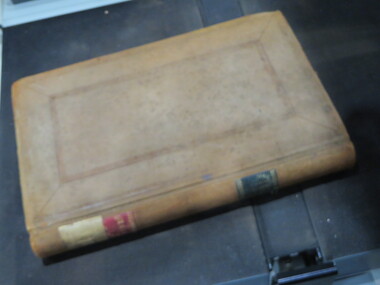
... The report includes information the the Ballarat School of Mines museum and the search for geological specimens from all Australian colonies for the collection. .5) A 'rough' assay report on samples of stone submitted by H. Major Senr, Wilcannia, New South Wales. 5) A 'rough' assay report on sample quartz drillings from quartz reef submitted by H. ...The Ballarat School of Mines had a 'Model Mine' that was used to teach students. Practical work was undertaken for a fee, supervised by laboratory superintendents. Copies of assays undertaken are compiled together in this book. Leatherbound ledger with transfer copies assay reports from the Ballarat School of Mines. Those seeking assaying work from the Ballarat School of Mines are listed in alphabetical order in the front of the ledger. The ledger contains 543 pages. .2) Foolscap assay report on foolscap Ballarat School of Mines letterhead, and signed by Alfred Mica Smith, Superintendent of Laboratories. The report was on eight samples of Quartz submitted by R.C. Morgan, Scotts, Hotel, Melbourne .3) Assay report on Ballarat School of Mines letterhead, dated 14 August 1985, and signed by Andrew Berry, Registrar. The assay was supervised by Professor Alfred Mica Smith, and undertaken for James Burke, Broken Hill, New South Wales. .4) Assay report on Ballarat School of Mines letterhead, dated 18 August 1988, and signed by Alfred Mica Smith, Superintendent of Laboratories. The assay was undertaken on samples of Limonite submitted by James Burke and others, Broken Hill, New South Wales. The report includes information the the Ballarat School of Mines museum and the search for geological specimens from all Australian colonies for the collection. .5) A 'rough' assay report on samples of stone submitted by H. Major Senr, Wilcannia, New South Wales. 5) A 'rough' assay report on sample quartz drillings from quartz reef submitted by H. Morris, Egerton, and an sample of quartz and pyrites for determination by Professor Krause submitted by R.M. Serjeant. ballarat school of mines, a.c. allan, brittania g.m. co., s. body, black horse company, john m. bickett, william bell, james barker, w. bliss, w. bailey, william barrou, w.h. batten, w. bechervaise, band and albion, budd bros, charles barker, i. cahir, a. chamber, w. cahill, james coglan, d. clarke, a.w. dobbie, john dosett, john dunstan, j.a. evans, l. eggleton, charles forbes, d. fitzpatrick, e. ford, michael goold, j. graham, john greenwood, james hayes, ed hardy, arthur harvey, george hodges, john hall, jubilee gold mining company, krause, luplau, lempiere, mt lyell co, john law, ed meadway, john murray, j.h. middleton, c.m. miles, m. muir, e. mcmillan, w. mcdougall, c. napier, w.r. nicholls, napier freehold, w.b, ochiltree, oakleigh gold mining company, dr pinnock, c. quin, james ross, c.b. retallack, e. rowlands, royal standard, linton, frank rabling, william russell, charles soloman, f. selby, w.j. scott, sulieman pasha co, south clunes united, h.w. sinclair, george selby, e.h. schroeder, horsham, e.w. spain, c.h. sheary, sir henry loch gold mining company, a. sutherland, saxon consols, j.b. triggs, h. townsend, harold turnley, c. taylor, melbourne, c. thorpe, a. vandenberg, charles walker, charles wilson, thomas wellington, a. wynne, r. warne, e. wattis, john wood, walter warner, armidale, c. winterbottom, w.l. willliams, j.c. young -
 Ballarat Clarendon College
Photograph, 1923 (exact)
... There are 6 adults in the photograph. Principal Major A.S.M. Polson is clearly identified. ...There are 6 adults in the photograph. Principal Major A.S.M. Polson is clearly identified. ...This named photograph is an excellent record of the 80 strong student cohort of 1923. There are 6 adults in the photograph. Principal Major A.S.M. Polson is clearly identified. Top row (Left to right) G Den – E Beacham – J B Coutts – J C Besemeres – G Naismith – M Levy – G N Witter – J C Loughrey – G Bredby – A P McLean – B Currie – W A Kilpatrick – G Clark – E Wearne – R Monteith 2nd row from top L T Wotherspoon – W A Stickland – E Campbell – A Bell – H Thomas – W A Paterson – E? Lyne – J Leishman – E J Forbes – J M Gray – J H Burr – J Creer - ? – C? Morgan – J Hammon 3rd row from top D A Miller – A G Shaw – W John – J Moorhouse – G L Scott – A Levy - ? Ford - ? Gill – T G Dowling – D Campbell – W McLean – J E Coutts - C? Carthew – D Douglas – A L McLean 4th row from top A M Greenfield - ? - M Featonby – G Leishman – J Woodward – Mr F R Potts BSc – Mr D S Coutts BA – Mr A S M Polson Principal – Miss Gilbert – Mr G Hay – A J Besemeres - ? - ? – R G Bradby – H F Brind 5th row from top R Buchanan - ? – M Symons – J Riddle - ? Goon - ? Symons - ? Komesarook - ? Fairey - ? – B Ronaldson - ? Buchanan - ? - ? – M Whiteside – Pat Shaw – J Groat - ? Front G P Jeffrey - ? Goon – R G Dowling – H M Greenfield – G Dale – A Hall-Jones – A Baker – J L Price – K McLean – E M Price Mounted black and white photograph of the Ballarat College student cohort in 1923. Cohort are arranged on tiered rows in front of timber external staircase. First row sitting cross-legged on ground. Second and third rows seated. Fourth, fifth and sixth standing on tiers. The photograph is mounted on grey cardboard. J. M. Gray written in ink on back of mount. Pencilled initials 'J.M.' also on back of mount. Photograph is accompanied by photocopy of photograph and handwritten papers detailing names of those in photograph. These papers are signed by Grant Coutts. J. M. Gray is identified as tenth from left on second top row. J.M. ballarat, 1923, college, j m gray, major a s m polson, student cohort -
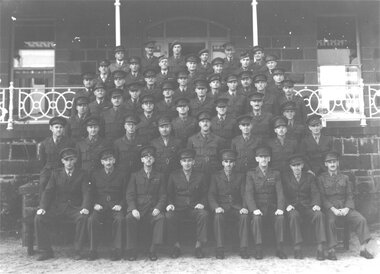 Lara RSL Sub Branch
79th Fighter Squadron, Wooloomanata
... A.E.Bunbury, Lt-Col. E.W. Bundey, Major W.A. Cronk, Capt. B.V. Eames, Lt. N.D. ...A.E.Bunbury, Lt-Col. E.W. Bundey, Major W.A. Cronk, Capt. B.V. Eames, Lt. N.D. ...The 79th Fighter Squadron was initially formed at Laverton on the 26th April, 1943 under the command of flying ace Squadron Leader Alan Rawlinson, but within seven days moved to Wooloomanata Homestead on the Geelong-Bacchus Marsh Rd, No 1580 in Victoria. It was a Spitfire Squadron and used Wooloomanata as a training base before flying. It was disbanded 20th October, 1945. Of national Significance as a Spitfire Squadron training camp in Lara Districts during WW2 Glossy photo and A4 document On the back of the photo is "No:15 Course 18th April 1943 on the steps of Wooloomanata Homestead Southern Side". On the bottom is a list of the names of those in the photo. Left to Right Rear Row: Maj. K. Ewen, Capt. N.F. Attree, Capt. C.N. Bucknell, Capt. J.L. McKenzie, Capt. C.D. Seabrook, Lt. W.G. Foley. Second row from rear: Maj. C. Dumble, Capt. A. Tavener, Maj. F. Langford, Maj. T.A.R. Cleave, Capt. M.D. Waller, Capt. J.B. Ainslie, Capt. G.M.Taylor. Third row from rear: Capt. E.K. Jennings, Lt. J.H. Loxton, Capt. D.J. Breheny, Lt. R.V. Stephens, Capt J.W.D. Cornell, Maj. C.A. Ricketts, Lt. A.R. Creswick. Fourth row from rear: Lt. W. Ruthven (V.C.), Capt. R.C. Tomkins, Capt. R.J.Bermingham, Maj. A.E. Arnott, Capt. L.S. Ralton, Maj. F.L. Edmunds, Capt. W.E. Paterson. Fifth row from rear: Maj. H.W. Stockwell, Capt. C.A. Ferry, Maj. A.C. Jennings, Capt. W.L. Hart, Maj. R.R. Marston, Capt. R.A. Cameron, Capt. R.W.M. Page. Sixth Row from rear: Lt. A.E. Pizzy, Capt. A.G. Yungman, Maj.T.G. Court, Maj. J.B. Chapman, Maj. H.F. Gough, Maj. P.L. Barbour, Maj. H.M. Heward, Maj. E.C. Nolte. Front Row: Lt. G.H. Rowden, Capt. C.J.F. Pollett, Maj. A.E.Bunbury, Lt-Col. E.W. Bundey, Major W.A. Cronk, Capt. B.V. Eames, Lt. N.D. Anderson, Maj. C.A. Lotherington. Absent: Lt. R.R. Webster, Lt. R.B. Blackwell The A4 is a written description of a brief history of the 79th Fighter Squadron 79th fighter squadron, raaf, wooloomanata, spitfire, world war 2, ww2, peter anderson, southern command training school, 15 course 18th april 1943 -
 Flagstaff Hill Maritime Museum and Village
Book - A Fictional Story, Jules Verne et al, The Giant Raft Part 2, The Cryptogram, 1885
... It was Verne’s first major work to centre on cryptography, the solving of the cryptogram becomes the central feature, representing a sophisticated treatment of cipher analysis compared to his earlier superficial treatment in “Journey to the Centre of the Earth.” ...The Giant Raft is a two part adventure novel set on the Amazon River part 1 “Eight Hundred Leagues on the Amazon” was primarily a geographical tale following the journey through tropical forests and the prairies of Peru and Brazil. Part 2 “The Cryptogram.” The cryptogram is a cipher mystery that becomes the central theme with geographical interest subordinate to the plot. This revolves around ranch owner Joam Garral, living near the Peruvian Brazilian border and is wanted in Brazil for a crime he didn't commit. He travels downstream on a giant timber raft with his family to Belém at the river's mouth, hoping to restore his good name. A scoundrel named Torres possesses an encrypted letter that could exonerate Joam, but demands Joam's daughter's hand in marriage for it. When Torres is killed, the Garral family must race to decode the Gronsfeld cipher before Joam faces execution.Hard Cover: The Giant Raft (Part II) The Cryptogram Author: Jules Verne Publisher: Sampson Low, Marston, Searle & Rivington Date: 1885 Blue hardcover book with cloth fabric cover. Original library sticker. A line drawing on the fly page is within a circle bordered by a vine plant. Within the circle is a man dressed in a suit, wearing a cravat, holding an unravelled scroll with marks like a crossword, and tugging at a vine wrapped around his neck. Title and Author written in black texter to the spine. fiction The Giant Raft is a two part adventure novel set on the Amazon River part 1 “Eight Hundred Leagues on the Amazon” was primarily a geographical tale following the journey through tropical forests and the prairies of Peru and Brazil. Part 2 “The Cryptogram.” The cryptogram is a cipher mystery that becomes the central theme with geographical interest subordinate to the plot. This revolves around ranch owner Joam Garral, living near the Peruvian Brazilian border and is wanted in Brazil for a crime he didn't commit. He travels downstream on a giant timber raft with his family to Belém at the river's mouth, hoping to restore his good name. A scoundrel named Torres possesses an encrypted letter that could exonerate Joam, but demands Joam's daughter's hand in marriage for it. When Torres is killed, the Garral family must race to decode the Gronsfeld cipher before Joam faces execution. warrnambool, shipwrecked-coast, flagstaff-hill, flagstaff-hill-maritime-museum, maritime-museum, flagstaff-hill-maritime-village, shipwrecked-artefact, book, warrnambool mechanics’ institute, pattison collection, warrnambool library, corangamite regional library service, warrnambool city librarian, mechanics’ institute library, victorian library board, warrnambool books and records, warrnambool children’s library, ralph eric pattison, jules verne, voyages extraordinaire series, l’école des robinson's -
 Orbost & District Historical Society
Album - Snowy River Collection, Max and Glenice White, The Snowy River Max and Glenice White Collection, 2021
... B: 1995 C: 1996 D: 1997 E: 1998 F: 1999 G: 2000 H: 2002 I: 2003 J: 2004 K: 2006 It bought together many communities up and down the Snowy River. ...This is a collection of information re: the Snowy River Campaign 1995 to 2006. It is divided into sections titled A: Pre Damming of the Snowy River. B: 1995 C: 1996 D: 1997 E: 1998 F: 1999 G: 2000 H: 2002 I: 2003 J: 2004 K: 2006 It bought together many communities up and down the Snowy River. About their concerns, about the effects of the much reduced water volumes in the River, as a result of the dams up-river built by the Snowy Mountains Scheme. This item is significant because it is a record of a major campaign to increase water flow into the Snowy River down stream from the Jindabyne dam. A blue folder containing a collection of photos, paper clippings, reports, printed documents. The Snowy River, Max White Collection, Snowy River Alliance notes; Inquiry papers; Newspaper cuttings; pamphlets. snowy river, campaign -
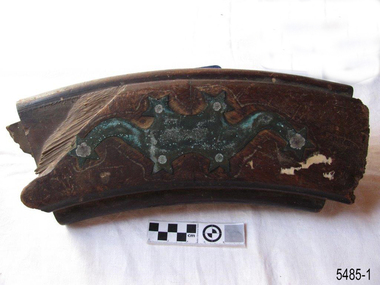 Flagstaff Hill Maritime Museum and Village
Functional object - Ship's Wheel, 1871 or earlier
... F. Lawrence second mate, Ned Sewall third mate and owner’s son, John French the cook, C. ...The ship building company E. & A. Sewall, from Bath, Maine, USA, built many ships that had wheels with the same decorative, starburst pattern on them as this particular wheel segment, including the Eric the Red. The wheel was manufactured by their local Bath foundry, Geo. Moulton & Co. and sold to the Sewall yard for $100, according to the construction accounts of the vessel. Eric the Red was a wooden, three masted clipper ship. She had 1,580 tons register and was the largest full-rigged ship built at Bath, Maine, USA in 1871. She was built and registered by Arthur Sewall, later to become the partnership E. & A. Sewall, and was the 51st ship built by this company. The annually-published List of Merchant Vessels of the U.S. shows that Bath was still the home port of Eric the Red in 1880. The vessel was named after the Viking discoverer, Eric the Red, who was the first European to reach the shores of North America (in 980AD). The ship Eric the Red at first traded in coal between America and Britain, and later traded in guano nitrates from South America. In 1879 she was re-metalled and was in first class condition. On 10th June 1880 (some records say 12th June) Eric the Red departed New York for Melbourne and then Sydney. She had been commissioned by American trade representatives to carry a special cargo of 500 exhibits (1400 tons) - about a quarter to a third of America’s total exhibits - from America for the U.S.A. pavilion at Melbourne’s first International Exhibition. The exhibits included furniture, ironmongery, wines, chemicals, dental and surgical instruments, paper, cages, bronze lamp trimmings, axles, stamped ware, astronomical and time globes, samples of corn and the choicest of leaf tobacco. Other general cargo included merchandise such as cases of kerosene and turpentine, brooms, Bristol's Sarsaparilla, Wheeler and Wilson sewing machines, Wheeler’s thresher machine, axe handles and tools, cases of silver plate, toys, pianos and organs, carriages and Yankee notions. The Eric the Red left New York under the command of Captain Z. Allen (or some records say Captain Jacques Allen) and 24 other crew including the owner’s son third mate Ned Sewall. There were 2 saloon passengers also. On 4th September 1880 the ship had been sailing for an uneventful 85 days and the voyage was almost at its end. Eric the Red approached Cape Otway in a moderate north-west wind and hazy and overcast atmosphere. Around 1:30am Captain Allen sighted the Cape Otway light and was keeping the ship 5-6 miles offshore to stay clear of the hazardous Otway Reef. However he had badly misjudged his position. The ship hit the Otway Reef about 2 miles out to sea, south west of the Cape Otway light station. Captain Allen ordered the wheel to be put ‘hard up’ thinking that she might float off the reef. A heavy sea knocked the man away from the wheel, broke the wheel ropes and carried away the rudder. The sea swamped the lifeboats, the mizzenmast fell, with all of its rigging, then the mainmast fell and the ship broke in two. Some said that the passenger Vaughan, who was travelling for his health and not very strong, was washed overboard and never seen again. The ship started breaking up. The forward house came adrift with three of the crew on it as well as a longboat, which the men succeeded in launching and keeping afloat by continually bailing with their sea boots. The captain, the third mate (the owner’s son) and others clung to the mizzenmast in the sea. Then the owner’s son was washed away off the mast. Within 10 minutes the rest of the ship was in pieces, completely wrecked, with cargo and wreckage floating in the sea. The captain encouraged the second mate to swim with him to the deckhouse where there were other crew but the second mate wouldn’t go with him. Eventually the Captain made it to the deckhouse and the men pulled him up. At about 4:30am the group of men on the deckhouse saw the lights of a steamer and called for help. At the same time they noticed the second mate and the other man had drifted nearby, still on the spur, and pulled them both onto the wreck. The coastal steamer Dawn was returning to Warrnambool from Melbourne, its sailing time different to its usual schedule. Cries were heard coming from out of the darkness. Captain Jones sent out two life boats, and fired off rockets and blue lights to illuminate the area. They picked up the three survivors who were in the long boat from Eric the Red. Two men were picked up out of the water, one being the owner’s son who was clinging to floating kerosene boxes. At daylight the Dawn then rescued the 18 men from the floating portion of the deckhouse, which had drifted about 4 miles from where they’d struck the reef. Shortly after the rescue the deckhouse drifted onto breakers and was thrown onto rocks at Point Franklin, about 2 miles east of Cape Otway. Captain Jones had signalled to Cape Otway lighthouse the number of the Eric the Red and later signalled that there was a wreck at Otway Reef but there was no response from the lighthouse. The captain and crew of the Dawn spent several more hours searching unsuccessfully for more survivors, even going back as far as Apollo Bay. On board the Dawn the exhausted men received care and attention to their needs and wants, including much needed clothing. Captain Allen was amongst the 23 battered and injured men who were rescued and later taken to Warrnambool for care. Warrnambool’s mayor and town clerk offered them all hospitality, the three badly injured men going to the hospital and others to the Olive Branch Hotel, then on to Melbourne. Captain Allen’s leg injury prevented him from going ashore so he and three other men travelled on the Dawn to Portland. They were met by the mayor who also treated them all with great kindness. Captain Allen took the train back to Melbourne then returned to America. Those saved were Captain Z. Allen (or Jacques Allen), J. Darcy chief mate, James F. Lawrence second mate, Ned Sewall third mate and owner’s son, John French the cook, C. Nelson sail maker, Clarence W. New passenger, and the able seamen Dickenson, J. Black, Denis White, C. Herbert, C. Thompson, A. Brooks, D. Wilson, J. Ellis, Q. Thompson, C. Newman, W. Paul, J. Davis, M. Horenleng, J. Ogduff, T. W. Drew, R. Richardson. Four men had lost their lives; three of them were crew (Gus Dahlgreen ship’s carpenter, H. Ackman steward, who drowned in his cabin, and George Silver seaman) and one a passenger (J. B. Vaughan). The body of one of them had been found washed up at Cape Otway and was later buried in the lighthouse cemetery; another body was seen on an inaccessible ledge. Twelve months later the second mate James F. Lawrence, from Nova Scotia, passed away in the Warrnambool district; an obituary was displayed in the local paper. The captain and crew of the Dawn were recognised by the United States Government in July 1881 for their humane efforts and bravery, being thanked and presented with substantial monetary rewards, medals and gifts. Neither the ship, nor its cargo, was insured. The ship was worth about £15,000 and the cargo was reportedly worth £40,000; only about £2,000 worth had been recovered. Cargo and wreckage washed up at Apollo Bay, Peterborough, Port Campbell, Western Port and according to some reports, even as far away as the beaches of New Zealand. The day after the wreck the government steam ship Pharos was sent from Queenscliff to clear the shipping lanes of debris that could be a danger to ships. The large midship deckhouse of the ship was found floating in a calm sea near Henty Reef. Items such as an American chair, a ladder and a nest of boxes were all on top of the deckhouse. As it was so large and could cause danger to passing ships, Captain Payne had the deckhouse towed towards the shore just beyond Apollo Bay. Between Apollo Bay and Blanket Bay the captain and crew of Pharos collected Wheeler and Wilson sewing machines, nests of boxes, bottles of Bristol’s sarsaparilla, pieces of common American chairs, axe handles, a Wheelers’ Patent thresher and a sailor’s trunk with the words “A. James” on the front. A ship’s flag-board bearing the words “Eric the Red” was found on the deckhouse; finally those on board the Pharos had the name of the wrecked vessel. During this operation Pharos came across the government steamer Victoria and also a steamer S.S. Otway, both of which were picking up flotsam and wreckage. A whole side of the hull and three large pieces of the other side of the hull, with some of the copper sheathing stripped off, had floated on to Point Franklin. Some of the vessels yards and portions of her masts were on shore. The pieces of canvas attached to the yards and masts confirmed that the vessel had been under sail. The beach there was piled with debris several feet high. There were many cases of Diamond Oil kerosene, labelled R. W. Cameron and Company, New York. There were also many large planks of red pine, portions of a small white boat and a large, well-used oar. Other items found ashore included sewing machines (some consigned to ‘Long and Co.”) and notions, axe and scythe handles, hay forks, wooden pegs, rolls of wire (some branded “T.S” and Co, Melbourne”), kegs of nails branded “A.T. and Co.” from the factory of A. Field and Son, Taunton, Massachusetts, croquet balls and mallets, buggy fittings, rat traps, perfumery, cutlery and Douay Bibles, clocks, bicycles, chairs, a fly wheel, a cooking stove, timber, boxes, pianos, organs and a ladder. (Wooden clothes pegs drifted in for many years). There seemed to be no personal luggage or clothing. The Pharos encountered a long line, about one and a half miles, of floating wreckage about 10 miles off land, south east of Cape Otway, and in some places about 40 feet wide. It seemed that more than half of it was from Eric the Red. The ship’s crew rescued 3 cases that were for the Melbourne Exhibition and other items from amongst the debris. There were also chairs, doors, musical instruments, washing boards, nests of trunks and fly catchers floating in the sea. Most of the goods were saturated and smelt of kerosene. A section of the hull lies buried in the sand at Parker River Beach. An anchor with chain is embedded in the rocks east of Point Franklin and a second anchor, thought to be from Eric the Red, is on display at the Cape Otway light station. (There is a photograph of a life belt on the verandah of Rivernook Guest House in Princetown with the words “ERIC THE RED / BOSTON”. This is rather a mystery as the ship was registered in Bath, Maine, USA.) Parts of the ship are on display at Bimbi Park Caravan Park and at Apollo Bay Museum. Flagstaff Hill Maritime Village also has part of the helm (steering wheel), a carved wooden sword (said to be the only remaining portion of the ship’s figurehead; further research is currently being carried out), a door, a metal rod, samples of wood and a medal for bravery. Much of the wreckage was recovered by the local residents before police and other authorities arrived at the scene. Looters went to great effort to salvage goods, being lowered down the high cliff faces to areas with little or no beach to collect items from the wreckage, their mates above watching out for dangerous waves. A Tasmanian newspaper reports on a court case in Stawell, Victoria, noting a man who was caught 2 months later selling tobacco from the wreckage of Eric the Red. Some of the silverware is still treasured by descendants of Mr Mackenzie who was given these items by officials for his help in securing the cargo. The gifts included silver coffee and tea pots, half a dozen silver serviette rings and two sewing machines. The wreck and cargo were sold to a Melbourne man who salvaged a quantity of high quality tobacco and dental and surgical instruments. Timbers from the ship were salvaged and used in the construction of houses and sheds around Apollo Bay, including a guest house, Milford House (since burnt down in bushfires), which had furniture, fittings and timber on the dining room floor from the ship. A 39.7 foot long trading ketch, the Apollo, was also built from its timbers by Mr Burgess in 1883 and subsequently used in Tasmanian waters. It was the first attempt at ship building in Apollo bay. In 1881 a red light was installed about 300 feet above sea level at the base of the Cape Otway lighthouse to warn ships when they were too close to shore; It would not be visible unless a ship came within 3 miles from it. This has proved to be an effective warning. The State Library of Victoria has a lithograph in its collection depicting the steamer Dawn and the shipwrecked men, titled. "Wreck of the ship Eric the Red, Cape Otway: rescue of the crew by the Dawn". “The Eric the Red is historically significant as one of Victoria's major 19th century shipwrecks. (Heritage Victoria Eric the Red; HV ID 239) The wreck led to the provision of an additional warning light placed below the Cape Otway lighthouse to alert mariners to the location of Otway Reef. The site is archaeologically significant for its remains of a large and varied cargo and ship's fittings being scattered over a wide area. The site is recreationally and aesthetically significant as it is one of the few sites along this coast where tourists can visit identifiable remains of a large wooden shipwreck, and for its location set against the background of Cape Otway, Bass Strait, and the Cape Otway lighthouse.“ (Victorian Heritage Database Registration Number S239, Official Number 8745 USA) Segment of a ship's wheel, or helm, from the wreck of the sailing ship Eric the Red. The wheel part is an arc shape from the outer rim of the wheel and is made up of three layers of timber. The centre layer is a dark, dense timber and is wider than the two outer layers, which are less dense and lighter in colour. The wheel segment has a vertically symmetrical, decorative copper plate inlaid on the front. The plate has a starburst pattern; six stars decorate it, each at a point where there is a metal fitting going through the three layers of timber to the rear side of the wheel. On the rear each of the six fittings has an individual copper star around it. The edges of the helm are rounded and bevelled, polished to a shine in a dark stain. Around each of the stars, front and back, the wood is a lighter colour, as though the metal in that area being polished frequently. The length of the segment suggests that it has probably come from a wheel or helm that had ten spokes. (Ref: F.H.M.M. 16th March 1994, 239.6.610.3.7. Artefact Reg No ER/1.) flagstaff hill, warrnambool, shipwrecked-coast, flagstaff-hill, flagstaff-hill-maritime-museum, maritime-museum, shipwreck-coast, flagstaff-hill-maritime-village, ship's-wheel, eric-the-red, helm, shei's wheel, ship's steering wheel -
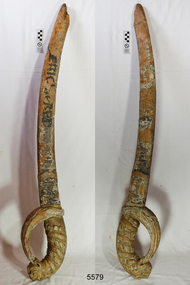 Flagstaff Hill Maritime Museum and Village
Decorative object - Sword, 1871 or earlier
... F. Lawrence second mate, Ned Sewall third mate and owner’s son, John French the cook, C. ...This wooden sword is said to “possibly be the only remaining part of the figurehead from the sailing ship Eric the Red.” It was previously part of the collection of the old Warrnambool Museum and the entry in its inventory says “Wooden sword, portion of the figurehead, held by “Eric the Red” at the bow.” A large part of the ship’s hull was found on the rocks and a figurehead may have been attached or washed up on the shore. The shipping records for E. & A. Sewall, the builders, owners and managers of Eric the Red, are now preserved in the Maine Maritime Museum. There is no photograph on record of Eric the Red but photographs of other ships built around that time by the same company show that these did not have figureheads, and there is no record found of a figurehead for Eric the Red being ordered or paid for. Further research is being carried out. The ship building company E. & A. Sewall, from Bath, Maine, USA, built Eric the Red, a wooden, three masted clipper ship. She had 1,580 tons register and was the largest full-rigged ship built at Bath, Maine, USA in 1871. She was built and registered by Arthur Sewall, later to become the partnership E. & A. Sewall, and was the 51st ship built by this company. The annually-published List of Merchant Vessels of the U.S. shows that Bath was still the home port of Eric the Red in 1880. The vessel was named after the Viking discoverer, Eric the Red, who was the first European to reach the shores of North America (in 980AD). The ship Eric the Red at first traded in coal between America and Britain, and later traded in guano nitrates from South America. In 1879 she was re-metalled and was in first class condition. On 10th June 1880 (some records say 12th June) Eric the Red departed New York for Melbourne and then Sydney. She had been commissioned by American trade representatives to carry a special cargo of 500 exhibits (1400 tons) - about a quarter to a third of America’s total exhibits - from America for the U.S.A. pavilion at Melbourne’s first International Exhibition. The exhibits included furniture, ironmongery, wines, chemicals, dental and surgical instruments, paper, cages, bronze lamp trimmings, axles, stamped ware, astronomical and time globes, samples of corn and the choicest of leaf tobacco. Other general cargo included merchandise such as cases of kerosene and turpentine, brooms, Bristol's Sarsaparilla, Wheeler and Wilson sewing machines, Wheeler’s thresher machine, axe handles and tools, cases of silver plate, toys, pianos and organs, carriages and Yankee notions. The Eric the Red left New York under the command of Captain Z. Allen (or some records say Captain Jacques Allen) and 24 other crew including the owner’s son third mate Ned Sewall. There were 2 saloon passengers also. On 4th September 1880 the ship had been sailing for an uneventful 85 days and the voyage was almost at its end. Eric the Red approached Cape Otway in a moderate north-west wind and hazy and overcast atmosphere. Around 1:30am Captain Allen sighted the Cape Otway light and was keeping the ship 5-6 miles offshore to stay clear of the hazardous Otway Reef. However he had badly misjudged his position. The ship hit the Otway Reef about 2 miles out to sea, south west of the Cape Otway light station. Captain Allen ordered the wheel to be put ‘hard up’ thinking that she might float off the reef. A heavy sea knocked the man away from the wheel, broke the wheel ropes and carried away the rudder. The sea swamped the lifeboats, the mizzenmast fell, with all of its rigging, then the mainmast fell and the ship broke in two. Some said that the passenger Vaughan, who was travelling for his health and not very strong, was washed overboard and never seen again. The ship started breaking up. The forward house came adrift with three of the crew on it as well as a longboat, which the men succeeded in launching and keeping afloat by continually bailing with their sea boots. The captain, the third mate (the owner’s son) and others clung to the mizzenmast in the sea. Then the owner’s son was washed away off the mast. Within 10 minutes the rest of the ship was in pieces, completely wrecked, with cargo and wreckage floating in the sea. The captain encouraged the second mate to swim with him to the deckhouse where there were other crew but the second mate wouldn’t go with him. Eventually the Captain made it to the deckhouse and the men pulled him up. At about 4:30am the group of men on the deckhouse saw the lights of a steamer and called for help. At the same time they noticed the second mate and the other man had drifted nearby, still on the spur, and pulled them both onto the wreck. The coastal steamer Dawn was returning to Warrnambool from Melbourne, its sailing time different to its usual schedule. Cries were heard coming from out of the darkness. Captain Jones sent out two life boats, and fired off rockets and blue lights to illuminate the area. They picked up the three survivors who were in the long boat from Eric the Red. Two men were picked up out of the water, one being the owner’s son who was clinging to floating kerosene boxes. At daylight the Dawn then rescued the 18 men from the floating portion of the deckhouse, which had drifted about 4 miles from where they’d struck the reef. Shortly after the rescue the deckhouse drifted onto breakers and was thrown onto rocks at Point Franklin, about 2 miles east of Cape Otway. Captain Jones had signalled to Cape Otway lighthouse the number of the Eric the Red and later signalled that there was a wreck at Otway Reef but there was no response from the lighthouse. The captain and crew of the Dawn spent several more hours searching unsuccessfully for more survivors, even going back as far as Apollo Bay. On board the Dawn the exhausted men received care and attention to their needs and wants, including much needed clothing. Captain Allen was amongst the 23 battered and injured men who were rescued and later taken to Warrnambool for care. Warrnambool’s mayor and town clerk offered them all hospitality, the three badly injured men going to the hospital and others to the Olive Branch Hotel, then on to Melbourne. Captain Allen’s leg injury prevented him from going ashore so he and three other men travelled on the Dawn to Portland. They were met by the mayor who also treated them all with great kindness. Captain Allen took the train back to Melbourne then returned to America. Those saved were Captain Z. Allen (or Jacques Allen), J. Darcy chief mate, James F. Lawrence second mate, Ned Sewall third mate and owner’s son, John French the cook, C. Nelson sail maker, Clarence W. New passenger, and the able seamen Dickenson, J. Black, Denis White, C. Herbert, C. Thompson, A. Brooks, D. Wilson, J. Ellis, Q. Thompson, C. Newman, W. Paul, J. Davis, M. Horenleng, J. Ogduff, T. W. Drew, R. Richardson. Four men had lost their lives; three of them were crew (Gus Dahlgreen ship’s carpenter, H. Ackman steward, who drowned in his cabin, and George Silver seaman) and one a passenger (J. B. Vaughan). The body of one of them had been found washed up at Cape Otway and was later buried in the lighthouse cemetery; another body was seen on an inaccessible ledge. Twelve months later the second mate James F. Lawrence, from Nova Scotia, passed away in the Warrnambool district; an obituary was displayed in the local paper. The captain and crew of the Dawn were recognised by the United States Government in July 1881 for their humane efforts and bravery, being thanked and presented with substantial monetary rewards, medals and gifts. Neither the ship, nor its cargo, was insured. The ship was worth about £15,000 and the cargo was reportedly worth £40,000; only about £2,000 worth had been recovered. Cargo and wreckage washed up at Apollo Bay, Peterborough, Port Campbell, Western Port and according to some reports, even as far away as the beaches of New Zealand. The day after the wreck the government steam ship Pharos was sent from Queenscliff to clear the shipping lanes of debris that could be a danger to ships. The large midship deckhouse of the ship was found floating in a calm sea near Henty Reef. Items such as an American chair, a ladder and a nest of boxes were all on top of the deckhouse. As it was so large and could cause danger to passing ships, Captain Payne had the deckhouse towed towards the shore just beyond Apollo Bay. Between Apollo Bay and Blanket Bay the captain and crew of Pharos collected Wheeler and Wilson sewing machines, nests of boxes, bottles of Bristol’s sarsaparilla, pieces of common American chairs, axe handles, a Wheelers’ Patent thresher and a sailor’s trunk with the words “A. James” on the front. A ship’s flag-board bearing the words “Eric the Red” was found on the deckhouse; finally those on board the Pharos had the name of the wrecked vessel. During this operation Pharos came across the government steamer Victoria and also a steamer S.S. Otway, both of which were picking up flotsam and wreckage. A whole side of the hull and three large pieces of the other side of the hull, with some of the copper sheathing stripped off, had floated on to Point Franklin. Some of the vessels yards and portions of her masts were on shore. The pieces of canvas attached to the yards and masts confirmed that the vessel had been under sail. The beach there was piled with debris several feet high. There were many cases of Diamond Oil kerosene, labelled R. W. Cameron and Company, New York. There were also many large planks of red pine, portions of a small white boat and a large, well-used oar. Other items found ashore included sewing machines (some consigned to ‘Long and Co.”) and notions, axe and scythe handles, hay forks, wooden pegs, rolls of wire (some branded “T.S” and Co, Melbourne”), kegs of nails branded “A.T. and Co.” from the factory of A. Field and Son, Taunton, Massachusetts, croquet balls and mallets, buggy fittings, rat traps, perfumery, cutlery and Douay Bibles, clocks, bicycles, chairs, a fly wheel, a cooking stove, timber, boxes, pianos, organs and a ladder. (Wooden clothes pegs drifted in for many years). There seemed to be no personal luggage or clothing. The Pharos encountered a long line, about one and a half miles, of floating wreckage about 10 miles off land, south east of Cape Otway, and in some places about 40 feet wide. It seemed that more than half of it was from Eric the Red. The ship’s crew rescued 3 cases that were for the Melbourne Exhibition and other items from amongst the debris. There were also chairs, doors, musical instruments, washing boards, nests of trunks and fly catchers floating in the sea. Most of the goods were saturated and smelt of kerosene. A section of the hull lies buried in the sand at Parker River Beach. An anchor with chain is embedded in the rocks east of Point Franklin and a second anchor, thought to be from Eric the Red, is on display at the Cape Otway light station. (There is a photograph of a life belt on the verandah of Rivernook Guest House in Princetown with the words “ERIC THE RED / BOSTON”. This is rather a mystery as the ship was registered in Bath, Maine, USA.) Parts of the ship are on display at Bimbi Park Caravan Park and at Apollo Bay Museum. Flagstaff Hill Maritime Village also has part of the helm (steering wheel), a carved wooden sword (said to be the only remaining portion of the ship’s figurehead; further research is currently being carried out), a door, a metal rod, samples of wood and a medal for bravery. Much of the wreckage was recovered by the local residents before police and other authorities arrived at the scene. Looters went to great effort to salvage goods, being lowered down the high cliff faces to areas with little or no beach to collect items from the wreckage, their mates above watching out for dangerous waves. A Tasmanian newspaper reports on a court case in Stawell, Victoria, noting a man who was caught 2 months later selling tobacco from the wreckage of Eric the Red. Some of the silverware is still treasured by descendants of Mr Mackenzie who was given these items by officials for his help in securing the cargo. The gifts included silver coffee and tea pots, half a dozen silver serviette rings and two sewing machines. The wreck and cargo were sold to a Melbourne man who salvaged a quantity of high quality tobacco and dental and surgical instruments. Timbers from the ship were salvaged and used in the construction of houses and sheds around Apollo Bay, including a guest house, Milford House (since burnt down in bushfires), which had furniture, fittings and timber on the dining room floor from the ship. A 39.7 foot long trading ketch, the Apollo, was also built from its timbers by Mr Burgess in 1883 and subsequently used in Tasmanian waters. It was the first attempt at ship building in Apollo bay. In 1881 a red light was installed about 300 feet above sea level at the base of the Cape Otway lighthouse to warn ships when they were too close to shore; It would not be visible unless a ship came within 3 miles from it. This has proved to be an effective warning. The State Library of Victoria has a lithograph in its collection depicting the steamer Dawn and the shipwrecked men, titled. "Wreck of the ship Eric the Red, Cape Otway: rescue of the crew by the Dawn". The Eric the Red is historically significant as one of Victoria's major 19th century shipwrecks. (Heritage Victoria Eric the Red; HV ID 239) The wreck led to the provision of an additional warning light placed below the Cape Otway lighthouse to alert mariners to the location of Otway Reef. The site is archaeologically significant for its remains of a large and varied cargo and ship's fittings being scattered over a wide area. The site is recreationally and aesthetically significant as it is one of the few sites along this coast where tourists can visit identifiable remains of a large wooden shipwreck, and for its location set against the background of Cape Otway, Bass Strait, and the Cape Otway lighthouse. (Victorian Heritage Database Registration Number S239, Official Number 8745 USA) This carved wooden sword, recovered from the Eric the Red, is possibly the only portion of the figurehead recovered after the wreck. There are spirals carved from the base of the handle to the top of the sword. The hilt of the sword is a lion’s head holding its tail in its mouth, the tail forming the handle. The blade of the sword has engraved patterns on it. Tiny particles of gold leaf and dark blue paint fragments can be seen between the carving marks. There are remnants of yellowish-orange and crimson paint on the handle. At some time after the sword was salvaged the name of the ship was hand painted on the blade in black paint. The tip of the sword has broken or split and the remaining part is charcoal in appearance. On both the tip and the base of the handle are parts made where the sword could have been joined onto the figurehead There is a white coating over some areas of the sword, similar to white lead putty used in traditional shipbuilding. The words “ERIC the RED” have been hand painted on the blade of the sword in black paint sometime after it was salvaged. flagstaff hill, flagstaff hill maritime museum and village, warrnambool, maritime museum, maritime village, great ocean road, shipwreck coast, sword, wooden sword, eric the red, carved sword, figurehead, snake head on sword -
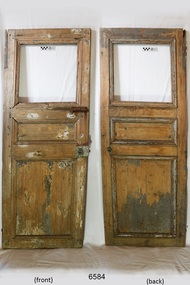 Flagstaff Hill Maritime Museum and Village
Furniture - Door, 1871 or earlier
... F. Lawrence second mate, Ned Sewall third mate and owner’s son, John French the cook, C. ...The wooden door was salvaged from the wreck of the sailing ship Eric the Red, which was a wooden, three masted clipper ship. Eric the Red was the largest full-rigged ship built at Bath, Maine, USA in 1871, having had a 1,580 tons register. She was built and registered by Arthur Sewall, later to become the partnership E. & A. Sewall, the 51st ship built by this company. The annually-published List of Merchant Vessels of the U.S. shows Bath was still the home port of Eric the Red in 1880. The vessel was named after the Viking discoverer, Eric the Red, who was the first European to reach the shores of North America (in 980AD). The ship Eric the Red at first traded in coal between America and Britain, and later traded in guano nitrates from South America. In 1879 she was re-metalled and was in first class condition. On 10th June 1880 (some records say 12th June) Eric the Red departed New York for Melbourne and then Sydney. She had been commissioned by American trade representatives to carry a special cargo of 500 exhibits (1400 tons) – about a quarter to a third of America’s total exhibits - from America for the U.S.A. pavilion at Melbourne’s first International Exhibition. The exhibits included furniture, ironmongery, wines, chemicals, dental and surgical instruments, paper, cages, bronze lamp trimmings, axles, stamped ware, astronomical and time globes, samples of corn and the choicest of leaf tobacco. Other general cargo included merchandise such as cases of kerosene and turpentine, brooms, Bristol's Sarsaparilla, Wheeler and Wilson sewing machines, Wheeler’s thresher machine, axe handles and tools, cases of silver plate, toys, pianos and organs, carriages and Yankee notions. The Eric the Red left New York under the command of Captain Z. Allen (or some records say Captain Jacques Allen) and 24 other crew including the owner’s son third mate Ned Sewall. There were 2 saloon passengers also. The ship had been sailing for an uneventful 85 days and the voyage was almost at its end. On 4th September 1880 the Eric the Red approached Cape Otway with a moderate north-west wind and hazy and overcast atmosphere. Around 1:30am Captain Allen sighted the Cape Otway light and was keeping the ship 5-6 miles offshore to stay clear of the hazardous Otway Reef. However he had badly misjudged his position. The ship hit the Otway Reef about 2 miles out to sea, south west of the Cape Otway light station. He ordered the wheel to be put ‘hard up’ thinking that she might float off the reef. A heavy sea knocked the man away from the wheel, broke the wheel ropes and carried away the rudder. The sea swamped the lifeboats. The mizzenmast fell, with all of its rigging, then the mainmast also fell and the ship broke in two. Some said that the passenger Vaughan, who was travelling for his health and not very strong, was washed overboard and never seen again. The ship started breaking up. The forward house came adrift with three of the crew on it as well as a longboat, which the men succeeded in launching and keeping afloat by continually bailing with their sea boots. The captain, the third mate (the owner’s son) and others clung to the mizzenmast in the sea. Then the owner’s son was washed away off the mast. Within 10 minutes the rest of the ship was in pieces, completely wrecked, with cargo and wreckage floating in the sea. The captain encouraged the second mate to swim with him to the deckhouse where there were other crew but the second mate wouldn’t go with him. Eventually the Captain made it to the deckhouse and the men pulled him up. At about 4:30am the group of men on the deckhouse saw the lights of a steamer and called for help. At the same time they noticed the second mate and the other man had drifted nearby, still on the spur, and pulled them both onto the wreck. The coastal steamer Dawn was returning to Warrnambool from Melbourne, its sailing time different to its usual schedule. Captain Jones sent out two life boats, and fired off rockets and blue lights to illuminate the area. They picked up the three survivors who were in the long boat from Eric the Red. Two men were picked up out of the water, one being the owner’s son who was clinging to floating kerosene boxes. At daylight the Dawn then rescued the 18 men from the floating portion of the deckhouse, which had drifted about 4 miles from where they’d struck the reef. Shortly after the rescue the deckhouse drifted onto breakers and was thrown onto rocks at Point Franklin, about 2 miles east of Cape Otway. Captain Jones had signalled to Cape Otway lighthouse the number of the Eric the Red and later signalled that there was a wreck at Otway Reef but there was no response from the lighthouse. The captain and crew of the Dawn spent several more hours searching unsuccessfully for more survivors, even going back as far as Apollo Bay. On board the Dawn the exhausted men received care and attention to their needs and wants, including much needed clothing. Captain Allen was amongst the 23 battered and injured men who were rescued and later taken to Warrnambool for care. Warrnambool’s mayor and town clerk offered them all hospitality, the three badly injured men going to the hospital for care and others to the Olive Branch Hotel, then on to Melbourne. Captain Allen’s leg injury prevented him from going ashore so he and three other men travelled on the Dawn to Portland. They were met by the mayor who also treated them all with great kindness. Captain Allen took the train back to Melbourne then returned to America. Those saved were Captain Z. Allen (or Jacques Allen), J. Darcy chief mate, James F. Lawrence second mate, Ned Sewall third mate and owner’s son, John French the cook, C. Nelson sail maker, Clarence W. New passenger, and the able seamen Dickenson, J. Black, Denis White, C. Herbert, C. Thompson, A. Brooks, D. Wilson, J. Ellis, Q. Thompson, C. Newman, W. Paul, J. Davis, M. Horenleng, J. Ogduff, T. W. Drew, R. Richardson. Four men had lost their lives; three of them were crew (Gus Dahlgreen ship’s carpenter, H. Ackman steward, who drowned in his cabin, and George Silver seaman) and one a passenger (J. B. Vaughan). The body of one of them had been found washed up at Cape Otway and was later buried in the lighthouse cemetery; another body was seen on an inaccessible ledge. Twelve months later the second mate James F. Lawrence, from Nova Scotia, passed away in the Warrnambool district; an obituary was displayed in the local paper. The captain and crew of the Dawn were recognised by the United States Government in July 1881 for their humane efforts, being thanked and presented with substantial monetary rewards, medals and gifts. Neither the ship, nor its cargo, was insured. The ship was worth about £15,000 and the cargo was reportedly worth £40,000; only about £2,000 worth had been recovered. Cargo and wreckage washed up at Apollo Bay, Peterborough, Port Campbell, Western Port and according to some reports, even as far away as the beaches of New Zealand. The day after the wreck the government steam ship Pharos was sent from Queenscliff to clear the shipping lanes of debris that could be a danger to ships. The large midship deckhouse of the ship was found floating in a calm sea near Henty Reef. Items such as an American chair, a ladder and a nest of boxes were all on top of the deckhouse. As it was so large and could cause danger to passing ships, Captain Payne had the deckhouse towed towards the shore just beyond Apollo Bay. Between Apollo Bay and Blanket Bay the captain and crew of Pharos collected Wheeler and Wilson sewing machines, nests of boxes, bottles of Bristol’s sarsaparilla, pieces of common American chairs, axe handles, a Wheelers’ Patent thresher and a sailor’s trunk with the words “A. James” on the front. A ship’s flag-board bearing the words “Eric the Red” was found on the deckhouse; finally those on board the Pharos had the name of the wrecked vessel. During this operation Pharos came across the government steamer Victoria and also a steamer S.S. Otway, both of which were picking up flotsam and wreckage. A whole side of the hull and three large pieces of the other side of the hull, with some of the copper sheathing stripped off, had floated on to Point Franklin. Some of the vessels yards and portions of her masts were on shore. The pieces of canvas attached to the yards and masts confirmed that the vessel had been under sail. The beach there was piled with debris several feet high. There were many cases of Diamond Oil kerosene, labelled R. W. Cameron and Company, New York. There were also many large planks of red pine, portions of a small white boat and a large, well-used oar. Other items found ashore included sewing machines (some consigned to ‘Long and Co.”) and notions, axe and scythe handles, hay forks, wooden pegs, rolls of wire (some branded “T.S” and Co, Melbourne”), kegs of nails branded “A.T. and Co.” from the factory of A. Field and Son, Taunton, Massachusetts, croquet balls and mallets, buggy fittings, rat traps, perfumery, cutlery and Douay Bibles, clocks, bicycles, chairs, a fly wheel, a cooking stove, timber, boxes, pianos, organs and a ladder. (Wooden clothes pegs drifted in for many years). There seemed to be no personal luggage or clothing. The Pharos encountered a long line, about one and a half miles, of floating wreckage about 10 miles off land, south east of Cape Otway, and in some places about 40 feet wide. It seemed that more than half of it was from Eric the Red. The ship’s crew rescued 3 cases that were for the Melbourne Exhibition and other items from amongst the debris. There were also chairs, doors, musical instruments, washing boards, nests of trunks and fly catchers floating in the sea. Most of the goods were saturated and smelt of kerosene. A section of the hull lies buried in the sand at Parker River Beach. An anchor with chain is embedded in the rocks east of Point Franklin and a second anchor, thought to be from Eric the Red, is on display at the Cape Otway light station. (There is a photograph of a life belt on the verandah of Rivernook Guest House in Princetown with the words “ERIC THE RED / BOSTON”. This is rather a mystery as the ship was registered in Bath, Maine, USA.) Parts of the ship are on display at Bimbi Park Caravan Park and at Apollo Bay Museum. Flagstaff Hill Maritime Village also has part of the helm (steering wheel), a carved wooden sword (said to be the only remaining portion of the ship’s figurehead; further research is currently being carried out), a door, a metal rod and samples of wood. Much of the wreckage was recovered by the local residents before police and other authorities arrived at the scene. Looters went to great effort to salvage goods, being lowered down the high cliff faces to areas with little or no beach to collect items from the wreckage, their mates above watching out for dangerous waves. A Tasmanian newspaper reports on a court case in Stawell, Victoria, noting a man who was caught 2 months later selling tobacco from the wreckage of Eric the Red. Some of the silverware is still treasured by descendants of Mr Mackenzie who was given these items by officials for his help in securing the cargo. The gifts included silver coffee and tea pots, half a dozen silver serviette rings and two sewing machines. The wreck and cargo were sold to a Melbourne man who salvaged a quantity of high quality tobacco and dental and surgical instruments. Timbers from the ship were salvaged and used in the construction of houses and sheds around Apollo Bay, including a guest house, Milford House (since burnt down in bushfires), which had furniture, fittings and timber on the dining room floor from the ship. A 39.7 foot long trading ketch, the Apollo, was also built from its timbers by Mr Burgess in 1883 and subsequently used in Tasmanian waters. It was the first attempt at ship building in Apollo bay. In 1881 a red light was installed about 300 feet above sea level at the base of the Cape Otway lighthouse to warn ships when they were too close to shore; It would not be visible unless a ship came within 3 miles from it. This has proved to be an effective warning. The State Library of Victoria has a lithograph in its collection depicting the steamer Dawn and the shipwrecked men, titled. "Wreck of the ship Eric the Red, Cape Otway: rescue of the crew by the Dawn". “The Eric the Red is historically significant as one of Victoria's major 19th century shipwrecks. (Heritage Victoria Eric the Red; HV ID 239) The wreck led to the provision of an additional warning light placed below the Cape Otway lighthouse to alert mariners to the location of Otway Reef. The site is archaeologically significant for its remains of a large and varied cargo and ship's fittings being scattered over a wide area. The site is recreationally and aesthetically significant as it is one of the few sites along this coast where tourists can visit identifiable remains of a large wooden shipwreck, and for its location set against the background of Cape Otway, Bass Strait, and the Cape Otway lighthouse.“ (Victorian Heritage Database Registration Number S239, Official Number 8745 USA) Door from the wreck of the ship Eric the Red. The wooden singular rectangular door includes three insert panel sections. The top section is square shaped and is missing its panel or glass. The centre timber panel is about a third of the height of the top panel and the bottom timber panel is approximately equal in height to the total height of the two upper panels. The door fastenings include both a metal door latch and traditional door bolt. They are both attached to the front right hand side of the door. The bolt is just below the top panel, and the door latch is in approximately the centre of that side. The door latch has a round mark where a handle could have been attached. The wood of the door has scraping marks in a semi-circle around the door latch where the latch has swung around on its one remaining fastening and grazed the surface. There is a metal hinge at the top section of the door on the opposite side to the latch. The painted surface has been scraped back to expose the wood. The door is shorter than the average height of a person. On the reverse of the door there are lines on the panels, just inside their edges, is what appears to be pencil. The door is not aligned straight but is skew to centre. warrnambool, flagstaff hill, flagstaff hill maritime village, maritime museum, shipwreck coast, great ocean road, shipwreck artefact, eric the red, jaques allen, sewall, 1880, melbourne exhibition 1880, cape otway, otway reef, victorian shipwreck, bass strait, eric-the-red, door -
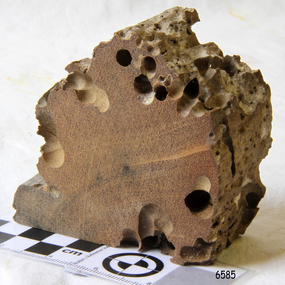 Flagstaff Hill Maritime Museum and Village
Wood Sample, about 1871
... F. Lawrence second mate, Ned Sewall third mate and owner’s son, John French the cook, C. ...This piece of timber from the ship Eric the Red has been eaten through by the marine animals called Teredo Worms, sometimes called sea worms or ‘termites of the sea’. The worms bore holes into wood that is immersed in sea water and bacteria inside the worms digest the wood. Shipbuilders tried to prevent this problem by using coatings of tar, wax, lead or pitch. In the 18th and 19th centuries the outside of their ships were sheathed in copper or a combination of copper and zinc (called Muntz metal) and would be re-metalled periodically to ensure the sheathing would remain effective. In more recent times the ships are protected with a toxic coating. The American ship Eric the Red was a wooden, three masted clipper ship. She had 1,580 tons register and was the largest full-rigged ship built at Bath, Maine, USA in 1871. She was built and registered by Arthur Sewall, later to become the partnership E. & A. Sewall, the 51st ship built by this company. The annually-published List of Merchant Vessels of the U.S. shows Bath was still the home port of Eric the Red in 1880. The vessel was named after the Viking discoverer, Eric ‘the Red-haired’ Thorvaldsson , who was the first European to reach the shores of North America (in 980AD). The ship Eric the Red at first traded in coal between America and Britain, and later traded in guano nitrates from South America. In 1879 she was re-metalled and was in first class condition. On 10th June 1880 (some records say 12th June) Eric the Red departed New York for Melbourne and then Sydney. She had been commissioned by American trade representatives to carry a special cargo of 500 exhibits (1400 tons) – about a quarter to a third of America’s total exhibits - for the U.S.A. pavilion at Melbourne’s first International Exhibition. The exhibits included furniture, ironmongery, wines, chemicals, dental and surgical instruments, paper, cages, bronze lamp trimmings, axles, stamped ware, astronomical and time globes, samples of corn and the choicest of leaf tobacco. Other general cargo included merchandise such as cases of kerosene and turpentine, brooms, Bristol's Sarsaparilla, Wheeler and Wilson sewing machines, Wheeler’s thresher machine, axe handles and tools, cases of silver plate, toys, pianos and organs, carriages and Yankee notions. The Eric the Red left New York under the command of Captain Zaccheus Allen (or some records say Captain Jacques Allen) and 24 other crew including the owner’s son third mate Ned Sewall. There were also 2 saloon passengers on board. The ship had been sailing for an uneventful 85 days and the voyage was almost at its end. As Eric the Red approached Cape Otway there was a moderate north-west wind and hazy and overcast atmosphere. On 4th September 1880 at about 1:30am Captain Allen sighted the Cape Otway light and was keeping the ship 5-6 miles offshore to stay clear of the hazardous Otway Reef. However he had badly misjudged his position. The ship hit the Otway Reef about 2 miles out to sea, south west of the Cape Otway light station. Captain Allen ordered the wheel to be put ‘hard up’ thinking that she might float off the reef. The sea knocked the helmsman away from the wheel, broke the wheel ropes and carried away the rudder. The lifeboats were swamped, the mizzenmast fell, with all of its rigging, then the mainmast also fell and the ship broke in two. Some said that the passenger Vaughan, who was travelling for his health and not very strong, was washed overboard and never seen again. The ship started breaking up. The forward house came adrift with three of the crew on it as well as a longboat, which the men succeeded in launching and keeping afloat by continually bailing with their sea boots. The captain, the third mate (the owner’s son) and others clung to the mizzenmast in the sea. Then the owner’s son was washed away off the mast. Within 10 minutes the rest of the ship was in pieces, completely wrecked, with cargo and wreckage floating in the sea. The captain encouraged the second mate to swim with him to the deckhouse where there were other crew but the second mate wouldn’t go with him. Eventually the Captain made it to the deckhouse and the men pulled him up. At about 4:30am the group of men on the deckhouse saw the lights of a steamer and called for help. At the same time they noticed the second mate and the other man had drifted nearby, still on the spur, and pulled them both onto the wreck. The coastal steamer SS Dawn was returning to Warrnambool from Melbourne, its sailing time different to its usual schedule. She was built in 1876 and bought by the Portland and Belfast Steam Navigation Co. in 1877. At the time of this journey she was commanded by Captain Jones, and was sailing between Melbourne and Portland via Warrnambool. The provedore of the Dawn, Benjamin Lear, heard cries of distress coming through the portholes of the saloon. He gave the alarm and the engines were stopped. Cries could be heard clearly, coming from the land. Captain Jones sent out crew in two boats, and fired off rockets and blue lights to illuminate the area. They picked up the three survivors who were in the long boat from Eric the Red. Two men were picked up out of the water, one being the owner’s son who was clinging to floating kerosene boxes. At daylight the Dawn then rescued the 18 men from the floating portion of the deckhouse, which had drifted about 4 miles from where they’d struck the reef. Shortly after the rescue the deckhouse drifted onto breakers and was thrown onto rocks at Point Franklin, about 2 miles east of Cape Otway. Captain Jones had signalled to Cape Otway lighthouse the number of the Eric the Red and later signalled that there was a wreck at Otway Reef but there was no response from the lighthouse. The captain and crew of the Dawn spent several more hours searching unsuccessfully for more survivors, even going back as far as Apollo Bay. On board the Dawn the exhausted men received care and attention to their needs and wants, including much needed clothing. Captain Allen was amongst the 23 battered and injured men who were rescued and later taken to Warrnambool for care. Warrnambool’s mayor and town clerk offered them all hospitality, the three badly injured men going to the hospital for care and others to the Olive Branch Hotel, then on to Melbourne. Captain Allen’s leg injury prevented him from going ashore so he and three other men travelled on the Dawn to Portland. They were met by the mayor who also treated them all with great kindness. Captain Allen took the train back to Melbourne then returned to America. Those saved were Captain Zaccheus Allen (or Jacques Allen), J. Darcy chief mate, James F. Lawrence second mate, Ned Sewall third mate and owner’s son, John French the cook, C. Nelson sail maker, Clarence W. New passenger, and the able seamen Dickenson, J. Black, Denis White, C. Herbert, C. Thompson, A. Brooks, D. Wilson, J. Ellis, Q. Thompson, C. Newman, W. Paul, J. Davis, M. Horenleng, J. Ogduff, T. W. Drew, R. Richardson. Four men had lost their lives; three of them were crew (Gus Dahlgreen ship’s carpenter, H. Ackman steward, who drowned in his cabin, and George Silver seaman) and one a passenger (J. B. Vaughan). The body of one of them had been found washed up at Cape Otway and was later buried in the lighthouse cemetery; another body was seen on an inaccessible ledge. Twelve months later the second mate James F. Lawrence, from Nova Scotia, passed away in the Warrnambool district; an obituary was displayed in the local paper. Neither the ship, nor its cargo, was insured. The ship was worth about £15,000 and the cargo was reportedly worth £40,000; only about £2,000 worth had been recovered. Cargo and wreckage washed up at Apollo Bay, Peterborough, Port Campbell, Western Port and according to some reports, even as far away as the beaches of New Zealand. The day after the wreck the government steam ship Pharos was sent from Queenscliff to clear the shipping lanes of debris that could be a danger to ships. The large midship deckhouse of the ship was found floating in a calm sea near Henty Reef. Items such as an American chair, a ladder and a nest of boxes were all on top of the deckhouse. As it was so large and could cause danger to passing ships, Captain Payne had the deckhouse towed towards the shore just beyond Apollo Bay. Between Apollo Bay and Blanket Bay the captain and crew of Pharos collected Wheeler and Wilson sewing machines, nests of boxes, bottles of Bristol’s sarsaparilla, pieces of common American chairs, axe handles, a Wheelers’ Patent thresher and a sailor’s trunk with the words “A. James” on the front. A ship’s flag-board bearing the words “Eric the Red” was found on the deckhouse; finally those on board the Pharos had the name of the wrecked vessel. During this operation Pharos came across the government steamer Victoria and also a steamer S.S. Otway, both of which were picking up flotsam and wreckage. A whole side of the hull and three large pieces of the other side of the hull, with some of the copper sheathing stripped off, had floated on to Point Franklin. Some of the vessels yards and portions of her masts were on shore. The pieces of canvas attached to the yards and masts confirmed that the vessel had been under sail. The beach there was piled with debris several feet high. There were many cases of Diamond Oil kerosene, labelled R. W. Cameron and Company, New York. There were also many large planks of red pine, portions of a small white boat and a large, well-used oar. Other items found ashore included sewing machines (some consigned to ‘Long and Co.”) and notions, axe and scythe handles, hay forks, wooden pegs, rolls of wire (some branded “T.S” and Co, Melbourne”), kegs of nails branded “A.T. and Co.” from the factory of A. Field and Son, Taunton, Massachusetts, croquet balls and mallets, buggy fittings, rat traps, perfumery, cutlery and Douay Bibles, clocks, bicycles, chairs, a fly wheel, a cooking stove, timber, boxes, pianos, organs and a ladder. (Wooden clothes pegs drifted in for many years). There seemed to be no personal luggage or clothing. The Pharos encountered a long line, about one and a half miles, of floating wreckage about 10 miles off land, south east of Cape Otway, and in some places about 40 feet wide. It seemed that more than half of it was from Eric the Red. The ship’s crew rescued 3 cases that were for the Melbourne Exhibition and other items from amongst the debris. There were also chairs, doors, musical instruments, washing boards, nests of trunks and fly catchers floating in the sea. Most of the goods were saturated and smelt of kerosene. A section of the hull lies buried in the sand at Parker River Beach. An anchor with chain is embedded in the rocks east of Point Franklin and a second anchor, thought to be from Eric the Red, is on display at the Cape Otway light station. (There is a photograph of a life belt on the verandah of Rivernook Guest House in Princetown with the words “ERIC THE RED / BOSTON”. This is rather a mystery as the ship was registered in Bath, Maine, USA.) Parts of the ship are on display at Bimbi Park Caravan Park and at Apollo Bay Museum. Flagstaff Hill Maritime Village also has part of the helm (steering wheel), a carved wooden sword (said to be the only remaining portion of the ship’s figurehead; further research is currently being carried out), a door, a metal rod, several samples of wood and a medal for bravery, awarded to Nelson Johnson, a crew member of the S.S. Dawn by the U.S. President, for the rescue of the crew. Much of the wreckage was recovered by the local residents before police and other authorities arrived at the scene. Looters went to great effort to salvage goods, being lowered down the high cliff faces to areas with little or no beach to collect items from the wreckage, their mates above watching out for dangerous waves. A Tasmanian newspaper reports on a court case in Stawell, Victoria, noting a man who was caught 2 months later selling tobacco from the wreckage of Eric the Red. Some of the silverware is still treasured by descendants of Mr Mackenzie who was given these items by officials for his help in securing the cargo. The gifts included silver coffee and tea pots, half a dozen silver serviette rings and two sewing machines. A Mr G.W. Black has in his possession a medal and a purse that were awarded to his father, another Dawn crew member who was part of the rescue team. The medal is inscribed and named “To John Black ….” (from “Shipwrecks” by Margaret E. Mackenzie, 3rd edition, published 1964). The wreck and cargo were sold to a Melbourne man who salvaged a quantity of high quality tobacco and dental and surgical instruments. Timbers from the ship were salvaged and used in the construction of houses and sheds around Apollo Bay, including a guest house, Milford House (since burnt down in bushfires), which had furniture, fittings and timber on the dining room floor from the ship. A 39.7 foot long trading ketch, the Apollo, was also built from its timbers by Mr Burgess in 1883 and subsequently used in Tasmanian waters. It was the first attempt at ship building in Apollo bay. In 1881 a red light was installed about 300 feet above sea level at the base of the Cape Otway lighthouse to warn ships when they were too close to shore; It would not be visible unless a ship came within 3 miles from it. This has proved to be an effective warning. Nelson Johnson, recipient of the medal for bravery, married Elizabeth Howard in 1881 and they had 10 children. They lived in South Melbourne, Victoria. Nelson died in 1922 in Fitzroy Victoria, age 66. In 1895 the owners of the S.S. Dawn, the Portland and Belfast Steam Navigation Co., wound up and sold out to the Belfast Company who took over the Dawn for one year before selling her to Howard Smith. She was condemned and sunk in Suva in 1928. The State Library of Victoria has a lithograph in its collection depicting the steamer Dawn and the shipwrecked men, titled. "Wreck of the ship Eric the Red, Cape Otway: rescue of the crew by the Dawn". The wood (timber) sample is listed on the Collections Australia Database, Heritage Victoria, number 239 00010 A “The Eric the Red is historically significant as one of Victoria's major 19th century shipwrecks. (Heritage Victoria Eric the Red; HV ID 239) The wreck led to the provision of an additional warning light placed below the Cape Otway lighthouse to alert mariners to the location of Otway Reef. The site is archaeologically significant for its remains of a large and varied cargo and ship's fittings being scattered over a wide area. The site is recreationally and aesthetically significant as it is one of the few sites along this coast where tourists can visit identifiable remains of a large wooden shipwreck, and for its location set against the background of Cape Otway, Bass Strait, and the Cape Otway lighthouse.“ (Victorian Heritage Database Registration Number S239, Official Number 8745 USA) Wood sample from the wreck of the ship Eric the Red. Triangular shaped, full of sea worm (Teredo worm) holes. The wood is dark in colour and is very light in weight. flagstaff hill, warrnambool, shipwrecked-coast, flagstaff-hill, flagstaff-hill-maritime-museum, maritime-museum, shipwreck-coast, flagstaff-hill-maritime-village, shipwreck-artefact, eric-the-red, zaccheus-allen, sewall, 1880, melbourne-exhibition, cape-otway, otway-reef, wood-sample, s.s.-dawn -
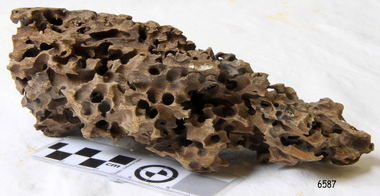 Flagstaff Hill Maritime Museum and Village
Wood Sample, About 1871
... F. Lawrence second mate, Ned Sewall third mate and owner’s son, John French the cook, C. ...This piece of timber from the ship Eric the Red has been eaten through by the marine animals called Teredo Worms, sometimes called sea worms or ‘termites of the sea’. The worms bore holes into wood that is immersed in sea water and bacteria inside the worms digest the wood. Shipbuilders tried to prevent this problem by using coatings of tar, wax, lead or pitch. In the 18th and 19th centuries the outside of their ships were sheathed in copper or a combination of copper and zinc (called Muntz metal) and would be re-metalled periodically to ensure the sheathing would remain effective. In more recent times the ships are protected with a toxic coating. The American ship Eric the Red was a wooden, three masted clipper ship. She had 1,580 tons register and was the largest full-rigged ship built at Bath, Maine, USA in 1871. She was built and registered by Arthur Sewall, later to become the partnership E. & A. Sewall, the 51st ship built by this company. The annually-published List of Merchant Vessels of the U.S. shows Bath was still the home port of Eric the Red in 1880. The vessel was named after the Viking discoverer, Eric ‘the Red-haired’ Thorvaldsson , who was the first European to reach the shores of North America (in 980AD). The ship Eric the Red at first traded in coal between America and Britain, and later traded in guano nitrates from South America. In 1879 she was re-metalled and was in first class condition. On 10th June 1880 (some records say 12th June) Eric the Red departed New York for Melbourne and then Sydney. She had been commissioned by American trade representatives to carry a special cargo of 500 exhibits (1400 tons) – about a quarter to a third of America’s total exhibits - for the U.S.A. pavilion at Melbourne’s first International Exhibition. The exhibits included furniture, ironmongery, wines, chemicals, dental and surgical instruments, paper, cages, bronze lamp trimmings, axles, stamped ware, astronomical and time globes, samples of corn and the choicest of leaf tobacco. Other general cargo included merchandise such as cases of kerosene and turpentine, brooms, Bristol's Sarsaparilla, Wheeler and Wilson sewing machines, Wheeler’s thresher machine, axe handles and tools, cases of silver plate, toys, pianos and organs, carriages and Yankee notions. The Eric the Red left New York under the command of Captain Zaccheus Allen (or some records say Captain Jacques Allen) and 24 other crew including the owner’s son third mate Ned Sewall. There were also 2 saloon passengers on board. The ship had been sailing for an uneventful 85 days and the voyage was almost at its end. As Eric the Red approached Cape Otway there was a moderate north-west wind and hazy and overcast atmosphere. On 4th September 1880 at about 1:30am Captain Allen sighted the Cape Otway light and was keeping the ship 5-6 miles offshore to stay clear of the hazardous Otway Reef. However he had badly misjudged his position. The ship hit the Otway Reef about 2 miles out to sea, south west of the Cape Otway light station. Captain Allen ordered the wheel to be put ‘hard up’ thinking that she might float off the reef. The sea knocked the helmsman away from the wheel, broke the wheel ropes and carried away the rudder. The lifeboats were swamped, the mizzenmast fell, with all of its rigging, then the mainmast also fell and the ship broke in two. Some said that the passenger Vaughan, who was travelling for his health and not very strong, was washed overboard and never seen again. The ship started breaking up. The forward house came adrift with three of the crew on it as well as a longboat, which the men succeeded in launching and keeping afloat by continually bailing with their sea boots. The captain, the third mate (the owner’s son) and others clung to the mizzenmast in the sea. Then the owner’s son was washed away off the mast. Within 10 minutes the rest of the ship was in pieces, completely wrecked, with cargo and wreckage floating in the sea. The captain encouraged the second mate to swim with him to the deckhouse where there were other crew but the second mate wouldn’t go with him. Eventually the Captain made it to the deckhouse and the men pulled him up. At about 4:30am the group of men on the deckhouse saw the lights of a steamer and called for help. At the same time they noticed the second mate and the other man had drifted nearby, still on the spur, and pulled them both onto the wreck. The coastal steamer SS Dawn was returning to Warrnambool from Melbourne, its sailing time different to its usual schedule. She was built in 1876 and bought by the Portland and Belfast Steam Navigation Co. in 1877. At the time of this journey she was commanded by Captain Jones, and was sailing between Melbourne and Portland via Warrnambool. The provedore of the Dawn, Benjamin Lear, heard cries of distress coming through the portholes of the saloon. He gave the alarm and the engines were stopped. Cries could be heard clearly, coming from the land. Captain Jones sent out crew in two boats, and fired off rockets and blue lights to illuminate the area. They picked up the three survivors who were in the long boat from Eric the Red. Two men were picked up out of the water, one being the owner’s son who was clinging to floating kerosene boxes. At daylight the Dawn then rescued the 18 men from the floating portion of the deckhouse, which had drifted about 4 miles from where they’d struck the reef. Shortly after the rescue the deckhouse drifted onto breakers and was thrown onto rocks at Point Franklin, about 2 miles east of Cape Otway. Captain Jones had signalled to Cape Otway lighthouse the number of the Eric the Red and later signalled that there was a wreck at Otway Reef but there was no response from the lighthouse. The captain and crew of the Dawn spent several more hours searching unsuccessfully for more survivors, even going back as far as Apollo Bay. On board the Dawn the exhausted men received care and attention to their needs and wants, including much needed clothing. Captain Allen was amongst the 23 battered and injured men who were rescued and later taken to Warrnambool for care. Warrnambool’s mayor and town clerk offered them all hospitality, the three badly injured men going to the hospital for care and others to the Olive Branch Hotel, then on to Melbourne. Captain Allen’s leg injury prevented him from going ashore so he and three other men travelled on the Dawn to Portland. They were met by the mayor who also treated them all with great kindness. Captain Allen took the train back to Melbourne then returned to America. Those saved were Captain Zaccheus Allen (or Jacques Allen), J. Darcy chief mate, James F. Lawrence second mate, Ned Sewall third mate and owner’s son, John French the cook, C. Nelson sail maker, Clarence W. New passenger, and the able seamen Dickenson, J. Black, Denis White, C. Herbert, C. Thompson, A. Brooks, D. Wilson, J. Ellis, Q. Thompson, C. Newman, W. Paul, J. Davis, M. Horenleng, J. Ogduff, T. W. Drew, R. Richardson. Four men had lost their lives; three of them were crew (Gus Dahlgreen ship’s carpenter, H. Ackman steward, who drowned in his cabin, and George Silver seaman) and one a passenger (J. B. Vaughan). The body of one of them had been found washed up at Cape Otway and was later buried in the lighthouse cemetery; another body was seen on an inaccessible ledge. Twelve months later the second mate James F. Lawrence, from Nova Scotia, passed away in the Warrnambool district; an obituary was displayed in the local paper. Neither the ship, nor its cargo, was insured. The ship was worth about £15,000 and the cargo was reportedly worth £40,000; only about £2,000 worth had been recovered. Cargo and wreckage washed up at Apollo Bay, Peterborough, Port Campbell, Western Port and according to some reports, even as far away as the beaches of New Zealand. The day after the wreck the government steam ship Pharos was sent from Queenscliff to clear the shipping lanes of debris that could be a danger to ships. The large midship deckhouse of the ship was found floating in a calm sea near Henty Reef. Items such as an American chair, a ladder and a nest of boxes were all on top of the deckhouse. As it was so large and could cause danger to passing ships, Captain Payne had the deckhouse towed towards the shore just beyond Apollo Bay. Between Apollo Bay and Blanket Bay the captain and crew of Pharos collected Wheeler and Wilson sewing machines, nests of boxes, bottles of Bristol’s sarsaparilla, pieces of common American chairs, axe handles, a Wheelers’ Patent thresher and a sailor’s trunk with the words “A. James” on the front. A ship’s flag-board bearing the words “Eric the Red” was found on the deckhouse; finally those on board the Pharos had the name of the wrecked vessel. During this operation Pharos came across the government steamer Victoria and also a steamer S.S. Otway, both of which were picking up flotsam and wreckage. A whole side of the hull and three large pieces of the other side of the hull, with some of the copper sheathing stripped off, had floated on to Point Franklin. Some of the vessels yards and portions of her masts were on shore. The pieces of canvas attached to the yards and masts confirmed that the vessel had been under sail. The beach there was piled with debris several feet high. There were many cases of Diamond Oil kerosene, labelled R. W. Cameron and Company, New York. There were also many large planks of red pine, portions of a small white boat and a large, well-used oar. Other items found ashore included sewing machines (some consigned to ‘Long and Co.”) and notions, axe and scythe handles, hay forks, wooden pegs, rolls of wire (some branded “T.S” and Co, Melbourne”), kegs of nails branded “A.T. and Co.” from the factory of A. Field and Son, Taunton, Massachusetts, croquet balls and mallets, buggy fittings, rat traps, perfumery, cutlery and Douay Bibles, clocks, bicycles, chairs, a fly wheel, a cooking stove, timber, boxes, pianos, organs and a ladder. (Wooden clothes pegs drifted in for many years). There seemed to be no personal luggage or clothing. The Pharos encountered a long line, about one and a half miles, of floating wreckage about 10 miles off land, south east of Cape Otway, and in some places about 40 feet wide. It seemed that more than half of it was from Eric the Red. The ship’s crew rescued 3 cases that were for the Melbourne Exhibition and other items from amongst the debris. There were also chairs, doors, musical instruments, washing boards, nests of trunks and fly catchers floating in the sea. Most of the goods were saturated and smelt of kerosene. A section of the hull lies buried in the sand at Parker River Beach. An anchor with chain is embedded in the rocks east of Point Franklin and a second anchor, thought to be from Eric the Red, is on display at the Cape Otway light station. (There is a photograph of a life belt on the verandah of Rivernook Guest House in Princetown with the words “ERIC THE RED / BOSTON”. This is rather a mystery as the ship was registered in Bath, Maine, USA.) Parts of the ship are on display at Bimbi Park Caravan Park and at Apollo Bay Museum. Flagstaff Hill Maritime Village also has part of the helm (steering wheel), a carved wooden sword (said to be the only remaining portion of the ship’s figurehead; further research is currently being carried out), a door, a metal rod, several samples of wood and a medal for bravery, awarded to Nelson Johnson, a crew member of the S.S. Dawn by the U.S. President, for the rescue of the crew. Much of the wreckage was recovered by the local residents before police and other authorities arrived at the scene. Looters went to great effort to salvage goods, being lowered down the high cliff faces to areas with little or no beach to collect items from the wreckage, their mates above watching out for dangerous waves. A Tasmanian newspaper reports on a court case in Stawell, Victoria, noting a man who was caught 2 months later selling tobacco from the wreckage of Eric the Red. Some of the silverware is still treasured by descendants of Mr Mackenzie who was given these items by officials for his help in securing the cargo. The gifts included silver coffee and tea pots, half a dozen silver serviette rings and two sewing machines. A Mr G.W. Black has in his possession a medal and a purse that were awarded to his father, another Dawn crew member who was part of the rescue team. The medal is inscribed and named “To John Black ….” (from “Shipwrecks” by Margaret E. Mackenzie, 3rd edition, published 1964). The wreck and cargo were sold to a Melbourne man who salvaged a quantity of high quality tobacco and dental and surgical instruments. Timbers from the ship were salvaged and used in the construction of houses and sheds around Apollo Bay, including a guest house, Milford House (since burnt down in bushfires), which had furniture, fittings and timber on the dining room floor from the ship. A 39.7 foot long trading ketch, the Apollo, was also built from its timbers by Mr Burgess in 1883 and subsequently used in Tasmanian waters. It was the first attempt at ship building in Apollo bay. In 1881 a red light was installed about 300 feet above sea level at the base of the Cape Otway lighthouse to warn ships when they were too close to shore; It would not be visible unless a ship came within 3 miles from it. This has proved to be an effective warning. Nelson Johnson, recipient of the medal for bravery, married Elizabeth Howard in 1881 and they had 10 children. They lived in South Melbourne, Victoria. Nelson died in 1922 in Fitzroy Victoria, age 66. In 1895 the owners of the S.S. Dawn, the Portland and Belfast Steam Navigation Co., wound up and sold out to the Belfast Company who took over the Dawn for one year before selling her to Howard Smith. She was condemned and sunk in Suva in 1928. The State Library of Victoria has a lithograph in its collection depicting the steamer Dawn and the shipwrecked men, titled. "Wreck of the ship Eric the Red, Cape Otway: rescue of the crew by the Dawn". The wood (timber) sample is listed on the Collections Australia Database, Heritage Victoria, number 239 00010 A “The Eric the Red is historically significant as one of Victoria's major 19th century shipwrecks. (Heritage Victoria Eric the Red; HV ID 239) The wreck led to the provision of an additional warning light placed below the Cape Otway lighthouse to alert mariners to the location of Otway Reef. The site is archaeologically significant for its remains of a large and varied cargo and ship's fittings being scattered over a wide area. The site is recreationally and aesthetically significant as it is one of the few sites along this coast where tourists can visit identifiable remains of a large wooden shipwreck, and for its location set against the background of Cape Otway, Bass Strait, and the Cape Otway lighthouse.“ (Victorian Heritage Database Registration Number S239, Official Number 8745 USA) Wood sample from the wreck of the ship Eric the Red. Oblong shaped, full of sea worm (Teredo worm) holes. The wood is dark in colour and is very light in weight. flagstaff hill, warrnambool, shipwrecked-coast, flagstaff-hill, flagstaff-hill-maritime-museum, maritime-museum, shipwreck-coast, flagstaff-hill-maritime-village, shipwreck-artefact, eric-the-red, zaccheus-allen, sewall, 1880, melbourne-exhibition, cape-otway, otway-reef, wood-sample, s.s.-dawn -
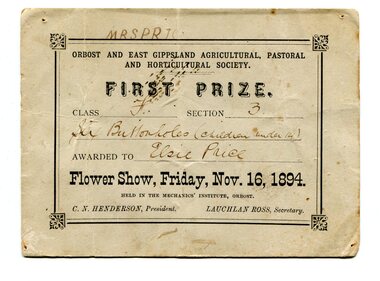 Orbost & District Historical Society
certificate/award, 1894
... First Prize in Class F Section C was awarded to Elsie Price for "six buttonholes (children under 14)". ...Orbost and East Gippsland Agricultural, Pastoral & Horticultural Society held their annual show in the Mechanics' Institute hall in Orrbost on November 16, 1894. First Prize in Class F Section C was awarded to Elsie Price for "six buttonholes (children under 14)". At this time C.N. Henderson was President and Lauchlan Ross was Secretary. The first meeting to form an Agricultural society in Orbost was convened by the then Orbost Progress Association and held in the Mechanics Hall on Saturday, 10th October 1891. Its first show was held on 3rd March 1904, on a site alongside the Bonang Road where the present Golf Club stands. It is currently held at the Recreation Reserve at Newmerella. Ref: In Times Gone By-Deborah Hall Prior to the Orbost Agricultural Society 's Annual Show these smaller shows were held in the Mechanics' Institute hall. Elsie Price, 1886-1897, was the daughter of David J and Mary Faithfull. This item is associated with the Orbost Agricultural Society 's Annual Show which has been a major event in Orbost for over a century. A original rectangular white paper certificate. Text is inside a border- all print is black. Details are handwritten. On back - many names. On front -"Mrs Price" award agricultural-show public-event -
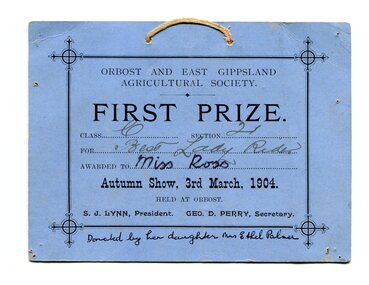 Orbost & District Historical Society
certificate/award, 1904
... C Section 21 fot Best Lady Ridrer was awarded to Miss Ross. Orbost and East Gippsland Agricultural, Pastoral & Horticultural Society held their annual show in the Mechanics' Institute hall in Orrbost on November 16, 1894. First Prize in Class F ...Orbost & East Gippsland Agricultural Society held an Autumn Show on 3rd March, 1904. First Prize in Class C Section 21 fot Best Lady Ridrer was awarded to Miss Ross. Orbost and East Gippsland Agricultural, Pastoral & Horticultural Society held their annual show in the Mechanics' Institute hall in Orrbost on November 16, 1894. First Prize in Class F Section C was awarded to Elsie Price for "six buttonholes (children under 14)". At this time C.N. Henderson was President and Lauchlan Ross was Secretary. The first meeting to form an Agricultural society in Orbost was convened by the then Orbost Progress Association and held in the Mechanics Hall on Saturday, 10th October 1891. Its first show was held on 3rd March 1904, on a site alongside the Bonang Road where the present Golf Club stands. It is currently held at the Recreation Reserve at Newmerella. Ref: In Times Gone By-Deborah Hall Prior to the Orbost Agricultural Society 's Annual Show these smaller shows were held in the Mechanics' Institute hall. This item is associated with the Orbost Agricultural Society 's Annual Show which has been a major event in Orbost for over a century. A rectangular, blue card certificate with yellow cord threaded through two small holes at the top centre. Text is black inside a frame. Details of the award are hand-written. On front - "Donated by her daughter Mrs Ethel Palmer"
